
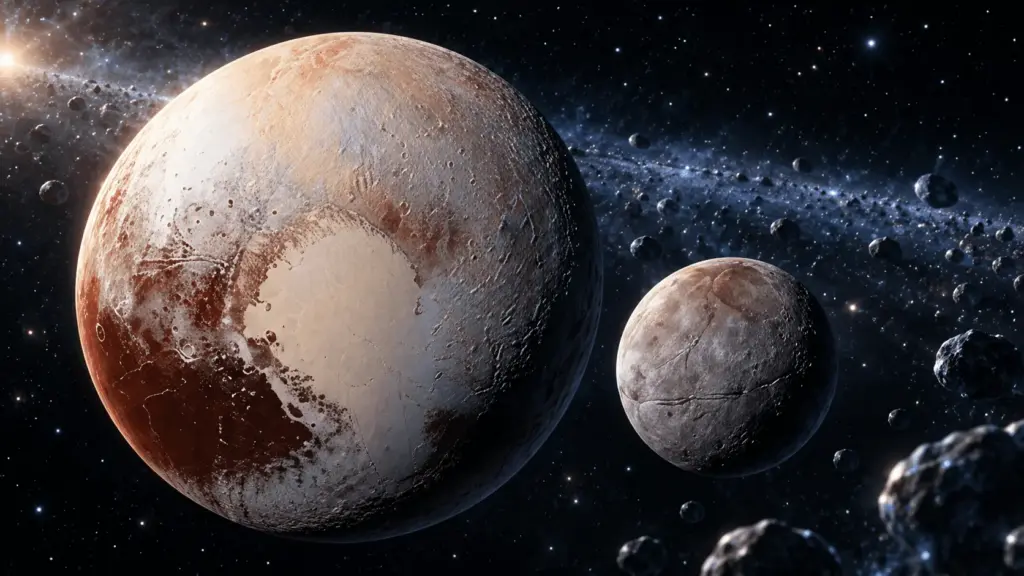
For 76 years, schoolchildren learned a Solar System with nine planets: Mercury, Venus, Earth, Mars, Jupiter, Saturn, Uranus, Neptune, and Pluto. Then, in 2006, Pluto’s official classification changed. It did not disappear, shrink, or suddenly become scientifically less important. Instead, astronomers adopted a more explicit definition of what counts as a planet, and Pluto did not satisfy one crucial requirement.
The International Astronomical Union, or IAU, defines a planet in our Solar System as a celestial body that orbits the Sun, has enough mass for its own gravity to make it nearly round, and has “cleared the neighbourhood around its orbit.” Pluto meets the first two conditions but not the third. Under the same resolution, an object that meets the first two conditions, has not cleared its orbital neighborhood, and is not a satellite is classified as a dwarf planet. [1]
That distinction is essential because many frequently repeated explanations for Pluto’s reclassification are incomplete. Pluto was not rejected simply because it is small, icy, distant, tilted, or on an eccentric orbit. Those characteristics help explain Pluto’s history and dynamical environment, but none is independently a disqualifying condition in the IAU definition. [1][3]
The three IAU requirements for a planet
| Requirement | Pluto | Result |
|---|---|---|
| Orbits the Sun | Yes | Pass |
| Massive enough to become nearly round through self-gravity | Yes | Pass |
| Has cleared the neighborhood around its orbit | No | Fail |
| Not a satellite, required for dwarf-planet status | Yes | Dwarf planet |
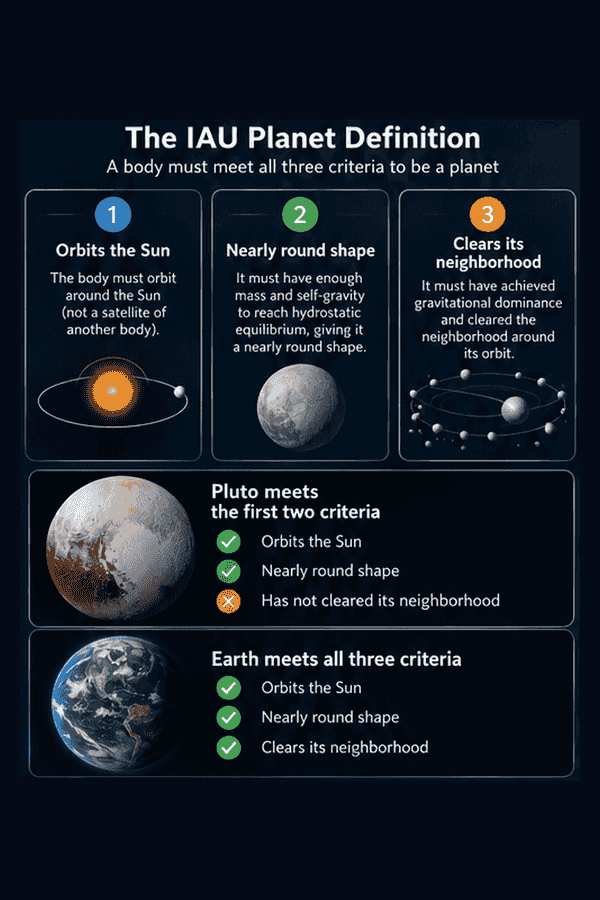
The third requirement is therefore the decisive one. The remaining reasons in this article explain why Pluto fails that dynamical test, why astronomers recognized the problem only after decades of new discoveries, and why Pluto remains one of the most scientifically interesting worlds in the Solar System despite its classification. [1]
Reason 1: Pluto Has Not Cleared Its Orbital Neighborhood
This is the most important reason Pluto is not classified as one of the eight major planets. The wording comes directly from the IAU’s 2006 planet definition. Pluto has enough gravity to make itself round and clearly orbits the Sun, but it has not become overwhelmingly dominant over the other objects occupying its orbital region. Instead, it remains part of a large trans-Neptunian population containing enormous numbers of icy bodies. [1][4]
What does “clearing the neighborhood” actually mean?
“Cleared the neighborhood” does not mean that a planet must travel through completely empty space. Earth still encounters near-Earth asteroids, Jupiter has Trojan asteroids sharing its orbit, and other planets interact with comets and small bodies. A perfectly empty orbit is neither required nor realistically possible.
The scientific concept is dynamical dominance. Over the history of a planetary system, a sufficiently massive body can accrete nearby material, scatter smaller objects into different orbits, eject them, capture them, or force them into stable resonances. The planet becomes gravitationally dominant compared with other substantial bodies occupying the same orbital zone. [5][6]
Why Pluto fails this test
Pluto never became the dominant body of the trans-Neptunian region. Instead, it remains one member of a huge reservoir of icy planetesimals and dwarf-planet-scale objects.
The difference between Pluto and the eight planets is not subtle when dynamical dominance is quantified. Steven Soter’s work identified a gap of roughly four to five orders of magnitude between the major planets and populations such as asteroids and Kuiper Belt objects. Jean-Luc Margot later proposed a quantitative orbit-clearing criterion based on body mass, stellar mass, orbital distance, and the time available for clearing. [5][6]
Orbital clearing takes time
Planet formation is not instantaneous. A large object gradually alters its surroundings through repeated gravitational encounters. Scientists can therefore discuss an orbital clearing timescale, meaning the period required for a body’s gravity to reorganize material in its orbital zone.
Margot’s mathematical treatment asks whether a body has enough mass to clear a specified orbital region during an appropriate timescale. All eight Solar System planets comfortably pass the proposed test. Pluto, Ceres, and Eris fall far below its threshold. [5]
Reason 2: Pluto Shares Its Orbital Zone With Many Other Bodies
A useful way to picture Pluto’s situation is a crowded highway. Pluto travels around the Sun in a region populated by numerous other objects rather than commanding a relatively isolated gravitational lane. The analogy is imperfect, because objects in the Kuiper Belt occupy different three-dimensional orbits, but it illustrates why Pluto’s orbital environment differs fundamentally from that of a dynamically dominant planet. [4]
Pluto is not alone in its region
Pluto belongs to the enormous population beyond Neptune known broadly as trans-Neptunian objects. NASA estimates that the Kuiper Belt may contain hundreds of thousands of bodies more than about 100 kilometers across, while millions of smaller icy objects may exist there. More than 2,000 trans-Neptunian objects had already been cataloged in NASA’s referenced overview, and ongoing surveys continue expanding the known population. [4]
Pluto is therefore not an isolated world occupying an otherwise evacuated zone. It inhabits a broad reservoir of leftover material from the early Solar System.
Why sharing an orbital region matters
Merely sharing space does not automatically prevent planethood. Jupiter shares its orbital neighborhood with Trojan asteroids, for example. What matters is the mass hierarchy and gravitational relationship between the dominant body and everything else around it.
The major planets are overwhelmingly dominant within their zones. Pluto is not. Its existence alongside numerous dynamically important Kuiper Belt bodies is therefore evidence of its limited gravitational dominance rather than an independent fourth rule added to the IAU definition. [5][6]
Reason 3: Pluto Is Part of the Kuiper Belt
Pluto is best understood not simply as a tiny outer planet, but as one of the largest known members of a much broader population of icy worlds beyond Neptune. When Pluto was discovered in 1930, astronomers had not yet identified this population. Modern observations completely changed that context. Pluto is now recognized as both a Kuiper Belt object, or KBO, and a trans-Neptunian object, or TNO. [4]
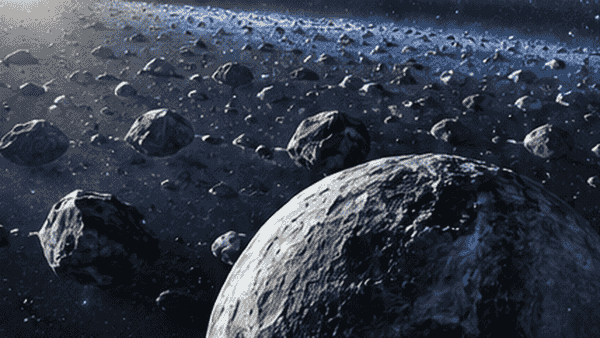
What is the Kuiper Belt?
The Kuiper Belt is a vast, thick disk or doughnut-shaped region of icy bodies beginning near Neptune’s orbit at roughly 30 astronomical units from the Sun. Its main region extends to approximately 50 AU, while dynamically related populations extend considerably farther.
The objects contain mixtures of rock, water ice, and frozen volatile compounds such as methane and ammonia. NASA describes the Kuiper Belt as a reservoir of material left from the Solar System’s early history. [4]
Pluto is one member of a much larger population
Pluto was the first object discovered that we now recognize as belonging to the Kuiper Belt, although astronomers did not know that in 1930. The observational breakthrough came decades later. Beginning in the 1990s, astronomers detected growing numbers of distant icy objects beyond Neptune.
Today, Pluto looks less like an isolated exception and more like the largest known member of a recognizable dynamical family. NASA even describes Pluto as the “King of the Kuiper Belt.” [4]
Classical Kuiper Belt, scattered disk, and resonant objects
The trans-Neptunian region contains several dynamically distinct populations. Classical Kuiper Belt objects occupy comparatively stable, non-resonant orbits. Scattered-disk objects, including Eris, tend to have more elongated and dynamically excited orbits shaped strongly by Neptune. Other objects occupy orbital resonances with Neptune.
Pluto belongs to the resonant population. Specifically, it is in a 3:2 mean-motion resonance with Neptune. Objects sharing this resonance are called plutinos. [4][10]
Pluto’s Kuiper Belt membership is not, by itself, an IAU disqualifier. Instead, it helps explain why Pluto has never cleared its orbital neighborhood.
Reason 4: Pluto Has Low Gravitational and Dynamical Dominance
Planetary classification is not only about whether an object is spherical. Gravity must also be considered at a larger scale. Pluto’s gravity is strong enough to pull its own material toward a nearly spherical shape, but it is not strong enough to make Pluto the dominant body throughout its much larger orbital environment.
This distinction between self-gravity and orbital dominance is one of the most important concepts for understanding the Pluto debate.
Why mass matters
Pluto has a mass of roughly 0.0022 Earth masses. That is sufficient to produce a round planetary body, but it is tiny compared with Earth, Neptune, or Jupiter.
Mass affects how strongly an object can gravitationally scatter planetesimals and restructure surrounding orbits. Distance from the Sun matters too. A body very far from its star generally requires more mass and more time to dominate a broad orbital region than an equivalent body orbiting much closer. [5][7]
Measuring planetary dominance
Several scientists have developed ways to quantify this concept.
The Stern-Levison parameter examines a body’s theoretical ability to scatter other objects from its orbital region. Steven Soter developed a related planetary discriminant comparing the mass of a body with the total mass of other objects sharing its orbital zone. Jean-Luc Margot proposed another metric, usually represented by the Greek letter Π, that estimates whether an object has sufficient mass to clear its orbital zone within an appropriate timescale. [5][6]
These metrics are not identical to the wording of the IAU resolution, but they illustrate the physical distinction that the phrase “cleared the neighbourhood” attempts to capture.
Pluto’s dynamical dominance is extremely low
Using Margot’s criterion, an object qualifies dynamically when Π is greater than or equal to 1. The eight major planets are comfortably above that line.
| Body | Margot planet discriminant Π |
|---|---|
| Jupiter | 40,000 |
| Saturn | 6,100 |
| Venus | 950 |
| Earth | 810 |
| Uranus | 420 |
| Neptune | 300 |
| Mercury | 130 |
| Mars | 54 |
| Pluto | 0.028 |
| Ceres | 0.040 |
| Eris | 0.020 |
The smallest planetary value in this analysis, Mars at 54, is still enormously above Pluto’s 0.028. That sharp gap demonstrates why dynamical scientists see a natural distinction between the eight major planets and dwarf planets. [5]
Graph: dynamical separation between planets and Pluto
Margot Π criterion, logarithmic comparison
Margot Π criterion, logarithmic comparison
The bars are illustrative because the actual numerical range spans more than six orders of magnitude. The important point is the large gap, not the visual length of an individual bar.
Reason 5: Pluto Is Extremely Small Compared With the Major Planets
Pluto is tiny compared with every one of the eight planets. Its diameter is about 2,377 kilometers, compared with approximately 3,474 kilometers for Earth’s Moon. Pluto is therefore only about two-thirds as wide as the Moon. Its mass is also only a small fraction of the Moon’s. [2][7]
That size difference is striking, but size must be interpreted carefully.
Pluto is smaller than Earth’s Moon
Pluto’s diameter makes it considerably smaller than Mercury, the smallest of the eight planets. It is also smaller than several major moons, including Earth’s Moon, Ganymede, Titan, Callisto, Io, Europa, and Triton.
Its low mass helps explain why Pluto has relatively weak control over the surrounding Kuiper Belt. It does not, however, mean that Pluto lacks sufficient gravity to behave like a planetary body internally.
Size alone did not disqualify Pluto
There is no minimum planetary diameter written into the IAU’s 2006 definition. A world is required to have enough mass for its self-gravity to overcome rigid-body forces and produce a nearly round equilibrium shape.
Pluto passes that criterion easily. Its nearly spherical shape demonstrates that gravity has become a major force controlling its global structure. This is one reason scientists still describe Pluto as a planetary world even while classifying it officially as a dwarf planet. [1][2]
Therefore, saying “Pluto is not a planet because it is too small” is scientifically misleading.
Minor planets, asteroids, comets, and dwarf planets are different concepts
Several labels appear in discussions about small Solar System bodies, but they should not be treated as synonyms.
An asteroid is generally a rocky or metallic small body, particularly one associated with populations such as the asteroid belt. A comet contains volatile material that can produce a coma or tail when heated. Small Solar System body is the IAU’s broad category for many objects that are neither planets nor dwarf planets nor satellites.
A dwarf planet, by contrast, must be sufficiently massive to become nearly round. [1]
Reason 6: Pluto Resembles Other Kuiper Belt and Dwarf-Planet Objects
One of the most important developments in Pluto’s history was not a discovery made on Pluto at all. It was the discovery of other distant, large worlds.
For much of the twentieth century, Pluto seemed unique. Once astronomers started finding a broader population of Pluto-like objects beyond Neptune, maintaining a category containing eight conventional planets plus Pluto became increasingly difficult to justify scientifically. [3]
Eris changed the classification debate
The object later named Eris was discovered in data collected in 2003 and announced in 2005. Early measurements suggested it rivaled or exceeded Pluto in size, while later work established that Eris is slightly smaller in diameter but more massive than Pluto.
Its discovery made the classification problem unavoidable. If Pluto was a planet, why should Eris not also be a planet? And if Eris qualified, what should astronomers do as more similar worlds were discovered? [8][9]
The issue helped trigger the formal planet debate that culminated in the 2006 IAU resolution.
Other Pluto-like worlds
The IAU and NASA recognize five official dwarf planets in current Solar System nomenclature:
| Dwarf planet | General region | Key distinction |
|---|---|---|
| Ceres | Main asteroid belt | Only recognized dwarf planet in inner Solar System |
| Pluto | Kuiper Belt | Largest known Kuiper Belt object by diameter |
| Eris | Scattered disk | More massive than Pluto |
| Haumea | Kuiper Belt | Rapidly rotating and highly elongated |
| Makemake | Kuiper Belt | Large, bright trans-Neptunian dwarf planet |
Other distant worlds may eventually qualify depending on their shapes and improved physical measurements. NASA notes that many additional dwarf-planet candidates probably exist. [3][4]
The larger classification problem
Astronomers faced two basic possibilities. They could broaden “planet” to include Pluto and potentially many comparable worlds, or establish a taxonomic boundary that distinguished gravitationally dominant planets from smaller planetary-mass bodies embedded within larger populations.
The IAU chose the second approach.
This is why the Pluto controversy is fundamentally a question of Solar System taxonomy, not a judgment about whether Pluto is interesting, complex, or worthy of exploration.
Reason 7: Pluto Has a Highly Eccentric and Inclined Orbit
Compared with the eight major planets, Pluto follows an unusual path around the Sun. Its orbit is significantly more elongated and more strongly tilted relative to the main planetary plane.
These characteristics were recognized long before Pluto’s reclassification and were among the clues that Pluto differed dynamically from the major planets. However, neither orbital eccentricity nor orbital inclination appears as a formal disqualifying criterion in the IAU planet definition. [1][7]
Pluto’s unusual orbital geometry
Pluto’s orbital eccentricity is approximately 0.249, compared with 0 for a perfect circle. Its orbit is inclined by roughly 17 degrees to the ecliptic, the reference plane closely associated with Earth’s orbit.
Pluto requires approximately 248 Earth years to complete one revolution around the Sun. Its distance from the Sun varies dramatically, from roughly 30 AU near perihelion to about 49 AU near aphelion. [2][7]
An astronomical unit, or AU, is approximately the average distance from Earth to the Sun.
Does an eccentric orbit make Pluto a dwarf planet?
No.
Mercury also has a noticeably eccentric orbit, yet Mercury is unquestionably a planet because it gravitationally dominates its orbital region. Orbital eccentricity and inclination alone are therefore insufficient for classification.
Pluto’s unusual orbit is important because it reveals something about its dynamical history and relationship with Neptune and other trans-Neptunian bodies. It is supporting context, not a standalone IAU test.
Gravitational perturbations shape planetary orbits
In celestial mechanics, every Solar System object’s orbit is influenced by the gravity of other bodies. These interactions create gravitational perturbations, resonances, precession, and slow variations in orbital elements.
Pluto’s current orbital configuration reflects billions of years of interaction among the giant planets and the primordial populations of small bodies. Its unusual orbit therefore contains information about early Solar System architecture rather than representing a simple flaw in Pluto’s credentials.
Reason 8: Pluto’s Orbit Extends Inside Neptune’s Distance From the Sun
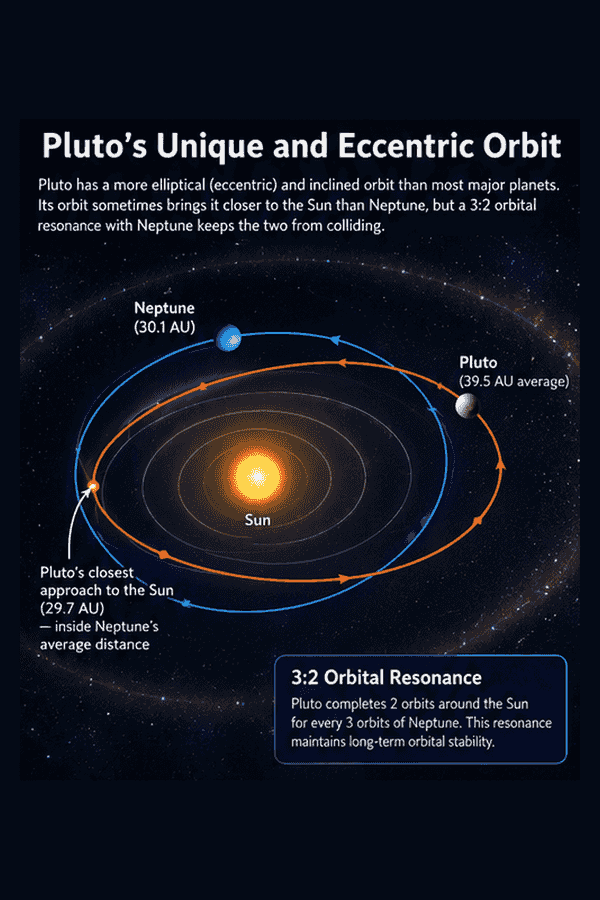
Pluto’s orbit is so eccentric that during part of its 248-year journey it is actually closer to the Sun than Neptune. This happened most recently from 1979 to 1999. [2]
That fact often produces the misleading statement that “Pluto crosses Neptune’s path.” Their heliocentric distance ranges overlap, but the real orbital geometry is much more sophisticated.
Pluto does not randomly cross Neptune’s path
Pluto and Neptune do not repeatedly approach one another in an unstable, collision-prone manner. Pluto’s orbit is significantly inclined relative to Neptune’s, and its motion is synchronized with Neptune through an orbital resonance.
Even when Pluto’s distance from the Sun becomes less than Neptune’s, the two objects remain safely separated.
NASA notes that Pluto actually comes physically closer to Uranus than it ever comes to Neptune. [4]
Pluto and Neptune are locked in a 3:2 orbital resonance
Pluto occupies a 3:2 mean-motion resonance with Neptune.
For approximately every three revolutions Neptune completes around the Sun, Pluto completes two. Their orbital phases repeat in a pattern that prevents dangerous close encounters.
This is a striking example of orbital resonance, in which gravitational interactions create a stable mathematical relationship between orbital periods. Rather than destabilizing Pluto, Neptune’s resonance helps preserve Pluto’s long-term orbital stability. [4][10]
Pluto is a plutino
Pluto is not the only object in this orbital arrangement. Astronomers have discovered an entire population of trans-Neptunian bodies occupying Neptune’s 3:2 resonance. These objects are called plutinos, named after Pluto.
This fact further changed how scientists viewed Pluto. Its apparently extraordinary orbit turned out to be the best-known example of a broader dynamical class.
Again, resonance with Neptune is not what officially makes Pluto a dwarf planet. It reveals that Pluto belongs to the complex dynamical architecture of the Kuiper Belt.
Reason 9: Pluto Fits the Definition of a Dwarf Planet Better Than a Major Planet
The most direct explanation of Pluto’s present status comes from comparing it with the IAU’s two categories.
Pluto meets essentially every dwarf-planet requirement exactly. It orbits the Sun, has sufficient self-gravity to become nearly round, has not cleared its orbital neighborhood, and is not a satellite. Consequently, “dwarf planet” is not merely an informal nickname. It is Pluto’s formal category under the IAU classification system. [1]
What the IAU classification says
The 2006 resolution created three broad Solar System categories.
First are planets, which orbit the Sun, are nearly round, and have cleared their orbital neighborhoods.
Second are dwarf planets, which orbit the Sun and are nearly round but have not cleared their neighborhoods and are not satellites.
Third are Small Solar System Bodies, a broad category containing most asteroids, comets, and trans-Neptunian objects that do not meet the dwarf-planet criteria. [1]
Pluto was explicitly identified as a dwarf planet in IAU Resolution 6A.
Reclassification rather than physical demotion
The word “demotion” became popular after 2006, but reclassification is scientifically more useful.
Nothing physical happened to Pluto in August 2006. Its diameter, atmosphere, moons, geology, and orbit remained the same. What changed was the framework astronomers used to organize the expanding inventory of Solar System bodies.
Scientific nomenclature changes as observations improve. Ceres provides a historical precedent. It was initially regarded as a planet after its 1801 discovery, but the discovery of numerous bodies in the same region eventually led astronomers to recognize the asteroid belt. [3]
The eight-planet Solar System
Under the current IAU definition, the eight planets are:
| Order | Planet | General type | Why it qualifies dynamically |
|---|---|---|---|
| 1 | Mercury | Terrestrial | Dominates its orbital region |
| 2 | Venus | Terrestrial | Strong orbital dominance |
| 3 | Earth | Terrestrial | Strong orbital dominance |
| 4 | Mars | Terrestrial | Clears the planet criterion despite being much less massive than Earth |
| 5 | Jupiter | Gas giant | By far the strongest dynamical dominator |
| 6 | Saturn | Gas giant | Extremely strong orbital dominance |
| 7 | Uranus | Ice giant | Strongly exceeds quantitative clearing thresholds |
| 8 | Neptune | Ice giant | Dominates its region despite interaction with Kuiper Belt populations |
This eight-planet structure reflects a largely dynamical definition of planet, although the roundness criterion also incorporates geophysical properties. [1][5]
Reason 10: Pluto’s Original Planet Classification Reflected Limited Knowledge
Pluto’s original status made sense in the scientific context of 1930. Astronomers knew very little about the distant outer Solar System, Pluto’s mass was poorly constrained, and the Kuiper Belt had not yet been observationally discovered.
The problem was therefore not that early astronomers were careless. They were classifying an object using the best information then available. Later discoveries changed the evidence.
The search for Planet X
The story began with attempts to identify a hypothetical world beyond Neptune known as Planet X.
Percival Lowell had promoted the idea that irregularities thought to exist in the motions of Uranus and Neptune might indicate another large planet. Lowell Observatory later constructed a 13-inch astrograph specifically for the search.
Modern understanding showed that Pluto was far too small to be the massive Planet X that had originally been envisioned. [8]
Clyde Tombaugh’s discovery of Pluto
Clyde Tombaugh arrived at Lowell Observatory in 1929 and systematically photographed sections of the sky. He compared photographic plates using a blink comparator, searching for objects that shifted position against the background stars.
On February 18, 1930, Tombaugh identified Pluto on photographic plates taken on January 23 and January 29. The discovery became one of the landmark events of twentieth-century astronomy. [8]
The name Pluto was suggested by 11-year-old Venetia Burney in England.
Why Pluto looked like a planet in 1930
Astronomers had not yet discovered the enormous population of icy bodies beyond Neptune. Pluto therefore appeared to occupy its region alone.
That changed dramatically after 1992, when astronomers began identifying additional Kuiper Belt objects. Continued discoveries revealed that Pluto belongs to a vast population rather than representing an isolated ninth major planet. [3][4]
Eris finally forced the unresolved classification question into the foreground, leading to the 2006 IAU decision.
How Pluto and Other Solar System Bodies Formed
Understanding Pluto’s formation helps explain why the outer Solar System contains a crowded population of icy bodies rather than a single dominant Pluto-sized planet.
The Solar System formed roughly 4.6 billion years ago from a collapsing cloud of gas and dust. As the cloud contracted, it flattened into a rotating protoplanetary disk surrounding the young Sun. Material within this disk began colliding, sticking together, and growing through a process called accretion. [11]
From dust to planetesimals and protoplanets
Tiny grains became larger aggregates, then rocks, then kilometer-scale bodies called planetesimals. Gravity accelerated growth as larger objects attracted additional material.
Some planetesimals grew into protoplanets, or planetary embryos. Repeated collisions and gravitational interactions eventually produced the planets, moons, asteroids, comets, dwarf planets, and leftover planetesimals found throughout the Solar System. [11]
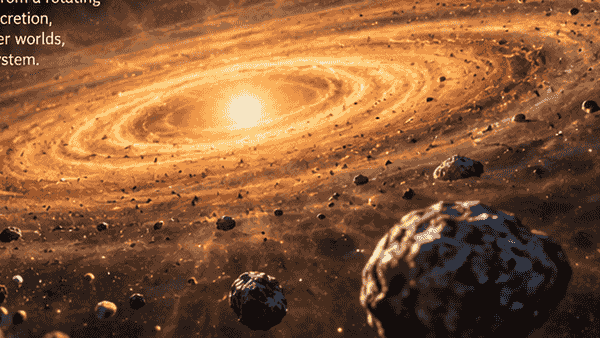
This means dwarf planets are not failed objects in a simplistic sense. They preserve information about the same primordial disk from which the major planets formed.
Why the outer Solar System retained so many icy bodies
Far from the young Sun, temperatures were low enough for compounds such as water, methane, ammonia, carbon monoxide, and nitrogen to exist as ices.
The outer Solar System contained a vast supply of icy planetesimals. Interactions with the giant planets, particularly Neptune, prevented much of this population from merging into one dominant planet.
NASA notes that Neptune’s gravity strongly shaped the Kuiper Belt and that planetary migration helped scatter, capture, and rearrange its objects. [4]
Leftover planetesimals reveal Solar System history
Many Kuiper Belt objects are effectively archaeological remnants of planetary formation. They preserve primitive material that escaped incorporation into major planets.
Studying Pluto, Arrokoth, comets, asteroids, and related bodies therefore allows scientists to reconstruct conditions in the primordial disk and understand how today’s Solar System architecture emerged.
New Horizons demonstrated the scientific value of this approach when it visited both Pluto and the much smaller Kuiper Belt object Arrokoth. [12]
Neptune Helped Shape Pluto’s Present Orbit
Pluto’s orbit probably cannot be understood without considering the early migration of the giant planets.
Modern models indicate that Jupiter, Saturn, Uranus, and Neptune did not necessarily form exactly where we see them today. Their orbits changed as they exchanged energy and angular momentum with enormous populations of planetesimals. Neptune’s outward migration had especially important consequences for the Kuiper Belt. [4][10]
Migration of Neptune
As Neptune gravitationally scattered icy planetesimals, its own orbit changed.
Current dynamical models indicate that Neptune migrated outward during the Solar System’s early evolution. As Neptune moved, its gravitational resonances also swept outward through the primordial disk.
This process rearranged the orbits of enormous numbers of small bodies and contributed to the modern structure of the Kuiper Belt. [10]
Resonant capture of Pluto
One influential explanation proposes that Pluto originally occupied a more circular, less inclined orbit. As Neptune moved outward, its 3:2 resonance swept through Pluto’s region.
Pluto could then have been caught through resonant capture. Once captured, Pluto migrated outward with the resonance while its orbital eccentricity and inclination increased.
Detailed dynamical modeling of this process helps explain why Pluto occupies its unusual but remarkably stable present orbit. [10]
The Nice model
The Nice model, named after Nice, France, is an influential family of models describing substantial early rearrangement of the giant planets.
In these scenarios, gravitational interactions between the giant planets and a massive primordial planetesimal disk produced planetary migration and dramatically altered populations of smaller bodies.
NASA notes that the modern Kuiper Belt may contain only a small fraction of its original material. Current versions and alternatives continue to be refined as new dynamical and observational constraints emerge. [4][10]
Pluto Is Still a Complex Planetary World
Dwarf-planet classification should never be confused with geological simplicity. New Horizons revealed Pluto to be one of the most diverse and active-looking small worlds ever explored.
It has giant mountains, glaciers, tectonic structures, volatile cycles, atmospheric hazes, and vast ice plains. Some features appear geologically young. Recent research has even strengthened the case that dynamic processes involving liquid nitrogen may occur beneath or at the surface of parts of Sputnik Planitia. [12][13]
Pluto’s internal and surface complexity
Pluto is believed to be differentiated, meaning that its interior separated into layers according to density. Models generally involve a rocky interior surrounded by a substantial water-ice layer.
New Horizons observations also produced evidence consistent with significant internal evolution and possible subsurface water.
On the surface, scientists identified mountains built largely from rigid water ice, along with plains composed of much softer volatile ices capable of flowing over geological timescales. [2][12]
Pluto’s atmosphere and volatile ices
Pluto possesses a thin atmosphere dominated by molecular nitrogen, with methane and carbon monoxide also present.
Its atmosphere is linked strongly to surface temperature. Volatile ices can sublimate directly into gas when conditions warm and condense again as Pluto travels through colder portions of its orbit.
New Horizons also observed spectacular atmospheric haze layers produced through photochemical reactions involving compounds such as nitrogen and methane. [2]
Sputnik Planitia
Sputnik Planitia is the enormous bright basin forming the western lobe of Pluto’s famous heart.
It contains a vast glacier dominated by nitrogen ice, with methane and carbon monoxide also present. New Horizons revealed polygonal cellular structures interpreted as evidence of convection within the ice. Warmer nitrogen ice slowly rises while cooler material sinks, producing a surface that appears geologically young in many areas. [12]
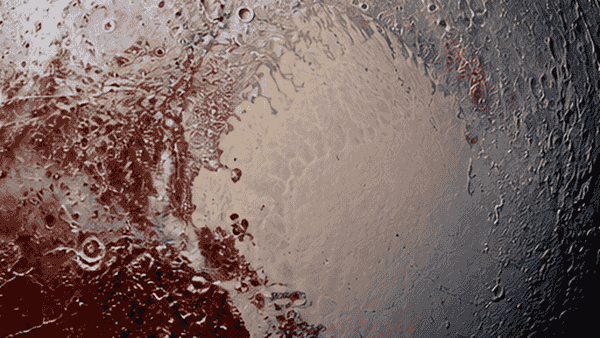
The basin spans roughly 1,000 kilometers across and is one of the most extraordinary landscapes found anywhere in the outer Solar System.
A major Pluto discovery announced in 2026
In August 2026, NASA reported a new analysis of New Horizons imagery indicating evidence that liquid nitrogen may have recently risen through cracks onto the northern portion of Sputnik Planitia.
Researchers interpreted dark linear and diffuse features as possible signs of temporary wetting by liquid nitrogen emerging from beneath the glacier. NASA described it as the first evidence for recently flowing liquid on Pluto.
The finding does not affect Pluto’s planetary classification, but it reinforces just how geologically surprising this dwarf planet remains. [13]
Tombaugh Regio
The bright heart-shaped region visible in iconic New Horizons images is called Tombaugh Regio, honoring Clyde Tombaugh.
Sputnik Planitia forms its western lobe. The larger heart-shaped region contains multiple geological terrains, revealing processes involving volatile transport, glaciation, erosion, tectonics, and deposition.
Few scientists expected such diversity before the New Horizons encounter. Pluto transformed from a distant point of light into a world with recognizable landscapes and an active geological history.
Pluto and Charon Form an Unusual System
Pluto is not alone. Five known moons orbit the dwarf planet: Charon, Styx, Nix, Kerberos, and Hydra.
Charon dominates the system. With a diameter of about 1,214 kilometers, it is slightly more than half Pluto’s diameter and unusually large relative to the body it orbits. This creates an orbital configuration unlike the familiar Earth-Moon arrangement. [2][14]
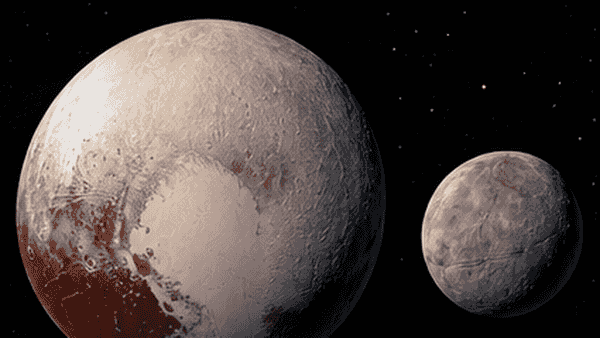
Pluto’s five natural satellites
Charon was discovered in 1978, nearly half a century after Pluto. The other moons were found much later through observations associated with the Hubble Space Telescope and preparation for New Horizons.
Charon and Pluto are mutually tidally locked. Charon keeps the same face toward Pluto, while Pluto keeps the same face toward Charon. One Pluto rotation and one Charon orbit each take approximately 6.4 Earth days. [2][14]
Pluto and Charon orbit a shared barycenter
Two orbiting bodies actually move around their common barycenter, or center of mass.
Because Charon is unusually massive relative to Pluto, the Pluto-Charon barycenter lies outside Pluto itself. Consequently, Pluto noticeably moves around the common gravitational center rather than merely sitting at the center while Charon circles it.
NASA has therefore sometimes described Pluto and Charon as a binary or double dwarf-planet system. [14]
Is Pluto-Charon officially a binary dwarf planet?
Not under the current formal IAU classification.
“Binary dwarf planet” is a useful descriptive concept, but the IAU has not established it as an official category that replaces Charon’s status as Pluto’s moon. NASA notes that Charon remains officially classified as a satellite.
The system nevertheless provides an excellent natural laboratory for studying tidal interactions, satellite formation, impacts, and the dynamics of binary planetary bodies. [14]
New Horizons Changed What We Know About Pluto
Before 2015, even the best observations could reveal only limited detail on Pluto’s surface. NASA’s New Horizons mission changed that completely.
Launched in 2006, the spacecraft traveled billions of kilometers through the Solar System before reaching the Pluto system. Ironically, Pluto was still officially categorized as the ninth planet when New Horizons left Earth, then became a dwarf planet while the spacecraft was already on its journey. [12]
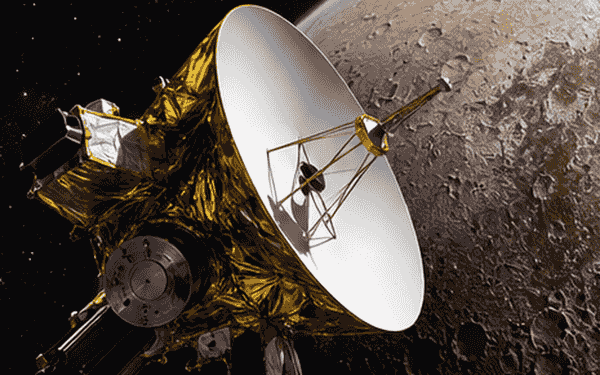
NASA’s mission to Pluto
New Horizons was designed to study Pluto, Charon, the smaller moons, and eventually other Kuiper Belt objects.
Its instruments examined geology, composition, surface temperature, atmospheric structure, particles, and plasma interactions.
The mission represented humanity’s first close exploration of Pluto and completed the initial spacecraft reconnaissance of the traditional nine planets as they had historically been taught.
The 2015 Pluto flyby
New Horizons made its closest approach on July 14, 2015, passing roughly 7,800 kilometers above Pluto’s surface.
The images and measurements revealed giant mountains, flowing nitrogen glaciers, extensive plains, atmospheric haze layers, tectonic structures, possible cryovolcanic features, and complex surface chemistry. Sputnik Planitia emerged as one of the mission’s most important discoveries. [12]
The spacecraft later continued into the Kuiper Belt and flew past Arrokoth on January 1, 2019.
Exploration did not reverse Pluto’s classification
New Horizons dramatically changed scientists’ understanding of Pluto’s geology but did not change the characteristic relevant to the IAU decision.
Mountains do not determine planethood. Neither glaciers, atmospheres, geological activity, subsurface oceans, nor complex chemistry appear in the IAU’s orbital criterion.
A body can therefore be exceptionally planet-like geophysically while still being a dwarf planet under a dynamical taxonomy.
Pluto demonstrates the difference better than perhaps any other Solar System object.
The Bigger Scientific Debate: What Should Count as a Planet?
Saying that Pluto is “not a planet” requires one important qualification: Pluto is not one of the eight planets under the official IAU definition adopted for the Solar System.
Not every planetary scientist agrees that this is the most useful possible definition. The Pluto controversy therefore includes a genuine scientific and terminological debate about what characteristics a planetary classification system should emphasize. [15]
The dynamical planet definition
The IAU approach combines intrinsic and environmental characteristics.
An object must be round because of its own gravity, an intrinsic geophysical property, but it must also dominate its orbital neighborhood, which depends on its relationship with surrounding bodies.
Supporters of this approach argue that dynamical dominance reflects an important outcome of planetary formation. The eight planets occupy a clearly separated dynamical population from dwarf planets such as Pluto, Ceres, and Eris. [5][6]
The geophysical planet definition
Other researchers favor a geophysical planet definition focused primarily on what a world is, rather than where it is or what surrounds it.
A prominent proposal by Kirby Runyon, Alan Stern, and colleagues defines a planet broadly as a substellar-mass body that has never undergone nuclear fusion and whose self-gravity produces a spheroidal shape, regardless of orbital parameters.
Under this type of definition, Pluto would qualify as a planet. Many rounded moons, including Earth’s Moon and large satellites of the giant planets, could also qualify as planets or satellite planets. [15]
Why the debate has not disappeared
Both approaches answer different questions.
A dynamical definition asks something like: What role does this object play in the architecture of its planetary system?
A geophysical definition asks: What kind of world is this object based on its own physical characteristics?
Pluto performs poorly under the first approach but extremely well under the second. It is spherical, differentiated, atmospherically active, geologically diverse, and probably possesses a complicated internal history.
Consequently, the statement “Pluto is not a planet” is taxonomically correct under current IAU nomenclature, but it should not be mistaken for a universal statement accepted under every proposed scientific definition.
Eight Planets Versus Pluto: Quick Comparison
The difference becomes easier to understand when Pluto is compared with the major planets as a group.
| World | Approximate orbital role | Nearly round? | Dynamically dominant? | Current IAU class |
|---|---|---|---|---|
| Mercury | Dominant inner body | Yes | Yes | Planet |
| Venus | Dominant inner body | Yes | Yes | Planet |
| Earth | Dominant inner body | Yes | Yes | Planet |
| Mars | Dominant terrestrial body | Yes | Yes | Planet |
| Jupiter | Strongest planetary dynamical influence | Yes | Yes | Planet |
| Saturn | Strong orbital dominance | Yes | Yes | Planet |
| Uranus | Dominant ice giant | Yes | Yes | Planet |
| Neptune | Dominates its planetary region and shapes Kuiper Belt dynamics | Yes | Yes | Planet |
| Pluto | Member of resonant Kuiper Belt population | Yes | No | Dwarf planet |
The table illustrates why comparing Pluto with Mercury simply by diameter misses the central point. A body’s classification under the IAU system depends strongly on orbital dynamics, not merely physical size.
10 Reasons Pluto Is Not a Planet at a Glance
1. Pluto has not cleared its orbital neighborhood
This is the decisive formal IAU reason. Pluto shares its orbital region with a substantial trans-Neptunian population and never became overwhelmingly gravitationally dominant. The eight major planets pass this dynamical test, while Pluto does not. [1][5]
2. Pluto shares its orbital region with many other bodies
The Kuiper Belt contains a huge population of icy objects. Pluto remains dynamically associated with that population rather than dominating it. Sharing space alone does not disqualify an object, but Pluto’s inability to dominate that shared environment is central to its classification. [4]
3. Pluto belongs to the Kuiper Belt
Pluto is one of the largest members of a vast population beyond Neptune. This membership is not itself an IAU disqualifier, but it provides the environmental context explaining why Pluto has not cleared its neighborhood. [4]
4. Pluto has low dynamical dominance
Quantitative planetary discriminants place an enormous gap between the eight planets and Pluto. In Margot’s formulation, Pluto’s Π value is roughly 0.028, while even Mars is around 54 and the proposed planetary threshold is 1. [5]
5. Pluto is much smaller than every major planet
At approximately 2,377 kilometers across, Pluto is even smaller than Earth’s Moon. Its low mass contributes to its limited gravitational influence. However, size alone is not an official reason for excluding Pluto. [2][7]
6. Pluto resembles numerous other trans-Neptunian worlds
Discoveries such as Eris, Haumea, and Makemake showed that Pluto was not unique. Eris was particularly important because its discovery forced astronomers to confront whether the Solar System should acquire many additional planets or adopt a new classification scheme. [3][9]
7. Pluto has an eccentric and inclined orbit
Pluto’s orbit has an eccentricity of about 0.249 and an inclination around 17 degrees relative to the ecliptic. These properties reveal its unusual dynamical history but are not formal IAU disqualifiers. [7]
8. Pluto’s distance overlaps Neptune’s orbital region
Pluto occasionally becomes closer to the Sun than Neptune, but the objects are protected from close encounters through a stable 3:2 orbital resonance. This arrangement is scientifically fascinating but is not itself part of the planet definition. [2][4]
9. Pluto exactly fits the IAU dwarf-planet category
Pluto orbits the Sun, is massive enough to become nearly round, has not cleared its orbital neighborhood, and is not a satellite. That combination matches the formal dwarf-planet definition. [1]
10. Pluto’s original planetary status came from an earlier picture of the Solar System
When Pluto was discovered in 1930, astronomers did not know about the enormous population of Kuiper Belt objects beyond Neptune. Later discoveries transformed Pluto from an apparently isolated ninth world into a prominent member of a much larger family. [3][8]
Frequently Asked Questions About Pluto’s Planet Status
Why is Pluto not a planet anymore?
Pluto is officially classified as a dwarf planet because it has not cleared the neighborhood around its orbit, the third requirement of the International Astronomical Union’s 2006 definition of a planet.
It still meets the other major physical requirements. Pluto orbits the Sun and has enough self-gravity to make itself nearly round. Its classification changed because scientists developed a new taxonomy after discovering many comparable bodies beyond Neptune. [1]
When did Pluto stop being a planet?
The International Astronomical Union adopted its new planet definition on August 24, 2006, during its General Assembly in Prague.
Pluto had been considered the ninth planet since its discovery in 1930, meaning it held that status for approximately 76 years.
The 2006 resolution explicitly classified Pluto as a dwarf planet and identified it as the prototype of a new category of trans-Neptunian objects. [1]
Is Pluto too small to be a planet?
Not according to the IAU definition.
No specific minimum planetary diameter is included. Pluto is large enough for self-gravity to overcome rigid-body forces and produce a nearly round shape, so it passes the hydrostatic-equilibrium requirement.
Its small mass matters indirectly because it contributes to Pluto’s inability to dominate its orbital neighborhood, but saying that Pluto was reclassified simply because it is small is inaccurate.
Is Pluto smaller than the Moon?
Yes. Pluto is approximately 2,377 kilometers in diameter, while Earth’s Moon is approximately 3,474 kilometers across.
Pluto is nevertheless massive enough to become spherical and differentiated. Size alone therefore cannot tell us whether an object satisfies the current IAU planet definition. [2][7]
Does Pluto cross Neptune’s orbit?
Pluto’s heliocentric distance overlaps Neptune’s orbital distance, and Pluto becomes closer to the Sun than Neptune during part of its orbit.
However, saying that Pluto simply “crosses Neptune’s path” can create the wrong impression. Pluto’s inclined orbit and its 3:2 resonance with Neptune keep the two bodies safely separated. Their motion is dynamically organized rather than chaotic. [4][10]
Could Pluto ever collide with Neptune?
Their present resonant configuration prevents the kind of random close encounters implied by simple drawings of two intersecting orbital lines.
Pluto’s perihelion occurs in a geometrical configuration that keeps it well separated from Neptune, while the 3:2 resonance maintains a repeating relationship between their orbital positions.
Long-term celestial mechanics is more complicated than two fixed ellipses drawn on a flat page. [10]
How many moons does Pluto have?
Pluto has five known natural satellites: Charon, Styx, Nix, Kerberos, and Hydra.
Charon is by far the largest. Its diameter is more than half Pluto’s, and the Pluto-Charon system revolves around a barycenter outside Pluto’s surface. This unusually balanced configuration is why the pair is sometimes described informally as a double dwarf planet. [2][14]
Is Pluto geologically dead?
No. New Horizons revealed evidence of remarkably diverse and comparatively young geological processes.
Pluto has glaciers, convection within volatile ice, mountains, tectonic structures, atmospheric haze, changing surface volatiles, and possible cryovolcanic features.
In 2026, scientists reported evidence consistent with recent liquid nitrogen emerging onto parts of Sputnik Planitia, adding another surprising chapter to Pluto’s geological story. [13]
Could Pluto become a planet again?
Pluto’s physical status is unlikely to change enough to satisfy the current IAU orbital-clearing criterion. However, the definition itself could theoretically change.
Some planetary scientists advocate definitions based primarily on intrinsic geology and self-gravity. Under certain geophysical definitions, Pluto already qualifies as a planet.
Therefore, whether Pluto could formally become a planet again depends primarily on future scientific nomenclature rather than on Pluto physically changing. [15]
Conclusion: Pluto Did Not Change, Our Understanding Did
Pluto’s transformation from “ninth planet” to “dwarf planet” is one of the clearest examples of how scientific classification evolves.
When Clyde Tombaugh discovered Pluto in 1930, astronomers saw an apparently isolated world beyond Neptune. Decades later, improved telescopes revealed the Kuiper Belt and a growing family of Pluto-like objects. Eris made the classification problem impossible to ignore. The International Astronomical Union responded in 2006 by defining a planet partly through orbital dominance.
Pluto passes two major tests. It orbits the Sun, and its self-gravity makes it nearly round. It fails the third: it has not cleared its orbital neighborhood. That is the formal reason Pluto is classified as a dwarf planet. [1]
Its small diameter, eccentric orbit, inclination, Kuiper Belt location, similarity to Eris, and resonance with Neptune are important pieces of the story, but they are supporting context rather than independent disqualifying rules.
And Pluto has hardly become less interesting since losing its planet label.
New Horizons revealed a world of nitrogen glaciers, towering water-ice mountains, atmospheric haze, active volatile cycles, tectonic landscapes, and an extraordinary relationship with Charon. Research published in 2026 even points toward recent liquid nitrogen activity on Sputnik Planitia. [12][13]
The most accurate conclusion is therefore not that astronomers discovered Pluto was somehow “unworthy” of being a planet.
They discovered something much more interesting: Pluto belongs to an entire population of worlds that astronomers barely knew existed when Pluto was discovered.
Its classification changed because our map of the Solar System became better.
Sources
[1] International Astronomical Union. IAU 2006 General Assembly: Result of the IAU Resolution Votes, Resolutions 5A and 6A. Official definition of planets and dwarf planets and Pluto’s reclassification.
https://www.iau.org/IAU/Iau/News/PR2006/iau-2006-general-assembly-resolution-votes.aspx
[2] NASA Science. Pluto: Facts. Pluto’s size, distance, orbit, moons, atmosphere, geology, and dwarf-planet status.
https://science.nasa.gov/dwarf-planets/pluto/facts/
[3] NASA Science. What Is a Planet? History of planet definitions, Kuiper Belt discoveries, Eris, the IAU decision, and continuing debate.
https://science.nasa.gov/solar-system/planets/what-is-a-planet/
[4] NASA Science. Kuiper Belt: Facts. Structure, population, Neptune’s influence, plutinos, Pluto’s resonance, and Solar System history.
https://science.nasa.gov/solar-system/kuiper-belt/facts/
[5] Jean-Luc Margot. A Quantitative Criterion for Defining Planets. Quantitative orbital-clearing metric and planetary discriminant Π.
https://arxiv.org/abs/1507.06300
[6] Steven Soter. What Is a Planet? Astronomical Journal research on dynamical dominance and planetary discriminants.
https://arxiv.org/abs/astro-ph/0608359
[7] NASA Goddard Space Flight Center, NSSDC. Pluto Fact Sheet. Orbital parameters including eccentricity, inclination, orbital period, and physical data.
https://nssdc.gsfc.nasa.gov/planetary/factsheet/plutofact.html?level=1
[8] Lowell Observatory. Pluto Discovery Telescope and Pluto Discovery History. Clyde Tombaugh, Planet X, Lowell Observatory, and the 1930 discovery.
https://lowell.edu/campus/pluto-discovery-telescope/
[9] NASA/JPL and IAU. Eris discovery and naming. Background on the discovery that intensified the planet-definition debate.
https://www.jpl.nasa.gov/news/hotly-debated-solar-system-object-gets-a-name/
[10] Renu Malhotra. Resonant Kuiper Belt Objects: A Review. Geoscience Letters, 2019. Pluto’s 3:2 resonance, Neptune migration, and resonant capture.
https://pmc.ncbi.nlm.nih.gov/articles/PMC7067275/
[11] NASA Science. How Did Our Solar System Form? Protoplanetary disk, accretion, planetesimals, and planetary formation.
https://science.nasa.gov/astrobiology/learning-resources/alp/how-did-our-solar-system-form/
[12] NASA Science. New Horizons Mission. Pluto flyby, Sputnik Planitia, atmospheric observations, geological discoveries, and subsequent Kuiper Belt exploration.
https://science.nasa.gov/mission/new-horizons/
[13] NASA Science, August 5, 2026. NASA’s New Horizons Finds Evidence of Recent Liquid on Pluto’s Surface. Evidence for recent liquid nitrogen activity associated with Sputnik Planitia.
https://science.nasa.gov/blogs/science-news/2026/08/05/nasas-new-horizons-finds-evidence-of-recent-liquid-on-plutos-surface/
[14] NASA. Pluto, Charon, and the Pluto System. Charon’s dimensions, barycenter, mutual tidal locking, and binary-system terminology.
https://www.nasa.gov/missions/new-horizons/exploring-the-unexplored-new-horizons-mission-to-pluto/
[15] The Planetary Society. What Is a Planet? Discussion of the IAU dynamical definition and alternative geophysical definitions, including the Runyon, Stern, and colleagues proposal.
https://www.planetary.org/worlds/what-is-a-planet