
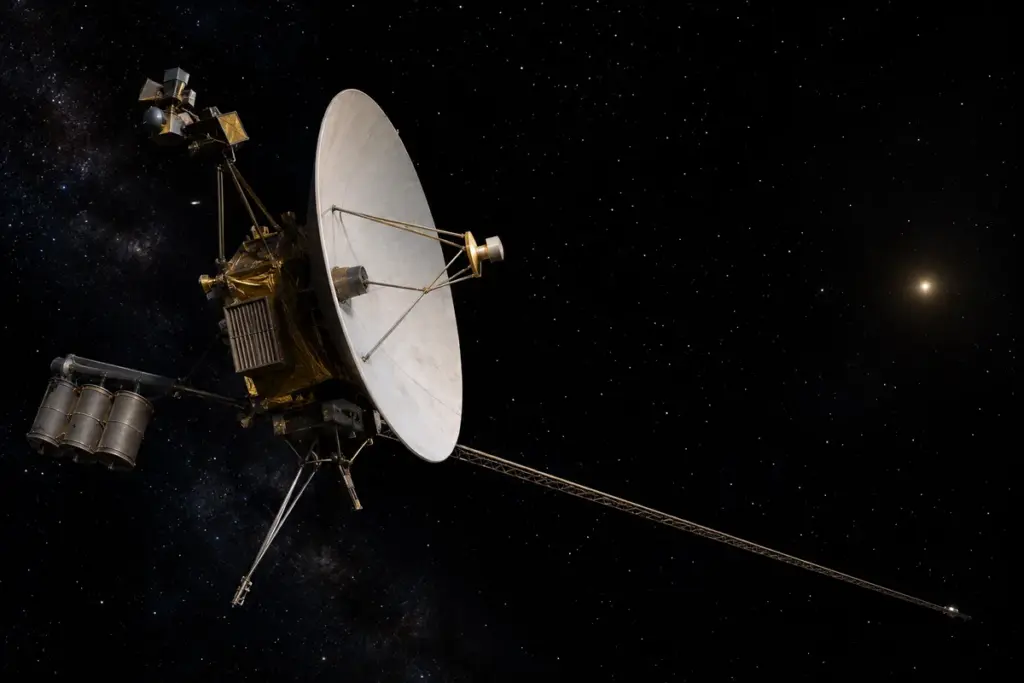
On November 18, 2026, NASA’s Voyager 1 became the first human-made object to reach a distance of one light-day from Earth, marking an extraordinary milestone in the history of space exploration. The spacecraft reached approximately 25.902 billion kilometers (16.094 billion miles) from our planet, a distance so immense that light and radio signals require an entire day to travel between Earth and the probe.
According to NASA and the California Institute of Technology (Caltech), Voyager 1 reached the milestone at 10:16:07 UTC (2:16:07 a.m. Pacific Standard Time), more than 49 years after its launch on September 5, 1977. The achievement demonstrates how far a spacecraft built with 1970s technology can travel while continuing to communicate across the vast distances of interstellar space. [1]
Originally designed to investigate Jupiter and Saturn, Voyager 1 has transformed into humanity’s most distant interstellar explorer. Its journey has revealed active volcanoes on Jupiter’s moon Io, intricate structures within Saturn’s rings, and previously unexplored characteristics of the environment beyond the Sun’s protective heliosphere.
Yet the one-light-day milestone is more than a record of distance. It highlights the remarkable endurance of spacecraft engineering, the difficulties of operating equipment billions of kilometers away, and the scientific value of directly studying the region between stars.
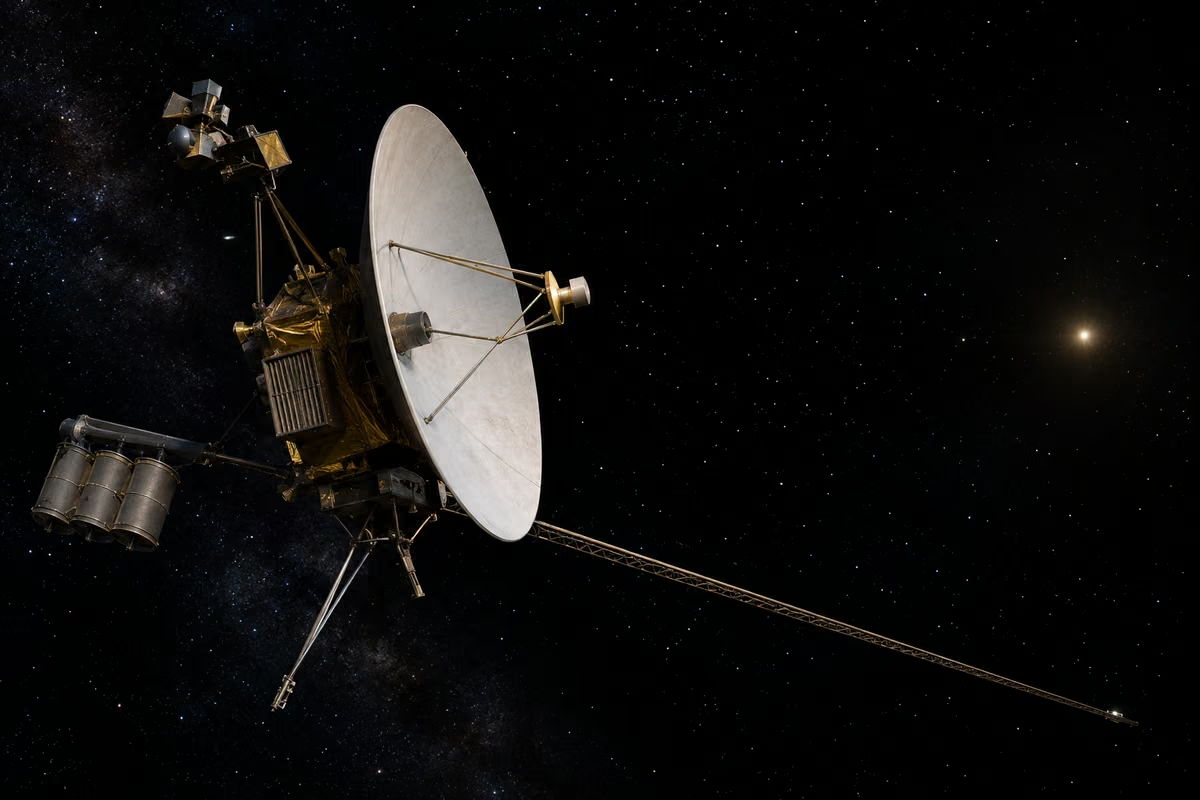
1. How Voyager 1 Made History by Reaching One Light-Day From Earth
Voyager 1’s achievement represents a new distance record for an object constructed by humanity. Unlike a planetary encounter or the crossing of a physical boundary, reaching one light-day is a milestone defined by the time required for light to traverse the separation between Earth and the spacecraft. Its significance comes from the extraordinary distance, the 49-year journey, and the fact that engineers can still communicate with the aging probe.
What Is Voyager 1, and Why Is Its One-Light-Day Milestone Historic?
Voyager 1 is an uncrewed robotic space probe developed by NASA to investigate the outer solar system. Launched in 1977, it was initially assigned to study Jupiter, Saturn, their moons, magnetic environments, and ring systems. After completing those encounters, the spacecraft continued outward along a trajectory that eventually carried it into interstellar space.
Its one-light-day milestone is historic because no other human-made object had previously traveled so far from Earth. It represents a separation of approximately 25.9 billion kilometers, equivalent to 24 hours of travel for light moving through a vacuum.
The spacecraft did not cross a newly discovered cosmic boundary on November 18, 2026. It simply reached a distance defined by an astronomical measurement. Nevertheless, that distance demonstrates the extraordinary longevity of the Voyager mission and humanity’s ability to operate technology far beyond the planetary region for which it was originally designed.
What Happened on November 18, 2026?
On Wednesday, November 18, 2026, Voyager 1 reached the one-light-day mark at 2:16:07 a.m. Pacific Standard Time, corresponding to 5:16:07 a.m. Eastern Standard Time and 10:16:07 UTC.
NASA identified the milestone distance as approximately 16.094 billion miles, or 25.902 billion kilometers, from Earth. The predicted crossing time was based on the spacecraft’s calculated trajectory and its changing separation from our moving planet.
Mission navigators determine spacecraft positions using radio tracking, precise timing, Doppler measurements, and orbital models. These techniques enable engineers to estimate positions and velocities far beyond the range of optical observation from Earth.
Nothing physically changed aboard Voyager 1 when the distance reached one light-day. The spacecraft did not encounter a barrier, activate a new instrument, or enter another region of space. NASA instead recognized the event as an extraordinary demonstration of the mission’s longevity and humanity’s expanding reach into the cosmos. [2]
Why Is Voyager 1 the Farthest Human-Made Object?
Voyager 1 became the most distant human-made object on February 17, 1998, when it surpassed Pioneer 10 in distance from the Sun. At that time, Voyager 1 was approximately 69.4 astronomical units from the Sun, having followed a faster outward trajectory after its encounters with Jupiter and Saturn.
Although several spacecraft are traveling outward on solar escape trajectories, Voyager 1 remains farther from Earth than any other human-made object. Its position reflects decades of continuous motion rather than an exceptionally high speed compared with light.
Maintaining communications at this distance is especially remarkable. Electrical power is limited, electronic systems have aged, and radio signals become increasingly difficult to detect as the spacecraft moves farther away.
Voyager 1 demonstrates that deep-space exploration does not necessarily end when a spacecraft completes its original objectives. With careful mission management, a probe can continue delivering scientific information for decades beyond its initial operational lifetime. [3]
2. How Far Is One Light-Day, and What Does It Mean in Space?
Astronomical distances are often expressed using the time light requires to travel between locations. This provides a more intuitive representation of distances that would otherwise involve billions or trillions of kilometers. Understanding the one-light-day measurement helps explain why Voyager 1 is so far away, why communication takes so long, and why the spacecraft remains relatively close to home on the much larger scale of the Milky Way.
What Exactly Is One Light-Day?
A light-day is the distance light travels through a vacuum during exactly 24 hours. It is a measurement of distance, not a period describing how long a spacecraft has been operating or traveling.
Light moves through a vacuum at exactly 299,792,458 meters per second. Since one day contains 86,400 seconds, multiplying these values gives the distance of one light-day:
One light-day = 25,902,068,371.2 kilometers
This is approximately 25.9 billion kilometers, or 16.09 billion miles.
Although Voyager 1 required more than 49 years to reach this separation from Earth, a light signal covers the same distance in just one day.
The distinction between light-travel distance and spacecraft travel time is essential. A spacecraft moves far more slowly than electromagnetic radiation, even when traveling at tens of thousands of kilometers per hour. [4]
How Far Is Voyager 1 From Earth in Kilometers and Miles?
At its November 18, 2026 milestone, Voyager 1 was approximately 25.902 billion kilometers (16.094 billion miles) from Earth. This is an Earth-to-spacecraft measurement, not the total distance the spacecraft has traveled along its journey since launch.
The distinction matters because Voyager 1’s actual flight path included planetary encounters and gravitational deflections. Its accumulated travel distance is different from the straight-line separation between Earth and its current position.
The separation also changes because Earth continuously orbits the Sun. During some parts of the year, Earth’s orbital motion slightly reduces its distance from Voyager 1, even as the spacecraft continues traveling outward from the Sun.
NASA’s continuously updated distance estimates therefore should not be interpreted as a perfectly uniform increase. The heliocentric distance and Earth-spacecraft distance are related but different quantities. [2]
How Does the Speed of Light Determine a Light-Day?
The speed of light is one of the fundamental constants of physics. In a vacuum, light propagates at exactly 299,792.458 kilometers per second, a value used in scientific measurements and the definition of the meter.
The relationship between speed, distance, and time is expressed by the equation:
Distance = Speed × Time
For one light-day:
299,792.458 km/s × 86,400 seconds = 25,902,068,371.2 km
Radio waves travel through a vacuum at the same speed as visible light because both are forms of electromagnetic radiation.
This relationship creates an unavoidable communication delay for distant spacecraft. Engineers cannot send instructions faster than light, regardless of the sensitivity of their antennas or the processing power of their computers. Consequently, the distance between Earth and Voyager 1 imposes a fundamental limit on how quickly information can be exchanged.
How Does One Light-Day Compare With Other Astronomical Distances?
A light-day is extremely large compared with distances inside the inner solar system, but it is small compared with the distances separating stars.
Astronomers use several measurement units depending on the scale involved. An astronomical unit (AU) is exactly 149,597,870.7 kilometers and approximately represents Earth’s orbital distance from the Sun. A light-hour is the distance light travels in one hour, while a light-year represents the distance traveled during a Julian year of 365.25 days.
| Distance unit | Approximate distance | Light-travel time |
|---|---|---|
| One astronomical unit | 149.6 million km | 8 minutes 19 seconds |
| One light-hour | 1.079 billion km | 1 hour |
| One light-day | 25.902 billion km | 24 hours |
| One light-year | 9.461 trillion km | 365.25 days |
| Distance to Proxima Centauri | 40.1 trillion km | 4.24 years |
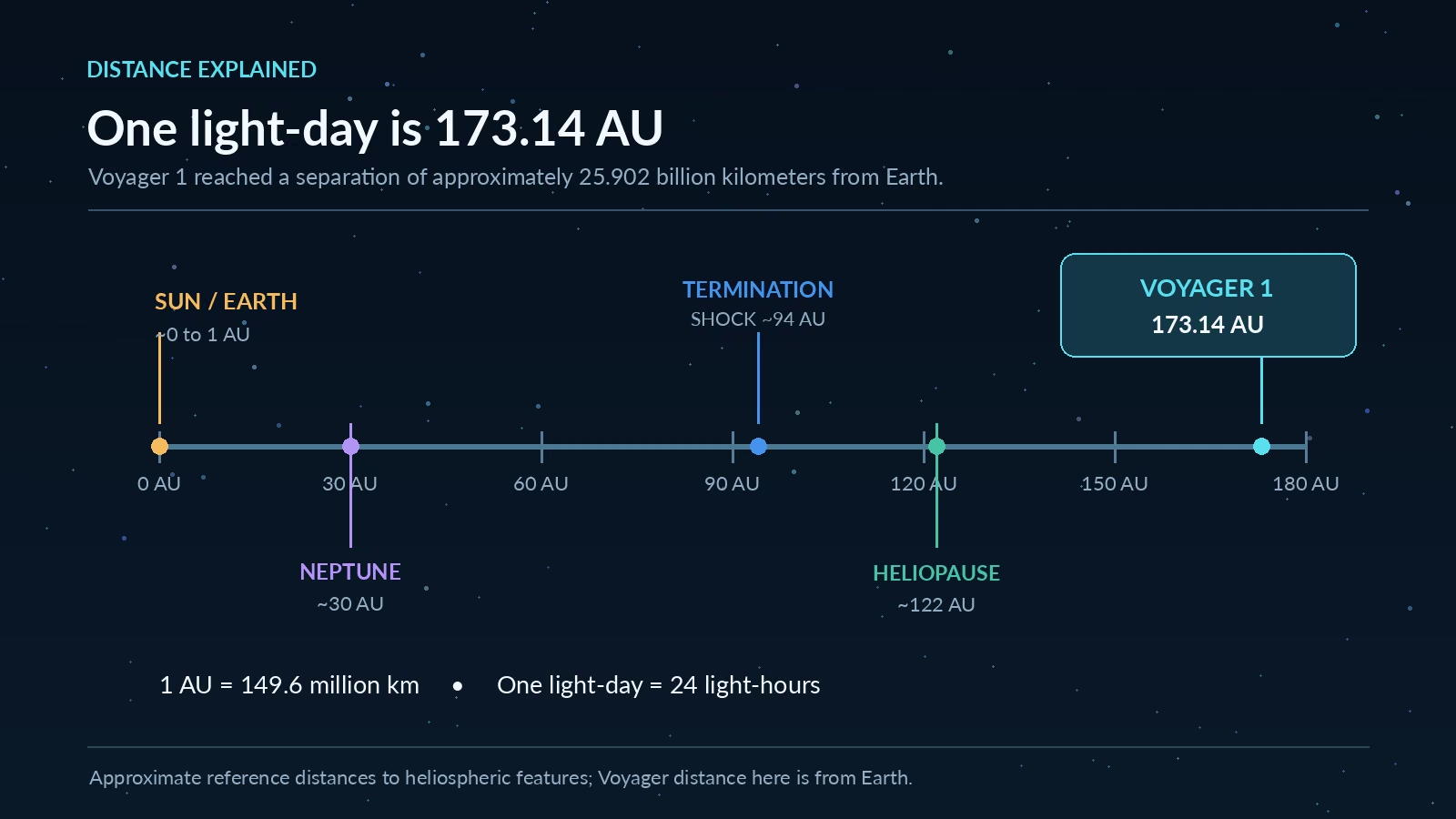
One light-day is equivalent to approximately 173.14 AU or about 0.00274 light-years.
For additional perspective, light requires approximately 1.3 seconds to travel from the Moon to Earth and about eight minutes and 20 seconds to travel from the Sun to Earth.
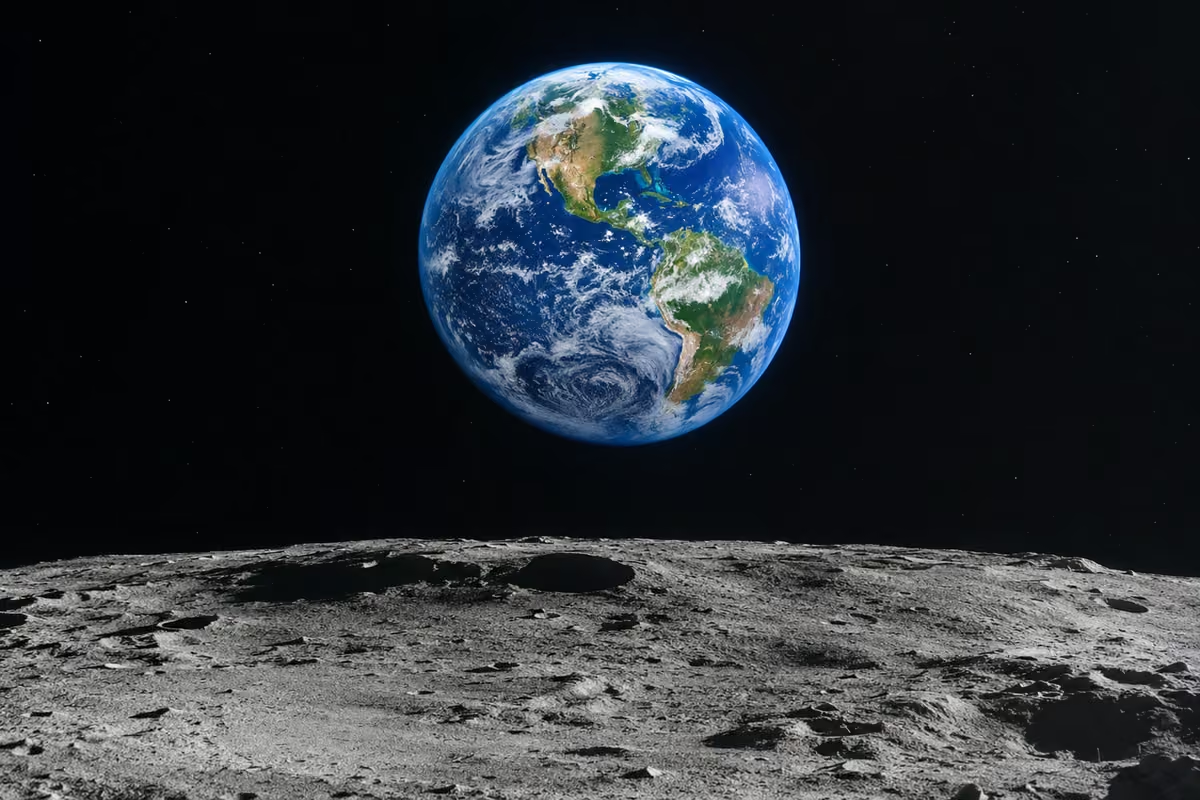
Voyager 1’s distance is therefore extraordinary by spacecraft standards, but it represents only a tiny fraction of the separation between the Sun and its nearest stellar neighbors. [5] [6]
3. Why Does Communicating With Voyager 1 Now Take Two Days?
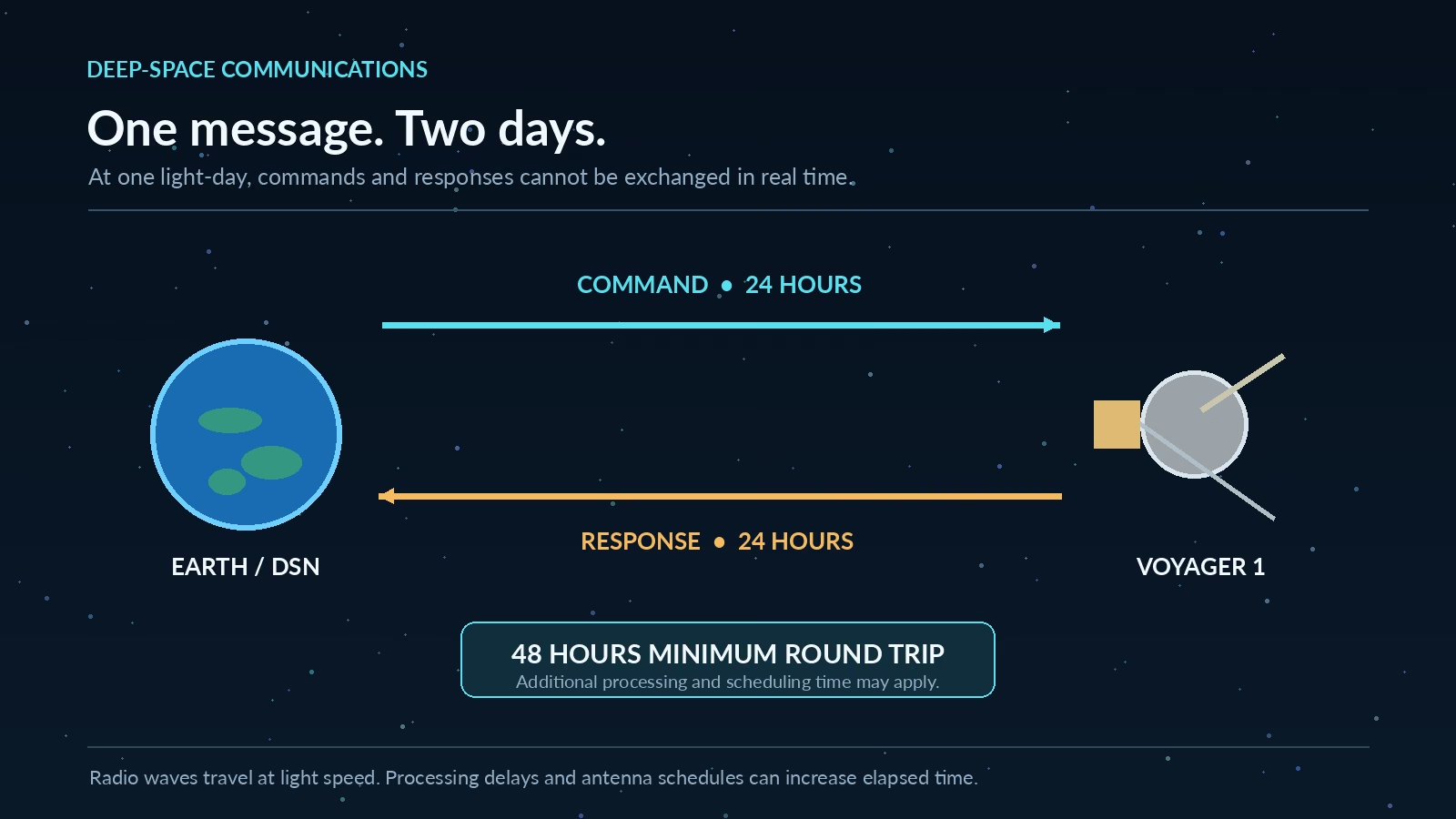
Communicating with Voyager 1 has become an exceptional challenge because its distance introduces a delay that cannot be eliminated by improvements in telecommunications technology. A radio command requires approximately 24 hours to reach the spacecraft, while a response requires another 24 hours to return. NASA must account for this delay while managing an aging spacecraft with limited electrical power, increasingly weak signals, and equipment that sometimes requires unexpected troubleshooting.
Why Does a Signal Take 24 Hours to Reach Voyager 1?
When NASA transmits a command to Voyager 1, the information travels as electromagnetic radio waves through space. These signals propagate at approximately the speed of light, which places an unavoidable physical limit on communication.
At a distance of one light-day, the radio signal needs approximately 86,400 seconds, or 24 hours, to reach the spacecraft.
This makes real-time interaction impossible. Engineers cannot immediately observe the consequences of a command or rapidly correct unexpected behavior.
The delay also increases as Voyager 1 moves farther away from Earth. Every additional million kilometers of separation adds approximately 3.34 seconds to the one-way light-travel time.
As a result, the spacecraft must execute carefully prepared instructions and maintain sufficient onboard autonomy to operate safely while Earth-based controllers await information about its condition.
Why Can a Message and Response Take at Least 48 Hours?
At the one-light-day milestone, the minimum communication cycle requires approximately 48 hours of light-travel time.
The process begins when engineers transmit a command from Earth. The signal takes about 24 hours to reach Voyager 1, where the onboard computers receive and process the instruction.
If the spacecraft immediately transmits a response, that signal requires another approximately 24 hours to travel back to Earth.
In practice, the complete process can take longer because the spacecraft may need additional time to perform a task. Ground stations also follow communication schedules, and engineering teams must analyze the returned telemetry before determining their next action.
The result is a carefully coordinated process in which even relatively simple troubleshooting can extend across several days. [7]
How Does Voyager 1 Send Radio Messages Across Interstellar Distances?
Voyager 1 communicates with Earth using a directional high-gain antenna measuring approximately 3.7 meters (12 feet) in diameter. The antenna concentrates radio energy in a relatively narrow beam, allowing the spacecraft to transmit information across enormous distances.
The spacecraft primarily returns science and engineering data through an X-band radio link. NASA describes a normal interstellar mission telemetry rate of approximately 160 bits per second, exceptionally slow compared with modern terrestrial communications.
Signals become extremely weak after traveling billions of kilometers because the transmitted energy spreads over an increasingly large area.
Successful communication therefore depends on precise antenna pointing, highly sensitive receiving equipment, low-noise electronics, signal processing, and carefully managed transmission schedules.
Unlike communication satellites operating near Earth, Voyager 1 cannot rely on rapid repeated exchanges or high-bandwidth connections. Its communication system must preserve reliability while operating with very limited power. [8]
What Is NASA’s Deep Space Network, and How Does It Track Voyager 1?
NASA’s Deep Space Network (DSN) is a worldwide system of large radio antennas used to communicate with spacecraft exploring the Moon, planets, and distant regions of space.
The network operates three principal antenna complexes:
- Goldstone, California, United States
- Madrid, Spain
- Canberra, Australia
Their geographic distribution allows different facilities to communicate with spacecraft as Earth rotates.
For Voyager 1, the DSN receives scientific measurements and engineering telemetry, transmits commands, and supports precise navigation using radio tracking.
The network’s powerful transmitters and sensitive receiving systems are essential because Voyager’s radio signal has traveled through more than 25 billion kilometers of space before reaching Earth.
Without the DSN, mission controllers would be unable to maintain routine communications with Voyager 1 or respond to technical problems aboard the spacecraft. [9]
How Do Engineers Monitor and Control Voyager 1 From Earth?
NASA engineers monitor Voyager 1 using spacecraft telemetry, which includes information about electrical power, temperatures, equipment status, orientation, and scientific measurements.
The spacecraft’s command latency means that operational decisions must be made without immediate confirmation. Engineers often design command sequences that include protective safeguards and expected responses.
Another important factor is the signal-to-noise ratio, which describes how strongly a useful radio signal stands out from surrounding electronic and natural noise.
As the spacecraft travels farther away, maintaining a detectable signal becomes increasingly difficult. Sensitive receivers, signal integration, error detection, and carefully scheduled communication sessions help the mission recover useful information.
When telemetry indicates an unexpected condition, engineers compare the observations with historical spacecraft behavior, develop possible explanations, and prepare commands that can safely test their conclusions. Each exchange may take several days, so reliability and caution are essential.
4. The Origins of NASA’s Voyager Mission: From 1977 to Interstellar Space
Voyager 1’s journey began with an ambitious plan to explore the giant planets of the outer solar system. Advances in planetary navigation and a favorable arrangement of planetary orbits made it possible to send spacecraft through multiple gravitational encounters. Although the initial mission focused on Jupiter and Saturn, the spacecraft’s design, scientific instruments, and continued operational support ultimately enabled a much longer interstellar mission.
Why Did NASA Create the Voyager Program?
NASA developed the Voyager program to investigate the giant planets and their surrounding environments using robotic spacecraft capable of performing close-range scientific observations.
The program initially concentrated on Jupiter and Saturn, which could be explored during a single mission through carefully planned trajectories. Two spacecraft were selected to provide complementary observations and different opportunities for planetary encounters.
Their instruments were designed to investigate planetary atmospheres, magnetic fields, energetic particles, moons, and ring systems.
Voyager 1 and Voyager 2 eventually transformed scientific understanding of the outer solar system through discoveries that could not have been made using Earth-based telescopes alone.
Following the successful planetary encounters, NASA extended the program to investigate the distant heliosphere and interstellar environment. This evolution made the Voyager program one of the longest-running and most productive robotic exploration efforts in NASA’s history. [10]
When Did Voyager 1 Launch, and What Was Its Original Mission?
Voyager 1 launched on September 5, 1977, from Cape Canaveral, Florida, aboard a Titan IIIE-Centaur launch vehicle. Its twin, Voyager 2, had launched earlier on August 20, 1977.
Despite launching second, Voyager 1 followed a faster trajectory that enabled it to reach Jupiter and Saturn before Voyager 2.
The original mission was designed around close observations of the two giant planets, their satellites, and surrounding plasma and magnetic environments.
The spacecraft were engineered for a planned mission lasting approximately five years, with onboard systems capable of carrying out scientific observations during planetary encounters.
Instead, Voyager 1 continued traveling for more than 49 years, crossing the heliopause in 2012 and reaching its one-light-day milestone in 2026.
This extension demonstrates how mission planning, system redundancy, and continued engineering support can expand a spacecraft’s scientific usefulness far beyond its initial objectives.
What Role Does NASA’s Jet Propulsion Laboratory Play?
NASA’s Jet Propulsion Laboratory (JPL), managed by Caltech in Southern California, built the Voyager spacecraft and remains responsible for their mission operations.
JPL engineers manage spacecraft commands, navigation, communication, subsystem performance, and technical troubleshooting. Scientists associated with NASA and research institutions analyze the measurements returned by the spacecraft’s instruments.
Operating Voyager 1 presents unusual engineering challenges because its hardware was developed during the 1970s. Teams must work with computer architectures, electronic components, and propulsion systems that differ substantially from those used in modern spacecraft.
Mission operations also depend on preserving technical documentation and transferring specialized knowledge between generations of engineers.
The continued operation of Voyager 1 reflects not only the durability of its original engineering but also decades of careful decisions by scientists, technicians, navigation specialists, and mission managers.
How Did a Rare Planetary Alignment Enable the Voyager Missions?
During the late 1970s and 1980s, Jupiter, Saturn, Uranus, and Neptune occupied a favorable arrangement that could support a sequence of spacecraft flybys.
Such opportunities, involving comparable configurations of the giant planets, occur approximately every 175 years.
The arrangement created the possibility of a Grand Tour in which a spacecraft could use the gravitational influence of one planet to reach another without carrying enough propellant to perform every major trajectory change independently.
NASA selected trajectories that prioritized Jupiter and Saturn, while preserving opportunities for Voyager 2 to continue toward Uranus and Neptune.
Gravity-assist navigation made this ambitious exploration strategy practical by reducing the required propulsion and flight time.
The resulting trajectories also helped place both Voyager spacecraft on long-term outward paths, eventually leading them beyond the heliosphere and into interstellar space.
5. How Voyager 1 Traveled From Jupiter and Saturn to Interstellar Space
Voyager 1’s outward journey was shaped by its encounters with Jupiter and Saturn. These flybys supplied scientific observations while using the motion and gravity of the giant planets to redirect the spacecraft. Its final planetary encounter with Saturn established the trajectory that would carry it away from the main plane of the solar system. Decades later, that same trajectory brought Voyager 1 to a record distance from Earth.
What Did Voyager 1 Discover During Its Jupiter Flyby?
Voyager 1 made its closest approach to Jupiter on March 5, 1979, passing approximately 280,000 kilometers (174,000 miles) from the giant planet.
Its observations revealed details of Jupiter’s turbulent atmosphere, complex cloud systems, faint rings, magnetic environment, and major moons.
One of the mission’s most significant discoveries was active volcanism on Io, establishing the first confirmed observation of active volcanoes beyond Earth.
Voyager observations showed that Io’s volcanic activity releases material into Jupiter’s surrounding environment, helping explain the presence of sulfur, oxygen, and other particles within the Jovian magnetosphere.
The spacecraft also returned important images of Europa, Ganymede, and Callisto, revealing complex surfaces shaped by geological and environmental processes.
These discoveries fundamentally changed scientists’ understanding of giant planets and their moons, demonstrating that the outer solar system contains active and scientifically diverse worlds. [10]
What Happened During Voyager 1’s Saturn Flyby?
Voyager 1 reached Saturn on November 12, 1980, making its closest approach at approximately 126,000 kilometers (78,000 miles) from the planet.
The encounter produced detailed observations of Saturn’s atmosphere, ring structures, moons, and magnetic environment.
One of the principal scientific objectives was a close examination of Titan, Saturn’s largest moon. Voyager 1 confirmed the presence of a dense atmosphere dominated by nitrogen, along with methane and other hydrocarbons.
Titan’s atmosphere prevented the spacecraft’s cameras from obtaining clear images of its surface, but the atmospheric measurements established the moon as an important target for future planetary exploration.
The Titan encounter required a trajectory that carried Voyager 1 northward out of the ecliptic plane.
This decision prevented further encounters with Uranus and Neptune but placed the spacecraft on the outward path that eventually led to interstellar space.
How Did Gravity Assists and Navigation Shape Voyager 1’s Journey?
A gravity assist occurs when a spacecraft passes near a moving planet and exchanges orbital energy and momentum with it.
Relative to the Sun, the encounter can increase or decrease spacecraft speed and change its direction, depending on the geometry of the flyby.
Voyager 1 used gravity assists at Jupiter and Saturn to reach its scientific targets while reducing the need for large onboard propulsion maneuvers.
The technique is particularly valuable for missions traveling to the outer planets, where conventional propulsion requirements would otherwise be substantial.
Following its Saturn encounter, Voyager 1 was directed onto a solar escape trajectory, meaning its motion relative to the Sun was sufficient to avoid remaining gravitationally bound in a closed solar orbit.
However, achieving a solar escape trajectory is not the same as crossing the heliopause. Gravitational escape describes a spacecraft’s long-term orbital motion, whereas the heliopause marks a boundary between solar and interstellar plasma environments.
How Fast Is Voyager 1 Traveling Through Space?
Voyager 1 travels at approximately 61,000 kilometers per hour (38,000 miles per hour) relative to the Sun, equivalent to about 17 kilometers per second.
This speed is extraordinarily high compared with terrestrial transportation. However, it represents only about 0.0057% of the speed of light.
The spacecraft’s speed must be described relative to a reference frame. Its velocity relative to Earth differs from its velocity relative to the Sun because Earth is itself moving along its orbit.
Even traveling at roughly 61,000 kilometers per hour, Voyager 1 needed more than 49 years to establish a one-light-day separation from Earth.
Its journey demonstrates the enormous scale of astronomical distances. A speed that would allow a spacecraft to cross the continental United States in minutes still requires thousands of years to cover a significant fraction of the distance to nearby stars. [7]
How Does Voyager 1 Compare With Voyager 2?
Voyager 1 and Voyager 2 are nearly identical spacecraft, but their different trajectories produced distinct scientific accomplishments.
Voyager 2 launched first, yet Voyager 1 traveled along a faster route that brought it to Jupiter and Saturn earlier. Voyager 2 continued toward Uranus and Neptune, becoming the only spacecraft to conduct close flybys of both planets.
| Mission characteristic | Voyager 1 | Voyager 2 |
|---|---|---|
| Launch date | September 5, 1977 | August 20, 1977 |
| Jupiter encounter | March 1979 | July 1979 |
| Saturn encounter | November 1980 | August 1981 |
| Uranus encounter | None | January 1986 |
| Neptune encounter | None | August 1989 |
| Entry into interstellar space | August 25, 2012 | November 5, 2018 |
| One-light-day milestone | November 18, 2026 | Projected November 2035 |
Voyager 1 reached interstellar space earlier because of its trajectory and outward motion. It remains the more distant spacecraft, while Voyager 2 provides complementary measurements along another direction through the interstellar environment.
Together, the probes enable scientists to compare conditions beyond the heliosphere across separate regions of space. [6]
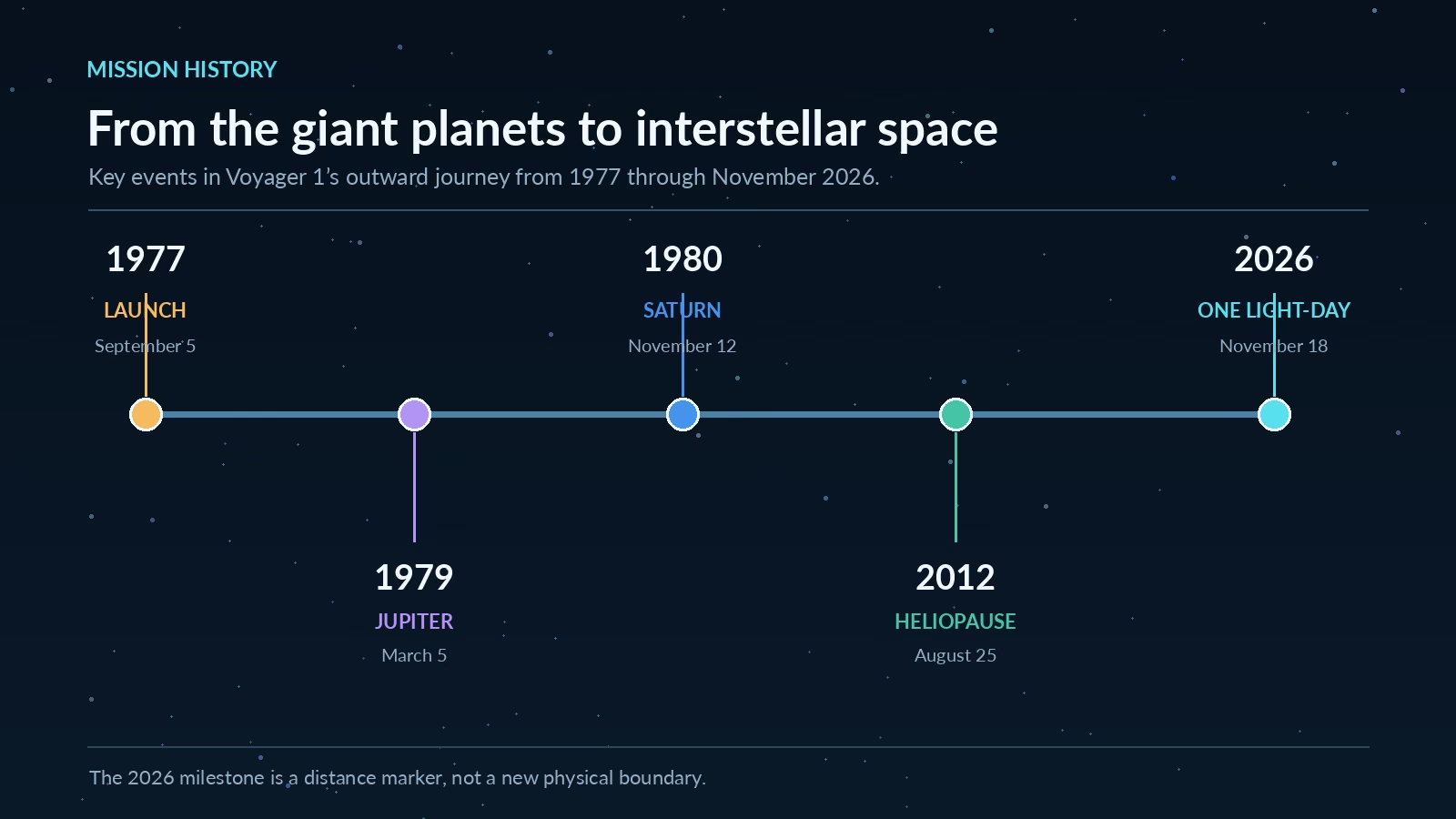
Key Milestones in Voyager 1’s Journey
Voyager 1’s progress can be understood through the sequence of planetary encounters, heliospheric crossings, and distance records achieved since its launch.
| Date | Mission milestone | Scientific or historical significance |
|---|---|---|
| September 5, 1977 | Launch | Begins outer-planet exploration |
| March 5, 1979 | Jupiter encounter | Reveals major discoveries involving Jupiter and its moons |
| November 12, 1980 | Saturn encounter | Investigates Saturn, its rings, and Titan |
| February 17, 1998 | Passes Pioneer 10 | Becomes the most distant human-made object |
| December 16, 2004 | Termination shock crossing | Enters the heliosheath |
| August 25, 2012 | Heliopause crossing | Becomes the first spacecraft in interstellar space |
| November 18, 2026 | One-light-day milestone | Reaches approximately 25.9 billion kilometers from Earth |
The timeline illustrates how a mission designed for planetary flybys gradually became an ongoing investigation of the space beyond the Sun’s heliosphere.
6. Where Is Voyager 1 Now? Understanding the Heliosphere and Interstellar Space
Voyager 1 is traveling through the local interstellar medium, beyond the heliopause that separates solar-wind-dominated plasma from its surrounding environment. However, being in interstellar space does not mean that the spacecraft has escaped every region associated with the Sun. Understanding its location requires distinguishing the heliosphere, its internal boundaries, and the much larger gravitational domain that includes distant icy objects in the Oort Cloud.
What Is the Heliosphere?
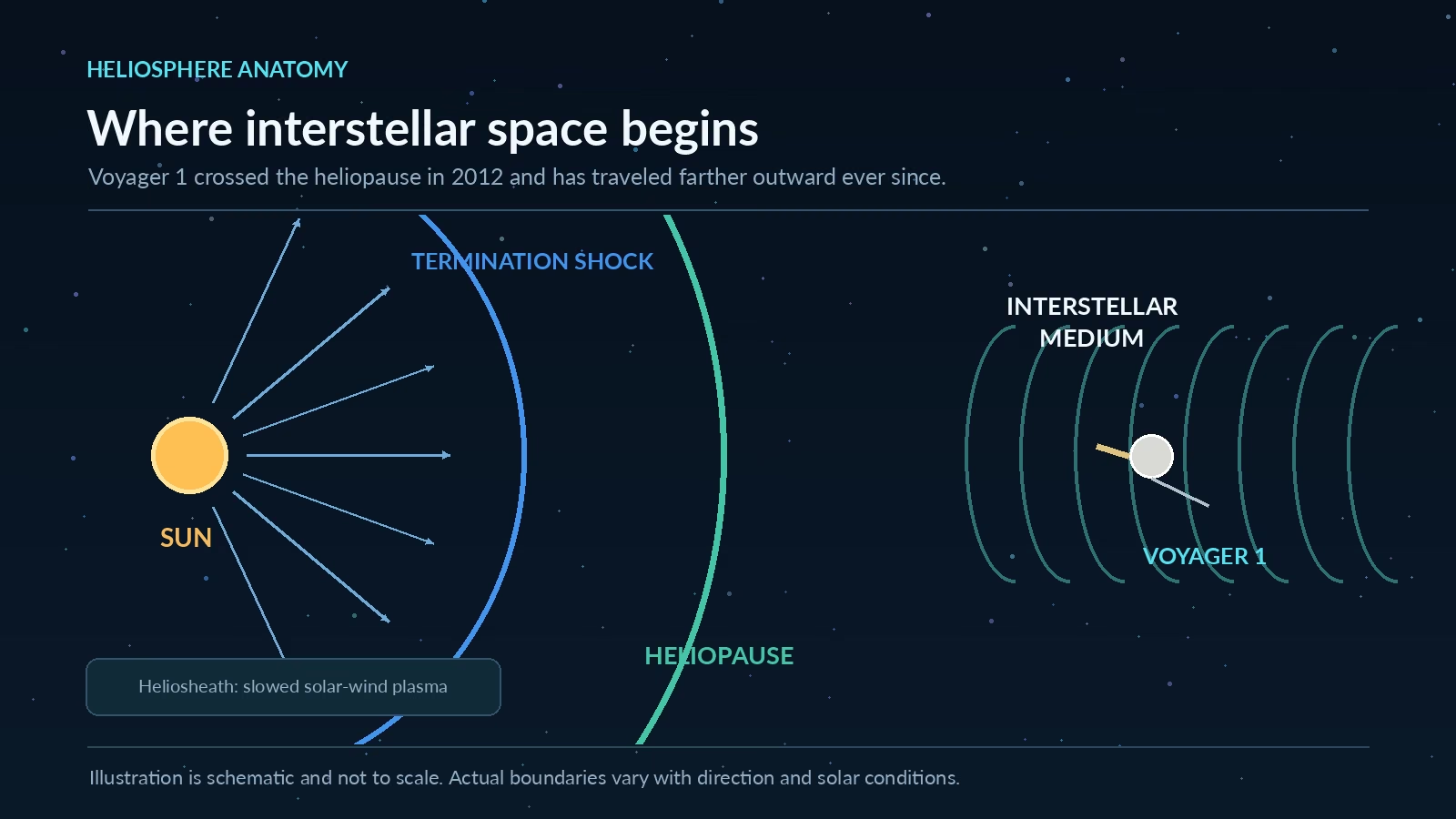
The heliosphere is the enormous region of space shaped by the solar wind and the magnetic field carried outward from the Sun.
It extends far beyond the orbits of the planets and forms a protective bubble within the surrounding interstellar medium.
The heliosphere does not have a perfectly spherical or permanently fixed shape. Its structure depends on the solar wind, magnetic conditions, and the pressure exerted by the surrounding interstellar environment.
Within this region, the Sun influences the motion and distribution of charged particles, including some high-energy cosmic rays.
The outer boundaries of the heliosphere are scientifically important because they reveal how stellar winds interact with the material between stars.
Voyager 1 became the first spacecraft to travel through these distant boundaries, allowing researchers to investigate processes that previously could only be studied indirectly.
How Does the Solar Wind Shape the Heliosphere?
The solar wind is a continuous flow of charged particles, primarily protons and electrons, released from the Sun’s outer atmosphere.
Near Earth’s orbit, typical solar-wind speeds are several hundred kilometers per second, although actual values vary substantially with solar activity.
As the solar wind moves outward, its density and pressure generally decrease. Eventually, it encounters increasing resistance from the surrounding interstellar medium.
The interaction between outward-flowing solar plasma and interstellar material produces the large-scale structure of the heliosphere.
This structure is influenced by the solar magnetic field, changes in solar activity, and the properties of the surrounding galactic environment.
Studying the solar wind at enormous distances helps scientists understand how stars interact with the gas and plasma between them, including the extent to which stellar environments influence incoming energetic particles.
What Is the Termination Shock?
The termination shock is a boundary where the outward-flowing solar wind slows from supersonic to subsonic speeds as it encounters resistance from the surrounding interstellar environment.
The transition changes the properties of the plasma, including its speed, density, temperature, and magnetic conditions.
Voyager 1 crossed the termination shock on December 16, 2004, at approximately 94 astronomical units from the Sun.
This crossing was important because it provided direct measurements of a major boundary of the heliosphere.
The termination shock is not the outermost boundary of the heliosphere. Instead, it marks the beginning of a region known as the heliosheath, where solar-wind plasma becomes slower and more complex.
Voyager 1 continued through this region for almost eight years before crossing the heliopause in August 2012. [11]
What Is the Heliosheath?
The heliosheath is the region between the termination shock and the heliopause.
Within this region, the solar wind has already slowed significantly, but the plasma and magnetic environment remain strongly influenced by the Sun.
The solar wind becomes compressed and turbulent as it interacts with pressure from the surrounding interstellar medium.
Voyager 1 investigated the heliosheath between December 2004 and August 2012. Its instruments recorded changes in energetic particles and magnetic conditions as it approached the outer boundary.
These measurements helped scientists develop a better understanding of how the heliosphere behaves under pressure from its surroundings.
The heliosheath should not be viewed as a fixed, uniform shell. Its thickness and structure can vary with direction and changing solar conditions, making direct spacecraft observations particularly valuable.
What Is the Heliopause, and When Did Voyager 1 Cross It?
The heliopause is the boundary separating plasma dominated by the solar wind from the surrounding interstellar plasma.
Voyager 1 crossed this boundary on August 25, 2012, at approximately 122 astronomical units from the Sun.
Scientists did not immediately recognize the crossing. Subsequent measurements revealed significant changes in the surrounding charged-particle environment.
In particular, Voyager 1’s plasma wave instrument detected oscillations that enabled researchers to estimate the density of nearby interstellar plasma.
These measurements provided strong evidence that the spacecraft had entered a region with characteristics expected outside the heliosphere.
The heliopause crossing marked the beginning of direct exploration of interstellar space by a human-made spacecraft.
It was a scientific boundary crossing, unlike the one-light-day event in 2026, which represented a distance measurement rather than a change in the spacecraft’s environment. [12]
Is Voyager 1 Really in Interstellar Space?
Yes. Voyager 1 has been in interstellar space since August 25, 2012, according to NASA’s interpretation of measurements obtained from its scientific instruments.
In this context, interstellar space refers to the region beyond the heliopause, where the surrounding plasma is no longer dominated by the Sun’s outward-flowing solar wind.
However, the phrase “outside the solar system” has several possible meanings.
If the solar system is defined primarily by the Sun’s heliosphere, Voyager 1 has crossed its outer boundary. If it is defined as the broader gravitational domain containing distant objects such as the Oort Cloud, Voyager 1 has not yet traveled beyond its full extent.
The spacecraft remains gravitationally influenced by the Sun, even though it follows an escape trajectory.
Therefore, the scientifically precise description is that Voyager 1 has left the heliosphere and entered interstellar space, but has not yet crossed the distant Oort Cloud. [13]
7. What Is Voyager 1 Discovering in Interstellar Space?
Voyager 1 continues contributing to our understanding of the environment between stars. Its instruments have measured plasma waves, energetic particles, and magnetic fields in a region no earlier spacecraft had directly explored. Although several scientific instruments have been switched off to conserve power, the mission still returns valuable measurements that help researchers understand the boundary between the heliosphere and the surrounding interstellar medium.
What Is the Interstellar Medium?
The interstellar medium is the matter and electromagnetic environment distributed throughout the space between stars.
It contains gas, dust, plasma, magnetic fields, and energetic particles. Its density and physical conditions vary considerably across different regions of the Milky Way.
The Sun and its heliosphere move through a portion of this environment commonly called the local interstellar medium.
Before Voyager 1 crossed the heliopause, observations of this nearby region depended largely on astronomical measurements and theoretical models.
Voyager 1 provides direct information about the plasma and magnetic conditions surrounding the heliosphere.
These measurements help scientists understand how the Sun interacts with its galactic environment and how conditions outside the heliosphere differ from those within it.
How Do Cosmic Rays Interact With the Heliosphere?
Cosmic rays are high-energy particles, primarily atomic nuclei and protons, that travel through space. Many originate from energetic astrophysical processes outside the solar system, although particles produced by the Sun can also contribute to radiation environments.
The heliosphere influences the intensity and distribution of galactic cosmic rays reaching the inner solar system.
Its magnetic fields and solar-wind plasma affect the transport of charged particles, particularly those with lower energies.
Voyager 1’s historical cosmic-ray measurements revealed changes in particle populations as the spacecraft approached and crossed the heliopause.
However, its Cosmic Ray Subsystem was turned off on February 25, 2025, to conserve electrical power.
Consequently, Voyager 1 no longer provides new measurements through that instrument. Its earlier data remain important for studying how the heliosphere modifies incoming cosmic radiation. [14]
How Does Voyager 1 Measure Plasma Density?
Plasma density describes the concentration of charged particles in a given volume of plasma.
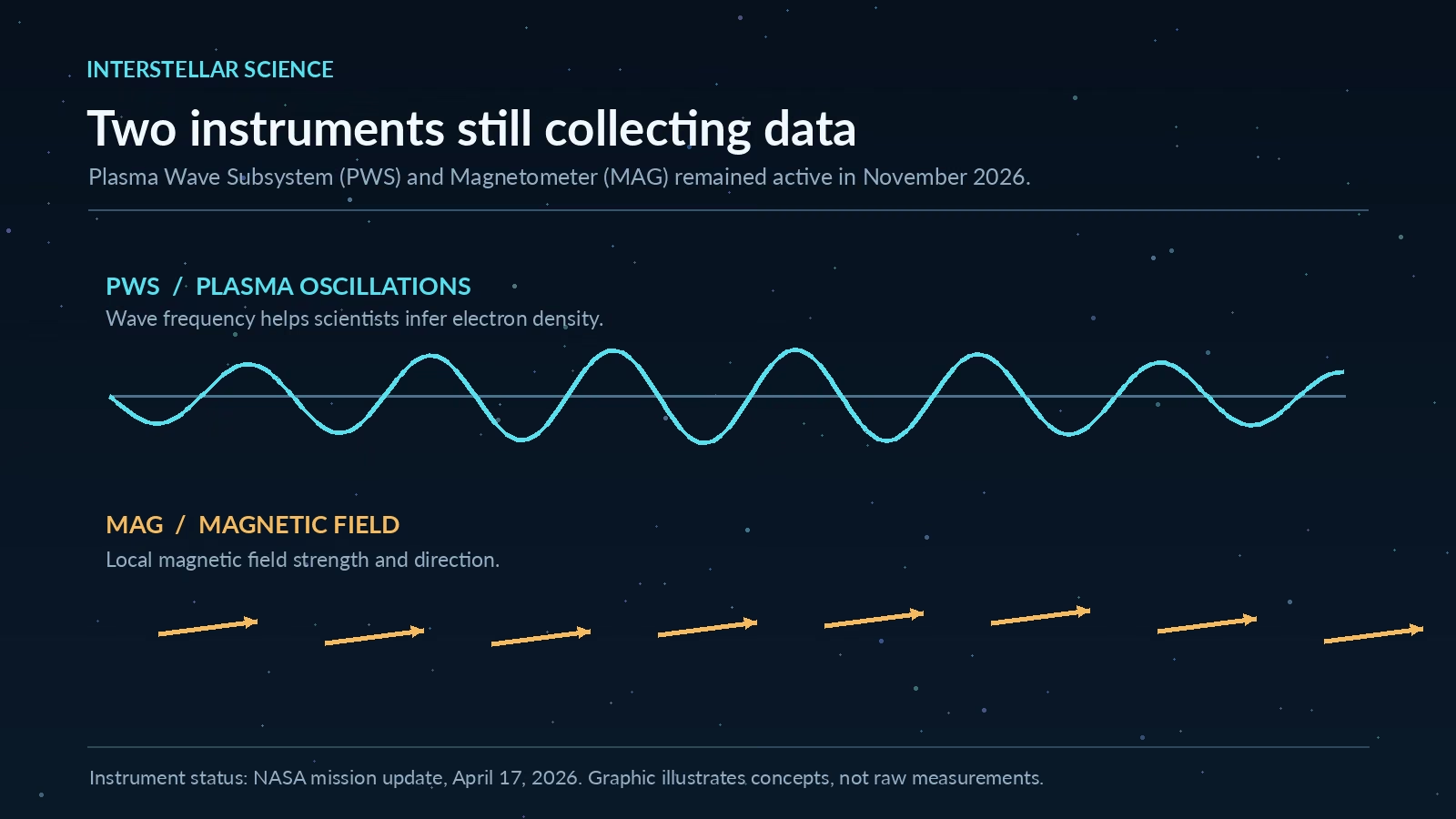
Voyager 1 investigates the surrounding plasma using its Plasma Wave Subsystem (PWS), which detects electromagnetic signals associated with plasma oscillations.
When plasma is disturbed, electrons can oscillate at characteristic frequencies. Scientists can use these frequencies to estimate electron density.
The method is especially valuable because Voyager 1’s original Plasma Science instrument is no longer operational.
In 2013, measurements of plasma oscillations helped establish that Voyager 1 had crossed into interstellar space.
Later observations revealed additional variations in electron density beyond the heliopause, allowing scientists to investigate the structure of the local interstellar environment.
Unlike direct particle collection, plasma-wave analysis derives important physical properties from the electromagnetic behavior of the surrounding charged material. [15]
What Does the Interstellar Magnetic Field Reveal?
Magnetic fields influence the movement of charged particles through interstellar space and affect the interaction between the heliosphere and its surroundings.
Voyager 1’s Magnetometer (MAG) measures the strength and direction of the magnetic field in the spacecraft’s environment.
These observations help scientists investigate how magnetic fields behave near and beyond the heliopause.
Changes in magnetic-field strength and orientation can reveal structures, disturbances, and possible interactions within the interstellar plasma.
The measurements are also important for interpreting cosmic-ray transport because charged particles respond to magnetic fields as they travel through space.
One of the scientifically interesting aspects of Voyager 1’s heliopause crossing was that the magnetic-field direction did not change as dramatically as some earlier expectations suggested.
Continued magnetometer measurements therefore help refine models of the boundary between the solar and interstellar magnetic environments.
What Scientific Instruments Does Voyager 1 Still Use?
Voyager 1 originally carried ten dedicated scientific instruments designed to investigate planets, moons, magnetic fields, charged particles, and electromagnetic radiation.
Many instruments were switched off after the planetary encounters or retired because of declining performance and electrical power.
As of November 19, 2026, NASA identifies two science instruments remaining in operation aboard Voyager 1:
| Instrument | Status | Scientific purpose |
|---|---|---|
| Plasma Wave Subsystem (PWS) | Operating | Measures plasma-wave activity and supports plasma-density studies |
| Magnetometer (MAG) | Operating | Measures magnetic-field strength and direction |
| Cosmic Ray Subsystem (CRS) | Off since February 25, 2025 | Previously measured high-energy charged particles |
| Low-Energy Charged Particles (LECP) | Off since April 17, 2026 | Previously investigated lower-energy particle populations |
| Plasma Science (PLS) | Inactive since 2007 | Previously measured plasma properties directly |
The remaining instruments provide complementary information about the surrounding interstellar environment.
However, their continued operation depends on the spacecraft’s declining electrical power and the ability of mission controllers to maintain essential spacecraft systems.
NASA’s more recent instrument reports supersede older mission summaries that still describe four operational science instruments aboard Voyager 1. [16]
8. How Has Voyager 1 Survived Nearly 50 Years in Space?
Voyager 1’s extraordinary longevity reflects a combination of durable engineering, radioisotope power, operational flexibility, and decades of careful mission management. Its original systems were designed for planetary encounters, not half a century of interstellar exploration. Maintaining the spacecraft requires balancing electrical consumption, equipment temperatures, communications, propulsion, and science priorities while responding to problems that may take days to diagnose from Earth.
What Explains Voyager 1’s Extraordinary Longevity?
Voyager 1’s survival has depended on its original engineering design and the continuing efforts of the teams responsible for operating it.
The spacecraft incorporates redundant equipment, autonomous fault protection, durable scientific instruments, and systems that can be reconfigured through commands from Earth.
Its radioisotope power system supplies electricity independently of sunlight, enabling continued operation far beyond the outer planets.
Mission engineers have repeatedly adapted operating procedures to accommodate equipment degradation and diminishing electrical power.
Components that are no longer essential can be turned off, while remaining resources are redirected toward scientific instruments and systems required for communication.
Voyager 1’s longevity illustrates the value of engineering flexibility. Rather than simply following an unchanged plan established in 1977, NASA has continually adjusted the mission to match the capabilities of the aging spacecraft.
How Does Voyager 1 Generate Electricity Without Solar Panels?
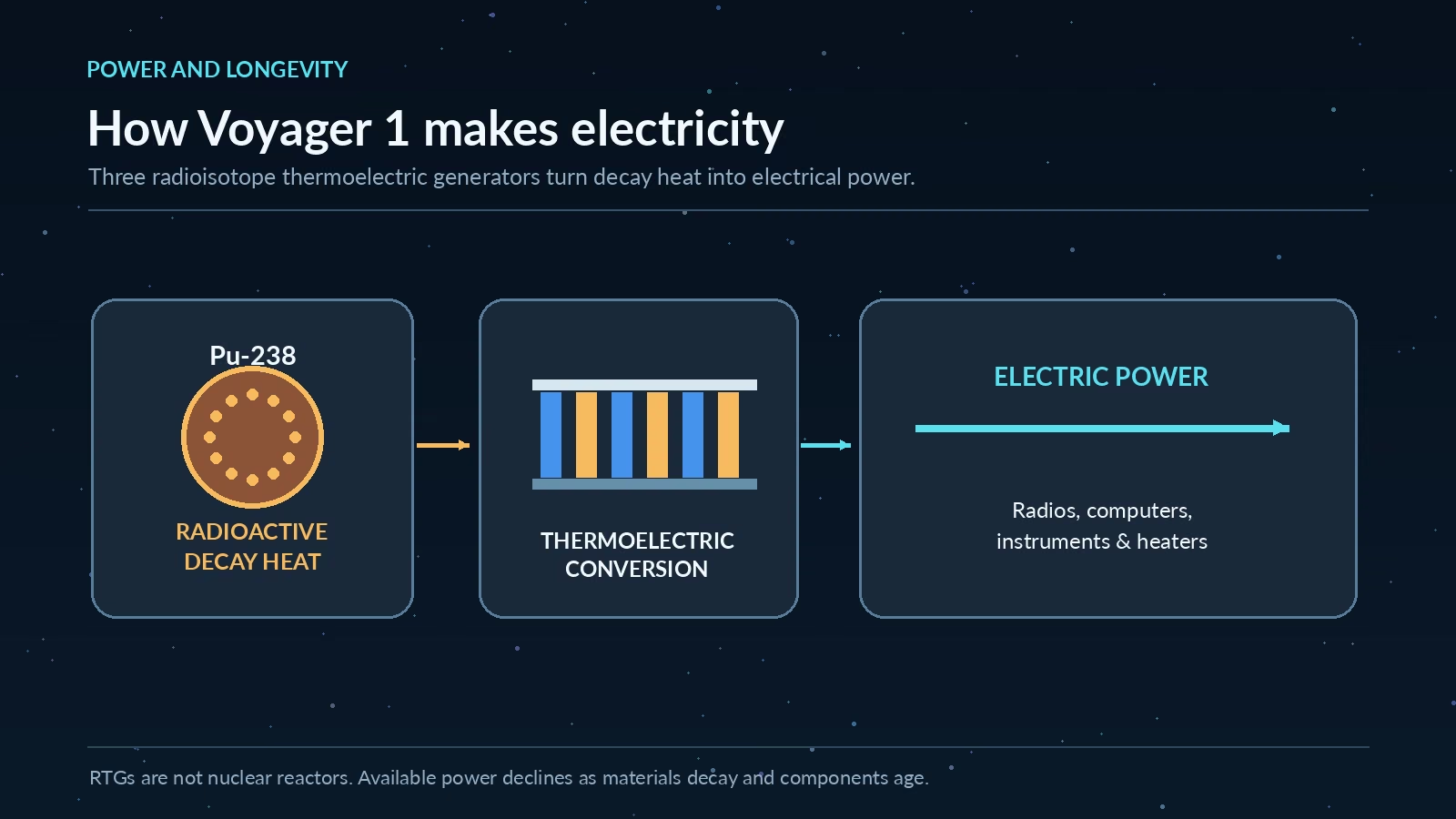
Voyager 1 generates electricity using three radioisotope thermoelectric generators (RTGs), which convert heat from radioactive decay into electrical energy.
The generators contain plutonium-238, an isotope that releases heat as it undergoes radioactive decay.
Thermoelectric components convert a portion of the temperature difference between the hot radioactive source and cooler surroundings into electrical power.
Unlike nuclear reactors, RTGs do not depend on a controlled nuclear chain reaction.
This power system is essential because sunlight becomes extremely weak at Voyager 1’s distance from the Sun. Large solar arrays would be impractical for providing comparable power so far from our star.
The generators have no conventional moving machinery for producing electricity, helping them operate over long periods.
However, available electrical power gradually declines because of plutonium decay and deterioration in thermoelectric conversion performance. [8]
Why Is Mission Power Management Becoming Critical?
Voyager 1 and Voyager 2 lose approximately four watts of available electrical power per year, according to NASA.
As their power supplies decline, engineers must carefully balance the needs of scientific instruments, radio transmitters, spacecraft computers, propulsion controls, and thermal management systems.
In February 2025, NASA switched off Voyager 1’s Cosmic Ray Subsystem. In April 2026, engineers switched off its Low-Energy Charged Particles experiment.
A further energy-saving effort completed in September 2026 replaced three powered devices with lower-power alternatives while preserving the spacecraft’s necessary thermal balance.
The effort, nicknamed the “Big Bang” by mission engineers, was designed to extend the operating lives of the remaining scientific instruments.
NASA indicated that without the changes, Voyager 1 might have needed another instrument shutdown as early as summer 2027.
The successful modifications improved the outlook for continued operation, but they did not eliminate the long-term decline in electrical power. [7]
How Do Attitude Control Thrusters Keep Voyager 1 Pointed Toward Earth?
Spacecraft attitude describes an object’s orientation in three-dimensional space.
Voyager 1 must maintain a sufficiently accurate orientation to direct its high-gain antenna toward Earth, where the Deep Space Network receives its signals.
Small attitude-control thrusters help adjust the spacecraft’s orientation when necessary.
These thrusters do not serve as the primary source of Voyager 1’s long-distance travel. Instead, they perform small corrective maneuvers that preserve the spacecraft’s ability to communicate and carry out scientific operations.
As the spacecraft ages, thruster performance and propulsion-system reliability become increasingly important.
Engineers monitor the behavior of available thrusters and may use backup equipment when required.
Precise attitude control is essential because even small pointing errors can interfere with communications across the enormous distance separating the spacecraft from Earth.
What Happens When Voyager 1 Detects a Technical Problem?
Voyager 1 includes autonomous fault-protection software designed to respond to certain unexpected spacecraft conditions without waiting for instructions from Earth.
When an onboard system detects a problem, protective procedures may reconfigure equipment, activate backups, or place the spacecraft in a safer operating condition.
This capability is essential because Earth-based commands now require approximately 24 hours to arrive.
An example occurred in October 2026, when the Deep Space Network failed to detect Voyager 1’s signal during scheduled communication attempts on October 18 and 19.
The signal reappeared on October 20, before engineers transmitted corrective commands.
NASA subsequently reported that one set of thrusters had gone offline and backup thrusters had activated. Engineers continued investigating the underlying cause, so the precise initiating fault had not been established in the October 29 report.
The incident demonstrated the importance of autonomous protection and redundancy for spacecraft operating at extreme distances. [7]
9. Voyager 1’s Cultural Legacy: Humanity’s Message to the Universe
Voyager 1’s importance extends beyond its technical achievements and scientific measurements. The spacecraft carries cultural artifacts intended to represent Earth to any distant civilization that might encounter it. Its Golden Record, connection to astronomer Carl Sagan, and famous Pale Blue Dot photograph have made Voyager 1 an enduring symbol of humanity’s curiosity and its place within the universe.
What Is the Voyager Golden Record?
The Voyager Golden Record is a gold-plated copper phonograph record carried aboard both Voyager spacecraft.
It was created as a symbolic message representing Earth, human civilization, and the diversity of life on our planet.
The record contains 115 encoded images, greetings in 55 languages, natural sounds, and music selected from different cultures and historical periods.
Its contents include representations of people, animals, landscapes, scientific concepts, and aspects of human daily life.
The record’s protective cover contains symbolic instructions explaining how it can be played and information intended to help identify its origin.
The Golden Record is not part of Voyager 1’s scientific measurement equipment. Instead, it serves as a cultural time capsule intended to accompany the spacecraft during its long journey through space. [17]
How Did Carl Sagan Shape the Voyager Mission’s Legacy?
Astronomer and science communicator Carl Sagan played a central role in developing the Voyager Golden Record.
Sagan chaired the committee responsible for selecting images, sounds, greetings, and music intended to represent Earth and humanity.
The project brought together scientists, artists, and other contributors to determine how a small collection of materials could communicate aspects of life on our planet.
Sagan also helped explain the broader meaning of planetary exploration to the public.
His work connected scientific discoveries with philosophical questions about humanity’s place in the universe.
The Golden Record reflects this perspective. It combines scientific information with cultural expression, presenting the Voyager spacecraft not only as robotic explorers but also as symbolic messengers from Earth.
What Is the Pale Blue Dot, and Why Does It Matter?
The Pale Blue Dot is a famous photograph of Earth captured by Voyager 1 on February 14, 1990.
At the time, the spacecraft was approximately 6 billion kilometers (3.7 billion miles) from the Sun.
The image was part of a wider sequence of photographs often called the Solar System Family Portrait.
In the photograph, Earth appears as an extremely small point within a scattered ray of sunlight.
The image became closely associated with Carl Sagan’s reflections on humanity’s place in the cosmos.
It demonstrates how small Earth appears when viewed from the distant outer solar system and how dramatically our perspective changes with increasing distance.
Voyager 1’s one-light-day milestone provides an even more distant reference point, although the spacecraft’s cameras have long since been switched off and it did not photograph Earth from that distance in 2026. [18]
What Has Voyager Project Manager Suzanne Dodd Said About the Milestone?
Suzanne Dodd, Voyager project manager at NASA’s Jet Propulsion Laboratory, has emphasized the extraordinary communications challenge created by the spacecraft’s distance.
In NASA’s October 29, 2026 mission update, Dodd explained that sending a message to Voyager 1 and receiving a response now effectively requires a two-day communication cycle.
Her observation highlights one of the milestone’s most important implications: the physical distance between Earth and the spacecraft now determines the pace of everyday mission operations.
Dodd and the wider mission leadership must balance the scientific value of continued observations with the risks created by aging equipment and declining electrical power.
The mission’s progress depends on the work of multiple generations of engineers and scientists who have preserved spacecraft systems and adapted operating procedures since 1977.
How Can the Public Track Voyager 1’s Position?
NASA provides publicly accessible tools that allow people to follow Voyager 1 and Voyager 2 as they continue traveling outward.
One of the most useful resources is NASA Eyes on the Solar System, an interactive three-dimensional visualization platform.
Users can explore spacecraft trajectories, examine the positions of planets, and investigate historical mission events.
NASA’s dedicated Voyager mission-status pages also present distance information and instrument status, helping readers understand how the spacecraft are progressing.
For the one-light-day milestone, Caltech provides an additional visualization that explains Voyager 1’s distance from Earth in light-travel units.
These resources are especially helpful for understanding distances that are difficult to visualize using conventional maps.
Official resources include NASA Eyes on the Solar System, NASA’s Voyager mission status, and Caltech’s one-light-day tracker.
10. What Happens Next for Voyager 1 After Reaching One Light-Day?
Voyager 1 will continue moving through interstellar space long after its one-light-day milestone. Its scientific mission will depend on available electrical power, communications capability, and the condition of its remaining instruments. Even when the spacecraft can no longer transmit information to Earth, its physical journey will continue. Over thousands of years, Voyager 1 will travel farther into the surrounding galactic environment and eventually pass relatively near other stars.
What Is the Future of the Voyager Interstellar Mission?
The Voyager Interstellar Mission is the extended phase of NASA’s Voyager program devoted to investigating the distant heliosphere and surrounding interstellar environment.
Its scientific value comes from the ability to directly measure conditions that cannot be fully characterized using Earth-based observations alone.
Voyager 1 continues gathering data using its plasma wave and magnetic-field instruments, while Voyager 2 supplies complementary observations from a different trajectory.
The long-term challenge is the continued decline in electrical power.
NASA has already retired several instruments and adjusted spacecraft operations to conserve energy.
Additional reductions may eventually become necessary, although the exact timing depends on future power margins and spacecraft performance.
The end of science operations and the end of communication need not occur simultaneously. Some systems may continue operating after scientific instruments are switched off, while a loss of sufficient transmission power or another major fault could eventually end contact altogether.
Will Voyager 1 Eventually Travel Through the Oort Cloud?
Voyager 1 is expected to travel through the distant region associated with the Oort Cloud as it continues along its outward trajectory.
The Oort Cloud is a hypothesized population of icy bodies occupying extremely distant orbits around the Sun. Scientists infer its existence primarily from the behavior of long-period comets.
Its boundaries are uncertain because the region has not been directly mapped.
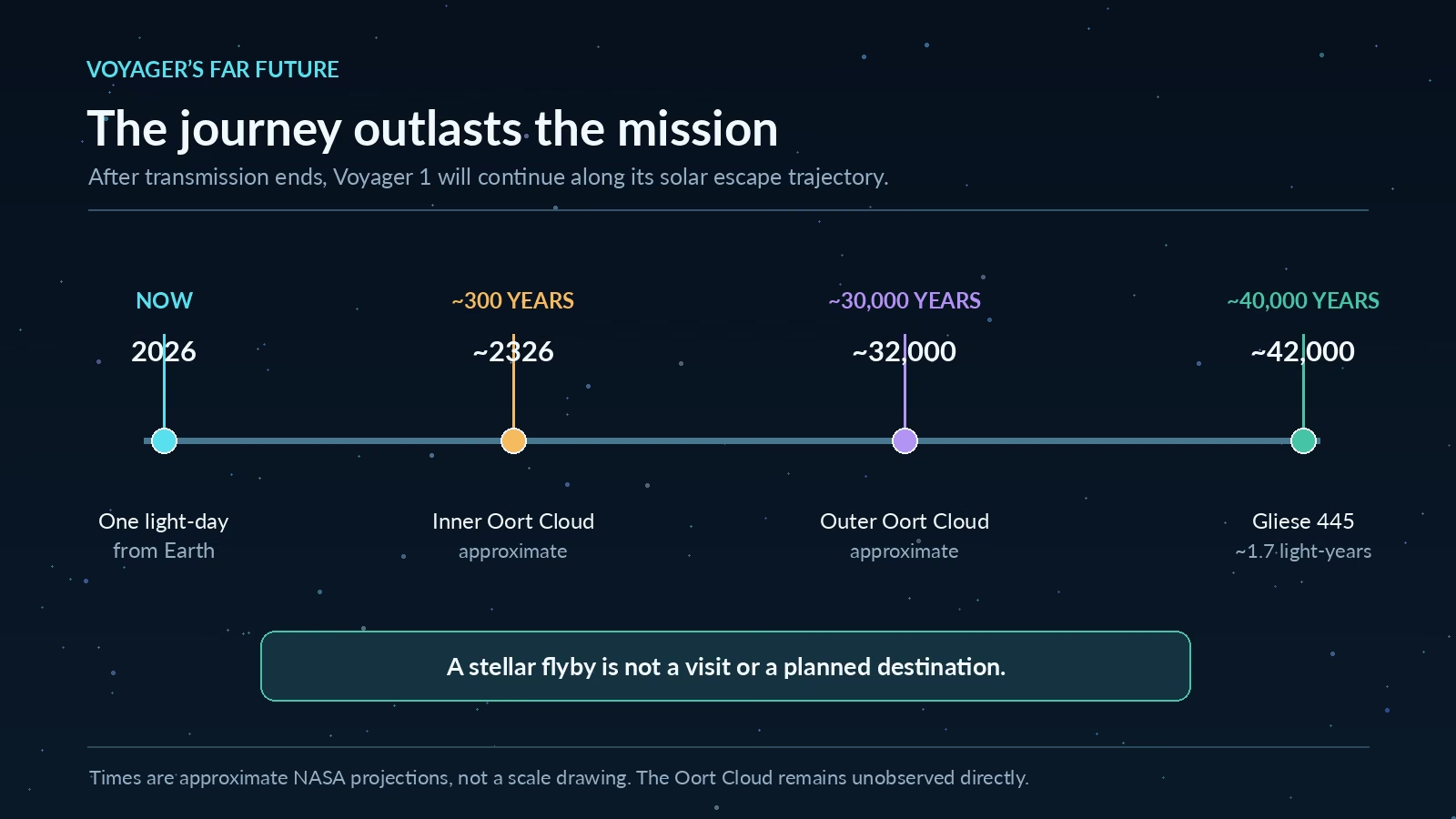
NASA estimates that Voyager 1 will require approximately 300 years to reach the inner region of the Oort Cloud and potentially around 30,000 years to travel beyond its outer extent.
These timescales illustrate why crossing the heliopause does not mean the spacecraft has passed beyond every object gravitationally associated with the Sun.
The Oort Cloud represents a vastly larger spatial domain than the planetary region, and Voyager 1 has only begun its long passage toward these distant reaches. [19]
Will Voyager 1 Ever Reach Another Star?
Voyager 1 is expected to make a relatively close approach to a distant star called Gliese 445, also cataloged as AC +79 3888.
According to NASA and Caltech, the spacecraft will pass within approximately 1.7 light-years of the star in about 40,000 years.
NASA currently identifies Gliese 445 with the constellation Ursa Minor.
This is not a planned stellar encounter or a mission destination. The spacecraft is simply following its existing trajectory through space, while the star also moves through the galaxy.
A closest approach of 1.7 light-years remains an enormous distance, far beyond the scale of the planetary systems familiar to spacecraft explorers.
Voyager 1 will almost certainly no longer be functioning as an active scientific spacecraft by then.
Nevertheless, its physical structure and Golden Record may continue traveling through the galaxy for an extremely long time, preserving a symbolic record of the civilization that launched it. [1]
Why Will Voyager 1’s Journey Remain Important for Future Space Missions?
Voyager 1 offers important lessons for future spacecraft designed to explore distant regions of the solar system and beyond.
Its experience demonstrates the importance of long-duration reliability, redundant spacecraft systems, autonomous fault protection, and careful management of limited electrical power.
The mission also shows how communication delay becomes a defining operational constraint as spacecraft move farther from Earth.
Future interstellar probes may require considerably greater onboard autonomy because Earth-based controllers cannot respond quickly to unexpected conditions.
Scientifically, Voyager 1 has demonstrated the value of directly measuring plasma and magnetic fields beyond the heliopause.
Its discoveries help establish a foundation for future investigations of stellar winds, interstellar environments, and the outer boundaries of planetary systems.
Even after Voyager 1’s scientific operations eventually cease, the experience accumulated during its decades of operation will remain valuable for generations of engineers and researchers.
Frequently Asked Questions About Voyager 1’s One-Light-Day Milestone
Voyager 1’s historic achievement raises questions about its distance, communication systems, location, remaining scientific capabilities, and eventual future. The answers depend on distinguishing the spacecraft’s measured separation from Earth, its position relative to the heliosphere, and its long-term solar escape trajectory. These questions also help clarify what the milestone means scientifically and what it does not.
When Did Voyager 1 Reach One Light-Day From Earth?
Voyager 1 reached one light-day from Earth on November 18, 2026, at 10:16:07 UTC, equivalent to 2:16:07 a.m. Pacific Standard Time.
NASA and Caltech identified the milestone using the spacecraft’s predicted trajectory and changing distance from Earth.
The event marked the first time a human-made object reached a separation equivalent to 24 hours of light travel.
It did not involve crossing a physical boundary or entering a new astronomical region.
Instead, it recognized the extraordinary distance covered by the spacecraft during more than 49 years of exploration.
How Far Away Is Voyager 1 in Miles and Kilometers?
At the milestone, Voyager 1 was approximately 16.094 billion miles or 25.902 billion kilometers from Earth.
This distance is equivalent to about 173 astronomical units, with minor differences depending on the exact Earth-spacecraft geometry.
Voyager 1 continues traveling outward from the Sun, so its distance changes over time.
Its separation from Earth can also fluctuate because Earth moves around the Sun.
For the most recent official estimates, readers should consult NASA’s Voyager mission-status page rather than relying on a fixed historical number.
Why Does It Take 24 Hours to Communicate With Voyager 1?
At a separation of one light-day, radio waves require approximately 24 hours to travel from Earth to Voyager 1.
Radio signals move through the vacuum of space at the speed of light, approximately 299,792 kilometers per second.
Although this speed is extraordinarily fast, the distance between Earth and the spacecraft is so large that a substantial communication delay is unavoidable.
A response transmitted immediately from Voyager 1 requires another approximately 24 hours to reach Earth, creating a minimum round-trip light-travel delay of roughly 48 hours.
Has Voyager 1 Left the Solar System Completely?
Voyager 1 crossed the heliopause on August 25, 2012, becoming the first spacecraft to enter interstellar space.
However, whether it has completely left the solar system depends on how the solar system’s outer boundary is defined.
The heliopause marks the limit of the solar-wind-dominated plasma environment, while the Sun’s gravitational influence extends much farther.
The distant Oort Cloud is often considered part of the broader solar system.
Voyager 1 has not yet traveled beyond that region, so it has entered interstellar space without crossing every possible boundary associated with the Sun.
Is Voyager 1 Still Working and Sending Information to Earth?
As of November 19, 2026, Voyager 1 remains in communication with NASA and continues returning scientific information.
Its two operating science instruments are the Plasma Wave Subsystem and Magnetometer.
Several other instruments have been retired to conserve electrical power.
Voyager 1 temporarily lost detectable communications during scheduled attempts in October 2026, but NASA reported that contact resumed on October 20.
The spacecraft’s continuing operation depends on its remaining power, working communications equipment, onboard computers, attitude-control systems, and the ability of engineers to manage future technical problems.
Will Voyager 2 Also Reach One Light-Day From Earth?
NASA projects that Voyager 2 will reach a distance of one light-day from Earth in November 2035, approximately nine years after Voyager 1.
Voyager 2 followed a different trajectory that allowed it to explore Uranus and Neptune, while Voyager 1 took a faster route outward after its Saturn encounter.
The projected milestone depends on the spacecraft’s future trajectory and its separation from Earth.
Voyager 2 does not need to remain operational to physically reach the distance. However, its continued operation would allow scientists and engineers to observe the milestone through spacecraft communications and telemetry.
Conclusion: Voyager 1’s One-Light-Day Milestone and the Future of Exploration
Voyager 1’s achievement on November 18, 2026, represents one of the most remarkable distance milestones in the history of robotic space exploration.
After more than 49 years in space, the spacecraft became the first human-made object to reach approximately 25.9 billion kilometers from Earth, a separation equivalent to an entire day of light travel.
The milestone reflects far more than the distance itself.
Voyager 1 transformed humanity’s understanding of Jupiter, Saturn, and their moons before continuing into the distant heliosphere and eventually crossing into interstellar space.
Its observations of charged particles, plasma waves, and magnetic fields have helped reveal the physical conditions beyond the Sun’s protective influence.
At the same time, its continuing operation demonstrates the importance of resilient spacecraft engineering, autonomous systems, long-term planning, and the work of generations of scientists and engineers.
Voyager 1 will eventually stop returning scientific information as its power supply declines. But its journey will not end when its instruments and transmitters fall silent.
The spacecraft will continue traveling through the galaxy, carrying the Voyager Golden Record and the legacy of a mission that began in 1977.
One light-day from Earth is an extraordinary distance for a spacecraft, yet only the beginning of the immense distances separating the stars.
Sources
The article uses NASA, NASA’s Jet Propulsion Laboratory, Caltech, and U.S. National Institute of Standards and Technology materials. Recent mission updates are prioritized for Voyager 1’s operational status.
[1] Caltech, Voyager 50. One Light-Day to One Light-Year. Confirms the November 18, 2026 milestone, exact UTC time, distance tracking, and future stellar encounter.
[2] NASA Science. Where Are Voyager 1 and Voyager 2 Now?. Official milestone information, spacecraft distance, tracking, and instrument status.
[3] NASA Science. Voyager 1: The Farthest Spacecraft. Historical mission timeline, Jupiter and Saturn encounters, and distance records.
[4] National Institute of Standards and Technology. Speed of Light in Vacuum. Official physical constant used in light-day calculations.
[5] NASA Jet Propulsion Laboratory. Astrodynamic Parameters. Astronomical unit and physical reference values.
[6] NASA Science. Voyager 1: What Is a Light-Day?. Light-day explanations, distance comparisons, and Voyager 2’s projected milestone.
[7] NASA Science, October 29, 2026. NASA’s Voyager 1 Conserves Power, Resolves Brief Communications Pause. Recent power conservation measures and October communication interruption.
[8] NASA Science. Voyager Instruments. Spacecraft hardware, scientific instruments, power systems, and telecommunications.
[9] NASA. Deep Space Network. Ground antenna facilities and deep-space communications infrastructure.
[10] NASA Science. Voyager Planetary Voyage. Original mission, planetary alignment, gravity assists, and scientific discoveries.
[11] NASA Science. Voyager Interstellar Mission. Heliosphere structure, termination shock, heliosheath, and heliopause.
[12] NASA, September 2013. NASA Spacecraft Embarks on Historic Journey Into Interstellar Space. Scientific evidence establishing Voyager 1’s heliopause crossing.
[13] NASA Science. Frequently Asked Questions About Voyager. Solar system boundaries, spacecraft trajectories, and Oort Cloud estimates.
[14] NASA Science. Voyager Interstellar Science. Mission science objectives and instrument retirement history.
[15] NASA. Voyager 1’s Interstellar Plasma Density Measurements. Plasma-wave analysis and interstellar electron-density observations.
[16] NASA Science, April 17, 2026. NASA Shuts Off Instrument on Voyager 1 to Keep Spacecraft Operating. Confirms the retirement of the LECP experiment and the two remaining operational science instruments.
[17] NASA Science. Voyager Golden Record Overview. Contents, history, and cultural purpose of the Golden Record.
[18] NASA Science. The Pale Blue Dot. Official information on Voyager 1’s February 1990 image of Earth.
[19] NASA Science. Oort Cloud Facts. Oort Cloud structure and Voyager 1’s estimated travel times.
[20] NASA/JPL. Eyes on the Solar System. Interactive spacecraft and solar system visualization.
[21] NASA Science, November 16, 2026. Voyager One Light-Day Downloads. Official milestone materials documenting the November 18, 2026 achievement.
[22] Nature, November 17, 2026. Voyager 1 Is About to Achieve a Cosmic First: One Light Day From Earth. Independent scientific reporting on the milestone and the Voyager mission’s significance.