
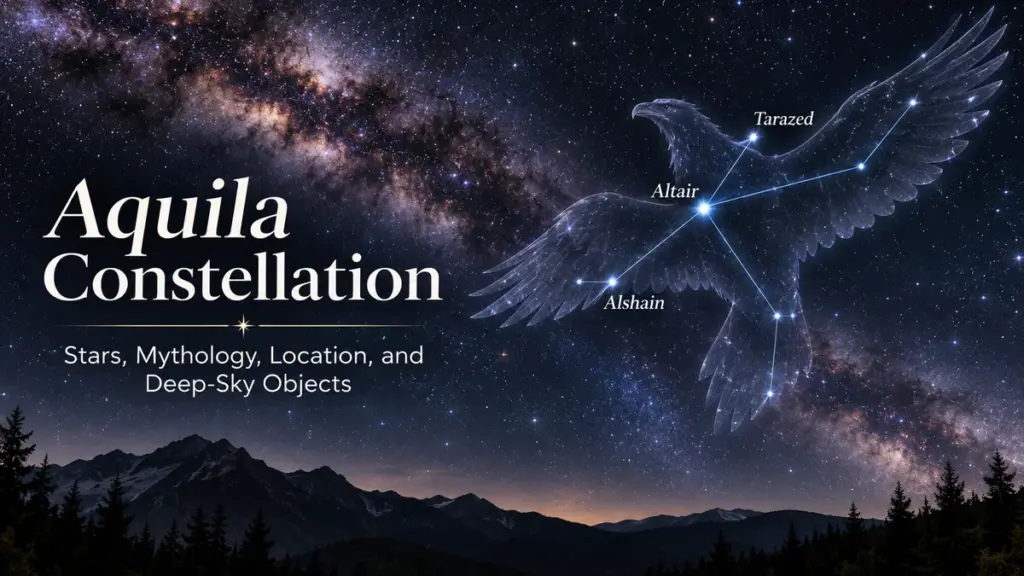
The Aquila constellation, also called the Eagle, is one of the 88 officially recognized constellations in the night sky. Located near the celestial equator and along the Milky Way, Aquila is distinguished by Altair, one of the brightest stars visible from Earth and a member of the famous Summer Triangle.
Aquila occupies approximately 652 square degrees of the celestial sphere, making it the 22nd-largest modern constellation. It contains bright stars, variable stars, open and globular clusters, planetary nebulae, and dark interstellar clouds. Its history also connects astronomy with ancient Greek mythology and East Asian cultural traditions.[1] [2]
This guide explores Aquila’s location, stars, scientific properties, astronomical objects, mythology, seasonal visibility, and practical observing methods.
What Is the Aquila Constellation?
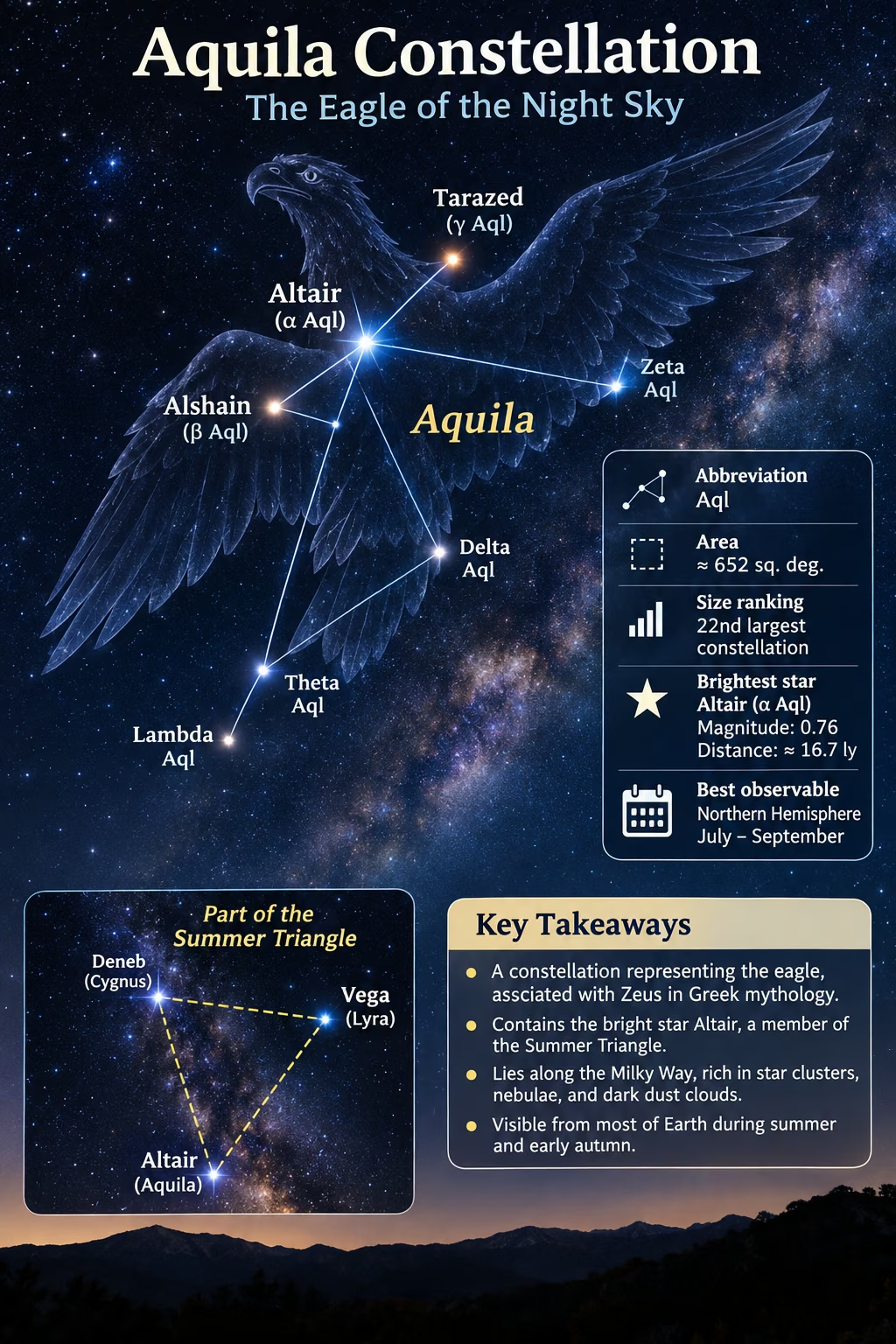
Aquila is a constellation centered near the celestial equator, visible from most inhabited regions of Earth during appropriate seasons. Its brightest star, Altair, provides an easily recognizable reference point for identifying the rest of its stellar pattern. The constellation is especially prominent in Northern Hemisphere summer and early autumn.
Unlike a star cluster, a constellation is not a gravitationally bound collection of stars. Its stars appear grouped together because they occupy approximately the same direction when viewed from Earth. In reality, these stars can be separated by enormous distances.
Aquila Constellation Meaning and Definition
The name Aquila comes from the Latin word for “eagle.” In traditional Western star charts, the constellation represents a bird with outstretched wings. Altair forms a central feature of this pattern, while surrounding stars help outline the eagle’s body and wings.
Modern astronomy defines Aquila as a specific region of the celestial sphere, not merely the visible eagle-shaped arrangement. Every astronomical object whose celestial coordinates fall within this region belongs to Aquila for positional classification, even when it does not contribute to the traditional figure.[1]
Origin of the Name Aquila
Aquila’s Latin name reflects its long association with an eagle in classical astronomy. The star name Altair has a different linguistic origin, coming from Arabic astronomical terminology associated with a flying eagle. These naming traditions illustrate how astronomical knowledge developed through several cultures.
The formal Latin genitive of Aquila is Aquilae, used in stellar designations such as Alpha Aquilae, Beta Aquilae, and Gamma Aquilae. Its standardized three-letter abbreviation is Aql, which appears in star catalogs, charts, scientific databases, and astronomical observing records.[1]
Aquila in Modern Astronomical Classification
The International Astronomical Union (IAU) recognizes 88 constellations that collectively cover the entire celestial sphere. The organization adopted its official list and abbreviations in 1922, with standardized constellation boundaries subsequently established through the work of astronomer Eugène Delporte.
Aquila is one of these officially recognized sky regions. Its boundaries are based on celestial coordinates, providing an unambiguous way to assign astronomical objects to constellations. The IAU does not prescribe a single official drawing of the eagle, so illustrated constellation figures can differ between star atlases.[1]
Where Is the Aquila Constellation Located in the Night Sky?
Aquila lies in the equatorial region of the celestial sphere, predominantly south of the smaller constellation Sagitta and near several constellations associated with the Milky Way. It stretches across both sides of the celestial equator, making it accessible to observers in most northern and southern geographic latitudes.
Its brightest star, Altair, offers the simplest starting point for locating it. Once Altair is identified, nearby stars reveal Aquila’s traditional shape, while a detailed star chart establishes its larger official boundaries.
Aquila’s Position in the Celestial Sphere
The celestial equator is the projection of Earth’s equator onto the imaginary sphere surrounding our planet. Aquila crosses this reference circle, with its official boundaries extending approximately from declination +18.7° to -11.9° and across right ascensions of roughly 18 hours 41 minutes to 20 hours 38 minutes.
Right ascension measures eastward position around the celestial sphere, while declination measures angular distance north or south of the celestial equator. Together, these coordinates make it possible to locate individual stars and deep-sky objects accurately, regardless of the observer’s geographic location.[2]
Aquila and the Milky Way
The Milky Way passes through Aquila, creating rich stellar backgrounds that become particularly striking under dark skies. This broad luminous band represents the combined light of enormous numbers of stars in our galaxy’s disk, many of which cannot be individually resolved without optical instruments.
Aquila’s position near the galactic plane also means that observers encounter substantial amounts of interstellar gas and dust. These materials can obscure distant stars, producing dark lanes and patches against the bright Milky Way. The Great Rift is a particularly important example of this phenomenon.
Constellations Surrounding Aquila
Aquila borders nine officially recognized constellations: Sagitta, Hercules, Ophiuchus, Serpens Cauda, Scutum, Sagittarius, Capricornus, Aquarius, and Delphinus. These neighboring regions provide useful reference points for interpreting detailed star charts.
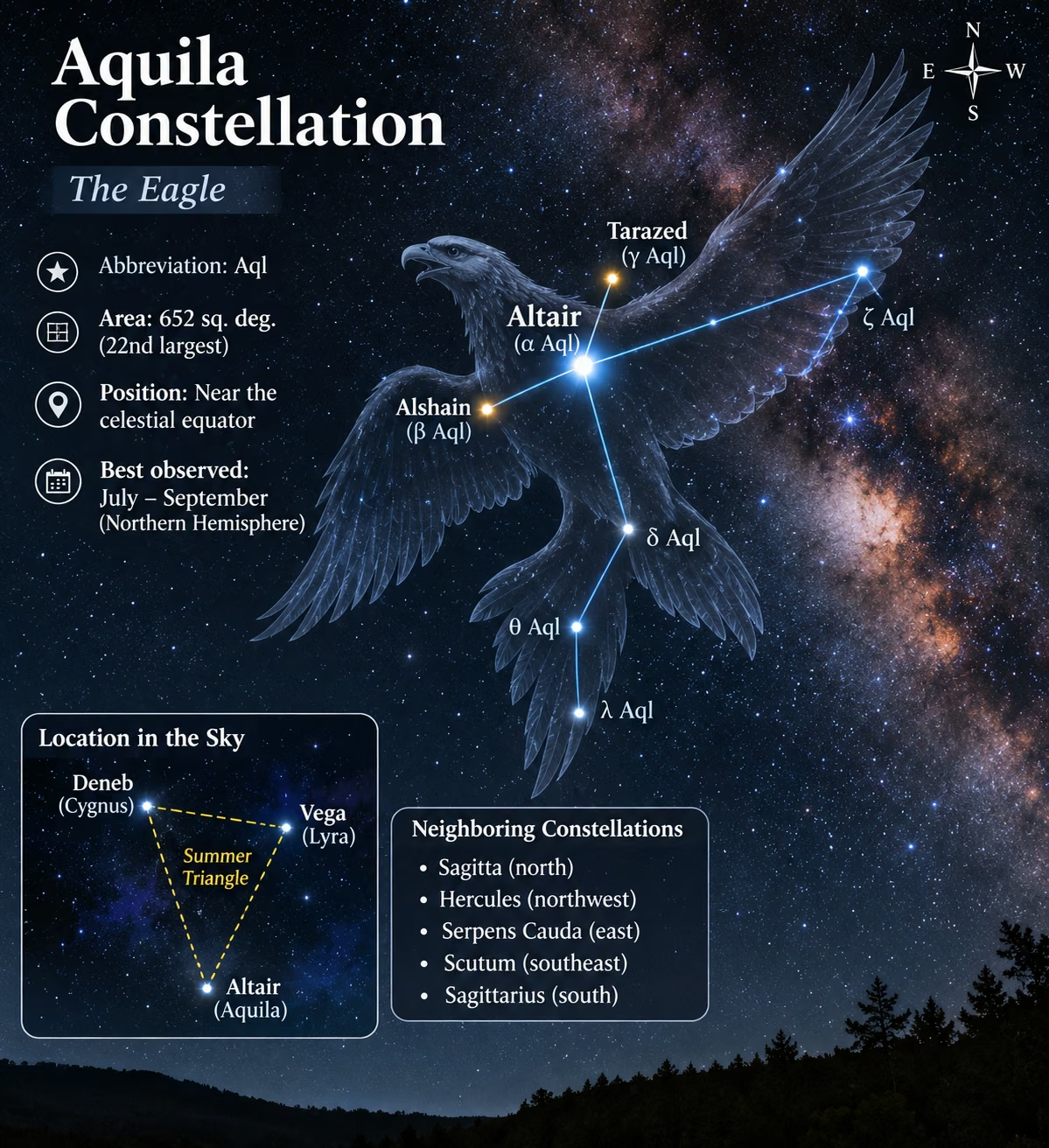
Cygnus is also an important nearby constellation because its brightest star, Deneb, joins Altair and Vega in the Summer Triangle. However, Cygnus does not directly share an official boundary with Aquila. This distinction matters when comparing traditional visual star patterns with formal constellation geography.[2]
Cygnus: The Swan
Cygnus is a prominent constellation along the northern Milky Way, distinguished by Deneb and the recognizable Northern Cross asterism. Although it does not directly border Aquila, it occupies the same broad summer-sky region and serves as an excellent navigational reference.
Deneb, Altair, and Vega establish the Summer Triangle, allowing observers to locate Cygnus and Aquila together. The contrast between their traditional bird figures also makes them useful subjects for learning how cultures interpret celestial star arrangements.
Sagitta: The Arrow
Sagitta is a small constellation located immediately north of Aquila. Its Latin name means “arrow,” reflecting the compact arrangement of stars that forms its traditional figure. Although Sagitta lacks a star comparable in brightness to Altair, its recognizable shape can be identified under reasonably dark conditions.
Finding Sagitta helps observers establish Aquila’s northern surroundings. Because the two constellations share an official boundary, their relationship is especially useful when working with detailed sky atlases or locating faint astronomical objects near the boundary.
Scutum: The Shield
Scutum lies beside Aquila toward the rich stellar regions of the Milky Way. It is a relatively small constellation, but its location makes it significant for observers interested in dense star fields, open clusters, and the structure of the galactic disk.
The Scutum region includes particularly rich Milky Way backgrounds. Observers moving their binoculars from Aquila toward Scutum can explore changes in stellar density and the appearance of dark dust lanes, gaining a practical sense of the galaxy’s structure.
Serpens Cauda: The Serpent’s Tail
Serpens Cauda is the eastern portion of the constellation Serpens, which is unusually represented by two separated sky regions. Its other portion is Serpens Caput, the Serpent’s Head, with Ophiuchus occupying the area between them.
Serpens Cauda borders Aquila and lies in a visually rich region of the Milky Way. It is important to distinguish this constellation from the nearby Eagle Nebula, Messier 16, which is located in Serpens rather than Aquila despite its bird-related name.
Hercules and Sagittarius
Hercules borders Aquila toward the northwestern portion of its official boundaries, while Sagittarius lies farther south near the direction of the Milky Way’s central regions. Both are important celestial reference points, although they represent very different observational environments.
Hercules is well known for its globular clusters, particularly Messier 13, while Sagittarius contains numerous star clusters and nebulae. Comparing these constellations with Aquila helps illustrate how deep-sky objects are distributed across different regions of the galaxy.
How to Identify Aquila Using the Summer Triangle
The easiest way to find Aquila is to locate the Summer Triangle, a large and recognizable asterism formed by Altair, Vega, and Deneb. These stars are bright enough to remain visible under many suburban skies, making the pattern useful even when numerous fainter stars are hidden by light pollution.
Altair marks the Aquila vertex of the triangle. Its position, together with two nearby stars named Tarazed and Alshain, makes it possible to recognize the central portion of the Eagle constellation without specialized equipment.[3]
What Is the Summer Triangle?
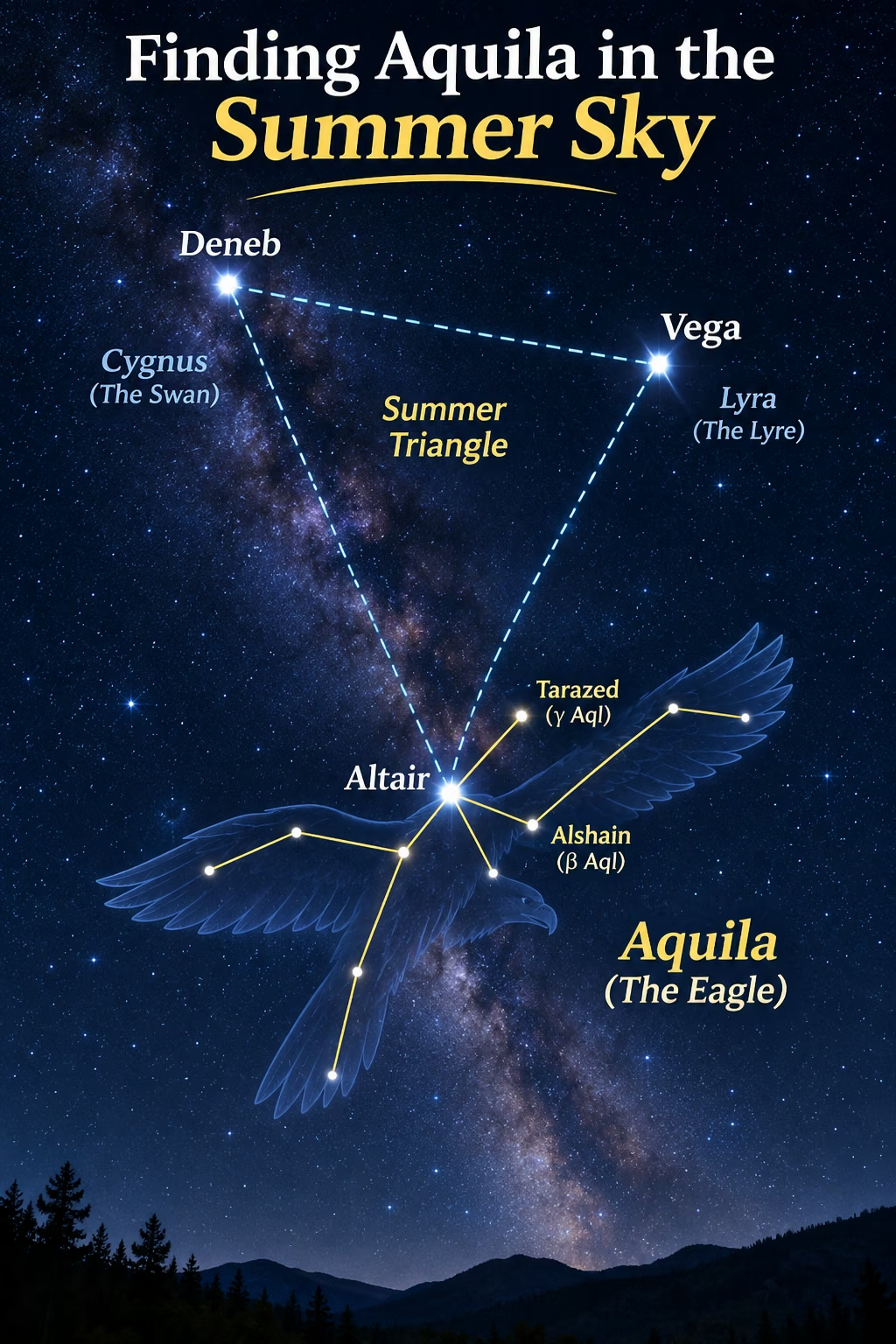
The Summer Triangle is an asterism rather than an official constellation. It consists of three prominent stars belonging to three different constellations: Altair in Aquila, Vega in Lyra, and Deneb in Cygnus.
The triangle becomes especially conspicuous during Northern Hemisphere summer evenings and remains useful for identifying autumn sky regions. Because its three stars are widely separated, the asterism covers a large apparent area. It is therefore particularly effective as a broad navigation landmark before examining smaller constellations.[3]
Altair, Vega, and Deneb: Three Major Stellar Landmarks
Altair, Vega, and Deneb appear connected as the Summer Triangle, but they differ considerably in distance and physical properties. Altair is relatively nearby at approximately 16.7 light-years, while Vega is roughly 25 light-years away. Deneb is a distant luminous supergiant whose exact distance has greater uncertainty.
These differences demonstrate that an asterism is primarily a line-of-sight arrangement, not a physical stellar association. The stars appear to form a triangle from Earth, even though they occupy different positions and evolutionary environments within the Milky Way.
Step-by-Step Method for Finding Aquila
Begin by identifying the three bright vertices of the Summer Triangle during an appropriate observing season. Vega is generally the brightest of the three, while Deneb occupies the Cygnus region and Altair marks the Aquila region.
Next, examine the stars immediately surrounding Altair. Tarazed and Alshain appear on opposite sides of it, forming a short, recognizable arrangement. From there, follow the fainter stars extending toward the eagle’s traditional wings and body. Confirming these stars with a planetarium application or printed chart is particularly helpful under urban skies.
Recognizing the Aquila Star Pattern
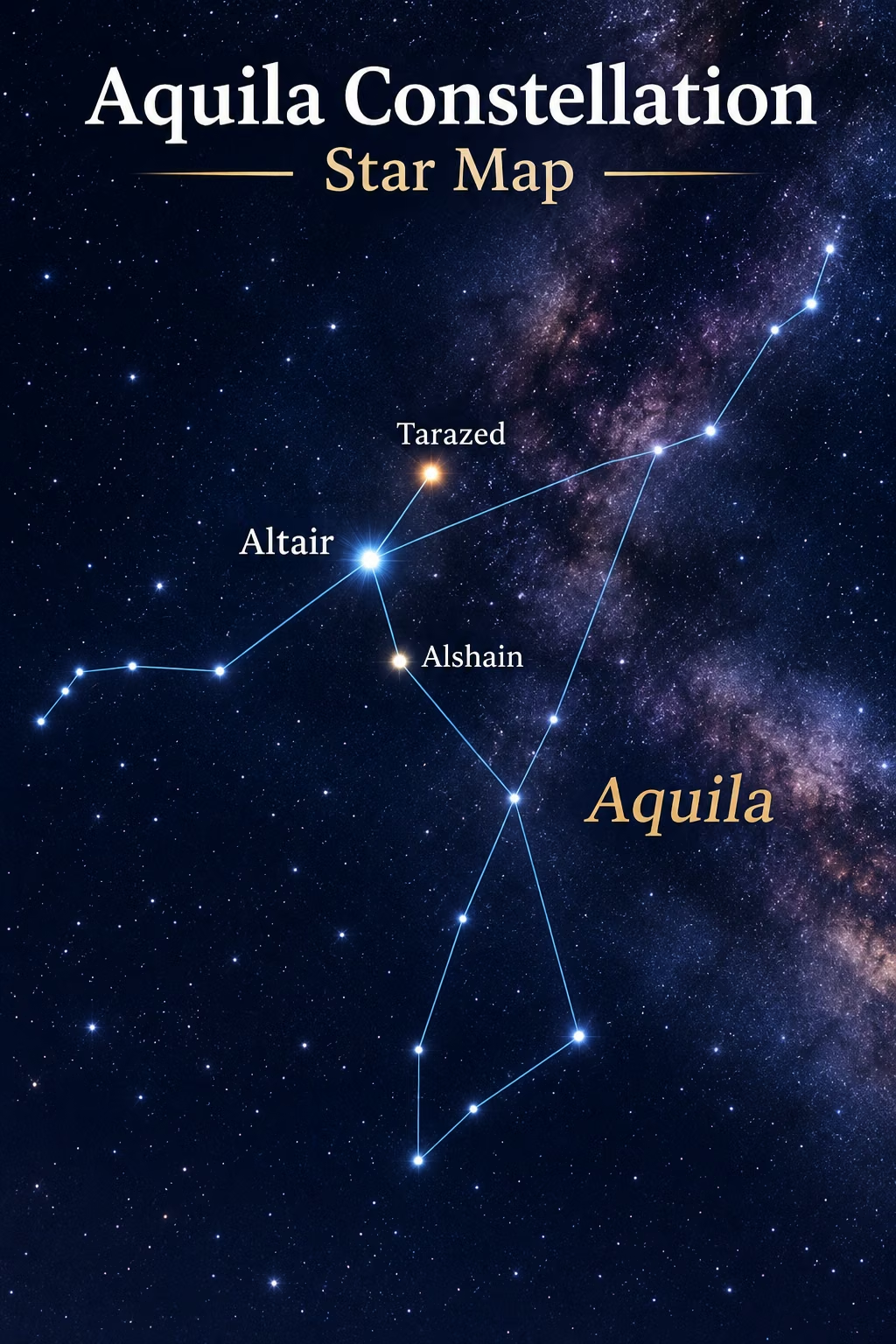
The traditional Aquila star pattern resembles an eagle with extended wings, although the exact connecting lines vary between atlases. Altair is the principal identifying star, and other bright members, including Zeta Aquilae and Delta Aquilae, contribute to the larger figure.
Star patterns can be difficult to recognize because they depend on cultural interpretation, sky orientation, and local viewing conditions. In the Southern Hemisphere, Aquila can appear rotated relative to familiar Northern Hemisphere illustrations. The underlying angular relationships remain unchanged, even though the figure’s orientation differs.
What Are the Brightest and Most Important Stars in Aquila?
Aquila contains several stars of different spectral types, temperatures, luminosities, and evolutionary stages. Its most prominent members are Altair, Tarazed, and Alshain, which form a recognizable grouping that helps observers distinguish the constellation from surrounding star patterns.
These stars are also scientifically interesting because their contrasting physical properties reveal different aspects of stellar evolution. Altair is a relatively nearby, rapidly rotating main-sequence star, Tarazed is an evolved bright giant, and Alshain is a subgiant. Other stars, including Zeta, Delta, Theta, and Lambda Aquilae, contribute to the constellation’s larger visual structure.
Altair (Alpha Aquilae): The Brightest Star in Aquila
Altair is the brightest star in Aquila and one of the brightest stars in Earth’s night sky. It has an apparent visual magnitude of approximately 0.76 and is located about 16.7 light-years from the Sun, making it one of our relatively close stellar neighbors.
Altair is an A-type main-sequence star, hotter and more massive than the Sun. One of its most distinctive properties is rapid rotation, which causes its equatorial region to bulge outward while its poles become flattened. This rotational distortion also influences the distribution of surface temperature and brightness.
Altair’s proximity and brightness make it valuable for observational studies of stellar structure, rotation, and atmospheric properties. It is also the southernmost vertex of the Summer Triangle in common Northern Hemisphere sky charts.[3]
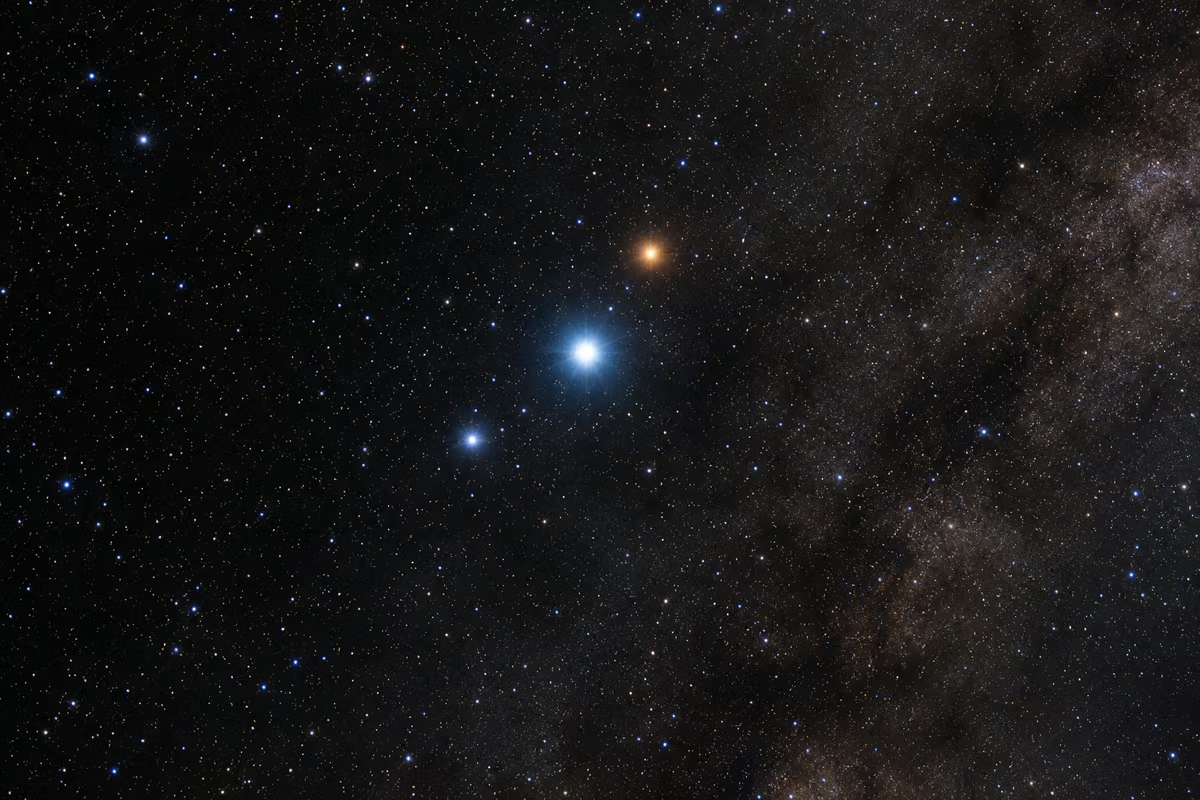
Tarazed (Gamma Aquilae): The Orange Giant
Tarazed, formally designated Gamma Aquilae, is an evolved orange bright giant star located close to Altair in the sky. Its apparent magnitude is approximately 2.7, making it readily visible without optical assistance under ordinary nighttime conditions.
Unlike Altair, Tarazed has progressed beyond the main-sequence phase of stellar evolution. Its outer layers have expanded and cooled, producing its characteristic orange color. The star’s position next to Altair makes it an important visual landmark, while its evolved state illustrates how changes in internal stellar structure affect radius, surface temperature, and luminosity.
Alshain (Beta Aquilae): Altair’s Stellar Neighbor
Alshain, or Beta Aquilae, is a relatively bright yellow-white subgiant star with an apparent magnitude of approximately 3.7. It appears on the opposite side of Altair from Tarazed, creating a recognizable three-star configuration.
Although the stars appear close together in the night sky, they are not necessarily close in physical space. Alshain is substantially farther from Earth than Altair and occupies a different stage of stellar evolution. As a subgiant, it is transitioning away from the main-sequence phase as changes in its internal hydrogen-burning structure alter its radius and luminosity.
Zeta Aquilae and the Eagle’s Wings
Zeta Aquilae is a relatively bright star associated with the traditional wing and tail regions of Aquila’s illustrated figure, depending on the star chart being used. It is a hot star whose visual brightness makes it useful for tracing the constellation beyond Altair’s immediate neighborhood.
Its traditional name, Deneb el Okab, refers to the eagle’s tail, although related historical star-name usage can vary. Zeta Aquilae demonstrates how culturally inherited stellar names and modern astronomical designations coexist. The Bayer designation provides a standardized identifier even when traditional figures differ.
Delta Aquilae, Theta Aquilae, and Lambda Aquilae
Delta, Theta, and Lambda Aquilae are useful secondary landmarks that help observers recognize the broader extent of Aquila. They are less conspicuous than Altair, but their positions provide reference points for tracing the constellation and navigating toward faint astronomical objects.
These stars are not physically interchangeable. Their spectral types, evolutionary characteristics, and distances differ, meaning they should be studied individually rather than treated as a single stellar group. In observational astronomy, however, their apparent positions make them useful for connecting sections of the traditional eagle pattern.
Delta Aquilae
Delta Aquilae is a relatively bright, approximately third-magnitude star that contributes to Aquila’s central and southern visual pattern. It is useful for locating nearby deep-sky objects, including NGC 6781, which lies several degrees to its north-northwest.
The star’s importance in observational astronomy comes partly from its convenient placement within Aquila. Once an observer identifies Altair and the constellation’s central structure, Delta Aquilae can act as a secondary reference point for navigating toward objects that are too faint to identify without a telescope.[8]
Theta Aquilae
Theta Aquilae is a bright stellar landmark toward the southern part of Aquila’s traditional figure. It is a hot, luminous star that contributes to the recognizable structure of the constellation when observing under sufficiently dark skies.
Although Theta Aquilae is not as prominent as Altair, identifying it makes it easier to trace Aquila’s extended figure. It also demonstrates the value of Bayer designations in star charts, where Greek letters provide compact labels for different members of a constellation.
Lambda Aquilae
Lambda Aquilae is another member of Aquila’s traditional star pattern, located toward the southern region of the constellation. It is also associated with the traditional name Al Thalimain, historically connected with two ostriches in Arabic star lore.
Its visual importance is primarily positional rather than exceptional brightness. Lambda Aquilae helps complete the broader pattern of the Eagle when the fainter stars are visible. It also illustrates how Arabic stellar traditions preserved figures and relationships that were not identical to the classical Greek eagle interpretation.
Comparing Aquila’s Principal Stars
Aquila’s principal stars demonstrate the variety of stellar types that can appear in a single constellation. Their apparent brightness does not directly reveal their physical luminosity because distance strongly influences how much light reaches Earth.
The following comparison gives approximate visual magnitudes and broad stellar classifications. Individual catalog values can differ slightly because of measurement methods, stellar variability, and classification revisions.
| Star | Bayer designation | Approx. visual magnitude | Broad stellar classification | Observational significance |
|---|---|---|---|---|
| Altair | Alpha Aquilae | 0.76 | A-type main-sequence star | Brightest star; Summer Triangle |
| Tarazed | Gamma Aquilae | 2.7 | K-type bright giant | Orange star near Altair |
| Alshain | Beta Aquilae | 3.7 | G-type subgiant | Flanks Altair |
| Zeta Aquilae | Zeta Aquilae | 3.0 | B-type star | Traditional eagle figure |
| Delta Aquilae | Delta Aquilae | 3.4 | F-type star | Deep-sky navigation |
| Theta Aquilae | Theta Aquilae | 3.2 | B-type giant | Southern stellar pattern |
| Lambda Aquilae | Lambda Aquilae | 3.4 | B-type star | Southern landmark |
The comparison highlights why Altair dominates Aquila visually while other stars remain scientifically valuable. Tarazed and Alshain provide contrasting evolutionary examples, and the remaining bright stars help observers understand the constellation’s angular structure.
Stellar Physics: What Makes Aquila’s Stars Scientifically Interesting?
The stars of Aquila provide examples of several important principles in astrophysics, including stellar brightness, temperature classification, evolutionary changes, rotation, and distance measurement. Although their grouping is based on appearance from Earth, their individual properties can be investigated through spectroscopy, photometry, astrometry, and interferometry.
Altair is especially notable because its rapid rotation produces measurable physical distortion. Other stars demonstrate how surface temperature, luminosity, and evolutionary stage affect the light astronomers receive.
Understanding Apparent Magnitude
Apparent magnitude measures how bright an astronomical object appears to an observer, conventionally using a logarithmic scale in which smaller numbers represent brighter objects. A difference of five magnitudes corresponds to a brightness ratio of exactly 100.
Altair’s apparent magnitude of approximately 0.76 makes it much brighter in the sky than Tarazed at approximately 2.7 or Alshain at approximately 3.7. However, apparent magnitude alone cannot establish which star emits the most energy. Intrinsic luminosity and distance must also be considered to understand a star’s actual physical brightness.
Spectral Classification of Aquila’s Stars
Astronomers classify stars using spectral types that primarily reflect the temperature and characteristics of their atmospheres. The familiar sequence O, B, A, F, G, K, and M generally runs from hotter stars to cooler stars.
Altair is an A-type star, while Tarazed is a cooler K-type bright giant. Their different colors and spectra indicate differences in surface temperature and stellar properties. Luminosity classes add another dimension by distinguishing dwarfs, subgiants, giants, and supergiants.
Together, spectral type and luminosity class provide a practical framework for interpreting stellar evolution rather than relying on color or apparent brightness alone.
Rapid Stellar Rotation and Altair’s Oblate Shape
Altair spins rapidly enough that its equatorial diameter is significantly greater than its polar diameter. This produces an oblate shape rather than the nearly spherical appearance associated with more slowly rotating stars.
Rapid rotation also affects the effective surface gravity and temperature distribution. The equatorial region is generally cooler than the polar regions, creating a phenomenon known as gravity darkening. Observations of Altair have helped astronomers study how stellar rotation influences physical structure, surface brightness, and the interpretation of stellar models.
NASA specifically highlights Altair’s flattened appearance as one of its most unusual characteristics.[3]
How Astronomers Measure Star Distances
Nearby stellar distances can be measured through parallax, the apparent shift in a star’s position caused by Earth’s changing viewpoint as it orbits the Sun. By measuring this tiny angular displacement, astronomers can determine distance geometrically.
A parallax angle of one arcsecond corresponds to a distance of one parsec, approximately 3.26 light-years. Altair’s distance of about 16.7 light-years makes it relatively close by stellar standards.
For more distant stars, astronomers combine parallax calibrations with other techniques, including stellar luminosity estimates and variable-star relationships, to extend the cosmic distance scale.[4]
Variable Stars and Stellar Explosions in Aquila
Aquila contains important examples of stars whose observed brightness changes over time. These include periodic pulsating variables and systems capable of sudden dramatic outbursts. Eta Aquilae is a well-known classical Cepheid variable, while V603 Aquilae is associated with a bright nova observed in 1918.
These objects are scientifically valuable because their changing light provides information about internal stellar structure, binary-star interactions, and astronomical distance measurements. Their behavior also makes them particularly interesting targets for long-term monitoring.
Eta Aquilae: One of the Best-Known Cepheid Variables
Eta Aquilae is a classical Cepheid variable whose brightness changes because the star repeatedly expands and contracts. Its pulsation period is approximately 7.177 days, and its visual magnitude generally varies from about 3.5 to 4.3.
Eta Aquilae is historically significant because its variability was discovered in 1784 by Edward Pigott, before the discovery of the variability of Delta Cephei. It therefore occupies an important place in the early history of Cepheid research.
The star is bright enough for visual monitoring, allowing observers to follow its changing brightness by comparing it with nearby reference stars.[5]
Cepheid Variables and the Cosmic Distance Ladder
Cepheid variables are pulsating stars whose periods correlate with their intrinsic luminosities. Longer-period classical Cepheids are generally more luminous than shorter-period examples, allowing astronomers to estimate their absolute brightness from measured pulsation periods.
By comparing this intrinsic brightness with observed brightness, astronomers can calculate distance after accounting for factors such as interstellar extinction. The relationship became foundational to the astronomical distance ladder, which connects nearby geometric measurements with distances to other galaxies.
Henrietta Swan Leavitt’s work on the period-luminosity relationship helped establish one of the most influential techniques in observational cosmology.[4]
V603 Aquilae: The Famous Nova of 1918
V603 Aquilae, also known as Nova Aquilae 1918, underwent a dramatic outburst in June 1918 and became one of the brightest novae observed in modern astronomical history. Its sudden increase in brightness made it an important historical example of a stellar transient.
A classical nova occurs in a binary system when a white dwarf accumulates hydrogen-rich material from a companion. Under suitable conditions, this material undergoes a thermonuclear runaway, producing a rapid increase in luminosity.
Unlike a typical supernova, a classical nova generally does not destroy the white dwarf. V603 Aquilae remains a studied cataclysmic variable system.[6]
Why Aquila Is Important for Variable-Star Observation
Aquila offers observers opportunities to study both predictable and irregular changes in stellar brightness. Eta Aquilae provides a relatively accessible example of periodic pulsation, while V603 Aquilae illustrates the long-term scientific importance of historical nova systems.
Variable-star observation typically involves measuring brightness at repeated intervals, recording observation times consistently, and comparing measurements with calibrated reference stars. The resulting light curve reveals patterns of variation.
Organizations such as the American Association of Variable Star Observers support standardized observing methods and preserve data contributed by amateur and professional astronomers.[5]
Deep-Sky Objects in the Aquila Constellation
Aquila contains a variety of deep-sky objects, including open clusters, globular clusters, planetary nebulae, and dark nebulae. Although it does not contain an object from the Messier catalog, it offers numerous targets for amateur astronomers equipped with binoculars or telescopes.
Many of these objects are situated against dense Milky Way star fields, which can make them visually attractive but sometimes difficult to identify. Their scientific importance extends beyond observation because they reveal different stages of stellar development and different components of the galaxy.[7] [8]
Overview of Aquila’s Deep-Sky Objects
Deep-sky objects are astronomical targets outside the Solar System, excluding individual stars in ordinary observational usage. They include star clusters, nebulae, galaxies, and other extended or complex structures.
Aquila’s principal deep-sky attractions include the open clusters NGC 6709 and NGC 6755, the globular cluster NGC 6760, and planetary nebulae such as NGC 6751 and NGC 6781. The constellation also contains Barnard’s E, a recognizable formation of dark interstellar clouds.
The visibility of these objects depends on apparent brightness, angular size, surface brightness, observing equipment, and sky conditions.
Open Star Clusters in Aquila
Open star clusters are groups of stars that formed from the same molecular cloud and generally share a common origin and motion through space. They are typically found in galactic disks, where star formation takes place.
Aquila contains several open clusters that provide opportunities for observing stellar populations against the Milky Way background. Unlike globular clusters, open clusters are usually less densely concentrated and may gradually disperse under gravitational influences. Their stars can be studied together to investigate stellar ages, chemical compositions, and evolutionary development.
NGC 6709: An Open Star Cluster
NGC 6709 is an open cluster in Aquila with an integrated apparent magnitude of approximately 6.7. It appears as a relatively loose grouping of stars against the surrounding Milky Way and is accessible to amateur observers using binoculars or small telescopes under favorable conditions.
Its individual stars become easier to distinguish as telescope aperture increases. Because a star cluster’s integrated magnitude combines the light of multiple members, the cluster may be less immediately conspicuous than a single star of equivalent magnitude.
NGC 6709 is particularly interesting for comparing clustered stars with the dense background stellar population.[7]
NGC 6755: Another Open Cluster in Aquila
NGC 6755 is an open star cluster with an integrated visual magnitude of approximately 7.5. It appears relatively compact when viewed through smaller instruments, although more of its constituent stars can be resolved with larger telescopes.
The cluster lies within the Milky Way’s rich stellar background, making accurate identification important. Observers can use detailed charts and nearby reference stars to distinguish the cluster from unrelated field stars.
NGC 6755 provides another opportunity to examine how open clusters vary in apparent density, brightness, and angular extent, even within the same constellation.
NGC 6760: A Globular Star Cluster
NGC 6760 is a globular cluster located in Aquila. Unlike open clusters, globular clusters are generally older, more massive stellar systems containing stars concentrated toward a dense central region.
NGC 6760 has an integrated apparent magnitude around 9 to 10, depending on the photometric reference. It can be observed with amateur telescopes, although resolving individual stars is more challenging than in many open clusters.
Its location toward the inner Milky Way makes it scientifically relevant to studies of ancient stellar populations, chemical enrichment, and galactic structure. Dark skies and moderate telescope aperture improve the observing experience.[7]
Planetary Nebulae in Aquila
Planetary nebulae are glowing shells of gas expelled by certain evolved stars, usually during late stages of their lives. Their central stellar remnants become hot enough to ionize the surrounding gas, which then emits radiation at characteristic wavelengths.
Despite the name, planetary nebulae are unrelated to planets. The terminology originated because some objects appeared round and planet-like through early telescopes.
Aquila contains several notable examples, ranging from relatively extended nebulae to extremely compact objects that can resemble faint stars through small instruments.[9]
NGC 6751: The Glowing Eye Nebula
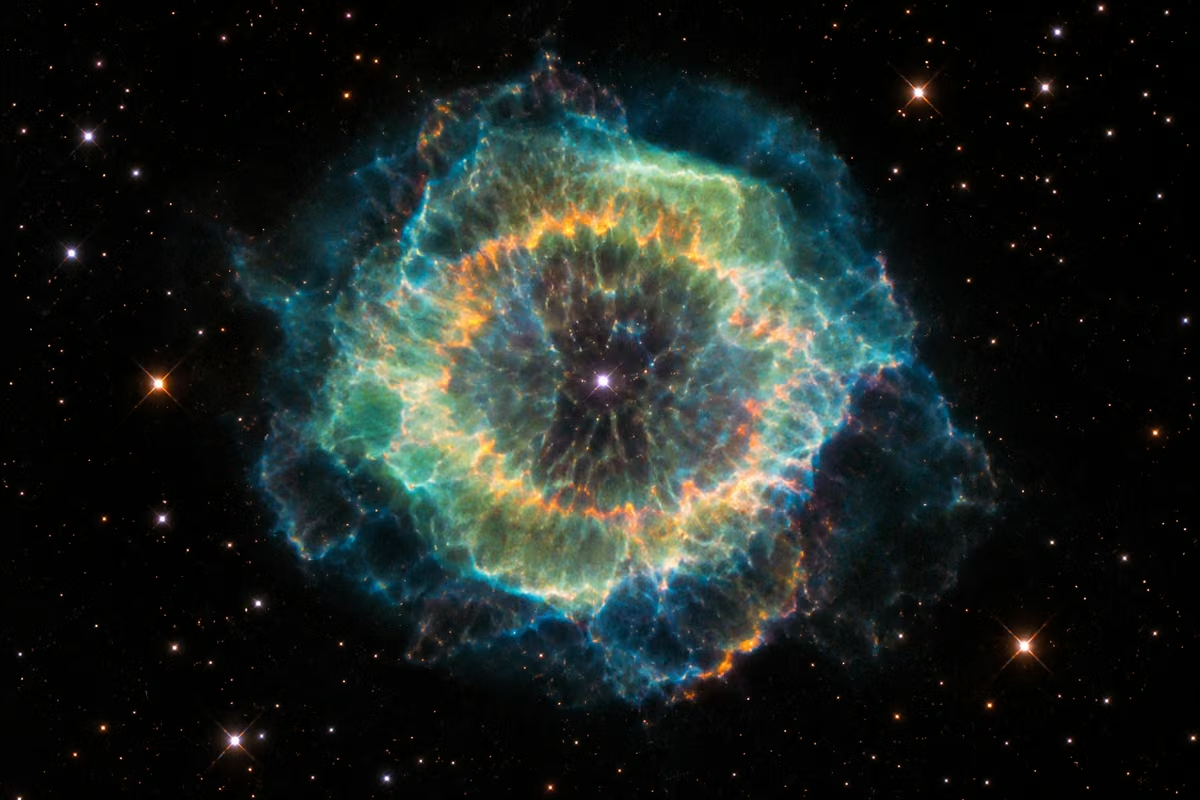
NGC 6751 is a planetary nebula in Aquila often called the Glowing Eye Nebula because of its striking eye-like appearance in detailed astronomical images. It consists of gas ejected by an evolved star whose hot central remnant illuminates the surrounding material.
NASA’s Hubble Space Telescope observations reveal a complex arrangement of rings, filaments, and regions emitting different wavelengths of light. The nebula provides evidence of interactions among stellar radiation, outflowing gas, and stellar winds.
Its detailed structure is much easier to study through professional astronomical imaging than through ordinary visual observation.[9]
NGC 6781: The Snow Globe Nebula
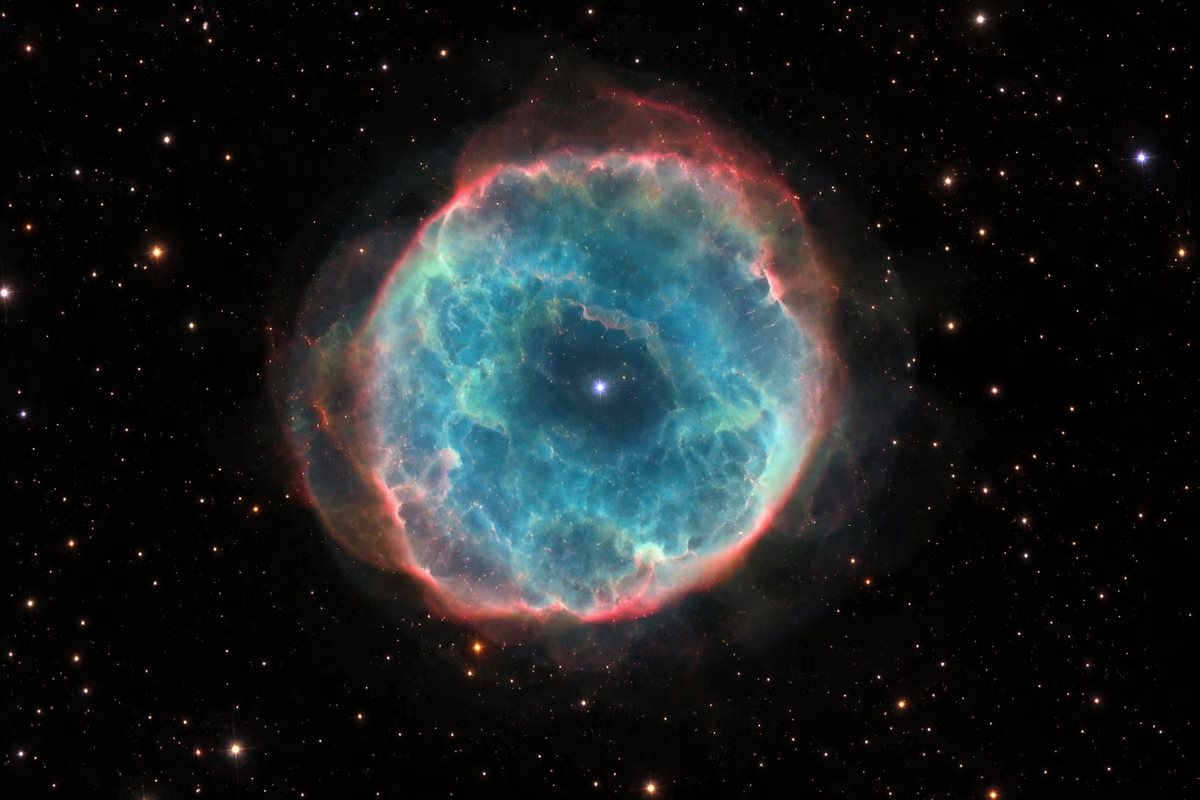
NGC 6781, sometimes called the Snow Globe Nebula, is an extended planetary nebula in Aquila. It has a roughly circular or ring-like appearance, with an angular diameter of approximately 1.8 arcminutes.
The nebula is a useful observing target for medium-sized amateur telescopes, particularly under dark skies. An oxygen-III or suitable narrowband nebula filter can improve contrast and make its structure easier to distinguish.
Published distance estimates have differed substantially, illustrating the uncertainties that can arise when measuring planetary nebula distances. Its appearance and classification are more firmly established than any single simplified distance figure.[8]
NGC 6803: A Compact Planetary Nebula
NGC 6803 is a compact planetary nebula in Aquila whose small angular diameter makes it challenging to distinguish from a star at low magnification. It is cataloged as a planetary nebula and can be investigated using telescopes capable of providing sufficient magnification and contrast.
Because its light is concentrated into a small apparent area, locating the correct object can require careful star hopping. Narrowband filters may help separate nebular emission from surrounding stellar light, especially when combined with accurate charts and stable atmospheric conditions.
NGC 6741: The Phantom Streak Nebula
NGC 6741 is a small planetary nebula commonly known as the Phantom Streak Nebula. Its compact apparent dimensions make it more demanding than larger planetary nebulae such as NGC 6781.
The object is an example of how planetary nebulae can differ dramatically in visual appearance. Some are broad, low-surface-brightness structures, while others appear nearly stellar until observed at high magnification.
For NGC 6741, careful identification and favorable atmospheric conditions are particularly important. A telescope’s resolving ability, rather than its light-gathering power alone, influences the observing result.
Comparing Aquila’s Most Interesting Deep-Sky Objects
The most useful way to compare deep-sky targets is to consider both object classification and practical observing difficulty. Integrated apparent magnitude is informative, but angular size and surface brightness can make two similarly bright objects appear very different.
The following table presents approximate catalog values. Magnitudes are rounded because different sources and photometric bands may report somewhat different measurements.[7] [8]
| Object | Type | Approx. apparent magnitude | Typical observing approach |
|---|---|---|---|
| NGC 6709 | Open cluster | 6.7 | Binoculars or small telescope |
| NGC 6755 | Open cluster | 7.5 | Small to medium telescope |
| NGC 6760 | Globular cluster | 9.8 | Medium telescope |
| NGC 6751 | Planetary nebula | 12 | Medium to large telescope |
| NGC 6781 | Planetary nebula | 11.4 | Medium telescope, nebula filter |
| NGC 6803 | Compact planetary nebula | 11.4 | Telescope with higher magnification |
| NGC 6741 | Compact planetary nebula | 11 | Medium to large telescope |
For beginners, the open clusters are sensible starting points because their stellar structure is easier to recognize. NGC 6781 is a worthwhile next target for observers experienced with faint extended objects.
Dark Nebulae and the Great Rift in Aquila
Dark nebulae are concentrations of interstellar dust and gas that block or scatter light from more distant objects. In Aquila, these clouds stand out against dense Milky Way star fields, producing dark patches that are not empty regions of space.
The Great Rift and Barnard’s E are particularly important examples. They demonstrate that some of the most interesting astronomical structures are identified by the light they obscure rather than by radiation they emit. Dark nebulae also provide important information about molecular clouds and the environments associated with star formation.
What Is the Great Rift in the Milky Way?
The Great Rift is an extensive apparent division in the Milky Way’s luminous band caused by interstellar dust clouds along our line of sight. It is especially noticeable across parts of Cygnus, Aquila, and neighboring galactic regions under dark observing conditions.
The Rift does not represent a literal empty channel cutting through the galaxy. Instead, foreground material blocks visible light from more distant stars.
Understanding this distinction is important because a darker region of the sky can contain substantial amounts of matter, even when fewer background stars are visible.
Barnard’s E Nebula: A Distinctive Dark Cloud Complex
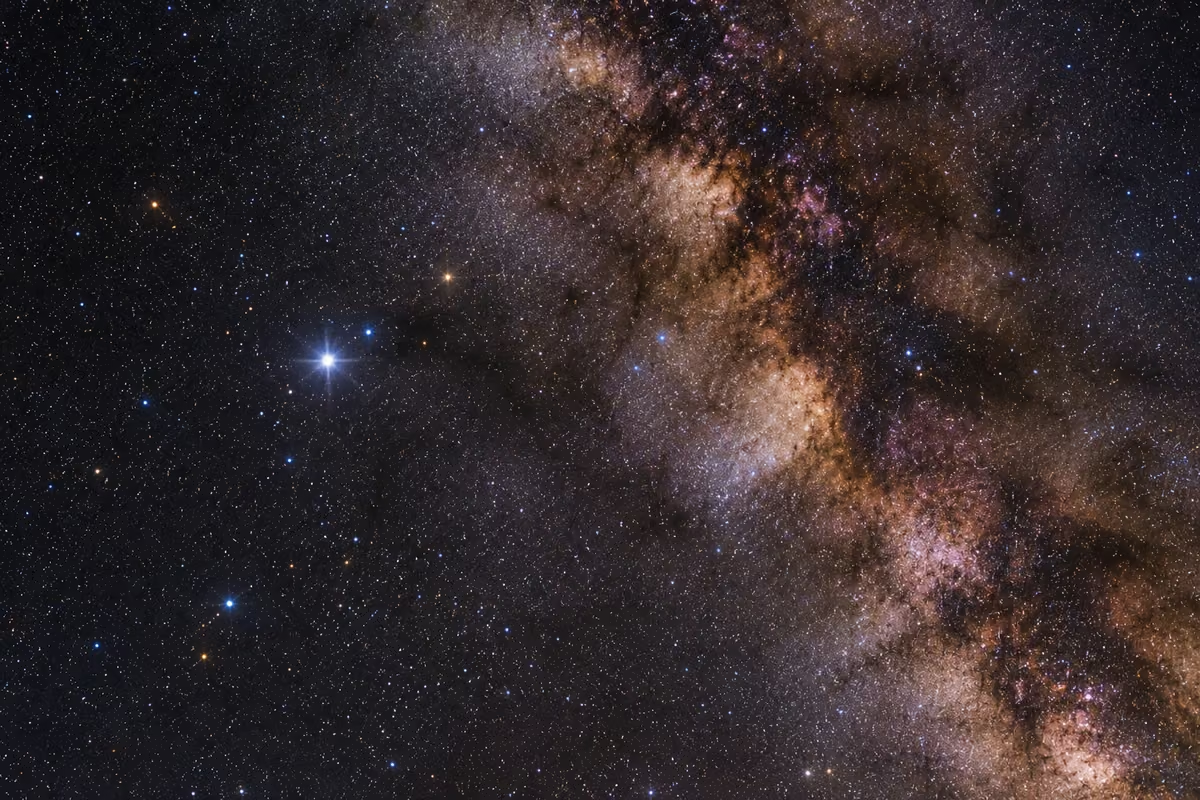
Barnard’s E is a recognizable dark nebula complex formed by Barnard 142 and Barnard 143. Its name comes from the shape the two clouds create when silhouetted against the Milky Way’s star-rich background.
The complex lies approximately 1.6 degrees west-northwest of Tarazed, making Gamma Aquilae a convenient starting point for locating it.
Under dark skies, binoculars with a relatively wide field of view can reveal the contrast between the dark clouds and surrounding stars. Light pollution greatly reduces this contrast.[10]
Barnard 142 and Barnard 143
Barnard 142 and Barnard 143 are separate cataloged dark nebulae that together produce the appearance of Barnard’s E. Both belong to a broader environment containing interstellar dust and cold gas.
Their visibility depends heavily on the brightness and density of background stars. They are often easier to recognize in wide-field observations than at very high magnification, where the surrounding context may be lost.
The two objects also demonstrate how astronomical cataloging can distinguish related structures while preserving their collective identity in a familiar observing name.
Barnard 142
Barnard 142 forms part of the southern portion of the Barnard’s E complex. It appears as a dark region where foreground dust obscures the background Milky Way, reducing the density of visible stars along that line of sight.
It is generally less distinct than Barnard 143 in amateur observations. Observers benefit from comparing the suspected cloud with brighter adjacent star fields rather than searching for a luminous object.
Its appearance is a reminder that observing dark nebulae requires attention to contrast, surrounding structures, and the overall field of view.[10]
Barnard 143
Barnard 143 forms a prominent portion of Barnard’s E and is generally the more visually conspicuous of the two components. Its dark structure stands out against the Milky Way, especially through binoculars under transparent, moonless skies.
The cloud absorbs and scatters background starlight, producing an apparent deficit of stars. Its distinctive shape helps observers recognize the larger complex.
The apparent boundaries of dark nebulae are influenced by the density of dust and the distribution of background illumination, so their visual outlines can vary with observing conditions and image processing.[10]
Dark Nebulae and the Galactic Plane
The Milky Way’s galactic plane contains substantial concentrations of stars, gas, and dust. Dark nebulae occur where sufficiently dense dust clouds lie in front of brighter stellar backgrounds, making the interstellar medium visible through its obscuring effect.
Some molecular clouds contain the cold, dense conditions from which stars can eventually form, although not every dark cloud is actively producing new stars.
Studying these regions through visible, infrared, and radio observations helps astronomers investigate cloud structure, chemical composition, and star-forming conditions. Aquila’s position along the Milky Way makes it an important observational setting for these relationships.
Aquila in Ancient Greek Mythology
Aquila has been associated with the eagle of Zeus since classical antiquity. In Greek mythology, eagles were linked with divine power, authority, and the sky, making the bird an appropriate symbol for Zeus, the ruler of the Olympian gods.
Ancient literary traditions contain several explanations of the constellation’s identity. Some connect the eagle with Zeus’s thunderbolts, while others associate it with the story of Ganymede. These accounts should be understood as related but not necessarily identical mythological traditions.[11]
The Legend of Zeus’s Eagle
The eagle was an important symbol of Zeus and was sometimes described as his messenger or a carrier of his thunderbolts. Its association with the sky and ability to fly at great heights reinforced its symbolic connection with divine authority.
In ancient constellation mythology, Aquila could represent this powerful bird placed among the stars. The association helped connect a recognizable celestial pattern with familiar stories about the Greek gods.
NASA’s skywatching material also describes Aquila as the mythical eagle associated with Zeus, highlighting the continuity of this traditional interpretation.[12]
The Story of Ganymede and the Eagle
Ganymede was a young Trojan figure in Greek mythology who became associated with the Olympian gods. In several accounts, Zeus or an eagle acting on his behalf carried Ganymede to Olympus, where he became cupbearer to the gods.
The constellation Aquila is commonly linked to the eagle in this story, while Aquarius has sometimes been interpreted as representing Ganymede. Ancient sources differ in details, including whether Zeus himself took the form of the eagle.
These variations illustrate how mythology develops through multiple authors and traditions rather than through a single standardized narrative.[11]
Aquila Among Ptolemy’s 48 Constellations
Aquila was included among the 48 constellations described by the astronomer Claudius Ptolemy in the second century CE. His astronomical work, the Almagest, preserved a major body of Greek astronomical knowledge and influenced later star catalogs.
The inclusion of Aquila shows that the constellation was recognized long before modern astronomical institutions standardized its boundaries.
Ptolemy’s constellation descriptions focused on recognizable star patterns and positions. Modern IAU definitions instead treat each constellation as a precisely bounded region, reflecting the development of astronomy from traditional celestial mapping into standardized scientific measurement.[1]
Cultural Symbolism of the Eagle Constellation
The eagle’s association with strength, flight, and divine authority contributed to its importance in Greek and Roman celestial traditions. Aquila’s traditional star figure placed this symbolic bird in the night sky, where its location could be connected with other mythological constellations.
However, cultural meanings should be distinguished from astronomical measurements. The figure of an eagle is an interpretation of the star arrangement, not a physical characteristic of the stars.
Different societies have identified different patterns and stories in the same region, demonstrating that constellation mythology reflects cultural history as well as sky observation.
Aquila in Chinese and Other Cultural Astronomy Traditions
The stars associated with Aquila also appear in astronomical traditions outside the classical Mediterranean world. Altair is especially important in East Asian cultural astronomy because of its connection with the Cowherd and Weaver Girl story.
In this tradition, Altair and Vega represent figures separated by the celestial river of the Milky Way. Their relationship provides an example of how the same astronomical objects can carry different meanings across cultures, while their positions and physical properties remain unchanged.
Altair in the Chinese Cowherd Legend
In the Chinese Cowherd and Weaver Girl legend, Altair is associated with Niulang, the cowherd, while Vega represents Zhinü, the weaver girl. The Milky Way symbolizes a river separating the two figures.
Different versions of the story describe their separation and eventual reunion in varying ways, but the central association with two conspicuous stars remains consistent.
This cultural connection makes Altair important beyond its physical characteristics as a nearby A-type star. It also demonstrates how bright stars can become enduring references in storytelling, seasonal traditions, and cultural calendars.[3]
The Relationship Between Altair and Vega
Altair and Vega are both bright stars and members of the Summer Triangle, but their cultural relationship in the Cowherd and Weaver Girl legend differs from their physical relationship in space.
They appear separated by a region of the Milky Way when viewed from Earth, inspiring the image of a celestial river between them. In reality, they are distinct stars at different distances from the Sun and are not a physically bound pair.
Their apparent positions make the legend particularly effective because both stars are relatively easy to identify during appropriate observing seasons.
The Qixi Festival and Celestial Traditions
The Qixi Festival is a traditional Chinese celebration associated with the Cowherd and Weaver Girl story. It is observed on the seventh day of the seventh month of the traditional Chinese lunisolar calendar.
The festival connects cultural storytelling with the changing seasonal visibility of Altair and Vega. Related traditions also exist in other East Asian cultures, including Japan’s Tanabata celebration, although their dates and customs differ.
These traditions show how astronomy can influence calendars, festivals, and cultural identity without requiring the stars themselves to form a physical astronomical system.
When Is the Aquila Constellation Visible?
Aquila is best known as a Northern Hemisphere summer constellation, although it can also be seen from much of the Southern Hemisphere. Its visibility depends on the observer’s latitude, the time of year, and the time of night.
The constellation is especially convenient to observe during northern summer evenings because Altair and the Summer Triangle occupy prominent positions in the sky. During other seasons, Aquila may be visible at less convenient hours or lie too close to the Sun’s apparent position for nighttime observation.[2] [3]
Aquila’s Observing Season
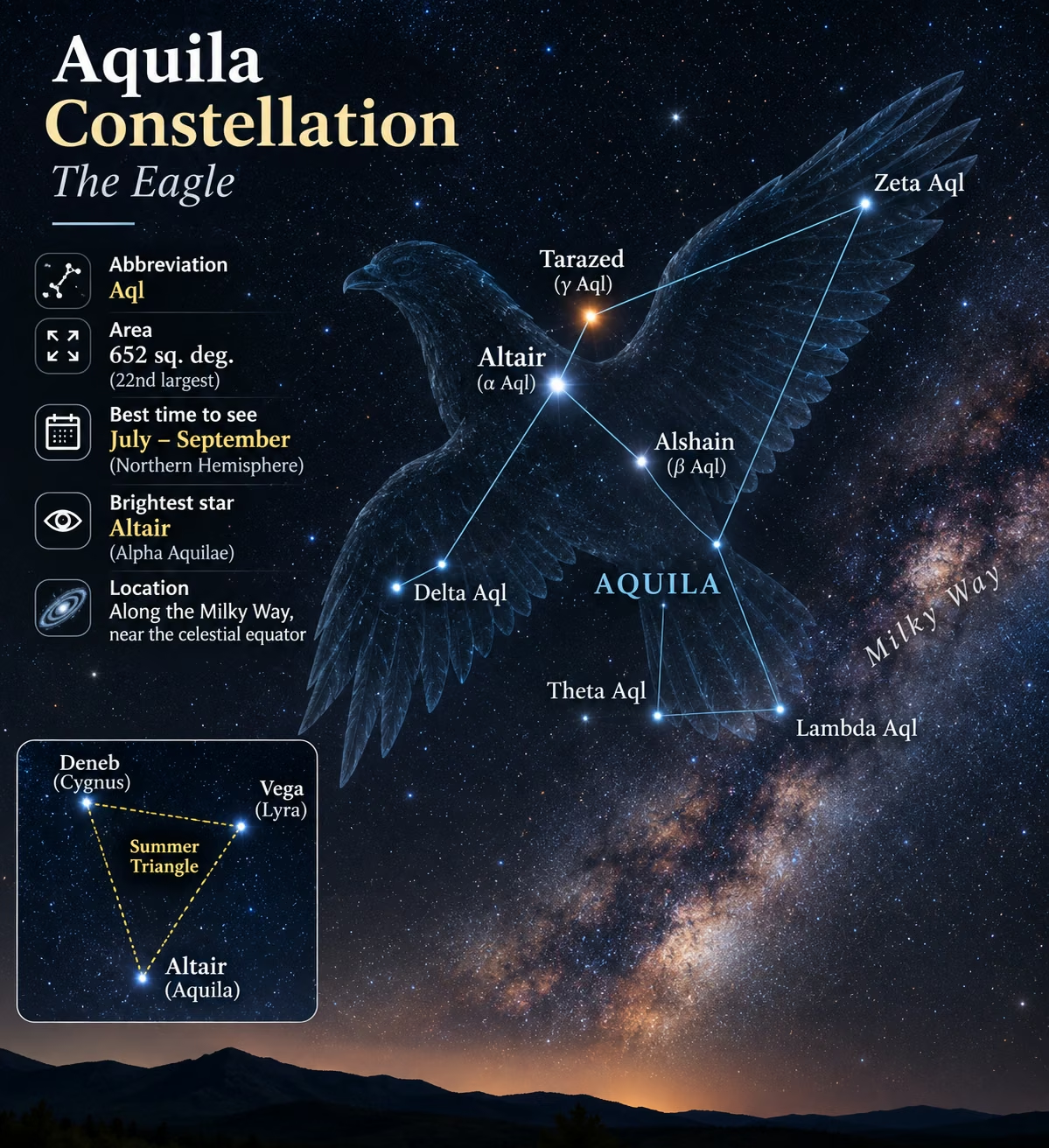
For Northern Hemisphere observers, Aquila is particularly well placed during summer and early autumn evenings. July, August, and September are useful months for locating Altair and tracing the surrounding constellation figure.
The exact best month depends on the preferred observing time. A constellation that reaches its highest point late at night in one month will reach that position earlier on successive nights as Earth progresses around the Sun.
Observers should therefore interpret observing seasons as approximate guides rather than strict visibility boundaries.
Aquila in the Northern Summer Sky
During Northern Hemisphere summer, Aquila appears as a prominent feature of the evening sky. Altair forms the lower vertex of the Summer Triangle in many standard north-up star charts, with Vega and Deneb occupying the other two corners.
Because Aquila lies near the celestial equator, it is commonly seen in the southern half of the sky by observers at middle northern latitudes, although its apparent direction changes as Earth rotates.
Its visibility is particularly favorable when the constellation approaches the local meridian and reaches its highest altitude above the horizon.
Aquila’s Visibility from the Southern Hemisphere
Aquila can also be observed from much of the Southern Hemisphere because its stars lie near the celestial equator. Its appearance differs from the Northern Hemisphere view because the observer sees the celestial sphere from a different geographic orientation.
Altair generally appears in the northern portion of the sky for observers at middle southern latitudes. The traditional eagle figure may appear rotated or inverted compared with familiar northern star charts.
For practical observation, southern observers should use location-aware charts that correctly represent the orientation of the sky at their latitude.
Best Time of Night to Observe Aquila
The best observing time is generally when Aquila is high above the horizon and the sky is fully dark. Objects at higher altitudes are seen through less of Earth’s atmosphere, which usually improves transparency and reduces the effects of atmospheric extinction.
For Northern Hemisphere summer viewing, late evening can be especially convenient, although the precise timing changes throughout the season.
Dark skies are particularly important for Aquila’s fainter stars and nebulae. Moonless conditions, low humidity, and minimal artificial lighting improve visibility, while atmospheric turbulence can limit detailed telescope observations.
How to Observe the Aquila Constellation
Aquila is suitable for several levels of astronomical observation, beginning with naked-eye identification and progressing to binocular exploration, telescopic star hopping, and astrophotography.
For beginners, Altair provides a simple and reliable starting point. More experienced observers can investigate stellar clusters, planetary nebulae, and dark dust clouds along the Milky Way.
The most appropriate equipment depends on the target. Bright stars require little assistance, while compact planetary nebulae may demand considerable magnification and accurate charts. Dark nebulae, by contrast, often benefit from wide fields and dark skies.
Finding Aquila Without a Telescope
To find Aquila without optical equipment, begin with the Summer Triangle. Identify Altair, then look for Tarazed and Alshain nearby. These three stars form a useful local pattern that distinguishes the central portion of Aquila.
After recognizing this grouping, trace the surrounding stars that traditionally represent the eagle’s wings and body.
In urban environments, only the brightest stars may be visible. A dark location makes the complete figure easier to recognize, especially after allowing your eyes time to adapt to low-light conditions.
Binocular Astronomy: What Can You See in Aquila?
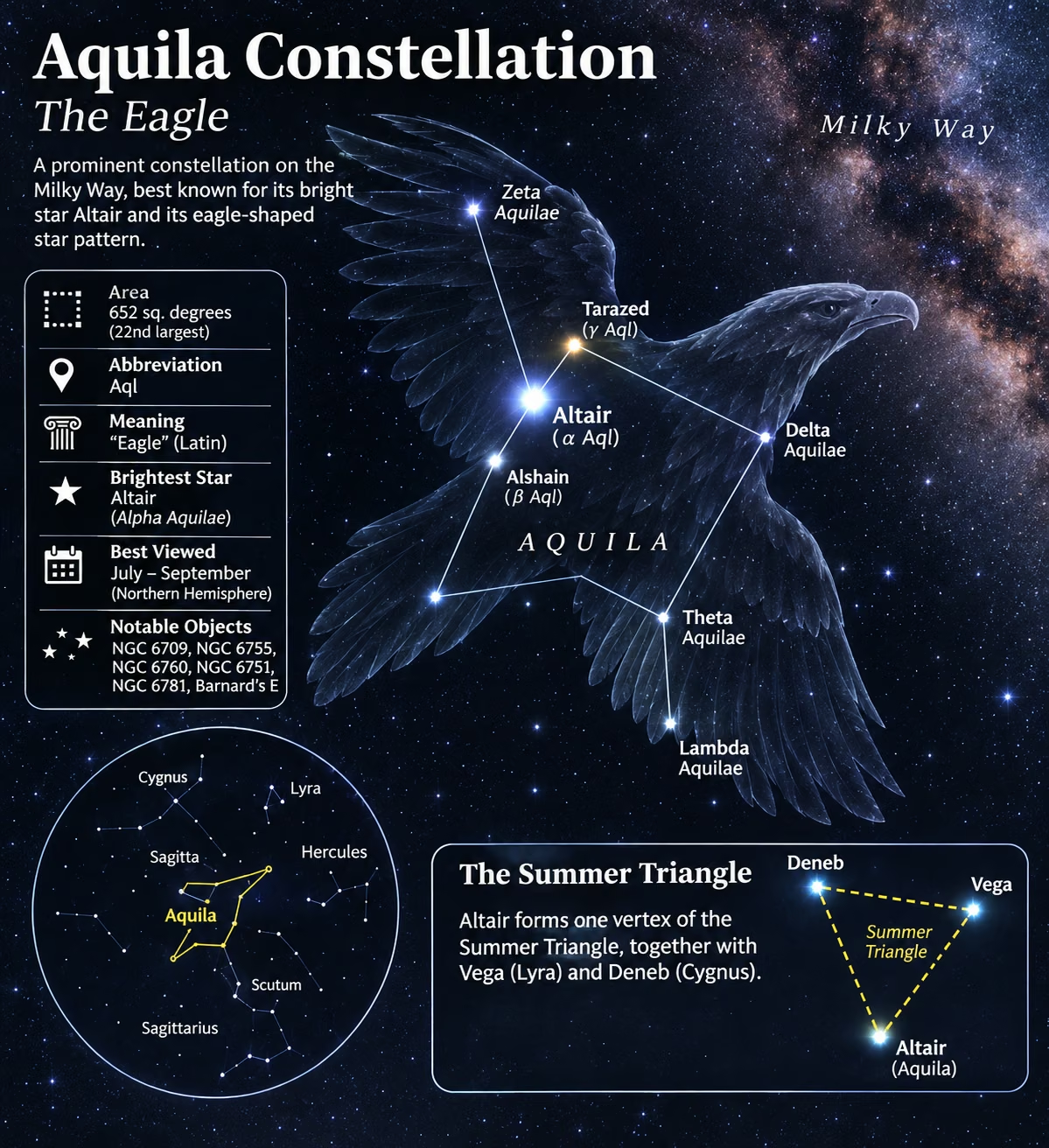
Binoculars can reveal significantly more stars than the unaided eye, making them especially useful for exploring Aquila’s Milky Way fields. Common binocular formats such as 7×50 and 10×50 provide wide fields of view suitable for scanning extended regions.
Open clusters such as NGC 6709 can become accessible targets, although their appearance depends on sky darkness, optical quality, and observer experience.
Barnard’s E is another interesting binocular target because its dark structure is best appreciated against a broad background of stars. Stable support can improve the experience with heavier binoculars.
Star Hopping to Aquila’s Deep-Sky Objects
Star hopping is a method of locating faint astronomical objects by moving systematically between recognizable stars and patterns. In Aquila, observers can begin with Altair or other bright reference stars before navigating toward a desired cluster or nebula.
A useful approach is to identify the object’s coordinates, select an appropriate starting star, and compare the telescope’s field of view with a detailed chart.
For example, NGC 6781 lies approximately 3.8 degrees north-northwest of Delta Aquilae, providing a practical starting point for locating the planetary nebula.[8]
Telescope Observation of Planetary Nebulae
Planetary nebulae in Aquila require different observational techniques depending on their apparent size and surface brightness. Larger examples such as NGC 6781 may be examined at moderate magnification, while compact objects such as NGC 6803 and NGC 6741 can require higher magnification.
Narrowband nebula filters, particularly oxygen-III filters, can improve contrast by transmitting important nebular emission wavelengths while suppressing much of the surrounding light.
However, these filters are not universally beneficial. They generally work better on emission nebulae than on ordinary stars or star clusters, whose light spans a broader range of wavelengths.[13]
Photographing Aquila and the Milky Way
Aquila is attractive for astrophotography because it contains bright stars, dense galactic fields, dark nebulae, and faint planetary nebulae. Wide-angle photography can capture Altair, the Summer Triangle, and portions of the Great Rift in a single composition.
A stable tripod and appropriately controlled exposures are useful for beginners. Tracking mounts allow longer exposures while reducing star trailing caused by Earth’s rotation.
Photographing faint planetary nebulae requires different methods, often involving longer focal lengths, accurate tracking, multiple exposures, and specialized filters. Image processing should preserve meaningful astronomical structures without introducing artificial features.
Why Is Aquila Important in Modern Astronomy?
Aquila is scientifically valuable because it contains stellar objects and interstellar structures representing different physical processes. Altair provides an example of rapid stellar rotation, Eta Aquilae illustrates pulsating variable-star behavior, and the constellation’s clusters and nebulae reveal information about stellar populations and late-stage stellar evolution.
The constellation’s Milky Way setting also makes it useful for studying interstellar dust and galactic structure. Its importance therefore extends beyond its recognizable shape and historical mythology to several areas of modern observational astrophysics.
Understanding Stellar Structure Through Altair
Altair is an important example of how rapid rotation changes the structure of a star. Its equatorial bulge demonstrates that stellar rotation can significantly distort the shape of a star and alter the distribution of surface temperature.
Astronomical techniques such as optical interferometry allow researchers to investigate nearby stars at angular resolutions beyond those available to ordinary telescopes.
By comparing observations of Altair with theoretical models, astronomers can examine how stellar rotation affects gravity darkening, atmospheric properties, and measurements of fundamental characteristics such as radius and temperature.[3]
Studying Stellar Evolution Through Aquila’s Stars
Aquila contains stars representing several stages of stellar evolution. Altair is a main-sequence star, Tarazed is an evolved bright giant, and Alshain is a subgiant transitioning away from the main sequence.
Eta Aquilae provides an example of stellar pulsation, while planetary nebulae such as NGC 6751 and NGC 6781 illustrate the late evolutionary stages of certain lower- and intermediate-mass stars.
These examples help explain how stellar mass, composition, nuclear fusion, and internal structure influence the pathways stars follow throughout their lifetimes.
Studying Stellar Populations and Galactic Structure
The distribution of clusters and dust clouds in Aquila provides information about the structure of the Milky Way. Open clusters contain stellar populations that generally formed together, making them useful for studying stellar ages and chemical composition.
Globular clusters such as NGC 6760 are associated with older stellar populations and provide complementary information about the galaxy’s history.
The Great Rift and Barnard’s E reveal the role of interstellar dust in obscuring distant stars. Infrared and radio observations can probe regions that visible-light observations cannot penetrate effectively.
Historical Novae and Changing Stars
Nova Aquilae 1918 demonstrates how astronomical events can remain scientifically relevant long after their initial discovery. Historical observations establish the timing and brightness evolution of an outburst, while subsequent observations reveal properties of the surviving binary system.
Long-term monitoring allows researchers to investigate accretion processes, orbital behavior, and changes in stellar systems over extended periods.
Variable stars such as Eta Aquilae provide a complementary example of repeated brightness changes. Together, these objects show the importance of continuous astronomical observation and carefully preserved scientific records.
Frequently Asked Questions About Aquila
The following answers address common questions about the Aquila constellation, including its meaning, brightest stars, visibility, scientific properties, and notable astronomical objects.
Understanding these basic facts makes it easier to connect the constellation’s visual appearance with its physical and cultural significance. Aquila is especially useful for beginners because its main landmark, Altair, is easily recognized, while its deeper astronomical features provide opportunities for more advanced observation and study.
What Does Aquila Mean?
Aquila means “eagle” in Latin. The name refers to the bird represented by the constellation’s traditional star pattern and is associated with the eagle of Zeus in classical Greek mythology.
Aquila is also the constellation’s official astronomical name, while Aquilae is its Latin genitive form. The abbreviation Aql is used in standardized stellar designations and astronomical databases. These naming conventions help distinguish the constellation’s cultural meaning from its formal role as a defined region of the celestial sphere.
Where Is the Aquila Constellation Located?
Aquila lies near the celestial equator, along a star-rich region of the Milky Way. It is surrounded by constellations including Sagitta, Hercules, Scutum, Serpens Cauda, and several others.
Its brightest star, Altair, forms one vertex of the Summer Triangle alongside Vega and Deneb. This makes Aquila relatively easy to find during Northern Hemisphere summer evenings.
Because its official boundaries extend across both sides of the celestial equator, the constellation can be observed from most inhabited locations around the world.
What Is the Brightest Star in Aquila?
Altair, formally known as Alpha Aquilae, is the brightest star in the Aquila constellation. It has an apparent visual magnitude of approximately 0.76 and is among the brightest stars visible in Earth’s night sky.
Altair is an A-type main-sequence star distinguished by its rapid rotation and noticeably oblate shape. It is also one of the three stars forming the Summer Triangle, making it valuable for identifying Aquila and navigating the surrounding summer sky.[3]
How Far Is Altair from Earth?
Altair is approximately 16.7 light-years from Earth, making it a relatively nearby star. A light-year is the distance light travels through a vacuum in one year, approximately 9.46 trillion kilometers.
This means the light currently reaching observers on Earth from Altair began its journey about 16.7 years earlier. Its proximity allows astronomers to investigate its properties in considerable detail compared with more distant stars.
Distance measurements are based on astronomical techniques such as parallax, which connects observed angular displacement to actual distance.
What Are the Three Stars Near Altair?
Altair is positioned between two recognizable nearby stars, Tarazed and Alshain. Together, these three stars form a short visual arrangement that helps observers locate the central portion of Aquila.
Tarazed is Gamma Aquilae, an evolved orange bright giant, while Alshain is Beta Aquilae, a subgiant star. Although they appear close together from Earth, their actual distances and physical characteristics differ considerably.
This grouping should not be confused with the Summer Triangle, which consists of Altair, Vega, and Deneb.
Is Aquila Part of the Summer Triangle?
Aquila is associated with the Summer Triangle because its brightest star, Altair, forms one of the triangle’s three vertices. The other two vertices are Vega in Lyra and Deneb in Cygnus.
The Summer Triangle is an asterism, meaning a recognizable arrangement of stars that does not constitute an official constellation.
Aquila itself is an officially defined constellation with boundaries established by the IAU. The distinction is important because the Summer Triangle combines stars from different constellations into a larger visual pattern.[1] [3]
What Is the Mythology Behind Aquila?
Aquila is traditionally associated with the eagle of Zeus, the chief god of Greek mythology. The eagle was connected with Zeus’s authority and was sometimes described as carrying his thunderbolts or acting as his messenger.
Another prominent tradition relates the eagle to Ganymede, a young Trojan figure who was brought to Olympus and became cupbearer to the gods.
Ancient accounts differ in their details, including whether Zeus transformed himself into an eagle. These variations reflect the diverse literary traditions that shaped classical constellation mythology.[11]
What Are the Most Interesting Deep-Sky Objects in Aquila?
Aquila contains several notable deep-sky objects, including the open clusters NGC 6709 and NGC 6755, the globular cluster NGC 6760, and planetary nebulae such as NGC 6751 and NGC 6781.
Barnard’s E, formed by dark nebulae Barnard 142 and Barnard 143, is another distinctive target.
These objects differ in brightness, angular size, and observing requirements. Open clusters are often easier for beginners, while faint planetary nebulae and dark clouds generally require more experience, appropriate equipment, and favorable sky conditions.
When Can You See Aquila in the Night Sky?
Aquila is most conveniently observed during Northern Hemisphere summer and early autumn evenings, particularly around July, August, and September. Its exact position changes throughout the night and across the observing season.
Because Aquila lies close to the celestial equator, it can also be seen from much of the Southern Hemisphere.
For the best view, choose a clear, dark night when Altair is relatively high above the horizon. A location with limited artificial lighting will make the constellation’s fainter stars easier to identify.
Can Aquila Be Seen Without a Telescope?
Yes. Aquila can be identified without a telescope because Altair and several neighboring stars are bright enough to see with the unaided eye. Altair is especially conspicuous and can often remain visible even under moderately light-polluted conditions.
The broader eagle-shaped pattern is easier to recognize under darker skies, where more of its secondary stars become visible.
Binoculars reveal additional stars and some clusters, while telescopes are needed to examine many of Aquila’s faint planetary nebulae. The constellation therefore offers observing opportunities at several experience levels.
Why Does Altair Appear Flattened?
Altair has a flattened, oblate shape because it rotates rapidly around its axis. The effects of rotation cause its equatorial region to extend farther outward than its polar regions.
This shape is a physical characteristic of the star, rather than an illusion created by viewing conditions. Its rotation also affects the distribution of temperature and brightness across its surface.
Astronomical observations of Altair help researchers understand how rapid rotation influences the structure of stars and the interpretation of their measured properties.[3]
What Is the Great Rift Near Aquila?
The Great Rift is a collection of dark interstellar dust clouds that obscure portions of the Milky Way’s bright stellar background. It creates the appearance of dark channels dividing the luminous band of the galaxy.
Aquila lies along a region where these obscuring structures are particularly relevant to sky observation.
The Great Rift is not an empty gap in the Milky Way. Its darkness results from foreground material blocking light from more distant stars. Under dark skies, its structure can be appreciated through wide-field observation and astrophotography.
Summary: Essential Facts About the Aquila Constellation
Aquila is a prominent equatorial constellation best recognized by Altair, a bright, nearby star that forms part of the Summer Triangle. Its position along the Milky Way makes it valuable for exploring rich star fields, open clusters, globular clusters, planetary nebulae, and dark interstellar clouds.
The constellation is also important historically and culturally, appearing in classical Greek mythology and East Asian traditions involving Altair and Vega.
For beginners, identifying Altair and the surrounding eagle pattern is the most practical starting point. More experienced observers can investigate objects such as NGC 6709, NGC 6781, and Barnard’s E.
| Attribute | Key fact |
|---|---|
| Official name | Aquila |
| Meaning | Eagle |
| Abbreviation | Aql |
| Latin genitive | Aquilae |
| Constellation area | Approximately 652 square degrees |
| Size ranking | 22nd-largest constellation |
| Brightest star | Altair (Alpha Aquilae) |
| Famous asterism | Summer Triangle |
| Other prominent stars | Tarazed, Alshain, Zeta Aquilae |
| Galactic location | Along the Milky Way |
| Notable clusters | NGC 6709, NGC 6755, NGC 6760 |
| Planetary nebulae | NGC 6751, NGC 6781, NGC 6803, NGC 6741 |
| Notable dark nebulae | Barnard 142 and Barnard 143 |
| Historical variable star | Eta Aquilae |
| Famous nova | Nova Aquilae 1918 (V603 Aquilae) |
| Best evening observing season | Northern Hemisphere summer and early autumn |
| Mythological association | Eagle of Zeus |
Sources
The following references support the article’s astronomical classifications, technical explanations, historical context, and observing recommendations. Official scientific organizations and astronomical catalogs were prioritized, with specialist observational resources used for practical skywatching details.
[1] International Astronomical Union (IAU). The Constellations. Official constellation definitions, abbreviations, Latin genitives, and standardized boundaries.
https://www.iau.org/IAU/Astronomy-FAQs/Constellations.aspx
[2] IAU Office of Astronomy for Education. Aquila Constellation Map. Official educational chart describing Aquila’s position, surrounding constellations, and visibility.
https://astro4edu.org/resources/diagram/A286J384Ch0/
[3] NASA Science. Summer Triangle Corner: Altair. Published July 15, 2026. Information about Altair, the Summer Triangle, stellar rotation, and cultural astronomy.
https://science.nasa.gov/solar-system/skywatching/night-sky-network/summer-triangle-corner-altair/
[4] NASA Science. Universe Glossary and Cepheids as Cosmology Tools. Explanations of stellar distance measurements, classical Cepheids, nova mechanisms, and the cosmic distance ladder.
https://science.nasa.gov/universe/glossary/
https://science.nasa.gov/photojournal/cepheids-as-cosmology-tools/
[5] American Association of Variable Star Observers (AAVSO). 10-Star Training Tutorial. Reference data for Eta Aquilae, including its variability, approximate magnitude range, and pulsation period.
https://www.aavso.org/sites/default/files/10startutorial-south-2013.pdf
[6] NASA Goddard Space Flight Center. V603 Aquilae = Nova Aquilae 1918. Astronomical identification and information about the historical nova system.
https://asd.gsfc.nasa.gov/Koji.Mukai/iphome/systems/v603aql.html
[7] TheSkyLive. Deep Sky Objects in Aquila. Catalog listings and classifications for Aquila’s clusters and nebulae.
https://theskylive.com/sky/constellations/aquila-deepsky-objects
[8] Astronomy Magazine. Michael’s Miscellany: Observe NGC 6781. Published September 5, 2025. Practical observational information about the Snow Globe Nebula, including telescope magnification, angular size, and filters.
https://www.astronomy.com/observing/michaels-miscellany-observe-ngc-6781/
[9] NASA Hubble Space Telescope. The Glowing Eye of Planetary Nebula NGC 6751. Hubble observations explaining planetary-nebula formation and the physical structure of NGC 6751.
https://science.nasa.gov/asset/hubble/the-glowing-eye-of-planetary-nebula-ngc-6751/
[10] Astronomy Magazine. Barnard’s E. Published January 2024. Observing directions, classification, and physical characteristics of Barnard 142 and Barnard 143.
https://www.astronomy.com/science/barnards-e/
[11] Theoi Greek Mythology. Eagle of Zeus (Aetos Dios). Historical Greek and Roman literary references concerning Aquila, Zeus, and Ganymede.
https://www.theoi.com/Ther/AetosDios.html
[12] NASA Science. What’s Up: July 2025 Skywatching Tips from NASA. Guidance on identifying Aquila and its association with Greek mythology.
https://science.nasa.gov/solar-system/skywatching/whats-up-july-2025-skywatching-tips-from-nasa/
[13] Sky & Telescope. What’s the Difference Between Nebula Filters and Light-Pollution Filters? Technical explanations of broadband, narrowband, and oxygen-III filters for astronomical observation.
https://skyandtelescope.org/astronomy-resources/astronomy-questions-answers/differences-between-nebula-filters-and-light-pollution-filters/
Research note: The astronomical data cited above were checked against sources available as of November 10, 2026. Stellar measurements and deep-sky object values are rounded where appropriate. Historical sources may contain different mythological traditions, and certain nebula distance estimates remain uncertain. Individual star properties should be checked against a current stellar catalog when precise numerical values are required. —