
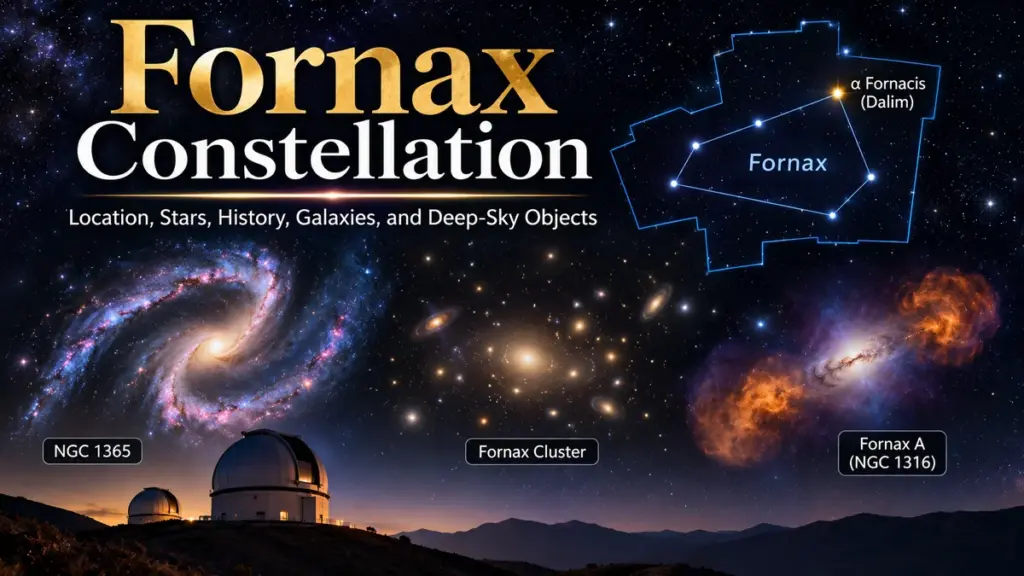
The Fornax constellation, Latin for “the Furnace,” is a relatively faint constellation in the southern celestial hemisphere. Although its stars are not particularly bright, this region of the sky contains some of the most scientifically important objects studied by modern astronomers. These include the nearby Fornax Galaxy Cluster, the powerful radio galaxy Fornax A, the spectacular barred spiral galaxy NGC 1365, and the famous Hubble Ultra Deep Field.
Fornax was introduced by the French astronomer Nicolas-Louis de Lacaille during his 18th-century mapping of the southern sky. Unlike ancient constellations associated with gods, heroes, and mythological creatures, Fornax represents a scientific instrument used in historical chemical experiments.
Today, astronomers study this constellation to investigate stellar systems, exoplanets, galaxy evolution, supermassive black holes, dark matter, and the early universe. Its location makes it particularly valuable for southern observatories, while several of its brighter galaxies are accessible to amateur astronomers using suitable telescopes.
This guide explores the history, location, visibility, stars, planetary systems, galaxies, and scientific significance of Fornax, along with practical advice for observing and photographing its celestial objects.
What Is the Fornax Constellation?
Fornax is one of the 88 constellations officially recognized by the International Astronomical Union (IAU). It occupies approximately 398 square degrees of the celestial sphere, ranking 41st among the constellations by area. Its central region is approximately located at right ascension 3 hours and declination 30 degrees south.
A constellation is a defined region of the sky, not necessarily a group of physically associated stars. The stars visible within Fornax lie at different distances from Earth, while its galaxies are often millions of light-years farther away. They appear within the same celestial boundaries because of the direction from which we observe them.
Fornax contains no star brighter than third magnitude, making it less conspicuous than familiar constellations such as Orion, Scorpius, or the Southern Cross. Nevertheless, its deep-sky objects make it an important destination for astronomical research. [1] [2]
Fornax Constellation Facts at a Glance
The following table summarizes the constellation’s defining characteristics. The coordinates are approximate reference values rather than the exact boundaries of the constellation. Likewise, its best observing season describes typical evening visibility, which varies according to geographic latitude and local observing conditions.
| Characteristic | Details |
|---|---|
| Official name | Fornax |
| Latin meaning | Furnace |
| Common representation | Chemical furnace |
| Abbreviation | For |
| Genitive form | Fornacis |
| Constellation family | Lacaille family |
| Discoverer | Nicolas-Louis de Lacaille |
| Historical introduction | 1750s |
| Celestial hemisphere | Southern |
| Approximate area | 398 square degrees |
| Area ranking | 41st of 88 |
| Approximate central right ascension | 3 hours |
| Approximate central declination | −30° |
| Brightest star | Alpha Fornacis |
| Brightest star’s apparent magnitude | Approximately 3.8 |
| Neighboring constellations | Cetus, Eridanus, Phoenix, Sculptor |
| Favorable evening observing season | November to January |
| Best-known galaxy cluster | Fornax Cluster |
| Notable radio galaxy | NGC 1316, or Fornax A |
| Notable spiral galaxy | NGC 1365 |
| Famous deep-field observation | Hubble Ultra Deep Field |
The most important distinction is that Fornax contains objects at very different distances. Alpha Fornacis is a nearby stellar system, the Fornax Dwarf is a satellite galaxy of the Milky Way, and the Fornax Cluster lies tens of millions of light-years away. They share a position on the celestial sphere rather than a common physical location. [1] [2] [3]
History and Origin of the Fornax Constellation
The history of Fornax reflects a major transformation in astronomy during the 18th century. European astronomers increasingly explored parts of the southern sky that had not been systematically represented in their traditional star atlases. Scientific instruments became popular subjects for newly introduced constellations, reflecting the growing importance of experimental observation.
Fornax emerged from this period of scientific expansion. Its name represents laboratory equipment rather than an ancient celestial legend, making it a distinctive example of how constellation naming developed alongside scientific exploration and increasingly accurate star mapping.
Who Discovered the Fornax Constellation?
French astronomer Nicolas-Louis de Lacaille introduced Fornax after observing the southern sky from the Cape of Good Hope, in present-day South Africa, during 1751 and 1752. His work involved measuring stellar positions and compiling a detailed catalog of southern stars.
Lacaille introduced 14 new constellations, most associated with scientific instruments or related tools. These additions helped astronomers describe regions of the southern sky that lacked widely established European constellation names.
Fornax was initially created from comparatively faint stars near Eridanus. Its introduction provided a recognizable designation for a previously less-defined region of celestial maps, rather than representing the discovery of previously unseen stars. [4]
The Original Name: Fornax Chemica
The constellation’s historical designation is commonly given as Fornax Chemica, meaning “chemical furnace.” Historical sources also preserve the variant Fornax Chimiae, reflecting the Latinized terminology used in older celestial atlases.
Lacaille’s original French designation, le Fourneau, referred to a furnace. A chemical furnace was used to heat materials during laboratory experiments, including processes involving metals and other substances.
Later astronomical usage simplified the name to Fornax, which became its standardized modern form. The shorter designation follows the naming conventions used for the 88 internationally recognized constellations.
Some historical descriptions connect the constellation with the development of modern chemistry and Antoine Lavoisier. However, these associations should not be confused with evidence that Lacaille specifically named the constellation after Lavoisier, who was still a child when Lacaille conducted his southern observations. [4]
Why Is Fornax Named After a Furnace?
The furnace symbolizes the scientific instruments that became increasingly important during the Age of Enlightenment. Laboratory furnaces allowed experimenters to heat substances, study chemical reactions, and investigate the properties of different materials.
Lacaille’s constellation names celebrated the technological and observational methods of his era. Other examples include Horologium, representing a clock; Microscopium, representing a microscope; and Telescopium, representing a telescope.
Fornax therefore illustrates the relationship between astronomy and broader scientific development. Its symbolic meaning emphasizes experimentation, measurement, and discovery rather than the mythological storytelling associated with many classical constellations.
Does Fornax Have a Mythology?
Fornax has no traditional constellation mythology comparable to the stories associated with Orion, Andromeda, or Perseus. Its establishment occurred in the 18th century, long after ancient Greek astronomical traditions had developed.
There was a Roman religious figure named Fornax associated with ovens and the baking of grain. However, the modern constellation was named for a laboratory furnace, and there is no established historical basis for treating the Roman figure as its intended celestial representation.
This distinction matters because similar names can create misleading connections between ancient mythology and modern scientific nomenclature.
Where Is the Fornax Constellation Located?
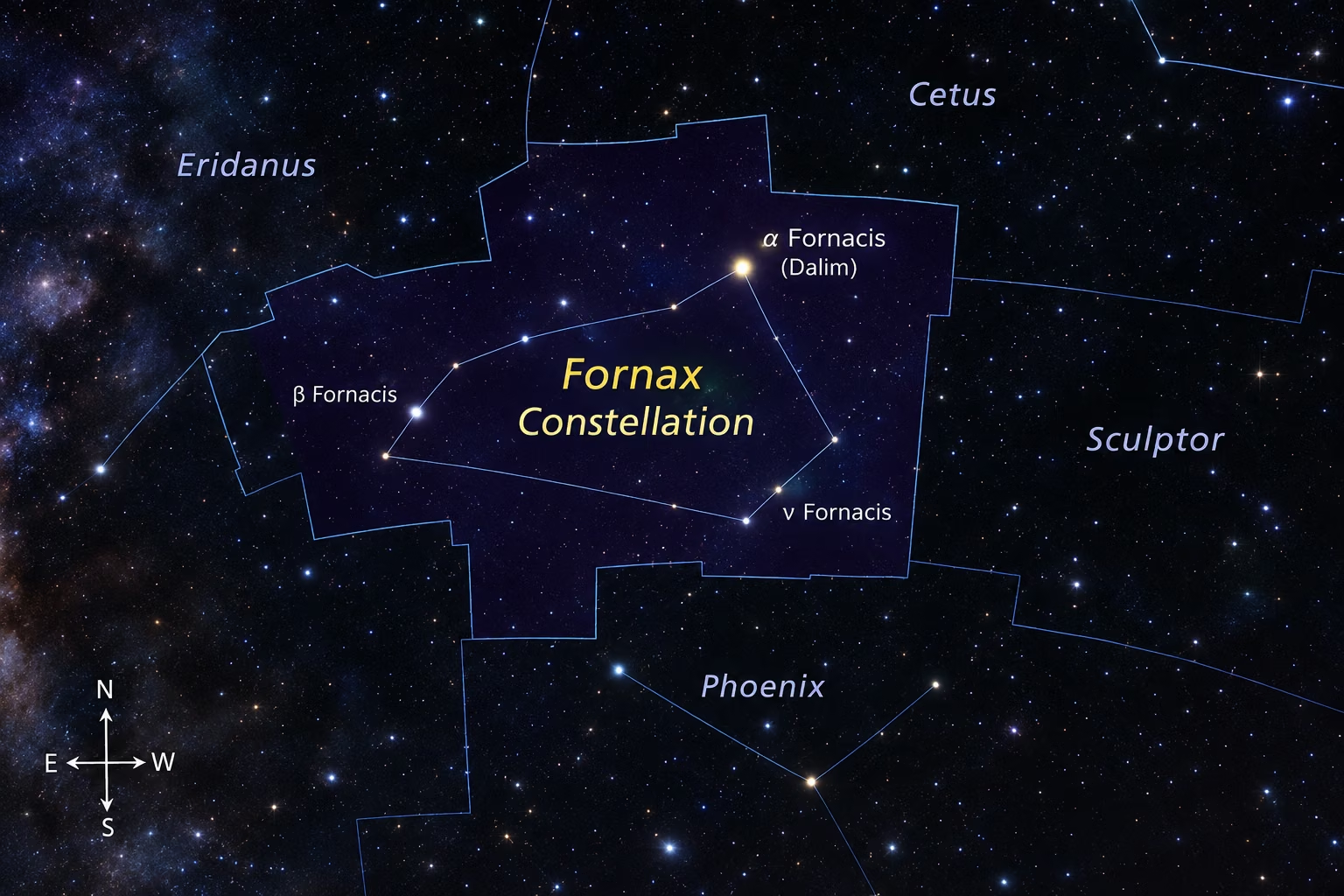
Fornax lies south of the celestial equator, between the prominent regions occupied by Cetus and Eridanus and the smaller southern constellations Sculptor and Phoenix. Its approximate central position is right ascension 3 hours and declination −30 degrees.
Because Fornax extends over a substantial area of the sky, individual stars and galaxies have different coordinates. A celestial globe or planetarium application is useful for understanding its full boundaries and the positions of neighboring constellations.
The constellation is best placed for observers in the Southern Hemisphere, but much of it can also be seen from tropical and lower northern latitudes.
Right Ascension and Declination of Fornax
Astronomers identify positions on the celestial sphere using right ascension and declination. Right ascension is comparable to longitude on Earth, while declination is comparable to latitude. Right ascension is normally expressed in hours, minutes, and seconds, while declination is measured in degrees north or south of the celestial equator.
Fornax occupies a region centered roughly on 3 hours of right ascension and −30 degrees declination. These figures are convenient for general orientation but should not be used as exact coordinates for individual objects.
For example, the Hubble Ultra Deep Field lies near right ascension 03h 32m 40s and declination −27° 48′. Its location is distinct from the center of the constellation and from the positions of the Fornax Cluster’s principal galaxies. [1] [5]
Official Constellation Boundaries
The International Astronomical Union recognizes constellations as defined regions rather than merely connected patterns of stars. Modern boundaries ensure that every position on the celestial sphere belongs to exactly one constellation.
The standardized boundaries were developed from the work of Belgian astronomer Eugène Delporte and adopted internationally in the early 20th century. They provide a consistent framework for assigning stars, nebulae, galaxies, and other celestial objects to specific constellations.
Consequently, a galaxy may be described as being “in Fornax” even though it is millions of light-years beyond the constellation’s visible stars. The designation refers only to its apparent direction in the sky. [1]
Which Constellations Border Fornax?
Fornax borders four officially recognized constellations: Eridanus, Cetus, Sculptor, and Phoenix. These neighboring regions help astronomers locate it on a star chart, although the visibility of their reference stars depends on the observer’s latitude and viewing time.
- Eridanus: A long, winding constellation representing a celestial river. It borders Fornax along much of its eastern and surrounding region.
- Cetus: A large constellation north of Fornax, traditionally representing a sea monster.
- Sculptor: A faint southern constellation west of Fornax, also introduced by Lacaille.
- Phoenix: A southern constellation located near Fornax’s southwestern boundary.
Eridanus is particularly useful for orientation because several of its stars are considerably brighter than the principal stars of Fornax. Together, these constellations occupy an area of the sky that becomes especially favorable for evening observation during the final months of the year. [2] [4]
How to Find Fornax in the Night Sky
Finding Fornax is more challenging than identifying bright constellations because its stars do not form a striking pattern. Observers should first locate its general sky region using a chart showing Eridanus, Cetus, Sculptor, and Phoenix. Once the region is identified, Alpha Fornacis provides a useful reference point.
A planetarium application can display the constellation’s current altitude and direction for a particular observing location. This is preferable to relying on a fixed compass bearing, since the stars’ positions change with the time of night and season.
For reliable identification, observers should use a reasonably dark site and allow their eyes to adapt to low light.
What Shape Does Fornax Have?
Fornax is often illustrated using a small arrangement of faint stars connected by simple lines. Unlike the easily recognizable hourglass of Orion or the curved tail of Scorpius, its pattern does not strongly resemble the object it represents.
The furnace depiction is symbolic. Historical star atlases often superimposed an illustration of a laboratory furnace over the relevant sky region, while modern charts generally show only stars, connecting lines, and constellation boundaries.
These line drawings are not standardized by the IAU. Different atlases may connect the constellation’s principal stars differently, even though the officially recognized celestial boundaries remain the same.
Does Fornax Have a Recognizable Asterism?
An asterism is a recognizable pattern of stars that may lie inside one constellation or span several constellations. The Big Dipper, for example, is an asterism within Ursa Major rather than a separate official constellation.
Fornax does not have a widely recognized bright asterism comparable to the Big Dipper or Orion’s Belt. Its faint stars offer few obvious visual landmarks for inexperienced observers.
For this reason, astronomers commonly identify Fornax through nearby reference stars, coordinate-based navigation, or computerized telescope pointing systems. The absence of a striking pattern does not diminish its importance for telescopic observation.
Step-by-Step Guide to Locating Fornax
The most reliable approach is to combine a star chart with the current position of the constellation. Begin by choosing a night between November and January, ideally when the Moon is absent or below the horizon.
- Find an observing location with a clear view toward the part of the sky where Fornax culminates.
- Open a star chart configured for your geographic location and observation time.
- Locate the neighboring constellation Eridanus.
- Identify Alpha Fornacis using the chart.
- Compare the surrounding faint stars with the displayed pattern.
- Use binoculars or a telescope if you intend to explore galaxies within the constellation.
For observers unfamiliar with southern constellations, digital planetarium software generally provides a more dependable starting point than memorizing an approximate geometric pattern.
When Is the Fornax Constellation Visible?
Fornax is most favorably positioned during the final months of the year, especially around December, when it reaches a convenient position in the evening sky. Its visibility depends on the observer’s latitude, the time of observation, weather conditions, atmospheric transparency, and local light pollution.
Although Fornax is commonly described as a Southern Hemisphere constellation, it is not exclusively visible south of the equator. Observers in tropical regions and portions of the Northern Hemisphere can also see it.
The key consideration is whether the constellation rises sufficiently high above the horizon for its relatively faint stars to be distinguished.
Best Time of Year to Observe Fornax
December is generally the most convenient month for evening observations of Fornax, with November and January also offering favorable opportunities. Around mid-December, its central region passes near the local meridian during the evening, placing it relatively high in the sky for observers at suitable latitudes.
This seasonal pattern results from Earth’s motion around the Sun. As Earth progresses through its orbit, different regions of the night sky become visible during evening hours.
Fornax remains in the celestial sphere throughout the year, but for several months it appears too close to the Sun’s direction for convenient nighttime observation. [2]
Can Fornax Be Seen from the Northern Hemisphere?
Yes. Fornax is visible from many locations in the Northern Hemisphere, although its altitude decreases as observers travel farther north.
A point at declination −30 degrees reaches approximately 37 degrees above the southern horizon when viewed from latitude 23 degrees north. At latitude 40 degrees north, it culminates only about 20 degrees above the horizon.
These values illustrate why Fornax is easier to observe from tropical regions and southern latitudes. Its northernmost portions remain accessible farther north than its southernmost parts, so the visibility limit is not identical for every star in the constellation.
Can You See Fornax Without a Telescope?
Under sufficiently dark conditions, observers can identify some of the brighter stars in Fornax without optical equipment. However, Alpha Fornacis has an apparent magnitude of only about 3.8, and most of the constellation’s other stars are fainter.
Human vision typically reaches approximately sixth magnitude under excellent dark-sky conditions, although the actual limit varies significantly. Urban light pollution, moonlight, haze, and atmospheric extinction can substantially reduce the number of visible stars.
Binoculars make the surrounding star field easier to explore, while telescopes are needed to reveal the constellation’s most interesting galaxies.
How Does Light Pollution Affect Fornax?
Light pollution increases the brightness of the night-sky background, reducing the contrast between faint celestial objects and their surroundings. This effect is especially important in Fornax because its recognizable stars are comparatively dim.
The Bortle scale provides a commonly used framework for describing sky darkness, ranging from exceptionally dark skies to bright inner-city conditions. For galaxies, dark skies are often more valuable than simply increasing telescope magnification.
Observers should also consider atmospheric extinction. When Fornax lies low above the horizon, its light passes through more of Earth’s atmosphere, making faint stars and galaxies harder to detect even when the sky overhead appears relatively dark.
Major Stars in the Fornax Constellation
The stars of Fornax are not especially bright, but they provide useful examples of different stellar classes, distances, and physical systems. The constellation includes ordinary main-sequence stars, evolved stars, binary systems, and a nearby brown dwarf.
Astronomers identify these objects using catalog designations such as Bayer letters, Flamsteed numbers, and Henry Draper catalog entries. Their properties are determined through spectroscopy, photometry, astrometry, and observations of stellar motion.
Understanding these stars also helps explain why the apparent arrangement of a constellation does not represent a physically connected group.
Alpha Fornacis (Dalim): The Brightest Star in Fornax
Alpha Fornacis, traditionally called Dalim, is the brightest star system in Fornax. It has an apparent visual magnitude of approximately 3.8 and is situated around 46 light-years from Earth. Although readily visible under dark conditions, it is much fainter than the brightest stars in the familiar northern and southern constellations.
Alpha Fornacis is a binary system. Its primary is a yellow-white star that has evolved beyond the ordinary main-sequence stage, while the companion is a smaller, cooler star.
The system provides an example of how two stars can orbit a common center of mass. Studying their orbital motion allows astronomers to estimate stellar masses and investigate the physical properties of multiple-star systems.
For amateur observers, Alpha Fornacis is particularly valuable as a reference point for locating the constellation.
Beta Fornacis
Beta Fornacis is another of the constellation’s principal stars. It is an evolved yellow giant, generally classified within the G spectral class, and appears considerably fainter than Alpha Fornacis.
Unlike the Sun, which is currently a main-sequence star, a giant has undergone significant changes in its internal structure as its hydrogen-burning evolution progresses. Such stars generally expand and become more luminous than they were during earlier stages.
Beta Fornacis helps illustrate the relationship between stellar evolution, temperature, radius, and luminosity. Its relative faintness in the night sky does not mean that it is intrinsically dim, since observed brightness also depends strongly on distance.
Nu Fornacis
Nu Fornacis is a faint star in the Fornax region that appears in detailed stellar catalogs and constellation charts. It is less useful as a naked-eye landmark than Alpha Fornacis, but it contributes to the mapped stellar population of this part of the southern sky.
For stars such as Nu Fornacis, astronomers rely on spectral measurements, color indices, and parallax observations to determine temperature, stellar classification, and distance.
These measurements are more informative than visual appearance alone. Two stars with similar apparent magnitudes can differ greatly in physical size, intrinsic luminosity, and distance from Earth.
HD 20794 (82 G. Eridani): A Nearby Star with Exoplanets
HD 20794, also known as 82 G. Eridani, is a nearby G-type star approximately 20 light-years from Earth. Its alternative designation reflects historical star-catalog conventions, even though its modern sky position lies in Fornax.
The star is slightly cooler and less luminous than the Sun. It has attracted considerable attention because precise measurements of its radial velocity have revealed planetary signals.
The NASA Exoplanet Archive lists several planets associated with HD 20794, but their classifications are not equally secure. The current archive distinguishes confirmed planets, disputed findings, and a refuted historical signal.
HD 20794 is particularly interesting because it provides astronomers with a nearby system in which to investigate relatively low-mass planets and the challenges of extracting small planetary signals from long-term stellar observations. [6]
LP 944-20: A Nearby Brown Dwarf
LP 944-20 is an exceptionally faint brown dwarf located in the direction of Fornax, approximately 16 light-years from Earth. Unlike an ordinary star, a brown dwarf has insufficient mass to sustain stable hydrogen fusion in its core.
Brown dwarfs occupy an intermediate mass range between giant planets and the lowest-mass hydrogen-burning stars. Their atmospheres are relatively cool, and many emit most strongly at infrared wavelengths.
LP 944-20 has also been studied for its magnetic activity and radio emission. Such observations are important because they reveal that some brown dwarfs can produce energetic phenomena despite their low luminosities.
The object is far too faint for ordinary naked-eye observation and requires specialized equipment for detailed study.
Stellar Properties and Star Systems in Fornax
Stars within Fornax demonstrate how astronomers classify celestial objects based on physical properties rather than apparent proximity. Their observed brightness depends on luminosity and distance, while their colors and spectra provide information about temperature and chemical composition.
Nearby stars can be investigated through parallax, and binary systems offer opportunities to measure stellar masses through orbital dynamics. These methods help establish the physical characteristics of stars in Fornax and elsewhere in the Milky Way.
The principles are essential for understanding both the constellation’s stellar population and the more distant astronomical objects observed in the same direction.
Binary and Multiple-Star Systems
A binary star system contains two gravitationally bound stars orbiting a common center of mass. Some systems contain three or more components and are classified as multiple-star systems.
Alpha Fornacis is an example of a binary system in Fornax. Its components can be investigated through repeated positional measurements, allowing astronomers to estimate orbital characteristics.
Binary stars are important because Newtonian gravitational dynamics, combined with observations of their orbits, can provide direct estimates of stellar masses.
These measurements help test theories of stellar structure and evolution, particularly when astronomers can independently determine the stars’ distances, temperatures, and luminosities.
Stellar Spectral Classification
Astronomers classify most ordinary stars using the spectral sequence O, B, A, F, G, K, and M. These categories broadly describe decreasing surface temperature, from the hottest O-type stars to the coolest M-type stars.
The Sun is a G-type star, while many cool red dwarfs belong to the M class. Additional classifications describe objects such as brown dwarfs and unusually evolved stars.
Spectroscopy works by separating starlight into its constituent wavelengths. Absorption and emission features reveal information about temperature, atmospheric composition, surface gravity, and motion.
Stars in Fornax can therefore be studied as individual physical objects rather than merely as points of light forming a constellation pattern.
Stellar Luminosity and Apparent Magnitude
Luminosity describes the total energy a star emits per unit time, while apparent magnitude measures its observed brightness from Earth.
The apparent magnitude scale is logarithmic and inverted: smaller numbers indicate brighter objects. A difference of five magnitudes corresponds to a brightness ratio of exactly 100.
Distance also affects observed brightness. For a source radiating approximately uniformly in all directions, the received light intensity decreases according to the inverse-square law. Doubling the distance reduces received intensity to one-quarter.
This explains why a highly luminous distant giant can appear fainter than a nearby main-sequence star. Absolute magnitude provides a standardized way to compare intrinsic brightness by specifying how bright an object would appear from 10 parsecs.
Stellar Distance and Parallax
Parallax measures the apparent shift in a nearby star’s position as Earth travels around the Sun. Astronomers compare observations taken at different points in Earth’s orbit against much more distant reference objects.
The relationship between parallax and distance is straightforward when parallax is measured in arcseconds:
[ d(\text{parsecs})=\frac{1}{p(\text{arcseconds})} ]
One parsec is approximately 3.26 light-years.
Modern astrometric missions such as ESA’s Gaia have measured positions, proper motions, and parallaxes for enormous numbers of stars. These observations improve distance estimates and help astronomers determine how stars move through the Milky Way.
Such measurements are especially useful for studying nearby systems including Alpha Fornacis, HD 20794, and other objects projected within Fornax.
Exoplanets and Planetary Systems in Fornax
An exoplanet is a planet orbiting a star outside the Solar System. The constellation Fornax contains several stars of interest to exoplanet researchers, including HD 20794.
When an exoplanet is described as being in Fornax, the designation refers to the position of its host star on the celestial sphere. The planet itself belongs to the Milky Way and is not necessarily associated with the more distant Fornax Galaxy Cluster.
Exoplanet research combines precise spectroscopy, photometric monitoring, orbital modeling, and statistical analysis to identify planetary signals and distinguish them from stellar activity or instrumental effects.
The HD 20794 Planetary System
HD 20794 is one of the more extensively investigated nearby planetary systems in this region of the sky. Its proximity makes it a useful target for measuring small stellar velocity changes produced by orbiting planets.
The NASA Exoplanet Archive, checked in November 2026, records the following planetary designations and orbital periods. The classifications require careful interpretation because different studies have revised earlier discoveries and challenged some signals. [6]
| Planet designation | Approximate orbital period | Archive status and qualification |
|---|---|---|
| HD 20794 b | 18.31 days | Confirmed |
| HD 20794 c | 40.11 days | Historical signal refuted |
| HD 20794 d | 89.68 days | Confirmed |
| HD 20794 e | 147.02 days | Listed as confirmed, but controversial |
| HD 20794 f | 647.6 days | Confirmed |
The longer-period planet HD 20794 f, reported in 2025, is particularly interesting because its orbit brings it through a range of stellar distances relevant to discussions of the habitable zone.
However, the planet’s minimum mass is several times Earth’s mass, and the available evidence does not establish that it has a solid surface, a suitable atmosphere, liquid water, or living organisms.
The classification of HD 20794 e also illustrates why planetary catalogs should be interpreted critically. A catalog entry may retain a confirmed designation while recording controversy in its accompanying scientific notes.
How Astronomers Detect Exoplanets
Astronomers generally cannot photograph small exoplanets directly because the glare of their host stars overwhelms the planets’ reflected or emitted light. Instead, researchers frequently use indirect detection methods.
The transit method detects small reductions in starlight when a planet passes in front of its star from our viewpoint. Radial velocity measurements detect changes in a star’s motion caused by an orbiting planet’s gravitational influence.
Other approaches include gravitational microlensing, astrometry, and direct imaging. Each technique is sensitive to different planetary properties and orbital configurations.
Combining methods can provide stronger evidence than relying on a single type of measurement. [7]
The Radial Velocity Method
The radial velocity method measures changes in a star’s velocity toward or away from Earth. An orbiting planet gravitationally influences its host star, producing a small periodic motion around their common center of mass.
This motion causes Doppler shifts in the star’s spectral lines. Astronomers measure these changes using high-resolution spectrographs and search for repeating patterns consistent with planetary orbits.
The technique can estimate a planet’s orbital period, orbital eccentricity, and minimum mass. However, the true mass usually remains uncertain unless the orbital inclination is independently constrained.
HD 20794 is an important example because its planetary signals require extremely precise measurements gathered over long observing periods.
Stellar activity, instrumental systematics, and additional planets can complicate interpretations, making independent confirmation and rigorous statistical analysis essential. [7]
The Habitable Zone Around HD 20794
The circumstellar habitable zone is the range of distances from a star where a suitable planet could potentially maintain liquid water on its surface, assuming appropriate atmospheric conditions.
Its location depends primarily on stellar luminosity and the planet’s climate properties. A less luminous star generally has a habitable zone closer to it than a more luminous star.
HD 20794 f has drawn scientific interest because its elongated orbit intersects distances relevant to habitable-zone calculations.
Nevertheless, a planet’s location within or near a habitable zone is not sufficient evidence of habitability. Atmospheric composition, surface pressure, planetary mass, geological activity, and orbital variations can all influence environmental conditions.
No detection of extraterrestrial life has been established in the HD 20794 system. [6] [8]
Deep-Sky Objects and Galaxies in Fornax
Fornax is especially important because it contains a remarkable concentration of galaxies and other deep-sky objects. While its individual stars are relatively inconspicuous, several galaxies within its boundaries are among the most studied objects in the nearby universe.
The Fornax Cluster is a major target for investigating galaxy evolution, while NGC 1316, NGC 1365, and NGC 1097 provide insights into galactic mergers, star formation, and supermassive black holes.
It is important to distinguish galaxies that belong to the Fornax Cluster from other galaxies that simply appear within the constellation. Sharing the same direction in the sky does not imply membership in the same gravitational structure.
The Fornax Cluster: One of the Nearest Rich Galaxy Clusters
The Fornax Cluster is a large gravitationally associated system of galaxies located approximately 60 to 62 million light-years from Earth. It is one of the nearest substantial galaxy clusters beyond our Local Group and is an important laboratory for understanding how dense environments influence galactic development.
The cluster contains dozens of luminous galaxies and many smaller, fainter systems. Its central region is dominated by NGC 1399, a giant elliptical galaxy surrounded by numerous globular clusters.
Other prominent members include NGC 1404 and the large barred spiral galaxy NGC 1365.
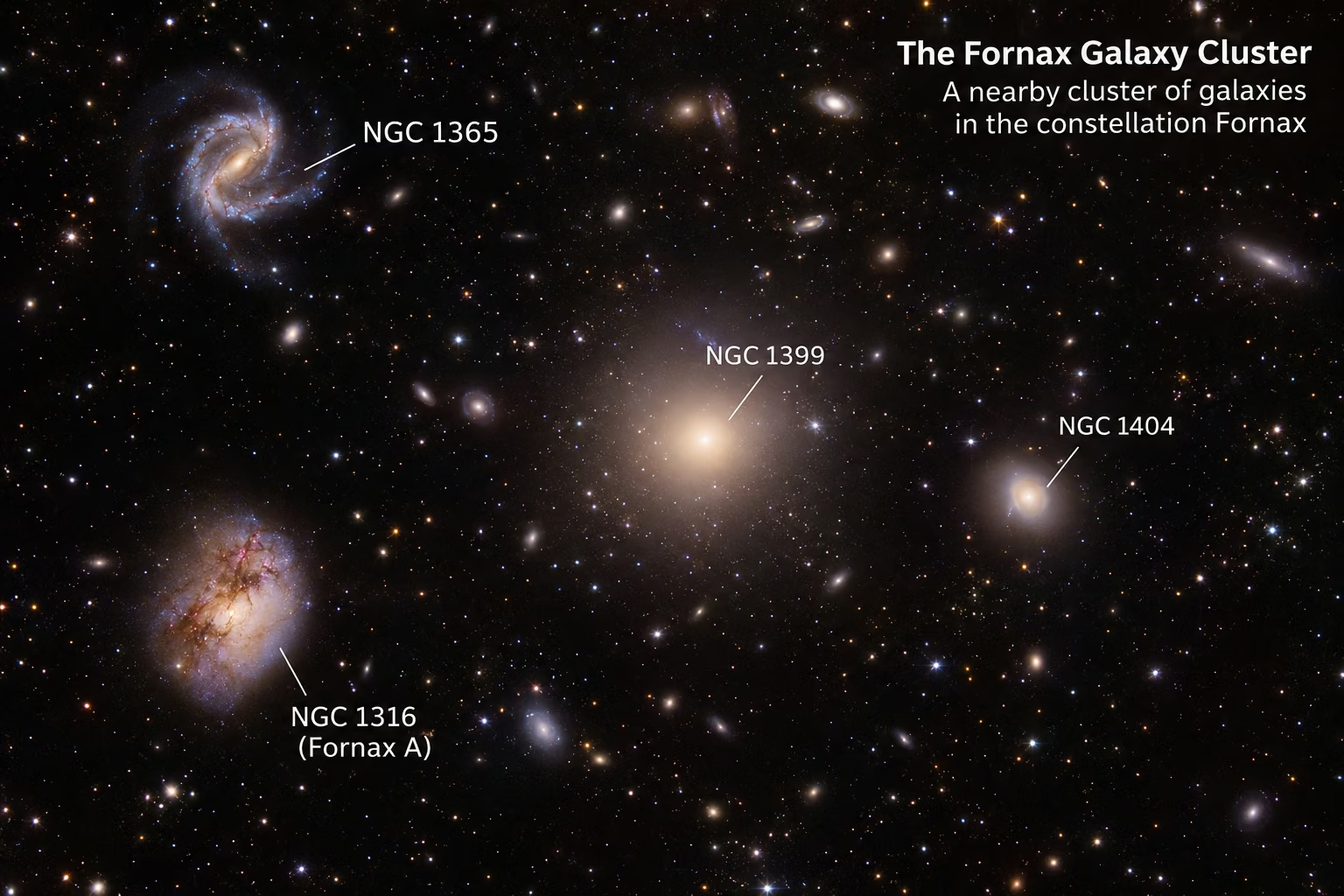
The Fornax Cluster is less extensive and less populous than the Virgo Cluster, but its relatively compact and evolved environment makes it scientifically valuable. Researchers study the movement of galaxies, their stellar populations, surrounding gas, and evidence of gravitational interaction.
NASA describes the cluster at approximately 62 million light-years, while related published measurements may differ depending on the objects and methods used. Such differences reflect astronomical measurement uncertainties, not necessarily contradictory observations. [3] [9]
NGC 1316 (Fornax A): A Powerful Radio Galaxy
NGC 1316, commonly called Fornax A, is a giant galaxy on the outskirts of the Fornax Cluster. It is particularly notable for its complex structure and powerful radio emission.
Optical observations reveal unusual dust lanes, stellar streams, shells, and other disturbances. These features provide evidence that NGC 1316 experienced significant galaxy mergers and interactions in the past.
The galaxy’s radio emission extends far beyond the stars visible in ordinary optical images. Its enormous radio lobes are associated with energetic activity originating near the galactic nucleus, where a supermassive black hole influences surrounding material.
Published distance estimates vary. Some ESO material gives approximately 60 million light-years, while NASA Hubble descriptions and a December 2025 Astronomy Picture of the Day use approximately 75 million light-years.
Because NGC 1316 lies in the complex outer environment of the Fornax Cluster, the different values should not be presented as though they are identical measurements. A broad description of roughly 60 to 75 million light-years is more appropriate when the underlying distance method is not being specified. [10] [11]
NGC 1365: The Great Barred Spiral Galaxy
NGC 1365 is one of the most spectacular galaxies in the direction of Fornax. Located approximately 60 million light-years away, it is a large barred spiral galaxy with a prominent central bar and extended spiral arms.
A barred spiral galaxy contains an elongated concentration of stars crossing its central region. Such bars can influence the movement of gas and help transport material toward the galaxy’s inner regions.
NGC 1365 also contains regions of active star formation and an active nucleus associated with a supermassive black hole.

Its spiral structure makes it valuable for studying the relationship between galactic dynamics, gas distribution, and stellar development.
NASA’s Hubble observations of Cepheid variable stars in NGC 1365 have contributed to measurements of extragalactic distances. Cepheids are important because their pulsation periods are related to their intrinsic luminosities, allowing astronomers to estimate distances and improve the cosmic distance scale. [12]
NGC 1399: A Giant Elliptical Galaxy
NGC 1399 is a dominant elliptical galaxy near the center of the Fornax Cluster. Unlike spiral galaxies, which often contain conspicuous disks and arms, elliptical galaxies generally have smoother stellar distributions and frequently contain older stellar populations.
NGC 1399 is particularly well known for its extensive globular cluster system. Globular clusters are dense, gravitationally bound collections of stars, many of which formed early in their host galaxies’ histories.
By studying the distribution and motion of these clusters, astronomers investigate the galaxy’s gravitational potential, formation history, and surrounding dark matter.
NGC 1399 also serves as an important reference object for research into the structure and dynamics of the Fornax Cluster. Its proximity to NGC 1404 on the sky provides opportunities to study interactions between a dominant central galaxy and other cluster members. [3] [9]
NGC 1404: An Elliptical Galaxy Undergoing Gas Stripping
NGC 1404 is another prominent elliptical galaxy in the Fornax Cluster, located approximately 62 million light-years from Earth. It is moving through the cluster environment toward the region dominated by NGC 1399.
As NGC 1404 moves through the hot intracluster medium, its own gas experiences pressure from the surrounding material. This phenomenon, known as ram-pressure stripping, can remove gas from the galaxy.
X-ray observations provide evidence of this interaction by revealing disturbed gas structures and features that are not obvious in visible-light images.
The removal of gas matters because galaxies require suitable gas supplies to sustain future star formation. By examining NGC 1404, astronomers can investigate how cluster environments affect the long-term evolution of their member galaxies.
ESO has documented the galaxy using observations from the Very Large Telescope. [13]
NGC 1097: A Barred Spiral Galaxy with an Active Nucleus
NGC 1097 is a barred spiral galaxy approximately 45 million light-years away in the direction of Fornax. It is often considered a rewarding target for amateur observers because of its relatively high apparent brightness.
The galaxy contains a central supermassive black hole and a distinctive circumnuclear ring in which new stars are forming.
ESO observations have revealed hundreds of star-forming regions concentrated around the central portion of the galaxy. The ring spans roughly 5,000 light-years and contains gas and dust associated with vigorous stellar development.
The galaxy also exhibits interactions with a nearby companion, illustrating how gravitational encounters can alter galactic structures.
NGC 1097 is an important example of how a stellar bar, gas dynamics, central activity, and star formation can coexist within a single galaxy. [14]
NGC 1350: The Colossal Cosmic Eye
NGC 1350 is an attractive spiral galaxy located approximately 65 million light-years from Earth. Its visual appearance is dominated by a bright central region, a bar-like structure, and gracefully curved spiral arms that create an eye-shaped pattern.
The European Southern Observatory has captured detailed images of NGC 1350 using the Very Large Telescope. These observations reveal dust structures, stellar concentrations, and numerous background galaxies.
Astronomers examine galaxies such as NGC 1350 to understand spiral-arm formation, gas distribution, and stellar populations.
Although NGC 1350 appears in the direction of the Fornax Cluster, its precise physical relationship to the cluster should be evaluated using distance and velocity measurements rather than sky position alone. [15]
NGC 1360: The Robin’s Egg Nebula
NGC 1360 is an important additional deep-sky object that deserves inclusion in a comprehensive guide to Fornax. Unlike the galaxies described above, it is a planetary nebula within the Milky Way, located approximately 1,500 light-years away.
Planetary nebulae form when evolved stars shed their outer layers, leaving expanding clouds of ionized gas illuminated by hot central stellar remnants. Despite their names, they are unrelated to planets.
NGC 1360 has a distinctive elongated appearance and is sometimes called the Robin’s Egg Nebula. Its blue-green emission is strongly associated with ionized oxygen.
The nebula’s central stellar system has also been studied as a binary system containing evolved stellar components.
NGC 1360 therefore gives observers an opportunity to investigate stellar evolution, complementing Fornax’s better-known collections of distant galaxies. [16]
The Fornax Dwarf Spheroidal Galaxy
The Fornax Dwarf Spheroidal Galaxy is a small satellite of the Milky Way located in the direction of the constellation Fornax. It should not be confused with the far more distant Fornax Cluster.
The dwarf galaxy is approximately 460,000 light-years away, although published distance measurements differ slightly. It is a diffuse, low-surface-brightness system containing old and intermediate-age stars, with a complex history of star formation.
Its proximity allows astronomers to resolve individual stars and study their motions, making it particularly valuable for investigating dwarf-galaxy evolution and dark matter.
Discovery and Physical Characteristics of the Fornax Dwarf
The Fornax Dwarf was identified in 1938 by astronomer Harlow Shapley. It belongs to the population of smaller galaxies gravitationally associated with the Milky Way.
Dwarf spheroidal galaxies are generally diffuse systems with relatively little gas and limited present-day star formation. Their stars are spread over a broad region, giving them very low surface brightness.
The Fornax Dwarf is notable for possessing several globular clusters, an unusual feature for a galaxy of its relatively modest size.
Researchers investigate the ages, chemical compositions, and spatial distributions of its stars to reconstruct its evolutionary history.
Unlike most bright galaxies photographed through amateur telescopes, its diffuse light is difficult to detect visually, even though it is comparatively nearby.
Globular Clusters in the Fornax Dwarf
The Fornax Dwarf hosts a significant globular cluster population that provides valuable evidence about its early development.
Globular clusters consist of gravitationally bound stars that generally share a common formation history. Their ages and chemical compositions help astronomers study conditions during earlier periods of galaxy evolution.
The Hubble Space Telescope has observed globular clusters in the Fornax Dwarf to examine their stellar populations.
These observations also contribute to a broader scientific question: why some dwarf galaxies possess relatively massive and long-lived globular clusters despite having modest overall stellar masses.
Comparing globular clusters in the Fornax Dwarf with those in the Milky Way and other nearby galaxies helps test theories of star-cluster formation and survival. [17]
Dark Matter and the Fornax Dwarf Galaxy
The Fornax Dwarf is an important target for dark matter research because its stellar motions can be used to investigate the galaxy’s total gravitational mass.
Astronomers measure the line-of-sight velocities of many individual stars and examine how their motions vary across the galaxy. These observations can be compared with dynamical models to estimate the mass required to support the observed stellar population.
In dwarf spheroidal galaxies, the gravitational mass inferred from stellar kinematics commonly exceeds the mass attributable to visible stars alone. This provides evidence for substantial dark matter components.
However, estimates depend on modeling assumptions, including stellar orbital distributions and the adopted dark matter density profile.
The Fornax Dwarf is especially useful for testing alternative explanations of its internal mass distribution and the influence of the Milky Way’s gravitational field.
The Hubble Ultra Deep Field in Fornax
One of the most scientifically important regions within Fornax is the Hubble Ultra Deep Field (HUDF). This small area of sky was observed for exceptionally long periods by the Hubble Space Telescope, revealing thousands of galaxies at enormous distances.
The HUDF is not a galaxy cluster or a single astronomical object. It is an observational field selected to study extremely faint galaxies across a wide range of cosmic history.
Its location in Fornax has helped astronomers investigate the formation and evolution of galaxies, the early stages of star formation, and the changing structure of the universe.
What Is the Hubble Ultra Deep Field?
The Hubble Ultra Deep Field is a small region centered near right ascension 03h 32m 40s and declination −27° 48′. The original field covers an area only about three arcminutes across, a tiny fraction of the apparent sky.
Despite its small angular size, the image reveals approximately 10,000 galaxies, many too faint to detect in ordinary astronomical observations.
The field was selected partly because it contains relatively little bright foreground interference, making it suitable for studying very distant objects.
Its galaxies are not all located at the same distance. Some are relatively nearby on cosmological scales, while others are observed as they existed billions of years ago.
The HUDF demonstrates how even an apparently empty region of the sky can contain an extraordinary population of galaxies. [5]
How the Hubble Space Telescope Observed the Field
The original Hubble Ultra Deep Field was constructed from observations obtained during 2003 and 2004. Astronomers combined numerous exposures taken with Hubble’s instruments to achieve far greater sensitivity than a single image could provide.
Long integration times allow telescopes to collect photons from extremely faint objects. Combining many carefully aligned exposures improves the signal-to-noise ratio and helps reveal galaxies that would otherwise remain hidden.
Later Hubble observations expanded the field’s scientific usefulness, including measurements at additional wavelengths.
These observations allowed researchers to examine galaxy colors, shapes, apparent brightness, and estimated distances, providing evidence about how galaxies developed over cosmic time.
What Did Astronomers Discover in the Ultra Deep Field?
The Hubble Ultra Deep Field revealed galaxies with a wide variety of shapes, sizes, colors, and apparent brightnesses. Some resemble familiar spiral and elliptical galaxies, while others appear irregular, compact, or distorted.
These differences are scientifically important because galaxies evolve through star formation, mergers, interactions, and changes in their gas supplies.
Astronomers use redshift measurements and estimates to investigate the distances and evolutionary stages of these objects.
Cosmological redshift occurs as light travels through the expanding universe, stretching its wavelength. Greater redshifts generally correspond to observations of earlier cosmic periods, although precise interpretation requires a cosmological model.
The HUDF has become an essential dataset for studying the history of galaxies and the development of cosmic structure. [5]
How Fornax Helps Astronomers Study the Early Universe
The Hubble Ultra Deep Field provides an observational window into the past because light takes time to travel across the universe. When astronomers detect light from a galaxy billions of light-years away, they observe that galaxy as it existed long ago.
This principle is called lookback time. It allows astronomers to compare galaxies from different cosmic epochs and investigate how their properties changed.
Deep-field surveys are particularly important for understanding early star formation, galaxy assembly, and the growth of stellar mass.
The James Webb Space Telescope complements Hubble by observing longer infrared wavelengths with exceptional sensitivity, helping researchers investigate highly redshifted galaxies and their stellar populations.
Fornax’s role in this research comes from the particular deep-field observation direction, rather than any unusual physical influence of the constellation itself.
Active Galactic Nuclei and Supermassive Black Holes in Fornax
Several galaxies visible within Fornax contain active galactic nuclei, making the constellation valuable for studying energetic processes associated with supermassive black holes.
An active galactic nucleus is a compact central region of a galaxy that emits unusually large amounts of radiation, often because gas is accreting toward a supermassive black hole.
Examples in Fornax include NGC 1316, NGC 1365, and NGC 1097. Their different structures and activity levels allow astronomers to investigate how galactic environments, gas supplies, and gravitational interactions affect nuclear activity.
What Are Active Galactic Nuclei?
An active galactic nucleus, commonly abbreviated AGN, is a luminous central region powered primarily by matter falling toward a supermassive black hole.
As gas moves inward, gravitational energy can be converted into radiation. The surrounding accretion flow may reach extremely high temperatures, producing emissions across several parts of the electromagnetic spectrum.
Not every galaxy containing a supermassive black hole has a strongly active nucleus. Activity depends partly on whether sufficient material is available for accretion.
Astronomers classify active galaxies using properties such as luminosity, spectral lines, radio emission, and viewing geometry.
Studying AGN helps researchers understand the relationship between black hole growth and the evolution of their host galaxies.
Supermassive Black Holes in Fornax Galaxies
Supermassive black holes typically contain millions to billions of solar masses and are found in the central regions of many large galaxies.
Evidence for their presence can come from the motions of nearby stars and gas, high-energy radiation, and the behavior of accreting material.
NGC 1097 and NGC 1365 are important examples of barred spiral galaxies with active central regions. Their stellar bars and gas structures provide opportunities to investigate how material moves toward galactic centers.
NGC 1316, meanwhile, illustrates how a galaxy with a complicated merger history can host substantial radio activity.
These observations help astronomers investigate black hole feeding, energetic feedback, and the relationship between central activity and the surrounding galaxy.
Why Is Fornax A Such a Strong Radio Source?
Fornax A is one of the best-known powerful radio galaxies in the nearby universe. Its radio emission is associated with relativistic particles and magnetic fields in enormous structures extending well beyond the visible stellar body of NGC 1316.
Much of this radiation is synchrotron emission, produced when energetic charged particles move through magnetic fields.
Radio observations reveal large lobes that are not apparent in ordinary optical photographs. These structures provide evidence of substantial energy transport from the galactic nucleus into the surrounding environment.
Fornax A is particularly useful for studying the long-term influence of black hole activity because its radio structures preserve evidence of energetic processes occurring over extended periods.
Its unusual optical structure also links this nuclear activity to a complex history of galactic interactions and mergers. [10] [11]
Galaxy Clusters and Gravitational Interactions
The Fornax Cluster provides an important environment for investigating how gravity influences galaxies over billions of years. Unlike isolated galaxies, cluster members experience interactions with neighboring galaxies, the cluster’s gravitational field, and hot gas distributed through the intracluster medium.
These processes can change galactic shapes, disturb stellar orbits, remove gas, and influence star formation.
Because the Fornax Cluster is relatively nearby, astronomers can study many of its galaxies in considerable detail. Such observations help distinguish evolutionary processes associated with dense environments from those occurring in more isolated systems.
How Gravity Shapes the Fornax Cluster
Gravity governs the orbital motions of galaxies within the cluster and influences how their structures evolve.
When galaxies pass near one another, tidal forces can distort their shapes, redistribute stars, and disturb gas clouds. Some encounters lead to mergers, while others produce streams, shells, or extended stellar structures.
The cluster’s overall gravitational potential also influences the motions of its member galaxies and the distribution of intracluster material.
Astronomers investigate these processes by measuring galaxy velocities, studying their stellar populations, and comparing observations with numerical simulations.
Disturbed systems such as NGC 1316 provide evidence of earlier mergers, while galaxies such as NGC 1404 demonstrate the continuing effects of motion through the cluster environment.
Galaxy Evolution Within the Fornax Cluster
Galaxy evolution refers to changes in the properties of galaxies over cosmic time. These changes include star formation, gas consumption, mergers, chemical enrichment, and transformations in structure.
Within the Fornax Cluster, galaxies experience additional environmental influences. Hot intracluster gas can exert ram pressure on galaxies moving through it, potentially removing their gas.
Gravitational encounters may also disturb galactic structures or alter the distribution of stars.
The effects vary according to galaxy mass, orbital history, gas content, and local environment. Some galaxies retain significant star-forming material, while others are dominated by older stellar populations.
The Fornax Deep Survey has provided extensive observational data used to investigate dwarf galaxies and low-surface-brightness structures in this environment. [18]
Why Is the Fornax Cluster Important for Cosmology?
Nearby galaxy clusters allow astronomers to study cosmic structure using detailed observations that are often difficult for more distant systems.
The Fornax Cluster provides opportunities to measure galaxy motions, estimate gravitational mass distributions, and examine interactions between visible matter and dark matter.
Researchers also use its galaxies to investigate extragalactic distance indicators, including methods based on stellar populations and surface brightness fluctuations.
The cluster is useful for comparison with Virgo because the two systems differ in population, density, and evolutionary characteristics.
Such comparisons help astronomers distinguish processes associated with galaxy mass from those driven by environment.
Although an individual cluster cannot independently determine the history of the universe, detailed observations contribute to broader models of structure formation and galaxy evolution.
Telescopes and Astronomical Research in Fornax
Fornax has been studied across the electromagnetic spectrum using ground-based and space-based instruments. Optical telescopes reveal stars, dust lanes, and galaxy structures, while infrared observations provide additional information about stellar populations and obscured regions.
Radio telescopes investigate energetic particles and large emission structures. X-ray observatories reveal hot gas and high-energy processes that may be invisible in conventional photographs.
Combining these observations produces a more complete understanding of the physical conditions within astronomical objects.
Fornax is particularly suitable for multiwavelength research because it includes nearby galaxies, interacting systems, and an extensively studied deep-field region.
Hubble Space Telescope Observations
The Hubble Space Telescope has made important contributions to research involving Fornax, including observations of the Ultra Deep Field, NGC 1316, and stellar populations in nearby galaxies.
Operating above Earth’s atmosphere allows Hubble to obtain sharp images without the blurring caused by atmospheric turbulence.
Its observations of NGC 1316 revealed dust lanes, star clusters, and structural disturbances associated with past mergers.
Hubble has also examined globular clusters in the Fornax Dwarf and helped investigate the properties of stellar populations in nearby galaxies.
In the Hubble Ultra Deep Field, long-duration observations revealed extremely faint distant galaxies, providing data used to study the earlier universe. [5] [11] [17]
Very Large Telescope Observations
The European Southern Observatory operates the Very Large Telescope (VLT) at Paranal Observatory in Chile.
The VLT consists of four major Unit Telescopes, each with an 8.2-meter primary mirror, supported by advanced instruments for imaging and spectroscopy.
Its southern location provides favorable access to Fornax. Observations have included NGC 1097, NGC 1350, NGC 1404, and other galaxies.
For example, VLT observations of NGC 1097 have examined its circumnuclear star-forming ring and gas structures near the active nucleus.
Spectroscopic instruments can also measure stellar and gas velocities, chemical abundances, and physical conditions within galaxies.
These capabilities make the VLT valuable for investigating galactic dynamics, star formation, and evolution. [13] [14] [15]
Radio and X-Ray Observations of Fornax
Radio and X-ray astronomy reveal physical processes that optical imaging alone cannot fully explain.
Radio observations of Fornax A show extensive lobes associated with energetic particles and magnetic fields. Their scale and structure provide evidence of activity originating near the galaxy’s central black hole.
X-ray observations of the Fornax Cluster reveal extremely hot intracluster gas and disturbances associated with galaxy motion.
NGC 1404 provides an especially informative example because its interaction with surrounding hot gas can be investigated through X-ray measurements.
Astronomers compare observations from different wavelengths to determine where energy is produced, how gas moves, and how galactic environments influence stellar and nuclear activity.
How to Observe and Photograph the Fornax Constellation
Observing Fornax requires more preparation than identifying a bright constellation. Its stars are relatively faint, and many of its most interesting objects are galaxies with low surface brightness.
Nevertheless, observers using suitable telescopes and dark-sky locations can explore several impressive targets, particularly NGC 1097, NGC 1316, and NGC 1365.
Successful observations depend on more than telescope aperture. Sky darkness, atmospheric transparency, the altitude of the target, optical quality, and observing experience all influence what can be detected.
The constellation is especially attractive to experienced deep-sky observers and astrophotographers.
Equipment Needed to Observe Fornax
The necessary equipment depends on whether the objective is to identify the constellation or examine its galaxies.
For locating Fornax, a star chart, red-light flashlight, and binoculars may be sufficient under dark conditions. An amateur telescope becomes more useful when studying individual deep-sky objects.
A telescope with an aperture around 150 to 200 millimeters can reveal several of the brighter galaxies under favorable skies, although their appearance will generally be faint and diffuse rather than photographically detailed.
Larger apertures improve light gathering and may reveal additional structure.
A stable mount, accurate finder system, and suitable eyepieces are also important. At low altitude, atmospheric extinction and turbulence can substantially reduce image quality.
Best Deep-Sky Objects to Observe in Fornax
Fornax includes targets ranging from comparatively bright spiral galaxies to challenging elliptical galaxies and diffuse stellar systems.
The following table provides approximate visual magnitudes and angular sizes. These values are rounded planning references, and published measurements can differ depending on the catalog, photometric band, and definition of an object’s visible extent.
| Object | Type | Approx. magnitude | Approx. apparent size | Observing difficulty |
|---|---|---|---|---|
| NGC 1097 | Barred spiral galaxy | 9.5 | 9′ × 6′ | Moderate |
| NGC 1316 | Radio galaxy | 8.5 | 12′ × 8′ | Moderate |
| NGC 1365 | Barred spiral galaxy | 9.6 | 11′ × 6′ | Moderate |
| NGC 1399 | Elliptical galaxy | 9.6 | 7′ × 6′ | Moderate |
| NGC 1404 | Elliptical galaxy | 10.0 | 3′ × 3′ | Moderate to challenging |
| NGC 1350 | Spiral galaxy | 10.5 | 6′ × 3′ | Challenging |
| NGC 1360 | Planetary nebula | 9.4 | 11′ × 7′ | Challenging due to low surface brightness |
| Fornax Dwarf | Dwarf spheroidal galaxy | Very diffuse | Extended | Extremely challenging |
Integrated magnitude is not the only factor determining visibility. A large diffuse object may have a relatively bright integrated magnitude while remaining difficult to distinguish from the night-sky background.
For example, NGC 1360 has a large apparent size, so its light is distributed over a considerable area. The Fornax Dwarf is even more challenging because of its exceptionally low surface brightness.
Astrophotography of Fornax
Fornax is an excellent region for deep-sky astrophotography because it contains galaxies with different structures and apparent sizes.
A wide-field camera can record the surrounding star field and the general constellation region, while a telescope with a moderate or long focal length can capture individual galaxies.
For detailed galaxy imaging, an equatorial tracking mount is particularly useful. Accurate tracking allows longer exposures without significant star trailing.
Multiple exposures can be combined through image stacking to improve the signal-to-noise ratio.
Calibration frames help reduce sensor noise, dark current, vignetting, and dust artifacts. Photographers should also consider target altitude, sky brightness, camera sampling, and atmospheric seeing.
Broadband galaxies usually benefit substantially from dark skies. Narrowband filters designed for emission nebulae are not a general substitute for dark-sky conditions when photographing galaxies.
A Practical Guide to Photographing Fornax Galaxies
Begin by selecting a specific target. NGC 1097, NGC 1316, and NGC 1365 are reasonable choices because they have relatively bright central regions and visually distinctive structures.
Use planetarium software to determine when the object will be highest in the sky. Observing near meridian transit generally reduces atmospheric extinction and improves the potential image quality.
After polar alignment and accurate focusing, capture a series of tracked exposures. The ideal exposure duration depends on mount performance, focal length, sky brightness, and camera characteristics.
Collect appropriate calibration frames and combine the images using astronomical stacking software.
During processing, adjust background levels, contrast, and color carefully. Excessive sharpening or noise reduction can introduce artificial structures and misrepresent faint galactic features.
The most important improvement often comes from obtaining more high-quality integration time rather than applying increasingly aggressive image processing.
10 Interesting Facts About the Fornax Constellation
Fornax contains several unusual features that distinguish it from more familiar constellations. Its importance comes less from bright stars and more from the variety of astronomical systems visible in its direction.
These facts summarize its history, stellar characteristics, galaxy populations, and contribution to modern research.
1. Fornax represents a scientific instrument. Unlike many classical constellations, it symbolizes a chemical furnace rather than a mythological figure.
2. It was introduced during the 18th century. Nicolas-Louis de Lacaille established it while mapping previously underrepresented regions of the southern sky.
3. It ranks 41st among the 88 constellations. Fornax covers approximately 398 square degrees.
4. Its brightest star is relatively faint. Alpha Fornacis has an apparent magnitude of approximately 3.8.
5. It contains one of the nearest rich galaxy clusters. The Fornax Cluster lies about 60 to 62 million light-years away.
6. Fornax A is a powerful radio source. NGC 1316 produces enormous radio structures associated with energetic galactic activity.
7. NGC 1365 is a prominent barred spiral galaxy. Its central bar and extended arms make it an important target for investigating galactic structure.
8. The Fornax Dwarf belongs to the Milky Way’s satellite population. It is far closer than the Fornax Cluster and is a separate galactic system.
9. The Hubble Ultra Deep Field lies within Fornax. This small field contains images of thousands of galaxies spanning vast cosmic distances.
10. Fornax contains nearby planetary systems. HD 20794 is an important target for investigating low-mass exoplanets using precise radial velocity observations.
Together, these characteristics make Fornax important to several branches of astronomy, including stellar astrophysics, exoplanet science, extragalactic astronomy, and cosmology.
Frequently Asked Questions About Fornax
What Is the Fornax Constellation Known For?
Fornax is best known for its collection of deep-sky objects rather than its bright stars. Its most notable features include the Fornax Galaxy Cluster, the powerful radio galaxy NGC 1316, the barred spiral galaxy NGC 1365, and the Hubble Ultra Deep Field.
The constellation also contains the nearby Fornax Dwarf, a satellite galaxy of the Milky Way.
These objects have made Fornax important for studies of galaxy evolution, dark matter, stellar populations, and the early universe.
Where Is the Fornax Constellation Located?
Fornax is located in the southern celestial hemisphere, approximately centered at right ascension 3 hours and declination −30 degrees.
It borders Eridanus, Cetus, Sculptor, and Phoenix. Its general region is visible from the Southern Hemisphere and much of the lower Northern Hemisphere.
For accurate identification, observers should use a star chart configured for their location and the time of observation.
Because its stars are comparatively faint, locating Fornax is often easier with digital planetarium software than by visual star patterns alone.
What Does Fornax Mean in Astronomy?
Fornax means “furnace” in Latin. The constellation represents a chemical furnace, reflecting the scientific instruments used during the 18th century.
Nicolas-Louis de Lacaille introduced the constellation during his southern sky mapping work.
The name is associated with laboratory experimentation rather than traditional mythological symbolism.
In modern astronomical usage, Fornax refers to a formally defined region of the celestial sphere, while Fornacis is the Latin genitive used in stellar designations such as Alpha Fornacis.
Who Discovered the Fornax Constellation?
The French astronomer Nicolas-Louis de Lacaille introduced Fornax during the 1750s following observations of the southern sky from the Cape of Good Hope.
His astronomical work led to the creation of 14 new constellations, most associated with scientific instruments or related equipment.
These constellations helped provide internationally recognizable names for regions of the southern sky that were not adequately represented in traditional European star atlases.
Lacaille did not discover the stars themselves. He introduced a constellation designation and arrangement for stars that had previously existed in other mapped regions.
What Is the Brightest Star in Fornax?
Alpha Fornacis, traditionally known as Dalim, is the brightest star system in the constellation.
Its apparent visual magnitude is approximately 3.8, making it visible under reasonably dark skies but less prominent than the brightest stars in many other constellations.
Alpha Fornacis is a binary system containing two gravitationally associated stars.
Its relatively modest apparent brightness helps explain why Fornax can be challenging to identify without a chart, even though the constellation covers a substantial region of the sky.
How Many Stars Are in the Fornax Constellation?
There is no single meaningful total for the number of stars in Fornax because the answer depends on observational sensitivity and the stellar catalog being considered.
Only a limited number of its brighter stars are identifiable to the naked eye, but modern telescopes and astronomical surveys record far more objects within its official boundaries.
The constellation also contains distant galaxies, each with potentially billions of stars.
Therefore, counting the visible stars in its traditional pattern is fundamentally different from counting all stars observable in its direction.
When Is the Best Time to See Fornax?
December is generally the best month for observing Fornax during convenient evening hours. November and January can also provide favorable opportunities.
The constellation’s precise position depends on geographic latitude and local sidereal time.
Observers should aim to view Fornax when it is near its highest point above the horizon, because atmospheric extinction increases at lower altitudes.
Dark, moonless skies are particularly helpful because its principal stars are relatively faint and its galaxies often have low surface brightness.
Can Fornax Be Seen from the Northern Hemisphere?
Yes. Much of Fornax can be observed from tropical and lower northern latitudes, although its altitude becomes progressively lower farther north.
From approximately 23 degrees north latitude, the constellation’s central region reaches a reasonable altitude above the southern horizon.
From higher northern latitudes, observation becomes more difficult because of atmospheric extinction and horizon obstructions.
The exact visibility limit varies across the constellation because its individual stars have different declinations.
Does the Fornax Constellation Have Planets?
Yes. Stars located within the official boundaries of Fornax have planetary systems, including HD 20794.
The HD 20794 system contains several planetary detections based on precise radial velocity observations. However, the scientific status of individual detections differs, with some confirmed, some disputed, and an earlier signal refuted.
These planets are located within our Milky Way Galaxy. They should not be confused with planets that might exist in the distant galaxies of the Fornax Cluster.
No planet in the HD 20794 system has been demonstrated to support life.
What Is the Fornax Cluster?
The Fornax Cluster is a gravitationally associated collection of galaxies located approximately 60 to 62 million light-years from Earth.
It contains numerous elliptical, spiral, and dwarf galaxies. Major members include NGC 1399, NGC 1404, and NGC 1365.
Astronomers use the cluster to study galaxy interactions, stellar populations, intracluster gas, and dark matter.
Because it is relatively nearby, researchers can investigate its galaxies in greater detail than comparable systems located much farther away.
Is the Fornax Dwarf Part of the Fornax Cluster?
No. The Fornax Dwarf Spheroidal Galaxy and the Fornax Cluster are entirely different astronomical systems.
The Fornax Dwarf is a satellite of the Milky Way located approximately 460,000 light-years away.
The Fornax Cluster is a much more distant collection of galaxies approximately 60 million light-years away.
Both appear in the direction of the same constellation, which explains their similar names.
Their shared celestial location does not mean that they belong to the same gravitational structure.
What Is Fornax A?
Fornax A is the radio-astronomy designation associated with NGC 1316, a giant galaxy in the outskirts of the Fornax Cluster.
The galaxy has a complicated merger history, visible through its unusual dust lanes, shells, and stellar structures.
It is also one of the strongest extended radio sources in the nearby sky.
Its radio emission is associated with energetic particles and magnetic fields in large lobes extending beyond the optical galaxy.
Fornax A is important for studying the relationship between galactic mergers, central black hole activity, and energy transport through the surrounding environment.
Are There Supermassive Black Holes in Fornax?
Yes. Several galaxies within the direction of Fornax contain central supermassive black holes.
Examples include NGC 1097, NGC 1365, and NGC 1316.
These black holes are associated with different levels of galactic nuclear activity. Gas accretion can produce intense radiation, while some systems develop large radio-emitting structures.
Astronomers study these galaxies using optical, infrared, radio, and X-ray observations to investigate how black holes grow and influence their host galaxies.
Why Is the Hubble Ultra Deep Field in Fornax?
The Hubble Ultra Deep Field was selected within Fornax because the chosen region provides a relatively unobstructed view of distant galaxies.
The location contains comparatively little interference from bright foreground objects, allowing deep observations to reveal faint sources.
The original Hubble images were created by combining many exposures of this tiny patch of sky.
The resulting observations revealed approximately 10,000 galaxies and helped astronomers investigate galaxy formation over billions of years.
Fornax itself does not cause the galaxies to appear there. It is the constellation in whose direction the selected field lies.
Can Beginners Photograph Galaxies in Fornax?
Beginners with basic astrophotography equipment can attempt some of the brighter galaxies in Fornax, but successful results require accurate tracking, careful focusing, and suitable observing conditions.
Targets such as NGC 1097 and NGC 1316 are more approachable than extremely faint dwarf galaxies.
An equatorial mount, sensitive camera, and telescope with appropriate focal length are useful.
Multiple exposures should be stacked to improve image quality.
Beginners should prioritize accurate tracking, dark skies, and sufficient integration time before attempting complex image-processing techniques.
Conclusion: Why Fornax Matters in Astronomy
Fornax may lack the bright stars and instantly recognizable pattern of famous constellations, but it occupies an important place in modern astronomy.
Its history illustrates the transformation of celestial mapping during the 18th century, when astronomers began naming southern constellations after scientific instruments and experimental equipment.
Its stellar population includes Alpha Fornacis, the nearby exoplanet-hosting star HD 20794, and the brown dwarf LP 944-20.
Farther away, the Fornax Dwarf provides a laboratory for investigating satellite galaxies and dark matter, while the Fornax Cluster reveals how dense environments influence galaxy evolution.
Galaxies such as NGC 1316, NGC 1365, NGC 1399, and NGC 1097 provide evidence of mergers, star formation, and supermassive black hole activity.
The Hubble Ultra Deep Field adds another dimension, allowing astronomers to investigate galaxies from much earlier periods of cosmic history.
For observers, Fornax offers challenging but rewarding opportunities. For researchers, it connects some of astronomy’s most important questions about stars, planets, galaxies, and the universe itself.
Sources
The following sources include official astronomical organizations, mission archives, and observational material. Numbered references correspond to citations throughout the article. Distance estimates and catalog classifications reflect the source and measurement method, and may differ between publications.
[1] International Astronomical Union. The Constellations.
[2] Sea and Sky. Fornax Constellation. General constellation characteristics, visibility, size, and neighboring constellations.
[3] NASA Astronomy Picture of the Day. The Fornax Cluster of Galaxies, November 2, 2023.
[4] David Malin Images. Constellations of Fornax and Upper Eridanus. Historical naming and star-chart context.
[5] NASA Science. Hubble Ultra Deep Field. Coordinates, astronomical characteristics, and galaxy population.
[6] NASA Exoplanet Archive. HD 20794 Planetary System Overview. Planetary classifications, orbital measurements, and scientific references.
[7] NASA Science. The Search for Other Earths. Exoplanet detection methods and observational principles.
[8] NASA Science. What Is the Habitable Zone?
[9] NASA Science. Fornax Galaxy Cluster. Infrared observations and notable cluster members.
[10] European Southern Observatory. Giant Elliptical Galaxy NGC 1316 in Fornax Cluster.
[11] NASA Science. The Dusty Galaxy NGC 1316. Hubble observations and merger evidence.
[12] NASA Science. Images of a Galaxy in the Fornax Cluster of Galaxies. NGC 1365 and Cepheid observations.
[13] European Southern Observatory. Falling in Fornax. NGC 1404 and ram-pressure stripping.
[14] European Southern Observatory. Rose of Star Formation Around Distant Supermassive Black Hole. NGC 1097 observations.
[15] European Southern Observatory. The Colossal Cosmic Eye NGC 1350. VLT observations and galaxy characteristics.
[16] NASA Science. NGC 1360: The Robin’s Egg Nebula, August 5, 2023.
[17] NASA Science. Hubble: The Riddle of the Missing Stars. Observations of globular clusters in the Fornax Dwarf Spheroidal Galaxy.
[18] European Southern Observatory. Fornax Deep Survey Data Release. Galaxy cluster research and survey methodology.
Research note: The NASA Exoplanet Archive was checked for the HD 20794 system as of November 10, 2026. Stellar and galaxy data are presented at approximate precision where greater precision would imply unsupported certainty. Several individual stellar properties and observing-table values remain general reference information rather than independently verified catalog measurements.