
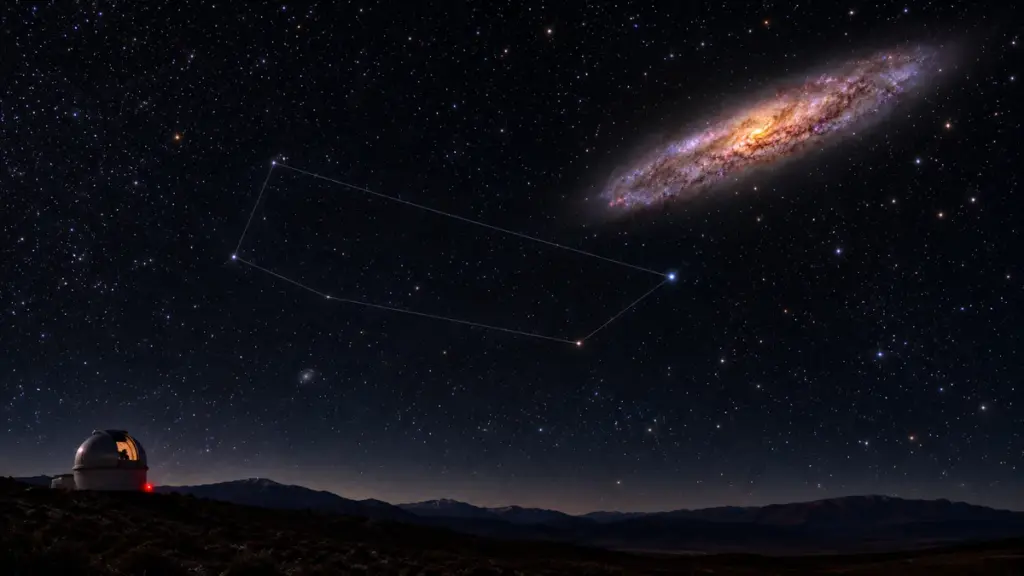
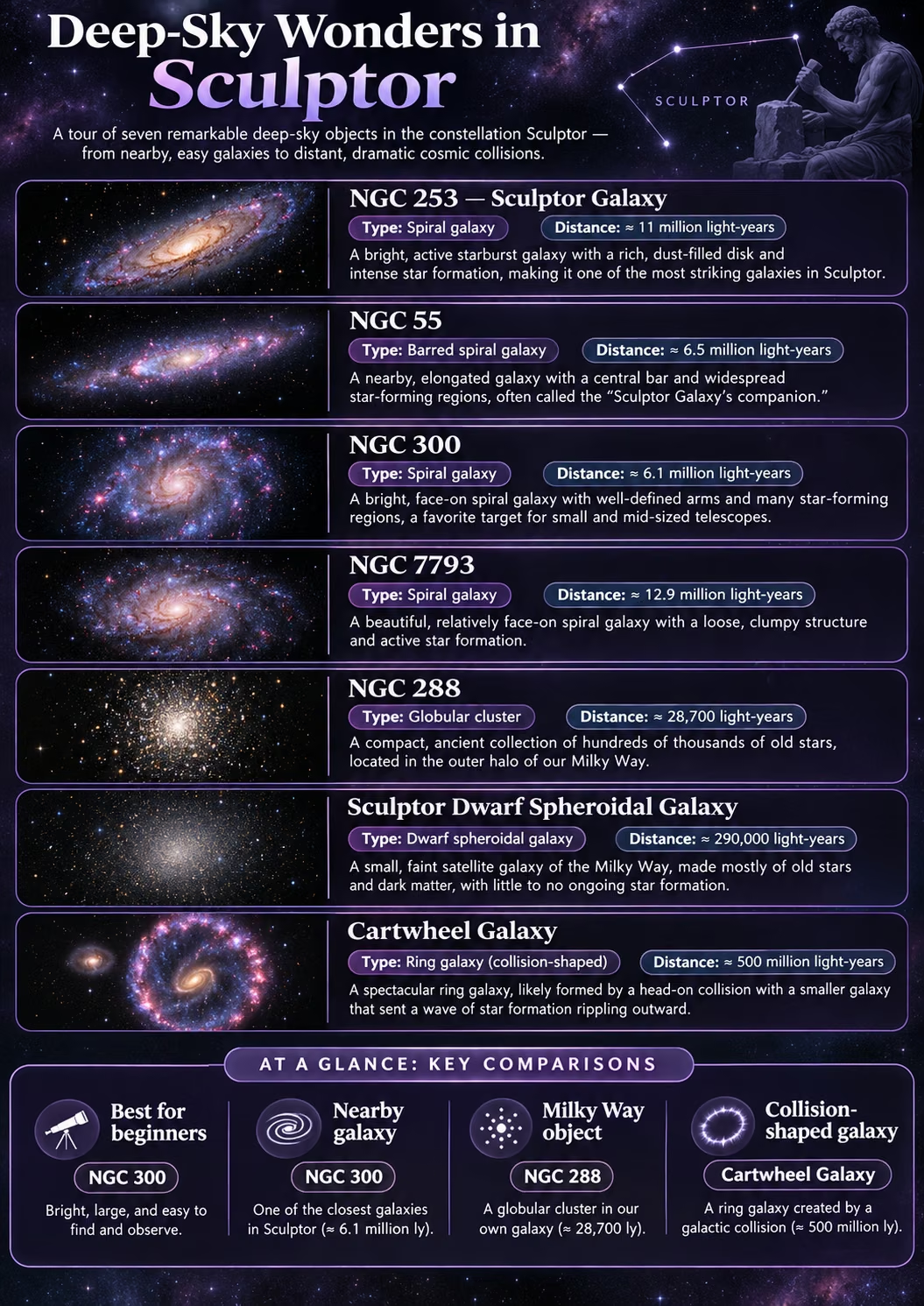
The Sculptor constellation (Scl) is a faint southern constellation best known for its remarkable collection of galaxies, including the famous Sculptor Galaxy (NGC 253), one of the nearest prominent starburst galaxies to Earth. Although Sculptor lacks the bright, recognizable star patterns of Orion or Scorpius, it occupies an important region of the sky for observing objects far beyond the Milky Way.
Introduced by French astronomer Nicolas-Louis de Lacaille in the 18th century, Sculptor represents a sculptor’s workshop rather than a character from ancient mythology. It covers approximately 475 square degrees and ranks as the 36th-largest of the 88 officially recognized constellations.
Sculptor also contains the South Galactic Pole, a direction nearly perpendicular to the Milky Way’s disk. This position makes the constellation particularly valuable for studying distant galaxies, stellar populations, galactic evolution, and dark matter.
This guide explores Sculptor’s history, location, brightest stars, notable deep-sky objects, scientific importance, and practical observing techniques.
What Is the Sculptor Constellation?
Sculptor is an officially recognized constellation situated south of the celestial equator. Its Latin name means “the Sculptor,” referring to an artist who creates three-dimensional works from materials such as stone, wood, or clay.
Unlike ancient constellations that were traditionally associated with mythological figures, Sculptor originated during the scientific exploration of the Southern Hemisphere. Lacaille introduced it to represent the tools and workplace of a sculptor, reflecting the growing influence of art, science, and technology on European constellation naming during the 18th century.
The International Astronomical Union (IAU) recognizes Sculptor as one of the 88 regions into which the entire celestial sphere is divided. Its official abbreviation is Scl, while Sculptoris is the Latin genitive used in stellar designations such as Alpha Sculptoris.
Despite its relatively modest stellar brightness, Sculptor is astronomically significant. It contains nearby spiral galaxies, distant interacting galaxies, dwarf galaxies, and the globular cluster NGC 288. These objects lie at vastly different distances, demonstrating that a constellation is a projected region of the sky rather than a physically connected group of celestial bodies. [1] [2]
Sculptor Constellation Facts at a Glance
| Property | Description |
|---|---|
| Official name | Sculptor |
| IAU abbreviation | Scl |
| Latin genitive | Sculptoris |
| English meaning | The Sculptor |
| Original designation | L’Atelier du Sculpteur |
| Constellation family | Lacaille’s modern southern constellations |
| Celestial hemisphere | Southern |
| Area | Approximately 475 square degrees |
| Size ranking | 36th of 88 |
| Brightest star | Alpha Sculptoris |
| Brightest star magnitude | Approximately 4.27 |
| Best evening viewing period | October to November |
| Historical creator | Nicolas-Louis de Lacaille |
| Introduced | Mid-18th century |
| Notable galaxy | NGC 253 (Sculptor Galaxy) |
| Notable star cluster | NGC 288 |
| Special astronomical feature | South Galactic Pole |
| Neighboring constellations | Aquarius, Cetus, Fornax, Phoenix, Grus, Piscis Austrinus |
These properties make Sculptor a useful target for both amateur stargazers and professional astronomers.
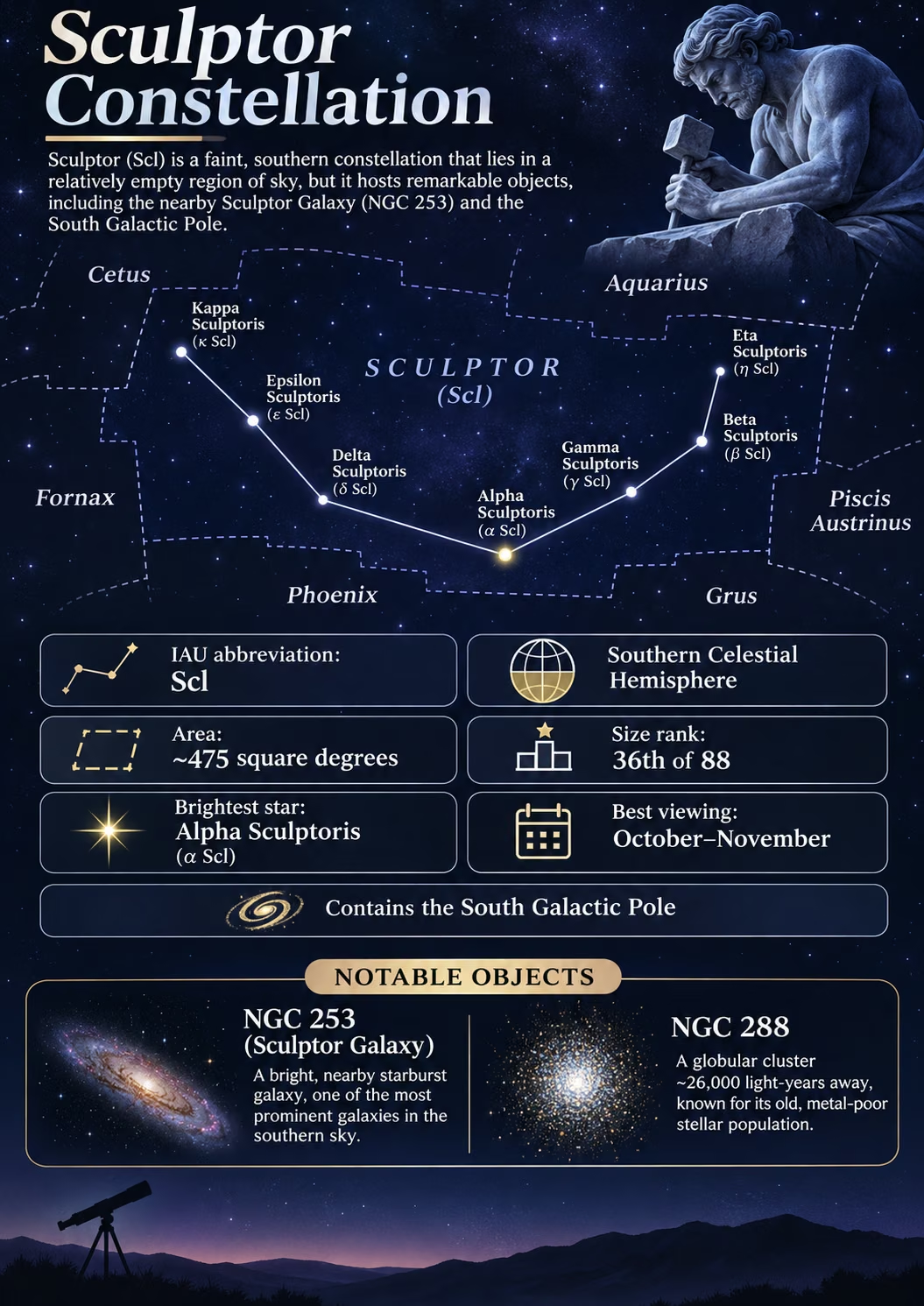
Its principal stars are relatively inconspicuous, but several galaxies within its boundaries are among the most accessible extragalactic targets in the southern sky. [2] [3]
History and Origin of the Sculptor Constellation
The history of Sculptor differs from that of most familiar northern constellations. Its creation resulted from systematic astronomical mapping rather than ancient storytelling. During the 18th century, European astronomers began assigning names to previously uncataloged regions of the southern sky, many of which were poorly documented in traditional European star atlases.
Sculptor emerged from this period of exploration. Its historical development illustrates the transition from constellations representing mythological figures to constellations celebrating scientific instruments, artistic occupations, and contemporary technology.
Who Discovered the Sculptor Constellation?
French astronomer Nicolas-Louis de Lacaille (1713–1762) introduced Sculptor during his extensive survey of the southern celestial hemisphere.
Between 1751 and 1752, Lacaille conducted observations near the Cape of Good Hope in present-day South Africa. His work substantially expanded the catalog of accurately measured southern stars and helped improve celestial charts used by astronomers and navigators.
Lacaille established 14 new constellations, most of which represented scientific or technical instruments. Sculptor was among these additions and became part of the standard international constellation system.
Although Lacaille created the constellation, the stars within it had existed and been observed long before his work. His contribution was the formal arrangement and naming of a particular sky region within the European astronomical tradition. [2]
Why Was Sculptor Originally Called Apparatus Sculptoris?
Lacaille originally used the French name L’Atelier du Sculpteur, meaning “the Sculptor’s Workshop.” The constellation was subsequently associated with the Latin designation Apparatus Sculptoris, which referred to a sculptor’s tools or working equipment.
Early illustrations depicted a sculptor’s workspace, including items such as carving implements and a workbench. This artistic representation distinguished Sculptor from constellations depicting animals, mythological heroes, or scientific measuring devices.
The name was eventually shortened to Sculptor, making it consistent with the concise Latin names used in modern astronomical catalogs.
The IAU’s standardized constellation system retains the name Sculptor but does not prescribe any particular artistic drawing of its stars. Official constellation boundaries define its astronomical identity, not the appearance of a sculptor or workshop. [1] [2]
Does the Sculptor Constellation Have a Mythology?
Sculptor has no established traditional Greek or Roman mythology because it was introduced during the 18th century, long after the classical constellation traditions developed.
Ancient constellations such as Orion, Andromeda, and Perseus were associated with stories involving gods, heroes, and legendary creatures. Sculptor instead represents a human profession and the tools used to produce works of art.
Its symbolism reflects an era when astronomy increasingly celebrated scientific observation, craftsmanship, and technological progress.
Although modern writers may invent stories about Sculptor, these should not be confused with documented ancient mythology. The historical origin of the constellation is specifically associated with Lacaille’s southern sky survey.
Where Is the Sculptor Constellation Located?
Sculptor lies in the Southern Celestial Hemisphere, primarily between approximately 25 and 39 degrees south of the celestial equator. It occupies a region south of Cetus, east of Piscis Austrinus, and north of Phoenix.
The constellation extends across the point where right ascension changes from 23 hours to 0 hours. This does not represent a physical discontinuity in the sky. Right ascension is a circular coordinate, so 24 hours and 0 hours identify the same celestial meridian.
Sculptor’s relatively low northern visibility makes it better suited to observers in tropical and southern latitudes. Its galaxies are especially rewarding when viewed high above the horizon, where atmospheric distortion and light absorption are reduced.
Right Ascension and Declination of Sculptor
Astronomers locate objects using two primary equatorial coordinates: right ascension (RA) and declination (Dec).
Right ascension is the celestial equivalent of longitude, measured eastward in hours, minutes, and seconds. Declination resembles geographic latitude and is measured in degrees north or south of the celestial equator.
Sculptor spans approximately RA 23h to 1h 46m, crossing the 0h boundary, and declinations near −25° to −39°. Exact coordinates depend on which point within its officially defined boundaries is being described.
The constellation’s position is useful for both manual star charts and computerized telescope systems. Astronomers should use the coordinates of an individual target, such as NGC 253, rather than an approximate constellation center when pointing a telescope. [1] [2]
Which Constellations Border Sculptor?
Sculptor shares its official borders with six constellations: Aquarius, Cetus, Fornax, Phoenix, Grus, and Piscis Austrinus.
Aquarius and Cetus lie generally north of Sculptor, while Fornax is toward the east. Phoenix and Grus occupy parts of the southern and southwestern surrounding sky, and Piscis Austrinus lies to the west.
These neighboring constellations provide valuable reference points because Sculptor lacks especially bright stars. Fomalhaut in Piscis Austrinus and Diphda in Cetus are particularly useful landmarks.
Identifying these neighboring regions first is generally more effective than trying to recognize Sculptor’s faint stellar pattern directly.
Sculptor Constellation Boundaries and Star Chart
The IAU defines Sculptor as a specific region on the celestial sphere, with boundaries established through the international constellation-standardization process completed in the early 20th century.
The modern boundaries were approved in 1928 and published in 1930 through the work of astronomer Eugène Delporte. They separate Sculptor from adjacent constellations using celestial coordinate lines.
A star chart typically represents Sculptor with a loose arrangement of stars connected by illustrative lines. However, these patterns are not universally standardized, and different planetarium applications may draw them differently.
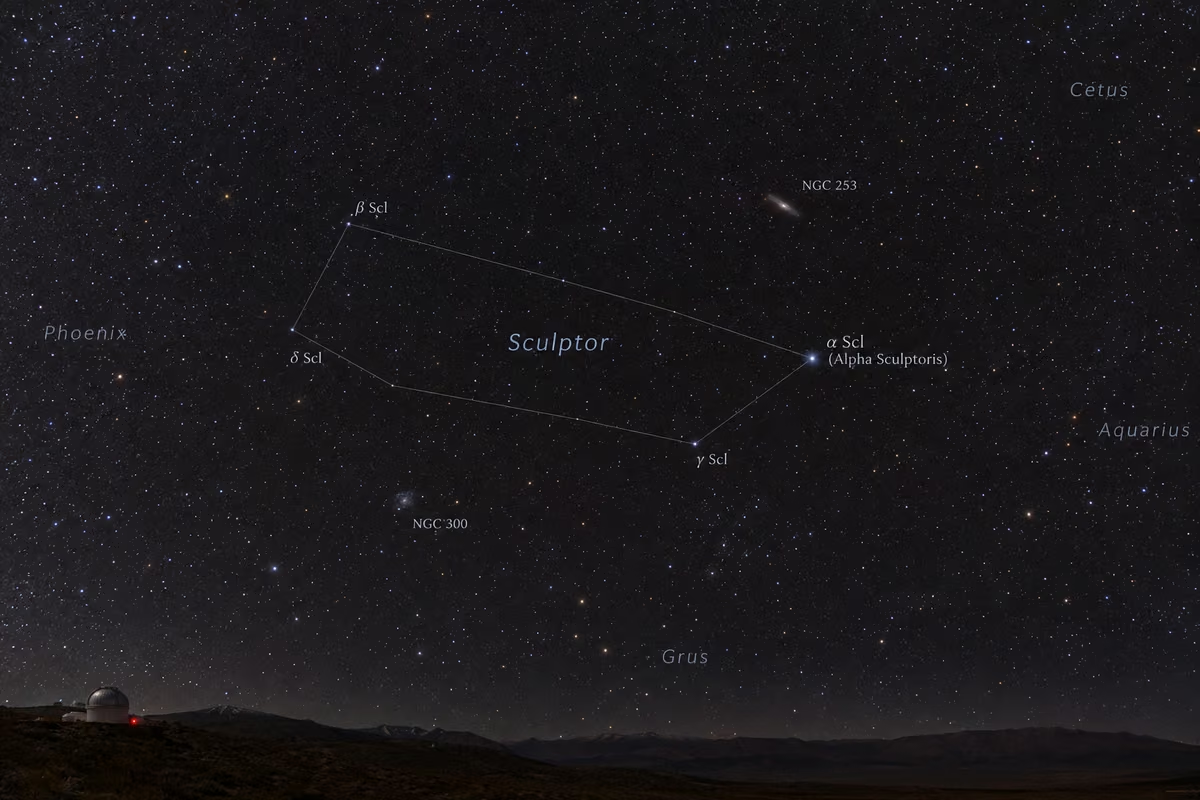
For accurate identification, observers should use charts showing the constellation’s official outline, nearby bright stars, celestial coordinates, and major deep-sky objects. [1]
When and Where Can You See the Sculptor Constellation?
Sculptor is best observed during the evening months of October and November, when it reaches favorable positions in the night sky. Its precise appearance depends on the observer’s latitude, longitude, date, and local time.
Because Sculptor occupies a southern declination, it rises higher for observers south of the equator. At middle northern latitudes, the constellation appears much lower, and portions of its southern boundary may be difficult or impossible to observe.
Clear weather, low light pollution, and an unobstructed southern horizon are particularly important when searching for its faint stars and galaxies.
Best Time of Year to Observe Sculptor
November is commonly identified as the most convenient evening month for observing Sculptor, although October also provides favorable conditions.
During these months, the constellation approaches or crosses the local meridian during the evening. The meridian is an imaginary north-south line passing through the observer’s zenith. Objects generally reach their highest altitude when crossing it.
Observing near culmination is especially beneficial for galaxies because their light passes through less of Earth’s atmosphere.
Sculptor remains observable during other months, but its position shifts relative to ordinary evening hours because Earth progresses through its orbit around the Sun.
Is Sculptor Visible from the Northern Hemisphere?
Yes, Sculptor is visible from much of the Northern Hemisphere, although its low position in the southern sky can make observation difficult.
At a latitude of approximately 40° north, a star at declination −30° reaches a maximum altitude of only about 20° above the southern horizon. This makes atmospheric extinction, haze, buildings, and trees significant obstacles.
Observers at latitudes around 50° north can still see portions of Sculptor, but the constellation’s southernmost regions become extremely low or inaccessible.
Locations closer to the equator offer substantially better viewing opportunities, particularly for the galaxies that form the constellation’s main attraction.
Sculptor Visibility from the Southern Hemisphere
Observers in Australia, New Zealand, South Africa, Chile, Argentina, and other southern locations generally have more favorable views of Sculptor.
At a latitude of approximately 30° south, an object at declination −30° can pass almost directly overhead. This considerably reduces atmospheric interference and makes faint galaxies easier to observe.
Sculptor is not circumpolar for most populated southern locations, meaning it still rises and sets rather than remaining continuously above the horizon.
Its best observing conditions occur when it is high in the sky during dark hours, preferably away from moonlight and artificial illumination.
How Does Light Pollution Affect Sculptor Visibility?
Light pollution is one of the main obstacles to observing Sculptor because its brightest stars have apparent magnitudes close to 4.3. In heavily illuminated cities, the naked-eye limiting magnitude may be insufficient to reveal the constellation’s main pattern.
Artificial light brightens the background sky, reducing contrast between faint stars or galaxies and their surroundings. Moonlight, humidity, and atmospheric haze produce similar effects.
A dark rural observing site can reveal stars and extended objects that disappear entirely under urban conditions.
For galaxies such as NGC 253, low sky brightness and good atmospheric transparency are often more important than increasing telescope magnification.
How to Find the Sculptor Constellation in the Night Sky
Finding Sculptor requires a slightly different approach from locating bright constellations. Its stars do not form a striking pattern, so the easiest method is to identify nearby bright stars and use them as positional references.
Fomalhaut in Piscis Austrinus and Diphda, also called Beta Ceti, in Cetus are especially helpful. These stars stand out against a comparatively sparse region of the sky.
A planetarium application or printed star atlas makes the process considerably easier, particularly when attempting to locate faint objects such as the Sculptor Galaxy or the Sculptor Dwarf Spheroidal Galaxy.
Step-by-Step Guide to Finding Sculptor
- Find Fomalhaut. Locate the bright star in Piscis Austrinus, visible toward the southern sky during favorable autumn evenings in the Northern Hemisphere.
- Identify Diphda. Find Beta Ceti, an orange giant star in the neighboring constellation Cetus.
- Look below Cetus. Sculptor occupies the region south of Cetus and generally east of Fomalhaut.
- Locate Alpha Sculptoris. Use a star atlas to find the constellation’s brightest star, near apparent magnitude 4.3.
- Confirm the star pattern. Compare surrounding stars with a chart showing Sculptor’s official boundaries and nearby galaxies.
The constellation is spread across a substantial area, so a wide-field chart is more useful than a narrow telescope view during the initial search.
Star-Hopping Techniques for Beginners
Star-hopping involves moving systematically between recognizable stars and celestial objects until the intended target is reached.
To locate NGC 253, begin with Diphda in Cetus and move approximately seven degrees southward toward the galaxy’s position. A detailed star atlas or digital sky map can then be used to match the surrounding stars.
Another useful target is NGC 288, a globular cluster located approximately 1.8 degrees southeast of NGC 253.
Binoculars are particularly helpful during star-hopping because their relatively wide field of view allows observers to identify several stars simultaneously.
For telescope users, a correctly aligned finderscope or computerized mount improves accuracy and reduces the time spent searching for faint objects.
Major Stars in the Sculptor Constellation
The brightest stars in Sculptor are relatively faint compared with prominent stars such as Sirius, Vega, or Betelgeuse. Nevertheless, several stars in the constellation are scientifically interesting because of their spectral characteristics, chemical composition, evolutionary stages, or membership in multiple-star systems.
The Bayer designations Alpha, Beta, Gamma, Delta, Epsilon, Eta, and Kappa Sculptoris identify individual stars or stellar systems within the constellation. These designations do not necessarily follow a strict brightness ranking.
Stellar properties are measured using photometry, spectroscopy, astrometry, and other observational methods. Catalogs such as SIMBAD and Gaia provide measurements of apparent brightness, parallax, spectral classification, and stellar motion.
Alpha Sculptoris: The Brightest Star in Sculptor
Alpha Sculptoris (α Scl) is the brightest star in the constellation, with a visual apparent magnitude of approximately 4.27. It is located roughly 700 light-years from Earth, based on the parallax listed in the SIMBAD astronomical database.
The star has a spectral classification of B7 IIIp, indicating a hot, evolved B-type star with unusual spectral characteristics. The suffix “p” identifies a chemically peculiar spectrum.
Alpha Sculptoris is associated with helium-weak stellar characteristics, meaning its observed atmospheric helium absorption differs from that expected in a normal star of comparable temperature.
Its catalog entries also identify it as a variable star. Stellar rotation and uneven distributions of chemical elements can contribute to observed spectral and brightness variations in chemically peculiar stars.
Although Alpha Sculptoris serves as the constellation’s primary stellar reference, it remains relatively difficult to identify under light-polluted skies. [4]
Beta Sculptoris: A Chemically Peculiar Star
Beta Sculptoris (β Scl) is another prominent star in the constellation, with an apparent visual magnitude of approximately 4.37.
SIMBAD lists a detailed spectral classification of B9.5 IIIpHgMnSi, identifying it as a chemically peculiar late-B-type star with unusual spectral features associated with elements including mercury, manganese, and silicon.
Its measured parallax places it approximately 183 light-years from Earth, making it substantially closer than Alpha Sculptoris despite their similar apparent brightness.
This illustrates an important astronomical principle: stars that appear nearly equally bright from Earth may have very different intrinsic luminosities and distances.
Chemically peculiar stars are valuable research targets because their atmospheric compositions provide information about stellar magnetic fields, rotation, diffusion, and other physical processes. [4]
Gamma Sculptoris: An Evolved Orange Giant
Gamma Sculptoris (γ Scl) is classified as a K1 III star, meaning it is an evolved K-type giant with a comparatively cool surface temperature.
Its apparent visual magnitude is approximately 4.41, and its measured parallax indicates a distance of roughly 189 light-years.
Unlike the hotter blue-white stars Alpha and Beta Sculptoris, Gamma Sculptoris has an orange appearance associated with its cooler stellar atmosphere.
The luminosity class III indicates that the star has evolved away from the main sequence and expanded into a giant.
Its contrasting temperature and evolutionary stage make Gamma Sculptoris useful when comparing the different kinds of stars that occupy the same apparent region of the sky. [4]
Delta Sculptoris: A Multiple-Star System
Delta Sculptoris (δ Scl) has an apparent visual magnitude of approximately 4.57. Its primary component is classified near spectral type A0, indicating a relatively hot, white star.
The star’s cataloged parallax corresponds to a distance of approximately 144 light-years.
Delta Sculptoris is also associated with multiple-star catalog entries, reflecting the presence of observed stellar companions.
However, a star listed in a double-star catalog is not automatically proven to be a gravitationally bound binary system. Astronomers must compare positions, motions, radial velocities, and distances to determine whether components are physically associated or merely appear close together.
Delta Sculptoris illustrates why visual double-star observations and modern astrometric measurements complement each other. [4]
Epsilon Sculptoris: A Double-Star Target
Epsilon Sculptoris (ε Scl) is a known double-star observing target in Sculptor. It can be more interesting through a telescope than as a simple naked-eye point of light because magnification may reveal distinct stellar components.
Double stars are traditionally described using their angular separation and position angle. The angular separation determines how far apart the components appear, while position angle specifies the direction of one component relative to another.
The ability to resolve a double star depends on telescope aperture, optical quality, atmospheric seeing, and the brightness difference between its components.
For accurate planning, observers should consult a current double-star catalog rather than assuming that historical angular separations remain unchanged.
Eta Sculptoris: A Lesser-Known Star in Sculptor
Eta Sculptoris (η Scl) is another Bayer-designated star within the constellation. Although it receives less attention than Alpha Sculptoris, it contributes to the wider stellar pattern used in astronomical maps.
Stars such as Eta Sculptoris are useful for understanding how astronomers identify and organize stars across the sky.
Its position can be obtained through a current astronomical catalog, while its brightness, stellar spectrum, distance, and motion can be compared with those of neighboring stars.
Because published stellar parameters may be updated as astrometric and spectroscopic measurements improve, precise values should be taken from a clearly identified catalog release.
Kappa Sculptoris: Stellar Identification and Observation
Kappa Sculptoris (κ Scl) is a Bayer-designated stellar entry associated with the constellation. It is not among Sculptor’s best-known observing targets, but its designation is useful in historical atlases and astronomical catalogs.
Bayer letters are historical identifiers rather than guaranteed indicators of descending stellar brightness. Consequently, Kappa Sculptoris should not be assumed to be the eleventh-brightest star in the constellation.
Astronomers studying a lesser-known star typically compare its catalog position, apparent magnitude, spectral type, parallax, and proper motion.
Cross-matching an older Bayer designation with a modern catalog identifier helps prevent confusion between similarly named stars or individual components of multiple-star systems.
Comparison of Sculptor’s Major Stars
The following comparison uses rounded visual magnitudes and approximate distances for four stars whose relevant measurements were checked against SIMBAD. Other Bayer-designated stars are discussed above, but numerical values are omitted where the corresponding catalog entries were not independently verified for this article.
| Star | Visual magnitude | Spectral classification | Approximate distance |
|---|---|---|---|
| Alpha Sculptoris | 4.27 | B7 IIIp | 700 light-years |
| Beta Sculptoris | 4.37 | B9.5 IIIp, chemically peculiar | 183 light-years |
| Gamma Sculptoris | 4.41 | K1 III | 189 light-years |
| Delta Sculptoris | 4.57 | Approximately A0 | 144 light-years |
These values demonstrate why apparent magnitude alone cannot determine a star’s distance, size, or luminosity. Alpha Sculptoris appears only slightly brighter than Beta Sculptoris, yet the two stars are separated by hundreds of light-years in distance from Earth. The distances are rounded estimates derived from catalog parallaxes rather than exact measurements. [4]
Understanding the Stellar Properties of Sculptor’s Stars
The stars in Sculptor differ considerably in temperature, luminosity, chemical composition, and evolutionary history. Understanding these differences requires more than identifying their colors or comparing their apparent brightness.
Astronomers use several complementary measurements to determine stellar properties. Photometry measures light received through selected wavelength bands, spectroscopy reveals information about temperature and composition, and astrometry measures positions, parallaxes, and motions.
Together, these techniques help researchers reconstruct the physical characteristics and evolutionary stages of stars across the Milky Way.
Apparent Magnitude vs. Absolute Magnitude
Apparent magnitude measures how bright a star appears from Earth. The magnitude scale is logarithmic, meaning a difference of five magnitudes corresponds to a brightness ratio of 100.
Lower numerical magnitudes indicate brighter objects. A first-magnitude star therefore appears brighter than a fourth-magnitude star under comparable conditions.
Absolute magnitude represents the brightness an object would have if observed from a standardized distance of 10 parsecs, or approximately 32.6 light-years.
The distinction is important for Sculptor because its major stars have similar apparent magnitudes despite being located at different distances.
For example, Alpha Sculptoris is much farther away than Beta Sculptoris but appears slightly brighter. This indicates that Alpha Sculptoris has a substantially greater intrinsic visual luminosity.
Stellar Spectral Classification
Astronomers classify stars according to spectral characteristics, principally related to their atmospheric temperatures.
The standard spectral sequence, from hottest to coolest, is O, B, A, F, G, K, and M.
These classifications also contain numerical subclasses and luminosity classes. For example, a B7 III star is a hot B-type giant, while a K1 III star is a cooler giant.
Sculptor provides examples of both categories through Alpha Sculptoris and Gamma Sculptoris.
Spectral observations also reveal chemical peculiarities. Unusual absorption lines may indicate atmospheric abundance differences caused by processes such as atomic diffusion, radiative levitation, or gravitational settling.
These measurements provide information that cannot be determined from visible color alone.
Measuring Stellar Distance Using Parallax
Stellar parallax is the apparent displacement of a nearby star relative to more distant background objects as Earth moves around the Sun.
Astronomers measure this small angular displacement and use geometry to estimate the star’s distance.
When parallax is expressed in arcseconds, the basic relationship is:
[ d(\text{parsecs})=\frac{1}{p(\text{arcseconds})} ]
For example, a star with a parallax of 0.01 arcseconds has a distance of approximately 100 parsecs, assuming the measurement is sufficiently precise.
The Gaia space observatory has measured positions and parallaxes for enormous numbers of stars, significantly improving knowledge of the Milky Way’s structure.
However, small or uncertain parallaxes require careful statistical treatment. Simply taking the reciprocal of a noisy parallax does not always provide a reliable distance.
Variable Stars in Sculptor
Variable stars change in observed brightness over time. Their variations may result from physical changes within the star, stellar rotation, eclipses by companions, or other mechanisms.
Alpha Sculptoris is associated with stellar variability and chemically peculiar atmospheric characteristics.
Chemically peculiar rotating stars can exhibit brightness variations when different regions of their surfaces rotate into and out of view. Variations in elemental abundances, opacity, and magnetic conditions can affect the observed light.
Other kinds of variable stars include pulsating stars, eclipsing binaries, and eruptive variables.
Astronomers study brightness changes using light curves, which plot measured brightness against time. These observations help determine rotation periods, orbital characteristics, and stellar physical processes.
Deep-Sky Objects in the Sculptor Constellation
Although Sculptor contains few bright stars, it is exceptionally rich in scientifically interesting deep-sky objects.
Deep-sky objects are astronomical targets outside the Solar System, including galaxies, star clusters, nebulae, and other distant structures.
Sculptor is particularly notable for galaxies because it lies close to the South Galactic Pole, where observers look away from the crowded plane of the Milky Way.
The constellation contains objects ranging from the Milky Way’s own globular cluster NGC 288 to galaxies hundreds of millions of light-years away.
Importantly, their shared position within Sculptor does not imply that they belong to the same physical system. Their distances and galactic relationships must be considered individually.
Sculptor Galaxy (NGC 253): The Constellation’s Most Famous Galaxy
The Sculptor Galaxy, also designated NGC 253 and Caldwell 65, is among the most impressive and extensively studied galaxies in Sculptor.
Discovered by astronomer Caroline Herschel in 1783, NGC 253 is a prominent spiral galaxy viewed at a steep inclination. Its elongated appearance has inspired the nicknames Silver Dollar Galaxy and Silver Coin Galaxy.
NASA describes NGC 253 as lying approximately 10 million light-years away, while other published summaries give distances closer to 11–13 million light-years. These differences reflect the use of different measurements and rounded estimates, rather than evidence that the galaxy’s distance is changing significantly.
NGC 253 is the dominant galaxy of the nearby Sculptor Group and is particularly important for understanding intense star formation. [5]
Why Is NGC 253 a Starburst Galaxy?
A starburst galaxy is a galaxy experiencing an unusually high rate of star formation relative to its normal or long-term activity.
NGC 253 contains substantial quantities of gas and dust, particularly toward its central region. Dense molecular clouds provide material from which new stars can form.
Observations at optical, infrared, radio, and other wavelengths reveal energetic star-forming regions, young stellar populations, and the effects of massive stars on surrounding interstellar matter.
The activity is especially strong in the galaxy’s central regions.
Young, massive stars emit intense ultraviolet radiation and eventually produce powerful stellar winds and supernova explosions. These processes inject energy into surrounding gas and can contribute to large-scale galactic outflows.
Studying NGC 253 helps astronomers investigate how star formation, gas supply, feedback processes, and galactic structure influence one another.
Structure and Appearance of the Sculptor Galaxy
NGC 253 has an extended stellar disk containing stars, gas, and prominent dust lanes.

Because the galaxy is viewed at a substantial inclination rather than face-on, its spiral structure is less obvious in ordinary telescope observations. Instead, it appears as an elongated, textured band of light.
High-resolution images reveal dark dust filaments crossing brighter stellar regions, while infrared observations can detect star-forming activity concealed by dust.
Its central region is particularly complex, containing dense gas, young stars, and energetic processes associated with intense star formation.
The galaxy’s apparent shape demonstrates how viewing angle affects galactic morphology. A face-on spiral may display clear arms, whereas the same general type of galaxy viewed almost edge-on can appear narrow and highly elongated.
How to Observe and Photograph NGC 253
NGC 253 has an apparent visual magnitude of approximately 7.6, making it accessible to binoculars under sufficiently dark skies.
Through binoculars, it may appear as a faint, elongated patch of light. A small telescope can reveal its broad shape, while larger telescopes under excellent conditions may show variations in brightness and dark dust features.
Its angular dimensions are roughly 27 by 7 arcminutes, so low to moderate magnification is often more useful than excessive magnification.
For astrophotography, NGC 253 is an excellent target for tracked cameras and telescopes. Combining multiple exposures through image stacking helps reveal faint outer regions while preserving structure in the brighter galactic disk.
Other Important Galaxies in Sculptor
Sculptor contains a diverse collection of galaxies representing different structures, distances, and evolutionary histories.
Some are relatively nearby members of the Sculptor Group or neighboring galaxy associations. Others are far more distant systems that merely appear within the same constellation boundaries.
These objects include irregular galaxies, ordinary spirals, barred spirals, and collision-produced ring galaxies.
Comparing them allows astronomers to investigate the influence of star formation, gravitational interactions, stellar populations, galactic bars, and environmental conditions on the development of galaxies.
NGC 55: Caldwell 72
NGC 55, also known as Caldwell 72, is a nearby galaxy approximately 6.5 million light-years from Earth.
It is sometimes called the String of Pearls Galaxy because of the appearance of its bright stellar regions.

NASA classifies NGC 55 as a Magellanic-type galaxy, a category associated with irregular or weakly organized spiral structures resembling those of the Magellanic Clouds.
Its elongated appearance makes it a distinctive observing target, especially from southern latitudes.
With an apparent magnitude around 7.8, NGC 55 may be detected using binoculars under favorable conditions, although telescopes reveal more of its irregular brightness distribution.
Its proximity makes it useful for investigating stellar populations, star formation, and the structure of relatively low-mass galaxies. [6]
NGC 300: Caldwell 70
NGC 300, or Caldwell 70, is a nearby spiral galaxy approximately 6 million light-years away, according to NASA’s Hubble description.
Its spiral structure is more directly visible than that of highly inclined galaxies because its disk is oriented closer to face-on from our perspective.

NGC 300 contains extensive stellar populations, star-forming regions, and interstellar dust distributed throughout its disk.
Hubble observations have resolved individual stars in the galaxy, allowing astronomers to study stellar evolution and techniques for measuring extragalactic distances.
With an apparent magnitude near 8.1, NGC 300 can be observed using a small telescope under dark skies. However, its relatively low surface brightness makes it more difficult than its integrated magnitude might suggest.
Its large angular size, approaching that of the full Moon, is an important consideration when choosing observing equipment. [7]
NGC 7793: A Spiral Galaxy in the Sculptor Group
NGC 7793 is a spiral galaxy located approximately 14 million light-years from Earth, according to ESA/Hubble.
It is generally associated with the Sculptor Group and contains an extensive population of stars and regions of ongoing star formation.
The galaxy’s appearance differs from strongly organized grand-design spirals. Its spiral features are relatively diffuse and less sharply defined.
NGC 7793 has also attracted attention because of energetic sources and large-scale structures associated with compact objects, jets, and interactions with surrounding gas.
Studying these features helps astronomers understand how stellar evolution and energetic sources affect the interstellar medium.
Although NGC 7793 is accessible to amateur telescopes, it is more challenging than NGC 253 because of its comparatively modest surface brightness and less conspicuous visual structure. [8]
NGC 613: A Barred Spiral Galaxy
NGC 613 is a barred spiral galaxy approximately 65–67 million light-years from Earth.
Unlike ordinary spiral galaxies without a strong central bar, NGC 613 has an elongated structure of stars extending across its inner region.
Its spiral arms curve outward from the ends of the central bar, creating a distinctive symmetrical appearance.
Galactic bars can influence how gas moves through a galaxy. Under suitable conditions, gravitational torques associated with a bar can redistribute gas and contribute to enhanced star formation in central regions.
NGC 613 is a valuable example for studying the relationship between galactic morphology, gas dynamics, and stellar evolution.
ESA/Hubble observations show its central bar, surrounding spiral arms, and numerous regions of active star formation. [9]
Cartwheel Galaxy (ESO 350-40): A Galactic Collision
The Cartwheel Galaxy, also designated ESO 350-40, is an unusual ring galaxy located approximately 500 million light-years away in Sculptor.
Its distinctive appearance developed following a high-speed collision involving a larger spiral galaxy and a smaller galaxy.
The encounter produced expanding waves of density and activity through the larger galaxy’s disk, creating prominent ring structures.
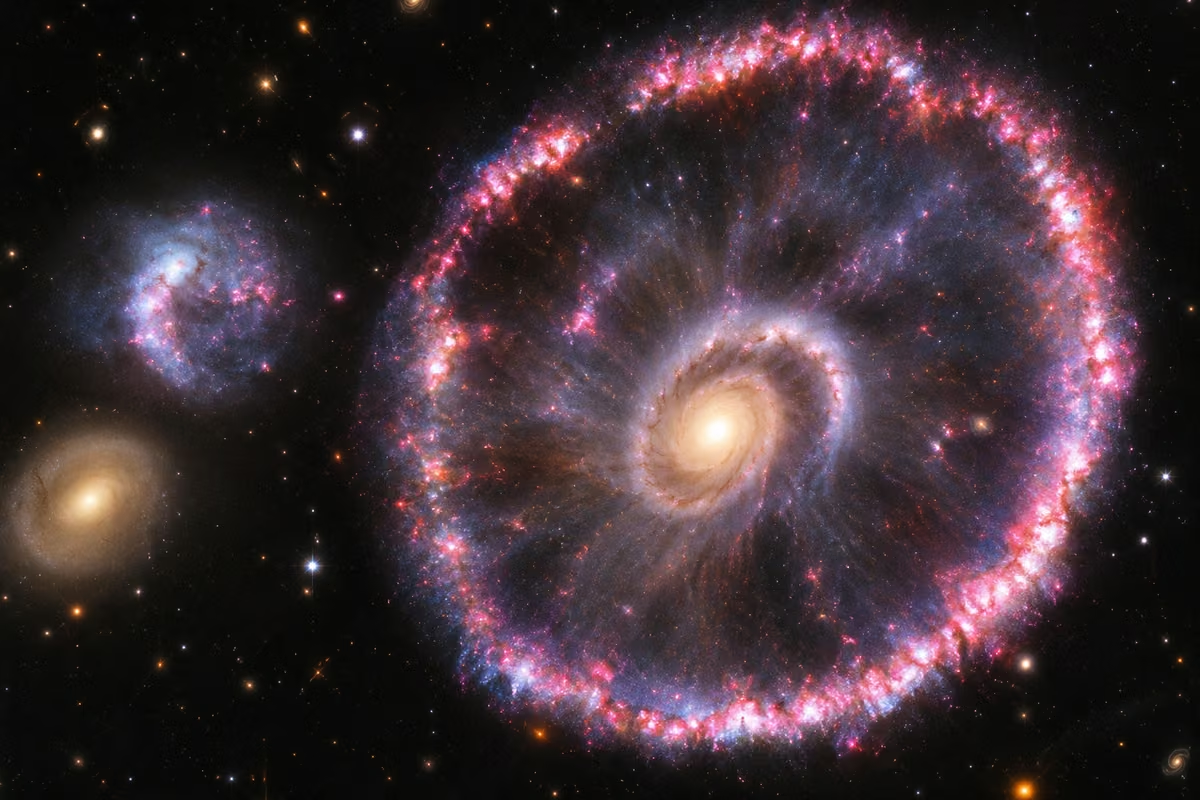
The Cartwheel Galaxy contains a bright inner ring and a much larger outer ring. The outer structure hosts extensive star formation associated with the propagation of the collision-driven disturbance.
Observations by the James Webb Space Telescope have revealed important details of its stars, dust, and galactic structure.
The Cartwheel demonstrates how galaxy collisions can dramatically reshape galactic morphology and influence star formation over long periods. [10]
IC 5332: A Face-On Spiral Galaxy
IC 5332 is a spiral galaxy located approximately 30 million light-years from Earth.
Its orientation provides astronomers with a comparatively unobstructed view of the galaxy’s disk and spiral arms.
NASA and ESA have published complementary observations of IC 5332 using the Hubble Space Telescope and the James Webb Space Telescope.
Visible-light imagery highlights stars and prominent stellar structures, while mid-infrared observations reveal additional information about dust and the interstellar medium.
These observations demonstrate why astronomers study galaxies at multiple wavelengths.
IC 5332 is particularly useful for comparing stellar populations, dust distribution, and the structure of spiral arms without the severe line-of-sight overlap associated with nearly edge-on galaxies. [11]
Comparison of Sculptor’s Notable Galaxies
The galaxies in Sculptor span an enormous range of distances, from nearby members of the Sculptor Group to much more distant systems.
| Galaxy | Approximate distance | Galaxy type | Notable feature |
|---|---|---|---|
| NGC 253 | 10–13 million light-years | Spiral, starburst | Intense central star formation |
| NGC 55 | 6.5 million light-years | Magellanic-type | Irregular stellar structure |
| NGC 300 | 6 million light-years | Spiral | Relatively face-on disk |
| NGC 7793 | 14 million light-years | Spiral | Diffuse spiral structure |
| NGC 613 | 65–67 million light-years | Barred spiral | Prominent central bar |
| Cartwheel Galaxy | 500 million light-years | Ring galaxy | Collision-generated rings |
| IC 5332 | 30 million light-years | Spiral | Face-on orientation |
Distances are approximate and follow the cited observatory summaries. They should not be interpreted as a uniform set of measurements made using the same techniques.
The comparison also illustrates why galaxies sharing one constellation can have completely different physical relationships, formation histories, and environments.
The Sculptor Group of Galaxies
The Sculptor Group is a nearby association of galaxies extending across a relatively large region of space beyond the Milky Way’s Local Group.
It is one of the closest prominent galaxy associations to the Local Group and includes several galaxies that can be studied in considerable detail.
Unlike a densely concentrated galaxy cluster, the Sculptor Group is comparatively loose and extended.
Astronomers commonly discuss NGC 253, NGC 55, NGC 300, NGC 247, and NGC 7793 when describing its principal galaxies.
However, membership definitions are not always identical across studies. The association has an extended spatial structure, and some galaxies previously grouped together may belong to different dynamical substructures or lie at significantly different distances. [12]
Major Galaxies Associated with the Sculptor Group
NGC 253 is generally regarded as a dominant member of the Sculptor Group because of its substantial mass, luminosity, and energetic star-forming activity.
NGC 55 and NGC 300 are relatively nearby galaxies often discussed together, while NGC 7793 and NGC 247 are also associated with the broader group.
These galaxies differ in mass, morphology, star formation rate, and internal structure.
Their physical relationships cannot be established simply by their apparent positions in the sky. Astronomers must measure distances and radial velocities to determine whether they occupy the same general region of space.
This distinction is especially important because nearby galaxies can appear widely separated on the celestial sphere while still belonging to an extended association.
Why Is the Sculptor Group Important to Astronomy?
The Sculptor Group provides astronomers with a nearby laboratory for studying galaxies under different physical conditions.
Its members include spiral galaxies, irregular systems, and galaxies showing different levels of star-forming activity.
Because these galaxies are relatively close, powerful telescopes can resolve individual bright stars and identify stellar populations that would be difficult to study in more distant galaxies.
Researchers use these observations to investigate star formation histories, chemical enrichment, galactic dynamics, and distance measurement methods.
Comparing multiple galaxies within a broadly similar environment also helps distinguish properties influenced by internal galactic processes from those associated with external gravitational interactions.
Dwarf Galaxies in the Sculptor Constellation
Sculptor contains important dwarf galaxies, including the Sculptor Dwarf Spheroidal Galaxy and the Sculptor Dwarf Irregular Galaxy.
Despite their similar names, these are separate objects with different physical characteristics and locations.
Dwarf galaxies typically contain fewer stars and have lower total masses than large spirals such as the Milky Way. However, they play an essential role in understanding the formation of larger galaxies and the distribution of dark matter.
Their relatively simple structures can make them especially useful for investigating stellar populations, chemical evolution, gravitational dynamics, and the effects of environmental interactions.
Sculptor Dwarf Spheroidal Galaxy
The Sculptor Dwarf Spheroidal Galaxy is a satellite galaxy of the Milky Way, located approximately 280,000 light-years from Earth.
Discovered in 1937, it was among the earliest dwarf spheroidal galaxies identified beyond the main body of the Milky Way.
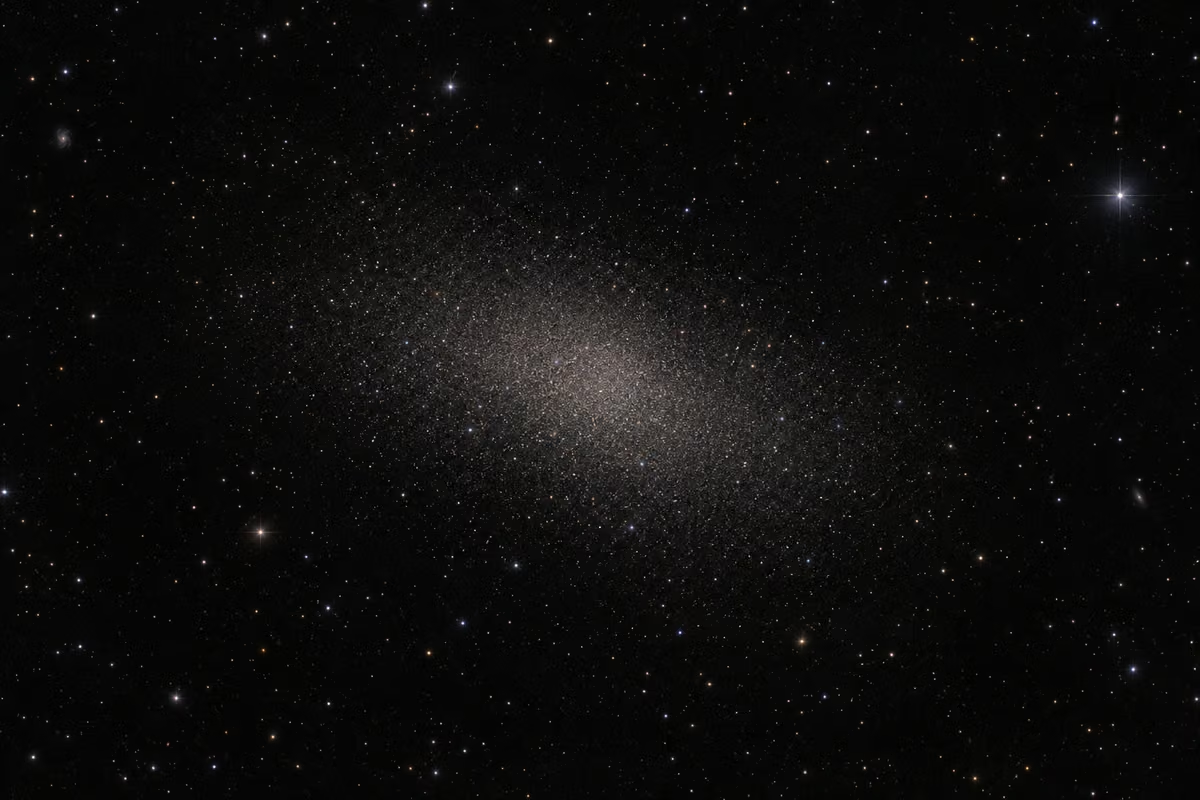
Unlike gas-rich spiral galaxies, the Sculptor Dwarf Spheroidal Galaxy contains a predominantly old stellar population and relatively little material available for ongoing star formation.
Its stars are distributed across a diffuse, low-surface-brightness structure rather than a prominent rotating disk.
The galaxy is important for studying early star formation and the chemical enrichment of low-mass galaxies.
Its stellar motions also provide evidence about the gravitational mass distribution, including the dark matter thought to dominate its total mass. [13]
Sculptor Dwarf Irregular Galaxy
The Sculptor Dwarf Irregular Galaxy, often abbreviated SDIG, is a different object from the Sculptor Dwarf Spheroidal Galaxy.
The Sculptor Dwarf Irregular Galaxy was identified through observations conducted in the 1970s. Early studies reported resolved stars and radio emission associated with neutral hydrogen.
Its irregular morphology distinguishes it from the more smoothly distributed stellar structure of the nearby dwarf spheroidal galaxy.
The presence of gas is particularly important because it provides material that can participate in star formation.
Researchers use dwarf irregular galaxies to study how low-mass systems retain gas, form stars, and evolve under different environmental conditions.
Historical distance estimates for SDIG were around several megaparsecs, placing it far beyond the Milky Way’s nearby Sculptor Dwarf Spheroidal satellite. [14]
Dark Matter in Dwarf Galaxies
Dwarf galaxies are important targets in dark matter research because their observed stellar motions often indicate more gravitational mass than can be accounted for by visible stars and gas alone.
In dwarf spheroidal galaxies, astronomers measure the velocities of individual stars and use dynamical models to estimate the underlying gravitational potential.
The Sculptor Dwarf Spheroidal Galaxy is particularly useful because it is close enough for detailed stellar spectroscopy.
Researchers can compare the motions and chemical properties of different stellar populations to investigate the galaxy’s mass distribution.
However, dark matter estimates depend on assumptions about stellar orbits, equilibrium, geometry, and model parameters.
For this reason, astronomers compare multiple models and observational measurements rather than treating any single inferred dark matter profile as definitive.
NGC 288: A Globular Cluster in Sculptor
NGC 288 is a globular star cluster located approximately 29,000 light-years from Earth, based on modern stellar population and distance studies.
Unlike the distant galaxies visible in Sculptor, NGC 288 is part of the Milky Way’s own system of globular clusters.
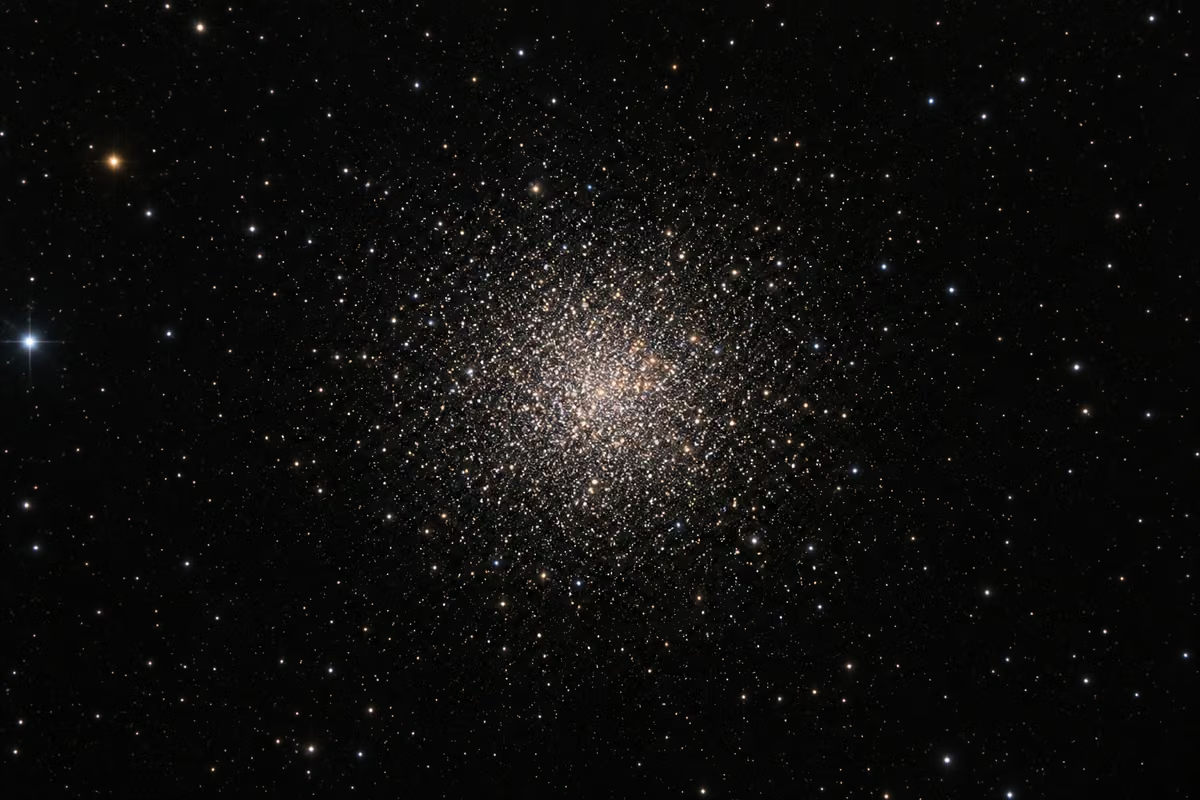
Globular clusters are approximately spherical collections of stars held together by gravity. They commonly contain large populations of old stars and are found throughout the halos of galaxies.
NGC 288 is particularly interesting because its stellar population provides information about early phases of the Milky Way’s history.
It lies relatively close in the sky to NGC 253, allowing observers to explore a Milky Way star cluster and a distant spiral galaxy within the same general observing region. [15]
Stellar Populations and Evolution in NGC 288
NGC 288 contains an old stellar population, including stars at different evolutionary stages.
Astronomers analyze its stellar characteristics using color-magnitude diagrams, which plot stellar brightness against color. These diagrams provide observational equivalents of theoretical Hertzsprung-Russell diagrams.
By comparing observed stellar distributions with theoretical evolutionary models, researchers can estimate the cluster’s age, distance, and chemical composition.
A published analysis reported age estimates near 13 billion years, with some variation depending on the stellar models and wavelength ranges used.
NGC 288 therefore provides evidence about conditions during the early history of the Milky Way.
Its stellar metallicity, meaning the abundance of elements heavier than helium relative to hydrogen, also helps astronomers investigate the chemical evolution of old stellar populations.
How to Observe NGC 288
NGC 288 is located approximately 1.8 degrees southeast of NGC 253, making the two objects convenient targets during the same observing session.
The cluster has a relatively diffuse appearance compared with highly concentrated globular clusters such as Omega Centauri.
Through a small telescope, NGC 288 generally appears as a faint, roughly circular glow. Larger apertures and favorable atmospheric conditions make it possible to distinguish individual stars.
Moderate magnification can improve contrast against the surrounding sky, although excessive magnification reduces the apparent brightness of extended objects.
For astrophotography, tracked exposures and careful image processing can reveal the cluster’s distribution of stars without saturating the brighter members.
The South Galactic Pole and Its Connection to Sculptor
One of Sculptor’s most significant astronomical characteristics is its inclusion of the South Galactic Pole.
The South Galactic Pole is the point on the celestial sphere directly perpendicular to the Milky Way’s galactic plane in the negative galactic-latitude direction.
The corresponding north galactic pole lies in the constellation Coma Berenices.
These poles are defined using the Milky Way’s coordinate system and should not be confused with Earth’s celestial poles.
Sculptor’s position near the South Galactic Pole gives observers a particularly valuable perspective for studying celestial objects outside our own galaxy.
What Is the South Galactic Pole?
The South Galactic Pole is the direction corresponding to galactic latitude −90 degrees.
In the J2000 equatorial coordinate system, its position is approximately:
- Right ascension: 00h 51m 26s
- Declination: −27° 07′ 42″
These coordinates place it within Sculptor.
The galactic coordinate system describes positions relative to the plane of the Milky Way rather than Earth’s equator.
Galactic latitude is measured north or south of that plane, while galactic longitude measures direction around it.
Looking toward the South Galactic Pole means observing approximately perpendicular to the Milky Way’s disk, rather than looking along the star-rich galactic plane.
This geometry helps explain why the region contains comparatively few bright foreground stars and provides useful views of distant galaxies. [3]
Why Is Sculptor Important for Extragalactic Astronomy?
Most of the Milky Way’s stars, gas, and interstellar dust are concentrated toward its disk.
When astronomers observe along the galactic plane, foreground stars can crowd the field of view, while dust absorbs and scatters light from objects farther away.
Observing toward a galactic pole reduces these obstacles along many lines of sight.
This makes high-galactic-latitude regions useful for detecting distant galaxies and measuring their properties.
However, the region is not completely free of foreground stars or dust. Galactic cirrus, faint stars, and other local structures may still affect observations.
Astronomers therefore use extinction maps, stellar catalogs, and statistical corrections when analyzing extragalactic surveys.
Sculptor and the Structure of the Milky Way
Sculptor provides an opportunity to understand how the Milky Way’s disk and halo appear from different viewing directions.
The galactic disk contains much of the galaxy’s gas, dust, and ongoing star formation. The stellar halo is a more extended and diffuse component containing old stars, globular clusters, and streams associated with past gravitational interactions.
Looking toward the South Galactic Pole reduces the number of disk stars projected along the line of sight.
Objects such as NGC 288 and the Sculptor Dwarf Spheroidal Galaxy illustrate different components associated with the Milky Way.
NGC 288 is a globular cluster belonging to the Milky Way, while the dwarf spheroidal galaxy is a separate satellite orbiting within the broader gravitational environment of our galaxy.
Scientific Importance of the Sculptor Constellation
Sculptor is scientifically valuable because its boundaries encompass several distinct types of astronomical systems.
Its stars provide examples of different stellar temperatures and evolutionary stages. Its nearby galaxies allow detailed observations of star formation and galactic structure. Its dwarf galaxies provide important information about early chemical evolution and dark matter.
The constellation also lies in a direction favorable for observations beyond the Milky Way.
These characteristics make Sculptor relevant to several major branches of astrophysics, including stellar astronomy, galactic dynamics, observational cosmology, and extragalactic astronomy.
Understanding Galactic Evolution
Galactic evolution describes how galaxies change in their structure, stellar populations, gas content, and star-forming activity over time.
Sculptor contains several useful examples of galaxies at different evolutionary stages.
NGC 253 exhibits intense star formation, while NGC 300 provides an example of a nearby spiral with a comparatively regular disk.
NGC 613 illustrates how a stellar bar can influence the redistribution of gas, while the Cartwheel Galaxy demonstrates how a collision can dramatically alter galactic structure.
Comparing these systems helps astronomers investigate how gravitational interactions, gas supply, star formation, and stellar feedback contribute to the evolution of galaxies.
Studying Stellar Populations
A stellar population is a collection of stars that can be studied in terms of age, chemical composition, position, and movement.
Astronomers analyze stellar populations to reconstruct the history of star formation within galaxies.
Nearby galaxies are particularly important because powerful telescopes can sometimes resolve individual stars rather than observing only their combined light.
The Sculptor Dwarf Spheroidal Galaxy contains predominantly old stars that preserve information about early chemical enrichment.
By contrast, galaxies such as NGC 253 contain regions with relatively young stellar populations.
Comparing these environments reveals how star formation histories differ according to galactic mass, available gas, and environmental conditions.
Investigating Dark Matter and Galaxy Dynamics
Dark matter is inferred from gravitational effects that cannot be explained fully by observed ordinary matter.
In large spiral galaxies, rotation curves provide evidence about the distribution of gravitational mass.
In dwarf spheroidal galaxies, astronomers often rely on stellar velocity distributions and other dynamical measurements.
The Sculptor Dwarf Spheroidal Galaxy is a major research target because its stars can be observed individually and divided into populations with different chemical properties.
These populations provide independent tracers of the galaxy’s gravitational potential.
Combining observations with dynamical models allows researchers to test hypotheses about dark matter distributions, although uncertainties in orbital structure and modeling assumptions remain important.
Why Astronomers Study Galaxies Near Sculptor
The region around Sculptor includes galaxies close enough for detailed stellar measurements and much more distant systems suitable for studying large-scale galactic processes.
This combination supports research across several distance scales.
For nearby galaxies, astronomers can measure individual stars, nebulae, and star-forming regions.
For more distant galaxies, observations often focus on integrated light, spectral features, gas distributions, and overall morphology.
The South Galactic Pole’s relatively low foreground stellar density also facilitates deep astronomical imaging.
By combining information from different telescopes and wavelengths, researchers can investigate galaxy formation, stellar evolution, galactic interactions, and the broader distribution of matter in the universe.
How to Observe Sculptor with Binoculars and Telescopes
Observing Sculptor is more rewarding when the goal is to locate individual deep-sky objects rather than simply recognize the constellation’s faint stellar outline.
Its stars may be difficult to identify from cities, but several galaxies are accessible with modest equipment under suitable conditions.
The most important factors are sky darkness, object altitude, atmospheric transparency, telescope aperture, and choosing an appropriate magnification.
Because galaxies are extended objects, their surface brightness often determines their visibility more strongly than integrated magnitude alone.
A galaxy that has a reasonably bright total magnitude may still be difficult to see if that light is spread over a large area.
Naked-Eye Observation
Sculptor’s brightest stars are near fourth magnitude, so they are visible to the naked eye under sufficiently dark skies.
However, the constellation does not contain a visually distinctive arrangement comparable to the Big Dipper or Orion’s Belt.
Observers should begin by identifying nearby brighter constellations and then locating Sculptor using a wide-field star chart.
Allowing the eyes to adapt to darkness improves sensitivity to faint light. Avoiding bright phone screens and using dim red illumination can help preserve dark adaptation.
Although exceptionally experienced observers at outstandingly dark sites may glimpse certain extended galaxies without optical assistance, binoculars offer a much more dependable starting point for exploring Sculptor.
Observing Sculptor with Binoculars
Binoculars with specifications such as 7×50 or 10×50 are useful for surveying Sculptor’s relatively large area.
Their wide fields of view help observers navigate between faint stars and locate brighter galaxies.
NGC 253 is one of the best binocular targets. Under dark conditions, it appears as an elongated, diffuse patch.
NGC 55 is another possible target, particularly from southern locations where it reaches a favorable altitude.
Binocular observations are limited by sky brightness, aperture, optical quality, and image stability.
A tripod or other support can improve performance by reducing shaking, especially during prolonged searches for faint galaxies.
Observing Sculptor with a Telescope
A small telescope can reveal substantially more detail than binoculars, especially when observing NGC 253.
Telescopes with apertures around 100–150 mm can show the broad shape of several bright galaxies under suitable conditions.
Larger instruments may reveal irregular brightness patterns, dust lanes, and additional faint objects.
However, telescope aperture does not eliminate the effects of light pollution or poor atmospheric transparency.
Selecting the correct magnification is equally important. Large, diffuse galaxies generally benefit from relatively wide fields of view, while compact globular clusters may tolerate higher magnification.
Observers should begin at low power to locate an object and then increase magnification gradually if contrast and atmospheric conditions permit.
Best Deep-Sky Targets for Beginners
The following targets offer different challenges and viewing experiences. Their listed magnitudes are approximate and can vary between catalogs depending on measurement methods and wavelength bands.
| Object | Type | Approximate magnitude | Difficulty |
|---|---|---|---|
| NGC 253 | Spiral galaxy | 7.6 | Relatively easy under dark skies |
| NGC 55 | Magellanic-type galaxy | 7.8 | Moderate |
| NGC 300 | Spiral galaxy | 8.1 | Moderate to challenging |
| NGC 288 | Globular cluster | 8.1 | Moderate |
| NGC 7793 | Spiral galaxy | 9.3 | Challenging |
NGC 253 is generally the best starting point because of its relatively high surface brightness and elongated appearance.
NGC 288 provides an opportunity to observe a star cluster instead of a galaxy, while NGC 300 and NGC 7793 are better suited to observers with darker skies and some experience.
Sculptor Constellation Astrophotography Guide
Sculptor is an excellent region for astrophotographers interested in distant galaxies, wide-field celestial landscapes, and globular clusters.
The constellation’s strongest photographic targets include NGC 253, NGC 55, NGC 300, NGC 7793, NGC 288, and several more distant galaxies.
Unlike naked-eye observing, deep-sky astrophotography can accumulate light over repeated exposures, revealing structures too faint for direct visual detection.
Successful imaging depends on accurate tracking, suitable focal length, sufficient integration time, careful calibration, and processing that preserves genuine astronomical detail.
How to Photograph Sculptor’s Stars
Wide-field photography is an effective way to capture the constellation’s overall location and surrounding sky.
A DSLR or mirrorless camera with a wide-angle lens can record its main stars under dark conditions.
A stable tripod is essential, while a tracking mount allows longer exposures without producing elongated star trails.
For untracked imaging, exposure duration must be limited according to focal length, sensor resolution, declination, and the acceptable amount of star movement.
Higher ISO settings can brighten recorded images but cannot compensate for inadequate exposure or severe light pollution.
For the best results, photographers should capture multiple exposures, maintain accurate focus, and avoid excessive image processing that removes faint stars.
Deep-Sky Astrophotography of NGC 253
NGC 253 is particularly suitable for deep-sky astrophotography because of its relatively high surface brightness and detailed dust structure.
A telescope with a focal length of several hundred to around 1,000 mm can provide useful framing, depending on sensor dimensions.
An equatorial tracking mount is important for keeping the galaxy stationary across long exposures.
Multiple light frames can be combined through stacking to improve the signal-to-noise ratio.
Calibration frames, including darks, flats, and bias frames where appropriate, help correct certain camera and optical artifacts.
Careful background extraction, color calibration, and controlled contrast enhancement can reveal the galaxy’s dust lanes and faint outer regions without introducing artificial detail.
Photographing Other Sculptor Galaxies
NGC 55, NGC 300, and NGC 7793 offer worthwhile photographic challenges beyond NGC 253.
NGC 55 is elongated and can be framed effectively with a moderately long focal length.
NGC 300 has a comparatively large apparent size but low surface brightness, making dark skies and substantial total integration time particularly important.
NGC 7793 is smaller and more challenging, requiring accurate tracking and careful noise control.
NGC 613 and IC 5332 are suitable for more advanced imaging setups because their smaller apparent dimensions benefit from greater image scale.
The Cartwheel Galaxy is much more demanding. Its distance and small angular size make detailed amateur imaging difficult, generally requiring substantial aperture, stable tracking, and favorable conditions.
Image Processing and Scientific Accuracy
Astrophotography processing should enhance genuine recorded information rather than invent or distort astronomical features.
Common techniques include image calibration, registration, stacking, gradient removal, noise reduction, and color balancing.
Stretching the image’s brightness distribution reveals faint details that would otherwise remain hidden in a linear image.
However, aggressive sharpening can create false structures, while excessive noise reduction may erase real low-contrast features.
Photographers should also distinguish between natural-color approximations and false-color images.
Space telescope images frequently assign visible colors to observations recorded at wavelengths outside human vision. Such color mappings are scientifically useful but should not be presented as literal naked-eye appearances.
10 Interesting Facts About the Sculptor Constellation
Sculptor may be less recognizable than many other constellations, but its scientific history and astronomical contents make it especially interesting.
The constellation combines an artistic historical name with some of the most important targets in nearby-galaxy research.
Its proximity to the South Galactic Pole, its unusually rich selection of galaxies, and its association with dark matter studies distinguish it from many other relatively faint constellations.
The following facts summarize its most notable characteristics.
1. Sculptor is one of the 88 official constellations. It is recognized by the International Astronomical Union and occupies a precisely defined region of the celestial sphere.
2. Its name comes from an artistic profession. Nicolas-Louis de Lacaille originally represented the tools and workspace of a sculptor rather than a mythological figure.
3. It is the 36th-largest constellation. Sculptor covers approximately 475 square degrees, making it moderately large despite its faint stellar pattern.
4. Its brightest star is only fourth magnitude. Alpha Sculptoris has an apparent visual magnitude of approximately 4.27, making dark skies helpful for identifying the constellation.
5. Sculptor contains the South Galactic Pole. This point represents the direction perpendicular to the Milky Way’s disk at galactic latitude −90 degrees.
6. The Sculptor Galaxy was discovered by Caroline Herschel. NGC 253 was identified in 1783 and remains one of the most prominent galaxies in the southern sky.
7. NGC 253 is undergoing intense star formation. Its starburst activity provides important evidence about how gas, dust, and energetic stellar processes interact.
8. The constellation contains a Milky Way satellite galaxy. The Sculptor Dwarf Spheroidal Galaxy is approximately 280,000 light-years away and is important for studying old stars and dark matter.
9. The Cartwheel Galaxy lies within Sculptor. Its unusual ring structure was produced by a galactic collision and has been studied using the James Webb Space Telescope.
10. Sculptor contains objects at dramatically different distances. These include Milky Way stars, the globular cluster NGC 288, nearby dwarf galaxies, and distant galaxies hundreds of millions of light-years away.
Frequently Asked Questions About the Sculptor Constellation
The following questions address common points of confusion about Sculptor’s location, stars, galaxies, visibility, and historical origin.
In particular, it is important to distinguish the Sculptor constellation from the Sculptor Galaxy, the Sculptor Group, and the Sculptor Dwarf Spheroidal Galaxy. These names refer to different astronomical concepts and objects, even though they share the word “Sculptor.”
What Does the Sculptor Constellation Represent?
The Sculptor constellation represents a sculptor’s workshop, reflecting the artistic occupation of creating objects from materials such as stone, wood, and clay.
Its historical origins are associated with the work of Nicolas-Louis de Lacaille, who introduced the constellation during his 18th-century survey of the southern sky.
Unlike ancient constellations based on mythological figures, Sculptor symbolizes a human profession. Its original depiction included sculpting tools and working equipment, although modern astronomy recognizes the constellation through its official celestial boundaries rather than a particular illustration.
Who Discovered the Sculptor Constellation?
Nicolas-Louis de Lacaille introduced Sculptor during the 18th century following his observations of the southern sky near the Cape of Good Hope.
His work contributed to the systematic mapping of previously underrepresented regions in European star atlases.
Lacaille created several new constellations representing scientific instruments and other practical objects, including Sculptor.
However, the individual stars within Sculptor were not discovered by Lacaille. His contribution was to define and name a constellation using stars already visible in the southern celestial hemisphere.
Where Is Sculptor Located in the Night Sky?
Sculptor lies south of the celestial equator, bordered by Aquarius, Cetus, Fornax, Phoenix, Grus, and Piscis Austrinus.
Its stars occupy a relatively inconspicuous region of the sky, making nearby bright stars useful for navigation.
Fomalhaut in Piscis Austrinus and Diphda in Cetus are particularly helpful landmarks.
Sculptor is best viewed from tropical and southern latitudes, although much of the constellation can also be observed from middle northern latitudes when the southern horizon is unobstructed.
What Is the Brightest Star in Sculptor?
Alpha Sculptoris is the brightest star in the Sculptor constellation, with an apparent visual magnitude of approximately 4.27.
It is a hot, chemically peculiar B-type star located roughly 700 light-years from Earth.
Despite its status as Sculptor’s brightest star, Alpha Sculptoris is considerably fainter than many familiar first-magnitude stars.
Observers under dark skies can see it without optical assistance, but locating it in urban environments may be difficult because of artificial light pollution.
How Many Stars Are in the Sculptor Constellation?
There is no single scientifically meaningful total for every star appearing within Sculptor’s boundaries.
The constellation contains numerous stars visible with binoculars and telescopes, along with many more detectable through modern astronomical surveys.
A star count depends on the observing instrument, brightness limit, wavelength, and criteria used for catalog inclusion.
Furthermore, stars projected within Sculptor occupy many different distances along our line of sight.
For this reason, the number of naked-eye stars should not be confused with the total number of stars physically located in that direction.
What Is the Best Month to See Sculptor?
November is generally one of the best months to observe Sculptor during convenient evening hours.
During October and November, the constellation reaches favorable positions in the sky for many observers, with its exact culmination time depending on location and date.
Observing conditions are typically better when Sculptor is close to its highest point above the horizon.
Southern Hemisphere observers generally enjoy a higher view than those at northern middle latitudes, making the constellation’s deep-sky objects easier to detect.
Can Sculptor Be Seen from the Northern Hemisphere?
Yes, Sculptor can be observed from many Northern Hemisphere locations, particularly those closer to the equator.
Its visibility becomes increasingly limited at higher northern latitudes because the constellation lies at negative declinations.
For observers around 40 degrees north, its central region appears relatively low above the southern horizon.
Light pollution, atmospheric haze, and physical obstructions can make observation difficult.
A clear southern horizon and dark observing site are therefore important for finding Sculptor and its galaxies from northern locations.
What Is the Sculptor Galaxy?
The Sculptor Galaxy is NGC 253, also known as Caldwell 65 and the Silver Dollar Galaxy.
It is a nearby spiral galaxy undergoing intense star formation, especially in its central regions.
Its elongated appearance results from the angle at which its galactic disk is viewed from Earth.
NGC 253 is one of the brightest prominent galaxies in the southern sky and is accessible to amateur astronomers using binoculars or modest telescopes under suitable conditions.
It is not the same object as the Sculptor Dwarf Spheroidal Galaxy.
How Far Away Is the Sculptor Galaxy?
The Sculptor Galaxy, NGC 253, lies approximately 10–13 million light-years from Earth, depending on the adopted measurement and source.
NASA’s Caldwell catalog describes it as approximately 10 million light-years away, while other summaries use values closer to 13 million light-years.
The variation reflects differences in published distance estimates and rounding.
These distances should be treated as approximate rather than exact. Astronomers use several distance-measurement methods to determine the positions of galaxies, and each technique has associated uncertainties.
Is the Sculptor Dwarf Galaxy Part of the Milky Way?
The Sculptor Dwarf Spheroidal Galaxy is a satellite galaxy of the Milky Way, not part of the Milky Way’s main stellar disk.
It belongs to the Local Group of Galaxies and lies approximately 280,000 light-years from Earth.
Like other satellite galaxies, it is gravitationally associated with the Milky Way.
Its predominantly old stellar populations and inferred dark matter distribution make it an important target for research.
It should not be confused with the more distant Sculptor Dwarf Irregular Galaxy or the galaxies belonging to the Sculptor Group.
Does Sculptor Contain Any Globular Clusters?
Yes. NGC 288 is a notable globular cluster located within the constellation Sculptor.
It lies approximately 29,000 light-years away and belongs to the Milky Way.
Globular clusters are dense, gravitationally bound stellar systems that commonly contain large populations of old stars.
NGC 288 is especially important for studies of stellar evolution, chemical composition, and the early history of the Milky Way.
Amateur astronomers can observe it using a telescope, particularly under dark skies where its diffuse glow becomes easier to distinguish.
Why Is the South Galactic Pole Important?
The South Galactic Pole is the direction perpendicular to the Milky Way’s disk at a galactic latitude of −90 degrees.
It lies within the Sculptor constellation.
Observing toward this region reduces the concentration of foreground Milky Way stars and often provides comparatively clear views of distant galaxies.
The direction is therefore useful for extragalactic astronomy and deep-sky surveys.
However, the line of sight is not completely free of stars, dust, or other foreground material, and astronomers still account for these effects when interpreting observations.
Can the Sculptor Galaxy Be Seen with Binoculars?
Yes. The Sculptor Galaxy, NGC 253, can be observed using binoculars under sufficiently dark and transparent skies.
Its apparent magnitude of approximately 7.6 places it within the reach of common astronomical binoculars, although detecting it requires suitable conditions.
Through binoculars, it generally appears as a faint, elongated patch of light rather than a detailed spiral.
A small telescope can reveal more of its overall shape, while larger telescopes may show variations in brightness and dust structure.
Its visibility improves significantly when the galaxy is high above the horizon.
Does Sculptor Have a Greek Mythology?
No. Sculptor is a modern constellation introduced during the 18th century and has no established traditional Greek mythology.
Its name refers to a sculptor’s workshop rather than a person or creature from an ancient legend.
This distinguishes it from classical constellations such as Orion, Perseus, and Andromeda.
The constellation’s history is associated with scientific exploration and astronomical mapping during the European Enlightenment.
Although modern fictional stories may be associated with Sculptor, they should not be presented as documented ancient astronomical traditions.
What Makes the Sculptor Constellation Scientifically Important?
Sculptor is scientifically important because it contains several different types of galaxies, a Milky Way globular cluster, and a nearby dwarf spheroidal satellite galaxy.
Its most famous galaxy, NGC 253, provides opportunities to study intense star formation.
The Sculptor Dwarf Spheroidal Galaxy contributes to research on old stellar populations and dark matter, while the Cartwheel Galaxy illustrates the effects of galactic collisions.
The constellation also contains the South Galactic Pole, making its general direction valuable for observing distant galaxies beyond the Milky Way.
Conclusion: Why the Sculptor Constellation Matters
The Sculptor constellation demonstrates that a region of the night sky does not need bright, recognizable stars to be scientifically significant.
Created by Nicolas-Louis de Lacaille in the 18th century, Sculptor represents an artistic profession rather than a mythological figure. Its faint stars and southern location make it less conspicuous than many familiar constellations, but its deep-sky objects offer remarkable opportunities for astronomical exploration.
The Sculptor Galaxy (NGC 253) provides an accessible example of intense star formation, while NGC 55, NGC 300, and NGC 7793 reveal different forms of galactic structure.
Other objects, including NGC 613, IC 5332, and the Cartwheel Galaxy, demonstrate how bars, spiral arms, and collisions influence galactic evolution.
Closer to home, the Sculptor Dwarf Spheroidal Galaxy and NGC 288 help researchers investigate old stellar populations, galactic formation, and gravitational dynamics.
Perhaps most importantly, Sculptor contains the South Galactic Pole, providing a valuable observational direction beyond the star-rich plane of the Milky Way.
For amateur astronomers, Sculptor offers rewarding opportunities to explore galaxies with binoculars and telescopes. For researchers, it represents a region where some of the fundamental processes shaping stars and galaxies can be investigated across enormous distances.
Sources
The following sources support the article’s historical background, catalog measurements, galaxy descriptions, and scientific explanations. Sources are numbered according to their references in the article.
[1] International Astronomical Union (IAU). The Constellations. Official constellation names, abbreviations, boundaries, and historical standardization.
[2] Sea and Sky. Constellation Sculptor. Overview of the constellation’s history, area, neighboring constellations, and visibility.
[3] Swinburne University of Technology, COSMOS. South Galactic Pole. Explanation of galactic coordinates and the pole’s position in Sculptor.
[4] Centre de Données astronomiques de Strasbourg (CDS). SIMBAD Astronomical Database. Stellar classifications, positions, parallaxes, magnitudes, and catalog identifications.
[5] NASA Science. Caldwell 65 (NGC 253). Sculptor Galaxy identification, star formation, apparent magnitude, and distance.
[6] NASA Science. Caldwell 72 (NGC 55). Galaxy classification, distance, historical discovery, and observation.
[7] NASA Science. Caldwell 70 (NGC 300). Hubble observations, spiral structure, stellar populations, and distance.
[8] ESA/Hubble. Jets and Explosions in NGC 7793. Observations of the spiral galaxy and energetic astrophysical activity.
[9] ESA/Hubble. Sculpted in Sculptor. NGC 613’s barred spiral morphology and galactic structure.
[10] NASA Science. Webb Captures Stellar Gymnastics in the Cartwheel Galaxy. Galaxy collision, ring structure, and star formation.
[11] NASA Science. Webb and Hubble’s Views of Spiral Galaxy IC 5332. Multiwavelength observations of a face-on spiral galaxy.
[12] NASA Technical Reports Server. HI Studies of the Sculptor Group Galaxies. Research on galaxy associations, dynamics, and group membership.
[13] European Southern Observatory (ESO). A Shy Galactic Neighbour. Sculptor Dwarf Spheroidal Galaxy, old stellar populations, and its relationship to the Milky Way.
[14] European Southern Observatory (ESO), The Messenger. The Sculptor Dwarf Irregular Galaxy and a Large Extragalactic Hydrogen Cloud. Historical research on the Sculptor Dwarf Irregular Galaxy.
[15] Monthly Notices of the Royal Astronomical Society. Isochrone Fitting of Galactic Globular Clusters III: NGC 288, NGC 362, and NGC 6218. Stellar ages and distance measurements.
Research note: Some NASA and ESO object pages contain inconsistent distance figures between their summary fields and explanatory text. This article uses rounded distances attributed to the relevant explanatory material and avoids treating them as exact. Stellar parameters, galaxy classifications, and group membership can also change as new observations become available. For publication, numerical values should retain their associated source context rather than being presented as permanently fixed measurements.