
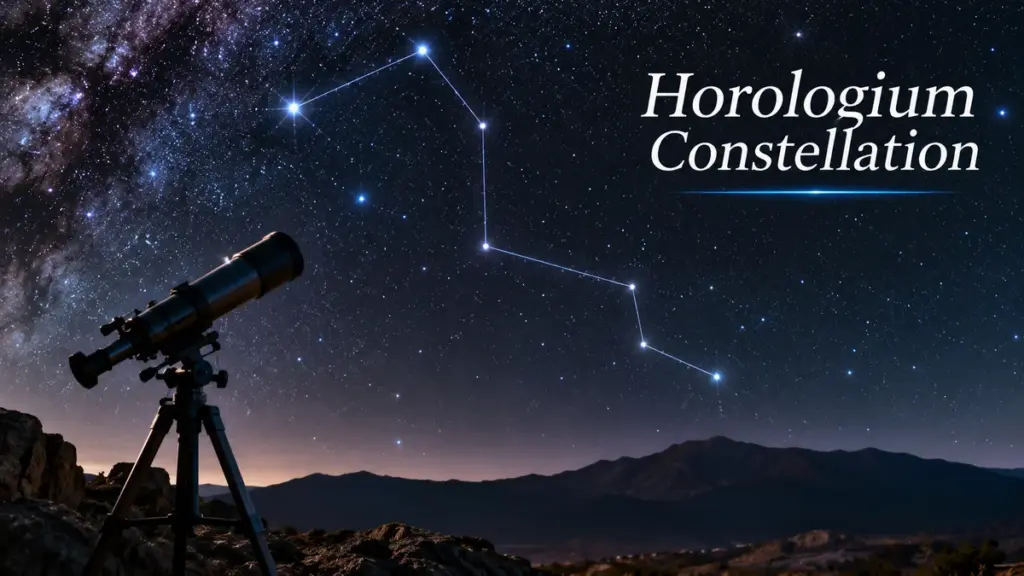
Introduction: What Is the Horologium Constellation?
The Horologium constellation, commonly known as the Clock, is a faint constellation in the southern celestial hemisphere. Its name comes from the Latin word horologium, meaning a clock or timepiece, and its traditional illustration depicts a pendulum clock. Unlike many constellations associated with ancient Greek mythology, Horologium originated in the eighteenth century as part of a scientific effort to map the southern sky.
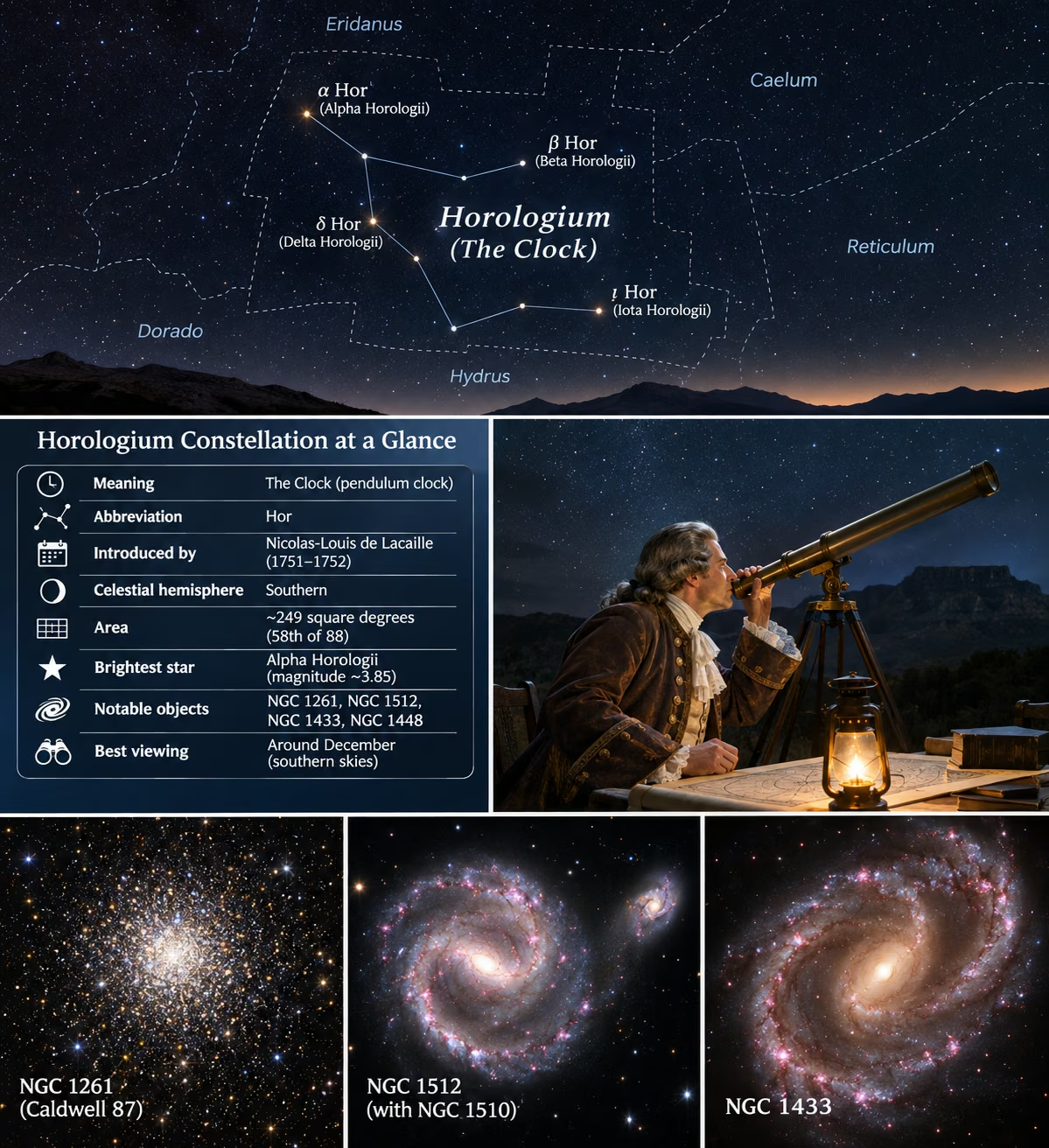
French astronomer Nicolas-Louis de Lacaille introduced Horologium following his observations of southern stars from the Cape of Good Hope in the early 1750s. Today, it is one of the 88 constellations officially recognized by the International Astronomical Union (IAU). It occupies approximately 249 square degrees of sky and ranks 58th in area. [1] [2]
Horologium has relatively few bright stars. Its brightest, Alpha Horologii, is an orange giant with an apparent visual magnitude of approximately 3.85. Other important stars include Beta Horologii, Iota Horologii, and R Horologii, a pulsating variable star. The constellation also contains planetary systems associated with Iota Horologii and the nearby red dwarf GJ 1061.
Although its stars are inconspicuous, Horologium contains remarkable deep-sky objects. These include the globular cluster NGC 1261, also catalogued as Caldwell 87, and several galaxies studied with major observatories. NGC 1512 is particularly interesting because its gravitational interaction with the smaller galaxy NGC 1510 influences its structure and star formation. NGC 1433 and NGC 1448 provide additional opportunities to investigate spiral galaxies. [3] [4] [5]
Horologium is best observed from southern latitudes, particularly during evenings around December. Understanding its position, boundaries, neighboring constellations, and important celestial objects makes it easier to identify and appreciate this relatively overlooked region of the night sky.
Horologium Constellation Facts and Astronomical Identity
Horologium is both a recognizable historical constellation figure and a precisely defined astronomical region. The distinction matters because modern constellations are not physically connected collections of stars. Instead, they divide the celestial sphere into 88 nonoverlapping regions, each with official boundaries.
The following facts provide a foundation for understanding Horologium’s identity and scientific classification.
| Attribute | Horologium fact |
|---|---|
| Official name | Horologium |
| English name | The Clock, or Pendulum Clock |
| Abbreviation | Hor |
| Latin genitive | Horologii |
| Symbolism | Pendulum clock |
| Introduced by | Nicolas-Louis de Lacaille |
| Historical period | Eighteenth century |
| Celestial hemisphere | Southern |
| Area | Approximately 249 square degrees |
| Size ranking | 58th of 88 constellations |
| Brightest star | Alpha Horologii |
| Brightest star magnitude | Approximately 3.85 |
| Notable globular cluster | NGC 1261 |
| Notable galaxies | NGC 1512, NGC 1433, NGC 1448 |
| Favorable evening observation | Around December |
| Official classification | IAU constellation |
These characteristics connect Horologium’s history with its modern astronomical function. The clock illustration provides the constellation’s identity, while its official celestial boundaries determine which stars, galaxies, and other astronomical objects are described as being within Horologium. [1]
What Does Horologium Mean?
The name Horologium comes from Latin and translates to “clock” or “timepiece.” It is related to the broader field of horology, which concerns the measurement of time and the construction and study of timekeeping instruments. In astronomy, Horologium specifically represents a pendulum clock rather than a sundial, hourglass, or modern wristwatch.
This distinction reflects the historical period in which the constellation was created. During the seventeenth and eighteenth centuries, improvements in mechanical clocks helped astronomers make more precise observations. Accurate timekeeping was especially important for recording celestial events and determining positions.
Horologium’s name therefore represents more than a decorative object. It commemorates technology closely associated with the development of precision astronomy.
Why Is Horologium Called the Clock Constellation?
Horologium is called the Clock constellation because Nicolas-Louis de Lacaille chose a pendulum clock as its symbolic representation. Historical star atlases depict a mechanical timepiece occupying the region of sky that Lacaille designated.
The shape should not be interpreted as an obvious clock formed by bright stars. Horologium’s stars are relatively faint, and the lines connecting them vary across historical and modern charts. The clock is a symbolic figure imposed on a region of the celestial sphere.
Its designation belongs to a larger tradition in which Lacaille named southern constellations after scientific instruments and technical equipment. That approach distinguished his new constellations from many ancient Greek figures representing gods, heroes, and animals.
Is Horologium an Official IAU Constellation?
Yes. Horologium is one of the 88 officially recognized constellations established under the modern classification system of the International Astronomical Union.
The IAU distinguishes between a constellation as a defined region of sky and a constellation figure as a recognizable arrangement of stars. Official boundaries allow astronomers to assign celestial objects to particular constellations consistently, even when those objects are not part of the traditional figure.
For example, NGC 1512 is described as being in Horologium because its apparent position falls within the constellation’s official boundaries. The galaxy is not physically associated with Alpha Horologii or the other visible stars.
This geographic approach makes constellation names useful in astronomical catalogues, sky surveys, telescope planning, and educational star charts. [1]
What Are Horologium’s Official Name, Abbreviation, and Genitive?
The official Latin name is Horologium, its internationally standardized abbreviation is Hor, and its Latin genitive form is Horologii.
The genitive is used when naming stars according to traditional constellation-based systems. For example, Alpha Horologii refers to the star designated Alpha in Horologium. Its Greek-letter shorthand is α Hor, combining the Bayer letter with the official constellation abbreviation.
Astronomical catalogues also use numerical identifiers, such as those in the Henry Draper, Hipparcos, and Gaia catalogues. These identifiers can coexist with Bayer designations, allowing the same star to be represented in historical maps and modern scientific databases.
Standardized constellation names and abbreviations are especially important because different languages use different common names. Scientific identification remains consistent across those languages. [1]
How Large Is the Horologium Constellation?
Horologium covers approximately 249 square degrees, making it the 58th-largest of the 88 officially recognized constellations. A square degree measures angular area on the celestial sphere rather than physical distance or volume in space.
The entire sky contains approximately 41,253 square degrees. Consequently, Horologium represents about 0.6% of the celestial sphere. Its relatively small size and lack of conspicuous bright stars help explain why it is less familiar to casual observers than Orion, Scorpius, or the Southern Cross.
The constellation’s angular area does not mean that its stars are clustered together physically. Some belong to the relatively nearby stellar population of the Milky Way, while many galaxies visible in the same direction lie millions of light-years beyond them.
Understanding this distinction is essential when interpreting constellation sizes and astronomical maps.
History and Origin of the Horologium Constellation
The history of Horologium illustrates how advances in astronomy and instrument design influenced the naming of constellations. Unlike classical constellations passed down through ancient Mediterranean traditions, Horologium emerged from systematic observational work in the Southern Hemisphere.
Its creation was closely associated with improvements in celestial surveying, precision timekeeping, and scientific cartography during the Enlightenment. Understanding this background explains why Horologium depicts a technological instrument rather than a mythological character.
Who Discovered and Named Horologium?
French astronomer Nicolas-Louis de Lacaille (1713–1762) introduced Horologium after studying the southern sky from the Cape of Good Hope, in present-day South Africa, during 1751 and 1752.
Lacaille undertook an extensive survey of southern stars, recording their positions and helping improve the accuracy of celestial maps. His work was particularly important because many southern regions had not been documented as systematically as the northern sky.
He introduced 14 new constellations, most named after scientific instruments. Horologium was one of them, representing a pendulum clock. Lacaille did not discover the individual stars, which had already been visible to people living at southern latitudes. His contribution was creating and documenting a new constellation designation.
What Is the History of the Horologium Constellation?
Horologium’s earliest history dates to Lacaille’s southern-sky observations in the 1750s. He initially used the French name l’Horloge, meaning the Clock. The longer Latin form Horologium Oscillitorium appeared in historical astronomical literature, with spelling and wording varying across subsequent publications and atlases.
The shorter name Horologium eventually became standard.
During the nineteenth and early twentieth centuries, astronomers worked toward a consistent system of constellation names and boundaries. The International Astronomical Union adopted the modern set of 88 constellations, and standardized boundaries were published in 1930 through the work of Belgian astronomer Eugène Delporte.
Horologium retained its place among the official constellations, preserving Lacaille’s scientific symbolism. [1] [2]
How Is Horologium Connected to the Pendulum Clock?
Horologium’s historical representation is associated with the pendulum clock, an important advancement in mechanical timekeeping. Dutch scientist Christiaan Huygens developed the first successful pendulum clock in 1656, substantially improving the accuracy available from many earlier mechanical clocks.
Precise time measurements were essential to astronomy because Earth’s rotation causes celestial objects to appear to move across the sky. Astronomers needed reliable clocks to record transit times, compare observations, and determine celestial positions.
The association between Horologium and precision timekeeping therefore reflects a genuine scientific relationship. By representing a pendulum clock among the stars, Lacaille commemorated the instruments that contributed to more accurate astronomical observations.
Why Doesn’t Horologium Have an Ancient Greek Myth?
Horologium does not have a traditional ancient Greek myth because it was introduced in the eighteenth century, long after the classical constellation traditions had developed.
Many familiar constellations, including Orion, Perseus, and Andromeda, became associated with stories involving gods, heroes, and legendary events. Horologium belongs to a different naming tradition that celebrates scientific instruments and technological achievements.
Lacaille used this approach for several southern constellations, including Caelum, Reticulum, and Microscopium. Their identities reflect the scientific culture of their time.
Although modern writers may create imaginative stories about the Clock constellation, those stories should not be confused with documented ancient mythology. Horologium’s historical significance comes primarily from astronomy, cartography, and the development of precision instruments.
Where Is the Horologium Constellation Located?
Horologium lies in the southern celestial hemisphere, in a relatively faint area of sky between several better-known southern constellations. Its position is useful for astronomers because it provides a recognizable celestial region containing stars, galaxies, and star clusters.
Locating Horologium accurately requires understanding two related concepts: its general position among neighboring constellations and its formal coordinates. The former is practical for stargazing, while the latter enables precise astronomical observation.
Horologium’s Position in the Southern Celestial Hemisphere
Horologium is situated south of the celestial equator, the imaginary extension of Earth’s equator onto the celestial sphere. Its stars occupy negative declinations, indicating positions in the southern half of the sky.
This location makes Horologium particularly suitable for observation from Australia, New Zealand, South Africa, Chile, Argentina, and other southern regions. Observers at northern latitudes have a more limited view because portions of the constellation remain below their horizon.
Horologium is not situated at the south celestial pole. Instead, it occupies an intermediate southern region where its altitude changes considerably with the observer’s geographic latitude.
Its relatively faint stellar pattern makes nearby constellation boundaries and reliable sky charts especially useful for identification.
What Are the Celestial Coordinates of Horologium?
Horologium occupies an irregular region extending approximately from 2h 13m to 4h 20m in right ascension and from about −40° to −67° in declination. These rounded ranges are useful for orientation but should not replace the official boundary-coordinate files when precision is required.
Right ascension identifies an east-west position on the celestial sphere, while declination measures angular distance north or south of the celestial equator.
Because Horologium has an irregular boundary, its complete location cannot be described by a single rectangle without including areas belonging to neighboring constellations.
Astronomers use the IAU’s boundary data and standard coordinate reference systems to determine whether a particular star or galaxy lies inside Horologium. [1]
How Does the Equatorial Coordinate System Locate Horologium?
The equatorial coordinate system uses right ascension and declination to assign positions to celestial objects. It is comparable to geographic longitude and latitude, except that the coordinates refer to the celestial sphere instead of Earth’s surface.
Right ascension is usually expressed in hours, minutes, and seconds, with 24 hours corresponding to a complete circle. Declination is measured in degrees from the celestial equator.
For example, a negative declination identifies an object south of the celestial equator.
Coordinates are often supplied for a reference epoch, such as J2000.0, because Earth’s rotational axis changes orientation slowly over time through precession and other effects.
The IAU provides standard constellation boundary coordinates so astronomers can assign objects consistently, even when using different observing instruments and software. [1]
What Is the Celestial Sphere?
The celestial sphere is an imaginary sphere surrounding Earth onto which astronomers project the apparent positions of stars, planets, galaxies, and other objects.
It provides a convenient framework for describing direction without requiring every object’s physical distance to be known. Two stars that appear close together on the celestial sphere may actually be separated by hundreds or thousands of light-years.
Constellations such as Horologium are defined on this apparent spherical surface. They are not necessarily gravitationally connected stellar systems.
The celestial sphere is therefore essential for interpreting star maps, understanding right ascension and declination, and distinguishing an object’s observed direction from its actual three-dimensional position in space.
What Are Horologium’s Official Constellation Boundaries?
Horologium’s official boundaries define the region of sky assigned to the constellation by the International Astronomical Union.
These boundaries were standardized through the work of Eugène Delporte and published in 1930. They form a network of adjoining regions that collectively cover the entire celestial sphere without gaps or overlaps.
The boundary lines are fundamentally different from the imaginary lines often drawn between stars. Connecting lines create a recognizable constellation figure, while official boundaries determine astronomical membership.
For example, NGC 1261 and NGC 1512 are catalogued within Horologium because their observed coordinates fall inside its defined region.
Modern software applies the appropriate coordinate transformations when comparing object positions with standardized boundaries. [1]
How to Read a Horologium Star Chart
A Horologium star chart displays the constellation’s approximate star pattern, official boundaries, neighboring constellations, and sometimes its most notable deep-sky objects.
Bright stars are generally represented by larger dots, while fainter stars appear as smaller symbols. Lines connecting stars provide a visual guide, but their arrangement can differ between publishers.
Coordinate grids indicate right ascension and declination. These become especially important when locating objects that are too faint to identify with the unaided eye.
To use a chart effectively, match it to the observing date, time, and geographic latitude. Orient it according to the direction you are facing.
Digital planetarium software can simplify this process by calculating the apparent sky for a specific observing location.
Which Constellations Surround Horologium?
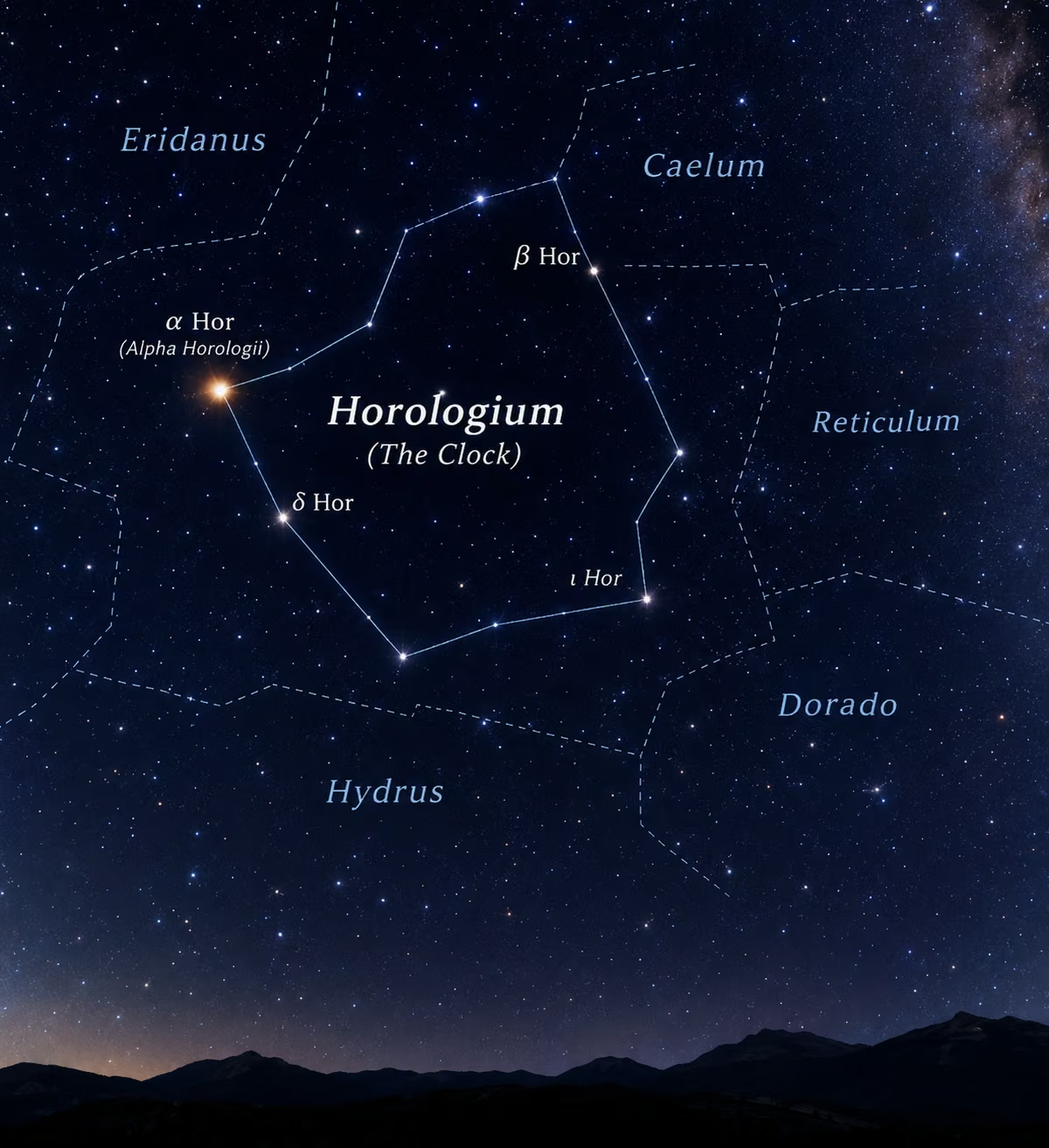
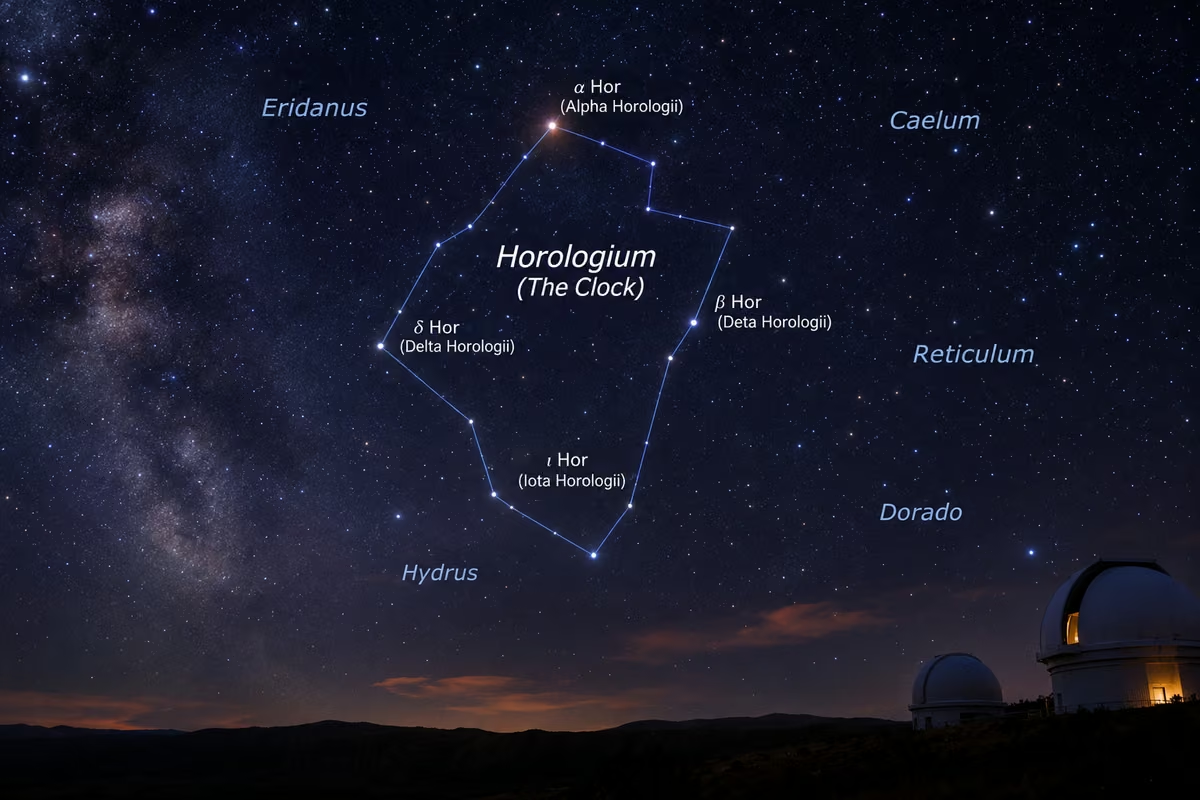
Horologium shares official boundaries with Eridanus, Reticulum, Dorado, Hydrus, and Caelum. These neighboring constellations provide valuable geographical reference points on the celestial sphere.
Learning their positions is often more useful than trying to recognize Horologium’s faint star pattern in isolation.
| Neighboring constellation | English meaning | Relationship to Horologium |
|---|---|---|
| Eridanus | The River | Along its northern and northeastern region |
| Reticulum | The Reticle | Toward its western and southwestern region |
| Dorado | The Dolphinfish | Along part of its southwestern side |
| Hydrus | The Lesser Water Snake | Toward its southern region |
| Caelum | The Chisel | Toward its northwestern region |
The following relationships describe their positions on standard constellation charts, not physical distances between stars.
Eridanus Constellation
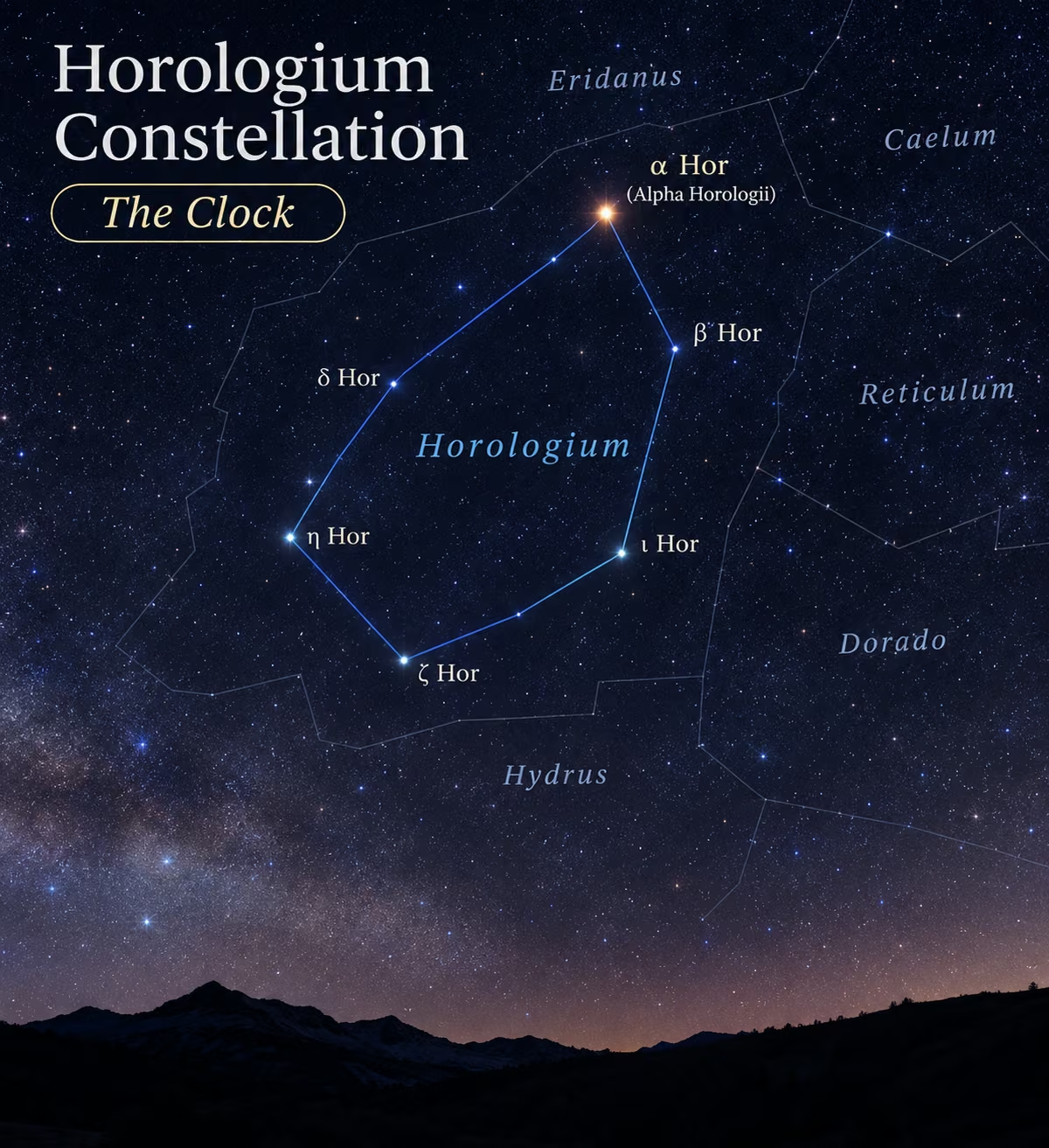
Eridanus, the River, is an extensive constellation stretching across a large portion of the sky. It borders Horologium to the north and northeast and contains numerous stars that are useful for understanding the surrounding region.
Its most prominent star is Achernar, also designated Alpha Eridani. Achernar is much brighter than any star in Horologium, making it useful as a general orientation landmark.
However, Achernar is not part of Horologium, and its position alone is insufficient to locate the Clock precisely.
Observers should use the recognizable parts of Eridanus together with a detailed chart to identify Horologium’s position. This approach is especially helpful because Horologium lacks the obvious pattern of brighter constellations.
Reticulum Constellation
Reticulum is a small southern constellation representing a reticle, the network of reference lines used in optical instruments to assist with aiming and measurement.
It lies adjacent to Horologium and shares its historical association with Nicolas-Louis de Lacaille’s instrument-themed constellation system.
Reticulum contains stars that can help observers establish a local reference pattern. Although it is also relatively faint, its compact arrangement makes it useful when navigating the sky with binoculars or astronomy software.
The relationship between Reticulum and Horologium demonstrates how Lacaille organized parts of the southern sky around scientific equipment.
Their proximity is a matter of celestial mapping, not evidence that their individual stars form a single physical structure.
Dorado Constellation
Dorado represents a dolphinfish and lies southwest of Horologium in the southern sky. It is particularly significant because it contains much of the Large Magellanic Cloud, a satellite galaxy of the Milky Way.
This makes Dorado a useful regional reference for southern observers, although the Large Magellanic Cloud does not directly identify Horologium’s boundaries.
Dorado’s stars and nearby celestial features help distinguish this region from the fainter areas surrounding the Clock constellation.
Astronomers studying the southern sky often encounter both constellations because they lie in neighboring celestial regions.
Their apparent proximity does not imply that the galaxies, stars, and clusters projected within them are physically connected.
Hydrus Constellation
Hydrus, commonly called the Lesser Water Snake, is a southern constellation bordering Horologium.
It should not be confused with Hydra, the much larger Water Snake constellation located in a different region of the sky. The similarity between the names can create confusion for beginning stargazers.
Hydrus extends across the southern celestial hemisphere and contains several stars useful for orientation.
Its relationship with Horologium is especially relevant when reading charts covering southern declinations, where the two constellations occupy adjacent official regions.
Observers can use Hydrus alongside Reticulum and Dorado to establish Horologium’s southern and southwestern surroundings.
Caelum Constellation
Caelum represents an engraver’s chisel and is another scientific-instrument constellation introduced by Nicolas-Louis de Lacaille.
It is located northwest of Horologium and is itself relatively small and faint. Like the Clock, Caelum lacks the conspicuous bright stars that make some constellations immediately recognizable.
The two constellations illustrate Lacaille’s preference for practical scientific instruments rather than ancient mythological figures.
Caelum can assist with locating Horologium when an observer already knows the surrounding regions of Eridanus and Reticulum.
Because both constellations contain faint stars, a detailed sky chart is usually more reliable than attempting to recognize their traditional figures from memory.
Can Achernar Help Locate Horologium?
Achernar, or Alpha Eridani, is a bright blue-white star in the constellation Eridanus. Its brightness makes it an excellent landmark for identifying the general region of the southern sky containing Horologium.
A practical approach is to locate Achernar first, identify the surrounding pattern of Eridanus, and then use a star chart to move toward Horologium’s official area.
The method requires care because Horologium lies across a comparatively broad and faint region, not immediately around Achernar itself.
A chart displaying Eridanus, Reticulum, and Horologium together is particularly helpful.
From northern locations where Achernar appears low above the horizon, atmospheric haze and obstructions may make this method less effective.
What Are the Brightest and Most Important Stars in Horologium?
Horologium contains stars of several spectral classes and evolutionary stages, ranging from relatively ordinary main-sequence stars to luminous giants and pulsating variables.
Its brightest stars are considerably less conspicuous than those in famous constellations such as Orion or Scorpius. Nevertheless, they provide valuable examples of stellar evolution, stellar classification, and planetary-system formation.
The table below presents approximate properties. Apparent magnitudes, distances, and spectral classifications can differ slightly between catalogues because of measurement updates, variable-star behavior, or differences in classification methods.
| Star | Approximate visual magnitude | Spectral classification | Approximate distance |
|---|---|---|---|
| Alpha Horologii | 3.85 | K2 III | 118 light-years |
| Delta Horologii | 4.93 | F2 IV/V | 183 light-years |
| Beta Horologii | 4.97 | A-type giant | 320 light-years |
| Zeta Horologii | 5.21 | F6 V | 161 light-years |
| Eta Horologii | 5.29 | A6 V | 129 light-years |
| Iota Horologii | 5.40 | F8 V | 57 light-years |
These rounded figures are suitable for orientation and comparison. Scientific calculations should use current catalogue measurements, including their reported uncertainties. [6]
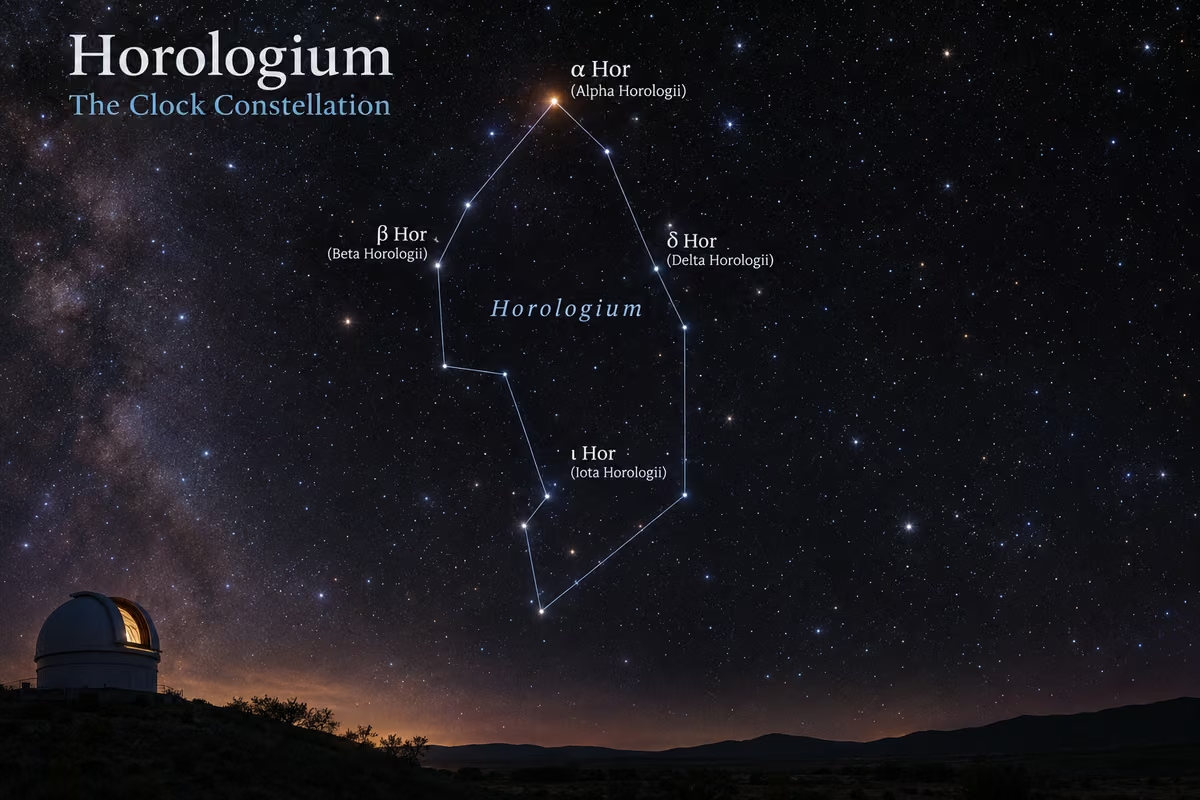
Alpha Horologii: The Brightest Star
Alpha Horologii, designated α Hor, is the brightest star in Horologium. It has an apparent visual magnitude of approximately 3.85 and lies roughly 118 light-years from Earth.
It is commonly classified as a K2 III star, indicating an evolved orange giant. Its spectrum reveals a surface temperature lower than that of the Sun, giving it a comparatively warm orange appearance.
Alpha Horologii has evolved beyond the ordinary hydrogen-burning phase of a main-sequence star. As its internal structure changed, its outer layers expanded, increasing its radius and luminosity.
Despite being Horologium’s brightest star, Alpha Horologii can be difficult to identify under urban skies because the constellation lacks a distinctive bright-star pattern.
Beta Horologii
Beta Horologii, designated β Hor, is an evolved A-type star with an apparent visual magnitude close to 5.0. Its spectral classification places it among the hotter, relatively white or blue-white stars.
Although its Bayer designation is Beta, it is not necessarily the constellation’s second-brightest star. Delta Horologii, for example, has a slightly brighter apparent magnitude in commonly used catalogues.
This illustrates an important limitation of Bayer designations. Greek-letter order often corresponds roughly to historical brightness rankings, but the system was not applied consistently according to modern photometric measurements.
Beta Horologii is useful for studying the spectral and luminosity differences between evolved A-type stars and cooler giant stars such as Alpha Horologii.
Delta Horologii
Delta Horologii, designated δ Hor, is one of the brighter stars in the constellation, with an apparent visual magnitude of approximately 4.9.
It is commonly classified near spectral type F2, with luminosity classifications indicating a star approaching or entering the subgiant stage. This makes it different from both Alpha Horologii, an established giant, and ordinary F-type main-sequence stars.
Its comparatively bright appearance makes it a useful reference in detailed Horologium charts.
The star also demonstrates why apparent brightness alone cannot reveal a star’s intrinsic luminosity. Distance, temperature, radius, and evolutionary stage all influence how bright a star appears from Earth.
Zeta Horologii
Zeta Horologii, designated ζ Hor, is a relatively faint F-type main-sequence star. Its commonly reported visual magnitude is approximately 5.2, placing it near the naked-eye visibility limit under moderately dark conditions.
An F-type star has a hotter photosphere than the Sun and generally appears yellow-white or white rather than orange.
Zeta Horologii contributes to the constellation’s mapped stellar pattern, although its faintness limits its usefulness in heavily light-polluted environments.
For observers, it is best identified through its position relative to other catalogued stars. For astrophysics students, it provides a useful comparison with Alpha Horologii because the two stars represent different stellar temperatures and evolutionary stages.
Eta Horologii
Eta Horologii, designated η Hor, is commonly classified as an A-type main-sequence star with a visual magnitude around 5.3.
Its spectral characteristics indicate a relatively hot stellar atmosphere compared with the Sun. Like other A-type stars, its visible-light spectrum is influenced by prominent hydrogen absorption features.
Eta Horologii is relevant to constellation mapping because it appears among Horologium’s named Bayer-designated stars, even though it is not particularly bright.
Its inclusion also helps demonstrate the wide range of stellar properties found within a single constellation. Stars sharing the Horologii designation are grouped by their apparent sky positions, not by a common age, composition, or gravitational origin.
Iota Horologii
Iota Horologii, also known as ι Hor or HR 810, is a relatively nearby F-type main-sequence star approximately 57 light-years from Earth.
It has a visual magnitude near 5.4, making it potentially visible to the unaided eye under sufficiently dark skies. Its physical characteristics resemble those of the Sun in broad terms, although it is somewhat hotter and more massive.
Iota Horologii is particularly important because it hosts a confirmed giant exoplanet, Iota Horologii b.
Its planetary system has been studied through precise stellar radial-velocity measurements. The relationship between the star and its planet makes it more scientifically significant than its modest apparent brightness might suggest. [7]
How Does the Bayer Designation System Work?
The Bayer designation system identifies stars using Greek letters followed by the genitive form of their constellation’s Latin name.
For example, Alpha Horologii is written as α Hor, while Beta Horologii is written as β Hor. This naming convention originated with Johann Bayer’s early seventeenth-century star atlas, Uranometria.
In many constellations, Greek letters approximately follow brightness order, but exceptions are common. Historical observational limitations, stellar positions, and naming practices influenced the assignments.
The Bayer system remains useful because it provides concise identifiers that connect stars with recognizable constellation regions.
Modern astronomy supplements these traditional designations with precise catalogue identifiers, enabling individual stars to be cross-referenced across major scientific databases.
Variable Stars and Stellar Evolution in Horologium
Several stars in Horologium are scientifically interesting because their brightness or spectral characteristics reveal processes occurring during stellar evolution.
Variable stars are especially useful because changes in their observed light can reflect pulsations, rotation, eclipses, or other physical mechanisms.
Horologium contains examples of evolved variable stars, including R Horologii and TW Horologii. Studying such objects helps astronomers understand the later stages of stellar development, the structure of stellar atmospheres, and the relationship between pulsation and luminosity.
R Horologii: A Variable Red Giant Star
R Horologii is a long-period pulsating variable star belonging to the Mira class. It is an evolved, cool red giant whose brightness changes considerably as its outer layers expand and contract.
Its pulsation cycle is commonly reported at roughly 405 days, although individual cycles do not necessarily repeat with perfect regularity.
At favorable maxima, R Horologii can become visible to the unaided eye under very dark skies. Near minimum brightness, however, it may require a substantial telescope to detect.
The amplitude of its brightness variation makes it valuable to amateur and professional observers who monitor changes in stellar luminosity.
Long-term observations help astronomers investigate pulsation behavior and the evolution of stars approaching the final stages of their lives. [6] [8]
What Are Mira-Type Variable Stars?
Mira-type variables are evolved red giant stars that undergo large, approximately periodic changes in brightness. Their variability results primarily from pulsations involving the expansion and contraction of their outer stellar envelopes.
These stars generally occupy advanced evolutionary stages on the asymptotic giant branch. Their atmospheres can be cool, extended, and affected by substantial mass loss.
As a Mira star pulsates, its radius, effective temperature, and atmospheric properties change. These variations influence the amount of visible radiation reaching an observer.
Mira-type stars typically have periods of roughly 80 to more than 1,000 days, although individual objects can show irregularities.
R Horologii provides an example of how pulsation measurements can reveal physical processes that are otherwise difficult to observe directly. [8]
TW Horologii and Other Variable Stars
TW Horologii is an evolved carbon-rich giant star known for its variable brightness. Carbon stars have atmospheric compositions in which carbon is relatively abundant compared with oxygen, allowing carbon-bearing molecules to influence their spectra.
These molecules can produce strong absorption features and contribute to the distinctive reddish appearance of many carbon stars.
TW Horologii is commonly associated with semiregular variability rather than the large, strongly periodic brightness changes characteristic of many Mira variables.
Monitoring its brightness over time can reveal changes associated with atmospheric pulsation and stellar evolution.
An observer interested in TW Horologii should consult updated variable-star databases for current classifications, predicted behavior, and observational measurements rather than assume a fixed brightness.
What Is an Orange Giant Star?
An orange giant star is an evolved star with a relatively cool photosphere and a substantially expanded outer envelope compared with its earlier main-sequence phase.
Its orange appearance typically corresponds to a K-type spectral classification, although stellar colors depend on atmospheric properties and observational conditions.
Alpha Horologii is an example of an orange giant. Its classification as K2 III indicates both its spectral type and its giant luminosity class.
As stars evolve, changes in their internal nuclear-burning processes alter their structure. The outer layers can expand while the surface temperature decreases.
A giant star may therefore emit much more total energy than the Sun despite having a cooler surface.
What Is a Red Dwarf Star?
A red dwarf is a relatively small, low-mass main-sequence star that produces energy through hydrogen fusion.
Red dwarfs are generally classified as M-type stars. Their low surface temperatures make them appear reddish, while their relatively low luminosities often prevent them from being visible to the unaided eye, even when they are nearby.
GJ 1061, located in the direction of Horologium, is an example.
Because low-mass stars consume their hydrogen comparatively slowly, red dwarfs can remain on the main sequence for extremely long periods.
Their abundance and longevity make them important targets in studies of stellar populations and exoplanetary systems. The planets orbiting GJ 1061 demonstrate their relevance to modern planetary astronomy. [9]
How Are Stars Spectrally Classified?
Astronomers classify stars by analyzing the distribution of wavelengths and absorption features in their spectra.
The principal temperature sequence is O, B, A, F, G, K, and M, ordered approximately from hottest to coolest. Each category is divided into numerical subclasses, and luminosity classes distinguish main-sequence stars from giants and supergiants.
For example, Alpha Horologii is commonly classified K2 III, while Iota Horologii is an F-type main-sequence star.
Spectral classification provides clues about temperature, chemical composition, atmospheric conditions, and evolutionary stage. However, a spectral type does not independently determine a star’s mass, exact age, or distance.
Combining spectroscopy with luminosity, parallax, and stellar models produces a more complete physical description.
Exoplanets and Planetary Systems in Horologium
Horologium contains several stars with confirmed exoplanets, making it relevant to the rapidly developing field of planetary-system research.
An exoplanet is a planet orbiting a star outside our Solar System. Because such planets are usually faint compared with their host stars, astronomers commonly identify them through indirect observational effects.
Two particularly interesting planetary systems in Horologium are associated with Iota Horologii and GJ 1061. They provide contrasting examples of a giant planet orbiting a Sun-like star and smaller planets orbiting a low-mass red dwarf.
Does Horologium Contain Stars With Exoplanets?
Yes. Horologium contains stars with confirmed planets beyond the Solar System, including Iota Horologii and GJ 1061.
Iota Horologii hosts a giant planet identified through radial-velocity observations. GJ 1061 is a nearby red dwarf with three confirmed planets listed in the NASA Exoplanet Archive.
These planetary systems differ substantially in their stellar environments and orbital structures.
Their placement in Horologium does not mean the systems are physically connected. The constellation identifies their apparent direction from Earth, while their actual distances and locations in three-dimensional space are different.
Studying these systems helps astronomers compare planetary formation and orbital evolution around stars with different masses and temperatures. [7] [9]
Iota Horologii b: A Giant Exoplanet
Iota Horologii b, also written ι Hor b, is a confirmed giant exoplanet discovered through radial-velocity measurements in 1999.
Published orbital solutions place its period at approximately 320 days and its orbital semimajor axis near 0.93 astronomical units, although catalogues may report different fitted values as additional observations improve the model.
Its minimum mass is approximately 2.3 times Jupiter’s mass, based on a published orbital solution. Because the radial-velocity method does not always establish orbital inclination, the actual planetary mass may be greater than the measured minimum mass.
The planet’s relatively long orbit distinguishes it from close-in hot Jupiters.
Iota Horologii b provides evidence that massive planets can occupy orbits with periods comparable to an Earth year around stars broadly resembling the Sun. [7]
GJ 1061: A Nearby Planet-Hosting Red Dwarf
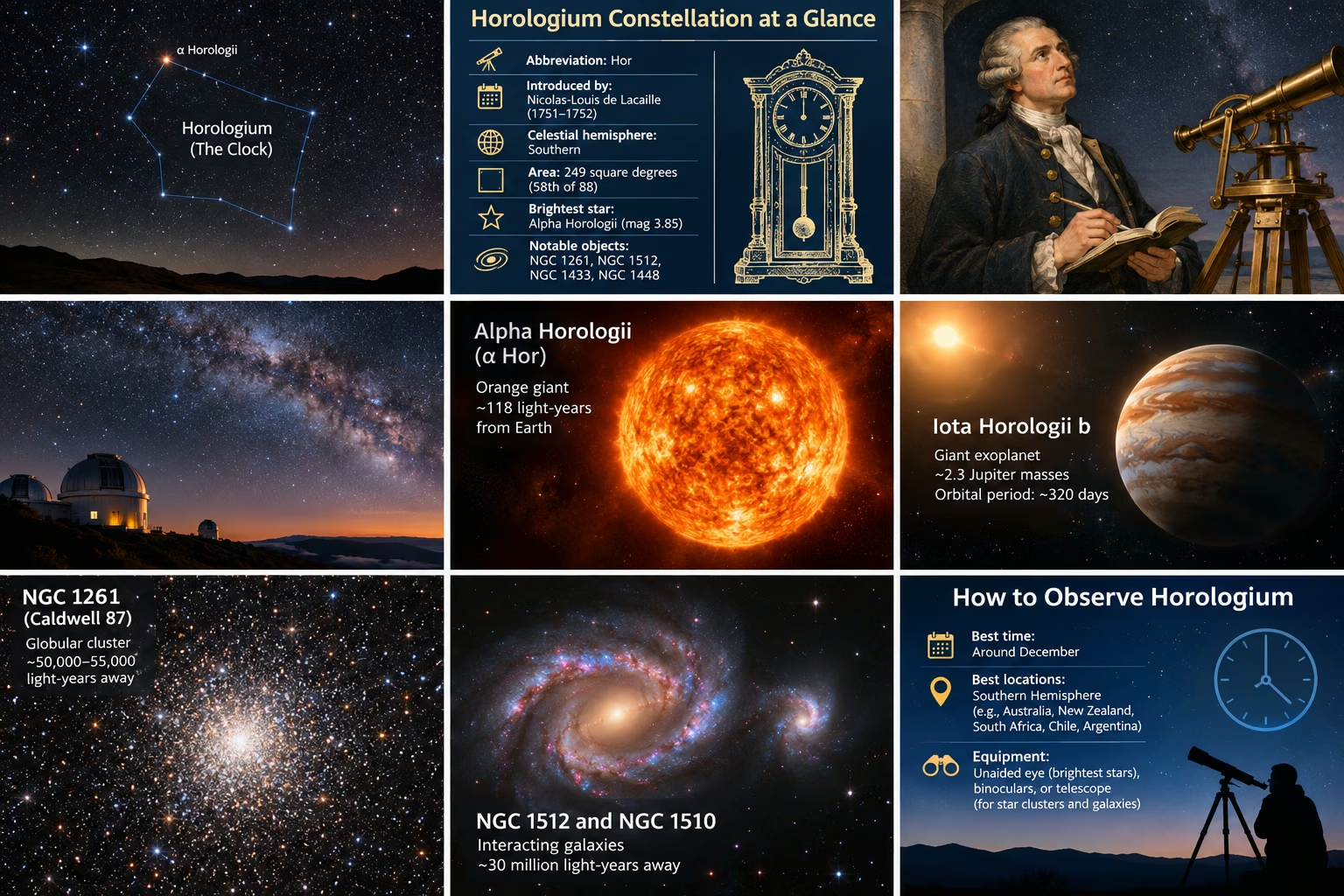
GJ 1061, also called Gliese 1061, is a nearby M-type red dwarf approximately 12 light-years from Earth.
The NASA Exoplanet Archive reports an effective stellar temperature of approximately 3,320 kelvin and a radius of about 0.16 solar radii, although published stellar parameters vary with the adopted measurements and models.
Because GJ 1061 is much smaller and less luminous than the Sun, planets with short orbital periods can receive moderate amounts of stellar radiation.
Its proximity also makes it an important target for studies of nearby low-mass stars.
Astronomers have detected three confirmed planetary companions, designated GJ 1061 b, c, and d, through precise radial-velocity measurements. [9]
The GJ 1061 Planetary System
The GJ 1061 planetary system contains three confirmed planets with short orbital periods.
The NASA Exoplanet Archive includes updated analyses published in 2025 alongside earlier discovery measurements. The refined solutions report approximate planetary masses in the range of one to two Earth masses, although their physical sizes and atmospheric conditions are not established by the radial-velocity measurements alone.
| Planet | Approximate orbital period | Reported mass from 2025 solution | Orbital semimajor axis |
|---|---|---|---|
| GJ 1061 b | 3.21 days | 1.11 Earth masses | 0.021 AU |
| GJ 1061 c | 6.68 days | 1.81 Earth masses | 0.034 AU |
| GJ 1061 d | 13.07 days | 1.67 Earth masses | 0.054 AU |
Some orbital solutions differ because of observational sampling and modeling uncertainties. In particular, earlier research considered an alternative orbital period for planet d.
GJ 1061 c and d have received attention because their estimated stellar irradiation makes them relevant to discussions of potentially temperate planets.
However, a planet’s estimated habitable-zone position does not establish that it contains liquid water, has an atmosphere, or supports life. Those possibilities require additional evidence. [9]
How Do Astronomers Detect Exoplanets?
Astronomers use several techniques to detect planets orbiting distant stars. Two of the most productive methods are radial-velocity measurements and transit photometry.
The radial-velocity method detects small changes in a star’s line-of-sight motion caused by the gravitational influence of orbiting planets. These movements shift spectral lines through the Doppler effect.
Transit photometry detects periodic decreases in stellar brightness when a planet passes in front of its host star from Earth’s perspective.
Other techniques include direct imaging, gravitational microlensing, and astrometric measurements.
Iota Horologii b and the confirmed GJ 1061 planets were detected through radial velocity. This technique provides information about orbital periods and planet masses, although some parameters remain dependent on orbital geometry and modeling assumptions.
Deep-Sky Objects in the Horologium Constellation
Horologium contains several scientifically important deep-sky objects, including globular clusters and distant galaxies. These objects are generally much fainter than the constellation’s principal stars and are best examined with telescopes.
Although they appear within the same celestial boundaries, they represent very different physical systems. Some belong to the Milky Way, while others are separate galaxies millions of light-years away.
The following objects are among the most significant astronomical targets in Horologium.
| Object | Type | Approximate distance | Scientific significance |
|---|---|---|---|
| NGC 1261 | Globular cluster | 50,000 to 55,000 light-years | Old stellar populations and cluster evolution |
| Arp-Madore 1 | Remote globular cluster | 390,000 to 400,000 light-years | Outer Milky Way halo |
| NGC 1512 | Barred spiral galaxy | 30 million light-years | Star formation and galaxy interactions |
| NGC 1510 | Dwarf galaxy | Approximately 30 million light-years | Interaction with NGC 1512 |
| NGC 1433 | Barred spiral galaxy | 46 million light-years | Galactic bars, rings, and central activity |
| NGC 1448 | Spiral galaxy | Approximately 50 to 60 million light-years | Galactic structure and supernovae |
Distances are rounded and may vary between studies because different observational techniques and calibration methods can produce different estimates. [3] [4] [5] [10]
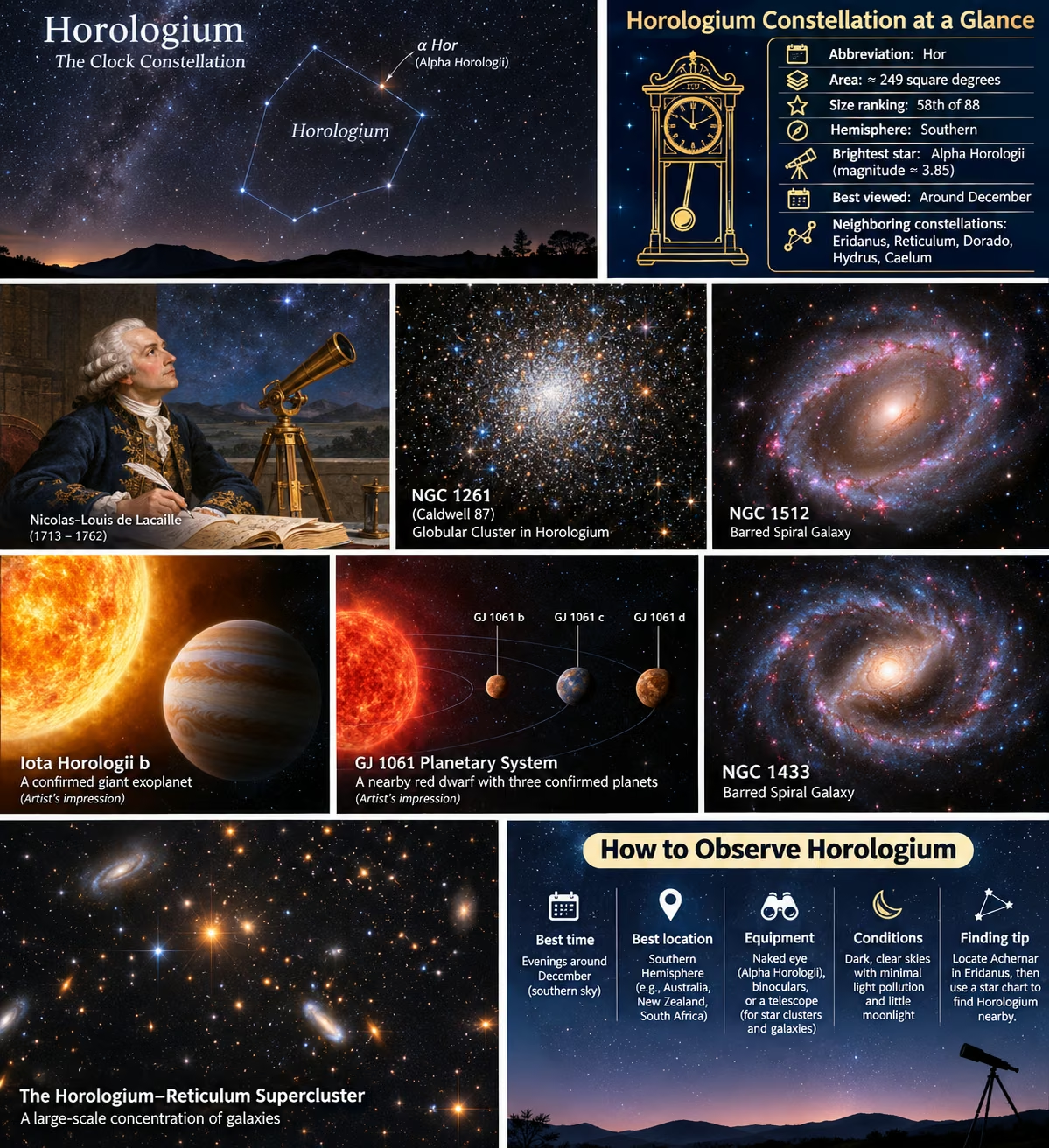
What Are Horologium’s Deep-Sky Objects?
Deep-sky objects are astronomical targets beyond the Solar System, typically including star clusters, nebulae, and galaxies.
Horologium’s notable deep-sky objects include the Milky Way globular clusters NGC 1261 and Arp-Madore 1, along with galaxies such as NGC 1512, NGC 1433, and NGC 1448.
Many are identified by their New General Catalogue designations. The NGC system originated in the nineteenth century and remains widely used to identify astronomical objects.
Deep-sky observing differs from ordinary constellation recognition because most targets are too faint to see without magnification or specialized imaging equipment.
Their visibility depends on total brightness, surface brightness, angular size, atmospheric conditions, and telescope capabilities.
NGC 1261: A Globular Star Cluster
NGC 1261, also known as Caldwell 87, is a globular star cluster within Horologium. NASA describes it as lying approximately 50,000 light-years from Earth, while ESO has published an estimate of about 55,000 light-years.
The cluster contains a dense population of stars held together by mutual gravity. Its integrated apparent magnitude is approximately 8.3, making it accessible to telescopic observation under suitable conditions.
Hubble Space Telescope observations have been used to investigate stellar motions, chemical abundances, and differences among its stellar populations.
These investigations are scientifically important because globular clusters were once often treated as nearly uniform populations of stars formed at approximately the same time.
Modern observations reveal that their formation and chemical histories can be more complicated. NGC 1261 is therefore valuable for understanding the assembly and evolution of the Milky Way. [3]
What Is a Globular Cluster?
A globular cluster is a dense, approximately spherical group of stars gravitationally bound together.
Globular clusters can contain tens of thousands to millions of stars, although individual cluster populations vary. Many are dominated by old stars and are found within the extended halos of galaxies.
Their high stellar densities distinguish them from open clusters, which are generally younger, less densely packed, and commonly associated with galactic disks.
Astronomers study globular clusters using stellar brightness measurements, spectroscopy, chemical abundances, and stellar motions.
These observations help determine cluster ages, distances, compositions, and evolutionary histories.
NGC 1261 illustrates a comparatively accessible globular cluster, while Arp-Madore 1 demonstrates how similar objects can exist at enormous distances from the Galactic center.
Arp-Madore 1: A Remote Galactic Cluster
Arp-Madore 1, abbreviated AM 1, is a faint globular cluster located in the outer halo of the Milky Way.
Photometric research has placed it at a distance of approximately 120 kiloparsecs, equivalent to about 390,000 light-years, from the Sun. Estimates differ slightly between studies and adopted distance calibrations.
This extraordinary distance makes AM 1 an important object for investigating the remote regions of the Galaxy.
Its faintness means it is not an easy target for ordinary amateur telescopes. Studying it requires sensitive imaging and careful measurements of individual stellar populations.
Remote globular clusters such as AM 1 help astronomers trace the Milky Way’s gravitational environment and investigate how its halo developed through the accumulation of smaller stellar systems. [11]
What Is the Stellar Halo of the Milky Way?
The stellar halo is an extended, comparatively diffuse population of stars and star clusters surrounding the Milky Way’s disk and central regions.
Many halo stars are old and have relatively low abundances of heavy elements, although the halo contains multiple populations with different origins.
Astronomers investigate halo objects to reconstruct the Milky Way’s history of mergers and accretion.
Arp-Madore 1 is particularly interesting because of its remote position. Its location provides information about stellar systems far beyond the Galaxy’s bright disk.
The stellar halo should not be confused with the Galaxy’s dark matter halo, although both contribute to studies of the Milky Way’s structure, gravitational potential, and evolutionary history.
NGC 1512: A Barred Spiral Galaxy
NGC 1512 is a barred spiral galaxy located approximately 30 million light-years from Earth. NASA reports that it spans roughly 70,000 light-years and contains a prominent central bar, spiral structure, and regions of active star formation.
One of its most distinctive features is a circumnuclear starburst ring approximately 2,400 light-years across.
The ring contains young star clusters and material involved in ongoing stellar formation. The central bar helps transport gas toward the inner galaxy, where concentrated gas can support new star formation.
NGC 1512 also interacts gravitationally with the smaller galaxy NGC 1510.
Observations from the Hubble and James Webb Space Telescopes reveal different aspects of its structure, including dust, gas, stellar populations, and star-forming regions. [4]
NGC 1510: An Interacting Galaxy
NGC 1510 is a dwarf galaxy that interacts with the much larger spiral galaxy NGC 1512.
The two galaxies exert gravitational forces on each other, influencing their structures and the movement of their stars and interstellar material.
NASA and ESA observations indicate that the interaction has affected the spiral arms and star-forming regions of NGC 1512. Its outer structures show distortions associated with gravitational encounters and the redistribution of matter.
The system is especially interesting because it illustrates how a comparatively small galaxy can significantly influence a larger companion.
NGC 1510 also demonstrates that galaxy evolution does not depend exclusively on internal processes. External interactions can alter gas distributions, affect stellar formation, and reshape galactic structures over hundreds of millions of years. [4]
NGC 1433: A Ringed Barred Spiral Galaxy
NGC 1433 is a barred spiral galaxy approximately 46 million light-years from Earth.
It contains a prominent central bar and ring-like structures associated with the distribution and movement of stars, gas, and dust.
The galaxy has been observed by several major facilities, including the Hubble Space Telescope, James Webb Space Telescope, and Atacama Large Millimeter/submillimeter Array (ALMA).
ALMA observations have revealed detailed molecular gas structures and evidence of an outflow near its central region.
NGC 1433 was also included in the PHANGS observational program, which investigates how gas and dust contribute to star formation across nearby galaxies.
These studies help astronomers examine the relationship between galactic structure, gas transport, and activity around galactic nuclei. [5]
NGC 1448: A Spiral Galaxy
NGC 1448 is a spiral galaxy observed nearly edge-on from Earth. Estimates place it roughly 50 to 60 million light-years away, depending on the study and measurement method.
Its orientation gives it an elongated appearance, rather than the broad, face-on spiral structure visible in galaxies such as NGC 1512.
NGC 1448 has been studied using both space-based and ground-based telescopes.
It is particularly notable for hosting observed supernovae, including SN 2001el and SN 2003hn. Such events provide opportunities to investigate stellar explosions and, in suitable cases, estimate extragalactic distances.
NGC 1448 also demonstrates how viewing angle influences the appearance of spiral galaxies. A galaxy’s underlying structure can be difficult to recognize when seen close to edge-on. [10]
What Defines a Barred Spiral Galaxy?
A barred spiral galaxy is a spiral galaxy containing an elongated, bar-shaped concentration of stars through its central region.
Spiral arms often extend from the ends of the bar, although detailed structures differ considerably among galaxies.
NGC 1512 and NGC 1433 are examples of barred spirals in Horologium.
Stellar bars can influence the gravitational dynamics of stars and interstellar gas. Under some circumstances, they transport gas inward toward central regions, where accumulated material can contribute to star formation or feed nuclear activity.
The formation and evolution of bars are subjects of active research.
By examining barred galaxies at different wavelengths, astronomers can compare stellar distributions with the dust and gas involved in ongoing galactic evolution.
How Do Galaxy Interactions Change Galaxies?
Galaxy interactions occur when neighboring galaxies exert gravitational forces on one another.
Depending on their relative masses, trajectories, and distances, these encounters can distort spiral arms, redistribute gas, produce tidal features, and influence the rate of star formation.
The NGC 1512 and NGC 1510 system provides a clear example.
The larger galaxy’s structure has been affected by its smaller companion, while the interaction also influences the dwarf galaxy.
However, galaxy interactions do not always trigger enhanced star formation. Their outcomes depend on gas availability, orbital geometry, internal structure, and other physical conditions.
Over longer timescales, some interacting galaxies may eventually merge, producing substantially different systems. [4]
The Horologium–Reticulum Supercluster and the Large-Scale Universe
Beyond its individual stars and galaxies, the Horologium region is associated with a major concentration of galaxies known as the Horologium–Reticulum Supercluster.
This structure is scientifically important because it belongs to the large-scale distribution of matter in the universe.
The supercluster extends across a region much larger than the constellation Horologium itself. Its name reflects its apparent location across the neighboring Horologium and Reticulum regions.
Astronomers study it through galaxy surveys, redshift measurements, and statistical analyses of cosmic structure.
What Is the Horologium–Reticulum Supercluster?
The Horologium–Reticulum Supercluster is a large-scale concentration of galaxies and galaxy clusters situated in the general direction of Horologium and Reticulum.
Astronomical surveys have identified substantial galaxy overdensities within this region.
A 2005 study using 547 galaxy redshift measurements found that the structure extends across more than 12 degrees in both major sky directions and contains complex spatial and redshift distributions.
The observations revealed multiple components rather than a single simple concentration of galaxies.
The research identified a substantial redshift span and gradients across the surveyed region, demonstrating that the supercluster has a complicated three-dimensional structure.
Such large-scale galaxy concentrations provide valuable evidence about the distribution of matter in the universe. [12]
How Are Galaxies Distributed Within Superclusters?
Galaxies are not distributed uniformly throughout the universe.
They are organized into groups, clusters, filaments, walls, and comparatively empty regions known as cosmic voids. Together, these structures form the cosmic web.
A supercluster represents a large concentration of galaxies and galaxy clusters, often connected by extended structures.
However, the term does not necessarily identify a single gravitationally bound object. Some superclusters contain components that may not remain associated indefinitely as the universe expands.
The Horologium–Reticulum Supercluster illustrates this complexity. Its galaxy distributions, redshift variations, and multiple concentrations reveal a structure that cannot be adequately described as one ordinary galaxy cluster.
How Do Astronomers Study Distant Galaxy Structures?
Astronomers study large-scale structures by measuring galaxy positions and distances.
A principal technique is spectroscopic redshift measurement, which identifies changes in the wavelengths of recognizable spectral features.
At cosmological distances, redshift is closely related to the expansion of the universe. Astronomers use cosmological models to convert measured redshifts into distance estimates.
Large surveys combine these measurements with apparent positions to reconstruct the three-dimensional distribution of galaxies.
The Horologium–Reticulum Supercluster has been investigated using galaxy redshift surveys, including observations with the Six-Degree Field spectrograph.
These surveys help reveal galaxy concentrations, velocity patterns, and large-scale structures that are not obvious from two-dimensional star charts. [12]
How Does the Supercluster Compare With the Milky Way?
The Milky Way is a single galaxy containing stars, gas, dust, planetary systems, and dark matter.
The Horologium–Reticulum Supercluster is a much larger structure containing many galaxies and galaxy clusters.
Galaxies are commonly measured across thousands or hundreds of thousands of light-years, while superclusters can extend across hundreds of millions of light-years.
This enormous difference in scale helps explain why the supercluster cannot be observed as one ordinary telescope target.
Astronomers instead reconstruct its structure through the positions and redshifts of many galaxies.
The comparison also demonstrates the hierarchy of cosmic organization: planets orbit stars, stars inhabit galaxies, many galaxies form groups and clusters, and larger concentrations contribute to the cosmic web.
When and How Can You See the Horologium Constellation?
Observing Horologium requires some preparation because its stars are relatively faint and its position favors southern observers.
Under a clear, dark sky, Alpha Horologii can be visible without optical equipment. However, identifying the constellation’s complete traditional pattern is more difficult.
The most effective observing strategy involves choosing a favorable season, understanding the constellation’s altitude, using nearby landmarks, and selecting equipment appropriate to the intended target.
When Is Horologium Most Visible?
Horologium is particularly well placed for evening observation during the Southern Hemisphere’s late spring and summer, with December generally providing a favorable period.
The constellation is close to its highest position during the evening around this season, although the precise culmination time changes throughout the year.
From suitable southern latitudes, parts of Horologium may remain visible for considerably longer, and some portions can be circumpolar.
The best date depends on the observing latitude and desired viewing time.
For planning purposes, a sky chart calculated for the observer’s location provides more reliable information than a single universal visibility date.
Dark conditions around the new Moon are especially beneficial because many of Horologium’s stars are relatively faint.
Can Horologium Be Seen From the Northern Hemisphere?
Horologium can be seen from some northern locations, but its visibility becomes increasingly restricted as latitude increases.
Its northernmost boundary reaches approximately −40° declination. Under ideal geometric conditions, portions of the constellation can rise above the horizon from locations south of approximately 50° north latitude.
However, visibility near the horizon does not guarantee practical observation. Atmospheric extinction, terrain, buildings, and light pollution can make low-altitude stars difficult or impossible to identify.
The entire constellation requires a substantially more southerly observing location.
Observers near the equator generally have better opportunities than those at higher northern latitudes, while southern observers enjoy the most favorable overall conditions.
How to Find Horologium in the Southern Hemisphere
The most reliable way to locate Horologium is to begin with a detailed southern-sky chart showing Eridanus, Reticulum, Dorado, Hydrus, and Caelum.
First, identify a bright regional landmark such as Achernar in Eridanus. Next, use the surrounding constellation positions to establish the area containing Horologium.
Alpha Horologii provides another useful reference point once the correct region has been located.
Because the constellation contains few prominent stars, trying to identify a clock-shaped pattern without a chart can be frustrating.
Binoculars can reveal additional stars and improve orientation, while a planetarium application can show the expected pattern for the specific date, time, and geographic location.
How Does Apparent Magnitude Affect Visibility?
Apparent magnitude measures the brightness of an astronomical object as observed from Earth.
The scale runs in the opposite direction from ordinary numerical rankings: lower magnitude numbers indicate brighter objects.
A difference of five magnitudes corresponds to a brightness ratio of exactly 100.
Alpha Horologii, at approximately magnitude 3.85, is bright enough for unaided-eye observation under suitable skies. Many other stars in the constellation are around fifth magnitude or fainter.
NASA notes that ideal dark-sky conditions may allow observers to detect stars near magnitude 6.5, although actual limits vary considerably. Light pollution can reduce the number of visible stars dramatically.
This is one of the main reasons Horologium can be difficult to recognize from populated areas. [13]
How Are Distances to Horologium’s Objects Measured?
Astronomers express distances to stars and galaxies using units such as light-years and parsecs.
A light-year is the distance light travels through a vacuum in one Julian year, approximately 9.46 trillion kilometers.
For relatively nearby stars, astronomers often use parallax, the apparent positional shift caused by observing a star from different points in Earth’s orbit.
For more distant systems, methods include standard candles, galaxy distance indicators, and redshift-based measurements.
These techniques operate across different distance ranges and introduce different uncertainties.
For example, Alpha Horologii is approximately 118 light-years away, NGC 1261 is roughly 50,000 to 55,000 light-years away, and NGC 1512 is about 30 million light-years distant.
Their shared constellation designation describes direction, not physical proximity.
What Equipment Is Best for Observing Horologium?
The equipment needed depends on whether the goal is identifying the constellation, observing individual stars, or studying faint deep-sky objects.
The unaided eye can detect Alpha Horologii under suitable conditions, while binoculars help reveal additional stars and navigate the region.
A small telescope can provide improved views of some brighter deep-sky targets, including NGC 1261. Larger apertures generally gather more light and can reveal fainter objects, although sky quality and target surface brightness remain important.
NGC 1512 and NGC 1433 are more challenging than bright stellar targets.
Extremely faint objects such as Arp-Madore 1 require specialized observation or imaging equipment.
A star chart and a dark observing site are often more valuable to beginners than purchasing a large telescope immediately. [14]
How to Photograph Horologium
Astrophotography offers an effective method of documenting Horologium’s stars and deep-sky objects.
For a wide-field image of the constellation, a camera with a wide-angle lens can capture the surrounding stellar region. A stable tripod is sufficient for short exposures, while a tracking mount allows longer exposures with reduced star trailing.
Deep-sky photography of targets such as NGC 1261 or NGC 1512 generally requires a telescope or telephoto lens, accurate tracking, and multiple exposures.
Image stacking improves the signal-to-noise ratio by combining observations.
Calibration frames can help correct sensor noise, uneven illumination, and other instrumental effects.
The most suitable exposure time depends on equipment, focal length, sky brightness, tracking accuracy, and target characteristics rather than a single universal setting.
What Conditions Improve Observation?
Horologium is best observed under clear, dark skies with minimal artificial light and little interference from moonlight.
Atmospheric transparency determines how effectively light passes through the atmosphere, while atmospheric seeing describes the blurring caused by turbulence. Both affect observations, but they influence different aspects of image quality.
Altitude above the horizon is also important. Objects observed through a thicker layer of atmosphere appear dimmer and often less sharply defined.
Before an observing session, check cloud forecasts, Moon phase, visibility, and the constellation’s position.
Allow your eyes time to adapt to darkness, avoid unnecessary white lighting, and use a dim red light for charts and equipment.
NASA recommends dark locations away from urban skyglow and with unobstructed views of the sky. [14]
Why Is Horologium Important to Astronomy?
Horologium is significant not because it contains exceptionally bright stars but because it brings together several important areas of astronomical research.
Its history reflects the development of scientific cartography and accurate timekeeping. Its stars provide examples of different evolutionary stages, while its planetary systems contribute to exoplanet studies.
Its globular clusters and galaxies support research into stellar populations, galactic structure, and large-scale cosmic evolution.
These connections make Horologium more scientifically interesting than its modest naked-eye appearance might suggest.
Historical Significance
Horologium preserves part of the history of eighteenth-century astronomical exploration.
Nicolas-Louis de Lacaille introduced the constellation during an era when astronomers were improving the measurement and classification of southern celestial objects.
Its pendulum-clock symbolism reflects the importance of accurate timekeeping in astronomical observations.
The constellation also illustrates the transition from cultural star patterns to standardized celestial regions.
Modern astronomy no longer depends on clock-shaped illustrations to define Horologium, but its historical name remains an important connection to earlier observational practices.
For historians of astronomy, Horologium offers an example of how scientific instruments, European exploration, and celestial cartography influenced the development of modern constellation systems.
Importance for Stellar Astrophysics
Horologium contains stars representing several different stages of stellar evolution.
Alpha Horologii is an evolved orange giant, while Iota Horologii is an F-type main-sequence star. GJ 1061 provides an example of a low-mass red dwarf.
R Horologii and TW Horologii illustrate the scientific value of variable stars.
Comparing these objects helps explain how stellar mass, temperature, composition, luminosity, and evolutionary stage influence observable properties.
Long-term brightness measurements of variable stars can reveal changes in stellar structure and pulsation behavior.
Although these stars occupy the same apparent celestial region, they do not form a single physically associated group. Their scientific usefulness comes partly from their contrasting characteristics.
Importance for Exoplanet Science
Horologium contains planetary systems that help researchers investigate how planets form and evolve around different types of stars.
Iota Horologii b represents a massive planet orbiting a relatively Sun-like star.
The GJ 1061 system contains three confirmed planets orbiting a much smaller, cooler red dwarf.
The contrast between these systems is useful for studying orbital dynamics, planetary masses, stellar irradiation, and the characteristics of planet-hosting stars.
Radial-velocity measurements provide evidence of the planets’ gravitational effects on their hosts.
Future observations and improved models may refine their physical properties, although current evidence does not justify unsupported conclusions about habitability or atmospheric composition.
Importance for Galactic Astronomy
Horologium contains objects that allow astronomers to investigate both the Milky Way and distant galaxies.
NGC 1261 provides information about globular cluster populations and their chemical and dynamical histories.
Arp-Madore 1 helps researchers study the remote outer halo of the Milky Way.
NGC 1512 and NGC 1510 illustrate the effects of galaxy interactions, while NGC 1433 provides evidence about the relationship between bars, gas movement, and central galactic activity.
NGC 1448 offers opportunities to examine spiral galaxy structure and stellar explosions.
Together, these objects show how observations of different astronomical systems can contribute to understanding galaxy formation, structural evolution, and stellar populations.
Importance for Cosmology
The Horologium–Reticulum Supercluster connects this constellation region with the study of the universe on very large scales.
Galaxy surveys reveal that matter is distributed unevenly, forming clusters, filaments, and voids rather than a completely uniform pattern.
By measuring galaxy redshifts and positions, astronomers can investigate the structures associated with the supercluster.
These observations contribute to research on cosmic expansion, gravitational clustering, and the growth of large-scale structure.
Horologium therefore offers a useful educational progression from nearby stars and planetary systems to galaxies and superclusters.
That progression also demonstrates why angular position in the night sky should not be confused with physical distance or gravitational association.
Frequently Asked Questions About Horologium
The following answers address common questions about Horologium’s identity, history, visibility, stars, planetary systems, and deep-sky objects. They summarize the essential distinctions between the constellation as an officially defined sky region and the many astronomical objects visible in its direction.
These questions are especially relevant to beginning stargazers, astronomy students, and readers seeking concise factual explanations before exploring the more technical sections.
What Is the Horologium Constellation?
Horologium is a small southern constellation representing a pendulum clock. It was introduced by French astronomer Nicolas-Louis de Lacaille during the eighteenth century and is now one of the 88 constellations recognized by the International Astronomical Union.
Its brightest star is Alpha Horologii, and its notable deep-sky objects include the globular cluster NGC 1261 and the spiral galaxy NGC 1512.
Horologium is relatively faint, making it less familiar than brighter constellations. Nevertheless, it is an important celestial region for studying stars, exoplanets, galaxies, and distant astronomical structures.
What Does Horologium Mean in English?
Horologium means the Clock or the Pendulum Clock in English. The name comes from Latin and refers to a timekeeping instrument.
Its historical representation depicts a mechanical pendulum clock rather than an hourglass or sundial.
The name reflects the scientific environment in which Nicolas-Louis de Lacaille introduced the constellation. During this period, accurate mechanical clocks were essential for improving astronomical observations and calculating celestial positions.
Horologium therefore represents the relationship between precision timekeeping and astronomy rather than a character or event from ancient mythology.
Why Is Horologium Associated With a Clock?
Horologium is associated with a clock because Nicolas-Louis de Lacaille deliberately represented a pendulum timepiece in the southern sky.
Pendulum clocks were important scientific instruments because they improved the precision of time measurement. Accurate clocks helped astronomers record celestial transits and make reliable positional observations.
The constellation commemorates this technological achievement.
Its stars do not form an unmistakable clock shape, and the traditional illustration is symbolic. This makes Horologium different from constellations whose names derive from older mythological or animal-based traditions.
Who Created the Horologium Constellation?
Nicolas-Louis de Lacaille introduced Horologium after conducting astronomical observations at the Cape of Good Hope during 1751 and 1752.
The French astronomer surveyed southern stars and established several new constellation figures, many representing scientific instruments.
Horologium was among these additions and became associated with the pendulum clock.
Lacaille’s work significantly improved the documentation of the southern sky in European astronomy. However, creating a constellation does not mean discovering its stars. People living in the Southern Hemisphere had observed those stars long before his survey.
Where Is Horologium Located in the Night Sky?
Horologium is located in the southern celestial hemisphere, approximately between right ascensions 2h 13m and 4h 20m and declinations −40° and −67°.
It is bordered by Eridanus, Reticulum, Dorado, Hydrus, and Caelum.
The constellation is most conveniently observed from southern latitudes, where its stars can reach greater altitudes above the horizon.
Because Horologium contains relatively few bright stars, observers generally need a detailed star chart to identify it accurately. Achernar in nearby Eridanus can provide a useful regional reference point.
What Is the Brightest Star in Horologium?
Alpha Horologii is the brightest star in Horologium, with an apparent visual magnitude of approximately 3.85.
It is an orange giant commonly classified as K2 III and lies roughly 118 light-years from Earth.
Its giant classification indicates that the star has evolved beyond the ordinary main-sequence stage.
Although Alpha Horologii can be visible without optical equipment, it is not exceptionally bright compared with stars such as Sirius or Canopus.
Its importance comes from being the brightest reference star in an otherwise relatively faint constellation.
How Many Prominent Stars Does Horologium Have?
The number of prominent stars in Horologium depends on the brightness threshold used.
Its principal Bayer-designated stars include Alpha, Beta, Delta, Zeta, Eta, and Iota Horologii, along with several others.
Most are comparatively faint, and only a limited number are easily visible under ordinary observing conditions.
The constellation does not have a recognizable group of exceptionally bright stars comparable to Orion’s prominent pattern.
A detailed chart will show considerably more stars than are normally apparent to the unaided eye. The apparent number also changes with sky darkness, atmospheric conditions, and the observer’s eyesight.
What Is the Best Month to See Horologium?
December is generally one of the best months for evening observation of Horologium.
During this season, the constellation is favorably positioned in the evening sky for southern observers.
However, exact visibility depends on geographic latitude, local time, and observing conditions. At some southern latitudes, portions of the constellation may remain visible for much of the year.
Clear weather and a dark sky without strong moonlight are especially important because many of Horologium’s stars are faint.
For accurate planning, observers should consult a planetarium chart calculated for their own location and observing date.
Can Horologium Be Seen From the Northern Hemisphere?
Parts of Horologium can be observed from lower and middle northern latitudes, but its visibility becomes increasingly restricted farther north.
The constellation lies entirely south of the celestial equator. Consequently, it appears lower in the sky when viewed from northern locations.
Its northernmost regions can theoretically rise above the horizon from locations south of approximately 50° north latitude, but practical visibility near the horizon may be poor.
Southern observers generally have much better views because the constellation rises higher above their horizon.
A location-specific star chart is the most reliable way to determine which parts are visible.
Which Constellations Border Horologium?
Horologium shares official boundaries with five constellations: Eridanus, Reticulum, Dorado, Hydrus, and Caelum.
Eridanus represents the River, Reticulum the Reticle, Dorado the Dolphinfish, Hydrus the Lesser Water Snake, and Caelum the Chisel.
Several of these constellations were introduced or named during the development of modern southern celestial cartography.
Their positions help observers identify the region containing Horologium.
The boundaries describe adjacent regions on the celestial sphere. They do not imply that the individual stars or deep-sky objects within those regions are physically connected.
Are There Exoplanets in the Horologium Constellation?
Yes. Horologium contains stars with confirmed exoplanets.
One important example is Iota Horologii b, a giant planet orbiting the F-type star Iota Horologii.
Another example is the GJ 1061 planetary system, which contains three confirmed planets orbiting a nearby red dwarf.
These planets were detected using radial-velocity measurements that reveal the gravitational influence of orbiting bodies on their host stars.
Their discovery contributes to research on planetary formation, orbital structures, and the diversity of planetary systems.
The presence of a confirmed exoplanet does not, by itself, indicate that the planet is habitable.
What Is the GJ 1061 Planetary System?
The GJ 1061 planetary system consists of a nearby red dwarf and three confirmed exoplanets designated GJ 1061 b, GJ 1061 c, and GJ 1061 d.
Their approximate orbital periods are 3.21, 6.68, and 13.07 days, respectively.
The host star is considerably smaller and cooler than the Sun.
Astronomers identified the planetary companions through radial-velocity measurements and have continued refining their orbital models.
Some of the planets receive levels of stellar radiation that make them relevant to habitability research. However, their atmospheric conditions, surface environments, and potential for supporting life remain uncertain. [9]
What Is NGC 1261?
NGC 1261, also known as Caldwell 87, is a globular star cluster located in Horologium.
It lies approximately 50,000 to 55,000 light-years from Earth and consists of a dense population of gravitationally bound stars.
Its apparent magnitude is approximately 8.3, making it a useful target for telescopic observation from southern locations.
The Hubble Space Telescope has observed NGC 1261 to investigate stellar motions and chemical properties.
Such measurements help astronomers understand globular cluster formation, stellar populations, and the evolutionary history of the Milky Way. [3]
What Galaxies Are Found in Horologium?
Horologium contains several notable galaxies, including NGC 1512, NGC 1510, NGC 1433, and NGC 1448.
NGC 1512 is a barred spiral galaxy interacting with the smaller galaxy NGC 1510.
NGC 1433 is another barred spiral galaxy known for its prominent structure and observations of central gas dynamics.
NGC 1448 is a spiral galaxy observed nearly edge-on and has hosted several recorded supernovae.
These systems are scientifically valuable because they reveal different aspects of galaxy morphology, stellar formation, gravitational interactions, and stellar explosions.
Their distances range from approximately 30 million to 60 million light-years, depending on the object and adopted measurements. [4] [5] [10]
What Is the Horologium–Reticulum Supercluster?
The Horologium–Reticulum Supercluster is a large-scale concentration of galaxies and galaxy clusters in the direction of the Horologium and Reticulum constellations.
It forms part of the cosmic web, the network of galaxy concentrations, filaments, and comparatively empty regions throughout the universe.
Astronomers study the supercluster through galaxy surveys and redshift measurements.
These observations reveal its complex structure and help researchers investigate how matter is distributed on cosmological scales.
The supercluster is much larger than an individual galaxy cluster and should not automatically be considered a single gravitationally bound system. [12]
Does Horologium Have a Mythology?
Horologium does not have an established ancient Greek mythology because it was introduced during the eighteenth century.
Unlike classical constellations that represent mythological heroes, animals, or legendary events, Horologium symbolizes a scientific instrument.
Nicolas-Louis de Lacaille created it as part of his southern celestial mapping work.
Its historical importance therefore comes from scientific exploration, precision timekeeping, and the development of astronomical cartography.
Although the Clock constellation has appeared in historical illustrations, these artistic representations should not be mistaken for evidence of ancient mythological traditions associated with the same star pattern.
Can You See Horologium Without a Telescope?
Yes. Some stars in Horologium are visible without a telescope, including Alpha Horologii under sufficiently dark conditions.
However, the constellation is relatively faint, and recognizing its traditional figure can be challenging.
Observers under heavily light-polluted skies may see only its brightest stars or fail to identify the constellation reliably.
Binoculars improve visibility by revealing fainter stars and making it easier to follow a star chart.
Telescopes are necessary for observing many of its deep-sky objects, while detailed imaging of the faintest targets requires more advanced equipment.
Is Horologium Part of the Milky Way?
Horologium is an officially defined region of the celestial sphere rather than a single physical structure within the Milky Way.
Some of the stars and star clusters visible in its direction belong to our Galaxy. Alpha Horologii, GJ 1061, NGC 1261, and Arp-Madore 1 are examples of objects associated with the Milky Way.
Other objects, including NGC 1512, NGC 1433, and NGC 1448, are separate galaxies far beyond it.
The distinction is important because constellations organize the sky by apparent direction, not by physical association or distance from Earth.
Conclusion: Understanding the Horologium Constellation
The Horologium constellation is a relatively faint but scientifically interesting region of the southern sky.
Introduced by Nicolas-Louis de Lacaille during the eighteenth century, it represents the pendulum clock and commemorates the importance of precision instruments in astronomy.
Its official position and boundaries are recognized by the International Astronomical Union, while its stars and deep-sky objects provide opportunities to investigate several major areas of astrophysics.
Alpha Horologii serves as its principal stellar reference. R Horologii and TW Horologii illustrate the behavior of evolved variable stars, while the planetary systems of Iota Horologii and GJ 1061 contribute to exoplanet research.
NGC 1261 and Arp-Madore 1 help astronomers study the Milky Way’s stellar populations and halo. NGC 1512, NGC 1433, and NGC 1448 reveal important processes involved in galaxy structure and evolution.
At even larger distances, the Horologium–Reticulum Supercluster connects this celestial region with research into the cosmic web.
For observers, the most practical approach is to begin with a reliable southern-sky chart, identify the surrounding constellations, and locate Alpha Horologii. Under dark conditions, binoculars and telescopes can reveal more of the region’s astronomical richness.
Horologium demonstrates that a constellation does not need exceptionally bright stars or an ancient mythology to have considerable historical, observational, and scientific significance.
Sources
The following references were used to verify the constellation’s official classification, history, stellar properties, planetary systems, deep-sky objects, and observational recommendations. Published measurements may be updated as new observations become available.
| Ref. | Source and research relevance |
|---|---|
| [1] | International Astronomical Union (IAU). The Constellations. Official constellation names, abbreviations, genitive forms, boundaries, and celestial classification. |
| [2] | Historical astronomy reference. Constellations: Horologium, the Pendulum Clock. Historical account of Lacaille’s introduction of Horologium and its naming. |
| [3] | NASA, Hubble Space Telescope. Caldwell 87: NGC 1261. Globular cluster classification, distance, brightness, and stellar population research. |
| [4] | NASA and ESA, Hubble Space Telescope. Interacting Galaxies NGC 1512 and NGC 1510. Galaxy interaction, star formation, and barred spiral structure. |
| [5] | European Space Agency (ESA). NGC 1433. James Webb observations, galactic structure, and PHANGS research. |
| [6] | Horologium stellar reference overview. Horologium: The Pendulum Clock of the South. Compiled stellar magnitudes, classifications, and distances. Numerical values should be cross-checked against individual catalogue records for technical use. |
| [7] | Extrasolar Planets Encyclopaedia. Iota Horologii b. Confirmed giant planet, discovery information, mass constraints, and orbital measurements. |
| [8] | Smithsonian Astrophysical Observatory, Chandra X-ray Center. Pulsating Variable Stars and the Hertzsprung-Russell Diagram. Stellar pulsations, Mira variables, and semiregular variable-star behavior. |
| [9] | NASA Exoplanet Archive, Caltech/IPAC. GJ 1061 Planetary System. Confirmed planetary companions, stellar parameters, and updated orbital solutions. |
| [10] | European Southern Observatory (ESO). A Supernova Duet in NGC 1448. Galaxy classification, distance estimates, and observed supernovae. |
| [11] | Madore and Freedman (1989), The Astrophysical Journal. Photographic, Near-Infrared, and CCD Photometry of the Distant Globular Cluster AM-1. Scientific distance and stellar-population analysis of Arp-Madore 1. |
| [12] | Fleenor et al. (2005). Large-Scale Velocity Structures in the Horologium–Reticulum Supercluster. Galaxy redshift measurements and large-scale structure. |
| [13] | NASA Science. Check Your Sky Quality With Orion. Apparent magnitude, naked-eye visibility, and sky quality. |
| [14] | NASA Science. Skywatching Frequently Asked Questions. Stargazing equipment, location selection, and observing conditions. |
Additional authoritative astronomy resources
For further verification and updates to object-specific measurements, the following scientific databases are particularly useful:
- SIMBAD Astronomical Database: Stellar identifiers, celestial coordinates, spectral classifications, and bibliographic references.
- ESA Gaia Archive: Stellar parallax, positions, proper motions, and astrophysical measurements.
- NASA/IPAC Extragalactic Database: Galaxy classifications, redshifts, published distances, and extragalactic measurements.
- American Association of Variable Star Observers: Variable-star observations, light curves, and observational guidance.
- NASA James Webb Space Telescope: Infrared observations of galaxies and star-forming regions.