
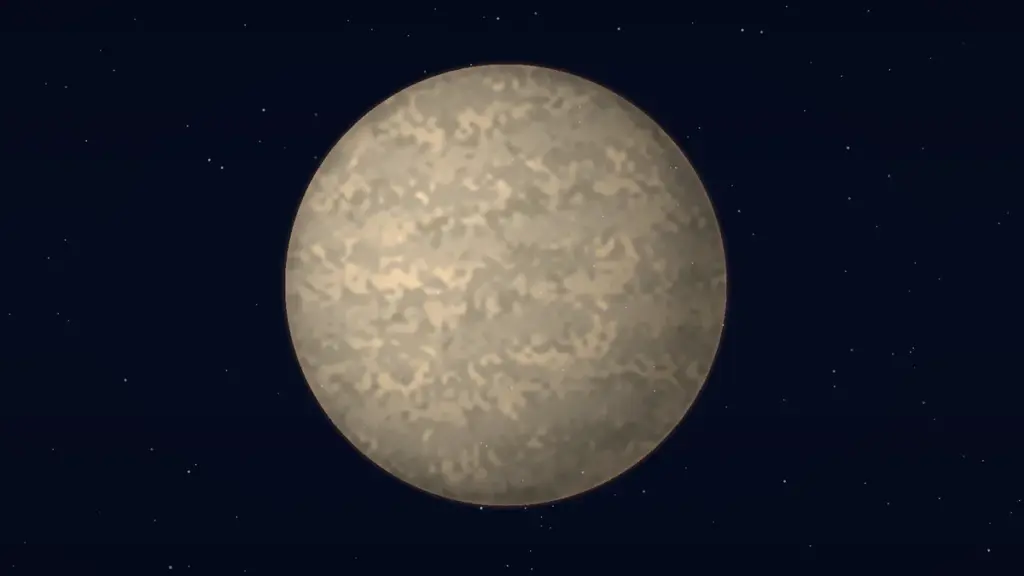
Venus is one of the most fascinating and mysterious planets in our Solar System. Often called Earth’s twin because of its similar size and rocky composition, Venus is actually a world of extreme temperatures, crushing atmospheric pressure, poisonous clouds, and unusual geological activity.
It is the second planet from the Sun, yet it is hotter than Mercury, which orbits much closer to our star. A single rotation on Venus takes longer than its entire year, and the planet spins in the opposite direction to Earth. Its thick atmosphere hides an extraordinary landscape of enormous volcanoes, rugged mountain ranges, impact craters, and geological formations unlike anything found on our planet.
Although Venus appears as a brilliant white object in Earth’s sky, conditions on its surface are among the most hostile in the Solar System. Temperatures are high enough to melt lead, and atmospheric pressure is comparable to conditions deep beneath Earth’s oceans.
Despite decades of exploration, scientists still have fundamental questions about Venus. Did it once have oceans? Are its volcanoes still erupting? Could microbial life survive in its upper atmosphere? And why did Venus and Earth develop such dramatically different environments?
These 20 fun facts about Venus explore its extraordinary physical characteristics, atmosphere, rotation, geology, scientific mysteries, and the spacecraft missions that have helped us understand Earth’s closest planetary neighbors.
Venus Facts at a Glance
Before exploring the individual facts, here is a quick overview of Venus’s most important planetary characteristics. These values come primarily from NASA’s planetary fact sheets and are rounded for readability. [1] [2]
| Characteristic | Venus facts |
|---|---|
| Position in Solar System | Second planet from the Sun |
| Planet type | Terrestrial, rocky planet |
| Average distance from Sun | 108.2 million km |
| Mean diameter | 12,104 km |
| Mass | 4.87 × 10²⁴ kg |
| Surface gravity | 8.87 m/s² |
| Average surface temperature | Approximately 464°C |
| Surface atmospheric pressure | Approximately 92 bar |
| Main atmospheric gas | Carbon dioxide, approximately 96.5% |
| Second most abundant gas | Nitrogen, approximately 3.5% |
| Orbital period | 224.7 Earth days |
| Sidereal rotation period | Approximately 243 Earth days |
| Solar day | Approximately 116.75 Earth days |
| Orbital eccentricity | Approximately 0.0068 |
| Axial tilt | 177.36° conventionally, equivalent to a 2.64° effective tilt |
| Natural satellites | None known |
| Planetary rings | None known |
| Known surface features | Volcanoes, mountains, plains, coronae, tesserae, impact craters |
These figures provide a starting point for understanding Venus. The most surprising characteristics become clearer when we compare the planet with Earth and examine how its atmosphere, orbital motion, and geological history are connected. [1] [2]
Part 1: Venus’s Position, Size, and Extreme Environment
1. Venus Is the Second Planet From the Sun, With an Almost Perfectly Circular Orbit
Venus occupies a remarkable position in the inner Solar System. It orbits between Mercury and Earth, making it one of the four terrestrial planets alongside Mercury, Earth, and Mars. Although Venus travels significantly closer to the Sun than Earth does, its orbital path is exceptionally close to a perfect circle. This characteristic influences how much its distance from the Sun changes during each revolution.
Where Is Venus Located in the Solar System?
Venus orbits the Sun at an average distance of approximately 108.2 million kilometers, equivalent to about 0.723 astronomical units (AU). One astronomical unit represents the average distance between Earth and the Sun, approximately 149.6 million kilometers.
Venus is about 41 million kilometers closer to the Sun than Earth when their average orbital distances are compared. Sunlight takes approximately six minutes to travel from the Sun to Venus, whereas it takes about eight minutes and 19 seconds to reach Earth.
Like the other planets, Venus moves around the Sun in an elliptical orbit, following the gravitational influence of our star. It completes this journey faster than Earth because its orbit is smaller and its average orbital speed is higher. [1]
How Circular Is Venus’s Orbit?
Scientists describe the shape of a planet’s orbit using a measurement called orbital eccentricity. An eccentricity of zero represents a perfect circle, while larger values indicate increasingly elongated elliptical orbits.
Venus has an orbital eccentricity of approximately 0.0068, compared with Earth’s value of about 0.0167. This makes Venus’s orbit more circular than Earth’s.
At its closest point to the Sun, called perihelion, Venus is approximately 107.5 million kilometers away. At its farthest point, called aphelion, that distance increases to approximately 108.9 million kilometers.
Because the difference is relatively small, Venus experiences little variation in received sunlight caused by its changing orbital distance. [1]
Interesting fact: Although Venus is much closer to the Sun than Earth, its nearly circular orbit means the planet’s solar distance varies by only about 1.5 million kilometers throughout its year.
2. Venus Is Almost Earth’s Twin in Size, but Not in Living Conditions
Venus is frequently described as Earth’s sister planet or Earth’s twin. These names come from similarities in size, mass, density, and rocky composition rather than environmental conditions. Both planets formed in the inner Solar System and are believed to contain layered interiors. However, their atmospheres, climates, surface environments, and geological evolution reveal how dramatically two similar planets can differ.
Why Is Venus Called Earth’s Twin?
Earth and Venus are terrestrial planets, meaning they have solid, predominantly rocky bodies rather than the deep hydrogen-rich atmospheres found on gas giants such as Jupiter and Saturn.
Venus is believed to contain a crust, rocky mantle, and metal-rich core, broadly resembling Earth’s internal structure. However, scientists have much less direct information about Venus’s interior, particularly the precise structure and physical state of its core.
The planets also have comparable densities. Venus has a mean density of approximately 5,243 kilograms per cubic meter, while Earth’s is about 5,513 kilograms per cubic meter.
Despite these similarities, Venus developed an exceptionally dense carbon dioxide atmosphere and extreme greenhouse warming. Earth retained liquid oceans and conditions compatible with life.
Understanding why these planetary histories diverged is one of the central objectives of modern Venus exploration. [1] [2]
How Big and Heavy Is Venus Compared With Earth?
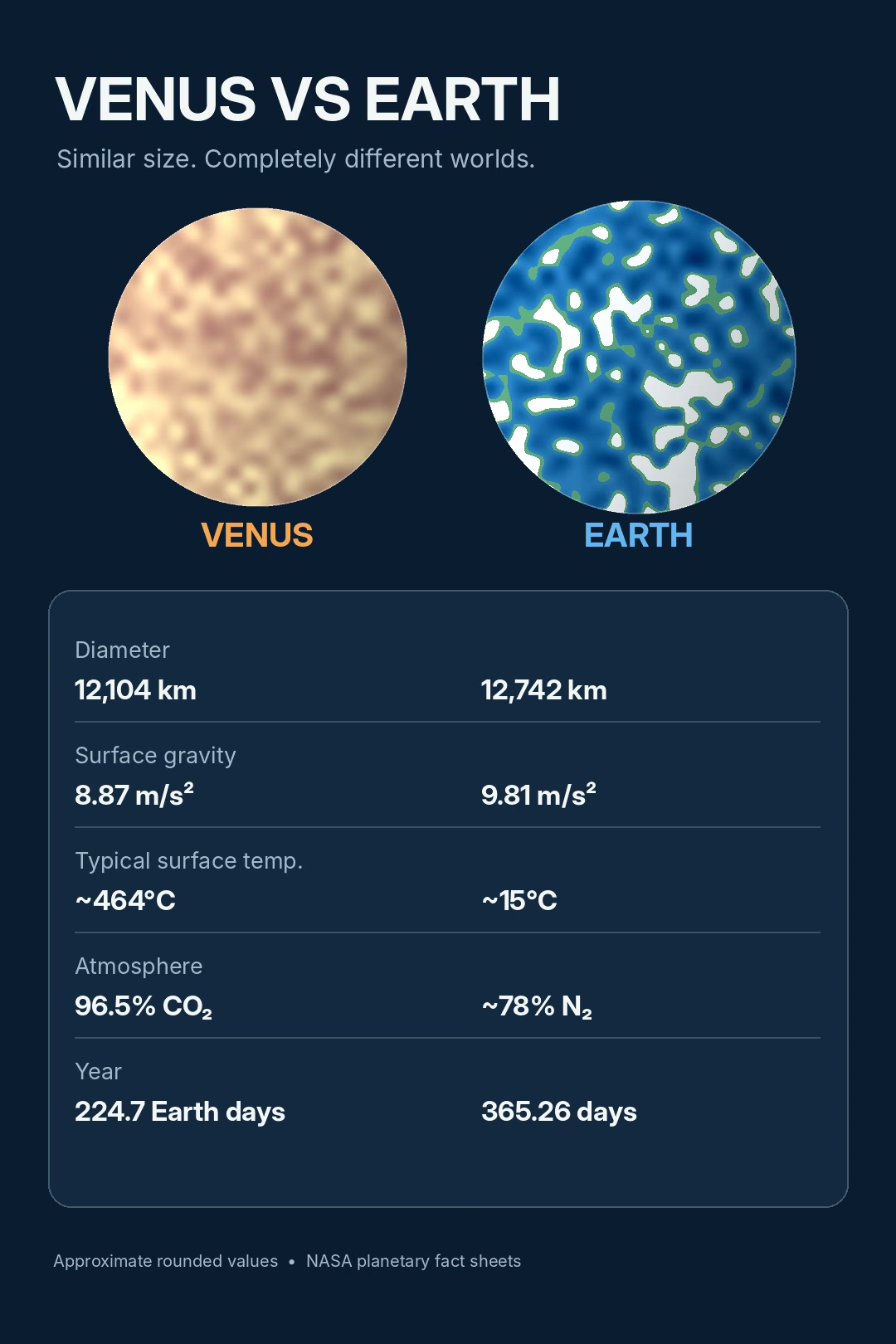
Venus has a mean diameter of approximately 12,104 kilometers, making it about 95% as wide as Earth. Its mass is approximately 4.87 × 10²⁴ kilograms, or 81.5% of Earth’s mass.
Its surface gravitational acceleration is approximately 8.87 meters per second squared, around 90% of Earth’s average surface gravity.
| Measurement | Venus | Earth |
|---|---|---|
| Mean diameter | 12,104 km | 12,742 km |
| Mass | 4.87 × 10²⁴ kg | 5.97 × 10²⁴ kg |
| Mean surface gravity | 8.87 m/s² | 9.82 m/s² |
| Mean density | 5,243 kg/m³ | 5,513 kg/m³ |
A person with a mass of 100 kilograms on Earth would still have a mass of 100 kilograms on Venus, but their gravitational weight would be approximately 90% of their Earth weight.
The comparison is theoretical because an unprotected person could not survive Venus’s surface conditions. [1]
Interesting fact: Venus is only about 5% smaller than Earth in diameter, yet its surface temperature and atmospheric pressure make it completely unsuitable for unprotected human exploration.
3. Venus Is the Hottest Planet in the Solar System, Even Hotter Than Mercury
One of the most surprising facts about Venus is that it is hotter than Mercury, even though Mercury is closer to the Sun. The explanation lies primarily in their atmospheric differences. Mercury has only an extremely thin exosphere and cannot effectively retain heat, while Venus possesses a massive, heat-trapping atmosphere that maintains extremely high surface temperatures across the planet.
How Hot Is the Surface of Venus?
The average surface temperature of Venus is approximately 464°C (867°F), making it the hottest planet in the Solar System.
This temperature is high enough to melt lead, which has a melting point of approximately 327°C. It is also far beyond the operating limits of conventional spacecraft electronics and most equipment designed for Earth’s environment.
Mercury can reach about 430°C on its sunlit surface, but its nighttime temperatures plunge dramatically because it lacks a substantial atmosphere capable of redistributing and retaining heat.
Venus, by contrast, maintains relatively consistent temperatures across much of its surface, including its day and night sides.
This extreme heat is one of the primary reasons Venus landers have historically survived for only short periods after reaching the ground. [1] [2]
What Causes the Runaway Greenhouse Effect on Venus?
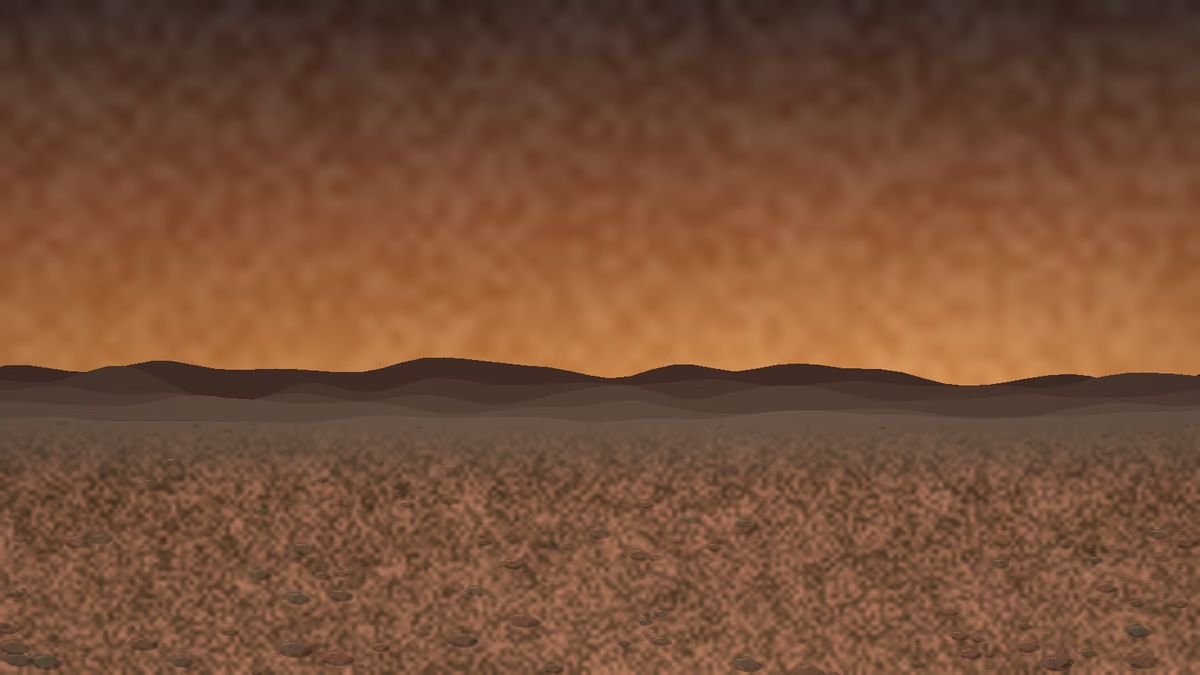
Venus’s extraordinary heat is maintained by an intense greenhouse effect. Its atmosphere consists predominantly of carbon dioxide, a gas that absorbs and emits infrared radiation.
Solar energy enters the atmosphere and warms the lower atmosphere and surface. The planet then emits infrared radiation, which interacts repeatedly with greenhouse gases. This process makes it much harder for energy to escape directly to space from the lower atmosphere.
Scientists use the term runaway greenhouse effect to describe a climatic process in which warming and water-vapor feedback can drive a planet toward extreme temperatures and water loss. Venus’s present atmosphere is the result of a complex history, and the precise sequence that produced its current climate remains under investigation.
Earth also experiences a natural greenhouse effect, but its atmosphere, oceans, and climate-regulating processes support much lower surface temperatures.
Venus demonstrates how atmospheric composition and climate evolution can transform a rocky planet into a profoundly different world. [2] [25]
Interesting fact: Venus is hot enough to melt lead almost everywhere on its surface, including regions that never receive direct sunlight during a particular night.
4. Venus Has an Atmosphere So Thick It Could Crush Spacecraft
Venus has one of the most extreme atmospheric environments of any terrestrial planet. Its atmosphere is enormously more massive than Earth’s and produces crushing pressure at ground level. Although Venus and Earth are similar in size, their surface conditions are completely different. This dense gaseous envelope also explains why Venus retains so much heat and why surface exploration requires specially engineered spacecraft.
What Is Venus’s Atmosphere Made Of?
The atmosphere of Venus consists of approximately 96.5% carbon dioxide and 3.5% nitrogen by volume near the surface. These two gases account for almost its entire atmospheric composition.
Smaller quantities of sulfur dioxide, argon, water vapor, carbon monoxide, and other trace gases are also present.
Carbon dioxide dominates the atmosphere’s greenhouse effect, while sulfur-containing gases participate in the chemical processes that help maintain Venus’s clouds.
Unlike Earth, whose atmosphere contains about 21% oxygen, Venus has no breathable oxygen-rich environment. Furthermore, Venus’s tiny water-vapor abundance reflects how dry its present atmosphere has become.
The atmospheric composition varies somewhat with altitude, and measurements of trace gases provide important clues about atmospheric circulation, volcanic activity, and interactions between the surface and atmosphere. [1] [3]
How Strong Is Atmospheric Pressure on Venus?
Venus’s average surface atmospheric pressure is approximately 92 bar, corresponding to roughly 91 times Earth’s standard sea-level atmospheric pressure. The frequently quoted comparison of about 92 times is a convenient approximation.
An equivalent pressure on Earth occurs at roughly 900 meters beneath the ocean’s surface, although exact depth depends on seawater density and local conditions.
The pressure comes from the enormous weight of the atmosphere above the surface.
Such conditions make spacecraft engineering particularly difficult. Venus landers must withstand intense external pressure, extraordinary heat, chemically demanding conditions, and limited opportunities for cooling.
The Soviet Venera landers used rugged pressure-resistant structures to operate briefly in this environment. For modern missions, surviving at the surface for extended periods remains a substantial technological challenge. [1] [2]
Interesting fact: Standing on Venus would expose a spacecraft to atmospheric pressure comparable to that experienced by a deep-sea submersible operating almost a kilometer underwater.
5. Venus Is Covered With Clouds Made of Sulfuric Acid
Venus is permanently hidden beneath an extensive global cloud system that reflects sunlight and prevents ordinary visible-light telescopes from seeing its surface. Unlike Earth’s clouds, which consist mainly of water droplets or ice crystals, the Venusian cloud system contains concentrated sulfuric acid droplets. These clouds help give Venus its remarkable brightness while creating a chemically hostile atmospheric environment.
What Are Venus’s Clouds Made Of?
The clouds surrounding Venus are composed largely of tiny sulfuric acid droplets, mixed with other atmospheric particles and aerosols.
The principal cloud region extends roughly from 45 to 70 kilometers above the surface, although cloud boundaries and structures vary with altitude and location.
These clouds reflect a large fraction of incoming sunlight. NASA’s planetary data give Venus a Bond albedo of approximately 0.77, indicating that the planet reflects about 77% of the total incoming solar energy when averaged over all wavelengths and directions.
This high reflectivity contributes to Venus’s striking appearance in Earth’s sky.
The clouds are also sufficiently opaque that regular optical observations cannot produce detailed images of the ground. Scientists use radar and selected infrared wavelengths to investigate the landscape hidden underneath. [1] [3]

How Does Sulfur Dioxide Contribute to Venus’s Clouds?
Sulfur dioxide, or SO₂, is an important trace gas in Venus’s atmospheric chemistry.
Solar ultraviolet radiation drives chemical reactions involving sulfur dioxide and other atmospheric constituents. Through a sequence of reactions that includes interactions with water, sulfuric acid can form and condense into aerosol droplets.
These particles contribute to the planet’s extensive cloud layers.
Scientists monitor sulfur dioxide concentrations because their variations may reveal atmospheric transport, chemical processes, or potentially material supplied from volcanic activity. However, changes in sulfur dioxide alone do not automatically establish that a volcanic eruption has occurred.
ESA’s Venus Express mission investigated the structure, chemistry, and variability of Venus’s atmosphere, helping researchers understand the connections between cloud formation, circulation, and atmospheric evolution. [3]
Interesting fact: The same clouds that make Venus shine so brightly in our sky contain highly corrosive sulfuric acid droplets.
Part 2: Strange Days, Years, and Skywatching Facts
6. One Rotation on Venus Takes Longer Than One Venusian Year
Time behaves very differently on Venus because the planet rotates extraordinarily slowly. While Earth completes a rotation approximately every 24 hours, Venus takes hundreds of Earth days to turn once relative to distant stars. In fact, Venus finishes an entire orbit around the Sun before completing one full rotation. This unusual relationship between its rotation and revolution creates one of the most memorable facts about the planet.
How Long Is a Day on Venus?
A sidereal day is the time a planet takes to complete one rotation relative to distant stars.
On Venus, this takes approximately 243 Earth days, compared with Earth’s sidereal rotation period of approximately 23 hours and 56 minutes.
Venus rotates so slowly that a point on its equator moves around the planet’s axis at only about 1.8 meters per second. Earth’s equatorial surface rotates at roughly 465 meters per second.
However, a sidereal day is not necessarily the same as the period between successive sunrises.
The difference depends on how a planet rotates while simultaneously traveling around its star. Venus’s unusual rotation direction makes this distinction especially important. [1]
How Long Is a Year on Venus?
A year on Venus lasts approximately 224.7 Earth days. This is the time required for the planet to complete one revolution around the Sun relative to distant stars.
Because Venus rotates once every approximately 243 Earth days, its sidereal rotation period is about 18 Earth days longer than its year.
However, a solar day, measured from one solar noon to the next, lasts approximately 116.75 Earth days on Venus.
This apparently confusing difference occurs because Venus rotates backward relative to its orbital motion. Its rotation and orbital movement affect the Sun’s apparent position in a way that shortens the solar day compared with the sidereal rotation period.
Therefore, the familiar statement that a day is longer than a year on Venus refers specifically to its sidereal rotation, not its sunrise-to-sunrise cycle. [1]
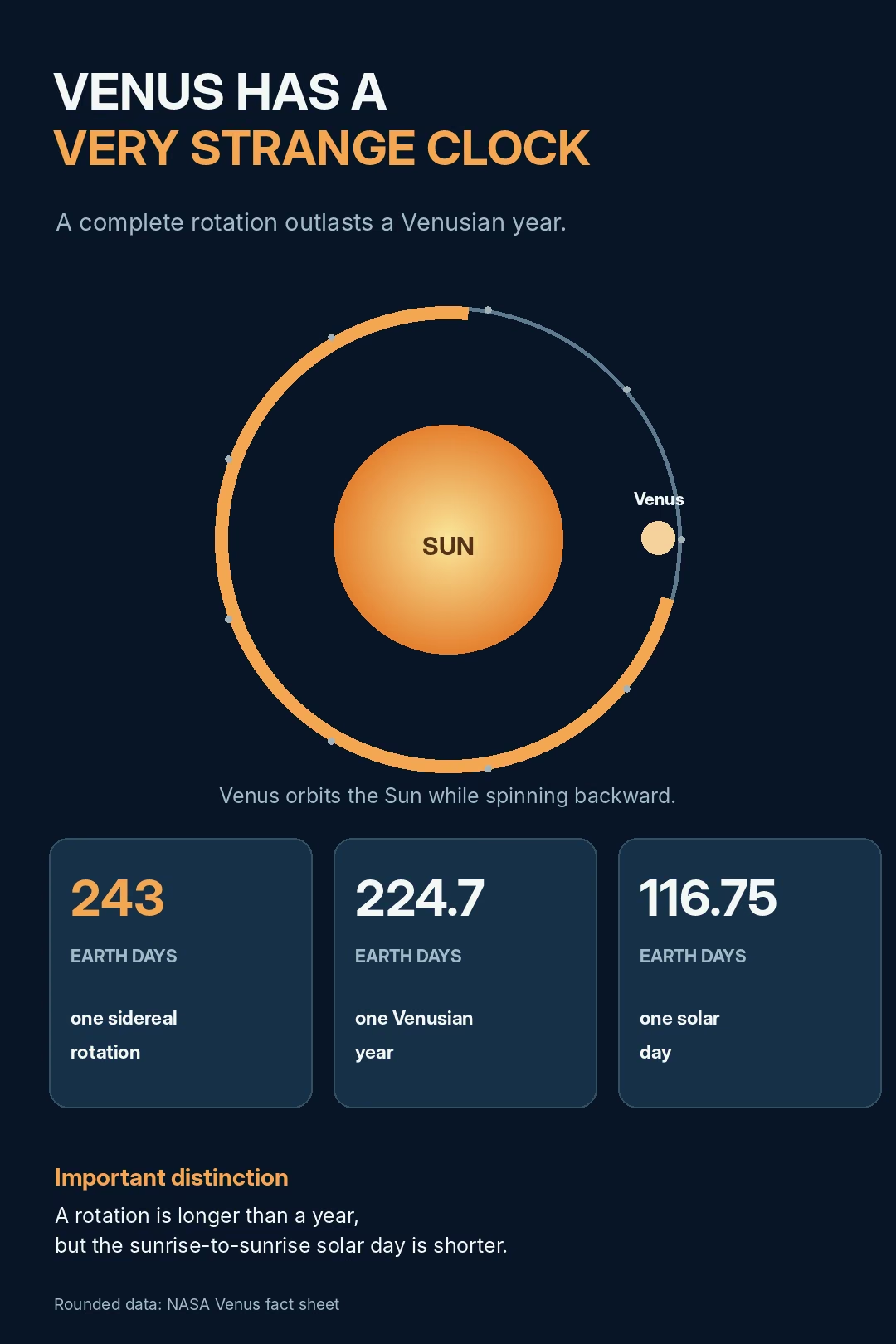
Interesting fact: Venus completes an entire journey around the Sun before its surface has finished one rotation relative to the distant stars.
7. The Sun Rises in the West and Sets in the East on Venus
On Earth, the Sun appears to rise in the east and set in the west because our planet rotates eastward. Venus follows the opposite pattern. Its slow, backward rotation would cause the Sun to move across the sky in the reverse direction. However, Venus’s dense clouds would make observing a clear sunrise or sunset from the surface much more difficult than on Earth.
Why Does Venus Rotate Backward?
Most planets, including Earth, rotate in the same general direction as their orbital motion around the Sun. This is called prograde rotation.
Venus exhibits retrograde rotation, meaning it spins in the opposite direction to its revolution around the Sun.
Scientists have proposed several explanations for this unusual behavior. Possible influences include large impacts during the planet’s early history, gravitational torques from the Sun, and interactions between the planet’s atmosphere and its solid body.
However, the precise evolutionary sequence that established Venus’s present spin is not definitively known.
The unusual rotation may preserve information about the planet’s early formation, internal structure, and long-term atmospheric evolution.
How Long Does It Take for the Sun to Rise Again?
A complete Venusian solar day lasts approximately 116.75 Earth days. This measures the average interval between successive solar noons, or approximately between successive sunrises at a given location under idealized conditions.
For an observer near Venus’s equator, the interval between sunrise and sunset would be roughly 58 Earth days.
Because Venus rotates retrograde, the Sun would appear to rise in the west and travel toward the east.
However, the surface sky would not look like Earth’s. The thick cloud cover scatters and filters incoming sunlight, making the Sun difficult to distinguish as a sharply defined disk.
Venus’s unusual apparent solar movement is therefore primarily a consequence of its rotation, not a different direction of planetary revolution. [1] [2]
Interesting fact: If you could observe the sky safely from Venus, the Sun’s apparent daily movement would be opposite to what we experience on Earth.
8. Venus Has Almost No Seasonal Changes Compared With Earth
Earth experiences distinct seasons because its rotational axis is tilted relative to the plane of its orbit around the Sun. Venus has a very different axial orientation. Although its conventional axial tilt is close to 180 degrees, its effective tilt is very small because the planet rotates backward. Combined with its dense atmosphere and nearly circular orbit, this produces relatively weak seasonal differences in surface conditions.
How Is Venus’s Axial Tilt Different From Earth’s?
A planet’s axial tilt, also called obliquity, describes the orientation of its rotational axis relative to its orbital plane.
Earth has an axial tilt of approximately 23.44 degrees. This causes the two hemispheres to receive different amounts of direct sunlight throughout the year, producing seasonal changes.
Venus has a conventionally defined obliquity of approximately 177.36 degrees. This high value reflects its retrograde rotation.
For understanding the variation in solar illumination, Venus can instead be described as having an effective tilt of only about 2.64 degrees.
This smaller effective tilt explains why the planet does not experience the strong seasonal changes familiar on Earth. [1]
Why Doesn’t Venus Experience Strong Seasons?
Venus’s small effective axial tilt means that the Sun’s angle in the sky changes relatively little between different parts of the Venusian year.
Its very low orbital eccentricity also prevents large seasonal variations in sunlight caused by changing distance from the Sun.
Additionally, the dense Venusian atmosphere redistributes thermal energy and maintains extraordinarily high surface temperatures.
As a result, Venus lacks the familiar seasonal patterns of summer and winter seen on Earth.
Although scientists observe complex variations in atmospheric circulation, cloud patterns, and upper-atmosphere temperatures, these changes do not produce Earth-like seasons at the surface.
Even Venus’s polar regions remain extremely hot compared with ordinary terrestrial environments. [1] [2]
Interesting fact: Venus has no familiar winter season that provides meaningful relief from its extreme surface heat.
9. Venus Is the Brightest Planet and Is Known as Both the Morning Star and Evening Star
Venus has fascinated skywatchers for thousands of years because of its extraordinary brightness. Under favorable conditions, it becomes a brilliant point of light visible before sunrise or after sunset. Ancient civilizations observed its repeated appearances and gave it different names. Despite these traditional nicknames, Venus is not a star, and its brightness comes from reflected sunlight rather than energy generated within the planet.
Why Is Venus So Bright in Earth’s Sky?
Venus is the brightest planet as seen from Earth, sometimes reaching an apparent magnitude of approximately -4.8.
Astronomers use apparent magnitude to describe how bright celestial objects appear from Earth. Smaller and more negative values indicate greater brightness.
Venus shines intensely for two principal reasons: it is relatively close to Earth, and its thick cloud cover reflects sunlight efficiently.
Its apparent brightness changes as its distance from Earth and illuminated phase change. It is often especially bright when it appears as a relatively large crescent.
Venus can occasionally be seen in daylight under favorable conditions, although locating it near the Sun requires extreme care. Never point binoculars or a telescope toward the Sun while searching for Venus. [1] [2]
Why Does Venus Have Two Famous Nicknames?
Venus is traditionally known as both the Morning Star and the Evening Star because it alternates between appearing before sunrise and after sunset.
Since Venus orbits closer to the Sun than Earth does, it never travels very far from the Sun in our sky. Instead, it remains relatively close to sunrise or sunset.
When Venus appears west of the Sun in the sky, it typically becomes visible before sunrise as the Morning Star.
When it appears east of the Sun, it is generally visible after sunset as the Evening Star.
These appearances are different viewing configurations of the same planet, not two separate celestial objects.
Venus’s repeating cycle of visibility is connected to its approximately 584-day synodic period, the interval between similar alignments of Venus, Earth, and the Sun. [1]

Interesting fact: Venus is commonly the brightest natural object in the nighttime sky after the Moon and can be bright enough to attract attention even from light-polluted cities.
10. Venus Has Phases Just Like the Moon
Venus displays a series of changing phases, including crescent, half-lit, gibbous, and nearly full appearances. These changes result from the geometry of sunlight illuminating Venus as it moves around the Sun and as Earth observes it from different positions. The phases are not merely attractive telescopic sights. Their discovery played an important role in the scientific transformation of astronomy.
What Are the Different Phases of Venus?
Like the Moon, Venus appears to change shape because observers see different fractions of its sunlit hemisphere.
When Venus is on the far side of the Sun, its visible hemisphere is mostly illuminated, although it appears relatively small because of its greater distance from Earth.
As Venus moves around its orbit, it passes through gibbous and half-lit phases.
When it approaches Earth, it can appear as a much larger crescent. Near inferior conjunction, when Venus passes between Earth and the Sun, its illuminated fraction becomes very small.
The complete cycle of similar phase configurations repeats approximately every 584 days.
A modest telescope can reveal Venus’s phases, and repeated observations over several months show clear changes in both its illuminated fraction and apparent size. [1] [2]

How Did Galileo Use Venus’s Phases to Change Astronomy?
In 1610, Italian astronomer Galileo Galilei observed Venus through a telescope and recognized that it displayed a wide range of phases.
These observations challenged the traditional Ptolemaic model, which placed Earth at the center and constrained Venus’s motion in a way that could not reproduce the observed complete phase cycle.
Galileo’s observations provided strong evidence that Venus travels around the Sun.
The results supported the heliocentric model associated with Nicolaus Copernicus, although the phases alone did not establish that Earth orbits the Sun. The alternative geoheliocentric system of Tycho Brahe could also reproduce Venus’s phases.
Nevertheless, Galileo’s observations became a major milestone in the development of modern observational astronomy. [5]
Interesting fact: A simple sequence of telescopic observations of Venus helped overturn a planetary model that had dominated astronomy for centuries.
Part 3: Venus’s Atmosphere and Unusual Planetary Features
11. Venus Has No Moons and No Planetary Rings
Unlike Earth, Mars, and the giant planets, Venus has no known natural moons. It also lacks the extensive ring systems associated with planets such as Saturn, Jupiter, Uranus, and Neptune. This makes Venus relatively simple in terms of its surrounding satellite environment, although scientists still investigate why it has no permanent natural satellite despite its considerable size and gravitational influence.
Why Doesn’t Venus Have Any Known Natural Moons?
Venus and Mercury are the only two planets in the Solar System without known natural satellites.
Earth has one large natural moon, while Mars has two small moons, Phobos and Deimos. Venus, despite having much greater mass than Mars, has no confirmed permanent moon.
The reason remains uncertain.
Scientists have considered several possible explanations, including the effects of ancient impacts, the capture or loss of satellites, gravitational disturbances from the Sun, and long-term orbital evolution.
Venus’s relatively close proximity to the Sun limits the region in which a satellite can maintain a stable orbit around the planet. However, this does not by itself prove why Venus has no moon today.
The absence of a moon is an observed fact, while its historical explanation remains an open scientific question. [2]
Does Venus Have Rings Like Saturn?
Venus does not have a known planetary ring system.
Planetary rings consist of numerous particles of ice, dust, rock, or other material orbiting a planet. All four giant planets possess ring systems, although Saturn’s are by far the most prominent.
Venus has no comparable confirmed structure.
The absence of rings does not mean the space surrounding Venus is completely free of dust. Dust can exist in heliocentric orbits near the planet’s orbital path, but material orbiting the Sun is different from a gravitationally bound planetary ring system.
Any long-term explanation for Venus’s lack of rings must account for possible sources of orbiting debris and the forces that would remove or redistribute it.
Interesting fact: Venus is one of only two planets in our Solar System without a confirmed natural moon, and neither planet has a known ring system.
12. Venus Has Winds That Race Around the Planet Faster Than It Rotates
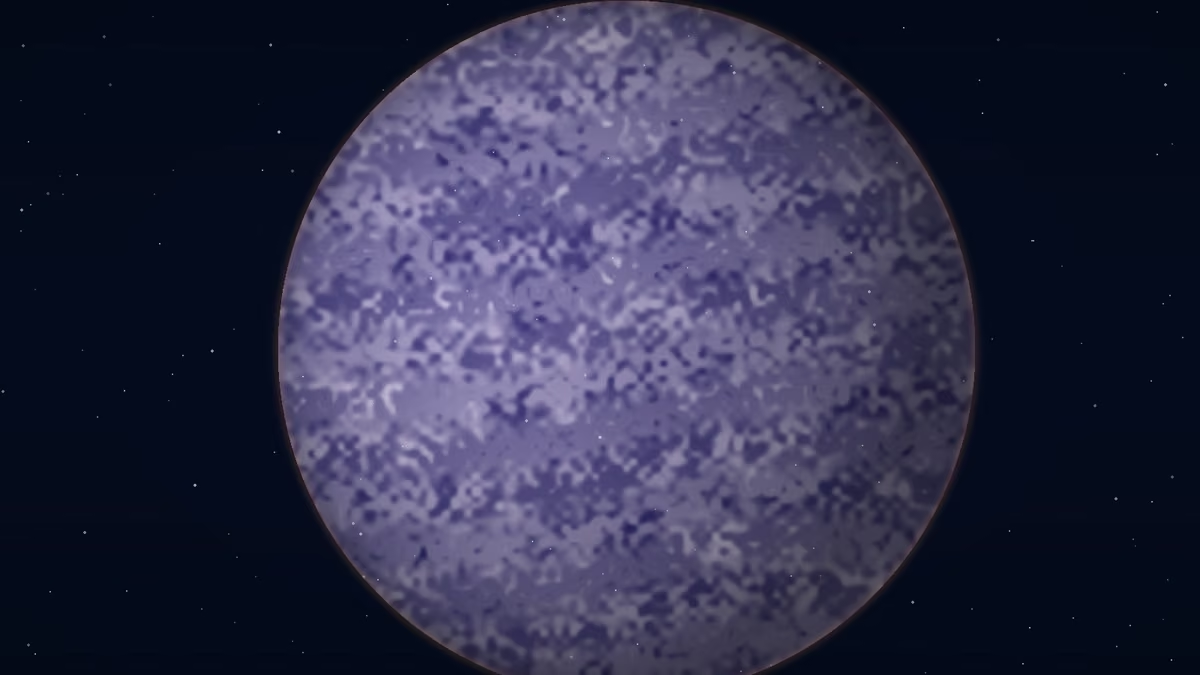
Although Venus rotates extremely slowly, its atmosphere contains some of the fastest large-scale winds observed on a terrestrial planet. High above the surface, cloud patterns move around Venus in only a few Earth days. This remarkable circulation is called atmospheric superrotation and remains a major subject of research because the atmosphere moves many times faster than the solid planet beneath it.
What Is Atmospheric Superrotation on Venus?
Atmospheric superrotation occurs when a planet’s atmosphere circulates around its rotational axis substantially faster than the planet’s solid surface.
On Venus, this phenomenon is especially dramatic.
While the solid planet requires approximately 243 Earth days to rotate once, cloud-level atmospheric circulation can complete a revolution in roughly four to five Earth days.
This circulation is generally westward, following the direction of Venus’s retrograde rotation.
Researchers investigate how atmospheric waves, thermal tides caused by solar heating, and the redistribution of angular momentum help maintain these powerful winds.
The mechanisms are not yet completely understood. Japan’s Akatsuki mission, also known as the Venus Climate Orbiter, was designed specifically to study these atmospheric dynamics. [4]
How Fast Are Winds on Venus?
At heights near the upper cloud layers, around 60 to 70 kilometers above the surface, wind speeds commonly approach 100 meters per second.
That corresponds to approximately 360 kilometers per hour, although actual speeds vary with altitude, latitude, and time.
These winds are dramatically faster than Venus’s solid-body rotation.
Closer to the surface, wind speeds are much slower, with NASA’s planetary data indicating typical values of approximately 0.3 to 1 meter per second.
However, Venus’s dense lower atmosphere means even relatively slow winds can exert significant aerodynamic forces compared with equally slow winds in Earth’s atmosphere.
Observations by spacecraft including Akatsuki and ESA’s Venus Express have helped scientists study these atmospheric movements and their relationship to Venusian cloud structures. [1] [4]
Interesting fact: Venus’s upper atmosphere can circle the entire planet in approximately four Earth days, while its surface takes about 243 Earth days to complete one rotation.
13. Venus Has Huge Volcanoes, and Some Have Erupted in Recent Geological History
Venus is one of the most volcanically shaped worlds in the Solar System. Vast volcanic plains, lava channels, enormous shield volcanoes, and other volcanic structures cover much of its surface. For many years, scientists debated whether Venus’s volcanoes were still active. Recent analyses of spacecraft radar data have provided increasingly strong evidence that volcanic eruptions occurred during the early 1990s, when NASA’s Magellan spacecraft was observing the planet.
What Does the Surface of Venus Look Like?
Venus’s surface consists of extensive rocky plains, mountains, volcanic structures, impact craters, and heavily deformed regions.
Much of the landscape appears to have been shaped by volcanic activity.
NASA’s Magellan mission found evidence that volcanic flows cover a substantial majority of the planet’s surface. These flows indicate that molten rock emerged from Venus’s interior and spread across large areas before cooling and solidifying.
Many features resemble shield volcanoes, which are broad volcanic mountains built through repeated lava eruptions.
Venus also contains volcanic domes, channels, and complex structures formed by interactions between its crust and interior.
Unlike Earth, Venus does not exhibit a clearly established global system of moving tectonic plates. Nevertheless, its crust has experienced extensive deformation, volcanism, and other geological processes. [2] [10]
Are There Active Volcanoes on Venus?
Scientists now have compelling evidence that Venus has experienced volcanism in modern times.
In 2023, researchers examining NASA’s Magellan radar images identified changes in a volcanic vent associated with Maat Mons, one of Venus’s major volcanoes.
Images taken in February and October 1991 showed that the vent had changed shape and approximately doubled in area. The researchers interpreted these changes as evidence of volcanic activity during that eight-month interval.
In 2024, another study identified changes in radar observations near Sif Mons and western Niobe Planitia that researchers interpreted as additional evidence of new lava flows during the Magellan mission.
These findings strongly support the conclusion that Venus is volcanically active, although determining eruption frequencies and the distribution of active volcanoes requires further observations. [6] [7] [24]
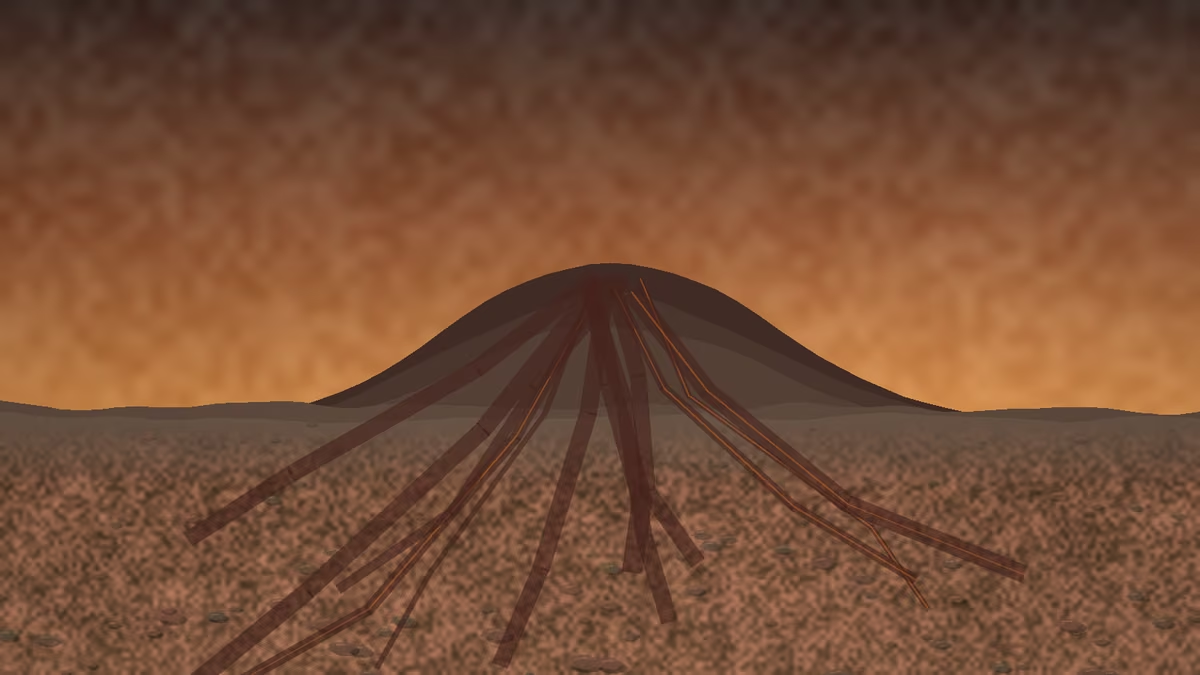
Interesting fact: Scientists discovered evidence of volcanic eruptions on Venus by reexamining radar measurements collected more than three decades earlier.
14. Venus Has Strange, Wrinkled Terrains and Giant Circular Geological Structures
Some of Venus’s most unusual geological features are difficult to compare directly with familiar landscapes on Earth. Radar mapping has revealed extensive areas of intersecting ridges and fractures, along with enormous circular or oval formations. These structures provide clues about the planet’s crustal deformation, volcanic history, and possible movement of hot material beneath its surface.
What Is Tessera Terrain on Venus?
Tessera terrain, often called tesserae, consists of highly deformed regions characterized by intersecting ridges, fractures, grooves, and other structural patterns.
The name refers to the tile-like appearance of these complex landscapes.
Tesserae are particularly important because some may preserve evidence of geological processes that occurred before extensive volcanic resurfacing affected much of Venus.
Researchers investigate whether these regions formed through compression, stretching, mantle-related deformation, or combinations of multiple geological processes.
Some hypotheses propose that certain tesserae might contain information about older crustal materials or a different period of Venusian geological evolution.
NASA’s DAVINCI mission plans to observe Alpha Regio, a tessera-rich highland region, during its descent through the atmosphere. These measurements could help scientists better understand how such unusual terrains formed. [2] [19]
What Are Venusian Coronae?
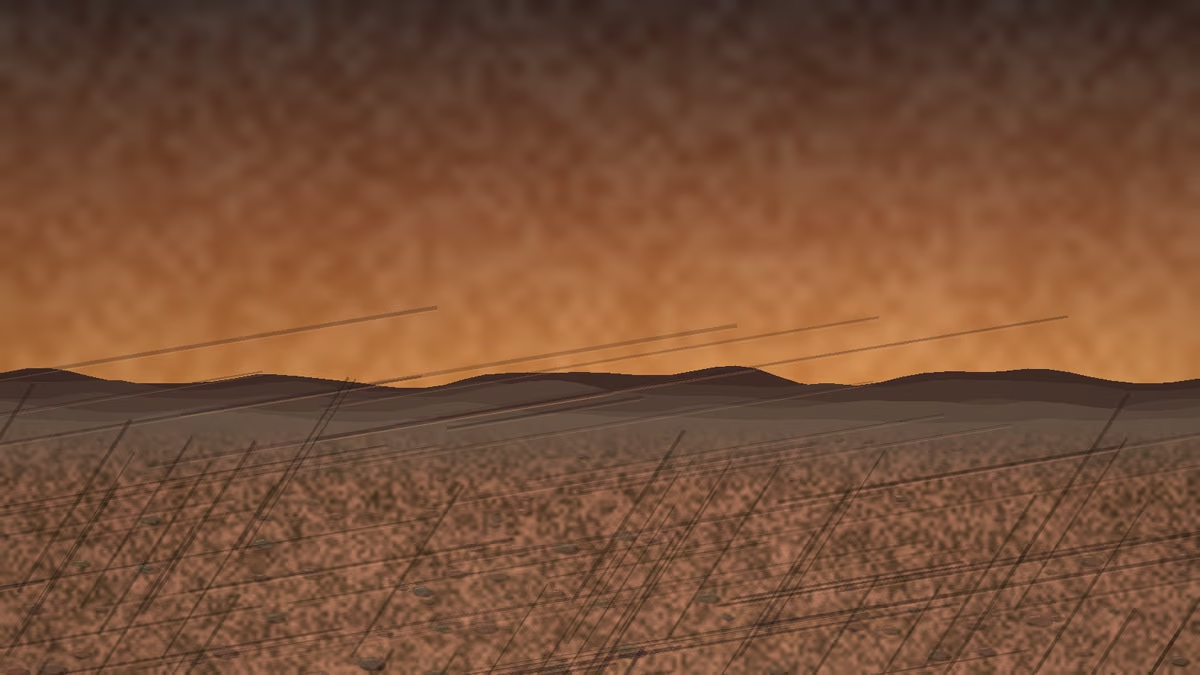
Venusian coronae are enormous, approximately circular or oval geological structures commonly surrounded by concentric fractures, ridges, or other deformation patterns.
Many coronae are thought to develop when hot, buoyant material rises through the planet’s mantle and interacts with the overlying lithosphere.
This process can deform the crust and contribute to volcanic activity.
Some coronae are hundreds of kilometers wide. For example, Aramaiti Corona has an officially listed diameter of approximately 350 kilometers.
Research published in 2025 using Magellan gravity and topography data provided additional evidence that tectonic processes may still be shaping some Venusian coronae.
These findings suggest that Venus’s interior remains dynamically important even without an Earth-like global plate tectonic system. [8] [9]

Interesting fact: Venus has enormous circular geological formations that may reveal movements of hot mantle material beneath its rocky surface.
15. Venus Has Enormous Mountains and Continent-Sized Highland Regions
Venus is not a uniformly flat planet covered only by volcanic plains. Its landscape includes substantial mountain ranges, elevated plateaus, and enormous highland regions that rise above surrounding terrain. Some of these features cover areas comparable in size to Earth’s continents. Radar observations have allowed scientists to map these structures despite the clouds that permanently conceal the surface from ordinary visible-light observation.
What Is the Highest Mountain on Venus?
The highest major mountain region on Venus is Maxwell Montes, located in the northern hemisphere within Ishtar Terra.
Its highest elevations rise approximately 11 kilometers above Venus’s reference level, commonly defined relative to the planet’s mean radius.
For comparison, Mount Everest reaches approximately 8.85 kilometers above Earth’s mean sea level.
However, the elevations are measured using different planetary reference systems, so these numbers are not perfectly equivalent measures of mountain height from base to summit.
Maxwell Montes is believed to have formed through processes involving significant deformation and compression of the Venusian crust.
Studying its structure helps researchers investigate the forces responsible for building mountains on a planet without Earth’s familiar plate tectonic configuration. [2]
What Are the Largest Highland Regions on Venus?
Venus has two especially prominent highland regions: Ishtar Terra and Aphrodite Terra.
Ishtar Terra is located in the northern hemisphere and is roughly comparable in area to Australia. It contains mountainous and highly deformed terrain, including Maxwell Montes.
Aphrodite Terra extends across a large portion of Venus’s equatorial region and is comparable in scale to South America.
These regions are sometimes described as continent-sized highlands, but they should not be confused with Earth’s continents.
Terrestrial continents are associated with distinctive crustal compositions and plate tectonic processes. Venus’s highlands may have formed through different combinations of crustal deformation, mantle activity, and volcanism.
Their formation histories remain important scientific questions because they may reveal how Venus transports internal heat and reshapes its surface. [2]
Interesting fact: Venus possesses highland regions comparable in scale to Earth’s continents, including a mountain system with elevations reaching approximately 11 kilometers above the planet’s reference level.
16. Venus Has Impact Craters That Reveal Clues About the Planet’s Surface Age
Asteroids and other space debris have struck Venus throughout its history, leaving behind impact craters that scientists can study using radar imagery. However, Venus has a different crater population from airless worlds such as the Moon. Its thick atmosphere can disrupt smaller incoming objects, while volcanic activity and crustal deformation can alter or bury older impact structures.
How Are Impact Craters Formed on Venus?
Impact craters form when asteroids, comet fragments, or other objects collide with a planetary surface at high velocity.
On Venus, incoming objects first pass through an exceptionally dense atmosphere.
Atmospheric drag, heating, and mechanical stresses can break apart or destroy smaller objects before they reach the surface. Larger objects may survive long enough to produce craters.
Consequently, Venus has relatively few small impact craters compared with an airless body exposed directly to incoming debris.
One notable example is Mead Crater, a large multiring impact structure named after anthropologist Margaret Mead.
The International Astronomical Union’s planetary nomenclature database lists Mead at approximately 270 kilometers in diameter. Measurements cited in NASA’s historical Magellan materials vary slightly with the feature boundaries and measurement methods. [10] [11]

What Can Impact Craters Tell Us About Venus’s History?
Scientists use impact craters to help estimate the relative ages of planetary surfaces.
In general, a region exposed to impacts for a longer time without significant resurfacing tends to accumulate more craters than a region whose surface has recently been renewed.
Venus’s crater distribution suggests that substantial geological processes have altered its surface over time.
Volcanic lava flows may bury older impact features, while crustal deformation can modify their original structures.
Researchers have debated whether Venus experienced a relatively concentrated period of widespread resurfacing or a longer history of regional geological activity.
Recent evidence increasingly supports ongoing regional volcanism and deformation, although the complete chronology of Venus’s surface remains uncertain.
Crater statistics are therefore most useful when considered alongside radar observations, geological mapping, and models of impact rates. [2] [10] [24]
Interesting fact: Venus’s exceptionally dense atmosphere acts as a filter for smaller incoming space rocks, leaving a surface crater population very different from the Moon’s.
Part 4: The Mysteries of Venus and the Search for Life
17. Venus May Have Had Liquid Water Long Ago
Today, Venus is one of the driest and hottest planets in the Solar System, but its distant history remains uncertain. Some climate models suggest that ancient Venus could have supported liquid water and relatively temperate surface conditions. Other research indicates that the planet may have been too hot for oceans to form in the first place. Understanding which scenario is more accurate could fundamentally change our understanding of planetary habitability.
Did Venus Ever Have Oceans?
Scientists have investigated whether Venus once possessed oceans of liquid water.
In 2016, researchers at NASA’s Goddard Institute for Space Studies used climate models to explore conditions on an ancient Venus with a shallow ocean. Their simulations suggested that certain combinations of atmosphere, rotation, cloud cover, and surface water could have maintained habitable temperatures for extended periods.
However, these findings demonstrated the possibility of a particular climatic scenario rather than proving that oceans actually existed.
Other research has reached different conclusions.
A study published in Nature Astronomy in December 2024 used atmospheric chemistry to infer that Venus’s interior is extremely dry. The researchers argued that their findings favor a history in which Venus never maintained liquid-water oceans.
Both approaches rely on scientific models and indirect evidence. Ancient oceans have not been confirmed through direct geological observations. [12] [13]
Where Did Venus’s Water Go?
Venus currently contains very little atmospheric water vapor, but scientists have evidence that water-related constituents have been lost to space over time.
Ultraviolet radiation from the Sun can break water molecules into hydrogen and oxygen through a process called photodissociation.
Hydrogen, being lightweight, can escape relatively easily from a planet’s upper atmosphere. Additional atmospheric escape processes involving charged particles can remove other constituents.
ESA’s Venus Express mission investigated these atmospheric loss mechanisms.
The relative abundance of deuterium, a heavier isotope of hydrogen, compared with ordinary hydrogen provides another important clue about Venus’s water history.
However, water loss does not establish that Venus once had surface oceans. Water may have existed primarily as vapor in an early atmosphere, and the amount, timing, and location of its original water inventory remain uncertain. [14] [25]
Could Ancient Venus Have Been Habitable?
Planetary habitability generally refers to an environment’s ability to support conditions necessary for life as we understand it, particularly stable liquid water, suitable chemistry, and usable energy sources.
Some models suggest that ancient Venus may have experienced conditions compatible with liquid water at its surface.
Other models indicate that Venus’s early atmosphere may have remained too hot for water vapor to condense into oceans.
A major challenge is that extensive geological activity has obscured much of the planet’s earliest surface history.
Future measurements of atmospheric noble gases, water-related isotopes, surface composition, and geological structures may help distinguish these scenarios.
Even if ancient Venus supported liquid water, that would not establish that life emerged there. Habitability and the actual existence of life are separate scientific questions. [13] [19] [25]
Interesting fact: Scientists are still investigating whether Venus began as a relatively wet planet or whether its surface was too hot for oceans throughout its history.
18. Scientists Are Investigating Whether Life Could Exist in Venus’s Clouds
Although the surface of Venus is extraordinarily hostile, conditions change significantly with altitude. High above the ground, temperatures and atmospheric pressures can become much more moderate. This has encouraged scientists to explore whether microscopic life might theoretically survive in parts of Venus’s cloud system. However, the clouds contain concentrated sulfuric acid, have very little available water, and present numerous unresolved chemical challenges.
Could Microorganisms Survive in Venus’s Atmosphere?
At altitudes around 50 to 60 kilometers, Venus’s atmosphere can have temperatures far closer to those experienced on Earth.
This makes the cloud environment more interesting for astrobiological research than the extremely hot surface.
However, moderate temperature alone does not establish habitability.
Venus’s cloud droplets contain concentrated sulfuric acid, and their water availability is extraordinarily low.
A study published in Nature Astronomy in 2021 estimated water-activity values of 0.004 or less in Venus’s cloud droplets. Water activity measures how much water is available for biological processes, rather than simply how much water exists.
The study noted that known extremophilic microorganisms require substantially higher water activity, with the lowest reported limit for known active life around 0.585.
These results suggest that Venus’s clouds are far too dry for known terrestrial organisms.
Scientists cannot rule out every conceivable form of unfamiliar biology, but there is currently no confirmed evidence of microorganisms living in Venus’s atmosphere. [15]
What Is the Phosphine Mystery on Venus?
Phosphine, with the chemical formula PH₃, is a gas containing phosphorus and hydrogen.
In September 2020, researchers published observations suggesting the presence of phosphine in Venus’s atmosphere.
The reported signal attracted enormous attention because phosphine can be produced by biological processes under some conditions on Earth, although nonbiological production mechanisms also exist.
However, the detection quickly became controversial.
Independent researchers questioned the statistical treatment of the observations and whether the measured spectral features could be reliably attributed to phosphine.
A 2021 independent analysis reported no convincing evidence of phosphine in the observations it examined.
Other researchers defended the detection, and a January 2026 review argued that additional evidence continued to support the possibility of atmospheric phosphine.
The scientific disagreement therefore concerns both whether phosphine is present and, if confirmed, how it is produced. No single explanation has been universally established. [16] [17] [18]
Has Life Been Discovered on Venus?
No confirmed evidence of extraterrestrial life has been discovered on Venus.
The possibility of microbial life in the clouds remains a scientific hypothesis rather than an established finding.
To investigate it properly, researchers would need reliable measurements of atmospheric composition, water availability, acidity, chemical energy sources, and potentially organic compounds.
Even detecting an unusual chemical would not automatically establish biological activity.
Scientists must first determine whether the chemical is genuinely present, exclude measurement errors, and investigate plausible nonbiological production mechanisms.
Future atmospheric probes could make more detailed measurements than those currently available from Earth-based telescopes and previous spacecraft.
Until such evidence exists, claims that Venus contains life or that phosphine proves biological activity are unsupported. [15] [17] [18]
Interesting fact: Parts of Venus’s upper atmosphere have comparatively moderate temperatures, but their extreme acidity and lack of available water create serious obstacles for any life resembling organisms known on Earth.
19. Venus Has No Earth-Like Global Magnetic Field, but the Solar Wind Creates an Induced One
Venus differs from Earth in another important way: it lacks a substantial internally generated global magnetic field. Earth possesses a magnetic field produced largely by the movement of electrically conducting fluid in its outer core. Venus, despite having a similar overall size and a likely metal-rich core, does not have a comparable active global magnetic dynamo. Instead, interactions with the Sun create an induced magnetic environment.
Does Venus Have a Magnetic Field?
Venus does not possess a strong intrinsic global magnetic dipole field like Earth’s.
However, this does not mean its surrounding space is completely free of magnetic fields.
The Sun continuously releases a flow of charged particles called the solar wind. These particles travel through space while carrying the interplanetary magnetic field.
When the solar wind encounters Venus’s electrically conducting ionosphere, the interaction causes the magnetic field to become distorted and draped around the planet.
This produces an induced magnetosphere, which interacts with incoming solar particles and the upper atmosphere.
The exact reason Venus lacks a strong intrinsic global magnetic dynamo remains uncertain. Its slow rotation, internal thermal evolution, and core dynamics may all be relevant.
Scientists study these processes to understand how planetary interiors and magnetic environments evolve. [2]
How Does the Solar Wind Affect Venus’s Atmosphere?
The solar wind consists primarily of charged particles, including protons and electrons, flowing outward from the Sun.
At Venus, these particles interact with the planet’s ionosphere and induced magnetic field.
Solar ultraviolet radiation can ionize atmospheric gases, while interactions with charged particles and electric fields can contribute to the escape of atmospheric constituents into space.
These processes are important when investigating how Venus lost water-related gases and how its atmosphere evolved over billions of years.
However, Venus’s induced magnetosphere does provide some interaction and shielding effects. The absence of an Earth-like intrinsic magnetic field does not mean that all solar particles travel directly to the surface.
Understanding atmospheric escape requires examining the combined effects of ultraviolet radiation, atmospheric composition, gravity, and solar-wind interactions. [2] [14]
Interesting fact: Venus generates much of its surrounding magnetic environment through interactions with the solar wind rather than through a strong magnetic field produced inside the planet.
Part 5: Exploring Venus With Spacecraft
20. Spacecraft Have Landed on Venus, Mapped Its Hidden Surface, and Are Preparing to Return
Venus has been explored by spacecraft for more than six decades, making it one of the earliest targets of interplanetary exploration. Although its hostile environment creates enormous engineering difficulties, robotic missions have successfully descended through its atmosphere, transmitted photographs from the surface, and mapped the landscape using radar. Future missions are intended to answer some of the most important remaining questions about Venus’s atmosphere, geological activity, and planetary evolution.
Which Spacecraft Have Successfully Landed on Venus?
The Soviet Union’s Venera program achieved several historic milestones in Venus exploration.
Venera 7 reached Venus’s surface in December 1970 and became the first spacecraft to successfully transmit data from the surface of another planet.
Subsequent missions improved spacecraft design and scientific capabilities.
Venera 9 and Venera 10 transmitted early photographs of the Venusian surface in 1975.
Venera 13, which landed on March 1, 1982, returned color panoramic images and conducted scientific measurements of the surrounding environment.
It continued transmitting from the surface for approximately 127 minutes.
These missions provided direct evidence of a rocky landscape beneath Venus’s clouds and demonstrated that carefully engineered instruments could function, at least briefly, in the planet’s extreme environment.
Nevertheless, constructing landers capable of operating for months or years under these conditions remains far more difficult than operating comparable spacecraft on Mars. [22] [23]
How Did Scientists Map Venus Through Its Thick Clouds?
Venus’s opaque clouds prevent normal visible-light cameras from observing most of its surface from orbit.
Scientists therefore use radar mapping, which works by transmitting radio waves toward the surface and measuring the returned signals.
Radar observations can reveal terrain roughness, geological structures, and other characteristics hidden beneath the cloud cover.
NASA’s Magellan mission, which orbited Venus from 1990 until 1994, transformed our understanding of the planet.
Using synthetic-aperture radar, Magellan mapped approximately 98% of Venus’s surface.
Its observations revealed extensive volcanic plains, mountain systems, impact craters, lava flows, fractures, and other complex formations.
The spacecraft also collected topographic and gravity information, helping scientists investigate the relationship between the surface and the planet’s interior.
Even decades after the mission ended, researchers continue finding new scientific evidence by analyzing its archived observations with improved methods. [10]
What Future Missions Will Explore Venus?
Several major missions are planned to investigate Venus in greater detail.
NASA DAVINCI Mission
DAVINCI stands for Deep Atmosphere Venus Investigation of Noble gases, Chemistry, and Imaging. The mission is designed to investigate Venus’s atmospheric composition, pressure, temperature, winds, and evolutionary history. Its atmospheric probe will also image the mountainous Alpha Regio region during descent. These observations could help determine whether Venus experienced a wet and potentially habitable past. [19]
NASA VERITAS Mission
VERITAS stands for Venus Emissivity, Radio Science, InSAR, Topography, and Spectroscopy. It will use advanced radar and other remote-sensing instruments to study Venus’s topography, geological structures, surface composition, and potential ongoing activity. NASA currently lists its planned launch as no earlier than 2031. [20]
ESA EnVision Mission
The European Space Agency’s EnVision mission will study Venus from its upper atmosphere to its interior. Its investigations will explore geological processes, atmospheric evolution, and interactions between the surface and atmosphere. ESA currently lists a planned launch in November 2031. [21]
All future launch dates remain subject to mission development, funding, and scheduling changes.
Together, DAVINCI, VERITAS, and EnVision could provide the complementary atmospheric, geological, and geophysical data needed to understand why Venus evolved so differently from Earth.
Interesting fact: Humans have already received photographs, temperature measurements, atmospheric data, and surface observations directly from Venus, despite conditions capable of destroying ordinary spacecraft equipment.
Frequently Asked Questions About Venus
Venus raises many questions because its physical characteristics are so different from what people might expect of an Earth-sized planet. These frequently asked questions summarize the most important scientific explanations, distinguish established observations from ongoing research, and clarify common misunderstandings about Venus’s temperature, rotation, atmosphere, surface, and potential for life.
Why Is Venus the Hottest Planet in the Solar System?
Venus is the hottest planet because its enormous carbon dioxide atmosphere produces an extraordinarily strong greenhouse effect.
Although Mercury is closer to the Sun, Mercury lacks a substantial atmosphere capable of retaining heat.
Venus, by contrast, has an average surface temperature of approximately 464°C.
The dense atmosphere traps and redistributes thermal energy, keeping the surface extremely hot even on the nighttime side.
This demonstrates that a planet’s temperature depends on more than its distance from the Sun. Atmospheric composition, pressure, reflectivity, and climate processes are also important. [1] [2]
How Is Venus Different From Earth?
Venus and Earth are similar in diameter, density, and overall rocky composition, but they have dramatically different surface environments.
Earth has liquid oceans, a nitrogen-oxygen atmosphere, moderate average temperatures, and a strong internally generated global magnetic field.
Venus possesses an atmosphere dominated by carbon dioxide, sulfuric acid clouds, extreme heat, and crushing surface pressure.
Venus also rotates backward and far more slowly than Earth.
Despite their physical similarities, these environmental differences make Earth suitable for life as we know it while Venus’s present surface is exceptionally hostile. [1] [2]
Can Humans Survive on Venus?
Humans cannot survive unprotected on Venus.
The planet’s average surface temperature is approximately 464°C, and atmospheric pressure is around 92 bar. Its atmosphere is dominated by carbon dioxide and contains essentially no breathable oxygen.
A conventional spacesuit would not provide sufficient protection against these conditions.
Hypothetical future exploration systems would require specialized thermal protection, pressure-resistant structures, breathing systems, and reliable cooling.
Some researchers have also investigated the idea of atmospheric platforms operating at higher altitudes, where temperatures and pressures are less extreme. However, such concepts remain far from demonstrated human habitation.
Why Does Venus Spin Backward?
Venus rotates in a retrograde direction, opposite to Earth’s rotation and opposite to its own revolution around the Sun.
Scientists have proposed several explanations, including ancient large impacts, solar gravitational torques, and atmospheric interactions affecting the planet’s rotation over long periods.
However, researchers have not established a definitive sequence of events that explains its present rotation.
Understanding Venus’s spin requires examining its formation history, internal structure, atmospheric dynamics, and gravitational interactions.
Its unusual rotation is therefore both an established physical fact and an important unresolved question in planetary science.
How Long Is a Day Compared With a Year on Venus?
Venus takes approximately 243 Earth days to complete one rotation relative to distant stars.
Its orbital period, or year, is only about 224.7 Earth days.
Therefore, a sidereal day on Venus is longer than a Venusian year.
However, the solar day is different. Because Venus rotates backward while orbiting the Sun, the interval between successive solar noons is approximately 116.75 Earth days.
The distinction between sidereal and solar days is essential when comparing the lengths of days and years on Venus. [1]
Why Is Venus Called the Morning Star?
Venus is called the Morning Star because it can appear as a brilliant point of light above the horizon shortly before sunrise.
At other times during its orbital cycle, Venus becomes visible shortly after sunset and is called the Evening Star.
These different appearances occur because Venus orbits closer to the Sun than Earth does.
From our perspective, the planet remains relatively close to the Sun in the sky.
Its traditional names reflect thousands of years of human skywatching, although Venus is a planet rather than a star.
Does Venus Have Moons?
Venus has no known natural moons.
This makes it one of only two planets in our Solar System without a confirmed natural satellite, the other being Mercury.
Scientists have investigated possible explanations involving gravitational interactions, collisions, and the long-term stability of satellite orbits.
However, no single explanation has been conclusively established.
Venus also has no confirmed planetary ring system.
The absence of moons and rings distinguishes Venus from Earth, Mars, and the four giant planets, all of which possess natural satellites. [1] [2]
Could Venus Have Supported Life in the Past?
Ancient Venus may have experienced conditions compatible with liquid water under certain climate scenarios, but this possibility remains scientifically disputed.
Some modeling studies suggest Venus could once have maintained moderate surface temperatures and potentially habitable environments.
Other studies, including research published in 2024, favor a history in which surface oceans never formed.
No direct evidence of ancient Venusian life has been discovered.
Future investigations of atmospheric chemistry, planetary geology, and the interior may help scientists determine whether Venus ever had conditions suitable for life as we understand it. [12] [13]
Are Volcanoes Still Active on Venus?
Scientific evidence strongly indicates that Venus remains volcanically active.
Research published in 2023 identified changes in a volcanic vent near Maat Mons between radar observations taken in 1991.
A separate study published in 2024 reported additional evidence consistent with new lava flows near other volcanic regions.
These observations suggest that eruptions occurred during NASA’s Magellan mission.
However, the frequency, geographic distribution, and magnitude of present-day volcanic activity are still being investigated.
Future radar observations should help determine how commonly eruptions occur and how they reshape the planet’s surface. [6] [7] [24]
What Will Future Venus Missions Investigate?
Future Venus missions will investigate atmospheric chemistry, water loss, surface composition, volcanism, crustal deformation, and the planet’s internal structure.
NASA’s DAVINCI mission will focus on atmospheric measurements and descent imaging.
NASA’s VERITAS mission will use advanced remote-sensing techniques to investigate the surface and geological activity.
ESA’s EnVision mission will study interactions among the atmosphere, surface, and interior.
Together, these missions could help answer fundamental questions about Venus’s climate history, potential past habitability, and the reasons Earth and Venus evolved into such different worlds. [19] [20] [21]
Conclusion: Why Venus Is One of the Most Extraordinary Planets
Venus is far more than a bright object in Earth’s sky. It is a world of extraordinary contrasts, where a planet almost as large as Earth experiences surface temperatures capable of melting lead, atmospheric pressure comparable to the deep ocean, and winds that travel around the planet far faster than its surface rotates.
Its unusual rotation, sulfuric acid clouds, massive volcanoes, extensive highlands, and complex geological formations make Venus one of the most scientifically important planets in our Solar System.
The planet also raises fundamental questions about planetary evolution.
Why did Earth develop stable liquid oceans while Venus became an intensely hot world? Did Venus ever experience conditions suitable for life? How much geological activity continues beneath its clouds? And what can its history teach scientists about rocky planets orbiting other stars?
Research conducted over the past several years has strengthened the evidence for active volcanism, while newer atmospheric and climate studies continue to challenge earlier ideas about Venus’s past.
Future spacecraft missions promise to investigate these mysteries with more advanced instruments and observations.
Perhaps the most important fact about Venus is that studying this seemingly alien world helps scientists understand the history of Earth, the evolution of planetary climates, and the conditions that may make other worlds habitable.
Sources
The following sources include NASA and ESA mission documentation, planetary data repositories, university research, and peer-reviewed scientific publications. Numerical values have been rounded where appropriate, and uncertain scientific interpretations have been distinguished from confirmed observations.
NASA and Space Agency References
[1] NASA Space Science Data Coordinated Archive. Venus Fact Sheet. Physical characteristics, gravity, orbital parameters, rotation periods, and atmospheric composition.
[2] NASA Science. Venus: Facts. Planetary structure, environment, rotation, geology, magnetosphere, and exploration history.
[3] European Space Agency. Acid Clouds and Lightning. Sulfuric acid cloud chemistry, atmospheric structure, and cloud formation.
[4] Japan Aerospace Exploration Agency. Akatsuki: Mission Objectives. Atmospheric superrotation, cloud motion, and Venusian wind research.
[6] NASA. NASA’s Magellan Data Reveals Volcanic Activity on Venus. March 15, 2023.
[7] NASA Jet Propulsion Laboratory. Ongoing Venus Volcanic Activity Discovered With NASA’s Magellan Data. May 27, 2024.
[8] NASA. Magellan Mission Reveals Possible Tectonic Activity on Venus. May 14, 2025.
[9] International Astronomical Union and USGS. Aramaiti Corona: Planetary Nomenclature. Official geological feature designation and measurements.
[10] NASA Science. Magellan Mission. Radar mapping, spacecraft observations, and mission history.
[11] International Astronomical Union and USGS. Mead Crater: Planetary Nomenclature. Official crater designation and dimensions.
[12] NASA Science. NASA Climate Modeling Suggests Venus May Have Been Habitable. August 10, 2016.
[14] European Space Agency. Venus’s Surface. Atmospheric escape, water loss, and geological interactions.
[19] NASA Science. DAVINCI Mission. Atmospheric composition, descent science, and planetary evolution.
[20] NASA Science. VERITAS Mission Overview. Radar mapping, geophysics, and planned mission operations.
[21] European Space Agency. EnVision Mission. Future atmospheric, geological, and interior investigations.
[22] NASA NSSDC. Venera 13 Lander: Surface Images. March 1, 1982.
[23] NASA Goddard Space Flight Center. Space Probes to Venus. Historical Venera, Mariner, Pioneer Venus, and Magellan missions.
[24] NASA Technical Reports Server. Assessing the Evidence for Active Volcanism on Venus. Research assessment of volcanism and the limitations of available observations.
[25] NASA Goddard Institute for Space Studies. The Long-Term Evolution of the Atmosphere of Venus: Processes and Feedback Mechanisms. 2022 scientific review of competing evolutionary models.
Scientific Studies and Historical Research
[5] University of Oxford, History of Science Collections. Galileo’s Most Decisive Telescopic Observation: The Phases of Venus.
[13] Constantinou, T., Shorttle, O., and Rimmer, P. B. A Dry Venusian Interior Constrained by Atmospheric Chemistry. Nature Astronomy, published December 2, 2024.
[15] Hallsworth, J. E., et al. Water Activity in Venus’s Uninhabitable Clouds and Other Planetary Atmospheres. Nature Astronomy, 2021.
[16] Greaves, J. S., et al. Phosphine Gas in the Cloud Decks of Venus. Nature Astronomy, 2020. Includes the journal’s editorial note regarding data recalibration.
[17] Villanueva, G. L., et al. No Evidence of Phosphine in the Atmosphere of Venus From Independent Analyses. Nature Astronomy, 2021.
[18] Clements, D. L. Venus Phosphine: Updates and Lessons Learned. Proceedings of the International Astronomical Union, published January 20, 2026.
Scientific source review: November 6, 2026. Mission schedules, scientific interpretations, and unresolved research findings may change as new observations become available.