The Eagle Nebula, catalogued as Messier 16(M16) or NGC 6611, stands as one of the most celebrated star-forming regions in the Milky Way. Located in the constellation Serpens,roughly 6,500 to 7,000 light-years from Earth,this vast cloud of gas and dust spans approximately 70 by 55 light-years. At its heart lie the famous Pillars of Creation—towering columns of interstellar material that have be come symbols of cosmic birth and the dynamic processes shaping our galaxy.Discovered in 1745 by the Swiss astronomer Jean-Philippe Loys de Chéseaux and later included by Charles Messier in his catalogue of non-cometary objects, the Eagle Nebula is an emission nebula, or H II region. It glows as ultraviolet radiation from young, hot stars ionizes the surrounding hydrogen gas. Thenebula’s name comes from its overall shape,which some observers liken to an eagle with outstretched wings. It is also known as the Star queen Nebula, a reference to the silhouette of a central pillar that resembles a regal figure.The most iconic feature within M16 is the Pillars Of creation. These three dense columns of cold molecular hydrogen and dust stretch roughly 4 to 5light-years tall—small compared with the full nebula yet immense by human standards. They sit in an active star-forming region and conceal newborn stars within their wispy structures. The pillars’distinctive shapes result from intense ultraviolet radiation and stellar winds from a nearby cluster of young, massive stars (NGC 6611). This radiation erodes the outer layers of the pillars through a process called photoevaporation, while dense pockets, known as evaporating gaseous globules(EGGs), resist the erosion and often harbor embryonic stars.The open star cluster NGC 6611 at the nebula’s core is relatively young, with estimates ranging from about 1–2 million years to roughly 5.5 million years. It contains hundreds to thousands of stars, including luminous O-type stars that can shine up to a million times brighter than the Sun. These stars not on illuminate and sculpt the surrounding gas but also trigger further star formation by compressing dense regions of the cloud. Within the pillars themselves,astronomers have identified protostars, stellar jets,and newborn stars at various stages of formation—clear evidence of ongoing stellar birth.
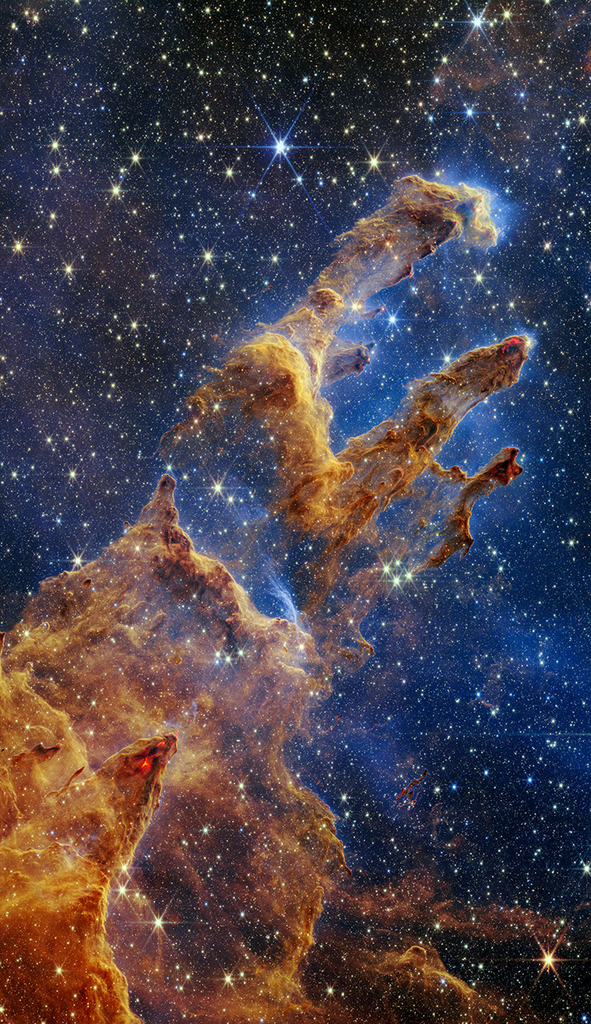
Multi-wavelength observations have dramatically expanded our understanding of the Eagle Nebula. The Hubble Space Telescope’s 1995 visible-light image of the Pillars of Creation became one of astronomy’s most recognized photographs, revealing intricate details of gas and dust in shades of blue (oxygen), red (sulfur), and green(nitrogen and hydrogen). Hubble revisited the region inhigher resolution in 2015. Infrared observations from Spitzer, Herschel, and especially the James Webb Space Telescope in 2022 have pierced the dust, revealing thousands of young stars previously hidden from view and showing the pillars glowing with the heat of forming stars.X-ray data from Chandra have identified young stars both with and without surrounding disks of material. Together,these views across the electromagnetic spectrum illustrate how radiation from massive stars both destroys and creates, eroding the pillars while compacting gas elsewhere into new stars.The pillars are temporary structures on cosmic timescales.Estimates suggest they may continue to form stars for another 1–3 million years before photoevaporation largely dissipates them. Some studies have even proposed that a supernova shock wave may already have disrupted the region thousands of years ago, though the light from any such event has not yet reached Earth. Regardless, The eagle Nebula continues to serve as a living laboratory for understanding how stars and planetary systems emerge from interstellar clouds—processes that likely formed our own Sun about 4.6 billion years ago.
For amateur astronomers, the Eagle Nebula offers both accessibility and challenge. With an apparent magnitude around 6, it can be spotted under dark skies with binoculars or a small telescope, best viewed in July when Serpens is well placed. The associated star cluster is relatively easy to locate near Gamma Scuti or the brighter Omega Nebula(M17). However, the faint nebulosity and especially The pillars of Creation require larger apertures (ideally 250 mmor more), dark skies, averted vision, and often specialized filters such as OIII or UHC. Long-exposure photography more readily reveals the eagle-like shapes and the pillarsthemselves.Beyond scientific value, the Eagle Nebula and its Pillars Of creation inspire awe. They remind us that the universe is not static: stars are born, live, and die in a continuous cycle of recycling gas and dust. Educational resources, interactive multi-wavelength visualizations, and public outreach materials from NASA and partners help students and the public explore these processes firsthand. From Hubble’sclassic portraits to Webb’s infrared revelations, each new image deepens our connection to the cosmos and underscores humanity’s place within a vast, ongoing story of creation.In the end, the Eagle Nebula is more than a beautiful object in the night sky. It is a dynamic stellar nursery where the raw materials of the universe are transformed into the next generation of stars and, potentially, planets. Its pillars stand as both monuments to the power of stellar radiation and cradles for the stars yet to come—enduring symbols of theuniverse’s creative force.
References
NASA. “The Pillars of Creation.”https://www.nasa.gov/image-article/pillars-ofcreation/
NASA’s Universe of Learning. “Pillars of CreationResources.” https://universe-oflearning.org/informal-educators/scienceresources/pillars-of-creation-resources
ViewSpace. “Star Formation: Eagle Nebula.”https://viewspace.org/interactives/unveiling_invisible_universe/star_formation/eagle_nebula
BBC Sky at Night Magazine. “How to see thefamous Pillars of Creation nebula.”https://www.skyatnightmagazine.com/advice/observe-pillars-creation-nebula
Additional sources consulted include NASAScience Messier 16 pages, ESA/Hubble materials,and peer-reviewed summaries of Gaia distancemeasurements and multi-wavelength studies ofM16/NGC 6611.