
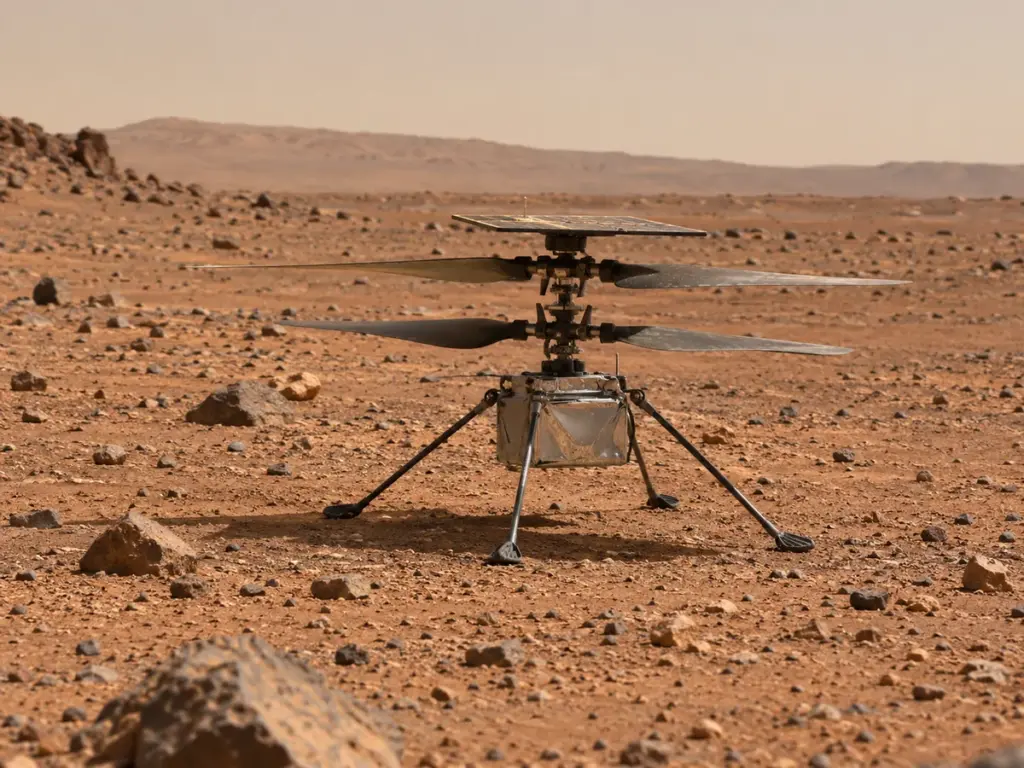
On April 19, 2021, a small robotic helicopter lifted off from the dusty surface of Mars and made aviation history. Named Ingenuity, the aircraft became the first vehicle to achieve powered, controlled flight on another planet. It climbed approximately 3 meters above the Martian ground, hovered briefly, and landed successfully after a flight lasting just 39.1 seconds.
The achievement was remarkable because Mars has an atmosphere dramatically thinner than Earth’s. Conventional helicopters depend on pushing large amounts of air downward to generate lift. On Mars, where the atmospheric density near the surface is roughly 1% of Earth’s, producing sufficient aerodynamic force requires an entirely different approach to rotorcraft engineering.
NASA’s Jet Propulsion Laboratory (JPL) overcame this challenge by combining lightweight carbon-fiber blades, high-speed counter-rotating rotors, autonomous flight-control software, specialized navigation sensors, and solar-powered electrical systems.
Ingenuity was originally designed to complete no more than five experimental flights during a 30-Martian-day technology demonstration. Instead, it completed 72 flights between April 2021 and January 2024, accumulated approximately 128.8 minutes of flight time, and traveled about 17 kilometers across the Martian landscape.
Its success demonstrated that aerial exploration could become a practical addition to planetary science, complementing orbiters, landers, and rovers. [1][5][6]
What Was NASA’s Ingenuity Mars Helicopter?
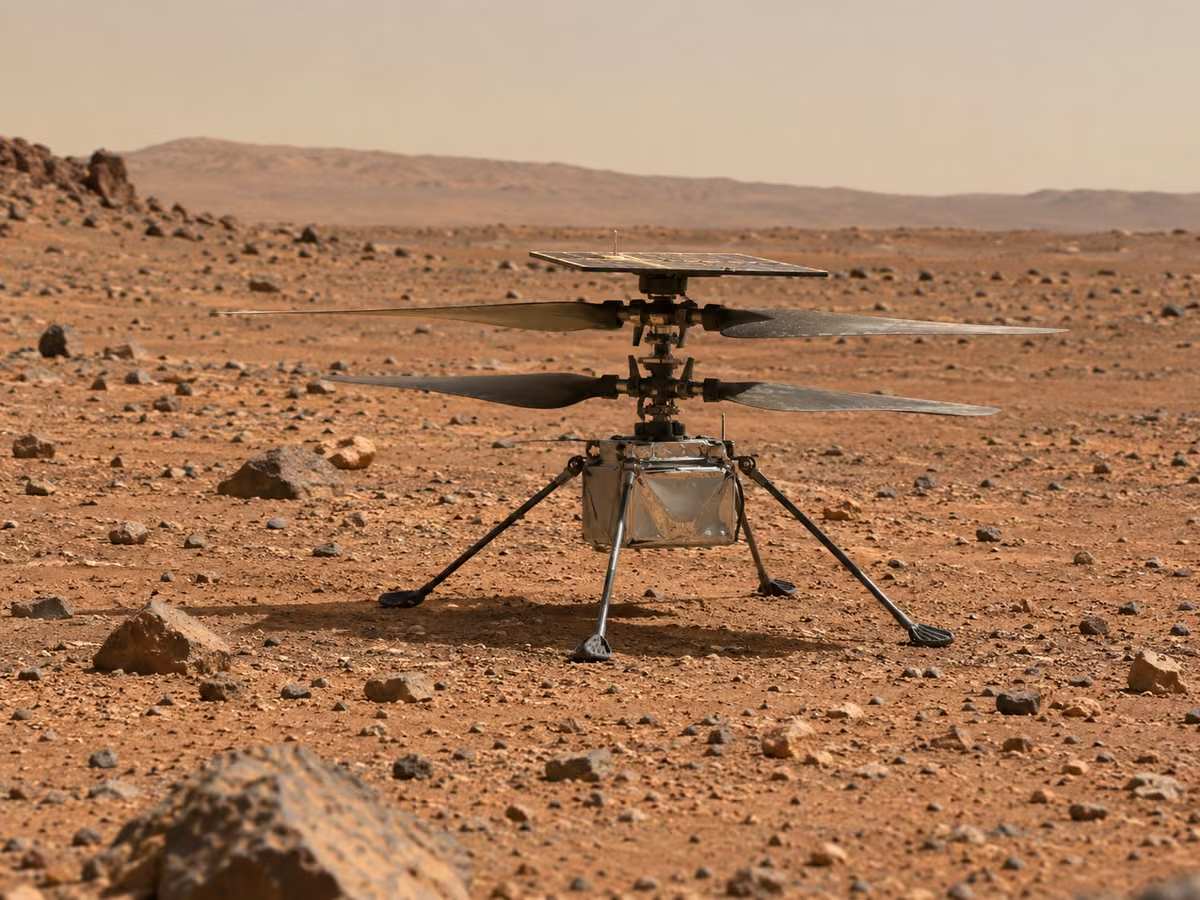
NASA’s Ingenuity Mars Helicopter was a small, autonomous, solar-powered rotorcraft developed to investigate whether powered flight was possible in the Martian atmosphere. Unlike spacecraft designed primarily to study geology, climate, or biology, Ingenuity was an experimental aircraft whose primary mission was to demonstrate a new engineering capability.
Standing approximately 49 centimeters tall and having a mass of about 1.8 kilograms, the helicopter carried two coaxial rotor assemblies, a solar panel, rechargeable batteries, cameras, sensors, and a flight computer. Its success established the feasibility of using robotic aircraft for future planetary exploration.
Understanding Ingenuity’s Purpose and Mission
Ingenuity was classified as a technology demonstration, meaning its primary objective was to test a capability that had never been successfully demonstrated in its intended environment. NASA wanted to establish whether an autonomous rotorcraft could take off, remain stable, maneuver, and land in the unusually thin atmosphere of Mars.
Unlike Perseverance, Ingenuity did not carry dedicated scientific instruments for analyzing rocks, soil, or atmospheric chemistry. Its two cameras primarily supported navigation, engineering evaluation, and terrain imaging.
The helicopter’s original mission was limited to five planned experimental flights within approximately 30 Martian days. Even a single controlled flight would have provided valuable evidence for future aircraft designs. The first five flights progressively tested hovering, horizontal movement, longer distances, and relocation to another landing site. [1][2]
How Ingenuity Became Part of the Mars 2020 Mission
Ingenuity traveled to Mars as part of NASA’s Mars 2020 mission, accompanying the Perseverance rover. The spacecraft launched on July 30, 2020, and landed in Jezero Crater on February 18, 2021.
Perseverance was designed to investigate Mars’s geology, past climate, and potential evidence of ancient microbial life. Its scientific responsibilities included examining rocks, studying the Martian environment, and collecting samples for possible future return to Earth.
Ingenuity had a separate objective: proving that powered aerial mobility could work on Mars.
The helicopter traveled attached beneath the rover and relied on Perseverance during its deployment. After separation, it operated independently as an aircraft, although it continued using the rover as a communications relay.
This arrangement allowed NASA to test a new exploration technology while Perseverance pursued its scientific mission.
Who Designed and Built Ingenuity?
NASA’s Jet Propulsion Laboratory in Southern California led Ingenuity’s system architecture, design, development, and integration. JPL engineers also developed essential components of the helicopter’s autonomous guidance, navigation, and flight-control capabilities.
The project involved several specialized organizations. AeroVironment contributed the rotor system, landing gear, and solar-panel substrate. SolAero Technologies integrated the solar panel. NASA’s Ames Research Center and Langley Research Center provided aerodynamic analysis, rotorcraft engineering expertise, and blade-design optimization.
Lockheed Martin Space developed the Mars Helicopter Delivery System that transported and deployed Ingenuity beneath Perseverance.
The multidisciplinary effort combined aerospace engineering, robotics, computational fluid dynamics, electronics, thermal protection, and autonomous software development. Each system had to function reliably after interplanetary travel and exposure to the Martian environment. [2]
Why Is Flying a Helicopter on Mars So Difficult?
Flying on Mars presents an unusual combination of aerodynamic and environmental challenges. Although the planet’s gravity is substantially weaker than Earth’s, its atmosphere is extraordinarily thin, reducing the amount of gas available for rotor blades to accelerate downward.
Engineers also had to consider atmospheric variations, extreme cold, dust, limited electrical energy, and communication delays. Ingenuity could not depend on real-time commands from Earth, so it needed onboard computing capable of controlling its position and attitude throughout every flight.
How the Martian Atmosphere Differs From Earth’s
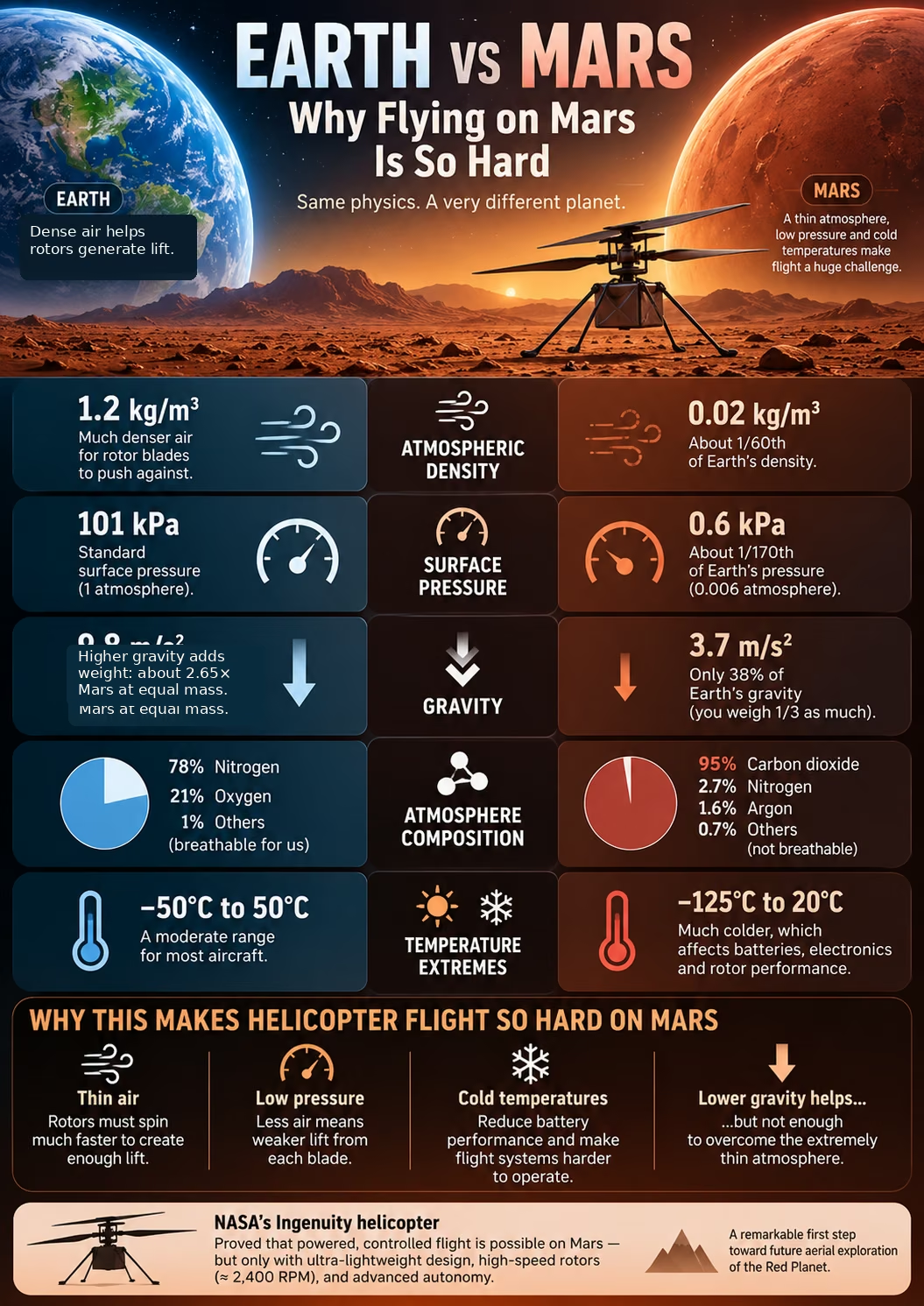
Mars has an atmosphere composed primarily of carbon dioxide, accounting for approximately 95% of its atmospheric gases. Nitrogen and argon make up most of the remainder, while oxygen and other gases occur in much smaller amounts.
Average surface atmospheric pressure is approximately 0.6% of Earth’s sea-level pressure, although pressure varies with location and season. Atmospheric density is likewise extremely low, typically around 1% to 2% of Earth’s sea-level density, depending on conditions and the comparison used.
These differences matter because helicopter rotors generate lift by interacting with surrounding gas. With far fewer gas molecules present, a rotor must sweep through the atmosphere rapidly enough to transfer the momentum needed to support the aircraft.
The problem is not simply Mars’s lack of breathable oxygen. Electric motors do not require atmospheric oxygen for combustion. The main aerodynamic limitation is the extremely low density of the available gas. [3]
How Martian Gravity Changes the Physics of Flight
Gravity works in Ingenuity’s favor. Martian surface gravity is approximately 3.71 meters per second squared, compared with Earth’s 9.81 meters per second squared. Consequently, an object on Mars experiences only about 38% of its Earth weight.
Ingenuity’s mass remained approximately 1.8 kilograms on both planets, but its weight under Martian gravity was about 6.7 newtons, compared with approximately 17.7 newtons on Earth.
This reduced weight lowered the aerodynamic thrust required for hovering and takeoff.
However, weaker gravity could not fully compensate for the severe reduction in atmospheric density. Ingenuity still needed specialized rotor geometry and high rotational speeds to produce enough lift.
Its engineering therefore required a careful balance between gravitational load, aerodynamic performance, structural strength, and available power.
How Martian Weather and Seasons Affect Flight
The Martian atmosphere changes with temperature, altitude, location, and season. These changes influence atmospheric density and therefore the amount of lift produced by a rotor operating at a given speed.
During periods of lower atmospheric density, Ingenuity required higher rotor speeds to maintain sufficient aerodynamic performance. NASA reported increasing its operating rotor speed from approximately 2,537 revolutions per minute during its first 13 flights to 2,700 revolutions per minute during later operations as the atmosphere became thinner.
Temperature also influenced battery capacity, solar charging, and thermal survival. Wind and dust introduced additional operational considerations.
Mission planning was organized around the Martian sol, a solar day lasting approximately 24 hours and 39 minutes. Engineers evaluated environmental conditions and electrical energy availability before scheduling flights. [4]
How Did Ingenuity Generate Enough Lift to Fly on Mars?
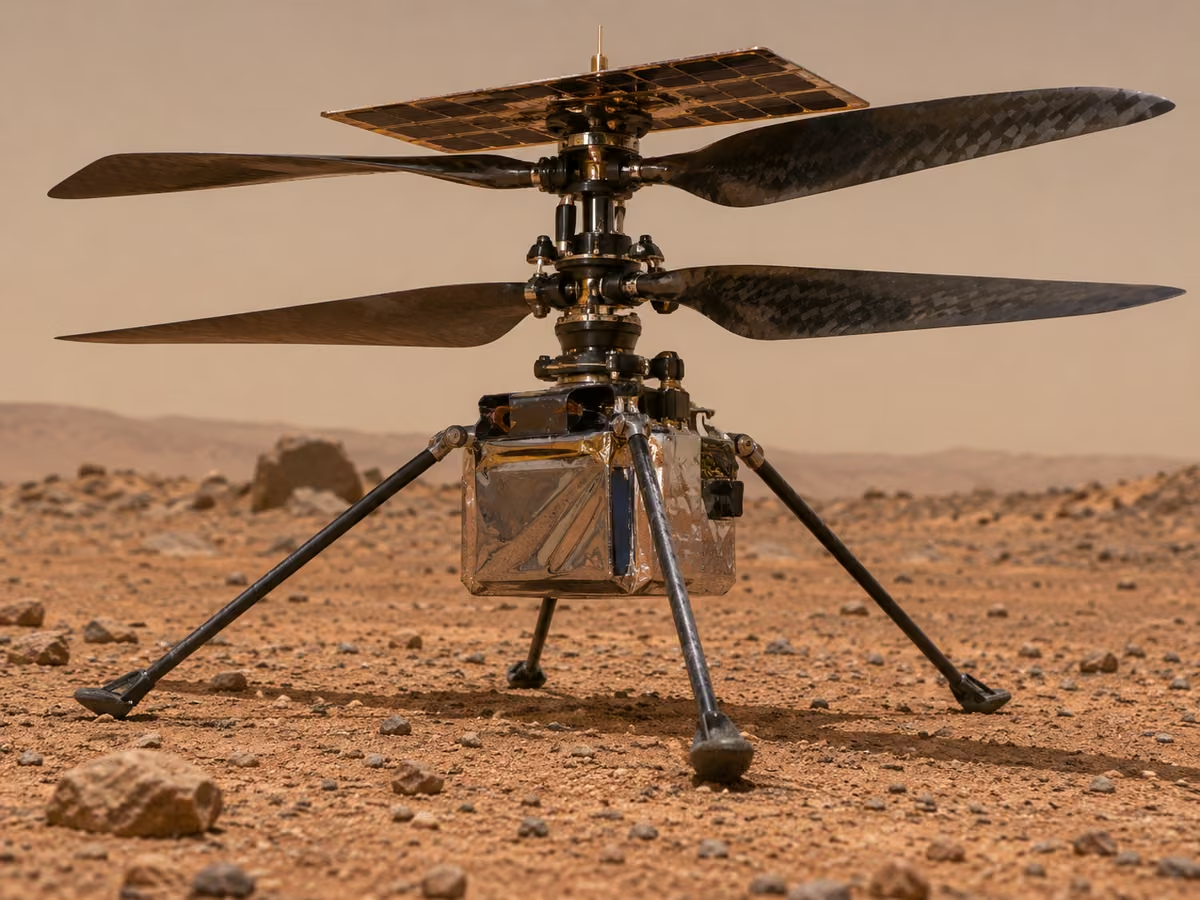
Ingenuity overcame Mars’s thin atmosphere through a highly optimized rotorcraft design. Its propulsion system used two large, lightweight rotors spinning in opposite directions at several thousand revolutions per minute. The blades were engineered to generate enough aerodynamic force while remaining structurally stable under demanding operating conditions.
The helicopter’s low mass, reduced gravitational load, and efficient rotor system worked together to make flight possible. Understanding this interaction explains why a conventional Earth helicopter would not have performed the same way on Mars.
The Basic Science of Aerodynamic Lift
Aerodynamic lift is the force generated when an aircraft changes the motion of surrounding air. In a helicopter, rotating blades act as moving airfoils that create pressure differences and accelerate air downward.
According to Newton’s third law, the downward acceleration of air produces an opposing upward force on the rotor system. The pressure distribution around the blades provides another way to describe the same aerodynamic process.
A simplified rotorcraft relationship is:
Here, T represents rotor thrust, CT is a dimensionless thrust coefficient, ρ is atmospheric density, A is the rotor disk area, Ω is angular velocity, and R is rotor radius.
The equation illustrates why low atmospheric density creates difficulties. If density decreases, the rotor must compensate through its size, rotational speed, or aerodynamic efficiency to maintain sufficient thrust. The coefficient itself also changes with operating conditions.
Why Ingenuity Used Coaxial Counter-Rotating Rotors
Ingenuity employed a coaxial counter-rotating rotor configuration. This arrangement placed two rotors on the same vertical axis, with each rotor turning in the opposite direction.
When a helicopter’s rotor spins, the motor applies torque that also tends to rotate the aircraft’s body in the opposite direction. Conventional single-main-rotor helicopters often use a tail rotor to counter this reaction torque.
Ingenuity instead balanced much of the reaction torque through its two opposing rotor assemblies.
The configuration reduced the need for a separate tail rotor and helped achieve a compact, lightweight aircraft. It also supported attitude control through adjustments to blade pitch and the rotor system.
Counter-rotation did not automatically guarantee stability. Ingenuity still required continuous electronic control to regulate its orientation and flight path.
Why Ingenuity’s Blades Spun So Fast
Rotor speed was essential to producing adequate lift in Mars’s low-density atmosphere. Ingenuity’s original rotor design was commonly described as operating at roughly 2,400 revolutions per minute, while its early operational flights used approximately 2,537 RPM. Later flights reached 2,700 RPM to compensate for changing atmospheric conditions.
Rotating faster increases the velocity of the blades through the surrounding gas, allowing them to produce more aerodynamic force.
However, there are limits. Excessive rotor-tip speed can introduce compressibility effects, additional drag, vibration, and reduced aerodynamic efficiency. The speed of sound on Mars also differs from Earth’s because of atmospheric composition and temperature.
Ingenuity’s designers therefore could not increase rotor speed indefinitely. They had to operate within aerodynamic, structural, and motor-performance constraints. [4][13]
The Engineering Behind Lightweight Rotor Blades
Ingenuity’s rotor system consisted of four specially manufactured carbon-fiber blades arranged into two rotors, each approximately 1.2 meters in diameter.
Carbon-fiber composite materials offered a valuable combination of low mass, stiffness, and strength. These characteristics allowed the blades to withstand rotational loading while maintaining their intended aerodynamic shapes.
Rotor diameter also influenced performance. A larger swept area allows the rotor to interact with a greater volume of atmosphere, although increasing rotor size introduces structural and packaging constraints.
Blade geometry was especially important because Mars rotorcraft operate in a challenging aerodynamic regime involving low Reynolds numbers and relatively high blade-tip Mach numbers.
NASA engineers optimized blade shape, rotational speed, and structural design together rather than treating these as independent engineering decisions. [2][13]
How Ingenuity Balanced Mass, Thrust, and Weight
Ingenuity had an aircraft mass of approximately 1.8 kilograms. Keeping that mass low was essential because every additional component increased the thrust required for flight and the energy needed to operate the aircraft.
The thrust-to-weight ratio describes the relationship between the upward thrust produced by the rotors and the downward gravitational force acting on the helicopter.
For a stationary hover, total rotor thrust must approximately equal aircraft weight. During vertical acceleration upward, available thrust must exceed the aircraft’s weight.
Engineers minimized mass throughout the helicopter by using a compact fuselage, lightweight landing legs, carefully selected electronics, and composite rotor structures.
The result was an aircraft capable of carrying its batteries, flight computer, sensors, and communications equipment without exceeding the performance limits of its propulsion system.
How Did Ingenuity Take Off, Hover, and Land Without a Runway?
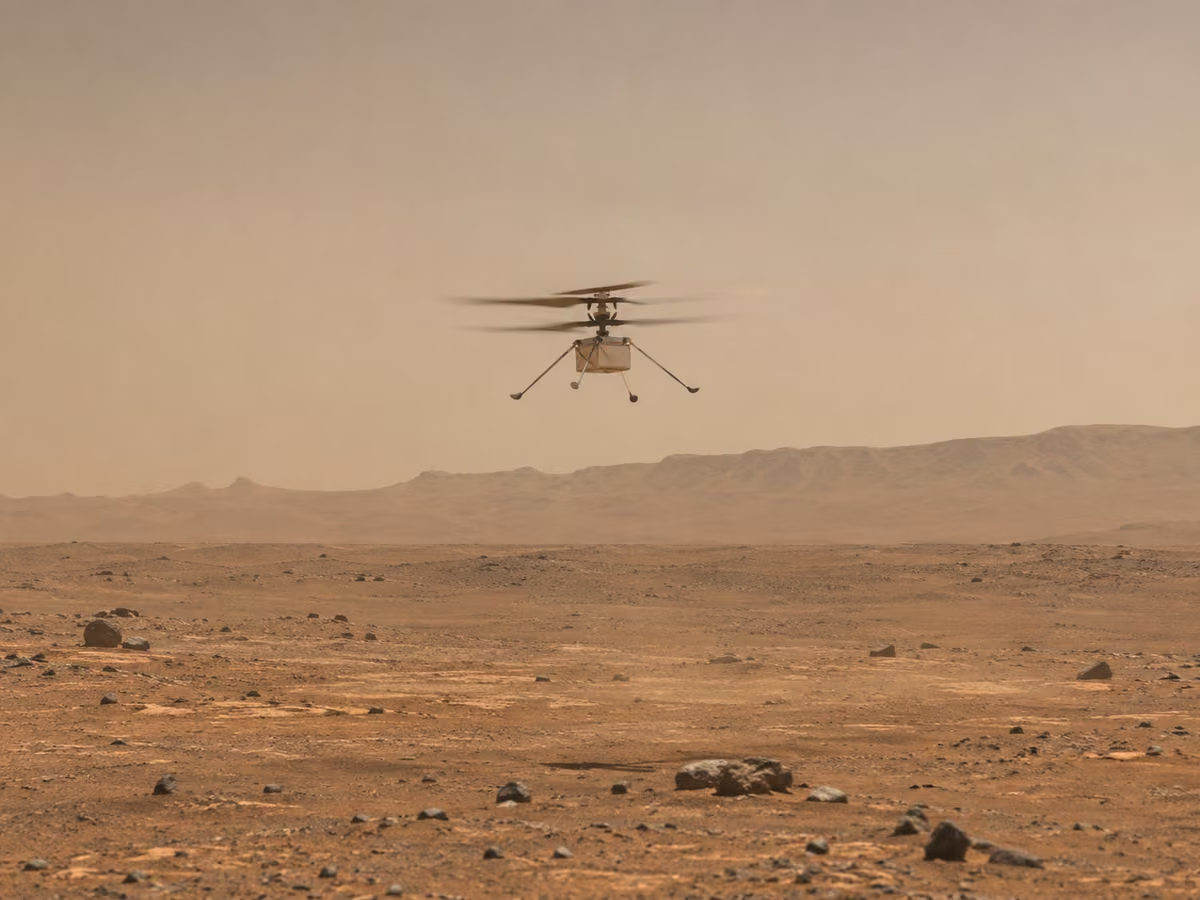
Ingenuity used vertical takeoff and landing, commonly abbreviated VTOL, allowing it to fly without a runway or prepared launch structure. This capability is particularly valuable for planetary exploration because natural terrain rarely provides the long, smooth surfaces required by conventional fixed-wing aircraft.
The helicopter could ascend directly from a selected landing area, hover above the surface, travel horizontally, and return to the ground. Each maneuver depended on precise control of rotor thrust and aircraft orientation.
Understanding Vertical Takeoff and Landing
Vertical takeoff begins when the rotor system produces enough thrust to overcome the helicopter’s weight. The aircraft then accelerates upward without requiring horizontal movement along the ground.
Ingenuity’s flight controller coordinated the motors and rotor-blade pitch controls during this process. Commands uploaded before flight defined the intended altitude, movement, and landing sequence.
Once the blades reached their operating speed, the helicopter could begin ascending toward its target altitude.
VTOL eliminated the need for a runway, but it did not eliminate the need for a suitable takeoff area. Engineers still had to consider slopes, rocks, obstacles, landing-leg clearance, and terrain features used by the navigation system.
How Ingenuity Maintained a Stable Hover
Hovering flight occurs when the helicopter maintains approximately constant altitude and horizontal position relative to the ground.
In ideal conditions, the upward thrust from the rotor system balances the aircraft’s weight. In practice, small disturbances constantly affect the aircraft, requiring continuous correction.
Ingenuity’s control system monitored orientation, acceleration, angular motion, and altitude through onboard sensors. It then adjusted rotor controls to correct deviations from its desired flight state.
A stable hover therefore did not mean that the aircraft remained perfectly motionless. It meant the control system kept its movement within acceptable limits.
This ability was particularly important during Ingenuity’s first flight, which focused on demonstrating controlled vertical flight before attempting substantial horizontal travel.
How Ingenuity Completed a Controlled Landing
Landing required Ingenuity to reduce altitude while keeping its horizontal motion and attitude within safe limits.
The flight-control system used sensor measurements to estimate the helicopter’s position, movement, and distance above the ground. It adjusted the aircraft’s descent through the rotor-control system.
Near touchdown, horizontal velocity was especially important. Excessive sideways movement could create forces that the landing legs were not designed to absorb.
Ingenuity’s lightweight landing structure had to tolerate normal touchdown loads without adding unnecessary mass.
Later mission experience demonstrated that landing safety depended not only on rotor performance but also on reliable navigation and suitable terrain. The final flight highlighted the consequences of inaccurate motion estimates during descent.
How Did Ingenuity Fly Autonomously Without Human Pilots?
Ingenuity did not have a human pilot controlling its movements in real time. Instead, engineers on Earth prepared flight plans and transmitted instructions to Mars. Once airborne, the helicopter executed those instructions through its onboard autonomous flight system.
This independence was necessary because radio signals take several minutes to travel between Earth and Mars. A person using a joystick could not react quickly enough to stabilize the aircraft or avoid problems during a flight lasting only seconds or minutes.
Why Ingenuity Needed Autonomous Flight
Autonomous flight allows an aircraft to perform essential navigation and control tasks without continuous human intervention.
The Earth-Mars communication delay changes throughout the planets’ orbits, but even at relatively favorable distances, signals cannot travel quickly enough to support real-time manual piloting.
Ingenuity therefore had to control its own orientation, altitude, movement, and landing sequence.
Mission engineers defined flight parameters such as destination, planned altitude, speed, and flight duration. The helicopter’s onboard software then handled the rapid decisions required to follow that plan.
This distinction is important: Ingenuity was autonomous during flight, but it did not independently invent all its missions. Human engineers selected the objectives and prepared the operational commands.
How the Flight Control System Maintained Stability
The flight control system was responsible for keeping Ingenuity within its intended flight conditions.
It compared the aircraft’s estimated position, velocity, orientation, and angular rates with the desired values established by its flight plan. Differences between these values generated corrective control commands.
These corrections affected rotor-blade pitch and the aerodynamic forces acting on the helicopter.
The system relied on feedback control, meaning new measurements continuously influenced subsequent adjustments. This was essential because disturbances, model uncertainties, and imperfect sensor measurements could otherwise cause the aircraft to drift from its intended trajectory.
Ingenuity’s control architecture included interconnected functions for attitude stabilization and translational movement, allowing the aircraft to coordinate orientation with its desired direction of travel.
What the Onboard Flight Computer Did
Ingenuity’s onboard flight computer processed navigation measurements, executed guidance and control software, managed flight sequences, and supported autonomous operations.
The helicopter used commercial off-the-shelf electronics, including computing technology derived from consumer devices. This helped provide substantial processing capability within strict limits on mass, size, and electrical power.
The computer’s responsibilities extended beyond movement during flight. Ingenuity also needed to manage communication, monitor system health, and carry out programmed operations between flights.
Because the aircraft could not depend on immediate assistance from Earth, its software needed to respond reliably to changing conditions during flight.
The successful use of compact commercial computing hardware also provided valuable engineering information for future planetary spacecraft.
How Ingenuity Measured Its Movement and Position
Ingenuity relied on several onboard sensors to estimate its motion and orientation.
Its inertial measurement unit, or IMU, contained sensors such as accelerometers and gyroscopes. Accelerometers measured changes in motion, while gyroscopes measured angular rotation.
A laser rangefinder, frequently described as a laser altimeter, measured distance to the Martian surface. These measurements helped estimate altitude during takeoff, flight, and landing.
No individual sensor could provide a complete, perfectly accurate description of the aircraft’s state.
Instead, the navigation system combined measurements from multiple sources, a process known as sensor fusion. This improved state estimation by using complementary information from inertial sensing, altitude measurements, and camera observations.
How Ingenuity Used Cameras to Navigate
Ingenuity carried a downward-facing black-and-white navigation camera and a separate color camera for terrain photography.
The navigation camera observed features on the Martian surface as the helicopter moved overhead. By tracking how recognizable features shifted between successive images, onboard algorithms estimated movement relative to the ground.
This technique is related to optical flow, a method used in computer vision to analyze apparent motion in images.
Unlike many Earth-based drones, Ingenuity could not rely on an operational GPS satellite network surrounding Mars.
Visual navigation therefore became essential for estimating horizontal motion. However, it depended on finding sufficiently recognizable features.
Uniform sand, repetitive terrain, and areas with few distinctive landmarks could reduce the quality of position and velocity estimates. This limitation eventually became central to the investigation of Ingenuity’s final flight. [7]
How Was Ingenuity Powered and Protected From the Martian Environment?
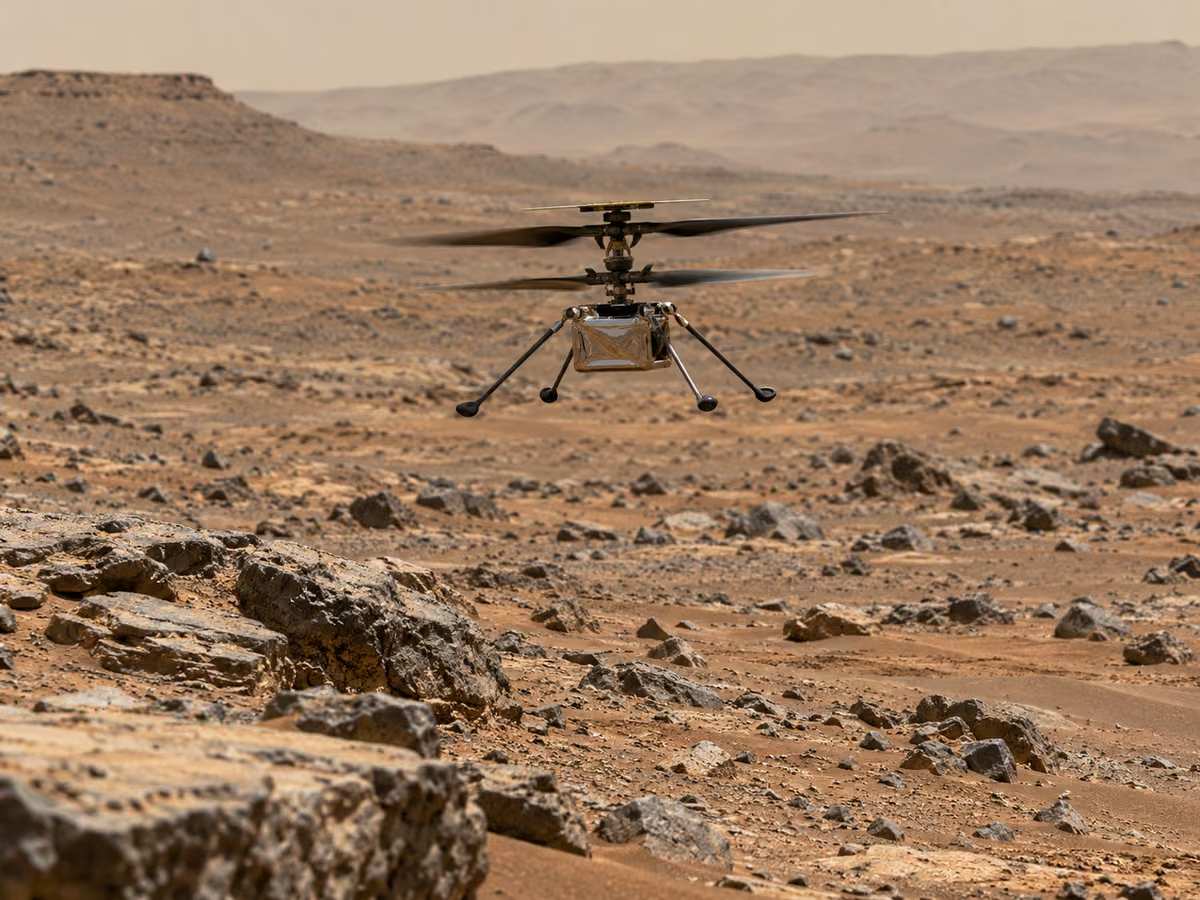
Ingenuity used a solar-electric power system that supported flight, onboard computing, communications, and thermal protection. Its electrical architecture had to satisfy competing requirements: the helicopter needed substantial power for its motors but could carry only a small battery system.
The Martian environment introduced further complications. Extremely cold nights required electrical heating, while dust and changing sunlight affected energy collection. Mission operations therefore depended on carefully managing available power across each Martian day.
How the Solar Power System Generated Electricity
Ingenuity carried a solar panel mounted above its rotor system. The panel converted incoming sunlight into electrical energy, which was used to recharge the helicopter’s batteries.
The solar cells were designed to operate under the sunlight conditions encountered on Mars.
Unlike Perseverance, which uses a radioisotope power source, Ingenuity depended on solar charging after deployment.
This created a daily energy budget. The helicopter needed to collect enough electricity for essential operations, battery heating, communications, and future flights.
Solar performance depended on available sunlight and environmental conditions. Reduced illumination or increased energy consumption could restrict flight scheduling.
Successful operation required balancing energy collection against the electrical demands of the aircraft.
How Lithium-Ion Batteries Powered Flight
Ingenuity used a system of six lithium-ion batteries to store electricity generated by its solar panel.
During flight, the battery system supplied power to the rotor motors, computers, sensors, and associated electronics. NASA’s original technical specifications described average electrical consumption during flight as approximately 350 watts.
That power requirement was significant for such a small aircraft.
Battery mass, capacity, and discharge performance had to be balanced against the helicopter’s lifting capability. Larger batteries could store more energy but would also increase the mass the rotors had to support.
The original flight design targeted short flights lasting up to about 90 seconds. Later operations expanded the demonstrated flight envelope, with some flights lasting considerably longer than the original design target.
How Ingenuity Survived Cold Martian Nights
Thermal management was essential to Ingenuity’s survival.
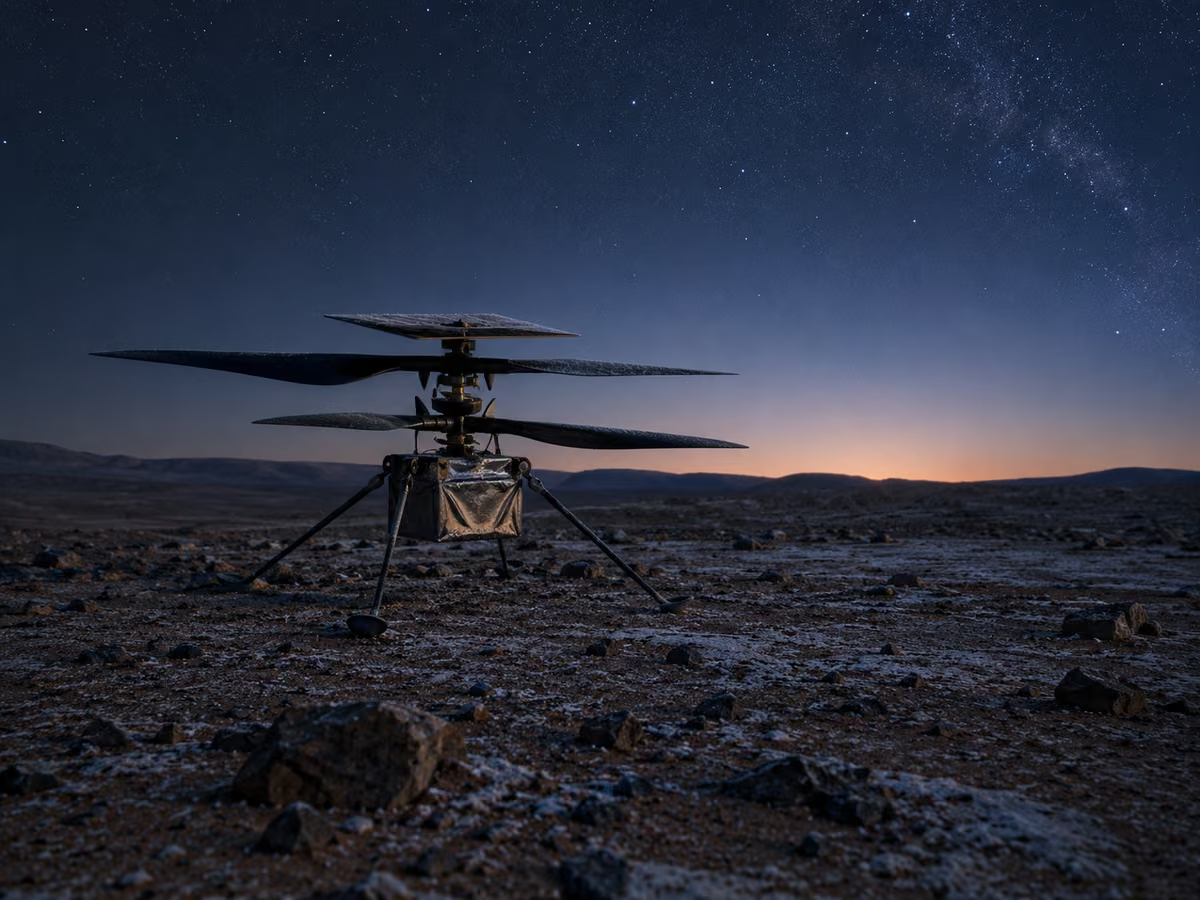
Martian nighttime temperatures can fall far below the operating limits of conventional electronic equipment and rechargeable batteries. The helicopter used insulation and electrically powered heaters to protect critical components.
Its batteries had to provide enough energy for heating during periods when the solar panel could not generate electricity.
Cold-season operations became particularly challenging. During the Martian winter of 2022, reduced available energy sometimes prevented Ingenuity from maintaining its normal overnight heating schedule.
NASA reported that power shortages caused periodic computer resets, forcing engineers to adapt the helicopter’s operating strategy.
Ingenuity’s ability to survive these conditions provided valuable information about the durability and limitations of lightweight solar-powered aircraft on Mars. [2][10]
How Did NASA Transport and Deploy a Helicopter on Mars?
Ingenuity could fly independently, but it could not travel from Earth to Mars or land on the Martian surface by itself. It depended on the Mars 2020 spacecraft and Perseverance rover for interplanetary transportation, entry, descent, and landing.
NASA designed a specialized deployment system that protected the helicopter during travel and released it only after Perseverance reached a suitable surface location. This carefully controlled sequence was essential because damage during transportation or deployment could have prevented the experimental aircraft from flying.
How Ingenuity Traveled to the Martian Surface
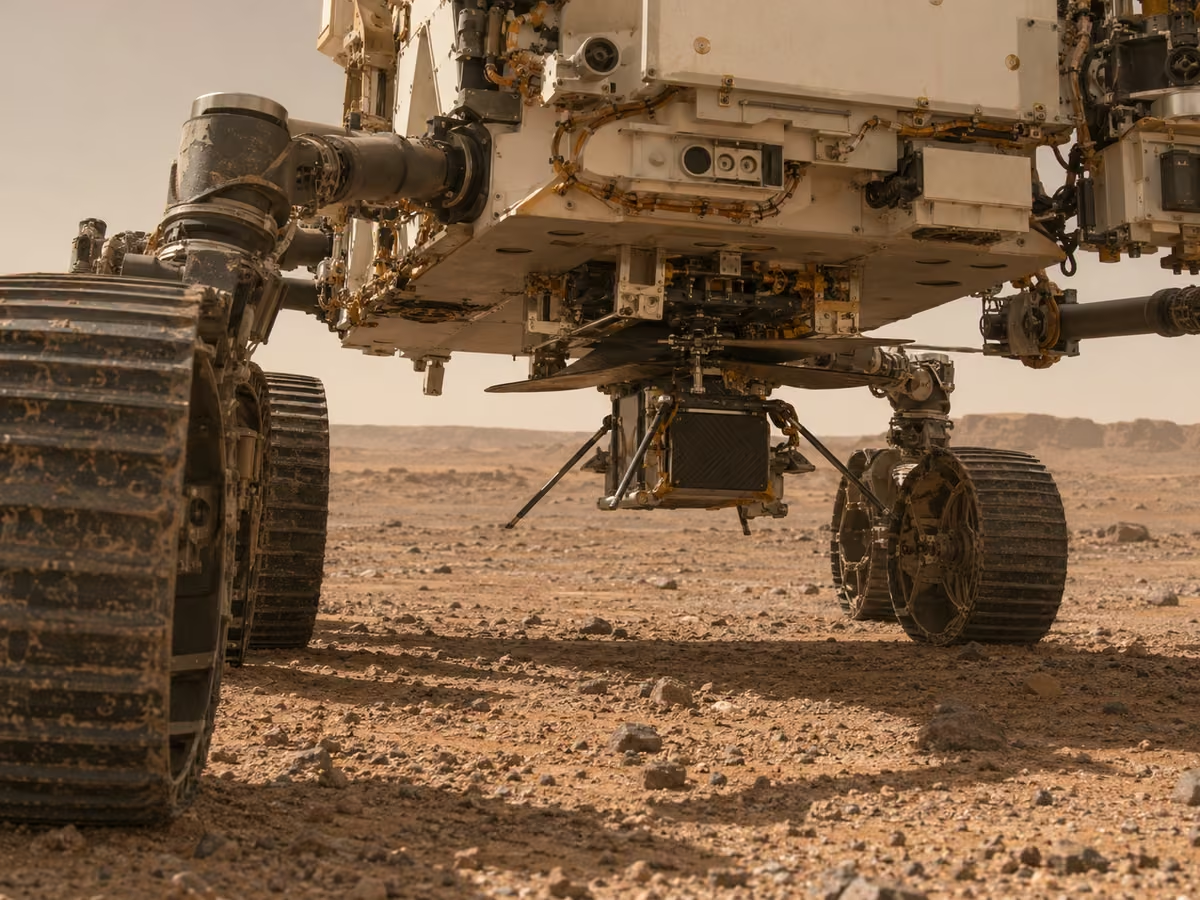
Ingenuity was carried beneath Perseverance using the Mars Helicopter Delivery System, developed through collaboration between Lockheed Martin Space and NASA’s mission teams.
The helicopter remained secured under the rover during launch, interplanetary cruise, and descent through the Martian atmosphere.
A protective debris shield helped prevent damage from material that could be disturbed during landing.
After Perseverance reached the surface, the rover carried Ingenuity while engineers selected a suitable deployment location.
During this period, the helicopter relied on the rover for electrical power and communications.
The delivery system had to protect the lightweight aircraft while keeping it compact enough to fit within the rover’s available mechanical envelope. [8]
How Ingenuity Was Released From Perseverance
Deploying Ingenuity required a carefully sequenced mechanical operation.
First, Perseverance released the protective debris shield. The deployment mechanism then unlocked the helicopter and gradually rotated it from its horizontal transport position into a vertical configuration.
Additional mechanisms extended the landing legs and prepared the aircraft for release.
Once the team confirmed the correct configuration, Ingenuity was lowered and released onto the Martian surface, dropping the final short distance to the ground.
The deployment was completed in early April 2021.
Perseverance then moved away to provide clearance for the helicopter’s rotors and to establish a safe observation position.
The deployment system remained attached to the rover while Ingenuity began independent operations on Mars. [8]
Why Jezero Crater Was the Flight Location
Jezero Crater was selected primarily for the scientific goals of the Perseverance mission, not because it was an ideal location for helicopter flight.
Scientists believe the crater once contained a lake fed by an ancient river. Sediment deposits formed a delta, making the area scientifically valuable for studying Mars’s geological history and investigating environments that may once have supported microbial life.
However, Jezero also contains challenging terrain, including rocks, slopes, sand deposits, and uneven surfaces.
Engineers identified a relatively flat, obstacle-free area for Ingenuity’s initial flights. Later flights explored a wider range of terrain as the helicopter accompanied aspects of Perseverance’s exploration campaign.
The combination of scientific interest and engineering challenges made Jezero an important test environment for planetary aviation. [11]
How Did NASA Test Ingenuity Before Attempting Flight on Mars?
NASA could not simply build Ingenuity, send it to Mars, and assume its design would work. Engineers spent years evaluating the helicopter’s aerodynamic performance, structural behavior, electronics, control software, and environmental resilience.
Testing was particularly difficult because Earth laboratories cannot naturally reproduce Mars’s combination of low atmospheric density and reduced gravity. Engineers addressed this challenge through specialized facilities, mechanical simulation techniques, analytical models, and carefully designed experimental procedures.
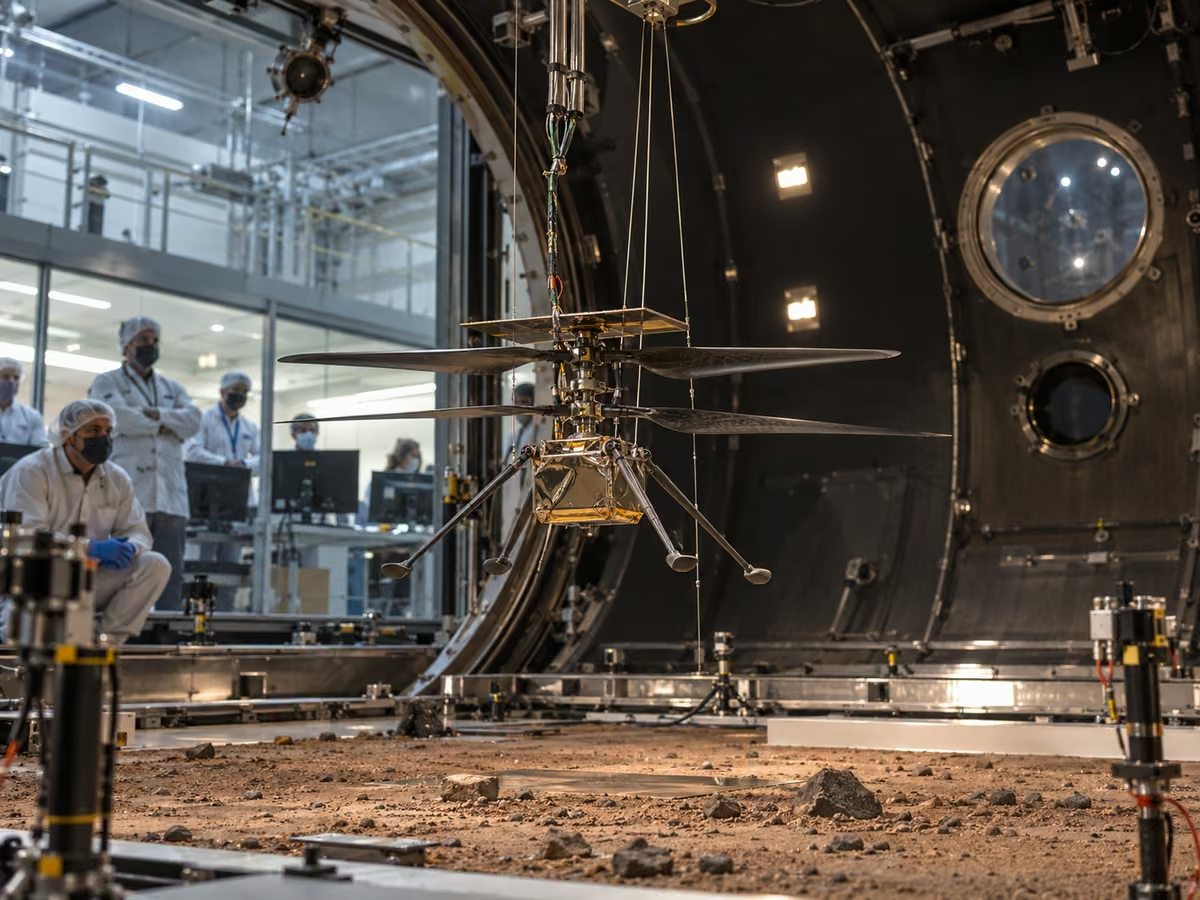
Simulating Martian Atmospheric Conditions on Earth
NASA’s Jet Propulsion Laboratory tested Ingenuity in its Space Simulator, a large environmental chamber approximately 7.6 meters in diameter.
Engineers reduced the chamber’s atmospheric pressure and introduced carbon dioxide to approximate the density of the Martian atmosphere.
This allowed them to investigate rotor behavior in an environment with aerodynamic characteristics much closer to Mars than ordinary Earth air.
Because Earth’s gravity remained stronger than Mars’s, the test setup also incorporated a gravity-offload system. A controlled tether applied an upward force to compensate for the difference in gravitational loading.
Together, these systems allowed engineers to evaluate the helicopter’s behavior under conditions approximating Martian flight. [9]
Testing Flight Stability, Navigation, and Power
Ingenuity underwent testing that evaluated much more than whether its rotors could generate lift.
Engineers needed to verify that the flight-control algorithms could stabilize the aircraft, that the sensors supplied usable measurements, and that the motors and mechanical systems responded correctly.
Testing also covered the electrical power system, battery operation, onboard computers, communications hardware, and thermal protection.
The helicopter’s deployment sequence was evaluated using Perseverance and the delivery hardware under simulated environmental conditions.
Software testing was especially important because the aircraft would eventually need to execute flight instructions without real-time human control.
Successful laboratory performance reduced engineering risk, but it could not guarantee that every situation encountered during a multi-year Martian mission would match the conditions tested on Earth.
Why Laboratory Testing Could Not Perfectly Reproduce Mars
Even sophisticated environmental chambers cannot recreate every physical condition found on Mars simultaneously.
Earth’s gravitational field remains stronger, requiring mechanical compensation during low-density flight testing. Temperature, atmospheric composition, turbulence, and structural interactions can also differ from natural Martian conditions.
Gravity-offload systems introduce their own mechanical influences, meaning laboratory results must be interpreted carefully.
NASA therefore combined physical tests with aerodynamic calculations, computer simulations, and control-system models.
Once Ingenuity reached Mars, real flight telemetry supplied evidence that could be compared with the predictions.
This combination of laboratory testing, simulation, and operational measurements helped engineers improve their understanding of the aircraft throughout its mission and informed the design of future planetary rotorcraft.
What Happened During Ingenuity’s First Flight on April 19, 2021?
On April 19, 2021, Ingenuity accomplished what no aircraft had previously achieved: powered, controlled flight in the atmosphere of another planet.
The initial flight was deliberately conservative. Rather than immediately traveling across the Martian landscape, the helicopter attempted a short vertical ascent, a controlled hover, and a safe landing at its starting location.
The flight demonstrated that the aircraft could generate sufficient lift, maintain stability, and execute an autonomous flight sequence under actual Martian conditions.
Preparing for the First Flight Hover Test
Before attempting its historic flight, Ingenuity completed a series of commissioning and engineering checks.
These included confirming that the helicopter could survive Martian nights, recharge its batteries, communicate with Perseverance, operate its computers, and spin its rotors safely.
The team also evaluated the selected flight area and verified the helicopter’s readiness for autonomous operation.
The initial test was designed to minimize unnecessary risk. A vertical ascent and hover required fewer navigation and trajectory changes than a flight involving substantial horizontal displacement.
By establishing a simple first objective, engineers could evaluate the most fundamental requirements for powered flight before progressively expanding the helicopter’s capabilities.
The First Martian Flight: Step-by-Step Timeline
Ingenuity’s first flight occurred on April 19, 2021, at approximately 12:33 local mean solar time at its Martian landing region.
The helicopter performed the following sequence:
- Rotor spin-up: The rotor system accelerated toward its commanded operating speed while the aircraft remained on the ground.
- Vertical takeoff: Ingenuity generated enough thrust to lift away from the Martian surface.
- Ascent: The helicopter climbed to approximately 3 meters above the ground.
- Hover: The aircraft maintained a stable hover for approximately 30 seconds.
- Descent and landing: Ingenuity reduced altitude, touched down at its original location, and stopped its rotors.
The complete flight lasted 39.1 seconds.
Although the helicopter traveled no significant horizontal distance, the successful ascent, controlled hover, and landing established that powered rotorcraft flight was achievable on Mars. [5]
Why the Landing Site Was Called Wright Brothers Field
NASA named Ingenuity’s first flight area Wright Brothers Field to honor Wilbur and Orville Wright, who achieved the first successful powered, controlled, sustained flight of a heavier-than-air aircraft on Earth on December 17, 1903.
The comparison connected two major milestones in aviation history: the first powered flight on Earth and the first powered flight on another planet.
Ingenuity also carried a small piece of fabric from the original Wright Flyer, attached beneath its solar panel.
The symbolic connection reflected the experimental nature of both achievements.
Like the Wright brothers’ aircraft, Ingenuity began with a relatively modest flight that demonstrated a breakthrough in engineering and opened possibilities for more capable aircraft in the future. [14]
How NASA Confirmed the Flight Was Successful
NASA’s engineers could not watch Ingenuity’s flight through a live, continuously controlled video connection.
Instead, the team waited for information transmitted from Mars after the flight sequence.
Data from Ingenuity and Perseverance allowed engineers to confirm that the helicopter had completed its commanded operations.
Flight telemetry showed rotor spin-up, takeoff, ascent, hovering, descent, landing, and rotor shutdown. Altimeter measurements confirmed that Ingenuity reached its prescribed altitude.
Perseverance’s cameras also recorded the flight, providing independent visual evidence.
The agreement between engineering data and rover imagery established that the aircraft had successfully completed its first powered, controlled flight.
How Did NASA Communicate With and Monitor Ingenuity From Earth?
Operating a helicopter on Mars required more than autonomous flight software. NASA also needed a reliable method for delivering commands, receiving diagnostic information, and analyzing flight performance across interplanetary distances.
Ingenuity did not carry the large communications system needed to contact Earth directly. Instead, it relied on a network involving the Perseverance rover, communication systems at Mars, and NASA’s Deep Space Network on Earth.
This architecture allowed the lightweight helicopter to operate without carrying heavy long-distance telecommunications equipment.
Why Earth-Mars Communication Delay Prevented Remote Piloting
Radio signals travel at the speed of light, but Earth and Mars are separated by enormous distances that change as the planets orbit the Sun.
Depending on their relative positions, one-way communication delays can range from several minutes to more than twenty minutes.
This delay prevents the instantaneous feedback needed for conventional remote piloting.
For example, if Ingenuity encountered an unexpected disturbance during a short flight, engineers on Earth would not receive the information quickly enough to correct the problem manually.
The helicopter therefore needed to execute real-time stabilization, navigation, and flight-control decisions independently.
NASA’s engineers retained control over mission planning, but the aircraft itself handled the immediate actions required to fly.
How Ingenuity Communicated With Perseverance
Ingenuity communicated with the Perseverance rover through the Mars Helicopter Base Station, an electronics and telecommunications system installed on the rover.
The helicopter and base station used a local radio connection to exchange commands and information.
Mission instructions received by Perseverance could be passed to the helicopter through this system. Data collected by Ingenuity could follow the reverse route.
The communications architecture enabled NASA to send flight plans, receive photographs, monitor system health, and examine engineering telemetry.
Perseverance also helped document early helicopter operations through its own cameras.
Although the rover was essential to the communication chain, Ingenuity did not depend on Perseverance to calculate its real-time flight-control commands. [2]
How NASA’s Deep Space Network Supported the Mission
NASA’s Deep Space Network, or DSN, is a global system of large radio antennas that communicates with spacecraft across the solar system.
For Ingenuity, the DSN formed the Earth-based portion of a larger communications architecture.
Commands could be sent from Earth to Perseverance directly or through Mars orbiters before being forwarded to the helicopter.
The communication pathway can be summarized as:
- NASA Mission Control, Earth: Flight planning and analysis.
- Deep Space Network: Interplanetary communications infrastructure.
- Perseverance Rover: Direct Earth link or relay through Mars orbiters.
- Helicopter Base Station radio link: Local communication between rover and helicopter.
- Ingenuity Helicopter: Receives commands, executes flights and returns data.
Telemetry and photographs followed the reverse path back toward Earth.
Ingenuity therefore did not communicate directly with the Deep Space Network. Its communication relied on the rover as an intermediary, with Mars orbiters available as part of the broader mission infrastructure.
How Flight Telemetry Helped Engineers Evaluate Performance
Flight telemetry consists of measurements and system information recorded during aircraft operation.
Ingenuity’s telemetry allowed engineers to examine estimated position, altitude, velocity, rotor operation, orientation, electrical performance, and other indicators of system health.
After receiving the data, engineers compared the recorded flight behavior with the planned trajectory and expected performance.
Unexpected differences could reveal navigation problems, environmental influences, or limitations in the aircraft’s engineering models.
Telemetry became increasingly valuable as Ingenuity completed more demanding flights.
The accumulated measurements helped engineers refine operating procedures, evaluate rotor performance, and expand the aircraft’s demonstrated flight capabilities while managing risks.
How Did Ingenuity Evolve From a Flight Experiment Into an Aerial Scout?
Ingenuity’s original mission was to demonstrate that flight was possible on Mars. Once that goal had been achieved, NASA began exploring how an aerial vehicle could contribute to ongoing planetary exploration.
The helicopter entered an extended operations demonstration phase in May 2021. It began performing more ambitious flights, traveling between different landing locations and capturing aerial images.
These activities helped engineers and mission planners investigate how flying robots could complement the capabilities of a surface rover.
Transitioning Into an Operations Demonstration
An operations demonstration tests how an experimental technology might be used during realistic mission activities.
After Ingenuity completed its first five flights, NASA expanded its objectives beyond the original technology demonstration.
The helicopter began traveling between airfields, recording new terrain, and supporting the evaluation of future exploration techniques.
Instead of repeatedly returning to a single initial flight zone, Ingenuity operated across a progressively larger region.
This phase also exposed the helicopter to more varied terrain and environmental conditions.
The extended operations supplied information about durability, flight planning, communication, navigation, and long-term maintenance of a lightweight robotic aircraft operating on another planet. [1]
How NASA Planned Routes for Autonomous Flights
Flight planning involved selecting suitable destinations and defining how Ingenuity would travel between them.
Engineers considered the aircraft’s available energy, expected atmospheric density, flight altitude, horizontal speed, route geometry, and landing-site characteristics.
Terrain assessment was particularly important because the helicopter needed both recognizable visual features for navigation and a suitable surface for landing.
Flight plans were checked against engineering limits before being uploaded to the aircraft.
Once a flight began, Ingenuity executed its instructions autonomously.
This approach allowed mission planners to combine human judgment with onboard control systems, preserving flexibility while avoiding the impossible requirement for real-time piloting across interplanetary distances.
How Aerial Scouting Assisted the Perseverance Rover
Aerial scouting involves observing terrain from above to support exploration decisions.
Ingenuity demonstrated how elevated perspectives could reveal features that are difficult to recognize from the surface, including rock distributions, uneven ground, sand formations, and possible routes through complex terrain.
Aerial images could help mission planners assess potential areas of interest or examine routes before a rover approached them.
However, Ingenuity did not replace Perseverance’s own cameras, navigation algorithms, or autonomous driving capabilities.
Its scouting activities were an operational demonstration of what future aircraft might contribute to planetary exploration.
More capable rotorcraft equipped with dedicated scientific instruments could eventually extend this role beyond reconnaissance.
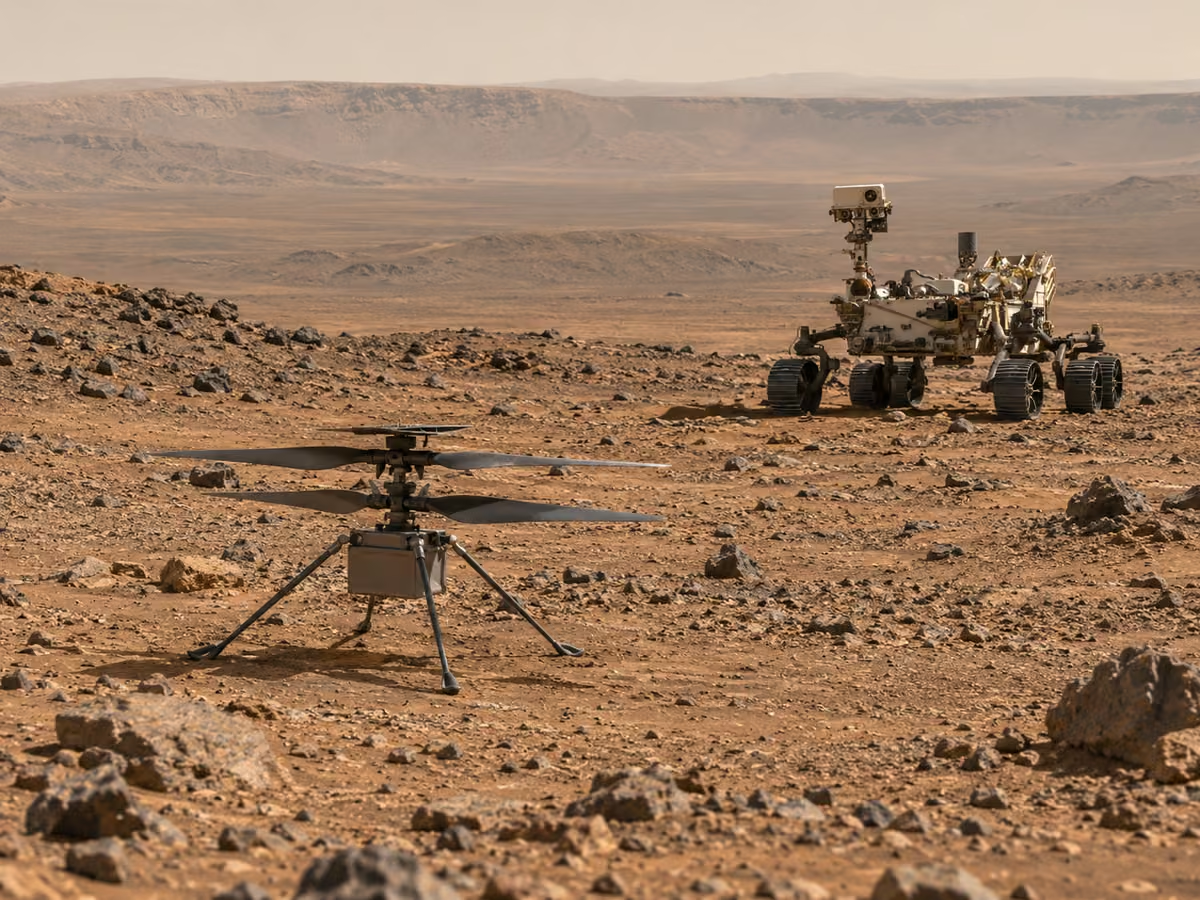
How Aerial Photography Revealed the Martian Landscape
Ingenuity’s color camera captured views of the Martian surface from perspectives unavailable to ground-based instruments.
Overhead and oblique aerial photography allowed engineers and scientists to examine terrain patterns, rock formations, ridges, sand deposits, and other landscape features.
These images provided useful geographic context for understanding the relationship between surface features.
They also demonstrated the potential of aerial platforms to document areas before rovers travel through them.
However, Ingenuity’s camera system was not a dedicated scientific mapping payload. Its primary functions were engineering support, navigation, and terrain imaging.
Future helicopters carrying specialized imaging systems could provide more systematic geological surveys and high-resolution terrain models.
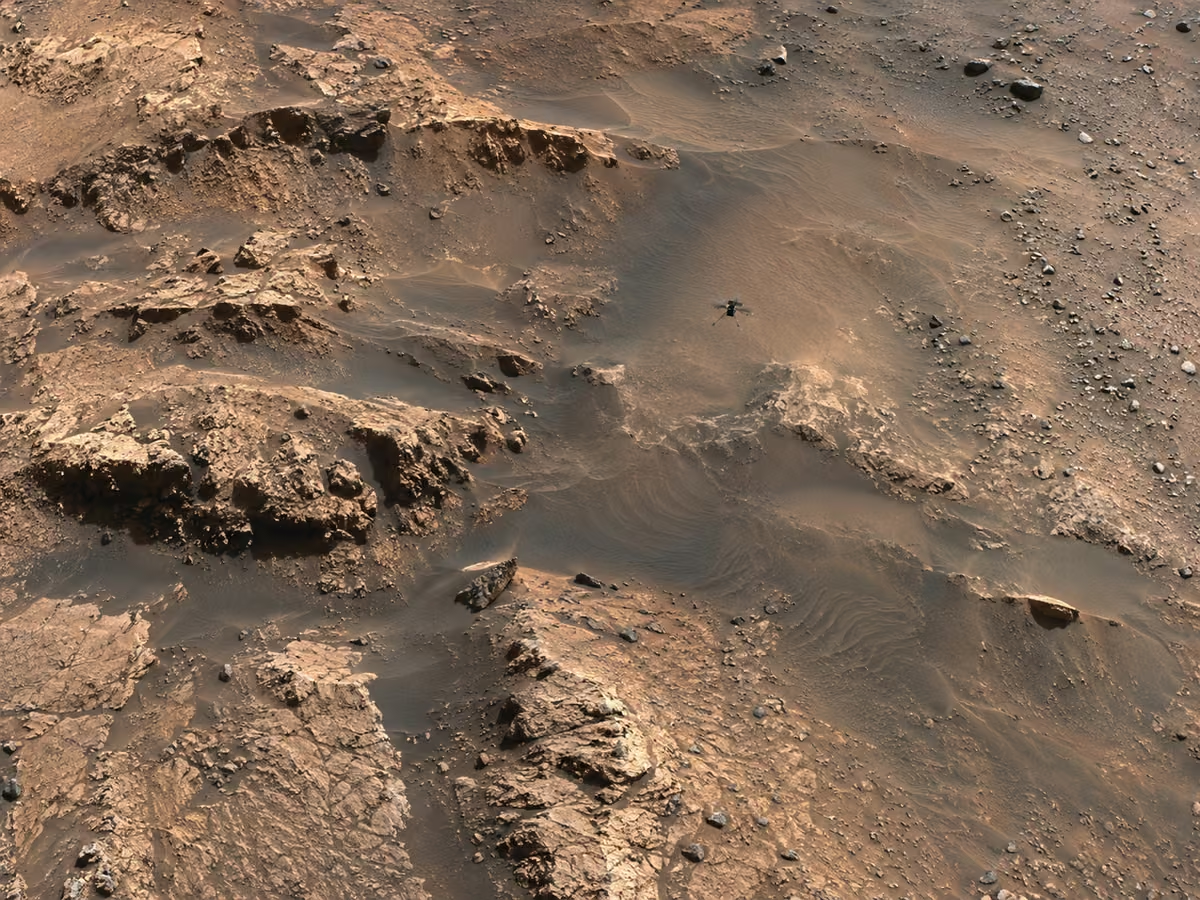
How Many Flights Did Ingenuity Complete, and What Records Did It Set?
Ingenuity completed 72 flights on Mars, far exceeding its original five-flight objective. Its achievements included longer flight durations, increasing travel distances, higher altitudes, and faster horizontal movement.
These records demonstrated that the aircraft could operate repeatedly in the Martian atmosphere rather than merely completing a single historical experiment.
NASA’s final flight log provides a detailed record of flight durations, distances, altitudes, and speeds. Together, these measurements document the helicopter’s progression from a short hover test to a sustained experimental aerial exploration program. [6]
Ingenuity’s Flight Performance Records
Ingenuity’s performance can be evaluated through several key metrics: completed flight count, cumulative flight time, total horizontal distance, maximum altitude, and maximum groundspeed.
Each measurement reveals a different aspect of the aircraft’s capabilities.
Flight count indicates repeated operational performance. Total airborne time provides information about cumulative exposure to flight conditions. Distance demonstrates mobility, while altitude and speed describe the boundaries of the aircraft’s demonstrated flight envelope.
Ingenuity’s records progressively expanded during the mission, showing that its design had considerable operational capability beyond the original short-duration technology demonstration.
These results helped NASA develop a more detailed understanding of rotorcraft performance in the Martian atmosphere.
How Ingenuity Completed 72 Flights on Mars
Ingenuity’s 72 flights took place between April 19, 2021, and January 18, 2024.
The first five flights established the basic feasibility of powered, controlled flight. Later flights evaluated longer routes, new landing locations, higher altitudes, and increased horizontal speeds.
The helicopter experienced operational interruptions, environmental difficulties, and system challenges throughout its mission.
Its ability to resume operations after many of these events provided valuable evidence of engineering resilience.
However, the 72-flight achievement should not be interpreted as proof that every flight proceeded without difficulties. Several flights revealed important limitations that engineers had to investigate or accommodate.
The complete flight history supplied a much broader engineering dataset than the original experiment was expected to produce.
How Long Did Ingenuity Spend Flying?
Ingenuity accumulated approximately 128.8 minutes of flight time, equivalent to about 2 hours and 9 minutes.
This figure represents the combined time spent airborne across all 72 flights, not the duration of a single continuous flight.
The distinction matters because Ingenuity’s mission lasted almost three Earth years, but the aircraft spent most of that period on the Martian surface.
Between flights, it needed to recharge its batteries, transmit data, survive environmental conditions, and receive new instructions.
The accumulated airborne time helped engineers evaluate repeated motor operation, rotor-system behavior, flight-control performance, and the durability of components subjected to many takeoff and landing cycles.
How Far Did Ingenuity Travel Across Mars?
Ingenuity traveled approximately 17.0 kilometers, or about 10.5 miles, in cumulative horizontal flight distance.
The distance was accumulated across numerous separate flights rather than one continuous journey.
Its longest individual flight covered approximately 704 meters during Flight 25 on April 8, 2022.
These achievements demonstrated the practical mobility advantages of aircraft operating above terrain that might be difficult for wheeled vehicles to cross.
Unlike a rover, a helicopter does not need to maintain continuous ground contact while traveling between locations.
Nevertheless, Ingenuity still depended on safe landing sites, reliable visual navigation, and sufficient electrical energy. Its range remained limited by those operational requirements.
How High and How Fast Could Ingenuity Fly?
Ingenuity’s maximum recorded altitude was approximately 24 meters above the local surface, achieved during Flight 61.
Its maximum recorded groundspeed was 10 meters per second, equivalent to approximately 36 kilometers per hour or 22.4 miles per hour. NASA reported that this speed was achieved during Flights 62, 68, and 69.
Altitude and groundspeed describe different aspects of flight.
Altitude measures vertical separation from the ground, while groundspeed describes movement relative to the surface.
These records were significant because increasing speed and altitude introduced additional aerodynamic and navigation challenges.
By exploring these limits, NASA obtained measurements that can help guide the development of future Martian aircraft.
Ingenuity’s Mission Achievements at a Glance
Ingenuity’s final results illustrate how extensively the mission exceeded its original objectives. Its initial demonstration was designed to last approximately 30 sols and include up to five test flights.
The completed mission instead extended across nearly three years and included operations far beyond the original flight envelope.
The following figures are taken from NASA’s final flight log and published mission records. [6]
| Metric | Final mission result |
|---|---|
| Original planned flights | Up to 5 |
| Completed flights | 72 |
| First flight | April 19, 2021 |
| Final flight | January 18, 2024 |
| Mission concluded | January 25, 2024 |
| Cumulative distance | Approximately 17.0 km |
| Cumulative flight time | Approximately 128.8 minutes |
| Maximum flight altitude | 24 m |
| Maximum groundspeed | 10 m/s |
| Longest individual flight distance | 704 m |
| Initial technology demonstration | Approximately 30 sols |
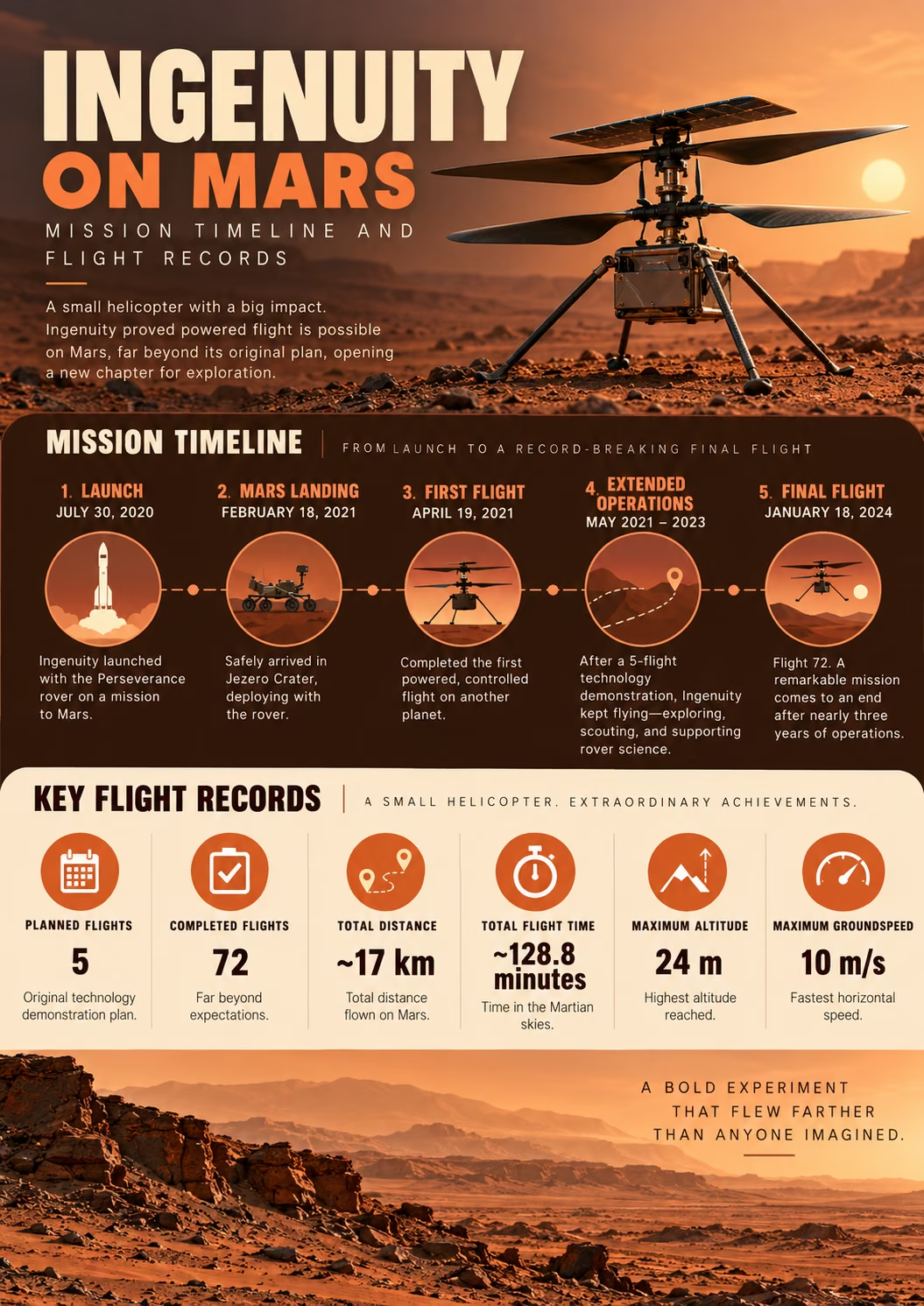
Ingenuity: planned vs completed flights: The helicopter completed 72 flights against an initial demonstration objective of up to five.
Ingenuity completed 14.4 times the originally planned maximum number of flights. The mission’s additional value came not simply from that numerical achievement, but from the opportunity to study long-term operation, changing atmospheric conditions, autonomous navigation, and repeated takeoff and landing on another planet.
Why Did NASA’s Ingenuity Helicopter Stop Flying?
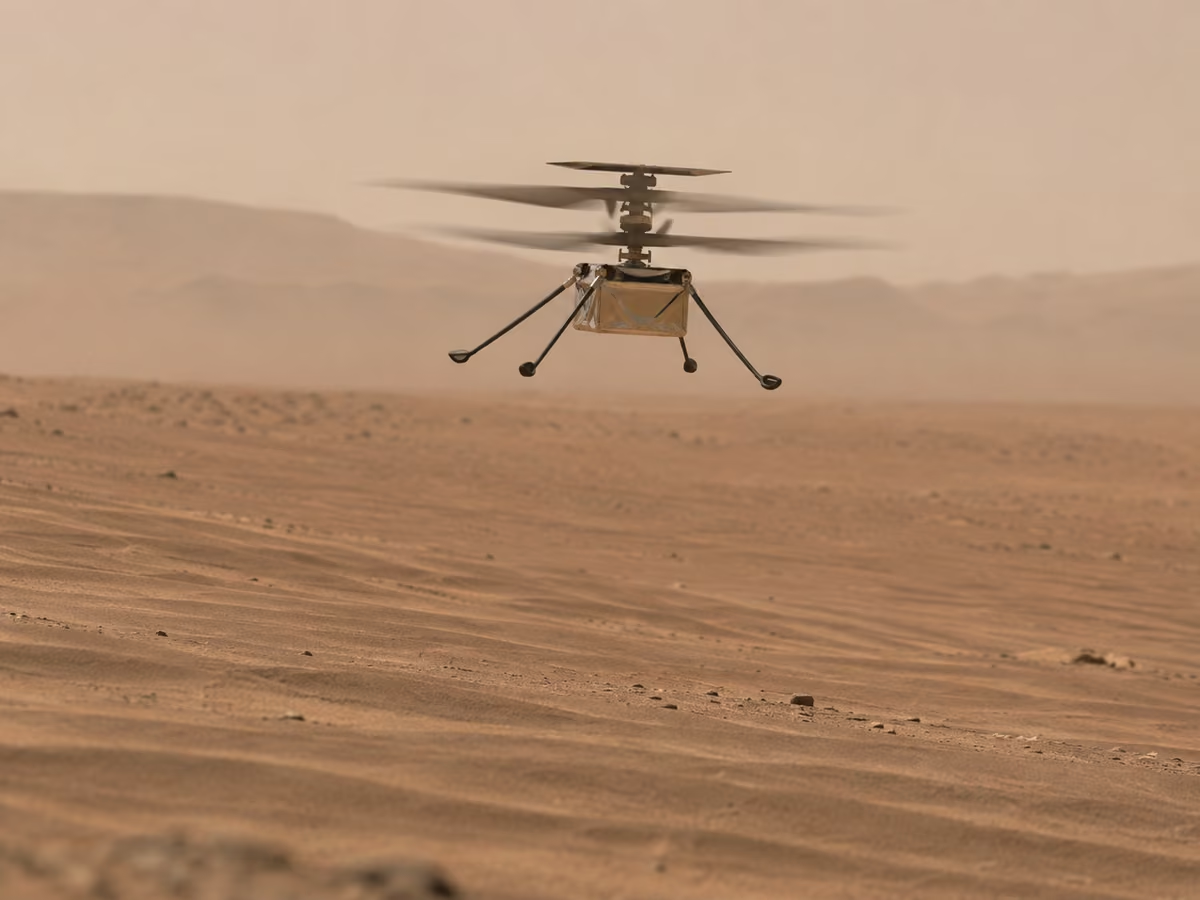
Ingenuity’s flying mission ended after its 72nd flight on January 18, 2024, when the helicopter suffered severe rotor-blade damage during landing.
NASA initially confirmed that the aircraft remained upright, but photographs later revealed damage that made further flight impossible. A subsequent investigation examined the helicopter’s navigation data, landing conditions, and visible damage.
The investigation identified a likely sequence involving unreliable visual navigation over relatively featureless terrain, excessive horizontal velocity at touchdown, and structural damage to the rotating blades. [7]
What Happened During Flight 72?
Flight 72 was intended to be a short vertical flight to evaluate Ingenuity’s systems and photograph the surrounding terrain. The flight followed an earlier operation that had ended with an unplanned landing.
On January 18, 2024, Ingenuity climbed approximately 12 meters above the Martian surface.
The helicopter hovered and collected images before beginning its descent approximately 19 seconds after takeoff.
By around 32 seconds, the aircraft had returned to the surface and communications had stopped.
NASA reestablished communications afterward, but subsequently received images showing significant rotor-blade damage.
The helicopter remained on the ground permanently, and NASA announced the conclusion of its flight mission on January 25, 2024.
How Rotor Blade Damage Ended the Flight Mission
Helicopter rotor blades experience substantial aerodynamic and centrifugal forces during operation. Their structural integrity is essential for generating predictable thrust and maintaining aircraft stability.
Damage to even one blade can produce an imbalance, generating excessive vibration and potentially affecting other components.
NASA’s investigation of Ingenuity’s final flight found evidence consistent with a hard landing that caused the aircraft to pitch and roll.
In the investigation’s most likely reconstruction, the resulting loads caused all four rotor blades to fracture near structurally vulnerable locations. Additional damage occurred as the rotor system continued rotating.
These failures left the aircraft incapable of safe flight.
Although Ingenuity’s electronics and some other systems remained functional, its rotor system could no longer support reliable airborne operations.
How Featureless Terrain Contributed to Navigation Problems
Ingenuity depended on visual features in the Martian terrain to estimate its horizontal movement.
Its downward-facing navigation camera tracked recognizable surface patterns. This worked well when the ground contained sufficient visual texture, including rocks, pebbles, and other distinct features.
During its final flight, Ingenuity was operating over terrain containing broad, relatively featureless sand ripples.
NASA’s investigation indicated that the navigation system likely failed to obtain sufficiently accurate motion estimates during descent.
The resulting position and velocity errors may have allowed excessive horizontal movement at touchdown.
Investigators concluded that a hard landing on sloping terrain was the most likely explanation for the subsequent rotor damage.
Importantly, NASA presented this as the most likely reconstructed accident sequence, not an event whose every detail could be independently observed. [7]
What NASA Learned From Ingenuity’s Final Flight
Ingenuity’s final flight revealed the importance of dependable navigation across a wide range of terrain conditions.
A navigation system designed for relatively flat, textured surfaces may encounter difficulties when operating over repetitive, visually uniform, or sharply changing landscapes.
Future aerial vehicles can benefit from more capable terrain recognition, improved state estimation, stronger landing-site assessment, and additional strategies for detecting uncertain navigation measurements.
The investigation also highlighted the importance of structural safety during touchdown and the relationship between navigation errors and mechanical damage.
Ingenuity’s engineering legacy therefore includes both its successful flights and the lessons learned from its final accident.
Even after its flying mission ended, NASA used the helicopter as a stationary engineering testbed. In April 2024, the team confirmed a software update that enabled continued autonomous data collection, and NASA subsequently reported weather and avionics measurements from the grounded aircraft. [7][10]
How Has Ingenuity Changed the Future of Planetary Exploration?
Ingenuity demonstrated that flying robots can operate successfully in environments where conventional Earth aircraft would face severe limitations.
The achievement introduced a new option for planetary mission designers. Rather than relying exclusively on orbiters, stationary landers, and surface rovers, future missions can consider aircraft capable of observing terrain from intermediate altitudes and moving between selected locations.
The engineering knowledge gained from Ingenuity also helps researchers understand the broader challenges of autonomous flight on other worlds.
How Ingenuity Proved Extraterrestrial Aerial Exploration Is Possible
Extraterrestrial aerial exploration involves using aircraft to investigate planetary environments beyond Earth.
Ingenuity demonstrated that a properly engineered rotorcraft can generate lift, navigate, maneuver, and land in the Martian atmosphere.
Before its mission, engineers had theoretical analyses and experimental evidence supporting the feasibility of Mars rotorcraft. Ingenuity supplied direct operational confirmation in the actual planetary environment.
Its successful flights also revealed how environmental conditions, energy constraints, and autonomous navigation affect long-term aircraft operations.
This information creates a foundation for designing future spacecraft that can combine aerial mobility with scientific observation.
Aircraft will not replace all other exploration platforms, but they can provide capabilities that complement those of surface and orbital spacecraft.
What Future Mars Aircraft Can Learn From Ingenuity
Future Mars helicopters may be larger, carry more sophisticated navigation equipment, and support scientific instruments that Ingenuity did not carry.
NASA has investigated designs that use improved rotor systems, increased payload capacity, and more advanced autonomous navigation.
One example is the Mars Chopper concept, which explores a substantially larger aircraft capable of carrying scientific instruments and traveling greater distances.
NASA also announced the SkyFall mission in March 2026, building on Ingenuity’s engineering heritage. NASA describes a planned mission involving three helicopters equipped for scientific exploration and aerial scouting. Its published schedule lists a targeted launch in late 2028, although future launch schedules can change.
SkyFall is designed to investigate Martian terrain, atmospheric conditions, and potential subsurface ice using instruments such as cameras and ground-penetrating radar.
Unlike Ingenuity, these future aircraft are intended to perform scientific investigations rather than only demonstrate flight technology. [12]
How Aerial Robots Could Transform Planetary Science
Aerial robots could eventually allow scientists to examine terrain that is difficult, slow, or hazardous for conventional rovers to reach.
Potential applications include high-resolution geological reconnaissance, terrain mapping, atmospheric measurements, and the investigation of remote surface features.
Aircraft equipped with specialized cameras, spectrometers, radar instruments, or environmental sensors could investigate multiple locations without requiring continuous ground travel between them.
However, aircraft designs must be adapted to their target environments.
Mars has a thin carbon-dioxide atmosphere and reduced gravity. Saturn’s moon Titan has a much denser atmosphere and different gravitational conditions, requiring a different approach to rotorcraft engineering.
NASA’s Dragonfly mission, under development for Titan, illustrates this broader direction. As of October 2026, Dragonfly is targeting a launch no earlier than 2028. NASA reported on October 23, 2026, that its flight system had completed a comprehensive simulated flight using flight-like computing hardware.
Ingenuity’s greatest contribution may therefore be the engineering precedent it established: autonomous aircraft can become practical tools for exploring worlds beyond Earth. [12][13]
Frequently Asked Questions About NASA’s Ingenuity Mars Helicopter
Ingenuity’s mission raises several important questions about the physics of flight, autonomous robotics, electrical propulsion, and planetary exploration.
The following answers summarize the main engineering principles and mission results, distinguishing between the capabilities Ingenuity successfully demonstrated and technologies that NASA continues developing for future aircraft.
How did NASA make a helicopter fly in Mars’s thin atmosphere?
NASA made helicopter flight possible on Mars by combining a lightweight aircraft structure with specially designed, high-speed rotors.
Ingenuity’s carbon-fiber rotor blades generated lift by accelerating the thin Martian atmosphere downward. Its low mass reduced the required thrust, while Mars’s weaker gravity further decreased the force needed to remain airborne.
The helicopter also used autonomous flight-control software to maintain stability.
Together, these technologies allowed Ingenuity to operate where an ordinary Earth helicopter would be unable to perform normally without substantial redesign.
Why did Ingenuity use two rotors instead of one?
Ingenuity used two coaxial counter-rotating rotors to help balance the reaction torque produced by the rotating blades.
In a conventional single-main-rotor helicopter, the motor’s torque tends to rotate the fuselage in the opposite direction. A tail rotor or another anti-torque system is normally required to counter this effect.
Ingenuity’s opposing rotors reduced the net reaction torque without requiring a separate tail rotor.
This configuration supported a compact, lightweight design, although the helicopter still needed active flight control to maintain orientation and stability.
Did Ingenuity have a human pilot?
Ingenuity did not have a human pilot controlling it in real time.
Engineers at NASA’s Jet Propulsion Laboratory planned flights, selected destinations, evaluated terrain, and uploaded flight instructions through the Mars communications system.
Once a flight began, the helicopter’s onboard computer controlled navigation, stabilization, and movement autonomously.
This autonomy was essential because radio signals take several minutes to travel between Earth and Mars.
By the time Earth-based operators received information about a problem, a short flight might already have ended.
How was Ingenuity powered on Mars?
Ingenuity used solar energy stored in rechargeable lithium-ion batteries.
A solar panel mounted above the rotor system collected sunlight during the Martian day and charged a battery system containing six lithium-ion cells.
The stored energy supplied electrical power for the motors, onboard computers, cameras, communication equipment, and thermal protection.
Electrical heaters also helped protect sensitive components during cold Martian nights.
Because the aircraft had limited battery capacity, NASA had to carefully manage flight duration, charging opportunities, heating demands, and other energy-consuming operations.
How did Ingenuity know where it was flying?
Ingenuity estimated its movement using a combination of visual navigation and onboard sensors.
Its downward-facing navigation camera tracked recognizable surface features, allowing software to estimate horizontal movement through image analysis.
An inertial measurement unit monitored acceleration and rotation, while a laser rangefinder measured distance above the ground.
The onboard navigation system combined these measurements to estimate the aircraft’s state.
Unlike Earth-based drones using satellite navigation, Ingenuity could not depend on GPS.
This visual navigation approach worked successfully across many flights but became less reliable over terrain with insufficient recognizable features.
How did Ingenuity communicate with NASA?
Ingenuity communicated with NASA through the Perseverance rover rather than transmitting directly to Earth.
A local radio link connected the helicopter to the Mars Helicopter Base Station aboard Perseverance.
Commands and engineering information could then pass between the rover and Earth through NASA’s planetary communications infrastructure.
Mars orbiters could serve as intermediate communications relays, while the Deep Space Network handled the long-distance Earth-spacecraft connection.
This arrangement reduced the communications hardware that Ingenuity needed to carry and allowed mission engineers to retrieve data after flights.
How many times did Ingenuity fly on Mars?
Ingenuity completed 72 flights between April 19, 2021, and January 18, 2024.
Its original technology demonstration was intended to include no more than five experimental flights during approximately 30 Martian days.
After successfully completing those tests, NASA expanded the mission to investigate operational applications, including aerial scouting and more ambitious flight maneuvers.
The helicopter ultimately accumulated approximately 128.8 minutes of airborne time and traveled about 17 kilometers.
These achievements provided extensive operational data that could not have been obtained from the original five-flight demonstration alone.
What was Ingenuity’s fastest and highest flight?
Ingenuity reached a maximum recorded altitude of approximately 24 meters above the Martian surface during Flight 61.
Its highest recorded groundspeed was 10 meters per second, equivalent to about 36 kilometers per hour. NASA reported that the helicopter achieved this speed during Flights 62, 68, and 69.
These were separate flight performance records.
The maximum altitude describes how far above the local surface the aircraft climbed, while groundspeed measures horizontal movement relative to the terrain.
The records demonstrated Ingenuity’s expanded operating capabilities beyond the limits originally anticipated for its initial technology demonstration.
Why did Ingenuity stop flying?
Ingenuity stopped flying because its rotor blades suffered severe damage during its 72nd flight on January 18, 2024.
NASA’s subsequent investigation concluded that unreliable visual navigation over relatively featureless sandy terrain was the most likely initiating problem.
In the reconstructed accident sequence, inaccurate motion estimates allowed excessive horizontal velocity during landing.
The resulting hard impact caused the aircraft to pitch and roll, placing damaging loads on the rotating blades.
The structural damage made further flight unsafe and impractical, although some onboard electronics continued functioning afterward.
Will NASA send more helicopters to Mars?
NASA is developing future helicopter capabilities for planetary exploration.
As of October 2026, NASA’s published SkyFall mission plan involves three Mars helicopters designed for aerial scouting and scientific investigations, with a targeted late-2028 launch.
NASA has also studied additional rotorcraft concepts, including larger aircraft capable of transporting scientific instruments across greater distances.
Separately, the agency’s Dragonfly mission is being developed to explore Saturn’s moon Titan using a rotorcraft designed specifically for that environment.
These efforts build on the engineering possibilities demonstrated by Ingenuity, although mission designs, funding, schedules, and objectives may change before launch.
Conclusion: How Ingenuity Redefined What Aircraft Can Do Beyond Earth
NASA’s Ingenuity Mars Helicopter transformed a difficult engineering proposal into a demonstrated capability for planetary exploration.
Its success required overcoming one of the most challenging problems in extraterrestrial aviation: producing enough aerodynamic lift in an atmosphere far thinner than Earth’s.
Engineers achieved this through a carefully optimized combination of high-speed counter-rotating blades, low-mass construction, rechargeable electrical power, autonomous navigation, and sophisticated flight-control software.
The first successful flight on April 19, 2021, lasted only 39.1 seconds, but it established a historic milestone. An aircraft had taken off, hovered, and landed under its own power on another planet.
What followed was equally significant. Ingenuity completed 72 flights, accumulated more than two hours of airborne time, traveled approximately 17 kilometers, and demonstrated the practical value of aerial reconnaissance on Mars.
Its final flight also provided important lessons about visual navigation, landing safety, and operating aircraft over unfamiliar terrain.
Ingenuity was never designed to be a permanent flying research platform. It was an experimental machine intended to answer a fundamental engineering question.
Could an aircraft fly on Mars?
Ingenuity answered that question through repeated, controlled flights in the real Martian environment.
Its legacy extends beyond its records. It established a foundation for future robotic aircraft that may carry scientific instruments, investigate remote geological environments, map terrain, and expand the reach of planetary exploration.
The mission showed that the sky is no longer a limit reserved for aircraft flying above Earth.
Sources
The following primary sources were used to verify the article’s engineering explanations, mission dates, aircraft specifications, flight statistics, accident investigation, and future mission information. Numerical references throughout the article correspond to these sources.
[1] NASA Science. Ingenuity Mars Helicopter: Official Mission Overview. Mission objectives, development history, achievements, and operational overview.
[2] NASA Jet Propulsion Laboratory. Ingenuity Landing Press Kit: Mission Spacecraft. Rotor specifications, materials, cameras, communications, batteries, electrical power, and aircraft design.
[3] NASA Goddard Space Flight Center. Mars Fact Sheet. Martian gravity, atmospheric composition, pressure, density, and environmental characteristics.
[4] NASA Jet Propulsion Laboratory. Mars Atmosphere Density Model. Seasonal atmospheric-density variations and adjustments to Ingenuity’s rotor speed.
[5] NASA Jet Propulsion Laboratory. NASA’s Ingenuity Mars Helicopter Succeeds in Historic First Flight. April 19, 2021, flight sequence, altitude, duration, and confirmation of successful operation.
[6] NASA Science. Ingenuity Mars Helicopter: Complete Flight Log (PDF). Official record of all 72 flights, individual durations, distances, speeds, altitudes, and final performance statistics.
[7] NASA Jet Propulsion Laboratory, December 11, 2024. NASA Performs First Aircraft Accident Investigation on Another World. Findings concerning Flight 72, navigation uncertainty, hard landing, and rotor-blade damage.
[8] NASA Jet Propulsion Laboratory. How NASA’s Mars Helicopter Will Reach the Red Planet’s Surface. Mars Helicopter Delivery System, mechanical deployment, and operational preparation.
[9] NASA Jet Propulsion Laboratory. Flying With Ingenuity: The Mars Helicopter. Engineering interviews covering low-density atmospheric testing and gravity-offload simulation.
[10] NASA Jet Propulsion Laboratory. After Three Years on Mars, NASA’s Ingenuity Helicopter Mission Ends. Mission longevity, winter operating challenges, and the end of flight operations.
[11] NASA Science. Perseverance Science Highlights. Jezero Crater’s geological significance, river-delta deposits, and the rover’s scientific objectives.
[12] NASA Science, 2026. SkyFall: Future Mars Helicopter Mission. Planned mission objectives, three-helicopter configuration, scientific instruments, and published launch schedule.
[13] NASA Jet Propulsion Laboratory, 2026. NASA Pushes Next-Gen Mars Helicopter Rotor Blades Past Mach 1. Rotor-speed limitations, blade-tip aerodynamics, and research into future Mars helicopter designs.
[14] NASA. 120 Years Ago: The First Powered Flight at Kitty Hawk. Historical connection between the Wright brothers and Ingenuity, including the Wright Flyer fabric carried to Mars.
Research verification: October 29, 2026. Mission statistics reflect Ingenuity’s completed flight program. Future mission dates and objectives reflect NASA’s published plans at the time of verification.