
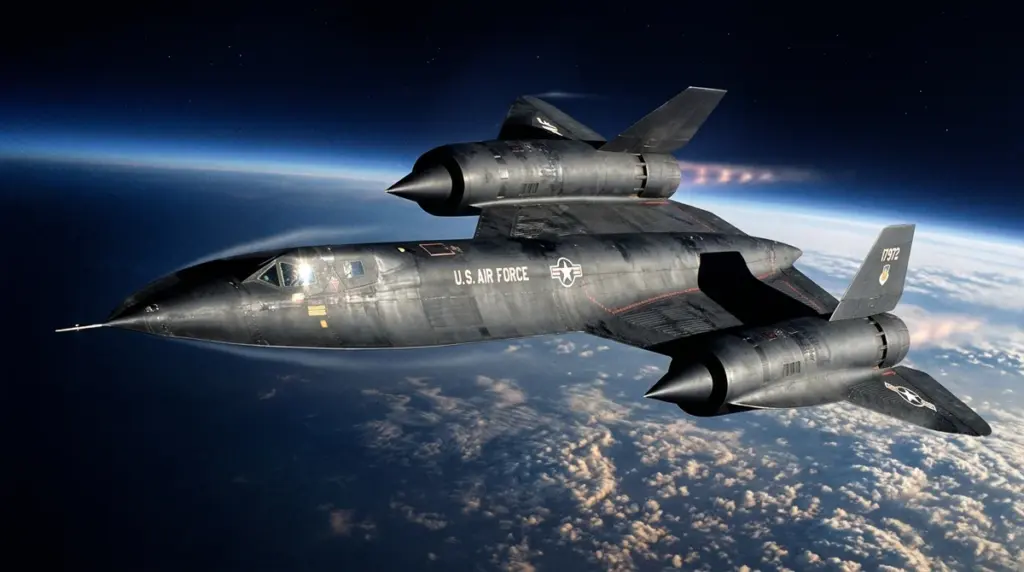
The Lockheed SR-71 Blackbird was one of the most extraordinary engineering achievements in aviation history. Designed by Lockheed’s Skunk Works during the Cold War, this long-range strategic reconnaissance aircraft could maintain speeds exceeding three times the speed of sound while operating above 80,000 feet.
Its remarkable performance was not simply the result of powerful jet engines. The Blackbird required a revolutionary combination of titanium alloys, high-temperature structural design, specialized fuel, aerodynamic shaping, and an advanced propulsion system that behaved differently from conventional jet engines at extreme speeds.
At Mach 3+, the aircraft encountered aerodynamic heating that could raise substantial portions of its structure to hundreds of degrees Fahrenheit. Its components expanded during flight, its fuel helped cool critical systems, and its moving engine inlet spikes controlled powerful shock waves to maintain efficient airflow.
Understanding SR-71 Blackbird engineering means understanding how materials science, thermodynamics, supersonic aerodynamics, and propulsion engineering worked together to make sustained high-speed flight possible.
SR-71 Blackbird: Key Specifications and Performance
The SR-71 was designed for sustained high-speed reconnaissance rather than short bursts of acceleration. Its propulsion system, structural materials, and fuel capacity supported prolonged Mach 3 cruise at altitudes beyond the reach of ordinary military aircraft of its era.
These published specifications establish the operating environment that shaped nearly every engineering decision. Maximum speed, altitude, and range depend on mission conditions, so published figures should not be interpreted as performance available simultaneously under every loading and atmospheric condition. [1], [2]
| Specification | SR-71 Blackbird |
|---|---|
| Manufacturer | Lockheed Skunk Works |
| First flight | December 22, 1964 |
| Primary mission | Strategic reconnaissance |
| Crew | 2 |
| Operational cruising speed | Approximately Mach 3.2 |
| Published maximum operating speed | Mach 3.3 |
| Operating altitude | Above 80,000 feet |
| Published ceiling | Above 85,000 feet |
| Engines | 2 Pratt & Whitney J58 |
| Rated thrust | 32,500 lbf per engine with afterburner |
| Length | 107 ft 5 in (32.74 m) |
| Wingspan | 55 ft 7 in (16.94 m) |
| Published range | More than 2,900 statute miles |
| Primary structural material | Titanium alloys |
| Specialized fuel | JP-7 |
The U.S. Air Force recorded a speed of 2,193.167 mph and an altitude of 85,068.997 feet on July 28, 1976, establishing records in the aircraft’s class. These were separate record performances rather than a single simultaneous speed-and-altitude result. [2]
What Made the SR-71 Blackbird Capable of Sustained Mach 3+ Flight?
The central engineering challenge was not reaching Mach 3 momentarily. It was maintaining that speed while protecting the aircraft’s structure, propulsion system, fuel, hydraulic equipment, instruments, and crew.
At extreme speed, aerodynamic drag and heating become closely connected. Increasing altitude reduces atmospheric density, but the aircraft must still generate enough lift and engine thrust to remain airborne. The Blackbird succeeded because its structure, engines, air intakes, fuel system, and aerodynamic configuration were optimized around a common high-speed operating environment.
How Fast and High Could the SR-71 Blackbird Fly?
The SR-71 commonly operated at approximately Mach 3.2, with operational altitudes exceeding 80,000 feet, or about 24.4 kilometers. Mach number expresses the aircraft’s true airspeed relative to the local speed of sound, which depends primarily on atmospheric temperature.
At an altitude where the speed of sound is approximately 295 meters per second, Mach 3.2 corresponds to roughly 944 meters per second, or 3,400 kilometers per hour. This is an illustrative calculation rather than an exact speed for every SR-71 mission.
High-altitude flight helped reduce aerodynamic loading because atmospheric density is much lower than near sea level. However, the thinner air also changed lift generation, engine airflow, and maneuverability. The aircraft therefore needed to operate inside a carefully defined combination of speed, altitude, temperature, and loading conditions. [1], [3]
What Were the Primary Engineering Challenges of Mach 3+ Flight?
The Blackbird’s engineers faced several problems that could not be solved independently. Aerodynamic heating could weaken conventional structural materials, while thermal expansion could distort assemblies or compromise sealed fuel tanks. Engine compressors had to process already-hot inlet air, and the aircraft needed sufficient thrust to overcome supersonic drag.
Another difficulty was endurance. Unlike an experimental aircraft that briefly accelerates to a high Mach number, the SR-71 remained at elevated temperatures long enough for its structure to experience substantial thermal soak.
This demanded materials that retained useful strength at high temperatures, an airframe that accommodated dimensional changes, and fuel and propulsion systems capable of surviving prolonged exposure to heat. [3], [4]
How Did Skunk Works Engineering Solve Interdependent Design Problems?
The Blackbird family emerged from Lockheed’s Advanced Development Projects organization, better known as Skunk Works, under the leadership of Clarence L. “Kelly” Johnson. The A-12 was developed for the CIA’s OXCART program and became the technological foundation for several related designs.
The YF-12 interceptor incorporated many Blackbird technologies, while the SR-71 adapted the concept into a two-seat strategic reconnaissance aircraft for the U.S. Air Force.
Skunk Works used tightly coordinated design, specialized fabrication, extensive wind-tunnel testing, and rapid evaluation of new engineering methods. The program demonstrated that high-speed aircraft development required the airframe, propulsion system, and thermal environment to be considered together rather than treated as separate engineering problems. [3]
Why Was Titanium Essential to the SR-71 Blackbird’s Structure?
Titanium was central to the SR-71’s ability to survive sustained high-temperature flight. Conventional aerospace aluminum alloys offered excellent strength-to-weight characteristics at ordinary aircraft operating temperatures, but the Blackbird’s projected thermal environment demanded materials with better elevated-temperature strength.
Titanium alloys offered a practical compromise between mass, structural strength, corrosion resistance, and heat resistance. They also introduced significant manufacturing challenges. Lockheed engineers had to develop specialized techniques to form, machine, fasten, and inspect extensive titanium structures.
Why Couldn’t Conventional Aluminum Alloys Meet the SR-71’s Requirements?
Aluminum is widely used in aircraft because it is relatively lightweight, easy to fabricate, and efficient for many airframe structures. However, the mechanical properties of common aerospace aluminum alloys deteriorate when exposed to sufficiently high temperatures for prolonged periods.
The SR-71’s predicted operating temperatures were beyond the practical continuous-service range of conventional aluminum airframe construction. Sustained exposure could reduce allowable strength, accelerate creep or overaging in susceptible alloys, and create unacceptable structural margins.
Replacing aluminum with titanium increased some manufacturing complexity and material density, but it allowed the airframe to tolerate temperatures that would severely constrain an aluminum-based design.
How Did Titanium Alloys Enable High-Temperature Flight?
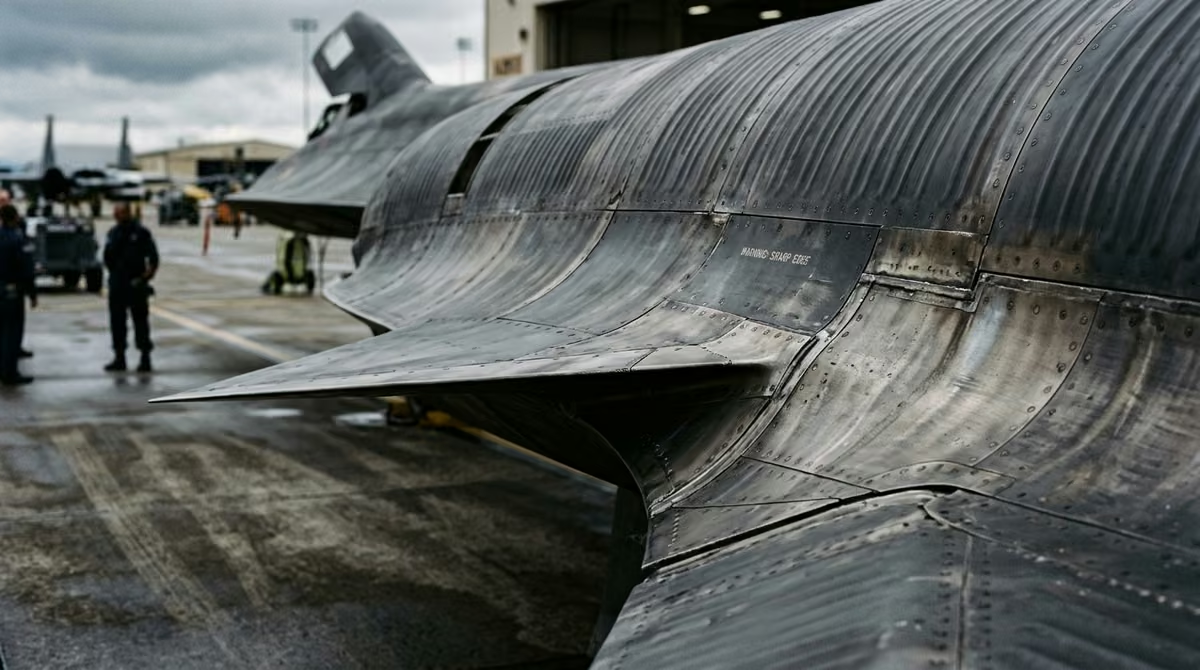
Titanium has a density of approximately 4.5 grams per cubic centimeter, compared with about 2.7 for aluminum and roughly 7.8 for many steels. Although titanium is heavier than aluminum by volume, suitable titanium alloys retain useful structural strength at temperatures where many aluminum alloys lose much of their engineering advantage.
Titanium also has a relatively low coefficient of thermal expansion compared with aluminum. That characteristic helped control dimensional changes, although it did not eliminate expansion.
The Blackbird program made extensive use of titanium alloys, including the beta titanium alloy known as B-120, or Ti-13V-11Cr-3Al. NASA’s historical documentation describes the unusually demanding materials and manufacturing problems associated with producing the Blackbird family. [3], [5]
| Property | Typical aluminum alloy | Typical titanium alloy |
|---|---|---|
| Density | ~2.7 g/cm³ | ~4.5 g/cm³ |
| Elastic modulus | ~70 GPa | ~100–120 GPa |
| Thermal expansion coefficient | ~22–24 × 10⁻⁶/K | ~8–10 × 10⁻⁶/K |
| Thermal conductivity | Generally higher | Generally lower |
| Elevated-temperature strength | Limited for many conventional aerospace grades | Better for suitable alloys |
| Manufacturing | Comparatively easy | More demanding |
These are representative material ranges, not certified properties for a particular SR-71 alloy or component. Exact values depend on alloy composition, heat treatment, temperature, and product form.
What Made Titanium Fabrication Difficult?
Titanium processing posed several unusual challenges for Lockheed engineers. Machining could cause substantial tool wear and heat concentration around the cutting edge. Forming and joining operations required carefully controlled temperatures, tooling, and procedures to avoid damaging components.
Contamination was particularly troublesome. NASA historical accounts describe difficulties involving cadmium deposits from tooling and chlorinated water during titanium fabrication. Such contamination could adversely affect certain manufacturing operations and material integrity.
Producing the airframe consequently required new fabrication procedures, improved handling practices, and strict attention to materials compatibility. The Blackbird was therefore not simply an aircraft made from an expensive metal. It was a major advance in manufacturing titanium structures at industrial scale. [3], [5]
How Did Heat-Resistant Materials and High-Temperature Seals Protect the Aircraft?
Titanium was not suitable for every component, and not every location experienced the same temperature. The Blackbird used different materials for specialized applications, including selected high-temperature alloys, nonmetallic materials, and temperature-resistant sealing systems.
Critical systems such as hydraulics, fuel transfer equipment, windows, fasteners, and engine components needed to retain their intended properties under heat, pressure, vibration, and repeated thermal cycling.
For example, the aircraft’s canopy incorporated specialized multilayer glazing to help isolate crew compartments from the external thermal environment. Fuel seals and joints also needed to accommodate structural movement. Selecting these materials required engineers to consider chemical compatibility, service temperature, thermal expansion, and long-term durability together. [3]
How Did Aerodynamic Heating Affect the SR-71 at Mach 3?
Aerodynamic heating was one of the defining physical constraints of the SR-71. As the aircraft traveled through the atmosphere at extraordinary speed, air decelerated and compressed around its surface. Viscous effects within the boundary layer also contributed to heating.
This was not simply the aircraft rubbing against air like two dry solid surfaces. It involved compressible-fluid thermodynamics and the conversion and redistribution of flow energy.
The resulting temperature distribution depended on airspeed, altitude, aircraft shape, local airflow, and heat transfer. Engineers had to design for both local hot spots and prolonged structural heating.
What Causes Aerodynamic Heating During Supersonic Flight?
At supersonic speeds, airflow undergoes significant pressure and temperature changes as it passes through shock waves and slows near an aircraft’s surface. Near leading edges and stagnation regions, the flow’s kinetic energy contributes to increases in local thermal energy.
Viscous dissipation in the boundary layer also affects the heat transferred to the structure. The magnitude of heating depends on the local flow condition and the temperature difference between the air and the surface.
For the SR-71, sustained Mach 3 operation meant this heating continued long enough to affect large portions of the airframe. Thermal management therefore became a structural and propulsion requirement rather than a minor environmental consideration.
What Is Stagnation Temperature, and Why Does It Matter?
Stagnation temperature is the temperature an airflow would reach if brought to rest adiabatically, meaning without exchanging heat with its surroundings. For an ideal gas with constant specific heats, its relationship to Mach number is given by:
Here, T0 is stagnation temperature in kelvins, T is static air temperature, \gamma is the ratio of specific heats, and M is Mach number.
As an illustration, assume a static air temperature of 216.65 K, a Mach number of 3.2, and \gamma=1.4.
This theoretical result does not mean every SR-71 surface reached 387°C. Actual skin temperatures depend on recovery temperature, boundary-layer properties, surface heat transfer, radiation, and internal cooling. The calculation illustrates why aerodynamic heating becomes severe at high Mach numbers.
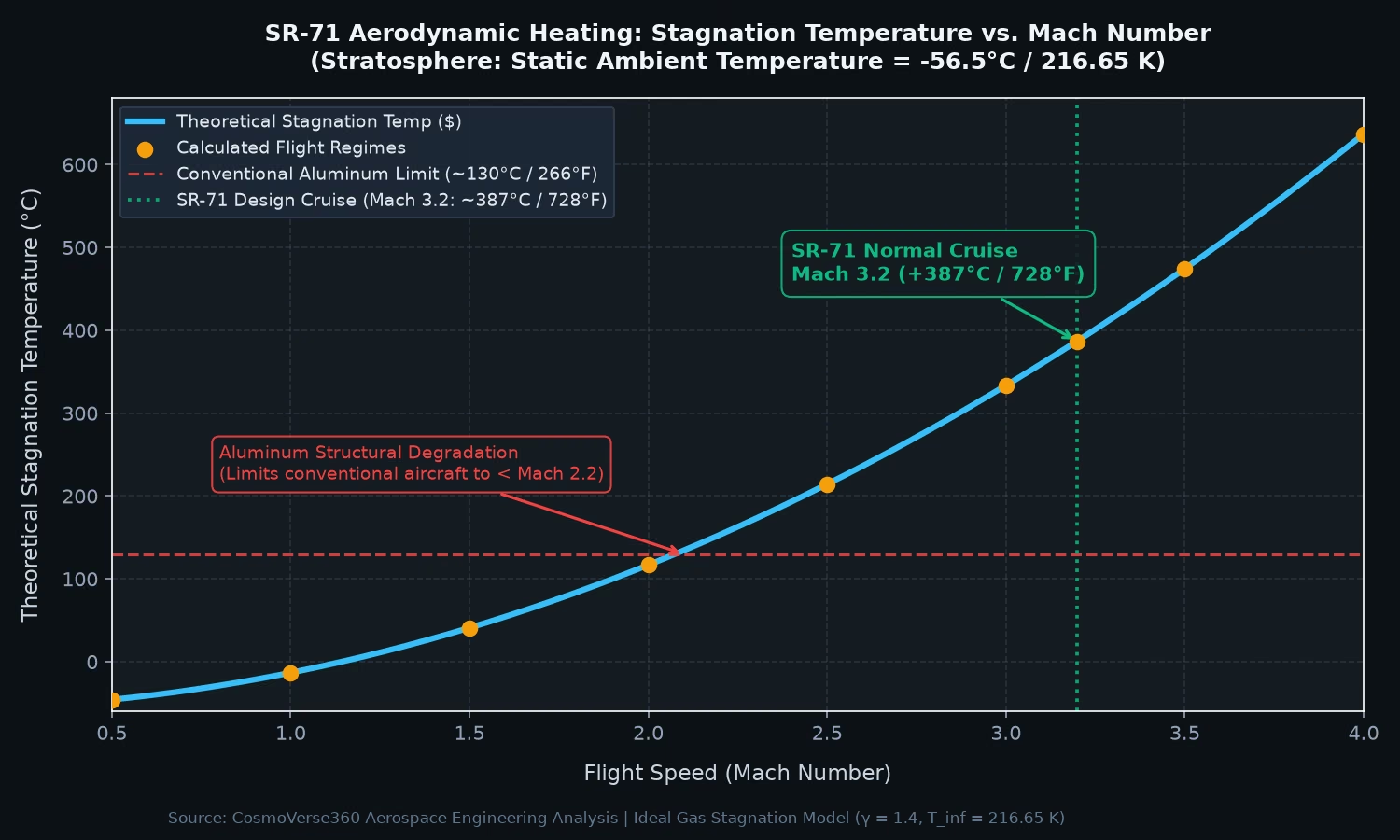
| Flight Speed (Mach) | Stagnation Temperature (°C) | Stagnation Temperature (°F) | Temperature Rise Over Ambient (K) | Operating Regime & Significance |
|---|---|---|---|---|
| Mach 0.5 | -45.7 °C | -50.3 °F | +37.1 K | Subsonic loiter and aerial tanker rendezvous |
| Mach 1.0 | -13.2 °C | 8.2 °F | +43.3 K | Transonic shock formation and drag rise transition |
| Mach 1.5 | +40.9 °C | 105.6 °F | +97.5 K | Low supersonic climb; moderate skin heating |
| Mach 2.0 | +116.8 °C | 242.2 °F | +173.3 K | Conventional aluminum structural design limit |
| Mach 2.5 | +214.6 °C | 418.3 °F | +271.1 K | Engine inlet spike translation begins |
| Mach 3.0 | +333.5 °C | 632.3 °F | +389.9 K | High supersonic cruise; compressor bypass opens |
| Mach 3.2 | +386.6 °C | 727.9 °F | +443.1 K | SR-71 Normal Design Cruise Speed (85,000 ft) |
| Mach 3.5 | +474.3 °C | 885.7 °F | +530.8 K | Airframe thermal limitation boundary |
| Mach 4.0 | +636.8 °C | 1178.2 °F | +693.3 K | Extreme theoretical limit for uncooled structures |
How Hot Did the SR-71’s Airframe Become?
Published temperature values vary because different parts of the aircraft experienced different heating conditions. NASA describes Blackbird heat-soak temperatures exceeding 600°F (316°C), while NASA’s broader Blackbird research documentation shows substantial temperature variations over the aircraft’s surface.
Some sources describe hotter localized regions, particularly around the leading edges and propulsion system. Those temperatures should not be interpreted as a uniform temperature across the entire aircraft.
Engine inlets, wing surfaces, fuselage panels, windows, and internal equipment all experienced different thermal environments. Designers consequently evaluated temperature distributions and gradients, not just a single headline maximum temperature. [4], [6]
How Did Thermal Conductivity and Specific Heat Capacity Affect Material Behavior?
Thermal conductivity describes how readily heat passes through a material. Specific heat capacity describes the amount of energy required to raise the temperature of a unit mass of that material by one degree.
These properties influenced how quickly Blackbird components heated, how temperature differences developed within structures, and how long cooling took after high-speed flight.
Titanium’s relatively low thermal conductivity compared with aluminum could create steeper local temperature gradients under some conditions. Structural thickness, connections between components, and heat transfer to internal systems also affected the temperature distribution. Engineers therefore had to analyze not only strength at high temperature but also the rates at which components gained and released heat.
How Did Thermal Radiation Help the Blackbird Dissipate Heat?
Thermal radiation allows a surface to emit electromagnetic energy based on its temperature and emissivity. For an idealized gray surface, radiative emission can be approximated using the Stefan-Boltzmann relationship:
Here, ε is emissivity, σ is the Stefan-Boltzmann constant, A is emitting area, and T is absolute temperature.
The SR-71’s black finish assisted thermal radiation because of its surface properties. Historical NASA and Smithsonian accounts also describe radar-signature-related functions of selected coatings.
However, emitted radiation is only part of the thermal balance. Aerodynamic heat transfer, internal conduction, and environmental conditions all influence whether a surface gains or loses heat. A black appearance alone does not establish an exact emissivity or radar-absorption performance. [3], [7]
How Did the SR-71’s Airframe Expand Without Structural Failure?
When an aircraft experiences large temperature changes, its structure expands and contracts. The SR-71’s engineers had to anticipate these dimensional changes while maintaining aerodynamic shape, structural integrity, and reliable mechanical operation.
The problem was complicated by uneven heating. A wing panel, fuel tank, engine mount, and fuselage frame could expand by different amounts because they were exposed to different temperatures or made from different materials.
Rather than attempting to prevent all expansion, designers incorporated features that accommodated controlled structural movement.
How Much Did Thermal Expansion Change the Aircraft’s Dimensions?
Linear thermal expansion can be estimated using:
Where ΔL is the change in length, α is the coefficient of thermal expansion, L0 is the original length, and ΔT is the temperature change.
For example, consider a hypothetical 10-meter titanium member with a coefficient of thermal expansion of 8.6\times10^{-6}/K experiencing a uniform temperature increase of 250 K.
The result is approximately 21.5 millimeters of free expansion.
This is an illustrative calculation, not a measured SR-71 component movement. Real airframe expansion involves complex three-dimensional geometry, different temperatures, restraints, joints, and thermal gradients.
What Is Airframe Thermal Stress?
Thermal stress develops when a material’s natural expansion or contraction is restricted. If a metal component is heated uniformly and allowed to expand freely, thermal expansion alone does not necessarily create significant internal stress.
If the same component is constrained, its tendency to expand can generate forces and stresses within the structure. Uneven heating can also create stresses even when the entire assembly is not rigidly fixed.
This makes thermostructural engineering essential for high-speed aircraft. Designers must analyze mechanical loading and temperature effects simultaneously, including the possibility that aerodynamic forces and thermal deformation interact. NASA’s YF-12 research confirmed the importance of these combined effects. [8]
Why Did the SR-71 Use Corrugated Skin Panels?
Selected wing skin areas of the Blackbird used corrugated titanium construction. Corrugations can increase stiffness in particular directions and help thin panels accommodate thermal deformation without experiencing the same behavior as flat, highly constrained sheets.
This design was part of a larger structural approach that included appropriate fastening arrangements and allowances for movement. NASA documentation describes wing skin fasteners capable of sliding as panels expanded and contracted.
Corrugated panels should not be understood as making the entire wing flexible in every direction. Their behavior depended on geometry, orientation, attachment, and the surrounding structural framework. [3]
Why Did the SR-71 Leak Fuel While on the Ground?
One of the Blackbird’s best-known characteristics was its tendency to seep fuel while parked or operating at relatively low temperatures. Its integral fuel tanks used portions of the aircraft structure as tank boundaries, making sealing especially challenging when that structure expanded and contracted.
The sealing system was designed around a demanding thermal environment, and certain gaps could allow JP-7 to seep when the aircraft was cold. High-speed heating changed the dimensions of tank panels and joints.
However, the popular claim that every SR-71 had to leak heavily is misleading. Leakage was managed through inspection and maintenance, and unacceptable leakage was not simply ignored.
The aircraft’s refueling requirements also involved range, fuel loading, mission planning, and operational constraints, not merely replacing fuel lost on the ground. [1], [9]
How Did Engineers Prevent Thermal Fatigue?
Thermal fatigue occurs when repeated heating and cooling contribute to progressive damage, particularly where components experience constrained expansion, localized stress concentration, or changing material properties.
For the SR-71, repeated acceleration to high Mach numbers followed by cooling during descent exposed structural components to thermal cycles over their service lives.
Managing this problem required suitable materials, deliberate joint design, engineering limits, inspection, and replacement or repair of affected components. It was not possible to eliminate every fatigue mechanism, but engineers could reduce damaging stresses and establish maintenance procedures intended to preserve acceptable structural integrity.
How Did the SR-71 Manage Heat Using Its Fuel System?
The Blackbird’s JP-7 fuel was more than an energy source for its two engines. It also participated in managing the aircraft’s thermal environment.
At sustained high speed, hydraulic fluids, lubrication systems, engine components, and other equipment could generate or absorb substantial heat. Using fuel as a heat sink allowed thermal energy to be transferred into a fluid that would subsequently be consumed by the engines.
This integration helped solve the difficulty of providing conventional cooling capacity in an aircraft operating at extreme temperatures and altitudes.
Why Was JP-7 Jet Fuel Necessary?
JP-7 was developed to meet demanding requirements for high-temperature aircraft operation. Its relatively low volatility and thermal stability made it better suited than ordinary aviation fuels for the Blackbird’s operating environment.
Fuel could experience significant heating during flight and while passing through aircraft systems. A suitable fuel needed predictable handling characteristics and resistance to undesirable thermal degradation under specified conditions.
The J58’s unusual ignition requirements also led to the use of triethylborane, commonly abbreviated TEB, as an ignition aid. TEB ignites readily when exposed to air and was used to initiate combustion during engine starting and certain afterburner operations.
JP-7 was not impossible to ignite, but its characteristics differed substantially from fuels used in typical commercial aviation. [9]
How Did the Thermal Management System Use Fuel as a Heat Sink?
A heat sink absorbs thermal energy from another component or fluid. In the SR-71, fuel could receive heat through specialized heat exchangers before being delivered for combustion.
The basic engineering process involved transferring heat from a hotter aircraft system into cooler JP-7. As the fuel absorbed energy, its temperature increased while the equipment being cooled remained within a more acceptable operating range.
This method did not make thermal energy disappear. It redistributed heat and ultimately moved part of that energy into the propulsion flow.
The approach connected the fuel system directly to component protection, engine operation, and the aircraft’s overall thermal balance.
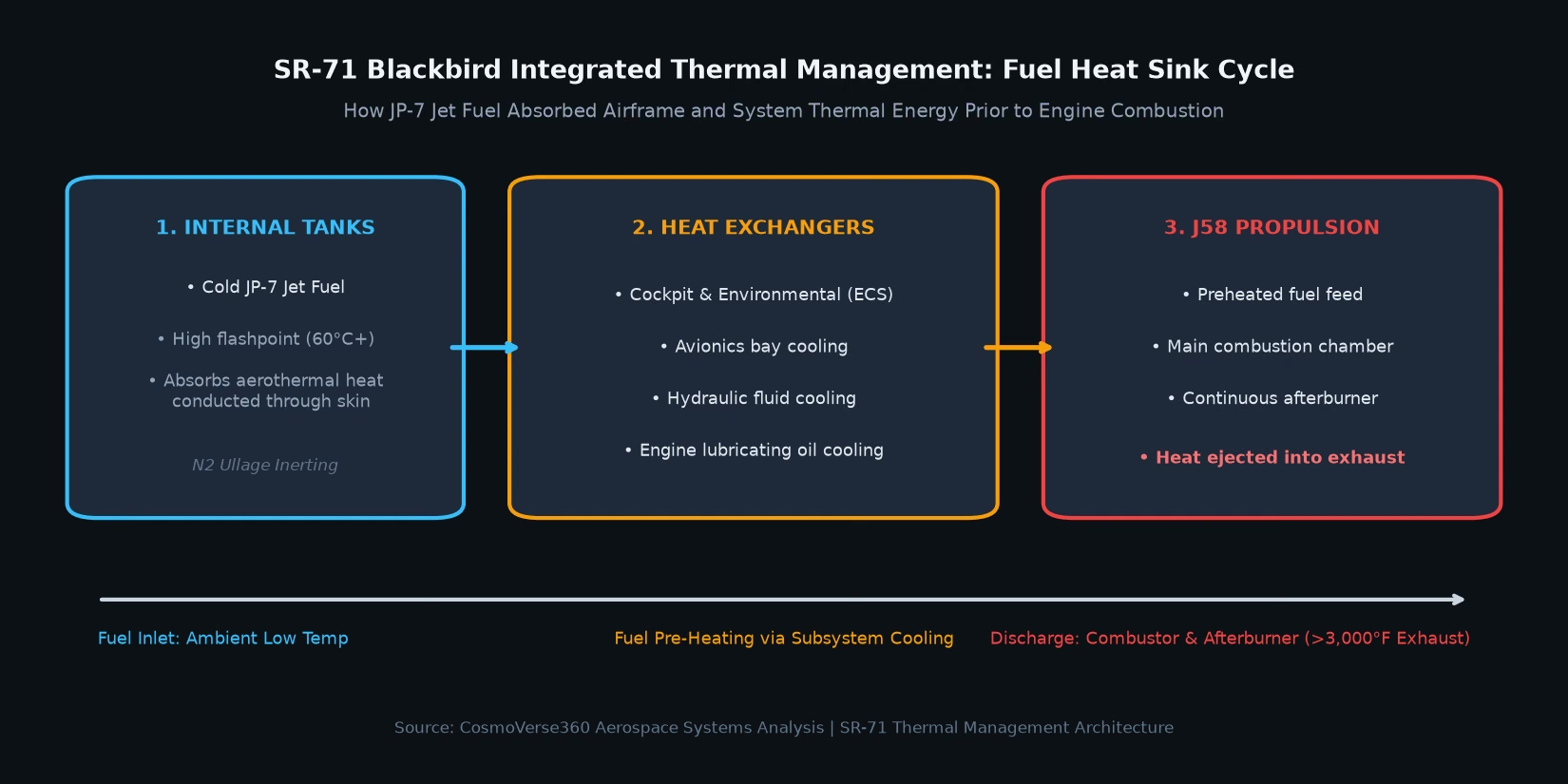
1. Internal Tanks
Cold JP-7 jet fuel stored in fuselage and wing tanks acts as the primary heat sink, protected by inert nitrogen gas ullage.
2. Heat Exchangers
Fuel absorbs waste heat from cockpit air conditioning, avionics bays, flight control hydraulic systems, and engine oil.
3. Fuel Feed Delivery
Preheated fuel is routed toward the engine fuel control systems and high-pressure pumps at controlled temperatures.
4. Propulsion Ejection
Fuel is burned in the J58 main combustors and afterburners, safely discharging the absorbed thermal energy into the exhaust stream.
How Did Fuel-Based Heat Exchangers Protect Aircraft Components?
A heat exchanger transfers energy between two fluids or media without requiring them to mix directly. In aircraft applications, hot oil or hydraulic fluid may pass through separate channels from the cooling medium.
In the Blackbird, fuel-based cooling was particularly valuable because conventional cooling methods faced limitations at high altitude and high flight Mach number.
Heat exchanger performance depended on temperature differences, heat-transfer surfaces, flow rates, and the physical properties of the fluids involved. Engineers had to balance cooling effectiveness with pressure losses and system reliability.
The same fuel that supported propulsion therefore also helped maintain conditions necessary for prolonged operation of temperature-sensitive equipment.
What Were the Limits of Fuel-Based Cooling?
Fuel could absorb heat only within its permitted operating temperature range. As fuel temperature increased, the available temperature difference for cooling other components could decrease.
Fuel quantity also changed throughout a mission. As the aircraft consumed fuel, the remaining thermal capacity and flow-management requirements could change. The practical cooling capability depended on the complete system, including pumps, flow paths, heat exchangers, and operating conditions.
Consequently, fuel-based cooling was not an unlimited solution. It was one component of a broader thermal strategy that also relied on materials selection, insulation, structural design, and appropriate flight-envelope limits.
How Did the Pratt & Whitney J58 Engine Work at Mach 3+?
The Pratt & Whitney J58 was one of the Blackbird’s most important technological achievements. Its architecture allowed sustained afterburning operation and enabled it to work with a sophisticated supersonic inlet system.
At extreme flight speeds, the engine could not be understood independently of the air entering its compressor. The variable-geometry inlet, compressor, bypass arrangements, afterburner, and ejector nozzle formed a closely integrated propulsion system.
NASA’s engineering history emphasizes that at Mach 3 cruise, much of the overall propulsive force was associated with the inlet and exhaust system rather than the turbojet engine core alone. [3], [10]
What Made the Pratt & Whitney J58 Different From a Conventional Turbojet?
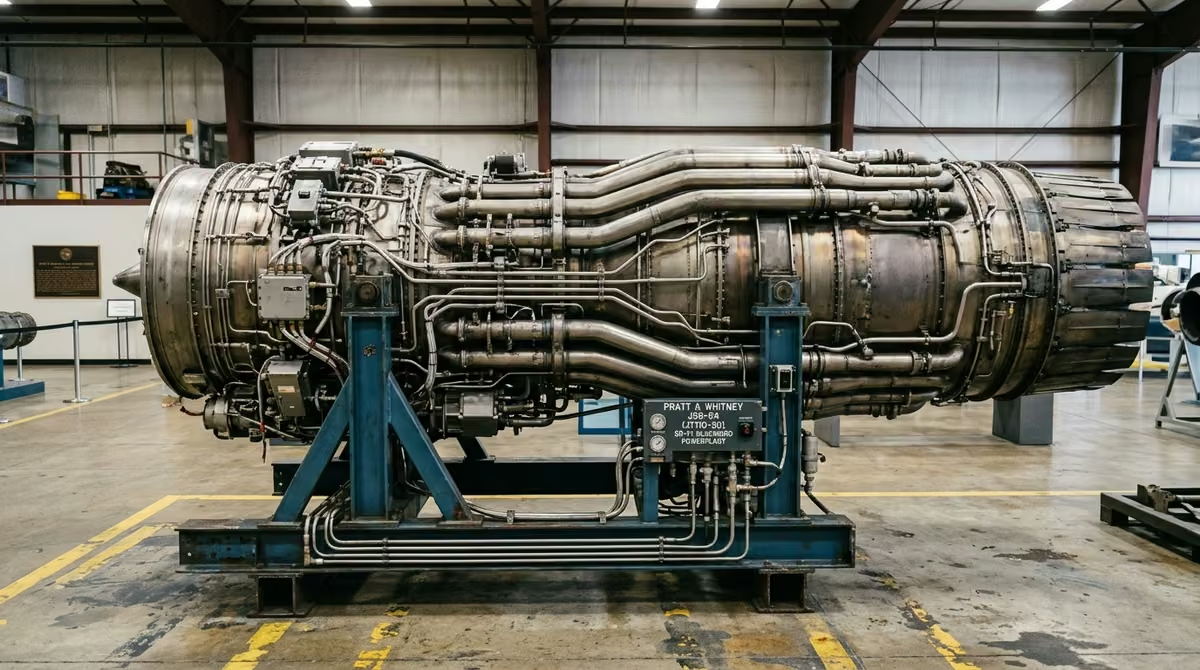
The J58 had a nine-stage axial compressor, combustion chamber, two-stage turbine, and afterburner. In basic configuration, it was a turbojet, but it was optimized for an operating environment far beyond that of most ordinary turbine engines.
At high Mach numbers, the engine inlet compressed the incoming air substantially before it reached the compressor. This increased inlet-air temperature and altered the compressor’s operating conditions.
The J58 incorporated specialized airflow control, compressor bleed arrangements, heat-resistant components, and continuous-afterburner capability to cope with this environment.
The U.S. Air Force museum identifies it as the first engine designed for extended operation using its afterburner and one of the central technologies behind the Blackbird’s performance. [10]
Was the J58 a Turbojet or a Ramjet?
The J58 was fundamentally a turbojet, not a pure ramjet. It retained its compressor, combustor, and turbine throughout flight and did not mechanically transform into a different engine.
However, the integrated propulsion system exhibited ramjet-like characteristics at high speed. Air compression produced by the inlet became increasingly important, while part of the airflow could bypass the main engine core and proceed toward the afterburner.
A pure ramjet has no rotating compressor or turbine and relies on forward motion and inlet compression to support combustion.
Describing the Blackbird’s propulsion system as a turbo-ramjet is therefore useful as a functional analogy, but it should not obscure the actual J58 architecture. [3]
How Did the Air-Bleed Bypass System Improve High-Speed Operation?
At sufficiently high flight speeds, the J58’s compressor bleed system directed a portion of compressor airflow through external bypass passages toward the afterburner region.
This helped manage compressor operating conditions as the inlet delivered hotter, higher-pressure air. It also allowed part of the propulsion airflow to avoid passing through the full compressor-turbine core.
The bypass system should not be confused with the separate inlet bypass doors, which helped regulate airflow and pressure within the supersonic inlet duct.
These were different mechanisms working together. One affected airflow within the engine, while the other helped coordinate the air intake with engine demand. [3], [11]
What Role Did the Afterburner Play in Mach 3+ Flight?
An afterburner adds fuel downstream of the turbine, allowing further combustion in the exhaust stream. This raises exhaust energy and can significantly increase the thrust generated by the propulsion system.
Most afterburning military turbojets use this capability intermittently because of its high fuel consumption and thermal demands. The J58, however, was specifically designed to operate with sustained afterburning during high-speed cruise.
This required an engine and exhaust system capable of tolerating prolonged exposure to elevated temperatures.
Although afterburning consumed substantial fuel, the Blackbird’s high-speed cruise represented a comparatively favorable operating regime for its particular propulsion configuration. [1], [10]
What Were the Main Combustion and Thermal Constraints?
The J58 had to operate with high inlet-air temperatures, demanding compressor conditions, substantial combustion temperatures, and continuous afterburner use. Its components needed to withstand temperature gradients, vibration, pressure changes, and repeated operating cycles.
The engine’s main combustor did not operate as a scramjet combustor. Airflow through the turbojet’s combustion process was subsonic, as is typical for turbine engines.
This distinction matters because true supersonic combustion is a different propulsion regime associated with scramjet research.
The Blackbird’s engineering achievement was maintaining controlled combustion and efficient propulsion while managing complex supersonic airflow outside and upstream of the engine core.
How Did the SR-71’s Variable-Geometry Inlets Control Supersonic Airflow?
The Blackbird’s engine inlets were among the most technically sophisticated parts of the aircraft. Each inlet had a movable conical spike and a controlled system of internal flow passages and doors.
A turbojet compressor cannot simply accept unrestricted Mach 3 airflow at its face. The incoming air must be slowed and compressed in a controlled manner, while minimizing harmful pressure losses and flow distortion.
At high speed, inlet performance played a major role in total propulsion effectiveness, making the intake much more than a passive opening in front of the engine. [3], [12]
Why Were Variable-Geometry Air Inlets Necessary?
An inlet that performs efficiently at low speed may not work efficiently at Mach 3. As aircraft speed changes, the ideal shock-wave configuration, inlet capture area, pressure recovery, and airflow demand also change.
The SR-71 used variable geometry to maintain acceptable conditions across different parts of the flight envelope. The system included movable spikes and controlled bypass doors, allowing the inlet to respond to changes in Mach number and engine requirements.
Without such adaptation, the inlet could experience excessive pressure losses, flow distortion, or instability.
Variable geometry was therefore essential for combining relatively conventional takeoff and landing operations with sustained high-supersonic cruise.
How Did the SR-71’s Inlet Spike Work?
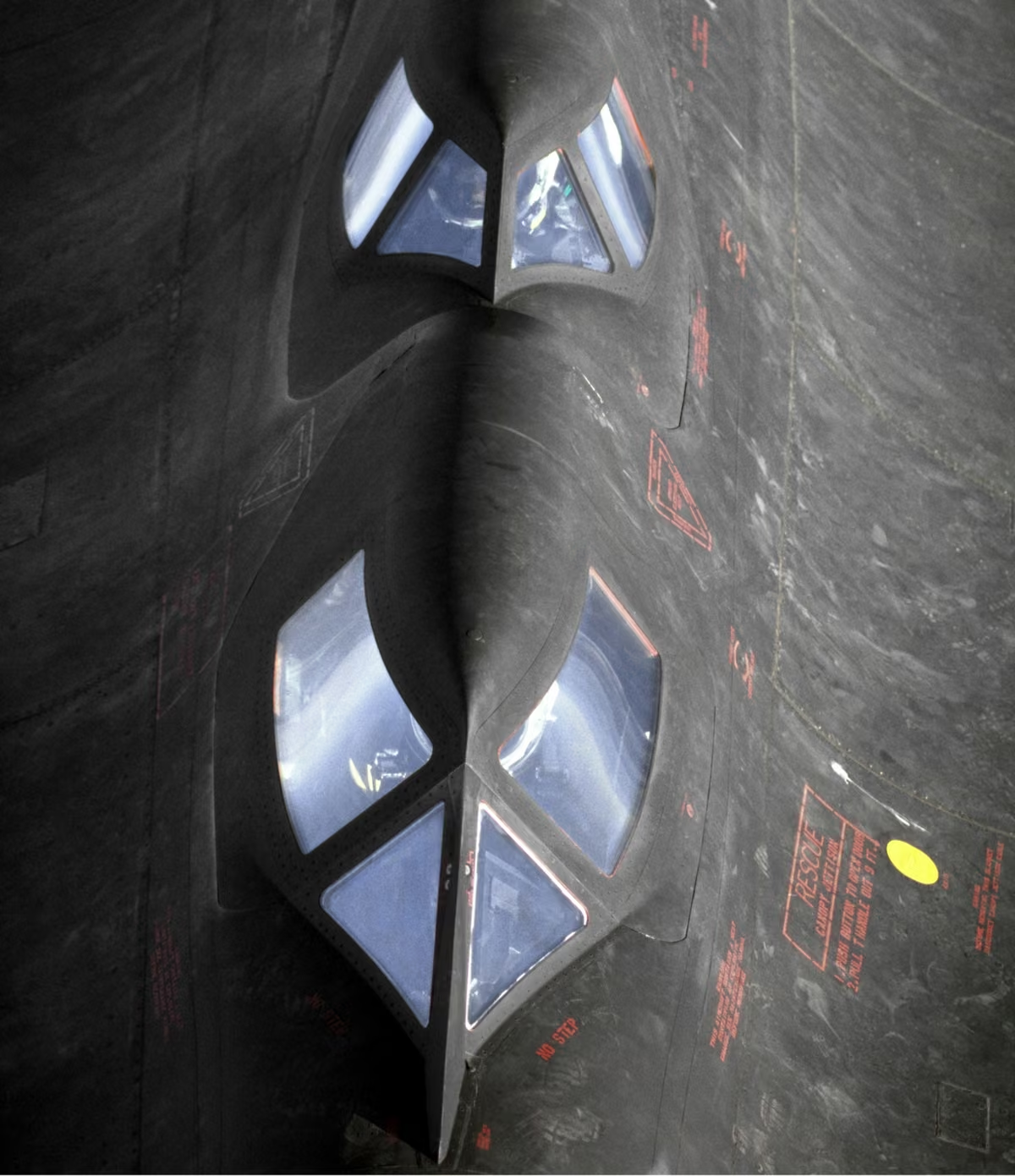
Each engine inlet had a pointed conical centerbody, commonly called the inlet spike. At high speeds, the spike helped establish shock waves that compressed and slowed the air entering the intake.
Its position changed according to the aircraft’s operating condition. In the high-speed regime, the spike retracted to help maintain the desired shock pattern and inlet geometry.
The system coordinated spike position with other inlet controls, including bypass doors.
The spike did not create propulsion by itself. It formed part of an inlet system that managed pressure, airflow direction, shock-wave location, and the conditions delivered to the engine. [12]
How Did Oblique and Normal Shock Waves Compress the Air?
An oblique shock wave occurs at an angle to the incoming supersonic airflow. Across the shock, pressure and temperature rise while the Mach number decreases, although the downstream airflow can remain supersonic.
A normal shock wave acts approximately perpendicular to the airflow and reduces a supersonic stream to subsonic speed.
The SR-71’s mixed-compression inlet exploited combinations of external and internal compression to manage airflow efficiently.
Careful shock positioning allowed substantial compression before the compressor while limiting avoidable total-pressure losses. The arrangement was highly sensitive to operating conditions, making active inlet control essential.
What Is Inlet Pressure Recovery?
Inlet pressure recovery measures how effectively an air intake preserves total pressure while delivering airflow to the engine. Total pressure is important because it represents the flow’s capacity to support subsequent compression and propulsion.
Shock waves, viscous losses, boundary-layer effects, and flow separation can reduce total pressure.
For a high-speed aircraft, minimizing these losses is especially important because the inlet performs a substantial portion of the overall compression process.
An efficient inlet provides favorable conditions for the turbojet compressor, while a poorly performing inlet reduces available thrust and can increase the risk of flow instability.
What Caused an SR-71 Inlet Unstart?
An inlet unstart occurred when the stable supersonic compression pattern broke down, causing the terminal shock system to move out of its intended position.
This could produce a sudden reduction in inlet pressure recovery and a sharp change in the propulsive force generated by that side of the aircraft.
If one inlet unstarted while the other remained properly started, the imbalance could produce a strong yawing motion. Pilots described these events as exceptionally violent.
Improved inlet control systems and recovery procedures reduced the frequency and severity of unstarts, but inlet stability remained an important engineering and operational consideration. [12], [13]
SR-71 Blackbird Engineering Simulation Video: How the Aircraft Worked
This detailed 3D engineering animation examines the Blackbird’s aerodynamics, J58 engines, inlet spikes, fuel system, aircraft controls, and other important components.
The presentation was produced by Animagraffs and published on March 1, 2024. Its technical reconstruction draws on contributions acknowledged from aerospace museum personnel, former SR-71 crew members, and a former J58 program manager. It is an explanatory visualization, not an official engineering simulation or original flight-test recording.
3D engineering animation by Animagraffs. Key chapters: Supersonic aerodynamics at 03:18, J58 engines at 10:18, Inlet spikes at 15:49, and Fuel thermal management at 23:48. Watch on YouTube.
How Did Supersonic Aerodynamics Shape the Blackbird’s Design?
The SR-71’s distinctive appearance was a direct consequence of its operating requirements. Its long fuselage, highly swept delta wings, pronounced chines, and integrated engine nacelles contributed to aerodynamic performance at extreme speeds.
At Mach 3, airflow behaves very differently from the airflow around an ordinary passenger aircraft. Shock waves, pressure changes, boundary-layer effects, and compressibility strongly influence lift and drag.
The Blackbird’s geometry was developed through extensive aerodynamic analysis and testing to balance high-speed efficiency, stability, structural loads, and reconnaissance mission requirements.
Why Was the SR-71’s Fuselage So Long and Narrow?
A slender fuselage helps manage pressure disturbances and shock formation during supersonic flight. At these speeds, abrupt changes in cross-sectional area can create stronger flow disturbances and increase wave drag.
The Blackbird’s elongated shape supported a relatively smooth overall distribution of aircraft volume while accommodating fuel, reconnaissance equipment, crew stations, and structural components.
Its aerodynamic configuration was not determined by a single principle. Designers had to balance supersonic drag with internal packaging, stability, radar-signature considerations, and structural requirements.
The result was a highly integrated aircraft whose fuselage and wings worked together aerodynamically rather than behaving as entirely separate components.
How Did the Delta Wing Configuration Support Mach 3 Flight?
The SR-71 used a highly swept delta-wing configuration. Strong wing sweep can reduce certain compressibility effects at high flight speeds and allows designers to create a relatively thin aerodynamic form suitable for supersonic cruise.
Delta wings can also provide useful internal structural volume and distribute loads through a broad wing root.
However, this configuration involves compromises. Lift and drag characteristics at lower speeds differ from those at high Mach numbers, and landing and takeoff performance require careful consideration.
The SR-71’s wing design therefore reflected the need to prioritize sustained high-speed efficiency while retaining manageable low-speed handling characteristics.
What Were the Blackbird’s Chines, and Why Were They Important?
Chines are pronounced extensions along the sides of an aircraft’s forward fuselage. On the SR-71, they helped blend the fuselage with the wing and influenced the distribution of aerodynamic lift.
At certain angles of attack, chines can contribute to vortex formation and alter stability and control characteristics. Their aerodynamic role is particularly significant because they affect the airflow around the forward aircraft body.
The Blackbird’s chines also contributed to its overall shaping for radar-signature reduction.
These structures illustrate how a single feature could satisfy multiple design objectives, combining aerodynamic efficiency, stability, and survivability considerations within the same aircraft geometry. [3], [7]
What Is Wave Drag, and How Did Engineers Reduce It?
Wave drag is a component of aerodynamic drag associated with compressibility effects and shock-wave formation. It becomes especially important as aircraft approach and exceed the speed of sound.
At high Mach numbers, aircraft geometry affects where shocks form and how strongly the airflow is compressed. Changes in fuselage cross-section, wing sweep, and component integration all influence wave drag.
The SR-71’s slender shape and swept surfaces helped manage these effects. Engineers also had to consider interference drag where different aircraft components interacted.
Reducing drag mattered because every additional unit of resistance increased the thrust and fuel required for sustained high-speed operation.
How Did the Boundary Layer Affect Engine Inlet Performance?
The boundary layer is the region of airflow close to an aircraft surface where viscosity causes velocity to change between the wall and the outer flow.
As boundary-layer air approaches an engine inlet, its lower momentum and potentially uneven properties can reduce inlet efficiency or contribute to unstable flow conditions.
At supersonic speeds, interactions between shock waves and the boundary layer can create flow separation, pressure losses, and distortion.
The Blackbird’s inlet system required careful management of these effects through its geometry, bleed arrangements, and airflow controls. The objective was to deliver sufficiently uniform and stable airflow to the compressor throughout its operating range.
How Did the SR-71 Balance Speed, Altitude, and Structural Loads?
The SR-71’s extraordinary speed was possible partly because it operated in the thin upper atmosphere. Reduced atmospheric density allowed the aircraft to travel at high true airspeed without experiencing the enormous dynamic pressures that would occur at the same speed near sea level.
However, flying higher also reduced the amount of air available for lift and engine operation. The aircraft needed to maintain enough dynamic pressure for aerodynamic control while avoiding excessive loads and temperatures.
Its usable flight envelope was therefore determined by several competing physical constraints.
What Is Dynamic Pressure?
Dynamic pressure is an important parameter in aerodynamics because it relates fluid density and velocity to aerodynamic loading.
It is defined as:
Here, q represents dynamic pressure, ρ is air density, and V is true airspeed.
For illustration, an aircraft traveling at 950 meters per second through air with a density of 0.040 kilograms per cubic meter experiences:
That is approximately 18.1 kilopascals.
The values are illustrative rather than a documented SR-71 flight condition. This equation helps explain why an aircraft can travel extremely fast at high altitude while maintaining manageable aerodynamic loads.
What Defined the SR-71’s Flight Envelope?
An aircraft’s flight envelope describes the combinations of speed, altitude, maneuvering load, and other operating parameters within which it can safely operate.
For the Blackbird, important constraints included available thrust, aerodynamic loading, structural temperature, inlet stability, and fuel-system operating conditions.
Maximum Mach number was therefore not determined solely by the amount of thrust produced by its engines. Even if thrust was available, continued acceleration could impose unacceptable temperatures on certain structural components.
The resulting operating envelope required disciplined flight management, especially during acceleration, high-speed cruise, descent, and aerial refueling.
How Did Structural Temperature Limits Restrict Flight Performance?
Temperature was a major factor limiting sustained Blackbird performance. Increasing Mach number raised stagnation temperature and could increase heat transfer into exposed components.
As structural temperatures increased, engineers had to consider changes in allowable material strength, deformation, joint behavior, and component durability.
NASA’s Blackbird development history identifies structural temperature restrictions as a primary limitation on the aircraft’s design cruise speed of Mach 3.2. [3]
This distinction explains why a theoretical propulsion capability or an exceptional high-speed flight does not establish a safe continuous operating speed under all conditions. Sustainable performance must satisfy both structural and propulsion limits.
How Did Thermal Engineering Affect SR-71 Ground Operations and Missions?
The Blackbird’s unusual thermal environment influenced operations well beyond high-altitude cruise. Maintenance crews had to work with specialized fuels, materials, seals, hydraulic systems, landing gear, and other equipment designed for the aircraft’s demanding conditions.
Takeoff and landing introduced challenges different from Mach 3 flight. High landing speeds and substantial aircraft mass affected tires and brakes, while major temperature changes influenced fuel tanks and structural assemblies.
Mission planning also needed to account for substantial fuel consumption, aerial refueling, and the changing thermal state of the airframe.
Why Did the SR-71 Require Specialized Landing Tires?
The SR-71 used specialized landing tires designed for its high-speed, high-load operating conditions. Heat generated during landing and braking placed demands on wheel and tire assemblies, while the aircraft’s overall operating environment required additional attention to materials and safety.
Nitrogen inflation was used to avoid some problems associated with oxygen and moisture in ordinary compressed air, particularly under demanding temperature conditions.
The tires also needed appropriate structural strength and resistance to wear.
It is important to distinguish the properties of the tire itself from those of the wheel, braking system, and inflation gas. Each component addressed different aspects of landing-gear reliability.
Why Was Aerial Refueling Important to SR-71 Missions?
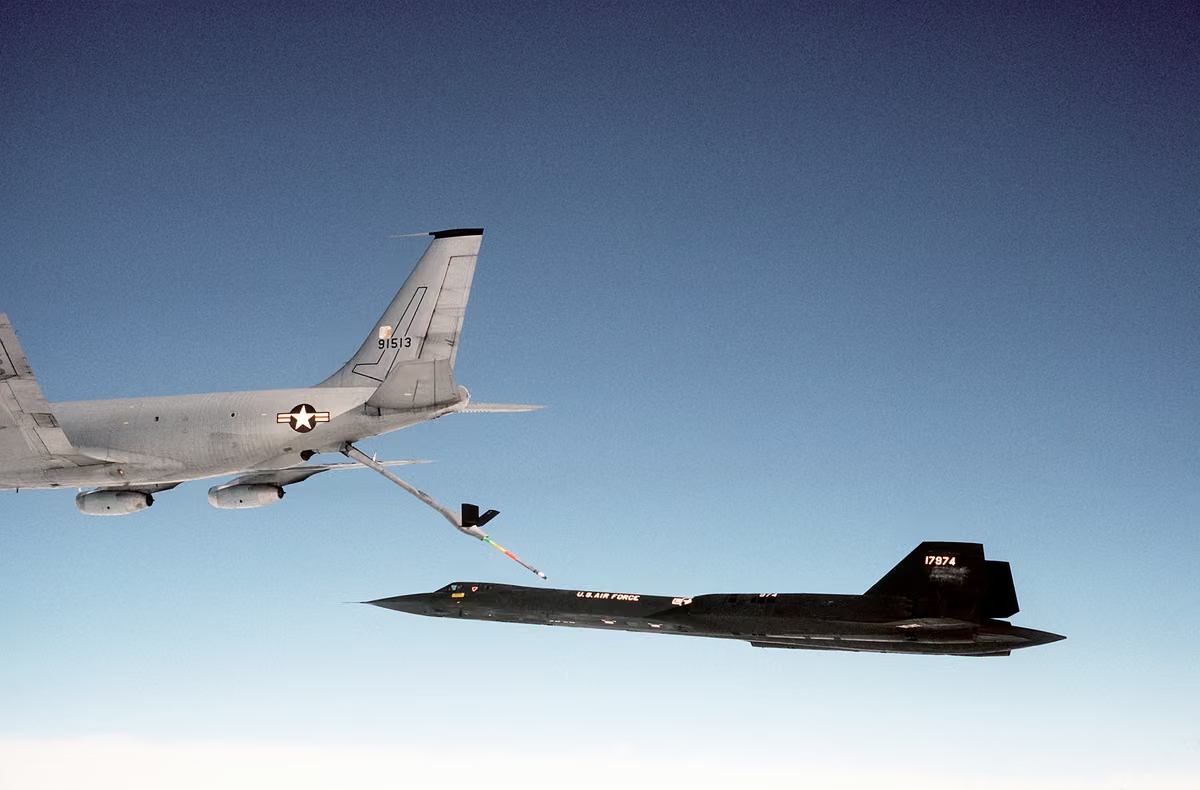
The Blackbird consumed substantial amounts of fuel, especially during acceleration and sustained high-speed operation. Aerial refueling helped extend the aircraft’s range and made demanding reconnaissance missions practical.
The specially equipped KC-135Q tanker became closely associated with SR-71 operations because it could support the aircraft’s JP-7 fuel requirements.
During refueling, the Blackbird descended and slowed to conditions compatible with the tanker. Cooling during these lower-speed segments affected the airframe’s dimensions, including the fuel tank structure.
Refueling was therefore both a logistical and operational maneuver, with implications for mission timing, fuel quantity, thermal state, and subsequent acceleration back to high-speed cruise. [1]
What Happened to the Blackbird During Heating and Cooling Cycles?
During takeoff and climb, the Blackbird began transitioning from relatively cool ground conditions toward the much hotter environment of high-speed flight.
As it accelerated, aerodynamic heating increased, causing external surfaces and structural members to expand. Some components reached elevated temperatures more rapidly than others, producing temporary temperature gradients.
During deceleration and descent, the aircraft gradually cooled, and structural components contracted.
These repeated cycles influenced sealing behavior, component clearances, structural stresses, and maintenance requirements. Engineers therefore had to understand the full thermal cycle, not simply the aircraft’s temperature during steady cruise.
How Was the SR-71 Tested for Thermal and Structural Safety?
The Blackbird family’s development demanded research methods capable of reproducing the combined effects of high-speed aerodynamic forces and extreme heating.
Traditional ground testing could measure structural strength under mechanical loads, but Mach 3 flight required engineers to understand how the structure behaved when substantial thermal loads were present simultaneously.
NASA and the U.S. Air Force used Blackbird-family aircraft as research platforms to investigate these interactions. The results improved experimental methods, aerodynamic models, structural predictions, and understanding of sustained high-speed flight. [8]
What Was Mach 3 Thermal-Structural Testing?
Mach 3 thermal-structural testing involved evaluating aircraft components or complete structures under temperature and load conditions representative of high-speed flight.
Engineers used laboratory heating equipment, instrumentation, and analytical models to investigate how materials and structures responded as temperature changed.
Such testing helped reveal potential problems associated with expansion, thermal stress, deformation, and interactions between heating and mechanical loads.
The YF-12 research program demonstrated that complex flight-temperature distributions could be reproduced in a laboratory environment. This made it possible to study structural behavior under controlled conditions and compare the results with observations from actual flight. [8]
How Did NASA Study the SR-71 and YF-12?
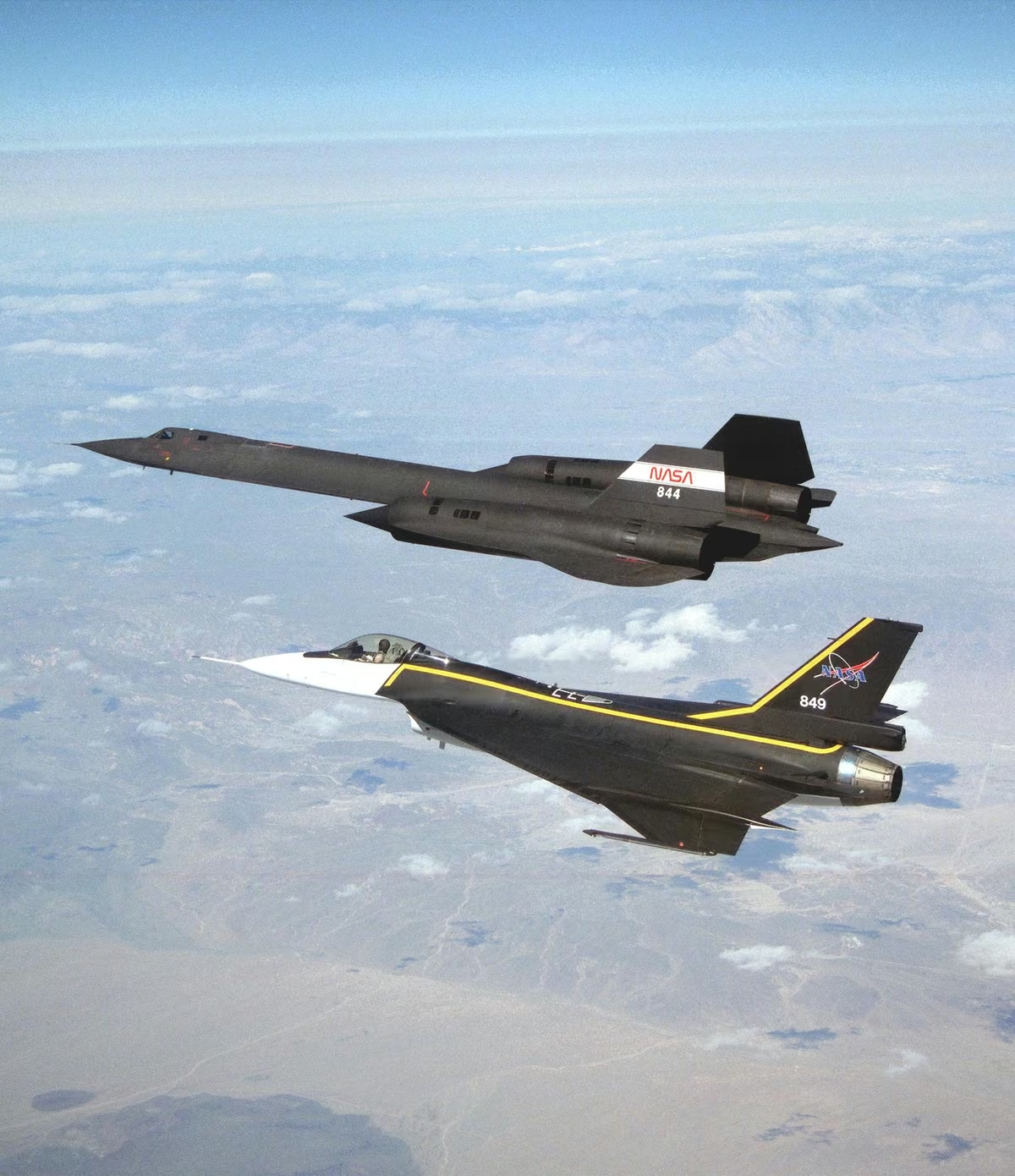
NASA’s research into the Blackbird family began with YF-12 aircraft and later included SR-71 aircraft used as high-speed research platforms.
The joint NASA-Air Force YF-12 program investigated aerodynamic heating, structural loads, boundary-layer behavior, propulsion system interactions, high-altitude turbulence, and inlet performance.
During the 1990s, NASA operated SR-71 aircraft for additional research involving aerodynamics, propulsion, instrumentation, atmospheric measurements, and experimental technologies.
These programs demonstrated the value of having an operational aircraft capable of sustaining extreme conditions long enough to collect meaningful scientific measurements. The research helped validate methods useful beyond the Blackbird program itself. [4], [8]
How Were Engineering Predictions Compared With Flight-Test Results?
Engineers used instruments such as temperature sensors, strain gauges, and pressure-measurement systems to observe how Blackbird structures behaved during flight.
Analytical predictions and wind-tunnel results could then be compared with measured temperatures, loads, and deformations.
An especially important aspect of the YF-12 research involved distinguishing structural strain caused by aerodynamic loading from strain caused by heating. Researchers compared flight data with ground tests that recreated the aircraft’s thermal environment.
This approach helped assess prediction methods and identify where models needed improvement.
The broader lesson was that sophisticated calculations require experimental validation, particularly when multiple physical effects interact. [8]
Did the SR-71 Blackbird Use Stealth Technology?
The SR-71 incorporated radar-signature-reduction measures, but its approach to survivability differed from that of later aircraft designed around comprehensive low-observable requirements.
The Blackbird combined aircraft shaping, selected radar-absorbing materials, speed, altitude, and reconnaissance mission planning.
Its unusual geometry was influenced by both aerodynamic and radar considerations. Nevertheless, the aircraft was not invisible to radar, and its radar-signature management should not be equated directly with that of modern stealth aircraft.
How Did Radar Cross-Section Reduction Influence the Aircraft’s Design?
Radar cross-section, or RCS, describes how strongly an object reflects radar energy toward a radar receiver under specified measurement conditions.
The Blackbird’s designers considered how aircraft shape and materials affected radar reflections. The aircraft’s chines, blended surfaces, and selected nonmetallic components contributed to signature-management efforts.
However, reducing radar cross-section involves more than simply creating an unusual outline. Reflection characteristics depend on radar frequency, polarization, viewing angle, surface geometry, and material properties.
The SR-71 represented an early application of radar-signature engineering integrated with aerodynamic and structural requirements, rather than a fully modern all-aspect low-observable design. [3], [7]
Did the Black Surface Coating Have Thermal and Radar-Related Functions?
The Blackbird’s dark finish was associated with thermal radiation management and, in selected applications, radar-signature reduction.
A surface coating’s infrared emissivity is distinct from its ability to absorb or reflect radio-frequency electromagnetic waves. These properties occur in different parts of the electromagnetic spectrum and depend on different material characteristics.
NASA historical accounts describe special coatings with heat-radiating and radar-absorbing roles, while Smithsonian accounts discuss radar-absorbing materials and ferrite-containing finishes. [3], [7]
The important engineering point is that one material system can potentially provide more than one function, but the functions should not be confused or assumed to be equivalent.
Why Was the SR-71 Not Equivalent to a Modern Stealth Aircraft?
Modern low-observable aircraft are generally designed to reduce detection opportunities across multiple aspects of their shape, materials, apertures, and operational configuration.
The SR-71 incorporated some radar-signature-reduction measures, but its survivability depended heavily on exceptional speed, altitude, and mission planning.
Its design priorities also included extremely demanding thermal and propulsion requirements that would influence many of the same structural and external features relevant to radar detection.
The Blackbird therefore belongs to the history of low-observable engineering, but it should not be described as having the same integrated stealth capabilities or operational characteristics as later aircraft designed primarily around reduced observability.
What Engineering Lessons Did the SR-71 Leave for Modern Aerospace Design?
The Blackbird remains important because it demonstrated what can be achieved when a complex aircraft is designed as an integrated system.
Its technologies addressed challenges in high-temperature materials, fuel-based cooling, supersonic inlet control, aerodynamic design, and thermal-structural testing.
Although modern aerospace engineering uses more advanced computational methods, manufacturing technologies, and materials, many of the fundamental problems remain relevant.
The lessons are particularly valuable for sustained high-speed aircraft, propulsion research, and systems operating under severe thermal and mechanical loads.
How Did the Blackbird Advance High-Temperature Materials Engineering?
The SR-71 demonstrated that titanium alloys could be used extensively in a large aircraft intended for sustained high-temperature operation.
Its development forced engineers to address problems involving fabrication methods, contamination, forming, joining, and structural analysis.
The resulting experience provided valuable lessons about selecting materials according to their actual operating environments rather than relying solely on room-temperature properties.
The broader contribution was not a single titanium alloy or manufacturing technique. It was the demonstration that high-temperature structural requirements could drive a comprehensive redesign of materials, production methods, inspection practices, and aircraft architecture.
What Did the SR-71 Teach Engineers About Integrated Thermal Management?
The Blackbird showed that thermal management must begin at the aircraft-system level. Its fuel system, propulsion equipment, external structure, and internal components all interacted through energy transfer.
Using JP-7 as a heat sink illustrated how an existing aircraft resource could support more than one essential function.
At the same time, this approach introduced constraints related to fuel temperature, flow rates, chemical stability, and operating conditions.
The lesson for modern engineers is that cooling arrangements should be evaluated alongside the systems that generate heat and the mission conditions under which that heat must be managed.
How Did Its Propulsion and Inlet Technology Influence High-Speed Flight Research?
The SR-71 demonstrated the importance of integrating air intakes, engine compressors, bypass systems, and exhaust nozzles.
At Mach 3, the inlet performed substantial compression and played a significant role in overall propulsion effectiveness. Stable shock-wave control was essential for maintaining performance and aircraft handling.
The Blackbird family also provided NASA with research platforms for improving understanding of inlet behavior and control technology.
Although the J58 was not a modern turbine-based combined-cycle engine, its integration with a high-speed inlet remains a valuable historical example for engineers studying advanced airbreathing propulsion systems.
Why Is the SR-71 Still Studied in Aerospace Engineering?
The SR-71 is an unusually complete case study in multidisciplinary aerospace engineering.
It illustrates how a design decision in one discipline can affect several others. Choosing titanium improved elevated-temperature structural capability but complicated manufacturing. Flying at high altitude reduced density-related aerodynamic loading but changed lift and propulsion conditions. Advanced air inlets improved high-speed performance but introduced complex control requirements.
Its development also demonstrates the importance of physical experimentation and flight testing.
Modern engineering students can learn not just how individual Blackbird systems worked, but how those systems were coordinated to satisfy the aircraft’s demanding mission requirements.
Frequently Asked Questions About SR-71 Blackbird Engineering
The SR-71 is surrounded by technical questions and popular misconceptions, particularly concerning its titanium structure, fuel leakage, engine operation, and maximum speed.
Many of these questions arise because the aircraft operated in a flight regime far beyond that of ordinary passenger and military aircraft. Understanding the correct engineering explanations requires distinguishing simplified descriptions from actual mechanical processes, documented performance, and operating limitations.
Why Was the SR-71 Made Mostly of Titanium?
The SR-71 used extensive titanium construction because its sustained Mach 3 flight produced temperatures that exceeded the practical structural limits of many conventional aluminum aerospace alloys.
Titanium alloys offered useful elevated-temperature strength, comparatively low thermal expansion, and a favorable strength-to-weight relationship for the mission.
Titanium was not the lightest possible metal, nor was it completely resistant to heat. It was selected because its combination of properties provided an effective solution to the aircraft’s demanding structural environment.
How Hot Did the SR-71 Get at Mach 3?
Substantial portions of the Blackbird’s airframe experienced temperatures reaching several hundred degrees Fahrenheit during sustained high-speed operation.
NASA reports heat-soak temperatures exceeding 600°F, while published accounts describe higher temperatures in certain localized regions. These figures refer to different surfaces, positions, or conditions rather than one uniform aircraft temperature.
The stagnation temperature of the airflow may also differ significantly from the actual temperature of a structural surface.
Understanding SR-71 heating therefore requires considering the local temperature distribution, heat-transfer behavior, and operating conditions rather than relying on a single maximum value.
Why Did the SR-71 Leak Fuel Before Takeoff?
The Blackbird used integral fuel tanks, meaning portions of the airframe formed boundaries of the fuel storage system.
Thermal expansion and contraction affected these structures and their sealing arrangements. When the aircraft was relatively cool, some joints could allow fuel seepage.
The problem was associated with the aircraft’s unusual structural and thermal requirements, but it was still subject to maintenance and inspection.
The Blackbird’s tendency to leak fuel did not mean fuel leakage was necessary for propulsion, and it was not the sole reason the aircraft frequently required aerial refueling.
How Did JP-7 Fuel Help Cool the Aircraft?
JP-7 acted as an energy source and as a heat sink within the Blackbird’s integrated thermal-management system.
Heat exchangers transferred energy from hotter equipment or fluids into the fuel, helping maintain acceptable operating conditions for critical systems.
The warmed fuel could then be delivered toward the propulsion system for combustion.
This reduced dependence on separate cooling arrangements, but cooling capacity was constrained by fuel temperature, flow conditions, and thermal-stability limits. The aircraft still required extensive thermal engineering beyond its fuel system.
Was the SR-71’s J58 Engine Actually a Ramjet?
No. The Pratt & Whitney J58 was an afterburning turbojet that retained its compressor and turbine throughout flight.
Its integrated propulsion system had ramjet-like characteristics at high Mach numbers because inlet compression became increasingly important and compressor bleed airflow could be routed around the turbine toward the afterburner.
The engine never became a pure ramjet with no rotating machinery.
The term turbo-ramjet is therefore a functional description of its high-speed behavior rather than evidence of a literal mechanical transformation.
What Caused an SR-71 Engine Inlet Unstart?
An inlet unstart occurred when the inlet’s intended supersonic shock-wave system became unstable and could no longer maintain its normal compression pattern.
This could cause a sudden loss of pressure recovery and a major reduction in propulsive force from the affected inlet.
If the two engine installations became unbalanced, the aircraft could experience a strong yawing disturbance.
Improved inlet controls helped reduce these events. An inlet unstart should not automatically be described as an engine flameout because the two are different phenomena.
How Did the Inlet Spikes Help the SR-71 Fly Faster?
The inlet spikes helped establish and position shock waves so that supersonic air could be slowed and compressed before reaching the J58 compressors.
Their movement allowed inlet geometry to adapt to changing flight conditions.
This improved pressure recovery and helped maintain suitable airflow for the engines during high-speed operation.
The spikes worked together with internal bypass doors and other inlet controls. Their contribution was not simply aerodynamic streamlining but precise management of the compressible airflow entering the propulsion system.
Why Was the SR-71 Painted Black?
The SR-71’s dark coating helped support thermal-radiation management, while selected coating and material systems also contributed to radar-signature reduction.
The relevant thermal property was surface emissivity, which describes how effectively a surface emits thermal radiation.
Radar absorption involves different electromagnetic properties and should not be treated as equivalent to heat radiation.
The Blackbird’s appearance therefore reflected functional engineering decisions rather than aesthetics alone, although its black finish also became one of the aircraft’s most recognizable characteristics.
Could the SR-71 Fly Faster Than Mach 3.3?
The Smithsonian describes Mach 3.3 as the aircraft’s published safe maximum operating speed, while NASA identifies Mach 3.2 as its design cruise speed.
Claims about substantially higher speeds appear in popular accounts, but they should be evaluated separately from verified aircraft operating limits and officially documented records.
Anecdotal reports of exceptional flight conditions do not establish an unrestricted maximum capability.
The key engineering constraint was that increasing speed also increased thermal and structural demands. Available thrust alone did not determine how fast the Blackbird could safely operate.
How Did the SR-71 Withstand Repeated Heating and Cooling?
The Blackbird relied on materials that retained useful strength at elevated temperatures, structural features that accommodated expansion, and systems designed for demanding thermal conditions.
Engineers also established operational limits and maintenance practices intended to manage the effects of repeated thermal cycling.
The aircraft’s structure did not remain dimensionally unchanged during flight. Its expansion and contraction were expected characteristics that designers had to account for.
Long-term durability depended on controlling thermal stresses, inspecting components, and maintaining the structural systems within acceptable operating conditions.
Conclusion: How Materials, Heat Management, and Propulsion Made the SR-71 Possible
The engineering achievement of the SR-71 Blackbird was not the result of any single revolutionary technology. It emerged from the successful integration of several advanced systems, each developed to address the challenges created by sustained Mach 3+ flight.
Titanium alloys provided the elevated-temperature structural capability needed to survive aerodynamic heating. Expansion allowances and specialized structural details helped the airframe accommodate dimensional changes. JP-7 fuel served as both an energy source and a heat sink, while the J58 engines and variable-geometry inlets enabled efficient propulsion in an extreme supersonic operating regime.
The Blackbird’s aerodynamic shape, high-altitude flight envelope, and specialized operational procedures completed this integrated design.
Its lasting importance lies in demonstrating that extreme aircraft performance depends on understanding how materials, heat transfer, airflow, propulsion, structural loads, and flight operations influence one another. The SR-71 remains a defining example of engineering a complete aerospace system around exceptionally demanding physical conditions.
Sources
The following references emphasize primary engineering research and authoritative aerospace institutions. Historical NASA and military documents remain especially relevant because they report original design decisions, technical specifications, and flight-test findings.
[1] Smithsonian National Air and Space Museum. Lockheed SR-71 Blackbird. Aircraft collection and operating characteristics.
[2] National Museum of the United States Air Force. Lockheed SR-71A. Official performance figures, technical specifications, and historical records.
[3] Merlin, Peter W. (2009). Design and Development of the Blackbird: Challenges and Lessons Learned. NASA-associated AIAA research paper covering the aircraft’s materials, propulsion, structure, and design evolution.
[4] NASA. SR-71 Blackbird Fact Sheet. NASA research aircraft specifications and thermal research.
[5] NASA. NASA’s Contributions to Aeronautics, Volume 1. Historical discussion of titanium processing and high-temperature aircraft materials.
[6] Smithsonian National Air and Space Museum. When an SR-71 Blackbird Is at Mach 3, How Hot Is the Airframe?. Explanation of aerodynamic heating.
[7] Smithsonian Institution. Why the SR-71 Blackbird Is the Epitome of Cold War Spycraft. Radar-signature reduction and reconnaissance design.
[8] NASA Technical Reports Server. A Historical Perspective of the YF-12A Thermal Loads and Structures Program. Flight research, thermal testing, and structural analysis.
[9] Smithsonian Air & Space Magazine. What a Blackbird Drinks. JP-7 fuel properties, fuel tanks, and ignition requirements.
[10] National Museum of the United States Air Force. Pratt & Whitney J58 Turbojet. Engine configuration and performance.
[11] NASA. The Smell of Kerosene. NASA historical account of high-speed propulsion and Blackbird engineering.
[12] Smithsonian National Air and Space Museum. Lockheed SR-71 Blackbird: Inlets. Museum video explaining the inlet system.
[13] NASA. Facing the Heat Barrier: A History of Hypersonics. High-speed inlet technology and unstart behavior.
Video reference: Animagraffs (2024). How the Lockheed SR-71 Blackbird Works. Three-dimensional educational engineering animation.