
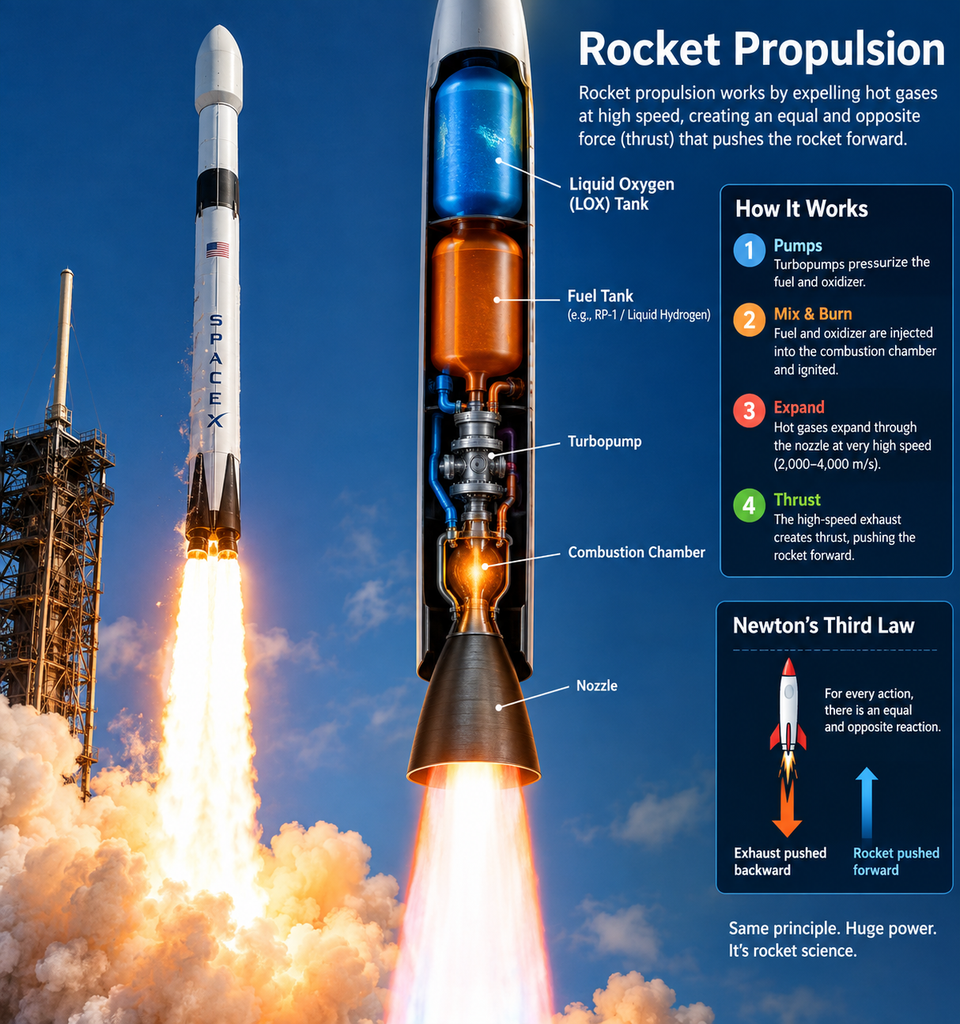
In the silent vastness between worlds, a controlled explosion becomes the purest expression of human will. Rocket propulsion is not merely engineering; it is the deliberate defiance of gravity, the conversion of chemical fire into motion so precise it can thread a spacecraft through the rings of Saturn or return humans to the Moon. At its heart lies a principle so simple a child can grasp it, yet so profound it has reshaped civilization: for every action, there is an equal and opposite reaction.
Isaac Newton stated the law in 1687. Rockets embody it with uncompromising clarity. Hot gases race backward through a nozzle at thousands of meters per second; the vehicle, by pure conservation of momentum, leaps forward. There is no atmosphere to push against, no ground to kick. The rocket carries its own reaction mass and hurls it away, leaving Earth behind in a trail of light and vapor.
The earliest experiments were modest. In thirteenth-century China, gunpowder-filled tubes of bamboo and paper leapt skyward in festivals and warfare. Historical records confirm that “fire arrows” were used by Chinese defenders against Mongol invaders during the siege of Kaifeng in 1232.By the twentieth century the principle had matured into liquid-propellant engines. Robert Goddard’s 1926 flight—a fragile metal frame rising only about 12 meters in 2.5 seconds near Auburn, Massachusetts—was the first true liquid-fueled rocket. From that small spark grew the V-2, the Saturn V, and the gleaming stages that now routinely climb from Florida and Kazakhstan.
Modern chemical rockets remain the workhorses of spaceflight. Liquid engines, such as those that powered the Space Shuttle Main Engines (RS-25) or SpaceX’s Raptor, mix cryogenic propellants—liquid oxygen with hydrogen or methane—in a combustion chamber hotter than the surface of the Sun. The resulting exhaust expands through a carefully contoured nozzle, accelerating to velocities exceeding 4,000 meters per second. Specific impulse for the best hydrogen-oxygen engines reaches approximately 450 seconds in vacuum.Solid-rocket motors, packed with a rubbery mixture of oxidizer and fuel, offer simplicity and immense thrust for the first critical minutes of flight. Hybrid designs blend both approaches, seeking the best of reliability and control.
Yet chemical propulsion carries an inherent limitation: the energy locked in molecular bonds. To journey farther and faster, engineers turn to more exotic methods. Ion thrusters and Hall-effect thrusters, whispering rather than roaring, accelerate xenon (or alternative) atoms with electric and magnetic fields to exhaust velocities many times higher. Their thrust is measured in fractions of a newton—gentle enough to be measured by the weight of a few coins—yet over months and years they can reshape trajectories with surgical precision. Hall thrusters typically operate in the 1,600-second specific-impulse range, while gridded ion engines can exceed 3,000–4,000 seconds.These systems already keep geostationary satellites on station and have propelled probes toward asteroids and the outer planets.
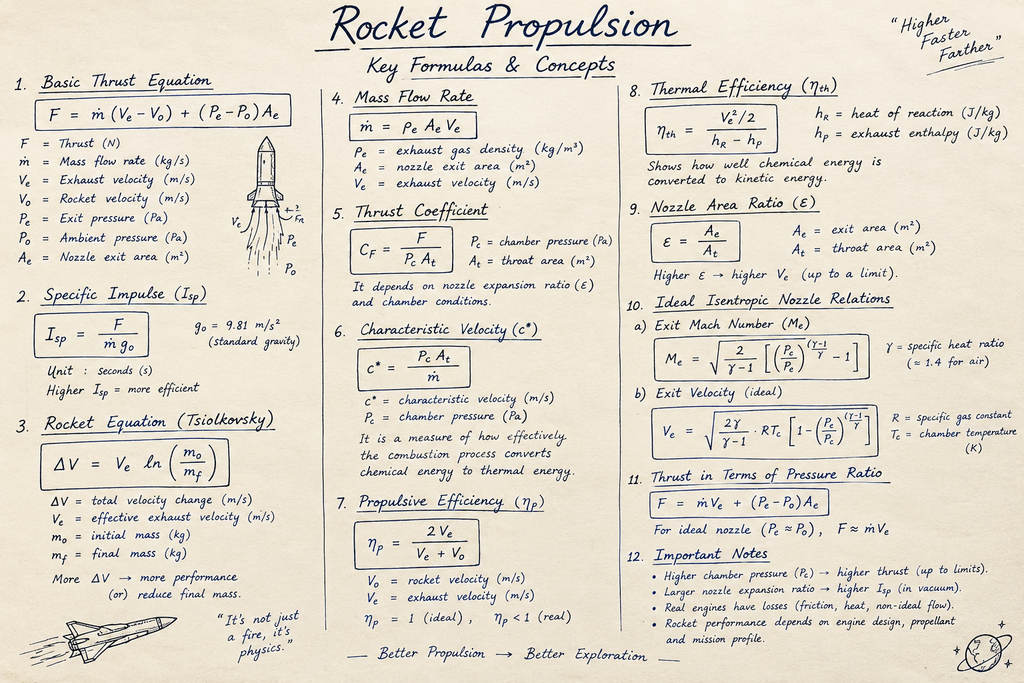
Nuclear thermal rockets promise a middle path. A compact reactor heats hydrogen propellant to extreme temperatures without combustion, yielding specific impulses roughly twice those of the best chemical engines—around 800–900 seconds.Though none have yet flown operationally, the physics is well understood from 1960s programs such as NERVA, and renewed interest from space agencies suggests the technology may soon leave the drawing board. Further still lie conceptual designs—fusion rockets, antimatter engines, laser-pushed sails—that stretch the imagination toward the stars.
The beauty of rocket propulsion lies not only in its equations but in its poetry of fire and silence. At liftoff the exhaust plume is a living sculpture of shock diamonds and translucent shock waves, a brief cathedral of energy that collapses into the thin blue of the upper atmosphere. In vacuum the same engine produces a perfect, invisible cone of thrust, its only signature the faint blue glow of residual ions or the steady brightening of a distant star as the spacecraft accelerates.
Every successful launch is a negotiation with physics. Structural mass must be minimized, propellant tanks insulated against the cold of space and the heat of re-entry, guidance systems capable of correcting trajectory errors measured in centimeters. The slightest miscalculation in mixture ratio or nozzle contour can turn triumph into catastrophe. Yet when the numbers align, the result is transcendent: a machine the size of a skyscraper rising on a pillar of flame, carrying instruments, satellites, or human beings beyond the reach of Earth’s embrace.
Looking ahead, the next generation of propulsion will decide whether humanity remains a single-planet species. Reusable chemical stages have already lowered the cost of reaching orbit by an order of magnitude. Combined with high-efficiency electric thrusters for interplanetary legs, and perhaps nuclear systems for rapid transit to Mars, the solar system begins to shrink. Beyond that horizon, the same principles that lift a Falcon 9 or a Starship may one day propel generation ships toward neighboring stars, carrying the fire of propulsion into the deep night.
Rocket propulsion is, ultimately, an act of faith rendered in metal and mathematics. It is the belief that the laws of motion, applied with sufficient courage and precision, can carry us anywhere the imagination dares to go. From the first Chinese fire-arrows to the quiet ion beams that will someday cross interstellar distances, the story remains the same: we throw mass backward so that we may move forward. And in that simple exchange, the universe opens.
References
The Chemical Engineer. “Rocket Science: From the Mongols to the Moon and Beyond.”
Aerospace America (AIAA). “Goddard Centennial Origins.
”European Space Agency. “Rockets in War and Peace.
”NASA Science. “Chapter 3: Gravity & Mechanics – Basics of Space Flight.
”Encyclopædia Britannica. “How Rockets Work | Newton’s Third Law of Motion Explained.
”Andøya Space. “Liquid Propellants – Learn with Andøya Space.
”PMC / National Library of Medicine. “Development Trend of Liquid Hydrogen-Fueled Rocket Engines.
”The Lee Company. “Hall Effect vs. Ion Thruster: Electric Propulsion Explained.
”Wikipedia / technical literature. “Hall-effect thruster.
”Mars Society Canada. “Rocket Physics, the Hard Way: Nuclear Thermal Rockets.
”IntechOpen. “Nuclear Thermal Propulsion.”