
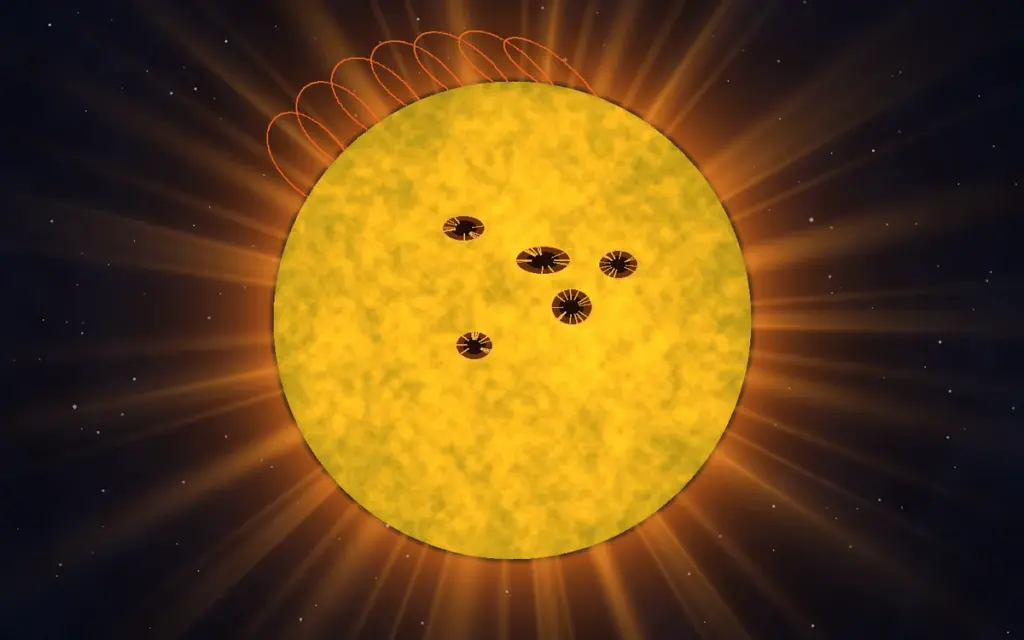
The Sun rises every morning, illuminates our planet, and provides the energy that makes most life on Earth possible. Yet this familiar object is actually a gigantic, magnetically active star with a nuclear furnace at its center, an atmosphere reaching millions of degrees, and enough gravitational influence to hold an entire planetary system together.
Our Sun is approximately 4.5 billion years old, contains about 99.85% of the solar system’s mass, and sends light across roughly 150 million kilometers of space before it reaches Earth. Despite centuries of observation, scientists are still investigating some of its most remarkable mysteries, including why its outer atmosphere is hotter than its visible surface. [1] [3]
Introduction: Why Is the Sun So Fascinating?
The Sun is the closest star to Earth and the only star in our solar system. From maintaining planetary orbits to driving Earth’s weather and water cycle, its influence reaches far beyond the sunlight we experience every day.
Unlike a fire that burns chemical fuel, the Sun produces its enormous energy output through nuclear fusion, a process that transforms hydrogen into helium in its core. Meanwhile, electrically charged plasma and powerful magnetic fields create sunspots, solar flares, and enormous eruptions that can influence conditions throughout the solar system.
Scientists investigate these processes using space telescopes, ground-based observatories, computer models, and robotic spacecraft. Missions such as NASA’s Parker Solar Probe and Solar Dynamics Observatory allow researchers to examine the Sun’s atmosphere, magnetic fields, and solar wind in unprecedented detail.
The following ten facts explain what makes our nearest star extraordinary, how it works, and why understanding it matters for life on Earth.
1. The Sun Is Actually a Star, Not a Planet
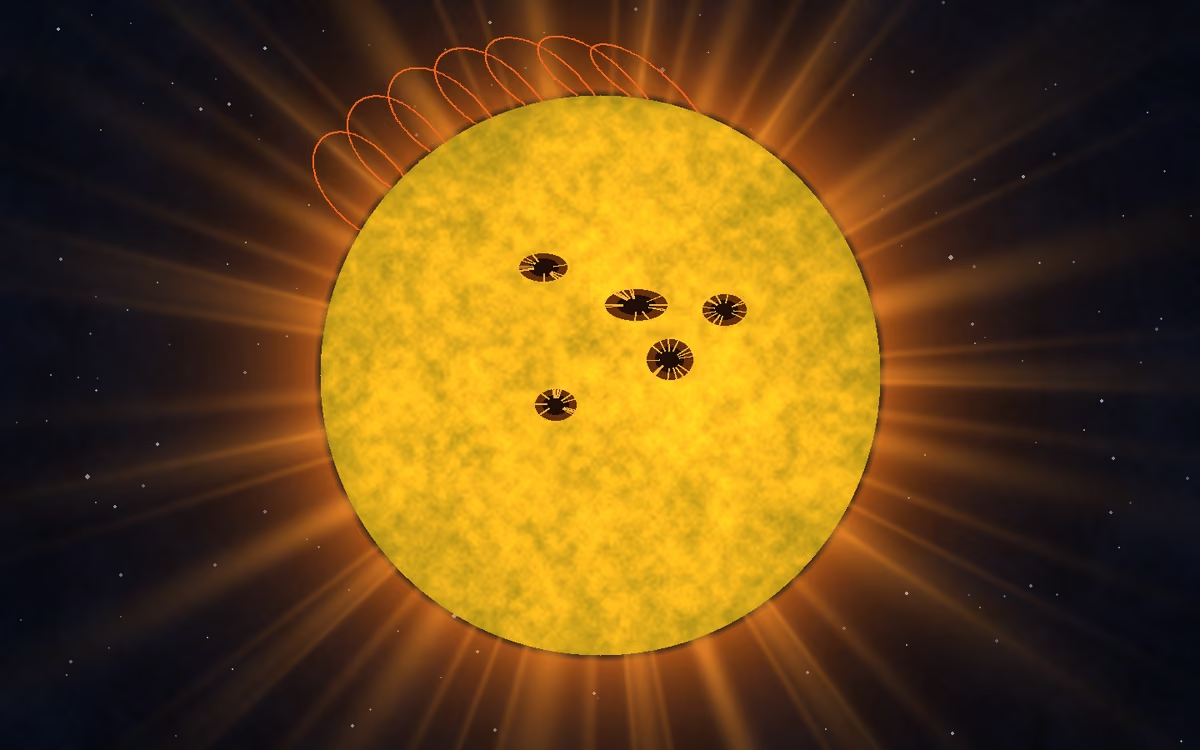
The bright object dominating Earth’s daytime sky is a star of the same fundamental kind as the distant stars visible at night. Its enormous apparent size and brightness come primarily from its proximity to Earth, not because it is the largest or most powerful star in the universe. Understanding this distinction is the first step toward understanding the Sun’s place in astronomy. [1]
What Makes the Sun a Star?
A star is a massive, self-gravitating astronomical object that generates energy through nuclear reactions during its active lifetime. The Sun consists primarily of hydrogen and helium, with temperatures high enough in its interior to sustain the nuclear fusion reactions responsible for its light and heat.
Unlike Earth, Mars, or Jupiter, the Sun does not have a solid surface. Most of its matter is ionized plasma, a state in which atoms have lost some or all of their electrons.
Planets and stars differ in their primary energy sources. Planets generally shine by reflecting starlight, although they can also emit their own thermal radiation. Main-sequence stars like the Sun produce enormous amounts of energy through sustained hydrogen fusion.
The Sun appears overwhelmingly brighter than other stars because it is approximately 150 million kilometers from Earth. The next nearest star, Proxima Centauri, is about 4.24 light-years away, making it vastly more distant. [1]
What Type of Star Is the Sun?
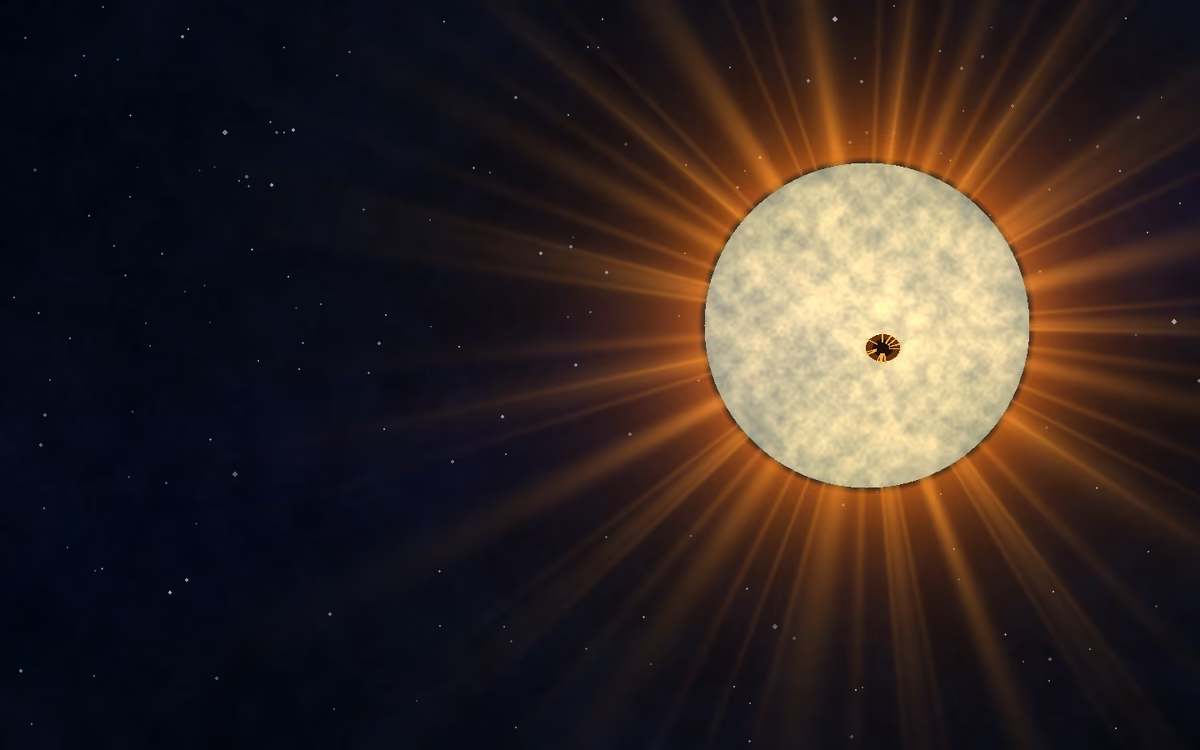
Astronomers classify the Sun as a G2V main-sequence star, commonly called a yellow dwarf. This classification describes its temperature, spectral characteristics, and stage of stellar evolution.
The letter G indicates its spectral class, associated with a surface effective temperature of roughly 5,500°C. The number 2 identifies a more specific subdivision within that class. The Roman numeral V indicates that the Sun is a main-sequence star, meaning it generates energy primarily through hydrogen fusion in its core.
Despite being called a yellow dwarf, the Sun is not intrinsically a purely yellow star. Its visible radiation contains a broad range of wavelengths that combine to produce essentially white light. Earth’s atmosphere can make it appear yellow, orange, or red because shorter wavelengths are scattered more strongly.
The Sun is also not particularly exceptional in luminosity or size compared with the enormous diversity of stars across the universe. It is more luminous than many small red dwarfs but far less luminous than massive blue stars and supergiants. [1] [6]
Where Is the Sun Located in the Universe?
The Sun belongs to the Milky Way, a barred spiral galaxy containing billions of stars, along with interstellar gas, dust, and other matter.
Our solar system is located within a smaller spiral feature known as the Orion Spur, also called the Orion Arm. This region lies between the larger Sagittarius and Perseus spiral arms, far from the Milky Way’s central region.
The Sun is gravitationally bound to the galaxy and travels around its center, carrying the entire solar system with it. Its journey is influenced by the combined gravitational field of the Milky Way, rather than by a single central object alone.
Although the Sun may seem stationary from Earth’s perspective, it is continuously moving through the galaxy as part of this much larger system. [1] [2]
2. The Sun Contains Almost All the Mass in Our Solar System
The Sun is not simply the largest object in the solar system. It overwhelmingly dominates the system’s mass, accounting for approximately 99.85% of the total. All eight planets, their moons, asteroids, comets, dwarf planets, and smaller objects together account for only a tiny fraction of the remaining mass. This extraordinary concentration of matter explains the Sun’s dominant gravitational influence. [3]
How Big Is the Sun Compared to Earth?
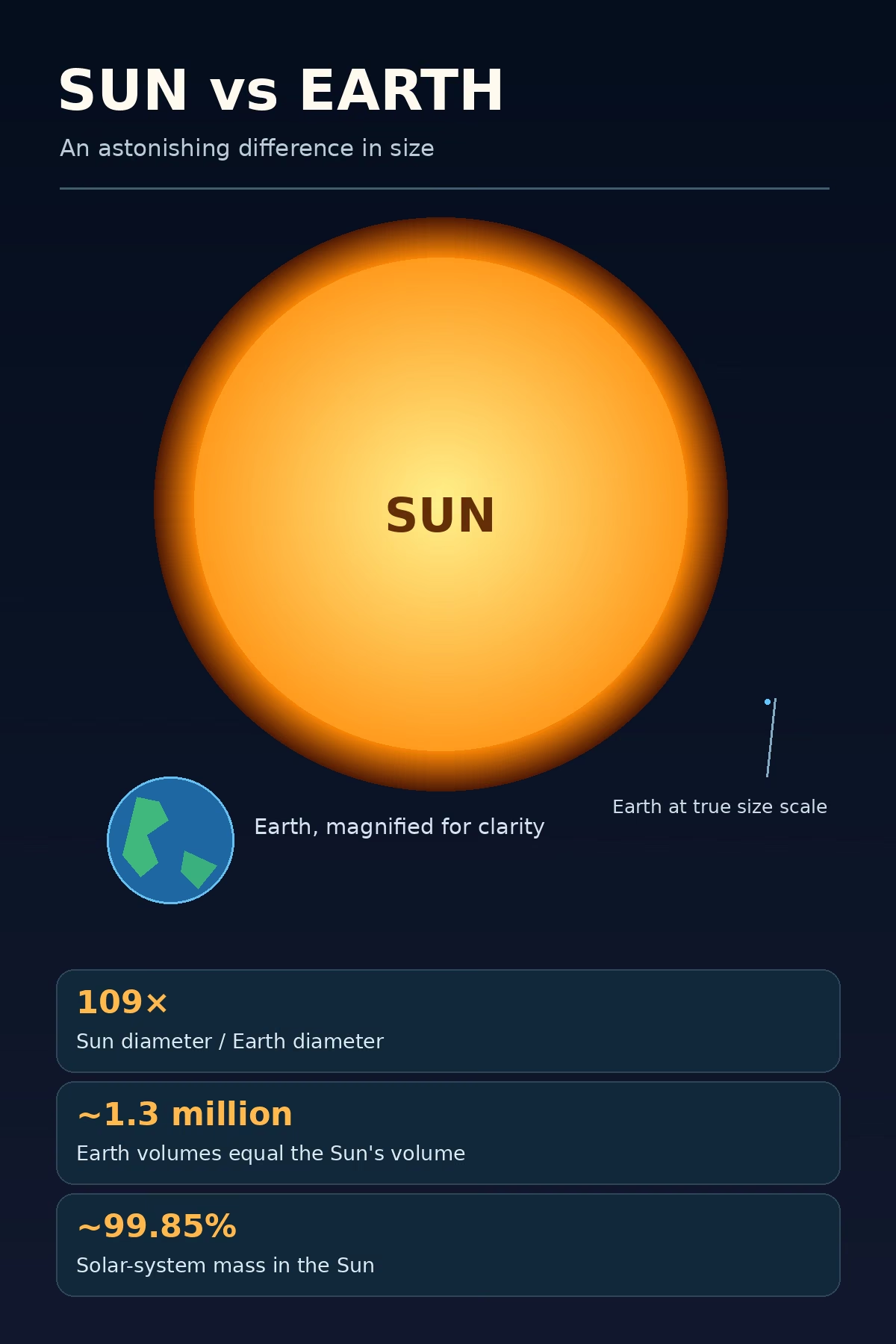
The Sun has a diameter of approximately 1.39 million kilometers, making it about 109 times wider than Earth. Its radius is close to 696,000 kilometers, while Earth’s mean radius is approximately 6,371 kilometers.
Because volume increases with the cube of radius, the size difference becomes even more impressive when comparing their volumes. The Sun’s volume is equivalent to approximately 1.3 million Earth volumes.
This comparison does not mean that 1.3 million intact spherical Earths could be packed into the Sun without empty spaces. It is a comparison of total volumes.
The Sun’s mass is approximately 1.989 × 10³⁰ kilograms, more than 330,000 times Earth’s mass. Despite this enormous mass, its average density is lower than Earth’s because it consists mainly of hot hydrogen and helium rather than dense rock and metal. [1] [3]
| Physical property | Sun | Earth |
|---|---|---|
| Approximate diameter | 1,392,700 km | 12,742 km |
| Approximate mass | 1.989 × 10³⁰ kg | 5.97 × 10²⁴ kg |
| Average density | 1.41 g/cm³ | 5.51 g/cm³ |
| Diameter ratio | About 109 Earth diameters | 1 |
| Volume ratio | About 1.3 million Earth volumes | 1 |
| Relative mass | About 333,000 Earth masses | 1 |
Values are rounded. The diameter and volume comparisons assume approximately spherical bodies.
How Does the Sun Hold the Solar System Together?
The Sun’s gravity is the principal force controlling the orbital motion of planets, dwarf planets, comets, and many other objects in our solar system.
Gravity depends on the masses of interacting objects and the distance between them. According to Newton’s law of universal gravitation, gravitational attraction becomes weaker as the distance between two objects increases.
Planets do not remain in orbit because gravity holds them completely motionless. Instead, they possess sideways orbital velocities that continuously carry them forward while solar gravity changes the direction of their motion.
This combination produces curved, generally elliptical orbits.
The Sun also affects the trajectories of spacecraft and comets, although gravitational interactions with planets can modify their paths. The entire solar system is therefore a dynamic gravitational system dominated by its central star. [1] [3]
Why Doesn’t the Sun Collapse Under Its Own Gravity?
The Sun’s enormous gravity continuously pulls its material inward. Without sufficient internal pressure, the star would contract under its own weight.
Its stability depends on hydrostatic equilibrium, a condition in which inward gravitational forces are balanced by outward pressure gradients within the stellar interior.
The extremely hot plasma inside the Sun creates substantial gas pressure. Radiation also contributes to internal pressure, although gas pressure is especially important for a star of the Sun’s mass.
Nuclear fusion maintains the high internal temperatures required to support this pressure.
This equilibrium is not perfectly static. Stars change gradually as their nuclear composition evolves, and solar oscillations produce small variations in their structure. Nevertheless, hydrostatic equilibrium allows the Sun to maintain a relatively stable configuration over billions of years. [1] [4]
3. The Sun Is About 4.5 Billion Years Old and Has Billions of Years Left
The Sun formed during the earliest stages of our solar system’s history, approximately 4.5 to 4.6 billion years ago. It has spent most of that time in its main-sequence phase, steadily converting hydrogen into helium. Although its appearance changes over shorter timescales, its overall evolution takes billions of years and will eventually transform it into a red giant and then a white dwarf. [4] [5]
How Old Is the Sun?
Scientists estimate that the Sun is approximately 4.6 billion years old, often rounded to 4.5 billion years.
Unlike Earth’s geological history, the Sun’s earliest physical material cannot be collected directly for conventional rock dating. Instead, scientists study ancient meteorites, lunar samples, and the physics of stellar evolution.
Some of the oldest primitive meteorite components formed approximately 4.56 to 4.57 billion years ago. These materials preserve evidence of the solar system’s earliest formation stages.
Astronomers also compare the Sun’s present luminosity, temperature, mass, composition, and internal oscillations with theoretical stellar models.
Together, these independent lines of evidence help establish its age and evolutionary status. The Sun is currently approaching the middle of its expected main-sequence lifetime. [5]
How Was the Sun Formed?
The Sun originated from a collapsing region of a giant molecular cloud containing gas and dust.
Approximately 4.6 billion years ago, gravity caused part of this cloud to contract. As material fell inward, the central region became denser and hotter.
Conservation of angular momentum helped the collapsing material develop into a rotating disk, known as the solar nebula or protoplanetary disk.
Most material accumulated near the center, where a growing protostar eventually formed. Dust and other material in the surrounding disk gradually combined into planetesimals, planetary embryos, and eventually planets.
As the central protostar contracted, temperature and pressure increased until sustained hydrogen fusion became possible.
The onset of stable core hydrogen fusion marked the beginning of the Sun’s main-sequence stage. [2] [4]
What Will Happen to the Sun in the Future?
The Sun is expected to continue fusing hydrogen in its core for roughly another five billion years.
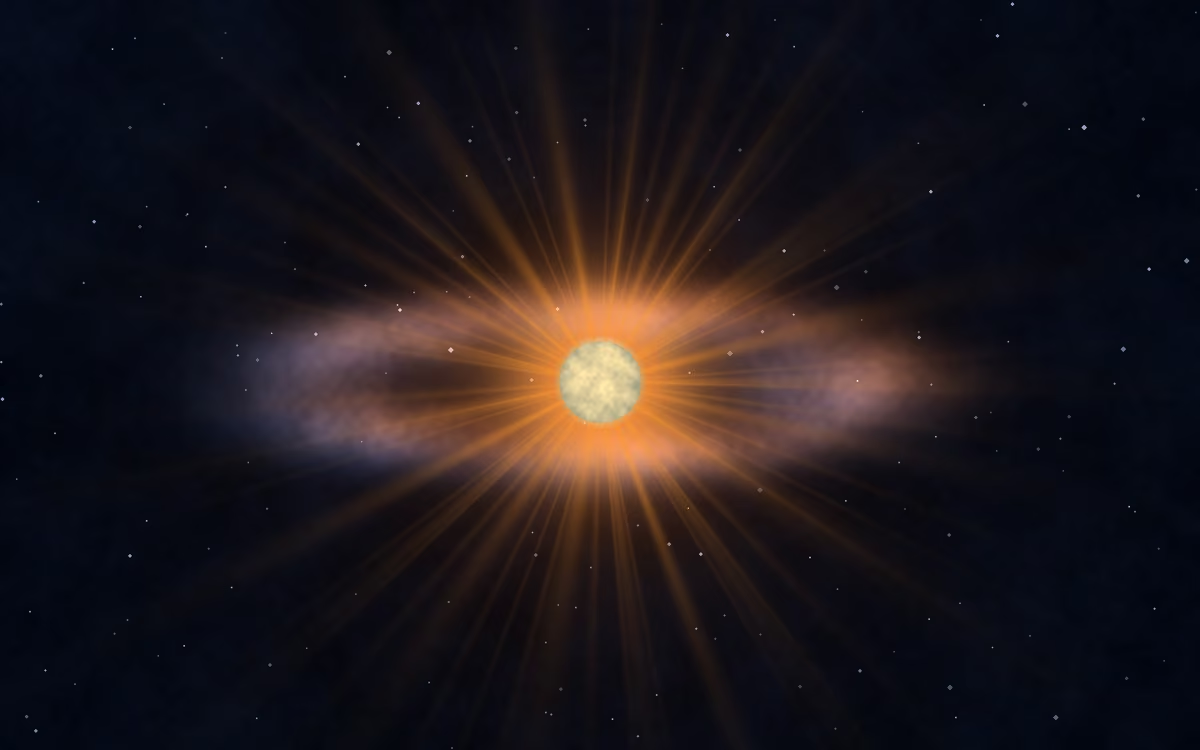
As hydrogen becomes depleted in its central region, the core will contract while fusion continues in a surrounding shell. Its outer layers will expand dramatically, transforming the Sun into a red giant.
During this stage, Mercury and Venus are expected to be engulfed. Earth’s ultimate physical fate is more uncertain, with models differing over whether the expanding Sun will engulf it. However, Earth is expected to become uninhabitable long before that stage because the Sun will gradually become more luminous.
Later, the Sun will undergo helium fusion and eventually shed its outer layers, producing an expanding planetary nebula.
Its remaining hot, dense core will become a white dwarf, which will gradually cool over extremely long timescales.
The Sun does not possess enough mass to end its life as a core-collapse supernova. [4]
Does the Sun Move Through Space?
The Sun is constantly moving through the Milky Way, along with Earth and every other object gravitationally associated with our solar system.
Its movement around the galactic center is known as its galactic orbit.
NASA estimates that the Sun requires approximately 230 million years to complete one revolution around the center of the Milky Way. This interval is sometimes called a galactic year or cosmic year.
The Sun’s orbital path is not a perfectly stationary circle. It is influenced by the galaxy’s distribution of stars, gas, dark matter, and other mass.
Consequently, the planets participate in several motions simultaneously. Earth rotates around its own axis, revolves around the Sun, and travels with the Sun through the galaxy. [1] [2]
4. The Sun Produces Energy by Turning Hydrogen Into Helium
The Sun’s light and heat come from nuclear fusion rather than chemical combustion. In its dense core, hydrogen nuclei undergo a sequence of nuclear reactions that ultimately produce helium. A small amount of mass is converted into energy during this process, providing the enormous power output responsible for illuminating planets and maintaining the Sun’s internal structure. [1] [3]
Where Does the Sun’s Energy Come From?
The Sun generates energy through nuclear fusion, a process in which lighter atomic nuclei combine to form heavier nuclei while releasing energy.
For a star like the Sun, the dominant fusion mechanism is the proton-proton chain. Through multiple reaction stages, four hydrogen nuclei are ultimately converted into one helium-4 nucleus, along with other reaction products.
These reactions release energy because the final products have slightly less total mass than the original reactants. The missing mass appears as energy according to Einstein’s equation:
[ E=mc^2 ]
Here, (E) represents energy, (m) represents mass, and (c) is the speed of light in a vacuum.
Fusion differs fundamentally from chemical burning, which rearranges electrons and chemical bonds without producing comparable nuclear energy.
The Sun’s fusion reactions also produce neutrinos, extremely weakly interacting particles that can escape from its interior and provide direct evidence of ongoing nuclear reactions. [3] [4]
How Hot Is the Center of the Sun?
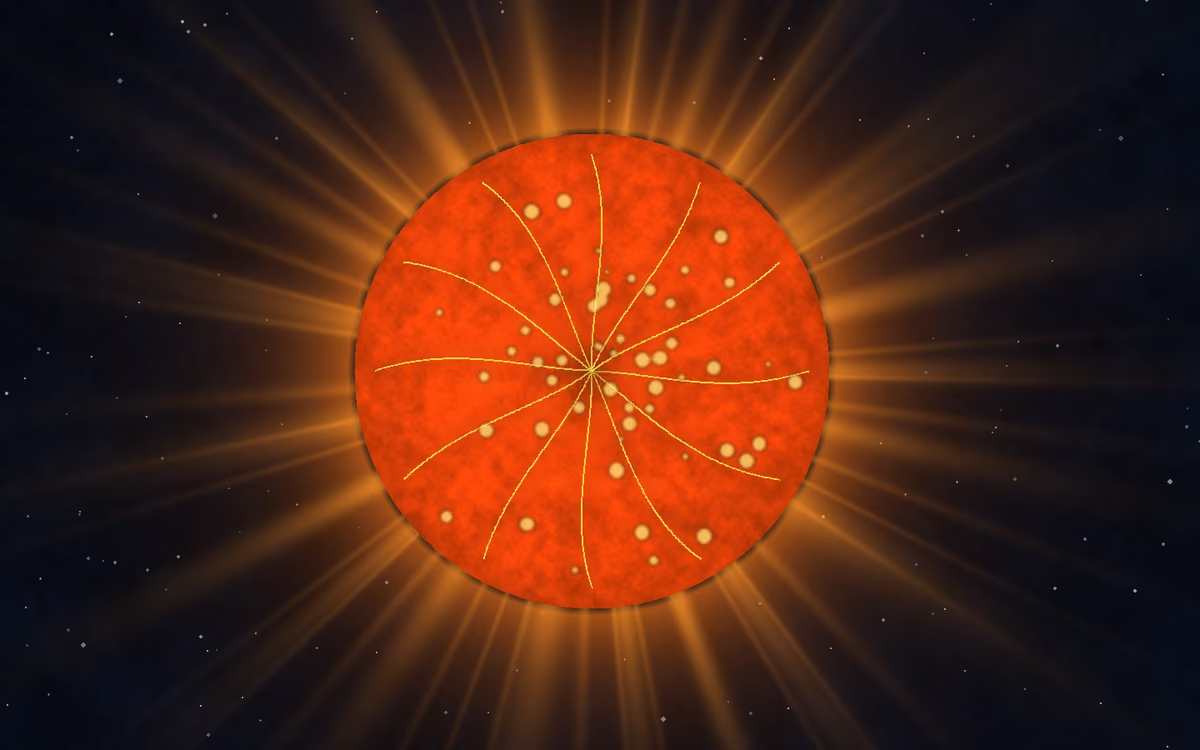
The Sun’s core reaches approximately 15 million degrees Celsius, equivalent to about 27 million degrees Fahrenheit.
At such temperatures, matter exists in an extremely energetic plasma state. Electrons are separated from nuclei, while particles move at high speeds and frequently interact.
Hydrogen nuclei carry positive electric charges and ordinarily repel one another. The extreme conditions inside the solar core, together with quantum tunneling, allow some nuclei to approach closely enough for nuclear fusion.
The Sun’s immense gravity maintains the pressure and density required for these reactions.
Fusion is concentrated in the central region rather than occurring equally throughout the entire star. Outside the core, temperatures and densities become insufficient to sustain hydrogen fusion at comparable rates. [1]
How Much Energy Does the Sun Produce?
The Sun releases approximately 3.8 × 10²⁶ joules of energy every second, corresponding to a luminosity of roughly 3.8 × 10²⁶ watts.
Another way to understand this output is through mass conversion. NASA explains that nuclear fusion converts approximately four billion kilograms, or four million metric tons, of mass into energy every second.
Energy generated in the core moves outward through the Sun’s interior before reaching the photosphere and escaping into space as electromagnetic radiation.
Most solar energy travels into directions that do not intersect Earth. Our planet receives only a tiny fraction of the Sun’s total output.
Nevertheless, that fraction is sufficient to sustain Earth’s climate system, power photosynthesis, and drive numerous natural processes. [3] [18]
5. Sunlight Takes About 8 Minutes and 20 Seconds to Reach Earth
Although light travels faster than anything else in a vacuum, the distance between the Sun and Earth is enormous. Even at approximately 300,000 kilometers per second, sunlight requires a little over eight minutes to make the journey. This means observing the Sun is also a way of looking into the recent past. [7] [8]
How Far Is the Sun From Earth?
The average distance between the centers of Earth and the Sun is approximately 149.6 million kilometers, or 93 million miles.
Astronomers commonly describe this distance using an astronomical unit, abbreviated au or AU.
The International Astronomical Union defines one astronomical unit as exactly 149,597,870,700 meters. This is a fixed unit of distance, not a measurement that changes with Earth’s orbital position.
Earth’s orbit is slightly elliptical, meaning the actual Sun-Earth distance changes throughout the year. Earth reaches its closest point, called perihelion, around early January and its farthest point, called aphelion, around early July.
These distance changes are not the main cause of Earth’s seasons. Seasonal changes primarily result from Earth’s axial tilt, which alters sunlight’s angle and the length of daylight in different hemispheres. [7]
How Long Does Sunlight Take to Reach Earth?
Light travels through a vacuum at exactly 299,792,458 meters per second, or approximately 299,792 kilometers per second.
To calculate the travel time from the Sun to Earth, divide the distance by the speed of light.
Using one astronomical unit:
[ t=\frac{149,597,870.7\ \text{km}}{299,792.458\ \text{km/s}} ]
[ t\approx499\ \text{seconds} ]
That equals approximately eight minutes and nineteen seconds, commonly rounded to eight minutes and twenty seconds.
Because Earth’s distance from the Sun changes throughout the year, the precise light-travel time also varies slightly.
This delay has an interesting consequence: when astronomers observe a solar flare, they are seeing radiation that left the Sun several minutes earlier.
In a purely hypothetical scenario in which the Sun suddenly stopped emitting light, the change would not become visible on Earth until that light-travel interval had passed. [7] [8]
What Types of Radiation Does the Sun Emit?
The Sun emits energy across the electromagnetic spectrum, including gamma rays, X-rays, ultraviolet radiation, visible light, infrared radiation, and radio wavelengths.
However, the amount of energy emitted varies considerably across these wavelength ranges. Much of the Sun’s radiative output is concentrated in visible and near-infrared wavelengths.
Earth’s atmosphere filters incoming solar radiation.
Ozone absorbs most of the Sun’s ultraviolet-C radiation and much of its ultraviolet-B radiation. Atmospheric gases also absorb particular infrared wavelengths, while molecules and particles scatter visible light.
Solar ultraviolet and X-ray radiation strongly influence Earth’s upper atmosphere, but much of this higher-energy radiation does not reach the ground.
Understanding these differences is essential for atmospheric science, solar energy research, and space weather monitoring. [9]
6. The Sun’s Outer Atmosphere Is Much Hotter Than Its Visible Surface
One of the Sun’s greatest scientific mysteries concerns its temperature structure. The visible photosphere has a temperature of roughly 5,500°C, but the outer corona can reach one to several million degrees. This surprising temperature increase occurs even though the corona lies farther from the nuclear fusion reactions inside the core. Scientists continue investigating how magnetic energy heats this extremely thin outer atmosphere. [1] [10]
Does the Sun Have a Solid Surface?
The Sun has no solid ground, crust, or well-defined physical boundary comparable to Earth’s surface.
Instead, the visible boundary normally observed in photographs is called the photosphere. This layer emits most of the visible light that escapes from the Sun.
Its temperature is approximately 5,500°C, although local temperatures differ, particularly within features such as sunspots.
The photosphere is part of a continuous atmosphere composed of hot plasma and gas, rather than a rigid shell.
As one moves inward from the photosphere, density, pressure, and temperature generally increase dramatically.
Moving outward, the atmosphere becomes progressively more tenuous, making its outer boundary difficult to define precisely.
Scientists therefore describe the Sun using distinct physical layers rather than solid surfaces. [1] [6]

What Are the Internal Layers of the Sun?
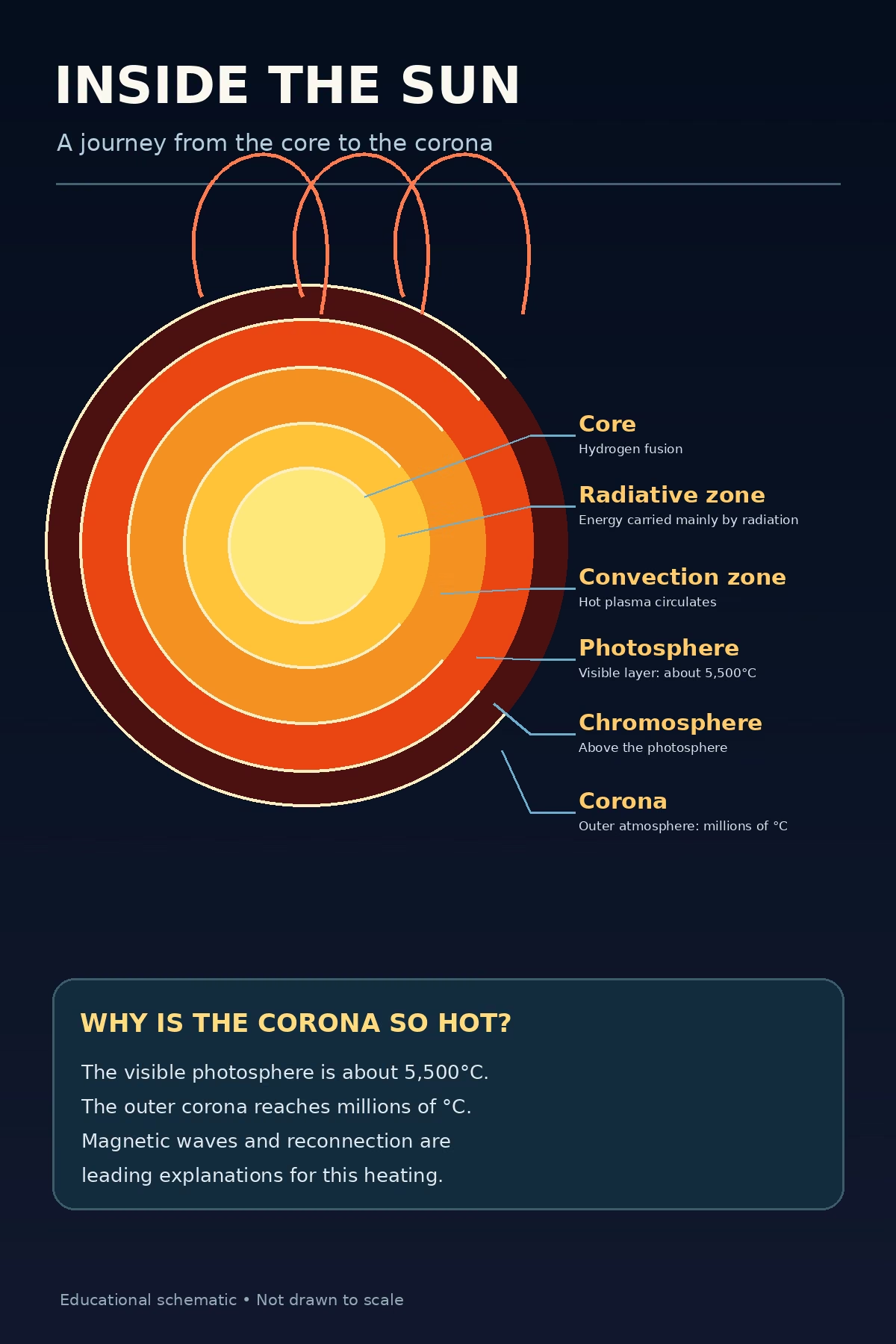
The Sun’s interior is generally divided into three primary regions: the core, radiative zone, and convection zone.
The core is the central region where nuclear fusion generates energy.
Surrounding it is the radiative zone, where energy moves primarily through interactions between radiation and matter. Photons are repeatedly absorbed, re-emitted, and scattered, causing energy to migrate gradually outward rather than following a straight path.
Farther outward lies the convection zone.
In this region, energy is transported mainly by the movement of plasma. Hotter material rises toward the surface, releases energy, cools, and moves downward again.
These convection currents contribute to the granular appearance of the photosphere and interact with solar magnetic fields.
Together, the interior layers transfer energy from the nuclear core toward the visible solar atmosphere. [1]
What Are the Layers of the Solar Atmosphere?
Above the convection zone, scientists distinguish several regions of the solar atmosphere.
The photosphere is the visible layer from which much of the Sun’s observable light escapes.
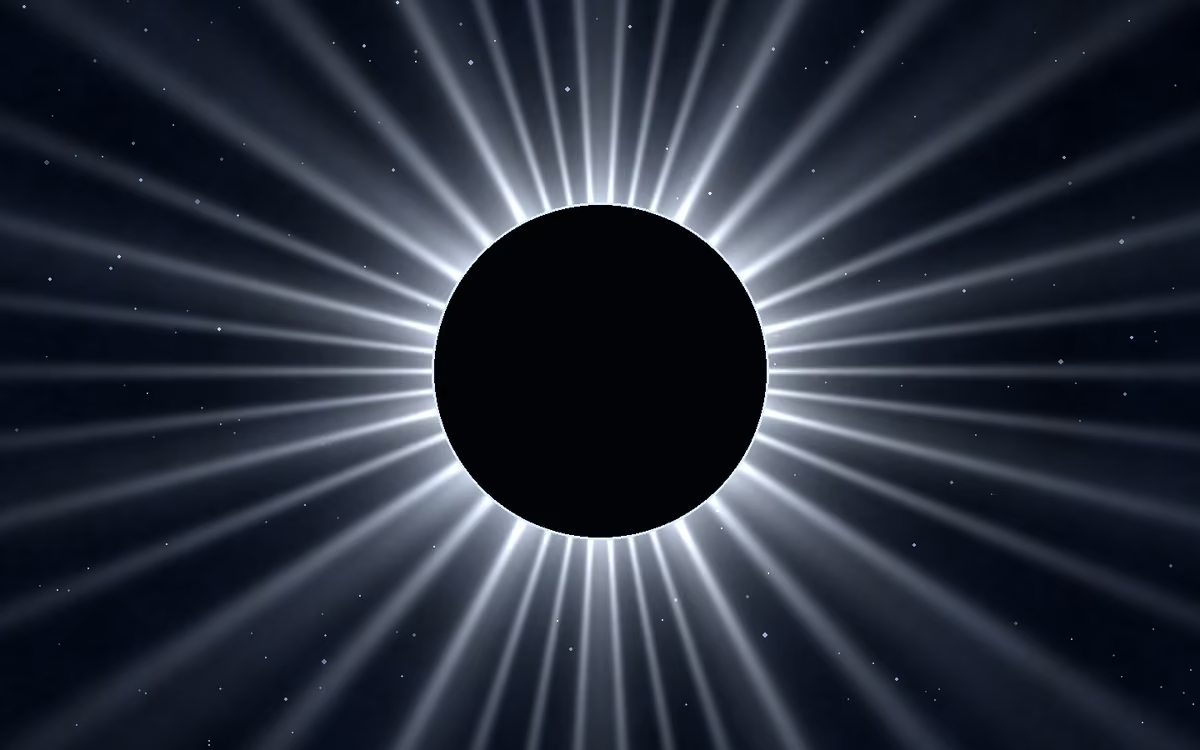
Above it lies the chromosphere, a comparatively thin region whose temperature generally increases with height. During a total solar eclipse, parts of the chromosphere may appear as a reddish rim.
The transition region separates the cooler lower atmosphere from the much hotter corona. Temperatures rise rapidly through this region.
The corona is the Sun’s extended outer atmosphere, containing extremely hot, low-density plasma shaped by magnetic fields.
Parts of the corona reach temperatures around one to two million degrees Celsius, with even hotter plasma present in some active regions.
The corona also connects to the origin of the solar wind, the continuous flow of charged particles escaping into space. [1] [6]
Why Is the Solar Corona Hotter Than the Photosphere?
At first glance, the corona’s high temperature seems contradictory. The Sun’s primary nuclear energy source is deep inside its core, so one might expect temperature to decrease continuously with distance.
However, energy from movements and magnetic processes in the lower solar atmosphere can travel outward and heat the corona.
One leading explanation involves Alfvén waves, which carry energy along magnetic fields. Another involves magnetic reconnection, where stressed magnetic fields rearrange and release stored energy.
Small, frequent energy-release events called nanoflares may also contribute.
These mechanisms are not necessarily mutually exclusive, and their relative importance can vary across different solar environments.
The corona’s high temperature also does not mean that its extremely thin plasma stores as much heat per unit volume as the much denser photosphere.
Determining exactly how energy is transported and dissipated remains an active area of solar physics research. [10]
7. The Sun Is Made of Plasma and Rotates at Different Speeds
The Sun does not rotate like a rigid planet. Its outer plasma moves at different rates depending on latitude, and its interior also displays complex rotational behavior. This differential rotation is important because the Sun’s electrically conducting plasma interacts with magnetic fields, contributing to the magnetic complexity responsible for solar activity. [1] [11]
What Is the Sun Made Of?
The Sun consists mainly of hydrogen and helium, with smaller quantities of heavier elements such as oxygen, carbon, neon, and iron.
Under the extreme conditions present through much of the star, atoms become ionized, forming plasma.
Plasma contains charged particles, including free electrons and positively charged ions. Unlike an ordinary neutral gas, plasma responds strongly to electromagnetic forces and can carry electrical currents.
These electrical properties are fundamental to the Sun’s behavior.
Plasma movements can generate and modify magnetic fields, while magnetic forces can influence how the plasma flows.
This interaction helps explain why the Sun develops magnetic loops, dark sunspots, prominences, and enormous eruptions.
The Sun’s behavior therefore cannot be understood through gravity and thermodynamics alone. Electromagnetism is equally essential. [1] [11]
How Fast Does the Sun Rotate?
The Sun rotates around an axis, but its rotation period depends on which part of the star is being measured.
At the solar equator, the visible plasma completes a rotation relative to distant stars in approximately 25 Earth days.
Near the poles, the rotation period can be around 35 to 36 days, according to NASA’s broad surface-rotation figures.
Astronomers measure solar rotation by tracking sunspots, magnetic structures, and other surface features.
An important distinction is the difference between sidereal and synodic rotation.
Sidereal rotation measures movement relative to distant stars. Synodic rotation describes the apparent rotation as observed from Earth, which is itself moving around the Sun.
Consequently, the apparent recurrence of equatorial solar features as seen from Earth takes roughly 27 days rather than 25. [1]
Why Do Different Parts of the Sun Rotate at Different Speeds?
The Sun exhibits differential rotation, meaning that different regions rotate at different angular velocities.
Unlike Earth, which behaves approximately as a rigid body over short timescales, the Sun consists of fluid plasma that can move in complex patterns.
Its equatorial regions rotate faster than the higher-latitude regions.
This variation causes magnetic structures embedded in the plasma to become stretched, twisted, and reorganized over time.
Differential rotation works together with convection and other internal plasma motions to influence the Sun’s magnetic field.
These processes are particularly important for understanding the formation of active regions and the longer-term solar cycle.
The phenomenon is also observed in other stars, making the Sun an important laboratory for studying stellar rotation. [1] [11]
How Does the Sun Generate Magnetic Fields?
The Sun’s magnetic field is generated and maintained through a process known as the solar dynamo.
Because plasma conducts electricity, its motions interact with magnetic fields through magnetohydrodynamic processes.
Differential rotation can stretch magnetic field structures, while convection and other turbulent motions contribute to their regeneration and rearrangement.
The resulting field is highly complex and changes with time.
Strong magnetic concentrations can emerge through the photosphere, creating sunspots and active regions.
When magnetic structures become sufficiently stressed, stored magnetic energy may be released through reconnection, contributing to solar flares and eruptions.
The solar dynamo also helps explain the approximately 22-year magnetic cycle during which the Sun’s large-scale magnetic polarity reverses and eventually returns to its original orientation. [11]
8. The Sun Goes Through an Approximately 11-Year Activity Cycle
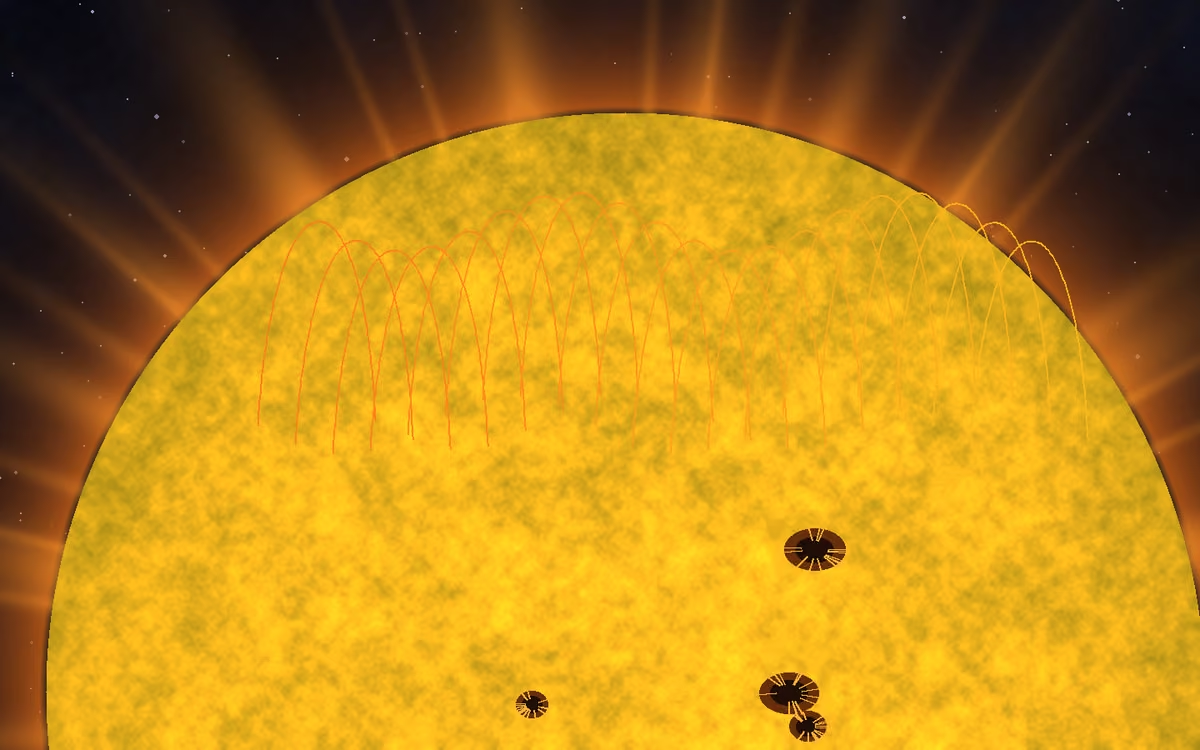
The Sun’s magnetic activity rises and falls in a recurring pattern called the solar cycle. Although each cycle differs in duration and strength, the average period is approximately eleven years. Scientists track this activity through sunspot counts, magnetic observations, and measurements of solar radiation and eruptions. Understanding the cycle helps researchers investigate the Sun’s internal dynamo and anticipate changes in space weather. [11] [12]
What Are Sunspots?
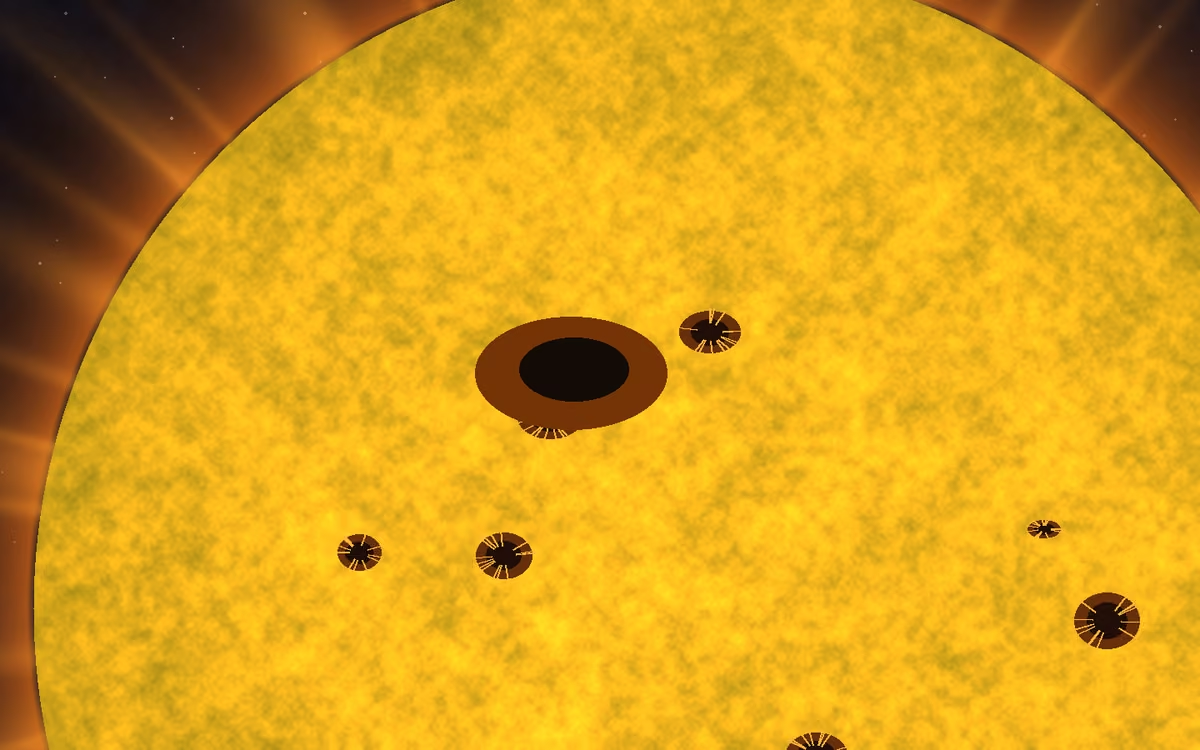
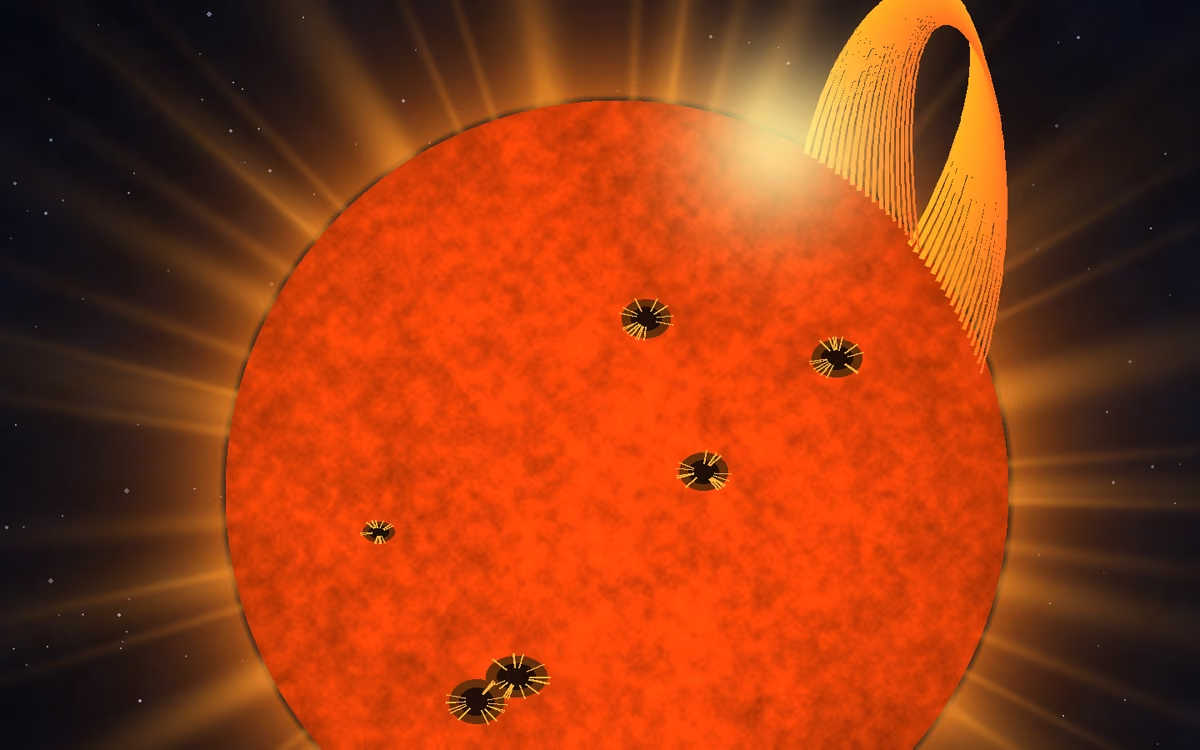
Sunspots are comparatively dark regions of the photosphere associated with strong concentrations of magnetic field.
They appear darker because they are cooler than the surrounding photosphere, although their temperatures are still thousands of degrees.
Strong magnetic fields can reduce the efficiency of convective heat transport into these regions, producing the observed temperature contrast.
Sunspots vary considerably in size and can appear individually or in complex groups.
They are frequently associated with active regions where magnetic fields extend into the solar atmosphere.
These regions are important because magnetic complexity can create conditions favorable for flares and other eruptions.
Astronomers have monitored sunspots for centuries, making sunspot records one of the longest systematic observations of changing solar activity. [12]
What Is the 11-Year Solar Cycle?
The solar cycle describes the recurring rise and fall of magnetic activity, particularly as measured by the number of visible sunspots.
A typical cycle lasts about eleven years, although individual cycles can be shorter or longer.
During the increasing phase, new sunspots and active regions become more common. Activity eventually reaches solar maximum before decreasing toward solar minimum.
The underlying magnetic cycle lasts approximately 22 years.
The Sun’s global magnetic poles reverse around each solar maximum. After another approximately eleven years, the polarity returns to its original orientation.
Sunspot numbers provide a useful indicator of solar activity, but they do not describe every aspect of it.
Researchers also track magnetic fields, solar irradiance, flares, coronal mass ejections, and energetic particles to understand the changing solar environment. [11]
What Happens During Solar Maximum?
Solar maximum is the most active phase of the solar cycle, generally characterized by increased sunspot numbers and more complex magnetic fields.
Solar flares and coronal mass ejections tend to occur more frequently during these active periods, although not every active region produces a significant eruption.
On October 15, 2024, NASA and NOAA announced that the Sun had entered the solar maximum period of Solar Cycle 25.
This announcement identified a broad phase of heightened activity rather than specifying an exact day on which solar activity reached its greatest value.
The strength and timing of individual events remain difficult to predict precisely.
Scientists monitor active regions continuously because the likelihood of significant space weather generally increases when solar magnetic activity is high. [13]
What Happens During Solar Minimum?
Solar minimum is the relatively quiet phase of the solar cycle, when sunspot numbers become low and major eruptions are generally less frequent.
During especially quiet intervals, the visible solar disk may go many consecutive days without detectable sunspots.
However, solar minimum does not mean the Sun stops rotating, producing magnetic fields, or releasing charged particles.
The solar wind continues to flow into interplanetary space, and solar eruptions remain possible.
Certain types of solar wind disturbances, including high-speed streams associated with coronal holes, can still produce geomagnetic activity.
Solar minimum therefore represents a reduction in some forms of magnetic activity, not a complete disappearance of space weather.
Its timing and duration provide important information about the evolution of the solar magnetic dynamo. [11] [12]
What Are Solar Prominences?
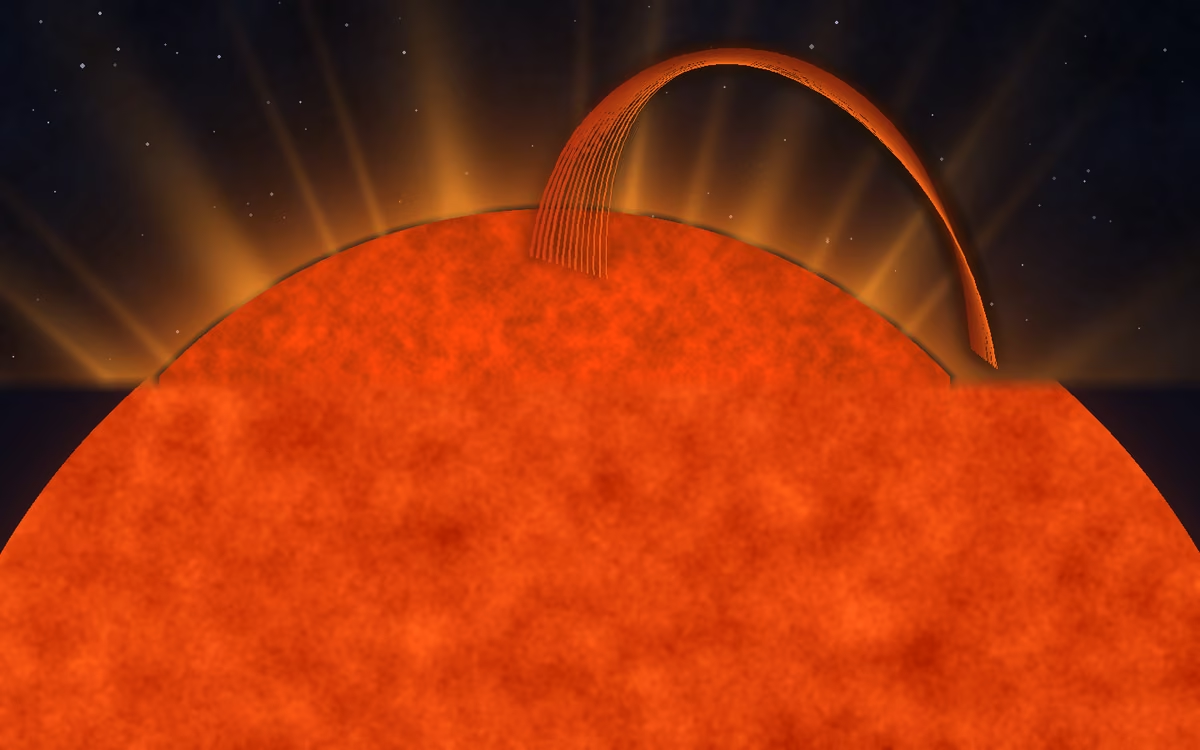
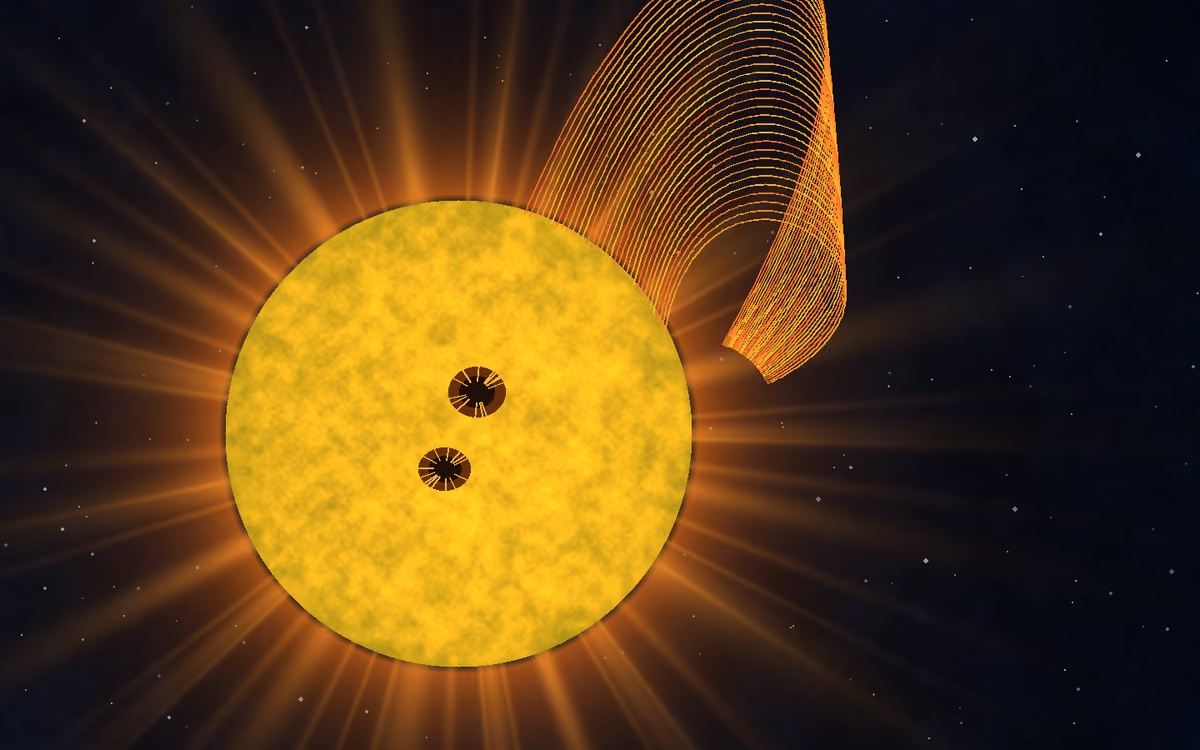
Solar prominences are enormous structures of relatively cool, dense plasma suspended within the much hotter solar corona by magnetic fields.
They often form spectacular arches or loops extending above the visible solar limb.
When the same structures are observed against the bright solar disk, they can appear as dark, elongated features called filaments.
Prominences may remain relatively stable for extended periods, but others become unstable and erupt.
Some erupting structures are associated with coronal mass ejections, although a prominence eruption does not necessarily produce an Earth-directed event.
Their shapes and movements reveal how magnetic fields support and guide plasma in the solar atmosphere.
NASA spacecraft regularly observe prominences in ultraviolet wavelengths, allowing researchers to study their development, stability, and disappearance. [1] [22]
9. Solar Storms Can Create Auroras and Disrupt Technology on Earth
The Sun’s influence extends far beyond light and heat. It continuously releases charged particles and occasionally produces powerful bursts of radiation or magnetized plasma. These events create changing conditions in interplanetary space, collectively known as space weather. When strong disturbances interact with Earth, they can generate spectacular auroras while also affecting satellites, navigation systems, radio communication, and electrical infrastructure. [14]
What Is the Solar Wind?
The solar wind is a continuous outward flow of charged particles, primarily electrons and protons, escaping from the Sun’s outer atmosphere.
As this plasma moves away from the Sun, it carries magnetic fields into interplanetary space.
The resulting magnetic influence fills an enormous region known as the heliosphere.
The heliosphere extends beyond the major planetary orbits and forms a broad boundary between solar plasma and the surrounding interstellar environment.
Solar wind conditions are not constant. Their density, speed, temperature, and magnetic orientation vary with solar activity and the regions from which the particles originate.
These variations influence planetary magnetospheres and the space environment through which spacecraft travel.
Because Earth lies inside the heliosphere, changes in solar wind conditions can directly affect near-Earth space weather. [1] [11]
What Causes Solar Flares and Coronal Mass Ejections?
Solar flares and coronal mass ejections are related to solar magnetic activity, but they are distinct phenomena.
A solar flare is a sudden release of energy that produces intense electromagnetic radiation, including X-rays and ultraviolet light.
Flares are commonly associated with magnetic reconnection, in which stressed magnetic fields rapidly change configuration and release stored energy.
A coronal mass ejection, or CME, is an eruption that sends a large quantity of magnetized plasma into space.
A flare can occur without an associated CME, and a CME does not always produce a prominent flare.
These distinctions matter because different emissions travel and affect Earth in different ways.
Electromagnetic radiation from a flare reaches Earth in approximately eight minutes, while the magnetized plasma from a CME generally requires much longer to cross interplanetary space. [6] [14]
| Feature | Solar flare | Coronal mass ejection |
|---|---|---|
| Main phenomenon | Sudden electromagnetic energy release | Eruption of magnetized plasma |
| Important emissions | X-rays, ultraviolet, other radiation | Charged particles and magnetic fields |
| Typical Earth arrival | About 8 minutes for light | Often roughly 1 to 3 days |
| Common effects | Radio blackouts and upper-atmospheric changes | Geomagnetic storms and possible power-grid impacts |
| Relationship | Can occur with or without a CME | Can occur with or without a major flare |
How Do Solar Storms Affect Earth?
Strong solar disturbances can affect technology through several different physical mechanisms.
Solar flares produce X-rays and ultraviolet radiation that can rapidly alter ionization in Earth’s upper atmosphere, interfering with high-frequency radio communication.
Energetic solar particles can affect satellite electronics and increase radiation exposure concerns for spacecraft and astronauts.
When a CME reaches Earth with a favorable magnetic orientation, it can produce a geomagnetic storm.
Geomagnetic disturbances can induce electrical currents in long conductors, potentially affecting power transmission systems.
They can also disturb Earth’s ionosphere, reducing the accuracy of GPS and other global navigation satellite systems.
However, the severity of these effects varies widely. Most solar disturbances do not cause major disruptions, and modern monitoring systems provide useful warnings for infrastructure operators.
NOAA’s Space Weather Prediction Center issues space weather watches, warnings, and alerts to support preparedness. [14]
How Does Earth Protect Itself From Solar Particles?
Earth possesses a magnetic field that creates a surrounding region called the magnetosphere.
The magnetosphere interacts with the solar wind and deflects many incoming charged particles around the planet.
On the side facing the Sun, the magnetosphere is compressed by solar wind pressure. On the opposite side, it stretches into a long region called the magnetotail.
Under certain magnetic conditions, energy and particles can enter the magnetosphere through processes such as magnetic reconnection.
Earth’s atmosphere provides additional protection by absorbing much of the Sun’s harmful high-energy electromagnetic radiation and stopping many energetic particles.
These protective systems help maintain conditions suitable for life on the surface.
Nevertheless, they do not completely eliminate the effects of space weather, particularly for satellites, high-altitude aviation, and electrical infrastructure. [14] [15]
How Does the Sun Create the Northern and Southern Lights?
Auroras occur when energetic charged particles interact with Earth’s upper atmosphere.
During geomagnetic activity, electrons can be accelerated along magnetic field lines into the atmosphere, where they collide with oxygen and nitrogen.
These collisions transfer energy to atmospheric particles. When excited atoms and molecules return to lower-energy states, they emit light.
The color depends on the atmospheric species, altitude, and type of electronic transition.
Green auroras are strongly associated with oxygen emissions, while red auroras can also come from oxygen at higher altitudes. Nitrogen contributes to blue, violet, and other colors.
Auroras commonly occur in regions surrounding Earth’s magnetic poles, producing the aurora borealis in the Northern Hemisphere and aurora australis in the Southern Hemisphere.
During powerful geomagnetic storms, the auroral regions can expand, allowing displays to become visible at unusually low latitudes. [15]

10. The Sun Makes Life on Earth Possible and Scientists Are Still Discovering Its Secrets
The Sun is fundamental to Earth’s natural systems, from photosynthesis and the water cycle to atmospheric circulation and long-term climate processes. Yet it remains an active subject of scientific investigation. Modern spacecraft and observatories are revealing new details about solar magnetic fields, the corona, and particle acceleration, improving our understanding of both our nearest star and the wider universe. [1] [11]
Why Is Sunlight Essential for Life?
Sunlight provides the energy for photosynthesis, the process used by plants, algae, and certain microorganisms to convert light energy into chemical energy.
In oxygen-producing photosynthesis, organisms use light energy to help transform carbon dioxide and water into organic compounds, releasing oxygen as a byproduct.
This process supports much of Earth’s biological productivity.
Plants and other photosynthetic organisms form the foundation of many food webs. Herbivores consume producers, while predators obtain energy indirectly through their prey.
Sunlight also affects biological rhythms, seasonal growth, and the distribution of ecosystems across Earth’s surface.
However, not every ecosystem depends directly on sunlight.
Some microorganisms obtain energy through chemical reactions, and entire communities around deep-sea hydrothermal vents can rely on chemosynthetic primary production.
The Sun therefore supports most of Earth’s life, but chemical energy also plays an important ecological role.
How Does the Sun Affect Earth’s Weather and Climate?
The Sun supplies nearly all the external energy driving Earth’s climate system.
Incoming solar radiation warms the land, oceans, and atmosphere, while Earth releases energy back into space primarily as infrared radiation.
The balance between incoming and outgoing energy strongly influences global temperatures.
Solar heating is also uneven. Differences in latitude, season, surface characteristics, and cloud cover create temperature contrasts that contribute to atmospheric circulation.
The Sun’s output varies slightly over time, including across the approximately eleven-year solar cycle.
However, solar variability is not responsible for the dominant pattern of recent global warming.
NASA explains that observed warming over recent decades cannot be accounted for by changes in solar output. Increased greenhouse gas concentrations are the primary driver of modern human-caused warming.
Solar energy is therefore central to understanding climate, but it must be considered alongside greenhouse gases, orbital variations, atmospheric composition, and feedback processes. [9] [16]
How Does the Sun Power the Water Cycle?
Solar energy is one of the principal drivers of Earth’s water cycle, also known as the hydrologic cycle.
When sunlight warms oceans, lakes, rivers, soil, and vegetation, some liquid water gains enough energy to evaporate into the atmosphere.
Plants also contribute water vapor through transpiration. Together, evaporation and transpiration are referred to as evapotranspiration.
As moist air rises and cools, water vapor may condense into tiny liquid droplets or form ice crystals, contributing to cloud formation.
Under suitable conditions, water returns to Earth’s surface as rain, snow, or other precipitation.
Gravity drives precipitation downward and helps move water through rivers, groundwater systems, and surface runoff.
Water may also be stored temporarily in glaciers, lakes, soil, and underground aquifers.
The water cycle illustrates how solar energy and gravity work together to redistribute water throughout Earth’s environment. [17]
How Much Energy Does the Sun Radiate?
The Sun’s total rate of energy emission is called its solar luminosity.
The International Astronomical Union adopted a nominal solar luminosity of:
[ L_\odot=3.828\times10^{26}\ \text{watts} ]
This standardized value is widely used in astronomy as a conversion constant.
One watt represents one joule of energy transferred per second, so this value corresponds to an extraordinary amount of energy radiated continuously in all directions.
It is important to distinguish luminosity from solar irradiance.
Luminosity measures the Sun’s total power output, while irradiance measures the power received per unit area at a particular distance.
At one astronomical unit, the nominal total solar irradiance is 1,361 watts per square meter at the top of Earth’s atmosphere on a surface perpendicular to incoming sunlight.
Actual irradiance varies with Earth-Sun distance and solar activity.
Only a minute proportion of the Sun’s total luminosity intersects Earth, but that energy sustains much of the planet’s physical and biological activity. [18]
How Do Scientists Study the Sun?
Modern solar astronomy combines continuous remote observations with direct measurements from spacecraft traveling through the solar environment.
NASA’s Parker Solar Probe investigates the solar corona, solar wind, energetic particles, and magnetic fields close to the Sun.
During its September 4, 2026 close approach, the spacecraft again traveled within approximately 3.8 million miles, or 6.1 million kilometers, of the visible solar surface. NASA reported that it matched its record speed of approximately 430,000 miles per hour.
The probe collects information from regions that cannot be directly sampled from Earth’s orbit.
NASA’s Solar Dynamics Observatory, or SDO, provides a complementary perspective by repeatedly imaging the Sun in multiple wavelengths.
Its instruments observe magnetic activity, atmospheric structures, and changes in ultraviolet emission.
Combining observations from different spacecraft helps scientists investigate how solar eruptions begin, how the corona is heated, and how space weather disturbances travel toward Earth.
These measurements also improve computer models used to study solar activity. [19] [20]
What Can We Learn From a Solar Eclipse?
A solar eclipse occurs when the Moon passes between Earth and the Sun, blocking some or all of the Sun’s visible disk from a particular location.
During a total solar eclipse, the Moon completely covers the Sun’s bright photosphere for observers within the path of totality.
A partial solar eclipse blocks only part of the solar disk, while an annular eclipse occurs when the Moon appears too small to cover the entire disk, leaving a bright ring visible.
Total solar eclipses are scientifically valuable because the bright photosphere is temporarily blocked, allowing the much fainter corona to become visible.
Researchers can study coronal structures, atmospheric composition, and magnetic phenomena during these events.
Solar viewing safety is essential. Looking directly at the Sun requires appropriate solar eye protection meeting the ISO 12312-2 standard.
The only exception is the brief period of complete totality during a total solar eclipse, when the bright photosphere is entirely hidden. Special solar filters are required for telescopes, cameras, and binoculars even when ordinary eclipse glasses are being used by an observer. [21]
Frequently Asked Questions About the Sun
Although scientists have studied the Sun for centuries, basic questions about its composition, size, temperature, age, and behavior remain important for understanding astronomy. The following answers summarize the most common questions while distinguishing familiar approximations from scientific details that are sometimes misunderstood.
Is the Sun a Star or a Planet?
The Sun is a star, not a planet. More specifically, it is classified as a G2V main-sequence star, commonly described as a yellow dwarf. Its core generates energy through nuclear fusion, converting hydrogen into helium. Planets such as Earth primarily reflect sunlight and do not sustain comparable hydrogen fusion. The Sun is the central gravitational body of our solar system and the only star within it. [1]
How Old Is the Sun?
The Sun is approximately 4.5 to 4.6 billion years old. Scientists estimate its age using measurements of primitive meteorites, lunar samples, and models of stellar evolution. Because the Sun and planets formed during roughly the same early period, ancient solar system materials provide important chronological evidence. The Sun has spent most of its life on the main sequence and is expected to continue core hydrogen fusion for roughly another five billion years. [5]
How Many Earths Can Fit Inside the Sun?
The Sun’s diameter is approximately 109 times Earth’s diameter, while its volume is equivalent to about 1.3 million Earth volumes. These two comparisons describe different physical quantities. Diameter measures the distance across an object, while volume measures the three-dimensional space it occupies. The volume figure does not represent the exact number of intact spherical Earths that could physically be packed inside the Sun without gaps. [1]
What Is the Sun Made Of?
The Sun consists mainly of hydrogen and helium, with smaller quantities of heavier elements. Its high internal temperatures cause much of its material to exist as ionized plasma containing free electrons and charged nuclei. The Sun also has several distinct regions, including the core, radiative zone, convection zone, photosphere, chromosphere, transition region, and corona. Its composition and internal structure determine how nuclear energy is generated, transported, and released into space. [1]
Why Is the Sun So Hot?
The Sun is extremely hot because its gravitationally compressed core sustains nuclear fusion reactions that release enormous amounts of energy. The central temperature reaches approximately 15 million degrees Celsius, allowing hydrogen nuclei to undergo fusion. This energy gradually moves outward through the Sun’s interior. Its visible photosphere is much cooler, at approximately 5,500°C, while magnetic processes heat the outer corona to temperatures of millions of degrees. [1] [10]
Does the Sun Rotate?
Yes. The Sun rotates around its axis, but it does not rotate uniformly like a solid object. Its equatorial photosphere completes a sidereal rotation in approximately 25 Earth days, while polar regions rotate more slowly, taking roughly 35 to 36 days. This behavior is called differential rotation. It plays an important role in the organization and evolution of the Sun’s magnetic fields, including the solar cycle and magnetic activity. [1]
Can a Solar Storm Destroy Earth?
Solar storms are not expected to physically destroy Earth. The planet’s magnetosphere and atmosphere provide substantial protection against charged particles and harmful solar radiation. However, powerful solar disturbances can disrupt technologies, including satellites, radio communications, navigation systems, and electrical power networks. Severe geomagnetic storms can cause important infrastructure problems, making forecasting and preparedness valuable. The actual effects depend on the strength, direction, and magnetic characteristics of the disturbance. [14]
What Will Happen When the Sun Dies?
In roughly five billion years, the Sun will begin transitioning toward its red giant phase as core hydrogen fusion ends. It will expand substantially, eventually shedding its outer layers and leaving behind a dense white dwarf. Earth is expected to become uninhabitable well before this final stage. The Sun will not explode as a typical core-collapse supernova because it is not massive enough to undergo that type of stellar death. [4]
How Long Does Sunlight Take to Reach Earth?
Sunlight takes approximately eight minutes and twenty seconds to reach Earth at an average distance of about 149.6 million kilometers. Light travels through a vacuum at exactly 299,792,458 meters per second. Dividing the mean Sun-Earth distance by this speed gives approximately 499 seconds. The actual travel time changes slightly as Earth moves through its elliptical orbit. This means the Sun we observe represents its condition several minutes earlier. [7] [8]
Can We See the Sun’s Corona From Earth?
Yes. The solar corona can become visible during the total phase of a total solar eclipse, when the Moon completely blocks the bright photosphere. Under these conditions, the corona appears as a faint, extended glow around the eclipsed Sun. Scientists also study it using specialized coronagraphs and solar observatories. Direct solar viewing is unsafe without suitable protection except during the brief period of complete totality. [21]
Conclusion: What Makes Our Sun So Extraordinary?
The Sun is much more than a familiar source of daylight. It is a massive, self-gravitating star whose nuclear reactions, magnetic fields, and continuous energy output shape conditions throughout the solar system.
Its enormous mass controls planetary orbits, while nuclear fusion has sustained its luminosity for billions of years. Its internal plasma transports energy toward the surface, and its changing magnetic fields generate sunspots, solar flares, prominences, and coronal mass ejections.
On Earth, sunlight drives photosynthesis, contributes to atmospheric circulation, and powers much of the water cycle. At the same time, powerful space weather events demonstrate that the Sun can influence the technologies on which modern societies depend.
Despite remarkable scientific progress, questions remain about coronal heating, solar magnetic behavior, particle acceleration, and the processes responsible for solar variability.
Spacecraft such as Parker Solar Probe and Solar Dynamics Observatory are helping scientists investigate these mysteries and improve their ability to understand and forecast solar activity.
Every sunrise connects Earth to a giant, dynamic star that formed billions of years ago and continues to shape life, weather, and the space environment around our planet. Studying the Sun helps us understand not only our own solar system but also the behavior and evolution of stars throughout the universe.
Sources
The following references include NASA scientific resources, official measurements and definitions from the International Astronomical Union and the National Institute of Standards and Technology, NOAA space weather information, and United States Geological Survey material. They provide the factual basis for the astronomical, physical, environmental, and spacecraft-related information presented in this article. Sources were reviewed against information available through November 6, 2026.
[1] NASA Science. Our Sun: Facts. Fundamental information about solar size, mass, temperature, composition, structure, rotation, location, and stellar evolution.
[2] NASA Science. Solar System: Facts. The formation, organization, and galactic location of the solar system.
[3] NASA. Basics of Space Flight: Chapter 1, The Solar System. Solar mass distribution, gravity, fusion, and energy production.
[4] NASA Science. Types of Stars. Main-sequence evolution, red giants, and white dwarf formation.
[5] NASA Space Place. How Old Is the Sun?. Solar age, meteorite dating, and estimated remaining main-sequence lifetime.
[6] NASA Science. The Heliopedia. Solar terminology, magnetic activity, atmospheric structure, and physical phenomena.
[7] International Astronomical Union. Measuring the Universe. Official definition of the astronomical unit.
[8] National Institute of Standards and Technology. CODATA: Speed of Light in Vacuum. Official value of the speed of light.
[9] NASA Earth Observatory. Solar Radiation and Climate Experiment: Fact Sheet. Solar radiation, atmospheric absorption, and Earth’s energy balance.
[10] NASA. Parker Solar Probe and the Curious Case of the Hot Corona. Scientific explanations for coronal heating, including Alfvén waves and nanoflares.
[11] NASA Science. Solar Science. Solar magnetic behavior, the approximately eleven-year activity cycle, and the twenty-two-year magnetic cycle.
[12] NASA Science. Sunspots. Sunspot formation, magnetic fields, active regions, and the solar cycle.
[13] NASA Science. NASA, NOAA: Sun Reaches Maximum Phase in 11-Year Solar Cycle. The official October 2024 Solar Cycle 25 maximum-phase announcement.
[14] NOAA Space Weather Prediction Center. Space Weather Impacts. Effects of solar flares, energetic particles, and geomagnetic storms on communication, navigation, satellites, and electrical infrastructure.
[15] NASA Science. Auroras. Magnetospheric processes, charged particles, atmospheric interactions, and auroral formation.
[16] NASA Science. What Is the Sun’s Role in Climate Change?. Solar variability and its relationship to Earth’s climate and modern global warming.
[17] U.S. Geological Survey. Water Cycle. Solar heating, evaporation, condensation, precipitation, and the movement of water through Earth’s systems.
[18] International Astronomical Union. Resolution B3: Recommended Nominal Conversion Constants for Selected Solar and Planetary Properties. Standard nominal solar luminosity, radius, effective temperature, and irradiance values.
[19] NASA Science, September 10, 2026. After Latest Swing Past Sun, NASA’s Parker Solar Probe Checks In. Details of the September 2026 close approach and mission observations.
[20] NASA. Watch a 10-Year Time Lapse of Sun From NASA’s SDO. Solar Dynamics Observatory imaging, wavelengths, and continuous observations.
[21] NASA Science. Eclipse Viewing Safety. Solar eclipse viewing guidance, appropriate eye protection, and precautions for optical equipment.
[22] NASA Science. Handle-Shaped Prominence on the Sun. Observations and scientific descriptions of solar prominences, plasma structures, and magnetic support.