

Galaxies are among the largest organized structures in the universe. Some resemble enormous spiraling pinwheels, others appear as smooth collections of stars, and many have unusual shapes produced by gravitational interactions or complex evolutionary histories. Astronomers study these differences to understand how galaxies form, develop, produce stars, and interact with their surroundings.
The four main morphological types of galaxies are spiral, elliptical, lenticular, and irregular. However, galaxies can also be classified according to their mass, luminosity, star formation activity, central black hole activity, and environment.
A galaxy can therefore belong to several categories simultaneously. The Milky Way, for example, is a barred spiral galaxy, while a small, actively star-forming irregular galaxy may also be described as a dwarf galaxy and a starburst galaxy.
This guide explains the major galaxy types, their subcategories, internal structures, physical characteristics, formation mechanisms, and real astronomical examples. It also explores how modern observations from the Hubble Space Telescope, James Webb Space Telescope, and large galaxy surveys have expanded our understanding of galaxy diversity. [1] [2]
Introduction to Galaxy Types
Galaxy types describe the different structural and physical characteristics of galaxies throughout the universe. Their appearances range from thin rotating disks with winding arms to nearly spherical systems, diffuse collections of stars, and severely distorted structures.
These differences arise from several interconnected factors, including the distribution of stars and gas, angular momentum, dark matter, gravitational encounters, and star formation history.
Astronomers primarily use galaxy morphology, meaning a galaxy’s observed shape and structure, to identify four broad categories. Additional terms such as dwarf, starburst, active, or interacting describe characteristics that may overlap with these morphological classes.
Understanding these distinctions provides a foundation for studying galaxy evolution rather than treating every unusual galaxy appearance as a completely separate type. [2] [3]
What Is a Galaxy?
A galaxy is a gravitationally associated system of stars, stellar remnants, interstellar gas, dust, and usually a substantial amount of dark matter. Galaxies may exist relatively isolated from other large systems, but many belong to groups and clusters.
Their properties vary enormously. Some dwarf galaxies contain only a few thousand visible stars, while the largest galaxies contain trillions. Despite this diversity, galaxies are governed by the same fundamental physical processes, including gravity, stellar evolution, gas dynamics, and interactions with their cosmic environment. [1]
Definition and Basic Characteristics of a Galaxy
A galaxy differs from a simple collection of stars because it is a large, dynamically organized system with a history of star formation and gravitational evolution.
Astronomers describe galaxies using measurements such as stellar mass, total dynamical mass, luminosity, physical diameter, color, and chemical composition. A galaxy’s stellar mass represents the mass contained in its stars, while its luminosity measures the energy it emits per unit time.
Dark matter often contributes substantially more gravitational mass than the visible stellar component. Its influence is inferred through observations of stellar motions, gas rotation, and gravitational lensing.
Galaxies are also distinct from nebulae, which are clouds of gas and dust, and from star clusters, which are generally smaller stellar systems. The boundary between extremely faint galaxies and some star clusters can nevertheless be difficult to establish. [1] [9]
What Are Galaxies Made Of?
Although galaxies have different appearances, many contain the same broad categories of matter.
Stars provide much of a galaxy’s visible light. Their ages, masses, and chemical compositions help astronomers reconstruct the galaxy’s star formation history.
Interstellar gas consists primarily of hydrogen and helium, with smaller quantities of heavier elements. Cold molecular gas supplies the material from which new stars form.
Cosmic dust absorbs and scatters starlight while re-emitting absorbed energy at infrared wavelengths.
Stellar remnants, including white dwarfs, neutron stars, and stellar-mass black holes, represent the final stages of stellar evolution.
Dark matter contributes gravitational mass and is commonly distributed in an extended halo.
Many massive galaxies also contain central supermassive black holes. When sufficient surrounding material falls inward, these objects can power active galactic nuclei. [1] [15]
Why Do Galaxies Have Different Shapes?
Galaxy morphology results from the interaction between initial conditions and billions of years of subsequent evolution.
Gas settling into a rotating structure can produce a galactic disk when the material retains sufficient angular momentum. Gravitational instabilities within the disk can then generate spiral arms or stellar bars.
Other galaxies undergo collisions, mergers, or repeated close encounters that redistribute their stars and gas. These processes can produce elongated stellar systems, tidal tails, disturbed disks, or entirely new structural arrangements.
The environment also matters. Galaxies moving through dense clusters may lose gas through ram-pressure stripping, while isolated galaxies can continue acquiring material and forming stars.
Consequently, galaxies do not necessarily progress through a single universal sequence of shapes. [3] [6] [14]
How Do Astronomers Classify Galaxies?
Astronomers use classification systems to organize galaxies according to observable characteristics. The most familiar approach examines morphology, including the presence of a disk, spiral arms, a central bulge, or a stellar bar.
However, morphology alone cannot describe every aspect of a galaxy. Modern studies combine imaging, spectroscopy, and measurements of gas, stellar populations, and nuclear activity.
These complementary classifications help distinguish galaxies with similar appearances but different physical histories, and galaxies with different appearances that share comparable star formation or dynamical properties. [2] [4]
Understanding Galaxy Classification and Morphology
Galaxy morphology refers to the shape and structural organization of a galaxy as observed in astronomical images.
For example, an astronomer may identify a thin disk, a central concentration of stars, or several spiral arms. These structures help determine whether the galaxy should be classified as spiral, lenticular, elliptical, or irregular.
Morphological classification is not identical to physical classification. A galaxy may be described as blue, gas-rich, low-mass, or active without changing its morphological category.
Observing wavelength can also alter apparent morphology. Ultraviolet images emphasize young stars, infrared images can reveal structures hidden by dust, and radio observations trace gas or energetic jets.
A reliable classification therefore considers the available observations and their limitations. [2] [5]
The Hubble Sequence and Hubble Tuning Fork Diagram
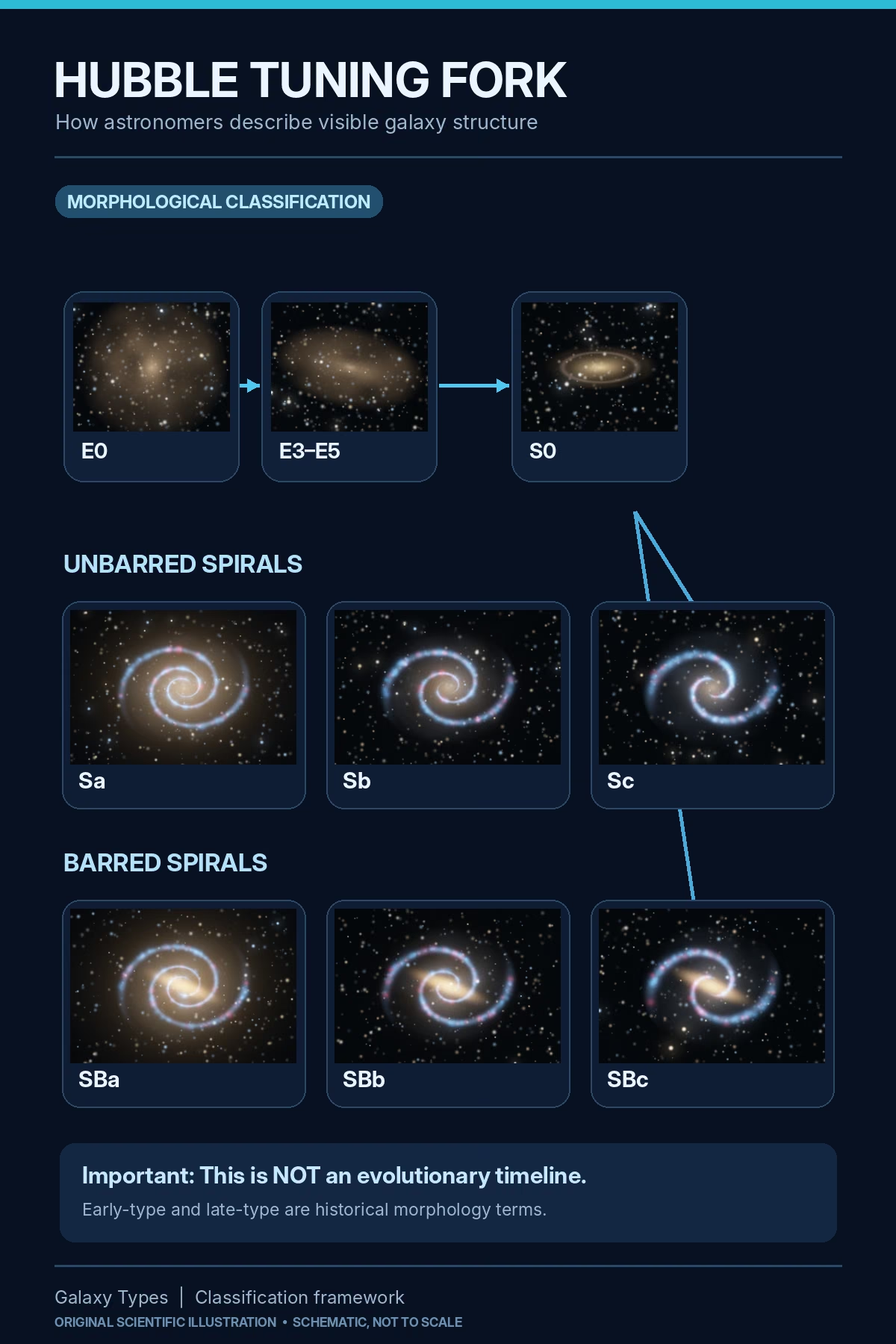
Astronomer Edwin Hubble developed a morphological classification system in 1926 that later became widely known as the Hubble tuning fork.
The diagram arranges elliptical galaxies along its handle, with lenticular galaxies near the point where the diagram divides. The two branches contain unbarred spiral galaxies and barred spiral galaxies.
Elliptical galaxies receive classifications such as E0 or E7 according to apparent flattening. Unbarred spirals use designations such as Sa, Sb, and Sc, while barred spirals are represented by SBa, SBb, and SBc.
The Hubble sequence remains useful because it provides a consistent visual description of many galaxies.
Importantly, the tuning fork is not a literal evolutionary timeline. Its labels describe morphological relationships rather than a required sequence through which every galaxy develops. [3]
The de Vaucouleurs Galaxy Classification System
Astronomer Gérard de Vaucouleurs expanded the Hubble system to describe a wider range of galactic structures.
His classification recognizes three important dimensions: morphological stage, bar family, and structural variety.
The principal bar families are SA, generally indicating an unbarred galaxy; SAB, indicating intermediate bar structure; and SB, indicating a clearly barred system.
The system also identifies inner rings using (r), spiral patterns using (s), and intermediate ring-spiral structures using (rs).
More detailed stage classifications include Sab, Sbc, Scd, Sd, Sdm, and Magellanic types.
This approach provides a more precise description of galaxies whose structures do not fit neatly into the simpler Hubble categories. For example, a galaxy classified as SB(r)c has a strong bar, ring-like inner structure, and relatively open spiral arms. [4] [5]
Early-Type Galaxies vs. Late-Type Galaxies
Astronomers commonly divide galaxies into early-type and late-type categories.
Early-type galaxies generally include ellipticals and lenticulars. They often contain older stellar populations, relatively little cold gas, and reduced present-day star formation.
Late-type galaxies typically include spirals and irregular systems. Many contain cold gas, dust, and substantial ongoing star formation.
These distinctions describe common statistical trends rather than universal rules. Some early-type galaxies still form stars, while certain spiral galaxies are unusually gas-poor.
The terminology can also be misleading. Early-type does not mean that the galaxy necessarily formed earlier, and late-type does not mean that it is younger.
Hubble used these terms to describe positions in a classification sequence, not to establish a universal chronological progression. [3]
The Four Main Types of Galaxies
The four principal morphological galaxy types are spiral, elliptical, lenticular, and irregular.
Spiral galaxies feature rotating disks containing recognizable spiral structure. Elliptical galaxies have comparatively smooth stellar distributions. Lenticular galaxies retain prominent disks without conspicuous spiral arms. Irregular galaxies lack a conventional, organized overall appearance.
These divisions are valuable starting points, but real galaxies form a continuum of shapes. Intermediate systems, disturbed structures, and ambiguous viewing angles mean that some galaxies cannot be assigned a single category with complete confidence. [2]

Spiral Galaxies
Spiral galaxies are rotating disk systems distinguished by winding arms extending around their central regions.
A typical spiral galaxy contains a stellar disk, central bulge, spiral arms, and surrounding stellar halo. It also resides within an extended dark matter halo.
Spiral arms often contain concentrations of gas, dust, and young stars. Bright blue stars and ionized hydrogen regions make star formation especially visible along these structures.
Older stars are found throughout the disk, bulge, and halo.
Spirals may possess a central stellar bar or lack an obvious bar. Their arms can be tightly wound, loosely organized, or fragmented.
The Milky Way and Andromeda are prominent nearby examples. Both contain complex stellar populations and evidence of prolonged galactic evolution. [2] [6]
Elliptical Galaxies
Elliptical galaxies appear as smooth, rounded, or elongated collections of starlight without prominent spiral arms.
Their stellar orbits are generally more varied in orientation than those within the ordered disks of spiral galaxies.
Many ellipticals contain predominantly older stars and comparatively little cold, dense gas. Consequently, they often exhibit weak ongoing star formation.
However, elliptical galaxies are not structurally or physically identical. Some contain dust, hot gaseous atmospheres, or traces of recent star formation.
Their masses range from relatively small systems to enormous galaxies containing trillions of stars.
Major mergers and other processes can redistribute stellar orbits and contribute to elliptical galaxy formation, although no single formation mechanism explains every elliptical galaxy. [2] [30]
Lenticular Galaxies
Lenticular galaxies, designated S0, possess a recognizable stellar disk and usually a central bulge, but they lack prominent spiral arms.
Their shape places them between spirals and ellipticals in traditional morphological diagrams. Their disk structure resembles a spiral galaxy, while their often older stellar populations and limited current star formation resemble those of ellipticals.
Some lenticular galaxies contain stellar bars, rings, dust, or residual gas.
One possible formation pathway involves a spiral galaxy losing or consuming the cold gas required to maintain significant star formation. As its bright, young stellar populations fade, its spiral structure may become less conspicuous.
Nevertheless, lenticular galaxies can form through multiple evolutionary pathways, including environmental interactions and mergers. [7] [32]
Irregular Galaxies
Irregular galaxies do not display the familiar organized morphology of classical spiral, elliptical, or lenticular systems.
Their appearances may be asymmetric, fragmented, clumpy, or dominated by scattered star-forming regions.
Some irregular galaxies are relatively small and gas-rich, while others are massive systems whose structures have been disturbed by interactions or mergers.
Young stars can make their star-forming regions appear bright and blue, although many irregular galaxies also contain substantial populations of older stars.
Irregular morphology should not automatically be interpreted as evidence that a galaxy is newly formed. A galaxy may have existed for billions of years before acquiring its present irregular appearance. [2]
Spiral Galaxy Types and Subtypes
Spiral galaxies exhibit considerable structural diversity. Their appearances depend on the prominence of their central bulges, the presence and strength of bars, the number of spiral arms, and the organization of those arms.
Some display two sweeping, symmetrical arms. Others have numerous branching arms or fragmented structures.
These characteristics arise from the dynamical behavior of rotating stellar disks, interactions with neighboring galaxies, and gravitational instabilities.
Because arm structure and bar strength describe different properties, a spiral galaxy can simultaneously belong to several descriptive subcategories. [6]
Barred Spiral Galaxies
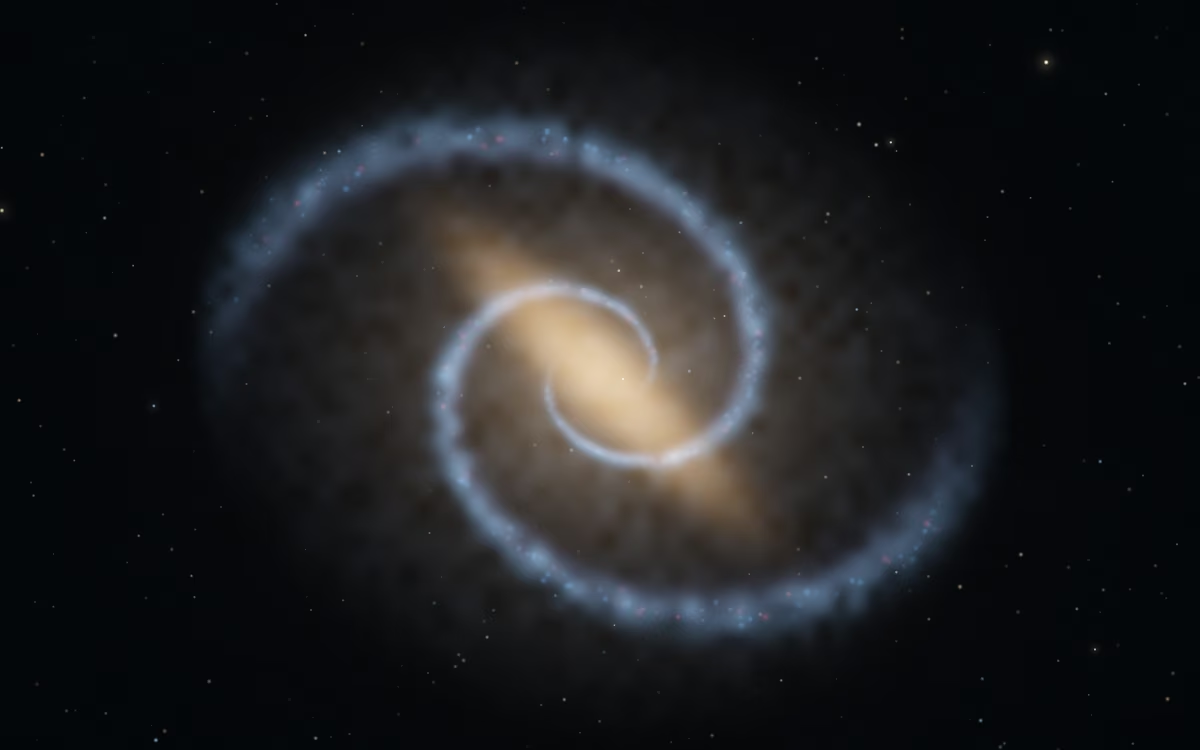
A barred spiral galaxy contains an elongated concentration of stars extending through its central region.
The bar is a dynamically organized stellar structure rather than a solid object. Stars move along different orbits within the rotating gravitational potential.
Spiral arms commonly begin near the ends of the bar. Bars can also redistribute angular momentum and influence how gas moves through the galaxy.
Under appropriate conditions, this movement can concentrate gas toward central regions, where it may contribute to star formation or supply material for nuclear activity.
The Milky Way is a barred spiral galaxy. Large surveys indicate that bars are common among spiral galaxies, although the measured fraction depends on galaxy properties, observational wavelength, and the criteria used to identify bars. [2] [6] [27]
Unbarred Spiral Galaxies
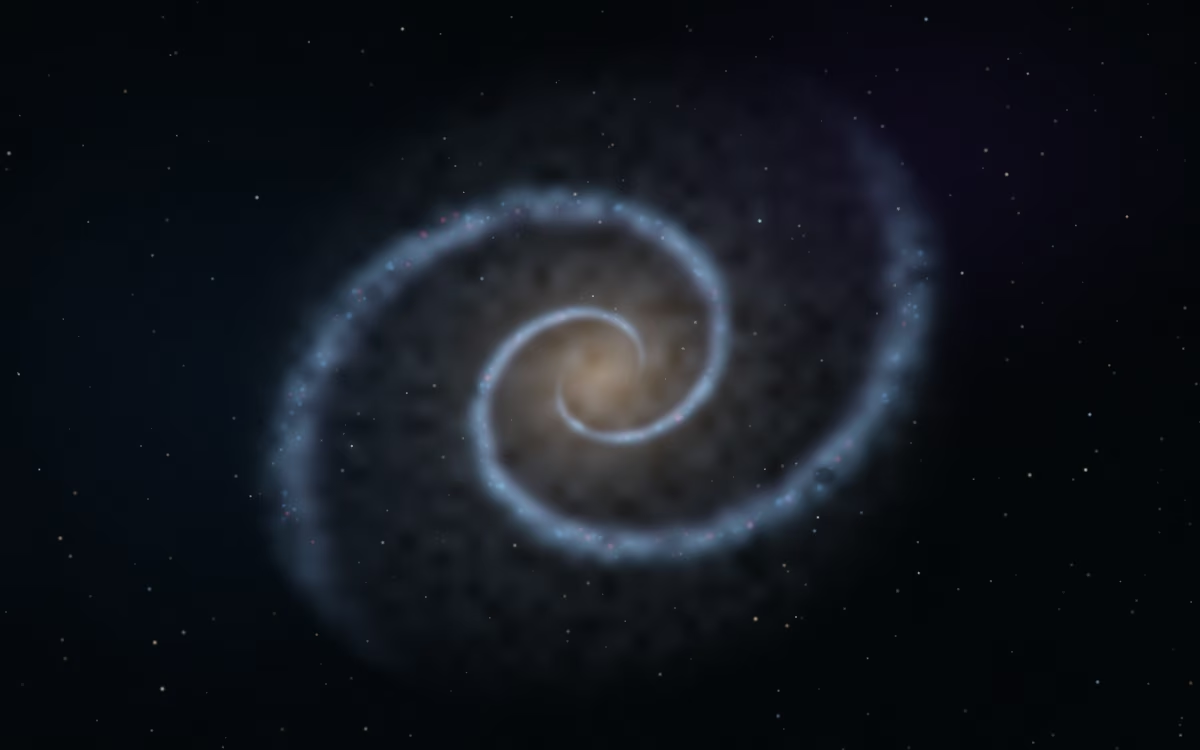
Unbarred spiral galaxies lack a clearly identified elongated stellar bar across their central regions.
Their spiral arms generally connect to or curve around the central bulge rather than emerging from the ends of an obvious bar.
The designation SA is used for unbarred systems in the de Vaucouleurs classification framework.
However, identifying a truly unbarred galaxy is not always straightforward. Weak bars may become visible in near-infrared images even when they are difficult to recognize in optical observations.
Dust, inclination, and the brightness of the central bulge can also conceal bar structures.
Unbarred spirals can still develop strong spiral patterns through internal gravitational instabilities or interactions with neighboring galaxies. [4] [6]
Grand-Design Spiral Galaxies
Grand-design spiral galaxies have prominent, relatively continuous spiral arms that create an organized appearance across much of the disk.
Many exhibit two principal arms, although their exact structures vary.
The Whirlpool Galaxy, Messier 51, is a particularly recognizable example of grand-design spiral structure. Its interaction with a companion galaxy contributes to its distinctive appearance.
Grand-design patterns can be influenced by gravitational interactions, bars, and dynamical instabilities within the galactic disk.
Spiral density wave models help describe how such large-scale patterns can exist without requiring the same stars to remain permanently within each arm.
The organized structure is therefore a dynamical pattern, not a fixed arrangement of individual stars. [6]
Flocculent Spiral Galaxies
Flocculent spiral galaxies exhibit fragmented, patchy, or discontinuous spiral arms rather than clearly defined large-scale patterns.
Their appearance often results from numerous local concentrations of young stars, gas, and dust.
Star formation can enhance the contrast of these features, making the disk resemble a collection of short spiral segments.
Local gravitational instabilities and stellar feedback contribute to this structure.
Flocculent morphology also depends on the observing wavelength. Blue and ultraviolet images emphasize young stellar associations, while infrared observations reveal the distribution of older stars and can expose a more organized underlying disk.
A flocculent appearance therefore does not necessarily imply that the galaxy lacks large-scale gravitational organization. [6]
Multi-Armed Spiral Galaxies
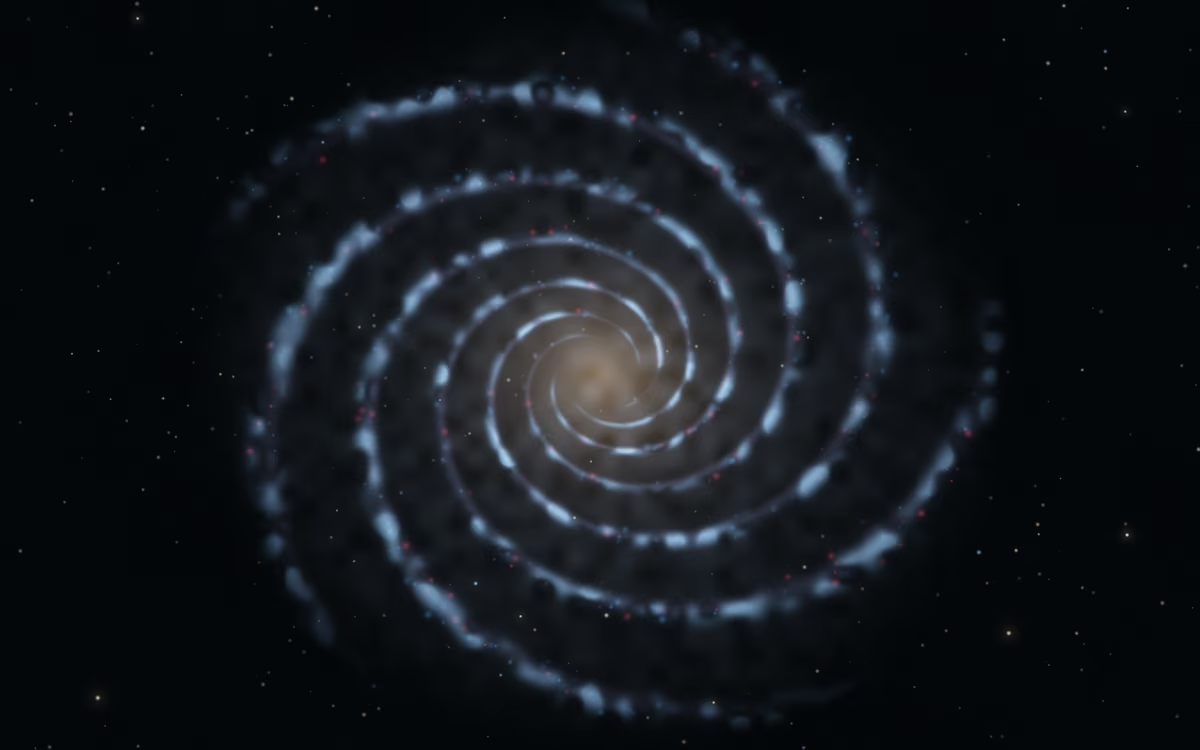
Multi-armed spiral galaxies contain several recognizable spiral arms instead of one dominant two-armed pattern.
Their structures may include branching arms, unequal segments, and multiple spiral patterns at different distances from the center.
Gravitational instabilities within the rotating disk can generate multiple arms. Interactions with satellite galaxies, stellar bars, and changes in the disk’s mass distribution can also influence their development.
The appearance of a multi-armed spiral may change over time because individual spiral patterns can grow, weaken, and reform.
Astronomers distinguish these systems from flocculent spirals when the additional arms remain relatively coherent across significant portions of the galaxy. [6]
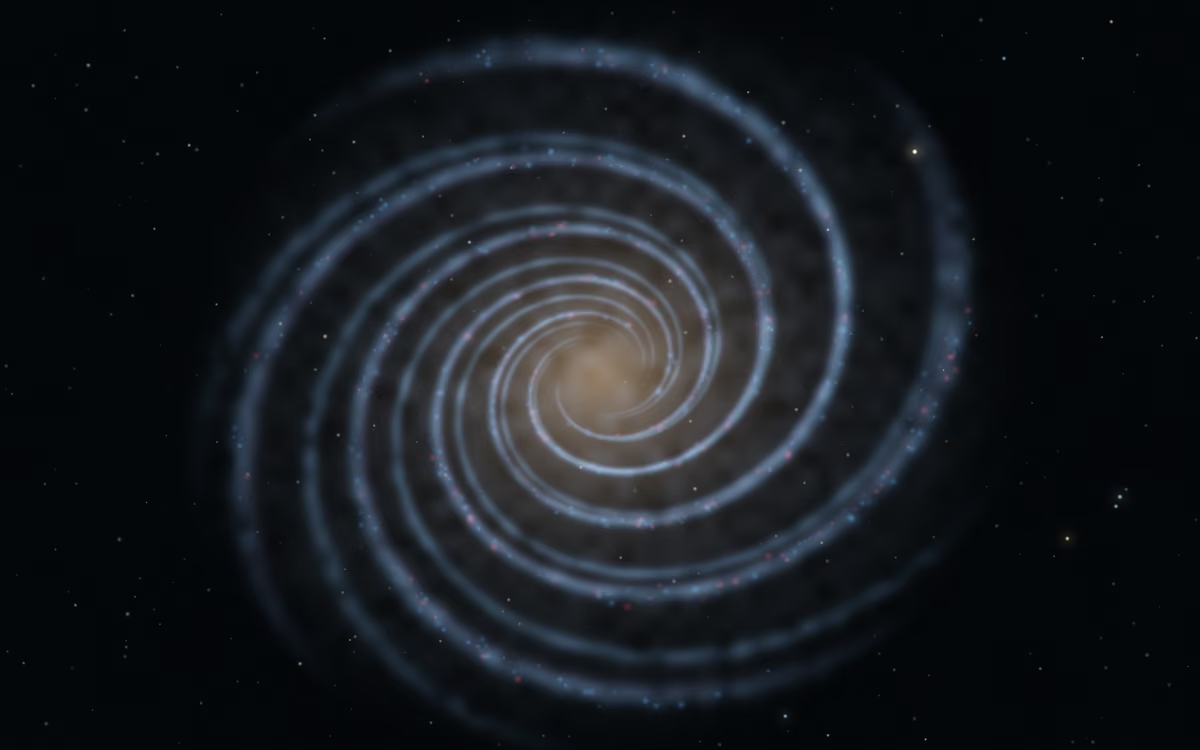
Spiral Galaxy Classification: Sa, Sb, Sc, and Sd
The Sa, Sb, Sc, and Sd categories describe changes in spiral structure along the Hubble sequence.
Traditionally, astronomers consider several visual characteristics, including spiral-arm openness, bulge prominence, and how concentrated the galaxy’s starlight appears toward its center.
Sa galaxies generally have tightly wound arms and prominent bulges. Later spiral stages usually have smaller bulges and more open or fragmented arms.
These relationships are trends, not exact physical rules. Galaxies with similar classifications can have different stellar masses, gas contents, and star formation histories. [3] [4]
Sa Spiral Galaxies
Sa spiral galaxies typically feature tightly wound arms surrounding a relatively prominent central bulge.
Their central regions often contribute a substantial fraction of the galaxy’s visible light, producing a concentrated appearance.
Compared with later spiral classifications, Sa systems commonly have smoother disks and less conspicuous patchy star formation.
However, their cold-gas content and star formation rates vary considerably. An Sa classification does not mean that the galaxy is inactive or unable to produce new stars.
Astronomers assess the winding of the arms, the prominence of the bulge, and the overall disk structure together when assigning this designation. [3] [4]
Sb Spiral Galaxies
Sb galaxies occupy an intermediate position in the traditional spiral sequence.
They generally display moderately wound spiral arms and a central bulge that is less dominant than the bulge of a typical Sa system.
Their disks frequently contain visible gas clouds, dust lanes, and star-forming regions.
An Sb galaxy may have relatively organized arms without the extremely tight winding associated with earlier spiral stages.
Andromeda has historically been described as an Sb galaxy, although more detailed studies have investigated additional structural features, including evidence of a stellar bar.
As with other Hubble classifications, Sb describes observed morphology rather than a specific stellar age or evolutionary stage. [3] [20] [21]
Sc Spiral Galaxies
Sc galaxies typically contain relatively small central bulges and more open spiral arms.
Their spiral structures often include prominent gas clouds, dust lanes, and bright star-forming regions.
These features can produce a patchy appearance, particularly in visible-light images emphasizing young stars.
Many Sc systems exhibit substantial ongoing star formation, but the classification alone does not determine a galaxy’s precise star formation rate.
The openness of the arms and the weak central concentration help distinguish Sc galaxies from Sa and Sb systems.
Some late spiral galaxies also contain multiple arms or fragmented spiral patterns, making the boundaries between neighboring classification stages gradual rather than absolute. [3] [4]
Sd Spiral Galaxies
Sd spiral galaxies lie toward the later end of the extended spiral classification sequence.
They generally possess loosely organized spiral arms and very small or inconspicuous central bulges.
Their disks may contain numerous irregular star-forming regions, making their appearances less symmetrical than those of earlier spiral types.
Sd galaxies help connect conventional spiral systems with Magellanic-type galaxies, which often show more asymmetric structures.
The Sd designation does not imply that a galaxy is about to become irregular or that it represents a necessary final phase of spiral evolution.
Instead, it describes a particular combination of observed arm structure and central stellar concentration. [4]
SBa, SBb, and SBc Barred Spiral Galaxies
Barred spiral galaxies can be classified according to their spiral stages while retaining the SB designation for their bars.
SBa galaxies generally have relatively prominent central bulges and tightly organized arms extending from the bar region.
SBb galaxies show intermediate bulge prominence and moderately wound spiral structure.
SBc galaxies commonly have smaller bulges and more open spiral arms.
These designations combine two morphological observations: the presence of a bar and the structure of the surrounding spiral disk.
Bar strength can vary within each category. A galaxy classified as SBc does not necessarily have a stronger bar than an SBa galaxy.
Astronomers may therefore use more detailed systems to describe bar strength independently of spiral stage. [4] [5]
SAB Intermediate Spiral Galaxies
SAB galaxies occupy the intermediate bar family between clearly unbarred SA systems and strongly barred SB galaxies.
They generally contain weak, subtle, or transitional elongated stellar structures in their central regions.
A galaxy may be classified as SABa, SABb, or SABc depending on its spiral morphology.
Bar identification becomes challenging when a galaxy is highly inclined, strongly obscured by dust, or has a particularly bright bulge.
Infrared observations often help reveal stellar bars because they reduce the obscuring effects of interstellar dust.
The SAB category demonstrates that galactic bar strength is a continuous physical property rather than a rigid division between two completely separate populations. [4] [5]
Spiral Arm Pitch Angle and Spiral Density Waves
The spiral arm pitch angle measures how open or tightly wound a spiral pattern appears.
A small pitch angle corresponds to tightly wound arms, while a larger angle indicates a more open spiral pattern.
Traditionally, pitch angle has contributed to the distinction between early and late spiral classifications.
Spiral density wave theory describes spiral arms as gravitational patterns where stars and gas can become temporarily concentrated.
However, modern research recognizes that spiral structure is more complex than a single permanent density wave. Transient gravitational instabilities, bar-driven perturbations, and encounters with nearby galaxies can all generate spiral patterns.
Individual stars do not generally remain fixed within the same visible spiral arm throughout their orbits. [6]
Elliptical Galaxy Types and Classification
Elliptical galaxies span a broad range of sizes, masses, stellar densities, and internal structures.
They are commonly classified by apparent ellipticity, but additional terms identify unusual properties such as exceptionally high stellar concentration, low luminosity, or extended outer envelopes.
Although ellipticals typically show smooth light distributions, their stellar motions can reveal complex dynamical histories.
Massive ellipticals may grow through repeated mergers, while dwarf elliptical systems can experience strong environmental influences. Understanding these differences requires more than simply measuring how round a galaxy appears. [2] [28]
E0 to E7 Elliptical Galaxy Classification
The classical Hubble system identifies elliptical galaxies using the designation E followed by a number describing their projected flattening.
The classification is based on the apparent major axis, (a), and minor axis, (b):
[ n=10\left(1-\frac{b}{a}\right) ]
The resulting number is rounded to describe the apparent ellipticity.
- E0: Nearly circular appearance.
- E1-E3: Mild to moderate projected elongation.
- E4-E6: More noticeably flattened appearances.
- E7: Highly flattened elliptical appearance.
The designation describes the galaxy’s observed two-dimensional shape, not necessarily its true three-dimensional geometry.
A galaxy may appear round because of its viewing angle even if its intrinsic shape is elongated. Systems that appear flatter than the traditional E7 range may be classified as lenticulars when disk-like features are identified. [28]
Giant Elliptical Galaxies
Giant elliptical galaxies are among the most massive stellar systems in the nearby universe.
They contain enormous populations of stars, generally distributed in smooth, extended structures rather than thin spiral disks.
Many are found near the centers of massive galaxy groups and clusters.
Their formation histories often involve mergers and the gradual accumulation of smaller galaxies.
Giant ellipticals can also contain extensive hot gaseous atmospheres, large globular cluster populations, and central supermassive black holes.
Although their visible starlight is frequently dominated by older stars, nuclear activity and interactions with surrounding gas can remain important.
Messier 87 is a well-studied example of a giant elliptical galaxy. [22] [30]
Dwarf Elliptical Galaxies
Dwarf elliptical galaxies are relatively low-luminosity stellar systems with smooth, elliptical-like appearances.
Their populations frequently include older stars, and many contain little cold gas compared with actively star-forming dwarf irregular galaxies.
They occur in galaxy groups and clusters, where interactions with larger galaxies can influence their evolution.
Despite their name, dwarf ellipticals are not simply miniature versions of giant ellipticals. Their internal structure, stellar density, and dynamical histories can differ substantially.
Some show traces of rotational support or embedded disk features, while others are more strongly supported by irregular stellar motions.
Environmental processes, including tidal interactions and gas stripping, may contribute to the transformation of certain dwarf galaxies into dwarf elliptical systems. [1] [8]
Compact Elliptical Galaxies
Compact elliptical galaxies contain unusually concentrated stellar populations within relatively small physical dimensions.
Their high surface brightness distinguishes them from more diffuse dwarf elliptical systems.
Messier 32, a satellite of Andromeda, is a prominent example.
One proposed formation mechanism involves tidal stripping, in which a larger galaxy removes the outer stars and gas from a neighboring system, leaving behind a dense stellar core.
This scenario is supported for some compact systems, although it should not be assumed to explain every compact elliptical galaxy.
Their high stellar densities and unusual structural relationships make compact ellipticals useful for studying galaxy interactions, stellar dynamics, and the survival of dense galactic remnants. [29]
cD Galaxies
cD galaxies are exceptionally large, centrally dominant elliptical-like galaxies characterized by extensive, diffuse stellar envelopes.
They are often associated with the central regions of rich galaxy clusters.
Their outer envelopes can extend far beyond the brightest central stellar distribution and may overlap with diffuse intracluster light.
Repeated mergers, tidal disruption of satellites, and the accumulation of stars within cluster environments contribute to their growth.
The distinction between a cD galaxy’s outer envelope and intracluster starlight can be observationally challenging.
These systems illustrate how the definition of a galaxy’s physical boundary becomes complicated when stars are spread across an enormous gravitational environment. [30]
Lenticular Galaxy Types and Characteristics
Lenticular galaxies occupy an important position in studies of galactic transformation because they combine disk structures with relatively weak spiral features.
Their stellar disks may be dynamically organized even when the bright, young stars that make spiral arms conspicuous are largely absent.
Lenticular galaxies also vary in bar strength, gas content, and environment.
Some appear to have evolved through reduced gas supply, while others show evidence of mergers or structural changes. Their diversity makes them important for understanding how disk galaxies can change without necessarily becoming conventional ellipticals. [7]
S0 Lenticular Galaxies
S0 is the standard designation for lenticular galaxies in the Hubble classification framework.
These systems generally possess a flattened stellar disk and a central bulge but lack obvious spiral arms.
Many have relatively old stellar populations and low current star formation rates.
The disk distinguishes an S0 galaxy from a classical elliptical galaxy, even when both appear smooth and red.
A lenticular galaxy may also contain subtle rings, dust structures, or weak signs of recent star formation.
NGC 1266 provides an interesting example because observations reveal both lenticular morphology and a history of intense star formation followed by a substantial decline in activity.
Such galaxies help researchers investigate the physical processes that suppress star formation. [7]
Barred Lenticular Galaxies
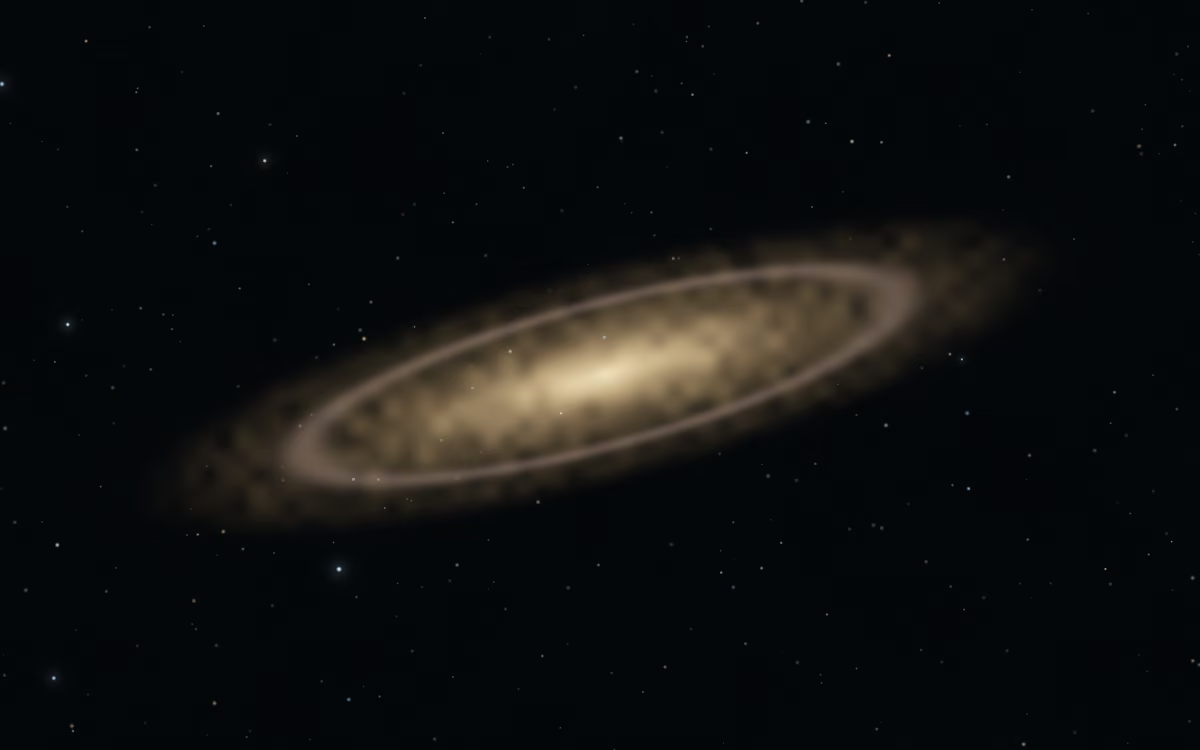
Barred lenticular galaxies contain a stellar bar embedded within a disk that lacks prominent spiral arms.
The designation SB0 is commonly used in traditional classifications, while more detailed systems may distinguish different bar strengths.
Their bars resemble the elongated stellar structures found in barred spiral galaxies.
A stellar bar can remain dynamically important even after the surrounding disk has lost much of its star-forming gas.
This means that a decline in star formation does not automatically eliminate the bar.
Barred lenticular galaxies are valuable for studying long-term disk evolution, stellar orbital dynamics, and the relationship between bars, rings, and gas redistribution. [4] [32]
Dwarf Lenticular Galaxies
Dwarf lenticular galaxies are relatively low-mass systems displaying disk-like structures without conspicuous spiral arms.
They are sometimes designated dS0, although classification conventions vary between studies.
Identifying these galaxies is challenging because their disks may be faint, compact, or difficult to distinguish from diffuse spheroidal stellar distributions.
Some objects historically classified as dwarf ellipticals reveal embedded disks or other lenticular-like features when observed with higher resolution.
Environmental interactions may contribute to their evolution by removing gas or disturbing their stellar structures.
Dwarf lenticular systems demonstrate that morphology can remain continuous across low-mass galaxy populations rather than forming sharply separated categories. [4] [5]
How Do Spiral Galaxies Become Lenticular Galaxies?
A spiral galaxy may develop lenticular morphology when its star formation declines and its visible spiral pattern becomes less prominent.
Several mechanisms can contribute to this transformation.
Gas exhaustion gradually reduces the supply of material available for new stars. Ram-pressure stripping can remove gas when a galaxy moves through a dense surrounding medium.
Gravitational encounters may alter the disk or redistribute existing stars.
Internal processes, including bar-driven evolution, can also change the distribution of gas and stellar populations.
Some lenticular galaxies may form through mergers or other pathways rather than through the fading of an ordinary spiral.
Consequently, the spiral-to-lenticular transformation is an important evolutionary possibility, not a universal rule. [7] [14]
Irregular Galaxy Types and Subclasses
Irregular galaxies include a wide range of systems that do not exhibit the classical symmetry of spiral or elliptical galaxies.
Their unusual structures can reflect low stellar mass, turbulent star formation, gravitational encounters, or disturbances affecting the distribution of gas and stars.
Historical classification systems separated irregular galaxies into broad subcategories, but modern astronomy often uses more detailed morphological and physical descriptions.
The distinction between a naturally asymmetric dwarf galaxy and a massive galaxy temporarily disrupted by a collision is particularly important when interpreting irregular morphology. [2]
Irr I Galaxies
Irr I is a historical classification used for irregular galaxies that display recognizable stellar associations or star-forming structures despite lacking an organized spiral pattern.
These systems commonly contain patches of bright young stars, gas clouds, and irregularly distributed stellar populations.
Their shapes may be asymmetric, but some internal features remain identifiable.
Many classical Irr I galaxies are relatively gas-rich and capable of continued star formation.
The designation is not as central to every modern classification catalog as broader irregular and dwarf irregular categories.
Nevertheless, it remains useful for understanding the historical development of galaxy morphology systems and distinguishing moderately structured irregular systems from more severely disturbed galaxies. [2] [5]
Irr II Galaxies
Irr II historically described irregular galaxies with more strongly disordered appearances and little recognizable internal organization.
Such systems may contain extensive dust structures, distorted stellar distributions, or features that obscure an underlying regular morphology.
Interactions and mergers can produce similarly chaotic appearances, which makes identifying the physical origin of an Irr II classification difficult.
Modern researchers frequently supplement or replace this designation with descriptions such as peculiar, disturbed, or merging.
The Irr I and Irr II categories therefore provide a historical morphological distinction rather than a complete explanation of galaxy formation.
Observations of gas motions and stellar populations are needed to determine whether an unusual appearance reflects a long-lived structure or a temporary disturbance. [2] [5]
Magellanic Irregular Galaxies
Magellanic irregular galaxies are named for their resemblance to the Magellanic Clouds, nearby satellite galaxies of the Milky Way.
They often display asymmetric stellar distributions, substantial gas content, and prominent star-forming regions.
Some contain weak spiral structures or central bars, making their classification transitional between irregular and late spiral systems.
The Large Magellanic Cloud is especially important because it combines irregular overall morphology with a rotating disk and prominent stellar bar.
The Small Magellanic Cloud is more strongly disturbed and has a complex three-dimensional structure.
These nearby systems allow astronomers to study individual stars, gas clouds, and star formation histories in greater detail than is possible for most distant galaxies. [24] [25]
Dwarf Galaxies: Small Galaxies with Diverse Structures
Dwarf galaxies are relatively low-mass and low-luminosity galaxies that occur in many different morphological forms.
They can be irregular, elliptical-like, spheroidal, compact, or extremely diffuse.
Although dwarfs contain fewer visible stars than massive galaxies, many are strongly influenced by dark matter.
They also respond sensitively to stellar feedback, gravitational interactions, and environmental gas removal.
Because dwarf galaxies can preserve evidence of early star formation and chemical enrichment, they are particularly valuable for studying the earliest phases of galaxy assembly and the behavior of dark matter. [8] [17]
What Is a Dwarf Galaxy?
A dwarf galaxy is a galaxy with relatively low stellar mass and luminosity compared with large systems such as the Milky Way.
There is no single universally applied boundary that separates all dwarf galaxies from larger galaxies.
Some contain only a few thousand observable stars, while others contain hundreds of millions or more.
Dwarfs may orbit larger galaxies as satellites or exist in relatively isolated environments.
Their low masses make them sensitive to the effects of supernova-driven winds and gravitational disturbances.
Dwarf galaxies are especially important because their stellar motions, chemical abundances, and star formation histories can constrain models of galaxy formation and dark matter. [1] [8]
Dwarf Irregular Galaxies
Dwarf irregular galaxies are low-mass systems with asymmetric shapes and no clearly organized spiral or elliptical structure.
Many contain substantial reservoirs of neutral hydrogen, molecular gas, and active star-forming regions.
Their stellar populations often include both young blue stars and older red stars.
Star formation may occur in scattered regions rather than along coherent spiral arms.
Because their gravitational potentials are relatively shallow, energetic feedback from massive stars and supernovae can redistribute gas and chemically enriched material.
NGC 1705 is an example of a dwarf irregular galaxy with evidence of a significant recent starburst.
Studying these galaxies helps astronomers understand the relationship between gas availability, stellar feedback, and chemical evolution. [17] [36]
Dwarf Spheroidal Galaxies
Dwarf spheroidal galaxies, commonly abbreviated dSph, are faint systems containing diffuse stellar populations with approximately spheroidal structures.
Many have very little detectable cold gas and show little present-day star formation.
They are frequently observed as satellites of larger galaxies, including the Milky Way.
Their stars often follow a range of orbital directions rather than the organized circular motion typical of spiral disks.
Measurements of stellar velocities provide important evidence for large amounts of unseen gravitational mass in many dwarf spheroidals.
The Draco dwarf galaxy is a particularly useful target for studies of dark matter distribution.
Dwarf spheroidal galaxies also preserve information about early star formation, chemical enrichment, and the environmental history of satellite systems. [8]
Ultra-Faint Dwarf Galaxies
Ultra-faint dwarf galaxies are among the least luminous known galactic systems.
Some contain only small observable populations of ancient, metal-poor stars.
Their low surface brightness makes them extremely difficult to discover against foreground Milky Way stars.
Many known ultra-faint dwarfs are considered strongly dark matter-dominated based on their stellar motions, although determining their masses can be challenging when only a few stars are available for measurement.
Astronomers distinguish these systems from star clusters using combinations of stellar velocity dispersion, size, chemical abundance patterns, and evidence of extended star formation histories.
Their properties offer important constraints on early galaxy formation and the smallest dark matter structures capable of producing stars. [8]
Blue Compact Dwarf Galaxies
Blue compact dwarf galaxies are relatively small systems with concentrated, intense star formation.
Their blue optical colors generally result from luminous, young, massive stars.
Many contain bright ionized gas regions surrounding newly formed stellar populations.
These galaxies may experience star formation episodes that are unusually intense compared with their existing stellar masses.
However, a blue compact dwarf is not necessarily a newly formed galaxy. Older stars can exist beneath the bright emission from its current starburst.
These galaxies provide laboratories for studying chemical enrichment, stellar winds, supernova feedback, and the conditions that trigger rapid star formation in relatively low-mass systems. [17] [36]
Ultra-Diffuse Galaxies
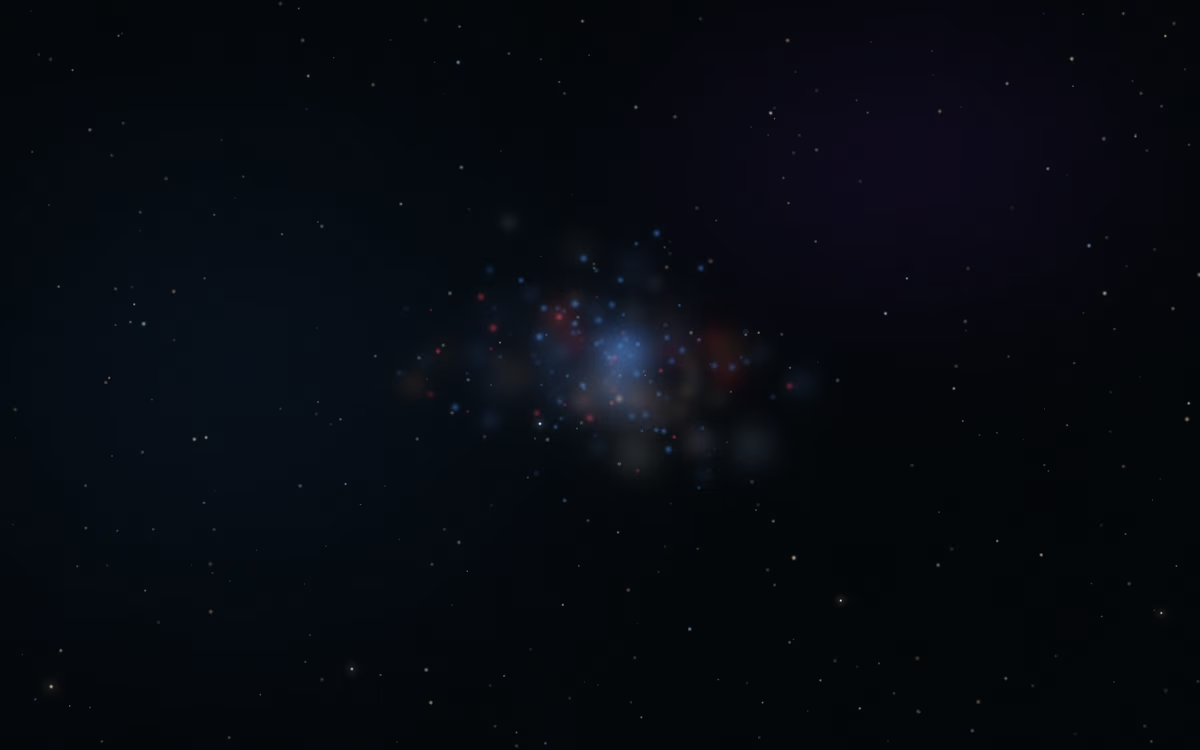
Ultra-diffuse galaxies are characterized by unusually extended stellar distributions and extremely low surface brightness.
Some have physical sizes comparable to much larger galaxies but contain relatively little starlight.
Their faint appearances make them difficult to detect without deep imaging.
Ultra-diffuse galaxies occur in galaxy clusters, groups, and other environments.
Their dark matter properties appear to vary substantially. While some are inferred to be strongly dark matter-dominated, others, such as NGC 1052-DF2, have been reported to contain unexpectedly little dark matter.
The interpretation of individual systems depends on distance measurements, stellar or globular cluster motions, and dynamical assumptions.
Ultra-diffuse galaxies therefore challenge simple assumptions about the relationship between galaxy size, stellar mass, and dark matter content. [9]
Low-Surface-Brightness Galaxies
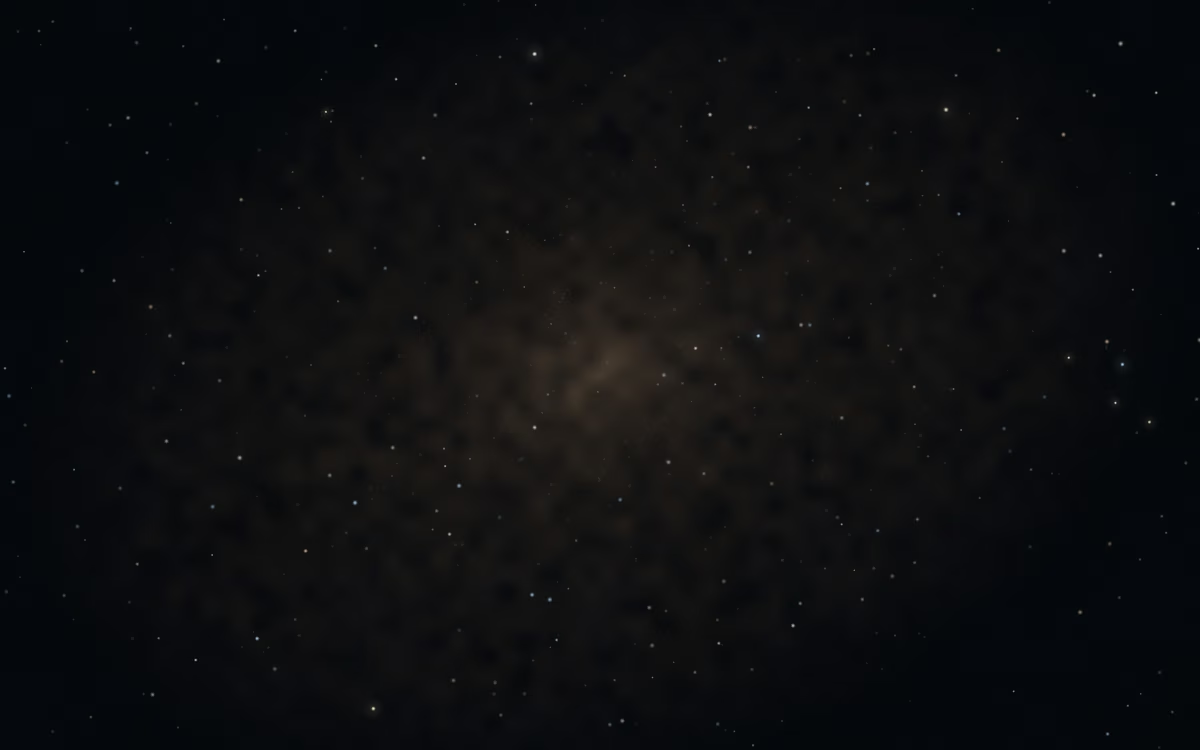
Low-surface-brightness galaxies emit relatively little visible light per unit area compared with more easily detected galaxies.
Their faintness does not necessarily mean that they contain very few stars. Instead, their starlight may be spread across an unusually large region.
Some are diffuse disk galaxies with substantial gas reservoirs, while others are spheroidal or extremely low-mass systems.
Ultra-diffuse galaxies belong to the broader family of low-surface-brightness systems, although individual studies may apply different numerical selection criteria.
Observational surveys can miss these galaxies because their diffuse light is difficult to distinguish from the sky background.
Improved imaging techniques have revealed that galaxy populations are more diverse than older, brightness-limited catalogs suggested. [9]
Tidal Dwarf Galaxies
Tidal dwarf galaxies can form when gravitational interactions between larger galaxies pull gas and stars into extended tidal tails.
Under favorable conditions, some of the displaced material becomes gravitationally bound and develops into a distinct stellar system.
Unlike conventional dwarf galaxies that form within their own primordial dark matter halos, tidal dwarfs are assembled primarily from material removed from pre-existing galaxies.
Consequently, established models predict that they generally contain much less non-baryonic dark matter than ordinary dwarf galaxies.
Their chemical composition may also differ from that of conventional dwarfs of comparable mass because their material originated in more chemically enriched parent galaxies.
Tidal dwarfs help astronomers investigate galaxy collisions and alternative pathways of galaxy formation. [10]
Satellite Galaxies
Satellite galaxies are smaller galaxies gravitationally associated with a larger host system.
Their orbits take them through the host galaxy’s extended gravitational environment, where they may experience tidal forces, gas stripping, and changes in star formation.
The Milky Way has numerous satellite galaxies, including the Large and Small Magellanic Clouds and several dwarf spheroidal systems.
Satellite galaxies may gradually lose stars and gas as they interact with their hosts.
Some eventually merge with the larger galaxy, contributing stars to its halo or disk.
Their orbital motions also provide information about the distribution of dark matter surrounding the host galaxy.
Satellite populations are therefore important tests of hierarchical galaxy formation models. [10]
Peculiar and Unusual Galaxy Types
Some galaxies contain structures that cannot be adequately described by traditional spiral, elliptical, lenticular, or irregular classifications.
These systems are often called peculiar galaxies.
Their appearances may include rings, stellar streams, unusual disks, displaced nuclei, or extreme asymmetries.
Many result from gravitational encounters, but unusual structures can also develop through internal dynamical processes.
Studying peculiar galaxies is valuable because their distorted features reveal physical processes that may be difficult to recognize in more ordinary-looking systems. [11] [12]
Peculiar Galaxies
Peculiar galaxies are systems whose visible structures depart substantially from conventional morphological categories.
Their unusual features may include tidal tails, bridges connecting neighboring galaxies, asymmetric disks, stellar shells, or displaced central regions.
Gravitational interactions are a major cause of peculiar morphology.
When galaxies pass near one another, tidal forces can stretch and redistribute their stars and gas, producing structures that remain visible for extended periods.
However, peculiar does not identify a single physical formation mechanism.
Astronomers often combine this designation with more specific classifications such as spiral, interacting, ring, or merging.
The term describes an unusual observed appearance rather than a separate, mutually exclusive class of galaxies. [2] [11]
Ring Galaxies
Ring galaxies display prominent ring-shaped stellar or star-forming structures.
However, not all galactic rings arise through the same mechanism.
Some rings form within barred or unbarred disk galaxies through orbital resonances associated with their gravitational structure.
Others result from collisions that launch expanding density disturbances through galactic disks.
These physically different formations can resemble one another in certain images.
Astronomers therefore distinguish ordinary inner or outer resonance rings from peculiar collisional ring galaxies.
The presence of a ring may also reveal how gas responds to a galaxy’s gravitational potential.
Multiwavelength observations help determine whether the ring contains old stars, gas, recent star formation, or a combination of these components. [4] [11]
Polar-Ring Galaxies
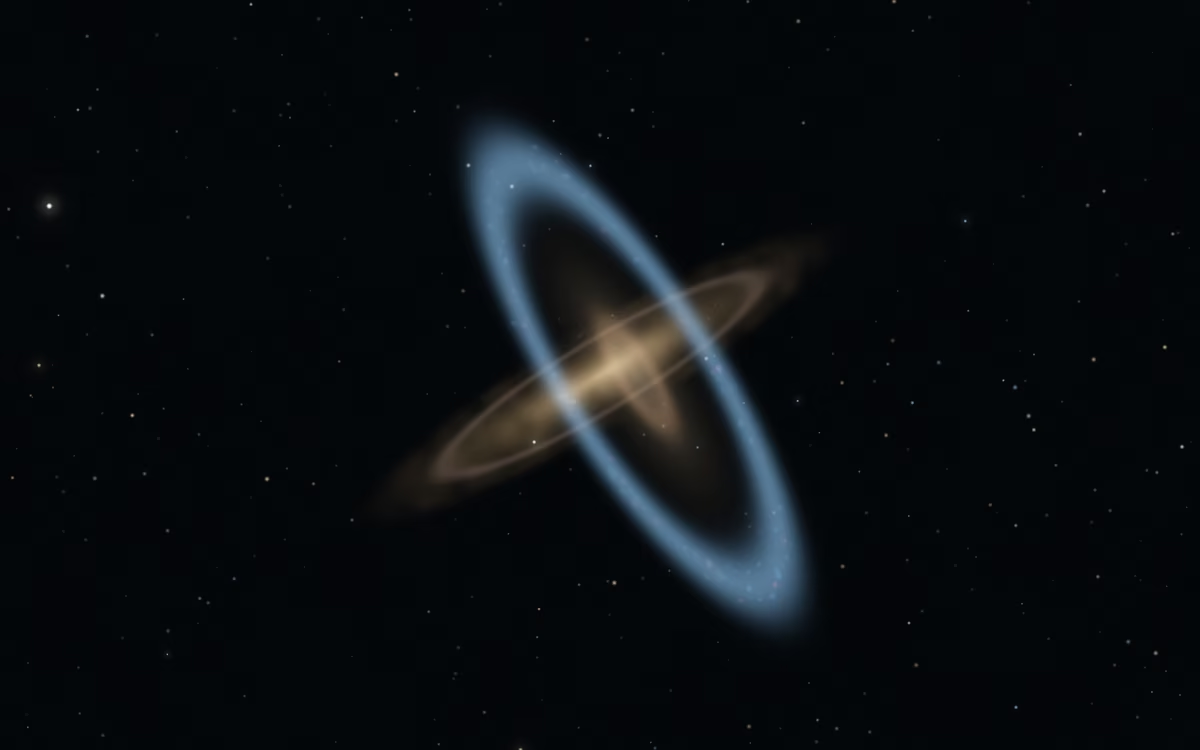
Polar-ring galaxies contain a central stellar system surrounded by a ring or disk of material orbiting at a large angle to the main galaxy’s plane.
In some systems, the outer structure is oriented approximately perpendicular to the central stellar disk.
Such configurations may develop through the accretion of material from another galaxy or through past mergers.
The unusual geometry allows astronomers to investigate gravitational motions in different orbital planes.
This provides useful constraints on the three-dimensional shape of the surrounding gravitational potential, including the dark matter halo.
NGC 660 is a well-known polar-ring galaxy.
These systems demonstrate that stars and gas within a single galaxy do not always share the same orbital plane. [12]
Collisional Ring Galaxies
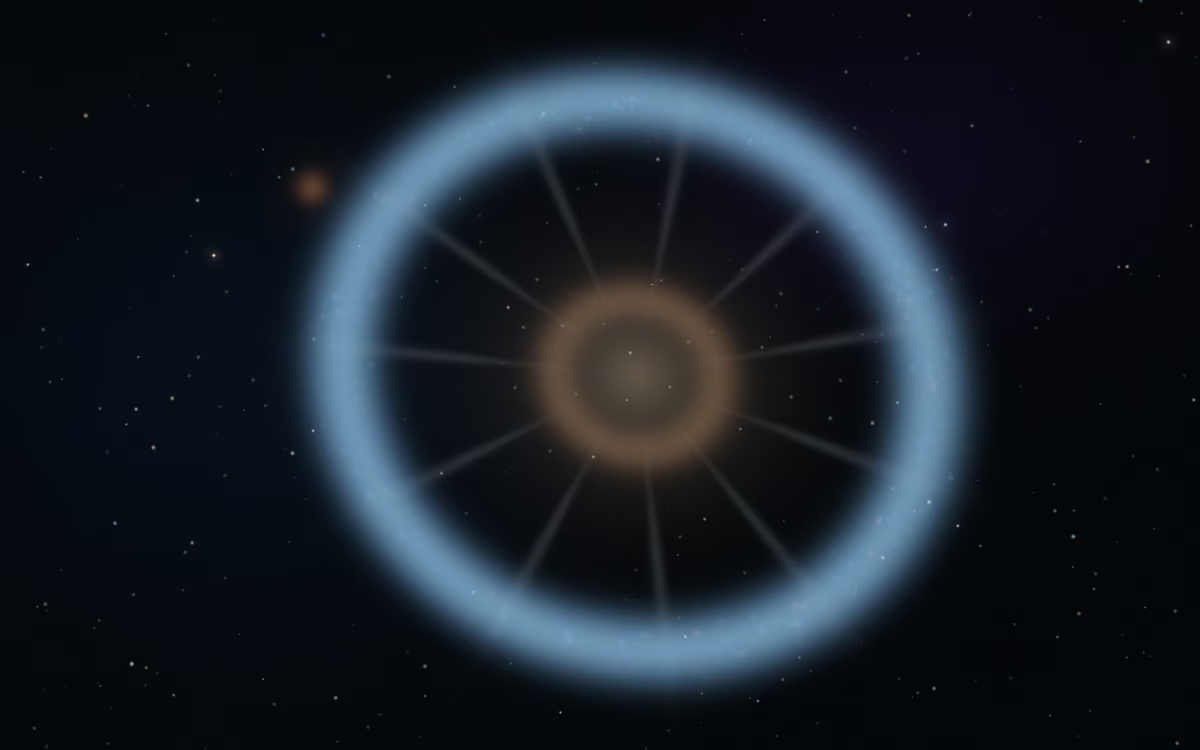
Collisional ring galaxies can form when a smaller galaxy passes through or close to the central region of a larger disk galaxy.
The gravitational disturbance can generate an outward-moving density wave through the disk.
As the disturbance propagates, it can compress gas and stimulate star formation within an expanding ring.
The resulting structure may contain bright young stars and numerous star-forming regions.
The Cartwheel Galaxy provides an especially recognizable example.
Its distinctive ring structure was produced by a galactic collision, and observations reveal both its bright inner region and extended star-forming outer ring.
The appearance of a collisional ring depends on the collision geometry, mass distribution, and subsequent dynamical evolution. [11]
Tadpole Galaxies
Tadpole galaxies have asymmetric appearances resembling a bright head followed by an elongated tail.
The head often contains concentrated star formation, while the tail may consist of stars, gas, or tidally displaced material.
Several physical processes can produce tadpole-like structures.
Gravitational encounters may stretch stellar distributions, while gas flows or disturbances within a disk can create asymmetric star-forming regions.
Such galaxies are observed in both relatively nearby and distant populations.
The tadpole designation describes a visible shape rather than a permanent evolutionary stage.
Astronomers investigate the motions of stars and gas to determine whether the observed structure is caused by interaction, gas dynamics, or another process. [2]
Green Pea Galaxies
Green Pea galaxies are compact, intensely star-forming galaxies originally identified through their distinctive appearance in Sloan Digital Sky Survey images.
Their greenish color in certain composite images is strongly influenced by bright emission from doubly ionized oxygen, commonly represented by the [O III] emission lines.
These systems often exhibit high specific star formation rates and relatively low chemical abundances.
Their strong nebular emission reveals energetic radiation produced by young, massive stars.
Green Pea galaxies are important because some resemble the physical conditions expected in early star-forming galaxies.
Researchers use them to investigate how ionizing ultraviolet radiation escapes galaxies and contributes to the ionization of surrounding gas. [13] [31]
Interacting, Merging, and Starburst Galaxies
Galaxy interactions can change morphology, redistribute gas, trigger bursts of star formation, and alter the activity of central black holes.
These processes connect different physical galaxy classifications.
An interacting galaxy may remain recognizably spiral, while a merger remnant may eventually acquire a smooth elliptical-like structure.
Starburst activity may occur during an interaction, but it can also result from internal processes.
Because interactions, mergers, and starbursts describe different phenomena, they should not be treated as interchangeable terms. [1] [2]
Interacting Galaxies
Interacting galaxies influence one another through their gravitational fields.
A close encounter can distort stellar disks, create tidal tails, or transfer gas between systems.
Some interactions produce bridges of stars and gas connecting neighboring galaxies.
Gravitational disturbances may compress gas clouds and stimulate star formation.
However, the effect depends on factors such as relative velocity, orbital geometry, gas content, and the masses of the galaxies involved.
Not every close encounter produces a major starburst or an eventual merger.
Some galaxies pass one another and continue on altered trajectories.
Interacting systems are valuable because their observed distortions reveal gravitational forces acting on galactic scales. [1] [2]
Merging Galaxies
Galaxy mergers occur when two or more galaxies become gravitationally bound and eventually combine into a larger system.
A major merger generally involves galaxies with relatively comparable masses, while a minor merger involves a substantially smaller companion.
Mergers redistribute stars, gas, and angular momentum.
Gas-rich mergers may trigger intense star formation and can sometimes increase the supply of material reaching central black holes.
A major merger may significantly disturb or destroy an existing stellar disk, although the eventual outcome depends on the properties of the merging systems.
Minor mergers can enlarge stellar halos, alter disk thickness, and contribute to gradual galactic growth.
Mergers are central components of hierarchical galaxy evolution. [1] [18]
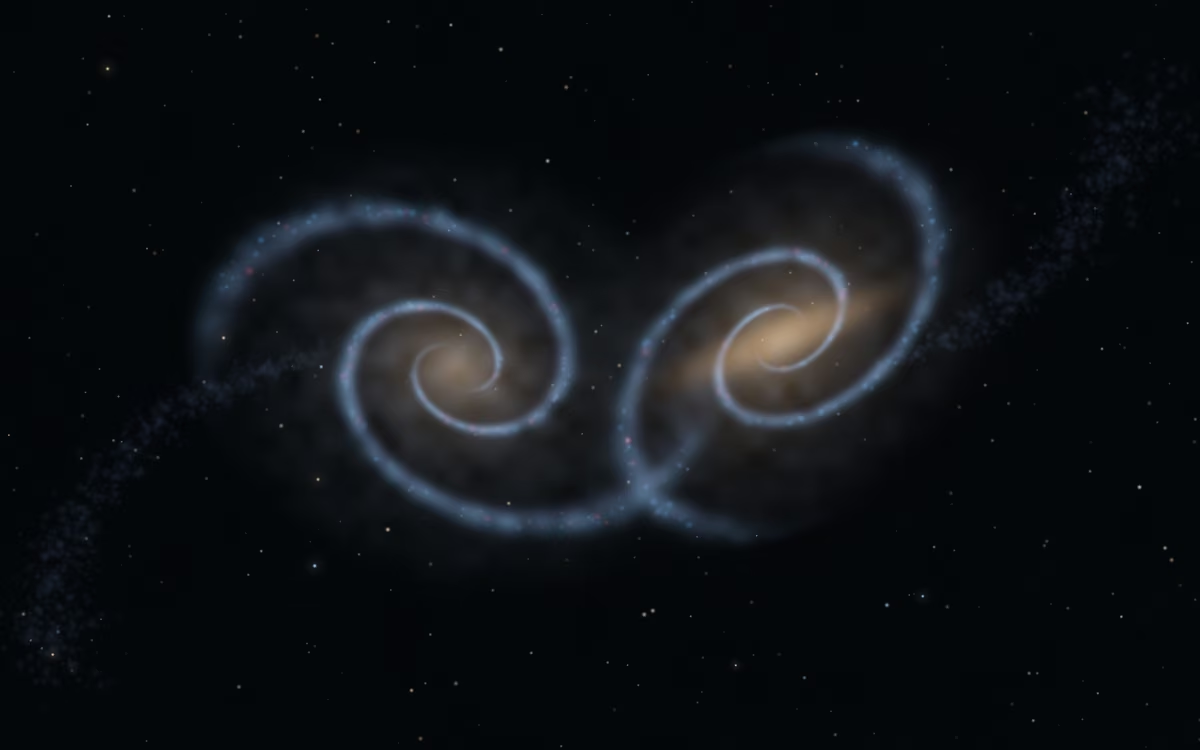
Starburst Galaxies
Starburst galaxies undergo episodes of unusually intense star formation relative to their existing stellar populations or available gas supplies.
These episodes produce large numbers of young, massive stars, which emit strong ultraviolet radiation and rapidly influence the surrounding interstellar medium.
Stellar winds and supernova explosions inject energy and chemically enriched material into the gas.
Starbursts can be triggered by galaxy interactions, mergers, and concentrated gas inflows, although not every starburst requires a major collision.
The activity may consume or expel gas, contributing to a subsequent decline in star formation.
Starburst galaxies help researchers study the connections among gas density, stellar feedback, chemical evolution, and galactic transformation. [17] [36]
Post-Starburst Galaxies
Post-starburst galaxies show evidence that a substantial episode of star formation occurred relatively recently but has since declined sharply.
Astronomers identify many such systems through their stellar spectra.
Strong absorption features from intermediate-age stars can remain visible after the short-lived massive stars responsible for prominent star-forming emission have disappeared.
The result provides evidence for significant recent star formation without correspondingly strong current activity.
Post-starburst galaxies are important for understanding how galaxies become quenched.
Possible causes include mergers, environmental gas removal, reduced gas supply, and feedback processes.
NGC 1266 is an example of a galaxy with post-starburst characteristics and lenticular morphology, illustrating how structural transformation and declining star formation can occur together. [7]
Jellyfish Galaxies
Jellyfish galaxies display extended streams of gas resembling the tentacles of a jellyfish.
These features commonly arise when galaxies move through the hot, diffuse gas filling a galaxy cluster.
The resulting ram pressure can remove gas from the galaxy’s disk.
Stripped material forms trailing structures, some of which contain young stars produced after gas compression.
The process can reduce the supply of cold gas remaining in the galaxy and eventually suppress star formation.
JW39 is a well-studied example of a jellyfish galaxy observed by Hubble.
These systems provide direct evidence of the relationship between cluster environments, gas stripping, star formation, and galactic evolution. [14]
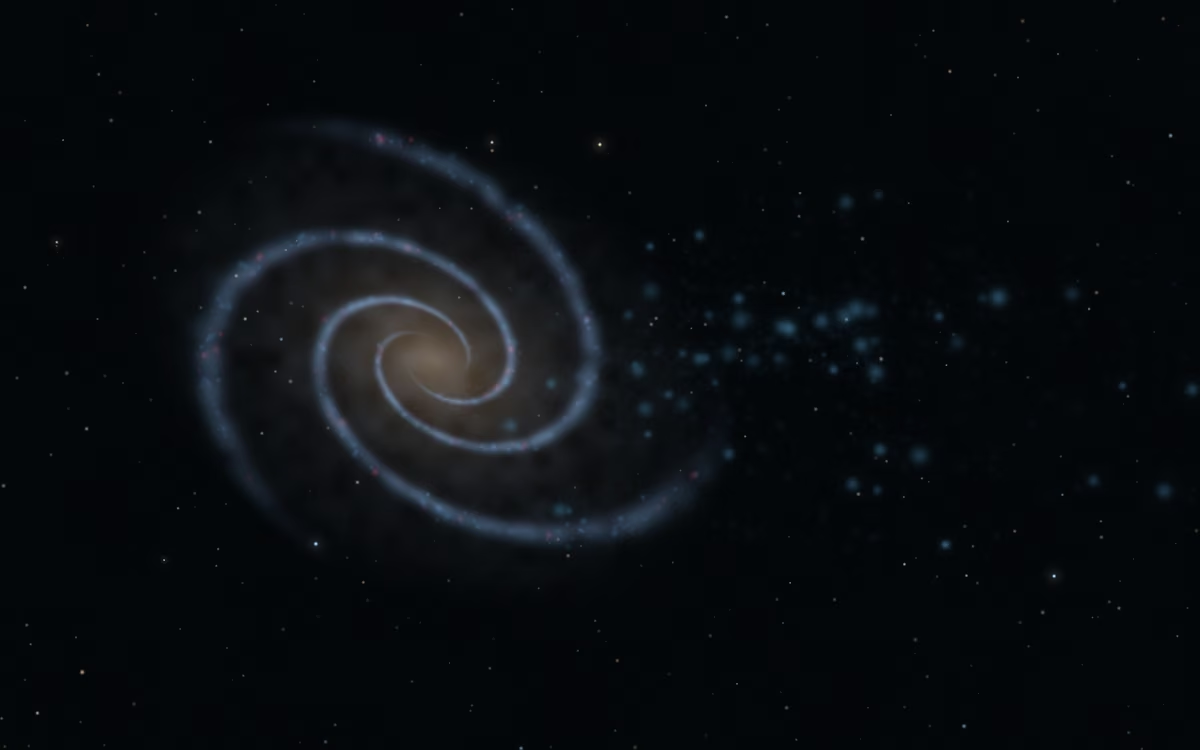
Active Galaxies and Their Types
Some galaxies produce unusually strong radiation from their central regions because matter is accreting onto supermassive black holes.
These systems are known as active galaxies.
The energy generated near the black hole can produce luminous accretion flows, strong emission lines, X-rays, and in some cases powerful relativistic jets.
Active galaxies are classified according to their nuclear spectra, luminosities, radio properties, and orientation.
These classifications are separate from the morphology of the host galaxy.
A spiral or elliptical galaxy can therefore contain an active galactic nucleus without becoming a different morphological galaxy type. [15]
What Is an Active Galaxy?
An active galaxy contains an active galactic nucleus, or AGN, whose radiation is powered primarily by matter accreting toward a central supermassive black hole.
Gas approaching the black hole can form an accretion disk or other hot accretion flow.
Gravitational energy released during accretion produces substantial radiation across the electromagnetic spectrum.
Dust may obscure parts of the central region, while some systems launch relativistic jets.
AGN activity differs from normal stellar radiation because the central source can be extraordinarily luminous compared with its physical size.
Not every galaxy containing a supermassive black hole is active.
The presence of a black hole alone is insufficient; significant observable activity requires appropriate conditions for accretion and energy release. [15]
Seyfert Galaxies
Seyfert galaxies contain bright active nuclei that can often be observed within otherwise recognizable host galaxies.
Their spectra show prominent emission lines produced by gas illuminated by the central energetic source.
They were identified as a distinctive class by astronomer Carl Seyfert in the twentieth century.
Seyfert galaxies commonly appear less overwhelmingly luminous than the most powerful quasars, allowing astronomers to study both the active nucleus and surrounding galaxy.
Their emission lines provide information about gas velocities, ionization conditions, and the central accretion environment.
Seyfert galaxies are typically divided into Type 1 and Type 2 categories based on their observed spectral properties.
These distinctions are important for understanding obscuration and viewing geometry in active galactic nuclei. [15]
Type 1 Seyfert Galaxies
Type 1 Seyfert galaxies exhibit broad permitted emission lines in their optical spectra.
These broad features indicate gas moving at high velocities relatively close to the central black hole.
Their spectra also contain narrower emission components produced farther from the central engine.
In the standard AGN unification framework, the broad-line region is visible because the observer has a relatively unobscured view toward the nucleus.
Type 1 Seyferts may also produce strong ultraviolet and X-ray emission associated with accretion.
However, orientation is not the only factor controlling their observed spectra. Changes in accretion conditions and obscuring material can also influence whether broad emission lines are detected. [15]
Type 2 Seyfert Galaxies
Type 2 Seyfert galaxies generally display narrow permitted and forbidden emission lines without directly visible broad permitted emission lines in ordinary optical spectra.
In many cases, obscuring material prevents a direct view of the central broad-line region.
The AGN unification model explains much of the Type 1 and Type 2 distinction through different viewing angles and obscuration.
Broad emission can sometimes be detected indirectly through polarized light.
However, not every Type 2 Seyfert is explained by an identical obscuring structure.
Intrinsic differences in accretion activity and the properties of the surrounding gas may also contribute.
Comparing the two classes helps astronomers investigate the geometry and physical conditions of active galactic nuclei. [15]
Radio Galaxies
Radio galaxies contain exceptionally strong sources of radio emission associated with their active galactic nuclei.
Many produce relativistic jets that extend far beyond the visible stellar distribution of the host galaxy.
These jets can inflate enormous radio-emitting lobes.
Much of the radio radiation arises through synchrotron emission, produced when energetic charged particles move through magnetic fields.
Radio galaxies are frequently associated with massive elliptical hosts, although radio-emitting AGN can exist in other morphological environments.
Jets can transfer energy into surrounding gas, producing shocks, cavities, and other disturbances.
Messier 87 is a prominent example of a galaxy containing a powerful jet and a central supermassive black hole. [15] [22]
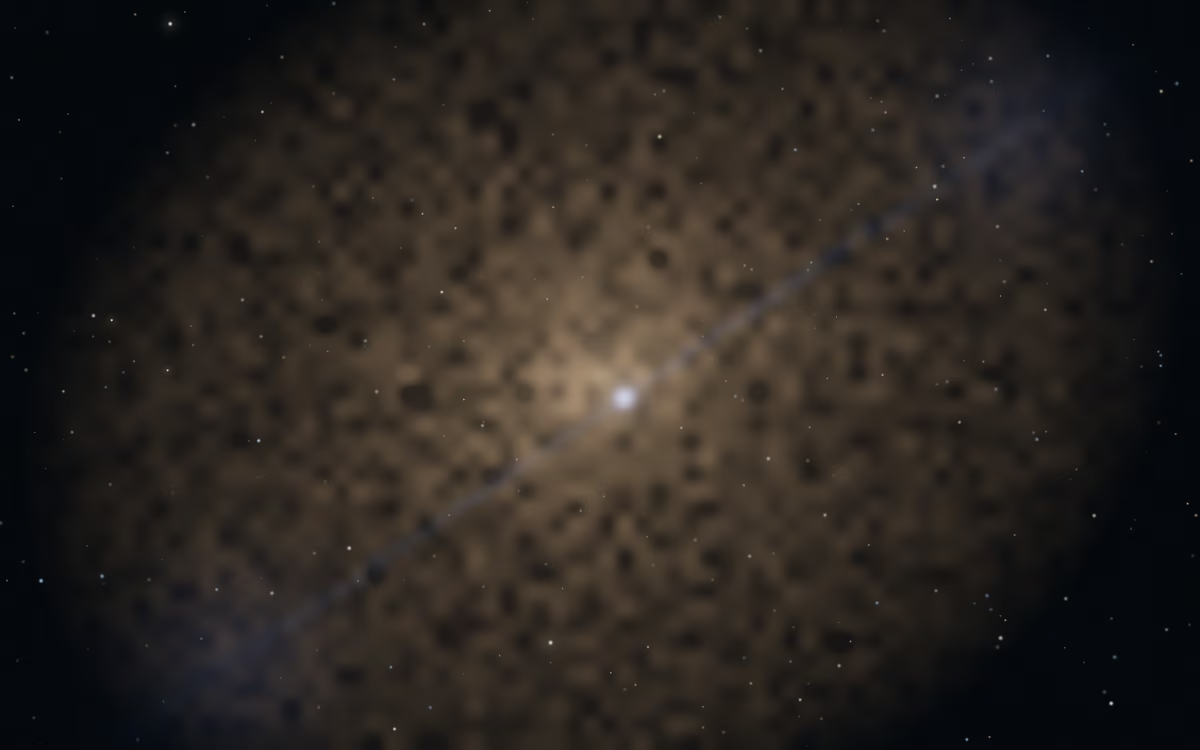
Radio-Loud and Radio-Quiet AGN
Astronomers describe active galactic nuclei as radio-loud or radio-quiet according to the prominence of their radio emission relative to other wavelengths.
Radio-loud AGN often produce powerful, extended relativistic jets and radio lobes.
Radio-quiet AGN generally lack similarly dominant large-scale radio structures, although some still produce weaker jets or radio emission from other processes.
The distinction is useful but depends on the measurement and selection criteria used.
Differences in black hole properties, accretion conditions, magnetic fields, and surrounding environments may influence radio activity.
Radio-loudness is not a galaxy morphology.
An elliptical galaxy may host a radio-loud nucleus, while another elliptical galaxy may contain a weak or inactive central black hole. [15]
Quasars
Quasars are extremely luminous active galactic nuclei powered by accretion onto supermassive black holes.
Their nuclear radiation can dominate the visible light of the surrounding host galaxy.
Quasars emit across a broad range of wavelengths, including optical, ultraviolet, infrared, and X-rays.
Some are radio-loud and produce powerful jets, while others are comparatively radio-quiet.
Because quasars can be detected across enormous cosmological distances, they are valuable probes of the early universe.
Their spectra reveal information about black hole accretion and material along the line of sight.
Quasar observations also help astronomers investigate how supermassive black holes grew within young galaxies and how their activity influenced surrounding gas. [15]
Blazars
Blazars are active galactic nuclei containing relativistic jets oriented close to our line of sight.
Their apparent brightness is strongly affected by relativistic beaming.
Radiation produced within material moving toward the observer at nearly the speed of light can appear greatly amplified.
Blazars often exhibit substantial variability across multiple wavelengths, sometimes over relatively short timescales.
Their emission may extend from radio wavelengths to high-energy gamma rays.
Because their jets are viewed at favorable angles, blazars offer valuable opportunities to study energetic particle acceleration and magnetic processes close to supermassive black holes.
Their classification describes the orientation and observational properties of an active nucleus rather than the overall shape of its host galaxy. [15]
Low-Ionization Nuclear Emission-Line Regions (LINERs)
LINER stands for low-ionization nuclear emission-line region.
A LINER is identified through a characteristic pattern of optical emission lines, including lines associated with relatively low-ionization species.
Some LINER spectra are produced by low-luminosity accretion activity near central black holes.
However, other mechanisms can generate similar emission-line patterns.
These include radiation from evolved stellar populations, shocks, and certain star-forming environments.
Consequently, identifying LINER-like emission does not automatically establish that a galaxy contains an actively accreting black hole.
Astronomers use additional spectral, spatial, radio, and X-ray observations to distinguish the underlying processes.
LINER-like emission occurs in galaxies with different morphological types. [16]
Internal Structure and Physical Properties of Galaxies
Galaxy morphology is closely connected to the distribution of stars, gas, dust, and dark matter.
The central bulge, rotating disk, spiral arms, stellar bar, and surrounding halo each influence a galaxy’s appearance and dynamical behavior.
However, structural components alone do not explain every physical property.
Astronomers also examine stellar ages, chemical abundances, luminosity, gas content, and star formation rates.
These measurements reveal how galaxies assembled their mass and how their internal conditions have changed over time. [1] [2]
Galactic Bulge
A galactic bulge is a central concentration of stars found in many disk galaxies.
Some bulges resemble small elliptical systems embedded within a larger disk, while others have more disk-like structures and rotational properties.
Astronomers often distinguish classical bulges from pseudobulges.
Classical bulges are commonly associated with dynamically hotter stellar populations and more varied orbital motions.
Pseudobulges may display features produced by gradual internal disk evolution, including bar-driven redistribution of material.
The distinction is not always simple because galaxies can contain multiple central components.
Bulge prominence contributes to traditional spiral classification, but a large bulge does not uniquely determine a galaxy’s age, mass, or evolutionary history. [4] [6]
Galactic Disk
The galactic disk is a flattened structure containing stars and, in many galaxies, interstellar gas and dust.
Disk stars frequently follow approximately circular orbits around the galactic center, although their motions include additional radial and vertical components.
Large disk galaxies can contain both thin and thick stellar disk populations.
Thin disks often include younger stars and much of the cold gas associated with current star formation.
Thick disks generally contain older stellar populations distributed over greater vertical distances from the disk plane.
Spiral galaxies contain disks with visible spiral patterns, while lenticular galaxies retain disk structures without similarly prominent arms.
Disk dynamics are central to understanding bars, spiral instabilities, and secular galaxy evolution. [6]
Spiral Arms
Spiral arms are coherent patterns within rotating galactic disks where stars, gas, and dust often become concentrated.
They are frequently associated with enhanced star formation, particularly where gas becomes compressed.
Bright, young stars can make the arms especially visible in ultraviolet and blue optical images.
However, spiral arms are not permanent material structures composed of the same fixed group of stars.
Stellar orbits and spiral patterns can evolve at different rates.
Modern dynamical models include transient gravitational instabilities, interactions with satellite galaxies, and perturbations caused by stellar bars.
The mixture of these processes explains why spiral galaxies display such a wide variety of arm shapes and structures. [6]
Galactic Bar
A galactic bar is an elongated stellar structure extending through the central region of a disk galaxy.
Bars arise from the gravitational dynamics of stellar disks and can persist for substantial periods.
Their non-axisymmetric gravitational fields redistribute angular momentum and influence stellar and gaseous orbits.
Gas may be directed toward resonance regions or central portions of the galaxy, potentially affecting star formation.
Bars are also associated with certain inner and outer ring structures.
However, their effects depend on gas availability, bar strength, and the galaxy’s overall gravitational potential.
A bar does not automatically imply that a galaxy contains an active nucleus or that central star formation is increasing. [4] [6]
Galactic Halo
A galactic halo is an extended region surrounding a galaxy’s main visible structure.
The stellar halo often contains relatively sparse populations of stars, globular clusters, and stellar streams.
Many halo stars are old and have chemical compositions that preserve information about earlier phases of galaxy formation.
Stellar streams can originate when satellite galaxies or star clusters are disrupted by gravitational tides.
These features allow astronomers to reconstruct parts of a galaxy’s merger and accretion history.
The visible stellar halo is different from the dark matter halo, although both occupy extended regions around the galaxy.
The Milky Way’s halo provides important evidence of past satellite accretion events. [1] [10]
Dark Matter Halo
A dark matter halo is an extended distribution of unseen gravitating matter surrounding a galaxy.
Dark matter does not emit, absorb, or reflect detectable electromagnetic radiation in the manner of ordinary matter.
Its presence is inferred from gravitational effects.
Galaxy rotation curves, stellar motions, gravitational lensing, and the dynamics of satellite systems provide evidence for dark matter.
In many galaxies, the dark matter halo extends considerably farther than the brightest stellar distribution.
It also plays a central role in theoretical models of galaxy formation by providing the gravitational structures within which gas can accumulate and cool.
However, individual galaxies can exhibit unusual inferred dark matter properties, particularly among low-mass and ultra-diffuse systems. [8] [9]
Supermassive Black Holes
Supermassive black holes are compact objects containing millions to billions of times the Sun’s mass.
They are found in the central regions of many massive galaxies.
These black holes can grow through accretion and mergers.
When surrounding material falls inward, the resulting release of gravitational energy can produce an active galactic nucleus.
The associated radiation, winds, and jets may influence the surrounding interstellar or intracluster gas.
However, a supermassive black hole can also remain comparatively inactive when little material is accreting.
Astronomers investigate relationships between black hole masses and host galaxy properties to understand how black hole growth and galaxy evolution influence one another. [15] [23]
Stellar Populations
A stellar population is a collection of stars studied through properties such as age, chemical composition, and spatial distribution.
Young, massive stars are generally bright and blue, while older stellar populations often contribute more strongly to a galaxy’s red and near-infrared light.
However, color is influenced by more than age alone.
Dust, metallicity, and the mixture of stellar populations can alter the observed spectrum.
Astronomers use stellar population synthesis models to estimate star formation histories and stellar masses from galaxy light.
Nearby galaxies also allow detailed studies of individual resolved stars.
Comparing stellar populations across galactic bulges, disks, and halos helps reconstruct the sequence of events that built each system. [1] [20]
Interstellar Medium
The interstellar medium consists of gas and dust distributed between stars within a galaxy.
It includes cold molecular gas, neutral atomic gas, ionized gas, and hotter diffuse components.
Molecular clouds are particularly important because they provide the dense material from which new stars can form.
Ionized hydrogen regions reveal the influence of energetic radiation from young stars.
Dust affects how starlight travels through a galaxy and emits strongly at infrared wavelengths after absorbing energy.
The amount and distribution of interstellar material vary between galaxy types.
Gas-rich spirals and irregular galaxies frequently support ongoing star formation, while many elliptical and lenticular systems contain comparatively little cold star-forming gas. [1] [2]
Star Formation Rate
A galaxy’s star formation rate measures how much stellar mass it forms over a specified period.
Astronomers commonly express this quantity in solar masses per year.
Different observations trace star formation over different timescales.
Ultraviolet light traces young, massive stellar populations, while hydrogen emission lines reveal gas ionized by short-lived massive stars.
Infrared emission helps identify star formation obscured by dust.
Measurements often combine several indicators to account for observational limitations.
The specific star formation rate compares a galaxy’s star formation rate with its existing stellar mass.
This distinction helps determine whether a galaxy is growing its stellar population rapidly or forming relatively few stars compared with the mass it already contains. [1] [17]
Galaxy Luminosity and Stellar Mass
Galaxy luminosity measures the total energy emitted by a galaxy per unit time, while apparent brightness describes how much of that radiation reaches an observer.
A distant luminous galaxy can appear fainter than a nearby galaxy emitting much less energy.
Stellar mass represents the combined mass of a galaxy’s stars and stellar remnants as estimated through observations and population models.
The mass-to-light ratio connects a system’s mass with its emitted light.
This ratio depends on stellar ages, chemical composition, and the distribution of stellar masses.
Galaxies with similar luminosities may have different stellar masses because their stellar populations differ.
Total gravitational mass additionally includes dark matter and other matter not counted in stellar mass. [1]
Galaxy Formation and Evolution
Galaxies began forming as matter accumulated within gravitational structures in the early universe.
Their subsequent development involved gas accretion, star formation, chemical enrichment, internal dynamics, and interactions with other galaxies.
Modern cosmology describes galaxy formation as a hierarchical process in which smaller structures can combine into larger systems.
However, galaxies follow diverse evolutionary pathways.
Some maintain rotating disks for billions of years, while others undergo repeated mergers or experience declining star formation.
Recent observations show that recognizable disk structures could form relatively early in cosmic history, making galaxy evolution a continuing area of active research. [18]
How Do Galaxies Form?
Galaxy formation began from small density fluctuations in the early universe.
Gravity amplified these fluctuations, allowing dark matter to accumulate into increasingly massive structures.
Ordinary gas responded to the gravitational potential of these developing halos.
Where physical conditions permitted, gas cooled, became denser, and formed the first generations of stars.
The resulting stellar systems continued to evolve through additional gas accretion, star formation, and mergers.
These processes established the foundations of galaxies observed today.
The exact pathways depended on halo mass, gas supply, environmental conditions, and feedback from stars and black holes.
Modern simulations attempt to reproduce these interconnected processes, while observations of early galaxies provide essential tests of the models. [1] [18]
How Do Galaxies Evolve Over Time?
Galaxies evolve as they gain, redistribute, transform, or lose matter.
Cold gas can support continued star formation, while stellar winds and supernova explosions return energy and chemically enriched material to the interstellar medium.
Gas accretion may replenish the star-forming supply.
Gravitational interactions can alter stellar orbits, generate bars, or trigger mergers.
Central black hole activity can influence the surrounding gas through radiation and mechanical feedback.
These processes do not produce one universal evolutionary sequence.
For example, a spiral galaxy may retain its disk, become lenticular after losing gas, or undergo a major merger that changes its structure substantially.
Observations from JWST show that some large disks developed surprisingly early, indicating that galactic assembly can proceed rapidly under favorable conditions. [18]
The Role of Galaxy Mergers
Galaxy mergers contribute to the growth and structural transformation of many galaxies.
A major merger can significantly redistribute stellar orbits, disturb existing disks, and create a new gravitationally relaxed system.
Minor mergers can add stars to a galaxy’s halo and influence its disk without necessarily destroying its overall structure.
Mergers may also drive gas inward, temporarily increasing star formation or nuclear accretion.
However, not every merger creates a strong starburst, and not every massive elliptical forms through one major event.
The outcome depends on the gas content, mass ratio, orbital parameters, and internal structures of the merging galaxies.
Repeated mergers are especially important in the hierarchical growth of massive galaxies and galaxy clusters. [1] [30]
Gravitational Interactions and Tidal Forces
Tidal forces arise because gravity acts with different strengths across an extended object.
When galaxies approach one another, these differences can distort their stellar and gaseous structures.
The resulting features include tidal tails, bridges, stellar streams, warped disks, and asymmetric star-forming regions.
A smaller satellite may lose material to a larger host during repeated encounters.
Over time, this material can become part of the host galaxy’s stellar halo.
Interactions can also transfer angular momentum and alter the orbits of stars and gas.
The severity of the disturbance depends on relative masses, closest approach, orbital direction, and encounter velocity.
These processes help explain many peculiar galaxy morphologies. [1] [10]
Ram-Pressure Stripping
Ram-pressure stripping occurs when a galaxy moves through surrounding gas and experiences pressure from the relative motion.
This effect is especially important in galaxy clusters containing hot intracluster plasma.
If the external pressure overcomes the gravitational forces retaining the galaxy’s gas, material can be stripped from the disk.
The removed gas may form extended tails, producing a jellyfish-like appearance.
Gas compression can sometimes trigger star formation within these tails.
Over longer periods, however, removing the star-forming reservoir can reduce or terminate star formation in the galaxy itself.
Ram-pressure stripping is therefore a major environmental mechanism linking galaxy motion, gas content, morphology, and quenching. [14]
Star Formation Quenching
Star formation quenching describes a sustained reduction or cessation of a galaxy’s ability to produce new stars.
Several mechanisms can contribute.
A galaxy may exhaust its available cold gas without replenishment, lose gas through environmental stripping, or experience heating that prevents gas from cooling efficiently.
Feedback from supernovae and active galactic nuclei can also influence gas conditions.
Quenching may occur rapidly or gradually, depending on the system and physical process involved.
As massive, short-lived blue stars disappear, the galaxy’s optical light may become increasingly dominated by older stellar populations.
However, red color alone does not prove quenching because dust and other effects can also redden a galaxy. [7] [14]
Galaxies in Groups and Clusters
Galaxies are not distributed randomly throughout the universe.
Many exist in gravitationally associated groups or larger galaxy clusters, which are embedded within the cosmic web of filaments and dense regions.
A galaxy’s surroundings can influence its gas supply, merger history, and structure.
Dense environments increase opportunities for gravitational encounters and expose galaxies to surrounding hot gas.
These effects help explain why the populations of spiral, lenticular, and elliptical galaxies differ between relatively isolated environments and rich clusters. [1]
Galaxy Groups
Galaxy groups are gravitationally associated collections of galaxies, generally containing fewer members and less total mass than rich galaxy clusters.
They often include several larger galaxies together with numerous dwarf satellites.
The Local Group contains the Milky Way, Andromeda, Triangulum, and many smaller galaxies.
Gravitational interactions within groups can produce mergers, tidal structures, and changes in gas distribution.
Because encounter velocities are often lower than those in massive clusters, some group environments provide favorable conditions for galaxy mergers.
Galaxy groups are particularly important for understanding hierarchical growth.
They also show that environmental effects do not require the extreme conditions found in the richest clusters. [1] [37]
Galaxy Clusters
Galaxy clusters are massive gravitationally bound systems containing hundreds or thousands of galaxies, dark matter, and extensive reservoirs of hot intracluster gas.
The hot gas often produces strong X-ray emission.
Cluster environments contain populations of elliptical, lenticular, and spiral galaxies, although their relative abundances depend on cluster properties and location within the system.
Gravitational encounters, tidal stripping, and ram-pressure stripping can transform galaxies as they move through the cluster.
Many massive clusters contain a dominant central elliptical galaxy.
Dark matter contributes substantially to the gravitational mass holding the system together.
Galaxy clusters therefore provide laboratories for studying large-scale structure, dark matter, gas dynamics, and environmental galaxy evolution. [1] [30]
Famous Examples of Different Galaxy Types
Nearby galaxies provide some of the most informative examples of galactic morphology.
Their relative proximity allows astronomers to resolve stellar populations, examine gas distributions, measure motions, and identify evidence of previous interactions.
The Milky Way and Andromeda demonstrate the diversity of large spiral galaxies.
Messier 87 illustrates the properties of a giant elliptical galaxy with an active nucleus.
The Large Magellanic Cloud provides a detailed example of a smaller, asymmetric disk galaxy with active star formation.
Together, these systems demonstrate how morphology, stellar population, environment, and nuclear activity can be studied as related but distinct characteristics. [20] [22] [24]
The Milky Way Galaxy: A Barred Spiral Galaxy
The Milky Way is a barred spiral galaxy containing a central stellar bar, rotating disk, spiral structure, bulge, and extended halo.
Our Solar System lies within the galactic disk, roughly 26,000 light-years from the galactic center, in the region called the Orion Spur.
Because Earth is inside the galaxy, astronomers cannot directly photograph its complete face-on structure.
Instead, they reconstruct its morphology using stellar distances, motions, infrared observations, radio measurements, and surveys of interstellar gas.
These studies reveal a central bar and a complex system of spiral arms.
The Milky Way also contains numerous satellite galaxies and an extended dark matter halo.
Its structure provides an important reference for interpreting other large disk galaxies. [27]
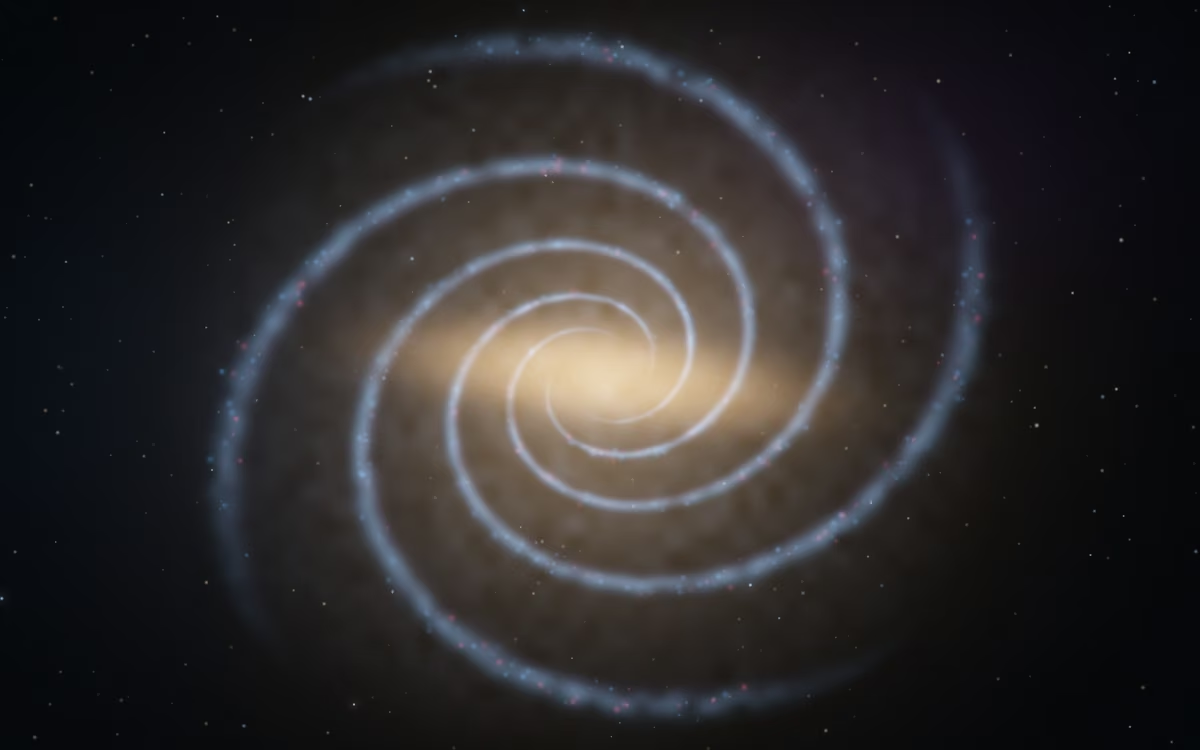
Andromeda Galaxy (M31): A Large Spiral Galaxy
The Andromeda Galaxy is the nearest major spiral galaxy to the Milky Way, located approximately 2.5 million light-years from Earth.
It contains an extensive stellar disk, central bulge, spiral structure, and outer stellar halo.
Its relatively inclined orientation makes certain internal features difficult to observe directly.
Although commonly classified as an Sb spiral, detailed infrared and dynamical studies have produced substantial evidence that Andromeda contains a stellar bar.
Hubble observations have resolved enormous numbers of individual stars, allowing astronomers to reconstruct its star formation and merger history.
Andromeda and the Milky Way are moving toward one another, but their eventual merger is not certain. A 2025 study incorporating additional Local Group dynamics estimated approximately even odds of a merger within the next 10 billion years. [19] [20] [21]
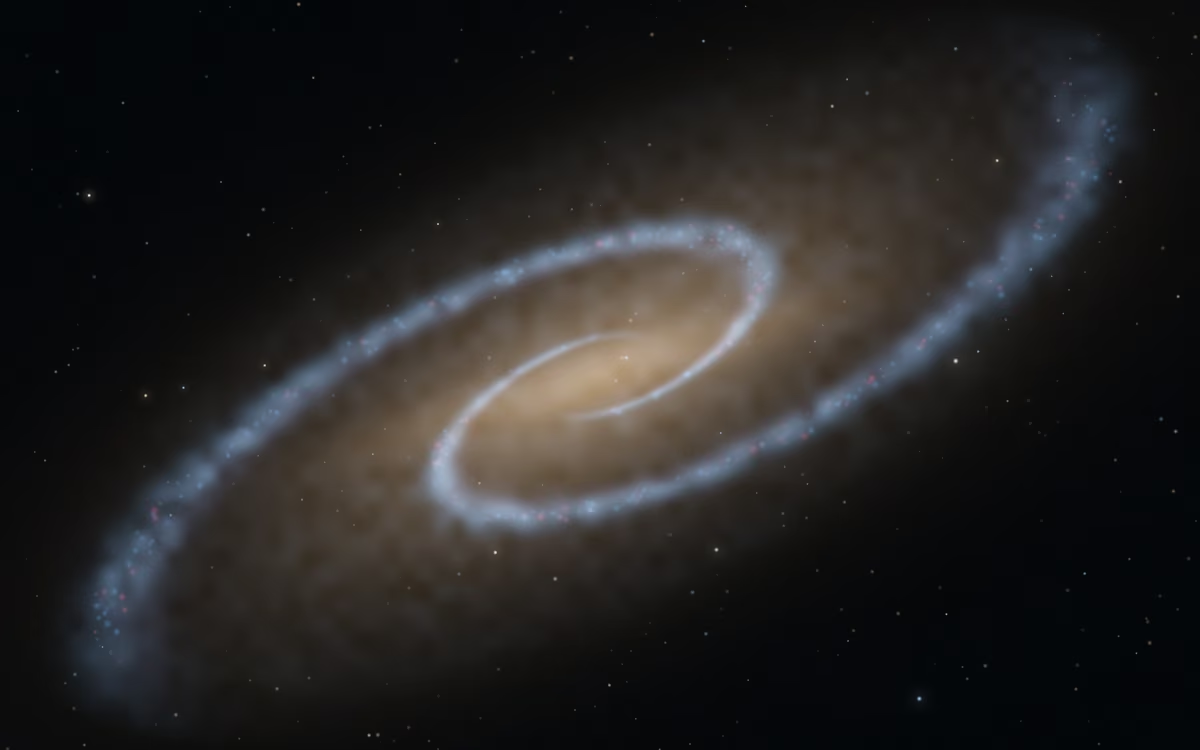
Messier 87 (M87): A Giant Elliptical Galaxy
Messier 87 is a massive elliptical galaxy located approximately 55 million light-years from Earth in the Virgo Cluster.
It contains an enormous stellar population, extensive globular clusters, and a central supermassive black hole.
The galaxy’s nucleus produces a powerful relativistic jet extending into the surrounding environment.
In 2019, the Event Horizon Telescope collaboration presented the first image showing the shadow of a black hole, associated with M87’s central object.
The black hole’s mass was estimated at approximately 6.5 billion solar masses.
M87 is therefore important for studying both giant elliptical galaxy formation and the physical processes occurring around supermassive black holes.
Its activity also demonstrates that an elliptical galaxy can contain a powerful active galactic nucleus despite generally limited star formation. [22] [23]
Large Magellanic Cloud (LMC): A Magellanic-Type Galaxy
The Large Magellanic Cloud is a nearby satellite galaxy approximately 160,000 light-years from Earth.
It is commonly classified as a Magellanic-type irregular galaxy, although it contains a rotating stellar disk, prominent bar, and spiral-like structure.
Its morphology has been influenced by gravitational interactions, including interactions with the Small Magellanic Cloud.
The Large Magellanic Cloud contains extensive gas reservoirs and numerous active star-forming regions.
One of its most famous features is the Tarantula Nebula, also known as 30 Doradus.
Because individual stars and gas structures can be studied in extraordinary detail, the LMC provides a valuable laboratory for stellar evolution, star formation, galaxy dynamics, and chemical enrichment. [24] [25] [33]
Comparison of Galaxy Types
Comparing galaxy types reveals recurring relationships between visible morphology and physical properties.
Spiral galaxies commonly contain rotating star-forming disks, while ellipticals generally have smoother stellar distributions and less cold gas.
Lenticular galaxies combine disk structures with comparatively weak visible spiral patterns.
Irregular galaxies display the greatest variation in overall shape.
However, these descriptions represent broad trends. Individual galaxies may deviate significantly because of their mass, environment, gas content, and evolutionary history.
Morphology is therefore most informative when combined with observations of stellar populations, star formation, and dynamics. [2]
Spiral vs. Elliptical vs. Lenticular vs. Irregular Galaxies
| Attribute | Spiral | Elliptical | Lenticular | Irregular |
|---|---|---|---|---|
| General shape | Flattened disk with spiral arms | Smooth, rounded or elongated | Flattened disk without prominent arms | Asymmetric or poorly organized |
| Disk structure | Usually prominent | Usually absent | Prominent | Variable |
| Spiral arms | Present | Absent | Generally absent | May contain incomplete patterns |
| Central bulge | Often present | Not a separate disk bulge | Often present | Variable |
| Stellar populations | Young and old | Often dominated by older stars | Frequently older populations | Highly variable |
| Cold gas content | Often substantial | Usually relatively low | Often low | Variable, frequently substantial |
| Star formation | Commonly ongoing | Usually reduced | Often reduced | Frequently active, but variable |
| Stellar orbital structure | Strong rotational support | Often more varied orbital directions | Generally significant disk rotation | Variable |
| Typical classification | Sa-Sd, SBa-SBd | E0-E7 | S0, SB0 | Irr, Im |
| Example | Milky Way | M87 | NGC 3115 | Small Magellanic Cloud |
These characteristics provide a useful first comparison, but galaxy properties overlap substantially.
A spiral galaxy may become gas-poor and form very few stars without immediately losing its spiral structure. An elliptical galaxy can contain cold gas or recently formed stars.
Likewise, a dwarf galaxy may be irregular, spheroidal, or elliptical-like.
The most useful classification therefore depends on the scientific question being investigated. Studies of visible structure emphasize morphology, while research into stellar growth may prioritize star formation rate, stellar mass, and gas content. [2] [4]
How Do Astronomers Identify Different Galaxy Types?
Galaxy classification relies on several complementary observing techniques.
Images provide information about the distribution of visible structures, while spectra reveal stellar populations, gas motions, and nuclear activity.
Observations at different wavelengths can expose features that are invisible or difficult to distinguish in ordinary optical images.
Modern galaxy surveys combine these measurements across large samples.
Machine learning and citizen science projects further help researchers classify the enormous numbers of galaxies identified by modern telescopes.
However, classifications remain subject to observational uncertainties and differences between classification methods. [5] [26]
Optical and Infrared Observations
Optical astronomy reveals many defining features of galaxy morphology, including spiral arms, stellar bulges, dust lanes, and bright star-forming regions.
However, interstellar dust can obscure portions of a galaxy and complicate structural interpretation.
Infrared observations help astronomers examine stellar distributions behind dust and identify certain structures that are less obvious in visible light.
Near-infrared images frequently emphasize older stellar populations and can reveal bars or smooth disk features.
Mid-infrared and far-infrared observations also provide information about warm dust and obscured star formation.
Because different wavelengths trace different components, galaxy morphology can change significantly between optical and infrared images.
Combining both provides a more reliable picture of the galaxy’s structure. [4] [21]
Radio, Ultraviolet, and X-ray Observations
Radio astronomy provides information about neutral hydrogen, molecular gas, magnetic fields, and energetic jets.
The 21-centimeter emission line of neutral hydrogen is especially useful for mapping extended galactic gas distributions and measuring rotational motions.
Ultraviolet observations trace luminous young stars and reveal recent star formation.
X-ray observations detect hot gas, energetic compact objects, and emission from some active galactic nuclei.
Each wavelength probes a different physical component.
For example, a galaxy that appears relatively smooth in optical images may reveal complex gas structures in radio observations or strong nuclear activity in X-rays.
Multiwavelength studies therefore connect morphology with the underlying physical processes responsible for galactic evolution. [1] [15]
Galaxy Surveys and Automated Classification
Modern galaxy surveys observe enormous numbers of galaxies using imaging, spectroscopy, and increasingly sophisticated data-processing methods.
Catalogs record properties such as position, redshift, luminosity, morphology, and spectral characteristics.
Projects such as Galaxy Zoo involve volunteers in identifying features including spiral arms, bars, and disturbed structures.
Machine learning systems can classify very large image collections and help identify unusual objects for further investigation.
A Galaxy Zoo: Cosmic Dawn study published in 2025, in a 2026 journal volume, reported classifications of more than 41,000 galaxies using citizen science and machine learning.
Nevertheless, automated classification has limitations.
Image quality, galaxy inclination, distance, dust, and the properties of training data can affect results.
Human review and spectroscopic confirmation remain valuable, especially for unusual systems. [26]
Frequently Asked Questions About Galaxy Types
Galaxy classification raises several common questions because astronomical terminology describes different physical and observational properties.
The four major morphological categories provide a useful starting point, but they do not encompass every way astronomers describe galaxies.
Some questions also depend on how observations are selected.
For example, the most common galaxy type in a survey of bright nearby galaxies may differ from the dominant population in a survey sensitive to extremely faint dwarf galaxies.
Understanding these qualifications helps prevent misleading generalizations. [2] [5]
How many types of galaxies are there?
Astronomers commonly recognize four broad morphological galaxy types: spiral, elliptical, lenticular, and irregular.
However, some educational classifications combine lenticulars with other categories or treat barred spirals as a separate major class.
More detailed systems include numerous subtypes such as Sa, Sb, Sc, Sd, E0 through E7, and Magellanic irregular galaxies.
Additional terms describe physical properties rather than fundamental morphology.
Dwarf galaxies, starburst galaxies, radio galaxies, and quasars may overlap with the basic structural categories.
Consequently, there is no single universally meaningful count of every galaxy type.
The appropriate number depends on the classification system and the properties being studied. [2] [4]
What is the most common type of galaxy?
The answer depends on the population being counted and the sensitivity of the observations.
Spiral galaxies are prominent among relatively bright, nearby galaxies and contain a large fraction of the stars in many local galaxy samples.
However, dwarf galaxies are extremely numerous and may dominate the total number of galaxies, particularly when very faint systems are included.
Many dwarfs remain difficult to detect because their luminosities and surface brightnesses are low.
Surveys also differ in how they classify lenticular and irregular systems.
It is therefore misleading to assign one universal percentage to a galaxy type without specifying the survey, selection criteria, distance range, and luminosity limits. [1] [2]
What type of galaxy is the Milky Way?
The Milky Way is a barred spiral galaxy.
It contains a central elongated stellar bar, rotating disk, spiral structure, bulge, and extended halo.
The Solar System lies within the disk in the Orion Spur, well outside the central bar region.
Because we observe the Milky Way from inside its disk, its large-scale morphology must be reconstructed using measurements of stars and interstellar gas.
Infrared surveys have helped establish the presence of the central bar.
The Milky Way also contains satellite galaxies and an extended dark matter halo.
These features make it a representative but structurally complex example of a large disk galaxy. [27]
Is Andromeda a spiral or barred spiral galaxy?
Andromeda is securely classified as a large spiral galaxy.
It has traditionally been described as an Sb spiral because of its central bulge and spiral-arm structure.
However, detailed infrared observations and dynamical modeling have provided strong evidence for a central stellar bar.
Andromeda’s relatively high inclination makes the bar difficult to recognize directly in ordinary images.
Its classification therefore illustrates how improved observations can reveal structures that were previously hidden or ambiguous.
Describing Andromeda as a spiral galaxy is correct, while describing it as a barred spiral reflects more detailed interpretations of its internal stellar distribution. [20] [21]
What is the largest type of galaxy?
Giant elliptical galaxies, including centrally dominant cD systems, are among the largest and most massive stellar galaxies known.
Some contain enormous stellar populations and exceptionally extended envelopes.
However, identifying the largest galaxy is not straightforward.
Astronomers must distinguish between stellar diameter, stellar mass, total gravitational mass, and the extent of diffuse surrounding light.
A galaxy’s dark matter halo can extend much farther than its visible stellar distribution.
In cluster environments, the boundary between a central galaxy’s extended envelope and intracluster light can also be ambiguous.
Giant ellipticals are therefore among the largest galaxy classes, but any specific size record depends on the measurement method and definition used. [30]
What is the smallest type of galaxy?
Ultra-faint dwarf galaxies are among the smallest and least luminous recognized galactic systems.
Some contain extremely small observable stellar populations and emit little total light.
However, physical size and luminosity do not always correspond directly.
Certain compact stellar systems are physically smaller than diffuse ultra-faint dwarfs but contain more densely concentrated stars.
The distinction between the faintest galaxies and star clusters is also challenging.
Astronomers investigate stellar motions, dark matter content, chemical abundance variations, and evidence of extended star formation to distinguish the categories.
There is therefore no single universally accepted smallest galaxy based on every possible measurement. [8]
What is the difference between a spiral and an elliptical galaxy?
A spiral galaxy typically contains a flattened, rotating stellar disk with recognizable spiral arms.
It often has substantial cold gas and ongoing star formation.
An elliptical galaxy generally has a smoother, rounded or elongated stellar distribution without prominent spiral arms.
Its stellar orbits are often more varied in direction, and its light is commonly dominated by older populations.
Ellipticals usually contain less cold star-forming gas than spirals, although exceptions exist.
The differences reflect both structural dynamics and star formation histories.
However, morphology alone cannot determine a galaxy’s complete evolutionary history because different physical processes can produce similar appearances. [2] [6]
Can a galaxy change its type?
Yes. Galactic morphology can change through internal evolution and interactions with the surrounding environment.
A spiral galaxy may lose gas and develop a lenticular appearance as star formation declines.
A major merger may substantially disrupt existing disks and produce a more spheroidal stellar system.
Gravitational encounters can create tidal tails, asymmetric structures, and other peculiar features.
Gas accretion and internal disk processes can also influence a galaxy’s structure over time.
However, morphological transformation is not a fixed progression through the Hubble sequence.
Different galaxies follow different evolutionary pathways, and the outcome depends on mass, gas content, environment, and interaction history. [3] [7]
Are quasars and blazars separate galaxy types?
Quasars and blazars are primarily classifications of active galactic nuclei rather than fundamental categories of galaxy morphology.
A quasar is an extremely luminous central source powered by accretion onto a supermassive black hole.
A blazar is an active nucleus with a relativistic jet oriented close to the observer’s line of sight.
The host galaxies containing these active nuclei have their own stellar distributions and morphological characteristics.
A galaxy can therefore be classified simultaneously by its host morphology and nuclear activity.
This distinction is essential because black hole accretion can change substantially without requiring a corresponding transformation of the entire galaxy’s shape. [15]
Why are some galaxies blue and others red?
Galaxy colors are influenced by their stellar populations, star formation histories, dust content, chemical composition, and redshift.
Blue galaxies often contain substantial populations of luminous, young, massive stars.
Red galaxies frequently have older stellar populations and relatively low current star formation.
However, dust can make an actively star-forming galaxy appear red by absorbing and scattering shorter-wavelength light.
Cosmological redshift also shifts the observed wavelengths of radiation from distant galaxies.
Consequently, astronomers do not determine a galaxy’s age or activity from visible color alone.
They combine color measurements with spectroscopy, infrared observations, and stellar population models to distinguish the underlying causes. [1] [2]
Can galaxies collide with each other?
Yes. Galaxies can pass close to one another, interact gravitationally, and sometimes merge.
Although galaxies contain enormous numbers of stars, the distances between individual stars are generally so large that direct star-to-star collisions are uncommon during galactic mergers.
The primary effects instead involve gravitational changes to stellar orbits and the redistribution of gas and dark matter.
Gas clouds may interact more directly, sometimes producing compression and enhanced star formation.
Galactic encounters can generate tidal tails, bridges, rings, and disturbed stellar systems.
These interactions typically unfold over hundreds of millions of years or longer rather than occurring as sudden collisions on human timescales. [1] [11]
Do all galaxies contain supermassive black holes?
No. Astronomers have strong evidence for central supermassive black holes in many massive galaxies, but their presence has not been established in every galaxy.
Some small galaxies may contain intermediate-mass black holes, relatively low-mass central black holes, or no detectable central black hole.
Detecting a black hole is especially challenging when it is faint or accreting very little material.
The absence of observable nuclear activity does not prove that a black hole is absent.
Researchers use stellar and gas motions, high-energy radiation, and other measurements to investigate central black holes.
Understanding their occurrence in low-mass galaxies is important for determining how the earliest black hole seeds formed and grew. [1] [15]
Conclusion: Understanding the Diversity of Galaxies
Galaxy classification provides a framework for understanding the enormous diversity of stellar systems throughout the universe.
The four main morphological categories, spiral, elliptical, lenticular, and irregular, describe fundamental differences in the distribution of stars and visible structure.
However, galaxy morphology is only one part of a larger physical picture.
Dwarf galaxies reveal how low-mass systems evolve and respond to stellar feedback. Interacting and merging galaxies demonstrate the effects of gravitational encounters. Starburst galaxies reveal episodes of rapid stellar growth, while active galaxies expose the extraordinary energy released by accretion onto supermassive black holes.
The structures and properties of galaxies are shaped by dark matter, gas dynamics, star formation, mergers, and environmental influences.
Modern observations continue to refine this understanding. JWST has revealed substantial galactic structures in the early universe, while research on nearby dwarf galaxies is improving our understanding of chemical enrichment and feedback. [17] [18]
Ultimately, galaxy types are not isolated labels describing unrelated objects. They are overlapping categories that allow astronomers to investigate how galaxies form, interact, transform, and evolve across cosmic time.
Sources
The following references include material from NASA, ESA, astronomical research institutions, and peer-reviewed scientific literature. The sources support the definitions, classifications, physical explanations, and examples discussed throughout the article. Where galaxy classifications overlap or observational findings remain uncertain, the article distinguishes established descriptions from model-dependent interpretations.
[1] NASA Science: Galaxies. Fundamental definitions, composition, formation, galaxy groups, and clusters.
[2] NASA Science: Types of Galaxies. Spiral, elliptical, lenticular, irregular, and active galaxy classifications.
[3] NASA/ESA Hubble: The Hubble Tuning Fork. Traditional morphological classification and its historical interpretation.
[4] Cambridge University Press: de Vaucouleurs’ System. Detailed classifications of galactic stages, bars, rings, and spiral structure.
[5] SIMBAD Astronomical Database: Morphological Type Coding. Formal galaxy classification terminology and coding conventions.
[6] Sellwood and Masters: Spirals in Galaxies. Annual Review of Astronomy and Astrophysics. Spiral dynamics, gravitational instabilities, and spiral-arm formation.
[7] NASA Hubble: Hubble Sights Galaxy in Transition, 2026. Lenticular morphology, post-starburst galaxies, and declining star formation.
[8] NASA Hubble: Tracing Dark Matter in a Dwarf Galaxy Using Stellar Motions. Dark matter measurements in the Draco dwarf galaxy.
[9] NASA Hubble: NGC 1052-DF2. Ultra-diffuse galaxy structure and unusual inferred dark matter content.
[10] NASA Webb: Secrets of Nearby Dwarf Galaxies. Satellite galaxy dynamics, tidal dwarfs, and dark matter.
[11] NASA Webb: Stellar Gymnastics in the Cartwheel Galaxy. Collisional ring formation and star-forming structures.
[12] European Space Agency: A Bizarre Cosmic Rarity, NGC 660. Polar-ring galaxy structure and possible formation mechanisms.
[13] Monthly Notices of the Royal Astronomical Society, 2026: Discovery of Green Pea Galaxies in DESI Legacy Imaging Surveys Using Deep Learning. Compact star-forming galaxies and emission-line characteristics.
[14] NASA Hubble: Hubble Captures a Drifting Galaxy. Jellyfish galaxies and ram-pressure stripping.
[15] NASA Webb: What Are Active Galactic Nuclei? AGN structure, quasars, blazars, Seyfert galaxies, and relativistic jets.
[16] NASA Hubble: The Barred Spiral Galaxy NGC 4394. Low-ionization nuclear emission-line regions and potential ionization mechanisms.
[17] NASA Hubble: Missing Oxygen in Nearby Dwarf Galaxies, November 2026. Chemical enrichment and stellar feedback in dwarf galaxies.
[18] Nature Astronomy, 2025: A Giant Disk Galaxy Two Billion Years After the Big Bang. Evidence of early disk development.
[19] European Space Agency, 2025: Hubble and Gaia Revisit Fate of Our Galaxy. Updated assessment of the Milky Way-Andromeda merger probability.
[20] NASA Hubble: Messier 31. Andromeda’s spiral structure, resolved stars, and observational history.
[21] Monthly Notices of the Royal Astronomical Society: Unravelling the Mystery of the M31 Bar. Dynamical and photometric evidence for Andromeda’s bar.
[22] NASA Hubble: Messier 87. Giant elliptical galaxy structure, globular clusters, and relativistic jets.
[23] European Southern Observatory: Astronomers Capture First Image of a Black Hole. Event Horizon Telescope results for M87.
[24] ESA/Hubble: A Hidden Treasure in the Large Magellanic Cloud. Irregular classification and spiral-like structural properties.
[25] NASA Hubble: New View of the Tarantula Nebula. Star formation within the Large Magellanic Cloud.
[26] Monthly Notices of the Royal Astronomical Society: Galaxy Zoo Cosmic Dawn. Galaxy morphology classification using citizen science and machine learning.
[27] NASA Astronomy Picture of the Day: Barred Spiral Milky Way. Infrared observations supporting the Milky Way’s bar classification.
[28] NASA/IPAC Extragalactic Database: Ellipticals. Elliptical galaxy morphology and the E0-E7 classification formula.
[29] NASA Hubble: Messier 32. Compact elliptical galaxy observations and identification.
[30] NASA Hubble: Giant Elliptical in the Head of the Serpent. Massive elliptical galaxies and their cluster environments.
[31] NASA Webb: Galaxy Population Driving Cosmic Reionization. Low-mass starburst galaxies, oxygen emission, and ionizing radiation.
[32] NASA Hubble: Hubble Spots Lens-Shaped Galaxy, 2026. Observational characteristics of lenticular galaxies.
[33] Astronomy & Astrophysics, 2025: Vertical Structure and Kinematics of the LMC Disc from SDSS/Gaia. Large Magellanic Cloud dynamics, disk warping, and interactions.
[34] NASA Science: Hubble’s Galaxies. Galactic morphologies, visible characteristics, and interactions.
[35] NASA Hubble: Andromeda Galaxy Star Formation Mapping, 2026. Resolved stellar populations and regional star formation histories.
[36] NASA Hubble: A Blaze of Stars in the Core of Dwarf Galaxy NGC 1705. Starburst activity and stellar populations in dwarf irregular galaxies.
[37] NASA Hubble: A Bright Galactic and Stellar Duo. Galaxy groups and Seyfert activity in the barred spiral NGC 3783.