
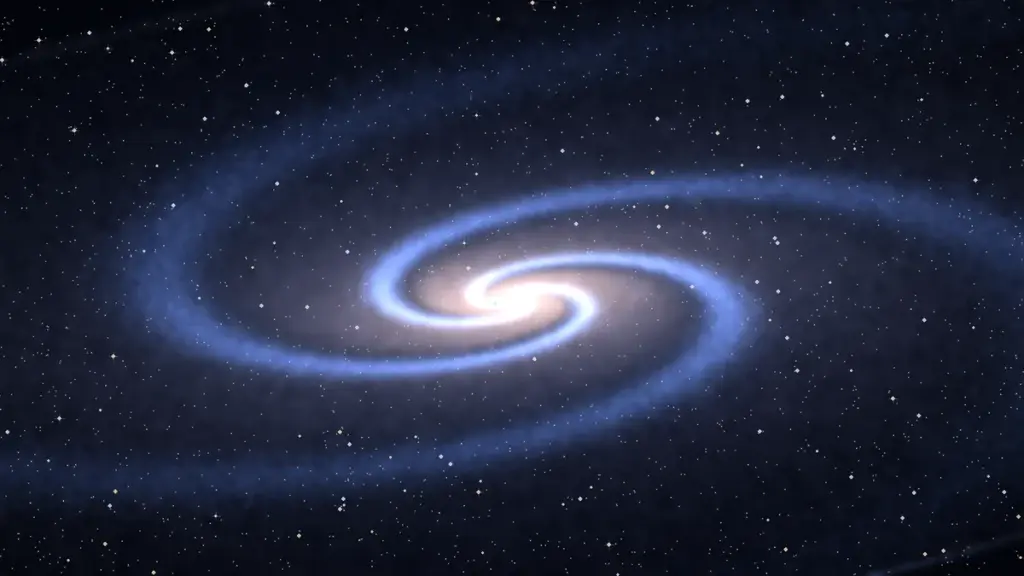
The Andromeda Galaxy is generally considered bigger than the Milky Way when comparing their commonly quoted galactic diameters. NASA describes Andromeda as approximately 220,000 light-years wide in one educational reference, compared with about 100,000 light-years for the Milky Way. Other NASA observations describe Andromeda’s disk as extending approximately 260,000 light-years. These estimates suggest that Andromeda is roughly 2.2 to 2.6 times wider than our home galaxy under those commonly cited measurements. [1] [2]
However, the comparison becomes more complicated when astronomers examine stellar mass, dark matter, galactic halos, and gravitational structure. Andromeda likely contains significantly more stars than the Milky Way, but their total gravitational masses are less firmly established. Recent scientific studies have produced substantially different mass estimates for both galaxies.
Understanding which galaxy is bigger requires distinguishing its visible stellar disk from its extended gaseous and dark matter halos. It also requires recognizing that galaxies do not have sharply defined physical boundaries.
Which Is Bigger: Andromeda or the Milky Way?
Andromeda and the Milky Way are the two dominant spiral galaxies in the Local Group, a gravitationally associated collection of galaxies that also includes the Triangulum Galaxy and numerous dwarf galaxies. Both contain enormous stellar populations, extensive interstellar gas, central supermassive black holes, and surrounding dark matter halos.
Although their structures share many similarities, Andromeda generally has a larger observed stellar distribution and a greater estimated number of stars. Their relative total masses, however, depend on the measurements and dynamical models used.
Andromeda Galaxy: The Larger Galaxy by Common Diameter Estimates
The Andromeda Galaxy, also known as Messier 31, M31, or NGC 224, is the nearest major spiral galaxy to the Milky Way. Located approximately 2.5 million light-years from Earth in the constellation Andromeda, it is one of the most extensively studied galaxies outside our own.
NASA has published broad diameter estimates ranging from about 220,000 to 260,000 light-years for Andromeda, although other observational definitions produce smaller values. Its total stellar population is commonly estimated at approximately one trillion stars. [1] [2] [6]
Andromeda’s relatively extended stellar disk, large stellar population, and prominent central bulge make it a useful comparison for understanding the structure and evolution of the Milky Way.
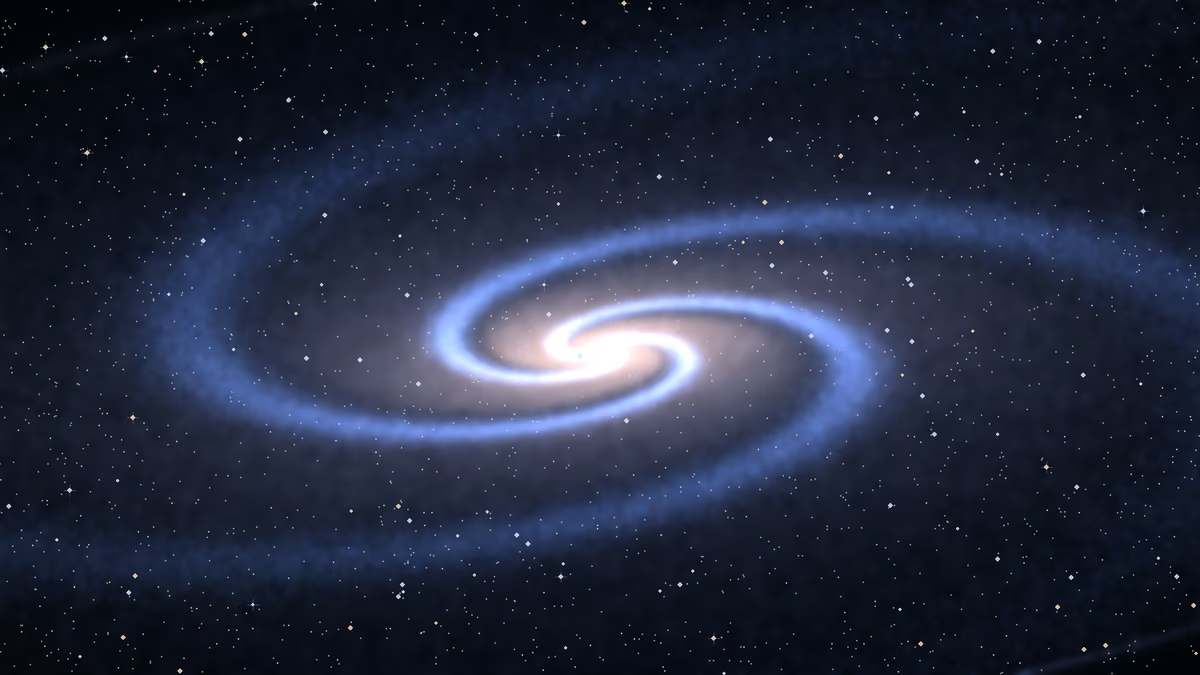
Milky Way Galaxy: How Large Is Our Home Galaxy?
The Milky Way is the barred spiral galaxy containing the Sun, Earth, and the entire Solar System. Our Solar System is located within the galactic disk, approximately 26,000 light-years from the Galactic Center, in the region commonly associated with the Orion Spur or Local Arm.
NASA and the European Space Agency commonly describe the Milky Way’s main stellar disk as approximately 100,000 light-years across. Its total stellar population is often estimated at between 100 billion and 400 billion stars. [1] [4]
The Milky Way also has a stellar halo extending well beyond its main disk and a more extensive dark matter halo. Consequently, its overall gravitational structure is considerably larger than its familiar disk diameter suggests.
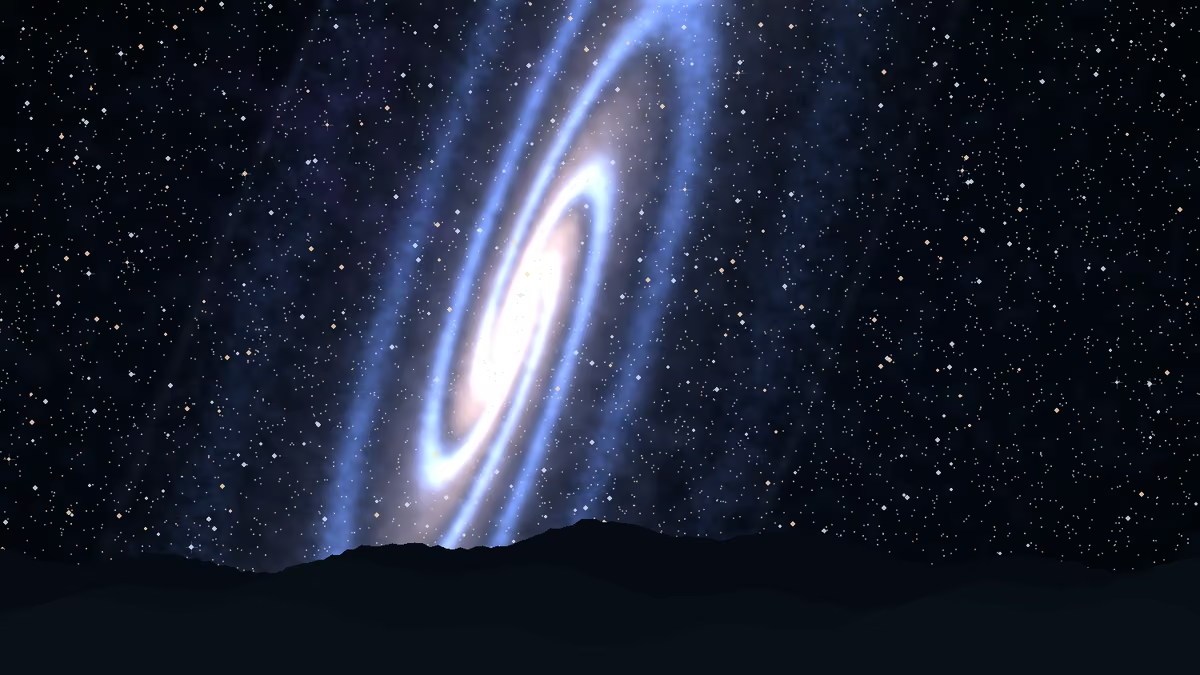
What Does Galactic Diameter Reveal About Their Sizes?
Galactic diameter describes the physical distance across a galaxy, usually measured through its central region between two specified boundaries. It is typically expressed in light-years or kiloparsecs.
For spiral galaxies, astronomers may measure the extent of the bright stellar disk, a faint outer stellar component, or a gas distribution. Each approach can produce a different diameter.
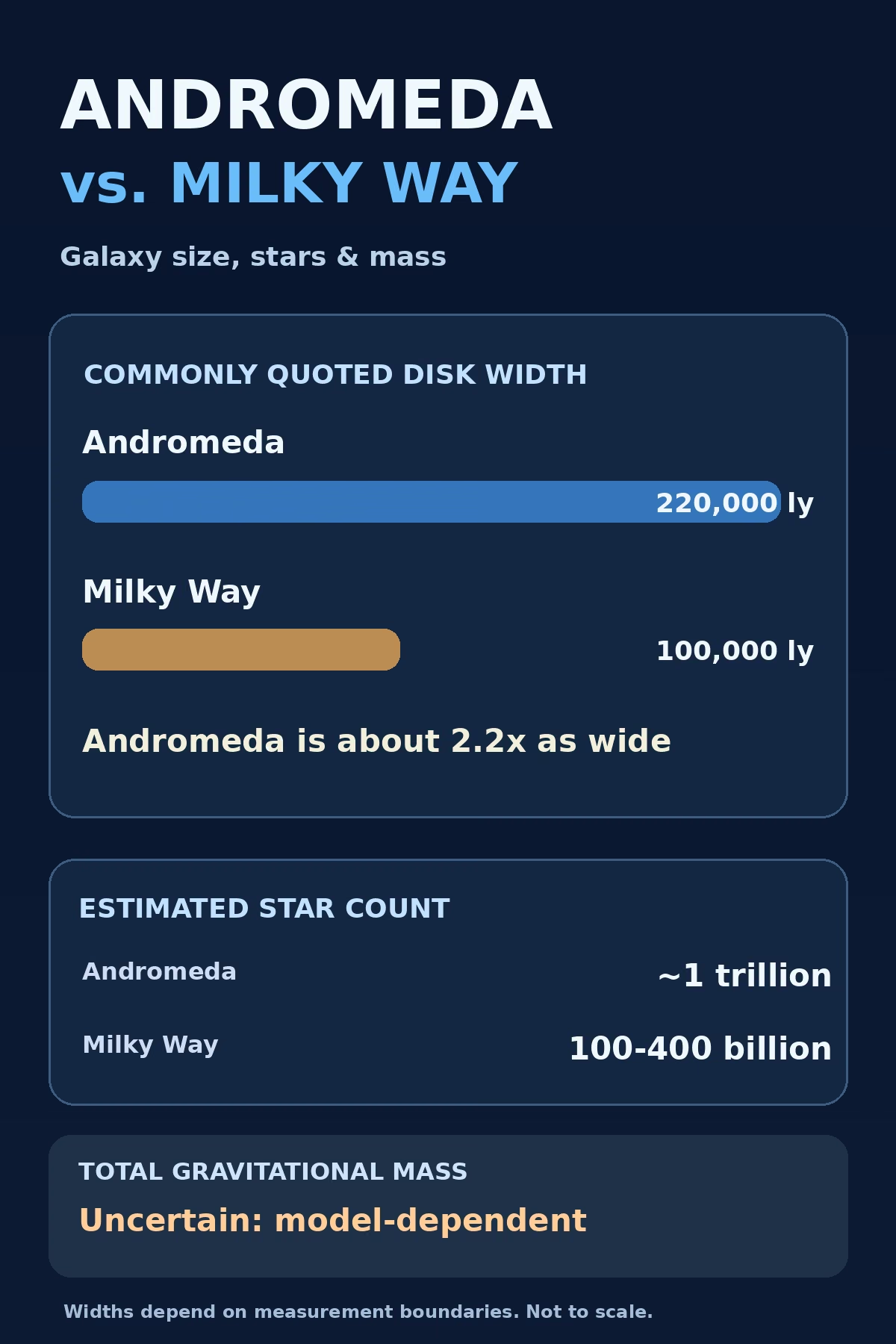
Comparing commonly quoted values of 220,000 light-years for Andromeda and 100,000 light-years for the Milky Way gives a diameter ratio of approximately 2.2.
However, galactic diameter is not equivalent to galactic mass or volume. A galaxy with a larger disk can still have a total mass comparable to a smaller galaxy if their dark matter distributions differ.
Andromeda vs. Milky Way: Which Measurements Determine the Winner?
Several physical characteristics can be used to compare these galaxies, including stellar diameter, total star count, stellar mass, halo mass, and overall gravitational influence.
The most useful comparison depends on what the word bigger means. Physical width measures spatial extent, stellar mass describes the combined mass of stars, and dynamical mass includes the gravitational contribution of stars, gas, dark matter, and other components.
| Characteristic | Andromeda Galaxy (M31) | Milky Way Galaxy |
|---|---|---|
| Galaxy type | Spiral galaxy with evidence of a stellar bar | Barred spiral galaxy |
| Commonly quoted diameter | About 220,000 light-years | About 100,000 light-years |
| Alternative broad disk estimate | About 260,000 light-years | Approximately 100,000 light-years |
| Estimated stars | Around 1 trillion | Approximately 100–400 billion |
| Distance from Earth | Approximately 2.5 million light-years | Earth is located inside it |
| Main stellar disk | More extended by commonly cited measures | Smaller by commonly cited measures |
| Total gravitational mass | Uncertain; model-dependent | Uncertain; model-dependent |
| Central black hole | Approximately 100 million solar masses in a NASA Hubble estimate | Approximately 4 million solar masses |
| Local Group status | One of two dominant galaxies | One of two dominant galaxies |
Diameter figures are approximate public-reference values, not measurements made using one identical observational boundary. Total galaxy mass cannot be ranked as confidently as commonly quoted stellar-disk width. [1] [2] [4] [11] [14]
Andromeda Diameter: How Wide Is M31?
Andromeda’s diameter is frequently described as approximately 220,000 to 260,000 light-years. NASA’s educational materials give a width of about 220,000 light-years, while a multiwavelength Spitzer and Galaxy Evolution Explorer presentation describes its disk as spanning approximately 260,000 light-years. [1] [2]
Importantly, NASA’s 2024 Hubble publication also reports a smaller diameter of approximately 152,000 light-years. [3]
These figures are not necessarily mutually exclusive measurements of an identical boundary. Optical brightness limits, stellar population selection, disk definitions, and faint outer structures influence what observers include.
Andromeda’s disk becomes progressively fainter toward its outskirts. Deep observations can therefore reveal stellar material beyond the region that initially appears to define the galaxy.
Milky Way Diameter: How Wide Is Our Galaxy?
The Milky Way’s commonly quoted stellar-disk diameter is approximately 100,000 light-years, equivalent to about 30.7 kiloparsecs. This figure describes the main stellar disk rather than the complete gravitationally associated system.
Unlike Andromeda, the Milky Way cannot be photographed from outside because Earth lies within its disk. Astronomers must reconstruct its structure using stellar distances, gas velocities, infrared observations, and galactic dynamics.
The European Space Agency describes a main stellar disk with a radius of approximately 50,000 light-years and a stellar halo extending to roughly 100,000 light-years from the Galactic Center. [4]
Some studies identify additional stars and structures beyond these conventional boundaries. The resulting diameter depends on whether researchers mean the main disk, outer stellar populations, or galactic halo.
How Do Astronomers Measure and Define Galaxy Size?
Measuring the physical size of a galaxy is more complicated than measuring an object with a solid surface. Galaxies contain stars and interstellar material distributed across enormous distances, with progressively lower densities toward their outskirts.
Astronomers therefore use observational definitions, including surface-brightness thresholds, stellar density profiles, and dynamical boundaries. These methods do not always produce identical results, but each helps describe a different aspect of galactic structure.
What Is a Light-Year, and Why Is It Used for Galaxy Size?
A light-year is the distance light travels through a vacuum during one Julian year. It is a unit of distance, not time, and equals approximately 9.46 trillion kilometers or 5.88 trillion miles.
Light-years are particularly useful for galaxy measurements because ordinary terrestrial units would produce impractically large numbers.
If a galaxy spans 100,000 light-years, light requires approximately 100,000 years to travel across that distance. Using the common 220,000-light-year estimate, a comparable journey across Andromeda would require about 220,000 years.
Professional astronomical research also frequently uses parsecs and kiloparsecs. One kiloparsec equals approximately 3,262 light-years, making it useful for describing stellar disks, galactic radii, and the distances between structural components.
Galactic Radius vs. Galactic Diameter
A galaxy’s radius is the distance from its center to a specified outer boundary. Its diameter is the distance across the galaxy through its center, approximately twice the radius when a symmetric boundary is used.
The relationship is expressed as:
Diameter = 2 × Radius
For a simplified disk diameter of 100,000 light-years, the corresponding radius is approximately 50,000 light-years.
Using a 220,000-light-year diameter for Andromeda gives an equivalent radius of about 110,000 light-years.
However, galaxies are neither perfect circles nor uniformly distributed structures. Their disks can be warped, elliptical in projection, or affected by tidal interactions, so a reported radius must always be interpreted alongside its measurement definition.
Where Does a Galaxy Actually End?
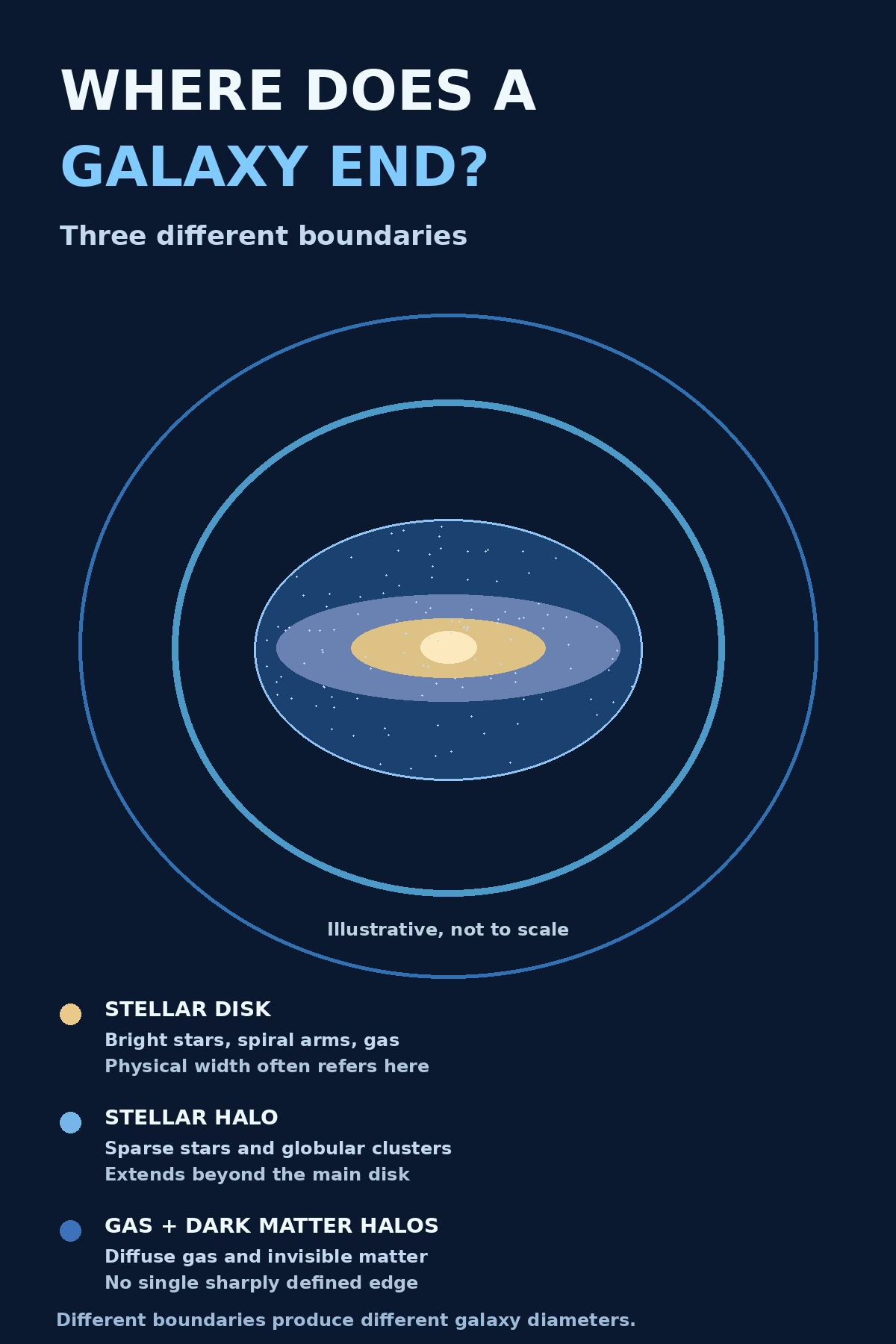
Galaxies do not have sharply defined edges where stars and matter suddenly disappear. Instead, their stellar densities generally decline outward, while extended gas and dark matter distributions reach far beyond the bright central disk.
A spiral galaxy contains several overlapping components, including a stellar disk, gaseous disk, central bulge, stellar halo, circumgalactic gas, and dark matter halo.
Each component can have a different extent.
For example, the Milky Way’s stellar halo extends well beyond its main disk, while observations of Andromeda have detected a vast gaseous halo reaching approximately 1.3 million light-years outward and up to 2 million light-years in some directions. [4] [9]
Therefore, the edge of a galaxy is usually an observational or theoretical definition rather than a physical wall.
Visible Extent: How Far Can We See Into a Galaxy?
A galaxy’s visible extent is the region from which telescopes detect sufficient electromagnetic radiation to distinguish its structures from background light and noise.
In optical images, the brightest galactic components are usually the central bulge, spiral arms, and concentrated stellar regions. Faint outer stars may remain undetected without deeper exposures.
Andromeda can be observed externally, giving astronomers a broad view of its structure. The Milky Way must be mapped from within, where interstellar dust obscures substantial portions of the disk.
Observations made at infrared and radio wavelengths can penetrate some dusty regions and reveal structures hidden from visible-light telescopes.
As observational sensitivity improves, the detectable extent of a galaxy may increase without any corresponding physical expansion.
How Surface Brightness Influences Galaxy Measurements
Surface brightness measures the amount of light received from an extended object per unit of apparent sky area. Astronomers commonly express it in magnitudes per square arcsecond.
A galaxy’s central regions generally have high surface brightness because numerous stars contribute light within a relatively small apparent area.
Its outskirts are usually much fainter.
When a survey reaches only a particular brightness threshold, the measured galaxy boundary may exclude faint stellar populations that deeper observations would reveal.
Surface brightness also depends on factors such as dust absorption, stellar age, inclination, and observational wavelength.
Consequently, a galaxy observed using a deeper imaging survey can appear physically larger than it does in shallower images, even though the galaxy itself has not changed.
What Is Isophotal Diameter in Astronomy?
An isophotal diameter is a galaxy’s diameter measured at a specified surface-brightness level. An isophote is a contour joining points with equal surface brightness.
A widely used historical standard is the D25 diameter, measured at a blue-band surface brightness of 25 magnitudes per square arcsecond.
The NASA/IPAC Extragalactic Database documents this convention and its role in producing comparable galaxy measurements. [7]
Isophotal diameter is valuable because it establishes a repeatable observational boundary rather than relying on a subjective visual impression.
Nevertheless, this measurement does not include every star belonging to a galaxy. Extremely faint stellar populations, extended halos, and material below the chosen threshold can exist outside the reported diameter.
Why Do Astronomers Report Different Galaxy Sizes?
Different galaxy-size estimates often arise because researchers measure different components or use different observational criteria.
Optical surveys primarily trace stellar light, ultraviolet images highlight young stellar populations, infrared observations reveal older stars and dust, and radio telescopes trace neutral hydrogen gas.
Differences also arise from telescope sensitivity, background subtraction, dust extinction, galaxy inclination, assumed distance, and statistical modeling.
For Andromeda, NASA publications have reported approximately 152,000, 220,000, and 260,000 light-years in different observational contexts. [1] [2] [3]
These numbers should not be combined into a single statistical uncertainty range without knowing how each was defined.
A scientifically meaningful comparison should identify the observed component, measurement method, and selected boundary.
How Do Astronomers Identify the Edge of a Stellar Disk?
Astronomers study the radial distribution of stars to determine where a galactic disk becomes faint, changes structure, or transitions into other stellar components.
One possible feature is disk truncation, a relatively sharp steepening in the stellar-density or surface-brightness profile beyond a particular radius.
However, not every disk exhibits a distinct truncation.
Some galaxies contain extended outer disks, stellar streams, warped regions, or multiple populations whose distributions overlap.
Researchers distinguish these structures using stellar positions, ages, chemical compositions, and orbital motions.
In Andromeda, externally observed stellar distributions help identify faint outer structures. In the Milky Way, stellar distances and motions help reconstruct the disk’s radial extent from our internal viewpoint.
Comparing the Physical Structures of Andromeda and the Milky Way
Both Andromeda and the Milky Way are massive spiral galaxies with broadly similar structural components. Each contains a rotating stellar disk, spiral-arm patterns, central stellar concentration, interstellar gas, and extended halo.
However, their structures have developed through different evolutionary histories. Differences in disk scale length, central bulge prominence, spiral-arm organization, stellar populations, and previous galactic interactions help explain why Andromeda appears more extended and contains more stars.
What Is a Spiral Galaxy?
A spiral galaxy is a rotating stellar system characterized by a flattened disk, central stellar concentration, and recognizable spiral-arm patterns.
The spiral arms contain combinations of stars, gas, dust, and regions of active star formation. Bright, massive young stars often make these arms especially prominent in visible and ultraviolet observations.
Spiral arms are not simply permanent collections of stars moving together. Instead, their structures can reflect density patterns, gravitational instabilities, and complex dynamics that influence the distribution of interstellar material.
Both Andromeda and the Milky Way belong to the spiral galaxy family.
Their overall morphology differs in details, including their central bars, bulge prominence, and the arrangement of prominent star-forming regions.
Is the Milky Way a Barred Spiral Galaxy?
The Milky Way is classified as a barred spiral galaxy because its central region contains an elongated concentration of stars rather than a purely round bulge.
This stellar bar affects the gravitational potential of the inner galaxy and influences the movement of stars and interstellar gas.
The European Space Agency describes the Milky Way’s central elongated, peanut-shaped structure as evidence of its barred morphology. [4]
Andromeda also has evidence of a stellar bar, although its highly inclined orientation makes the structure less visually obvious than a face-on barred spiral.
Bars can redistribute angular momentum, drive gas toward central regions, and influence star formation and the development of surrounding structures. Their presence does not, by itself, determine the total size of a galaxy.
How Does Galactic Structure Affect Physical Size?
Galactic structure describes how stars, gas, dust, and dark matter are distributed throughout a galaxy.
The stellar disk largely determines the recognizable flattened shape of a spiral galaxy, while the central bulge contributes a dense concentration of stars near its center.
The surrounding stellar halo contains a more diffuse population, including globular clusters and stars associated with earlier galactic interactions.
Andromeda’s extended disk and prominent bulge contribute to its large observable dimensions. The Milky Way has a smaller commonly quoted main disk but possesses extensive outer stellar and dark matter structures.
A galaxy can therefore appear larger in optical images without necessarily containing proportionally more total mass.
Which Galaxy Has the Larger Stellar Disk?
Andromeda generally has the larger stellar disk under commonly used descriptions of the galaxies’ visible and extended disk structures.
NASA educational comparisons describe Andromeda as about 220,000 light-years wide and the Milky Way as approximately 100,000 light-years wide. [1]
Independent structural studies also find a larger characteristic disk scale length for Andromeda.
However, the commonly quoted diameters are not necessarily based on equivalent stellar-density thresholds.
The strongest interpretation is that Andromeda has a more radially extended stellar disk in typical structural comparisons, rather than claiming that every possible definition of its disk produces exactly twice the Milky Way’s diameter.
What Does Disk Scale Length Tell Us About Galaxy Size?
Disk scale length describes how quickly the surface brightness or surface density of a galactic stellar disk declines with increasing distance from its center.
An idealized exponential disk follows a relationship in which surface density decreases exponentially with radius.
A larger scale length generally indicates that the stellar population is distributed over a broader radial region.
A published structural analysis of Andromeda reported a stellar-disk scale length of approximately 5.3 ± 0.5 kiloparsecs. Observational studies commonly place the Milky Way’s disk scale length around 2 to 3 kiloparsecs, depending on the population and methodology. [8]
These findings support the conclusion that Andromeda has a more extended disk.
However, scale length is not the same as total disk radius or diameter.
Comparing the Galactic Bulges of Andromeda and the Milky Way
A galactic bulge is a dense central concentration of stars, often containing older stellar populations and overlapping with a bar or other inner-galaxy structures.
Andromeda has a particularly prominent central bulge that contributes substantially to its brightness in optical and infrared observations.
The Milky Way’s inner region includes a barred, boxy or peanut-shaped stellar distribution.
These differences reflect their structural development and potentially their different histories of gas inflow, secular evolution, and galactic interactions.
A large bulge can increase a galaxy’s central brightness and stellar mass without necessarily increasing its overall diameter.
Consequently, astronomers distinguish bulge properties from disk scale length and halo extent when comparing the sizes of spiral galaxies.
Which Galaxy Has Larger or More Prominent Spiral Arms?
Both galaxies contain extensive spiral-arm structures, but their apparent prominence depends on observing wavelength and viewing geometry.
Andromeda’s spiral arms are visible through its dust lanes, young stellar associations, and star-forming regions. Some observations reveal a prominent ring-like arrangement of star formation within its disk.
The Milky Way contains several major spiral structures mapped using stars, gas clouds, and radio observations.
Because Earth lies inside the Milky Way, its spiral pattern cannot be photographed directly from an external perspective.
Andromeda’s larger overall disk allows its spiral patterns to extend across a wider physical region in common structural comparisons.
However, the longest individual spiral arm is not a standardized measurement of total galaxy size.
The Galactic Centers of Andromeda and the Milky Way
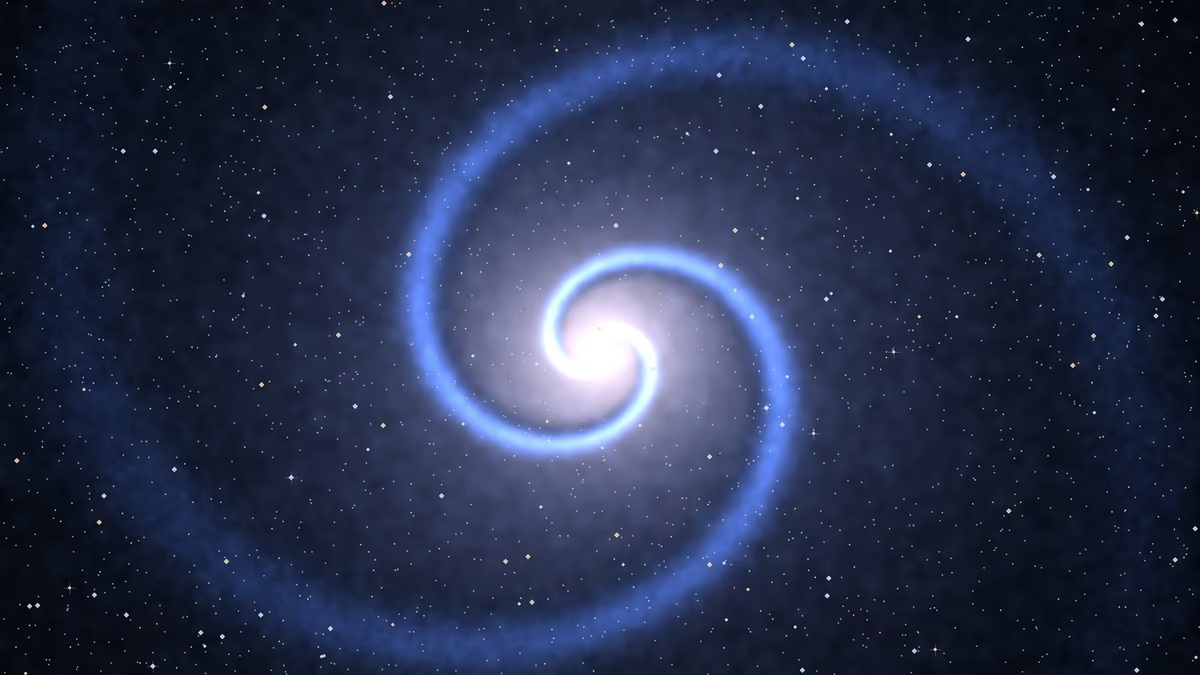
The galactic center is the region surrounding the gravitational and structural center of a galaxy.
The Milky Way contains the supermassive black hole Sagittarius A*, with a mass of approximately four million solar masses.
Andromeda contains a substantially more massive central black hole, commonly called M31*, with NASA Hubble material describing a mass of approximately 100 million solar masses. Other published estimates differ. [4] [14]
Andromeda’s nuclear region is also unusual because its light distribution shows an apparent double nucleus, explained through the organization and orbital motion of stars surrounding the central black hole.
Although central black holes influence their immediate environments, their masses represent only a small fraction of the total mass of these enormous galaxies.
How Does Stellar Density Differ Between the Two Galaxies?
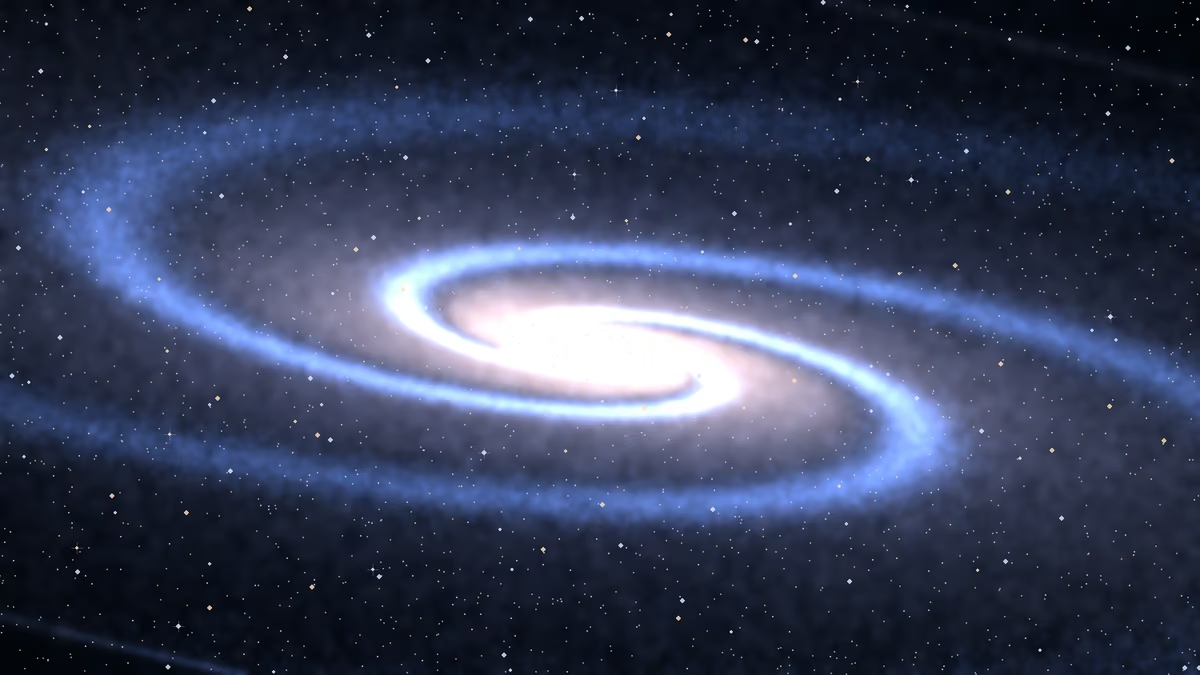
Stellar density describes the number of stars or amount of stellar mass occupying a particular volume or area of a galaxy.
Both the Milky Way and Andromeda contain dense central stellar populations and more sparsely populated outer regions.
Andromeda’s luminous central bulge reflects a substantial concentration of older stars, while its outer disk contains a combination of older populations and regions where younger stars are present.
The Milky Way similarly contains a densely populated central region, an extended disk, and a diffuse halo.
A galaxy with a larger diameter does not necessarily have a greater stellar density throughout its structure.
Star counts and galactic brightness depend on both the distribution of stars and the luminosities of the individual stellar populations.
Which Galaxy Contains More Stars?
A galaxy’s stellar population is another important way to compare its overall scale. Star counts reveal how much stellar material has accumulated through star formation, gas accretion, and previous mergers.
Andromeda is generally believed to contain more stars than the Milky Way. However, counting every star is impossible with current observations, so astronomers estimate total populations using luminosity, stellar evolution models, resolved stellar surveys, and assumptions about faint stars.
Comparing Stellar Populations in Andromeda and the Milky Way
Stellar populations are groups of stars that share characteristics such as age, chemical composition, location, or formation history.
In spiral galaxies, young stars frequently occur within gas-rich disk regions, while older stars are prominent in central bulges and stellar halos.
Andromeda and the Milky Way both contain a wide range of stellar populations, reflecting billions of years of star formation and galactic evolution.
Their populations are not distributed identically.
Andromeda’s extensive bulge, disk, and stellar halo contain evidence of past interactions with smaller galaxies. The Milky Way also preserves evidence of earlier mergers through chemically and dynamically distinct stellar populations.
These differences help astronomers reconstruct the formation histories of both systems.
Andromeda vs. Milky Way Star Count
Andromeda is commonly estimated to contain approximately one trillion stars, compared with roughly 100 billion to 400 billion stars in the Milky Way. [1] [6]
Using these estimates, Andromeda may contain about 2.5 to 10 times as many stars as our galaxy.
These are broad estimates rather than precise census results.
Astronomers cannot individually detect every faint star across either galaxy. Instead, they use observed stellar luminosity distributions, models of stellar populations, and statistical corrections for undetected objects.
NASA’s extensive Hubble surveys have resolved approximately 200 million stars across a large portion of Andromeda. Although enormous, that sample still represents only a fraction of the galaxy’s estimated population. [5]
What Types of Stars Make Up These Galaxies?
Both galaxies contain main-sequence stars, red giants, massive blue stars, evolved stars, and stellar remnants.
Main-sequence stars generate energy by fusing hydrogen in their cores. Low-mass red dwarfs are especially numerous but relatively faint, making them difficult to detect individually across distant galaxies.
Massive blue stars are much brighter but live shorter lives. They often identify regions where star formation occurred relatively recently.
Red giant stars provide useful information about older stellar populations, particularly in galactic halos.
White dwarfs, neutron stars, and stellar black holes are remnants of earlier stellar evolution.
Because different stellar types have very different luminosities and masses, the number of visible stars cannot be directly converted into a galaxy’s total stellar population without modeling.
Which Galaxy Has More Stellar Mass?
Stellar mass is the combined mass of a galaxy’s stars and, depending on the adopted definition, may also include stellar remnants.
Andromeda is commonly regarded as having a larger stellar mass than the Milky Way, consistent with its prominent bulge and extensive stellar disk.
However, the difference in stellar mass is not necessarily proportional to the difference in estimated star counts.
A galaxy’s stellar mass depends on its population of low-mass stars, massive stars, evolved stars, and remnants.
Researchers estimate stellar mass using measured luminosities, stellar population models, chemical composition, and mass-to-light ratios.
It is therefore more accurate to describe Andromeda as generally richer in stellar material than to assign a universal stellar-mass ratio without specifying the underlying study.
What Is a Solar Mass?
A solar mass is a standard astronomical mass unit equivalent to approximately 1.989 × 10³⁰ kilograms, representing the mass of the Sun.
Astronomers use solar masses to express the masses of stars, black holes, galaxies, and dark matter halos without relying on extremely large kilogram values.
For example, a galaxy with a mass of one trillion solar masses contains the gravitational equivalent of approximately one trillion Suns.
This does not mean the galaxy contains one trillion Sun-like stars.
Its mass can also include gas, stellar remnants, and dark matter.
Solar mass is particularly important when distinguishing stellar mass from total dynamical mass, because the latter can be far greater than the combined mass of visible stars.
What Can Halo Stars Reveal About Galactic Size?
Halo stars occupy regions outside the main stellar disk, often following inclined or elongated orbits around the galactic center.
Many are old and relatively metal-poor, although galactic halos can contain populations with different ages and chemical histories.
Astronomers use halo stars to trace the gravitational influence and formation history of a galaxy.
Stellar streams, for example, can reveal the remnants of smaller galaxies that were disrupted by gravitational interactions.
Both Andromeda and the Milky Way possess extended stellar halos containing evidence of previous accretion events.
Because halo stars can exist far outside the bright disk, including them in a galaxy-size measurement produces a substantially different result from measuring only the disk.
Comparing Globular Clusters in the Two Galaxies
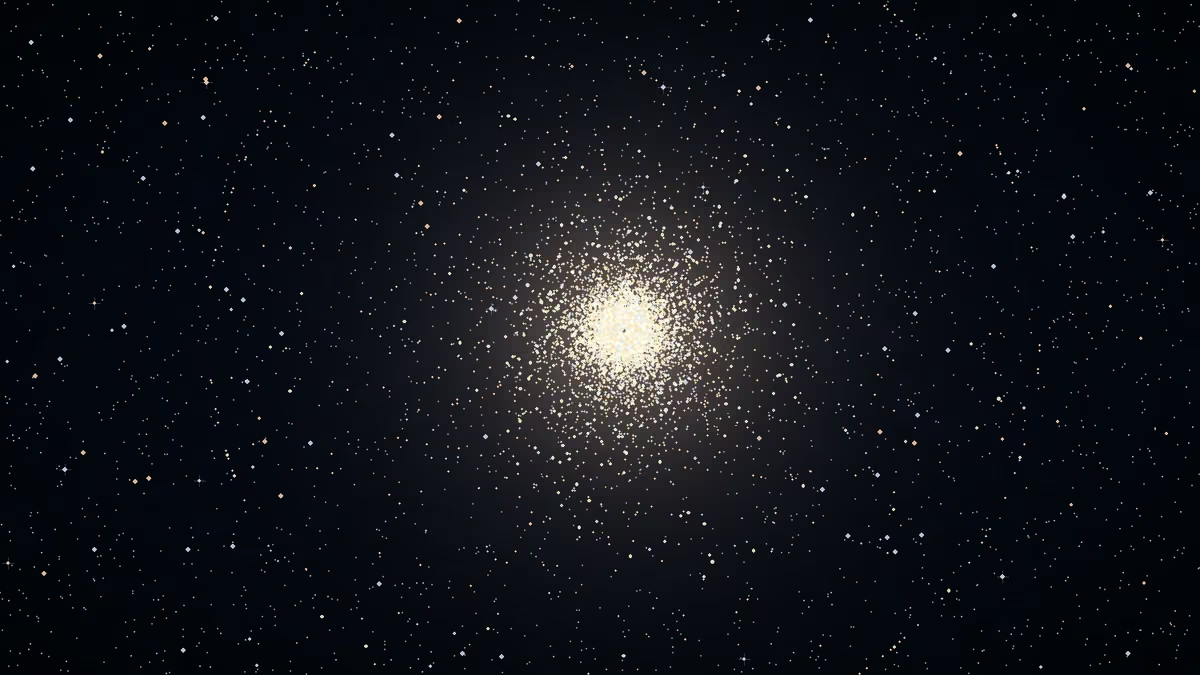
Globular clusters are dense, gravitationally bound groups of stars, typically dominated by old stellar populations.
They often contain tens of thousands to millions of stars and can survive for billions of years.
NASA reports that the Milky Way has more than 150 known globular clusters, while Andromeda has more than 400. [10]
These clusters are important tracers of galactic formation because their positions, chemical compositions, and orbital motions preserve information about earlier evolutionary events.
Globular clusters also help astronomers estimate gravitational mass, especially when they orbit far beyond the main stellar disk.
Andromeda’s more extensive globular-cluster system is consistent with its substantial stellar population and complex merger history.
Is Andromeda More Massive Than the Milky Way?
A galaxy’s total mass is not determined by its visible dimensions alone. Dark matter contributes substantially to the gravitational mass of both Andromeda and the Milky Way, extending well beyond their bright stellar components.
Determining which galaxy is heavier therefore requires dynamical measurements and theoretical modeling. Recent studies have produced significantly different estimates, especially for Andromeda, demonstrating that the comparison is not as straightforward as their visible diameters.
Galaxy Mass vs. Galaxy Size: What Is the Difference?
Galactic size measures spatial extent, while galactic mass measures the amount of matter associated with a galaxy.
A galaxy can have a broad, diffuse stellar disk but a relatively modest total mass. Another galaxy may have a more compact visible structure while possessing a massive dark matter halo.
Stars, stellar remnants, gas, dust, and dark matter all contribute to gravitational mass.
For Andromeda and the Milky Way, studies frequently estimate total masses on the order of hundreds of billions to trillions of solar masses.
However, the values depend on the adopted halo boundary, the available observational tracers, and the assumptions used to interpret their orbital motions.
How Is Total Dynamical Mass Measured?
Dynamical mass is the mass inferred from the gravitational motions of stars, gas, globular clusters, or satellite galaxies.
Astronomers study how these objects move within a galaxy’s gravitational potential.
For a simplified circular orbit in an approximately spherical mass distribution, the enclosed mass can be estimated using:
M(r) ≈ v²r/G
Here, v represents orbital speed, r represents orbital radius, and G is the gravitational constant.
Real galaxies require more complicated models because their disks are flattened, orbital motions are not always circular, and their systems may be disturbed by interactions.
Consequently, dynamical mass estimates are sensitive to assumptions about equilibrium, galaxy geometry, satellite trajectories, and dark matter distributions.
Why Is Dark Matter Important in Comparing Galaxies?
Dark matter is a form of matter inferred primarily through its gravitational effects rather than its direct emission or absorption of electromagnetic radiation.
Observations of galaxy rotation, gravitational lensing, and the motion of satellite systems indicate that visible stars and gas cannot explain all the observed gravitational behavior of galaxies.
For spiral galaxies such as Andromeda and the Milky Way, dark matter is modeled as a substantial extended halo surrounding the visible components.
Its gravitational influence affects the speeds and orbital paths of stars and gas.
Because dark matter does not have an observable luminous boundary, measuring its distribution requires indirect methods.
This uncertainty is one major reason why astronomers cannot compare the total masses of the two galaxies as easily as their optical dimensions.
Comparing the Dark Matter Halos of Andromeda and the Milky Way
Published measurements of the two galaxies’ dark matter halos show substantial variation.
A 2025 Nature Astronomy study adopted total galaxy masses of approximately 1.0 ± 0.2 trillion solar masses for the Milky Way, excluding the Large Magellanic Cloud, and 1.3 ± 0.4 trillion solar masses for Andromeda. These were representative assumptions used in its orbital modeling, rather than definitive measurements. [11]
Other studies disagree significantly.
A 2023 analysis based on Andromeda’s satellite motions estimated a virial mass approaching three trillion solar masses. Meanwhile, a 2025 dynamical reconstruction presented a much lower mass estimate of approximately 450 billion solar masses. [12] [13]
These findings reflect different techniques and assumptions, particularly concerning non-equilibrium motions and past mergers.
The available evidence does not establish a universally accepted numerical ranking of their total halo masses.
How Large Are Their Galactic Halos?
Galactic halos are extended structures surrounding the central stellar disks. They include stellar populations, diffuse gas, and dark matter, each with a different spatial distribution.
The Milky Way’s stellar halo extends well beyond its familiar 100,000-light-year disk diameter.
Andromeda possesses an enormous circumgalactic gaseous halo mapped through ultraviolet absorption measurements.
NASA reports that Andromeda’s diffuse gas extends approximately 1.3 million light-years from its center and reaches as far as two million light-years in some directions. [9]
These are radial distances, not galactic diameters.
The gaseous halo is therefore vastly more extended than the bright stellar disk.
The dark matter halos of both galaxies also reach far beyond their visible structures, but their boundaries are convention-dependent and uncertain.
What Is the Virial Radius of a Galaxy?
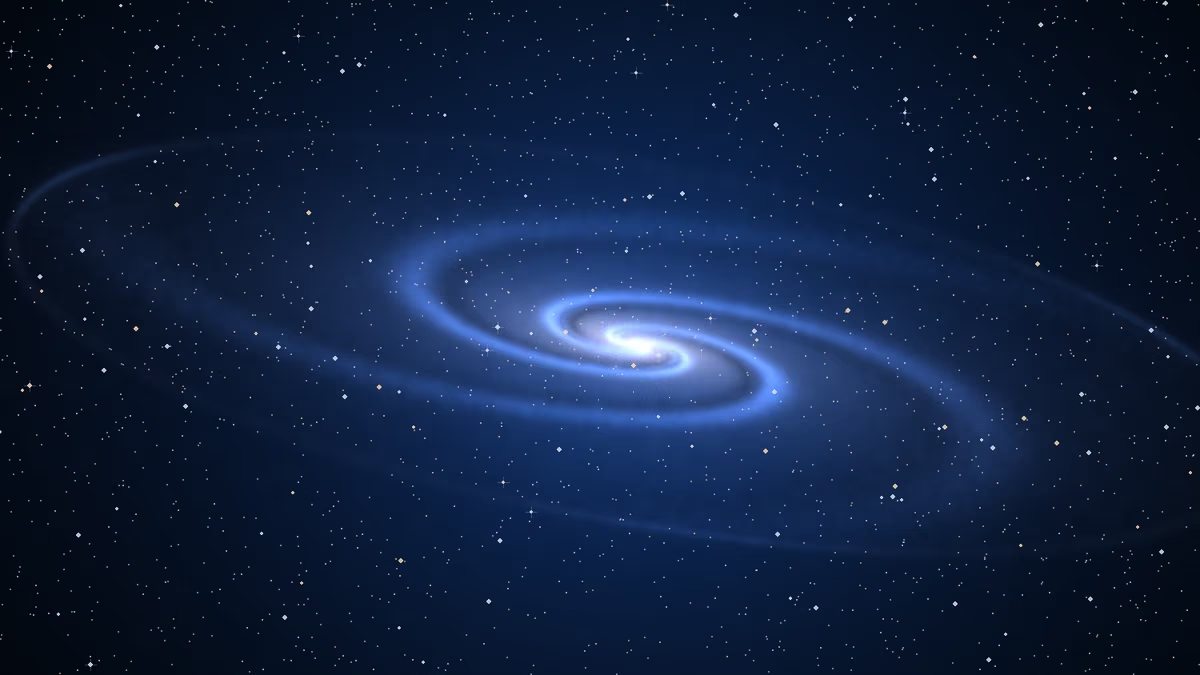
The virial radius is a conventionally defined boundary used to describe the extent of a gravitationally bound or approximately virialized dark matter halo.
In cosmological studies, researchers frequently use radii defined by an average enclosed density equal to a specified multiple of the universe’s critical or mean matter density.
One common example is R200, often defined using a density of 200 times the critical density.
The corresponding enclosed mass is referred to as M200.
Different conventions, such as M200c, M200m, and other virial-overdensity definitions, can produce different numerical results for the same halo.
Therefore, comparisons between Andromeda and the Milky Way should use matching halo-mass definitions whenever possible.
How Do Galaxy Rotation Curves Reveal Hidden Mass?
A galaxy rotation curve shows how orbital velocity varies with distance from the galactic center.
If most of a galaxy’s mass were concentrated in its bright central region, orbital speeds would generally be expected to decline substantially at large radii.
However, observations of many spiral galaxies reveal outer rotational behavior that cannot be explained by visible matter alone.
Studies of Andromeda played an important historical role in developing this understanding, including influential work by Vera Rubin and her collaborators.
Rotation curves provide evidence about the distribution of matter within galaxies, but interpreting them requires assumptions about orbital equilibrium and non-circular motion.
Recent modeling of Andromeda shows that gravitational disturbances associated with past interactions can significantly affect inferred mass distributions. [12]
How Does Orbital Velocity Help Determine Galaxy Mass?
Orbital velocity describes the speed at which an object moves around a gravitational center.
In galaxies, the orbital motions of stars, gas, globular clusters, and satellite galaxies provide information about the gravitational field acting on them.
Higher orbital speeds at a given radius can indicate a greater enclosed gravitational mass, although the relationship depends on the geometry and orbital configuration.
For circular orbits, astronomers can estimate enclosed mass using Newtonian gravitational relationships.
However, many outer-halo objects follow elongated or non-equilibrium trajectories.
Satellite galaxies may also be experiencing their first approach rather than repeatedly orbiting a stable system.
These complications explain why mass estimates based on different stellar and satellite samples sometimes disagree.
How Does the Mass-to-Light Ratio Differ Between Galaxies?
A mass-to-light ratio compares the amount of mass associated with an object to the luminosity it produces.
It is commonly expressed in solar units, comparing a galaxy’s mass and luminosity with those of the Sun.
Young stellar populations dominated by luminous massive stars can produce substantial light relative to their mass.
Older populations containing many faint, low-mass stars generally have different mass-to-light ratios.
Astronomers distinguish stellar mass-to-light ratios, used to estimate stellar mass, from total dynamical mass-to-light ratios that include the influence of dark matter.
Both Andromeda and the Milky Way have different stellar populations across their disks and bulges.
Therefore, a single optical luminosity measurement cannot provide a precise comparison of their total masses.
Comparing the Gas Mass of Andromeda and the Milky Way
Gas mass includes the combined mass of atomic, molecular, and ionized gas associated with a galaxy.
Atomic hydrogen is commonly traced using radio observations, molecular gas is often studied through carbon monoxide emission, and ionized gas can be detected through emission or absorption at various wavelengths.
The Milky Way contains extensive gas reservoirs supporting ongoing star formation.
Andromeda also contains substantial interstellar gas, but its present star formation activity and gas distribution differ from those of our galaxy.
The exact comparison depends on whether researchers include only cold gas within the disk or also the much larger circumgalactic gas reservoir.
Gas contributes to each galaxy’s baryonic mass, but dark matter dominates many estimates of their total gravitational mass.
What Is the Interstellar Medium?
The interstellar medium is the gas and dust occupying the space between stars within a galaxy.
It includes cold molecular clouds, neutral atomic gas, warmer ionized regions, and hot diffuse plasma.
Dense molecular clouds provide environments where gravity can initiate star formation.
Radiation from young massive stars, stellar winds, and supernova explosions subsequently heat and redistribute surrounding gas.
Both Andromeda and the Milky Way contain these interstellar components.
However, the distribution of gas, dust, and young stars differs between them, helping explain variations in their star formation patterns.
Observations at multiple wavelengths allow astronomers to examine the different physical phases of the interstellar medium and reconstruct the processes shaping each galaxy.
Do Neutral Hydrogen Disks Extend Beyond Visible Galaxy Boundaries?
Neutral hydrogen, commonly designated H I, is an important tracer of gas distributions in galaxies.
Radio telescopes detect neutral hydrogen through its characteristic 21-centimeter spectral line, allowing astronomers to map gas that may be too faint to observe through ordinary optical imaging.
In many spiral galaxies, the neutral hydrogen distribution extends beyond the brightest stellar regions.
This makes H I observations particularly useful for studying outer disks, warps, gas motions, and gravitational mass.
Both Andromeda and the Milky Way have been extensively mapped using neutral hydrogen observations.
However, the extent of detectable hydrogen depends on telescope sensitivity and the selected gas column-density threshold. It should not automatically be interpreted as the complete physical boundary of either galaxy.
Where Are Andromeda and the Milky Way Located in the Universe?
Andromeda and the Milky Way are neighboring galaxies within the Local Group, a relatively small cosmic association held together by gravity.
Their proximity makes them particularly valuable for studying galactic structure, star formation, dark matter, and gravitational interactions. Because Andromeda is close enough for powerful telescopes to resolve individual stars, astronomers can investigate its history in far greater detail than that of many more distant galaxies.
What Is the Local Group of Galaxies?
The Local Group is a gravitationally associated collection of galaxies containing the Milky Way, Andromeda, Triangulum, and numerous smaller systems.
Its three most prominent spiral members are the Milky Way, Andromeda, and the Triangulum Galaxy, also called Messier 33.
Most of the smaller members are dwarf galaxies, many of which orbit or interact gravitationally with larger neighbors.
The Local Group is not a single solid structure. Its members occupy different locations, possess different velocities, and experience gravitational interactions over billions of years.
The Milky Way and Andromeda dominate much of its overall mass distribution, making their relative motions especially important for modeling its long-term evolution.
How Far Is Andromeda From the Milky Way?
Andromeda lies approximately 2.5 million light-years from Earth, equivalent to about 770 kiloparsecs. [5]
This distance is measured between our location and Andromeda, rather than between the exact centers of the two galaxies, although the difference is relatively small on this scale.
The separation is much greater than the commonly quoted stellar diameters of either galaxy.
Astronomers determine Andromeda’s distance using methods such as Cepheid variable stars and other calibrated stellar distance indicators.
Distance accuracy is essential because a galaxy’s physical diameter is calculated from its observed angular extent and distance.
An incorrect distance estimate would therefore affect the calculated size, luminosity, and inferred physical properties of the galaxy.
Do Andromeda and the Milky Way Have Satellite Galaxies?
Satellite galaxies are smaller galaxies gravitationally associated with a more massive host system.
Andromeda has numerous known satellites, including Messier 32 and Messier 110, both visible near the larger galaxy in suitable observations.
The Milky Way has its own satellite population, including the Large Magellanic Cloud, Small Magellanic Cloud, Sagittarius Dwarf Spheroidal Galaxy, and other dwarf systems.
Satellite galaxies provide important information about how massive galaxies form and evolve.
Their orbital motions help astronomers investigate the distribution of dark matter and estimate the mass of their host galaxies.
However, satellite-based mass estimates can become uncertain when the satellites have complicated trajectories or have been affected by recent gravitational interactions.
How Does the Triangulum Galaxy Compare With Andromeda?
The Triangulum Galaxy, also known as Messier 33 or M33, is another prominent spiral member of the Local Group.
It is considerably smaller than Andromeda and the Milky Way.
NASA commonly describes M33 as approximately half the size of the Milky Way, while other astronomical descriptions give a diameter of more than 50,000 light-years. [19]
Triangulum has an extensive star-forming disk and is located roughly three million light-years from Earth.
Its gravitational relationship with Andromeda is important because their relative motion can influence the future dynamics of the Local Group.
Recent merger simulations therefore consider M33 alongside Andromeda and the Milky Way rather than treating the two largest galaxies as an isolated pair.
What Role Does the Large Magellanic Cloud Play?
The Large Magellanic Cloud, or LMC, is a major satellite galaxy of the Milky Way.
Although much smaller than the Milky Way, it has enough mass to exert a measurable gravitational influence on its host galaxy.
The LMC can affect the motion of the Milky Way’s outer stellar halo and the inferred dynamics of the Local Group.
It also complicates total mass estimates because some methods include its gravitational contribution while others attempt to separate it.
Recent simulations of the Milky Way and Andromeda’s future trajectories show that the LMC can significantly alter their predicted encounter geometry.
This influence is one reason why modern merger predictions differ from earlier models that focused primarily on the gravitational interaction between the two largest galaxies. [11]
How Do Astronomers Study and Measure Andromeda and the Milky Way?
Astronomers combine observations from space telescopes, ground-based observatories, radio arrays, and large stellar surveys to investigate the two galaxies.
Each technique measures different physical properties. Astrometry reveals positions and motions, spectroscopy measures velocities and chemical composition, and multiwavelength imaging traces different stellar and gas populations. Combining these approaches provides a more complete understanding of galactic size and mass.
How Does Stellar Parallax Help Astronomers Measure Distances?
Stellar parallax is the apparent change in a nearby star’s position against more distant background objects as Earth moves around the Sun.
Astronomers measure this tiny angular shift to calculate stellar distance geometrically.
The European Space Agency’s Gaia mission has made highly precise astrometric measurements for an enormous population of stars, improving the mapping of the Milky Way.
Parallax provides an essential foundation for the cosmic distance ladder because it calibrates methods used to determine greater distances.
However, individual stellar parallaxes become extremely small at the distance of Andromeda.
Astronomers therefore rely on other methods, including Cepheid variables and additional calibrated distance indicators, to determine its distance reliably.
What Are Standard Candles in Astronomy?
Standard candles are astronomical objects whose intrinsic luminosities can be estimated from measurable properties.
By comparing intrinsic luminosity with observed brightness, astronomers can calculate distance using the inverse-square law of light.
Cepheid variable stars are among the most historically important examples because their pulsation periods are related to their intrinsic luminosities.
Type Ia supernovae are another important distance indicator, particularly on much larger cosmic scales.
Accurate distance measurements are essential for determining galactic physical sizes.
A galaxy’s observed angular width indicates how large it appears in the sky, but its actual diameter cannot be calculated without knowing its distance.
Standard candles therefore connect stellar physics directly with measurements of galaxy structure.
How Did Cepheid Variables Help Establish Andromeda’s Distance?
Cepheid variables are pulsating stars whose brightness changes periodically, following a relationship between pulsation period and intrinsic luminosity.
In 1923, Edwin Hubble identified a Cepheid variable in the object then known as the Andromeda Nebula.
By measuring the star’s brightness variations and using the period-luminosity relationship, Hubble established that Andromeda lay far beyond the accepted scale of the Milky Way at the time.
This discovery helped demonstrate that Andromeda was an independent galaxy rather than a nebula located inside our own galactic system.
Modern observations have substantially refined the original distance measurement, placing Andromeda approximately 2.5 million light-years away. [15]
How Has the Hubble Space Telescope Mapped Andromeda?
NASA’s Hubble Space Telescope has produced some of the most detailed stellar maps ever assembled of a galaxy outside the Milky Way.
The Panchromatic Hubble Andromeda Treasury, or PHAT, and its southern counterpart, PHAST, have mapped enormous portions of Andromeda’s stellar disk.
In January 2025, NASA presented a panoramic mosaic assembled from more than 600 overlapping Hubble observations collected over approximately a decade.
The resulting image resolves roughly 200 million stars and contains approximately 2.5 billion pixels. [5]
These observations allow astronomers to study stellar ages, dust structures, star clusters, and evidence of earlier galactic interactions.
The resulting datasets provide far more information than a simple visible-light photograph of Andromeda.
How Has the Gaia Mission Improved Our Understanding of the Milky Way?
Gaia is an astrometric space mission operated by the European Space Agency.
Its observations have provided precise measurements of stellar positions, parallaxes, proper motions, and, for suitable sources, radial velocities.
By studying these measurements together, astronomers can reconstruct the three-dimensional distribution and movement of stars throughout large portions of the Milky Way.
Gaia observations have improved understanding of the galactic disk, central structure, halo, and past merger events.
Stellar motions also provide evidence about the Milky Way’s gravitational field and dark matter distribution.
Gaia data contribute to studies of Andromeda and Triangulum as well, particularly through measurements of the motions of selected stars in these neighboring galaxies. [4] [18]
What Have Large Andromeda Stellar Surveys Revealed?
Large stellar surveys study extensive populations of stars to determine their positions, luminosities, colors, ages, and chemical properties.
The PHAT and PHAST Hubble programs have provided exceptionally detailed observations across Andromeda’s northern and southern disk regions.
These datasets reveal variations in stellar populations and provide evidence about previous star formation episodes.
A July 2026 NASA report described research using these surveys that found Andromeda’s star formation has declined over the past 500 million years, with a particularly steep decrease during the most recent 40 million years. [17]
Such measurements help astronomers understand how galaxies transition between periods of active star formation and more subdued evolution.
They also reveal structural differences that simple diameter measurements cannot capture.
How Did the Galaxy Evolution Explorer Observe Andromeda?
NASA’s Galaxy Evolution Explorer, or GALEX, observed the universe primarily at ultraviolet wavelengths.
Ultraviolet observations are especially useful for identifying hot, young, massive stars and regions associated with relatively recent star formation.
In Andromeda, GALEX data reveal extensive ultraviolet structures associated with its disk and spiral patterns.
These observations complement infrared measurements from telescopes such as Spitzer, which provide information about dust and older stellar populations.
NASA has combined ultraviolet and infrared observations to demonstrate how different wavelength bands trace different components of Andromeda. [2]
Together, these datasets help astronomers distinguish actively star-forming regions from older stellar structures and improve understanding of the galaxy’s evolutionary state.
Why Is Multiwavelength Astronomy Important for Measuring Galaxies?
Multiwavelength astronomy combines observations made at different regions of the electromagnetic spectrum.
Visible light reveals many stellar populations, ultraviolet radiation highlights young massive stars, and infrared observations can penetrate dust and trace cooler material.
Radio astronomy reveals neutral hydrogen and other gas components, while X-ray observations can detect hot plasma and energetic processes.
Each wavelength provides a different view of galactic structure.
A galaxy may appear relatively compact in one wavelength while exhibiting extensive faint structures in another.
Combining these observations helps astronomers separate stellar disks, gas distributions, bulges, and halos, preventing misleading conclusions based on a single image or observational technique.
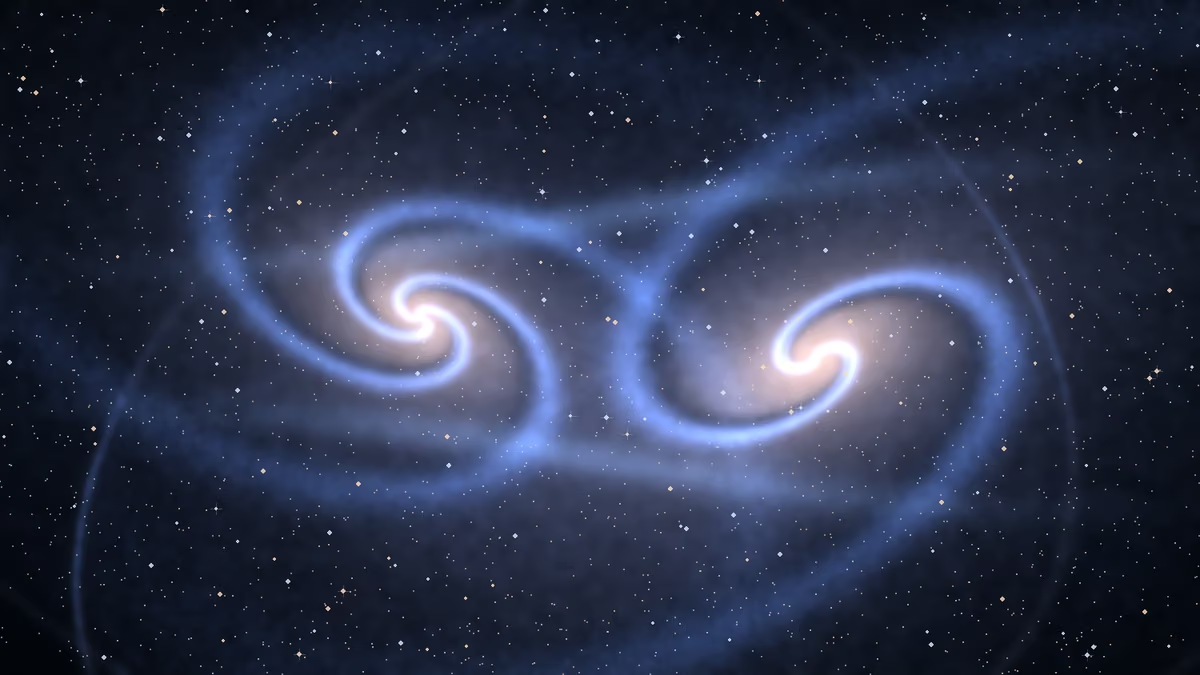
Will Andromeda and the Milky Way Eventually Collide or Merge?
Andromeda is moving toward the Milky Way, and their mutual gravitational attraction has long suggested the possibility of a future close encounter or merger.
However, the outcome depends on more than their current separation and approach speed. Small differences in sideways motion, galaxy mass, and the gravitational effects of satellites can substantially change the future trajectories predicted by computer simulations.
How Did Andromeda and the Milky Way Form?
Both galaxies developed through gravitational processes associated with structure formation in the early universe.
Small density variations allowed matter to accumulate within growing dark matter halos, where gas could cool and form stars.
Over billions of years, galaxies increased their mass through gas accretion, star formation, and mergers with smaller systems.
The Milky Way and Andromeda likely experienced different combinations of these processes.
Their present-day stellar disks, bulges, and halos preserve evidence of their formation histories.
Andromeda’s prominent stellar substructures and extensive halo suggest significant past interactions, while the Milky Way also contains stellar streams and populations associated with earlier mergers.
These evolutionary differences help explain their present structural characteristics.
How Have Both Galaxies Changed Over Time?
Galactic evolution involves changes in stellar populations, gas content, star formation activity, chemical composition, and overall structure.
As stars form and evolve, they return material to the interstellar medium through winds and supernova explosions, enriching future generations of stars with heavier elements.
Galaxies also acquire material from their surroundings and through gravitational interactions.
Andromeda shows evidence of substantial previous interactions and a changing star formation history.
Recent Hubble-based research published in 2026 indicates that its star formation activity has declined over hundreds of millions of years. [17]
The Milky Way has also experienced past mergers, but its present disk retains substantial ongoing star formation.
These different histories contribute to differences in their stellar populations and structural development.
What Happens During a Galactic Merger?
A galactic merger occurs when two galaxies interact gravitationally and eventually combine into a larger gravitational system.
During the interaction, their stellar disks can become distorted, stars may be redistributed into new orbits, and gas clouds can experience compression and gravitational disturbances.
Some mergers trigger increased star formation, depending on the amount and distribution of available gas.
Despite the enormous number of stars involved, direct star-to-star collisions are relatively uncommon because the distances between stars are extremely large compared with their physical sizes.
A merger can transform spiral structures and create a more spheroidal stellar distribution.
However, the final shape depends on the galaxies’ masses, orbital configurations, gas content, and merger history.
How Do Tidal Interactions Change the Shapes of Galaxies?
Tidal interactions occur when the gravitational force from one galaxy acts differently across the extended structure of another.
These variations in gravitational attraction can stretch stellar distributions, distort disks, and redistribute stars and gas.
Strong tidal encounters may produce elongated stellar streams, tidal tails, and extended bridges of material.
Smaller satellite galaxies can also be disrupted, depositing stars into a larger galaxy’s halo.
Both Andromeda and the Milky Way contain structures associated with past gravitational interactions.
These features provide valuable evidence about the galaxies’ formation and merger histories.
If the two galaxies eventually experience a close encounter, tidal forces could substantially modify their spiral disks even before a complete merger occurs.
Is a Future Milky Way–Andromeda Encounter Inevitable?
A future merger remains plausible, but its probability and timing are scientifically uncertain.
Earlier models commonly predicted an encounter within roughly four billion years followed by a merger several billion years later.
A 2025 study published in Nature Astronomy, incorporating Gaia and Hubble observations along with the effects of Triangulum and the Large Magellanic Cloud, found approximately a 50% probability that the Milky Way and Andromeda would not merge within the next 10 billion years. [11]
A newer study published in The Astrophysical Journal Letters in April 2026 used revised Gaia proper-motion measurements and obtained a roughly 90% merger probability within 10 billion years in its preferred model, with a median merger time of approximately 6.5 billion years. [20]
These results are not directly contradictory measurements of a single certain future event. They reflect different observational inputs and modeling assumptions.
The 2026 study itself emphasized that the result remains sensitive to the adopted sideways motion of Andromeda.
Therefore, a future merger is possible and may be likely, but it cannot currently be described as inevitable with scientific certainty.
Frequently Asked Questions About Andromeda vs. the Milky Way
The most common questions about the two galaxies involve their diameters, star counts, masses, separation, and eventual gravitational interaction.
The answers depend on what is being compared. A diameter ratio describes physical width, while stellar mass, total gravitational mass, and halo extent require different observations and modeling assumptions. These distinctions are particularly important when interpreting simplified figures quoted in general astronomy references.
Is Andromeda Bigger Than the Milky Way?
Yes. Andromeda is generally considered bigger than the Milky Way when comparing their commonly quoted stellar-disk or broad visible dimensions.
NASA frequently describes Andromeda as approximately 220,000 light-years wide and the Milky Way as about 100,000 light-years across. [1]
However, different studies use different boundaries, producing different reported diameters.
Andromeda is also commonly estimated to contain more stars.
These findings support describing Andromeda as the larger of the two galaxies in ordinary comparisons, while the distinction becomes less certain when comparing total gravitational mass.
How Many Times Bigger Is Andromeda Than the Milky Way?
Using the commonly quoted diameters of 220,000 and 100,000 light-years, Andromeda is approximately 2.2 times wider than the Milky Way.
Using NASA’s alternative 260,000-light-year figure gives a diameter ratio of approximately 2.6. [2]
These numbers describe linear width rather than total volume or mass.
They also depend on the boundaries used for each galaxy.
Therefore, saying that Andromeda is approximately twice as wide is a reasonable general description, but saying it contains twice as much total matter would not follow from the diameter comparison.
Which Galaxy Has More Stars, Andromeda or the Milky Way?
Andromeda is generally estimated to contain more stars than the Milky Way.
A commonly cited estimate places Andromeda’s population near one trillion stars, compared with approximately 100 billion to 400 billion in our galaxy. [1] [6]
The estimates are uncertain because many faint stars cannot be detected individually.
Astronomers instead extrapolate from observed stellar populations and luminosity measurements.
The precise ratio also depends on assumptions about low-mass stars and stellar remnants.
Nevertheless, the broad conclusion that Andromeda contains more stars is supported by its substantial stellar disk and bulge.
Is Andromeda Heavier Than the Milky Way?
The answer remains uncertain because total galaxy mass measurements depend strongly on observational tracers and dynamical models.
Some studies estimate Andromeda’s mass as moderately greater than the Milky Way’s, while others find comparable masses or substantially different values.
Recent publications have reported Andromeda mass estimates ranging from approximately 450 billion to several trillion solar masses under different assumptions. [11] [12] [13]
These figures should not be treated as a single confidence interval.
Andromeda’s larger diameter and greater estimated star count do not guarantee that its total gravitational mass is larger.
Why Do Some Sources Report Different Diameters for Andromeda?
Different sources often measure different parts of Andromeda.
A visible-light survey may identify the bright stellar disk, while a deeper survey detects fainter outer stars or additional structural components.
Ultraviolet, infrared, and radio observations can reveal different distributions of stars and gas.
Measurement definitions, assumed distance, background subtraction, and image sensitivity also affect reported values.
NASA materials include examples describing Andromeda as approximately 152,000, 220,000, and 260,000 light-years wide. [1] [2] [3]
The correct interpretation depends on understanding the observational boundary used rather than assuming that one figure must be universally valid.
Does the Milky Way Have More Dark Matter Than Andromeda?
Current observations do not establish a definitive answer.
Dark matter is not observed directly through ordinary light, so its distribution is inferred from gravitational effects on stars, gas, satellite galaxies, and other tracers.
Different studies estimate different halo masses for both galaxies.
Some results favor a more massive Andromeda halo, while others indicate that the galaxies may be comparable or support substantially lower mass estimates for Andromeda.
The outcome also depends on which halo boundary and gravitational model researchers use.
Consequently, it would be misleading to claim confidently that either galaxy contains more dark matter without identifying the specific study and mass definition.
Is Andromeda the Largest Galaxy in the Local Group?
Andromeda is generally regarded as the largest major galaxy in the Local Group when comparing commonly quoted visible stellar dimensions.
It also has a greater commonly estimated stellar population than the Milky Way.
The Triangulum Galaxy, another major spiral member, is substantially smaller than both.
However, total gravitational mass is a different comparison and remains uncertain.
The Local Group also contains extensive satellite systems, stellar halos, and diffuse matter that complicate attempts to define a single physical boundary for its largest members.
Thus, Andromeda is the usual answer when the question refers to visible galaxy size rather than precisely measured total mass.
How Far Away Is the Andromeda Galaxy?
Andromeda is approximately 2.5 million light-years from Earth, making it the nearest major spiral galaxy to the Milky Way. [5]
This distance means that the light reaching us today left Andromeda roughly 2.5 million years ago.
Astronomers determine its distance using calibrated stellar distance indicators, including Cepheid variables.
Andromeda is far beyond the outer regions of the Milky Way’s main stellar disk, but it belongs to the same Local Group.
Under sufficiently dark sky conditions, it is also visible to the unaided eye as a faint, diffuse patch of light.
Can We See the Entire Milky Way From Earth?
No. Earth is located inside the Milky Way’s stellar disk, which prevents us from observing the entire galaxy from an external perspective.
Interstellar dust also blocks substantial portions of the galaxy at visible wavelengths.
The bright band seen across a dark night sky represents our view through part of the Milky Way’s disk.
Astronomers reconstruct the galaxy’s overall structure using stellar distances, infrared observations, radio measurements, and orbital motions.
Modern surveys provide increasingly detailed three-dimensional maps, but they do not amount to an actual external photograph of the entire Milky Way.
Illustrations showing our galaxy from above are scientific visualizations based on observational evidence and models.
Will Andromeda Collide With the Milky Way?
A future collision or merger is possible, but the outcome remains dependent on uncertain measurements and models.
A 2025 simulation study found approximately a 50% chance of a merger within the next ten billion years.
An April 2026 peer-reviewed study, using revised measurements of Andromeda’s motion, instead estimated a 90% probability under its preferred assumptions. [11] [20]
These studies demonstrate the importance of sideways motion, galaxy mass, and the influence of satellite galaxies.
Astronomers expect future astrometric measurements and improved dynamical models to refine these predictions.
Therefore, it is more accurate to describe a future merger as a significant possibility than as an absolutely certain event.
Conclusion: Which Galaxy Is Actually Bigger?
Andromeda is generally bigger than the Milky Way when comparing their commonly quoted visible and stellar-disk dimensions. NASA frequently describes Andromeda as approximately 220,000 light-years across, compared with about 100,000 light-years for our galaxy. Other observational definitions produce different values, including a broad Andromeda disk estimate of approximately 260,000 light-years.
Andromeda is also commonly estimated to contain around one trillion stars, substantially more than the Milky Way’s estimated 100 billion to 400 billion.
However, comparing total gravitational mass is more complicated. Stars, interstellar gas, dark matter, and extensive galactic halos contribute to the overall structure of both galaxies.
Recent research has produced conflicting total mass estimates, demonstrating that Andromeda’s larger visible diameter does not automatically make it the heavier galaxy.
The essential distinction is between physical width, stellar population, stellar mass, and total gravitational mass.
For the original question, the most useful answer remains straightforward: Andromeda is the larger galaxy by commonly quoted diameter and likely contains significantly more stars, but the relative total masses of Andromeda and the Milky Way remain uncertain.
Sources
The following sources include NASA and ESA publications, astronomical reference databases, and peer-reviewed scientific research. Sources published at different times may report different measurements because of observational definitions or revised scientific models.
[1] NASA Science. Our Milky Way Galaxy: How Big Is Space?
[2] NASA Science. Amazing Andromeda Galaxy. Multiwavelength observations from Spitzer and GALEX.
[3] NASA Science. Hubble Zooms into the Rosy Tendrils of Andromeda. August 30, 2024.
[4] European Space Agency. Guide to Our Galaxy. Milky Way structure, stellar disk, halo, and central black hole.
[5] NASA Science. NASA’s Hubble Traces Hidden History of Andromeda Galaxy. January 16, 2025.
[6] NASA Astronomy Picture of the Day. Infrared Andromeda. June 9, 2006. Historical stellar-population estimates.
[7] NASA/IPAC Extragalactic Database. Dimensions of Galaxies. Isophotal diameters and surface-brightness conventions.
[8] Courteau et al. (2011). The Luminosity Profile and Structural Parameters of the Andromeda Galaxy. The Astrophysical Journal.
[9] NASA Science. Hubble Maps Giant Halo Around Andromeda Galaxy. August 27, 2020.
[10] NASA Science. Hubble’s Star Clusters. Globular-cluster populations in galaxies.
[11] Sawala et al. (2025). No Certainty of a Milky Way–Andromeda Collision. Nature Astronomy, volume 9, pages 1206–1217. Includes adopted galaxy mass estimates and Local Group merger simulations.
[12] Paris Observatory (2025). The Mass of the Andromeda Galaxy Is Revised Downwards. February 3, 2025. Summarizes a dynamical model by Hammer and collaborators.
[13] Patel and Mandel (2023). Evidence for a Massive Andromeda Galaxy Using Satellite Galaxy Proper Motions. The Astrophysical Journal.
[14] NASA Science. Hubble Zooms in on Double Nucleus in Andromeda Galaxy. January 11, 2012.
[15] NASA Science. Edwin Hubble. The discovery of Cepheid variable stars in Andromeda and the establishment of extragalactic distances.
[16] NASA Science. Galaxies. General reference for galactic structure, classification, and the Local Group.
[17] NASA Science. NASA’s Hubble Shows Star Formation in Andromeda Galaxy Winding Down. July 27, 2026.
[18] European Space Agency. Stellar Motions in the Andromeda Galaxy. Gaia observations of stellar movement in M31.
[19] NASA Science. Messier 33: The Triangulum Galaxy. Hubble Messier Catalog.
[20] Wu et al. (2026). The Fate of the Milky Way–Andromeda System: To Merge or Not? The Astrophysical Journal Letters, published April 9, 2026.
[21] NASA Science. Apocalypse When? Hubble Casts Doubt on Certainty of Galactic Collision. June 2, 2025.
[22] NASA Science. Messier 31: The Andromeda Galaxy. Hubble Messier Catalog and 2025 panoramic survey details.