
Astronomy has evolved over thousands of years, from the earliest observations of the Sun, Moon, and stars to sophisticated investigations of black holes, distant galaxies, exoplanets, and the expanding universe. Every major astronomical discovery has contributed to a deeper understanding of celestial motion, planetary systems, stellar evolution, and the physical laws governing the cosmos.
The timeline of astronomy traces how ancient civilizations developed calendars and recorded celestial events, how mathematicians created predictive models of planetary motion, and how scientists used telescopes, spectroscopy, spacecraft, and gravitational-wave detectors to investigate the universe.
Some of astronomy’s most significant turning points include the development of heliocentrism, Kepler’s laws of planetary motion, Newton’s theory of universal gravitation, the discovery of galaxies beyond the Milky Way, evidence for cosmic expansion, and the detection of gravitational waves.
This chronological history examines 100 important astronomical milestones, from approximately 3000 BCE to 2025. It explains the people, discoveries, instruments, scientific principles, and historical circumstances that shaped astronomy. Ancient dates are approximate where historical evidence is incomplete, while modern discoveries are distinguished by their observation, publication, or mission-launch dates.
Introduction: How Astronomy Evolved from Ancient Skywatching to Modern Astrophysics
Astronomy is the scientific study of celestial objects and phenomena, including planets, stars, galaxies, nebulae, black holes, and the universe as a whole. It investigates their positions, motions, physical properties, origins, and evolution using observational evidence, mathematics, and physical theories.
Early astronomy developed because celestial patterns offered practical information about time, seasons, navigation, and agricultural activities. Ancient observers recognized that the Sun’s position changed throughout the year, the Moon passed through recurring phases, and certain stars appeared during particular seasons.
These observations gradually produced calendars, star catalogs, and increasingly sophisticated mathematical predictions. Astronomers in Mesopotamia, Egypt, China, India, Greece, the Islamic world, and other regions contributed to the development and transmission of astronomical knowledge.
Historically, astronomy and astrology were closely associated, especially in traditions that interpreted celestial movements as signs of earthly events. Modern astronomy, however, is an evidence-based natural science that explains celestial phenomena through testable physical models rather than astrological predictions.
The invention and adoption of telescopes in the early seventeenth century transformed astronomy by revealing objects invisible to unaided human eyes. Later developments in spectroscopy allowed astronomers to investigate the chemical composition and physical conditions of distant stars.
During the twentieth century, general relativity, nuclear physics, radio astronomy, and spaceflight extended astronomical investigation beyond traditional optical observations. Astronomers discovered that the Milky Way is one galaxy among many, that the universe is expanding, and that stars generate energy through nuclear fusion.
Contemporary astronomy combines ground-based telescopes, space observatories, computer simulations, particle physics, and gravitational-wave measurements. Modern research examines questions that earlier astronomers could scarcely formulate, including the nature of dark matter, the origins of the earliest galaxies, and the potential existence of life beyond Earth. [2] [12] [16]
Ancient Astronomy: The Origins of Celestial Observation (Prehistory–150 CE)
Ancient astronomy emerged through repeated observations of celestial patterns long before the development of modern scientific instruments. Communities developed practical knowledge of lunar phases, seasonal solar movements, visible planets, and recurring stellar appearances. This knowledge supported agriculture, ritual practices, timekeeping, and navigation.
Different civilizations approached astronomy through distinct observational and intellectual traditions. Mesopotamian scholars developed systematic celestial records, Egyptian calendars organized civil time, Chinese observers maintained chronicles of unusual celestial events, and Greek mathematicians constructed geometrical models of the heavens. Together, these developments established the foundations of positional astronomy and mathematical celestial prediction.
Early Civilizations and Astronomical Timekeeping
The earliest astronomical practices were closely connected to daily life. The changing length of daylight, shifting sunrise and sunset positions, and recurring lunar phases helped communities recognize natural cycles. Over generations, these observations became incorporated into monuments, calendars, religious traditions, and increasingly formal systems of recording time.
Astronomical knowledge was not confined to a single civilization. Evidence from Europe, Africa, Asia, and the Americas shows that many societies independently developed methods of observing celestial events. The strength of historical evidence varies, however, and an intentional astronomical alignment does not necessarily establish that a monument functioned as a precise scientific observatory. [1]
Prehistoric Sky Alignments (c. 3000 BCE)
Prehistoric sky alignments demonstrate that people recognized important relationships between the movements of celestial objects and the changing seasons. Stonehenge in England and Newgrange in Ireland are among the best-known examples of prehistoric monuments with orientations associated with the Sun.
At Newgrange, sunlight enters the passage tomb around the winter solstice, illuminating its interior. Stonehenge also contains a securely established solstitial alignment, although different phases of construction complicate interpretations of its original functions.
These alignments suggest that solar cycles held cultural and ceremonial significance. They do not automatically prove that the monuments operated as precise calendars or observatories. Archaeologists evaluate architectural orientation, construction history, local horizons, and comparative evidence before drawing conclusions about astronomical purposes. [1]
Egyptian Civil Calendar (3rd Millennium BCE)
Ancient Egyptian civilization developed a civil calendar containing 365 days, divided into twelve months of thirty days, followed by five additional days. The calendar supported administration, religious observances, and the organization of seasonal activities.
Egyptian astronomy was also associated with the annual appearance of Sirius, known in ancient Egyptian tradition as Sopdet, and the seasonal flooding of the Nile. These events were important seasonal references, although their precise relationship varied over time because the civil calendar did not originally include a regular leap day.
With a fixed 365-day year, the calendar gradually shifted relative to the seasons. Its historical importance lies in demonstrating how astronomical cycles were translated into an organized civil system of timekeeping.
Babylonian Astronomy (2nd–1st Millennia BCE)
Babylonian astronomy became one of the most influential traditions of ancient mathematical astronomy. Scholars in Mesopotamia systematically recorded planetary positions, lunar observations, eclipses, and other celestial phenomena over extended periods.
Cuneiform tablets preserve astronomical diaries, observational reports, and numerical procedures used to calculate and predict celestial events. The text tradition known as MUL.APIN organized important information about stars, constellations, and seasonal celestial appearances.
Babylonian astronomers recognized recurring relationships among lunar months, planetary movements, and eclipse opportunities. During the first millennium BCE, increasingly sophisticated mathematical methods supported predictions of astronomical phenomena without requiring a complete physical explanation of celestial motion.
Their methods influenced later Greek astronomy and contributed to the historical foundations of astronomical tables and ephemerides. [2] [3]
Ancient Chinese Astronomy (1st Millennium BCE Onward)
Ancient Chinese astronomy developed extensive traditions of observing and recording celestial events. Astronomers documented eclipses, comets, planetary movements, unusual stellar appearances, and other phenomena that were often interpreted within political and cosmological frameworks.
Imperial astronomical offices maintained calendars and monitored celestial patterns because accurate timekeeping and celestial observations were important responsibilities of government.
Historical Chinese records are especially valuable for modern researchers studying transient astronomical events. Some descriptions of guest stars can be associated with supernovae whose remnants remain observable today.
Chinese astronomers also developed their own celestial mapping conventions and star-group systems. Their observations provide a long historical record that complements astronomical evidence preserved in other cultures. [2]
Saros Cycle (c. 500 BCE)
The Saros cycle is a period of approximately 18 years, 11 days, and 8 hours after which similar solar or lunar eclipses can recur. Its predictive usefulness arises because 223 synodic lunar months are approximately equal to 242 draconic months and 239 anomalistic months.
These overlapping cycles bring the Moon back to nearly the same phase, orbital-node relationship, and Earth-distance configuration.
Babylonian scholars recognized long-term eclipse periodicities, although assigning the precise discovery of the Saros to one individual or date is not justified by surviving evidence.
Because the cycle includes an additional eight hours, successive solar-eclipse paths usually shift substantially in longitude. The Saros predicts recurring eclipse circumstances, not identical visibility from a particular location. [3]
Babylonian Zodiac (5th Century BCE)
The Babylonian zodiac divided the ecliptic, the apparent annual path of the Sun against the background stars, into twelve equal sections. Each zodiacal sign occupied thirty degrees of celestial longitude.
This standardized framework made it easier to describe and calculate the positions of the Sun, Moon, and planets. The signs were associated with constellations, but they were mathematical divisions rather than identical reproductions of the constellations’ irregular boundaries.
The standardized zodiac developed during the first millennium BCE and became especially important in later mathematical astronomy.
Greek astronomers subsequently adopted and modified zodiacal concepts, helping establish the ecliptic coordinate systems used in historical planetary calculations. [3]
Greek Astronomy and Mathematical Models of the Universe
Greek astronomy introduced increasingly systematic attempts to describe celestial motion through geometry and mathematical reasoning. Philosophers debated the physical structure of the cosmos, while astronomers constructed models intended to reproduce observed planetary movements.
Important developments included early heliocentric proposals, measurements of Earth’s dimensions, stellar catalogs, and recognition of long-term changes in celestial coordinates. Greek astronomy also inherited significant observational and mathematical knowledge from earlier cultures, particularly Mesopotamia. Its enduring contribution was the development of geometric approaches that could connect celestial observation with quantitative explanation.
Homocentric Spheres (4th Century BCE)
Eudoxus of Cnidus developed a mathematical model using multiple concentric spheres to describe the apparent motions of celestial bodies. Each sphere rotated uniformly around an axis, and combinations of rotations attempted to reproduce observed planetary movements.
The model reflected the Greek preference for explaining celestial motion through regular geometrical patterns, especially uniform circular movement.
Homocentric spheres provided a conceptual framework for combining different rotational motions, but they could not fully account for changes in apparent planetary brightness and distance.
Later astronomers developed alternative geometrical models involving eccentric circles and epicycles. Nevertheless, Eudoxus helped establish the principle that mathematical constructions could be evaluated according to their ability to represent astronomical observations.
Aristotelian Cosmology (4th Century BCE)
Aristotle proposed a geocentric universe in which Earth occupied the central region and celestial bodies moved around it. His cosmology distinguished the changing terrestrial world from the heavens, which he considered fundamentally different in composition and motion.
Celestial movement was associated with circular motion and the philosophical assumption of an ordered cosmos.
Aristotle’s system was influential because it attempted to combine astronomical appearances with an overarching physical explanation.
However, later observations of comets, supernovae, and irregular celestial phenomena challenged the claim that the heavens were unchanging. The eventual replacement of Aristotelian physics required both improved astronomical evidence and new mathematical theories.
Aristarchus’s Heliocentrism (3rd Century BCE)
Aristarchus of Samos proposed that Earth moved around the Sun, anticipating a central feature of the much later Copernican system. His proposal represented a striking departure from the geocentric frameworks common in ancient Greek astronomy.
The original detailed heliocentric treatise has not survived, and knowledge of the proposal comes mainly from references by other ancient writers.
One major historical difficulty was the absence of detectable annual stellar parallax. If Earth moved around the Sun, nearby stars should shift slightly against more distant stars, but ancient instruments lacked the precision needed to measure the effect.
Aristarchus’s proposal demonstrates that heliocentrism was considered in antiquity, even though it did not become the dominant model.
Earth’s Circumference Measurement (c. 240 BCE)
Eratosthenes developed a geometric approach to estimating Earth’s circumference by comparing solar angles at different locations. The traditional account describes observations associated with Alexandria and Syene, near modern Aswan in Egypt.
At approximately the same time, sunlight was nearly vertical at Syene while casting a measurable shadow at Alexandria.
By relating the angular difference to the estimated distance between the cities, Eratosthenes calculated a value for Earth’s circumference expressed in stadia.
The exact modern distance represented by his result remains uncertain because ancient stadium units varied. The method nevertheless demonstrated how geometry and astronomical observation could produce quantitative knowledge about Earth’s size.
Hipparchus’s Star Catalog (2nd Century BCE)
Hipparchus made major contributions to positional astronomy through the systematic study of stars and celestial coordinates. He is traditionally credited with producing an early star catalog that recorded stellar positions and apparent brightness.
Much of his cataloging work is known indirectly through later astronomical sources, including Ptolemy.
Hipparchus also contributed to the mathematical treatment of the Sun and Moon, observational comparisons, and methods used to describe positions on the celestial sphere.
His work demonstrated why astronomical measurements needed consistent coordinate references. That principle remains fundamental to modern astrometry, which measures stellar positions, distances, and motions with instruments far more precise than those available in antiquity.
Precession of the Equinoxes (2nd Century BCE)
Hipparchus recognized that stellar positions changed gradually relative to the equinoxes when observations from different periods were compared. This effect is now understood primarily as axial precession, the slow change in the orientation of Earth’s rotation axis.
The axis traces a long-term motion caused mainly by gravitational torques from the Moon and Sun acting on Earth’s equatorial bulge.
Precession changes the relationship between equinox positions and distant stars. Its complete cycle takes approximately 26,000 years, although the motion is not perfectly uniform.
Recognizing precession was essential for improving long-term star catalogs, celestial coordinates, and astronomical calculations. [2]
Ancient Astronomical Instruments and Standardized Systems
Ancient astronomers used instruments and mathematical conventions to improve the consistency of their observations. Sundials, shadow-measuring devices, sighting instruments, and mechanical calculators translated celestial motion into measurable or predictable quantities.
Calendar reform represented another form of astronomical standardization because societies needed to reconcile whole-day civil years with natural cycles that do not contain exact numbers of days. These innovations helped transform astronomical knowledge from isolated observations into reproducible systems that could be used across generations.
Antikythera Mechanism (2nd–1st Century BCE)
The Antikythera mechanism is an ancient Greek geared instrument recovered from a shipwreck near the island of Antikythera. It represents an extraordinary example of mechanical astronomical computation.
Surviving fragments reveal complex arrangements of gears and dials associated with calendrical and celestial cycles.
Research has identified a Metonic dial representing 235 lunar months and a Saros dial representing 223 lunar months, along with inscriptions associated with eclipse predictions.
The mechanism demonstrates how mathematical astronomical knowledge could be incorporated into sophisticated mechanical technology.
Its original manufacture date remains a subject of historical investigation, and reconstructed operating details involve interpretations of incomplete surviving components. [3]
Julian Calendar Reform (46 BCE)
Julius Caesar introduced a major reform of the Roman calendar in 46 BCE, establishing the framework commonly called the Julian calendar. It used a year of 365 days with an additional day approximately every fourth year.
The resulting average calendar year was 365.25 days, slightly longer than the tropical year, which governs the seasonal cycle.
This small difference accumulated over centuries, gradually shifting calendar dates relative to the equinoxes.
The Julian reform was historically significant because it standardized civil timekeeping and reduced dependence on irregular calendar adjustments. Its remaining seasonal discrepancy later became a major reason for the Gregorian reform of 1582. [4]
Ptolemaic System and Almagest (c. 150 CE)
Claudius Ptolemy organized a comprehensive mathematical astronomical system in the Almagest. His framework described the apparent movements of the Sun, Moon, stars, and planets using Earth-centered geometrical constructions.
The planetary models employed devices such as deferents, epicycles, eccentric circles, and the equant to reproduce variations in observed motion.
These mathematical techniques could predict planetary positions with considerable usefulness for their historical context, despite the limitations of the underlying geocentric framework.
Ptolemy’s work became a major reference for astronomers in Byzantine, Islamic, and European intellectual traditions. Later astronomers refined or criticized its mathematical arrangements before heliocentric models transformed the field. [2]
Medieval Astronomy: Mathematical Advances and the Transmission of Astronomical Knowledge (499–15th Century)
Medieval astronomy developed through extensive interaction among Indian, Central Asian, Middle Eastern, and European scholarly traditions. Astronomers refined planetary calculations, developed trigonometric methods, translated earlier scientific works, and established institutions dedicated to celestial observation.
This period was not simply an era of preserving ancient knowledge. Scholars challenged inherited planetary models, improved astronomical parameters, and created new mathematical techniques.
The transmission of astronomical texts through Sanskrit, Arabic, Persian, Greek, and Latin helped connect scientific communities across regions. Major observatories supported long-term measurements and the construction of increasingly precise astronomical tables.
Indian Mathematical Astronomy
Indian mathematical astronomy developed sophisticated systems for calculating planetary positions, eclipses, calendars, and celestial cycles. Astronomical texts frequently combined geometry, trigonometry, arithmetic, and numerical procedures.
Aryabhata and Brahmagupta were among the influential scholars associated with these traditions. Their works reveal both mathematical innovation and disagreements about the physical interpretation of celestial motion.
Indian astronomy subsequently influenced scholarship in the Islamic world through translation and adaptation, helping shape a broader international history of mathematical astronomy. [5] [6] [7]
Aryabhata’s Astronomical System (499)
Aryabhata’s Aryabhatiya, composed in 499, presented mathematical and astronomical methods covering planetary motion, eclipses, and numerical calculation.
A particularly important feature was Aryabhata’s explanation that the apparent daily rotation of the heavens could be understood through Earth’s axial rotation.
His astronomical calculations also treated the geometry of solar and lunar eclipses rather than relying on purely mythological accounts.
The Aryabhatiya incorporated mathematical techniques involving trigonometric values and planetary parameters. Although its models differed from modern heliocentric astronomy, the text demonstrates a sophisticated effort to relate celestial observations to mathematical relationships.
Its influence extended through later Indian scholarship and translations into Arabic. [5]
Brahmagupta’s Astronomical Mathematics (628)
Brahmagupta composed the Brahmasphutasiddhanta in 628, producing an influential work that addressed mathematical methods and astronomical calculations.
The text discussed planetary longitudes, solar and lunar eclipses, conjunctions, celestial risings and settings, and other problems important to observational prediction.
Brahmagupta also developed methods involving arithmetic, zero, negative numbers, algebra, and numerical computation. These mathematical contributions were connected to the practical needs of astronomy.
Unlike Aryabhata, Brahmagupta favored a stationary Earth and criticized aspects of Aryabhata’s system.
His work subsequently entered Arabic scientific traditions and contributed to the international exchange of astronomical and mathematical knowledge. [6] [7]
Astronomy During the Islamic Golden Age
Astronomy flourished in the medieval Islamic world through translation, observation, mathematical innovation, and scholarly debate. Astronomers worked across regions that included Iraq, Syria, Iran, Central Asia, North Africa, and the Iberian Peninsula.
Astronomical knowledge was important for calendars, timekeeping, navigation, geographical measurement, and theoretical inquiry.
Scholars studied Greek, Indian, and earlier Mesopotamian traditions while also producing original tables, observational programs, and planetary models. The resulting work influenced later astronomical developments both within the Islamic world and in Europe.
House of Wisdom (9th Century)
The House of Wisdom, associated with Abbasid Baghdad, represents the intellectual environment in which scientific translation and mathematical scholarship flourished.
Under Abbasid patronage, scholars studied works from Greek, Persian, and Indian traditions and developed methods in mathematics, astronomy, and related disciplines.
The precise institutional organization of the House of Wisdom is debated by historians, so it should not be understood simply as a modern research university or scientific academy.
Its broader historical significance lies in Baghdad’s role as an influential center of scholarly exchange. Translation and mathematical study helped make earlier astronomical traditions available for criticism, modification, and further development. [2] [7]
Al-Khwarizmi’s Astronomical Tables (9th Century)
Muhammad ibn Musa al-Khwarizmi contributed to mathematical astronomy through astronomical tables commonly associated with the Zij al-Sindhind tradition.
These tables provided numerical methods for calculating the positions of the Sun, Moon, and planets. They also addressed calendars, eclipses, trigonometric quantities, and other astronomical problems.
Al-Khwarizmi’s astronomical work drew substantially on Indian mathematical traditions while incorporating knowledge influenced by Greek astronomy.
Tables were essential because astronomers could use them to produce predictions without repeating lengthy mathematical derivations.
His broader mathematical influence also contributed to the development and transmission of computational methods that later became fundamental to scientific calculation. [8]
Al-Battani’s Observations (c. 900)
Al-Battani was an influential astronomer whose observations and calculations improved several astronomical parameters inherited from earlier traditions.
Working principally in the region of Raqqa, he studied the apparent motions of the Sun, Moon, and planets. His astronomical tables presented measurements and mathematical procedures intended to improve prediction.
Trigonometric methods played an important role in his calculations, reflecting the increasing mathematical sophistication of medieval astronomy.
Al-Battani’s work also illustrates how astronomers evaluated earlier authorities by comparing inherited numerical values with observations.
His astronomical writings influenced subsequent scholarship, including later European astronomers who gained access to Arabic scientific works through translation. [9]
Book of Fixed Stars (964)
Abd al-Rahman al-Sufi completed the Book of Fixed Stars in the tenth century, combining inherited stellar knowledge with observations and descriptive information.
The work discussed constellations, stellar positions, apparent brightnesses, and visual representations of star groups.
It drew on the Ptolemaic cataloging tradition while contributing additional descriptions and interpretations.
The book became important in the history of constellation illustration and stellar nomenclature. Several traditional star names preserve traces of Arabic astronomical terminology.
Al-Sufi’s work demonstrates that medieval astronomy involved the active revision and interpretation of inherited astronomical data rather than the passive copying of ancient catalogs.
SN 1054 Observation (1054)
In 1054, astronomers in China recorded an unusually bright guest star in the constellation now known as Taurus.
Modern astrophysics associates this historical event with the supernova explosion that produced the Crab Nebula.
The Crab Nebula contains expanding gas and a rapidly rotating neutron star, the Crab Pulsar, which provides evidence about the physical consequences of massive stellar explosions.
Historical records of the event are valuable because they connect a transient astronomical observation with a remnant that scientists can investigate using modern telescopes.
The event illustrates how observations separated by nearly a millennium can contribute to a single scientific explanation of stellar evolution. [2]
Ibn al-Haytham’s Astronomical Critique (11th Century)
Ibn al-Haytham critically examined inconsistencies in Ptolemaic astronomy, particularly where mathematical planetary models conflicted with assumptions about physically possible celestial motion.
His criticism highlighted a distinction between constructing a mathematical device that predicts observed positions and developing a physically coherent explanation of how celestial bodies actually move.
This question became important in later medieval planetary theory.
Ibn al-Haytham is also well known for his contributions to optics, where careful reasoning about light and vision influenced the broader development of observational science.
His astronomical criticism contributed to a tradition of examining established models rather than accepting their authority without analysis.
Medieval Observatories and Advanced Planetary Models
Major medieval observatories represented an important institutional development in astronomy. Long-term observation required instruments, funding, skilled mathematicians, and methods for recording measurements consistently.
The observatories at Maragheh and Samarkand became associated with advanced planetary theory and precise astronomical tables.
Researchers working in these institutions refined inherited models and developed mathematical constructions that could reproduce observed planetary positions. Their work illustrates how organized scientific research existed long before the appearance of modern national observatories. [10] [11]
Maragheh Observatory (1259)
Construction of the Maragheh Observatory began in 1259 under the direction of Nasir al-Din al-Tusi. The observatory became operational in the early 1260s and developed into an influential center of astronomical research.
Its facilities included instruments for measuring celestial positions, mathematical resources, and a library.
Al-Tusi contributed to planetary modeling through the mathematical construction now called the Tusi couple, which can generate linear oscillation from combinations of circular motion.
The observatory produced astronomical tables and supported researchers who sought more satisfactory mathematical accounts of celestial movement.
Its contributions influenced subsequent medieval astronomy, including work associated with later Islamic planetary theorists. [10]
Ibn al-Shatir’s Planetary Models (14th Century)
Ibn al-Shatir, an astronomer associated with Damascus, developed mathematical models of lunar and planetary motion that revised elements of the traditional Ptolemaic system.
His constructions used combinations of geometrical movements to represent celestial behavior without relying on the Ptolemaic equant.
The models remained geocentric, so their similarity to certain later mathematical constructions does not mean Ibn al-Shatir proposed Copernican heliocentrism.
Historians have investigated mathematical relationships between medieval Islamic planetary models and those appearing in early modern European astronomy.
These comparisons demonstrate the importance of tracing astronomical ideas through texts, mathematical structures, and historical transmission rather than treating discoveries as isolated achievements.
Samarkand Observatory (1420s–1430s)
Ulugh Beg established a major observatory at Samarkand during the fifteenth century. Its researchers employed large instruments and careful mathematical methods to improve measurements of stellar positions.
The observatory was associated with the Zij-i Sultani, a substantial astronomical work containing stellar positions, numerical tables, and trigonometric calculations.
The catalog recorded nearly a thousand stars and became an important reference in later positional astronomy.
Ulugh Beg worked with accomplished mathematicians and astronomers, including Jamshid al-Kashi and Qadi Zada.
The observatory demonstrated that highly precise astronomy could be pursued using carefully designed naked-eye instruments before telescopes became available. [11]
The Scientific Revolution: Heliocentrism, Telescopes, and Celestial Mechanics (1543–1728)
The Scientific Revolution transformed astronomy through competing cosmological models, new observational instruments, and increasingly powerful mathematical explanations.
Copernicus reorganized the planetary system around the Sun. Tycho Brahe produced exceptionally precise observations, Kepler discovered mathematical laws of planetary motion, and Galileo used telescopes to reveal celestial phenomena that challenged traditional assumptions.
Newton later developed a theory of universal gravitation that explained why planetary orbits followed predictable mathematical patterns.
These developments did not occur instantaneously or without controversy. Astronomical theories changed through decades of observation, argument, calculation, and the gradual accumulation of evidence.
The Breakdown of Traditional Geocentric Cosmology
During the sixteenth century, astronomers increasingly questioned inherited assumptions about the arrangement and nature of the heavens.
The Ptolemaic system remained mathematically useful, but alternative arrangements offered different explanations of planetary motion.
Observations of a new star and a distant comet challenged the longstanding Aristotelian assumption that the celestial region was fundamentally unchanging.
The period also included calendar reform, reflecting the continuing importance of accurate solar measurements for both scientific and civil purposes.
Copernican Revolution (1543)
Nicolaus Copernicus published De revolutionibus orbium coelestium in 1543, presenting a comprehensive astronomical system in which Earth and the other known planets revolved around the Sun.
The model explained apparent planetary retrograde motion through differences in orbital movement and the changing viewpoint of an observer on Earth.
Copernicus still relied heavily on circular-motion assumptions, so his calculations did not immediately provide the final mathematical explanation of planetary orbits.
The significance of his system was conceptual as well as mathematical. Earth became one planet among others rather than the fixed center of celestial motion.
The proposal initiated a prolonged transformation in astronomy that later observations and physical theories strengthened. [12]
Tycho’s Supernova (1572)
In November 1572, Tycho Brahe observed a bright new star in the constellation Cassiopeia. The object is now identified as the historical supernova SN 1572.
Tycho carefully studied its position and found no detectable parallax consistent with a nearby atmospheric or sublunar phenomenon.
The observations indicated that the event occurred in the supposedly unchanging celestial region.
This challenged an important component of Aristotelian cosmology and strengthened arguments that celestial objects could undergo physical change.
The later study of the supernova remnant connected Tycho’s historical observations to modern explanations of explosive stellar events.
Great Comet of 1577 (1577)
The Great Comet of 1577 provided another important challenge to traditional ideas about the heavens.
Tycho Brahe and other astronomers observed the comet and compared its apparent position from different locations.
The lack of sufficiently large measurable parallax suggested that the comet was far beyond the Moon.
This finding created difficulties for theories involving solid, nested celestial spheres through which planetary bodies moved.
The comet’s importance therefore extended beyond cometary astronomy. Its observed path encouraged astronomers to reconsider the physical structure of the heavens and the nature of celestial motion.
Gregorian Calendar Reform (1582)
The Gregorian calendar reform addressed the gradual displacement of calendar dates relative to the seasonal cycle.
Because the Julian calendar’s average year was slightly too long, the date associated with the spring equinox had drifted over centuries.
Introduced under Pope Gregory XIII in 1582, the reform adjusted the calendar and established a revised leap-year rule.
Under this rule, years divisible by four are generally leap years, but century years are leap years only when divisible by 400.
The Gregorian system reduced long-term calendar drift and eventually became the dominant international civil calendar. Its history demonstrates the practical importance of astronomical measurement in organizing human time. [4]
The Telescope and Direct Observation of the Solar System
The introduction of practical telescopes fundamentally changed astronomy by allowing celestial objects to be examined in greater detail.
Observers could distinguish lunar surface features, resolve additional stars, identify satellites around other planets, and investigate changing features on the Sun.
These observations raised questions about the reliability of traditional cosmological models.
At the same time, Kepler used precise planetary observations to develop mathematical laws describing actual orbital behavior. Together, telescopic evidence and improved mathematics transformed the scientific understanding of the solar system.
Invention of the Refracting Telescope (1608)
The first widely documented practical telescope designs emerged in the Netherlands around 1608, with Hans Lippershey among the individuals associated with early patent activity.
These instruments used lenses to magnify distant objects, initially serving terrestrial purposes.
A refracting telescope gathers light through an objective lens and directs it toward an eyepiece or detector.
Early designs were limited by optical imperfections, particularly chromatic aberration, in which different wavelengths are refracted by different amounts.
Despite these limitations, the telescope quickly became essential to astronomy. Its ability to reveal previously invisible details changed the relationship between direct observation and theoretical explanation. [13]
Kepler’s First Two Laws (1609)
Johannes Kepler published his first two laws of planetary motion in Astronomia Nova in 1609.
The first law states that planets follow elliptical orbits, with the Sun located at one focus of the ellipse.
The second law states that a line connecting a planet with the Sun sweeps out equal areas in equal intervals of time.
This means a planet moves faster when it is closer to the Sun and slower when farther away.
Kepler developed these relationships through detailed analysis of planetary observations, especially those of Mars collected by Tycho Brahe. The laws replaced important assumptions about uniform circular planetary motion. [12]
Galileo’s Astronomical Telescope (1609)
Galileo Galilei constructed and improved telescopes in 1609, applying the new instrument to celestial observation.
His telescopic investigations revealed features that could not be adequately explained through traditional assumptions about perfectly smooth and unchanging celestial objects.
The Moon appeared to contain mountains, valleys, and irregular surface features. Telescopic observations also revealed additional stars invisible to the unaided eye.
Galileo’s work demonstrated that the quality and range of observational evidence could change dramatically when new instruments became available.
Although he did not invent the original telescope, his astronomical applications helped establish telescopic observation as a central method of scientific investigation.
Galilean Moons Discovery (1610)
In January 1610, Galileo observed several small points of light near Jupiter whose positions changed over successive nights.
He concluded that these objects revolved around Jupiter rather than remaining fixed among the background stars.
The four satellites are now known as Io, Europa, Ganymede, and Callisto.
Their existence challenged the assumption that every celestial body must orbit Earth.
The discovery did not independently establish the complete Copernican system, but it provided strong evidence against an exclusively Earth-centered interpretation of all celestial motion.
These moons subsequently became important objects of planetary research, particularly because several possess complex geological or subsurface environments. [12]
Phases of Venus (1610)
Galileo observed that Venus displays a changing sequence of phases comparable to those of the Moon.
The planet’s illuminated appearance depends on the relative positions of Venus, Earth, and the Sun.
The full range of observed phases was incompatible with the traditional Ptolemaic arrangement, in which Venus’s motion was restricted in a way that could not produce the observed geometry.
However, the phases were also consistent with the Tychonic geoheliocentric system, in which Venus orbited the Sun while the Sun orbited a stationary Earth.
The observations therefore ruled out an important traditional model without uniquely proving every aspect of Copernican heliocentrism.
Sidereus Nuncius (1610)
Galileo published Sidereus Nuncius, commonly translated as Starry Messenger, in 1610.
The work presented telescopic observations of the Moon, previously unresolved stars, and satellites associated with Jupiter.
Its illustrations and descriptions made extraordinary observational findings available to other scholars.
The publication helped transform astronomy because it presented celestial claims that readers could attempt to verify through comparable instruments.
Scientific communication increasingly depended on documented observations, diagrams, numerical measurements, and reproducible procedures.
Sidereus Nuncius became an influential example of how new instrumentation and scientific publishing could accelerate changes in established astronomical knowledge.
Sunspot Investigations (1611–1613)
Early telescopic investigations of sunspots involved several observers, including Galileo Galilei, Christoph Scheiner, Thomas Harriot, and Johannes Fabricius.
Sunspots appeared as dark regions that changed position and shape across the visible solar disk.
Their movement provided evidence that the Sun rotates, while their changing appearance challenged the belief that celestial bodies were perfectly unchanging.
Modern solar physics explains sunspots as relatively cool photospheric regions associated with concentrated magnetic fields.
The historical investigation of sunspots therefore connects early telescopic astronomy to contemporary research on solar magnetism, solar activity cycles, and space weather. [13]
Kepler’s Third Law (1619)
Kepler’s third law established a mathematical relationship between the orbital period of a planet and the size of its orbit.
For bodies orbiting the same dominant central mass, the square of the orbital period is proportional to the cube of the orbital semimajor axis.
This relationship made it possible to compare planetary orbits systematically.
It also showed that planetary motion follows a common mathematical pattern rather than requiring completely independent descriptions for each planet.
Newton later demonstrated that Kepler’s relationship follows approximately from gravitational dynamics when the mass of the central body dominates the system.
The law remains fundamental in orbital astronomy and spacecraft navigation.
Scientific Controversy and the Transformation of Astronomy
The transition from geocentric to heliocentric astronomy involved scientific disagreements, philosophical assumptions, institutional authority, and religious interpretation.
Astronomers had to distinguish observational evidence from the different models capable of explaining that evidence.
The controversy surrounding Galileo illustrates why scientific change cannot be reduced to a single discovery or publication. Acceptance depended on improved measurements, theoretical developments, and debates about the interpretation of nature.
The process eventually helped establish the importance of evidence-based scientific explanation.
Dialogue Concerning the Two Chief World Systems (1632)
Galileo’s Dialogue Concerning the Two Chief World Systems, published in 1632, presented an extended discussion comparing geocentric and heliocentric interpretations of the universe.
The work explored astronomical evidence, physical arguments, and the implications of Earth’s motion.
Its conversational structure allowed different positions to be debated through fictional speakers.
The book contributed to controversy because it supported arguments favorable to Copernican astronomy within a sensitive religious and intellectual environment.
Its significance extends beyond heliocentrism to the history of scientific persuasion, public debate, and the relationship between mathematical reasoning and observational evidence.
Galileo’s Trial (1633)
In 1633, Galileo faced proceedings before the Roman Inquisition concerning his defense of heliocentric astronomy.
The trial occurred within a historical context involving earlier ecclesiastical restrictions on treating Earth’s motion as established physical truth.
Galileo was judged to be vehemently suspected of heresy and was required to recant. His remaining life was spent under restrictions that included house arrest.
The episode is often discussed as an example of conflict between scientific inquiry and institutional authority.
A historically accurate interpretation also recognizes that the scientific evidence available at the time did not yet include the later Newtonian explanation or direct stellar-parallax measurements that strengthened heliocentrism.
Planetary Discoveries, Optical Innovation, and Newtonian Mechanics
During the later seventeenth and early eighteenth centuries, astronomers made important advances in optical instruments, planetary observation, celestial mechanics, and the measurement of light.
New observations revealed details of Saturn and its satellites, while improved telescope designs increased the potential of astronomical investigation.
At the same time, studies of comet trajectories, planetary orbits, and astronomical timing provided increasingly precise tests of mathematical theory.
Newton’s gravitational framework offered a powerful explanation connecting these different phenomena.
Huygens’s Saturn Discoveries (1655–1659)
Christiaan Huygens discovered Titan, Saturn’s largest moon, in 1655 and later developed a successful explanation of Saturn’s unusual appearance.
Earlier telescope observations had revealed puzzling features around Saturn, but instrument limitations made the planet difficult to interpret.
Huygens proposed that Saturn was surrounded by a thin, flat ring that did not touch the planet.
Improved optical observations supported this interpretation.
The discoveries expanded knowledge of planetary satellites and ring systems while demonstrating the importance of instrument quality in interpreting celestial structures.
Modern observations reveal that Saturn’s rings contain enormous numbers of particles, ranging from dust-sized material to much larger icy fragments.
Newtonian Reflecting Telescope (1668)
Isaac Newton constructed a successful reflecting telescope in 1668 using a curved primary mirror rather than a large refracting objective lens.
The design addressed chromatic aberration, an optical problem caused by different wavelengths of light focusing at different positions in ordinary lenses.
A Newtonian reflector uses a primary mirror to gather light and a smaller secondary mirror to redirect the focused beam.
Reflecting telescopes became increasingly important because large mirrors could eventually be constructed and supported more practically than similarly sized lenses.
Modern large optical observatories and many space telescopes rely on reflecting designs, although their exact optical arrangements differ from Newton’s original instrument.
Rømer’s Light-Speed Evidence (1676)
Ole Rømer used observations of Jupiter’s moon Io to infer that light travels at a finite speed.
He noticed that the observed timing of Io’s eclipses varied systematically as the distance between Earth and Jupiter changed.
The variations could be understood if light required additional time to travel across a greater distance.
Rømer’s interpretation challenged the assumption that light propagated instantaneously.
His observations did not produce the modern numerical value of light speed, but they provided important astronomical evidence for finite light-travel time.
The principle later became essential for understanding the observation of distant celestial objects, whose light reveals conditions in the past.
Newton’s Principia (1687)
Isaac Newton published Philosophiae Naturalis Principia Mathematica in 1687, establishing a mathematical framework for classical mechanics and universal gravitation.
Newton’s laws of motion described how forces affect moving bodies.
His gravitational law proposed that masses attract one another with a force proportional to the product of their masses and inversely proportional to the square of their separation.
This framework explained many aspects of planetary motion, satellite orbits, and terrestrial dynamics.
It also demonstrated why Kepler’s planetary laws provided accurate approximations.
The Principia transformed celestial mechanics by showing that a common set of physical principles could describe phenomena on Earth and in space. [12]
Halley’s Comet Prediction (1705)
Edmond Halley analyzed historical comet observations and recognized that several recorded apparitions were consistent with a recurring object.
Using Newtonian orbital theory, he predicted that the comet would return.
The comet later became known as Halley’s Comet, officially designated 1P/Halley.
Its return in 1758, after Halley’s death, provided a major demonstration of the predictive power of Newtonian celestial mechanics.
The event helped establish that at least some comets follow periodic orbits rather than making one-time passages through the planetary system.
Modern observations show that gravitational perturbations alter the precise interval between the comet’s appearances.
Stellar Aberration (1728)
James Bradley discovered stellar aberration through precise measurements of the apparent positions of stars.
The effect arises from Earth’s motion relative to incoming starlight and the finite speed of light.
As Earth moves around the Sun, the apparent direction from which light arrives changes slightly.
Bradley’s observations provided evidence consistent with Earth’s orbital motion and revealed why high-precision stellar measurements require corrections for the observer’s velocity.
Stellar aberration is distinct from stellar parallax, which results from changes in the observer’s location.
Both phenomena later became fundamental considerations in accurate astrometric measurement.
Classical Astronomy and the Emergence of Astrophysics (1755–1913)
Astronomy underwent another major transformation during the eighteenth and nineteenth centuries. Researchers discovered additional planets, measured stellar distances, improved celestial catalogs, and developed techniques for analyzing the physical properties of light.
The development of spectroscopy allowed astronomers to identify chemical elements in stars and nebulae. Photography made large-scale sky surveys possible, while improved mathematical methods enabled precise predictions of planetary positions.
These changes laid the foundations of astrophysics, a branch of astronomy that uses physical principles to investigate the structure, composition, energy production, and evolution of celestial objects.
New Ideas About the Solar System and Deep-Sky Objects
As observational instruments improved, astronomers identified objects beyond the traditionally recognized planets and stars.
The discovery of Uranus extended the known planetary system, while Ceres and other minor planets revealed a more complex distribution of bodies orbiting the Sun.
Astronomers also began compiling detailed catalogs of nebulae and star clusters.
New theories attempted to explain how planetary systems originated, establishing connections between celestial observation, gravitational physics, and long-term cosmic evolution.
Nebular Hypothesis (1755)
Immanuel Kant proposed early ideas about the formation of cosmic systems from diffuse matter, and Pierre-Simon Laplace later developed an influential nebular explanation of solar-system formation.
These theories suggested that the Sun and planets could emerge through the gravitational evolution of an initially distributed or rotating mass of material.
The broad concept anticipated modern models in which stars form from collapsing molecular clouds surrounded by rotating protoplanetary disks.
However, historical nebular hypotheses differ substantially from current theories in their mathematical and physical details.
Modern explanations incorporate angular momentum, gas dynamics, dust aggregation, gravitational instability, and planetary accretion processes.
Messier Catalog (1774)
Charles Messier compiled a catalog of diffuse objects that could be mistaken for comets during telescopic observations.
The catalog included star clusters, nebulae, and objects later identified as galaxies.
Messier’s work developed over several decades, and the 1774 publication represented an important early stage rather than the final form of the catalog.
The objects were useful to comet observers because their persistent positions distinguished them from moving comets.
Today, the Messier catalog remains an influential reference for deep-sky observation.
Its historical value also demonstrates how systematic classification helped organize celestial objects before their distances and physical properties were fully understood.
Discovery of Uranus (1781)
William Herschel discovered Uranus in 1781 while conducting telescopic observations.
Initially, the object was considered a possible comet, but further observations established its planetary orbit.
Uranus became the first planet discovered in modern times that had not been recognized as a planet by ancient observers.
Its discovery substantially expanded the known scale of the solar system and encouraged further searches for distant planetary bodies.
Later measurements of Uranus’s orbit revealed discrepancies that eventually contributed to predictions of Neptune’s existence.
The event illustrates the close relationship between improved instruments, systematic observation, and the advancement of celestial mechanics.
Discovery of Infrared Radiation (1800)
William Herschel discovered infrared radiation in 1800 while investigating the heating effects of different parts of the solar spectrum.
He measured temperatures beyond the visible red portion of sunlight and found evidence of radiation outside the range detectable by the human eye.
This result helped establish that visible light represents only part of a broader physical spectrum.
Infrared astronomy later became essential for studying cool celestial objects, interstellar dust, star-forming regions, and distant galaxies whose radiation is shifted toward longer wavelengths.
Modern infrared observatories, including the James Webb Space Telescope, build on the fundamental recognition that astronomical information exists beyond visible light.
Discovery of Ceres (1801)
Giuseppe Piazzi discovered Ceres in 1801 while observing the sky near the region between Mars and Jupiter.
Ceres was initially treated as a new planet, but the subsequent discovery of numerous similar objects led to changing classification practices.
It is now recognized as the largest object in the asteroid belt and classified as a dwarf planet.
Its composition and geological history provide evidence about conditions in the early solar system.
The discovery helped establish the importance of small solar-system bodies, including asteroids and dwarf planets, for understanding planetary formation and the distribution of material around the Sun.
Spectroscopy, Stellar Distances, and Planetary Prediction
Nineteenth-century astronomy increasingly relied on precise measurements rather than visual descriptions alone.
Astronomers developed methods for estimating stellar distances, identifying chemical elements through their spectra, and predicting planetary positions using gravitational theory.
These advances revealed that celestial objects could be studied through measurable physical properties.
The emerging connections among optics, chemistry, geometry, and mechanics helped transform astronomy into an increasingly quantitative physical science.
Fraunhofer Spectral Lines (c. 1814–1817)
Joseph von Fraunhofer systematically investigated dark absorption features in the solar spectrum during the early nineteenth century.
William Hyde Wollaston had observed similar dark lines earlier, but Fraunhofer developed more extensive and precise measurements.
These features occur at characteristic wavelengths where atoms and ions absorb radiation under suitable physical conditions.
Fraunhofer’s work established an important observational foundation for spectroscopy.
Later investigations by Gustav Kirchhoff and Robert Bunsen connected spectral patterns to specific chemical elements.
The discovery ultimately made it possible to analyze the composition of celestial objects through their light rather than requiring physical samples. [13]
First Reliable Stellar Parallax (1838)
Friedrich Bessel measured the annual parallax of the star 61 Cygni in 1838.
Stellar parallax is the apparent shift in a nearby star’s position relative to more distant objects as Earth moves around the Sun.
The technique uses Earth’s orbital baseline and simple geometry to estimate stellar distance.
A parsec is defined in relation to parallax, with a star at one parsec having an annual parallax of one arcsecond.
Bessel’s measurement provided convincing direct evidence that distances to stars could be determined geometrically.
Modern spacecraft such as Gaia use the same underlying principle with dramatically greater precision.
Discovery of Neptune (1846)
Neptune was discovered in 1846 following mathematical investigations of irregularities in Uranus’s observed orbit.
Urbain Le Verrier developed a prediction for the position of an additional planet, while John Couch Adams independently pursued related calculations.
Johann Galle and Heinrich d’Arrest subsequently identified Neptune observationally near the predicted location.
The discovery became an important example of how gravitational theory could reveal an unseen celestial object through its effects on another body’s motion.
It strengthened confidence in Newtonian celestial mechanics and demonstrated that astronomical discoveries could emerge from mathematical inference as well as direct visual searching.
Astronomical Spectroscopy (1859–1860s)
Gustav Kirchhoff and Robert Bunsen helped establish the relationship between spectral lines and chemical elements during the late 1850s and early 1860s.
Astronomers subsequently used spectroscopy to investigate the composition of stars and nebulae.
Light emitted or absorbed by atoms and ions produces characteristic spectral features that reveal chemical and physical information.
Spectra can also provide information about temperature, density, and radial velocity.
The application of spectroscopy fundamentally changed astronomy because it allowed the study of distant celestial matter.
Astronomers were no longer restricted to measuring positions, motions, and apparent brightness. They could investigate the physical conditions within celestial objects. [13]
Solar Helium Identification (1868)
During the 1868 solar eclipse, Pierre Janssen observed an unusual spectral feature in light associated with the Sun.
Subsequent investigations, including work by Norman Lockyer, contributed to the recognition of a previously unidentified element.
The element was named helium after the Greek word for the Sun.
Helium was identified spectroscopically in solar observations before it was isolated as an element on Earth in 1895.
The discovery demonstrated the extraordinary power of astronomical spectroscopy.
By studying light, researchers could identify the presence of matter in distant celestial environments, establishing an important connection between laboratory physics and astrophysical observation. [13]
Discovery of Mars’s Moons (1877)
Asaph Hall discovered Mars’s two natural satellites, Phobos and Deimos, in 1877.
The moons are small and irregularly shaped, with Phobos orbiting closer to Mars than Deimos.
Their discovery expanded the known diversity of planetary satellite systems and demonstrated the importance of careful observations near bright planetary disks.
Modern research investigates their origins, compositions, and orbital evolution.
Scientists continue to examine whether the moons formed from captured material, debris associated with impacts, or other processes.
The historical discovery remains relevant because the physical characteristics of small satellites provide evidence about the formation and dynamical history of planetary systems.
Astrophotography and Large Astronomical Catalogs
Photography enabled astronomers to record celestial observations permanently and compare them across time.
Photographic plates could reveal stars too faint for comfortable visual observation and preserve their positions for later measurement.
Large cataloging projects expanded the number of objects that could be systematically studied.
These developments were essential for stellar classification, proper-motion measurements, and the eventual growth of large astronomical datasets.
They also created new opportunities for researchers specializing in astronomical computation, catalog construction, and photographic analysis.
Supernova in Andromeda (1885)
S Andromedae, also designated SN 1885A, appeared in the Andromeda Galaxy in 1885.
At the time, the physical nature and distance of spiral nebulae remained uncertain, so the event could not initially be interpreted within the modern framework of extragalactic supernova astronomy.
Later observations established that Andromeda is a separate galaxy and that S Andromedae represented a stellar explosion.
The event became historically important because it demonstrated how transient observations could acquire new scientific meaning after advances in distance measurement and astrophysical theory.
Modern studies of supernova remnants use such events to investigate explosive stellar evolution and chemical enrichment.
Carte du Ciel Project (1887)
The Carte du Ciel project began as an international effort to photograph and map large portions of the sky.
Participating observatories used standardized photographic techniques to record stellar positions and construct astronomical catalogs.
The project reflected the growing importance of collaboration, instrumentation, and systematic data collection.
Photographic plates provided records that could be measured repeatedly and compared with later observations.
Although the project’s scale created substantial organizational challenges, its surviving data became valuable for astrometry and studies of stellar motion.
It represented an important predecessor to modern automated sky surveys and space-based astrometric missions.
Henry Draper Stellar Spectral Catalog (1890 Onward)
The Henry Draper Memorial project at Harvard Observatory contributed to the systematic photographic classification of stellar spectra.
Williamina Fleming, Annie Jump Cannon, Antonia Maury, and other researchers played important roles in identifying and organizing stellar spectral patterns.
The resulting cataloging tradition helped establish the modern spectral sequence commonly expressed as O, B, A, F, G, K, and M.
These classes are closely related to stellar surface temperature and atmospheric conditions.
The project was important not only because of the number of stars classified, but also because it created a systematic framework that later became central to understanding stellar populations and evolution.
Physical Theories and the Structure of Stars
The early twentieth century brought new methods for connecting astronomical observations with fundamental physics.
Relativity changed ideas about space, time, and energy, while investigations of solar magnetism revealed that celestial phenomena could be governed by electromagnetic processes.
Stellar classification and distance measurements helped astronomers relate luminosity, temperature, and stellar structure.
These developments established the framework necessary for modern theories of stellar evolution and the physical behavior of galaxies.
Special Relativity (1905)
Albert Einstein introduced special relativity in 1905, establishing a framework in which the laws of physics are the same in inertial reference frames and the speed of light in vacuum is constant.
The theory fundamentally changed the scientific understanding of space and time.
Its consequences include time dilation, length contraction, and the equivalence of mass and energy.
Special relativity became important to astrophysics because celestial objects and particles can move at velocities approaching the speed of light.
It also provided conceptual foundations for later developments in relativistic gravity, high-energy astrophysics, and the interpretation of radiation from rapidly moving astronomical sources.
Discovery of Sunspot Magnetism (1908)
George Ellery Hale demonstrated the presence of strong magnetic fields in sunspots in 1908.
The discovery relied on the Zeeman effect, in which magnetic fields split or modify spectral lines.
This connected visible solar features with the physical behavior of electrically charged matter and magnetic fields.
Modern solar physics recognizes magnetic fields as central to sunspot formation, solar flares, and many other forms of solar activity.
The discovery helped establish solar astronomy as a field combining spectroscopy, magnetism, plasma physics, and atmospheric observation.
It also contributed to the foundations of space-weather research, which investigates solar effects on Earth’s technological and natural environments. [13]
Cepheid Period–Luminosity Relation (1912)
Henrietta Swan Leavitt identified an important relationship between the pulsation periods and intrinsic brightnesses of Cepheid variable stars.
Her work, based on observations of stars in the Magellanic Clouds, showed that Cepheids with longer pulsation periods are generally more luminous.
Once calibrated, this relationship allows astronomers to estimate distance by comparing intrinsic luminosity with observed brightness.
Cepheids became essential components of the cosmic distance ladder.
Their use enabled astronomers to measure distances beyond those accessible through early stellar-parallax techniques.
Leavitt’s discovery directly contributed to later determinations of distances to external galaxies and the expansion of the known universe. [15]
Hertzsprung–Russell Diagram (1911–1913)
Ejnar Hertzsprung and Henry Norris Russell independently developed relationships connecting stellar luminosity with spectral type or temperature.
The resulting Hertzsprung–Russell diagram became a fundamental tool in stellar astrophysics.
Most ordinary hydrogen-burning stars occupy the main sequence, while other regions contain giant stars, supergiants, and white dwarfs.
A star’s position on the diagram provides information about its physical properties and evolutionary stage.
Modern stellar models explain how stars move through different regions of the diagram as their internal structure and nuclear fuel change.
The diagram connects observations of brightness and temperature with the physics of stellar evolution.
Modern Astronomy: Relativity, Galaxies, the Big Bang, and Space Exploration (1915–1989)
Twentieth-century astronomy radically expanded humanity’s understanding of the universe.
General relativity provided a new description of gravitation. Astronomers established that the Milky Way is one galaxy among many and discovered evidence that the universe is expanding.
Nuclear physics explained how stars produce energy and chemical elements.
New technologies opened radio, X-ray, and space-based astronomy, while observations of cosmic microwave background radiation strengthened the physical foundations of Big Bang cosmology.
By the late twentieth century, astronomy had become a multiwavelength scientific discipline concerned with objects ranging from nearby planets to the large-scale structure of the universe.
Relativity and the Expanding Scale of the Universe
Relativistic physics transformed the understanding of gravity, while new distance measurements revealed the enormous scale of the universe.
Astronomers moved beyond the question of how planets orbit the Sun to investigate how galaxies are distributed and how the universe changes with time.
The development of extragalactic astronomy depended on advances in stellar luminosity measurement, spectroscopy, and cosmological theory.
Together, these developments established the foundations of modern observational cosmology.
General Relativity (1915)
Einstein presented the field equations of general relativity in 1915, describing gravity through the geometry of spacetime.
In this framework, matter and energy influence spacetime curvature, while the geometry of spacetime affects the trajectories of matter and light.
The theory predicted effects such as gravitational light deflection, gravitational time dilation, and the possibility of gravitational waves.
General relativity also provided the mathematical foundation for modern models of black holes and expanding universes.
Its importance to astronomy lies in the ability to explain gravitational phenomena that cannot be described accurately through Newtonian mechanics alone, particularly near compact massive objects or on cosmological scales.
Solar Eclipse Relativity Test (1919)
The total solar eclipse of May 1919 offered an opportunity to investigate Einstein’s prediction that gravity deflects light.
Observational expeditions photographed stars appearing near the eclipsed Sun and compared their apparent positions with reference measurements.
Arthur Eddington and Frank Dyson were among the leading figures associated with the observations and their analysis.
The results were widely publicized as support for general relativity.
Historians and scientists recognize that the original measurements had limitations and uncertainties, while later observations have tested gravitational light deflection with substantially greater precision.
The 1919 event nevertheless became an important turning point in the public and scientific reception of Einstein’s theory. [13]
Great Debate (1920)
The Great Debate of 1920 brought together competing interpretations of the universe’s scale and the nature of spiral nebulae.
Harlow Shapley argued for a large Milky Way system, while Heber Curtis supported the view that spiral nebulae could be separate stellar systems.
The disagreement reflected the limited distance measurements available at the time.
Astronomers had not yet established reliable distances to many spiral nebulae, making it difficult to determine whether they belonged to the Milky Way.
The debate illustrates how theoretical interpretations depend on the quality of observational data.
Subsequent Cepheid measurements resolved the central question by demonstrating that Andromeda is an external galaxy.
Andromeda Galaxy Distance (1923–1924)
Edwin Hubble identified Cepheid variable stars in the Andromeda Nebula using observations from Mount Wilson Observatory.
The period–luminosity relationship discovered by Henrietta Leavitt made it possible to estimate their intrinsic brightnesses and infer their distances.
Hubble’s measurements showed that Andromeda lay far beyond the previously understood boundaries of the Milky Way.
This established Andromeda as a separate galaxy containing its own stellar population.
The discovery transformed the known scale of the cosmos.
Although Hubble’s original numerical distance estimate was substantially smaller than the modern value, the conclusion that Andromeda was extragalactic remained decisive. [15]
Lemaître’s Expanding Universe (1927)
Georges Lemaître developed a relativistic cosmological model in 1927 that connected the expansion of space with the observed recession of distant galaxies.
His work built on mathematical possibilities within general relativity and the growing body of extragalactic observations.
Rather than treating galaxy redshifts only as ordinary motion through static space, expanding-universe models describe how increasing cosmic scale affects the wavelengths of traveling light.
Lemaître’s contribution became an important foundation of modern cosmology.
The later development of Big Bang theory incorporated additional physical ideas about the early universe, radiation, matter, and cosmic evolution.
Hubble–Lemaître Law (1929 Observational Confirmation)
The Hubble–Lemaître law describes the approximate relationship between the distance to a galaxy and its recession velocity in the local expanding universe.
In simple form, the relationship is expressed as velocity equals the Hubble constant multiplied by distance.
Edwin Hubble’s 1929 work combined galaxy distance estimates with radial velocities, much of the earlier spectroscopic groundwork having been established by Vesto Slipher and others.
The relationship provided important observational support for cosmic expansion.
At larger cosmic distances, the complete relativistic relationship between redshift and distance becomes more complex than the basic linear approximation.
The law remains central to measurements of cosmological expansion and the age and evolution of the universe. [15] [16]
Radio Astronomy, Dark Matter, and Stellar Energy
As astronomers investigated galaxies and stars, they discovered phenomena that could not be understood through visible-light observations alone.
Radio emission revealed previously inaccessible celestial environments. Galaxy-cluster motions raised questions about unseen gravitating matter.
At the same time, nuclear physics provided an explanation for the enormous energy radiated by stars.
These developments demonstrated that astronomy required multiple branches of physics, including gravitation, electromagnetism, thermodynamics, and nuclear reactions.
Discovery of Cosmic Radio Emission (1932–1933)
Karl Jansky discovered radio emission originating from the Milky Way while investigating sources of radio interference.
His work showed that astronomical objects could emit detectable electromagnetic radiation at wavelengths far longer than visible light.
This discovery established the observational foundation of radio astronomy.
Radio telescopes subsequently became essential for studying neutral hydrogen, pulsars, active galactic nuclei, interstellar gas, and the cosmic microwave background.
Different wavelengths provide information about different physical processes, so radio observations complement optical and infrared astronomy.
Jansky’s findings marked an important expansion of astronomy beyond the human-visible spectrum.
Early Dark Matter Evidence (1933)
Fritz Zwicky investigated the motions of galaxies within the Coma Cluster and found that the observed velocities implied more gravitating mass than could readily be accounted for by visible matter.
This discrepancy became an influential early example of the missing-mass problem.
The interpretation was not immediately equivalent to modern particle-based dark-matter models, but it helped establish an important observational question.
Later measurements of galaxy rotation curves, gravitational lensing, galaxy clusters, and cosmological structure provided additional evidence for unseen gravitating matter.
Dark matter remains a major research topic because its gravitational effects are well established while its fundamental physical nature is not yet identified.
Stellar Nuclear Fusion Theory (1938)
Hans Bethe’s work in the late 1930s helped explain the nuclear reactions responsible for powering stars.
In stellar interiors, sufficiently high temperatures and pressures permit nuclear reactions that transform lighter nuclei into heavier ones while releasing energy.
In Sun-like stars, the proton–proton chain is a major energy-production mechanism.
In many more massive stars, the carbon–nitrogen–oxygen cycle becomes particularly important.
These nuclear processes explain how stars can radiate energy for millions to billions of years.
The development of fusion theory connected stellar luminosity and evolution with nuclear physics, replacing earlier explanations that could not account adequately for stellar lifetimes.
Big Bang Nucleosynthesis (1948)
Ralph Alpher, George Gamow, and Robert Herman contributed to early theoretical investigations of nuclear processes in the expanding universe.
Big Bang nucleosynthesis describes the formation of light atomic nuclei during the universe’s earliest minutes, when temperatures and densities allowed nuclear reactions to occur.
The standard framework predicts primordial abundances of elements and isotopes including hydrogen, helium, deuterium, and lithium.
Observed light-element abundances provide important tests of early-universe physics.
A complete account must distinguish theoretical predictions from ongoing observational issues, particularly the longstanding discrepancy involving primordial lithium abundance.
Big Bang nucleosynthesis remains one of the major empirical foundations of hot Big Bang cosmology. [16]
Stellar Nucleosynthesis Theory (1957)
Margaret Burbidge, Geoffrey Burbidge, William Fowler, and Fred Hoyle published influential work in 1957 describing nuclear processes responsible for producing many chemical elements in stars.
Their research helped establish that stellar evolution and nuclear reactions contribute substantially to the chemical enrichment of the universe.
Different elements and isotopes arise through different processes, including stellar fusion, neutron capture, and explosive events.
Modern nucleosynthesis theory also includes important contributions from neutron-star mergers and other astrophysical environments.
The 1957 work was a major step toward understanding the origin of the material from which planets, living organisms, and later generations of stars are formed.
The Space Age and New Forms of Astronomical Observation
Spaceflight created opportunities to observe and investigate environments inaccessible to traditional ground-based astronomy.
Artificial satellites enabled measurements above Earth’s atmosphere, while spacecraft traveled directly to the Moon and distant planets.
Space-based detectors opened new approaches to high-energy astrophysics, planetary science, and heliospheric research.
The development of radio and X-ray astronomy also revealed compact objects and energetic processes unlike those traditionally studied through visible light.
These advances transformed astronomy into a discipline supported by both remote sensing and direct spacecraft exploration.
Sputnik 1 Launch (1957)
The Soviet Union launched Sputnik 1 on October 4, 1957, placing the first artificial satellite into Earth orbit.
The event marked the beginning of the space age and demonstrated the technical possibility of operating scientific instruments beyond Earth’s surface.
Sputnik’s radio transmissions could be monitored from the ground, while its orbital motion provided opportunities for scientific and engineering investigation.
The launch accelerated satellite development and space exploration programs internationally.
Later satellites carried instruments designed specifically for astronomical observations, Earth science, and planetary investigation.
Sputnik’s significance for astronomy therefore extends beyond the first orbital achievement to the emergence of space-based scientific observation.
Identification of Quasars (1963)
In 1963, Maarten Schmidt identified a large redshift in the spectrum of the radio source 3C 273.
The observation demonstrated that the source was extremely distant and extraordinarily luminous.
Quasars are now understood as highly luminous active galactic nuclei powered by matter accreting toward supermassive black holes.
As material moves through an accretion flow, gravitational energy can be converted into radiation across multiple wavelengths.
Quasars are important tools for studying distant galaxies, black-hole growth, and conditions in the early universe.
Their discovery revealed that some of the brightest astronomical objects are powered by processes fundamentally different from ordinary stellar nuclear fusion.
Cosmic Microwave Background Discovery (1965)
Arno Penzias and Robert Wilson discovered an unexplained microwave signal during radio measurements at Bell Laboratories.
The radiation was subsequently identified as part of the cosmic microwave background, a nearly uniform relic of the early hot universe.
The background represents radiation released when the universe cooled enough for electrons and nuclei to combine into neutral atoms, allowing photons to travel much more freely.
Its present-day spectrum corresponds to a temperature of approximately 2.7 kelvin.
The discovery strongly supported hot Big Bang cosmology.
Later satellite observations measured subtle temperature variations that contain information about the universe’s early density structure and physical composition. [16]
Pulsar Discovery (1967)
Jocelyn Bell Burnell discovered highly regular radio pulses in 1967 while analyzing observations obtained through a radio-astronomy research project supervised by Antony Hewish.
The signals were eventually interpreted as emission from rapidly rotating neutron stars.
A pulsar produces an observed pulse when its radiation beam sweeps across Earth’s line of sight.
Neutron stars are extremely compact remnants associated with certain stellar explosions and represent matter under extraordinary gravitational and physical conditions.
Pulsars became valuable for studying relativistic gravity, dense matter, binary systems, and precise astronomical timing.
Their discovery opened an important field of research into compact stellar remnants.
Apollo 11 Lunar Landing (1969)
Apollo 11 achieved the first crewed landing on the Moon in July 1969.
Neil Armstrong and Buzz Aldrin explored the lunar surface while Michael Collins remained in lunar orbit aboard the command module.
The mission returned lunar samples and conducted scientific investigations that contributed to understanding the Moon’s composition and geological history.
Lunar exploration provided evidence relevant to the formation and evolution of the Earth–Moon system.
Apollo 11 also demonstrated that astronomy and planetary science could extend beyond remote observation to direct investigation of another celestial body.
Subsequent lunar missions expanded the scientific record through additional samples, experiments, and observations.
Uhuru X-ray Observatory (1970)
Uhuru, launched in December 1970, was the first satellite dedicated to surveying the sky in X-rays.
Earth’s atmosphere absorbs most incoming cosmic X-rays, making space-based instruments essential for observing many high-energy astronomical phenomena.
Uhuru detected and cataloged numerous X-ray sources, helping establish X-ray astronomy as a major observational field.
Such sources include interacting binary systems, accreting compact objects, and hot gas in galaxy clusters.
X-ray observations are especially valuable for investigating matter heated to extreme temperatures or accelerated in strong gravitational environments.
The mission contributed to later investigations of neutron stars, black-hole candidates, and high-energy astrophysical processes.
Voyager Missions (1977)
NASA launched Voyager 1 and Voyager 2 in 1977 to investigate the outer solar system.
Both spacecraft explored Jupiter and Saturn, while Voyager 2 subsequently visited Uranus and Neptune.
The missions returned extensive observations of planetary atmospheres, rings, moons, magnetic fields, and plasma environments.
Their findings transformed knowledge of the outer planets and revealed complex geological processes on several moons.
The spacecraft later continued outward, investigating conditions near and beyond the heliopause.
The Voyager missions demonstrate how planetary exploration connects astronomy with geology, atmospheric science, magnetospheric physics, and the study of the Sun’s influence throughout the solar system.
Early-Universe Theory and Precision Cosmology
By the late twentieth century, cosmology increasingly depended on comparisons between physical models and precise measurements of relic radiation.
The development of inflationary theory addressed important questions about the early universe, while dedicated satellites provided improved measurements of the cosmic microwave background.
These advances connected theoretical particle physics with astronomical observations of large-scale structure.
Cosmology became increasingly quantitative, allowing scientists to constrain models of the universe’s age, composition, geometry, and evolution.
Cosmic Inflation Theory (1980)
Alan Guth introduced an influential inflationary model around 1980, proposing a period of extremely rapid expansion during the universe’s early history.
Inflationary theories were developed to address problems including the observed large-scale uniformity and near-flat geometry of the universe.
Later researchers, including Andrei Linde and others, developed alternative inflationary models.
Inflation provides possible explanations for the origins of primordial density fluctuations that later contributed to cosmic structure formation.
However, the physical mechanism responsible for inflation has not been established through direct experimental identification.
Modern cosmological observations constrain inflationary models but do not uniquely confirm one specific theoretical explanation. [16]
COBE Satellite Launch (1989)
NASA launched the Cosmic Background Explorer, known as COBE, in 1989.
The mission was designed to measure the cosmic microwave background and investigate the universe’s early physical conditions.
Its instruments studied the radiation spectrum and the small variations in microwave intensity across the sky.
COBE subsequently provided major evidence that the background has an exceptionally precise blackbody spectrum and revealed temperature anisotropies associated with primordial fluctuations.
These results strengthened the empirical foundations of Big Bang cosmology.
The mission also helped establish the importance of specialized space observatories for precision measurements of faint cosmological signals.
Contemporary Astronomy: Exoplanets, Gravitational Waves, and the Deep Universe (1990–2025)
Contemporary astronomy has been transformed by powerful space telescopes, precise stellar measurements, advanced computing, and new methods of detecting celestial phenomena.
Astronomers have discovered planets around other stars, measured the accelerating expansion of the universe, detected gravitational waves, and reconstructed images of emission surrounding black-hole shadows.
Large astronomical surveys now produce datasets containing information about billions of celestial objects.
Modern research increasingly combines observations at different wavelengths and through different physical messengers.
The resulting scientific questions concern not only what exists in space, but how cosmic systems formed, changed, and interacted throughout the universe’s history.
Space Observatories and Planetary Discoveries
Space observatories provide stable observing conditions above Earth’s atmosphere and access to wavelengths that are difficult or impossible to measure from the ground.
During the 1990s and early 2000s, new missions and observational techniques transformed research on galaxies, planets, and cosmic expansion.
The discovery of exoplanets established that planetary systems exist around other stars, while increasingly accurate cosmological observations revealed unexpected behavior in the expansion of the universe.
These discoveries reshaped both planetary science and cosmology.
Hubble Space Telescope (1990)
The Hubble Space Telescope was launched in April 1990 as a collaboration involving NASA and the European Space Agency.
Operating above Earth’s atmosphere, Hubble has produced high-resolution observations across ultraviolet, visible, and near-infrared wavelengths.
Its scientific contributions include observations of star-forming regions, planetary atmospheres, galaxies, and distant supernovae.
The Hubble Deep Field and subsequent deep surveys revealed enormous numbers of faint galaxies.
Hubble also contributed to improved measurements of the expansion rate of the universe.
Its long operational history demonstrates how a versatile space observatory can support scientific discoveries across multiple generations of astronomical research.
COBE CMB Anisotropy Discovery (1992)
In 1992, the COBE mission announced the detection of small temperature variations in the cosmic microwave background.
These variations represent differences associated with the universe’s early density and gravitational conditions.
Their detection was important because an entirely uniform early universe would not readily explain the observed distribution of galaxies and galaxy clusters.
Small primordial fluctuations provided the seeds from which gravitational evolution could produce larger cosmic structures.
The COBE results helped connect early-universe physics with the later formation of galaxies.
Subsequent missions measured the background in greater detail, allowing increasingly precise tests of cosmological models.
First Confirmed Pulsar Exoplanets (1992)
Aleksander Wolszczan and Dale Frail reported the discovery of planets orbiting the pulsar PSR B1257+12 in 1992.
The planets were detected through variations in the timing of the pulsar’s exceptionally regular radio signals.
Gravitational interactions with orbiting planets alter the motion of the pulsar, producing measurable changes in the arrival times of its pulses.
The discovery provided the first widely accepted confirmed detections of planets outside the solar system.
It was especially surprising because pulsars are neutron stars formed through violent stellar processes.
The finding established that planetary systems can exist in environments very different from those surrounding ordinary Sun-like stars. [18]
Discovery of 51 Pegasi b (1995)
Michel Mayor and Didier Queloz announced the discovery of 51 Pegasi b in 1995.
It became the first confirmed exoplanet detected orbiting a Sun-like main-sequence star.
The planet was identified using the radial-velocity method, which measures small changes in a star’s line-of-sight velocity caused by the gravitational pull of an orbiting planet.
51 Pegasi b is a gas giant with an orbital period of approximately 4.2 days.
Its extremely close orbit challenged expectations based largely on the solar system and helped establish the category of hot Jupiters.
The discovery accelerated the development of exoplanet detection and planetary-system research. [18]
Accelerating Universe Discovery (1998)
Two independent research collaborations studying distant Type Ia supernovae reported evidence in 1998 that the universe’s expansion is accelerating.
The work involved researchers including Saul Perlmutter, Brian Schmidt, and Adam Riess.
Type Ia supernovae serve as useful distance indicators because their light curves can be standardized to estimate intrinsic luminosity.
Comparisons between observed brightness, distance, and redshift revealed an expansion history inconsistent with simple decelerating cosmological models.
The result led to renewed attention to the cosmological constant and other possible explanations grouped under the term dark energy.
Cosmic acceleration is supported by multiple observations, but the physical nature of dark energy remains unresolved. [17]
WMAP First-Year Results (2003)
The Wilkinson Microwave Anisotropy Probe, or WMAP, released influential first-year results in 2003.
The mission measured temperature variations in the cosmic microwave background with greater angular resolution and sensitivity than COBE.
These observations helped constrain the age, geometry, and composition of the universe.
The results strengthened the standard cosmological framework in which ordinary matter, dark matter, and dark energy contribute differently to cosmic evolution.
WMAP also helped establish the importance of comparing multiple cosmological parameters simultaneously.
Later missions, particularly Planck, refined these measurements further, while some questions, including differences among measurements of the present expansion rate, remain active areas of investigation. [16]
Exoplanet Surveys and Milky Way Mapping
The discovery of individual exoplanets gradually developed into statistical investigations of entire planetary populations.
Space telescopes monitored large numbers of stars to detect subtle brightness changes, while astrometric missions measured stellar positions and motions with unprecedented precision.
These approaches revealed important information about planetary frequency, stellar distances, and the structure of the Milky Way.
They also demonstrated that modern astronomy increasingly depends on combining high-precision instrumentation with large-scale computational analysis.
Kepler Space Telescope (2009)
NASA launched the Kepler Space Telescope in March 2009 to search for planets around other stars.
Kepler primarily used the transit method, detecting small and repeated decreases in stellar brightness when planets passed in front of their host stars.
The technique is particularly effective when many stars are monitored continuously.
Kepler discovered thousands of exoplanets and candidates and substantially improved understanding of planetary occurrence rates.
Its observations revealed systems containing multiple planets and showed that planets unlike those in our solar system are common.
Kepler’s findings helped transform exoplanet research from a collection of unusual discoveries into a statistical study of planetary populations. [19]
Gaia Astrometry Mission (2013)
The European Space Agency launched Gaia in December 2013 to measure the positions, distances, and motions of an enormous number of celestial objects.
Gaia used precision astrometry, photometry, and spectroscopy to construct a multidimensional picture of the Milky Way.
Its observations supported research on stellar populations, Galactic structure, stellar evolution, and the gravitational history of our galaxy.
Gaia completed its science-observation phase on January 15, 2025, having collected more than three trillion observations of approximately two billion stars and other objects.
Further scientific value continues through processing and release of the collected data.
The mission demonstrates how large astrometric datasets can reconstruct the history of an entire galaxy. [20]
Gravitational-Wave Astronomy and Black Hole Observation
Modern instruments have made it possible to investigate astronomical phenomena through signals beyond conventional electromagnetic radiation.
Gravitational-wave detectors measure tiny changes in spacetime caused by energetic events involving massive compact objects.
Very-long-baseline radio interferometry combines observations from widely separated telescopes to achieve extremely high angular resolution.
Together, these techniques opened new opportunities to investigate black holes, neutron stars, strong gravity, and high-energy cosmic events.
First Direct Gravitational-Wave Detection (2015)
On September 14, 2015, the Laser Interferometer Gravitational-Wave Observatory detected the signal GW150914.
The observation was announced in February 2016 and interpreted as gravitational waves produced by the merger of two black holes.
LIGO’s interferometers measured extraordinarily small relative changes in distance caused by passing gravitational waves.
The signal’s evolution matched predictions from general relativity for a binary black-hole system.
The detection provided the first direct observation of gravitational waves and opened a new field of gravitational-wave astronomy.
It demonstrated that events involving compact objects could be investigated through spacetime disturbances rather than electromagnetic radiation alone. [21]
Multi-Messenger Neutron Star Merger (2017)
On August 17, 2017, gravitational-wave detectors observed GW170817, a signal associated with the merger of two neutron stars.
A gamma-ray burst was detected near the same time, and telescopes around the world subsequently observed electromagnetic emission from the event.
The combined evidence established a landmark example of multi-messenger astronomy.
The associated kilonova provided valuable information about nuclear processes that produce heavy elements through rapid neutron capture.
The event also strengthened connections among gravitational physics, high-energy astronomy, stellar evolution, and nuclear astrophysics.
By combining different signals from one event, scientists could investigate physical processes that would be difficult to reconstruct using a single observational method. [22]
First Black Hole Image (2019)
In April 2019, the Event Horizon Telescope collaboration released the first image showing emission surrounding the shadow of a supermassive black hole.
The target was M87*, located at the center of the galaxy Messier 87.
The image was reconstructed using radio observations from a global network of telescopes operating together through very-long-baseline interferometry.
The dark central region represents a shadow-like feature produced by strong gravitational effects and the distribution of surrounding radiation.
The black hole itself is not directly visible because light cannot escape from within its event horizon.
The result provided powerful observational evidence concerning black-hole environments and strong-field gravity. [23]
Next-Generation Telescopes and Cosmic Surveys
Recent astronomical missions emphasize infrared sensitivity, high-resolution imaging, large-area sky surveys, and precise measurements of cosmic structure.
Different observatories serve complementary scientific purposes. Some investigate individual faint galaxies and planetary atmospheres, while others map enormous numbers of objects across large portions of the sky.
These instruments increasingly combine detailed spectroscopy with repeated observations and automated data processing.
Their scientific value depends on careful calibration, uncertainty analysis, and comparisons between observational results and theoretical models.
James Webb Space Telescope Launch (2021)
The James Webb Space Telescope launched on December 25, 2021, through a partnership involving NASA, ESA, and the Canadian Space Agency.
Webb was designed primarily for infrared astronomy, using a large segmented primary mirror and highly sensitive scientific instruments.
Infrared observations are important for studying distant galaxies whose emitted light has been redshifted, as well as dust-obscured star-forming regions and the atmospheres of some exoplanets.
Webb complements Hubble rather than simply replacing it because their observational strengths and wavelength ranges differ.
The telescope has enabled detailed studies of early galaxies, stellar birth, planetary systems, and the physical properties of distant astronomical objects. [24]
Sagittarius A* Black Hole Image (2022)
In May 2022, the Event Horizon Telescope collaboration released an image of Sagittarius A*, the compact radio source associated with the supermassive black hole at the center of the Milky Way.
The observations revealed a bright ring-like structure surrounding a darker central region.
Sagittarius A has a much smaller mass than M87, making its surrounding emission change more rapidly on observational timescales.
Interstellar scattering also complicates imaging in the direction of the Galactic center.
The reconstructed image provided important evidence consistent with general relativity and a supermassive black hole.
It also offered a comparison between black holes in very different galactic environments. [25]
Webb’s First Science Images (2022)
NASA and its international partners released Webb’s first major science images and spectra in July 2022.
The observations included the galaxy cluster SMACS 0723, stellar environments, nebulae, and interacting galaxies.
The images demonstrated Webb’s ability to detect faint infrared radiation and resolve structures across enormous cosmic distances.
Spectroscopic observations also showed how Webb could investigate the physical and chemical properties of astronomical objects.
For distant galaxies, careful spectroscopic analysis is particularly important because photometric estimates alone can be uncertain.
The release marked the beginning of a new period of infrared astronomical research supported by Webb’s scientific capabilities. [24]
Euclid’s First Cosmic Images (2023)
The European Space Agency released Euclid’s first full-color cosmic images in November 2023.
Euclid is designed to investigate the large-scale structure of the universe and help constrain models of dark matter and dark energy.
Its observations combine wide-field imaging and spectroscopic information to study galaxy distributions and cosmic evolution.
Weak gravitational lensing is an important method because the apparent shapes of distant galaxies can be subtly distorted by intervening matter.
Galaxy clustering provides complementary information about how matter is distributed.
Euclid’s scientific approach demonstrates why understanding the dark universe requires measurements of enormous galaxy populations rather than observations of isolated objects. [26]
Vera C. Rubin Observatory First Imagery (2025)
The Vera C. Rubin Observatory in Chile released its first public images from the LSST Camera on June 23, 2025.
Earlier engineering-camera imagery had also been released during the observatory’s commissioning period.
Rubin combines a wide field of view with a large digital camera designed to support repeated observations of the changing sky.
Its planned Legacy Survey of Space and Time will enable studies of asteroids, supernovae, variable stars, galaxy distributions, dark matter, and dark energy.
The observatory officially transitioned from construction to operations in October 2025.
Its approach highlights the growing importance of time-domain astronomy, in which repeated measurements reveal motion, variability, and transient cosmic events. [27]
How Astronomical Knowledge Developed Across the Timeline
The history of astronomy is more than a sequence of discoveries. It is also the history of changing scientific methods, observational capabilities, and explanations of the physical universe.
Each major advance built on questions raised by earlier observations.
Mathematical models made celestial predictions possible, telescopes revealed previously unseen structures, spectroscopy exposed physical composition, and relativistic physics expanded the understanding of gravity.
Modern astronomy combines these traditions with large datasets, space-based instruments, and observations of different physical signals.
From Observation to Mathematical Prediction
Ancient astronomy began with recognizing recurring celestial patterns, such as lunar phases and seasonal changes in the Sun’s position.
Babylonian astronomers subsequently developed sophisticated numerical methods based on long observational records.
Greek astronomers increasingly used geometrical models to describe the heavens, while Indian and medieval Islamic scholars refined calculations and mathematical techniques.
The shift from observation to prediction depended on reproducible measurements, consistent timekeeping, and reliable numerical procedures.
Modern astronomical ephemerides continue this fundamental objective, although contemporary calculations use precise physical models, numerical integration, and observational data gathered by advanced instruments.
From Geocentrism to Heliocentrism
The transition from geocentrism to heliocentrism occurred through centuries of theoretical debate and scientific investigation.
Aristotle and Ptolemy developed influential Earth-centered models, while Aristarchus proposed an early alternative.
Copernicus reorganized the planetary system around the Sun, but subsequent discoveries were necessary to establish a more accurate physical understanding.
Galileo’s telescopic observations challenged traditional assumptions, Kepler discovered elliptical planetary orbits, and Newton explained orbital motion through universal gravitation.
The eventual acceptance of Earth’s motion depended on the combined explanatory power of observations, mathematics, and physical theory.
From Positional Astronomy to Astrophysics
Positional astronomy focuses on the locations and movements of celestial objects.
Astrophysics investigates their physical properties, including temperature, mass, chemical composition, energy production, and evolution.
This transition accelerated during the nineteenth century with improved stellar-parallax measurements and the development of spectroscopy.
Stellar classification and the Hertzsprung–Russell diagram revealed systematic relationships among observable stellar properties.
Nuclear physics later explained how stars generate energy and produce chemical elements.
Modern astrophysics builds on both traditions because physical interpretation often requires precise knowledge of an object’s distance, motion, brightness, and spectrum.
From the Milky Way to the Expanding Universe
For much of recorded history, astronomy concentrated on the solar system and the visible stellar sky.
The discovery of reliable cosmic distance indicators transformed this perspective.
Cepheid variables helped establish that Andromeda is a separate galaxy, while galaxy redshift measurements revealed evidence of cosmic expansion.
General relativity provided the theoretical framework for expanding-universe models.
Observations of the cosmic microwave background, primordial element abundances, and galaxy distributions supported increasingly quantitative descriptions of cosmic evolution.
Modern cosmology also confronts unresolved questions about dark matter, dark energy, inflation, and the present expansion rate.
From Optical Telescopes to Multi-Messenger Astronomy
The earliest astronomical telescopes gathered visible light using lenses.
Later reflecting telescopes employed mirrors, allowing increasingly large optical instruments to be constructed.
Radio, infrared, ultraviolet, X-ray, and gamma-ray astronomy expanded the range of observable physical processes.
Space observatories overcame atmospheric restrictions affecting many wavelengths.
Gravitational-wave astronomy added a fundamentally different observational channel, allowing scientists to detect disturbances in spacetime produced by energetic events.
Modern multi-messenger astronomy combines these signals with other information, including neutrino observations, to obtain a more complete picture of cosmic phenomena.
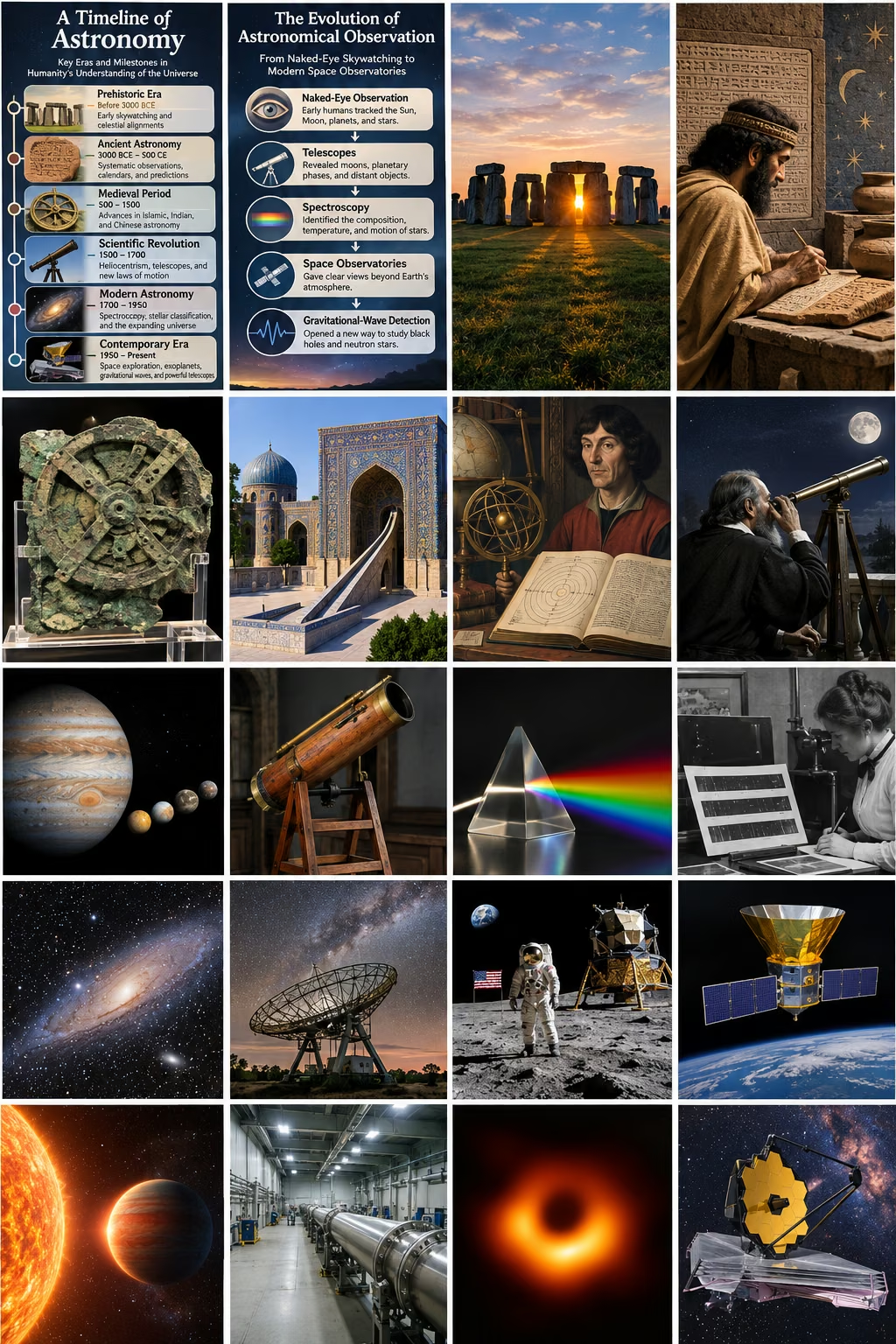
From Solar System Exploration to Modern Cosmic Surveys
Astronomy initially studied planets through their apparent positions and motions.
Spacecraft later allowed direct exploration of planetary surfaces, atmospheres, moons, and magnetic environments.
Apollo and Voyager demonstrated the scientific value of collecting information close to celestial targets.
Meanwhile, missions such as Kepler and Gaia transformed the study of planetary populations and Galactic structure through statistical and astrometric surveys.
Contemporary observatories including Euclid and Rubin extend this approach to enormous cosmic datasets.
These developments show how astronomy increasingly connects detailed individual observations with population-level analysis, numerical models, and the reconstruction of long-term cosmic history.
Frequently Asked Questions About the Timeline of Astronomy
The history of astronomy raises important questions about when scientific sky observation began, how different civilizations contributed, and which discoveries transformed humanity’s understanding of the universe.
Many questions require distinguishing an early idea from its later scientific confirmation.
For example, heliocentrism was proposed in antiquity but became widely accepted only after substantial observational and mathematical developments.
The following questions explain important historical distinctions and connect major astronomical milestones with the scientific principles used today.
When Did Astronomy First Begin?
Astronomy began long before written historical records, making it impossible to identify one precise starting date.
Prehistoric communities observed the Sun, Moon, and stars and recognized recurring celestial patterns.
Evidence from monuments and archaeological remains suggests that some societies incorporated celestial alignments into architecture and ceremonial practices.
More systematic written records later developed in ancient civilizations such as Mesopotamia, Egypt, and China.
Modern scientific astronomy emerged gradually through mathematics, precise measurements, instrumental observation, and physical theory.
The history of astronomy therefore represents a long process of cultural and scientific development rather than a single invention. [1] [2]
Which Ancient Civilization Made the Earliest Astronomical Discoveries?
No single civilization can be identified as the exclusive origin of astronomy.
People in many regions independently observed celestial patterns before surviving written records.
Mesopotamian societies developed especially influential systems of celestial recordkeeping and mathematical prediction.
Egyptian traditions contributed to calendars and seasonal timekeeping, while Chinese astronomers maintained extensive records of celestial phenomena.
Ancient American civilizations also developed sophisticated astronomical and calendrical traditions.
Determining which civilization made the earliest discovery depends on the specific phenomenon, the definition of discovery, and the quality of surviving evidence.
The development of astronomy is best understood as a global historical process.
Who First Proposed That Earth Revolves Around the Sun?
Aristarchus of Samos is among the earliest known thinkers to propose that Earth revolves around the Sun.
His heliocentric hypothesis appeared during the third century BCE, many centuries before Nicolaus Copernicus.
However, Aristarchus’s original detailed explanation has not survived, and the proposal did not become the dominant astronomical framework.
Copernicus presented a comprehensive mathematical heliocentric model in 1543.
Later discoveries by Kepler, Galileo, and Newton strengthened the scientific explanation for planetary motion.
The distinction is important because proposing an idea, constructing a predictive model, and establishing a well-supported physical theory are separate achievements.
How Did Astronomy Change During the Scientific Revolution?
The Scientific Revolution transformed astronomy by combining new observations with mathematical explanations.
The telescope revealed celestial phenomena that challenged traditional assumptions about perfectly ordered, Earth-centered heavens.
Kepler’s planetary laws replaced uniform circular-orbit assumptions with elliptical motion.
Galileo’s observations of Jupiter’s moons and the phases of Venus challenged important aspects of traditional geocentric astronomy.
Newton’s theory of universal gravitation later explained orbital motion within a broader framework of physical laws.
These developments encouraged the evaluation of scientific ideas through measurements, reproducible observations, and theoretical predictions rather than reliance on inherited philosophical authority alone.
Who Invented the Astronomical Telescope?
The earliest practical telescope designs emerged in the Netherlands around 1608, with Hans Lippershey among the individuals associated with their development.
Because several instrument makers were experimenting with similar optical arrangements, assigning the invention exclusively to one person requires historical caution.
Galileo Galilei improved the telescope in 1609 and became an influential pioneer of its astronomical use.
His observations revealed lunar features, additional stars, and satellites orbiting Jupiter.
Later instruments used improved refracting lenses and reflecting mirrors.
The history of the telescope therefore involves several distinct developments: optical invention, instrument refinement, and systematic scientific application.
How Did Astronomers Discover Other Galaxies?
Astronomers recognized distant galaxies through improvements in stellar-distance measurement.
Before the 1920s, the nature of spiral nebulae remained uncertain because their distances were difficult to determine.
Edwin Hubble identified Cepheid variable stars in Andromeda and applied the period–luminosity relationship established by Henrietta Leavitt.
The resulting distance estimates showed that Andromeda lies beyond the Milky Way.
This demonstrated that the universe contains separate galaxies rather than one all-encompassing stellar system.
Subsequent observations revealed an enormous diversity of galaxies and helped establish the foundations of extragalactic astronomy. [15]
When Was the Big Bang Theory Developed?
Big Bang cosmology developed gradually during the twentieth century rather than appearing as one complete theory on a single date.
General relativity provided the mathematical foundation for dynamic cosmological models.
Georges Lemaître developed an expanding-universe model in 1927 and later proposed ideas concerning an extremely early cosmic state.
Research on primordial nucleosynthesis expanded during the 1940s.
The 1965 discovery of the cosmic microwave background provided major observational support for a hot early universe.
Modern Big Bang cosmology combines expansion measurements, primordial element abundances, cosmic background radiation, and large-scale structure observations.
Questions about the earliest physical conditions and inflation remain active areas of investigation.
When Were the First Exoplanets Discovered?
The first widely accepted confirmed discoveries of planets outside the solar system were announced in 1992 by Aleksander Wolszczan and Dale Frail.
These planets orbit the pulsar PSR B1257+12 and were identified using changes in the timing of radio pulses.
In 1995, Michel Mayor and Didier Queloz announced 51 Pegasi b, the first confirmed exoplanet discovered around a Sun-like main-sequence star.
That discovery used the radial-velocity technique.
Later observatories, including Kepler, found thousands of additional planets.
Exoplanet research now investigates planetary sizes, masses, orbital architectures, atmospheric properties, formation pathways, and potential habitability. [18] [19]
What Was the First Direct Evidence of Gravitational Waves?
The first direct detection of gravitational waves occurred on September 14, 2015, when LIGO observed the signal GW150914.
The signal came from the merger of two black holes and was publicly announced in February 2016.
Earlier observations of binary pulsar systems had provided strong indirect evidence for gravitational-wave emission, but LIGO measured the waves themselves.
Gravitational waves are disturbances in spacetime predicted by general relativity.
The detection introduced a new way to study compact objects and energetic cosmic events.
Later observations, including the neutron-star merger GW170817, demonstrated how gravitational-wave astronomy could be combined with electromagnetic observations. [21] [22]
What Are the Most Important Recent Discoveries in Astronomy?
Several developments have substantially expanded astronomical knowledge since the 1990s.
These include confirmed exoplanet discoveries, evidence for accelerating cosmic expansion, direct gravitational-wave detection, and event-horizon-scale imaging of black-hole environments.
Hubble and Webb have transformed observations of galaxies and star-forming regions, while Gaia has produced extraordinarily precise measurements of stellar positions and motions.
Euclid and Rubin contribute new approaches to large-scale cosmic surveys.
The importance of each discovery depends on the scientific question being investigated.
Together, these advances reveal the growing role of precision instruments, computational analysis, and observations across multiple wavelengths and physical messengers.
What Is the Difference Between Astronomy, Astrophysics, and Cosmology?
Astronomy is the broad scientific study of celestial objects and phenomena.
Astrophysics focuses on explaining their physical properties and behavior using principles from physics, including gravity, thermodynamics, electromagnetism, and nuclear processes.
Cosmology investigates the origin, large-scale structure, composition, and evolution of the universe as a whole.
These disciplines overlap extensively.
For example, observing a distant galaxy is astronomical research, investigating its stellar populations and black hole activity involves astrophysics, and using its redshift to study cosmic expansion involves cosmology.
Modern researchers frequently work across all three areas because understanding celestial systems requires both detailed observations and physical explanation.
How Have Telescopes Changed Our Understanding of the Universe?
Telescopes transformed astronomy by revealing celestial objects and physical details that could not be detected through unaided observation.
Galileo’s telescope revealed Jupiter’s moons and features of the Moon.
Later reflecting telescopes allowed larger instruments to be constructed, while spectroscopy made it possible to investigate stellar composition.
Radio and high-energy telescopes revealed phenomena such as pulsars, quasars, and hot gas in galaxy clusters.
Space telescopes including Hubble and Webb provide observations from above Earth’s atmosphere.
Modern telescopes also support enormous surveys, making astronomy increasingly capable of studying both individual objects and the statistical behavior of entire cosmic populations.
Conclusion: The Continuing Evolution of Astronomy
The history of astronomy demonstrates how human understanding of the universe has developed through observation, mathematics, instrumentation, and physical explanation.
Ancient communities recognized celestial cycles and developed calendars. Babylonian, Greek, Indian, Chinese, and Islamic astronomical traditions contributed important methods of observation and prediction.
The Scientific Revolution transformed planetary theory through heliocentrism, telescopic observations, Kepler’s laws, and Newtonian mechanics.
During the nineteenth and twentieth centuries, spectroscopy, stellar-distance measurements, relativity, nuclear physics, and radio astronomy expanded scientific investigation beyond traditional celestial mapping.
Astronomers discovered that stars generate energy through nuclear fusion, that the Milky Way is one galaxy among many, and that the universe is expanding.
The development of space exploration allowed direct investigation of planets and moons, while space observatories provided new views of distant objects across multiple wavelengths.
Contemporary astronomy has introduced additional methods of investigation through gravitational waves, infrared spectroscopy, high-precision astrometry, and enormous cosmic surveys.
Despite these advances, important questions remain unanswered.
Scientists still investigate the physical nature of dark matter and dark energy, the origin of the earliest black holes, the formation of galaxies, the conditions that produce planetary systems, and the possibility of life beyond Earth.
The timeline of astronomy is therefore not a completed record of scientific achievement. It is an evolving account of how observations generate questions, how theories organize evidence, and how new instruments reveal aspects of the universe that earlier generations could not investigate.
Recommended Supporting Content and Internal Linking
A comprehensive astronomy-history resource benefits from supporting articles that explain major discoveries and scientific concepts in greater depth.
The chronological timeline establishes relationships among important milestones, but specialized articles can explore the technical details of planetary motion, spectroscopy, cosmology, instruments, and individual astronomers.
This supporting structure also helps readers move naturally from historical events to the scientific principles underlying them.
History of Astronomical Models
Supporting content on astronomical models should explain how geocentric, heliocentric, and relativistic frameworks developed.
Important subjects include Ptolemaic epicycles, the Copernican system, Kepler’s laws, Newtonian mechanics, and Einstein’s general relativity.
These topics should distinguish mathematical prediction from physical explanation and show why different models were accepted or rejected.
Comparative diagrams, orbital examples, and explanations of observational tests would help readers understand how scientific theories changed.
History of Astronomical Instruments
A dedicated history of astronomical instruments can trace developments from ancient measuring devices to modern space observatories.
Important examples include the Antikythera mechanism, astrolabes, quadrants, refracting telescopes, reflecting telescopes, spectrographs, photographic plates, radio interferometers, and gravitational-wave detectors.
The content should explain how each instrument works, what measurements it enables, and which limitations it overcomes.
Understanding instruments helps explain why major discoveries occurred when they did.
Famous Astronomers Throughout History
Biographical articles can explain the contributions of astronomers across different civilizations and historical periods.
Important figures include Hipparchus, Ptolemy, Aryabhata, al-Battani, al-Sufi, al-Tusi, Ulugh Beg, Copernicus, Galileo, Kepler, Newton, Herschel, Leavitt, Hubble, and Einstein.
Biographies should connect individual achievements to existing knowledge, institutions, collaborators, and observational methods.
This approach avoids presenting scientific discoveries as isolated accomplishments detached from their historical and intellectual contexts.
History of Planetary Discoveries
Supporting articles about planetary discoveries can explain how the known solar system expanded and how exoplanets were eventually identified.
Topics include the discoveries of Uranus, Neptune, Ceres, planetary satellites, asteroids, and dwarf planets.
Modern sections can examine radial-velocity measurements, transits, pulsar timing, direct imaging, and gravitational microlensing.
Comparing methods would help explain why different planetary systems are easier or harder to detect and what each technique reveals.
History of Stellar Astronomy
Stellar astronomy provides opportunities to connect historical observation with modern astrophysical theory.
Important topics include stellar parallax, spectroscopy, spectral classification, the Hertzsprung–Russell diagram, nuclear fusion, stellar evolution, supernovae, neutron stars, and black holes.
Articles should explain how stellar mass, temperature, luminosity, and composition influence evolutionary outcomes.
These relationships help readers understand why historical discoveries about stars contributed directly to larger theories concerning galaxies and chemical evolution.
History of Cosmology
A cosmology-focused content cluster can examine how astronomers developed models of the universe’s origin, expansion, composition, and large-scale structure.
Important topics include general relativity, Lemaître’s expanding universe, the Hubble–Lemaître law, Big Bang nucleosynthesis, cosmic microwave background radiation, inflation, dark matter, and dark energy.
The content should clearly distinguish observational findings from theoretical interpretations and unresolved scientific questions.
This distinction is especially important when explaining current cosmological uncertainties.
History of Space Exploration
Supporting content about space exploration should connect engineering milestones with their scientific contributions.
Sputnik established the possibility of artificial satellites, Apollo enabled direct lunar investigation, and Voyager explored the outer planets.
Later observatories such as Hubble, Kepler, Gaia, and Webb expanded astronomical research beyond Earth’s atmosphere.
Articles can explain differences among flyby missions, orbiters, landers, probes, and space telescopes.
These distinctions help readers understand how different mission architectures answer different scientific questions.
Modern Astronomical Discoveries
Modern discovery articles can explore exoplanets, gravitational waves, black hole imaging, precision astrometry, and large astronomical surveys.
Detailed explanations should identify the instruments used, the observations obtained, the methods of analysis, and the conclusions supported by the evidence.
Important contemporary programs include LIGO, the Event Horizon Telescope, Webb, Gaia, Euclid, and Rubin Observatory.
Coverage should distinguish completed observations from future scientific objectives and avoid treating preliminary results as settled conclusions.
Sources
The following references include primary scientific institutions, observatory collaborations, historical research projects, and academic resources. Historical dates and interpretations are based on surviving evidence, which is sometimes incomplete or disputed. The latest modern mission information included here was verified against institutional publications available by November 2026.
[1] UNESCO World Heritage Centre. Chankillo and the Monumental Astronomical Traditions, including research on Stonehenge and Newgrange. https://whc.unesco.org/en/tentativelists/7055/
[2] NASA Goddard Space Flight Center. Chronology of Early Astronomy, Mechanics and Spaceflight. Archived historical timeline. https://pwg.gsfc.nasa.gov/stargaze/Stimelinold.htm
[3] Antikythera Mechanism Research Project. History and Research on the Antikythera Mechanism. https://new.antikythera-mechanism.gr/history
[4] United States Naval Observatory. Introduction to Calendars and Leap-Year Rules. https://aa.usno.navy.mil/faq/calendars
[5] University of St Andrews, MacTutor History of Mathematics. Aryabhata: Biography and Mathematical Astronomy. https://mathshistory.st-andrews.ac.uk/Biographies/Aryabhata_I/
[6] University of St Andrews, MacTutor History of Mathematics. Brahmagupta: Biography and Astronomical Mathematics. https://mathshistory.st-andrews.ac.uk/Biographies/Brahmagupta/
[7] Cambridge University Press, International Astronomical Union Colloquium. An Examination of Al-Biruni’s Knowledge of Indian Astronomy. https://doi.org/10.1017/S0252921100105962
[8] University of St Andrews, MacTutor History of Mathematics. Al-Khwarizmi: Biography and Astronomical Tables. https://mathshistory.st-andrews.ac.uk/Biographies/Al-Khwarizmi/
[9] University of St Andrews, MacTutor History of Mathematics. Al-Battani: Biography and Observational Astronomy. https://mathshistory.st-andrews.ac.uk/Biographies/Al-Battani/
[10] University of St Andrews, MacTutor History of Mathematics. Nasir al-Din al-Tusi and the Maragheh Observatory. https://mathshistory.st-andrews.ac.uk/Biographies/Al-Tusi_Nasir/
[11] University of St Andrews, MacTutor History of Mathematics. Ulugh Beg and the Samarkand Observatory. https://mathshistory.st-andrews.ac.uk/Biographies/Ulugh_Beg/
[12] NASA Earth Observatory. Planetary Motion: The History of an Idea That Launched the Scientific Revolution. https://science.nasa.gov/earth/earth-observatory/planetary-motion/
[13] NASA. Spots, Waves and Wind: A Solar Science Timeline. https://www.nasa.gov/history/spots-waves-and-wind-a-solar-science-timeline-full-text/
[14] NASA Goddard Space Flight Center. History of Astronomy and Scientific Discovery Before 1600. https://science.gsfc.nasa.gov/attic/cosmicopia.gsfc.nasa.gov/hist_bef1600.html
[15] NASA Science. Hubble Views the Star That Changed the Universe. https://science.nasa.gov/missions/hubble/hubble-views-the-star-that-changed-the-universe/
[16] NASA Science. The Universe: Overview and History. https://science.nasa.gov/universe/overview/
[17] NASA Science. What Is Dark Energy? Understanding the Accelerating Universe. https://science.nasa.gov/missions/roman-space-telescope/the-universe-is-expanding-faster-these-days-and-dark-energy-is-responsible-so-what-is-dark-energy/
[18] NASA Science. Nobel Winners Changed Our Understanding with Exoplanet Discovery. https://science.nasa.gov/universe/exoplanets/nobel-winners-changed-our-understanding-with-exoplanet-discovery/
[19] NASA Science. Kepler and K2 Mission: In Depth. https://science.nasa.gov/mission/kepler/in-depth/
[20] European Space Agency. Gaia Mission and Data Releases. https://www.esa.int/Science_Exploration/Space_Science/Gaia/Gaia_factsheet
[21] LIGO Laboratory, Caltech and MIT. Gravitational-Wave Detection Publications, Including GW150914. https://www.ligo.caltech.edu/page/ligo-publications
[22] LIGO Laboratory. GW170817: Multi-Messenger Neutron Star Merger Press Release. https://www.ligo.caltech.edu/page/press-release-gw170817
[23] Event Horizon Telescope Collaboration. Astronomers Capture First Image of a Black Hole, April 10, 2019. https://eventhorizontelescope.org/press-release-april-10-2019-astronomers-capture-first-image-black-hole
[24] NASA Science. James Webb Space Telescope Mission Timeline. https://science.nasa.gov/mission/webb/webb-mission-timeline/
[25] Event Horizon Telescope Collaboration. Astronomers Reveal First Image of the Black Hole at the Heart of Our Galaxy. https://eventhorizontelescope.org/blog/astronomers-reveal-first-image-black-hole-heart-our-galaxy
[26] European Space Agency. Euclid’s First Images: The Dazzling Edge of Darkness. https://www.esa.int/Newsroom/Press_Releases/Euclid_s_first_images_the_dazzling_edge_of_darkness
[27] NSF–DOE Vera C. Rubin Observatory. History of Rubin Observatory and First Imagery. https://rubinobservatory.org/about/history