
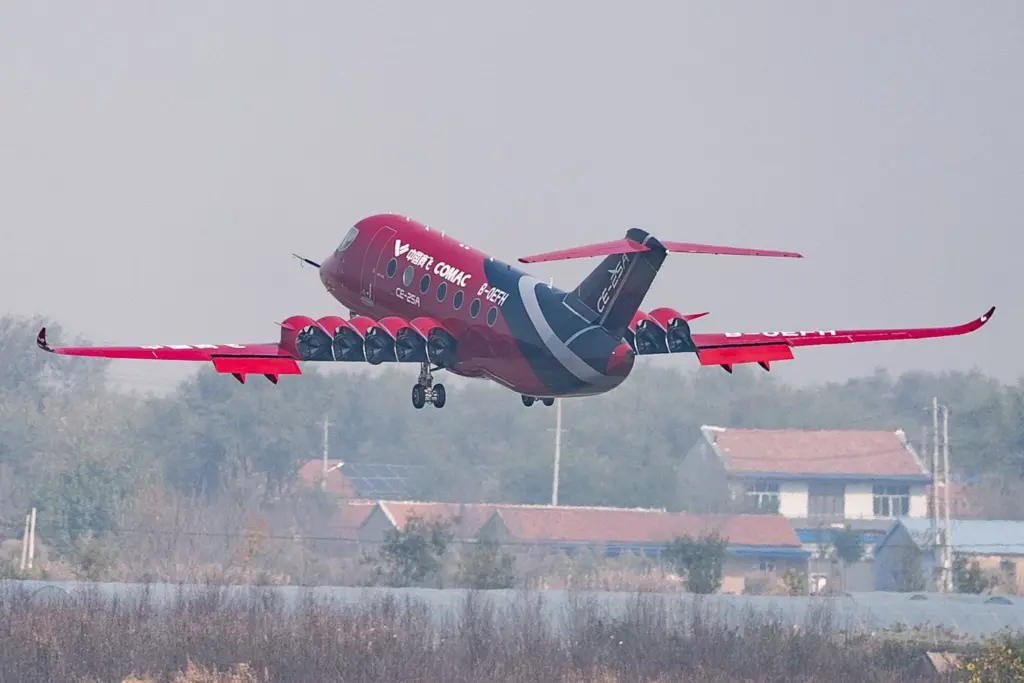
China’s electric aviation industry reached a significant milestone on November 14, 2026, when the COMAC CE-25A all-electric regional aircraft completed its first piloted flight in Binzhou, Shandong Province. Developed by the Commercial Aircraft Corporation of China (COMAC), the aircraft represents an ambitious effort to bring battery-electric propulsion into the commercial regional aviation market.
Designed to accommodate 19 passengers, the CE-25A has a reported maximum takeoff weight of 10 tonnes, a cruising speed of 300 km/h, and a flight range of 400 kilometers. Its distinctive wing-mounted distributed electric propulsion system replaces conventional turbine engines with multiple electrically driven ducted fans.
The project brings together COMAC, battery manufacturer Contemporary Amperex Technology Co. Limited (CATL), Shanghai Jiao Tong University, and other research partners.
Although the November 2026 flight marks important progress, the aircraft remains in development. China’s Civil Aviation Administration (CAAC) has accepted its type certificate application, but commercial passenger operations have not been approved. The CE-25A’s long-term significance will depend on whether its technology can satisfy aviation safety requirements while delivering practical operating economics. ([1] [2])
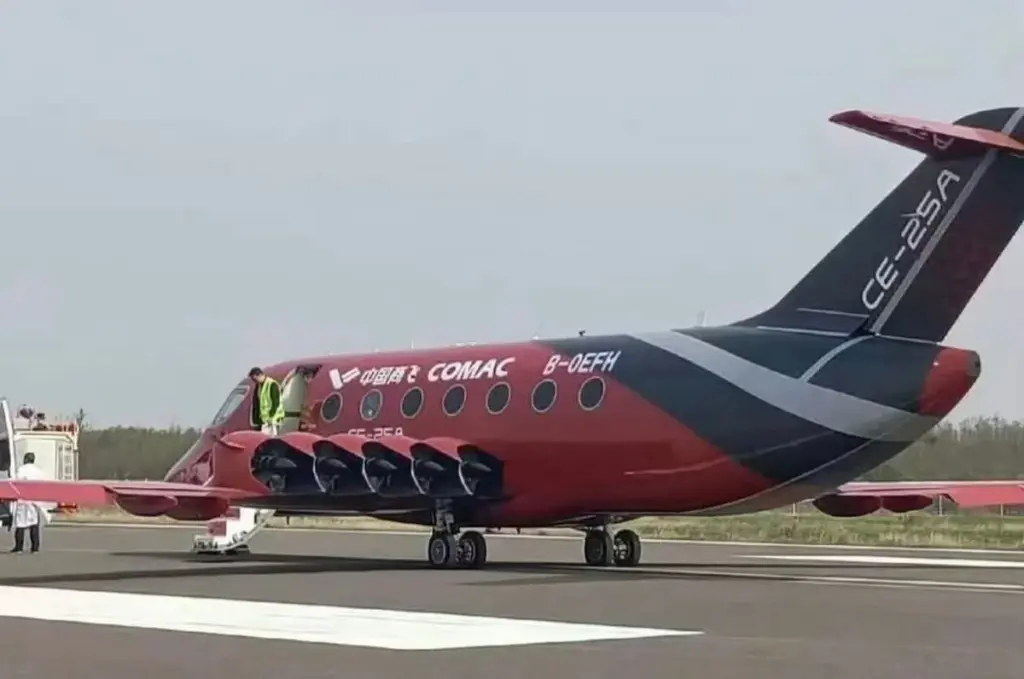
What Is the COMAC CE-25A All-Electric Regional Aircraft?
The COMAC CE-25A is a Chinese-designed, battery-electric aircraft intended for short-distance commercial flights between cities. Unlike conventional regional airliners, which rely on aviation fuel to power combustion engines, the CE-25A uses electrical power to operate a distributed propulsion system.
Its reported passenger capacity places it in the small regional aircraft category, while its intended certification basis reflects transport-category airworthiness requirements. The program combines aircraft design, energy storage, electrical systems, aerodynamics, and advanced flight testing.
COMAC’s First Electric Commercial Aircraft
COMAC, formally known as the Commercial Aircraft Corporation of China, is a state-owned aerospace manufacturer associated with China’s domestic commercial aircraft programs, including the C919 passenger jet.
According to information released through Xinhua, the CE-25A is COMAC’s first electric commercial aircraft development program. It is designed for intercity transportation rather than long-distance airline routes.
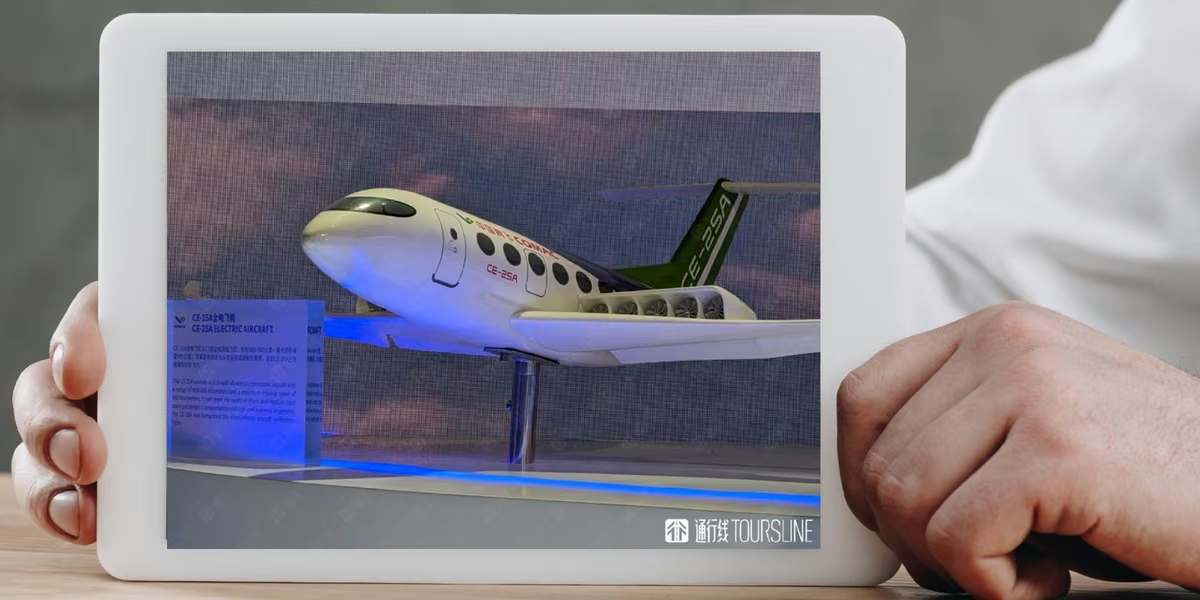
A conventional regional turboprop uses a gas turbine to drive one or more propellers. By contrast, a battery-electric aircraft supplies electrical energy to motors that operate its propulsors.
This difference changes the aircraft’s energy-storage requirements, mechanical architecture, maintenance considerations, and airport infrastructure needs. However, a battery-powered aircraft still requires comprehensive certification, just like its conventionally powered counterparts. ([1])
What Does the CE-25A Aircraft Name Mean?
COMAC has publicly explained the designation CE-25A, giving each component a particular meaning.
- C\: Represents China and COMAC.
- E\: Stands for electric propulsion.
- 25\: Refers to the CCAR-25 transport-category airworthiness standards.
- A\: Identifies the first aircraft product in this designation series.
The reference to CCAR-25 is particularly important. These regulations establish airworthiness requirements for transport-category aircraft, including structural strength, flight characteristics, systems, and safety.
COMAC’s use of the designation indicates its intention to develop the aircraft under a demanding certification framework. However, specifying that framework does not mean the aircraft has already demonstrated compliance or achieved a safety record equivalent to established commercial airliners. ([1] [9])
Why China Is Developing a 19-Passenger Electric Aircraft
A 19-passenger aircraft can serve routes where demand is too limited to support a larger regional airliner. These routes might connect smaller cities, remote communities, regional airports, or transportation hubs over relatively short distances.
Electric propulsion could be particularly relevant because energy requirements generally become more manageable as planned flight distances decrease.
China also has extensive battery manufacturing and electric vehicle supply chains. Applying that industrial expertise to aerospace engineering creates opportunities for research into high-energy-density batteries, propulsion systems, and advanced electrical equipment.
Nevertheless, a smaller aircraft does not automatically guarantee profitable service. Passenger demand, charging facilities, airport costs, dispatch reliability, and the number of daily flights remain essential factors.
COMAC CE-25A Specifications and Performance
The CE-25A’s published specifications describe a compact regional aircraft rather than a conventional medium-range passenger jet. COMAC’s reported figures suggest a design optimized around relatively short intercity routes with a modest passenger capacity.
Importantly, these are manufacturer-reported specifications, not independently demonstrated commercial-service guarantees. Public reporting has not established the full set of operating limitations, approved payload-range combinations, or battery endurance data that airlines would eventually require.
COMAC CE-25A Technical Specifications
| Specification | Reported figure |
|---|---|
| Manufacturer | COMAC, China |
| Aircraft designation | CE-25A |
| Aircraft category | All-electric regional passenger aircraft |
| Intended passenger capacity | 19 |
| Maximum takeoff weight | 10,000 kg (10 tonnes) |
| Cruising speed | 300 km/h |
| Cruising altitude | 2,400 m |
| Stated flight range | 400 km |
| Propulsion | Distributed electric ducted fans |
| Fan arrangement | Ten units reported, five per wing |
| Development partners | CATL, Shanghai Jiao Tong University, others |
| First unmanned flight | February 2, 2026 |
| First piloted flight | November 14, 2026 |
| Type certification | Application accepted by CAAC |
| Battery capacity | Not publicly established |
| Battery chemistry | Not publicly established |
| Charging time | Not publicly established |
| Commercial service date | Not announced |
Sources: Xinhua, Beijing News, and Aviation International News. ([1] [2] [4])
Passenger Capacity and Maximum Takeoff Weight
The CE-25A is designed to accommodate 19 passengers, a capacity that could suit commuter airline operations and relatively low-demand regional routes.
Its reported maximum takeoff weight of 10 tonnes represents the upper limit of the aircraft’s permitted takeoff mass under its stated design specification. That total must account for the airframe, propulsion equipment, energy storage, crew, passengers, baggage, and other operational loads.
Battery-electric aircraft face an important weight constraint because their batteries generally retain nearly the same mass throughout a flight. Conventional aircraft, on the other hand, become lighter as they consume fuel.
The CE-25A’s actual useful payload, operating empty weight, and passenger-plus-baggage limitations have not been sufficiently disclosed for a reliable independent payload analysis.
Flight Range, Cruising Speed, and Altitude
COMAC reports a cruising speed of 300 km/h, a cruising altitude of 2,400 meters, and a design range of 400 kilometers.
These figures help establish the aircraft’s intended operating envelope, but they should not be interpreted as a guarantee that it can fly 400 kilometers with 19 passengers under every condition.
Real-world flight range depends on battery condition, payload, atmospheric temperature, winds, routing, climb energy, and mandatory energy reserves. Operators must also account for contingencies such as an unexpected delay or a diversion.
The reported cruising speed is not necessarily the maximum achievable speed, and cruising altitude should not be confused with the aircraft’s service ceiling.
A complete operational assessment will require certified performance charts and clearly defined range assumptions.
Can the CE-25A Replace Conventional Short-Haul Aircraft?
The CE-25A could eventually serve some routes currently operated by small turboprops, particularly where flight distances are relatively short and adequate charging infrastructure is available.
However, conventional aircraft offer significant advantages in refueling flexibility and operating range. A fuel-powered commuter aircraft may be able to operate several legs without needing specialized electrical charging facilities.
The CE-25A’s practical competitiveness will depend on whether it can meet scheduled passenger loads while maintaining adequate reserves and reasonable turnaround times.
For now, it is better understood as a developing alternative for selected regional missions rather than a universal replacement for conventional turboprops.
How Does the COMAC CE-25A’s Electric Propulsion System Work?
One of the CE-25A’s most distinctive features is its distributed electric propulsion architecture. Instead of concentrating thrust in one or two large conventional engines, the design distributes electrically driven fans across the wings.
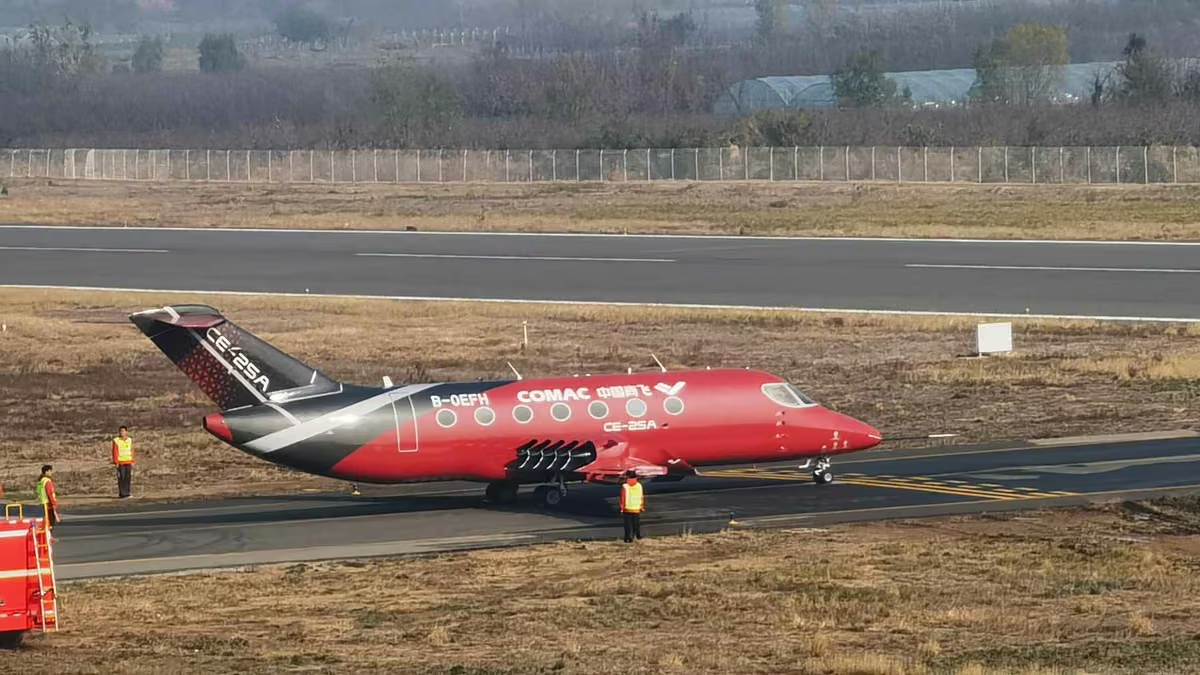
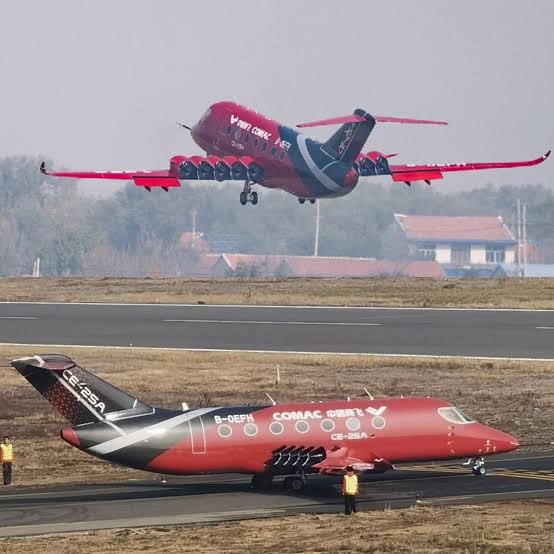
COMAC has confirmed the use of wing-mounted distributed electric ducted propulsion. Aviation reporting and publicly circulated photographs identify a ten-fan configuration, although detailed propulsion specifications remain limited.
This arrangement creates opportunities to integrate thrust production with the aircraft’s aerodynamic design. ([1] [4])
Distributed Electric Propulsion (DEP) Explained
Distributed electric propulsion, commonly abbreviated DEP, uses multiple electric propulsors positioned around an aircraft to generate thrust.
A typical system includes batteries or another electrical power source, electrical distribution equipment, power electronics, electric motors, and propellers or fans.
Unlike conventional propulsion systems that mechanically connect a turbine or piston engine to its propeller, electric architectures can distribute power through cables to motors positioned at different locations.
This creates additional freedom for aircraft designers to integrate propulsion with the airframe.
NASA’s X-57 Maxwell research program investigated distributed electric propulsion as a method of improving aerodynamic performance and exploring new aircraft configurations. However, NASA’s research aircraft and COMAC’s CE-25A employ different propulsion arrangements, so their results cannot be transferred directly. ({}^{[5] [6]})
Wing-Mounted Ducted Fan Propulsion Architecture
Aviation photographs of the CE-25A show ten ducted-fan units, arranged in groups of five above each wing. This configuration differs substantially from the two externally mounted propellers commonly seen on regional turboprop aircraft.
A ducted fan contains rotating blades surrounded by a casing or duct. The fan accelerates air to produce thrust, while the duct influences airflow around the rotating blades.
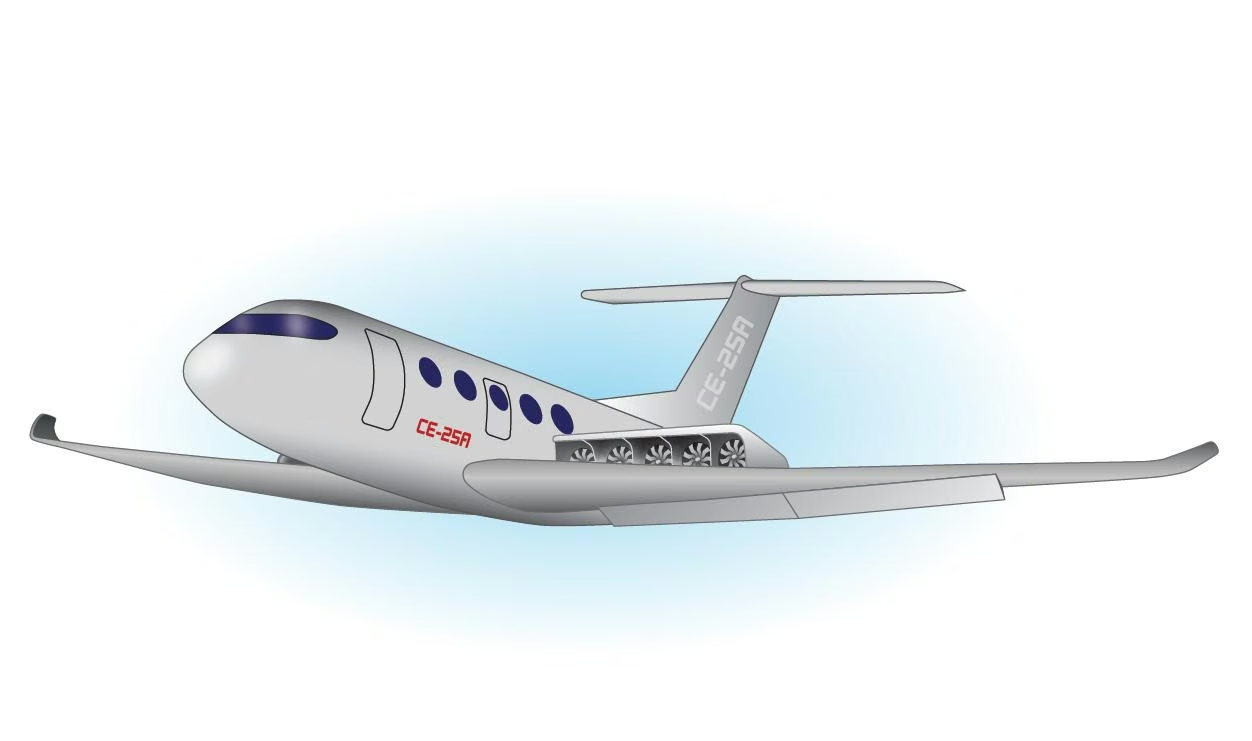
The aerodynamic efficiency of such a system depends on fan diameter, rotational speed, duct geometry, installation position, and operating conditions.
The CE-25A’s fan arrangement may offer advantages in packaging and aerodynamic integration, but those possibilities must be weighed against additional motors, inverters, wiring, cooling requirements, and structural complexity.
COMAC has not publicly released enough detailed performance information to quantify the specific efficiency benefits of its installation. ([4])
Blown-Wing Aerodynamics and High-Lift Wing Design
Distributed propulsion can interact with the airflow around an aircraft’s wings. One possible application is blown-wing aerodynamics, in which accelerated air from propulsors increases airflow over portions of the wing and its high-lift devices.
Under suitable conditions, this interaction can increase lift, especially at relatively low airspeeds.
NASA investigated related principles through the X-57 program. Its research demonstrated how distributed high-lift propellers could influence wing lift and potentially support more aerodynamically efficient designs.
The CE-25A’s visible installation suggests that propulsion-airframe interaction is an important design consideration.
However, no verified public CE-25A performance data establishes a specific lift increase, takeoff distance, landing distance, or short takeoff and landing (STOL) capability. Those claims would require aircraft-specific testing and documentation. ([5])
Electric Motors, Power Electronics, and Motor Controllers
Electric aircraft propulsion depends on much more than the motors themselves. A complete powertrain must control how electrical energy moves from the batteries to each propulsive unit.
Electric motors convert electrical energy into mechanical rotation. Inverters and motor controllers regulate the power delivered to those motors, allowing the propulsion system to respond to pilot commands and aircraft control requirements.
A multi-motor aircraft also requires sophisticated electrical distribution, protection, and monitoring systems.
Cooling is essential because motors, inverters, cables, and battery packs generate heat during operation. Engineers must prevent excessive temperatures without introducing unacceptable weight or aerodynamic drag.
Electric motors may require fewer mechanical maintenance tasks than combustion engines, but the complete aircraft still requires inspection of bearings, fan blades, high-voltage connections, electronic equipment, and cooling components. ({}^{[5] [8]})
Propulsion Efficiency, Redundancy, and Flight Safety
Multiple electric fans may give aircraft designers flexibility in managing propulsion failures, but having more motors does not automatically make an aircraft safer.
If one fan fails, the remaining fans might continue producing thrust. However, a failure could also create asymmetric thrust, particularly when propulsors are distributed across the wings.
The consequences depend on the aircraft’s control authority, power-system architecture, flight condition, and the location of the failed component.
Common-cause failures are another important consideration. A shared electrical bus, control system, or battery fault might affect several motors simultaneously.
NASA’s distributed-propulsion research identified these issues as central to failure analysis and handling-quality evaluation.
The CE-25A’s actual redundancy arrangements and demonstrated failure-response performance have not been publicly detailed. ([6])
CE-25A Battery Technology and Energy Storage System
Energy storage is one of the most consequential technical challenges facing the CE-25A. Unlike a conventional aircraft, which can take advantage of the high specific energy of aviation fuel, a battery-electric airplane must carry enough stored electricity to complete its planned mission safely.
The aircraft’s energy-storage system therefore influences its weight, range, payload, structural design, thermal management, and operating costs.
Although CATL is a confirmed development partner, the precise battery configuration installed in the CE-25A has not been fully disclosed.
CATL’s Role in Developing Electric Aircraft Technology
CATL, formally Contemporary Amperex Technology Co. Limited, is a major battery manufacturer with extensive experience in energy storage and electric vehicle technology.
COMAC has identified CATL among the organizations involved in developing the CE-25A.
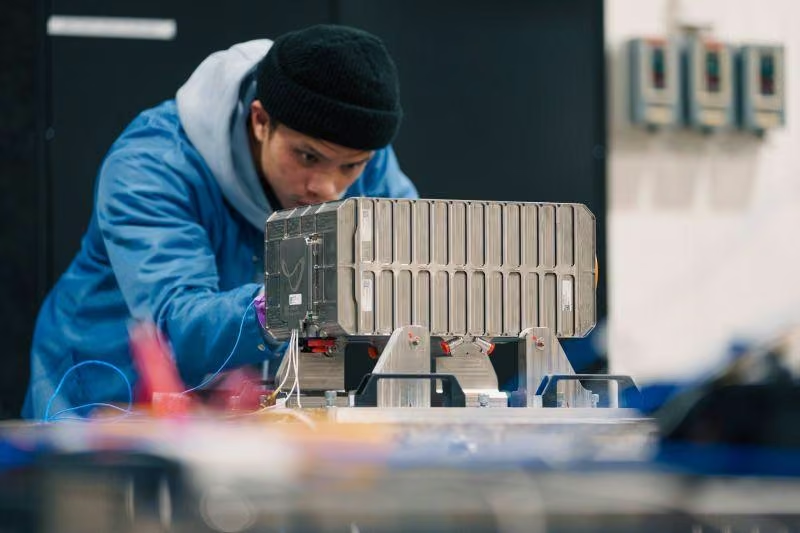
CATL has also pursued aviation-specific battery technologies. In August 2026, the company announced that a 350 Wh/kg aviation battery system developed for passenger eVTOL aircraft had passed a test demonstrating resistance to thermal runaway propagation between adjacent cells.
That achievement is relevant to the broader development of electric aviation, but it does not establish that the CE-25A uses the same battery.
Aircraft-specific confirmation of battery type, installed energy capacity, and certification testing is still needed. ([1] [7])
Lithium-Ion Battery Technology and Energy Density
Lithium-ion batteries are widely used in electric mobility applications because they can store substantial electrical energy in a rechargeable system.
Their suitability for aviation depends heavily on gravimetric energy density, which measures stored energy relative to battery mass.
Energy density is commonly expressed in watt-hours per kilogram (Wh/kg). A higher value means more energy can be stored for the same weight, although battery safety, durability, power output, and cooling requirements also matter.
It is important to distinguish cell-level energy density from complete battery-system energy density. The installed system includes structural supports, electrical connections, protective components, and cooling equipment.
CATL has publicly discussed aviation battery systems with energy densities of up to 500 Wh/kg in other development programs. However, neither that figure nor its disclosed 350 Wh/kg eVTOL battery specification has been verified as the CE-25A’s installed battery specification. ([7] [8])
Aircraft Battery Management System (BMS)
A battery management system, or BMS, supervises the condition and operation of a rechargeable battery pack.
Important BMS functions include monitoring battery voltage, temperature, current, state of charge, and potential faults. Depending on the battery design, the system may also manage cell balancing and estimate remaining usable energy.
Aircraft applications introduce particularly demanding requirements because propulsion energy availability is directly connected to flight safety.
The system must provide reliable information about battery condition and identify failures before they become hazardous. It must also interact appropriately with the aircraft’s electrical protection and propulsion control systems.
The CE-25A will require an acceptable approach to these functions, but COMAC has not released a detailed public description of its BMS architecture. ([10])
Battery Thermal Management and Thermal Runaway Prevention
Battery thermal management is critical because charging and discharging generate heat. During takeoff and climbing, an electric aircraft may demand substantial propulsion power, creating significant electrical and thermal loads.
Temperature management must also account for outside air conditions, battery aging, and differences between individual cells.
One of the most serious battery hazards is thermal runaway, a condition in which internal reactions cause self-accelerating heating that can damage cells and potentially spread to adjacent components.
Aircraft engineers address this risk through a combination of battery design, electrical protection, monitoring, cooling, containment, and failure-response procedures.
CATL’s 2026 aviation battery test illustrates the importance of preventing thermal propagation. Nevertheless, demonstrating that a battery is suitable for the CE-25A requires evidence specific to the aircraft’s installed system and applicable certification requirements. ([7] [10])
Battery Weight, Cycle Life, and Payload-Range Trade-Offs
Battery mass creates a fundamental engineering trade-off. Installing more battery capacity may increase available flight energy, but it also increases aircraft weight and can reduce the payload available for passengers and baggage.
The relationship is not necessarily linear because additional battery mass can increase the energy required to fly the aircraft.
Cycle life introduces a separate commercial consideration. Rechargeable batteries gradually lose capacity and may experience changes in internal resistance as they age.
Repeated charging, temperature exposure, depth of discharge, and high-power operation can influence degradation.
Airlines would therefore need to account for battery inspection, usable capacity limits, replacement intervals, and the financial consequences of capacity loss.
Without published battery mass, cycle-life data, and payload-range performance, the CE-25A’s long-term battery economics cannot yet be calculated reliably.
COMAC CE-25A Development History and Technology Demonstration
The CE-25A’s development reflects a gradual progression from aircraft concept to physical demonstration and flight testing.
The design was publicly discussed in 2023, when its wing-integrated electric propulsion arrangement attracted attention in specialist aviation media. By 2026, the project had advanced into unmanned and piloted flight testing.
These milestones demonstrate progress in integrating the aircraft’s major systems, although developing a flight-capable demonstrator is different from establishing a fully certified commercial aircraft production program. ([3])
From Aircraft Concept to Flight-Test Demonstrator
Aviation Week reported COMAC’s 19-seat electric regional aircraft design on November 28, 2023.
The concept featured distributed electric ducted fans integrated into the wing, distinguishing it from more conventional electric aircraft concepts based on one or two propellers.
Over the following years, engineering development progressed toward a physical aircraft capable of flight testing.
In October 2026, photographs circulated showing an apparent full-scale CE-25A demonstrator. Aviation International News reported on the images in early November, while noting that their authenticity had not yet been independently established.
COMAC’s subsequent confirmation of the CE-25A’s flight-testing milestones provided substantially stronger evidence that the aircraft program had moved beyond concept-stage development. ([3] [4])
COMAC, CATL, and Shanghai Jiao Tong University Collaboration
The CE-25A development program involves COMAC, CATL, Shanghai Jiao Tong University, and additional partners.
These organizations bring different engineering capabilities to a project that requires the integration of aviation structures, propulsion technology, energy storage, electrical systems, and flight-control functions.
COMAC’s established aircraft development activities provide an aerospace engineering foundation, while CATL contributes expertise relevant to advanced batteries. Shanghai Jiao Tong University represents the academic and research dimension of the collaboration.
The publicly available information confirms their involvement but does not establish a complete division of engineering responsibilities between every partner.
Integrating these different technologies is a major challenge because battery performance, propulsion efficiency, aircraft aerodynamics, and certification requirements influence one another throughout the design process. ([1])
COMAC CE-25A First Unmanned Flight on February 2, 2026
The CE-25A completed its first unmanned intelligent flight on February 2, 2026, according to information supplied by COMAC and published by Xinhua.
This milestone was important because it demonstrated that the aircraft could conduct a flight without an onboard human crew.
The unmanned test campaign also established a foundation for later piloted operations. However, the public reports do not provide a complete technical breakdown of the early flight-test program, including individual flight durations, maximum speeds, or detailed system evaluation results.
The Initial Autonomous Flight Milestone
The February 2 flight marked the CE-25A’s transition from ground-based development and testing into airborne validation.
Unmanned testing can allow engineers to investigate aircraft behavior before introducing the additional risks associated with carrying pilots and other personnel.
For an electric aircraft, flight testing may involve propulsion response, power-system behavior, flight-control performance, navigation, communication links, and aircraft stability.
Autonomous operation requires the aircraft to follow an appropriate control strategy without direct intervention from an onboard pilot.
However, the fact that the CE-25A completed an unmanned flight does not establish the precise level of autonomy used, the aircraft’s emergency control arrangements, or whether all flight phases were conducted under the same control mode.
Those technical details have not been sufficiently disclosed. ([1])
Nineteen Unmanned Flight Validation Tests
COMAC reported that the CE-25A had completed 19 unmanned autonomous flight validations before its first piloted flight.
A series of repeated tests is more informative than an isolated demonstration because engineers can examine consistency, system behavior, and responses under different operating conditions.
Such campaigns can support the development of aircraft control laws, propulsion integration, and operating procedures.
Nevertheless, the number of flights alone does not establish the scope or completeness of an aircraft’s certification testing.
The publicly reported figure confirms a development milestone, but it does not reveal total flight hours, test conditions, battery endurance results, or the full collection of engineering issues identified and resolved during the program. ([1])
COMAC CE-25A Completes First Piloted Flight on November 14, 2026
On November 14, 2026, the CE-25A completed its first flight with personnel on board in Binzhou, Shandong Province.
The aircraft carried two pilots and one flight-test engineer. COMAC reported that the aircraft operated normally and that the evaluated performance indicators met expectations.
Beijing News, citing COMAC, provided additional details: the test event lasted 57 minutes and 46 seconds, including 16 minutes and 38 seconds airborne, during which the aircraft traveled 60.4 kilometers.
This was an important development milestone, although it was not a commercial passenger service flight. ([1] [2])
Historic Flight Testing in Binzhou, Shandong Province
Binzhou, located in eastern China’s Shandong Province, was the site of the CE-25A’s first reported piloted flight.
The event marked a transition from unmanned flight validation to direct evaluation with an onboard flight crew.
That distinction matters because piloted flight testing introduces additional considerations involving cockpit systems, crew workload, flight-control feedback, and emergency procedures.
The reported successful completion of the flight demonstrates that the aircraft could undertake this particular test mission while operating within the conditions selected for the event.
However, the available information does not establish that the entire flight envelope has been explored or that the aircraft has met every applicable certification requirement. ([1] [2])
Two Pilots and One Flight-Test Engineer on Board
The November 14 test flight carried three people: two pilots and one flight-test engineer.
Flight-test pilots are responsible for controlling the aircraft, observing its handling characteristics, responding to abnormalities, and executing the planned flight profile.
A flight-test engineer supports the evaluation by monitoring relevant systems, coordinating test objectives, and collecting or interpreting engineering information as appropriate to the assigned role.
Testing an experimental aircraft with people on board requires careful planning, risk assessment, and emergency preparation.
The presence of three flight-test personnel should not be confused with the aircraft’s stated 19-passenger commercial capacity.
The available reports do not establish that the CE-25A has completed flight testing with a full passenger payload. ([2])
Flight Duration, Distance, and Aircraft Performance
The published November 14 flight-test figures provide a useful picture of the milestone.
| Flight-test measurement | Reported result |
|---|---|
| Date | November 14, 2026 |
| Location | Binzhou, Shandong, China |
| Personnel on board | Two pilots and one flight-test engineer |
| Total test-event duration | 57 minutes, 46 seconds |
| Airborne flight time | 16 minutes, 38 seconds |
| Distance traveled airborne | 60.4 km |
| Aircraft condition | Reported normal |
| Performance indicators | Reported to meet expectations |

Source: Beijing News, citing COMAC. ({}^{[2]})
The distinction between the total test-event duration and actual airborne time is important. The report does not describe the entire 57-minute period as continuous flight.
Likewise, the 60.4-kilometer distance represents the reported test flight, not a demonstration of the aircraft’s stated 400-kilometer range.
No public technical report accompanying the announcement established battery consumption, reserve energy, detailed aerodynamic measurements, or maximum demonstrated endurance.
Therefore, the flight should be recognized as a successful developmental test rather than complete verification of the CE-25A’s intended commercial performance.
What Comes Next in the CE-25A Flight-Test Program?
Following an initial piloted flight, a new aircraft normally requires extensive additional testing to establish safe performance across its intended operating envelope.
For the CE-25A, relevant areas would include handling characteristics, climb performance, stability, controllability, propulsion reliability, battery endurance, and electrical system behavior.
Engineers would also need to evaluate abnormal situations, including failures affecting electrical power, propulsion units, flight controls, and battery systems.
Testing under different temperatures, operating weights, and atmospheric conditions is especially important for an aircraft dependent on battery energy.
These are logical requirements for progressing toward certification, not a confirmed schedule of COMAC’s next test events.
As of November 15, 2026, no publicly verified timeline establishes when all required testing will be completed.
CE-25A Airworthiness Certification and Aviation Safety Requirements
Commercial aircraft cannot enter routine passenger service solely because they have completed successful test flights.
Manufacturers must demonstrate that their aircraft meet an applicable set of airworthiness requirements. This process involves engineering analysis, inspections, laboratory testing, ground testing, flight testing, and technical documentation.
The CE-25A is particularly noteworthy because COMAC has associated it with China’s CCAR-25 transport-category airworthiness standards. These standards establish a framework for evaluating the aircraft, but the exact CE-25A certification basis and any additional special conditions have not been fully published.
The Civil Aviation Administration of China’s Role
The Civil Aviation Administration of China, commonly known as the CAAC, is the national authority responsible for overseeing civil aviation safety and airworthiness certification in China.
For a new aircraft type, the certification process evaluates whether the design satisfies the applicable regulatory requirements.
This work includes assessing aircraft performance, structural integrity, propulsion systems, electrical systems, flight controls, and operational safety.
The regulator must also consider whether the manufacturer’s compliance evidence is adequate.
In the CE-25A’s case, COMAC has announced that CAAC accepted its type certificate application.
That announcement establishes a formal certification milestone, but it should not be interpreted as confirmation that CAAC has approved the aircraft for commercial passenger operations. ({}^{[1] [9]})
CCAR-25 Transport Category Airworthiness Standards
CCAR-25 refers to China’s airworthiness standards for transport-category airplanes. The framework covers important safety requirements involving aircraft structures, flight characteristics, systems, and equipment.
COMAC explicitly included the number 25 in the aircraft’s designation to reflect its intended certification approach.

Developing an aircraft under transport-category requirements can introduce demanding engineering obligations, particularly for systems whose failures could create hazardous flight conditions.
Battery-electric propulsion also presents issues that conventional aircraft certification rules were not originally designed to address in the same way.
The regulatory treatment of propulsion batteries, electric motors, electrical distribution systems, and high-voltage faults may therefore require additional technical assessments.
The CE-25A must demonstrate compliance with its final applicable certification basis before a type certificate can be issued. ([1] [9] [10])
CE-25A Aircraft Type Certificate Application
A type certificate is a regulatory approval establishing that an aircraft’s approved type design meets its applicable certification requirements.
The process normally involves agreement on a certification basis, preparation of compliance plans, engineering analysis, conformity inspections, and an extensive program of testing and evaluation.
COMAC has confirmed that CAAC accepted the CE-25A’s application for a type certificate.
Acceptance is an important administrative and regulatory step because it places the aircraft within a formal approval process.
However, application acceptance is not type certification.
The manufacturer must still provide the required evidence, resolve any outstanding safety issues, and obtain the regulator’s approval.
No verified public announcement available as of November 15, 2026, establishes that the CE-25A has received its type certificate. ([1] [12])
Electric Aircraft Safety Certification Challenges
Electric aircraft certification introduces several technical challenges that require careful evaluation.
Battery systems must be protected against overheating, excessive current, overcharging, electrical faults, and potentially hazardous thermal events.
High-voltage electrical distribution must function reliably, while electric motors and controllers must operate safely under expected environmental and loading conditions.
Multiple electrically powered fans create additional considerations involving common-cause failures, thrust distribution, and aircraft control.
These concerns are not unique to the CE-25A. Aviation regulators worldwide are developing approaches for evaluating electric propulsion.
For example, the European Union Aviation Safety Agency’s Special Condition SC E-19 addresses electric and hybrid propulsion systems. It illustrates the types of safety issues regulators must consider, although it is not itself the CE-25A’s Chinese certification basis. ([10])
When Could the CE-25A Receive Commercial Passenger Operations Approval?
No verified commercial entry-into-service date has been announced for the CE-25A.
Even after an aircraft receives type certification, additional approvals and operational preparations are generally necessary before scheduled passenger service can begin.
The manufacturer must establish an approved production process, and individual aircraft must satisfy applicable airworthiness requirements.
Commercial operators also need appropriate operating authorization, trained personnel, maintenance arrangements, aircraft documentation, and suitable airports.
The FAA’s aircraft certification guidance provides a useful illustration of the distinction between design approval, production authorization, and the airworthiness of individual aircraft. China’s procedures are governed by CAAC regulations, but the overall distinction remains relevant.
Consequently, predicting a CE-25A passenger-service launch year from its first piloted flight would be premature. ([12] [13])
Electric Aircraft Charging Infrastructure and Airport Operations
Airport infrastructure could be a major determinant of whether the CE-25A becomes commercially practical.
Conventional regional aircraft rely on established aviation fueling systems. Battery-electric aircraft instead require charging equipment capable of transferring substantial electrical energy safely and efficiently.
Airports must consider the availability of electrical power, ground-handling procedures, charging equipment compatibility, and emergency response arrangements.
These requirements are particularly relevant to smaller regional airports, where electrical infrastructure may be less developed than at major aviation hubs.
Charging Requirements for Regional Electric Aircraft
Charging an electric regional aircraft requires more than connecting it to an ordinary electrical outlet.
A suitable installation must provide the necessary charging power, electrical protection, communication with the aircraft, and safe operating procedures.
The airport may also require new transformers, upgraded distribution equipment, and substantial electrical service capacity.
Depending on the site, energy-storage systems could help manage peak charging demand, although they introduce their own costs and operating requirements.
A 2026 U.S. Government Accountability Office report identified infrastructure cost, uncertainty about demand, and access to reliable electricity among the challenges facing airports preparing for electric aviation.
For the CE-25A, the charging connector, voltage, power requirements, and intended ground infrastructure have not been publicly established. ([11])
Battery Charging Time and Aircraft Turnaround
Turnaround time is a critical commercial consideration because aircraft generate revenue primarily when transporting passengers.
Charging time depends on battery capacity, the amount of energy that must be replenished, charger output, battery temperature, and the battery’s charging limitations.
As a simplified engineering relationship, charging time can be approximated by dividing the electrical energy to be added by average charging power. Actual charging takes longer when charging power must be reduced or energy losses are considered.
An airline might be able to accommodate charging during passenger boarding and other ground operations, but only if the aircraft and charging system are designed for that schedule.
COMAC has not released verified CE-25A battery capacity or charging-rate specifications, so a reliable charging-time estimate is not currently possible.
Airport Infrastructure and Short-Runway Suitability
Small regional airports could represent a potential market for the CE-25A, particularly if the aircraft can operate profitably on relatively short intercity routes.
However, airport suitability depends on more than aircraft size.
Relevant factors include runway length, pavement strength, obstacle clearance, available approach procedures, emergency services, charging capacity, and operational weather limits.
The aircraft’s distributed propulsion architecture may create opportunities to optimize low-speed aerodynamics, but that does not establish a short takeoff and landing capability.
COMAC has not published validated CE-25A takeoff and landing distance figures sufficient to determine exactly which small airports it could serve.
Any claim that the aircraft can use a particular runway length would therefore require additional manufacturer performance data.
CE-25A Operating Costs and Commercial Feasibility
The potential economic appeal of battery-electric aviation comes from replacing conventional aviation fuel with electricity and simplifying certain propulsion-system components.
However, airline operating costs involve considerably more than energy consumption.
Aircraft acquisition, financing, maintenance, batteries, crew, airport fees, insurance, charging infrastructure, and fleet utilization all affect commercial feasibility.
For the CE-25A, reliable operating-cost estimates are not yet available because essential technical and financial information has not been publicly disclosed.
Could Electric Aircraft Reduce Regional Airline Operating Costs?
Electric propulsion could reduce some operating expenses because electric motors have relatively few mechanical components compared with gas turbine engines.
Using grid electricity may also reduce direct energy costs on suitable routes, depending on local electricity prices and aircraft efficiency.
However, those potential advantages must be evaluated against battery depreciation, charging infrastructure, high-voltage maintenance, and other operating requirements.
Electric propulsion equipment is not maintenance-free. Cooling systems, fans, power electronics, cables, and battery modules all require monitoring and servicing.
The aircraft’s initial purchase price is another unknown.
Without reliable data on acquisition costs, electricity consumption, battery replacement intervals, maintenance expenses, and aircraft utilization, it is not possible to establish whether the CE-25A would operate more cheaply than a comparable turboprop.
Economics of a 19-Passenger Electric Commuter Aircraft
A 19-passenger regional aircraft has limited seating capacity over which to distribute its operating expenses.
This makes passenger load factor especially important. A flight carrying only a small number of paying passengers may struggle to cover crew, airport, maintenance, and capital costs.
Airlines often evaluate unit costs using measures such as cost per available seat-kilometer or cost per available seat-mile.
Lower electricity expenses could improve these economics, but charging downtime may reduce the number of revenue flights possible each day.
Battery replacement expenses and airport infrastructure costs could also affect profitability.
For commercial viability, the CE-25A would need to demonstrate a workable combination of ticket revenue, operating reliability, route demand, and lifecycle costs.
Regional Aviation Connectivity and Short-Haul Intercity Routes
The CE-25A’s stated 400-kilometer range suggests potential applications in short-distance regional aviation.
Possible routes include connections between smaller cities, regional airports and major transportation hubs, or communities separated by difficult terrain or limited surface transportation.
These are potential applications rather than confirmed CE-25A airline routes.
The aircraft might be particularly useful where passenger demand is insufficient for a larger aircraft but frequent service could still provide economic or social benefits.
However, the suitability of a route depends on more than airport-to-airport distance.
Aircraft range reserves, payload limitations, available charging facilities, weather, ground transportation alternatives, and passenger willingness to pay would all influence whether an operator could establish a sustainable service.
Environmental Impact of the COMAC CE-25A
Environmental performance is an important motivation behind research into battery-electric aircraft.
An all-electric propulsion system does not burn aviation fuel during flight, eliminating the direct carbon dioxide emissions associated with onboard fuel combustion.
Nevertheless, the complete environmental impact of an electric aircraft depends on electricity generation, battery manufacturing, component production, infrastructure, and aircraft lifecycle.
The CE-25A’s actual environmental benefits cannot be quantified accurately without verified energy consumption and lifecycle data.
Potential Benefits of Battery-Electric Aviation
A battery-electric aircraft produces no direct carbon dioxide emissions from fuel combustion during flight.
This is a significant distinction from conventional turboprop aircraft, which burn aviation fuel and release carbon dioxide and other combustion products into the atmosphere.
Electric propulsion also eliminates the aircraft’s direct fuel-combustion emissions of nitrogen oxides, although other sources of pollution remain relevant.
The overall benefit depends on how the electricity used for charging is produced.
Charging with low-carbon electricity generally offers stronger emissions-reduction potential than charging with electricity generated primarily from fossil fuels.
The CE-25A could contribute to cleaner regional aviation if it achieves efficient operation and is supported by appropriately low-emission energy sources.
However, manufacturer-specific lifecycle emissions reductions have not been established.
Aviation Noise Reduction
Electric propulsion can change an aircraft’s noise characteristics because electric motors do not require the same combustion processes as conventional engines.
Nevertheless, aircraft noise is not produced by engines alone.
Rotating fans and propellers generate aerodynamic noise, while airflow around the airframe and interactions between propulsion systems and wing structures can contribute additional sound.
A distributed electric propulsion system with ten ducted fans may create a complex acoustic environment.
Its noise performance will depend on fan design, rotational speed, duct configuration, aerodynamic integration, and operating conditions.
Although quieter aircraft could benefit communities surrounding regional airports, no independently verified CE-25A measurements establish a particular noise reduction relative to conventional aircraft.
That assessment would require standardized acoustic testing.
Life-Cycle Carbon Emissions and Battery Sustainability
A life-cycle assessment evaluates environmental effects across the aircraft’s production, operation, maintenance, and eventual retirement.
For battery-electric aircraft, important considerations include battery manufacturing, mineral extraction, electricity generation, replacement components, and end-of-life processing.
Battery production can create substantial emissions before an aircraft begins operating. However, those manufacturing emissions may be offset over time by lower operational emissions, depending on electricity sources and aircraft utilization.
Battery recycling and material recovery could also influence long-term sustainability.
A comparison with conventional aircraft should therefore use consistent boundaries and account for the complete energy supply chain.
The CE-25A’s reported specifications are not sufficient to calculate a defensible lifecycle carbon footprint or a percentage emissions saving.
How Does the COMAC CE-25A Compare With Other Electric Regional Aircraft?
The CE-25A is part of a growing international effort to develop more practical electric aircraft.
Manufacturers are exploring different approaches, including fully battery-electric propulsion, hybrid-electric powertrains, distributed electric fans, and conventional propellers driven by electric motors.
These designs have different technical strengths and limitations.
Comparisons are complicated because manufacturers frequently publish design targets before commercial certification. Flight-test achievements, proposed specifications, and approved operational capabilities should therefore be evaluated separately.
CE-25A vs Conventional 19-Seat Turboprop Aircraft
The CE-25A and a conventional 19-seat turboprop can serve similar passenger-capacity requirements, but their propulsion architectures are fundamentally different.
A typical turboprop relies on aviation fuel and gas turbine engines, allowing it to replenish energy through established airport fueling infrastructure.
The CE-25A instead depends on onboard electrical energy and charging facilities.
Electric propulsion may offer maintenance and energy-cost advantages on appropriately selected routes. Conventional aircraft, however, retain considerable flexibility because of their energy storage characteristics and established operating infrastructure.
The CE-25A’s reported 400-kilometer range is an important design target, but direct comparison requires matching payload, reserves, operating conditions, and certified performance.
Without that information, claims that the CE-25A is economically or operationally superior to conventional commuter aircraft would be unsupported.
CE-25A vs Other Electric Aviation Development Programs
Several aircraft development programs provide useful comparisons with the CE-25A.
Heart Aerospace is developing the ES-36, a 36-seat hybrid-electric regional aircraft. The company unveiled the design in September 2026 as the successor to its earlier ES-30 concept.
Heart reported that its full-scale X1 electric demonstrator completed a piloted flight on August 12, 2026. However, this was a development test, not commercial certification of the ES-36.
BETA Technologies is developing the ALIA CX300, a smaller fully electric aircraft intended for conventional runway operations and other missions, including cargo transportation.
Its 2026 annual report described an intended range of approximately 215 nautical miles for certain missions while also confirming that certified aircraft deliveries had not yet begun.
These projects illustrate the diversity of electric aircraft development rather than providing direct evidence of one manufacturer’s technological superiority. ({}^{[14] [15] [16]})
| Attribute | COMAC CE-25A | Heart Aerospace ES-36 | BETA ALIA CX300 |
|---|---|---|---|
| Propulsion | Fully electric | Hybrid-electric | Fully electric |
| Intended capacity | 19 passengers | 36 passengers | Smaller passenger/cargo configuration |
| Published range | 400 km | 200 km electric; 1,200 km hybrid | Approx. 215 nautical miles for stated missions |
| Propulsion layout | Distributed ducted fans | Twin series-hybrid powertrains | Single electric pusher propeller |
| Relevant flight milestone | Piloted flight in November 2026 | X1 demonstrator piloted flight in August 2026 | Flight-test operations underway |
| Certification status | CAAC type certificate application accepted | Production aircraft under development | FAA certification program underway |
Comparison as of November 15, 2026. Figures are manufacturer-published targets or mission specifications, not harmonized certified performance measurements. The Heart X1 is a technology demonstrator, not the production ES-36. Sources: COMAC reporting, Heart Aerospace, and BETA Technologies. [1][14][15][16]
Advantages and Limitations of Distributed Electric Propulsion
Distributed electric propulsion offers greater flexibility in placing thrust-producing equipment around an aircraft.
This can support aerodynamic integration and potentially improve specific aspects of efficiency, lift generation, or aircraft control.
However, the technology also creates additional engineering complexity.
Multiple propulsion units require electrical distribution, motor controllers, protective systems, cooling, and software coordination.
The reliability of the entire system depends not only on individual motors but also on the architecture connecting them.
Battery energy density remains a major limitation regardless of the number of propulsors.
Consequently, the CE-25A’s distinctive ten-fan arrangement should be evaluated as a complete propulsion-airframe system rather than assuming that more fans automatically provide better performance.
Challenges Facing the COMAC CE-25A
The CE-25A’s early flight-test achievements demonstrate progress, but several major challenges remain before the aircraft can become an established commercial product.
These include energy storage, real-world operating range, regulatory compliance, manufacturing scalability, and charging infrastructure.
The aircraft must ultimately prove not only that its propulsion concept works, but that it can transport passengers reliably, safely, and economically under normal airline operating conditions.
Battery Energy Density and Aircraft Weight
Batteries are significantly heavier than liquid aviation fuel when compared solely by stored energy per unit mass.
Although electric propulsion can convert a high proportion of stored electrical energy into useful mechanical output, the weight of the battery system remains a fundamental design constraint.
Aircraft designers must carefully balance battery capacity against structural mass, passenger payload, and energy consumption.
Increasing battery energy density could improve the CE-25A’s usable range or payload capability, but improvements must also satisfy aviation safety and durability requirements.
COMAC has not disclosed enough technical information to determine the aircraft’s exact battery mass fraction or the energy density required to achieve its published 400-kilometer design range with a commercially representative payload.
Range Limitations and Flight Reserve Requirements
Aircraft cannot plan flights solely around the energy needed to travel from departure airport to destination airport under ideal conditions.
Safe operations require sufficient energy for the planned route plus applicable reserves and contingencies.
These may include delays, unfavorable winds, unexpected routing, missed approaches, and diversion requirements.
For battery-electric aircraft, the usable energy available for the mission must also account for battery state of health and operational limitations.
As a result, the CE-25A’s stated 400-kilometer range does not mean an airline could necessarily schedule every route approaching that distance with a full passenger load.
Certified operational planning data will be needed before its practical commercial route network can be assessed.
Certification, Production, and Commercialization
Moving from successful flight testing to airline service requires coordinated progress in engineering, regulation, manufacturing, and commercial support.
COMAC must demonstrate compliance with the applicable airworthiness requirements and establish reliable production processes.
The company would also need to provide technical documentation, spare parts, maintenance procedures, training support, and continuing airworthiness arrangements.
Airline customers would need confidence in the aircraft’s reliability, operating costs, and long-term product support.
Airport charging infrastructure represents another potential adoption barrier.
Even if the aircraft eventually receives a type certificate, its commercial success will depend on whether operators can integrate it into profitable and reliable transportation networks.
The Future of COMAC CE-25A and the Electric Regional Aviation Market
The CE-25A represents an attempt to apply advances in electric propulsion and battery technology to the regional passenger aircraft market.
Its successful piloted flight demonstrates that COMAC has progressed beyond the conceptual design stage.
However, commercial adoption requires much more than a successful demonstration.
The aircraft’s future will depend on certification results, battery development, production readiness, infrastructure availability, and the willingness of airlines to invest in a new category of regional aircraft.
Could the CE-25A Become a Commercial Regional Passenger Aircraft?
The CE-25A has several characteristics that could make it relevant to future regional aviation.
Its 19-passenger design, stated 400-kilometer range, and battery-electric propulsion system suggest a potential role on selected short-distance routes.
The November 2026 piloted flight also provides an important foundation for further engineering validation.
Nevertheless, a successful commercial outcome is not guaranteed.
The aircraft must demonstrate acceptable safety, reliability, payload capability, and operating economics before airlines can make informed deployment decisions.
Potential early applications could include short intercity links or regional airport services where charging infrastructure and passenger demand support the concept.
No verified commercial operator, initial route network, or entry-into-service date has been publicly established.
Future Improvements in Electric Aircraft Technology
Progress in several technologies could influence the CE-25A and future electric regional aircraft.
Higher-energy-density batteries could potentially increase available flight energy without a proportional increase in mass.
More efficient motors and power electronics could reduce electrical losses, while improved cooling systems could help manage high-power operation.
Advanced structural materials and aerodynamic optimization could also reduce the amount of energy needed for flight.
Charging technology will remain important because aircraft turnaround time directly affects fleet utilization.
However, improvements in individual components must be assessed as part of the complete aircraft.
For example, a lighter battery may provide an advantage only if it also meets the necessary safety, durability, and power-delivery requirements.
What the CE-25A Means for China’s Aviation Industry
The CE-25A demonstrates China’s effort to extend its aircraft development capabilities into battery-electric commercial aviation.
The project brings together aerospace manufacturing, advanced battery technology, and university research.
This collaboration is particularly relevant because electric aircraft development requires close integration between disciplines that have traditionally operated in different industrial sectors.
The program may also generate knowledge applicable to future electric propulsion systems, high-voltage aircraft equipment, and advanced flight-control architectures.
However, the broader industrial impact will depend on the results of continued development and certification.
For now, the CE-25A is an important technology and flight-test milestone rather than evidence that large-scale electric passenger aviation has already become commercially established.
Frequently Asked Questions About the COMAC CE-25A
The CE-25A has attracted attention because of its unusual propulsion system and the possibility of carrying commercial passengers using battery power.
Its recent flight-test milestones have also created questions about certification, aircraft performance, and commercial readiness.
The following answers distinguish the aircraft’s published specifications from technical details that remain undisclosed, helping clarify what is currently known about the program.
What Is the COMAC CE-25A?
The COMAC CE-25A is a Chinese battery-electric regional passenger aircraft being developed by the Commercial Aircraft Corporation of China.
It is designed to accommodate 19 passengers on relatively short intercity flights.
Its propulsion system uses electrically driven ducted fans distributed across the wings instead of conventional gas turbine propulsion.
The aircraft completed its first unmanned flight in February 2026 and its first piloted flight in November 2026.
However, the CE-25A remains under development and has not received approval for routine commercial passenger operations.
Is the COMAC CE-25A Fully Electric?
Yes. COMAC describes the CE-25A as an all-electric commercial aircraft with distributed electric ducted propulsion.
This means its reported propulsion concept relies on electrical energy rather than conventional aviation fuel combustion.
The aircraft should not be confused with a hybrid-electric design that uses a combustion-powered generator or turbine to supplement its batteries.
Although the general propulsion architecture is confirmed, the manufacturer has not publicly provided a complete technical description of the installed battery system, including battery chemistry, total energy capacity, and charging performance.
How Many Passengers Can the COMAC CE-25A Carry?
COMAC states that the CE-25A is designed to carry 19 passengers.
That capacity positions it within the small regional passenger aircraft market, where operators may serve routes with relatively limited travel demand.
The first piloted flight on November 14, 2026, did not carry 19 commercial passengers. Instead, the test aircraft carried two pilots and one flight-test engineer.
The published passenger capacity therefore describes the intended aircraft configuration rather than a demonstrated full-load passenger service mission.
Certified passenger capacity and payload limitations will need to be established through the applicable approval process.
What Is the COMAC CE-25A’s Maximum Flight Range?
The CE-25A has a reported design range of 400 kilometers.
However, that figure should not automatically be interpreted as a maximum distance available with 19 passengers, full baggage, all required reserves, and unfavorable weather conditions.
Practical airline range depends on aircraft loading, battery condition, flight profile, and operational requirements.
The November 14, 2026, piloted flight covered 60.4 kilometers, which is substantially shorter than the published design range.
COMAC has not publicly released sufficient operational data to establish the aircraft’s certified range under specific passenger and reserve conditions.
How Fast Can the CE-25A Fly?
COMAC reports a cruising speed of 300 km/h for the CE-25A.
Cruising speed describes the intended speed during a particular phase of flight, usually after the aircraft has completed its initial climb and established its cruise conditions.
It should not be confused with maximum operating speed, maximum level-flight speed, or a speed achieved during every flight segment.
The reported cruising altitude is approximately 2,400 meters.
Detailed aircraft performance charts have not been publicly released, so its complete speed envelope and performance at different altitudes remain insufficiently documented.
How Many Electric Motors Does the CE-25A Have?
The publicly observed CE-25A configuration features ten ducted-fan propulsion units, with five positioned above each wing.
Aviation reporting describes these as electrically driven fan units.
The arrangement represents a distributed electric propulsion architecture intended to spread thrust production across multiple locations.
However, the visible number of fan units does not establish every detail of the internal motor, inverter, electrical bus, and control-system configuration.
A complete technical specification would be needed to verify motor ratings, installed power, redundancy arrangements, and electrical architecture.
What Batteries Does the CE-25A Use?
CATL is a confirmed partner in the CE-25A development program, but COMAC has not published a complete battery specification.
As a result, the exact installed battery chemistry, energy density, capacity, and configuration cannot be stated with confidence.
CATL has announced advanced aviation battery technologies, including systems with reported energy densities of 350 Wh/kg and development work involving 500 Wh/kg technology.
However, those announcements concern broader aviation battery programs and do not independently confirm the battery installed in the CE-25A.
Readers should avoid treating these separate figures as verified CE-25A specifications.
When Did the COMAC CE-25A First Fly?
According to COMAC information published by Xinhua, the CE-25A completed its first unmanned intelligent flight on February 2, 2026.
The aircraft subsequently underwent additional unmanned validation testing, with 19 such validations reported.
Its first piloted flight took place on November 14, 2026, in Binzhou, Shandong Province.
That flight carried two pilots and a flight-test engineer, remaining airborne for 16 minutes and 38 seconds.
The distinction between the first unmanned flight and the first piloted flight is important because they represent separate development milestones.
Has the COMAC CE-25A Been Certified for Commercial Flights?
No. As of November 15, 2026, the CE-25A had not been reported as having received a type certificate authorizing its approved design for commercial use.
CAAC has accepted the aircraft’s type certificate application, which represents progress toward certification.
However, application acceptance does not establish that the design meets all regulatory requirements.
Additional analysis, testing, documentation, and regulatory evaluation remain necessary.
Even after type certification, production authorization, individual aircraft airworthiness documentation, and applicable operator approvals are important parts of preparing for commercial passenger operations.
When Will the COMAC CE-25A Enter Commercial Service?
COMAC has not announced a verified entry-into-service date for the CE-25A.
Although the successful November 2026 piloted flight demonstrates development progress, several significant steps remain before airlines could operate the aircraft in routine passenger service.
These include completion of certification testing, approval of the aircraft design, production readiness, operational documentation, maintenance arrangements, and charging infrastructure.
The timeline will depend on technical results and regulatory decisions.
Therefore, any prediction of a specific launch year should be treated as speculation unless supported by an official manufacturer or regulatory announcement.
Conclusion: Can the COMAC CE-25A Advance All-Electric Regional Aviation?
The COMAC CE-25A all-electric regional aircraft represents an important development in China’s effort to bring battery-powered propulsion into commercial passenger aviation.
With a stated capacity of 19 passengers, a cruising speed of 300 km/h, and a design range of 400 kilometers, the aircraft targets a segment of regional transportation where electrification may eventually become practical.
Its distributed electric ducted-fan architecture distinguishes it from conventional turboprops and creates opportunities for closer integration between propulsion and aerodynamics.
The successful first piloted flight on November 14, 2026, is a major achievement, particularly following the aircraft’s earlier unmanned testing campaign.
However, the CE-25A still faces important challenges involving battery performance, payload-range capability, certification, charging infrastructure, and commercial economics.
Its future significance will depend on whether COMAC can turn a promising flight-test program into a safe, reliable, and economically viable aircraft.
The CE-25A is not yet a certified replacement for conventional regional aircraft, but it represents a meaningful step toward exploring what battery-electric passenger aviation could eventually achieve.
Sources
The following sources were consulted for aircraft specifications, flight milestones, technical engineering context, battery technology, certification, and comparisons. Research reflects information available through November 15, 2026.
[1] Xinhua News Agency, November 14, 2026. Primary reporting based on information provided by COMAC.
[2] Beijing News, November 14, 2026. Flight duration, distance, personnel, and specifications.
[3] Aviation Week Network, November 28, 2023. Original aircraft concept and distributed propulsion design.
[4] Aviation International News, November 2, 2026. Reported ten-fan configuration.
[5] NASA. Distributed electric propulsion and aerodynamic integration.
[6] NASA Technical Reports Server, 2024. Failure analysis, propulsion distribution, and aircraft handling.
[7] CATL, August 9, 2026. Aviation battery safety testing.
[8] CATL, April 21, 2026. Advanced energy-storage technologies and aviation battery research.
[9] Civil Aviation Administration of China. Chinese aircraft certification standards.
[10] European Union Aviation Safety Agency. Electric propulsion safety considerations.
[11] U.S. Government Accountability Office, May 27, 2026. Certification and airport infrastructure challenges.
[12] Federal Aviation Administration, April 23, 2026. Aircraft design and production certification process.
[13] Federal Aviation Administration. Manufacturing approval requirements.
[14] Heart Aerospace, August 13, 2026. Full-scale electric demonstrator milestone.
[15] Heart Aerospace, September 23, 2026. Updated regional aircraft development program.
[16] BETA Technologies, March 9, 2026. ALIA aircraft development, operational targets, and certification status.
Editorial verification note: The CE-25A’s exact battery chemistry, installed battery capacity, charging duration, certified payload-range performance, measured noise reductions, and commercial entry-into-service date remain unverified in the publicly available technical disclosures reviewed for this article.