
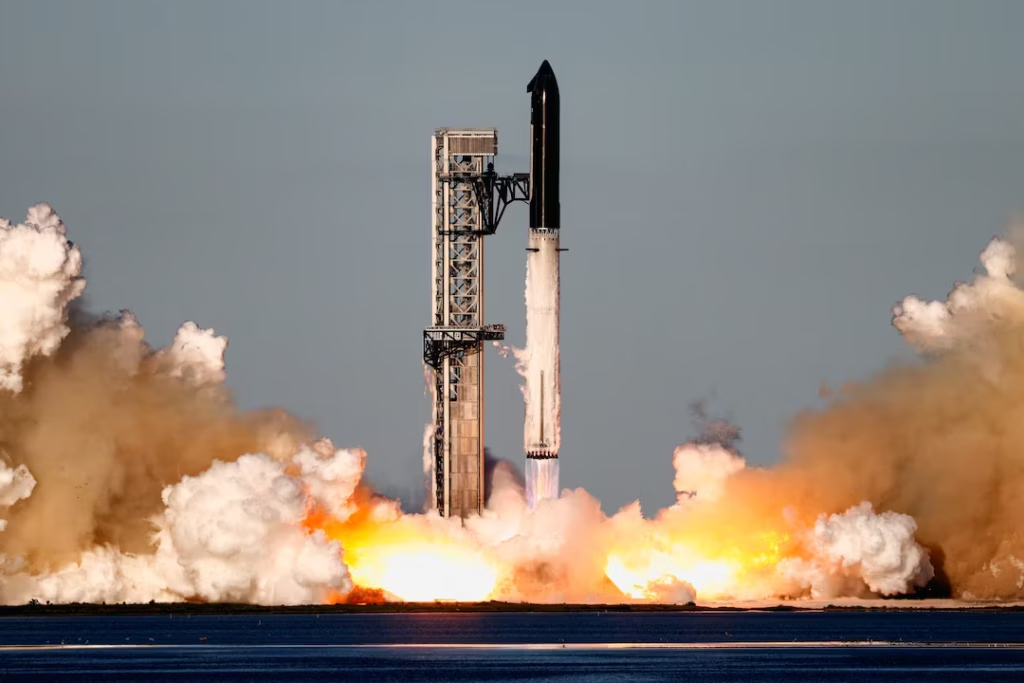
SpaceX achieved one of the most significant milestones in its Starship development program on November 14, 2026, when the Starship upper-stage spacecraft returned from orbit and was caught by the mechanical arms of its launch tower at Starbase, Texas. The historic recovery followed a 22.5-hour mission that included approximately 14 orbits around Earth and the successful deployment of 26 Starlink V3 satellites.
The mission, known as Starship Flight 15, launched on November 13, 2026, using Super Heavy Booster 22 and Starship Ship 42. It was the company’s first attempt to recover both stages of its next-generation launch system at the launch site during a single mission.
That ambitious objective was only partially achieved. Ship 42 completed its orbital flight and became the first Starship upper stage caught by a launch tower. However, Booster 22 experienced an anomaly during its return sequence, automatically aborted its planned tower catch, and was destroyed offshore in the Gulf of Mexico.
Flight 15 therefore demonstrated a major advance toward a fully reusable orbital launch system without establishing complete two-stage recovery. Its results provide important evidence about Starship’s orbital capabilities, Raptor propulsion, satellite deployment, thermal protection, autonomous recovery systems, and the engineering challenges that remain. [1] [2]
What Is SpaceX Starship Flight 15, and Why Is It Historic?
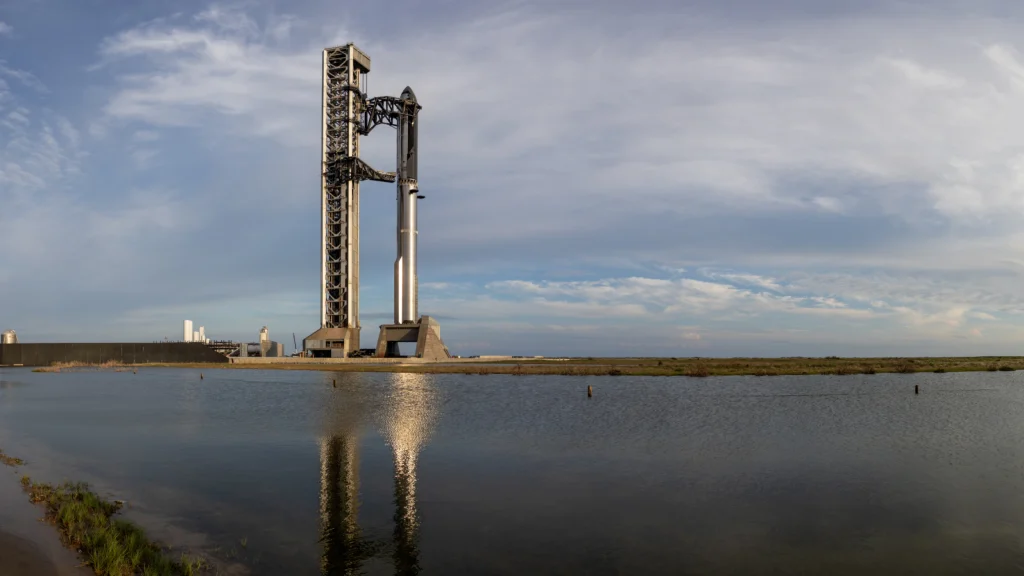
Starship Flight 15 was the fifteenth integrated flight test of SpaceX’s Starship and Super Heavy rocket system. Unlike earlier suborbital tests and shorter orbital demonstrations, this mission combined operational satellite deployment, prolonged orbital flight, a controlled deorbit maneuver, atmospheric reentry, and an unprecedented upper-stage tower catch.
Its historical importance comes from recovering an orbital spacecraft using the same launch infrastructure from which it departed. Previous Starship missions had ended with ocean landings or vehicle losses. Flight 15 demonstrated that a large orbital spacecraft could return to its launch site and be physically captured without conventional landing legs. [1] [2]
Understanding Starship Flight 15
Flight 15 lifted off from Orbital Launch Pad 2 at Starbase, Texas, at approximately 4:47 p.m. Central Standard Time on Friday, November 13, 2026. Ship 42 entered low Earth orbit, released its satellite payload, and remained in space until the following afternoon. The spacecraft then performed a controlled deorbit and was caught at approximately 3:20 p.m. CST on November 14.
The mission had three particularly important objectives: demonstrate meaningful orbital operations, deploy the next generation of Starlink communication satellites, and recover both the booster and spacecraft for potential reuse.
Two of those objectives were achieved. The planned simultaneous recovery of both stages across the mission was not. Nevertheless, the successful upper-stage catch represented a major engineering advance, particularly because Starship had to survive orbital reentry before approaching the launch tower. [2] [3]
What Is the Starship Spacecraft?
Starship is both the name of SpaceX’s complete two-stage launch system and the name of its upper-stage spacecraft. The integrated vehicle consists of the Super Heavy first-stage booster and the Starship upper stage, commonly called the Ship.
Super Heavy provides the enormous thrust required to lift the combined vehicle through the lower atmosphere. After stage separation, Starship’s engines continue accelerating the spacecraft toward space and its intended trajectory.
The upper stage contains the payload compartment, propulsion equipment, guidance systems, propellant tanks, thermal protection, and hardware necessary for atmospheric reentry and landing.
SpaceX is developing Starship for missions involving satellite deployment, large cargo transportation, orbital infrastructure, and eventually human transportation. Specialized Starship variants are also being developed for lunar exploration under NASA’s Artemis program.
Unlike conventional expendable upper stages, Starship is designed to survive reentry and return for additional flights. [5] [8]
What Makes an Orbital Flight Different From a Suborbital Flight?
An orbital spacecraft travels fast enough horizontally that, while continuously falling toward Earth under gravity, it keeps missing the planet’s surface. In low Earth orbit, this typically requires a velocity of approximately 7.8 kilometers per second, although the precise velocity depends on orbital altitude and trajectory.
A suborbital spacecraft may reach space without achieving the horizontal velocity necessary to remain in orbit. It subsequently returns to Earth unless additional propulsion changes its trajectory.
During Flight 15, Starship initially followed a trajectory that allowed SpaceX to evaluate vehicle health before committing to sustained orbit. An additional engine burn then established the intended orbital path.
This distinction matters because reaching orbital velocity, operating in orbit, and returning safely from orbit are separate engineering challenges. Flight 15 demonstrated all three for the Starship upper stage. [1] [2]
The Goal of a Fully Reusable Launch System
A fully reusable launch system is designed to recover its major flight components and use them again rather than manufacture an entirely new rocket after each mission.
Traditional expendable rockets discard both their boosters and upper stages. SpaceX’s Falcon 9 demonstrates partial reusability by recovering and reflighting the first stage, while its second stage is normally expended. The Space Shuttle recovered its orbiter and solid rocket boosters but discarded its external tank and required extensive refurbishment.
Starship’s intended architecture goes further by recovering both Super Heavy and the orbital spacecraft.
This could eventually reduce hardware replacement costs and support more frequent launches. However, recovery alone does not establish economical reusability. Vehicles must also be inspected, refurbished when necessary, and demonstrated to fly again safely.
Flight 15 recovered Ship 42 but lost Booster 22, so complete two-stage recovery remained unproven. [2] [5]
Starship Flight 15 Vehicle Configuration and Hardware
Flight 15 used SpaceX’s third-generation Starship architecture, commonly described as Starship V3 or Block 3. The mission paired Super Heavy Booster 22 with Starship Ship 42 and used upgraded Raptor 3 propulsion technology.
The V3 configuration incorporates changes intended to improve performance, simplify manufacturing, strengthen reusability, and support more demanding orbital missions. These developments also increase the importance of precisely coordinating propulsion, flight software, thermal protection, and ground infrastructure.
Flight 15 was therefore not simply another launch test. It evaluated how an updated launch vehicle performs during a nearly complete operational mission cycle. [1] [6]
Ship 42: The Upper-Stage Spacecraft
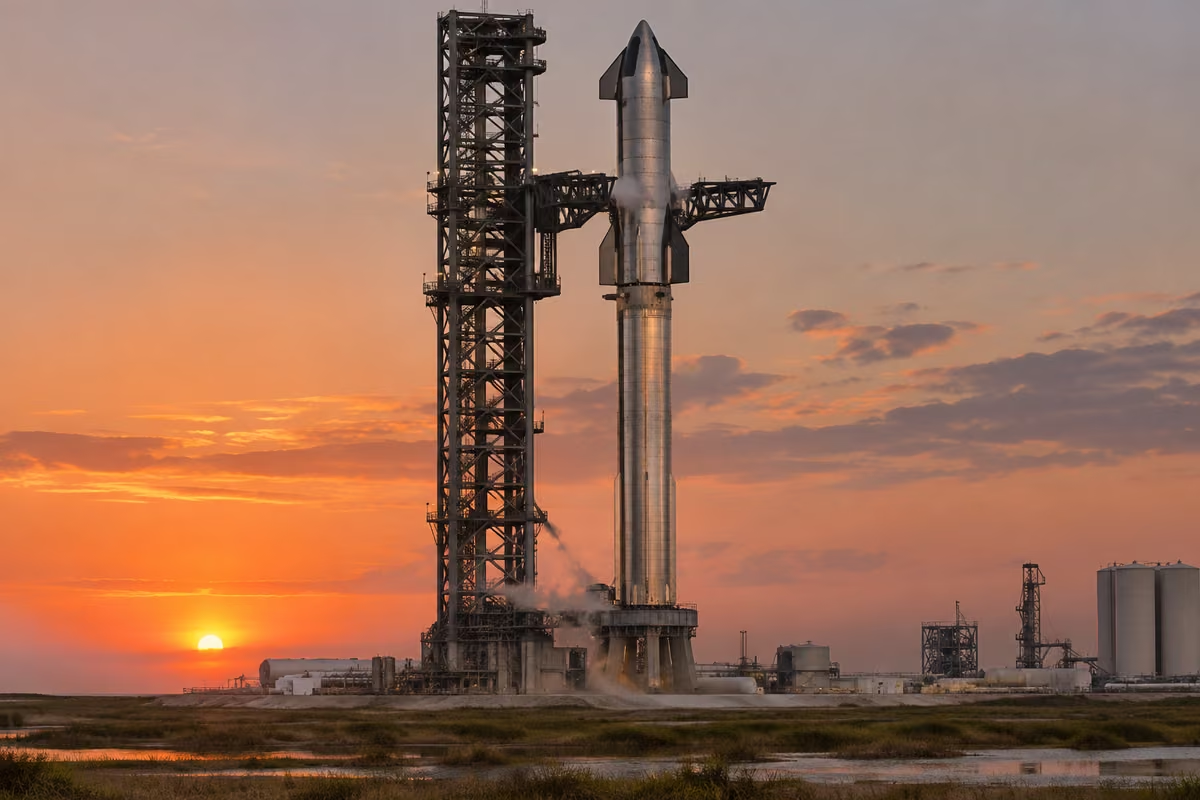
Ship 42, also identified as S42, was the Starship upper stage used during Flight 15. It was responsible for continuing the ascent after separation from Super Heavy, entering Earth orbit, carrying 26 Starlink V3 satellites, releasing those spacecraft, and returning to Starbase.
Ship 42 used six Raptor engines, including engines optimized for atmospheric operation and engines designed for efficient propulsion in the vacuum of space.
During its mission, the spacecraft demonstrated multiple engine operations separated by extended periods of orbital flight. These included ascent propulsion, orbital insertion, deorbit, and landing maneuvers.
Its successful recovery provided SpaceX with something previous Starship orbital missions could not: an intact upper-stage spacecraft available for detailed postflight examination. [1] [2]
Super Heavy Booster 22: The First-Stage Rocket
Super Heavy Booster 22, also designated B22, supplied the thrust necessary to lift Ship 42 and its payload away from Starbase.
The booster used 33 Raptor 3 engines arranged at its base. Following the initial ascent, the vehicle separated from Starship and attempted to reverse its trajectory through a boostback maneuver.
The planned recovery called for Booster 22 to return to the launch tower and descend into its mechanical catching arms approximately six and a half minutes after liftoff.
However, the boostback sequence ended earlier than intended. The booster subsequently aborted its return to the tower, diverted offshore, executed a landing burn, and was destroyed after activation of its flight termination system.
Although Booster 22 was lost, its successful ascent and stage separation allowed Ship 42 to continue the orbital mission. [3] [4]
Starship V3: Third-Generation Vehicle Architecture
Starship V3 represents an evolutionary development of the earlier Starship vehicle configurations. Its changes include upgraded Raptor engines, propulsion-system integration, improved thermal protection approaches, and enhancements to onboard sensing and navigation.
SpaceX has described increased engine thrust, simplified engine packaging, redesigned ignition systems, and improved vehicle monitoring as important elements of this generation.
The architecture is intended to support larger payloads and more demanding operations, including orbital propellant transfer and rapid vehicle reuse.
Flight 15 demonstrated that a V3 Starship could deliver satellites to orbit and return for tower recovery. It did not demonstrate that V3 vehicles can repeatedly fly with minimal refurbishment or that every design objective has been achieved.
Those capabilities require additional testing and evidence from recovered hardware. [5] [6]
Raptor 3 Engines and Vehicle Propulsion
Raptor 3 is an upgraded version of SpaceX’s methane-fueled Raptor rocket engine. It uses a full-flow staged-combustion cycle, an engine architecture intended to support high performance and reuse.
SpaceX has published nominal thrust figures of approximately 250 metric tons-force for the Raptor 3 sea-level variant and 275 metric tons-force for the vacuum variant.
The Super Heavy booster uses a cluster of 33 engines, while the Starship spacecraft uses three sea-level Raptors and three vacuum-optimized Raptors.
Engine reliability matters throughout the mission. Ascent requires powerful, sustained thrust; orbital insertion and deorbit require precise engine restarts; and final landing requires controlled thrust reduction and stable attitude.
Flight 15 demonstrated several of these capabilities on Ship 42. The booster anomaly also illustrated how propulsion performance and accurate propellant management directly affect recovery decisions. [5] [6]
Starbase Launch Infrastructure and Mission Preparation
SpaceX launched Flight 15 from its Starbase facility in South Texas, a location developed specifically for manufacturing, testing, launching, and recovering Starship vehicles.
The launch infrastructure includes vehicle integration equipment, launch towers, propellant storage systems, ground-support hardware, and facilities for evaluating rocket components.
For a reusable rocket, the launch site must eventually serve as more than a departure point. It must also support vehicle recovery, inspections, maintenance, and preparation for additional missions.
Flight 15 demonstrated this integrated role by returning Ship 42 directly to its launch tower after more than 22 hours in space. [1] [2]
Starbase, Texas: SpaceX’s Development and Launch Facility
Starbase is located near Boca Chica on the Gulf Coast of South Texas, close to Brownsville. The site is central to SpaceX’s Starship development and manufacturing operations.
Its coastal location allows rockets to launch over large stretches of water, helping manage risks associated with experimental launches and potential vehicle failures.
Starbase also provides SpaceX with direct access to manufacturing facilities and ground-testing infrastructure. This is particularly useful during a development program in which hardware and operating procedures change frequently.
Recovering Starship at Starbase creates the possibility of moving a vehicle from flight operations into inspection and refurbishment without transporting it back from a distant landing location.
The successful Ship 42 catch demonstrated that the site’s launch infrastructure could also function as an upper-stage recovery facility. [1] [2]
Orbital Launch Pad 2 and Launch Operations
Orbital Launch Pad 2, often abbreviated OLP-2 or Pad 2, was the launch and recovery location for Flight 15.
Before liftoff, the Super Heavy booster and Starship upper stage were assembled into a single launch vehicle. Ground systems supplied electrical connections, communications, and large quantities of cryogenic liquid oxygen and methane.
The launch sequence also required verification of onboard flight computers, engine readiness, vehicle pressure, and ground-system conditions.
Pad 2’s supporting infrastructure included the launch tower and associated mechanical arms used for vehicle capture.
The significance of this arrangement became clear during the mission’s final minutes. The spacecraft returned to the same operational complex from which it launched, rather than descending toward an independent landing platform or ocean splashdown location. [1] [3]
Mechazilla and the Launch-Tower Catch Mechanism
Mechazilla is the informal name for SpaceX’s launch-tower recovery system, which uses large mechanical arms often called chopsticks.
The system is designed to catch returning rocket stages by supporting dedicated catching structures on the vehicle. Instead of relying on traditional landing legs, the rocket descends vertically toward a precisely controlled capture position.
The arms must accommodate substantial structural loads while the descending vehicle uses engine thrust and flight-control systems to reduce its velocity.
Successful capture requires the rocket’s position, orientation, and descent rate to remain within acceptable limits.
Earlier Starship flights demonstrated the recovery method with Super Heavy boosters. Flight 15 extended the technique to the orbital upper stage, which must survive reentry before attempting the final capture maneuver. [2] [13]
Methalox Propulsion and Cryogenic Propellant Systems
Both stages of Starship use methane and liquid oxygen as rocket propellants. This combination is commonly called methalox.
The choice affects several aspects of the vehicle, including engine design, tank insulation, ground loading systems, ignition, and fuel management.
Because both propellants are stored at extremely low temperatures, the rocket and its ground infrastructure must carefully control temperatures, pressures, and fluid conditions.
Accurate propellant measurements are especially important during recovery maneuvers, when the onboard system must determine whether enough fuel and oxidizer remain to execute a safe landing sequence. [5] [6]
What Is Methalox Propulsion?
Methalox propulsion uses methane as fuel and liquid oxygen as the oxidizer. During combustion, the propellants react inside the engine, producing high-temperature gases that expand through the nozzle and generate thrust.
Methane offers several potential advantages for reusable rocket engines. Its combustion characteristics can support cleaner operation than some hydrocarbon alternatives, potentially reducing deposits that complicate maintenance.
Methane is also relevant to SpaceX’s long-term Mars plans because it may be possible to manufacture methane and oxygen from locally available resources using suitable industrial processes.
However, these potential benefits do not eliminate the challenges of high-pressure combustion, cryogenic storage, or repeated engine operation. [5] [6]
Liquid Oxygen (LOX)
Liquid oxygen, abbreviated LOX, supplies the oxidizer necessary for methane combustion. It is stored at cryogenic temperatures because oxygen must be cooled substantially below ordinary ambient conditions to remain liquid.
During launch preparation, LOX is loaded into dedicated tanks in both Super Heavy and Starship. The engines then receive oxygen through their propulsion feed systems.
Controlling temperature and pressure is important because changes in propellant conditions influence density, flow behavior, and system performance.
LOX also presents handling hazards because it strongly supports combustion when exposed to compatible fuels or other combustible materials.
For recovery operations, maintaining an accurate understanding of remaining oxidizer is essential to calculating the propulsion capability available for boostback and landing. [5] [6]
Liquid Methane (CH₄)
Liquid methane, represented chemically as CH₄, serves as Starship’s fuel. Like liquid oxygen, it requires cryogenic storage and specialized equipment for loading and transfer.
Methane is delivered to the combustion system, where it reacts with oxygen to generate the energy that accelerates exhaust gases through the rocket nozzle.
The fuel’s properties influence tank design, engine cooling, combustion behavior, and reusable propulsion-system maintenance.
During an orbital mission, methane must remain available for engine restarts after extended coast periods. During booster recovery, it must support multiple burns separated by relatively short intervals.
Flight 15’s reported low fuel-mass alarm highlights why propellant measurement and management are central to reliable rocket recovery, although the alarm alone does not establish the precise cause of Booster 22’s anomaly. [4] [6]
Engine Chilldown and Final Countdown
Before ignition, rocket engines and associated plumbing must be conditioned for the extremely cold propellants they will handle. This process is commonly called engine chilldown.
Without appropriate temperature conditioning, cryogenic fluids can experience unwanted boiling and unstable flow conditions inside propulsion components.
SpaceX’s published Flight 15 countdown called for Raptor engine chilldown to begin approximately 21 minutes and 40 seconds before liftoff.
Propellant loading was scheduled to finish only a few minutes before launch, followed by final readiness checks and the flight director’s authorization.
The countdown also included flame-diverter activation shortly before engine startup. These tightly coordinated ground and vehicle activities were necessary to prepare the fully fueled rocket for a safe ascent. [1]
Starship Flight 15 Launch and Ascent Timeline
Flight 15’s launch sequence involved powerful first-stage propulsion, aerodynamic loading during ascent, engine cutoff, hot-staging separation, and a subsequent upper-stage burn.
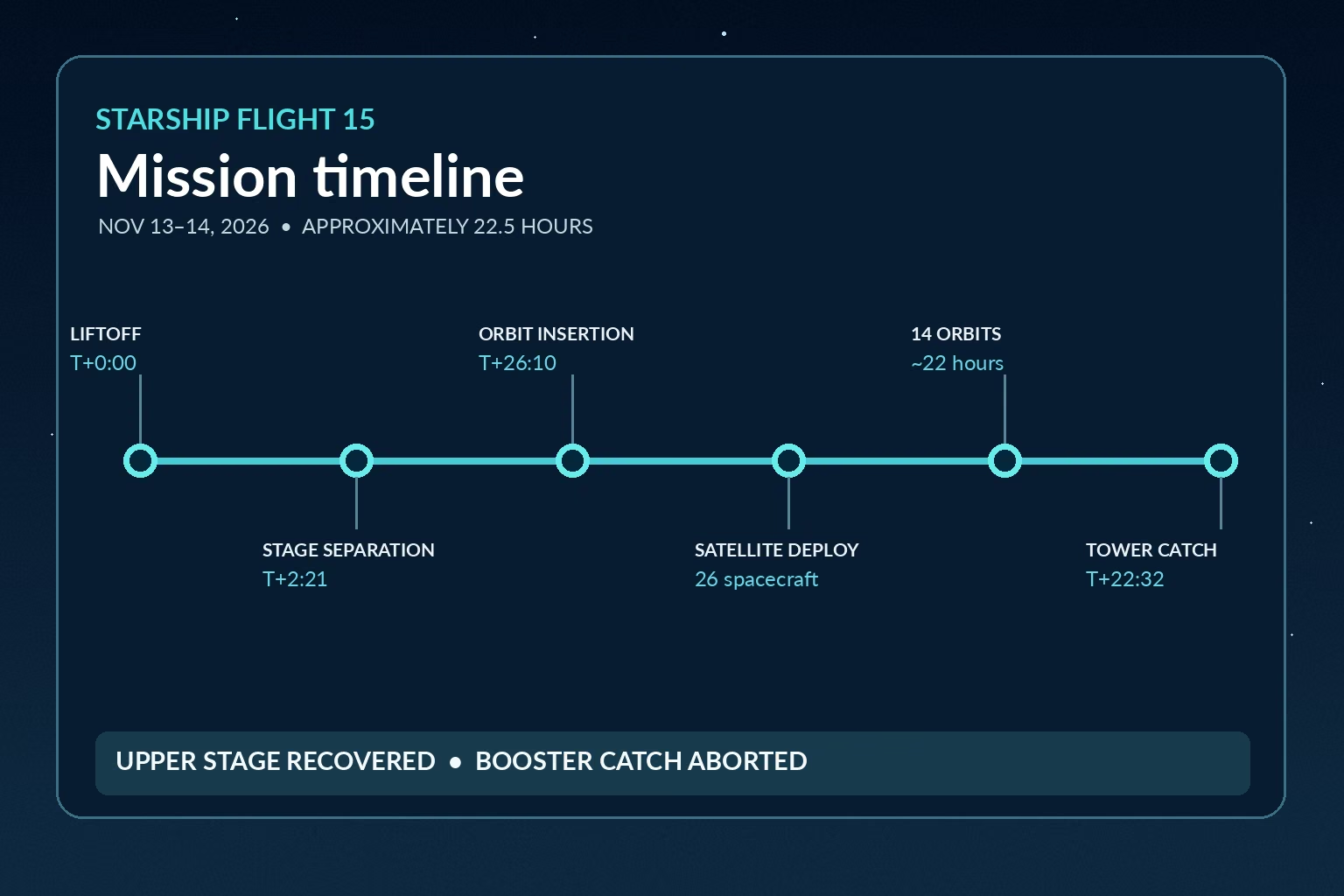
SpaceX published a detailed mission timeline before launch. Most key ascent milestones occurred as intended, allowing Ship 42 to continue toward orbit. However, the planned booster recovery diverged from the published timeline after an anomaly in its return sequence.
The table below summarizes the major milestones using SpaceX’s approximate preflight schedule and the observed mission results. The scheduled times should not be interpreted as precise independent measurements of actual event timing. [1] [3]
| Mission event | Planned time after liftoff | Outcome |
|---|---|---|
| Liftoff | T+0:00 | Successful |
| Maximum dynamic pressure | T+0:58 | Passed |
| Super Heavy MECO | T+2:19 | Successful |
| Hot-staging separation | T+2:21 | Successful |
| Booster boostback burn | T+2:26 to T+3:02 | Ended early |
| Planned booster catch | T+6:35 | Aborted |
| Starship engine cutoff | T+8:09 | Successful |
| Orbital insertion burn | T+26:10 to T+26:30 | Successful |
| Starlink deployment | T+35:01 to T+1:17:40 | All 26 deployed |
| Orbital operations | Approximately 14 orbits | Completed |
| Deorbit burn | Around T+21:36 | Successful |
| Atmospheric entry | Around T+22:11 | Successful |
| Starship catch | Around T+22:32 | Successful |
Liftoff and Initial Rocket Ascent
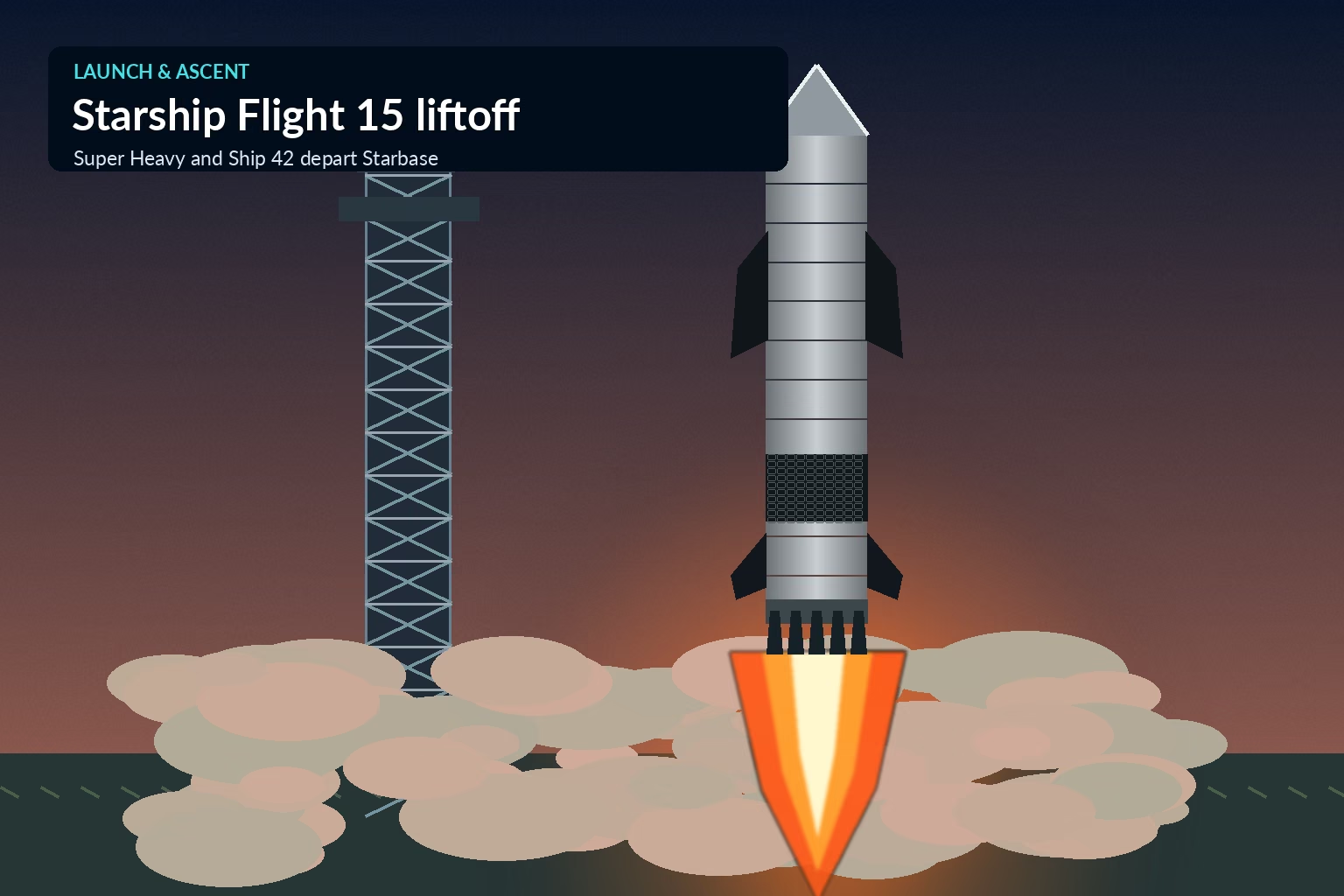
Starship Flight 15 lifted off at approximately 4:47 p.m. CST on November 13, 2026. The combined vehicle rose from Pad 2 using the thrust generated by Super Heavy’s 33 Raptor 3 engines.
The launch produced more than 18 million pounds-force of thrust, sufficient to accelerate the enormous rocket despite its fully loaded propellant tanks and satellite payload.
During the initial climb, the flight-control system monitored engine conditions, vehicle attitude, trajectory, and structural performance.
As propellant was consumed, the rocket’s mass decreased, changing its acceleration characteristics.
The initial ascent progressed successfully and established the trajectory needed for stage separation. This first phase was essential because any major propulsion or guidance failure could have prevented the upper stage from reaching its intended orbital mission. [3] [5]
Maximum Dynamic Pressure (Max Q)
Maximum dynamic pressure, or Max Q, is the point during atmospheric ascent when a rocket experiences its peak dynamic pressure.
Dynamic pressure depends on atmospheric density and the square of the vehicle’s speed. As a rocket accelerates, aerodynamic pressure initially increases. Eventually, the atmosphere becomes thin enough that the decreasing air density outweighs the increasing speed.
NASA describes Max Q as an important structural design constraint because aerodynamic forces are directly related to dynamic pressure.
SpaceX’s Flight 15 timeline placed Max Q approximately 58 seconds after liftoff.
Successfully passing this phase indicated that the vehicle had progressed through a critical part of atmospheric ascent without a publicly reported structural failure preventing continued flight. [1] [10]
Main Engine Cutoff (MECO)
Main Engine Cutoff, abbreviated MECO, marks the transition from the booster’s primary ascent propulsion phase toward stage separation.
For Starship, this involves shutting down most Super Heavy engines rather than necessarily extinguishing every engine simultaneously.
SpaceX scheduled Flight 15’s MECO for approximately two minutes and 19 seconds after liftoff.
This maneuver reduces the thrust produced by the first stage while the upper stage prepares to ignite its own propulsion system.
The timing is particularly important because the vehicle uses hot staging, meaning the Starship engines begin firing as the stages separate.
A controlled MECO establishes the conditions required for that transition. Flight 15 successfully progressed through this stage, allowing Ship 42 to continue its ascent independently. [1] [3]
Hot-Staging Separation
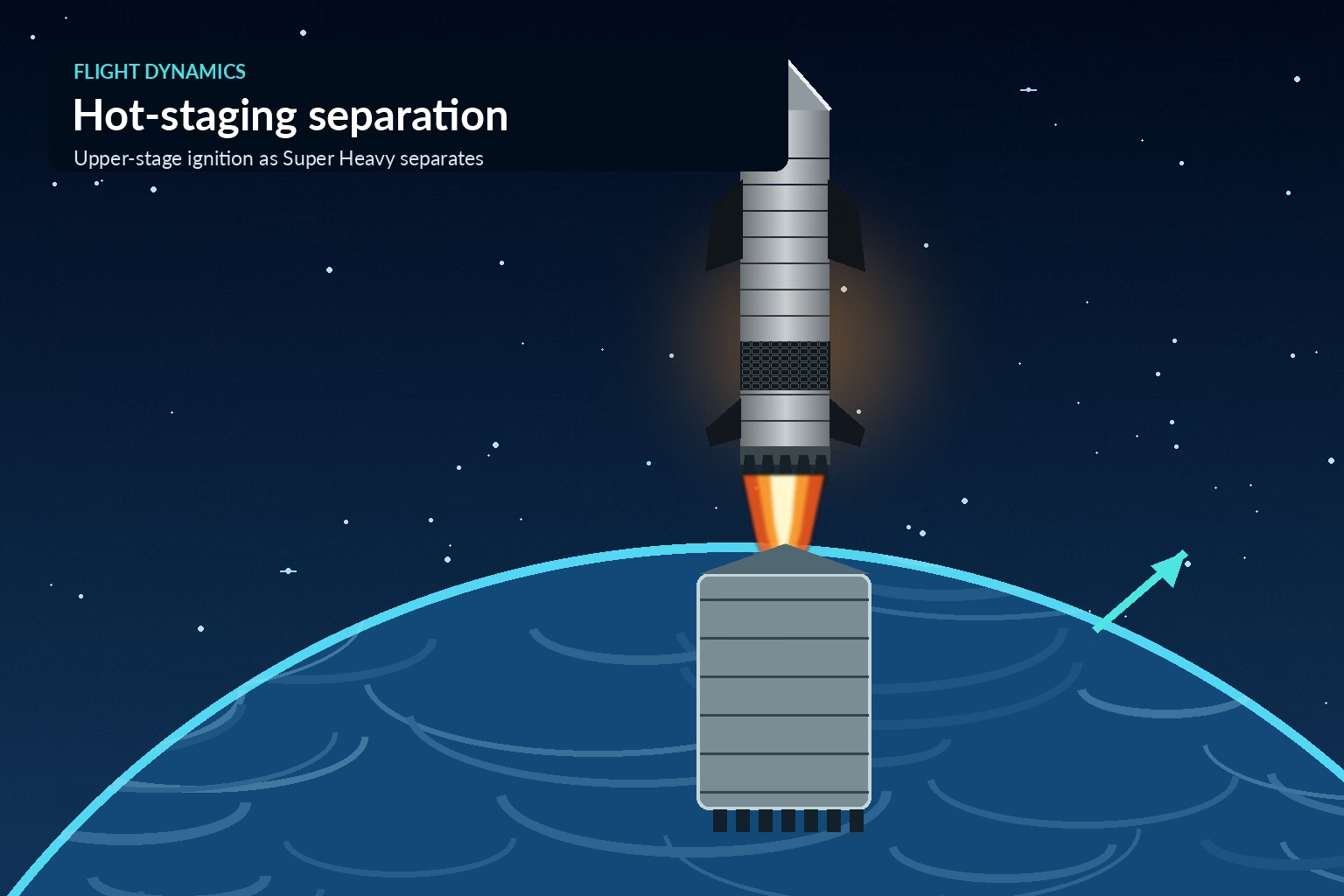
Hot staging is a rocket separation method in which the upper-stage engines ignite while the stages are still in the process of separating.
Unlike conventional staging, which usually involves a clearer interval between first-stage shutdown and upper-stage ignition, hot staging reduces the interruption in propulsion.
The technique can improve overall launch performance but introduces additional thermal and mechanical challenges because the upper-stage exhaust operates close to the departing booster.
Starship’s design accommodates this process through specialized structural arrangements intended to manage exhaust flow and separation loads.
During Flight 15, hot staging occurred approximately two minutes and 21 seconds after liftoff.
The successful maneuver allowed Ship 42’s six Raptor engines to take over propulsion while Booster 22 began its return sequence. [1] [3]
Starship Engine Cutoff (SECO)
Starship Engine Cutoff, commonly called SECO, is the point at which the upper-stage engines stop firing after a planned propulsion phase.
For Flight 15, the initial upper-stage ascent burn ended approximately eight minutes and nine seconds after launch.
However, this engine cutoff did not by itself establish a stable Earth orbit. The spacecraft initially followed a trajectory that allowed SpaceX to conduct health assessments before committing to orbital insertion.
This distinction is essential when analyzing launch performance.
A spacecraft can complete its main ascent burn and still require another propulsion maneuver to achieve its intended orbit. Flight 15 used an additional engine restart after the initial ascent phase to establish its approximately 275-kilometer orbital trajectory. [1] [3]
Orbital Insertion Burn
An orbital insertion burn is a propulsion maneuver that changes a spacecraft’s velocity sufficiently to establish its intended orbit.
For Flight 15, SpaceX planned a short Raptor engine burn beginning approximately 26 minutes and ten seconds after liftoff.
The maneuver lasted around 20 seconds and placed Ship 42 into low Earth orbit at an altitude of approximately 275 kilometers.
This step converted the spacecraft’s initial ascent trajectory into a sustained orbital path.
The successful maneuver was particularly important because the spacecraft needed to remain in orbit long enough to deploy satellites, undergo health checks, and complete its extended mission.
It also demonstrated another critical capability of Raptor propulsion: reliable engine restart after the main ascent burn had already ended. [1] [3]
Starship Flight 15 Orbital Mission: Fourteen Orbits Over Earth
Once Ship 42 entered orbit, Flight 15 transitioned from a launch demonstration into an extended spacecraft operations mission.
The spacecraft remained in low Earth orbit for most of its approximately 22.5-hour flight. During this period, it deployed satellites, maintained orientation and communications, monitored vehicle systems, and underwent assessments intended to determine whether a return to Starbase was safe.
This represented a substantial expansion beyond the short-duration Starship missions that preceded it.
The mission demonstrated that Starship could perform meaningful orbital work before returning through Earth’s atmosphere for recovery. [1] [2]
The Fourteen-Orbit Mission
Ship 42 completed approximately 14 revolutions around Earth before beginning its final return sequence.
Its intended orbit was around 275 kilometers above Earth, although reports of its altitude varied slightly depending on the observation and orbital position.
At such altitudes, a spacecraft travels at several kilometers per second and typically completes an orbit in roughly 90 minutes.
The prolonged orbital phase allowed SpaceX to gather data across multiple changes in sunlight exposure, temperature, and spacecraft orientation.
It also created additional opportunities to evaluate propulsion-system readiness and communications performance.
Completing the fourteen-orbit mission established that Ship 42 could operate in space for far longer than previous Starship upper-stage flights while retaining the ability to perform a controlled deorbit and landing. [1] [2]
The 22.5-Hour Mission Duration
Flight 15 lasted approximately 22 hours and 32 minutes from liftoff to the successful tower catch.
The mission began on November 13, 2026, and ended on November 14, when Ship 42 returned to the launch infrastructure at Starbase.
Most of that time was spent in orbit rather than under engine thrust.
The mission included several distinct operational phases: initial ascent, orbital insertion, Starlink deployment, extended orbital coast, vehicle health assessments, deorbit, atmospheric reentry, and the final tower recovery.
Its duration significantly exceeded Flight 14, which ended after approximately three hours.
This longer mission supplied valuable information about the behavior of Starship’s power systems, thermal environment, navigation equipment, and propulsion hardware during extended exposure to space conditions. [2] [11]
Spacecraft Health Monitoring During Extended Orbital Operations
A spacecraft operating for more than 22 hours must continuously monitor systems that could affect its ability to complete the mission.
These include propellant conditions, tank pressure, electrical power, temperature, attitude control, propulsion readiness, and communication links.
Flight 15 also involved specific return-decision checkpoints. SpaceX designed the mission so controllers could choose contingency ocean-return options if spacecraft conditions were unsuitable for a tower catch.
The published plan included assessment points associated with potential returns near Hawaii and Chile.
By passing these checkpoints, Ship 42 remained authorized to continue toward its primary recovery objective.
This approach demonstrates an important principle of experimental spaceflight: a successful landing attempt depends not only on flight performance but also on reliable assessment of vehicle health before committing to a high-risk maneuver. [1] [3]
Starlink V3 Satellite Deployment During Flight 15
Deploying operational communications satellites was a central objective of Starship Flight 15.
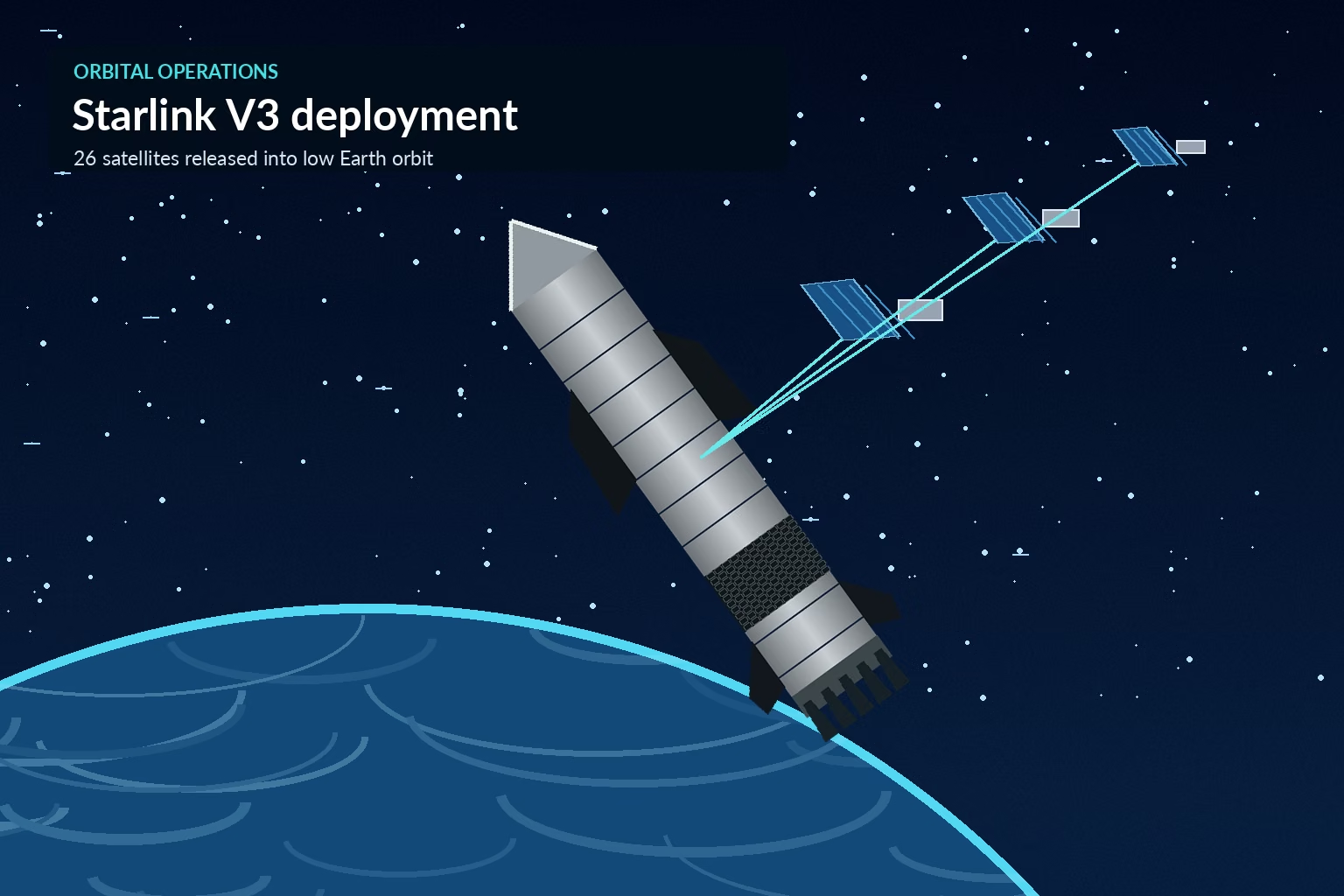
Ship 42 carried 26 Starlink V3 satellites into low Earth orbit. The satellites were designed to expand SpaceX’s broadband constellation and take advantage of the larger payload capability offered by Starship.
All 26 satellites were successfully released during the mission, marking another important demonstration of the rocket’s commercial usefulness.
Unlike test flights that merely prove a vehicle can reach space, satellite deployment provides a practical service while generating data about payload integration, orbital insertion, and release mechanisms. [1] [3]
Starlink V3 Deployment: Mission Payload Overview
Starship Flight 15 successfully placed 26 Starlink V3 satellites into Earth orbit.
The deployment began approximately 35 minutes after launch and concluded around one hour and 17 minutes into the mission.
This followed Flight 14, which had also delivered a batch of 26 Starlink V3 satellites to orbit.
The satellites are part of SpaceX’s effort to expand the capacity of its low Earth orbit broadband constellation.
SpaceX states that each Starlink V3 satellite is designed to add approximately one terabit per second of network capacity. Based on that design figure, the 26-satellite batch represents approximately 26 terabits per second of potential aggregate capacity once the spacecraft are appropriately commissioned and integrated.
That figure is not a guarantee of immediately available customer throughput. [1] [3]
Starship Payload Bay and Satellite Storage
Starship contains a large payload compartment designed to accommodate spacecraft and other cargo.
For Starlink missions, the payload bay uses a specialized deployment arrangement capable of releasing satellites through an opening in the vehicle’s structure.
During launch, the satellites must remain securely restrained while experiencing acceleration, vibration, and changing aerodynamic and mechanical loads.
The payload compartment must also provide sufficient clearance for release after orbital insertion.
Starlink V3 satellites are designed around the larger carrying capability of Starship, allowing SpaceX to deploy higher-capacity spacecraft than those typically carried on Falcon 9.
The successful Flight 15 deployment demonstrated that Ship 42’s payload-handling system could transport and release a substantial batch of operational communications satellites. [1] [3]
Payload Deployment System and Satellite Release Sequence
Starship releases Starlink satellites using a deployment mechanism often compared to a dispenser because spacecraft leave the payload compartment sequentially.
The release process must control satellite separation to reduce the risk of contact with the spacecraft, the dispenser, or previously deployed satellites.
Mission controllers also need to maintain appropriate vehicle orientation and confirm that the release system is functioning correctly.
During Flight 15, satellite deployment occurred over approximately 42 minutes.
This extended sequence allowed the spacecraft to release the batch while continuing orbital operations.
Deployment confirmation was based on spacecraft and mission telemetry, not simply the appearance of objects leaving the payload bay.
SpaceX reported that all 26 Starlink V3 satellites reached orbit successfully, establishing a key commercial mission result. [1] [3]
Starlink V3 Satellites and Their Capabilities
Starlink V3 satellites represent an updated generation of SpaceX’s broadband communications spacecraft.
Their intended improvements include greater network capacity, increased data throughput, and integration with Starship’s larger payload system.
SpaceX describes approximately one terabit per second of capacity per V3 satellite and states that a 26-satellite batch offers capacity comparable to roughly ten Falcon 9 launches carrying Starlink V2 Mini satellites.
These figures reflect SpaceX’s stated design capabilities rather than a direct measurement of customer service immediately after launch.
Before entering regular service, newly deployed satellites must complete commissioning activities such as power-system initialization, communications checks, orbit adjustments, and subsystem verification.
Successful deployment is therefore an important first step, but it is not equivalent to confirming that every satellite has reached its final operating configuration. [1]
The Starlink Constellation and Its Global Network
Starlink is a satellite broadband network operating primarily in low Earth orbit.
Its architecture uses a large constellation of spacecraft, ground stations, network infrastructure, and customer terminals to deliver internet connectivity.
Low Earth orbit helps reduce signal travel time compared with traditional geostationary communications satellites because signals cover a much shorter distance between Earth and space.
Additional satellites can improve network capacity, geographic coverage, and service resilience, depending on their orbital placement and the distribution of users.
Higher-capacity Starlink V3 satellites may allow SpaceX to increase available network resources without relying solely on large increases in satellite numbers.
Flight 15 supported this strategy by demonstrating that Starship could deploy another batch of operational V3 satellites while continuing its own orbital mission. [1] [7]
Satellite Solar-Array Deployment
Solar arrays provide the electrical energy needed to operate Starlink satellites after deployment.
Once a satellite separates from its launch vehicle, it must establish a stable attitude and deploy or configure its solar panels so they can receive sunlight.
The generated electricity supports onboard computers, communications equipment, navigation systems, and propulsion hardware, while batteries provide power during periods of eclipse.
SpaceX’s Flight 15 mission plan identified solar-array deployment as part of the satellites’ post-release operations.
However, spacecraft release and successful solar-array deployment are separate milestones.
Although SpaceX confirmed deployment of the 26-satellite batch, the available initial mission reporting does not establish the complete long-term operational status of every subsystem on every satellite. [1] [7]
Satellite Antenna Deployment and Communications
Starlink satellites use specialized communications antennas to transmit and receive data.
Depending on the generation and operating configuration, these systems support connections with user terminals, ground infrastructure, and other satellites.
After launch, the spacecraft must initialize communications hardware and establish reliable links before entering regular network service.
SpaceX’s Flight 15 plan stated that the satellites would deploy their antennas, establish communications, and begin commissioning after release.
Successful contact provides evidence that a satellite can communicate, but it does not automatically verify that every communications payload has reached full operational capability.
Network integration requires additional checks of power systems, antenna operation, onboard software, orbital position, and communication performance.
These activities turn a successfully launched satellite into a functioning element of the broadband constellation. [1] [7]
Optical Intersatellite Links and Laser Communications
Optical intersatellite links, commonly abbreviated ISLs, allow satellites to communicate directly using tightly directed laser beams.
These links can relay data between spacecraft without requiring every communication path to pass immediately through a nearby ground station.
Starlink uses optical connections to create a distributed network across its constellation.
According to Starlink’s published technology information, its established satellite architecture includes optical links capable of transferring substantial amounts of data between spacecraft.
Laser communications are particularly valuable when connecting regions where terrestrial infrastructure or ground-station availability is limited.
However, effective operation depends on precise pointing, spacecraft orientation, and reliable network coordination.
Starlink V3’s integration into this architecture requires post-deployment commissioning and verification of communications links, separate from confirmation that the satellites were released into orbit. [1] [7]
Satellite Orbit Raising and Final Orbital Positioning
Satellites are not necessarily deployed directly into the final orbits where they will provide service.
After separation, Starlink spacecraft use onboard propulsion to adjust their trajectories and move toward assigned operational positions.
This process is called orbit raising.
It must account for orbital mechanics, spacecraft health, fuel or propellant availability, collision avoidance requirements, and the distribution of satellites within the constellation.
Starlink’s published spacecraft technology describes electric propulsion systems that support orbit raising and other orbital maneuvers.
Following Flight 15, the newly deployed satellites were expected to begin adjusting their orbits after initial checkout.
The roughly 275-kilometer insertion altitude associated with the Starship mission should therefore not be confused with the final operational altitude of every satellite.
Maintaining that distinction is important when evaluating whether a deployment mission has reached its later operational objectives. [1] [7]
Starship Heat Shield Inspection and Orbital Safety Assessment
One of the most technically demanding parts of Flight 15 was returning Ship 42 safely from orbital velocity.
During atmospheric reentry, a spacecraft encounters severe aerodynamic heating that can damage unprotected structures.
Starship uses thermal protection materials, including heat-shield tiles, to protect the vehicle during this process.
Because Flight 15 planned to return to the launch site, SpaceX needed confidence that Ship 42 could withstand reentry and execute its landing maneuvers.
The mission therefore incorporated external inspection imagery and spacecraft health assessments before authorizing the tower approach. [1] [3]
Orbital Heat-Shield Inspection
Orbital heat-shield inspection involves evaluating the condition of a spacecraft’s thermal protection system while it remains in space.
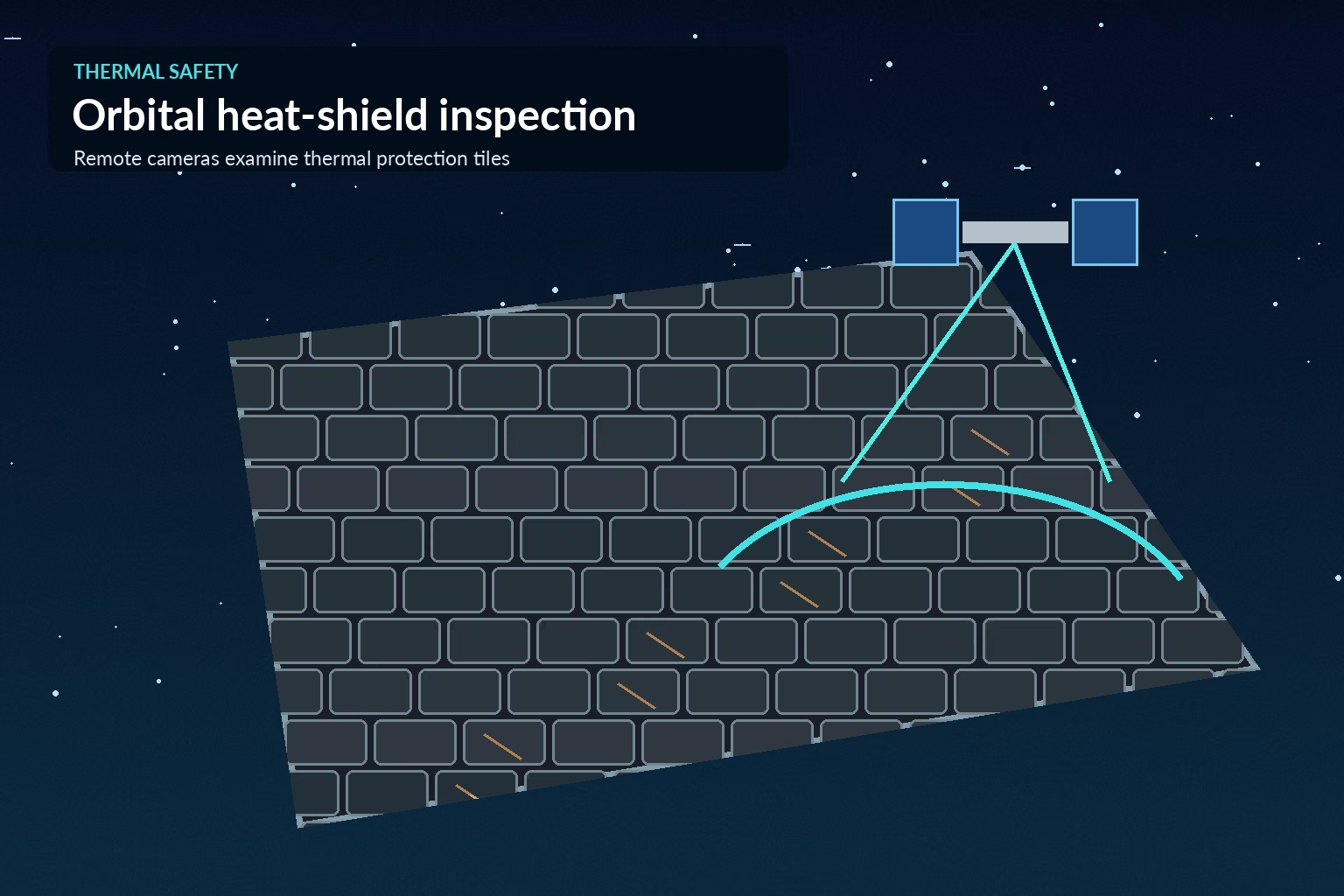
For Starship, the inspection can help identify missing tiles, damaged surfaces, or other conditions that might increase the risks of atmospheric reentry.
Flight 15 used information from ground-based tracking systems and cameras mounted on deployed satellites.
SpaceX reported that its heat-shield team reviewed the available information and considered the vehicle suitable for the planned return.
That assessment supported the decision to continue toward Starbase instead of using a contingency ocean-return trajectory.
However, the inspection did not prove that the heat shield required no maintenance. Reentry performance and postflight refurbishment requirements can only be fully evaluated through a combination of flight telemetry and physical examination after recovery. [1] [3]
Satellite Inspection Cameras
Three of the Starlink V3 satellites carried by Flight 15 were equipped with cameras intended to observe Ship 42 after deployment.
These cameras provided external views of the spacecraft’s heat shield and other visible surfaces.
This approach allowed SpaceX to inspect areas of the vehicle that might not be adequately covered by onboard cameras alone.
To obtain useful imagery, the satellite and Starship needed suitable relative positions and orientations.
SpaceX used this inspection method during previous orbital testing and incorporated it into Flight 15’s return-readiness evaluation.
The cameras contributed to the spacecraft health assessment, but external images are only one source of evidence.
Temperature readings, structural measurements, propulsion-system telemetry, and other onboard data remain important when deciding whether an experimental spacecraft is safe to return to a launch facility. [1] [3]
Starship Heat Shield and Thermal Protection Architecture
Starship’s thermal protection system is designed to reduce the heat transferred into the spacecraft’s underlying structure during atmospheric reentry.
Its external heat-shield tiles cover areas expected to experience substantial aerodynamic heating.
During descent at orbital speeds, air around the vehicle is compressed and heated intensely, creating a demanding thermal environment.
The protection system must manage both the highest heating regions and the interfaces between individual tiles.
Flight 15 incorporated tile-design improvements informed by earlier tests, including additional retention measures and curved tile designs intended to reduce heating in gaps.
These changes are important because small gaps, damaged attachment points, or localized tile failures can expose underlying structures to dangerous temperatures.
Successful reentry demonstrated meaningful thermal protection capability, but sustained reuse will require evidence that the system survives repeated flights without excessive repair. [1] [2]
Heat-Shield Tiles and Thermal Durability
Heat-shield tiles protect Starship by limiting the amount of thermal energy reaching the vehicle’s structure.
A reusable tile system must withstand intense heating, cooling, vibration, and mechanical loads across repeated missions.
SpaceX has been developing improved tile retention methods and materials to address damage observed during previous Starship tests.
Flight 15’s design incorporated additional retention mechanisms in areas considered vulnerable to tile loss.
The mission also used curved tile designs in substantial portions of the heat shield to improve the management of heating between tiles.
Following the successful catch, the recovered spacecraft became available for inspection of tile wear, attachment points, and underlying structure.
As of November 15, the public mission results establish successful reentry and recovery, but they do not provide a complete independent measurement of refurbishment requirements or long-term tile durability. [1] [2]
Super Heavy Booster 22 Recovery Failure and Safety Systems
The loss of Booster 22 was Flight 15’s principal unsuccessful objective.
Although the booster completed its main ascent and successfully separated from Starship, it did not return to the launch tower for capture.
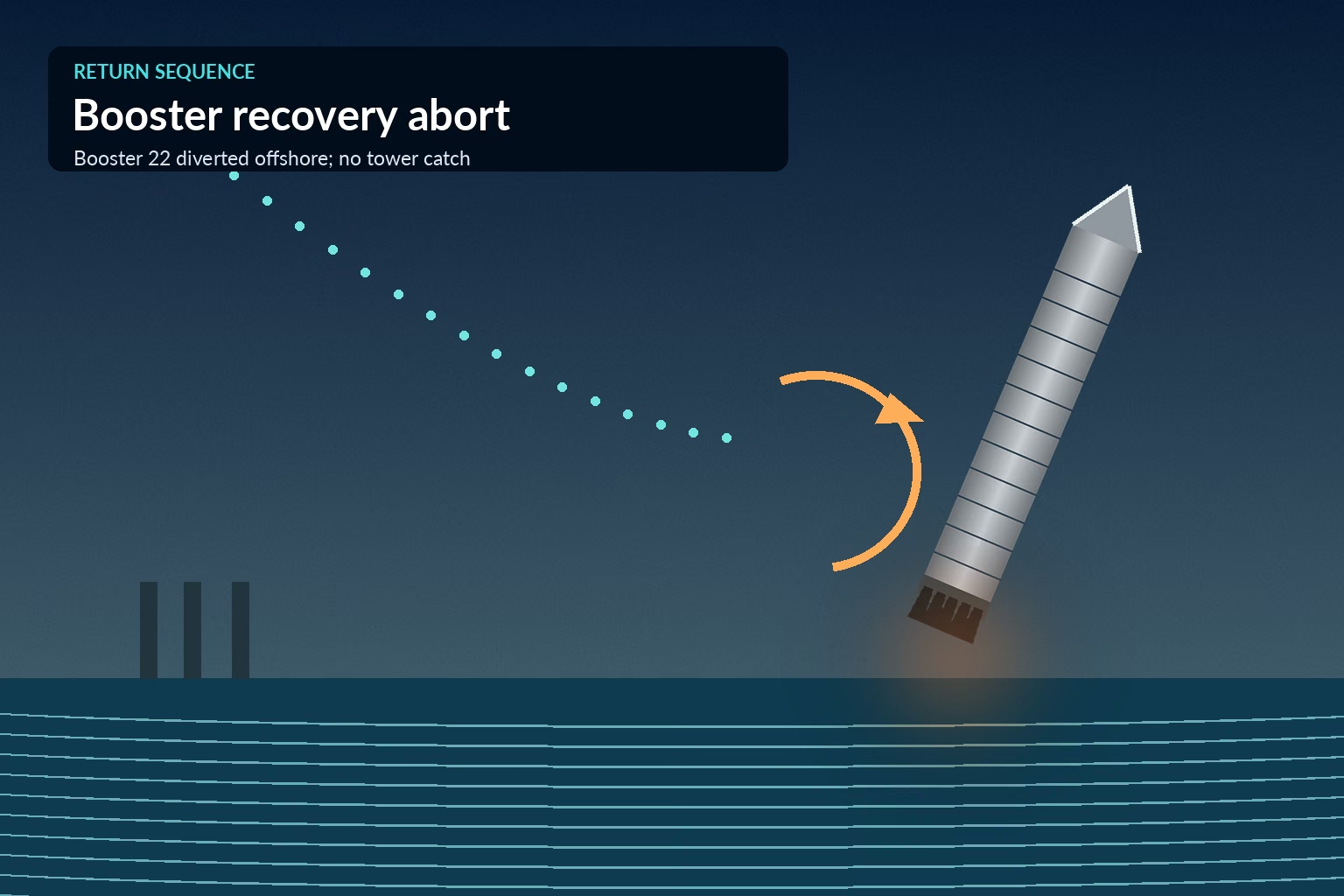
Early information indicated that its boostback burn ended prematurely following a low fuel-mass alarm. The onboard recovery system subsequently determined that the booster was outside the conditions required for a safe tower approach.
Rather than continue toward the launch infrastructure, the vehicle automatically diverted offshore, where its flight termination system was activated.
The sequence illustrates the difference between a failed recovery attempt and an automated safety system operating according to its protective logic. [3] [4]
Boostback Burn and Planned Booster Recovery
A boostback burn changes the direction and trajectory of a rocket booster after stage separation.
For Starship, this maneuver is essential when the booster is intended to return toward its launch site rather than continue along a downrange trajectory.
Following separation, Booster 22 performed a directional flip and began firing engines for its return maneuver.
SpaceX reported that 32 of the planned 33 engines relit for the boostback burn.
However, the maneuver ended earlier than intended.
A successful boostback burn must provide sufficient trajectory correction while preserving enough propellant for the subsequent landing burn.
The premature termination placed Booster 22 outside the expected recovery conditions, preventing the planned tower catch despite the booster’s successful contribution to the initial launch. [4]
Booster Catch Abort: What Happened?
Booster 22’s planned catch was automatically aborted during its return toward Starbase.
The recovery system determined that the vehicle was not positioned appropriately to proceed with the tower approach.
Instead of continuing toward Pad 2, the booster followed a contingency trajectory toward an offshore landing area in the Gulf of Mexico.
The vehicle then performed a landing burn, after which its flight termination system activated.
Early mission commentary initially suggested a guidance, navigation, and control problem. SpaceX later clarified that the GNC system had detected an unacceptable recovery condition and initiated the abort as intended.
This distinction is important.
The booster recovery objective failed, but the available reporting indicates that the guidance system’s abort response was a protective action rather than the established cause of the anomaly. [3] [4]
Low Fuel Mass Alarm and Propellant Concerns
SpaceX reported that early indications pointed to a low fuel-mass alarm associated with the premature termination of Booster 22’s boostback burn.
Propellant availability is critical during reusable rocket recovery.
The booster must reserve sufficient fuel and oxidizer to change its trajectory and then reduce its descent velocity before capture.
If onboard measurements indicate that available propellant has fallen below an acceptable threshold, the vehicle may no longer be able to complete its planned recovery profile with appropriate margins.
However, a low fuel-mass indication does not automatically establish why the condition occurred.
Potential questions include whether the measurement reflected actual propellant quantity, unexpected consumption, propulsion performance, or another system issue.
As of November 15, 2026, SpaceX had not publicly established a final root cause for the Flight 15 booster anomaly. [4]
Guidance, Navigation and Control (GNC)
Guidance, navigation, and control, abbreviated GNC, is the system responsible for determining a vehicle’s position, velocity, orientation, and required flight adjustments.
Navigation estimates the spacecraft’s current state using sensor information. Guidance determines the desired trajectory, while control commands engines and other actuators to follow that trajectory.
During a rocket recovery, GNC must continuously assess whether the vehicle can reach the intended landing corridor.
For Flight 15, the booster guidance system detected that its position was unsuitable for a safe tower catch and initiated an automated diversion.
SpaceX subsequently clarified that the GNC system acted as intended.
The issue therefore should not be described simply as a confirmed guidance failure. The evidence instead indicates that GNC responded to a trajectory problem whose underlying cause remained under investigation. [3] [4]
Autonomous Recovery Abort and Fault Detection
Autonomous recovery abort systems allow a rocket to change or cancel a landing attempt when safety conditions are not met.
These systems use sensor measurements, onboard calculations, and programmed decision criteria to evaluate vehicle health and trajectory.
If the rocket cannot satisfy the required conditions, it may be directed away from the launch infrastructure.
Such autonomy is especially important for Starship because a large returning rocket carries substantial kinetic energy and residual propellants.
Allowing an unhealthy vehicle to continue toward a valuable launch tower could create greater hazards than sacrificing the rocket.
Flight 15 illustrated this protective principle.
The booster did not achieve recovery, but its automated system prevented an attempted catch under conditions the vehicle had identified as unsuitable. [4] [12]
Offshore Contingency Landing in the Gulf of Mexico
Offshore contingency areas provide alternatives when a rocket cannot safely complete its intended return to a launch facility.
During Flight 15, Booster 22 diverted toward the Gulf of Mexico instead of returning to Pad 2.
The diversion separated the vehicle’s final descent from the planned tower-capture location.
The booster executed a landing burn offshore, but its flight termination system was subsequently activated, resulting in the vehicle’s destruction.
Consequently, the event should not be described as a successful recovered booster landing.
It was a contingency descent ending in the loss of the vehicle.
The ability to direct a failed recovery away from critical infrastructure is nevertheless an important part of managing the hazards associated with experimental reusable rockets. [3] [4]
Flight Termination System and Mission Safety
A flight termination system, or FTS, is designed to prevent an uncontrolled or hazardous rocket flight from endangering people and property.
Depending on the vehicle and operating conditions, the system can be used to terminate flight when the rocket cannot remain within acceptable safety boundaries.
During Booster 22’s offshore descent, the flight termination system was activated after the landing burn sequence.
The resulting destruction of the booster meant the hardware could not be recovered for reuse.
However, the activation must be evaluated separately from the original propulsion or trajectory anomaly.
SpaceX’s early reporting indicated that the booster had already abandoned its tower recovery attempt.
Commercial launch safety systems and contingency procedures are important elements of the FAA-regulated launch environment, even when a mission’s recovery objectives are unsuccessful. [4] [12]
Starship’s Return to Earth and Atmospheric Reentry
Ship 42’s return from orbit was the defining technical achievement of Flight 15.
After completing its satellite deployment and extended orbital operations, the spacecraft performed a controlled deorbit burn to begin descending toward Earth.
The vehicle then encountered the intense heating and aerodynamic forces associated with orbital reentry.
Starship’s thermal protection, flight-control software, aerodynamic surfaces, and propulsion systems had to work together to guide the spacecraft toward South Texas.
Unlike an ocean splashdown, the planned recovery required the vehicle to approach a specific launch tower and complete a controlled capture maneuver. [1] [2]
Deorbit Burn: Beginning the Return Journey
A deorbit burn changes a spacecraft’s velocity and orbital trajectory so that it will enter Earth’s atmosphere.
For a spacecraft in low Earth orbit, the maneuver generally reduces orbital energy by applying thrust in a direction that lowers the altitude of its future trajectory.
During Flight 15, Ship 42 used a Raptor engine for a short deorbit burn approximately 21 hours and 36 minutes after launch.
The maneuver lasted around ten seconds and initiated the spacecraft’s return from its approximately 275-kilometer orbit.
Precise timing was essential because the spacecraft needed to reach the correct atmospheric entry conditions and subsequently align with the recovery corridor near Starbase.
The successful deorbit burn demonstrated that Starship’s propulsion system remained functional after prolonged orbital operations. [1] [3]
Atmospheric Reentry From Low Earth Orbit
Atmospheric reentry occurs when a spacecraft enters increasingly dense layers of Earth’s atmosphere while traveling at high velocity.
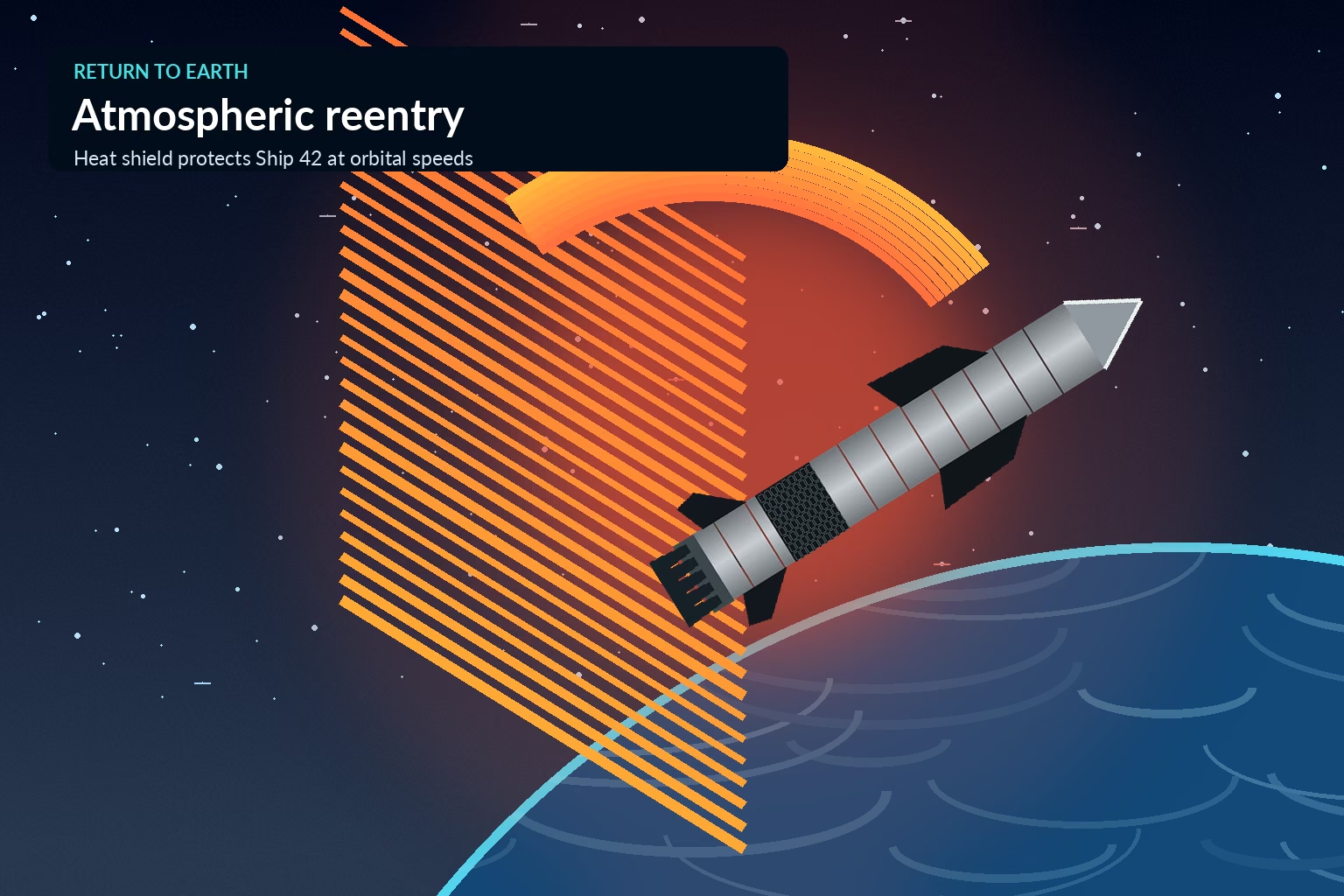
Ship 42 approached reentry at orbital speeds of roughly 17,000 miles per hour, or approximately 27,000 kilometers per hour.
As the spacecraft encountered denser air, intense compression and aerodynamic effects generated substantial heating.
The spacecraft’s orientation was important because Starship’s thermal protection is designed to withstand heating concentrated on particular surfaces.
Aerodynamic drag progressively reduced its speed, converting much of its kinetic energy into heat transferred to the atmosphere and vehicle surfaces.
The spacecraft successfully passed through this environment and continued toward Texas.
This achievement was essential for proving that an orbital Starship could return intact and retain sufficient control for a precision landing maneuver. [2] [3]
Controlling Starship During Hypersonic and Supersonic Descent
During reentry, Starship passes through several aerodynamic flight regimes as its velocity decreases.
At hypersonic speeds, aerodynamic heating and vehicle orientation are especially important. As the spacecraft slows through supersonic and transonic conditions, the aerodynamic environment changes significantly.
Starship uses movable aerodynamic surfaces, including its flaps, together with onboard navigation and flight-control systems to manage attitude and trajectory.
The vehicle must continuously adjust its orientation to maintain a suitable descent path.
During Flight 15, Ship 42 successfully transitioned through these flight regimes before approaching Starbase.
This demonstrated the ability to coordinate aerodynamic control with precise navigation after orbital reentry.
Nevertheless, successful performance on one mission does not establish the reliability of every future reentry under different payload, environmental, or vehicle conditions. [2] [3]
Landing Flip Maneuver and Vehicle Reorientation
Starship descends through much of the lower atmosphere in an attitude intended to manage aerodynamic forces and control its trajectory.
Near the end of the descent, it must rotate into an upright orientation for a powered vertical landing.
This action is known as the landing flip maneuver.
The maneuver requires precisely timed engine ignition, controlled thrust, and coordinated attitude adjustments.
An incorrect rotation rate or unsuitable engine response could leave the vehicle improperly aligned with its intended capture position.
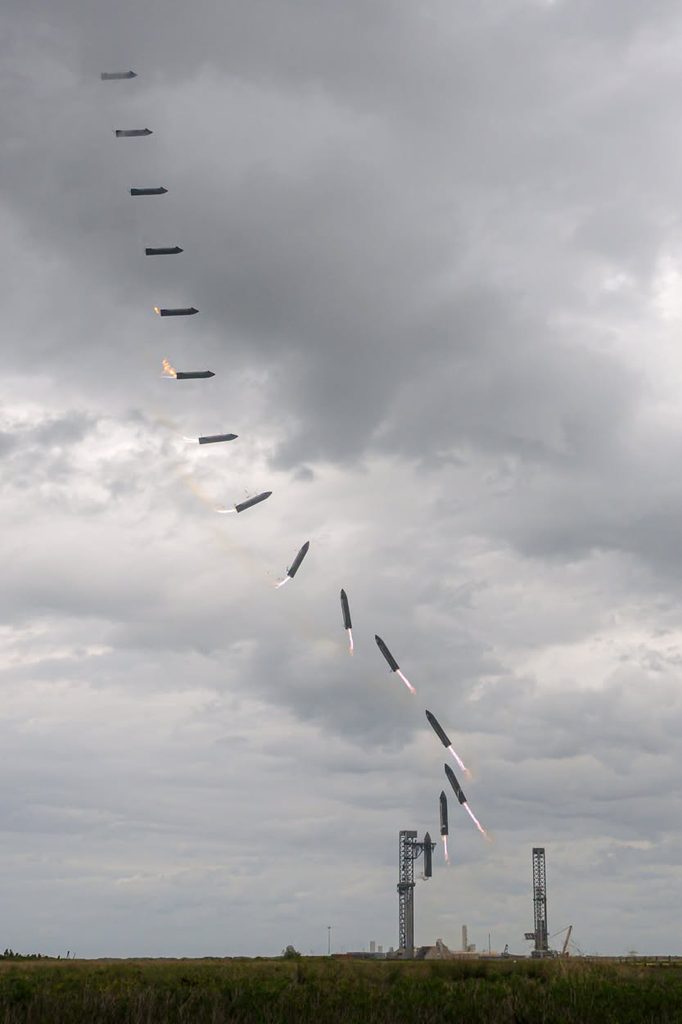
During Flight 15, Ship 42 successfully performed the landing flip after returning to the Starbase area.
The spacecraft transitioned from aerodynamic descent into a vertical, engine-controlled configuration, enabling the final approach toward the launch tower’s catching arms. [2] [13]
Landing Burn and Final Descent
The landing burn reduces Starship’s downward velocity and provides the control needed for a precise vertical recovery.
SpaceX’s published Flight 15 sequence called for an initial landing burn using multiple engines, followed by progressive reduction to fewer operating engines.
This approach allows the vehicle to generate substantial deceleration before using a smaller amount of thrust for final positioning.
Ship 42 successfully executed the powered descent and aligned itself with the catching structure at Starbase.
The engines continued controlling the vehicle as it approached the tower arms.
The successful maneuver required reliable ignition, thrust regulation, navigation accuracy, and rapid onboard decision-making.
It was the final powered phase of the first successful recovery of a Starship spacecraft directly from orbit. [1] [2]
First Starship Tower Catch: How Ship 42 Was Recovered
The successful capture of Ship 42 on November 14, 2026, was the historic achievement that distinguished Flight 15 from every previous integrated Starship test.
After approximately 22.5 hours of flight and fourteen orbits around Earth, the spacecraft descended toward the launch tower at Starbase.
Its engines slowed the descent while the vehicle maneuvered into the required capture position.
The tower’s mechanical arms successfully supported the spacecraft after its engines shut down.
This was the first time SpaceX had recovered a Starship upper stage using its tower-catching system following orbital flight. [2] [13]
Return to Launch Site (RTLS)
Return to Launch Site, abbreviated RTLS, describes a recovery profile in which a rocket or spacecraft returns to the same general launch facility from which it departed.
For Flight 15, Ship 42 targeted Starbase after completing its orbital mission.
This required careful coordination between orbital trajectory design, deorbit timing, atmospheric descent, and final powered maneuvering.
Unlike an ocean splashdown, the spacecraft had to reach a narrow recovery corridor near valuable ground infrastructure.
RTLS recovery may eventually reduce logistical requirements by keeping recovered hardware close to launch and maintenance facilities.
However, it also demands extremely reliable guidance and recovery authorization systems.
The successful return of Ship 42 demonstrated that Starship could combine orbital operations with a precise return to its original launch infrastructure. [1] [2]
First Starship Tower Catch: The Historic Achievement
Ship 42 was caught by Starbase’s launch tower at approximately 3:20 p.m. CST on November 14, 2026.
After descending through clouds and completing its landing flip, the spacecraft slowed into a nearly vertical position between the tower’s mechanical arms.
The arms engaged the spacecraft’s dedicated catching structures and supported the vehicle after its engines shut down.
This marked the first successful tower catch of a Starship upper stage.
Earlier Starship missions had demonstrated ocean landings, and SpaceX had previously caught Super Heavy boosters. Flight 15 extended the recovery concept to the spacecraft that had completed an orbital mission.
The achievement demonstrated a new approach to recovering large orbital-class spacecraft without requiring conventional landing gear or a runway. [2] [13]
How the Catch Mechanism Supports the Vehicle
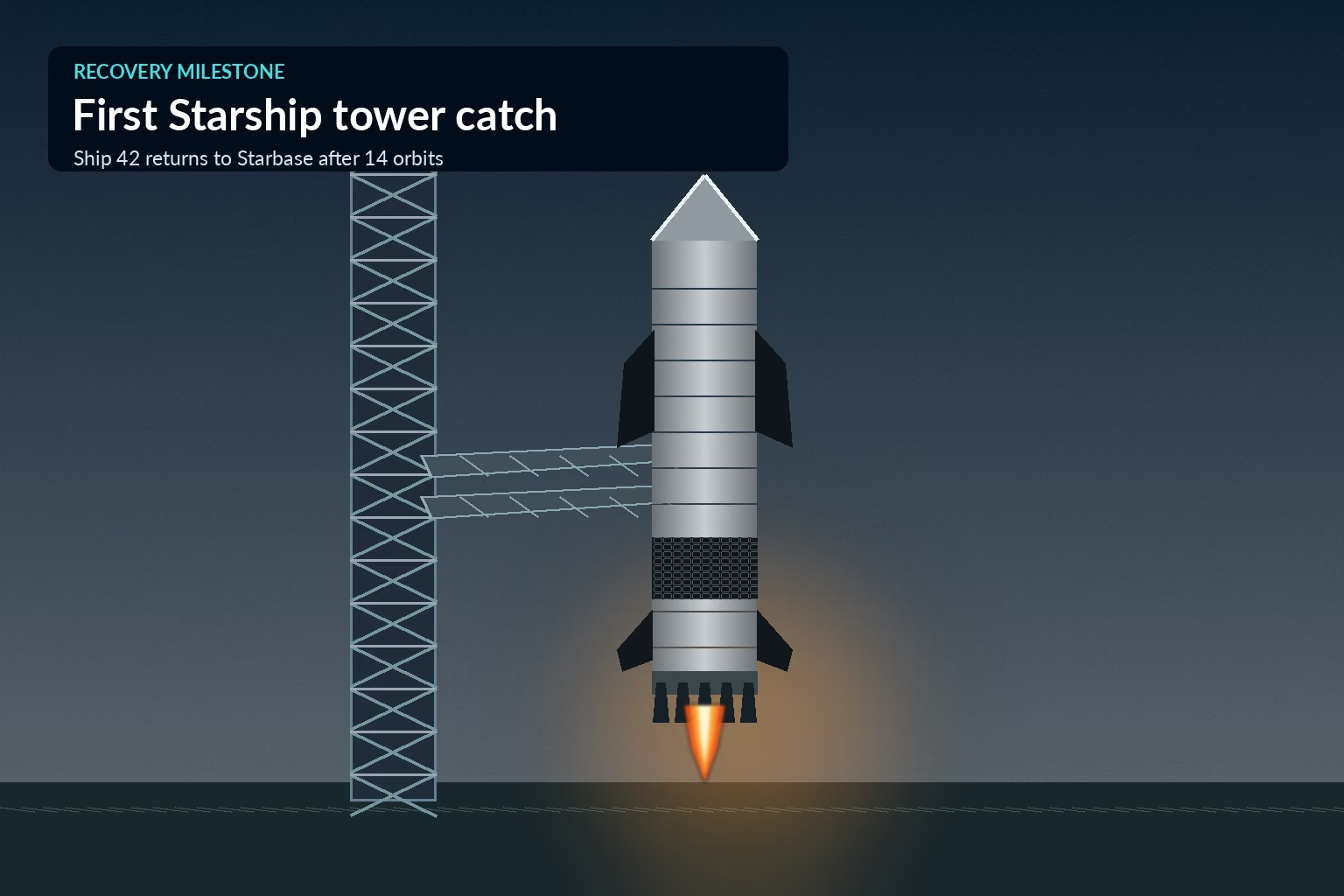
The tower-catching mechanism works by transferring the spacecraft’s weight from its propulsion-supported descent to large mechanical arms.
For the capture to succeed, Starship must reach the correct horizontal position, vertical alignment, attitude, and descent rate.
The catching structures on the spacecraft then engage the tower’s arms, which support the vehicle after the engines stop.
This requires coordination between the vehicle’s control systems and the structural design of the recovery equipment.
The tower must withstand the resulting loads without damaging the spacecraft or compromising its own integrity.
During Flight 15, the system successfully captured Ship 42.
For future rapid-reuse operations, SpaceX will need to demonstrate that repeated catches do not create unacceptable fatigue or maintenance requirements in either the spacecraft or its ground hardware. [2] [13]
Post-Recovery Inspection and Reusability Assessment
Recovering Ship 42 intact provides SpaceX with an opportunity to examine hardware after a complete orbital mission.
Important inspection targets include the heat-shield tiles, propulsion system, engine nozzles, propellant tanks, aerodynamic surfaces, primary structure, and tower-catching interfaces.
Engineers can compare observed wear and damage with flight telemetry to evaluate how the vehicle responded to launch, extended orbital operations, reentry, and capture.
This information can help identify components requiring redesign or refurbishment.
However, successful recovery does not prove that the spacecraft is ready for another flight.
Repeated use requires demonstrating that the vehicle can be restored to a safe flight condition within acceptable maintenance, time, and cost limits.
As of November 15, 2026, Flight 15 had demonstrated recovery, not a subsequent reflight of Ship 42. [2] [6]
Starship Flight 15 Results, Achievements, and Limitations
Starship Flight 15 produced a mixed but technically significant outcome.
Its upper stage successfully completed the orbital mission, deployed operational satellites, survived atmospheric reentry, and returned to the launch tower.
At the same time, the Super Heavy booster failed to complete its planned recovery, preventing SpaceX from achieving its first simultaneous recovery of both stages.
Evaluating the mission therefore requires separating individual technical achievements from the overall reusable-launch objective.
That distinction helps explain why Flight 15 was an important success for Starship development without demonstrating that the launch system is already fully operational or rapidly reusable. [2] [4]
Which Flight 15 Mission Objectives Were Achieved?
Flight 15 successfully completed several major objectives that are essential for Starship’s future operational use.
The mission demonstrated a successful launch, stage separation, orbital insertion, satellite deployment, extended orbital operations, deorbit, atmospheric reentry, and first-ever Starship upper-stage tower recovery.
The approximately 22.5-hour mission also provided engineering data from a much longer orbital flight than earlier Starship demonstrations.
Its deployment of 26 Starlink V3 satellites established a meaningful commercial result.
| Mission objective | Result |
|---|---|
| Liftoff and primary ascent | Achieved |
| Hot-staging separation | Achieved |
| Starship orbital insertion | Achieved |
| Deployment of 26 Starlink V3 satellites | Achieved |
| Approximately 14 Earth orbits | Achieved |
| Extended spacecraft health monitoring | Achieved |
| Controlled deorbit | Achieved |
| Atmospheric reentry | Achieved |
| First Starship upper-stage tower catch | Achieved |
| Super Heavy booster tower catch | Not achieved |
| Recovery of both stages on one flight | Not achieved |
The results show substantial progress across the launch system, while also identifying the booster recovery system as a continuing development priority. [1] [2] [4]
Which Objectives Were Not Achieved?
The primary objective not achieved during Flight 15 was the planned return and tower catch of Super Heavy Booster 22.
The booster completed its ascent responsibilities but experienced an anomaly during its recovery sequence. It automatically diverted offshore and was destroyed rather than captured.
As a result, SpaceX did not recover both rocket stages during the same mission.
The flight also did not demonstrate rapid refurbishment or reflight of the recovered Ship 42.
These are separate milestones from initial recovery.
Although the satellite deployment was successful, long-term satellite commissioning and network service are also distinct from the initial launch results.
Flight 15 should therefore be evaluated as a successful upper-stage recovery demonstration with an unsuccessful first-stage recovery attempt. [2] [4]
What Does Flight 15 Prove About Fully Reusable Rocket Technology?
Flight 15 demonstrated that a large orbital spacecraft can complete an extended mission, survive atmospheric reentry, and be caught by its launch tower.
This is important because conventional orbital upper stages are generally discarded after delivering their payloads.
Recovering Ship 42 provides a practical foundation for developing reusable upper-stage operations.
However, complete reusability requires more than catching a spacecraft once.
Both stages must be recovered reliably, inspected, and successfully reflown. Their maintenance requirements must also be low enough to justify the added complexity of recovery hardware and operational procedures.
Flight 15 established a major technical capability but did not prove routine, low-cost, fully reusable space transportation.
Its long-term significance will depend on whether SpaceX can repeat the achievement and convert it into dependable operational practice. [2] [13]
What Engineering Lessons Can SpaceX Draw From Flight 15?
Flight 15 created valuable opportunities for engineering analysis across several systems.
The Booster 22 anomaly requires investigation into the early boostback shutdown, propellant indications, engine performance, trajectory development, and automated recovery decisions.
Ship 42’s successful return allows engineers to inspect the thermal protection system, propulsion hardware, catching structures, and flight surfaces after actual orbital reentry.
Telemetry from the extended orbital mission can also support improvements in vehicle health monitoring and recovery decision-making.
The successful tower catch provides information about navigation precision, structural loading, and ground-system performance.
However, specific corrective actions should not be assumed before the investigation and postflight analysis are complete.
The most useful outcome will be identifying improvements that increase reliability while reducing inspection and refurbishment requirements. [2] [4] [6]
Starship Flight 15’s Significance for Future Space Missions
Starship is being developed for missions extending far beyond individual flight tests.
Its potential applications include large-scale satellite deployment, heavy cargo delivery, in-space infrastructure, lunar exploration, and eventually human missions beyond Earth orbit.
Flight 15 advanced several technologies relevant to those ambitions, particularly sustained orbital operations and recovery of the spacecraft after reentry.
Nevertheless, Starship’s future mission architectures demand additional capabilities that Flight 15 did not test.
These include repeated vehicle reuse, orbital propellant transfer, more complex rendezvous operations, and systems capable of meeting human spaceflight requirements.
The mission therefore represents progress within a much larger development program. [5] [8]
Starship Flight 14 vs. Flight 15: Technical Progress
Starship Flight 14, launched on September 28, 2026, marked the program’s first successful orbital insertion and first deployment of operational Starlink V3 satellites.
It carried 26 satellites, but its planned orbital mission was shortened, and Ship 41 returned to an ocean splashdown rather than a launch-site catch.
Flight 15 built on those capabilities by carrying another 26 Starlink V3 satellites, remaining in orbit for approximately 22.5 hours, completing fourteen orbits, and returning Ship 42 to Starbase.
| Feature | Flight 14 | Flight 15 |
|---|---|---|
| Launch date | September 28, 2026 | November 13, 2026 |
| Starship spacecraft | Ship 41 | Ship 42 |
| Orbital insertion | Successful | Successful |
| Starlink V3 deployment | 26 satellites | 26 satellites |
| Approximate mission duration | 3 hours | 22.5 hours |
| Orbital operations | Shortened | Approximately 14 orbits |
| Upper-stage recovery | Ocean splashdown | Tower catch |
| Booster recovery | Ocean splashdown | Failed offshore recovery |
| Full two-stage recovery | Not achieved | Not achieved |
The comparison shows clear advances in mission duration, orbital operations, and upper-stage recovery.
However, reliable recovery of a V3 Super Heavy booster remained an unresolved challenge. [2] [11]
NASA Artemis Human Landing System and Lunar Exploration
NASA selected SpaceX to develop a Starship-based Human Landing System, or HLS, as part of its Artemis lunar exploration program.
The HLS architecture involves specialized Starship vehicles and technologies that differ significantly from the commercial satellite-deployment configuration used during Flight 15.
One important requirement is transferring cryogenic propellant between spacecraft in Earth orbit. SpaceX’s concept uses tanker Starships and an orbital propellant depot to prepare the lunar lander for its journey.
NASA’s updated October 2026 planning also revised the assignment of future lunar landing missions. Both SpaceX and Blue Origin remain involved in lander development, but NASA stated that neither provider had been assigned a specific crewed lunar landing mission under the revised arrangements.
Flight 15’s successful orbital operations and spacecraft recovery provide relevant engineering experience, but they do not demonstrate orbital propellant aggregation, crew systems, lunar landing capability, or human-rating certification.
Those remain separate technical and programmatic requirements. [8] [9]
Implications for Future Starlink Deployment
Starship’s potential impact on Starlink comes from its ability to carry larger and more capable satellites into orbit.
A rapidly reusable launch vehicle could eventually reduce the amount of launch hardware that must be replaced for each satellite deployment mission.
This could allow SpaceX to expand broadband capacity more efficiently, provided launch turnaround times and vehicle reliability improve.
Flight 15 demonstrated that Starship could deploy a second batch of 26 operational Starlink V3 satellites while completing an extended orbital mission.
The successful upper-stage recovery also created a pathway toward reducing the need to expend the spacecraft after every deployment.
However, frequent Starlink launches will still depend on vehicle availability, reliable booster recovery, payload manufacturing, launch-site capacity, regulatory approvals, and the practical economics of refurbishment. [1] [2]
Remaining Challenges Before Routine Starship Operations
SpaceX must address several technical and operational challenges before Starship can function as a routinely reusable transportation system.
The first is reliable recovery of both stages during the same mission.
The second is demonstrating that recovered hardware can be inspected, serviced, and flown again safely.
Other challenges include heat-shield durability, engine reliability, cryogenic propellant management, launch infrastructure maintenance, and efficient flight preparation.
For lunar and other deep-space missions, orbital propellant transfer and more complex spacecraft operations will also be essential.
Flight 15 achieved a major recovery milestone, but routine service requires consistent performance across multiple missions rather than a single successful demonstration.
The key measure of progress will be the transition from experimental recovery to repeatable, economically practical operations supported by engineering evidence. [2] [8]
Conclusion: Why Starship Flight 15 Matters
Starship Flight 15 demonstrated a new capability in orbital spaceflight: the return and mechanical capture of a Starship upper stage after an extended orbital mission.
Ship 42 successfully entered orbit, deployed 26 Starlink V3 satellites, completed approximately fourteen revolutions around Earth, performed a controlled deorbit, survived atmospheric reentry, and returned to its launch tower at Starbase.
At the same time, the loss of Super Heavy Booster 22 prevented the mission from achieving its planned recovery of both stages.
The results demonstrate meaningful progress without resolving every challenge associated with full reusability.
Flight 15’s lasting importance is that it transformed upper-stage tower recovery from an engineering objective into a demonstrated capability. The next challenge is turning that achievement into a reliable, repeatable, and economically practical launch system. [1] [2] [4]
Frequently Asked Questions About Starship Flight 15
The following answers summarize the major confirmed results of SpaceX’s fifteenth Starship test flight. They distinguish completed flight milestones from preliminary anomaly information and longer-term program objectives.
Because the booster investigation and the inspection of recovered hardware were still developing immediately after the mission, some technical conclusions may change as SpaceX publishes additional findings.
The answers reflect public information available through November 15, 2026, rather than assuming that future vehicle reuse or satellite commissioning has already been completed.
When did SpaceX Starship Flight 15 launch?
SpaceX Starship Flight 15 launched on Friday, November 13, 2026, at approximately 4:47 p.m. Central Standard Time, equivalent to approximately 22:47 UTC.
The mission began from Orbital Launch Pad 2 at Starbase, Texas.
The launch vehicle consisted of Super Heavy Booster 22 and Starship Ship 42. The upper stage successfully reached orbit, deployed its satellites, and returned to Texas the following afternoon.
The spacecraft’s successful tower catch occurred on Saturday, November 14, approximately 22 hours and 32 minutes after liftoff. [2] [3]
Where did Starship Flight 15 launch from?
Starship Flight 15 launched from SpaceX’s Orbital Launch Pad 2 at Starbase, Texas, near Boca Chica and Brownsville on the Gulf Coast.
Starbase is SpaceX’s primary development, manufacturing, testing, and launch complex for the Starship program.
The facility includes large vehicle assembly infrastructure, cryogenic propellant systems, launch towers, and hardware designed for rocket recovery.
Ship 42 returned to the same launch complex after its orbital mission and was caught by the tower’s mechanical arms.
This return-to-launch-site approach is central to SpaceX’s longer-term goal of reusing Starship vehicles with reduced transportation and recovery logistics. [1] [2]
Was Starship Flight 15 successful?
Flight 15 was successful in achieving most of its major upper-stage objectives, but it did not complete the planned recovery of both rocket stages.
Ship 42 successfully reached orbit, deployed 26 Starlink V3 satellites, completed approximately fourteen orbits, survived atmospheric reentry, and was caught by the launch tower.
However, Booster 22 experienced an anomaly during its recovery sequence and diverted offshore, where it was destroyed.
The mission is therefore best described as a major technical success with an important first-stage recovery failure.
Its strongest achievement was demonstrating the first successful tower recovery of an orbital Starship upper stage. [2] [4]
Did SpaceX catch Starship on Flight 15?
Yes. SpaceX successfully caught Ship 42 using the mechanical arms of its launch tower at Starbase on November 14, 2026.
The spacecraft returned after approximately 22.5 hours of flight and fourteen orbits around Earth.
During its final descent, Ship 42 performed a landing flip, slowed under engine thrust, and descended into the tower’s catching arms.
This was the first successful catch of a Starship upper stage following orbital flight.
However, the successful upper-stage recovery should not be confused with recovery of the entire rocket, because Super Heavy Booster 22 was lost during the same mission. [2] [13]
Why did Super Heavy Booster 22 fail to return?
Booster 22 failed to complete its planned tower recovery after its boostback burn ended earlier than intended.
SpaceX reported that preliminary information pointed to a low fuel-mass alarm associated with the early shutdown.
The vehicle’s guidance system subsequently determined that the booster was not in the correct position to continue toward the launch tower and automatically initiated an offshore diversion.
Booster 22 performed a landing burn over the Gulf of Mexico before its flight termination system was activated.
As of November 15, SpaceX had not publicly established a definitive root cause for the original anomaly. [4]
How many times did Starship orbit Earth during Flight 15?
Ship 42 completed approximately fourteen orbits around Earth during Starship Flight 15.
The mission operated in low Earth orbit at an altitude of roughly 275 kilometers, although the reported altitude varied slightly depending on the measurement and orbital location.
The fourteen-orbit journey allowed SpaceX to evaluate the spacecraft over an extended period while completing satellite deployment and health assessments.
This represented a substantial increase in mission duration compared with Flight 14.
Completing the orbital sequence was particularly important because Ship 42 subsequently performed a controlled deorbit and returned to the launch site for recovery. [1] [2]
How long did Starship Flight 15 last?
Starship Flight 15 lasted approximately 22 hours and 32 minutes, commonly rounded to 22.5 hours.
The mission began with liftoff at approximately 4:47 p.m. CST on November 13, 2026, and concluded with Ship 42’s tower catch at approximately 3:20 p.m. CST on November 14.
Most of that period was spent in low Earth orbit.
The extended duration allowed Starship to deploy satellites, complete multiple orbital revolutions, undergo health assessments, and prepare for reentry.
It also made Flight 15 the longest Starship mission completed up to that point. [2] [3]
How many Starlink V3 satellites were deployed?
SpaceX successfully deployed 26 Starlink V3 satellites during Flight 15.
The deployment sequence began approximately 35 minutes after launch and finished around one hour and 17 minutes into the mission.
The satellites are designed to increase the capacity of the Starlink broadband constellation.
Three of the spacecraft also carried cameras intended to inspect Starship’s thermal protection system after deployment.
Although the complete batch reached orbit, initial deployment success and long-term operational commissioning are different milestones.
The satellites still require appropriate subsystem checks and orbital positioning before entering regular service. [1] [3]
What is the difference between Ship 42 and Booster 22?
Ship 42 was the upper-stage spacecraft responsible for orbital insertion, satellite deployment, extended orbital operations, atmospheric reentry, and tower recovery.
Booster 22 was the Super Heavy first stage responsible for lifting the combined vehicle during the initial launch phase.
Booster 22 used 33 Raptor engines, while Ship 42 used six.
After stage separation, the two vehicles followed different trajectories.
Ship 42 continued into orbit and eventually returned to Starbase.
Booster 22 attempted a much shorter return trajectory but experienced an anomaly and was destroyed offshore.
Together, they formed the two-stage Starship launch system used during Flight 15. [1] [5]
What is Mechazilla, and how does it catch Starship?
Mechazilla is SpaceX’s informal name for its launch-tower catching system.
It uses large mechanical arms, commonly called chopsticks, to support a returning rocket after a controlled vertical descent.
Instead of landing on conventional legs, Starship approaches the tower under engine thrust and positions its dedicated catching structures so they can engage the arms.
This requires highly accurate navigation, controlled descent velocity, and sufficient structural strength.
SpaceX previously demonstrated tower catches with Super Heavy boosters.
Flight 15 marked the first successful use of the mechanism to recover a Starship upper stage returning from orbit. [2] [13]
What happened to Starship’s heat shield during the mission?
Ship 42’s heat shield successfully protected the spacecraft sufficiently for it to survive atmospheric reentry and complete its tower recovery.
Before deorbit, SpaceX assessed the thermal protection system using information from ground-based cameras and inspection cameras carried by several deployed Starlink satellites.
The company reported that the heat shield was in a condition suitable for proceeding with the return.
However, successful reentry does not establish that every tile remained undamaged or that the system requires no refurbishment.
Detailed inspection of the recovered spacecraft is necessary to determine wear, localized damage, and the maintenance required before any potential reflight. [1] [3]
What makes Flight 15 different from Flight 14?
Flight 14 was Starship’s first successful orbital mission and the first to deploy operational Starlink V3 satellites.
It launched on September 28, 2026, deployed 26 satellites, and ended after approximately three hours with an ocean splashdown.
Flight 15 expanded those capabilities.
It deployed another batch of 26 satellites, remained in orbit for approximately 22.5 hours, completed fourteen orbital revolutions, and returned its upper stage to Starbase for a successful tower catch.
The most important difference was upper-stage recovery.
Flight 14 demonstrated orbital deployment, while Flight 15 demonstrated a much longer orbital mission followed by successful return-to-launch-site capture. [2] [11]
Does Flight 15 mean Starship is now fully reusable?
No. Flight 15 demonstrated successful recovery of the Starship upper stage, but it did not prove that the complete launch system is fully reusable.
Super Heavy Booster 22 was lost during the mission, preventing recovery of both stages.
Furthermore, recovering hardware does not automatically mean it can be flown again economically.
SpaceX must inspect the recovered spacecraft, determine refurbishment requirements, and demonstrate successful reflight.
Both stages also need to achieve reliable recovery across repeated missions.
Flight 15 was therefore a major milestone toward full reusability rather than proof that routine two-stage reuse has already been established. [2] [4]
How does Flight 15 support NASA’s Artemis program?
Flight 15 provided engineering experience relevant to NASA’s Artemis program by demonstrating extended Starship orbital operations, propulsion restarts, controlled reentry, and spacecraft recovery.
NASA is working with SpaceX on a specialized Starship Human Landing System intended to support future lunar missions.
However, a lunar lander requires additional capabilities beyond those demonstrated by Flight 15.
These include orbital cryogenic propellant transfer, rendezvous operations, lunar descent and ascent, and crew-related safety systems.
NASA’s updated 2026 Artemis planning also changed the assignment of future lunar landing missions.
Consequently, Flight 15 supports the broader technology development effort but should not be interpreted as proof that Starship’s lunar configuration is ready to carry astronauts. [8] [9]
What still needs to happen before Starship can fly repeatedly?
SpaceX must demonstrate reliable recovery of both the Super Heavy booster and Starship spacecraft, including recovery during the same mission.
The company must also inspect recovered hardware and prove that engines, thermal protection, structures, and catching interfaces can withstand repeated flights.
Another important step is reducing refurbishment time and associated operational costs.
Successful reflight of an already flown Starship upper stage would provide evidence of practical upper-stage reuse.
Additional work is also necessary in launch-site operations, cryogenic propellant management, reliability verification, and regulatory compliance.
Flight 15 demonstrated a historic recovery capability, but dependable, frequent Starship operations will require repeated successful missions and documented hardware performance. [2] [6] [12]
Sources
The following sources were consulted and cross-checked for mission outcomes, published flight timelines, vehicle specifications, engineering explanations, and Artemis program information. SpaceX’s mission timeline contains planned event times, while postflight reporting is used to establish the actual outcomes.
[1] SpaceX. Starship Flight 15: Official Mission Overview, Objectives, Countdown, and Flight Timeline. Primary source for mission design, satellite payload, recovery planning, and scheduled flight events.
[2] Reuters, November 14, 2026. SpaceX Starship Returns to Landing Pad From Orbit, Acing Test for Reusable Rockets. Independent reporting on the first upper-stage catch, mission duration, satellite deployment, and booster loss.
[3] Space.com, November 13–14, 2026. Starship Flight 15 Live Updates: Launch, Orbital Operations, Reentry, and Tower Catch. Chronological reporting of mission operations and statements made during SpaceX webcasts.
[4] Space.com, November 14, 2026. Why Did Starship Flight 15 Booster Abort Its Landing Catch? SpaceX Still Investigating. Reporting on the low fuel-mass alarm, automated abort, and continuing investigation.
[5] SpaceX. Starship Vehicle and Raptor Engine Specifications. Technical information about Super Heavy, Starship, engine configuration, and the intended reusable vehicle architecture.
[6] SpaceX. Starship Development Updates. Manufacturer information about third-generation vehicle architecture, Raptor 3 engines, navigation improvements, and launch infrastructure.
[7] Starlink. Starlink Satellite Technology. Technical background on satellite antennas, optical intersatellite links, propulsion, and electrical power systems.
[8] NASA, October 2026. NASA, Partners Accelerate Lander Development for 2028 Moon Missions. Updated Artemis mission architecture, lander-provider arrangements, and Starship HLS requirements.
[9] NASA Office of Inspector General, March 10, 2026. NASA’s Management of the Human Landing System Contracts, IG-26-004. Independent assessment of HLS development, propulsion-transfer requirements, technical risks, and schedule challenges.
[10] NASA Glenn Research Center. Dynamic Pressure. Technical explanation of aerodynamic dynamic pressure and maximum dynamic pressure during rocket ascent.
[11] SpaceX. Starship Flight 14: Official Mission Results. Primary source for the preceding flight’s orbital and satellite-deployment milestones.
[12] Federal Aviation Administration. Commercial Space Compliance, Enforcement, and Mishap Investigations. Regulatory background on commercial spaceflight safety systems, mishaps, and investigation requirements.
[13] Aerospace America, November 14, 2026. SpaceX Achieves First Starship Tower Catch. Aerospace-industry reporting on the orbital upper-stage recovery and technical significance of the tower capture.