
Introduction: Why Are Astronomy and Astrology Often Confused?
Astronomy and astrology have fascinated humanity for thousands of years. Both involve the Sun, Moon, planets, stars, and constellations, and both originated partly from humanity’s desire to understand the sky. However, despite their similar names and shared historical background, astronomy and astrology are fundamentally different in their objectives, methods, and relationship with scientific evidence.
Astronomy investigates the physical universe through observation, mathematics, and established scientific principles. It seeks to understand how celestial objects form, move, interact, and evolve. Astrology, by contrast, interprets the positions and movements of celestial bodies as meaningful indicators of human personality, relationships, behavior, and future events.
The confusion between these fields is understandable. Both astronomers and astrologers may use planetary positions, celestial coordinates, and astronomical calendars. Historically, the distinction between them was not always clearly defined. Some ancient scholars practiced both observational astronomy and forms of astrological interpretation.
Modern science, however, recognizes a clear separation. Astronomy is an evidence-based natural science, while astrology is a traditional interpretive belief system whose central predictive claims have not demonstrated reliable scientific validity.[1] [3]
What is the difference between astronomy and astrology?
Astronomy is the scientific study of celestial objects, space, and the universe using observation, physics, and mathematics. Astrology is a belief system that interprets celestial positions as influences or indicators of human personality and events. Astronomy produces testable scientific explanations, while astrology’s personal predictions lack reliable empirical support.[1] [3]
Understanding this distinction requires examining what each field studies, how its methods work, why its conclusions differ, and how both traditions developed from humanity’s historical relationship with the night sky.
Astronomy vs. Astrology: What Are the Main Differences?
The most important difference between astronomy and astrology is not simply the objects they examine, but what they attempt to learn from those objects.
Astronomers study celestial phenomena to identify physical properties and discover relationships governed by natural laws. Astrologers interpret celestial configurations through systems of symbolic meanings associated with human experiences.
An astronomical prediction can be evaluated against measurable events, such as the timing of an eclipse. An astrological prediction usually concerns personality, relationships, or future circumstances, where objective validation requires controlled testing that accounts for chance and bias.[1] [3]
What Is Astronomy?
Astronomy is a natural science concerned with the origin, structure, composition, motion, and evolution of objects and phenomena throughout the universe.
Astronomers investigate stars, planetary systems, galaxies, nebulae, black holes, comets, and the large-scale structure of the cosmos. They use observational instruments and physical theories to examine objects that are often far beyond the reach of direct exploration.
For example, astronomers can determine the chemical composition of a distant star by analyzing the wavelengths of light it emits or absorbs. They can calculate a planet’s orbital period using mathematical models and investigate the expansion of the universe by measuring the light from distant galaxies.
Astronomy depends on empirical evidence, measurable quantities, and hypotheses that can be evaluated through observation. Its explanations are updated when improved measurements or new discoveries challenge existing models.[2]
This makes astronomy a scientific discipline rather than merely the practice of identifying objects in the night sky.
What Is Astrology?
Astrology is a traditional belief and interpretive system that associates celestial positions and movements with human characteristics, experiences, and events.
Its best-known concepts include zodiac signs, horoscopes, birth charts, astrological houses, planetary aspects, and transits. Practitioners assign symbolic meanings to celestial objects and use established traditions to interpret their configurations.
For example, Western astrology commonly associates Mercury with communication, Venus with relationships, and Mars with action or conflict. These associations are part of an interpretive tradition rather than conclusions demonstrated through physical experiments.
Astrology is not a single uniform system. Western tropical astrology, Indian sidereal traditions, and other historical approaches use different conventions, calendars, and interpretations.
Although astrologers may calculate real astronomical positions accurately, scientific research has not established that those positions reliably reveal personality traits or predict individual life events.[3] [19]
Astronomy vs. Astrology: A Side-by-Side Comparison
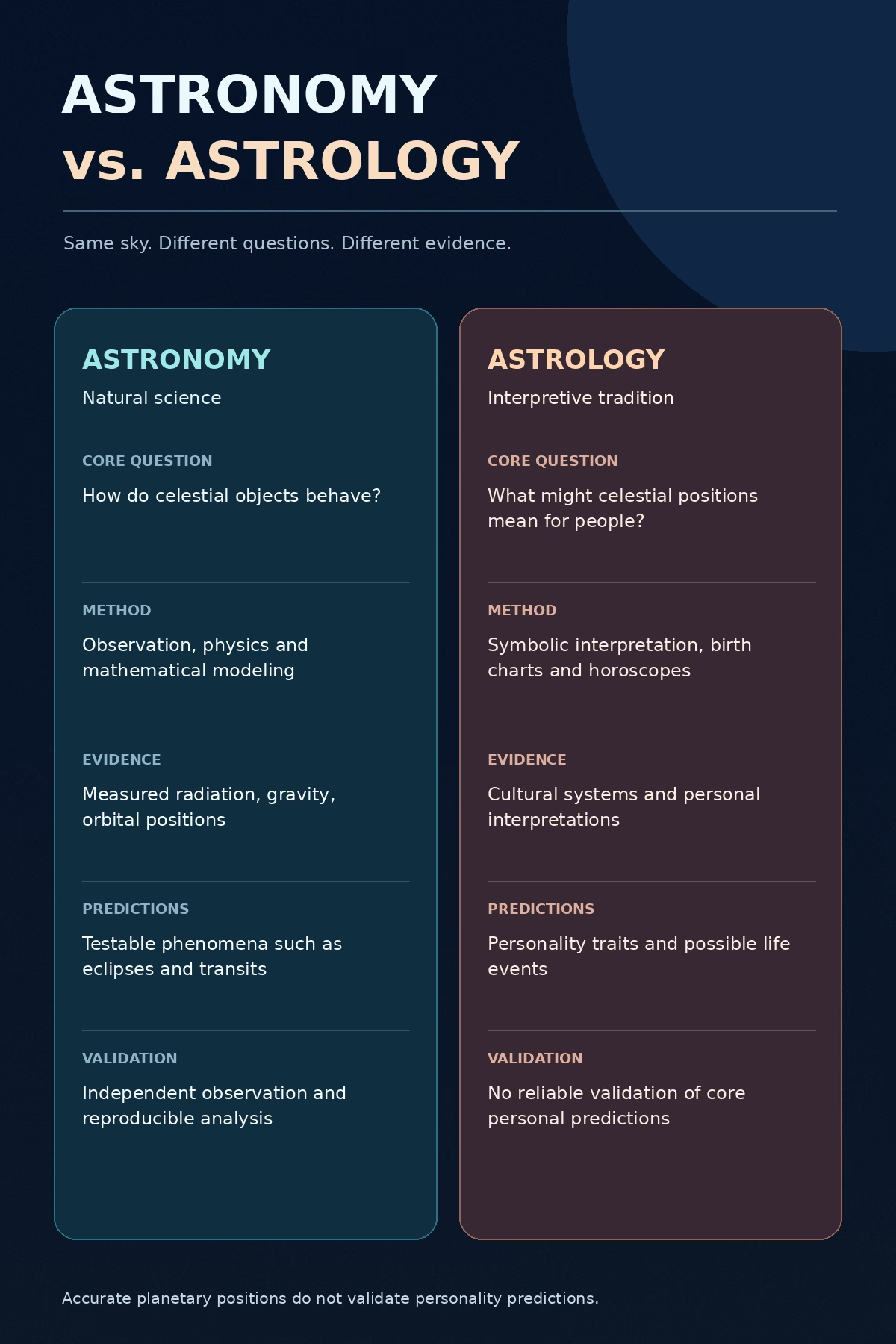
The following comparison summarizes how astronomy and astrology differ in their purposes, methodologies, tools, and treatment of evidence. Some overlap exists in their terminology and mathematical calculations, but their conclusions are evaluated in fundamentally different ways.
Astronomy attempts to develop explanations that remain consistent with observed physical reality. Astrology assigns interpretive significance to celestial arrangements, often through traditions that differ among practitioners. This distinction becomes particularly important when evaluating claims of predictive accuracy.[1] [3]
| Comparison factor | Astronomy | Astrology |
|---|---|---|
| Classification | Natural science | Belief system, generally classified as pseudoscience when presented as empirical prediction |
| Primary purpose | Understand the physical universe | Interpret celestial positions in relation to human affairs |
| Main subjects | Stars, planets, galaxies, cosmic phenomena | Zodiac signs, natal charts, planetary symbolism |
| Methodology | Observation, experimentation where possible, mathematical modeling | Traditional interpretive frameworks |
| Evidence | Empirical measurements and scientific research | Historical traditions, symbolic interpretations, personal experiences |
| Common tools | Telescopes, spectrographs, detectors, computer models | Horoscopes, birth charts, ephemerides, chart software |
| Predictions | Eclipses, orbital positions, transits, physical phenomena | Personality traits, relationships, life events |
| Validation | Independent observation, statistical evaluation, peer review | No established reliable validation of central predictive claims |
| Treatment of errors | Models are tested, corrected, or rejected | Interpretations may vary between traditions and practitioners |
| Professional practice | Research, education, observatory operations, space science | Personal readings, consultations, cultural and spiritual interpretation |
Scientific Evidence vs. Belief: Why Does the Distinction Matter?
Scientific knowledge requires more than an idea that appears convincing. Researchers must establish whether observations support a claim and whether independent investigators can evaluate it using appropriate methods.
Suppose an astronomer predicts that a planet will cross a particular position in the sky at a specified time. That prediction can be compared with observations. If the result differs, the calculations, assumptions, and measurements can be investigated.
An astrological statement such as “a major opportunity may appear soon” is more difficult to evaluate because the terms are subjective and the conditions for success are not clearly defined.
Nevertheless, sufficiently specific astrological claims can be tested scientifically. The central issue is that controlled investigations have not established reliable predictive performance for astrology’s core claims.
Personal meaning and scientific validity are different questions. A tradition can be culturally meaningful without providing an empirically demonstrated explanation of nature.[22]
What Does Astronomy Study, and How Does It Work?
Astronomy investigates the universe through several interconnected scientific disciplines, including physics, chemistry, mathematics, planetary science, and computer science.
Because most celestial objects cannot be physically sampled, astronomers frequently study them through radiation, gravitational effects, and changes in their observed positions. These measurements allow scientists to infer properties that cannot be seen directly.
Astronomical research extends from nearby objects in the solar system to galaxies billions of light-years away. Its methods also help researchers understand Earth’s position within the larger universe.[2]
Celestial Bodies: What Objects Do Astronomers Investigate?
Celestial bodies are naturally occurring objects found in space. They include stars, planets, dwarf planets, moons, asteroids, comets, and other astronomical objects.
Stars are massive objects whose interiors can generate energy through nuclear fusion. Planets orbit stars and possess characteristics determined by their formation histories, chemical compositions, temperatures, and gravitational environments.
Moons orbit planets or other nonstellar bodies, while asteroids and comets preserve important information about the formation and evolution of planetary systems.
Galaxies are enormous gravitationally associated systems containing stars, gas, dust, and dark matter. Astronomers also investigate nebulae, supernova remnants, black holes, and the interstellar medium.
To classify these objects, scientists measure properties such as mass, diameter, luminosity, temperature, orbital motion, and chemical composition.
Gravity governs many large-scale interactions, while electromagnetic radiation provides a major source of observational information. These measurable characteristics form the foundation of astronomical classification and research.[2]
The Solar System and the Scientific Study of Planets
The solar system consists of the Sun, eight recognized planets, their natural satellites, dwarf planets, asteroids, comets, and numerous smaller objects bound gravitationally to the Sun.
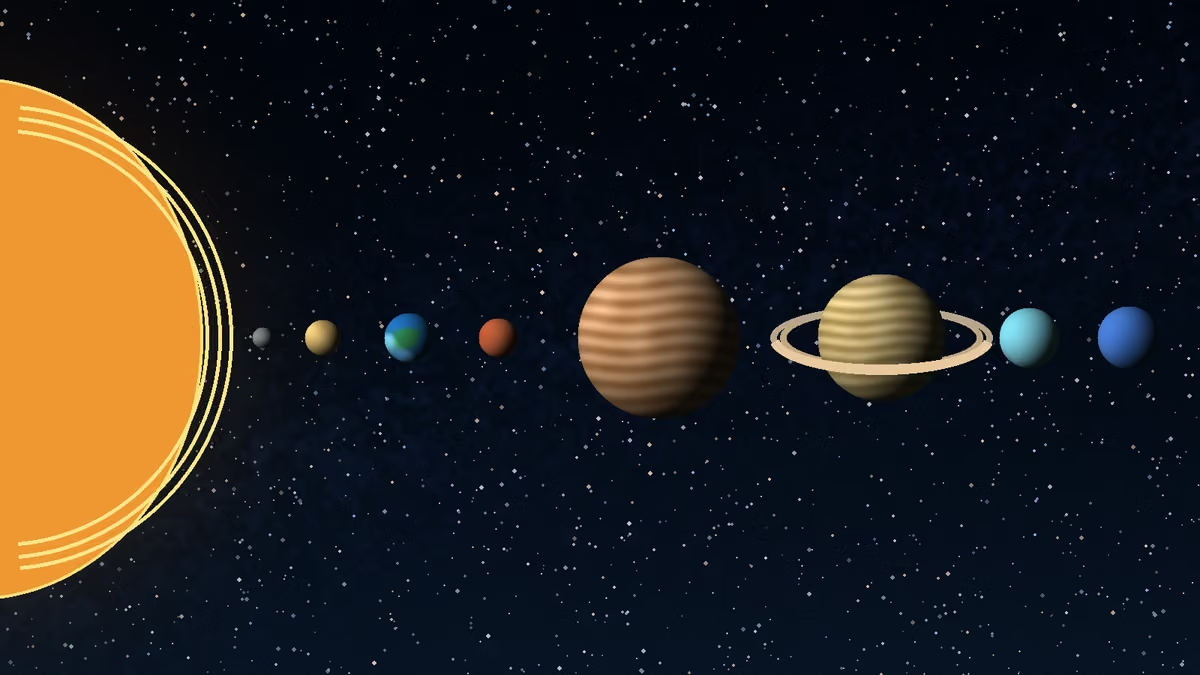
The eight planets, in order of increasing distance from the Sun, are Mercury, Venus, Earth, Mars, Jupiter, Saturn, Uranus, and Neptune.
The four inner planets are predominantly rocky terrestrial worlds. Jupiter and Saturn are gas giants, while Uranus and Neptune are classified as ice giants.
Astronomers investigate planetary atmospheres, internal structures, magnetic fields, surface conditions, and orbital characteristics. Spacecraft observations and laboratory studies of meteorites provide additional evidence about solar system formation.
A planet’s orbital period describes the time required to complete a revolution around the Sun. Mercury takes approximately 88 Earth days, while Neptune requires approximately 165 Earth years.
In astronomy, these properties are physical characteristics that can be measured and modeled. Astrology instead assigns symbolic meanings to planetary positions and movements.[4] [5]
Planetary Motion and Gravitational Force
Planetary motion follows physical principles that can be described mathematically.
Johannes Kepler formulated three laws describing planetary orbits. The first states that planets travel around the Sun in elliptical orbits, with the Sun at one focus. The second describes how a planet sweeps out equal areas in equal time intervals. The third relates orbital period to orbital size.
Isaac Newton later explained these relationships through his laws of motion and universal gravitation.
Newton’s gravitational law can be expressed as:
F = G(m₁m₂)/r²
Here, F represents gravitational force, G is the gravitational constant, m₁ and m₂ are the masses, and r is the distance between their centers of mass for the idealized model.
Modern astronomy extends these calculations using numerical simulations and, when necessary, general relativity.
These methods allow scientists to calculate planetary trajectories, spacecraft paths, and eclipses. NASA explains that modern eclipse predictions depend on the geometry and gravitational motion of Earth, the Moon, and the Sun.[5] [6]
Astronomical Observations: How Do Astronomers Gather Evidence?
Astronomical observations involve measuring radiation and other signals originating from celestial objects and events.
Visible-light observations reveal stars, planets, and galaxies, but the electromagnetic spectrum extends far beyond the wavelengths detectable by human eyes.
Radio telescopes observe long-wavelength radiation from sources such as cold gas clouds and active galaxies. Infrared instruments can investigate dust-obscured regions, while ultraviolet, X-ray, and gamma-ray detectors reveal energetic physical processes.
Astronomers also use techniques that do not rely solely on electromagnetic radiation. Gravitational-wave observatories, for example, detect distortions in spacetime associated with certain massive cosmic events.
Scientific observations require careful calibration, consideration of measurement uncertainty, and analysis of possible instrumental errors.
Researchers compare observations with physical models, published findings, and independent datasets. The goal is not merely to collect impressive images, but to obtain measurements that can support or challenge explanations of the universe.[2] [7]
How Do Telescopes Help Astronomers Understand Space?
A telescope collects radiation from distant objects and directs it toward instruments that record or analyze the signal.
Optical telescopes use lenses or mirrors to observe visible light. Radio telescopes collect radio-frequency radiation, often using large antennas. Space telescopes operate above Earth’s atmosphere, allowing observations that may be difficult or impossible from the ground.
Two important telescope characteristics are light-gathering capability and angular resolution.
A larger collecting area generally allows a telescope to detect fainter objects. Angular resolution describes its ability to distinguish closely spaced details. Magnification alone does not determine scientific performance.
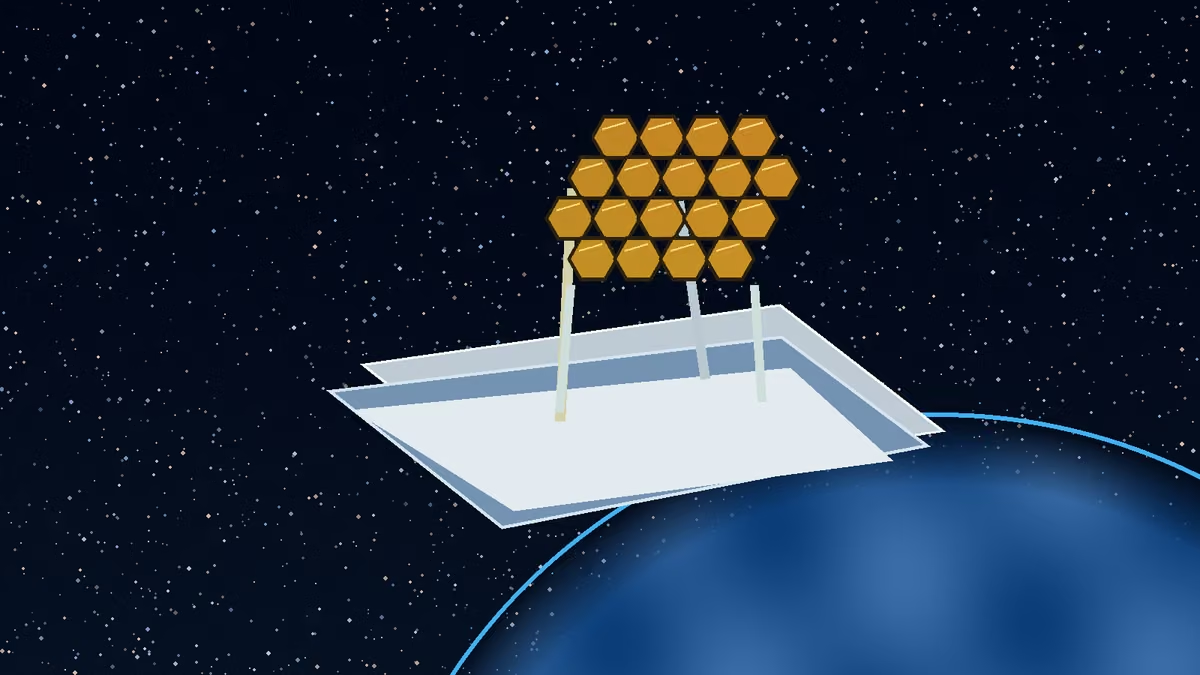
The Hubble Space Telescope primarily observes ultraviolet, visible, and near-infrared light. The James Webb Space Telescope is optimized for red and infrared wavelengths.
Their capabilities complement each other. Hubble can examine many objects at shorter wavelengths, while Webb’s infrared instruments can investigate distant galaxies, star-forming regions, and selected exoplanet atmospheres.[7]
What Is Spectroscopy in Astronomy?
Spectroscopy is the study of how electromagnetic radiation is distributed across different wavelengths or frequencies.
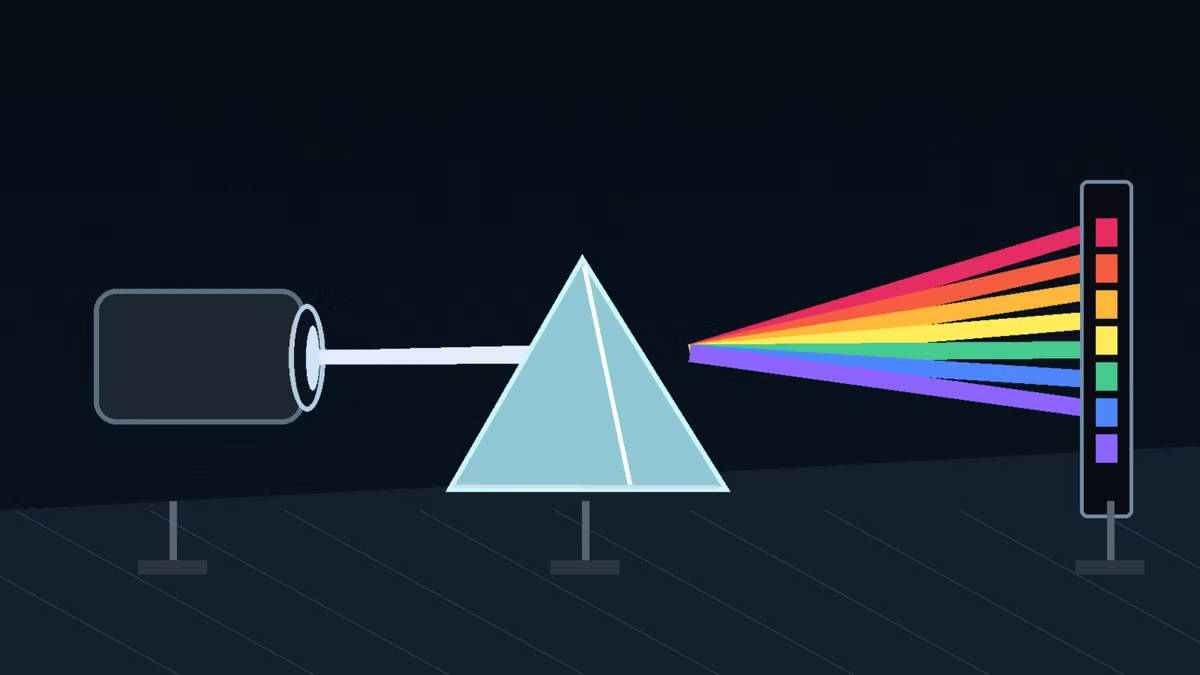
Astronomers use spectrographs to separate incoming light into spectra. These spectra contain information about the physical conditions and chemical composition of celestial objects.
Atoms and molecules absorb or emit radiation at characteristic wavelengths, creating identifiable spectral features. By comparing observed spectral lines with laboratory measurements, astronomers can identify elements and investigate temperature, density, and other properties.
Spectroscopy also reveals motion through wavelength shifts.
A redshift occurs when identifiable spectral features appear at longer wavelengths. A blueshift occurs when they shift toward shorter wavelengths.
For nearby moving objects, these changes can result from the Doppler effect. For sufficiently distant galaxies, cosmological redshift primarily reflects the expansion of space.
Spectroscopy provides measurable evidence about objects that may be far beyond direct human exploration.[8]
What Are the Main Branches of Astronomy?
Astronomy encompasses several overlapping areas of scientific investigation. Observational astronomy focuses on acquiring measurements, while theoretical astronomy develops mathematical and computational explanations.
Planetary science examines planets, moons, asteroids, and related systems. Galactic astronomy studies the structure and development of galaxies, while extragalactic astronomy investigates objects beyond the Milky Way.
Other important areas include solar physics, astrobiology, stellar astronomy, astrophysics, and cosmology.
The boundaries between these disciplines are not rigid. For example, research on black holes may combine theoretical astrophysics, observational techniques, gravitational-wave measurements, and cosmological questions.
Astrophysics: Explaining Celestial Phenomena Through Physics
Astrophysics applies physical laws to investigate the properties and behavior of celestial objects.
It examines how gravity, pressure, radiation, magnetic fields, nuclear reactions, and other physical processes operate in astronomical environments.
For example, astrophysicists investigate how nuclear fusion supplies energy in stars, how matter behaves near black holes, and how radiation interacts with gas and dust.
They may use mathematical equations, computer simulations, telescope observations, and laboratory measurements to evaluate theories.
Astrophysics is closely integrated with modern astronomy. While the terms are sometimes used interchangeably, astrophysics particularly emphasizes explaining astronomical phenomena through physical mechanisms.
Stellar Evolution: How Do Stars Form and Change?
Stellar evolution describes how stars form, develop, and eventually reach the ends of their lives.
Stars originate within sufficiently dense regions of interstellar gas and dust. Gravitational collapse heats the forming star until conditions in its core allow sustained nuclear fusion.
During most of its lifetime, a star remains in the main-sequence stage, where energy production helps balance inward gravitational compression.
Its later evolution depends strongly on its mass.
Stars broadly similar to the Sun eventually expand into red giants, shed outer material, and leave white dwarfs.
Sufficiently massive stars may undergo core-collapse supernova explosions, leaving neutron stars or black holes, depending on the properties of the remaining core.
The Sun is currently a main-sequence star, and its future evolution is studied through established stellar models.[9]
Cosmology: Understanding the Origin and Evolution of the Universe
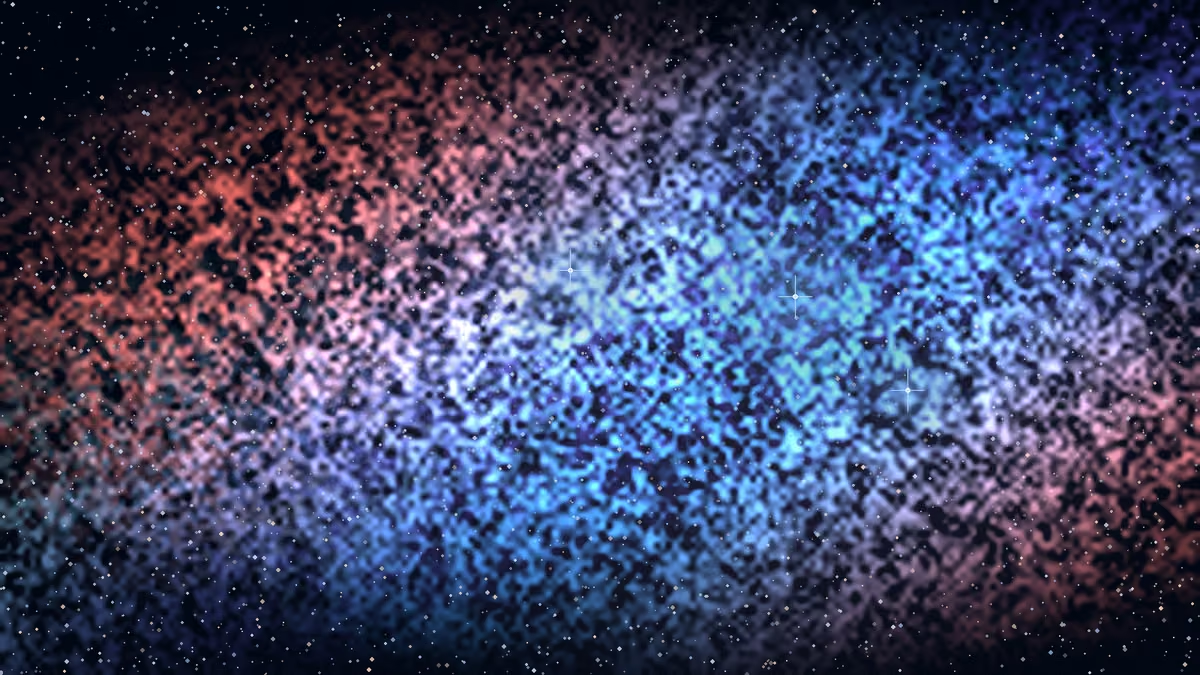
Cosmology investigates the universe as a whole, including its expansion, large-scale structure, composition, and evolutionary history.
The modern Big Bang model describes the development of the observable universe from an early hot, dense state. It does not provide a complete explanation of why the universe exists or what, if anything, preceded that state.
Important evidence includes the expansion of the universe, the cosmic microwave background, and the observed abundance of light elements.
Cosmologists also investigate dark matter, which is inferred from gravitational effects, and dark energy, associated with the accelerated expansion of the universe.
Although fundamental questions remain unresolved, cosmological models are evaluated against observations and mathematical predictions.
This distinguishes scientific cosmology from systems that interpret cosmic arrangements as symbolic indicators of personal destiny.[10]
What Does Astrology Study, and How Are Astrological Predictions Made?
Astrology centers on interpreting the apparent positions of celestial objects from Earth and assigning significance to their relationships.
Its practitioners use zodiac systems, planetary placements, angular relationships, and birth charts to construct personal or general interpretations.
Many astrological traditions share historical terminology, but their rules and meanings are not identical. Western tropical astrology and Indian sidereal traditions, for example, use different reference systems.
Understanding astrology therefore involves examining both its astronomical calculations and the symbolic frameworks applied to those calculations.
What Are Zodiac Signs in Astrology?
The zodiac is a system of celestial divisions associated historically with the apparent annual movement of the Sun along the ecliptic.
In widely used Western astrology, the zodiac consists of twelve equal signs, each occupying 30 degrees of ecliptic longitude.
The traditional signs are:
| Zodiac sign | Traditional element |
|---|---|
| Aries | Fire |
| Taurus | Earth |
| Gemini | Air |
| Cancer | Water |
| Leo | Fire |
| Virgo | Earth |
| Libra | Air |
| Scorpio | Water |
| Sagittarius | Fire |
| Capricorn | Earth |
| Aquarius | Air |
| Pisces | Water |
These four elements are symbolic classifications within astrology. They are not the chemical elements or physical states of matter studied in modern science.
Although the signs retain names associated with constellations, the twelve equal astrological divisions are not identical to the irregularly shaped astronomical constellations.
Furthermore, not every astrological tradition uses the same starting point for dividing the zodiac.[13] [26]
What Are Sun Signs, and How Are They Determined?
A Sun sign is the zodiac sign associated with the Sun’s position at the time of a person’s birth under a particular astrological system.
Popular Western astrology generally assigns Sun signs using calendar birth dates. Someone described as an Aries, Taurus, or Gemini is usually referring to this classification.
Traditional astrological interpretations assign characteristics to the signs. Aries, for example, is commonly associated with initiative, Taurus with stability, and Gemini with communication or adaptability.
These associations are cultural and interpretive rather than scientifically established personality relationships.
Actual Sun-sign boundaries do not always fall at precisely the same civil-calendar time each year. Exact calculations also depend on the zodiac system used.
Scientific research has not demonstrated that a person’s Sun sign reliably predicts personality or intelligence. A large-scale investigation involving more than 15,000 participants found no evidence supporting the examined relationships between birth dates, astrological Sun signs, and measured individual differences.[19]
What Is a Horoscope, and How Does It Work?
A horoscope is an astrological chart or interpretation describing celestial positions in relation to a particular moment, person, or event.
In popular media, the term usually refers to short predictions organized by zodiac sign.
Daily horoscopes commonly describe possible emotional, professional, or relationship developments. Weekly and monthly versions extend those interpretations over longer periods.
Personalized horoscopes may use a person’s birth date, location, and time to calculate more detailed celestial configurations.
The central distinction is between calculating the astronomical positions and assigning personal meaning to them.
A prediction about a measurable celestial event can be evaluated through physical observations. A statement about future happiness, romantic compatibility, or career success requires specific definitions and appropriate controlled testing before predictive accuracy can be established.
General horoscope statements have not demonstrated reliable predictive validity under scientific evaluation.[3] [19]
What Is a Birth Chart or Natal Chart?
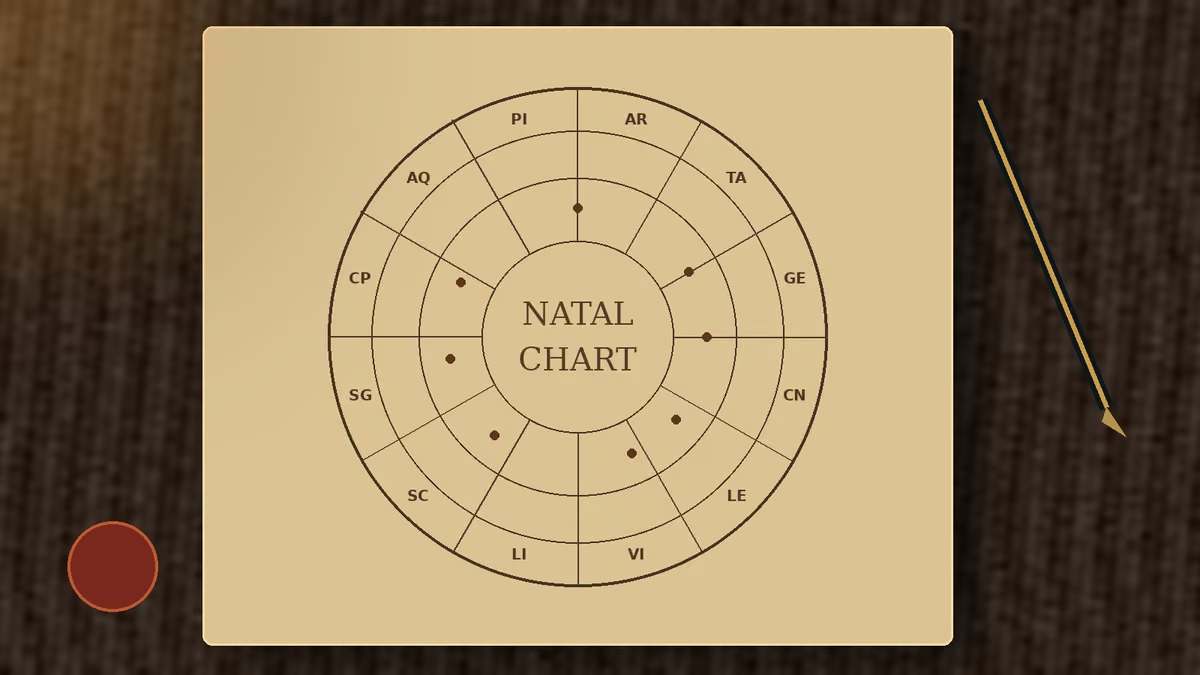
A birth chart, also called a natal chart, represents the celestial positions used in astrology for a particular birth time and location.
Astrologers generally calculate the apparent positions of the Sun, Moon, and planets, then place them within a zodiac and house system.
Important components include the Sun sign, Moon sign, ascendant or rising sign, planetary placements, and angular relationships known as aspects.
The ascendant is the point where the ecliptic intersects the eastern horizon at the specified time and location. It is an astronomically calculable direction.
Astrologers traditionally interpret a birth chart as a description of personality, tendencies, relationships, and possible life developments.
However, the ability to calculate accurate celestial coordinates does not establish that the resulting personal interpretation is scientifically valid.
Birth charts therefore combine real astronomical geometry with meanings derived from astrological traditions.[11] [15]
What Are the Twelve Astrological Houses?
Astrological houses are twelve divisions of a natal chart traditionally associated with different areas of human life.
In common interpretations, the houses represent themes such as identity, finances, communication, family, creativity, work, partnerships, shared resources, education, career, friendships, and private experiences.
Unlike the twelve zodiac signs, astrological houses are defined with reference to local sky geometry, including the horizon and meridian.
Different house systems produce different boundaries.
For example, whole-sign houses use complete zodiac signs, while systems such as Placidus use calculations based on the apparent movement of celestial points relative to the local horizon.
These methods can place the same planet in different houses.
The houses are not physical regions of space separated by observable boundaries. They are mathematical and symbolic divisions used for interpretation, and no house system has been scientifically established as a predictor of personal life outcomes.[11]
How Do Planetary Positions Influence Astrological Interpretations?
Astrological interpretations depend on the symbolic meanings assigned to celestial bodies, the zodiac signs they occupy, and their angular relationships.
Traditional Western astrology commonly associates Mercury with communication, Venus with affection and relationships, Mars with action, Jupiter with growth, and Saturn with responsibility or limitation.
The Sun and Moon are also important, although astronomically they are a star and Earth’s natural satellite, respectively.
Astrologers use aspects to interpret angular relationships between celestial objects.
A conjunction generally refers to objects occupying similar zodiacal longitudes, while an opposition describes an angular separation of approximately 180 degrees.
Other common aspects include trines and squares.
These angular relationships can be calculated mathematically. However, the claim that they determine personality, relationships, or specific personal events has not been established through reliable scientific evidence.[3] [15]
Why Do Astronomy and Astrology Share Celestial Concepts?
Astronomy and astrology share terminology because both evolved from ancient practices of observing and recording the sky.
Long before modern physics, people tracked the apparent motion of the Sun, Moon, and planets to organize calendars, anticipate seasonal changes, and interpret events.
Consequently, concepts such as the zodiac, ecliptic, conjunctions, retrograde motion, and planetary positions appear in both fields.
Their mathematical foundations may overlap, but modern astronomy and astrology use these concepts for different purposes.[16]
Constellations vs. Zodiac Signs: Are They the Same Thing?
Constellations and zodiac signs are related historically, but they are not identical.
In modern astronomy, a constellation is an officially defined region of the celestial sphere. The International Astronomical Union recognizes 88 constellations that collectively cover the sky.
These regions vary in shape and angular size. Their traditional figures are cultural interpretations of star patterns, while their modern boundaries serve astronomical identification and mapping.
Western astrological zodiac signs, by contrast, are twelve equal divisions of 30 degrees each.
The Sun’s apparent annual path crosses thirteen officially recognized astronomical constellations, including Ophiuchus.
This does not mean that a thirteenth sign has been added to the conventional twelve-sign Western zodiac. The astronomical constellations and the symbolic astrological signs belong to different classification systems.
The actual stars within a constellation are also not necessarily physically close together. They may occupy very different distances from Earth.[12] [13]
What Is the Ecliptic, and Why Is It Important?
The ecliptic is the Sun’s apparent annual path across the celestial sphere as observed from Earth.
Geometrically, it is associated with the plane of Earth’s orbit around the Sun.
Because the major planets orbit the Sun in planes relatively close to Earth’s orbital plane, they generally appear near the ecliptic when viewed from Earth.
The Moon also appears near this region, although its orbit is inclined relative to the ecliptic.
Astronomers use the ecliptic as an important reference for celestial coordinates, planetary positions, and eclipse geometry.
The word ecliptic is connected with eclipses because solar and lunar eclipses occur when the Sun and Moon have the necessary alignment near the intersections of their orbital planes.
Astrological zodiac systems also divide positions along the ecliptic, but they interpret those angular positions symbolically.[28]
What Is the Precession of the Equinoxes?
The precession of the equinoxes is a long-term change in the orientation of Earth’s rotational axis and the corresponding position of equinox reference points relative to distant stars.
Earth is not a perfectly spherical body. Gravitational torques exerted mainly by the Moon and Sun on Earth’s equatorial bulge contribute to its axial precession.
The rotational axis gradually traces a conical path over approximately 26,000 years.
This motion changes the direction of Earth’s celestial poles and causes the equinox positions to shift slowly relative to the background stars.
Astronomers account for precession when constructing celestial coordinate systems, comparing historical observations, and calculating accurate positions.
Precession also explains why the seasonal zodiac used in much of Western astrology has gradually shifted relative to the star-based zodiac.
It is a measurable astronomical phenomenon, not evidence that either astrological interpretation system predicts human affairs.[14]
Tropical Zodiac vs. Sidereal Zodiac: What Is the Difference?
The tropical and sidereal zodiacs are two different systems for defining zodiacal longitude.
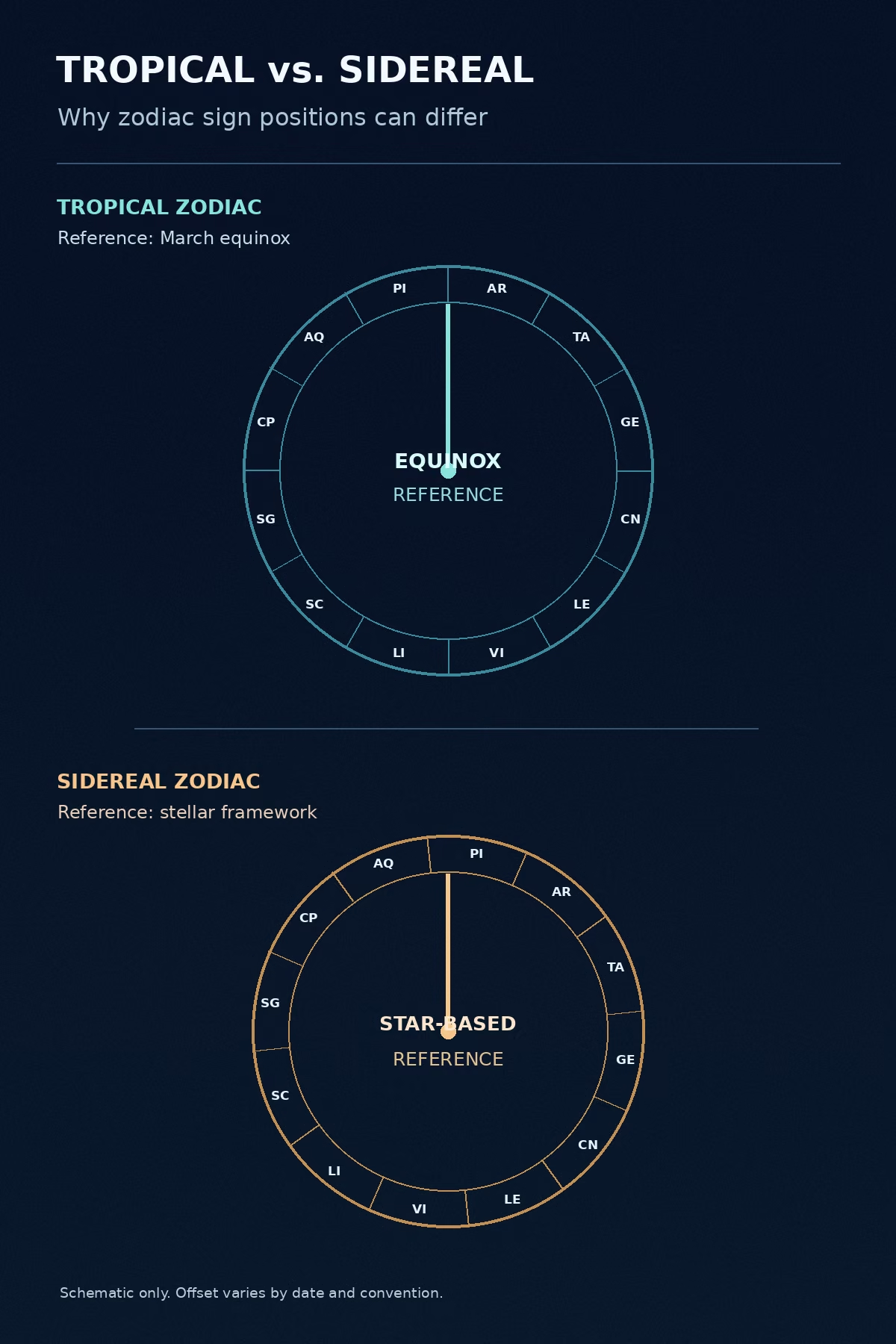
Both commonly divide a complete circle into twelve equal sections of 30 degrees. Their principal difference concerns the location of the zero-degree reference point.
The tropical zodiac uses an equinox-related reference, while sidereal zodiacs reference positions relative to a stellar framework.
Because Earth’s axis precesses, these reference points do not remain aligned over long periods. The resulting difference affects which zodiac sign is assigned to a particular celestial longitude.[14] [26]
Tropical Zodiac
The tropical zodiac is the zodiac system most commonly used in contemporary Western astrology.
It places the beginning of Aries at the March equinox, when the apparent path of the Sun crosses the celestial equator northward.
The remaining eleven signs each occupy successive 30-degree sections along the ecliptic.
This means that the tropical zodiac is tied to the equinox reference system rather than fixed to the current visual boundaries of the constellations.
Its sign names preserve historical associations with star patterns, but the physical constellations have shifted relative to its seasonal reference points over time.
The tropical zodiac is a defined coordinate convention. Its mathematical consistency does not demonstrate the validity of the personality or predictive meanings associated with its signs.
Sidereal Zodiac
A sidereal zodiac defines its reference point in relation to a stellar framework rather than fixing it to the moving equinox.
Sidereal zodiac systems are used in many Indian astrological traditions and in certain other astrological approaches.
These systems generally retain twelve equal 30-degree signs, so they should not be confused with the irregular boundaries of the modern IAU constellations.
Different sidereal traditions may choose slightly different reference points, producing differences in calculated zodiacal longitudes.
The underlying calculations can be performed using established astronomical coordinate methods.
However, there is no scientific evidence that choosing a star-referenced zodiac makes astrological personality or life-event predictions reliable.
Why Do Tropical and Sidereal Zodiac Signs Differ?
The difference between tropical and sidereal zodiac positions arises primarily from the precession of the equinoxes.
As Earth’s rotational axis gradually changes orientation, the equinox reference moves relative to the stars.
The angular offset between the reference points of the two zodiac systems is called ayanamsha.
The exact value depends on the date and the sidereal convention being applied. Different ayanamsha definitions can produce somewhat different calculated placements.
Consequently, a person may receive different Sun-sign classifications under tropical and sidereal astrology.
Neither classification necessarily involves an error in the underlying planetary-position calculation. They employ different coordinate conventions.
Importantly, disagreement over which zodiac to use is separate from the question of whether the assigned astrological meanings have predictive validity.[26]
What Is an Ephemeris, and How Is It Used in Both Fields?
An ephemeris is a table or dataset providing calculated positions and often other properties of celestial objects at specified times.
Astronomers use ephemerides to plan observations, predict planetary positions, calculate spacecraft trajectories, and support precise navigation.
NASA’s Jet Propulsion Laboratory operates the Horizons system, which generates ephemerides for planets, moons, comets, asteroids, and other solar system objects.
These calculations incorporate observational measurements and physical models. Their accuracy depends on the quality of the data and the relevant uncertainties.
Astrologers also use ephemerides to obtain planetary positions for birth charts and other interpretations.
This shared use of positional astronomy is sometimes misunderstood.
An ephemeris can accurately describe where Mars appeared in the sky at a certain time without providing evidence that its position affected someone’s personality or romantic relationships.[15]
What Is Retrograde Motion in Astronomy and Astrology?
Retrograde motion describes the apparent reversal of a celestial object’s usual direction of movement relative to background stars.
In the solar system, this phenomenon commonly results from changing viewing geometry as Earth and other planets move along their orbits.
When Earth overtakes a more distant planet such as Mars, that planet can temporarily appear to move backward against the stars.
Mercury also exhibits apparent retrograde motion, but its geometry involves Mercury’s faster orbit around the Sun and the changing line of sight from Earth.
The planet does not physically reverse its orbital direction during these events.
In astrology, Mercury retrograde is traditionally associated with communication problems, misunderstandings, technological difficulties, or disrupted plans.
Astronomy can calculate the apparent retrograde periods using orbital models. However, no reliable scientific evidence establishes that those periods cause the personal difficulties attributed to them.[27]
Is Astrology a Science? Examining Scientific Evidence and Predictive Accuracy
Whether astrology qualifies as science depends on how its claims are formulated, tested, and supported by evidence.
Scientific inquiry relies on systematic observations, clearly defined hypotheses, critical evaluation, and methods that allow independent researchers to assess results.
Astrology sometimes uses calculations that are scientifically accurate, but its central claims concern relationships between celestial positions and human characteristics or experiences.
The scientific question is whether those proposed relationships can be demonstrated consistently under appropriate testing conditions.[3] [22]
What Makes Astronomy a Science?
Astronomy qualifies as a science because it develops explanations that can be assessed using observational evidence and established physical principles.
Astronomers investigate hypotheses about measurable phenomena, including stellar temperatures, planetary masses, orbital motion, radiation, and galaxy evolution.
A scientific model must be consistent with existing observations while producing useful predictions or explanations that can be independently evaluated.
For example, orbital calculations predict where a planet should appear at a specified time. Telescope observations can then test the result.
Astronomy also recognizes measurement uncertainty, instrumental limitations, and the possibility that established models may need revision.
Scientific conclusions are not automatically permanent truths. They remain open to improvement when sufficiently strong new evidence becomes available.
This continual relationship between prediction, observation, and revision is fundamental to astronomy’s scientific status.[2] [5]
How Does the Scientific Method Apply to Astronomy?
The scientific method is a broad framework for investigating questions through evidence and logical evaluation rather than a single rigid sequence used in every study.
An astronomical investigation might begin with an unexpected change in a star’s brightness.
Researchers could propose that an orbiting planet periodically passes in front of the star, temporarily blocking a small fraction of its light.
The hypothesis generates predictions about the timing, duration, and shape of future brightness changes.
Astronomers then collect additional observations, compare them with the predicted transit pattern, and evaluate alternative explanations such as stellar activity.
If the evidence supports the planetary hypothesis, further measurements may strengthen the interpretation. If important predictions fail, researchers must reconsider their explanation.
The main stages are:
- Identify a question or observation.
- Develop a testable hypothesis.
- Derive predictions.
- Collect and analyze evidence.
- Compare observations with expectations.
- Revise, refine, or reject the explanation when warranted.
This process makes scientific knowledge accountable to observable results.
Why Is Astrology Classified as Pseudoscience?
Pseudoscience refers to claims or practices presented as scientific despite failing to meet important standards of scientific evidence and inquiry.
Astrology is generally classified as pseudoscience when its claims about personality, destiny, or future events are presented as empirically established.
The classification does not arise simply because astrology is old, culturally significant, or associated with spiritual beliefs.
Rather, its central predictive claims have not demonstrated reliable performance under controlled scientific investigation.
Astrological interpretations may also be sufficiently flexible that unsuccessful predictions can be reinterpreted after an event.
However, not everything outside science is pseudoscience. Art, religion, and cultural traditions may serve purposes that do not depend on scientific validation.
The distinction becomes important when astrology is presented as a reliable method for predicting measurable outcomes or explaining human behavior.
Its cultural significance can be acknowledged without treating unsupported empirical claims as scientifically established.[22]
What Is Falsifiability, and Why Does It Matter?
Falsifiability refers to whether a claim could, in principle, conflict with an identifiable observation or result.
Philosopher Karl Popper emphasized falsifiability as an important feature of scientific theories.
Consider the claim that a solar eclipse will begin at a particular location within a specified time interval.
The prediction is testable because observations could show that the eclipse did not occur as expected.
Now consider a horoscope stating that someone may experience an important emotional development.
Unless the statement defines what counts as important, when it will occur, and what constitutes success or failure, almost any outcome may seem compatible with the prediction.
This makes rigorous testing difficult.
Falsifiability is not the only consideration in evaluating scientific claims. Evidence quality, statistical power, explanatory coherence, and reproducibility also matter.
A testable claim may still be false, and passing one test does not establish universal validity.[22]
Can Astrological Predictions Demonstrate Predictive Accuracy?
Predictive accuracy concerns how closely forecasts correspond to outcomes established before those outcomes occur.
An effective test requires predictions that are specific enough to score objectively.
Researchers must also determine how often the same result might occur by chance or through simpler explanations.
For example, if a personality prediction matches a large proportion of people, an apparent success does not necessarily establish an individualized predictive ability.
A 2006 study published in Personality and Individual Differences examined more than 15,000 participants across two large datasets.
The researchers investigated relationships between date of birth, personality characteristics, intelligence, and astrological classifications.
They reported no support for the examined Sun-sign associations with personality and intelligence.
This study does not test every possible astrological tradition, but it provides substantial evidence against the specific relationships investigated.
Overall, controlled scientific research has not established that astrology reliably predicts individual personalities or future life events.[19]
How Does Double-Blind Testing Evaluate Astrological Claims?
Double-blind testing reduces bias by preventing relevant participants or evaluators from knowing information that could influence the results.
In astrology research, blinding can help determine whether practitioners match birth charts to personality descriptions more accurately than chance would predict.
A widely discussed study by Shawn Carlson was published in Nature in 1985.
It tested claims that astrologers could use natal charts to identify personality information. The study reported that participating astrologers did not achieve the anticipated better-than-chance performance.[17]
However, the study has been debated.
A subsequent published reanalysis by Suitbert Ertel criticized aspects of its design and statistical treatment and reported some alternative results suggestive of a possible effect. The author nevertheless did not regard those results as sufficient to establish astrology’s empirical validity.[18]
The distinction is important: criticizing a particular study does not independently demonstrate that astrology works.
Establishing a reliable predictive method would require strong, transparent testing and independently reproducible positive findings across appropriately designed studies.
How Does Peer Review Support Astronomical Research?
Peer review is a quality-control process in which qualified researchers evaluate a scientific manuscript before publication.
Reviewers may examine whether the research question is meaningful, the methodology is appropriate, the calculations are defensible, and the conclusions are supported by the evidence.
Astronomical studies frequently contain detailed descriptions of observational instruments, measurement uncertainties, statistical analyses, and physical models.
These details allow other researchers to evaluate the work or investigate whether its results can be reproduced.
However, peer review does not guarantee that a paper is correct.
Published research can contain errors, unrecognized assumptions, or conclusions that later evidence challenges.
Independent verification, continuing observations, improved methods, and scientific criticism remain essential.
The strength of astronomy therefore comes from an ongoing evidence-evaluation process, not merely from publishing research in scientific journals.
Correlation vs. Causation: Can Planetary Positions Affect Human Lives?
Correlation describes a statistical relationship between variables. Causation means that changes in one factor contribute to changes in another.
These concepts must not be confused.
For example, a study might detect a relationship between birth season and a particular outcome. That observation would not automatically establish an astrological cause.
Researchers would need to investigate alternative explanations, such as environmental, social, or biological seasonal factors.
Celestial objects do have real physical effects on Earth.
The Sun supplies radiation that influences climate, ecosystems, and biological processes. The Moon contributes substantially to ocean tides through gravity.
Solar storms can affect satellites, radio communications, and navigation systems.[25]
However, these established influences do not demonstrate that particular planetary configurations determine personal relationships, intelligence, or professional success.
A proposed causal relationship requires evidence connecting the specific cause to the claimed effect, ideally supported by a plausible physical mechanism.
What Is Confirmation Bias, and How Can It Affect Astrology?
Confirmation bias is the tendency to favor information that supports existing expectations while overlooking or discounting contradictory evidence.
A person who believes in astrology may remember occasions when a horoscope appeared accurate and forget predictions that did not come true.
For example, a horoscope might predict conflict in personal relationships. If an argument occurs, the reader may connect it to the prediction.
If no argument occurs, the unsuccessful forecast may receive little attention.
This selective evaluation can create an exaggerated impression of predictive accuracy.
Confirmation bias is not limited to astrology. It affects reasoning in many areas of human decision-making, including scientific research.
One useful safeguard is to record predictions before events occur, establish clear success criteria, and evaluate all outcomes rather than only memorable examples.[20]
What Is the Barnum Effect, and Why Do Horoscopes Feel Accurate?
The Barnum effect, also called the Forer effect, describes the tendency to accept general personality descriptions as highly specific to oneself.
Consider the statement:
“You enjoy being appreciated, but sometimes you prefer privacy and need time to reconsider important decisions.”
Many individuals could recognize themselves in this description because it combines broadly applicable human experiences.
Horoscopes and personality readings may use similarly flexible language, making the descriptions feel individually accurate even when they are not based on personal evidence.
Psychologist Bertram Forer investigated this phenomenon in work published in 1949.
The Barnum effect differs from confirmation bias, although they can reinforce each other.
The Barnum effect concerns the perceived personal relevance of general statements. Confirmation bias influences which experiences people emphasize or remember.
Neither subjective recognition nor personal satisfaction is sufficient evidence that a prediction has objective scientific accuracy.[21]
How Did Astronomy and Astrology Develop Historically?
Astronomy and astrology have intertwined histories extending across multiple civilizations.
Ancient societies observed celestial phenomena for practical, religious, political, and philosophical purposes. Careful observations helped establish calendars and recognize recurring astronomical cycles.
At the same time, celestial events were often interpreted as signs associated with rulers, communities, or human affairs.
Modern astronomy did not emerge in one isolated moment. Its development involved centuries of improvements in mathematics, instruments, observational techniques, and explanations of natural phenomena.[16] [23]
Ancient Astronomy and Astrology: Why Were They Once Connected?
Ancient civilizations relied on astronomical observations to track time, organize agriculture, navigate, and understand recurring celestial events.
Babylonian scholars maintained detailed records of planetary movements and other sky phenomena. These observations supported both mathematical astronomy and traditions of celestial divination.
Astrological interpretations were sometimes concerned with the fortunes of rulers or entire societies rather than individual personalities.
Other civilizations developed important astronomical knowledge independently or through cultural exchange.
Ancient Egyptian observers associated the appearance of particular stars with annual cycles, while Chinese astronomers recorded events such as comets and temporary bright stars.
Mesoamerican cultures developed sophisticated calendar systems, and Polynesian navigators used stars to travel across large ocean distances.
These traditions illustrate why astronomy and astrology should not be described as originating through one universal historical sequence.
Accurate observations and symbolic interpretations could coexist within the same cultural framework.[23]

How Did Ancient Greek Scholars Influence Astronomy and Astrology?
Greek scholars made important contributions to mathematical astronomy and the interpretation of celestial phenomena.
Hipparchus, active during the second century BCE, carried out detailed observations, developed a major star catalog, and identified the phenomenon now called precession.
Claudius Ptolemy, working in Roman-era Alexandria during the second century CE, produced influential works on both astronomy and astrology.
His Almagest presented a mathematical framework for predicting planetary positions using a geocentric system.
His Tetrabiblos systematically discussed astrological interpretation.
These works illustrate how astronomy and astrology could coexist within the intellectual traditions of the ancient world.
Greek astronomical knowledge was subsequently transmitted, translated, criticized, and extended by scholars in other cultural traditions, including the Islamic world.
The development of astronomy was therefore cumulative, involving cross-cultural exchange rather than a continuous tradition belonging to one civilization alone.[16] [23]
How Did the Scientific Revolution Separate Astronomy from Astrology?
The Scientific Revolution transformed the understanding of celestial motion by increasingly connecting astronomical observations with mathematical explanations and physical laws.
Nicolaus Copernicus advanced a heliocentric model in which Earth and the other planets orbit the Sun.
Galileo Galilei used telescopic observations to investigate the Moon, Jupiter’s satellites, and the phases of Venus, contributing evidence that challenged traditional assumptions about the heavens.
Johannes Kepler demonstrated that planetary orbits could be described through mathematical laws involving ellipses.
Isaac Newton later provided a physical explanation for planetary motion through universal gravitation and laws of motion.
These developments strengthened astronomy’s ability to explain and predict celestial phenomena using testable physical models.
However, astronomy and astrology did not separate instantly. Some early modern scholars continued participating in astrological practices.
The distinction developed gradually as empirical methods and institutional scientific standards became increasingly important.[24]
When Did Astronomy Become a Modern Scientific Discipline?
Modern astronomy emerged through a long process rather than a single historical event.
During the seventeenth century, increasingly precise observations and mathematical physics transformed explanations of planetary motion.
The development of improved telescopes, measurement instruments, and observational methods expanded the range of objects astronomers could study.
During the nineteenth century, spectroscopy and photography made it possible to investigate the physical and chemical properties of stars more systematically.
These developments contributed to the growth of astrophysics.
In the twentieth century, radio astronomy, space-based observations, relativity, and cosmological measurements dramatically expanded the field.
Professional observatories, research institutions, scientific journals, and international collaborations also strengthened systematic astronomical investigation.
Modern astronomy consequently became a broad scientific enterprise involving observations across the electromagnetic spectrum, advanced computing, spacecraft missions, and theoretical research.
Astrology continued as a cultural and interpretive practice but did not acquire comparable empirical validation for its central predictive claims.
Astronomy and Astrology in Modern Society: How Are They Used Today?
Astronomy and astrology occupy very different roles in contemporary society.
Astronomy contributes to scientific knowledge, technological development, space exploration, and the understanding of environmental influences from space.
Astrology continues through traditional practices, personal consultations, digital media, and cultural expressions.
Their coexistence reflects the difference between scientific explanations and systems that people may find personally meaningful.
Recognizing their separate functions allows individuals to appreciate historical traditions without confusing them with experimentally supported knowledge.
What Are the Modern Applications of Astronomy?
Astronomy supports research and practical activities involving celestial mechanics, space science, planetary environments, and the broader universe.
Orbital calculations are essential for planning spacecraft missions and understanding the movement of satellites and other objects.
Astronomical measurements also contribute to celestial reference systems, navigation, and the accurate determination of time and position.
Planetary science informs exploration missions and investigations of potentially habitable environments beyond Earth.
Solar physics and space-weather research help scientists monitor conditions that can affect satellites, communications, navigation, and electrical infrastructure.
Large observatories and international research collaborations investigate questions about galaxy formation, stellar evolution, dark matter, and the expansion of the universe.
Not every technological application comes directly from astronomy, but astronomical research contributes instruments, computational methods, and physical understanding used across scientific and engineering disciplines.[15] [25]
Why Is Astrology Still Popular?
Astrology remains popular because it serves cultural, psychological, social, and sometimes spiritual purposes for many people.
Zodiac signs provide an accessible vocabulary for discussing personality, relationships, and identity.
Horoscopes can also function as entertainment, conversation starters, or prompts for personal reflection.
In some societies, astrological traditions are incorporated into customary practices surrounding relationships, ceremonies, or significant life decisions.
Digital platforms have made astrological content widely accessible through applications, websites, and social media.
The subjective appeal of astrology does not necessarily depend on its scientific accuracy.
People may experience comfort, familiarity, or enjoyment from symbolic interpretations even when those interpretations lack demonstrated predictive power.
Psychological processes, including confirmation bias and the Barnum effect, can also contribute to the perception that astrological readings are personally accurate.[20] [21]
How Do Education and Media Shape Public Understanding?
Education and media influence how people distinguish scientific explanations from traditional beliefs.
Astronomy education introduces concepts such as gravity, planetary motion, electromagnetic radiation, and observational evidence.
These topics provide tools for evaluating claims about celestial phenomena.
However, popular media sometimes uses astronomical terminology when presenting astrological predictions, which can blur the distinction between measured facts and symbolic interpretations.
For example, an article may accurately describe a planetary conjunction but then suggest that it necessarily causes changes in relationships or financial outcomes.
The astronomical description and personal causal claim require separate evaluation.
Scientific literacy involves identifying the original source of a claim, understanding the evidence behind it, recognizing uncertainty, and distinguishing correlation from causation.
These skills help readers engage critically with information without dismissing its possible cultural significance.
Can Someone Be Interested in Both Astronomy and Astrology?
A person can study astronomy and also enjoy astrology as a cultural practice, form of entertainment, or personal symbolic framework.
These interests are not necessarily incompatible at the level of individual preference.
The important distinction concerns how claims are understood.
Someone may enjoy discussing zodiac personality descriptions while recognizing that those descriptions are not supported by reliable scientific evidence.
Similarly, an individual can appreciate the historical influence of astrology on sky observation without treating its predictions as scientifically established.
Problems arise when unsupported interpretations are presented as reliable facts, particularly when used for consequential decisions.
A balanced approach recognizes that personal meaning and empirical truth are not identical.
Scientific questions should be evaluated through evidence, while cultural participation can be understood within its appropriate social and historical context.
Common Misconceptions About Astronomy and Astrology
The shared history and terminology of astronomy and astrology have produced several persistent misconceptions.
Many arise because accurate astronomical calculations are used within astrological systems, making the interpretations appear scientifically grounded.
Others concern confusion between zodiac signs and constellations, or misunderstandings about real physical phenomena such as retrograde motion and gravity.
Separating what astronomy can measure from what astrology interprets helps clarify these issues.
Are Astronomy and Astrology Two Branches of the Same Science?
No. Astronomy and astrology are not two branches of the same modern scientific discipline.
Astronomy is a natural science that investigates celestial objects through empirical observation, physical theory, and mathematical analysis.
Astrology is a traditional interpretive system that associates celestial configurations with human characteristics or events.
The two share historical roots, and their boundaries were not always clearly distinguished in earlier societies.
However, a common historical origin does not mean that both practices meet contemporary standards of scientific evidence.
Modern astronomy develops testable explanations of physical phenomena. Astrology’s central personality and life-event predictions have not achieved comparable empirical validation.[1] [3]
Does Astronomy Use Zodiac Signs?
Astronomy investigates the regions of the sky associated with the zodiac, but astronomers do not use zodiac signs to determine personality or destiny.
The astronomical zodiac includes constellations located along the Sun’s apparent annual path.
The International Astronomical Union defines constellations as regions with official boundaries, while traditional Western astrological zodiac signs divide the ecliptic into twelve equal sections.
Astronomers may refer to zodiacal constellations when describing celestial positions or observational events.
They also use coordinate systems that measure positions relative to the ecliptic.
These methods serve geometric and scientific purposes rather than assigning personal meaning to birth dates.[12] [13]
Do Astrologers and Astronomers Calculate the Same Planetary Positions?
Astronomers and astrologers can use the same underlying astronomical calculations to determine planetary positions.
Both may consult ephemerides, apply time conversions, and calculate apparent celestial coordinates.
However, the resulting numbers may be expressed through different coordinate conventions.
For example, an astrologer may convert a calculated planetary longitude into tropical or sidereal zodiac coordinates.
Astronomers commonly use coordinate systems appropriate to research, observation planning, or spacecraft navigation.
The critical difference lies in interpretation.
A correct calculation of Venus’s position is a statement about celestial geometry. It does not establish that Venus determines someone’s romantic compatibility or emotional tendencies.[15] [26]
Does Mercury Retrograde Actually Cause Problems?
Mercury retrograde is a real apparent astronomical phenomenon, but the claim that it causes communication problems or technological failures is unsupported by reliable scientific evidence.
From Earth’s changing viewpoint, Mercury can temporarily appear to reverse its usual motion against the background stars.
This occurs because Mercury and Earth move around the Sun at different orbital speeds and distances.
Astronomers can predict these intervals using established orbital models.
The retrograde period does not represent Mercury physically traveling backward along its orbit.
Although someone might experience inconvenient events during such a period, coincidence alone does not demonstrate causation.
An appropriate test would need to compare clearly defined problems during retrograde and non-retrograde periods while accounting for chance and other influences.[27]
Does Gravity Prove That Astrology Works?
Gravity is a real physical interaction between objects with mass, including celestial bodies and human beings.
The Sun’s gravity keeps Earth in orbit, while the Moon’s gravitational influence contributes to the ocean tides.
These measurable effects are explained through established physical theories.
However, the existence of gravitational interactions does not demonstrate the particular personality or predictive claims made by astrology.
To establish such a relationship, researchers would need evidence connecting defined planetary configurations to specific human outcomes.
They would also need to distinguish any proposed influence from environmental factors, chance associations, and measurement bias.
No such reliable body of evidence currently establishes astrology’s central predictive claims.
Physical influence and astrological significance are therefore separate concepts.
Are Astrology Predictions Scientifically Proven?
Astrological predictions concerning personality, relationships, and future life events have not been scientifically established as reliable.
Researchers have tested several kinds of astrological claims using personality assessments, birth data, statistical comparisons, and controlled matching experiments.
The overall evidence has not demonstrated consistent predictive performance sufficient to validate astrology’s central claims.
Individual studies can have limitations, and researchers may disagree over particular methods or analyses.
For example, Carlson’s 1985 experiment has been subject to subsequent methodological criticism.
Nevertheless, disagreements about one experiment do not constitute independent evidence that astrological predictions work.
Scientific confirmation requires results that are clearly defined, statistically defensible, and independently reproducible.
Personal anecdotes and readings that feel accurate cannot substitute for that standard.[17] [18] [19]
Frequently Asked Questions About Astronomy and Astrology
The following questions address common points of confusion between astronomy and astrology, including their scientific classifications, historical development, terminology, and practical applications.
Although many of the questions have straightforward answers, understanding the underlying reasoning helps clarify why shared celestial concepts do not imply shared scientific validity.
The central distinction remains consistent: astronomy studies measurable physical phenomena, while astrology interprets celestial arrangements through symbolic frameworks.
What Is the Biggest Difference Between Astronomy and Astrology?
The biggest difference is that astronomy investigates the universe scientifically, while astrology interprets celestial positions in relation to human life.
Astronomers use observations, physics, mathematics, and testable models to explain celestial phenomena.
Astrologers use zodiac signs, birth charts, and symbolic traditions to interpret personality and events.
Astronomical conclusions can be checked against measurable evidence. Astrology’s central personal predictions have not demonstrated comparable reliability under controlled testing.
Their common vocabulary does not eliminate this fundamental methodological difference.
Is Astronomy a Science and Astrology a Pseudoscience?
Yes. Astronomy is a recognized natural science, while astrology is generally classified as pseudoscience when its predictive claims are presented as scientific knowledge.
Astronomy uses testable hypotheses, observational measurements, and physical explanations.
Astrology includes historically developed symbolic interpretations that have not demonstrated reliable predictive validity.
However, astrology may also be practiced simply as entertainment or cultural expression.
Calling its scientific claims pseudoscientific does not mean that every personal or cultural use of astrology is attempting to function as science.
The classification concerns the evidence supporting its claims.[22]
Which Came First, Astronomy or Astrology?
Astronomy and astrology developed through intertwined ancient traditions, so assigning a single universal starting point is misleading.
People observed the sky long before the emergence of either field in its modern form.
Early observations supported calendars, seasonal planning, navigation, and religious interpretation.
Organized celestial divination and mathematical astronomy developed within ancient civilizations, including Mesopotamia.
Modern scientific astronomy emerged much later through increasingly precise observation and mathematical physics.
Astrology therefore cannot accurately be described as simply the predecessor of all astronomy, nor can ancient astronomical practices be reduced entirely to astrology.[16] [23]
Why Are Astronomy and Astrology So Similar in Name?
Astronomy and astrology share linguistic roots associated with the Greek word astron, meaning star.
The terms developed through historical traditions concerned with understanding or interpreting celestial phenomena.
Astronomy became associated with the scientific study of celestial objects, while astrology came to designate systems interpreting the positions of those objects in relation to human affairs.
Their similar names reflect a shared historical and linguistic background.
However, their modern meanings are distinct, just as a shared word origin does not necessarily imply identical methods, purposes, or evidentiary standards.
Is the Zodiac Used in Astronomy?
The zodiac has an astronomical meaning because it refers to the region around the ecliptic where the Sun, Moon, and planets appear.
Astronomers study this region and its constellations when observing celestial objects or describing sky positions.
However, modern astronomy does not assign personality characteristics to zodiac signs.
The astronomical constellations have varying boundaries and sizes, unlike the twelve equal zodiac divisions used by many astrologers.
The Sun’s apparent annual path crosses Ophiuchus as well as the twelve traditionally named zodiacal constellations.
This astronomical fact does not require adding a new sign to Western tropical astrology.[13]
Can Astrology Accurately Predict the Future?
There is no reliable scientific evidence demonstrating that astrology can consistently predict individual future events better than appropriate chance-based or alternative explanations.
Some predictions are vague enough that many possible outcomes can appear to confirm them.
Others are more specific and can be evaluated through controlled testing.
To establish genuine predictive ability, astrologers would need to produce clearly defined forecasts, record them before outcomes occur, and demonstrate repeatable accuracy under independent evaluation.
Personal experiences of apparently correct predictions are not sufficient because chance, selective memory, and flexible interpretation can create misleading impressions of success.[19] [20]
What Is the Difference Between an Astronomer and an Astrologer?
An astronomer is a scientist who studies celestial objects and physical processes through observation, mathematical analysis, and scientific research.
Astronomers commonly work in research institutions, universities, observatories, and space-related organizations.
An astrologer interprets celestial positions using astrological systems, often producing birth-chart readings, horoscopes, or consultations.
Their educational backgrounds and professional activities can vary substantially.
Astronomers are evaluated through scientific methods, research quality, and observable evidence.
Astrological practice does not have an equivalent established system of empirical validation for its personal predictive claims.
Both may use planetary-position data, but their professional purposes differ.
Is Astrophysics the Same as Astronomy?
Astrophysics is a major branch of astronomy focused on understanding celestial phenomena through physical laws.
Astronomy is the broader discipline studying objects and events throughout the universe.
Astrophysicists investigate questions involving gravity, radiation, stellar energy production, black holes, and the physical evolution of cosmic structures.
Modern astronomical research frequently overlaps with astrophysics, making the terms closely related and sometimes interchangeable in professional contexts.
However, not all astronomical work emphasizes the same theoretical questions.
Observational astronomy, planetary science, and celestial mechanics may involve different research priorities while still relying on physical principles.
Why Do Horoscope Predictions Sometimes Seem Correct?
Horoscope predictions can appear accurate because they frequently contain broad statements that apply to many people.
The Barnum effect helps explain why generalized personality descriptions may feel personally specific.
Confirmation bias can then reinforce that impression when people remember apparent successes and overlook unsuccessful predictions.
Chance also plays a role because common life events are likely to occur for many individuals over time.
Additionally, flexible wording makes it easier to interpret events as matching a prediction after they happen.
These psychological processes can create sincere feelings of accuracy without demonstrating that a horoscope contains reliable predictive information.[20] [21]
Can Planetary Alignment Affect Human Behavior?
Planetary alignments are real astronomical configurations, but there is no reliable scientific evidence that their symbolic arrangements determine human personality or behavior.
Celestial bodies interact through gravity and other established physical processes.
However, the existence of those interactions does not demonstrate that a conjunction, opposition, or other alignment produces specific personal outcomes.
Planetary alignments observed from Earth can also be apparent arrangements along our line of sight rather than close physical groupings in space.
A scientific claim about behavioral influence would require a clearly defined effect, appropriate measurements, and evidence distinguishing the proposed cause from competing explanations.[28]
Conclusion: Understanding the Real Difference Between Astronomy and Astrology
Astronomy and astrology share a long historical relationship, but their purposes, methods, and scientific standing are fundamentally different.
Astronomy is the scientific investigation of celestial objects and the universe. It relies on observation, mathematical modeling, physical laws, and the critical evaluation of evidence.
Through these methods, astronomers can explain planetary orbits, study distant galaxies, identify chemical elements in stars, and investigate the evolution of the cosmos.
Astrology, by contrast, interprets celestial positions through symbolic traditions connecting the sky with personality, relationships, and human events.
Although astrology may use mathematically accurate planetary positions, that accuracy does not validate the personal meanings assigned to those positions.
Scientific studies have not established reliable predictive validity for astrology’s central claims.
This distinction does not erase astrology’s historical or cultural importance. Ancient astrological traditions contributed to humanity’s long-standing interest in observing the sky, and many people continue to find personal meaning in them.
However, cultural significance and scientific evidence serve different purposes.
Understanding the distinction encourages more accurate thinking about both fields and helps readers assess claims involving celestial objects, physical mechanisms, and human experiences.
The essential takeaway: Astronomy explains how the universe behaves through evidence and physical laws. Astrology interprets celestial arrangements in relation to human life, but its central predictive claims lack reliable scientific support.
Sources
The article draws on scientific agencies, astronomical organizations, educational references, peer-reviewed research, and academic sources. References concerning astrological terminology describe how its practitioners define and use those systems; they are not presented as scientific validation of astrological predictions.
Astronomy, planetary science, and physical evidence
[1] American Astronomical Society. Frequently Asked Questions: Difference Between Astronomy and Astrology.
[2] NASA Science. Universe Glossary: Astronomy, Astrophysics, Spectroscopy, and Celestial Terminology.
[3] International Astronomical Union, Office of Astronomy for Education. Glossary: Astrology.
[4] NASA Science. Solar System Facts.
[5] NASA Science. Orbits and Kepler’s Laws.
[6] NASA Science. Eclipses Frequently Asked Questions.
[7] NASA Science. Hubble vs. Webb.
[8] NASA Science. Spectroscopy 101: Beyond Temperature and Composition.
[9] NASA Science. Star Lifecycle.
[10] NASA Science. Big Bang and the Evolution of the Universe.
Astrological terminology and celestial reference systems
[11] Astrodienst. A Brief Introduction to Astrology: The House System.
[12] International Astronomical Union. The 88 IAU Constellations.
[13] International Astronomical Union. Frequently Asked Questions: Zodiac Constellations and Ophiuchus.
[14] NASA Science. Basics of Space Flight: Reference Systems and Precession.
[15] NASA Jet Propulsion Laboratory. Horizons System Manual. Documentation reviewed includes the August 25, 2026 version.
[16] OpenStax, Rice University. Astronomy: Astrology and Astronomy.
Scientific testing and psychology
[17] Carlson, Shawn. (1985). A Double-Blind Test of Astrology. Nature, 318, 419–425.
[18] Ertel, Suitbert. (2009). Appraisal of Shawn Carlson’s Renowned Astrology Tests. Journal of Scientific Exploration, 23(2), 125–137.
[19] Hartmann, Peter, Martin Reuter, and Helmuth Nyborg. (2006). The Relationship Between Date of Birth and Individual Differences in Personality and General Intelligence: A Large-Scale Study. Personality and Individual Differences, 40(7), 1349–1362.
[20] American Psychological Association. Dictionary of Psychology: Confirmation Bias.
[21] American Psychological Association. Dictionary of Psychology: Barnum Effect.
[22] Stanford Encyclopedia of Philosophy. Science and Pseudo-Science.
History, applications, and additional reference material
[23] OpenStax, Rice University. Astronomy 2e: Ancient Astronomy.
[24] OpenStax, Rice University. Astronomy: The Birth of Modern Astronomy.
[25] NOAA Space Weather Prediction Center. Space Weather Impacts.
[26] Koch, Dieter. Astrodienst. Ayanamshas in Sidereal Astrology. Used to document the distinction between tropical and sidereal astrological conventions.
[27] NASA Science. Planetary Motion: The History of an Idea That Launched the Scientific Revolution.
[28] NASA Science. Planetary Alignments and Planet Parades.