
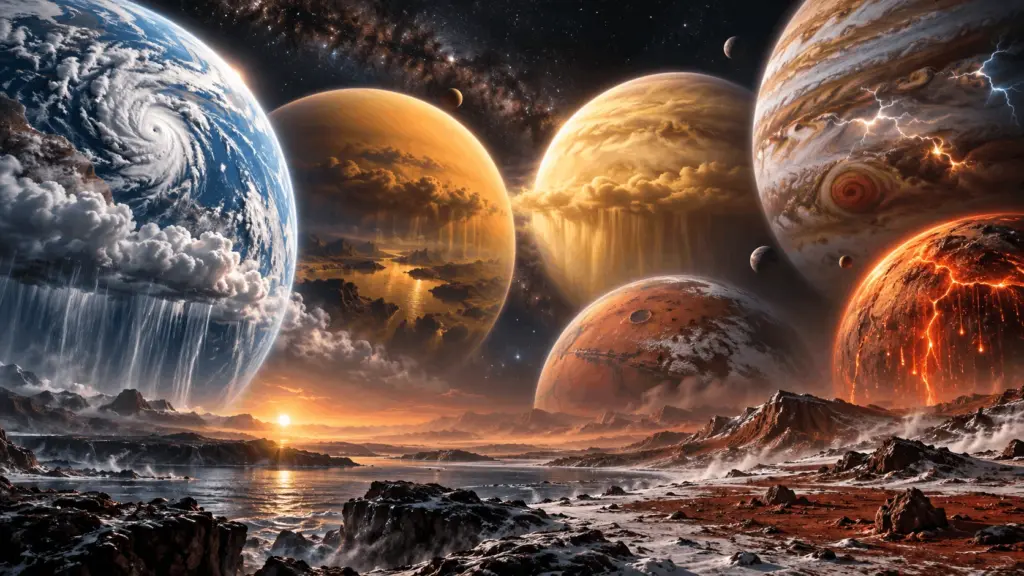
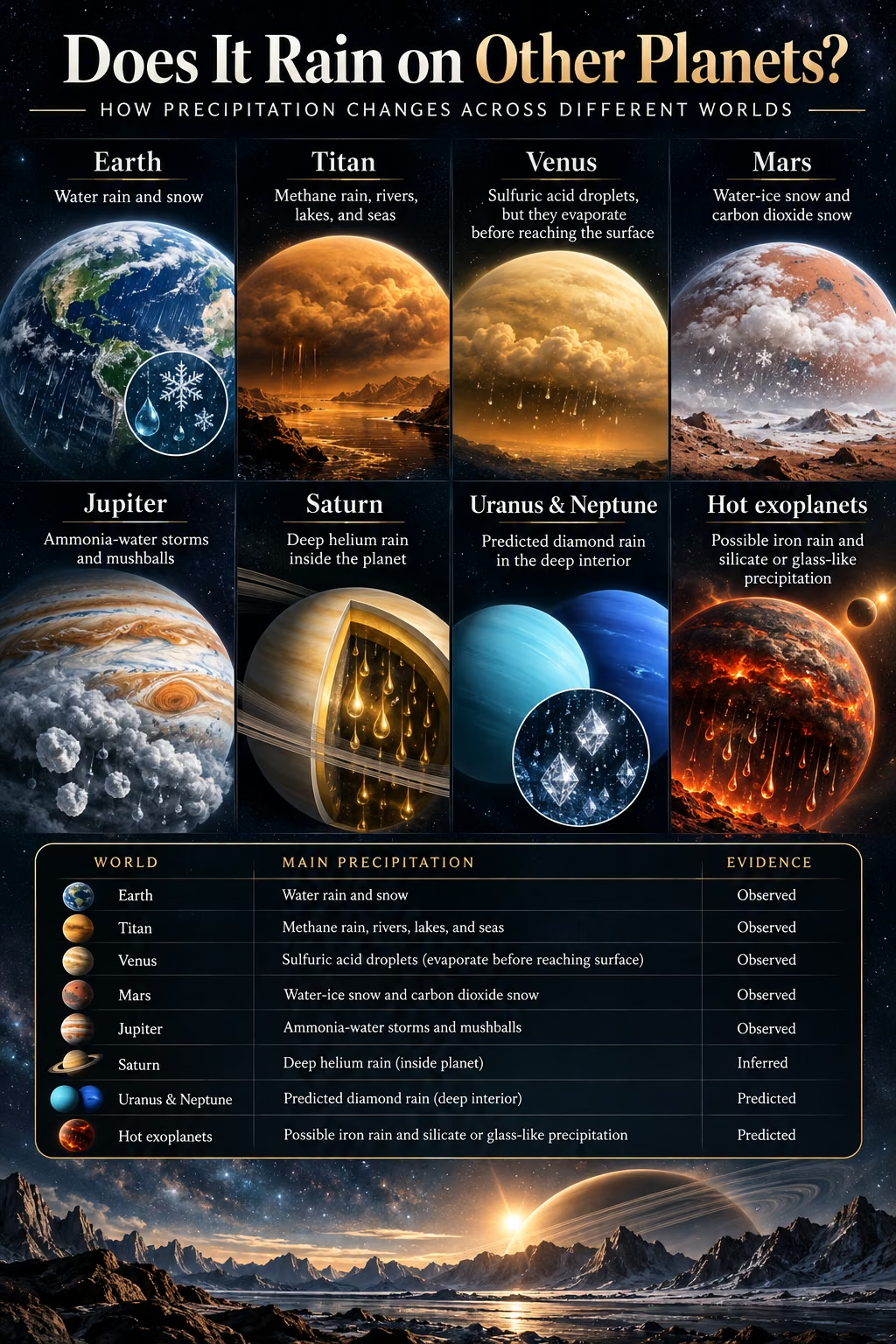
Yes, but rain elsewhere in the universe can be radically different from the water droplets that fall on Earth. Planetary scientists use the broader idea of precipitation to describe material that condenses, freezes, crystallizes, or otherwise separates from an atmosphere or planetary fluid and moves downward under gravity. On different worlds, that material may include methane, sulfuric acid, water ice, carbon dioxide ice, ammonia-rich mixtures, helium, carbon, iron, or silicate minerals.
The evidence is not equally strong in every case. Methane rainfall on Titan and snow on Mars are supported by spacecraft observations. Sulfuric acid droplets occur in Venus’s clouds but evaporate long before reaching its surface. Jupiter’s ammonia-rich weather involves complex ammonia-water precipitation and hail-like “mushballs.” Helium rain inside Saturn and Jupiter is supported by interior physics and models rather than visible cloud observations.
Diamond rain on Uranus and Neptune is a prediction supported by laboratory experiments. On exoplanets such as WASP-76b and HD 189733 b, exotic “iron rain” and “glass rain” are interpretations of spectroscopy, atmospheric physics, and models rather than photographs of falling droplets. [2][5][8][9][12][14][17][19][21]
Rain Beyond Earth: Can It Really Rain on Other Planets?
Rain beyond Earth is real if “rain” is understood in the planetary-science sense. The fundamental physics is familiar: a substance exists as vapor or dissolved material, environmental conditions change, condensation or crystallization becomes favorable, particles or droplets form, and gravity carries them toward lower layers.
What changes from world to world is the substance involved and whether the material remains liquid, freezes, evaporates, sublimates, or chemically decomposes before reaching a surface.
That distinction is essential because worlds such as Jupiter and Saturn do not have an Earth-like solid surface beneath their visible clouds. On those planets, precipitation can simply descend into progressively hotter and denser atmospheric layers. Titan, by contrast, has a solid surface where hydrocarbon rain can carve channels and replenish lakes and seas. [2][3][11][13]
| World | Main precipitation discussed | Where it occurs | Evidence status |
|---|---|---|---|
| Earth | Water rain, snow, hail | Atmosphere to surface | Directly observed |
| Titan | Methane-rich rain | Atmosphere to surface | Strong spacecraft evidence |
| Venus | Sulfuric acid droplets | Clouds, evaporating below | Direct cloud evidence plus physical interpretation |
| Mars | Water-ice and CO₂ snow | Atmosphere, polar regions | Direct spacecraft evidence |
| Jupiter | Ammonia-water precipitation and mushballs | Deep atmosphere | Spacecraft evidence plus modeling |
| Saturn | Atmospheric condensates, deep helium rain | Atmosphere and interior | Helium rain is model-based |
| Uranus and Neptune | Diamond precipitation | Deep interior | Laboratory-supported prediction |
| WASP-76b | Condensed iron | Day-night atmospheric circulation | Spectroscopic inference |
| HD 189733 b | Silicate or glass-like particles | Hot atmosphere | Possible, model-supported interpretation |
What Scientists Mean by Extraterrestrial Rain
Extraterrestrial rain is any precipitation process in which material separates from an atmosphere or fluid layer and moves downward because of gravity. On Earth, the familiar substance is water. Elsewhere, the available chemicals and environmental conditions are different, so water does not have a monopoly on precipitation.
Methane can condense on Titan because the moon is extremely cold. Sulfuric acid forms droplets in Venus’s clouds. Carbon dioxide can freeze into snow on Mars. Under much more extreme conditions, iron, silicates, carbon, or helium may separate from surrounding material and move downward.
For that reason, scientists often prefer precipitation when comparing worlds. The term includes liquid droplets, ice crystals, solid particles, slush, hail-like bodies, and even gravitational separation deep inside planets. [2][5][9][12][14][17]
Why Rain Is Different on Every Planet
The type of precipitation a world can produce depends mainly on temperature, pressure, atmospheric composition, vertical temperature structure, and the availability of condensable material. A substance that is gaseous on one world may be liquid or solid on another. Methane is normally a gas under everyday terrestrial conditions, but at Titan’s surface temperature of roughly -179°C it can exist as a liquid and participate in a climate cycle involving clouds, rain, rivers, lakes, and seas. [2]
Pressure matters as much as temperature. Increasing pressure changes the conditions at which phases are stable and becomes especially important in the interiors of giant planets. Atmospheric chemistry also determines which substances are actually available to form clouds.
Venus supplies sulfur compounds that produce sulfuric acid clouds, while Jupiter’s hydrogen-helium atmosphere contains ammonia and water that participate in very different cloud and storm processes. [5][11][14]
How Does Rain Form on Another Planet?
The basic recipe for extraterrestrial precipitation is surprisingly universal. A material must first be present in vapor, fluid, or dissolved form. Environmental conditions then move it into a part of its phase diagram where condensation, freezing, crystallization, or phase separation becomes favorable. Small particles or droplets form and may grow through collisions, deposition, chemical reactions, or continued condensation. Once they become heavy enough relative to atmospheric motions, gravity makes them descend.
Whether they survive that descent is another question. Temperature and pressure usually change dramatically with altitude. A droplet may therefore form in one atmospheric layer and disappear in another. Venus provides an excellent example, because sulfuric acid droplets form high in its clouds but encounter temperatures below the cloud deck that are hot enough to evaporate them. [5][6]
Condensation and Cloud Formation
Condensation occurs when a vapor becomes a liquid, although planetary clouds can also form when vapor deposits directly into solid crystals. Cooling is a common trigger. When an ascending parcel of atmosphere expands and cools, a condensable substance can become saturated. Molecules then collect on aerosol particles or other condensation nuclei and build droplets or crystals.
Earth’s water clouds illustrate the process, but the same physical principle can operate with different chemicals. Methane condenses into clouds on Titan. Ammonia participates in Jupiter’s upper cloud system. Silicate materials can form clouds in atmospheres hot enough to vaporize rock. The composition of the cloud is therefore a major clue to the type of precipitation that might develop below it. [1][2][11][23]
Evaporation and Atmospheric Cycling
Evaporation is the transfer of molecules from a liquid into a gaseous state. On Earth, solar energy drives enormous amounts of water from oceans and other reservoirs into the atmosphere. The vapor later condenses, forms clouds, and returns as precipitation, creating part of the hydrological cycle. NOAA emphasizes that the complete water cycle also includes storage, runoff, groundwater, ice, transpiration, and other pathways. [1]
A comparable cycle can exist with another liquid. Titan provides the clearest extraterrestrial example. Methane evaporates from surface reservoirs, enters the atmosphere, condenses into clouds, falls as precipitation, flows across the surface, and accumulates again in lakes and seas. The chemistry differs from Earth’s water cycle, but the relationship among evaporation, condensation, precipitation, runoff, and storage is strikingly familiar. [2][3]
Sublimation in Cold Planetary Environments
Sublimation is a phase change in which a solid becomes a gas without first melting into a liquid. The reverse process, direct conversion from gas to solid, is usually called deposition. Sublimation is particularly important on Mars because the planet is cold and its atmosphere is thin. Both water ice and carbon dioxide ice can undergo strong seasonal exchanges between surface deposits and the atmosphere.
NASA observations show seasonal carbon dioxide frost and snow associated with Mars’s polar regions. As sunlight returns and temperatures increase, carbon dioxide ice does not need to melt first. It can transform directly back into gas. Water ice exposed at the surface can also sublimate rapidly under Martian conditions. These processes help drive seasonal changes in the polar caps and atmospheric circulation. [7][9]
What Is Virga?
Virga is precipitation that forms and begins falling from a cloud but evaporates or sublimates before reaching the surface. The phenomenon occurs on Earth and is especially useful when discussing other planets because enormous vertical changes in temperature and pressure can destroy precipitation during its descent.
Venus offers an extreme example. Sulfuric acid droplets form in its cloud system, but lower atmospheric temperatures eventually become high enough to evaporate the droplets before they reach the ground. Mars can also produce fall streaks. NASA’s Phoenix lander detected water-ice crystals descending from clouds during observations in 2008, and one early measurement showed the snow vaporizing before reaching the ground. Later mission summaries also describe Martian water-ice snowfall reaching the surface under some conditions, showing that survival depends on the atmospheric profile at the time and place of the event. [6][8]
Earth’s Hydrological Cycle: The Familiar Model of Rain
Earth provides the most accessible model for understanding planetary precipitation, but it should not be treated as the universal template for chemistry. Earth’s climate system works because water can naturally move among vapor, liquid, and solid states across common surface and atmospheric temperatures. Oceans provide a vast reservoir, the atmosphere transports vapor and clouds, precipitation returns water to the surface, and rivers, groundwater, glaciers, vegetation, and runoff redistribute it.
When scientists compare Earth with Titan or Mars, they are therefore comparing cycles and physical processes, not assuming the same substance must be involved. The same principles of energy transfer, phase change, atmospheric circulation, gravity, and surface storage can create completely different meteorological systems under different planetary conditions. [1][2]
How the Hydrological Cycle Works
Earth’s hydrological cycle continuously exchanges water among the atmosphere, oceans, surface, ground, ice, and living systems. Liquid water evaporates from oceans, lakes, rivers, wet soils, and falling precipitation. Plants return water vapor through transpiration. As moist air cools, water vapor condenses into droplets or deposits as ice, creating clouds. When droplets or crystals become large enough, they fall as rain, snow, sleet, or hail.
Water reaching the ground may run into rivers, infiltrate soil, recharge groundwater, freeze into glaciers, or eventually return to the ocean. NOAA therefore describes the water cycle as a network of pools and fluxes rather than a simple circular diagram. [1]
Why Earth’s Water Rain Is Not Universal
Liquid water rain requires the right combination of temperature, pressure, atmospheric structure, and water availability. Earth happens to maintain extensive surface reservoirs of liquid water, but many other worlds occupy physical regimes where surface water rapidly freezes, boils, sublimates, or is chemically unavailable.
Venus is far too hot at the surface for ordinary rainfall to survive its descent, even though sulfuric acid droplets exist in the clouds. Mars is generally too cold and has an atmosphere too thin for stable, widespread surface liquid water today. Titan is cold enough that water behaves essentially like rock at the surface, while methane and ethane occupy the liquid role. The relevant laws of thermodynamics are universal, but the substance moving through the cycle depends on local conditions. [2][5][7]
Does It Rain Methane on Titan?
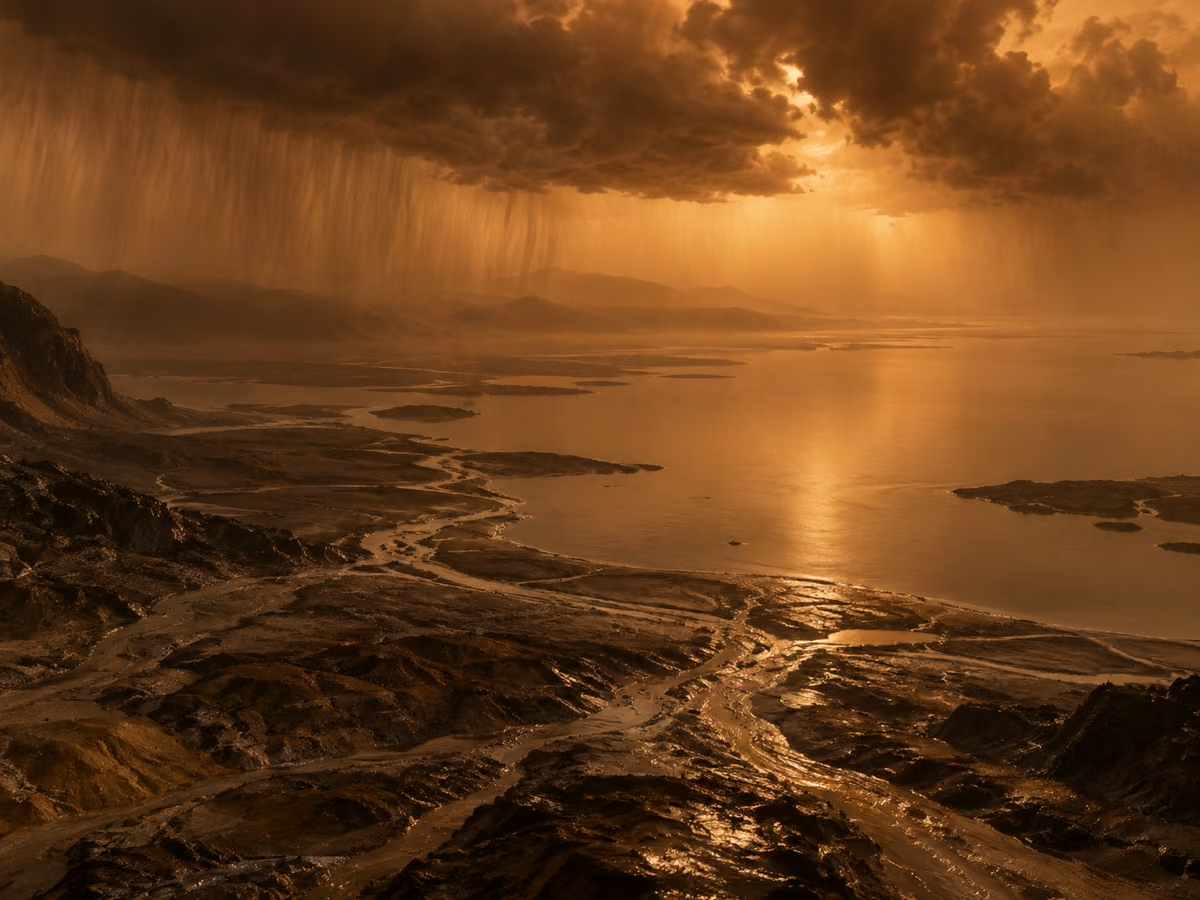
Yes. Titan, Saturn’s largest moon, provides the strongest known example of an alien precipitation cycle that resembles Earth’s while using a different working fluid. NASA describes Titan as the only moon with a substantial atmosphere and the only world besides Earth known to have stable bodies of liquid at its surface. Those liquids are hydrocarbons, particularly methane and ethane. [2]
Cassini observations revealed clouds, rainfall-related surface changes, river channels, lakes, and seas. Huygens photographed branching channels consistent with flowing liquids. The result is not merely a theoretical prediction that methane rain should be possible. Multiple independent observations connect Titan’s atmosphere, clouds, surface channels, and hydrocarbon reservoirs into an active methane-based climate system. [3][25]
Why Titan Has Weather Similar to Earth
Titan is remarkably Earth-like in a structural sense despite being chemically and thermally alien. It has a dense atmosphere composed primarily of nitrogen, with methane making up several percent. Surface atmospheric pressure is roughly 60 percent higher than Earth’s sea-level pressure, while surface temperature is near -179°C. At that temperature, water ice is extremely hard and methane can remain liquid. [2]
Those conditions create familiar-looking meteorology with unfamiliar chemistry. Solar heating and seasonal circulation move methane through the atmosphere. Methane condenses into clouds, storms develop, precipitation falls, liquids flow through channels, and hydrocarbons collect in depressions. Titan therefore demonstrates that Earth-like weather processes do not require Earth-like temperatures or liquid water.
How Methane Rain Forms on Titan
Methane evaporating from Titan’s lakes and seas enters its nitrogen-rich atmosphere as vapor. When methane-rich air reaches conditions cold enough for saturation, methane condenses into cloud particles. Cloud systems can then grow into storms capable of producing rainfall. Cassini observed major cloud events and surface darkening interpreted as wetting after rainfall, while earlier Huygens and Cassini observations revealed terrain shaped by flowing liquids. [2][3]
The process matters geologically as well as meteorologically. Rainwater erodes landscapes on Earth, and liquid hydrocarbons perform a comparable role on Titan. Methane-rich runoff can follow drainage networks, transport sediment-like material, alter shorelines, and eventually reach lakes and seas. Titan’s landscape is therefore partly a product of weather.
Titan’s Methane Cycle
Titan’s methane cycle is often compared with Earth’s hydrological cycle because both involve evaporation, atmospheric transport, condensation, precipitation, surface runoff, and collection in large reservoirs. The analogy is powerful, but the cycles are not identical. Titan receives far less sunlight, its seasons last much longer, and methane chemistry in the upper atmosphere gradually converts some methane into more complex hydrocarbons. [2][3]
This creates an important scientific question: methane is continually being chemically altered or lost, so long-term climate models need mechanisms capable of explaining its continued atmospheric presence. Regardless of the ultimate methane source, spacecraft evidence establishes that modern Titan operates an active methane-based meteorological cycle.
Hydrocarbon Lakes and Seas on Titan
Cassini radar and infrared observations transformed Titan from a hazy moon into a world with mapped shorelines. Its polar regions contain numerous lakes and three major northern seas. Kraken Mare, Titan’s largest sea, stretches roughly 1,100 kilometers in length according to NASA mapping. Cassini radar data indicate that Titan’s large liquid bodies contain methane and ethane rather than water. [4]
Rainfall, evaporation, infiltration, and seasonal atmospheric transport all influence these reservoirs. NASA’s 2019 analysis of northern lakes explicitly links methane rainfall with evaporation and seepage into Titan’s subsurface. That makes the lakes part of an active climate system rather than simply ancient pools of hydrocarbon material. [3]
What Role Does Ethane Play on Titan?
Methane is the most prominent fluid in Titan’s weather cycle, but ethane is also important. Ultraviolet radiation and energetic particles drive reactions in Titan’s upper atmosphere that transform methane into a wide range of hydrocarbons. Ethane is one of the resulting compounds and can accumulate in surface liquids. Measurements show that Titan’s lakes and seas can contain mixtures of methane and ethane, although the exact proportions differ among reservoirs. [2][3][4]
Titan therefore provides perhaps the clearest demonstration that precipitation does not need to involve water. A world can maintain rivers, rainfall, clouds, lakes, shorelines, evaporation, and seasonal weather using a completely different volatile chemistry.
Does Sulfuric Acid Rain on Venus?
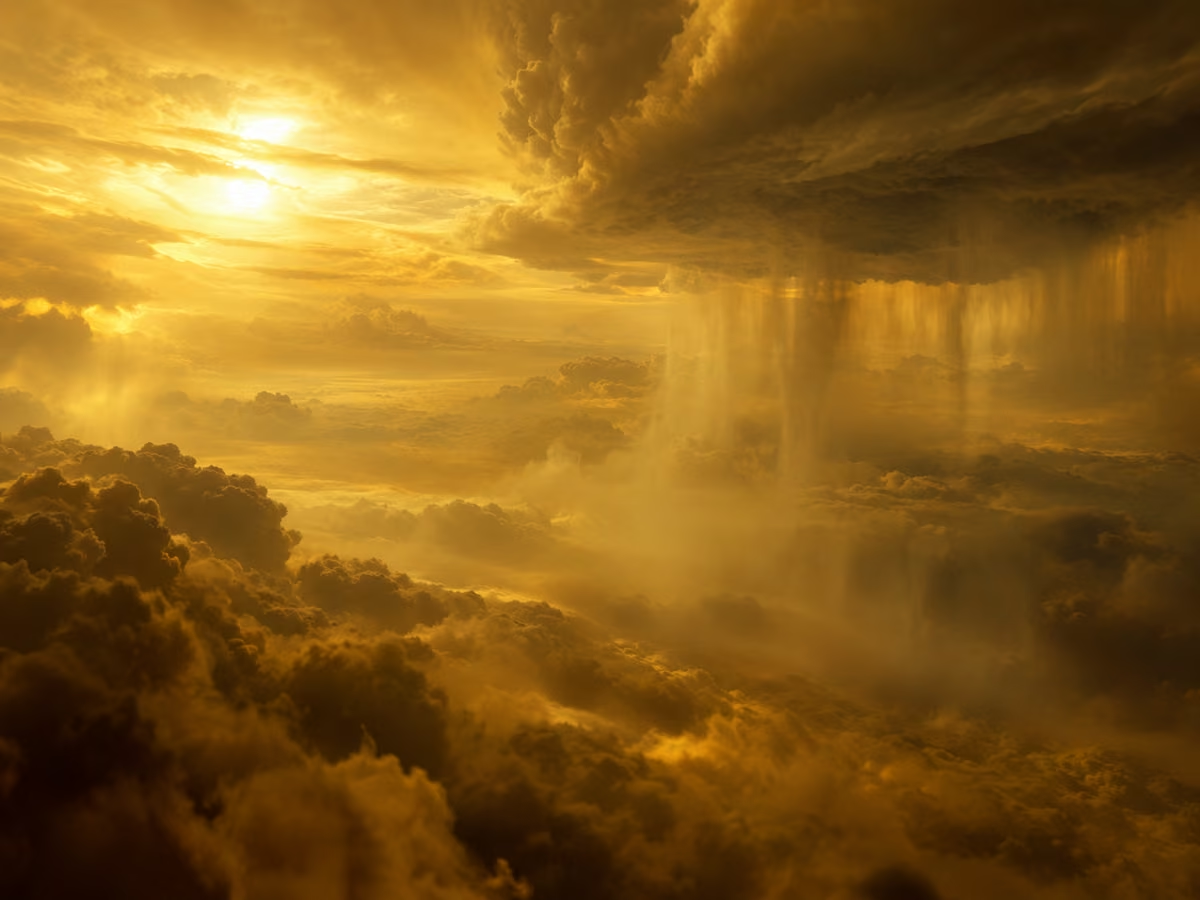
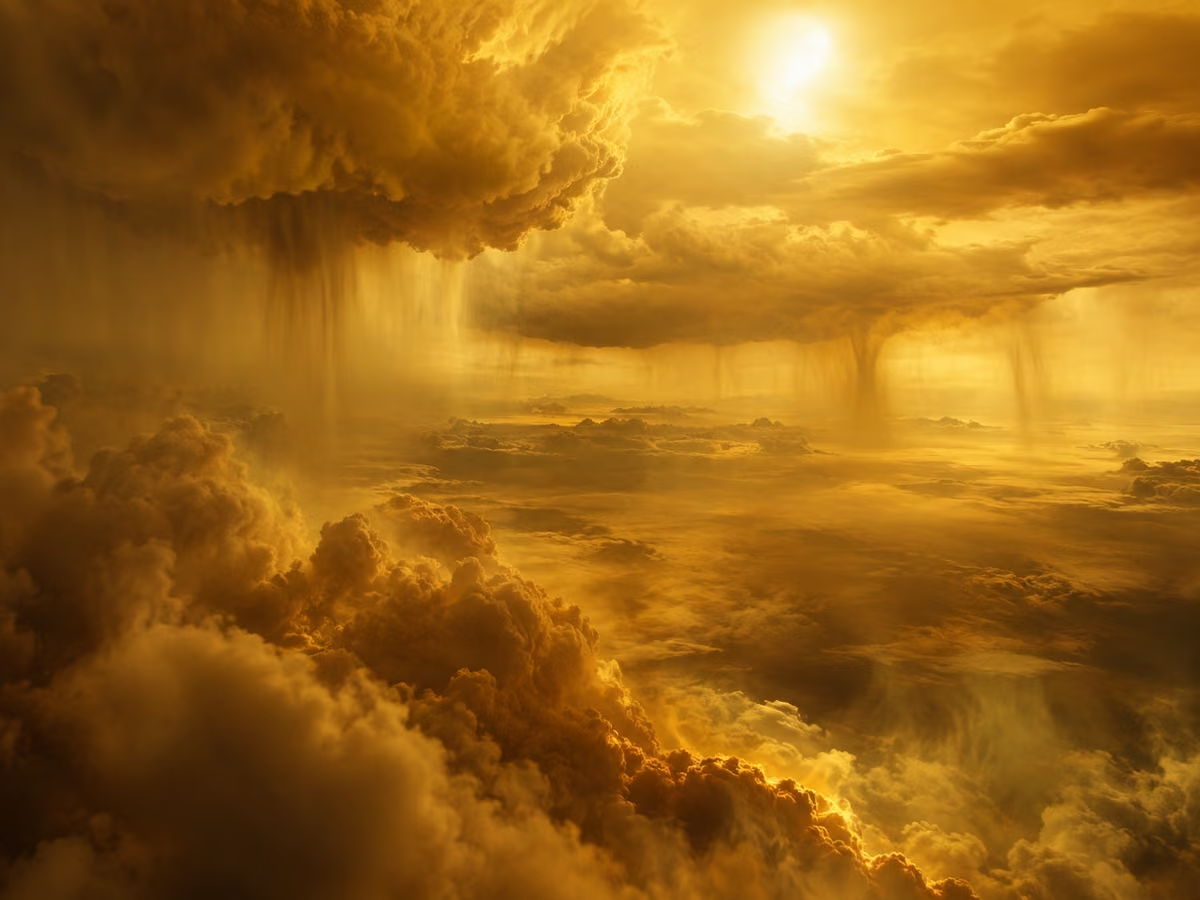
Venus contains droplets of sulfuric acid in its enormous cloud system, and those droplets can fall downward. Calling the process “sulfuric acid rain” is reasonable as long as one important qualification is included: the droplets do not survive all the way to Venus’s surface. The atmosphere below the clouds becomes progressively hotter, causing the acid droplets to evaporate and eventually participate again in atmospheric chemistry. [5][6]
This makes Venus a classic example of why cloud precipitation and surface rainfall are not the same thing. Rain can begin falling in an atmosphere even when virtually none of that liquid reaches the ground.
Why Venus Has Such an Extreme Atmosphere
Venus has one of the most hostile atmospheric environments in the Solar System. Its atmosphere is dominated by carbon dioxide and produces an intense greenhouse effect. NASA reports a mean surface temperature around 467°C and surface pressure about 93 times Earth’s sea-level pressure. Thick clouds composed of sulfuric acid obscure the planet’s surface from ordinary visible-light observation. [5]
The atmosphere changes dramatically with altitude. Conditions in parts of the cloud layer are much less extreme than conditions at the surface, allowing sulfuric acid aerosols and droplets to persist there. Descending material eventually encounters hotter conditions that make liquid sulfuric acid unstable, preventing an acid storm at the ground.
How Sulfuric Acid Rain Forms
Venus’s sulfuric acid clouds are products of atmospheric chemistry involving sulfur dioxide, water-bearing compounds, sunlight, and photochemical reactions. NASA and ESA observations confirm that sulfuric acid droplets dominate substantial portions of the cloud system. The droplets can grow and gravitationally settle downward, behaving in some respects like precipitation. [5]
The important difference from terrestrial rainfall is the vertical chemical cycle. As droplets descend below the cloud deck, temperatures increase substantially. Sulfuric acid evaporates, and deeper still its vapor can undergo thermal decomposition. Material is then mixed through the atmosphere and can ultimately participate again in cloud formation. Venusian acid “rain” is therefore part of a vertically recycled chemical system.
Why Venusian Rain Never Reaches the Surface
The lower Venusian atmosphere acts like an enormous furnace beneath the sulfuric acid clouds. Historical NASA atmospheric studies found that sulfuric acid droplets evaporate below the main cloud layers as temperatures increase, and modern NASA descriptions continue to characterize Venus’s precipitation as evaporating before it reaches the surface. [6]
Meteorologically, that makes the phenomenon virga. The distinction matters. Saying that Venus has sulfuric acid clouds is directly supported. Saying sulfuric acid droplets fall from those clouds is physically well supported. Saying liquid sulfuric acid reaches the rocky surface would be incorrect. The surface is simply too hot for such droplets to survive the journey.
Does It Snow on Mars?
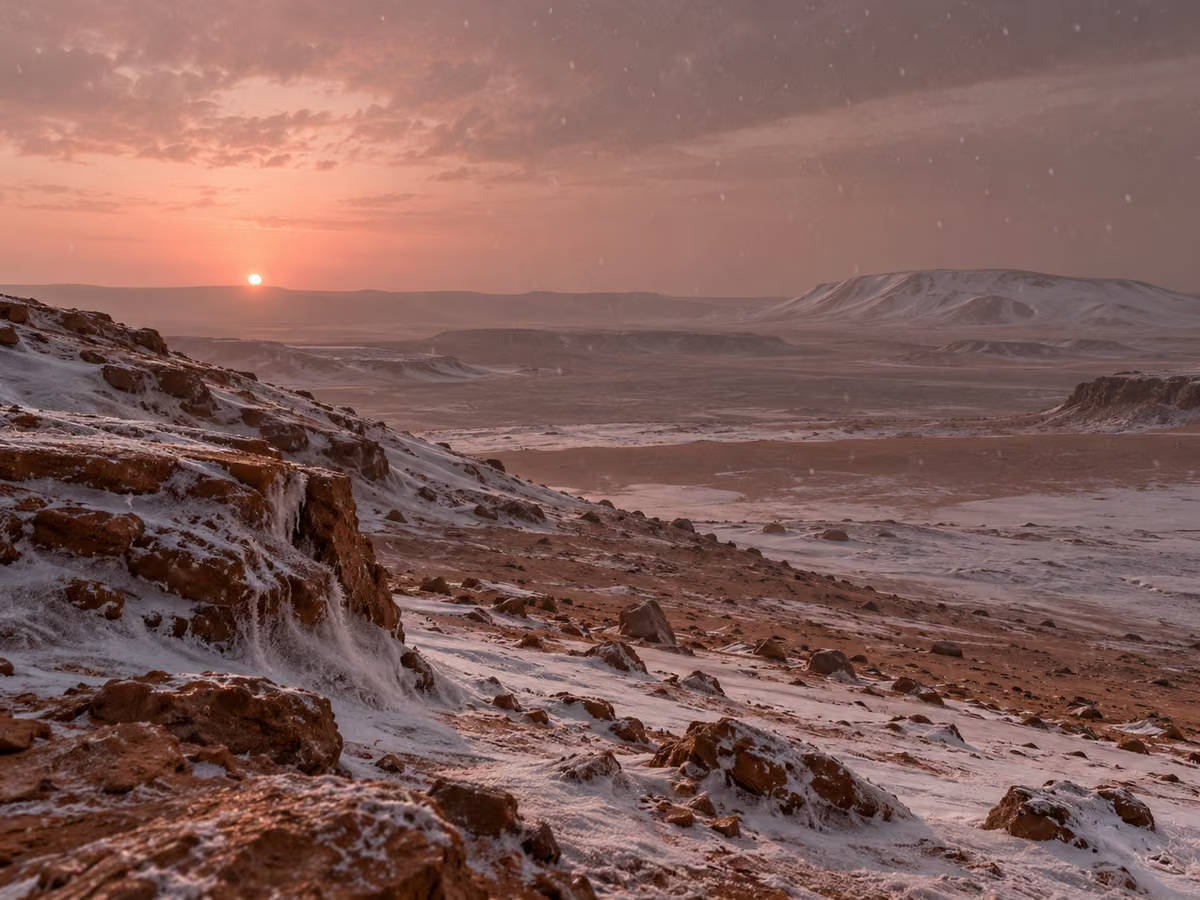
Yes. Mars can produce more than one kind of snow. Water-ice snow has been observed by NASA’s Phoenix lander, while Mars Reconnaissance Orbiter observations provided strong evidence of carbon dioxide snow around the south pole. This gives Mars a precipitation system with two different condensable substances, although neither operates exactly like Earth’s familiar winter weather. [8][9]
Mars’s atmosphere is extremely thin and dominated by carbon dioxide. Surface temperatures vary enormously, and liquid water generally cannot remain stable for long under modern surface conditions. Those factors favor frost, snow, sublimation, and atmospheric ice clouds rather than a vigorous liquid-water hydrological cycle.
Why Mars Can Produce Frozen Precipitation
Mars is cold enough for both water vapor and carbon dioxide to enter solid phases under the right conditions. NASA reports temperatures ranging from roughly 20°C under exceptional warm conditions down to about -153°C. Its atmosphere is also extremely thin and consists primarily of carbon dioxide. [7]
These conditions make liquid precipitation difficult but allow frozen precipitation. Atmospheric water vapor can condense or deposit onto dust particles and form water-ice clouds. Near the winter south pole, temperatures can become cold enough for atmospheric carbon dioxide itself to freeze, producing dry-ice clouds and snowfall.
Martian Snow
NASA’s Phoenix lander provided a direct demonstration that water-ice precipitation occurs on Mars. Its lidar detected crystals falling from clouds several kilometers above the lander. In a September 2008 observation, researchers reported that the snow vaporized before reaching the surface, a Martian example of virga. Subsequent mission analyses and NASA summaries found evidence that water-ice precipitation can also contribute to surface accumulation under suitable seasonal conditions. [8]
Martian snow is therefore not simply theoretical. What differs is its intensity, particle size, atmospheric environment, and probability of surviving its descent. The planet’s low humidity and low atmospheric pressure make sublimation highly important.
Carbon Dioxide Snow on Mars
Mars is the only known world in the Solar System where carbon dioxide snowfall has been clearly identified. Mars Reconnaissance Orbiter’s Mars Climate Sounder detected carbon dioxide ice clouds near the south pole and evidence that dry-ice particles fall to the surface and contribute to seasonal deposits. Carbon dioxide freezes at much lower temperatures than water, so this process is restricted to exceptionally cold Martian conditions. [9]
Dry-ice snow is chemically and physically different from water snow. NASA notes that carbon dioxide ice crystals should have a different crystal symmetry from terrestrial water snowflakes, another reminder that “snow” describes a precipitation process rather than a requirement that the material be frozen water.
Sublimation and Seasonal Frost on Mars
Seasonal change on Mars repeatedly transfers material between the atmosphere and the polar surface. During cold seasons, carbon dioxide from the atmosphere freezes and accumulates as frost and snow. When sunlight and warmer temperatures return, much of that material sublimates directly back into gas. This seasonal exchange changes atmospheric pressure and helps drive global circulation. [7][9]
Water ice undergoes related processes on smaller scales. Phoenix photographed exposed subsurface water ice disappearing over several days, consistent with sublimation into the thin Martian atmosphere. The Martian climate therefore illustrates how precipitation, deposition, frost formation, and sublimation can dominate a cycle without requiring persistent liquid water.
What Does Rain Mean on Gas Giants?
The word “rain” becomes more complicated on Jupiter and Saturn because neither planet has an ordinary solid surface beneath its visible cloud tops. Their atmospheres become progressively denser, hotter, and higher in pressure with depth, eventually transitioning into fluid and exotic high-pressure states. A raindrop, crystal, or hail-like object falling on a gas giant may therefore travel downward until it evaporates, dissolves, melts, chemically reacts, or enters another phase. [11][13]
Precipitation on giant planets is consequently better viewed as vertical material transport. Clouds form in certain temperature-pressure layers, particles grow, gravity moves material downward, and deeper temperatures can return those substances to vapor or fluid form.
Why Gas Giants Have No Normal Surface for Rain to Reach
Jupiter and Saturn are dominated by hydrogen and helium and do not present a rocky ground where an observer could stand beneath the clouds. NASA describes Jupiter as lacking a true surface, with gas transitioning into denser fluid states under immense pressure. Saturn has the same fundamental problem, with pressure eventually becoming strong enough to squeeze gases into liquid-like states. [11][13]
This changes the meaning of “reaching the ground.” A particle falling through a Jovian or Saturnian cloud does not necessarily terminate its journey at a boundary. Instead, it encounters progressively different physical regimes, which may cause evaporation, melting, dissolution, or phase separation.
What Kind of Rain Falls on Jupiter?
Jupiter has one of the most complex meteorological systems in the Solar System. Its visible bands and storms sit above deeper atmospheric layers containing ammonia, ammonium compounds, water, and other substances. NASA describes the upper visible clouds as involving ammonia ice, with deeper cloud systems and thunderstorms involving water. [11]
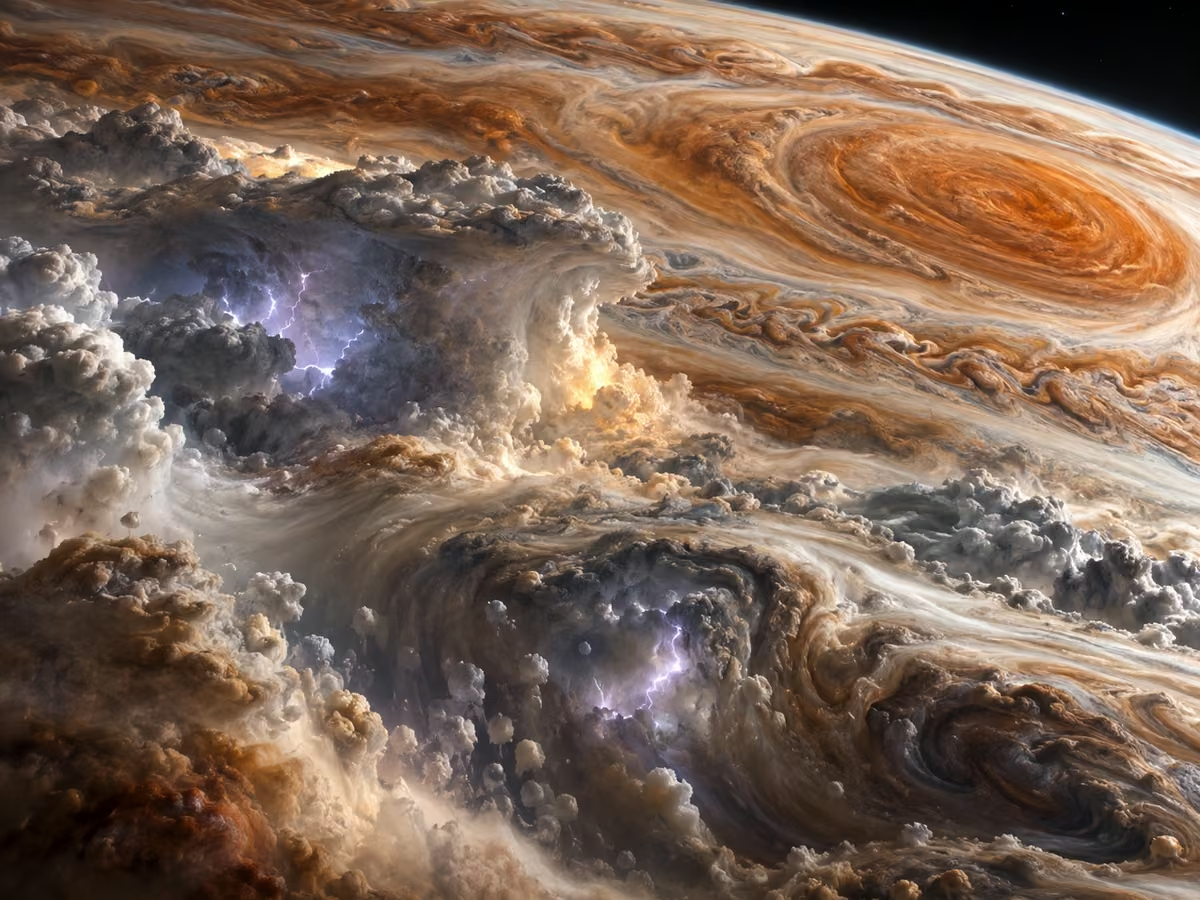
Calling Jupiter’s precipitation simply “ammonia rain” can therefore be misleading. Juno observations have instead revealed a richer system in which water and ammonia interact inside violent storms, producing liquid mixtures and large ammonia-rich hailstones called mushballs that transport both substances downward.
Jupiter’s Clouds and Planetary Weather
Jupiter’s atmosphere is powered by strong convection, rapid rotation, internal heat, and enormous storms. NASA’s cloud models place ammonia ice near the top, likely ammonium hydrosulfide beneath it, and water clouds deeper down. Juno’s Microwave Radiometer measures water and ammonia below the visible clouds, providing information unavailable from ordinary images. [11][26]
Strong thunderstorms can carry water ice upward into colder layers containing ammonia gas. The interaction changes the freezing behavior of water and creates unusual mixed-phase precipitation. This means vertical atmospheric circulation is directly connected to Jupiter’s chemistry, cloud structure, lightning, and distribution of ammonia.
Ammonia Rain on Jupiter
The phrase “ammonia rain” is useful shorthand, but pure liquid ammonia rain is not the best description of what Juno has revealed. Researchers initially considered ammonia-water rain as one way to explain why ammonia appeared depleted from portions of Jupiter’s upper atmosphere. Juno observations led to a more detailed model involving ammonia dissolving into water ice and liquid mixtures inside intense thunderstorms. [12]
The resulting particles can grow into “mushballs,” hail-like objects made of water-ammonia slush and ice surrounded by a water-ice crust. Once they become too heavy for updrafts, they fall into deeper, warmer layers and eventually evaporate. This process can move ammonia and water far below the cloud tops.
Does It Rain Inside Saturn?
Saturn also supports atmospheric clouds, storms, condensation, and vertical transport, but its deepest and most famous proposed “rain” occurs far below its visible atmosphere. Saturn consists predominantly of hydrogen and helium, and pressure increases dramatically with depth. Under appropriate interior conditions, helium can become less soluble in metallic hydrogen, separate into helium-rich droplets, and sink. [13][14]
That process is called helium rain. It should not be imagined as droplets falling from Saturn’s visible cloud deck. It occurs under pressures and temperatures so extreme that ordinary concepts of weather become only approximate analogies.
Saturn’s Atmospheric Precipitation
Saturn’s visible atmosphere contains cloud bands, storms, powerful winds, and condensable species. Like Jupiter, atmospheric models predict different cloud layers at different temperature-pressure levels, with ammonia and deeper water-bearing clouds among the expected condensates. NASA observations show a dynamic atmosphere rather than a featureless gas envelope. [13]
Any conventional precipitation within those layers would descend into progressively warmer and denser surroundings rather than land on a solid surface. Consequently, droplets and particles would eventually evaporate or mix into deeper material. Saturn’s ordinary cloud precipitation and its much deeper helium differentiation are physically distinct processes and should not be conflated.
Helium Rain Inside Saturn
At sufficiently high pressures, hydrogen behaves in unusual ways, including entering a metallic fluid state. Research indicates that hydrogen and helium may cease to mix uniformly under particular pressure-temperature conditions. Helium can then separate into helium-rich droplets that move deeper under gravity. A 2024 Nature Communications study found conditions favorable to hydrogen-helium demixing across a substantial fraction of Saturn’s interior and also potentially within Jupiter. [14]
As helium sinks, gravitational potential energy is converted into heat. This process can influence Saturn’s thermal evolution and help explain why it emits substantial internal energy. “Helium rain” is therefore a useful physical description, but it refers to phase separation inside a giant planet rather than meteorological rain from visible clouds.
Can It Rain Diamonds on Uranus and Neptune?
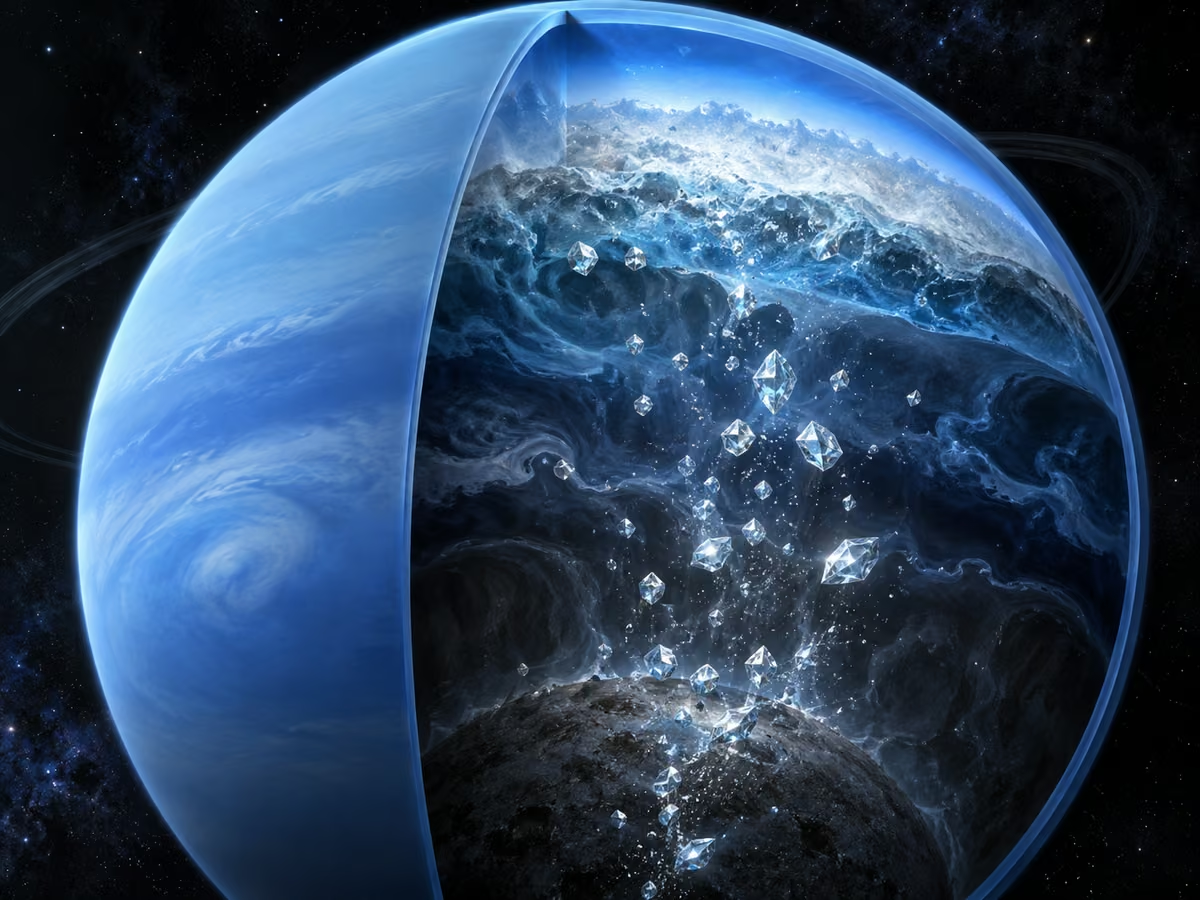
Possibly, and the idea is more scientifically grounded than its dramatic name might suggest. Uranus and Neptune are ice giants with interiors containing hydrogen, helium, water, ammonia, methane, and other carbon-bearing material under enormous pressures and temperatures. Models predict that under some interior conditions, carbon can separate from hydrocarbon compounds and crystallize into diamond. [15][16][17]
Scientists have not directly observed diamonds falling inside either planet. However, high-pressure laboratory experiments have produced nanodiamonds under conditions intended to reproduce aspects of ice-giant interiors, strengthening the physical plausibility of the process.
Conditions Deep Inside Uranus
Uranus is an ice giant rather than a simple ball of frozen material. NASA estimates that most of its mass is composed of a hot, dense fluid rich in substances described in planetary science as “ices,” including water, methane, and ammonia, above a smaller rocky core. Pressures and temperatures rise dramatically toward the interior. [15]
Methane and other carbon-bearing compounds are especially relevant to the diamond-rain hypothesis. Under sufficient pressure and heat, chemical bonds can reorganize, carbon can separate from hydrogen-rich compounds, and solid carbon phases can become energetically favorable. The exact planetary structure remains uncertain because no spacecraft has directly sampled Uranus’s deep interior.
Conditions Deep Inside Neptune
Neptune has a broadly similar classification but is denser and remains extraordinarily active meteorologically. NASA describes much of its mass as a hot, dense fluid composed largely of water, methane, and ammonia-rich material beneath a hydrogen-helium-methane atmosphere. Unlike a conventional ocean, this deep material exists under pressures and temperatures far outside everyday experience. [16]
Those conditions provide the high-pressure environment required by diamond-formation models. The hypothesis also has implications beyond producing gemstones. Carbon separation and sinking could redistribute energy and material, potentially affecting thermal structure and even processes connected to the unusual magnetic fields of the ice giants.
How Diamond Rain Could Form
The basic idea begins with carbon-bearing molecules exposed to extreme pressure and temperature. Chemical bonds break and reorganize, allowing carbon atoms to combine into dense crystalline structures. Because diamond is denser than surrounding material in the relevant models, the crystals would sink toward deeper layers, creating the analogy of a diamond “rain.” [17]
Laboratory work at high-energy facilities has observed nanodiamond formation in compressed materials chosen to approximate components of ice-giant chemistry. Experiments reported in 2017, 2022, and 2024 have strengthened the case and suggest diamond formation may occur over a wider range of conditions than earlier estimates. That remains laboratory support for planetary models, not direct detection inside Uranus or Neptune.
Can It Rain on Planets Outside the Solar System?
Almost certainly. Thousands of confirmed exoplanets occupy environmental regimes absent from our Solar System, including gas giants orbiting extremely close to their stars, highly irradiated rocky worlds, and planets with atmospheric temperatures hot enough to vaporize minerals and metals. As those vapors circulate toward cooler regions, condensation becomes possible. [18][23]
Unlike Titan or Mars, however, scientists cannot send spacecraft through these distant atmospheres. Most claims about exotic exoplanet rain therefore come from spectroscopy, temperature maps, atmospheric circulation models, chemical equilibrium calculations, and comparisons with laboratory measurements. The result is a spectrum of certainty rather than a simple observed-versus-unobserved distinction.
What Is Exoplanet Weather?
Exoplanet weather includes atmospheric circulation, winds, clouds, chemistry, temperature patterns, storms, and potentially precipitation on planets orbiting stars other than the Sun. Exoplanet atmospheres span an enormous physical range, which means their clouds can be composed of substances that would normally be rocks or metals on Earth. Webb observations, for example, have identified crystalline silica particles in the atmosphere of the hot giant WASP-17 b. [23]
Detecting a cloud substance does not automatically prove it falls as rain. Scientists combine cloud composition with temperatures, pressures, circulation patterns, particle behavior, and condensation physics to determine whether material is likely to settle or precipitate into deeper layers.
Why Hot Jupiters Have Extreme Weather
A hot Jupiter is a gas giant orbiting extremely close to its star, often completing an orbit in only a few days. NASA’s current glossary describes the class as Jupiter-like giant planets with orbital periods shorter than about ten days. Their proximity to their stars subjects their atmospheres to intense radiation and extreme heating. [18]
Many hot Jupiters are tidally locked, meaning approximately the same hemisphere faces the star continuously. This can create enormous day-night temperature differences. Atmospheric winds transport heat and vaporized material toward cooler regions. Substances that remain gaseous on the dayside can then condense near the terminator or nightside, producing some of the strongest candidates for exotic precipitation known.
Can It Rain Iron on an Exoplanet?
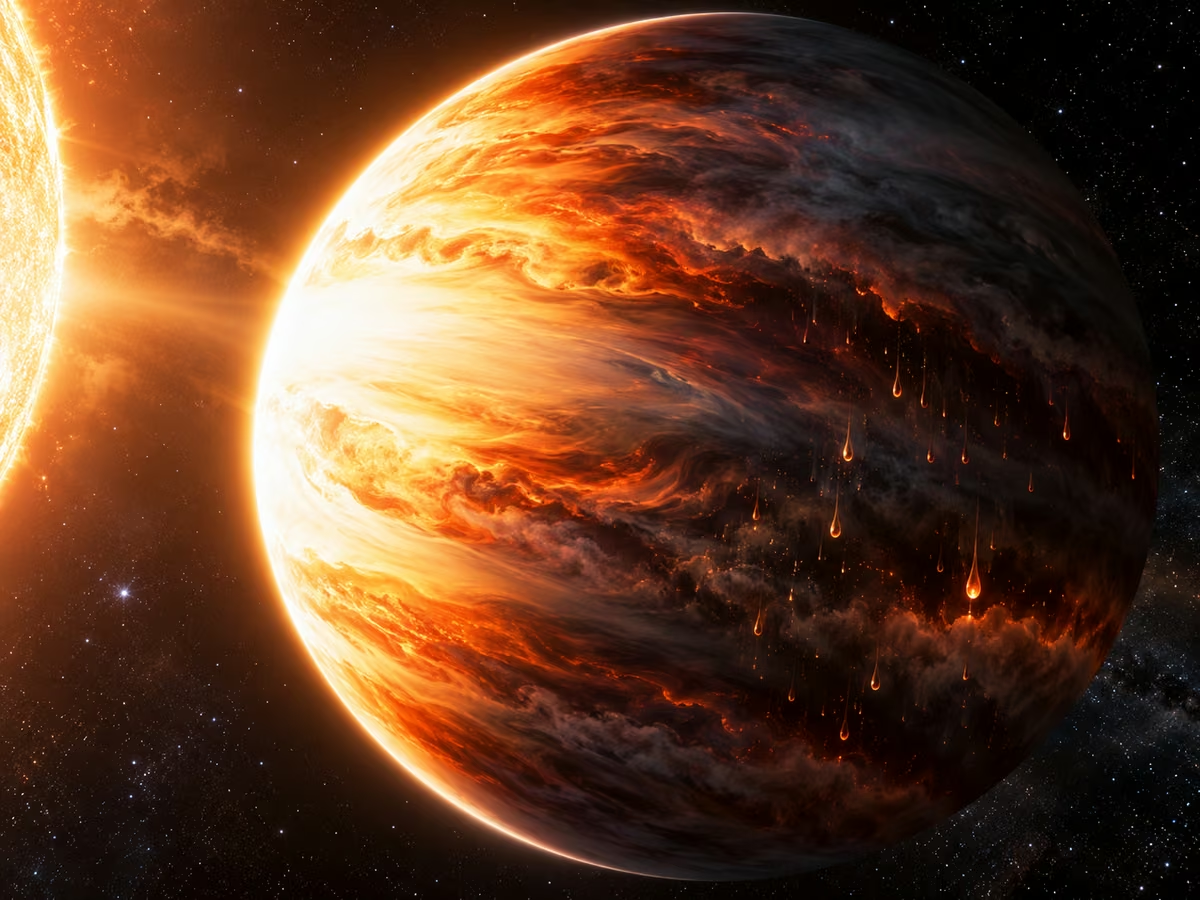
The most famous candidate is WASP-76b, an ultra-hot giant planet where atmospheric iron appears to behave differently between its intensely heated dayside and cooler nightside. Observations with the ESPRESSO spectrograph on ESO’s Very Large Telescope detected neutral iron on one side of the planet’s atmospheric limb but not where air returning from the nightside should appear. Researchers interpreted the asymmetry as evidence that iron vapor condenses while crossing the nightside. [19][20]
This is commonly called “iron rain,” but scientists did not photograph iron droplets falling. It is an inference from spectroscopy combined with temperature and circulation physics.
Iron Rain on WASP-76b
WASP-76b’s dayside reaches temperatures above roughly 2,400°C, hot enough to keep iron in gaseous form in parts of its atmosphere. Powerful winds can carry that vapor toward cooler regions. The 2020 Nature study found a strong neutral-iron signature near one terminator but not near the opposite limb, concluding that iron must condense during its passage across the nightside. [19][20]
Condensed iron could form droplets or particles that settle downward before reheating and potentially vaporizing again elsewhere in the circulation. “Iron rain” therefore describes a physically plausible condensation cycle supported by spectral evidence. The existence of individual falling liquid iron droplets has not been directly imaged.
Can It Rain Glass or Rock on Other Planets?
Under sufficiently high temperatures, materials we normally think of as solid rock can vaporize and become components of an atmosphere. When that vapor reaches cooler regions, minerals can condense into liquid droplets or solid particles. Exoplanet atmospheric models therefore predict clouds and precipitation involving silicates, metals, oxides, and other refractory materials.
Actual evidence varies by planet. Webb has spectroscopically detected silicate-bearing cloud material on some hot worlds, establishing that mineral clouds genuinely exist outside the Solar System. Whether those particles form sustained “rock rain” in a particular atmosphere requires additional assumptions about particle size, vertical mixing, gravity, temperature, and circulation. [23]
Silicate Rain
Silicates are minerals built largely from silicon and oxygen and form a major fraction of rocky planetary material. In extremely hot atmospheres, silicate-bearing material can enter vapor form. If winds carry that vapor to lower temperatures, mineral particles or molten droplets may condense and gravitationally settle. This is the physical basis of the term silicate rain.
Webb observations have already detected silicate cloud signatures on exotic worlds. One notable case is crystalline silica, or quartz, in the atmosphere of WASP-17 b. Such observations establish the presence of mineral aerosols, but they do not by themselves demonstrate visible showers of molten rock. Precipitation must be inferred from atmospheric structure and particle microphysics. [23]
Glass Rain on HD 189733 b
HD 189733 b is a hot Jupiter famous for its deep blue appearance. Hubble observations found that its color is consistent with an atmosphere containing silicate-rich particles. NASA has described the planet as a world where silicates could condense into tiny glass-like droplets and where extremely fast winds could carry the material almost sideways through the atmosphere. [21]
The phrase “glass rain” should not be interpreted as broken window glass or sharp household shards falling through an Earth-like sky. It refers to silicate material under extreme atmospheric conditions. NASA itself uses cautious wording such as “possibly rains glass,” reflecting the inferential nature of the interpretation.
How Do Scientists Know It Rains on Other Planets?
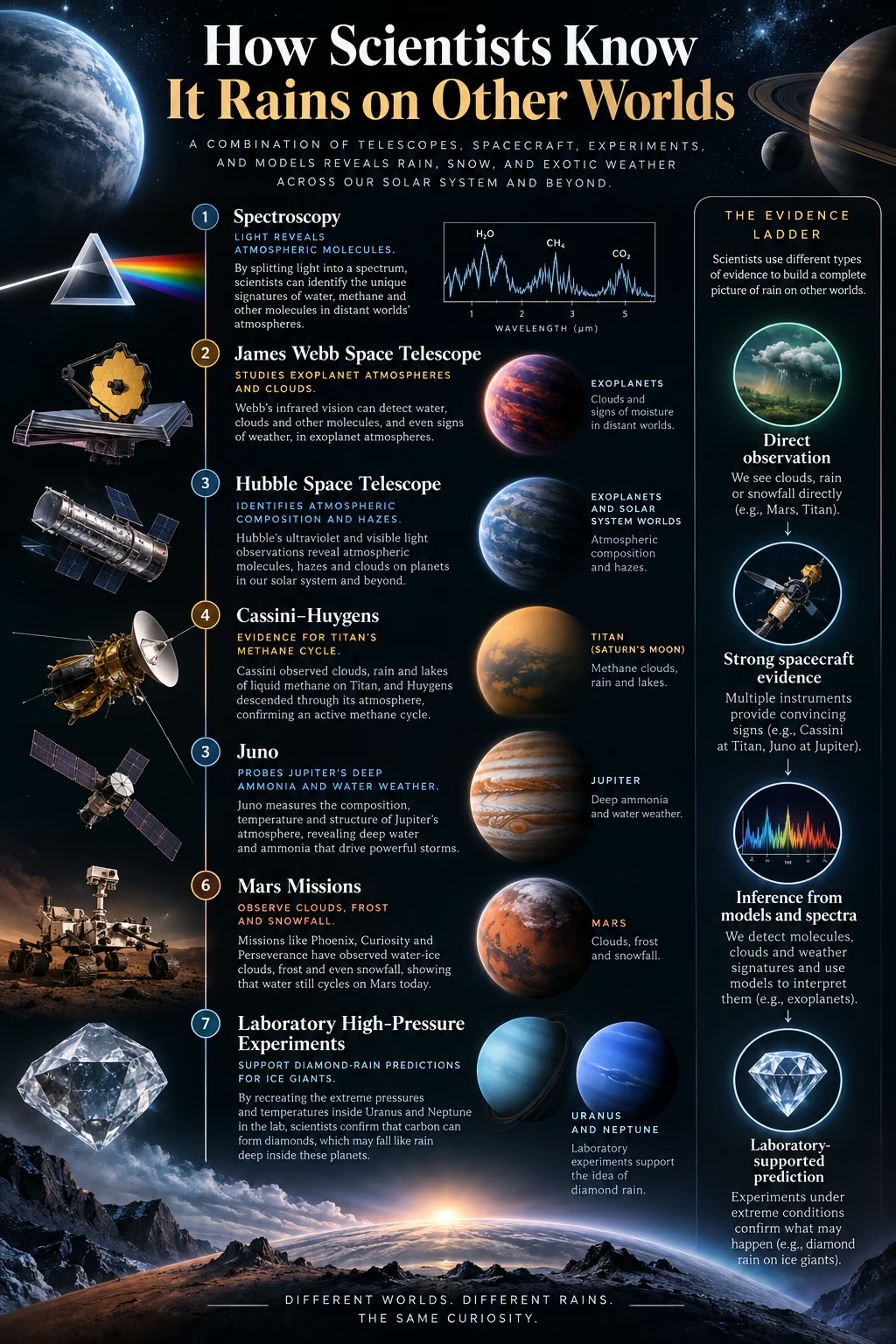
Scientists rarely rely on one line of evidence. For nearby Solar System worlds, orbiters, landers, atmospheric instruments, radar, cameras, infrared measurements, microwave observations, and lidar can reveal clouds, falling particles, surface changes, lakes, frost, and atmospheric composition. Titan and Mars are especially strong examples because spacecraft have observed both atmospheric processes and relevant surface features.
For exoplanets, direct measurement is much harder. Researchers instead use spectra, thermal maps, orbital phase curves, atmospheric models, laboratory experiments, and physical chemistry. These methods can identify substances and determine where condensation should occur, but the resulting confidence depends on what has actually been measured. [22][23][24]
| Evidence level | Example | What scientists actually measure |
|---|---|---|
| Direct atmospheric detection | Martian snow | Falling ice particles measured by spacecraft |
| Surface plus atmospheric evidence | Titan methane cycle | Clouds, surface wetting, channels, lakes and seas |
| Cloud observation plus thermodynamics | Venus acid precipitation | Sulfuric acid clouds and lower-atmosphere conditions |
| Deep-atmosphere spacecraft measurements | Jupiter | Ammonia, water, lightning and storm structure |
| Laboratory plus interior modeling | Uranus and Neptune | Diamond formation under simulated pressure |
| Spectroscopic inference | WASP-76b | Iron absorption changing around planetary limbs |
| Spectroscopy plus cloud physics | HD 189733 b | Silicate-rich haze or clouds and atmospheric temperature |
Using Spectroscopy to Study Planetary Atmospheres
Spectroscopy separates light into wavelengths and looks for patterns created when atoms or molecules absorb or emit specific parts of the spectrum. During an exoplanet transit, some starlight passes through the planet’s atmosphere. Different gases absorb characteristic wavelengths, allowing researchers to identify atmospheric components even when the planet itself cannot be resolved as a detailed image. [22]
Spectroscopy can also reveal temperature, motion through Doppler shifts, cloud or haze properties, and differences between parts of an atmosphere. When combined with condensation temperatures and atmospheric models, those measurements allow scientists to ask whether a substance should remain gaseous, form clouds, or precipitate. This is how exotic-rain hypotheses can be tested without directly watching droplets fall.
James Webb Space Telescope and Exoplanet Weather
The James Webb Space Telescope has dramatically expanded atmospheric characterization in infrared wavelengths. Webb transmission and emission spectroscopy can detect molecular fingerprints, cloud signatures, temperature structures, and chemical processes. Its observations of WASP-39 b, for example, revealed multiple atmospheric species and evidence of active photochemistry, while other observations have identified silicate cloud particles on hot planetary-mass objects and exoplanets. [23]
Webb does not usually “see rain” as an ordinary camera would. Instead, it provides the chemical and thermal information required to determine what materials are present and whether atmospheric conditions allow them to condense. That distinction is critical when interpreting headlines about metal or mineral rain.
Hubble Space Telescope and Atmospheric Studies
Hubble established many of the techniques now used for exoplanet atmospheric science. By measuring how starlight is filtered during transits, astronomers have detected water vapor and characterized clouds and hazes in multiple exoplanet atmospheres. Hubble also measured the unusual visible color of HD 189733 b, helping motivate the silicate-cloud interpretation behind its famous “glass rain” description. [21][24]
Hubble’s observations show why multiple wavelengths matter. Clouds can obscure molecular absorption features, while clear atmospheric regions can expose chemical signatures. Atmospheric conclusions therefore depend not just on detecting a molecule, but also on understanding cloud altitude, temperature, stellar contamination, and observational uncertainty.
Cassini-Huygens and Titan’s Methane Rain
Cassini-Huygens provided one of the most complete demonstrations of non-water weather beyond Earth. Cassini used radar, infrared instruments, imaging, and repeated flybys to map Titan’s lakes, seas, clouds, dunes, channels, and seasonal changes. Huygens descended through the atmosphere in 2005 and photographed a landscape showing evidence of recent liquid flow. [25]
Taken together, the mission data revealed lakes and seas of methane and ethane replenished by precipitation from hydrocarbon clouds. Cassini even documented surface changes following major cloud events. This combination of atmospheric and geological evidence makes Titan’s methane precipitation much more firmly established than many of the exotic-rain claims made for giant-planet interiors or exoplanets.
Juno and Jupiter’s Deep Weather
NASA’s Juno spacecraft studies Jupiter using instruments capable of probing below the visible cloud tops. Its Microwave Radiometer measures ammonia, water, and temperature at depth, helping researchers reconstruct how material moves vertically through Jupiter’s atmosphere. Juno also detected unusual shallow lightning associated with ammonia-water clouds. [26][12]
Those observations led to the mushball model. Water ice lofted high into the atmosphere interacts with ammonia, creating a low-temperature liquid mixture. Repeated movement through storms allows hail-like objects to grow before they fall into deeper layers. This mechanism helps explain puzzling ammonia distributions and shows how precipitation can reshape a giant planet’s atmospheric chemistry.
Voyager 2 and the Ice Giants
Voyager 2 flew past Uranus in January 1986 and Neptune in August 1989. It remains the only spacecraft to have visited either ice giant at close range. The mission returned images and data on their atmospheres, rings, moons, magnetic fields, winds, and internal properties, providing much of the foundation for modern models of Uranus and Neptune. [27]
Voyager did not observe diamonds raining inside the planets. That hypothesis comes from combining the gross interior constraints provided by planetary observations with theoretical equations of state and high-pressure laboratory experiments. Consequently, “diamond rain” belongs in a different evidence category from Titan’s methane precipitation or Martian snow.
Venera and the Atmosphere of Venus
The Soviet Venera program provided direct measurements from within Venus’s atmosphere and, eventually, from its surface. Venera 7 became the first spacecraft to return data after a successful landing on another planet. Later landers such as Venera 13 measured extreme surface conditions and returned images. NASA’s historical records report Venera 13 measurements around 465°C and roughly 89.5 Earth atmospheres at its landing site. [28]
These direct measurements, combined with later orbital observations of sulfuric acid clouds, established the vertical environment needed to understand Venusian precipitation. Acid droplets can persist in the cooler cloud deck but cannot remain liquid throughout the descent into the hotter lower atmosphere.
Curiosity and Perseverance on Mars
Curiosity and Perseverance contribute long-duration surface records of Martian weather. Curiosity has repeatedly photographed clouds, including high-altitude carbon dioxide ice clouds observed in recent campaigns. Perseverance’s Mars Environmental Dynamics Analyzer measures temperature, pressure, humidity, wind, and dust, while its SkyCam monitors the Martian sky. [10]
These rovers complement orbital observations. They help scientists determine when clouds occur, what environmental conditions accompany them, and how atmospheric dust and water vary with season. Neither rover is simply functioning as a rain gauge. Instead, long-term meteorological records help reveal the physical environment in which Martian clouds, frost, and precipitation develop.
What Determines What Kind of Rain a Planet Gets?
The dominant precipitation material on a world is controlled by the intersection of thermodynamics and chemistry. Scientists need to know what substances are present, the atmospheric temperature at different altitudes, pressure, vertical circulation, available condensation nuclei, and how quickly particles settle compared with how quickly winds mix them upward.
The same chemical can behave completely differently on two planets. Methane is a gas in Earth’s lower atmosphere but a surface liquid on Titan. Carbon dioxide is a gas making up most of Mars’s atmosphere but can freeze near the winter pole. Silicates form rocks on Earth yet can become atmospheric cloud particles in ultra-hot exoplanets. This is why planetary weather cannot be understood from composition alone. [2][7][23]
Temperature
Temperature controls whether substances tend to remain gaseous, condense into liquids, freeze into solids, melt, evaporate, or sublimate. Titan’s extreme cold allows methane to behave as a surface liquid. Mars’s winter polar temperatures allow atmospheric carbon dioxide to freeze. Venus’s hot lower atmosphere destroys sulfuric acid droplets before they reach the ground. [2][6][9]
At the opposite extreme, hot-Jupiter atmospheres can become hot enough for materials such as iron and silicates to exist as gases. Atmospheric circulation can then transport those vapors to cooler regions where condensation becomes possible. Temperature gradients therefore create the basic engine behind many exotic-rain hypotheses.
Atmospheric Pressure
Pressure changes the temperatures and conditions at which materials change phase. Near Earth’s surface, familiar boiling and freezing behavior takes place around one atmosphere of pressure. Giant-planet interiors operate at pressures millions of times greater, producing states of matter that cannot persist naturally at Earth’s surface.
Hydrogen can become metallic deep inside Jupiter and Saturn, and hydrogen-helium mixtures may separate under suitable interior conditions, producing helium rain. Extreme ice-giant pressures can make carbon crystallization energetically favorable and support the diamond-rain hypothesis. Pressure is therefore not simply a secondary factor. In giant planets it fundamentally changes the physical rules governing what “rain” can mean. [14][17]
Atmospheric Chemistry
A planet cannot precipitate a material that is not present in usable quantities or cannot be chemically produced under local conditions. Venus’s sulfur chemistry contributes to sulfuric acid cloud formation. Titan’s methane-rich atmosphere enables hydrocarbon clouds and rain. Jupiter contains ammonia and water that interact in storms. Ultra-hot exoplanets can contain vaporized metals and minerals because temperatures are high enough to transfer normally solid material into the atmosphere. [2][5][11][19]
Atmospheric chemistry can also transform precipitation materials during their journey. Photochemistry, thermal decomposition, reactions with aerosols, and dissolution into other droplets may change the composition between cloud formation and deeper layers.
Cloud Composition
Cloud composition provides one of the most useful clues to possible precipitation. Water clouds can produce water rain, snow, or hail. Methane clouds on Titan can produce methane-rich rainfall. Sulfuric acid clouds on Venus generate acid droplets. Carbon dioxide clouds on Mars can create dry-ice snow. Jupiter’s ammonia-water storm clouds can produce mixed liquid and solid precipitation, including mushballs. [2][5][9][12]
On exoplanets, clouds can include mineral or silicate particles. The key caution is that cloud detection is not automatically precipitation detection. Researchers still have to determine particle size, growth rates, sedimentation, vertical mixing, temperature gradients, and whether condensates would survive while descending.
How Rain Differs Across the Solar System
The Solar System provides a natural laboratory for comparative meteorology. Earth uses water as its dominant condensable fluid. Titan substitutes methane and other hydrocarbons. Mars combines a thin carbon dioxide atmosphere with water and carbon dioxide ice precipitation. Venus produces corrosive cloud droplets that cannot survive to the surface. Jupiter and Saturn support cloud precipitation within deep atmospheres, while their interiors introduce completely different phase-separation processes. Uranus and Neptune may go further still, allowing carbon to crystallize into diamonds under extraordinary pressure.
A useful way to compare these worlds is not to ask whether they have “Earth rain,” but to ask which substance can change phase, how gravity transports it, and what happens during descent.
Rain on Earth
Earth’s precipitation is dominated by water because surface temperature and atmospheric pressure allow water to exist abundantly as vapor, liquid, and ice. Oceans provide the primary reservoir feeding atmospheric evaporation. Clouds return water as rain, snow, sleet, and hail, while runoff and groundwater complete broader circulation pathways. [1]
This system is unusually favorable to surface liquid water, which is one reason Earth is such a poor universal template for planetary weather. What is universal is the physics of energy exchange, condensation, particle growth, gravity, and circulation. Other worlds apply those processes to substances that would be gases, rocks, or corrosive chemicals under terrestrial conditions.
Rain on Titan
Titan replaces Earth’s water-dominated meteorology with a methane-centered hydrocarbon system. Methane forms clouds, falls as precipitation, produces surface runoff, and replenishes lakes and seas. Ethane and other hydrocarbons participate as well. The resulting landscape contains river channels, shorelines, lake basins, large seas, and evidence of erosion by flowing liquid. [2][3][4]
The analogy with Earth is strongest at the process level. Titan demonstrates evaporation, condensation, precipitation, runoff, storage, and seasonal circulation. The difference is that Titan’s frigid environment allows methane to perform the role that water plays on Earth.
Rain on Venus
Venus demonstrates how precipitation can form without reaching a planetary surface. Its cloud deck contains sulfuric acid droplets. Gravity moves cloud particles downward, but the atmosphere becomes hotter toward the ground. The droplets therefore evaporate below the clouds, and sulfuric acid vapor is eventually chemically altered at still deeper levels. [5][6]
Calling this “acid rain” is scientifically defensible only if the distinction is made clear. A hypothetical observer on Venus’s surface would not experience liquid sulfuric acid drops falling from the sky. Venus’s precipitation is primarily an atmospheric recycling process.
Precipitation on Mars
Mars supports both water-ice and carbon dioxide precipitation. Phoenix directly detected falling water-ice snow, including observations in which particles sublimated before reaching the ground. Mars Reconnaissance Orbiter later established carbon dioxide snowfall associated with the south polar winter. [8][9]
The planet’s thin atmosphere makes sublimation particularly important. Seasonal carbon dioxide ice can be transferred between atmosphere and surface without passing through a liquid state. Martian precipitation is therefore closely connected to frost, deposition, polar-cap growth, sublimation, and seasonal atmospheric pressure changes rather than a stable surface-liquid cycle like Earth’s.
Precipitation on Jupiter and Saturn
Jupiter and Saturn contain condensable materials in atmospheres that become continuously denser with depth. Jupiter provides particularly strong evidence for ammonia-water interactions. Juno observations indicate that violent storms create ammonia-rich mushballs capable of carrying material to warmer layers, where they eventually evaporate. [11][12]
Saturn has its own clouds and storms, although its deep precipitation is less directly constrained. Far beneath visible clouds, hydrogen-helium phase separation may cause helium-rich droplets to sink. Modern calculations suggest such demixing may occur in both Saturn and Jupiter, with particularly extensive effects in Saturn. [14]
Precipitation on Uranus and Neptune
The most famous proposed precipitation inside Uranus and Neptune is diamond rain. Interior models place carbon-bearing compounds under pressures and temperatures capable of reorganizing their molecular structure. Laboratory experiments recreating aspects of those conditions have repeatedly produced nanodiamonds and suggest diamond formation may begin at lower pressures and temperatures than some earlier estimates. [17]
No camera or probe has watched diamonds falling inside either planet. Consequently, the correct scientific wording is that diamond rain may occur or is predicted to occur. Laboratory confirmation of the underlying material physics strengthens the hypothesis without turning it into a direct planetary observation.
Precipitation on Extreme Exoplanets
Exoplanets extend the concept of weather beyond anything found in our Solar System. WASP-76b appears to transport vaporized iron from its dayside toward cooler regions where iron condenses. HD 189733 b contains high-altitude silicate material associated with the possibility of glass-like droplets or particles driven through the atmosphere by extreme winds. Other hot worlds show mineral and silicate clouds directly through spectroscopy. [19][20][21][23]
These are not all equally proven as precipitation. The safest interpretation is that astronomers can identify atmospheric materials and temperature regimes that make exotic condensation likely, then use circulation and cloud models to determine whether actual precipitation should occur.
Common Misconceptions About Rain on Other Planets
Popular discussions of alien weather often compress complicated atmospheric science into memorable phrases such as “diamond rain,” “glass rain,” or “iron rain.” Those descriptions are useful, but they can create the impression that scientists have directly photographed familiar rainstorms made from bizarre substances. In many cases, that is not what happened.
Planetary science relies on different levels of evidence. Some precipitation has been directly detected by instruments, as with Martian snow. Some is established through a combination of clouds and surface geology, as with Titan. Some is inferred from atmospheric chemistry and temperature. Some occurs only in computer models and high-pressure experiments. Distinguishing these evidence levels makes the topic more interesting, not less.
Is All Rain Made of Water?
No. Rain and precipitation are physical processes rather than chemical definitions. Water dominates Earth’s weather because environmental conditions and planetary composition make it abundant and mobile. On Titan, methane and ethane occupy much of the same climatic role. Venus has sulfuric acid cloud droplets. Mars can precipitate frozen carbon dioxide. Jupiter has ammonia-water mixtures. [2][5][9][12]
Under extreme planetary conditions, even helium and carbon can separate and move downward, while metals and minerals may condense in exoplanet atmospheres. The broader lesson is that any substance can potentially participate in precipitation if the local pressure, temperature, composition, and phase behavior allow it.
Does Rain Always Reach the Ground?
No. Virga is the obvious counterexample. A droplet or crystal can form and begin falling but enter a layer where it evaporates or sublimates. Venusian sulfuric acid precipitation disappears in the increasingly hot atmosphere below its cloud deck. Mars has produced water-ice fall streaks that sublimated before reaching the ground during particular Phoenix observations. [6][8]
Even on Earth, virga is common in dry air. Other planets simply make the effect more dramatic because temperature and pressure can vary through much larger ranges. Detecting precipitation therefore does not automatically mean a surface becomes wet or accumulates snow.
Does Every Planet Have a Surface Beneath Its Rain?
No. Jupiter and Saturn have no conventional solid surface beneath their clouds. Atmospheric pressure and density continue increasing until hydrogen and other materials enter liquid-like and exotic high-pressure states. Any precipitation descending through these planets encounters deeper atmospheric or fluid layers rather than soil or rock. [11][13]
This is why phrases such as “rain reaches Jupiter” can be misleading. There is no single ground level where the process ends. Particles may evaporate and mix back into the atmosphere, while deeper interior processes such as helium separation occur thousands of kilometers below the visible weather layer.
Have Scientists Actually Seen Diamond and Iron Rain?
Not in the way people often imagine. Diamond precipitation inside Uranus and Neptune has not been directly observed. Scientists have recreated relevant high-pressure chemistry in laboratories and produced nanodiamonds, which supports interior models predicting that carbon could crystallize and sink inside ice giants. [17]
Iron rain on WASP-76b is also inferred rather than photographed. Astronomers detected neutral iron on one atmospheric limb but not where material returning from the cooler nightside would be expected. The interpretation is that iron condenses during nightside transport. [20]
The scientific evidence is meaningful, but “direct observation of falling droplets” would overstate it.
Why Is Extraterrestrial Rain Scientifically Important?
Precipitation is more than a weather curiosity. It transports energy and material vertically through atmospheres, removes substances from upper layers, replenishes surface reservoirs, modifies landscapes, affects cloud coverage, influences radiation balance, and reveals the pressure-temperature structure of planetary environments.
Because different chemicals condense under different conditions, clouds and precipitation can act as natural thermometers and chemical probes. Detecting methane clouds on Titan, ammonia-water processes on Jupiter, or silicate clouds on exoplanets tells researchers something about conditions that may be impossible to sample directly. Studying alien precipitation therefore connects atmospheric chemistry, climate science, geophysics, planetary interiors, and the search for habitable environments.
Comparative Planetology
Comparative planetology asks why worlds governed by the same fundamental physical laws develop such different outcomes. Earth, Venus, Mars, Titan, Jupiter, Saturn, Uranus, and Neptune are ideal examples. All experience gravity, radiation, thermodynamics, chemistry, and fluid motion, yet their weather systems range from water rain to methane storms, acid virga, dry-ice snow, ammonia-water hail, and predicted deep-interior precipitation.
Comparing them helps scientists identify which variables matter most. Earth and Venus show how atmospheric mass and greenhouse behavior transform climate. Earth and Titan show how similar landscape-forming processes can operate with different liquids. Jupiter and Saturn reveal how pressure introduces entirely new phases of matter.
Understanding Planetary Climate
Precipitation helps redistribute both mass and energy. When vapor condenses, latent heat is released. When droplets or particles fall, they move material between atmospheric layers. Clouds can reflect incoming stellar radiation, absorb outgoing thermal radiation, and change atmospheric heating rates. On planets with surface reservoirs, precipitation can also redistribute material geographically.
Titan provides a dramatic example because rainfall links the atmosphere to rivers, lakes, and seas. Jupiter’s mushballs illustrate vertical chemical transport, potentially carrying ammonia and water to depths very different from where they began. Understanding precipitation is therefore essential to reconstructing atmospheric circulation rather than simply cataloging unusual weather phenomena. [3][12]
Studying Potentially Habitable Worlds
Water vapor, clouds, temperature, atmospheric pressure, and potential surface liquid water are important pieces of the habitability puzzle, but none is proof that a planet is habitable or inhabited. NASA emphasizes that even being inside a star’s habitable zone only identifies a region where surface liquid water could be possible under suitable atmospheric conditions. Many additional factors are required. [29]
Precipitation observations can still help. They reveal whether an atmosphere is actively cycling volatile material and can constrain temperatures, pressures, and cloud behavior. For potentially Earth-like worlds, evidence of a stable water cycle would be extremely interesting, but habitability assessment must also consider atmospheric retention, stellar radiation, chemistry, surface conditions, and long-term climate stability.
The Bigger Scientific Picture: Rain Is Not Unique to Earth
The discovery of precipitation processes beyond Earth expands the definition of weather. The same fundamental physics repeats across environments that could hardly look more different. Material evaporates or enters vapor form, air or fluid circulates, temperatures and pressures change, condensation or crystallization occurs, particles grow, gravity moves them downward, and they either accumulate, evaporate, sublimate, dissolve, or transform.
The substance is secondary to the process. Earth cycles water. Titan cycles methane. Mars can exchange carbon dioxide between atmosphere and polar ice. Giant planets may separate helium or carbon under conditions far removed from familiar meteorology. Exoplanets push the same principles into regimes where metals and rock-forming minerals become atmospheric constituents.
How the Same Physical Laws Create Different Types of Weather
Planetary weather is governed by conservation of energy, gravity, fluid dynamics, thermodynamics, radiation, chemistry, and phase equilibrium. None of those laws changes when scientists move from Earth to Titan or from Jupiter to an exoplanet. What changes are the boundary conditions: temperature, pressure, gravity, stellar heating, atmospheric composition, rotation, and the abundance of condensable substances.
That is why radically different precipitation can emerge from common physics. Cooling water vapor creates terrestrial rain. Cooling methane creates Titan’s hydrocarbon rain. Cooling vaporized iron may remove iron from a hot exoplanet’s nightside atmosphere. Compressing carbon-bearing material can favor diamond formation inside an ice giant. Alien weather is strange because planetary conditions are strange, not because different physical laws apply.
So, Does It Rain on Other Planets?
Yes. Precipitation occurs on several worlds, and scientists expect additional exotic forms under conditions found inside giant planets and in exoplanet atmospheres. The important qualification is that “rain” is not a single phenomenon with the same level of evidence everywhere.
Titan’s methane precipitation is supported by clouds, surface features, lakes, seas, and Cassini-Huygens observations. Mars has directly detected water-ice and carbon dioxide snowfall. Venus produces sulfuric acid droplets that evaporate before reaching the surface. Jupiter has ammonia-water precipitation and mushballs. Saturn and probably Jupiter experience deep hydrogen-helium phase separation according to modern interior models. Diamond rain remains a laboratory-supported prediction for ice giants. Iron and glass-like rain on exoplanets are atmospheric inferences based on spectroscopy and physical modeling. [2][6][8][9][12][14][17][19][21]
The Short Answer
Yes, but what falls depends on the world. On Titan, methane condenses and falls from clouds into a landscape containing rivers, lakes, and seas. Venus creates sulfuric acid droplets that disappear before reaching its furnace-hot surface. Mars can produce both water-ice snow and carbon dioxide snow. Jupiter’s thunderstorms generate ammonia-water mixtures and mushballs. Deep inside Saturn and Jupiter, helium may separate and sink through metallic hydrogen. Uranus and Neptune may produce descending diamond crystals, although this has never been observed directly inside the planets.
Beyond the Solar System, atmospheric spectroscopy indicates even more extreme condensation cycles. WASP-76b probably removes iron from its cooler nightside atmosphere through condensation, while HD 189733 b may contain glass-like silicate droplets or particles moving through extreme winds. Rain, in other words, is not uniquely terrestrial. Liquid-water rain is terrestrially familiar, but precipitation is a much broader planetary phenomenon.
Sources
- National Oceanic and Atmospheric Administration, The Water Cycle. https://www.noaa.gov/education/resource-collections/freshwater/water-cycle
- NASA Science, Titan Facts. https://science.nasa.gov/saturn/moons/titan/facts/
- NASA Science, Cassini Reveals Surprises with Titan’s Lakes. https://science.nasa.gov/missions/cassini/cassini-reveals-surprises-with-titans-lakes/
- NASA Science, Titan’s North and Kraken Mare mapping. https://science.nasa.gov/resource/titans-north-annotated-with-text/
- NASA Science, Venus Facts. https://science.nasa.gov/venus/venus-facts/
- NASA, Venus sulfuric acid precipitation and evaporation. https://www.nasa.gov/image-article/going-extremes/
- NASA Science, Mars Facts. https://science.nasa.gov/mars/facts/
- NASA JPL, Phoenix detection of Martian snowfall. https://www.jpl.nasa.gov/news/nasa-mars-lander-sees-falling-snow-soil-data-suggest-liquid-past/
- NASA JPL, Carbon Dioxide Snowfall on Mars. https://www.jpl.nasa.gov/news/nasa-observations-point-to-dry-ice-snowfall-on-mars/
- NASA, Curiosity observations of Martian carbon dioxide ice clouds. https://www.nasa.gov/missions/mars-science-laboratory/nasas-curiosity-rover-captures-colorful-clouds-drifting-over-mars/
- NASA Science, Jupiter Facts. https://science.nasa.gov/jupiter/jupiter-facts/
- NASA JPL, Juno shallow lightning and ammonia-rich mushballs. https://www.nasa.gov/missions/juno/shallow-lightning-and-mushballs-reveal-ammonia-to-nasas-juno-scientists/
- NASA Science, Saturn Facts. https://science.nasa.gov/saturn/facts/
- Nature Communications, theoretical evidence for hydrogen-helium demixing in Jupiter and Saturn. https://www.nature.com/articles/s41467-024-52868-4
- NASA Science, Uranus Facts. https://science.nasa.gov/uranus/facts/
- NASA Science, Neptune Facts. https://science.nasa.gov/neptune/neptune-facts/
- SLAC National Accelerator Laboratory, experimental research on diamond rain in ice giants. https://www6.slac.stanford.edu/news/2024-01-08-diamond-rain-icy-planets-offers-clues-magnetic-field-mysteries
- NASA Science, definition and characteristics of hot Jupiters. https://science.nasa.gov/universe/glossary/
- European Southern Observatory, WASP-76b iron condensation observations. https://www.eso.org/public/unitedkingdom/news/eso2005/
- Nature, Nightside condensation of iron in WASP-76b. https://www.nature.com/articles/s41586-020-2107-1
- NASA Science, Hubble observations of HD 189733 b and possible glass-like precipitation. https://science.nasa.gov/missions/hubble/nasas-hubble-finds-a-true-blue-planet/
- NASA Science, Spectroscopy 101 and transmission spectra. https://science.nasa.gov/mission/webb/science-overview/science-explainers/spectroscopy-101-types-of-spectra-and-spectroscopy/
- NASA Science, Webb’s impact on exoplanet atmospheric research. https://science.nasa.gov/mission/webb/science-overview/science-explainers/webbs-impact-on-exoplanet-research/
- NASA Science, Hubble exoplanet atmospheric spectroscopy. https://science.nasa.gov/missions/hubble/hubble-traces-subtle-signals-of-water-on-hazy-worlds/
- NASA Science, Cassini-Huygens mission and Titan observations. https://science.nasa.gov/mission/cassini-huygens/
- NASA Science, Juno mission instruments and deep atmospheric measurements. https://science.nasa.gov/mission/juno/
- NASA Science, Voyager 2 exploration of Uranus and Neptune. https://science.nasa.gov/mission/voyager/voyager-2/
- NASA, historical Venera and Venus atmospheric measurements. https://www.nasa.gov/history/40-years-ago-pioneers-encounter-venus/
- NASA Science, planetary habitability and the habitable zone. https://science.nasa.gov/exoplanets/can-we-find-life/