
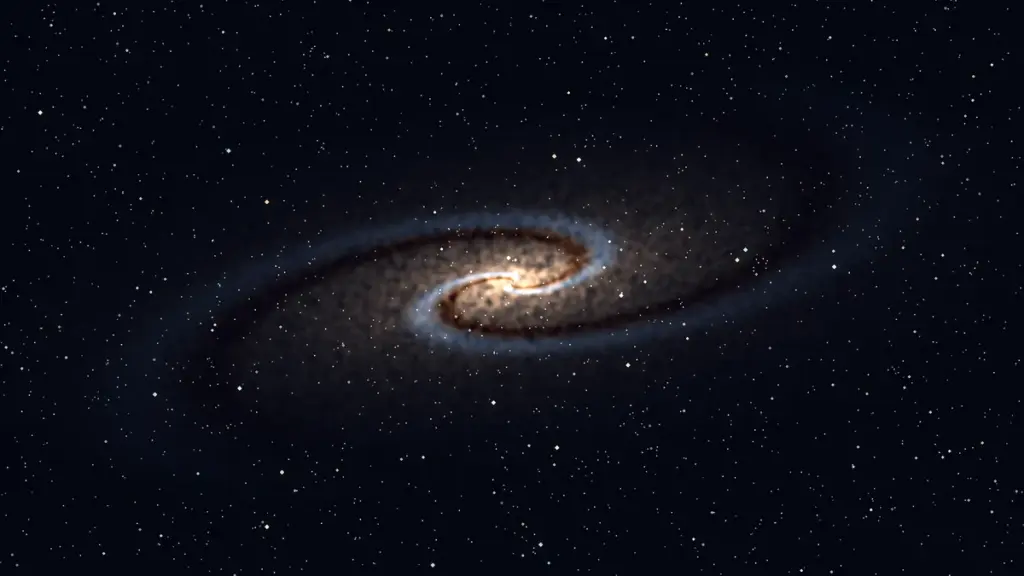
The Andromeda Galaxy may contain roughly one trillion planets or more, based on its estimated population of approximately one trillion stars and evidence that planets are common throughout our Milky Way. However, astronomers have not counted Andromeda’s planets individually, and no planet within the galaxy has been securely confirmed as of November 2026.
The distinction between an estimated planetary population and an actual discovery is important. Modern telescopes can resolve hundreds of millions of stars in Andromeda, but detecting the much smaller planets associated with those stars remains extraordinarily difficult. Researchers therefore combine stellar observations, exoplanet occurrence statistics, gravitational microlensing, and theoretical models to investigate how many worlds the galaxy might contain.
This article examines the evidence behind the trillion-planet estimate, the intriguing PA-99-N2 b candidate, the types of planets that may exist in Andromeda, and the observational technologies that could eventually reveal planetary systems beyond the Milky Way.
How Many Planets Are in the Andromeda Galaxy?
The Andromeda Galaxy could contain approximately one trillion or more planets, but its actual planetary population is unknown. This estimate is obtained by combining Andromeda’s estimated stellar population with planet occurrence rates measured in the Milky Way. It is not a direct astronomical measurement or a formally established statistical confidence interval.
Understanding the estimate requires examining Andromeda’s structure, its stars, and the scientific evidence showing that planetary systems are widespread.
What Is the Andromeda Galaxy?
The Andromeda Galaxy, officially designated Messier 31 (M31) and also cataloged as NGC 224, is the nearest major galaxy to our Milky Way. It is a large spiral galaxy situated approximately 2.5 million light-years from Earth in the constellation Andromeda.
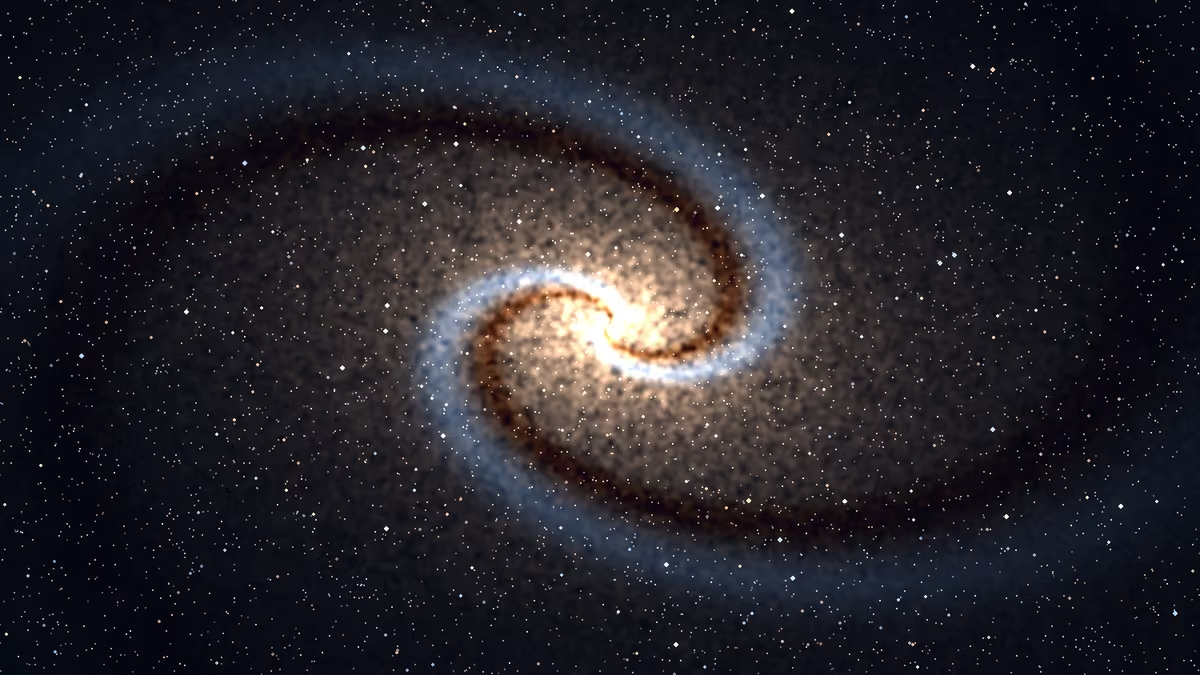
Like the Milky Way, M31 contains an extensive stellar disk, spiral arms, interstellar gas and dust, a central bulge, star clusters, and a surrounding stellar halo. Its visible stellar disk extends across well over 100,000 light-years, while its outer stellar structures reach considerably farther.
NASA estimates that Andromeda contains approximately one trillion stars, making it one of the most substantial stellar populations in the Local Group. The galaxy is sufficiently bright to be visible without a telescope under favorable dark-sky conditions. However, even its brightest visible appearance represents the combined light of enormous numbers of stars rather than individual planetary systems. [1] [2]
What Is the Estimated Number of Planets in Andromeda?
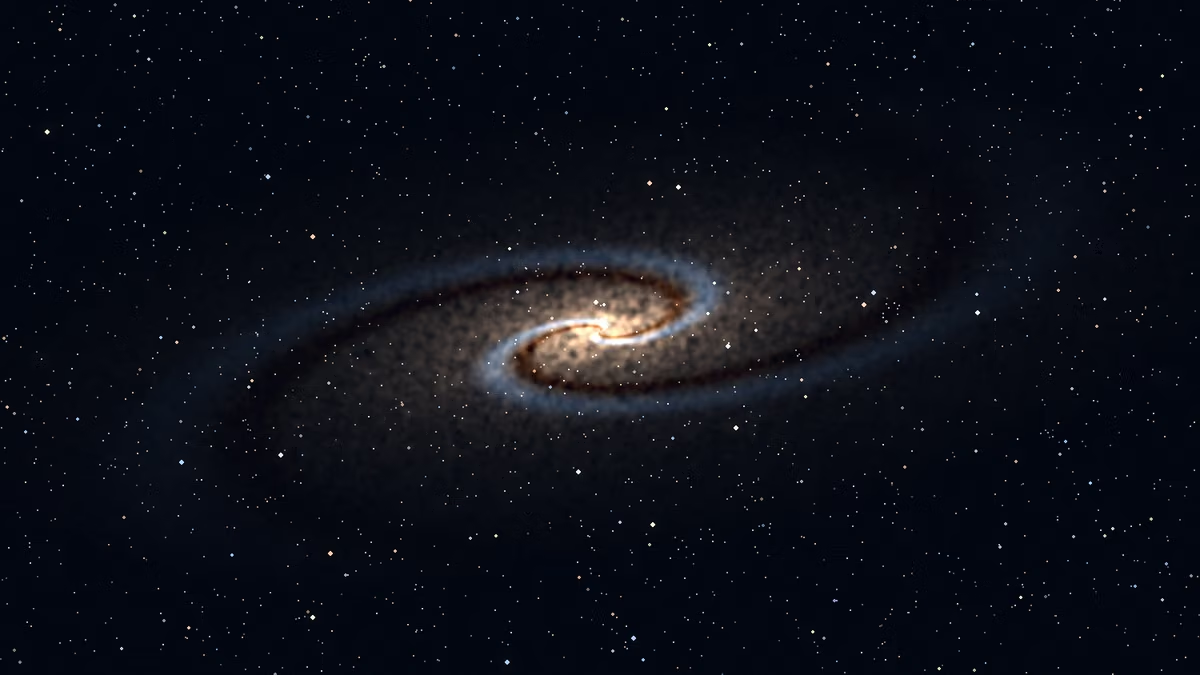
A reasonable first-order estimate is that Andromeda contains around one trillion star-orbiting planets, with a larger total possible if its stars host multiple planets on average. This calculation assumes that planetary systems occur in Andromeda at approximately the same average frequency as in the Milky Way.
An influential gravitational microlensing study published in Nature in 2012 concluded that the Milky Way contains, on average, at least one bound planet per star within the planetary populations investigated. Applying that finding to Andromeda’s estimated trillion stars produces an illustrative estimate of roughly a trillion planets. [3]
However, the actual number may differ because Andromeda’s stellar populations, chemical composition, and formation history are not identical to those of our galaxy. The estimate also normally excludes free-floating planets unless they are counted separately.
Are Any Planets in Andromeda Confirmed?
As of November 2026, no planet has been securely confirmed as belonging to the Andromeda Galaxy. Astronomers have identified possible planetary signatures in observations of M31, but the evidence has not established an unambiguous detection.
An exoplanet is a planet outside our Solar System. An extragalactic planet is a planet located beyond the Milky Way. This distinction matters because many thousands of confirmed exoplanets are known within our galaxy, while the observational evidence for planets in other galaxies remains considerably less certain.
A peer-reviewed 2026 study of stars associated with the Sagittarius dwarf galaxy stream explicitly noted that no exoplanets had been confirmed outside the Milky Way. The study illustrates how difficult it remains to extend planetary detection beyond our own galaxy. [4]
Have Astronomers Discovered Any Planets in Andromeda?
Andromeda has been a target of extragalactic planetary research for more than two decades. Astronomers have monitored its stars for gravitational microlensing events, which occur when a foreground object temporarily magnifies the light of a more distant star.
Some observations have produced signals consistent with possible planetary companions. Nevertheless, these events are difficult to interpret because the lensing objects usually cannot be observed directly or revisited under identical conditions. The most frequently discussed Andromeda planet candidate is PA-99-N2 b.
What Is PA-99-N2 b?
PA-99-N2 b is an unconfirmed planetary companion candidate associated with a gravitational microlensing event observed toward the Andromeda Galaxy. The event was first analyzed by the POINT-AGAPE collaboration, with subsequent research considering whether a low-mass companion could have contributed to its unusual light curve.
The Extrasolar Planets Encyclopaedia lists PA-99-N2 b as a candidate, not a confirmed planet. Its catalog includes a model-dependent estimated mass of approximately 6.34 Jupiter masses, associated with a published 2009 planetary interpretation. [5]
This value should not be treated as a directly measured planetary mass. The physical properties depend on assumptions about the lensing system, including the masses and locations of its components. Consequently, PA-99-N2 b is evidence of an interesting possible planetary signal, not proof of a discovered planet.
What Happened During the PA-99-N2 Microlensing Event?
During the PA-99-N2 event, astronomers observed a temporary increase in brightness that did not perfectly follow the smooth, symmetric pattern expected from a simple single-object gravitational lens.
In a 2004 study, J. H. An and collaborators investigated potential explanations, including observational effects, parallax, and a binary gravitational lens. Their preferred binary-lens model produced a lens mass ratio of approximately 0.012, meaning the secondary component had about 1.2% of the primary’s mass. [6]
Depending on the lens location and total system mass, the secondary could potentially fall within a planetary or substellar mass range. Alternative configurations involving stellar remnants, low-mass stars, or brown dwarfs could also explain the event.
Later investigations examined the planetary interpretation further, but they did not eliminate the uncertainties sufficiently to establish a confirmed extragalactic planet. [7]
How Can Scientists Detect Planets in Another Galaxy?
One promising technique is gravitational microlensing, in which the gravity of a foreground object bends and magnifies the light from a distant background star. If the foreground lens has a planetary companion, that companion can produce a short additional feature in the observed brightness pattern.
In Andromeda, most stars are too closely packed together to be measured individually from ground-based images. Astronomers therefore use pixel lensing, a variation of microlensing that detects changes in brightness within unresolved stellar fields.
This approach can reveal temporary gravitational events without requiring the source star or lensing object to be separately resolved. Its main limitation is that uncertain source brightness, lens distance, and companion mass can make planetary interpretations ambiguous. [7] [9]
How Do Scientists Estimate the Total Number of Planets in Andromeda?
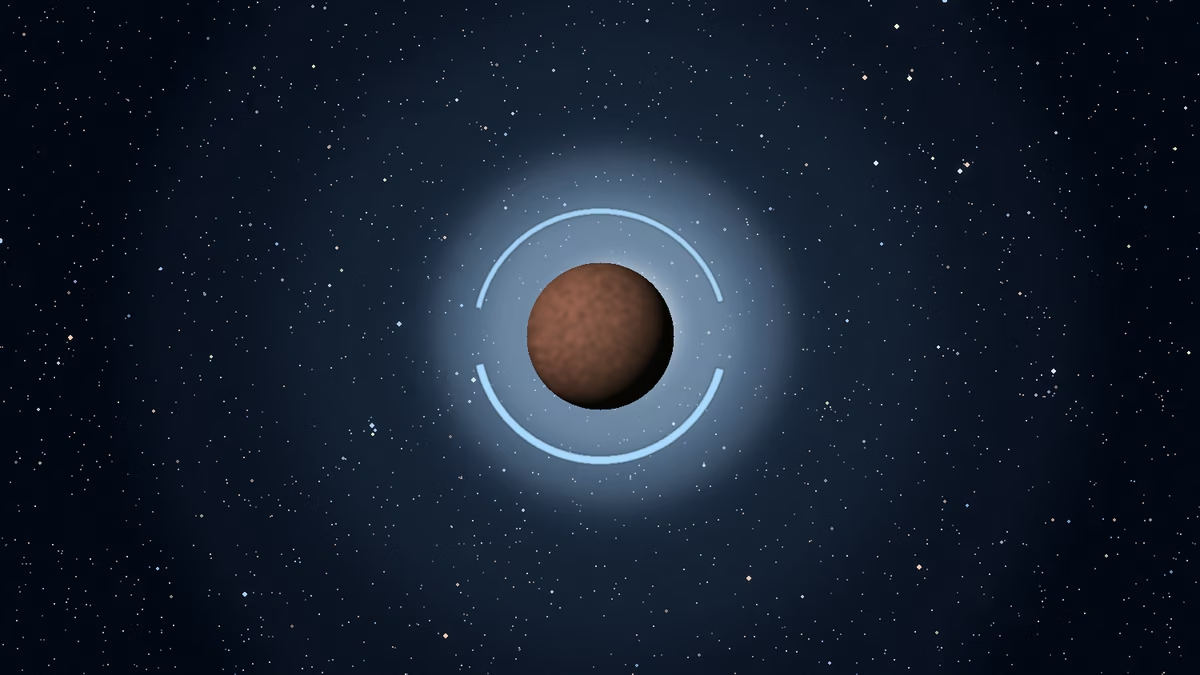
Because individual planetary detections are so limited, astronomers must estimate Andromeda’s planetary population indirectly. The central approach is to study the galaxy’s stellar demographics and compare them with planetary occurrence rates measured in better-observed environments.
This process requires careful distinctions between the number of stars, the percentage of stars hosting planets, the average number of planets per star, and the types of planets detectable by different surveys. Each factor introduces uncertainty into any estimate of the galaxy’s total planetary population.
How Does Andromeda Compare With the Milky Way?
The Milky Way and Andromeda are both large spiral galaxies containing extensive populations of stars, gas, dust, and planetary-forming material. Their structural similarities make the Milky Way a useful reference for estimating the number of planets in M31.
In our galaxy, observations from Kepler, TESS, and gravitational microlensing surveys demonstrate that planetary systems are common. This provides a scientific basis for expecting many planetary systems in Andromeda.
Nevertheless, Andromeda has experienced a different history of galaxy mergers, stellar formation, and chemical enrichment. These differences may affect the relative abundance of rocky planets, gas giants, and planetary systems associated with different stellar populations.
Consequently, Milky Way occurrence rates provide a useful starting point rather than a precise measurement of Andromeda’s planetary abundance. [2] [3]
How Many Stars in Andromeda Could Host Planets?
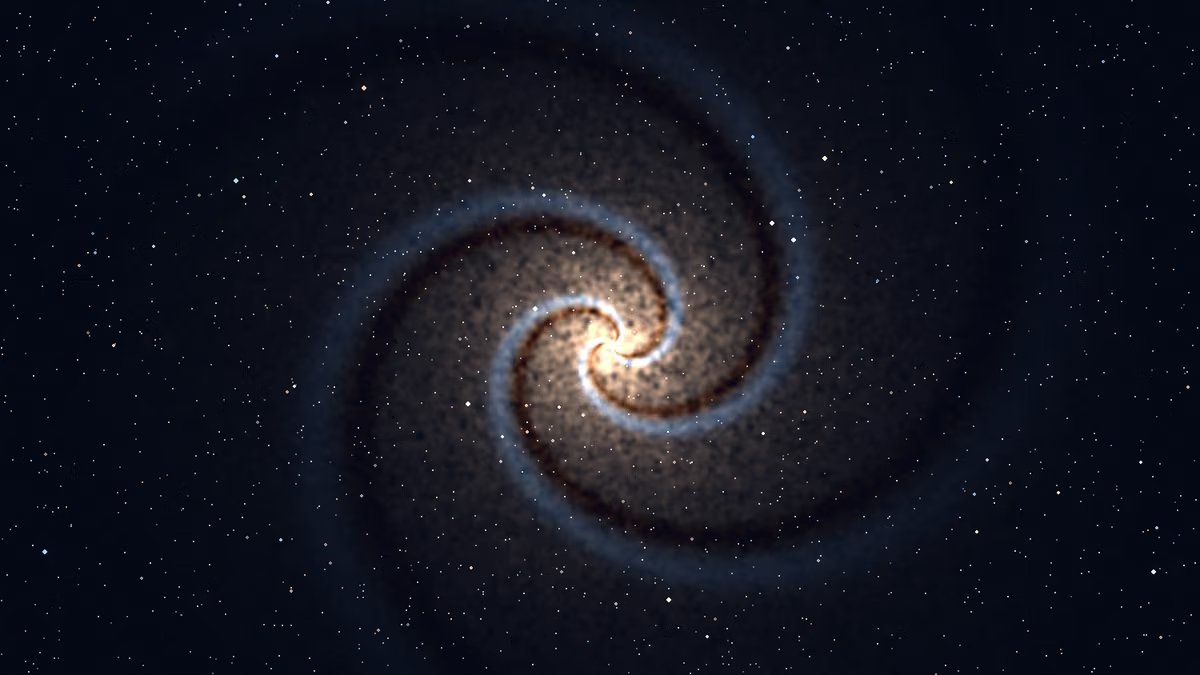
Andromeda contains approximately one trillion stars, but the number that currently host planets is unknown. A host star is a star gravitationally associated with one or more orbiting planets, and a planetary system may contain several planets, smaller bodies, and additional stellar companions.
Different stellar populations have different opportunities to form and retain planets. Long-lived, low-mass stars may support planetary systems for billions of years, whereas massive stars have much shorter lifetimes.
Binary stars and stellar remnants introduce additional possibilities and complications. Some planets orbit one star in a binary system, while others orbit both stars.
Although the galaxy’s large stellar population strongly supports the expectation of widespread planets, it does not establish that every star has a planet today.
How Can Astronomers Calculate Andromeda’s Planetary Population?
A simplified estimate uses the relationship:
Estimated number of bound planets = Number of stars × Average number of bound planets per star
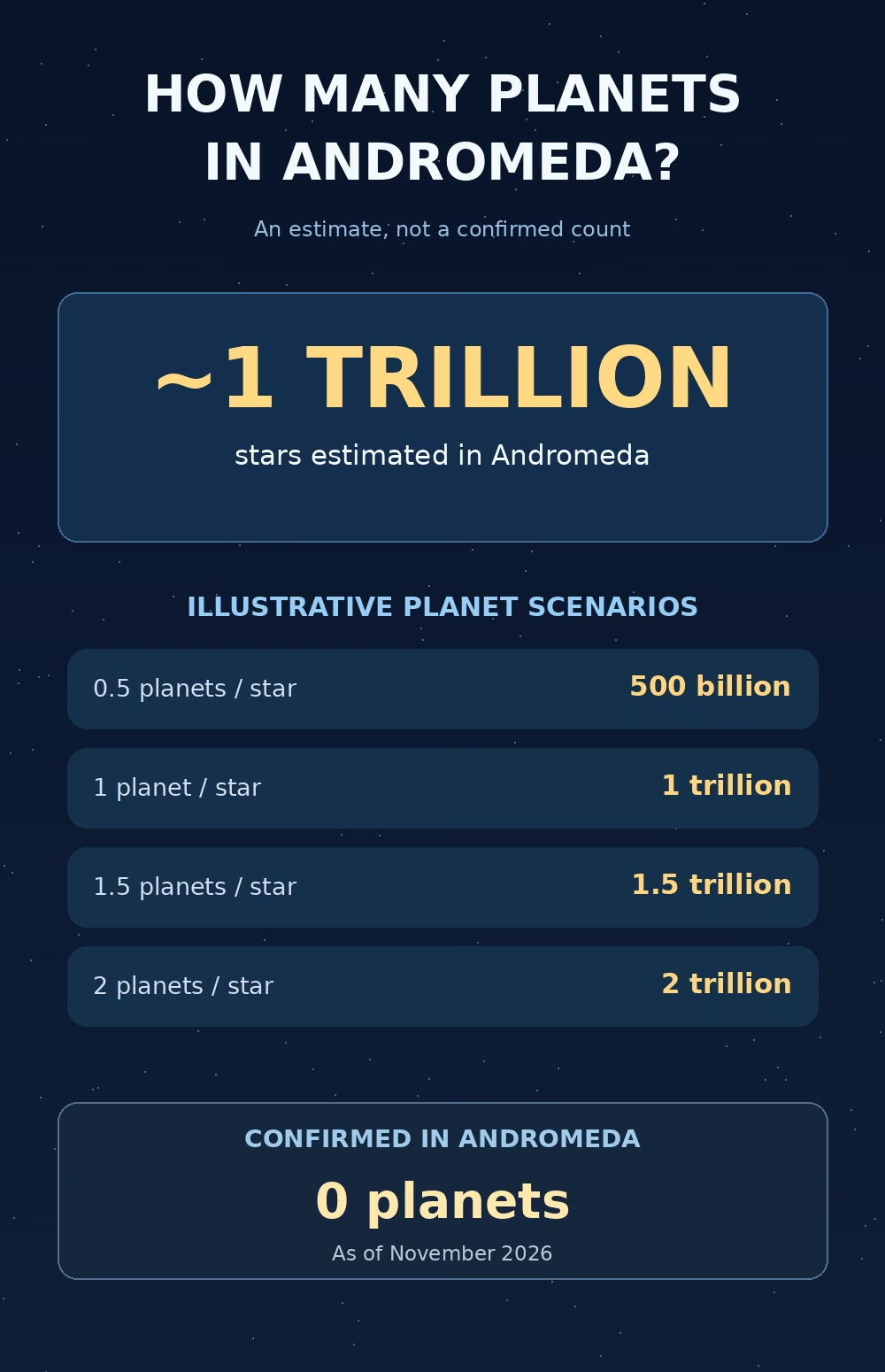
If Andromeda contains approximately one trillion stars, different assumed planetary occurrence rates produce different totals.
| Assumed average planets per star | Illustrative Andromeda planet estimate |
|---|---|
| 0.5 | 500 billion |
| 1 | 1 trillion |
| 1.5 | 1.5 trillion |
| 2 | 2 trillion |
| 3 | 3 trillion |
These are illustrative scenarios, not measured estimates or formal uncertainty bounds. The assumed average could vary among stellar types and galactic environments.
A more sophisticated calculation would divide Andromeda’s stars into different populations, estimate planetary occurrence for each group, and combine the results while accounting for survey selection effects. [3]
Why Is the Planet Count Uncertain?
The main difficulty is that astronomers have not measured planet occurrence rates directly across Andromeda. Existing observations establish the presence of enormous stellar populations, but even powerful telescopes cannot routinely resolve planets orbiting those stars.
The uncertainty is not simply a matter of counting stars more accurately. It also involves unknown planetary distributions, differences in stellar metallicity, the survival of planets after stellar evolution, and the limitations of Milky Way survey samples.
Furthermore, a population estimate based on one planet per star should not automatically be presented as a scientifically determined lower limit for Andromeda.
Without an Andromeda-specific occurrence survey, there is no reliable confidence interval for the galaxy’s total planet count.
How Many Stars Are in the Andromeda Galaxy?
NASA estimates Andromeda’s stellar population at approximately one trillion stars. This figure is based on astronomical observations and models of the galaxy’s stellar populations rather than a literal count of every individual star. [2]
In January 2025, NASA released a Hubble Space Telescope mosaic assembled from more than 600 overlapping observations. The panoramic image resolved approximately 200 million stars, particularly those bright enough to meet the survey’s detection limits.
Although 200 million is an enormous observational sample, it represents only a small fraction of the galaxy’s modeled total stellar population.
Astronomers combine resolved-star measurements with stellar population models, luminosity distributions, and estimates of stars too faint to observe individually. This distinction explains why the estimated total can be much larger than the number of stars directly detected.
How Far Away Is Andromeda From Earth?
Andromeda is approximately 2.5 million light-years from Earth, making it the nearest major spiral galaxy to the Milky Way. A light-year is the distance light travels through a vacuum in one year, approximately 9.46 trillion kilometers.
At this distance, the light reaching Earth today left Andromeda roughly 2.5 million years ago. Astronomers therefore observe the galaxy as it appeared in the distant past.
The immense distance creates a major observational problem. The angular separation between a planet and its host star becomes extremely small, while the planet itself emits or reflects far less light than the star.
Consequently, methods that work for nearby exoplanets become extraordinarily difficult when applied to Andromeda. [1]
How Do Planets Form in the Andromeda Galaxy?
The fundamental processes that produce planetary systems should operate throughout Andromeda wherever suitable gas, dust, and stellar environments exist. Scientists study these processes primarily within the Milky Way, where young stars and their surrounding disks can be observed in much greater detail.
Applying planet formation theory to Andromeda involves understanding how material accumulates around newborn stars, why different stellar environments produce different planetary outcomes, and how the galaxy’s chemical and evolutionary history may influence its planetary population.
How Are New Planetary Systems Created?
Planetary systems commonly begin forming when a molecular cloud collapses under gravity and produces a young star surrounded by a protoplanetary disk of gas and dust.
Within this rotating disk, microscopic dust particles collide and accumulate into larger aggregates. These materials can develop into pebbles and planetesimals, which are solid bodies that serve as important building blocks for planets.
Through planetary accretion, planetesimals and growing planetary embryos accumulate additional material. In sufficiently massive and gas-rich disks, solid cores may acquire substantial hydrogen and helium envelopes, producing giant planets.
The process depends on disk mass, temperature, composition, gas lifetime, and dynamical interactions. NASA’s Webb observations have also provided evidence for inward-drifting icy pebbles, an important mechanism in current formation models. [10]
Which Types of Stars Are Most Likely to Host Planets?
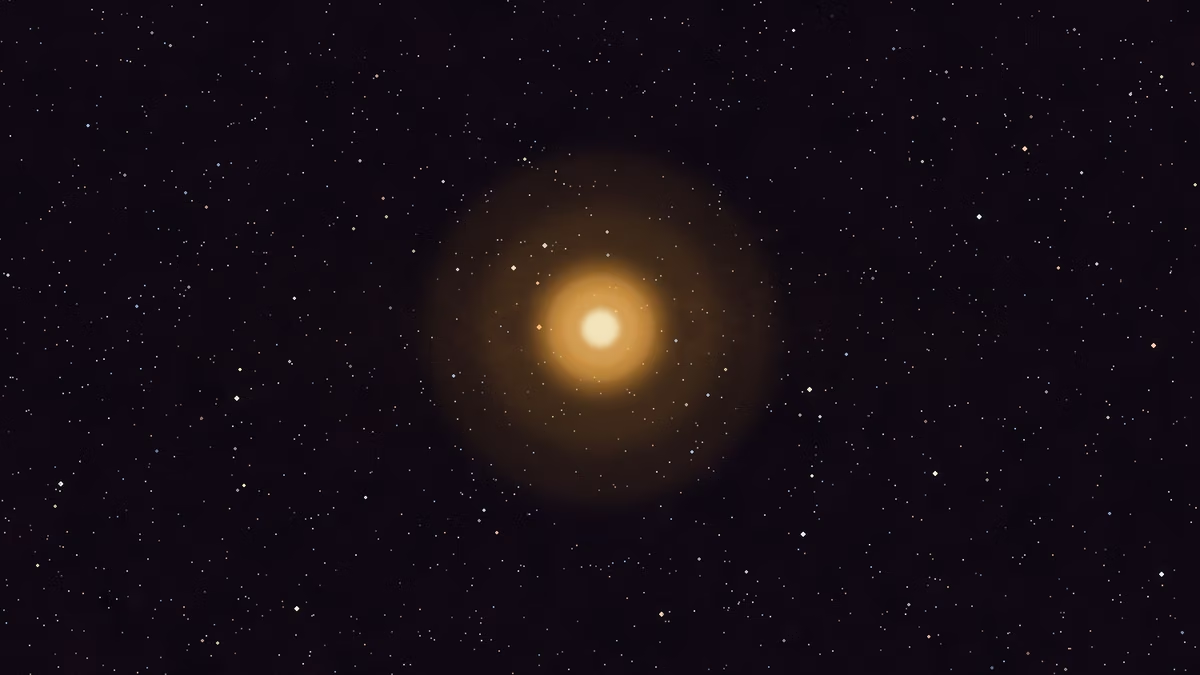
Low-mass stars are particularly important because they are abundant and can remain active stars for extremely long periods. Red dwarfs, or M-type stars, constitute the majority of stars in the Milky Way and are therefore expected to contribute substantially to planetary populations in other large galaxies.
Sun-like stars, usually classified as G-type main-sequence stars, also support diverse planetary systems, including rocky planets and gas giants.
Stellar mass influences protoplanetary disk properties, radiation environments, and the formation of giant planets. More massive stars may initially possess more massive disks, but their intense radiation and relatively short lifetimes can affect disk evolution.
The exact distribution of host-star types in Andromeda must be considered before applying planet occurrence rates measured around nearby stars. [11]
Why Do Some Stars Have More Planets Than Others?
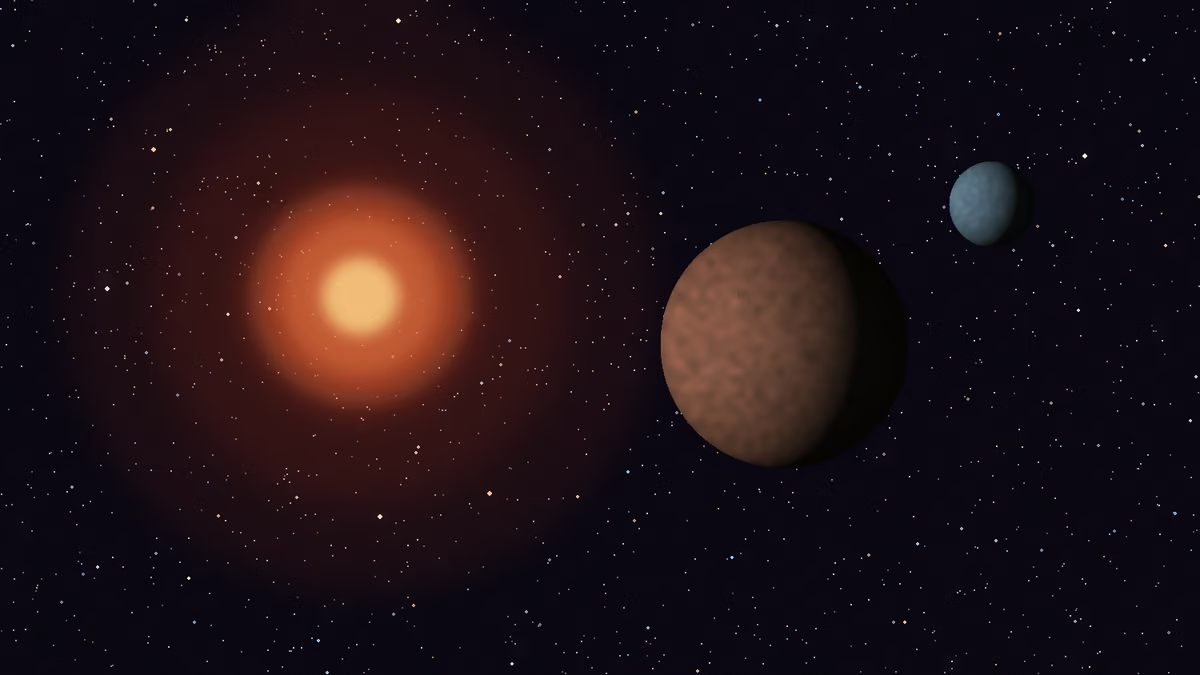
The number of planets around a star depends partly on the initial conditions of its protoplanetary disk and the gravitational interactions that occur during and after planet formation.
Disks differ in mass, solid material content, temperature, and lifetime. Some may form several rocky planets, while others produce fewer massive planets or systems with unusual orbital configurations.
Planetary migration can move planets inward or outward after formation. Gravitational interactions may also cause collisions, orbital rearrangements, or the ejection of planets into interstellar space.
These processes shape planetary demographics, including the distribution of planet sizes, masses, orbital periods, and eccentricities. As a result, the average number of planets per star is more informative than assuming all stars possess identical planetary systems.
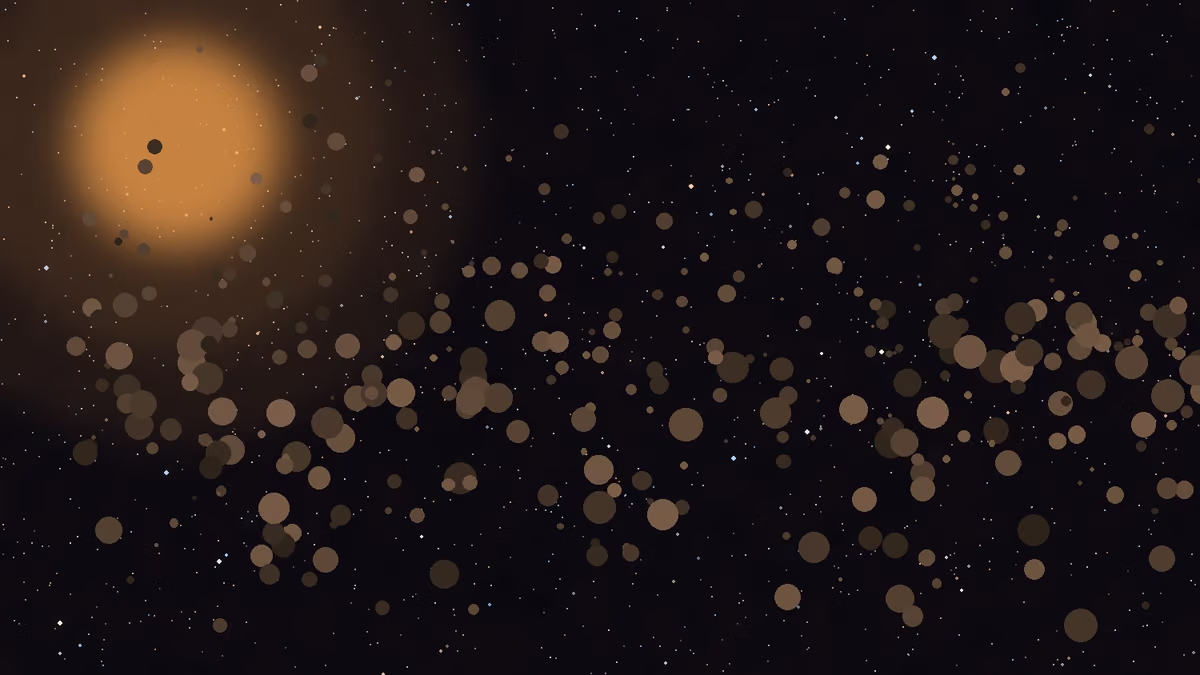
Does a Star’s Chemical Composition Affect Planet Formation?
A star’s metallicity describes the abundance of elements heavier than helium, usually measured relative to the Sun. Because stars and their planetary disks generally form from the same molecular cloud, stellar metallicity provides information about the material available during planet formation.
Observations demonstrate a strong relationship between higher metallicity and the occurrence of some classes of giant planets, particularly around Sun-like stars.
However, smaller planets can form around stars spanning a relatively broad range of metallicities. Research based on Kepler observations found that planets smaller than approximately four Earth radii occur around stars with diverse chemical compositions. [12]
These findings mean that Andromeda’s metallicity distribution may influence the relative frequency of different planetary types, but low metallicity does not automatically imply a complete absence of planets.
Does the Age of Andromeda’s Stars Affect Its Planet Count?
Stellar age influences planetary history because planets form during early stages of stellar evolution and may subsequently survive for billions of years. Older stellar populations therefore have had substantial time to develop mature planetary systems.
However, old age does not guarantee that a particular star retains its original planets. Stellar evolution, mass loss, gravitational interactions, and changes in orbital stability can alter or destroy planetary systems.
Andromeda contains stars of different ages, reflecting a complicated history of star formation and galaxy interactions.
A July 2026 NASA report described Hubble-based research showing that Andromeda’s star formation has declined over approximately the past 500 million years, with a more pronounced decrease during the most recent 40 million years. This affects the present production of new stars and potential planetary systems, but does not directly measure the number of existing planets. [13]
What Types of Planets Could Exist in the Andromeda Galaxy?
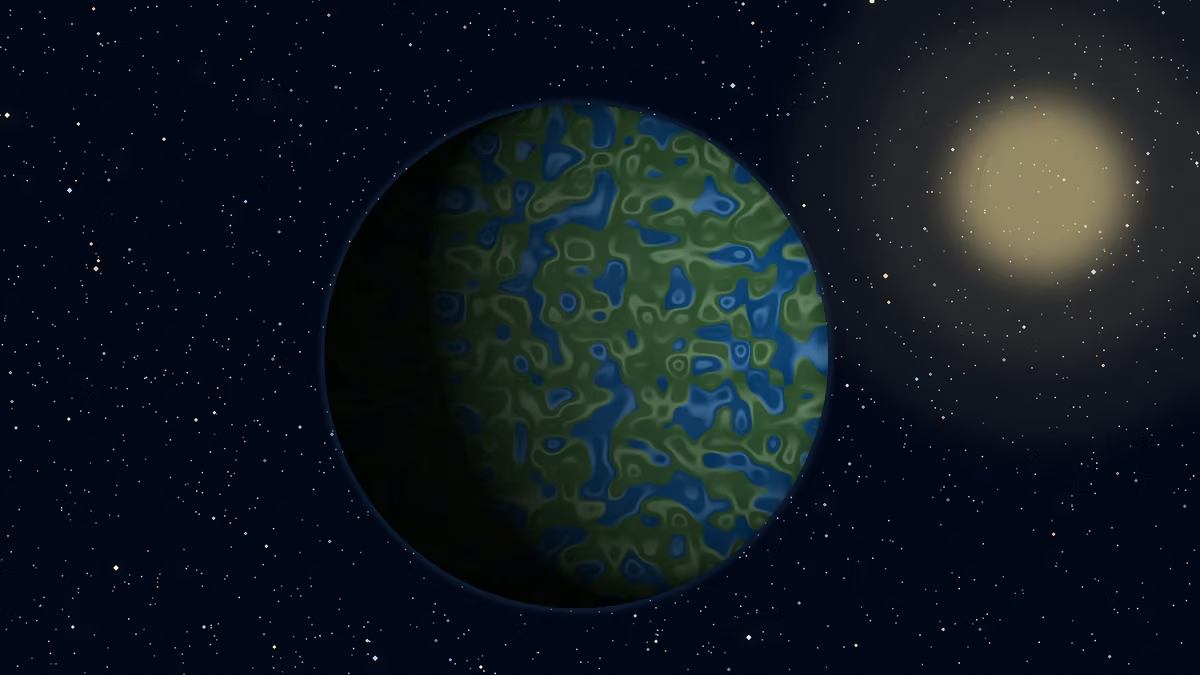
The enormous diversity of exoplanets found in the Milky Way suggests that Andromeda may contain many different planetary categories. These potentially include rocky planets, gas giants, ice giants, super-Earths, mini-Neptunes, and objects that do not orbit stars.
These possibilities are based on physical theory and observed exoplanet demographics rather than confirmed identifications in Andromeda. Researchers must therefore distinguish familiar planetary categories from actual discoveries within M31.
Could Andromeda Contain Rocky Planets Like Earth?
Rocky planets consist primarily of solid materials such as silicate minerals and iron-rich metals. Mercury, Venus, Earth, and Mars provide familiar examples from our Solar System.
The existence of rocky exoplanets throughout the Milky Way indicates that their formation is a common outcome of planetary development.
Because Andromeda contains enormous numbers of long-lived stars and chemically enriched stellar populations, rocky planets are scientifically plausible there.
However, no Earth-like planet has been confirmed in Andromeda, and astronomers do not have enough evidence to calculate its Earth-sized planet population accurately.
Furthermore, being rocky or similar in size to Earth does not establish that a planet possesses oceans, a suitable atmosphere, or conditions capable of supporting life. [14]
Are There Gas Giants and Ice Giants in Andromeda?
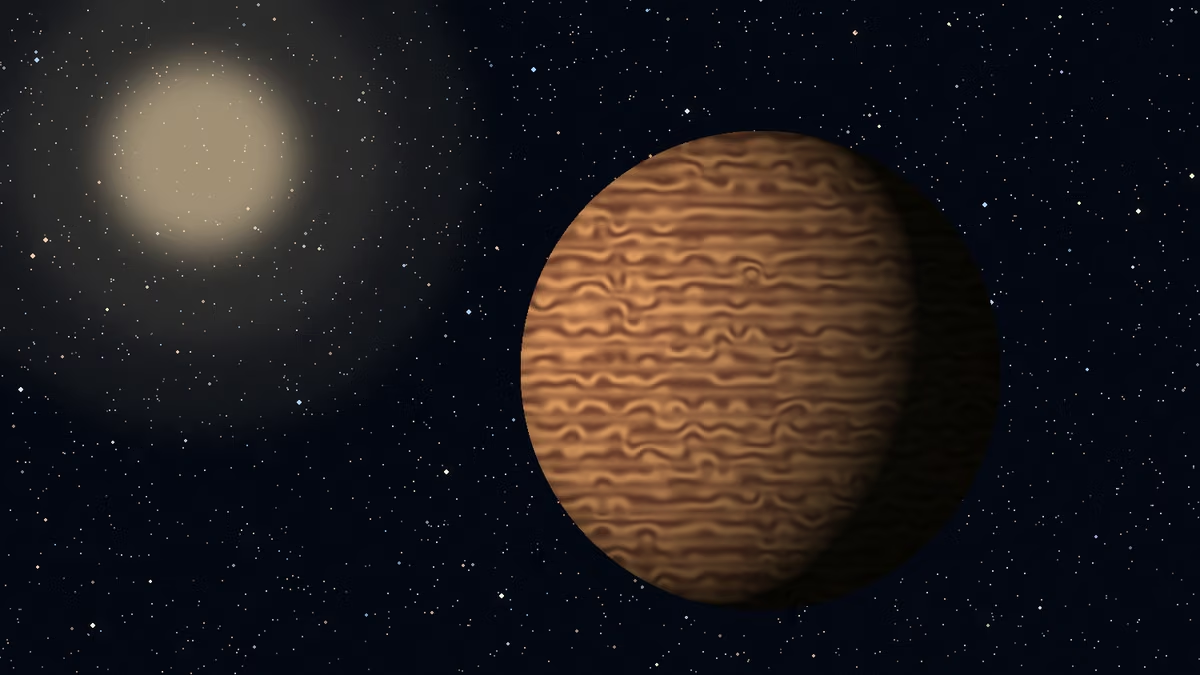
Gas giants are large planets dominated by substantial hydrogen and helium envelopes. Jupiter and Saturn are examples, while Uranus and Neptune are generally categorized as ice giants because their internal compositions contain larger proportions of heavier volatile materials.
Giant planets can form when growing planetary cores accumulate substantial material from their surrounding disks. The availability of solids, gas, and sufficient formation time is important.
The discovery of many giant exoplanets throughout the Milky Way supports the expectation that Andromeda may host comparable worlds.
Nevertheless, scientists have not directly identified or measured a confirmed gas giant or ice giant in Andromeda. Estimates of their possible abundance must be inferred from stellar demographics and planet formation models. [14]
Could Super-Earths and Mini-Neptunes Exist in Andromeda?
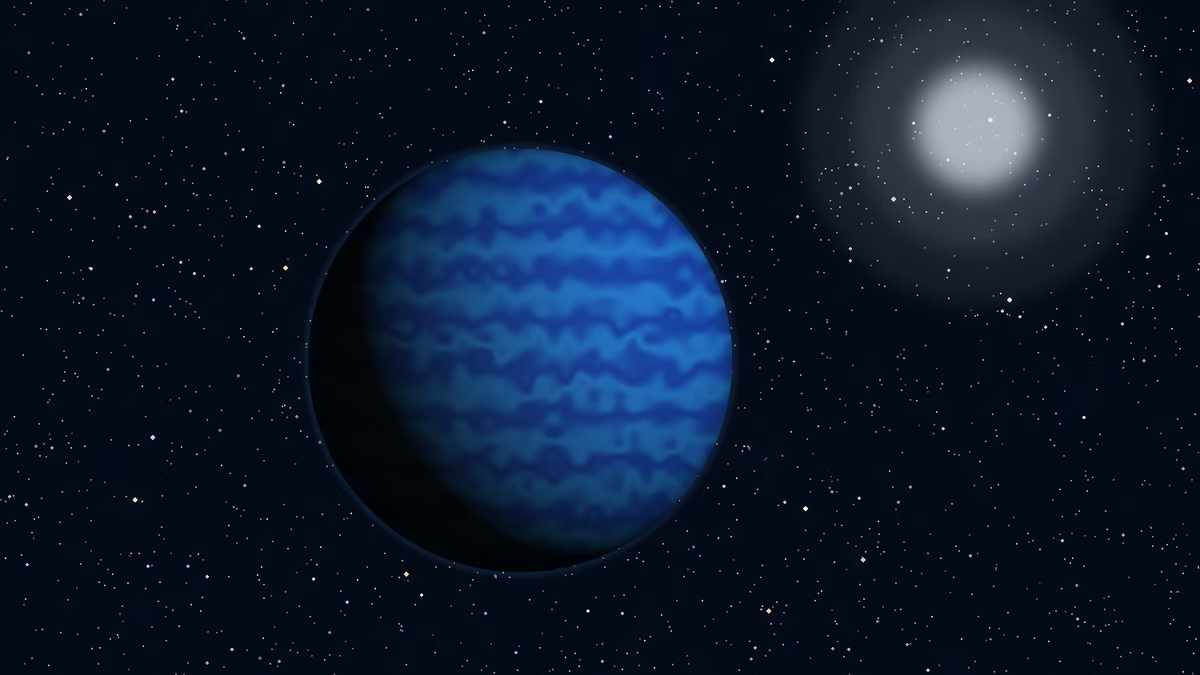
Super-Earths are planets larger or more massive than Earth but smaller than Neptune, although individual studies may use different mass or radius boundaries.
Their names describe broad physical categories rather than guaranteed Earth-like environments. A super-Earth can be rocky, volatile-rich, or possess a substantial atmosphere.
Mini-Neptunes are relatively small planets that typically have significant gaseous envelopes and may lack a conventional solid surface accessible beneath their atmospheres.
Both categories are important in Milky Way exoplanet research because planets between Earth and Neptune in size are common in observed samples.
Given Andromeda’s enormous stellar population, similar planetary classes are plausible there, but their frequency and composition cannot currently be measured directly. [14]
Could Andromeda Have Planets That Do Not Orbit Stars?
Rogue planets, also called free-floating planets, are planetary-mass objects that are not gravitationally bound to a host star.
Some may have formed within planetary systems before being ejected through gravitational interactions. Others may originate through the direct collapse of gas clouds, making their classification more complicated.
Because Andromeda contains enormous stellar populations, gravitational interactions could plausibly produce unbound planetary-mass objects there.
However, their number is highly uncertain. Theoretical estimates depend on formation and ejection models, while observational constraints remain limited.
This also complicates the total planet count. Estimates based on planets per star usually refer to bound planets, so including rogue planets requires a separate population calculation.
Could There Be Habitable Planets in Andromeda?
A potentially habitable planet is a world whose physical conditions might permit environments suitable for life. Astronomers frequently begin by identifying planets within a star’s habitable zone, where surface liquid water could exist under suitable atmospheric conditions.
However, the habitable zone is only one consideration. Atmospheric pressure, greenhouse warming, stellar radiation, water availability, planetary composition, and long-term environmental stability can all influence habitability.
A true Earth analog would need to resemble Earth across several relevant physical characteristics rather than simply orbiting at a similar temperature.
Andromeda could plausibly contain potentially habitable planets, but none have been identified or characterized. There is currently no observational basis for estimating how many contain liquid water, biological activity, or life. [15]
Could Andromeda Contain Planets Larger Than Jupiter?
Planets more massive than Jupiter are sometimes called super-Jupiters. Some may possess masses several times greater than Jupiter while retaining broadly gas-giant characteristics.
The boundary between massive planets and brown dwarfs is complicated because their classification can depend on mass, formation history, and internal nuclear processes.
Deuterium fusion becomes possible near a commonly cited boundary of about 13 Jupiter masses under certain assumptions, but it is not a universal dividing line for every object.
Andromeda could contain massive planetary companions similar to those observed in the Milky Way. However, even if a candidate’s gravitational signal implies a large mass, the absence of independent constraints may prevent astronomers from determining whether it is a planet, brown dwarf, or low-mass star.
Can Planets Form Around Two Stars?
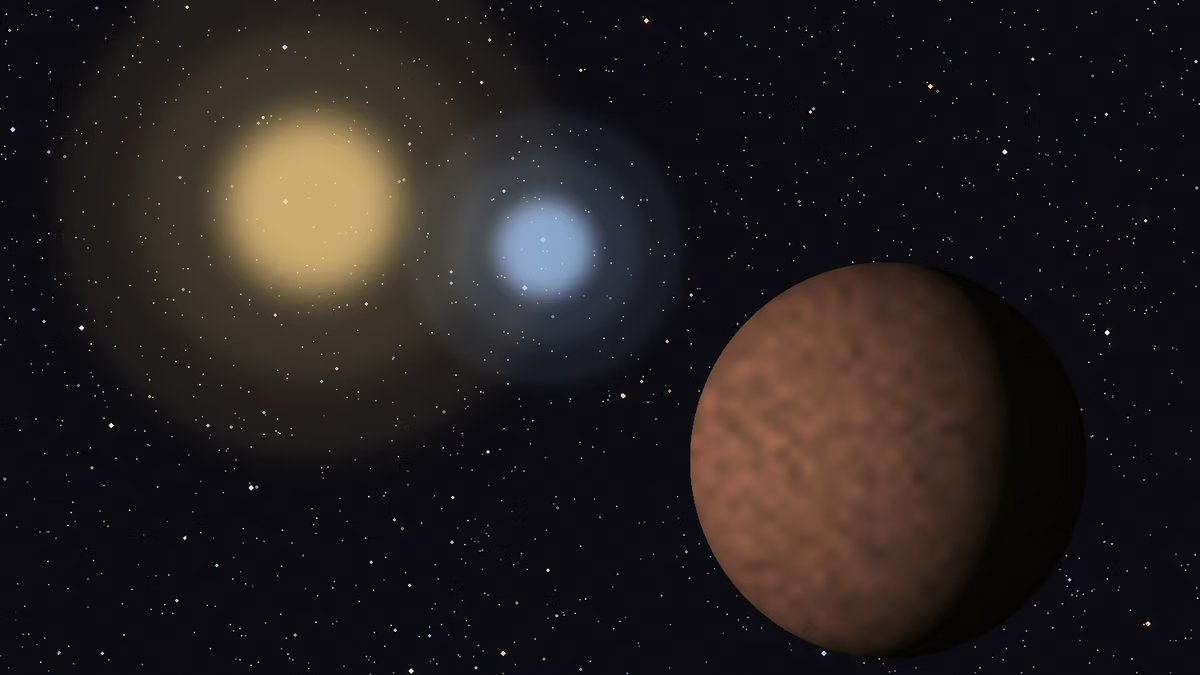
Yes. Planetary systems can form and survive in binary star systems, which contain two stars gravitationally bound to one another.
An S-type planet orbits one member of the binary, while a circumbinary planet follows a wider orbit around both stars. The stability of either arrangement depends on the stellar separation, orbital eccentricity, and gravitational configuration.
Multiple circumbinary planets have been confirmed in the Milky Way, demonstrating that planetary formation is not limited to single-star systems.
Because binary stars are common astronomical systems, similar planetary arrangements could exist in Andromeda.
Their abundance remains unknown, and estimating the number of planets in multiple-star systems requires avoiding double-counting stars or planetary systems in statistical calculations.
How Does Gravitational Microlensing Help Detect Planets in Andromeda?
Gravitational microlensing is one of the most promising techniques for investigating possible planets in galaxies beyond the Milky Way. Unlike methods that require astronomers to measure light emitted or reflected by a planet, microlensing relies on gravitational effects.
It is particularly valuable for observations of Andromeda because it can reveal otherwise invisible foreground objects through temporary changes in the brightness of background stars. However, interpreting these events requires careful mathematical modeling and consideration of competing explanations.
How Does a Microlensing Event Work?
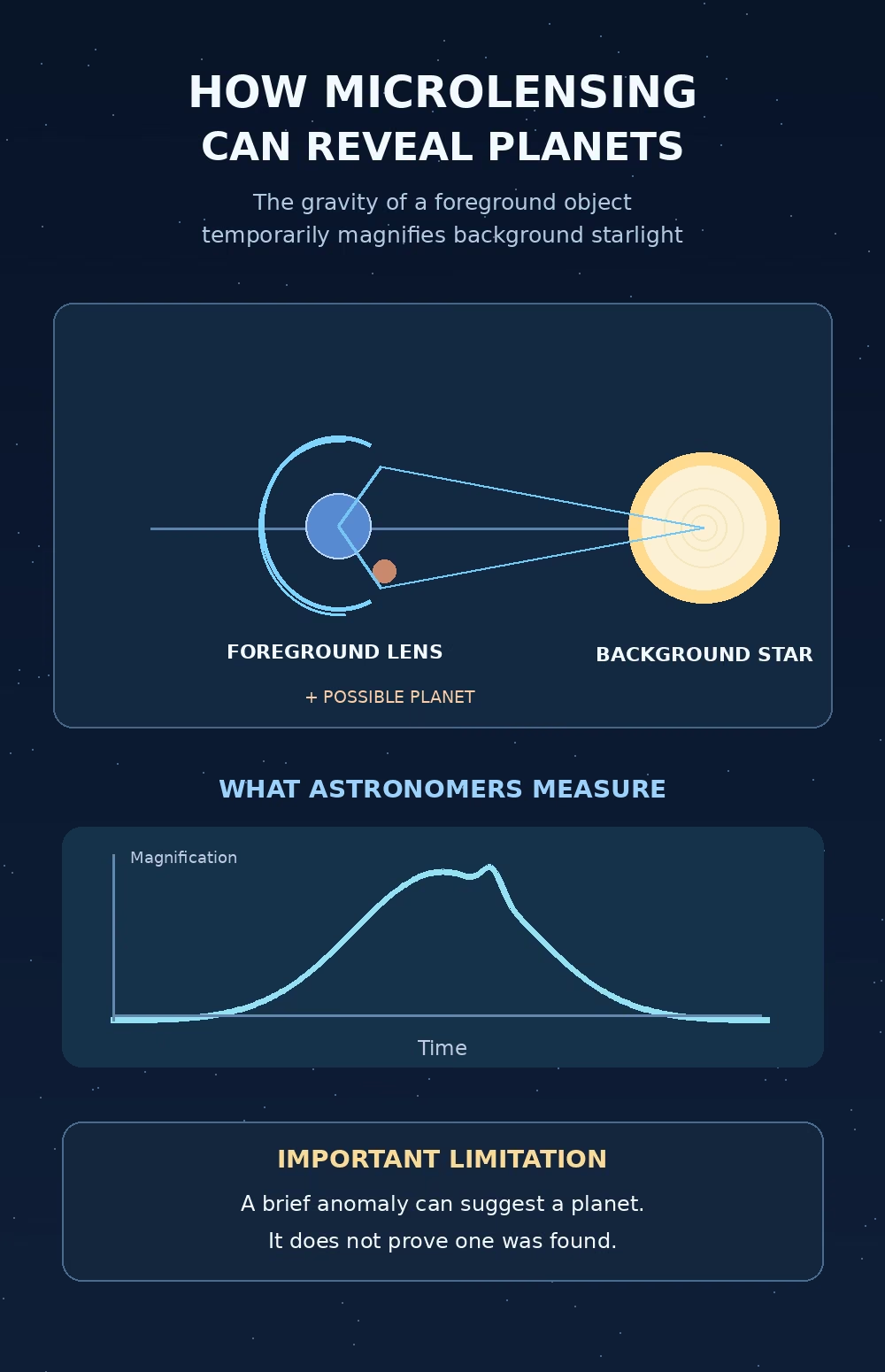
A gravitational microlensing event occurs when a foreground object, called the lens, passes close to the line of sight between an observer and a more distant source star.
According to general relativity, the gravitational field of the lens bends the paths of light rays. This can temporarily increase the apparent brightness of the background source.
As the relative positions of the source, lens, and observer change, the magnification rises and falls, producing a characteristic light curve.
A single, isolated point-mass lens normally produces a smooth, approximately symmetric event. The exact brightness pattern depends on the alignment and motion of the objects.
In Andromeda surveys, the source is often a distant star in M31, while the lens may be another object within M31 or an intervening population. [9]
How Can Astronomers Identify a Planetary Signal?
A microlensing light curve plots observed brightness against time. Astronomers compare that curve with mathematical predictions for different gravitational lens configurations.
If the foreground lens is accompanied by a planet, the planet’s gravity may introduce a short-lived microlensing anomaly superimposed on the primary event.
Researchers use a binary lens model to determine whether two gravitational masses could explain the observed pattern.
One important model parameter is the lens mass ratio, commonly represented by the symbol q. A sufficiently small mass ratio may be consistent with a planetary companion.
However, a small ratio does not establish planetary status without information about the overall lens mass. Stellar binaries, source effects, and other configurations can sometimes produce similar observational signatures. [6] [9]
Which Physical Factors Affect Microlensing Measurements?
Several physical parameters determine the appearance of a microlensing event.
The Einstein radius is the characteristic scale associated with gravitational light deflection. It depends on the lens mass and the distances between the observer, lens, and source.
The Einstein crossing time describes the timescale over which relative motion changes the alignment by one Einstein radius.
A finite-source effect occurs when the apparent angular size of the background star is significant compared with the lensing structure. This can smooth or alter short-lived features.
Other important factors include relative proper motion, source brightness, gravitational magnification, and potential blending from nearby stars.
Accurate interpretations require combining these variables while recognizing degeneracies between physically different lensing configurations. [9] [16]
Why Is It Difficult to Count Planets in the Andromeda Galaxy?
Andromeda’s distance creates a fundamental observational barrier. Even though astronomers can measure large stellar populations in M31, the planets associated with those stars are far smaller, dimmer, and more difficult to separate from their surroundings.
The limitations are not restricted to telescope magnification. Detecting planets also depends on precision photometry, observation timing, statistical survey completeness, and the ability to distinguish genuine planetary signatures from other astronomical events.
How Do Astronomers Measure the Light From Distant Stars?
Astronomical photometry is the measurement of light received from astronomical sources. In exoplanet research, astronomers often monitor brightness over time to identify transits, microlensing events, and other variations.
An important parameter is observation cadence, meaning how frequently measurements are collected.
High cadence is essential when a planetary signal may last only a short period. If observations are separated by several hours, a brief anomaly could be completely missed.
Researchers also evaluate the signal-to-noise ratio, which describes the strength of a measured signal relative to background noise and measurement uncertainty.
For Andromeda, faint sources, crowded fields, atmospheric effects, and variable observing conditions make high-precision photometry especially demanding.
Why Are Individual Stars Difficult to Observe?
Andromeda contains extremely crowded stellar environments where many stars occupy areas smaller than the resolving capability of a telescope.
This phenomenon is called stellar crowding, and it often produces source blending, where light from multiple stars contributes to a single recorded image element.
Blending makes it difficult to determine the true brightness of a particular star and can distort the interpretation of a microlensing light curve.
To address this, astronomers use difference image analysis, which compares observations taken at different times and subtracts the relatively constant background light.
The remaining differences can reveal variable stars or transient brightening events, even when individual stars cannot be continuously resolved.
How Do Scientists Account for Planets They Cannot Detect?
Astronomical surveys do not detect every planet within their observing regions. Researchers therefore evaluate survey completeness, which describes how effectively an observing program can detect objects with particular properties.
Completeness depends on planet mass, orbital separation, stellar brightness, observation cadence, and instrumental sensitivity.
Selection bias occurs when some types of planets are much easier to detect than others. For example, transit surveys preferentially identify planets whose orbits happen to cross their host stars from our perspective.
Researchers can inject simulated planetary signals into real or modeled observations to estimate detection efficiency.
Statistical methods may then produce occurrence rates and confidence intervals, but such intervals are meaningful only when the underlying data and assumptions justify them.
For Andromeda, the available planetary evidence remains insufficient for a precise galaxy-wide population measurement.
Can Computer Models Predict Andromeda’s Planetary Population?
Computer simulations can help estimate the types and numbers of planets that might form across Andromeda’s stellar populations.
Planet population synthesis models combine protoplanetary disk properties, accretion physics, orbital migration, gravitational interactions, and stellar characteristics to simulate possible planetary systems.
Another important concept is the initial mass function, which describes the relative numbers of stars formed at different initial masses.
By combining a stellar population model with planetary formation and occurrence prescriptions, researchers can predict potential distributions of planet sizes, masses, and orbital distances.
However, these predictions depend heavily on assumptions and calibration data, much of which comes from the Milky Way.
Computer models therefore offer testable scenarios rather than direct observational counts of Andromeda’s planets.
Where Would Most Planets Be Located in Andromeda?
Planetary populations are expected to broadly follow the galaxy’s stellar distribution, although their frequency may vary between different environments. Andromeda contains a large disk, prominent spiral structures, a dense central bulge, and extended outer stellar populations.
Each region has different stellar ages, chemical compositions, densities, and formation histories. These differences could influence planet formation and long-term orbital stability, but direct observations have not established the distribution of planets across M31.
Could Most Planets Be Found in Andromeda’s Galactic Disk?
Andromeda’s galactic disk contains a large population of stars distributed across its rotating, flattened structure.
Because planets commonly form alongside stars, the disk is a natural candidate for hosting an enormous number of planetary systems.
Its stellar populations include relatively young stars associated with star-forming regions and older stars distributed throughout the disk.
However, it is not possible to establish confidently what fraction of Andromeda’s total planets occupy the disk without knowing how planet occurrence varies across its different stellar environments.
The central bulge and outer populations may also contain substantial numbers of planetary systems. A reliable answer requires stellar mass distributions and planet occurrence estimates for each region.
Are Spiral Arms Important for Planet Formation?
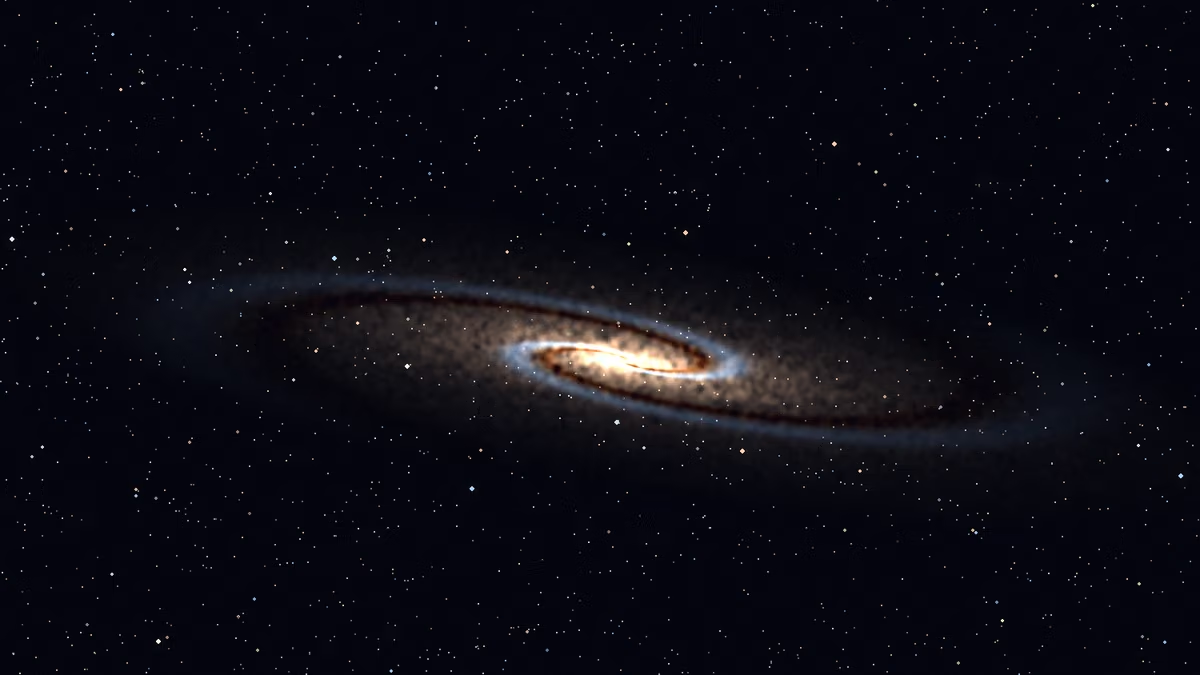
Spiral arms are prominent features of disk galaxies, often associated with concentrations of gas, dust, young stars, and star-forming regions.
Dense molecular gas within these structures can collapse to form new stars. Some of those stars develop protoplanetary disks, creating opportunities for new planetary systems.
Andromeda’s spiral structure includes dust lanes and stellar associations that provide evidence of different stages of star formation.
However, spiral arms do not contain all the stars or potential planets in a galaxy. Stars orbit through the galactic disk, and planetary systems can survive long after leaving the regions where they originally formed.
Therefore, spiral arms are important environments for producing new planetary systems, not necessarily the exclusive or permanent locations of planets.
Could Planets Exist Near Andromeda’s Galactic Center?
Andromeda’s central region includes a dense galactic bulge populated by many older stars. Those stars could potentially host planetary systems formed earlier in the galaxy’s history.
Planet survival in crowded environments may be influenced by stellar encounters, gravitational interactions, and the evolutionary histories of host stars.
However, high stellar density does not automatically prevent planets from existing. A planet’s stability depends on its orbit and the particular gravitational environment.
The galactic center is also observationally difficult because the light from numerous stars overlaps within extremely small angular areas.
Consequently, astronomers cannot presently determine how common planetary systems are throughout Andromeda’s central bulge or how their demographics compare with those in its disk.
Could Planets Exist Far Outside Andromeda’s Main Disk?
The stellar halo of Andromeda contains stars extending well beyond its main visible disk, including populations associated with past mergers and disrupted satellite galaxies.
Some halo stars are old and relatively metal-poor, characteristics that may influence the kinds of planets they formed.
The possibility of planets in these outer environments is supported indirectly by the existence of planetary systems around stars with diverse compositions and evolutionary histories in the Milky Way.
However, stellar halo environments differ from the younger, chemically enriched regions where many exoplanets have been studied.
There is currently no reliable census of planets in Andromeda’s halo. The likely population depends on its stellar demographics and the survival of planetary systems over long timescales.
How Do Gas and Dust Influence Planet Formation?
The interstellar medium consists of gas, dust, and other material distributed between stars. Dense regions of this medium, particularly molecular clouds, provide the raw material for star formation.
As a molecular cloud collapses, some of its material may become incorporated into a protostar and surrounding protoplanetary disk.
Dust grains within those disks play an essential role in building planetesimals and larger planetary bodies.
Andromeda’s dark dust lanes are visible in astronomical images because dust absorbs and scatters light from stars behind it.
These regions help researchers identify the galaxy’s interstellar structure, although dust can also conceal objects and complicate stellar observations.
The abundance and chemical composition of gas and dust influence the opportunities for future planet formation.
Could Planets Form Inside Star Clusters?
Star clusters contain groups of stars formed together or gravitationally associated over long periods.
Young clusters provide environments in which many stars may initially possess protoplanetary disks. Planet formation can occur within these disks, as it does around stars outside clusters.
However, cluster environments can affect planetary evolution. Strong ultraviolet radiation from nearby massive stars may accelerate disk dispersal, while close stellar encounters can perturb planetary orbits.
Dense clusters therefore present both opportunities for planet formation and potential challenges for planetary survival.
Andromeda contains numerous stellar clusters, but researchers have not established the fraction of their stars that host planets.
The effects of cluster density, age, and chemical composition must be considered before estimating planetary populations in these environments.
Which Telescopes and Scientific Surveys Study Andromeda?
Astronomers investigate Andromeda through a combination of space-based observations, large ground-based telescopes, and extensive astronomical surveys.
Different instruments provide complementary information about stellar populations, galactic structure, star formation, and possible gravitational microlensing events. Although these facilities have transformed our understanding of M31, none has produced a confirmed inventory of its planetary systems.
Understanding each telescope’s scientific role is essential when evaluating claims about planets in Andromeda.
How Has the Hubble Space Telescope Studied Andromeda?
The Hubble Space Telescope has provided some of the most detailed observations ever obtained of Andromeda’s stellar populations.
Its high angular resolution allows researchers to distinguish enormous numbers of stars across regions that appear heavily blended in lower-resolution images.
In January 2025, NASA released a panoramic Hubble mosaic of Andromeda based on observations spanning more than a decade. The mosaic contained approximately 2.5 billion pixels and resolved around 200 million stars. [2]
These observations help astronomers study stellar ages, star clusters, dust structures, and the galaxy’s history of interactions with smaller galaxies.
Although the images are extraordinarily detailed, resolving stars does not mean resolving their individual planets. Hubble’s Andromeda surveys principally support stellar population studies rather than a direct census of exoplanets.
What Are the PHAT and PHAST Surveys?
PHAT, the Panchromatic Hubble Andromeda Treasury, was a major Hubble observing program that mapped a substantial portion of Andromeda’s northern disk using multiple wavelengths, including near-ultraviolet, optical, and near-infrared observations.
PHAST, the Panchromatic Hubble Andromeda Southern Treasury, extended this research into the southern disk.
According to the Space Telescope Science Institute’s archive, PHAST was a 195-orbit Hubble program covering approximately 0.45 square degrees of the southern star-forming disk, with photometric measurements of more than 90 million resolved stars. [17]
Together, PHAT and PHAST cover roughly two-thirds of Andromeda’s star-forming disk and provide an extensive observational foundation for studying the galaxy’s stellar formation history.
These surveys improve the stellar demographic information needed for future planetary population modeling, but they do not directly establish the presence of individual planets.
How Do Space Agencies Contribute to Andromeda Research?
Organizations including NASA and the European Space Agency (ESA) contribute to Andromeda research through telescope missions, scientific instruments, observations, and data archives.
Hubble is a joint NASA and ESA mission, while the James Webb Space Telescope involves NASA, ESA, and the Canadian Space Agency.
Research institutions also contribute observations and analyses using ground-based facilities.
Public astronomical archives preserve observational data and make it available to scientists studying stellar populations, transient events, and galactic evolution.
This collaborative infrastructure is especially important for planetary research because the interpretation of a possible extragalactic signal often requires comparing observations, instrument characteristics, stellar models, and theoretical predictions.
What Was the POINT-AGAPE Project?
POINT-AGAPE was an astronomical collaboration that investigated gravitational microlensing events in the direction of the Andromeda Galaxy.
Its work used repeated observations of crowded stellar fields to search for temporary brightening events associated with gravitational lenses.
The survey was particularly relevant to investigations of compact objects and the possible contribution of such objects to dark matter.
One notable event was PA-99-N2, whose unusual brightness variations prompted detailed investigation of binary-lens configurations.
The resulting research became important to early discussions of possible planetary-mass companions in Andromeda.
However, the collaboration’s observations did not establish a confirmed planet in M31. They demonstrated the potential scientific value of gravitational lensing for investigating otherwise inaccessible distant objects. [6] [7]
Can the Subaru Telescope Detect Planetary Signals?
The Subaru Telescope, located in Hawaii, uses the wide-field Hyper Suprime-Cam (HSC) instrument to monitor large areas of the sky.
Its combination of sensitivity, field of view, and rapid repeated imaging makes it suitable for investigating temporary brightness variations toward Andromeda.
A published 2019 study used high-cadence Subaru observations of M31 to constrain populations of hypothetical primordial black holes through gravitational microlensing. [18]
Subsequent research examined how the same observational data could constrain populations of low-mass unbound objects, including possible planetary-mass lenses. [19]
These studies demonstrate the usefulness of Subaru observations for investigating compact objects and gravitational lensing.
Nevertheless, the detection of a microlensing candidate is not automatically the detection of a planet, and these results do not constitute a confirmed Andromeda planetary discovery.
Could the Nancy Grace Roman Space Telescope Discover Distant Planets?
NASA’s Nancy Grace Roman Space Telescope launched on August 30, 2026, aboard a SpaceX Falcon Heavy rocket. By November 2026, it was undergoing commissioning ahead of its planned scientific operations. [20] [21]
Roman combines a wide field of view with infrared observational capabilities. Its planned exoplanet research includes a major gravitational microlensing survey designed to investigate the diversity of planetary systems within the Milky Way.
The mission is expected to improve understanding of planets at orbital distances and masses that are difficult to study through transit surveys alone.
Roman’s instrumental capabilities may also support research relevant to distant stellar populations and gravitational lensing.
However, its principal planned exoplanet microlensing survey targets the Milky Way, not an established dedicated census of Andromeda’s planets.
How Could the James Webb Space Telescope Help?
The James Webb Space Telescope (JWST) studies the universe primarily through infrared observations, enabling investigations of stars, galaxies, dust, and planetary environments.
Webb has made important contributions to the study of protoplanetary disks and the physical processes responsible for planetary formation.
For Andromeda, infrared observations can help researchers investigate obscured stellar populations, interstellar material, and aspects of the galaxy’s structure.
However, the distance to M31 makes it impractical for Webb to routinely separate ordinary planets from their host stars or measure their individual atmospheres.
Its value for Andromeda planetary research is therefore more likely to come from improving knowledge of stellar and environmental conditions than from directly counting planets.
Webb’s success in observing nearby exoplanets should not be confused with a confirmed ability to resolve comparable worlds in Andromeda. [22]
What Is the OGLE Survey?
The Optical Gravitational Lensing Experiment (OGLE) is a long-running astronomical survey led by researchers associated with the University of Warsaw.
The project began in 1992 and has extensively monitored dense stellar fields, particularly toward the Milky Way’s central bulge and the Magellanic Clouds.
Its research has contributed to gravitational microlensing science, variable-star astronomy, and exoplanet detection.
OGLE observations have helped astronomers develop the techniques required to identify short-lived lensing anomalies and distinguish them from other types of stellar variability.
Although OGLE is not primarily an Andromeda exoplanet survey, its methods and accumulated scientific experience are relevant to understanding the challenges involved in extragalactic microlensing research. [23]
Where Can Scientists Verify Planet Discoveries in Andromeda?
Claims about exoplanet discoveries must be checked against established astronomical catalogs and peer-reviewed research. This is particularly important for Andromeda because proposed planetary signals may be difficult or impossible to confirm through repeated observations.
Scientific databases may distinguish confirmed planets, candidates, disputed interpretations, and rejected detections. Readers should examine these categories carefully rather than assuming that every named object represents a verified discovery.
What Is the NASA Exoplanet Archive?
The NASA Exoplanet Archive is a scientific database operated through NASA’s Exoplanet Science Institute at Caltech/IPAC.
It maintains information about confirmed exoplanets, host stars, planetary parameters, discovery methods, and relevant scientific publications.
As of November 5, 2026, the archive listed 6,464 confirmed exoplanets. This number represents cataloged discoveries, not the estimated number of planets in the Milky Way or other galaxies. [24]
The archive has explicit criteria for including confirmed planetary objects, including sufficient validation, published evidence, and confidence that the signal is not a false positive.
For claims involving Andromeda, researchers should investigate the underlying papers and whether the object appears as an established confirmed planet.
What Is the Extrasolar Planets Encyclopaedia?
The Extrasolar Planets Encyclopaedia, available at exoplanet.eu, is another astronomical database that compiles information about exoplanets and potential planetary companions.
Its entries can include planetary characteristics, discovery references, observational methods, and classification status.
The archive is particularly useful for investigating PA-99-N2 b because its catalog explicitly identifies the object as a candidate. [5]
Different exoplanet databases may use different inclusion criteria, which can lead to variations in their published totals and object classifications.
Consequently, a catalog entry should not be interpreted as confirmation unless the object’s status and supporting evidence establish it.
Readers should review the referenced scientific literature alongside the database classification.
How Can Readers Distinguish Confirmed Discoveries From Scientific Hypotheses?
A reliable planetary discovery requires evidence that adequately distinguishes the planetary interpretation from competing explanations.
This may involve repeated observations, independent confirmation, statistically robust validation, or detailed analysis demonstrating that alternative astrophysical scenarios are unlikely.
Readers should also distinguish a candidate, which has suggestive but insufficient evidence, from a confirmed planet, whose status satisfies accepted validation criteria.
A third category is a statistical population prediction, such as estimating a trillion planets from stellar occurrence rates.
The three categories answer different scientific questions.
PA-99-N2 b illustrates a candidate interpretation, while the estimated trillion-planet population represents a statistical extrapolation. Neither is equivalent to an individually confirmed planetary discovery in Andromeda. [5] [25]
What Methods Could Detect Planets Beyond the Milky Way?
Astronomers use several techniques to discover exoplanets, including transits, radial velocity measurements, direct imaging, astrometry, and gravitational microlensing.
Each method is sensitive to different combinations of planetary size, mass, orbital separation, stellar properties, and observing conditions.
Although these techniques have identified thousands of planets in the Milky Way, most become substantially more difficult at extragalactic distances. Comparing their strengths explains why microlensing receives particular attention in research involving Andromeda.
Could Scientists Detect Planets Through Stellar Transits?
Transit photometry detects a planet when it passes between its host star and the observer, causing a temporary reduction in observed stellar brightness.
The amount of dimming depends primarily on the relative sizes of the planet and star. Repeated transits can also reveal the planet’s orbital period.
The technique has been exceptionally successful within the Milky Way, particularly through the Kepler and TESS missions.
In Andromeda, however, most stars cannot be measured individually with the required precision. Blended light from surrounding stars greatly reduces the apparent depth of an already faint transit.
Astronomers have proposed specialized extragalactic transit searches, including observations of compact X-ray sources, but no such method has securely confirmed a planet in M31. [9]
Could Scientists Detect Planets Through Their Gravitational Effects?
The radial velocity method measures small changes in the motion of a star toward or away from the observer.
An orbiting planet and its host star both move around their common center of mass. This produces periodic shifts in the star’s spectral lines through the Doppler effect.
Radial velocity measurements have provided strong evidence for numerous exoplanets within the Milky Way and are valuable for estimating planetary masses.
However, the technique requires sufficiently bright, individually resolved stars and extremely precise spectra.
At Andromeda’s distance, the combination of faint stellar light, source crowding, and tiny planetary signals makes ordinary radial velocity planet detection impractical with current instruments. [9]
Could Scientists Directly Photograph Planets in Andromeda?
Direct imaging attempts to detect light coming from a planet itself rather than measuring its effects on a host star.
In nearby planetary systems, astronomers sometimes use specialized optics to suppress starlight and reveal relatively massive, widely separated planets.
Andromeda presents two major obstacles.
First, planets are extremely faint compared with their host stars. Second, their apparent angular separation from those stars is far smaller because of the galaxy’s immense distance.
A planet orbiting at a distance comparable to Earth’s orbit would appear much too close to its host star to resolve using current optical or infrared telescopes.
Therefore, no ordinary exoplanet in Andromeda has been directly photographed, and routine direct imaging of such worlds is beyond current capabilities. [9]
Could Changes in Stellar Position Reveal Planets?
Astrometric planet detection measures small changes in a star’s apparent position caused by the gravitational influence of orbiting companions.
As the planet and star move around their common center of mass, the star follows a small orbital motion that can sometimes be detected through highly precise position measurements.
Astrometry can provide valuable information about planetary masses and orbital configurations.
However, the apparent positional displacement becomes extremely small at large distances.
In Andromeda, a planetary-induced stellar wobble would generally be far below the sensitivity of current astrometric measurements.
The crowded stellar fields of M31 introduce additional difficulties, including overlapping sources and uncertain positions.
Astrometry is therefore not presently a practical method for conducting a broad planetary survey of Andromeda. [9]
Which Exoplanet Detection Method Is Most Suitable for Andromeda?
Among established exoplanet techniques, gravitational microlensing is one of the most promising methods for detecting possible planets in Andromeda.
Unlike most other techniques, it does not require direct detection of light from the planet or separate resolution of its host star.
| Detection method | Main measurement | Suitability for Andromeda |
|---|---|---|
| Gravitational microlensing | Temporary gravitational magnification | Promising for unusual detectable events, but confirmation is difficult |
| Transit photometry | Temporary dimming of a source | Extremely challenging for ordinary unresolved stars |
| Radial velocity | Doppler shifts in stellar spectra | Impractical for ordinary planets with current instrumentation |
| Direct imaging | Light from a planet | Beyond current capability for ordinary Andromeda planets |
| Astrometry | Planet-induced stellar positional changes | Far below current practical sensitivity |
Microlensing is not guaranteed to produce confirmed discoveries. Its interpretation depends on event quality, competing models, and the ability to constrain the lensing system.
Nonetheless, it currently offers one of the clearest observational paths toward investigating possible planetary-mass companions in M31.
How Does Andromeda Compare With Other Galaxies in the Local Group?
Andromeda is not an isolated galaxy. It belongs to the Local Group, a collection of galaxies that includes the Milky Way, Triangulum, and numerous smaller systems.
Comparing these galaxies provides useful information about stellar populations, chemical enrichment, and star formation histories. Such comparisons may eventually help astronomers understand whether planetary occurrence is broadly similar across galaxies or varies significantly with galactic environment.
What Is the Local Group of Galaxies?
The Local Group is a gravitationally associated collection of nearby galaxies dominated by the Milky Way and Andromeda.
Its other prominent member is the Triangulum Galaxy, designated Messier 33 (M33), which is smaller than the Milky Way and Andromeda.
The Local Group also contains numerous dwarf galaxies, including satellite systems associated with its largest members.
These galaxies differ in stellar mass, chemical composition, gas content, and star formation activity.
For planetary population research, the Local Group offers an opportunity to compare environments ranging from large spiral galaxies to small dwarf systems.
However, the ability to study planets directly remains concentrated within the Milky Way, making extrapolation necessary for most other Local Group galaxies. [26]
Does Andromeda Have More Planets Than the Milky Way?
Andromeda is generally estimated to contain more stars than the Milky Way, which suggests that it could also contain more planets if their average planetary occurrence rates are similar.
However, the number of stars alone is not enough to determine the number of planets.
The total depends on how frequently different stellar populations host planets and how many planets each system contains.
For example, differences in metallicity, stellar mass distributions, planetary survival, and formation history could alter the average number of planets per star.
Consequently, Andromeda may contain more planets than the Milky Way, but this has not been established through direct planetary observations.
Any comparison must distinguish a plausible extrapolation from a measured population difference.
Could There Be Trillions of Planets Throughout the Local Group?
If large galaxies such as Andromeda and the Milky Way contain enormous planetary populations, it is plausible that the Local Group collectively contains trillions of planets.
However, an accurate estimate would require more than summing rough star counts.
Each galaxy has its own combination of stellar populations, ages, metallicities, and environmental conditions.
Small dwarf galaxies may have planetary occurrence rates different from those of large spiral galaxies, and their total contributions cannot be determined without reliable stellar and planetary demographics.
Therefore, a trillions-of-planets description is reasonable as a broad possibility, but it should not be presented as a confirmed total.
Future studies may improve these estimates by comparing exoplanet statistics with increasingly detailed stellar population measurements.
Will Astronomers Ever Know Exactly How Many Planets Andromeda Contains?
An exact inventory of every planet in Andromeda is unlikely with foreseeable observational technology.
Many planets are too small, faint, distant, or unfavorably oriented to be detected individually. Others may orbit stellar remnants or exist without a host star.
However, a precise individual count is not required to make scientifically useful population estimates.
Astronomers can improve their understanding by obtaining better stellar demographic measurements, more sensitive gravitational microlensing observations, and statistically calibrated occurrence models.
A future survey might determine the frequency of certain planetary classes within defined mass and orbital ranges.
The realistic long-term objective is therefore a better-constrained planetary population model, complete with clearly defined uncertainties, rather than a literal count of every world.
Frequently Asked Questions About Planets in the Andromeda Galaxy
Questions about Andromeda’s planets frequently involve the difference between what scientists can calculate and what telescopes have actually detected.
The answers below summarize the current evidence while distinguishing observational discoveries, theoretical possibilities, and scientific limitations. All statements about confirmed discoveries reflect the available evidence as of November 2026.
How Many Planets Are Estimated to Be in Andromeda?
Andromeda could contain approximately one trillion planets or more, based on its estimated one trillion stars and the evidence that planets are common in the Milky Way.
However, this is an illustrative extrapolation rather than a measured galaxy-wide population. The actual number could be lower or higher, depending on planetary occurrence rates across different stellar populations. No reliable direct planetary census currently exists for Andromeda. [2] [3]
Have Astronomers Confirmed Any Planets in Andromeda?
No. As of November 2026, astronomers have not securely confirmed a planet belonging to the Andromeda Galaxy.
Researchers have investigated unusual gravitational microlensing events that could potentially involve planetary-mass companions. However, these signals have not provided sufficiently unambiguous evidence for confirmation.
The absence of confirmed detections reflects severe observational limitations rather than evidence that Andromeda lacks planets. [4] [6]
Is PA-99-N2 b a Real Planet?
PA-99-N2 b remains an unconfirmed candidate rather than an established planet.
Its proposed existence is based on interpretations of an unusual gravitational microlensing event observed toward Andromeda.
A planetary-mass companion is one possible interpretation, but the lens mass, distance, and physical configuration remain uncertain.
The Extrasolar Planets Encyclopaedia continues to classify the object as a candidate, so it should not be described as a confirmed discovery. [5]
Does Andromeda Have More Planets Than the Milky Way?
Andromeda may contain more planets because it has a very large estimated stellar population, potentially exceeding that of the Milky Way.
However, this conclusion depends on whether the two galaxies have comparable average planetary occurrence rates.
Differences in stellar demographics, metallicity, and evolutionary history could influence their planetary populations.
Scientists currently lack sufficient direct observations to establish which galaxy contains more planets.
How Many Earth-Like Planets Might Exist in Andromeda?
There is no reliable Andromeda-specific estimate for the number of Earth-like planets.
Although rocky planets are common in Milky Way exoplanet observations, an accurate extrapolation requires defining what Earth-like means.
A planet might resemble Earth in size without having a suitable atmosphere, surface water, or stable environmental conditions.
No confirmed Earth analog has been identified in Andromeda, and applying a generic percentage to all its stars would produce a speculative number rather than a verified estimate.
Could Andromeda Have Planets That Support Life?
Potentially, yes. Andromeda may contain planets in environments where liquid water and other conditions relevant to life could exist.
However, habitability depends on numerous factors, including atmosphere, temperature, chemistry, stellar radiation, and environmental stability.
Being in a habitable zone does not automatically establish that a planet supports life.
Astronomers have not confirmed a habitable planet in Andromeda, detected its biosignatures, or established the existence of extraterrestrial life there. [15]
How Far Away Are the Planets in Andromeda?
Andromeda is approximately 2.5 million light-years from Earth, so planets belonging to the galaxy would generally be at comparable distances.
Their exact distances would vary depending on where they are located within the galaxy’s disk, bulge, or halo.
Because even light requires millions of years to travel between Earth and Andromeda, direct observation and communication are fundamentally constrained by enormous distances. [1]
Can We See Planets in Andromeda With a Telescope?
Current telescopes cannot ordinarily resolve individual planets orbiting stars in Andromeda.
The planets would appear far too close to their host stars and would be vastly fainter than the stellar light surrounding them.
Astronomers can study hundreds of millions of Andromeda’s stars and search for indirect planetary signatures, particularly through gravitational microlensing.
However, these techniques have not yet provided a confirmed individual planet in M31.
Why Is Gravitational Microlensing Important for Extragalactic Planet Detection?
Gravitational microlensing can reveal the gravitational influence of otherwise invisible objects by observing changes in the brightness of background stars.
Unlike direct imaging or ordinary transit photometry, it does not always require the lensing object or source star to be individually resolved.
This makes it especially valuable for distant, crowded stellar fields such as those in Andromeda.
Its limitations include short-lived signals, uncertain lens properties, and the difficulty of repeating observations for confirmation.
Are There Rogue Planets in the Andromeda Galaxy?
Rogue planets could exist in Andromeda because the gravitational mechanisms capable of ejecting planets from stellar systems are expected to operate throughout galaxies.
Some free-floating planetary-mass objects might also form independently through cloud fragmentation.
However, no reliable population count exists for such objects in M31.
Their presence and abundance remain uncertain, and they should not automatically be included in estimates calculated from the average number of bound planets per star.
Could Humans Ever Travel to a Planet in Andromeda?
With current technology, human travel to Andromeda is far beyond practical capability.
The galaxy is approximately 2.5 million light-years away, so even a spacecraft traveling at 10% of the speed of light would require about 25 million years to cover that distance, ignoring acceleration and other engineering constraints.
Intergalactic human travel would require breakthroughs far beyond existing propulsion, life-support, and spacecraft engineering technologies.
There is no established practical mission plan for sending humans to Andromeda.
Will Future Space Telescopes Discover More Planets Beyond the Milky Way?
Future telescopes may improve the search for extragalactic planets through more sensitive observations, wider fields of view, and more advanced detection techniques.
NASA’s Roman Space Telescope, launched in August 2026, is designed to improve our understanding of exoplanet populations through gravitational microlensing, primarily within the Milky Way.
Advances in instrumentation and analysis may eventually support stronger evidence for planets in other galaxies.
However, future confirmed discoveries are not guaranteed, and Roman’s launch should not be interpreted as the beginning of an established Andromeda planet survey. [20] [21]
Conclusion: How Many Planets Could the Andromeda Galaxy Really Contain?
The Andromeda Galaxy may contain roughly one trillion or more planets, but astronomers do not yet know its actual planetary population.
The estimate comes from two major observations: Andromeda contains approximately one trillion stars, and studies of the Milky Way demonstrate that planetary systems are widespread.
Together, these findings make an enormous planetary population scientifically plausible. However, the number remains an extrapolation rather than a directly observed total.
The best-known possible planet in Andromeda, PA-99-N2 b, remains unconfirmed. Its gravitational microlensing signal demonstrates both the promise and the difficulties of detecting planetary companions at extragalactic distances.
Future progress will depend on improvements in stellar population research, gravitational microlensing surveys, telescope sensitivity, and statistical modeling.
Hubble’s PHAT and PHAST surveys have already produced exceptionally detailed information about Andromeda’s stars, while newer observational facilities may improve our understanding of distant planetary environments.
For now, the most scientifically defensible answer is straightforward: Andromeda probably contains an immense number of planets, potentially a trillion or more, but none has yet been individually confirmed within the galaxy.
Sources
The following sources include NASA and ESA mission resources, authoritative scientific databases, and peer-reviewed astronomical research. They support the observational facts, theoretical framework, and discovery-status distinctions used throughout this article.
[1] NASA Science. Messier 31: The Andromeda Galaxy. Galaxy classification, distance, and basic characteristics.
[2] NASA Science, January 16, 2025. NASA’s Hubble Traces Hidden History of Andromeda Galaxy. Andromeda’s estimated stellar population, Hubble observations, and galactic history.
[3] Cassan, A., et al., 2012. One or More Bound Planets per Milky Way Star From Microlensing Observations. Nature, 481, 167–169. Evidence for widespread planetary occurrence in the Milky Way.
[4] Schap, W., Dittmann, J., and Lada, E., 2026. Searching for Extragalactic Exoplanets: A Survey of the Sagittarius Dwarf Galaxy Stream With TESS. The Astronomical Journal. Extragalactic planet searches and confirmation limitations.
[5] Extrasolar Planets Encyclopaedia. PA-99-N2 b Catalog Entry. Candidate status and model-dependent planetary characteristics.
[6] An, J. H., et al., 2004. The Anomaly in the Candidate Microlensing Event PA-99-N2. The Astrophysical Journal, 601, 845. Binary-lens modeling and alternative interpretations.
[7] Ingrosso, G., et al., 2011. Search for Exoplanets in M31 With Pixel-Lensing and the PA-99-N2 Event Revisited. General Relativity and Gravitation. Pixel-lensing detection prospects and event reanalysis.
[8] NASA Exoplanet Archive. Exoplanet Criteria for Inclusion. Scientific criteria for cataloging confirmed planets.
[9] NASA Science. How We Find and Characterize Exoplanets. Transit, radial velocity, imaging, astrometry, and microlensing methods.
[10] NASA Science. How Do Planets Form?. Protoplanetary disks, planetesimals, accretion, and planetary system development.
[11] NASA Science. Stars in an Exoplanet World. Host-star types, red dwarfs, stellar radiation, and planetary environments.
[12] Buchhave, L. A., et al., 2012. An Abundance of Small Exoplanets Around Stars With a Wide Range of Metallicities. Nature, 486, 375–377. Relationship between stellar metallicity and planetary occurrence.
[13] NASA Science, July 27, 2026. NASA’s Hubble Shows Star Formation in Andromeda Galaxy Winding Down. Recent evidence concerning Andromeda’s star formation history.
[14] NASA Science. Exoplanet Types: Overview. Terrestrial planets, super-Earths, mini-Neptunes, and gas giants.
[15] NASA Science. The Habitable Zone. Stellar habitable zones and conditions for possible surface liquid water.
[16] NASA Exoplanet Archive. Microlensing Planet Data Column Definitions. Definitions of Einstein crossing time, lens mass ratio, and other microlensing parameters.
[17] Space Telescope Science Institute. Panchromatic Hubble Andromeda Southern Treasury (PHAST). Survey coverage, observations, and resolved stellar measurements.
[18] Niikura, H., et al., 2019. Microlensing Constraints on Primordial Black Holes With Subaru/HSC Andromeda Observations. Nature Astronomy. High-cadence microlensing observations toward M31.
[19] Monthly Notices of the Royal Astronomical Society, 2024. Constraints on Sub-terrestrial Free-floating Planets From Subaru Microlensing Observations. Limits on populations of low-mass unbound objects.
[20] NASA, August 30, 2026. NASA’s Dark Universe-Seeking Nancy Grace Roman Space Telescope Launches. Official launch announcement and mission objectives.
[21] Space Telescope Science Institute, September 2026. Roman Science Operations Center Newsletter. Post-launch commissioning and mission operations.
[22] NASA Science. NASA’s Webb Findings Support Long-Proposed Process of Planet Formation. Infrared evidence for material transport and accretion in protoplanetary disks.
[23] Optical Gravitational Lensing Experiment. General Description of OGLE. Project history, microlensing observations, and survey objectives.
[24] NASA Exoplanet Archive. Official Exoplanet Database. Confirmed planetary discoveries and catalog statistics, checked November 2026.
[25] NASA Exoplanet Archive. Frequently Asked Questions. Exoplanet confirmation, catalog inclusion, and distinctions between candidates and confirmed objects.
[26] NASA Science. Messier 33: The Triangulum Galaxy. Local Group membership, comparative galactic structure, and stellar populations.