
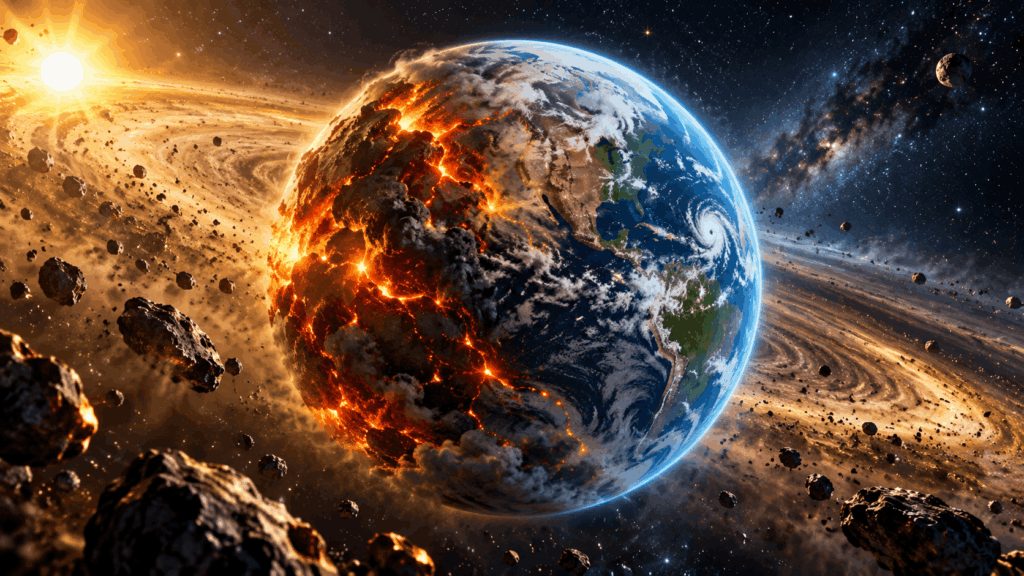
Earth is approximately 4.54 billion years old, with a commonly cited uncertainty of about ±50 million years. Scientists did not reach this figure by finding a single 4.54-billion-year-old rock. Instead, the estimate comes from geochronology, the science of determining the timing of geological and planetary events. Researchers combine radioactive isotope measurements from meteorites, ancient terrestrial minerals, old rocks, and lunar materials with models of Solar System formation. The agreement among these independent lines of evidence makes Earth’s age one of the best-established large-scale measurements in Earth science.[1][2]
I. How Old Is Earth?
Understanding Earth’s age requires more than simply asking how old the oldest rock is. Earth is a dynamic planet. Its crust has been melted, buried, uplifted, eroded, metamorphosed, and recycled for billions of years. Much of the material present during Earth’s earliest history no longer survives in its original form. Geologists therefore reconstruct Earth’s chronology using several types of evidence, including the oldest minerals, ancient crustal rocks, primitive meteorites, radioactive decay systems, and records from the Moon. Together, these archives provide a coherent history extending back more than four and a half billion years.[1][8]
The Scientifically Accepted Age of Earth
The best-supported scientific estimate places Earth’s age at about 4.54 billion years. This number should not be interpreted as an exact planetary birthday. Earth formed through planetary accretion, a process in which countless smaller bodies collided and merged over millions of years. The figure instead represents the early Solar System interval in which Earth accumulated most of its mass and became a distinct planetary body. Clair Cameron Patterson’s landmark meteorite work in the 1950s produced an age of roughly 4.55 ± 0.07 billion years, remarkably close to the modern value.[1][2]
Geochronology makes this reconstruction possible by combining geology, chemistry, nuclear physics, mineralogy, and planetary science. Relative dating establishes whether one event occurred before or after another, while radiometric dating can assign numerical ages. This combination transformed the older concept of Deep Time, the recognition that Earth’s history is enormously long, into a measurable chronology.
One way to appreciate Deep Time is to imagine all 4.54 billion years compressed into a single familiar scale. Almost everything humans regard as recorded history would occupy an almost imperceptible fraction at the very end. The National Park Service illustrates the same idea with a string analogy: a string representing Earth’s history would be tens of thousands of miles long compared with only a tiny length for recorded human history.[9]
Why Determining Earth’s Age Is Scientifically Challenging
Earth does not preserve a complete physical archive stretching continuously back to its formation. Oceanic crust is continually created and destroyed through plate tectonics. Continental crust survives much longer, but it can still be eroded, metamorphosed, partially melted, buried, or incorporated into younger rocks. These processes have erased much of the direct evidence from Earth’s first several hundred million years.
For this reason, scientists cannot simply search for “the first Earth rock.” Even exceptionally ancient rocks formed after Earth itself. Individual minerals can also be older than the sedimentary or metamorphic rocks that contain them because resistant grains may survive the destruction of an earlier host rock and later become incorporated into a younger one.
Researchers therefore triangulate Earth’s age using three particularly important archives:
- Primitive meteorites, which preserve material from the earliest Solar System.
- Ancient terrestrial minerals, especially zircon.
- Extremely old rocks, including the Acasta Gneiss and other ancient crustal terranes.
The result is expressed with uncertainty because every measurement has analytical limits and because “formation of Earth” describes an extended planetary process rather than a single instantaneous event.[1][11][12]
II. What Is the Accepted Age of Earth?
The accepted figure of about 4.54 billion years represents a convergence of geochemical and planetary evidence. It is consistent with ancient terrestrial samples, meteorites, lunar chronology, and theoretical models of how rocky planets form. Importantly, Earth’s present surface is not 4.54 billion years old. Most exposed rocks are vastly younger because geological processes continually modify the surface. The age refers to the origin of Earth as a planetary body during the earliest stage of Solar System evolution.[1][3]
Earth Is Approximately 4.54 Billion Years Old
The U.S. Geological Survey cites an age of approximately 4.54 ± 0.05 billion years based largely on isotopic evidence involving meteorites and terrestrial lead. Patterson’s classic 1956 study obtained 4.55 ± 0.07 billion years from lead isotope relationships in meteorites, particularly material associated with the Canyon Diablo meteorite. Later improvements in analytical instruments, standards, decay constants, sample preparation, and isotope measurements have refined the precision of geochronology without overturning Patterson’s basic conclusion.[1][2]
The uncertainty is scientifically important. Saying 4.54 billion years does not imply researchers know the moment of Earth’s creation to the nearest year. It indicates that measurements and models consistently place Earth’s formation in a tightly constrained interval near the beginning of Solar System history.
Earth’s Age Compared With the Age of the Solar System
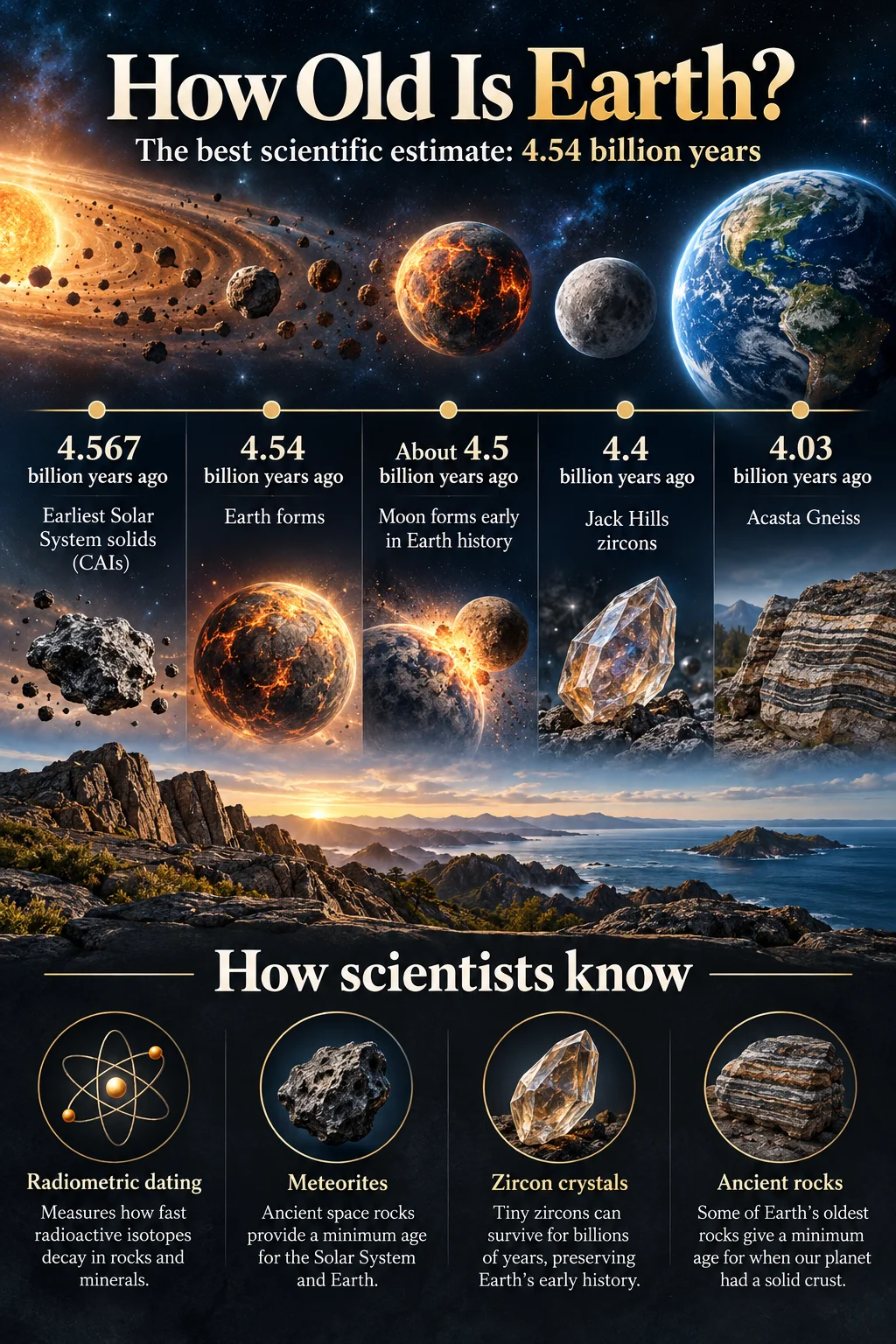
The Solar System is slightly older than Earth. NASA describes the Solar System as having formed roughly 4.6 billion years ago, while high-precision dating of calcium-aluminum-rich inclusions, or CAIs, in primitive meteorites gives ages around 4.567 billion years. These inclusions are among the earliest known solids formed in the protoplanetary disk and are often used as a reference point for the beginning of Solar System chronology.[3][4]
Earth’s 4.54-billion-year age therefore fits naturally into the Solar System timeline. The Sun and the earliest solids formed first. Dust, rock, and metal then accumulated into planetesimals and planetary embryos. Earth grew through repeated collisions and gravitational accretion.
| Event or material | Approximate age |
|---|---|
| Earliest Solar System solids, including CAIs | 4.567 billion years |
| Formation interval of the Solar System | About 4.6 billion years |
| Accepted age of Earth | About 4.54 billion years |
| Oldest known Jack Hills zircons | About 4.4 billion years |
| Oldest components of Acasta crust | About 4.03 billion years |
This sequence is one of the central relationships in cosmic chronology, the reconstruction of events during the birth and evolution of planetary systems.[1][4][11][12]
III. How Did Earth Form?
Earth formed as part of the same physical process that produced the Sun and the rest of the Solar System. The widely accepted model begins with the gravitational collapse of an interstellar cloud of gas and dust. Most material became concentrated in the young Sun, while the remaining matter formed a rotating disk. Inside that disk, microscopic particles collided and accumulated into larger bodies. Repeated impacts eventually produced the rocky planets, including Earth.[3][5]
The Solar Nebula
The Solar Nebula was the rotating cloud of material from which the Solar System developed. Gravity caused a region of an interstellar cloud to collapse. As the cloud contracted, conservation of angular momentum caused it to rotate more rapidly and flatten into a disk. Most of the material accumulated near the center, where increasing temperature and pressure ultimately produced the young Sun.
The nebular model explains why most major planets orbit the Sun in roughly the same plane and direction. It also provides the physical setting in which dust grains, minerals, metal particles, ice, and other material began forming increasingly large objects.[3]
The Protoplanetary Disk
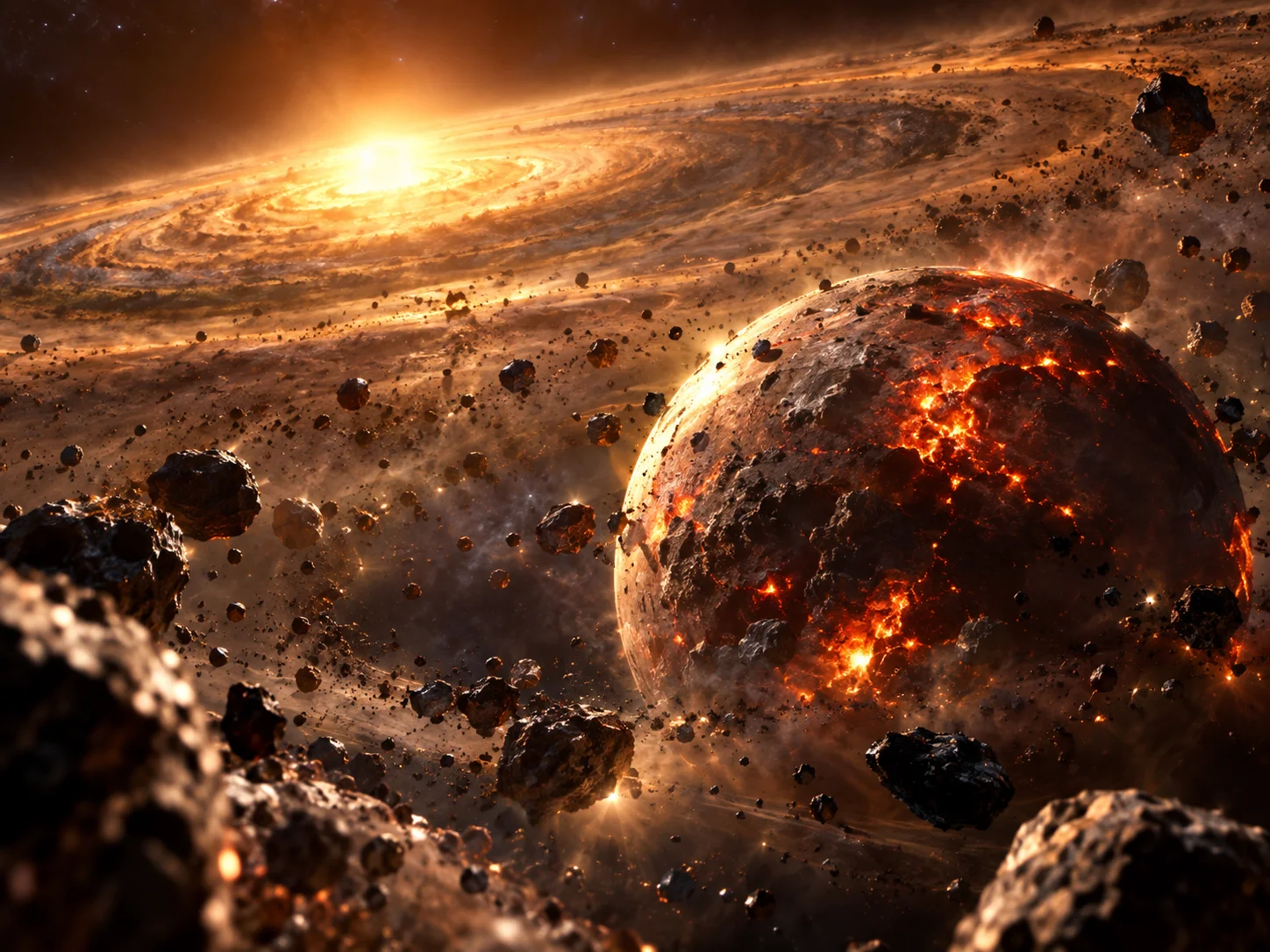
The flattened material surrounding the young Sun is called a protoplanetary disk. Within it, temperature varied dramatically with distance from the Sun. In the hotter inner region, materials capable of surviving high temperatures, including silicate minerals and metals, dominated the solids available for forming planets. Farther from the Sun, colder conditions allowed additional volatile materials and ices to participate.
Particles within the disk did not remain isolated. They collided, stuck together, broke apart, and collided again. Over time, some concentrations became large enough for gravity to accelerate their growth. Earth’s history begins within this environment, not as an already completed planet but as part of an evolving population of solid bodies.[3][4]
Formation of Planetesimals
Planetesimals were solid bodies that served as major building blocks of planets. Their sizes varied greatly, and their precise formation pathways remain an active field of planetary research. What matters for Earth’s chronology is that the protoplanetary disk eventually contained populations of increasingly large objects whose gravitational interactions led to collisions, fragmentation, and mergers.
Some meteorites reaching Earth today are fragments of asteroids whose parent bodies preserve chemical and isotopic information from this early period. Their great age explains why meteorites are so valuable for establishing the Solar System’s formation timeline.[8]
Planetary Accretion
Planetary accretion is the process through which progressively larger objects accumulate material through collisions and gravitational attraction. Earth did not appear instantaneously. It grew from smaller planetary building blocks over an extended interval.
As growing planetary embryos became more massive, their gravity allowed them to attract additional bodies. Some impacts added material, while exceptionally energetic collisions could melt or vaporize portions of the young planets. This violent environment helps explain why defining one exact instant as Earth’s “birth” is difficult. The 4.54-billion-year figure is therefore best understood as a model age for Earth’s formation during this accretionary phase rather than a literal calendar birthday.[2][3]
Early Differentiation of Earth
The young Earth became extremely hot. Energy came from repeated impacts, gravitational compression, differentiation, and radioactive decay. When enough material melted, dense metallic components such as iron tended to sink toward the center while lighter silicate material remained above. This process contributed to the formation of Earth’s metallic core and silicate mantle.
NASA describes modern Earth as a differentiated planet with an inner core, outer core, mantle, and crust. These layers record the long-term consequence of processes that began very early in planetary history.[5]
Differentiation is particularly relevant to geochronology because different chemical elements preferentially entered different reservoirs. Isotope systems can therefore provide information not only about age but also about when Earth’s core, mantle, and crust separated and evolved.
IV. Earth’s Earliest Geological History
The first several billion years of Earth’s history are divided into large geological units called eons. Current international stratigraphic practice recognizes the Hadean, Archean, Proterozoic, and Phanerozoic portions of the planet’s chronology. The first three collectively make up the Precambrian, which occupies the overwhelming majority of geological time. Modern numerical boundaries are continuously refined as geochronological measurements improve.[7]
The Hadean Eon
The Hadean represents the earliest stage of Earth history. The current International Commission on Stratigraphy chart uses 4567 million years ago as the lower numerical limit and places the transition to the Eoarchean at about 4031 ± 3 million years ago. Older educational materials frequently round the end of the Hadean to approximately 4.0 billion years ago.[7]
The Hadean Earth experienced enormous changes. Accretion was completing, the interior differentiated, large impacts occurred, and crust began to form and repeatedly be modified. Contrary to older images of the Hadean as an uninterrupted global inferno, ancient zircons suggest that portions of Earth’s surface may have cooled surprisingly early.
Almost no extensive, unquestionably intact Hadean crust remains, which is why tiny mineral grains and extraterrestrial samples are so valuable.
Transition Into the Archean Eon
The Archean followed the Hadean and lasted until approximately 2.5 billion years ago. The current ICS timescale places the Hadean-Eoarchean boundary near 4.031 billion years ago, based on chronometric calibration associated with the Acasta Gneiss Complex.[7]
Compared with the Hadean, the Archean preserves substantially more geological evidence. Ancient continental nuclei, volcanic sequences, sedimentary deposits, and mineral assemblages provide information about crustal evolution, early oceans, atmospheric conditions, tectonic behavior, and early life.
However, the Archean rock record is still incomplete. Billions of years of later metamorphism, deformation, erosion, and tectonic recycling have altered many surviving rocks.
The Proterozoic Eon
The Proterozoic Eon followed the Archean and extended from approximately 2.5 billion years ago to 538.8 million years ago according to the current International Chronostratigraphic Chart.[7]
This enormous span includes major developments in the atmosphere, oceans, continental organization, and biological evolution. The Great Oxidation Event occurred early in the Proterozoic, and complex multicellular organisms appeared much later.
From the perspective of Earth’s age, the Proterozoic illustrates how misleading familiar biological history can be as a measure of planetary time. Entire cycles of continental assembly and breakup occurred long before the abundant animal fossils associated with the Phanerozoic became common.
The Precambrian
The Precambrian is the broad term for Earth’s history before the Phanerozoic. It includes the Hadean, Archean, and Proterozoic and therefore covers roughly the first four billion years of planetary history.
Because complex visible fossils are much more abundant in younger rocks, traditional geology courses often devote substantial attention to the Phanerozoic. Yet the Precambrian accounts for almost nine-tenths of Earth’s entire existence.
This period includes the formation and stabilization of crust, early oceans, early life, atmospheric transformation, large-scale crustal evolution, and the emergence of increasingly complex organisms. Understanding Earth’s age therefore requires thinking in Precambrian rather than merely human or biological timescales.[7][9]
The Geological Time Scale
The Geological Time Scale organizes Earth history hierarchically into eons, eras, periods, epochs, and ages. Early geologists originally assembled much of this framework using relative relationships in rock layers and fossils before numerical radiometric ages were available. Modern geochronology later attached numerical ages to many of the boundaries.[9]
A simplified representation of Earth’s eons looks like this:
| Interval | Approximate span |
|---|---|
| Hadean | 4.567 to 4.031 billion years ago |
| Archean | 4.031 to 2.5 billion years ago |
| Proterozoic | 2.5 billion to 538.8 million years ago |
| Phanerozoic | 538.8 million years ago to present |
Graph: How Much of Earth’s History Does Each Major Eon Represent?
Using 4.54 billion years as Earth’s approximate age and current ICS boundaries, the relative duration can be visualized approximately as follows:
Relative Duration of Geological Eons
The graph makes an important point: the Phanerozoic, which contains dinosaurs, mammals, flowering plants, and humans, represents only a relatively small final portion of Earth’s history. Most planetary history belongs to the Precambrian.[7]
V. How Scientists Date Earth
Determining Earth’s age requires both relative and numerical chronology. Relative dating tells scientists the sequence in which geological events occurred. Absolute, or numerical, dating assigns ages measured in years. Stratigraphy, fossils, cross-cutting relationships, and superposition establish sequence, while isotope geochronology provides numerical anchors. Together they allow scientists to convert Earth’s complex rock record into a coherent timeline extending from the present into Deep Time.[9][10]
Absolute Dating
Absolute dating, often called numerical dating, assigns an age or age range expressed in years to geological material or events. For very ancient materials, radiometric methods are the most important tools.
The term “absolute” should not be mistaken for perfect or infinitely precise. A radiometric age still carries analytical uncertainty. Modern laboratories report age uncertainties because isotope measurements, decay constants, calibration standards, geological disturbance, and sample interpretation all influence precision.
Earth’s 4.54-billion-year age depends primarily on numerical isotope geochronology rather than counting sediment layers or extrapolating modern erosion rates.[8][9]
Relative Dating
Relative dating establishes whether a rock, fossil, structure, or geological event is older or younger than another. It does not normally assign a specific age in years.
For example, if a lava flow lies above a sedimentary formation without disturbance, the lava is younger. If a fault cuts both units, the fault is younger still. Such relationships allow geologists to reconstruct a sequence of events even when no datable mineral is available.
Relative dating formed the original basis of the Geological Time Scale. Radiometric measurements later provided numerical calibration, making the relative and absolute approaches complementary rather than competing methods.[9][10]
Stratigraphy
Stratigraphy is the study of layered rocks and their relationships through space and time. Sedimentary rocks are especially useful because sediments commonly accumulate in successive layers.
A stratigraphic sequence can preserve environmental change, erosion surfaces, volcanic ash beds, fossils, sea-level changes, and tectonic events. Geologists compare these relationships across different regions to reconstruct larger portions of geological history.
Stratigraphy was indispensable long before radioactivity was discovered. Today it remains equally important because numerical dates make the most sense when they are interpreted within a geological context. A laboratory age by itself cannot substitute for understanding what geological event the dated mineral actually records.[9][10]
The Law of Superposition
The Law of Superposition states that in an undisturbed sequence of sedimentary layers, the lowest layers are generally older than those above them. Nicolaus Steno clearly formulated this principle in the seventeenth century, helping establish the foundations of geological reasoning.[10]
Superposition provides relative age rather than a numerical age. It might establish that layer A predates layer B, but it cannot tell scientists whether layer A formed 10 million, 100 million, or one billion years ago.
Modern geologists combine superposition with radiometric ages from volcanic ash, igneous intrusions, or minerals to transform a relative succession into a calibrated timeline.
VI. Radiometric Dating: The Main Evidence for Earth’s Age
Radiometric dating transformed geology because radioactive decay provides a physical clock. Certain atomic nuclei are unstable and spontaneously transform into other nuclei at statistically predictable rates. If a mineral contains a suitable radioactive parent isotope and its daughter products can be measured accurately, scientists can calculate the time elapsed since the relevant isotopic system formed or closed.[8]
What Is Radiometric Dating?
Radiometric dating determines geological ages using radioactive isotopes and their decay products. Scientists measure isotope abundances, typically with highly sensitive mass spectrometers, and use known decay relationships to calculate elapsed time.
Different isotope systems are suited to different materials and age ranges. Carbon-14, for example, is useful for relatively young organic material but completely unsuitable for determining the age of Earth. Very old rocks require long-lived isotopes such as uranium-238, uranium-235, rubidium-87, samarium-147, and potassium-40.[8][18][19]
Understanding Radioactivity
Radioactivity occurs when an unstable atomic nucleus spontaneously changes into another nuclear configuration. Depending on the isotope, the process may involve alpha decay, beta decay, electron capture, or more complex decay chains.
The discovery of radioactivity at the end of the nineteenth century radically changed debates about Earth’s age. It revealed both a method for measuring geological time and an important source of internal planetary heat.
Naturally occurring uranium, thorium, and potassium contribute radiogenic heat within Earth today. This discovery helped scientists understand why nineteenth-century models that treated Earth mainly as a cooling conductive body underestimated its age.[17]
Radioactive Decay
In radiometric dating terminology, an unstable parent isotope transforms through radioactive decay into a daughter isotope or a chain of intermediate daughters ending in a stable nuclide.
If a mineral behaves as a closed system after formation, changes in the parent-daughter ratio follow mathematically predictable relationships. Scientists can therefore work backward from present isotope abundances to calculate elapsed time.
The geological challenge is not merely solving an equation. Researchers must determine whether the mineral preserved the relevant isotopes, whether later heating caused loss or redistribution, whether initial daughter products were present, and exactly what geological event the measured age represents.[8][20]
What Is an Isotope?
Isotopes are atoms of the same element that contain the same number of protons but different numbers of neutrons. Their chemical behavior is broadly similar because chemical identity depends mainly on proton number and electron structure, but their nuclear properties may differ.
Some isotopes are stable. Others are radioactive and decay over time.
For example, uranium-238 is radioactive, while lead-206 is the stable final product of its decay chain. Measuring isotope ratios allows scientists to distinguish ordinary chemical composition from the time-dependent nuclear changes used in geochronology.[8]
Understanding Half-Life
A radioactive isotope’s half-life is the time required for half of a large population of parent atoms to decay. After one half-life, half remains. After two half-lives, one quarter remains. After three, one eighth remains.
Long half-lives are essential for studying very old geological materials because enough parent isotope must survive for billions of years.
Important geological clocks include:
| Parent isotope | Stable daughter product | Approximate half-life |
|---|---|---|
| Uranium-238 | Lead-206 | 4.47 billion years |
| Uranium-235 | Lead-207 | 704 million years |
| Potassium-40 | Argon-40 | 1.25 billion years |
| Rubidium-87 | Strontium-87 | 48.8 billion years |
| Samarium-147 | Neodymium-143 | About 106 billion years |
The enormous differences among these half-lives allow scientists to choose isotopic clocks appropriate for different geological problems.[8]
VII. Uranium-Lead Dating and Earth’s Deepest Time
Uranium-lead dating is among the most important methods for reconstructing Earth’s earliest history. It is especially powerful when applied to zircon because zircon commonly incorporates uranium during crystallization while incorporating very little initial lead. Uranium then decays into lead over time, creating an exceptionally useful geological clock. Two independent uranium decay chains also provide valuable internal checks on the resulting age.[20]
Uranium-Lead Dating
Uranium-lead dating, commonly written U-Pb dating, uses the radioactive decay of uranium isotopes into stable lead isotopes.
Two major systems operate simultaneously:
- Uranium-238 decays ultimately to lead-206.
- Uranium-235 decays ultimately to lead-207.
Because the two uranium isotopes have different half-lives, a mineral can effectively contain two independent clocks. If both produce compatible ages, confidence that the system has behaved predictably increases substantially.
U-Pb methods are widely applied to zircon and other uranium-bearing minerals and are capable of dating events extending almost to the beginning of the Solar System.[8][20]
Uranium-238
Uranium-238, written 238U, has a half-life of approximately 4.47 billion years, strikingly close to Earth’s total age. This makes it exceptionally useful for investigating billion-year timescales.
Uranium-238 does not transform directly into lead-206 in one step. It passes through a sequence of radioactive daughter nuclides before ultimately reaching stable 206Pb.
Because a significant fraction of the original uranium-238 remains even in the oldest terrestrial minerals, geochemists can measure both remaining uranium and accumulated radiogenic lead. The resulting ratios provide numerical ages when the mineral’s geological history and isotopic behavior are understood.[8][20]
Lead-206
Lead-206, written 206Pb, is the stable final product of the uranium-238 decay chain. As uranium-238 atoms decay through a series of intermediate isotopes, radiogenic lead-206 accumulates.
A mineral that initially incorporated uranium but almost no lead is particularly useful because the lead found later can largely be attributed to radioactive decay. Zircon is famous for providing this favorable behavior.
Geochemists do not simply count lead atoms and declare an age. They measure multiple isotope ratios, correct for non-radiogenic or common lead where necessary, assess analytical uncertainty, and evaluate whether later geological processes have disturbed the system.[20]
Why Uranium-Lead Systems Are So Powerful
U-Pb dating is unusually robust because two independent uranium decay chains can be compared. Results can be plotted on a concordia diagram. If the isotopic system remained closed, measured ratios should correspond to the expected concordia relationship. Disturbance, such as lead loss, can produce discordant results that geochronologists may recognize and investigate rather than unknowingly accepting as a valid formation age.[20]
This ability to test internal consistency is one reason zircon U-Pb dating is central to Precambrian geology.
Radiometric dating is therefore not based on blindly assuming every sample remained unchanged. Modern geochronology includes methods designed specifically to identify disturbance and quantify uncertainty.
VIII. Zircons: Tiny Crystals That Preserve Early Earth History
Some of Earth’s oldest surviving evidence is microscopic. Zircon crystals can endure weathering, erosion, sedimentary transport, and many metamorphic conditions that destroy or transform less resistant minerals. Because they can also preserve uranium-lead isotope systems, zircons act as tiny geological archives. Individual grains may survive after their original host rock disappears and later become incorporated into much younger sedimentary rocks.[11][20]
What Is Zircon?
Zircon is zirconium silicate, ZrSiO4, a durable accessory mineral found especially in many silica-rich igneous rocks.
Its significance to geochronology comes from its crystal chemistry. Zircon can accept uranium into its crystal structure when it forms while strongly excluding lead. Consequently, much of the lead found in an undisturbed ancient zircon was generated later through radioactive uranium decay.
Zircon is also chemically and mechanically resistant. A crystal can survive the destruction of the igneous rock in which it originally formed, be transported as a sediment grain, and later become enclosed within another rock.[20]
The Oldest Minerals on Earth
The oldest widely recognized terrestrial materials are ancient zircon grains. Some formed hundreds of millions of years before the oldest well-preserved continental rocks.
That distinction is crucial. A zircon’s age records when the crystal originally formed, while the age of the rock currently containing that zircon may be much younger.
Ancient zircons provide more than a timestamp. Their chemical and isotopic compositions can preserve information about the magmas from which they crystallized, crustal recycling, and environmental conditions on early Earth. Some Jack Hills studies have supported the possibility that Earth’s surface cooled rapidly enough for a hydrosphere to exist surprisingly early.[11]
The Jack Hills Zircons
The Jack Hills region of Western Australia contains detrital zircons dating to approximately 4.4 billion years ago. Researchers at the University of Wisconsin-Madison reported confirmation of a zircon crystallization age around 4.4 billion years, making such grains among the oldest known terrestrial materials.[11]
These zircons are not 4.54 billion years old and therefore do not directly date Earth’s formation. Instead, they reveal something equally important: within roughly the first few hundred million years of planetary history, portions of Earth had cooled sufficiently for zircon-bearing crustal materials to crystallize.
Because their original host rocks were destroyed, the zircons also demonstrate how minerals can preserve ancient information after the surrounding geological record has vanished.
IX. The Oldest Surviving Rocks
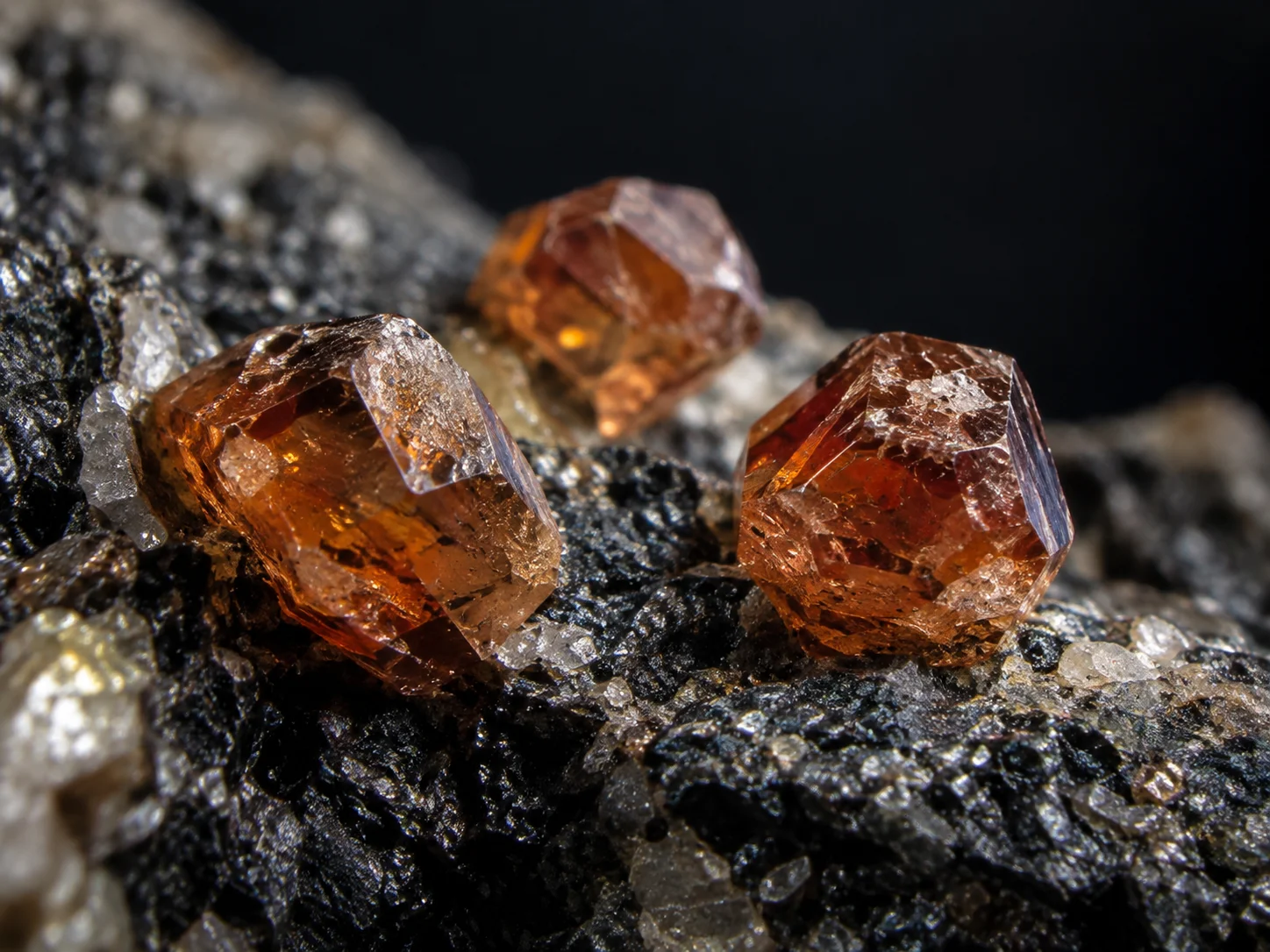
The phrase oldest rock is more complicated than it sounds. Geologists must distinguish between the age of a whole rock, the crystallization ages of minerals within it, inherited grains from older sources, metamorphic ages, and isotopic model ages. This distinction explains why a 4.4-billion-year-old zircon can occur in a rock much younger than the zircon itself.[11][12]
What Counts as the Oldest Rocks?
A rock is an aggregate of minerals, and those minerals do not necessarily share a simple history. A sedimentary rock may contain grains eroded from rocks of many different ages. A metamorphic rock may preserve minerals from an older igneous precursor while also recording younger metamorphic events.
Researchers therefore distinguish a rock’s crystallization, deposition, metamorphism, and inherited components.
Claims about “the world’s oldest rock” also depend on the method and definition being used. The Acasta Gneiss Complex preserves exceptionally well-established crustal components older than four billion years, while the Nuvvuagittuq Greenstone Belt has produced still older model-age interpretations whose exact formation age remains debated.[12][13]
The Acasta Gneiss
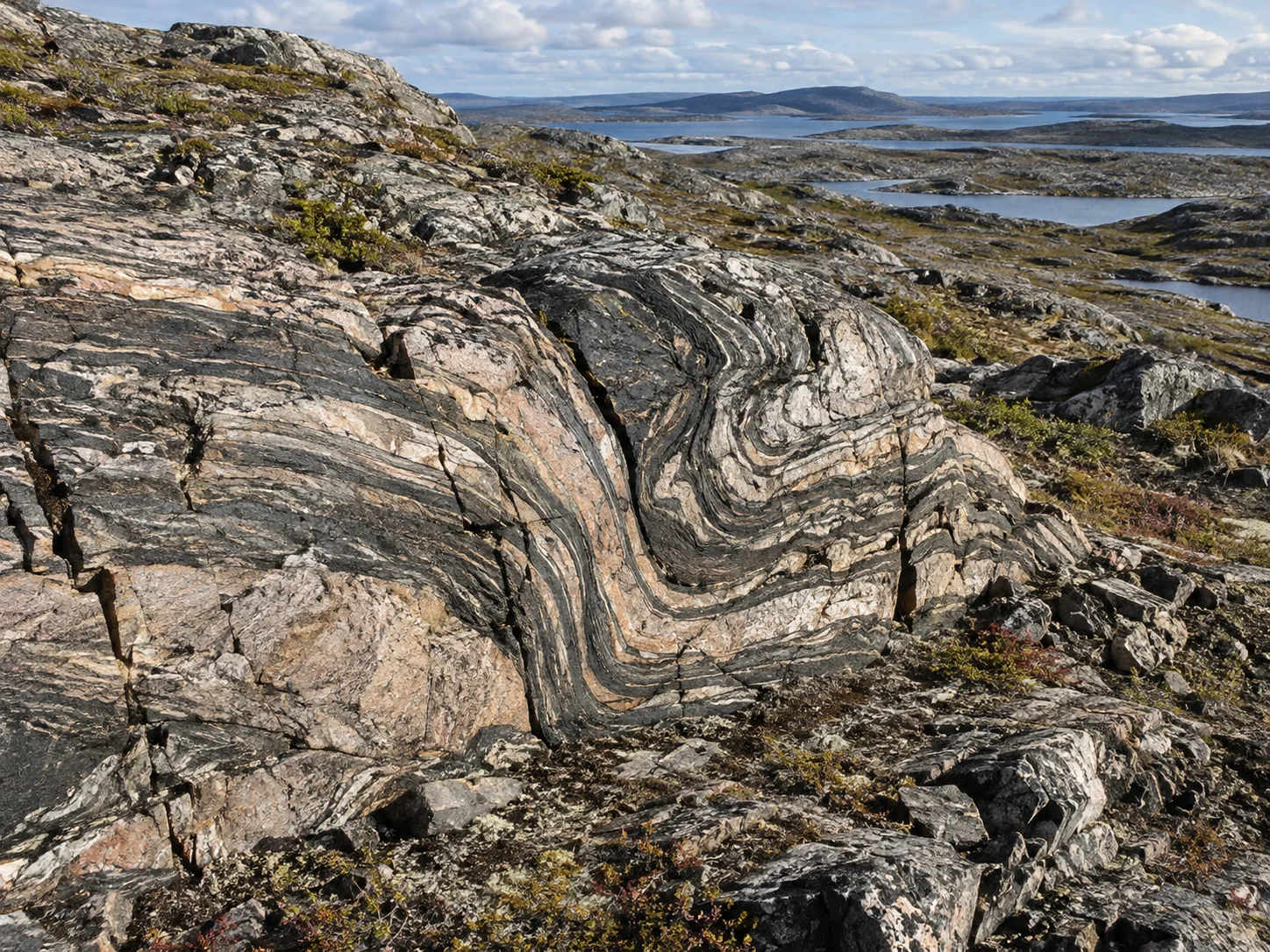
The Acasta Gneiss Complex in Canada’s Northwest Territories preserves some of Earth’s oldest known evolved crust. Modern studies identify components with zircon U-Pb crystallization ages reaching approximately 4.03 billion years.[12]
The Smithsonian describes a specimen about 3.96 billion years old and emphasizes that Earth itself is roughly half a billion years older. This difference illustrates the central problem of dating Earth from terrestrial rocks alone.
The Acasta rocks demonstrate that continental-like crust already existed extremely early, but they formed after the planet began accreting. They therefore provide a minimum age for Earth, not Earth’s full formation age.
A Note About the Nuvvuagittuq Greenstone Belt
The Nuvvuagittuq Greenstone Belt in northeastern Canada contains rocks that are certainly extremely ancient. Its exact age remains scientifically debated. Some isotope interpretations suggest a formation age of about 4.3 billion years, while other constraints indicate that the rocks are at least approximately 3.75 to 3.8 billion years old.[13]
This debate is scientifically useful rather than problematic. It illustrates how geochronologists distinguish direct crystallization ages from isotopic model ages and test competing interpretations.
For that reason, it is safer to describe Acasta as containing some of the oldest securely dated evolved crust rather than claiming that one locality unquestionably possesses the single oldest rock on Earth.
Why the Oldest Rocks Cannot Directly Establish Earth’s Formation Date
Earth existed before any surviving Acasta rock crystallized. The earliest crust experienced impacts, melting, metamorphism, chemical alteration, erosion, burial, and tectonic recycling.
Plate tectonics makes Earth especially difficult to date using only surface rocks because large portions of crust are continually modified. Oceanic crust, in particular, is recycled on geological timescales far shorter than Earth’s age.
The missing early record forces scientists to look beyond intact terrestrial rocks. Resistant zircons extend the terrestrial archive farther back, but primitive meteorites extend it closer to the origin of the Solar System itself.[1][11][12]
X. Why Meteorites Are Critical to Determining Earth’s Age
Meteorites provide access to material that formed during the infancy of the Solar System but avoided the extensive crustal recycling that characterizes Earth. Many meteorites originated as parts of asteroids or other small planetary bodies. Some preserve isotopic systems dating almost to the formation of the first Solar System solids. This makes meteorites essential reference materials for establishing the chronology within which Earth formed.[3][8]
Why Scientists Study Meteorites
Most meteorites that reach Earth originated from asteroids, though some are fragments of the Moon or Mars. NASA notes that meteorites can be as old as approximately 4.6 billion years.[8]
Small asteroids did not experience geological evolution identical to Earth’s. Some preserved ancient material with comparatively limited large-scale melting, crustal recycling, or plate tectonics.
By measuring their isotope systems, scientists can establish when early Solar System materials separated into chemically distinct bodies. Meteorites effectively function as surviving samples of the environment in which planets formed.
Meteorites and the Solar System Age
Primitive meteorites contain some of the earliest solids known from the Solar System. Calcium-aluminum-rich inclusions within certain meteorites have U-Pb ages near 4.567 billion years and serve as a reference for the beginning of Solar System chronology.[4]
Earth necessarily formed after or during the period when these first solids were available to build larger objects.
The difference between the age of the earliest solids and the accepted Earth age reflects the time required for dust, planetesimals, embryos, and larger planetary bodies to develop.
This is why Earth’s age and the Solar System’s age are related but not identical numbers.
The Canyon Diablo Meteorite
The Canyon Diablo meteorite is associated with Meteor Crater in Arizona and played a historic role in the modern determination of Earth’s age.
Clair Cameron Patterson used lead isotope data from meteorites to construct a model of isotopic evolution in the early Solar System. His analysis showed that meteorites yielded a consistent age and that Earth’s lead isotope composition fit the same broad evolutionary framework.[1][2]
The significance of Canyon Diablo therefore goes far beyond one meteorite specimen. It helped provide the reference needed to overcome the problem that Earth’s earliest rocks had been destroyed.
XI. Clair Cameron Patterson and the Modern Age of Earth
Few individuals are as closely associated with the modern numerical age of Earth as Clair Cameron Patterson. His work brought together precise isotope measurement, meteorite chemistry, uranium-lead decay, and planetary reasoning. In 1956 he published an estimate of approximately 4.55 ± 0.07 billion years, essentially establishing the modern scale of Earth’s age.[2]

Who Was Clair Cameron Patterson?
Patterson was an American geochemist whose research focused heavily on lead isotopes. The challenge he faced was that ordinary terrestrial rocks had been repeatedly processed throughout Earth’s history. Meteorites provided a way around that difficulty.
By treating Earth and meteorites as components of a related evolving Solar System, Patterson could compare lead isotope compositions and reconstruct their history.
His achievement depended on extremely careful measurement. Lead contamination was a major analytical problem, and the drive for cleaner laboratory procedures became an important part of his scientific work.
The age result was powerful because it connected terrestrial geochemistry with planetary materials rather than assuming Earth’s oldest exposed rock represented the planet’s beginning.[1][2]
Lead-Lead Dating
Lead-lead dating uses relationships among different lead isotopes, particularly radiogenic lead generated by uranium decay. Because uranium-235 and uranium-238 generate different lead isotopes at different rates, their daughter products preserve information about elapsed time.
Patterson’s meteorite work showed how lead isotope ratios from different Solar System materials could be interpreted within a common chronological model.
The method is especially useful because some relevant calculations can be performed using lead isotope relationships without requiring a simple assumption that a sample began with zero lead.
Lead-lead chronology remains an important component of meteorite dating and early Solar System science.[2][19]
Patterson’s Earth-Age Calculation
Patterson’s 1956 paper reported that meteorites gave, within experimental error, a common age. His most accurate lead isotope estimate was 4.55 ± 0.07 billion years. He concluded that Earth’s lead evolution was consistent with the same broad age and interpreted the value as corresponding approximately to the time Earth attained its present mass.[2]
The modern value of about 4.54 billion years differs only slightly.
That stability is significant. Scientific instrumentation has improved enormously since the 1950s, yet the central answer has been refined rather than overturned.
XII. Other Important Radiometric Dating Methods
No responsible reconstruction of geological time depends on one isotope pair alone. Geochronologists use several independent systems, each with different chemical behavior, decay constants, strengths, and vulnerabilities. Agreement among these techniques provides powerful cross-validation. Disagreement can also be informative because it may reveal metamorphism, reheating, alteration, inherited minerals, isotope loss, or other events in a sample’s history.[8][19]
Isochron Dating
An isochron method compares multiple minerals or related samples with different parent-daughter ratios. When appropriate conditions are met, isotope ratios plot along a line whose slope relates to elapsed time. The intercept can provide information about the initial daughter-isotope composition.
This is valuable because one of the central challenges in radiometric dating is determining how much daughter isotope existed when the system formed.
Isochron approaches can therefore estimate an initial ratio rather than simply assuming it was zero. A failure of samples to define the expected relationship may also warn researchers that the system was disturbed or that the assumptions are inappropriate.[19]
Potassium-Argon Dating
Potassium-argon dating uses the decay of radioactive potassium-40 to argon-40. Because potassium is common in many minerals and potassium-40 has a half-life of roughly 1.25 billion years, the system is useful across an enormous range of geological time.[8][18]
Argon is a gas and can escape from hot molten material. Once a volcanic mineral cools sufficiently, radiogenic argon may begin accumulating.
Modern argon geochronology often uses the related 40Ar/39Ar method. It is especially important for dating volcanic eruptions and thermal events, although it is not the primary basis for Earth’s 4.54-billion-year formation age.
Rubidium-Strontium Dating
Rubidium-strontium dating uses the decay of rubidium-87 to strontium-87. Rubidium-87 has a very long half-life of roughly 48.8 billion years, making the system suitable for extremely ancient geological and planetary materials.[8][19]
Rb-Sr analyses can be performed using isochron techniques in which several minerals or related samples are compared. Because rubidium and strontium behave differently during mineral formation and melting, their ratios can preserve information about geological differentiation.
The Rb-Sr system has historically contributed to dating ancient terrestrial rocks, lunar samples, and meteorites and remains important in isotope geochemistry.
Samarium-Neodymium Dating
Samarium-neodymium dating commonly uses the decay of samarium-147 to neodymium-143. Samarium-147 has an extremely long half-life, making the Sm-Nd system particularly valuable for Precambrian rocks and the study of mantle and crust evolution.[8][19]
Sm and Nd tend to remain useful even in geological systems where some other isotope clocks may be more easily disturbed.
The method is important not only for determining ages but also for tracing the long-term chemical differentiation of Earth’s mantle and crust.
Ancient lunar materials have also been investigated using Sm-Nd systematics, providing another connection between terrestrial and planetary chronology.
Agreement Between Independent Dating Systems
The strongest evidence does not come from one laboratory obtaining one number from one isotope.
U-Pb, Pb-Pb, Rb-Sr, Sm-Nd, K-Ar, Ar-Ar, and other systems involve different elements, half-lives, mineral behaviors, and analytical procedures. When several systems independently produce compatible chronological relationships, explanations based on one unnoticed flaw become increasingly implausible.
Some isotope systems may be reset during metamorphism while others remain closed. Rather than invalidating geochronology, this behavior can reveal multiple geological events.
Scientists therefore use cross-validation as a central part of determining whether a numerical age truly represents crystallization, metamorphism, cooling, alteration, or another process.[8][18][19]
XIII. The Moon as Additional Evidence for Early Earth History
The Moon provides another archive of early Solar System history. Unlike Earth’s active surface, the Moon has no global plate tectonic system continually recycling crust. Ancient lunar rocks and impact structures can therefore preserve information from extremely early periods. Lunar chronology does not independently produce the single number 4.54 billion years for Earth, but it provides important constraints on planetary formation, giant impacts, differentiation, and the timing of events soon after Earth’s accretion.[6]
Moon Formation
The Moon formed very early in Solar System history, roughly 4.5 billion years ago. NASA describes modern lunar origin research as favoring scenarios in which major collisions involving the young Earth produced material that eventually formed the Moon.[6]
Returned lunar rocks, meteorites from the Moon, remote observations, and computer simulations all contribute to the reconstruction.
Because the Moon formed after Earth’s accretion had begun but very early in planetary history, its formation acts as an important chronological checkpoint in the evolution of the Earth-Moon system.
The Giant-Impact Hypothesis
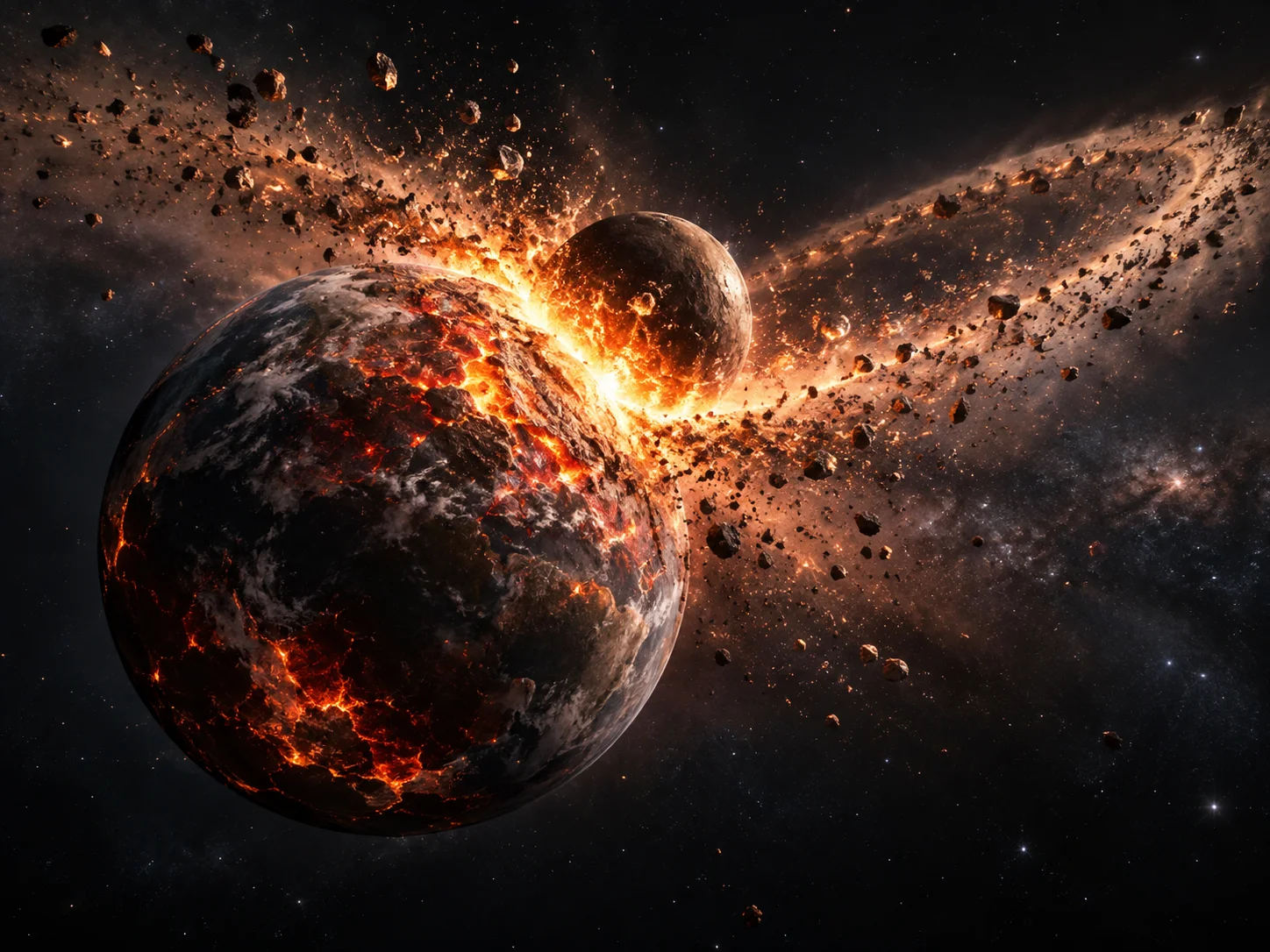
The best-known lunar origin model is the Giant-Impact Hypothesis. In its simplified form, a planetary body often called Theia, roughly comparable in scale to Mars in many models, collided with the young Earth. Material placed into orbit later accreted to form the Moon.[6]
Modern models are more complicated than the simple textbook picture. Researchers continue to investigate the impactor’s size, velocity, composition, impact geometry, degree of mixing, and whether lunar formation could have involved a more complex sequence.
The essential chronological point remains: a major Moon-forming event occurred very early after Earth’s initial formation.
Why Moon Formation Helps Constrain Earth’s Early Timeline
A Moon-forming impact requires Earth to have already accumulated a large fraction of its eventual mass. The Moon therefore provides a constraint on the later stages of Earth’s accretion and differentiation.
NASA notes that the major collision associated with lunar formation probably occurred within roughly the first hundred million years of Earth’s existence in common giant-impact scenarios.[6]
Lunar material also supplies independent isotope systems that can be compared with meteorites and terrestrial samples.
When lunar chronology, meteorite ages, ancient terrestrial minerals, and planetary models all fit within the same early Solar System interval, the overall reconstruction becomes substantially stronger.
XIV. How Ideas About Earth’s Age Developed Historically
Humans recognized that landscapes change long before anyone could calculate Earth’s numerical age. The crucial intellectual shift was understanding that ordinary geological processes, acting over immense spans of time, could create mountains, sedimentary sequences, unconformities, valleys, and other large geological structures. During the eighteenth and nineteenth centuries, this reasoning established the concept of an ancient Earth. Radioactivity later supplied the quantitative clock needed to measure that antiquity.[14]
James Hutton and Deep Time
Scottish geologist James Hutton became one of the foundational figures in the development of geological Deep Time.
Hutton studied erosion, sedimentation, uplift, igneous intrusion, and unconformities. At locations such as Siccar Point in Scotland, he recognized evidence of repeated geological cycles requiring enormous amounts of time.
In 1788 he presented ideas that helped form the basis of uniformitarian geological thinking. The significance was profound. Landscapes did not need to be interpreted as products of one short sequence of events. Slow processes, operating repeatedly over extraordinarily long periods, could transform the planet.[14]
Uniformitarianism
Uniformitarianism broadly expresses the idea that natural processes observable today can be used to interpret geological processes of the past.
This does not mean that every geological process always operates at exactly the same rate. Catastrophic events, including asteroid impacts, enormous volcanic eruptions, and rapid floods, unquestionably occur.
The deeper principle is methodological: the laws of nature and understandable geological mechanisms provide a basis for reconstructing ancient events.
Erosion, sediment deposition, volcanism, intrusion, metamorphism, and uplift can produce tremendous geological changes when operating across millions or billions of years. This reasoning provided a conceptual foundation for Deep Time before numerical radiometric dating existed.[14]
Charles Lyell
Charles Lyell became one of the most influential nineteenth-century geologists. His Principles of Geology, first published beginning in 1830, helped popularize geological reasoning based on processes observable in the modern world.
The Geological Society of London describes Lyell as a major promoter of uniformitarian thinking originally associated with Hutton. Lyell emphasized that landscapes could be interpreted through long-term operation of natural processes rather than requiring fundamentally different physical laws in the past.[15]
His work helped normalize the concept of an ancient, continuously changing Earth and strongly influenced later geological and biological thinking.
Geological Evidence Before Radiometric Dating
Before radioactive clocks became available, geologists already knew Earth had a very long history.
Thick sedimentary sequences required repeated deposition. Unconformities showed cycles of sediment accumulation, deformation, erosion, and renewed deposition. Fossil succession revealed biological change through successive rock layers. Igneous intrusions demonstrated repeated episodes of melting and emplacement.
Such observations established relative geological time, but they could not reliably distinguish whether Earth’s total age was hundreds of millions or several billions of years.
Radiometric dating therefore did not create the concept of an ancient Earth from nothing. It supplied the numerical scale that older geological methods lacked.[9][14]
XV. Lord Kelvin and the Earth-Cooling Problem
During the nineteenth century, physicist William Thomson, later Lord Kelvin, attempted to place geological time on a quantitative physical basis. His work was scientifically important because he argued that Earth’s age should be finite and measurable rather than effectively unlimited. His calculated ages, however, were far too young because the physical model of Earth’s interior and heat transport was incomplete.[14][16]
Lord Kelvin
Lord Kelvin treated Earth as a body that had initially been very hot and then cooled over time. By analyzing the modern geothermal gradient and applying mathematical heat-conduction models, he attempted to calculate how long such cooling would require.
His nineteenth-century estimates varied with assumptions but included ranges roughly between 20 million and 400 million years, with later preferred estimates much lower than the true age.[14]
Although the conclusion was incorrect, Kelvin’s approach represented an important advance: Earth’s age should be investigated using quantitative physical laws and measurable properties.
Earth Cooling as an Age-Estimation Method
Kelvin’s model assumed that Earth started hot and lost heat mainly by conduction. In a simple conductive model, the near-surface temperature gradient changes systematically with time. Measure today’s gradient, estimate the starting conditions and thermal properties, and theoretically one can calculate how long cooling has occurred.
The logic was reasonable given the physics then available. The problem lay in assumptions about the planet’s interior and heat transport.
Earth’s mantle is not a static solid conducting heat in the simple way required by Kelvin’s calculation. Over long timescales, mantle convection transports heat and fundamentally changes the planet’s thermal evolution.[16]
Why Kelvin’s Estimate Was Too Young
The discovery of radioactivity revealed additional internal heat generated by uranium, thorium, potassium, and other radioactive isotopes. However, modern analyses emphasize that mantle convection, not merely missing radioactive heat, was a crucial failure in Kelvin’s conductive cooling model.[16][17]
Convection allows Earth’s interior to transport and retain heat in ways a conduction-only model cannot reproduce.
Kelvin therefore underestimated Earth’s age because he lacked key knowledge about both nuclear physics and planetary interior dynamics.
His failure remains scientifically instructive. Good mathematics cannot rescue a model whose physical assumptions do not adequately represent the system being modeled.
XVI. How Scientists Combine Relative and Absolute Geological Evidence
Modern geology rarely uses one dating method in isolation. Scientists first determine what a rock represents, how it relates to surrounding formations, whether it has been disturbed, and what event a mineral may record. Numerical isotope measurements are then interpreted within this geological framework. The result is a chronological network in which stratigraphy and structural relationships establish sequence while isotope geochronology establishes numerical ages.[9][10]
Relative Chronological Framework
Relative methods establish the sequence of events. Superposition identifies older and younger sedimentary layers. Cross-cutting relationships reveal that faults or intrusions are younger than rocks they cut. Fossil succession allows formations in different locations to be correlated.
These principles can reconstruct surprisingly complicated histories without assigning a single numerical year.
For example, a geologist might establish that sediment was deposited, folded, intruded by magma, eroded, and later covered by another sequence. Radiometric dating of suitable minerals can then place numerical constraints on several of these events.
Relative geology therefore provides the narrative structure into which isotope dates fit.[10]
Numerical Chronological Framework
Radiometric methods provide numerical ages for suitable minerals, rocks, and geological events.
An ash bed deposited between fossil-bearing sediment layers can sometimes be dated, placing numerical constraints on the fossils. A zircon from an igneous intrusion can establish when the magma crystallized. Argon dating can determine the age of volcanic activity. Metamorphic minerals may record the timing of heating or recrystallization.
These ages transform statements such as “formation A is older than formation B” into a calibrated chronology.
The goal is not merely attaching numbers to rocks. It is identifying which geological process each isotopic clock records.[8][18]
Building the Geological Time Scale
The Geological Time Scale began largely as a relative chronology assembled from rock sequences and fossils. Radiometric dating later provided numerical ages for boundaries and events.
Modern international stratigraphy combines physical reference sections, fossils, chemical signals, isotope ages, magnetic reversals, and other markers. The International Commission on Stratigraphy periodically updates numerical boundary ages as evidence improves.[7][9]
This continuing refinement is important. A revised boundary does not mean Earth’s history has changed. It means scientists have improved their measurement of where a formally defined geological interval sits within numerical time.
XVII. Why Earth Does Not Contain a Complete Record of Its Own Beginning
Earth’s geological activity is simultaneously the reason our planet is scientifically fascinating and the reason its earliest record is difficult to recover. Rocks are constantly altered by weathering, burial, metamorphism, volcanism, erosion, and tectonic recycling. Consequently, the absence of a 4.54-billion-year-old intact rock is exactly what scientists would expect from an active rocky planet rather than evidence against Earth’s measured age.[11][12]
Destruction and Recycling of Ancient Crust
Early crust faced an exceptionally hostile history. Large impacts could melt extensive regions. Internal heat drove vigorous magmatism. Later tectonic activity buried and metamorphosed older rocks. Weathering and erosion fragmented exposed crust, while subduction transported material back into Earth’s interior.
Even continental crust, which can survive far longer than oceanic crust, is not perfectly preserved.
As a result, direct geological evidence becomes increasingly sparse toward the beginning of the Hadean.
The scarcity of very ancient rocks is therefore a preservation problem. It does not imply that Earth lacked crust before the oldest surviving rock crystallized.
Survival of Resistant Minerals
Zircon offers a remarkable solution to part of this preservation problem.
A zircon crystal may survive erosion after its original host rock is destroyed. It can be transported, deposited as sediment, buried, and incorporated into a younger rock while still preserving the uranium-lead signature of its original crystallization.[11][20]
This explains the importance of the Jack Hills zircons. The rocks in which the grains now occur are not themselves 4.4 billion years old, yet the crystals retain evidence from that earlier period.
Zircon therefore functions like a geological message removed from a lost book but preserved in a later volume.
Extraterrestrial Archives
Meteorites and lunar materials provide archives that experienced histories very different from Earth’s.
Primitive meteorites can preserve Solar System material almost as old as the first solids. The Moon preserves ancient crust and impact structures without global plate tectonic recycling. Earth preserves zircons and ancient rocks that record processes occurring after planetary accretion.
Scientists compare these independent archives rather than expecting one sample to answer every question.
When meteorites establish the beginning of the Solar System, zircons demonstrate early terrestrial crust, ancient rocks document later crustal preservation, and lunar materials constrain the early Earth-Moon system, a coherent chronology emerges.[4][6][8]
XVIII. Cosmic Chronology and the Broader Timeline of Earth
Cosmic chronology places Earth’s history within the formation of the Solar System. Instead of asking only how old one terrestrial rock is, planetary scientists ask when the earliest solids formed, when planetesimals developed, when Earth accumulated mass, when its interior differentiated, when the Moon formed, and when stable crust appeared. Different isotope systems and materials constrain different stages of this sequence.[3][4]
Establishing Cosmic Chronology
A simplified chronology begins with collapse of the Solar Nebula approximately 4.6 billion years ago.
The young Sun formed near the center of a rotating disk. Refractory solids condensed in this environment, including CAIs dated to roughly 4.567 billion years. Dust and solid particles accumulated into planetesimals and planetary embryos. Larger objects collided and merged through planetary accretion. Earth emerged from this process near the beginning of Solar System history.[3][4]
The important point is that the age of a planet must be understood within a sequence of formation events. “4.54 billion years” summarizes that planetary formation interval rather than identifying one instantaneous creation event.
Connecting Major Early Events
A simplified early Earth timeline looks like this:
| Stage | Approximate chronological relationship |
|---|---|
| First Solar System solids | About 4.567 billion years ago |
| Planetesimal formation | Very early Solar System |
| Earth accretion | Early Solar System, near 4.54 billion years ago |
| Core and mantle differentiation | During early planetary evolution |
| Major Moon-forming event | Very early after Earth formed |
| Oldest surviving Jack Hills zircons | About 4.4 billion years ago |
| Acasta crustal components | Around 4.03 billion years ago |
The boundaries are not equally precise because they represent different kinds of processes. A crystal can crystallize at a definable time, while the construction of an entire planet occurs over an interval.[1][4][6][11][12]
Connecting Planetary and Geological Clocks
The strength of modern chronology lies in convergence.
Meteorites place the origin of Solar System solids around 4.567 billion years ago. Lead isotope relationships place Earth’s formation around 4.54 to 4.55 billion years ago. Jack Hills zircons demonstrate crustal material by about 4.4 billion years ago. Acasta rocks preserve evolved crust by roughly 4.03 billion years ago. Lunar chronology records major planetary events within the same early interval.[1][2][4][6][11][12]
These ages are not random independent numbers. They occur in exactly the chronological order expected from planetary formation and geological evolution.
XIX. How Certain Are Scientists About Earth’s Age?
Scientific certainty does not mean claiming that measurements have zero error. Instead, confidence comes from quantified uncertainty, repeated measurement, independent methods, physical theory, and consistency among different samples. Earth’s age satisfies all of these criteria. The commonly cited 4.54 ± 0.05 billion years explicitly includes uncertainty while still restricting the possible age to a very narrow fraction of the planet’s total history.[1]
Uncertainty in Earth’s Age
Several kinds of uncertainty must be distinguished.
First is analytical uncertainty, arising from measuring isotope ratios and standards. Second is uncertainty in physical quantities such as decay constants. Third is geological uncertainty about whether a mineral remained closed to parent and daughter isotopes. Fourth is conceptual uncertainty about precisely which stage of planetary accretion should define Earth’s “age.”
Modern laboratories address these issues through calibration, replicate analyses, standard reference materials, statistical treatment, careful sample selection, and comparisons among isotope systems.
Uncertainty therefore represents the measured limits of a scientific conclusion, not an admission that the conclusion is unsupported.[1][8]
Cross-Validation
Scientists can compare results from several isotopic systems:
- Uranium-lead dating
- Lead-lead dating
- Rubidium-strontium dating
- Samarium-neodymium dating
- Potassium-argon and argon-argon dating
- Isochron approaches involving multiple related samples
Each system has different nuclear and chemical properties.
A hypothetical problem that invalidated one mineral system would not automatically produce the same false chronology across unrelated parent-daughter pairs, different minerals, meteorites, lunar material, and terrestrial rocks.
Cross-validation is therefore one of geochronology’s strongest safeguards. Scientists actively look for discordant results because discrepancies can reveal geological disturbance that needs to be explained.[8][18][19]
Why the Accepted Age Is Highly Reliable
Earth’s age is considered highly reliable for several reasons.
First, primitive meteorites consistently indicate formation during the earliest Solar System. Second, different isotope systems rely on different radioactive processes. Third, ancient terrestrial zircons and rocks are younger than, but fully compatible with, the meteorite-derived planetary age. Fourth, lunar evidence fits the same early chronology. Fifth, the sequence predicted by planetary accretion models matches the observed age hierarchy.[1][4][6][11][12]
The evidence therefore resembles a network of independent constraints rather than a chain depending on one vulnerable assumption.
XX. Common Questions About the Age of Earth
Questions about Earth’s age often arise from misunderstandings about what radiometric measurements actually date. A zircon dates a mineral crystallization event. A volcanic mineral may date cooling or eruption. A sedimentary sequence may provide only relative age until an appropriate layer is numerically dated. A meteorite can constrain Solar System formation. Understanding which clock measures which event resolves many apparent contradictions.[8][9]
Is Earth Exactly 4.54 Billion Years Old?
No. 4.54 billion years is a scientifically estimated planetary age, not a known birthday precise to a single year.
The widely quoted USGS value is approximately 4.54 ± 0.05 billion years. In addition, Earth assembled through accretion rather than appearing instantly. Different definitions could refer to the beginning of accretion, acquisition of most of Earth’s mass, differentiation, or completion of major late impacts.
The value is therefore best understood as the age of Earth’s formation within the early Solar System.
Its uncertainty is tiny compared with 4.54 billion years, which is why scientists can simultaneously call it an estimate and regard it as highly reliable.[1][2]
Why Are the Oldest Rocks Younger Than Earth?
Rocks do not need to be as old as the planet they belong to.
Earth’s earliest crust was exposed to impacts, melting, metamorphism, erosion, tectonic deformation, and recycling. Most of it disappeared or was transformed into younger material.
The Acasta Gneiss preserves crustal components around 4.03 billion years old, yet Earth is roughly half a billion years older.[12]
A useful analogy is a very old city whose oldest surviving building is centuries younger than the city itself. The absence of the original buildings does not make the city younger. Geological recycling produces a similar preservation problem on planetary timescales.
Why Are the Oldest Zircons Younger Than Earth?
The oldest known Jack Hills zircons crystallized around 4.4 billion years ago, roughly 140 million years after the commonly cited 4.54-billion-year age of Earth.[11]
That difference is expected. Earth first had to accrete, become extensively heated, differentiate, begin cooling, generate suitable magmas, and crystallize zircon-bearing material.
The important discovery is not that zircons fail to reach Earth’s full age. It is that solid crustal minerals already existed remarkably early.
Some zircons subsequently survived destruction of their host rocks and were recycled into younger sediments, preserving a fragmentary record of Earth’s Hadean surface.
Why Do Scientists Use Meteorites to Determine Earth’s Age?
Meteorites are used because they preserve material from the Solar System’s earliest history more effectively than Earth’s continually recycled crust.
Earth and most meteorite parent bodies formed from the same broad protoplanetary reservoir. Primitive meteorites therefore provide a reference for when solid planetary materials formed and when isotope systems evolved in the young Solar System.
Patterson’s lead isotope work exploited this relationship to overcome the lack of pristine terrestrial material dating directly to Earth’s accretion.[1][2]
Meteorites do not mean Earth is literally made from one particular meteorite. They are comparative samples from the same ancient planetary formation environment.
How Does Radioactive Dating Actually Work?
The basic principle is straightforward.
A radioactive parent isotope decays into daughter products at a characteristic rate. Scientists measure the present abundances of relevant isotopes. Knowing the decay constant or half-life allows them to calculate how much time has passed since the isotopic clock began operating.
For uranium-238, the stable final daughter is lead-206. For potassium-40, one important daughter is argon-40. Rubidium-87 produces strontium-87.[8]
Real laboratory dating is more complicated because geochemists must account for initial daughter isotopes, contamination, mineral chemistry, geological disturbance, analytical calibration, and uncertainty. Modern dating therefore combines physics, chemistry, mineralogy, statistics, and geological interpretation.
Can Radioactive Decay Rates Change Enough to Invalidate Earth’s Age?
The long-lived radioactive systems used in geochronology have decay behavior that is extremely well characterized. Geological dating treats appropriate decay rates as fixed under ordinary geological conditions, and the strongest safeguard is that scientists do not depend on only one radioactive isotope.[21]
Uranium, potassium, rubidium, samarium, and other systems involve different nuclei and different decay processes. Yet they produce mutually compatible geological chronologies when properly applied.
A change large enough to make a 4.54-billion-year-old Earth appear billions of years older than its real age would also have to reconcile many independent isotope systems, meteorite chronology, lunar chronology, and geological sequences. The observed agreement provides a strong empirical check.
Was Earth’s Age Always Known to Be Billions of Years?
No. The scientific understanding developed gradually.
Hutton and later Lyell argued from geology that Earth must be extremely old, but they lacked a reliable numerical clock. Kelvin attempted a quantitative calculation using thermal physics but obtained ages tens to hundreds of millions of years because his model of Earth’s cooling was incomplete.[14][15][16]
The discovery of radioactivity changed the problem fundamentally. Scientists could now use nuclear decay as a clock.
During the twentieth century, increasingly precise isotope measurements ultimately established a planetary age near 4.5 billion years, culminating in Patterson’s landmark meteorite work.
XXI. Step-by-Step: How We Know Earth Is About 4.54 Billion Years Old
The logic behind Earth’s age becomes easiest to understand when arranged as a sequence of observations. No individual step proves the entire conclusion. Instead, each contributes a constraint that must agree with the others. Together they connect astronomical formation, meteorite chronology, radioactive decay, ancient terrestrial minerals, surviving rocks, and lunar history into a single coherent model.[1][2][4]
- A Solar Nebula collapsed. Material formed a young Sun surrounded by a rotating protoplanetary disk approximately 4.6 billion years ago.[3]
- The earliest solid materials formed. Calcium-aluminum-rich inclusions in primitive meteorites preserve ages close to 4.567 billion years.[4]
- Dust accumulated into larger objects. Collisions and gravitational interactions produced planetesimals and planetary embryos.
- Planetary accretion built Earth. Earth accumulated material over an extended early Solar System interval rather than forming instantaneously.
- Earth differentiated internally. Dense material moved inward as the young planet developed a core, mantle, and crust.
- Meteorites preserved early Solar System isotope records. Unlike Earth’s crust, many small parent bodies avoided global geological recycling.
- Scientists measure radioactive parent and daughter isotopes. Mass spectrometers determine isotope ratios with high precision.
- Radioactive decay supplies numerical clocks. Long-lived isotopes retain measurable parent material over billions of years.[8]
- Uranium-238 ultimately produces lead-206. The approximately 4.47-billion-year half-life makes the system ideal for studying ancient geological material.
- Uranium-235 independently produces lead-207. Two uranium decay chains allow powerful internal consistency tests.
- Zircon preserves U-Pb information. Zircon commonly incorporates uranium but little initial lead and resists later geological disturbance.[20]
- Jack Hills zircons reach about 4.4 billion years. They prove that terrestrial crustal material existed surprisingly early.[11]
- Acasta rocks preserve crust around 4.03 billion years old. These are among the oldest securely dated components of evolved terrestrial crust.[12]
- Meteorite lead isotopes establish a formation age near 4.55 billion years. Patterson’s 1956 work obtained approximately 4.55 ± 0.07 billion years.[2]
- The Canyon Diablo meteorite played a central role. Its lead system provided key evidence used in the modern Earth-age calculation.[1]
- Other isotope systems provide cross-checks. Rb-Sr, Sm-Nd, K-Ar, Ar-Ar, and other systems independently constrain geological and planetary events.
- The Moon provides another early archive. Lunar chronology and the giant-impact model fit within the same early Solar System framework.[6]
- The age sequence makes physical sense. The earliest Solar System solids are older than Earth’s accepted age, and Earth’s accepted age is older than its oldest surviving zircons and intact crustal rocks.
- Different laboratories and methods reproduce compatible results. The conclusion does not rest on one sample or one institution.
- The evidence converges near 4.54 billion years. That convergence is why approximately 4.54 billion years remains the accepted scientific age of Earth.
Summary Table: The Evidence for Earth’s Age
| Evidence | What it tells scientists | Approximate age or significance |
|---|---|---|
| CAIs in primitive meteorites | Beginning of Solar System solid formation | About 4.567 billion years |
| Primitive meteorites | Early Solar System chronology | Up to about 4.6 billion years |
| Patterson’s lead isotope chronology | Earth and meteorite formation age | 4.55 ± 0.07 billion years |
| Modern accepted Earth age | Best combined estimate | About 4.54 ± 0.05 billion years |
| Jack Hills zircons | Ancient terrestrial crustal material | About 4.4 billion years |
| Acasta Gneiss Complex | Ancient preserved evolved crust | Up to about 4.03 billion years |
| Lunar materials | Early Earth-Moon chronology | Roughly 4.5-billion-year planetary history |
| Multiple isotope systems | Independent verification | Consistent geological chronology |
[1][2][4][6][11][12]
XXII. Conclusion: Why 4.54 Billion Years Is the Best Scientific Estimate
Earth is approximately 4.54 billion years old. The conclusion does not depend on one ancient stone, one isotope, one laboratory, or one theoretical model. It emerges from the agreement of nuclear physics, geochemistry, geology, astronomy, mineralogy, and planetary science.
Meteorites provide the crucial connection to the earliest Solar System. Their isotope systems show that planetary materials formed more than 4.5 billion years ago. Clair Cameron Patterson’s lead isotope work produced an Earth age near 4.55 billion years, extraordinarily close to the modern value.[1][2]
Terrestrial geology independently fits this chronology. Jack Hills zircons show that zircon-bearing crustal materials existed around 4.4 billion years ago. The Acasta Gneiss preserves evolved crust near 4.03 billion years. The current geological time scale then records the Hadean, Archean, Proterozoic, and Phanerozoic stages of the planet’s subsequent development.[7][11][12]
Radioactivity transformed Deep Time from a qualitative geological idea into a measurable chronology. Uranium-238, uranium-235, potassium-40, rubidium-87, samarium-147, and other long-lived isotopes act as natural clocks. Their daughter products record elapsed time, while multiple decay systems allow results to be checked against one another.[8][18][19]
The most persuasive fact is therefore not simply the number 4.54 billion. It is the convergence behind that number.
The earliest meteorite solids, primitive Solar System bodies, planetary accretion models, ancient lunar materials, Hadean zircons, Archean rocks, stratigraphic relationships, and several independent radiometric systems all fit into the same chronological sequence.
That is why Earth’s approximately 4.54-billion-year age is not merely a traditional estimate repeated in textbooks. It is a conclusion supported by multiple independent physical records preserved across Earth and the Solar System.
Sources
[1] U.S. Geological Survey. Earth age and Canyon Diablo meteorite evidence, including the commonly cited estimate of 4.54 ± 0.05 billion years.
https://www.usgs.gov/observatories/yvo/news/when-earths-history-did-yellowstones-volcanism-begin-lets-look-calendar-find
[2] Clair C. Patterson, Geochimica et Cosmochimica Acta, 1956. Age of Meteorites and the Earth. Patterson reported a Pb-207/Pb-206 age of 4.55 ± 0.07 billion years.
https://www.sciencedirect.com/science/article/pii/0016703756900369
[3] NASA Science. Solar System formation from the solar nebula approximately 4.6 billion years ago.
https://science.nasa.gov/solar-system/solar-system-facts/
[4] NASA Astrobiology. Early Solar System inclusions with uranium-lead ages around 4.567 billion years.
https://astrobiology.nasa.gov/news/using-isotopes-to-probe-the-earliest-history-of-the-solar-nebula/
[5] NASA Science. Earth’s formation and internal structure, including core, mantle, and crust.
https://science.nasa.gov/earth/facts/
[6] NASA Science. Moon formation and the Giant-Impact Hypothesis involving the young Earth and a major planetary collision.
https://science.nasa.gov/moon/formation/
https://science.nasa.gov/astrobiology/learning-resources/alp/earth-right-after-it-formed/
[7] International Commission on Stratigraphy. Current International Chronostratigraphic Chart, including Hadean, Archean, Proterozoic, and Phanerozoic numerical boundaries.
https://stratigraphy.org/chart/
https://stratigraphy.org/news/156
[8] U.S. Geological Survey. Radioactive decay, isotopes, half-lives, geological age equations, and major radiometric systems.
https://www.usgs.gov/educational-resources/geologic-age-using-radioactive-decay-determine-geologic-age
[9] U.S. National Park Service. Relative dating, absolute dating, geological time, and development of the Geological Time Scale.
https://www.nps.gov/subjects/geology/geotime.htm
[10] U.S. National Park Service. Nicolaus Steno, superposition, original horizontality, and the foundations of relative dating.
https://home.nps.gov/articles/geologic-principles-superposition-and-original-horizontality.htm
[11] University of Wisconsin-Madison. Research confirming approximately 4.4-billion-year ages for ancient Jack Hills zircon.
https://news.wisc.edu/oldest-bit-of-crust-firms-up-idea-of-a-cool-early-earth/
[12] Smithsonian National Museum of Natural History and modern geological research. Ancient Acasta Gneiss and crustal ages approaching 4.03 billion years.
https://naturalhistory.si.edu/explore/collections/geogallery/10026559
https://link.springer.com/article/10.1007/s00410-025-02254-0
[13] International Union of Geological Sciences. Nuvvuagittuq Greenstone Belt and the scientific debate surrounding its possible Hadean age.
https://iugs-geoheritage.org/geoheritage_sites/the-hadean-to-eoarchean-nuvvuagittuq-greenstone-belt/
[14] U.S. Geological Survey. Development of geological time concepts, including Hutton, radiometric dating, and Kelvin’s age calculations.
https://www.usgs.gov/news/powell-expedition-geologic-time-then-and-now
[15] Geological Society of London. Charles Lyell and the development and popularization of uniformitarian geological thinking.
https://www.geolsoc.org.uk/the-library/online-exhibitions/the-societys-portrait-and-bust-collection/portrait-of-sir-charles-lyell/
[16] Journal of Geology and historical geophysics research. Why Kelvin’s conductive cooling model underestimated Earth’s true age and why mantle convection is central to the solution.
https://www.journals.uchicago.edu/doi/abs/10.1086/629037
[17] U.S. Geological Survey. Radiogenic heat production from naturally occurring uranium, thorium, and potassium.
https://pubs.usgs.gov/circ/2004/c1249/
[18] U.S. Geological Survey. Potassium-argon and argon-argon geochronology, decay of potassium-40, and geological applications.
https://www.usgs.gov/usgs-triga-reactor/neutron-irradiations-argon-isotopic-dating
[19] U.S. Geological Survey. Definitions and applications of rubidium-strontium, samarium-neodymium, uranium-lead, lead-lead, and isochron dating.
https://pubs.usgs.gov/of/2003/0236/appendix2.html
https://pubs.usgs.gov/gip/geotime/radiometric.html
[20] Springer Nature and peer-reviewed U-Pb geochronology literature. Zircon incorporation of uranium, exclusion of lead, U-Pb dating, and concordance testing.
https://doi.org/10.1007/978-94-007-6326-5_202-1
https://gmd.copernicus.org/articles/19/6571/2026/
[21] U.S. National Park Service. Radiometric age dating and the use of characteristic radioactive decay rates and half-lives as geological clocks.
https://www.nps.gov/subjects/geology/radiometric-age-dating.htm