

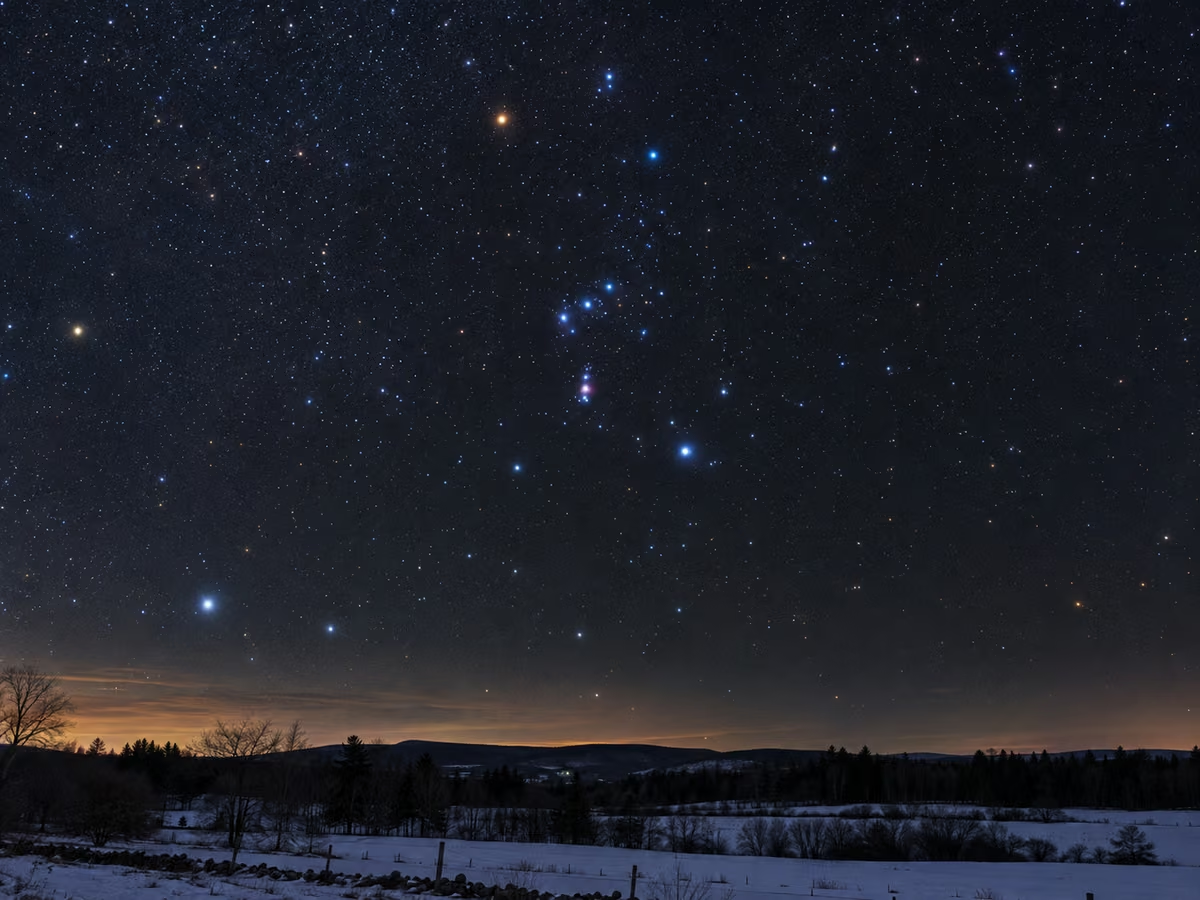
Finding Orion’s Belt is one of the easiest ways to begin exploring the night sky. Whether you are looking up from your backyard, a city rooftop, or a remote countryside location, three bright stars arranged in a nearly straight line can help you identify one of the most recognizable constellations visible from Earth.
These stars, Alnitak, Alnilam, and Mintaka, form Orion’s Belt, a distinctive star pattern near the center of the constellation Orion, also known as Orion the Hunter. Their relatively even spacing and similar apparent brightness make them useful landmarks for anyone learning to recognize stars and constellations.
The best part is that you do not need a telescope, binoculars, or specialized astronomical equipment to find Orion’s Belt. Under reasonably clear skies, your eyes are enough.
In this guide, you will learn where to look for Orion’s Belt, how to identify its three stars, the best seasons and times to observe it, and how to use the Belt to locate other fascinating objects, including Sirius, Aldebaran, and the Orion Nebula.
What Is Orion’s Belt?
Orion’s Belt is a recognizable group of three bright stars that appear in a nearly straight line within the constellation Orion. Astronomers classify this arrangement as an asterism, meaning a familiar star pattern that is not itself one of the officially recognized constellations.
The Belt lies approximately across the middle of Orion’s hourglass-shaped figure, representing the waist of the hunter in traditional constellation illustrations. Its three stars appear close together from Earth, but they are separated by enormous distances in three-dimensional space.
All three are exceptionally luminous, hot, blue-white stellar objects. Their apparent alignment is mainly a matter of perspective rather than evidence that they form one small, physically connected star system.
According to NASA, the Belt’s three prominent stars have different distances from Earth despite appearing nearly equally bright in the night sky. This makes Orion’s Belt a useful example of how the celestial sphere represents objects that actually occupy different locations in space. [1]
Meet Alnitak, Alnilam, and Mintaka
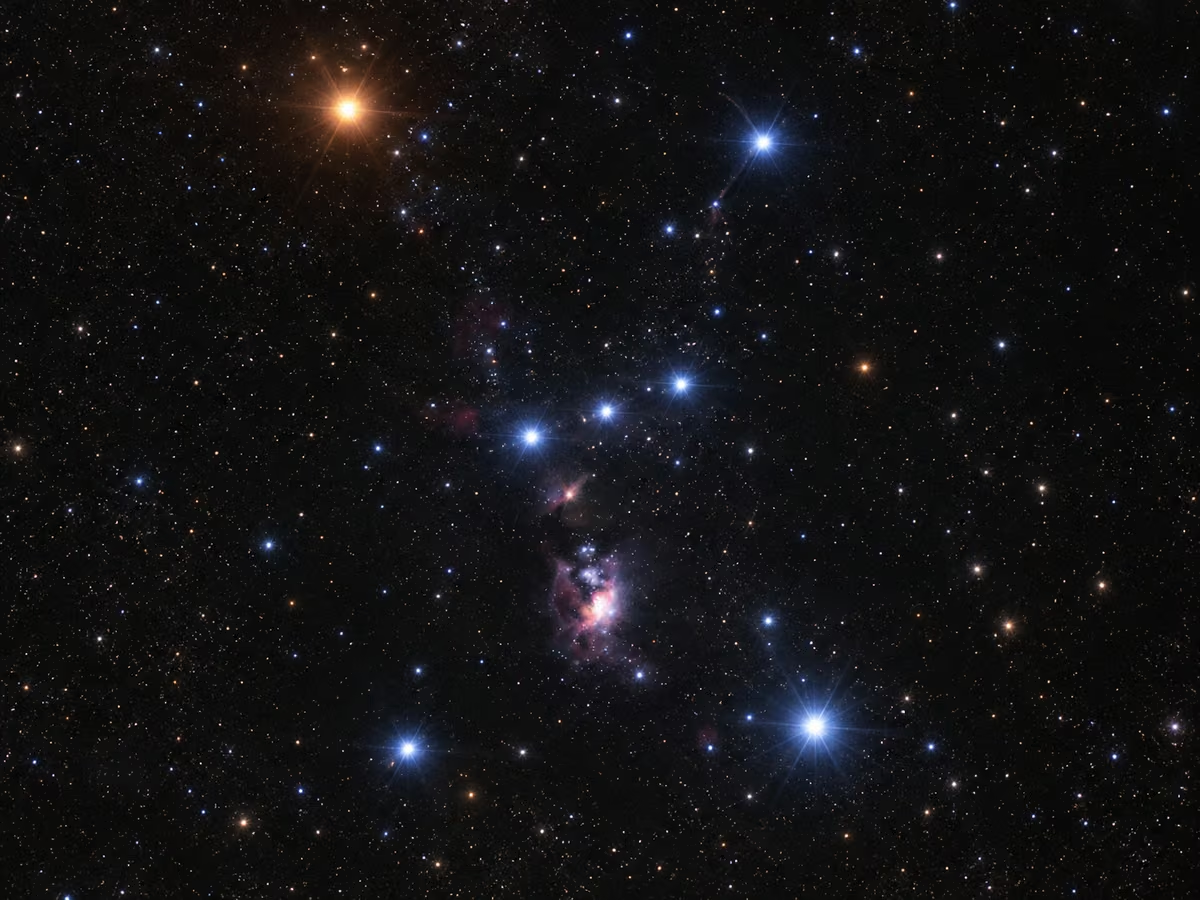
Orion’s Belt consists of three stars named Alnitak, Alnilam, and Mintaka. In commonly published Northern Hemisphere star charts, Alnitak appears toward the left, Alnilam occupies the middle, and Mintaka appears toward the right. However, their actual visual orientation changes with your geographic location and the time of observation.
| Star | Designation | Approximate apparent magnitude | Approximate distance |
|---|---|---|---|
| Alnitak | Zeta Orionis | 1.7 to 1.9 | 800 light-years |
| Alnilam | Epsilon Orionis | 1.7 | 1,300 light-years |
| Mintaka | Delta Orionis | 2.2 to 2.3 | 900 light-years |
Distances are rounded values reported in NASA’s introductory Orion guide. Published astronomical distance estimates vary with measurement methods and stellar-system models. Apparent magnitudes are approximate and can vary, particularly for multiple or variable star systems. [1, 2]
Alnilam is the central star and appears slightly separated from its neighbors by nearly equal angular intervals. Alnitak and Mintaka are also complex multiple-star systems, although their components cannot all be distinguished with the naked eye.
Astronomers use apparent magnitude to describe how bright a celestial object looks from Earth. Smaller magnitude numbers indicate greater apparent brightness. Although Mintaka is somewhat dimmer than the other two Belt stars, all three are bright enough to be identified without optical assistance under suitable conditions.
Is Orion’s Belt a Constellation?
Orion’s Belt is not an independent constellation. It is an asterism located inside Orion, one of the 88 modern constellations officially recognized by the International Astronomical Union (IAU).
The distinction is important because astronomers use the term constellation to describe an officially defined region of the celestial sphere. An asterism, by comparison, is a recognizable arrangement of stars that people use to identify a particular part of the sky.
The Big Dipper, for example, is an asterism within Ursa Major, just as Orion’s Belt is an asterism within Orion.
These patterns depend on our viewing perspective. If an observer could travel far across the Milky Way, the stars would appear in different relative positions, and the familiar Belt alignment could disappear.
The IAU also emphasizes that cultures around the world have developed different interpretations and names for recognizable stellar patterns. Orion’s Belt has been recognized by generations of skywatchers, even though its meaning has varied across cultures. [3]
How to Find Orion’s Belt Step by Step
Finding Orion’s Belt becomes much easier when you search for its distinctive three-star arrangement rather than attempting to identify the entire constellation immediately.
Begin on a clear evening during a season when Orion is visible. Choose a place with a reasonably unobstructed view of the sky, then look for three prominent stars close together in a straight or slightly sloping line. Once you locate this formation, you can check the surrounding stars to confirm that you have found the correct pattern.
The following three-step method works for observers in both hemispheres, although the constellation may appear upright, sideways, or upside down depending on your position.
Look for Three Bright Stars in a Row
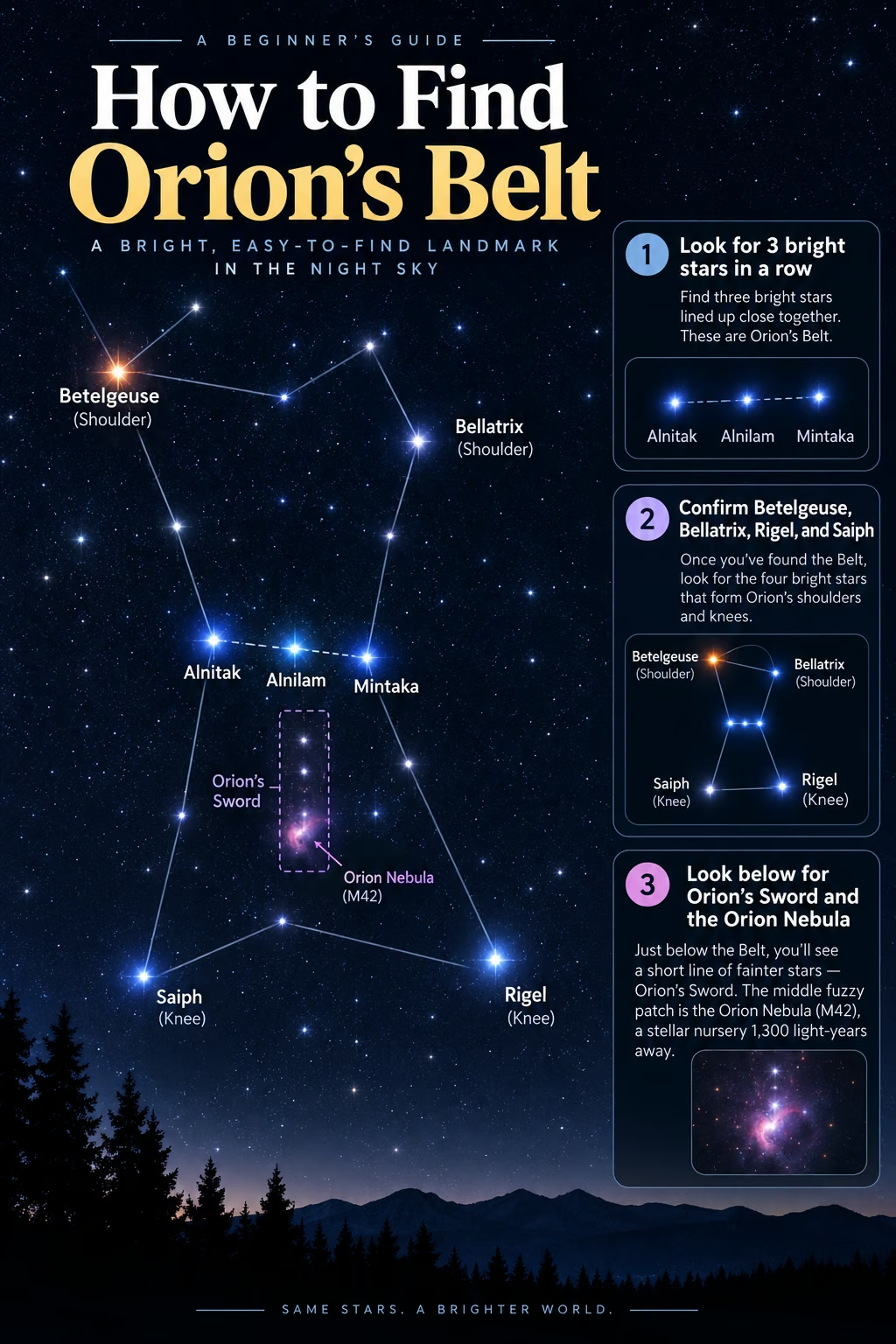
The quickest way to locate Orion’s Belt is to recognize its three-star alignment.
Unlike scattered collections of stars, the Belt forms a compact arrangement with nearly equal gaps between the stars. Although the line is not mathematically perfect, its alignment is distinctive enough to stand out against the surrounding sky.
Start by scanning an area roughly 2 to 3 degrees wide. The full Belt spans approximately 2.3 degrees, equivalent to about four or five full Moon diameters placed side by side.
Its stars are bright, but they are not necessarily the brightest objects in that region. Nearby Betelgeuse and Rigel can appear more prominent.
If you spot three fairly similar, blue-white stars in a short row, pause and examine their surroundings. Their consistent spacing provides your first clue that you have found Orion’s Belt. You can then confirm the identification using the larger constellation pattern.
Confirm the Larger Shape of Orion
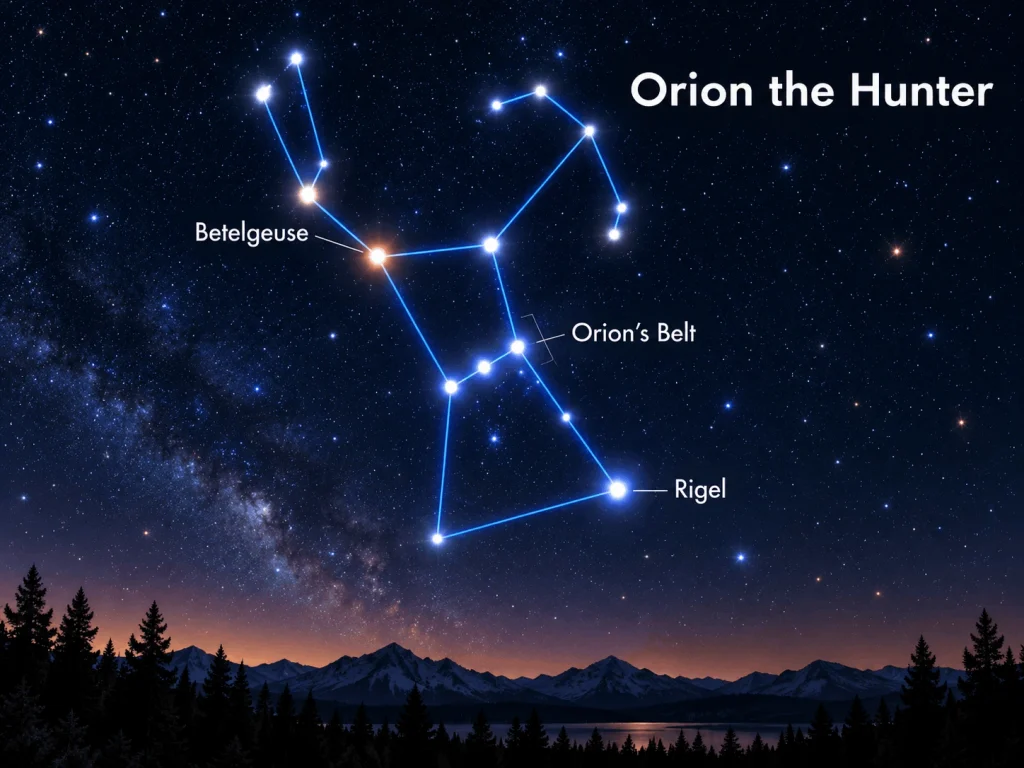
Once you locate the three Belt stars, examine the brighter stars around them. Orion’s larger figure resembles an irregular hourglass or a broad rectangle narrowing toward the middle.
Four major stars establish this familiar outline:
- Betelgeuse: A reddish-orange star marking one of Orion’s shoulders.
- Bellatrix: A blue-white star marking the opposite shoulder.
- Rigel: A brilliant blue-white star associated with one of Orion’s feet.
- Saiph: Another luminous star marking the opposite foot.
In a familiar upright Northern Hemisphere view, Betelgeuse and Bellatrix generally appear above the Belt, while Rigel and Saiph appear below it.
The arrangement changes orientation as Earth rotates, so these descriptions are not fixed directions in the sky.
The contrast between Betelgeuse and Rigel provides another useful confirmation. Betelgeuse often displays a noticeable orange-red color, while Rigel appears bluish-white. These colors reflect differences in their stellar temperatures.
If the three aligned stars occupy the middle of this larger pattern, you have almost certainly identified Orion correctly. NASA’s observing guides use this hourglass shape as one of the easiest ways to recognize the constellation. [4]
Look Below the Belt for Orion’s Sword
After identifying the Belt, look toward the side of the constellation that contains Rigel and Saiph. In the familiar upright view, a shorter, fainter line of stars extends downward from the Belt. This feature is known as Orion’s Sword.
One of the Sword’s most interesting features is the Orion Nebula, designated Messier 42 or M42.
Under sufficiently dark skies, the nebula can appear to the unaided eye as a small, hazy patch. Binoculars reveal it more clearly, while a telescope can show additional structure within the surrounding gas cloud.
The Orion Nebula is a massive star-forming region located approximately 1,300 to 1,500 light-years from Earth, depending on the measurement and source. It contains gas, dust, and young stars, including the bright stars of the Trapezium Cluster.
Finding the Sword after locating the Belt gives you an easy introduction to deep-sky observing without requiring complicated astronomical coordinates. [1, 5]
When Is the Best Time to See Orion’s Belt?
The best time to see Orion’s Belt depends on the season, your hemisphere, and the time of night. Orion is not visible in the evening sky throughout the entire year because Earth’s changing position in its orbit around the Sun alters which parts of the celestial sphere face the nighttime side of our planet.
For observers in much of the Northern Hemisphere, Orion is especially prominent during winter evenings, particularly from December through February. During this period, the constellation can be seen rising in the east, climbing into the southern sky, and eventually moving toward the western horizon.
However, Orion is not limited to winter. It returns to the predawn sky several months earlier and remains visible near the western evening horizon during parts of spring.
The Southern Hemisphere has the opposite seasonal calendar, so Orion’s prominent evening appearance occurs during southern summer.
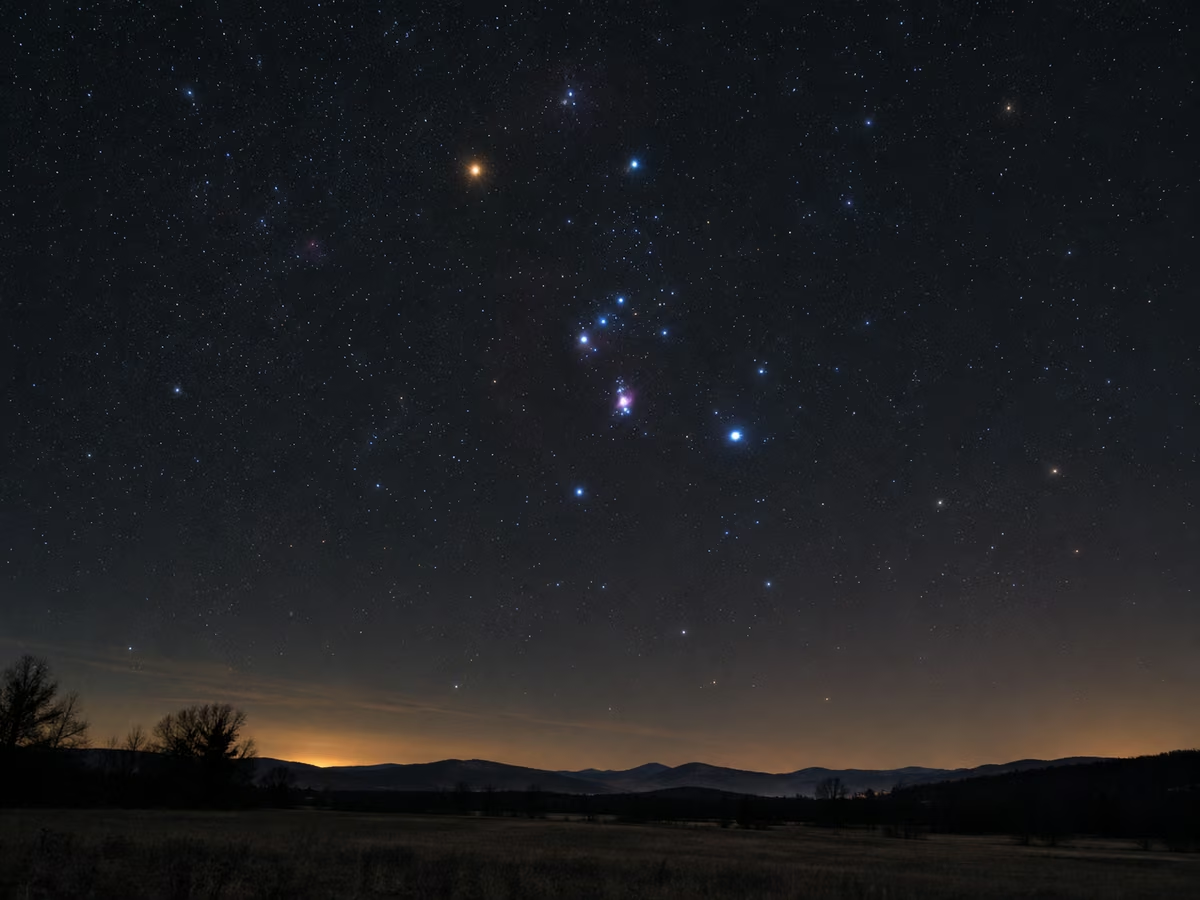
Orion’s Belt Visibility by Season
| Time of year | Northern Hemisphere viewing conditions |
|---|---|
| July to August | Returns to the eastern sky before sunrise, becoming easier later in this period |
| September to October | Visible before dawn, increasingly high as the months progress |
| November to December | Moves into the evening sky, with increasingly convenient viewing |
| January to February | Excellent evening visibility; typically high in the sky |
| March to April | Visible toward the western sky after sunset, gradually setting earlier |
| May to June | Generally difficult or impossible to observe because Orion is close to the Sun’s direction |
General seasonal guide for mid-northern latitudes. Exact visibility depends on latitude, local time, and horizon conditions. Southern Hemisphere observers experience different seasonal timing and orientation, although the broad annual pattern of evening visibility is similar. [4, 6]
Earth’s rotation also changes Orion’s position during a single night. This apparent daily movement, known as diurnal motion, causes stars to rise toward the eastern horizon and progress westward across the sky.
Earth’s orbital motion creates a second effect: Orion appears approximately four minutes earlier on successive nights. Over a month, this amounts to roughly two hours, which explains why a constellation that is visible before sunrise in autumn becomes prominent during the evening in winter.
For beginners, the easiest general strategy is to observe Orion during January or February evenings in the Northern Hemisphere, or during the corresponding southern summer months in the Southern Hemisphere. [6]
Where Should You Look for Orion’s Belt?
The direction you should face when searching for Orion’s Belt depends on your location, the season, and the time of observation. Orion does not remain fixed in one compass direction, so advice such as “always look south” is only accurate under particular circumstances.
For observers at mid-northern latitudes, Orion generally rises in the eastern or southeastern part of the sky, moves across the southern sky, and sets toward the western or southwestern horizon.
Observers in the Southern Hemisphere often see Orion pass across the northern portion of their sky. Near Earth’s equator, the constellation can rise very high, and parts of the Belt may pass close to overhead.
Astronomers describe an object’s location using altitude and azimuth. Altitude measures its angle above the horizon, while azimuth describes its compass direction.
Because Orion’s Belt lies close to the celestial equator, it can be observed from nearly the entire inhabited world. [3]
How Orion’s Position Changes During the Night
The Belt’s apparent tilt changes throughout its journey. When Orion rises, the three stars may form a nearly vertical line. As the constellation climbs, the line gradually rotates relative to the horizon. Later, toward the western sky, its apparent orientation changes again.
This rotation is a normal effect of observing the celestial sphere from Earth’s rotating surface.
Latitude also affects the altitude of the Belt. Near the equator, Orion may pass almost overhead, while observers much farther north or south see it travel lower across the sky.
If you are unsure where to look, use a location-aware star chart such as Stellarium Web. Enter your location and select the observation date and time to see Orion’s predicted position. NASA recommends interactive sky maps as useful tools for learning constellations. [7]
How to Make Orion’s Belt Easier to See
Although Orion’s Belt is bright enough to be observed without a telescope, your observing environment can make a significant difference. Artificial lighting, clouds, atmospheric haze, and moonlight all affect how clearly stars appear against the night sky.
The good news is that you do not need to travel to a remote astronomical observatory. Orion’s Belt can often be identified from suburban neighborhoods and even moderately light-polluted cities.
What matters most is having a clear view of the correct part of the sky, choosing an appropriate observation time, and allowing your eyes to adjust to the darkness.
NASA recommends reducing exposure to bright light, checking sky conditions, and allowing sufficient time for dark adaptation before attempting to observe faint astronomical objects. [7, 8]
Choose a Dark Location With an Open Horizon
A location with a broad, unobstructed horizon can help you identify Orion shortly after it rises or before it sets. Parks, open fields, rooftops, and rural areas often provide better viewing opportunities than streets surrounded by tall buildings.
Light pollution reduces the contrast between stars and the sky background. While Orion’s three Belt stars are generally bright enough to remain visible in moderately light-polluted environments, fainter stars around the constellation become more difficult to see.
A darker observing location reveals additional details, including more stars in Orion’s Sword and potentially the faint glow of the Orion Nebula.
However, darker does not always mean better if the location is unsafe or has poor visibility. Choose a secure observing site, avoid isolated areas with hazards, and check the local weather before traveling. [8]
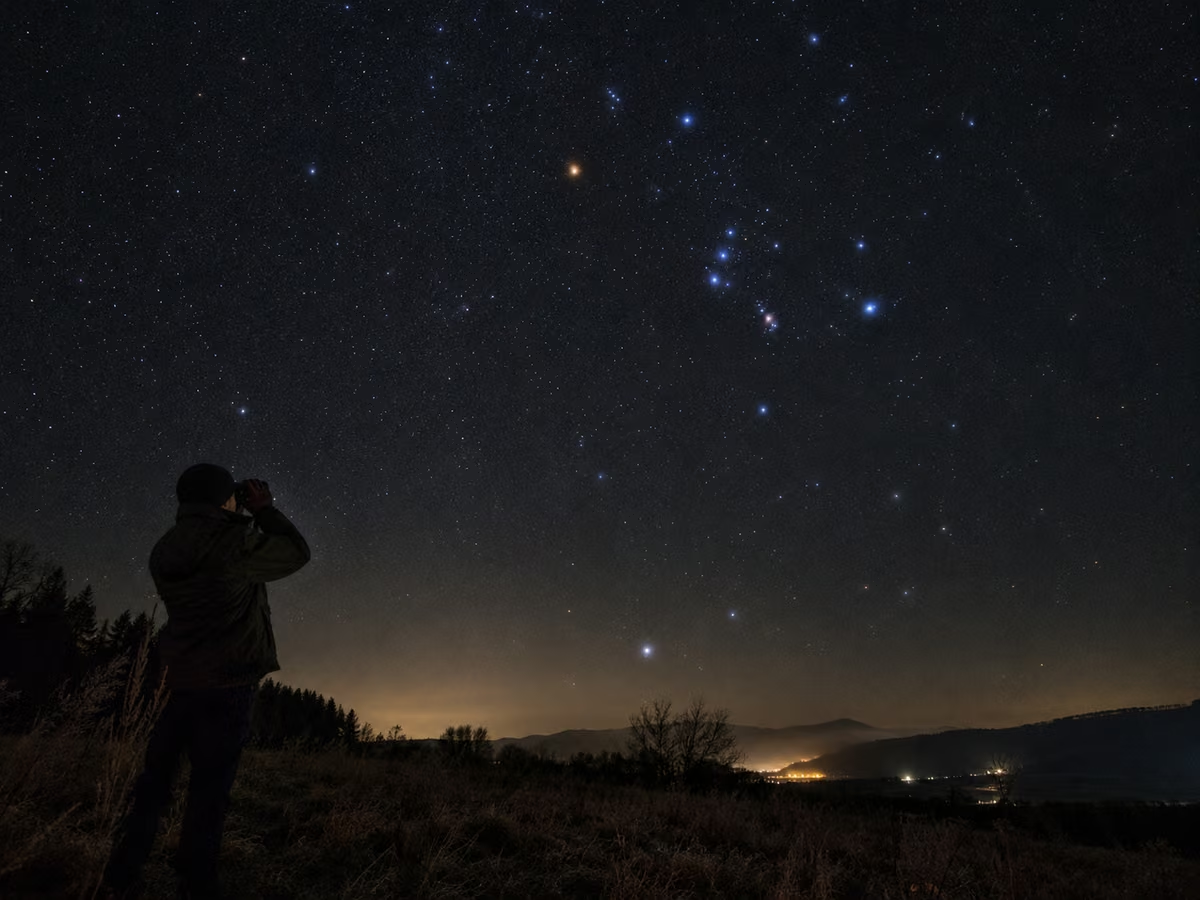
Allow Your Eyes to Adjust to the Darkness
Human eyes need time to adapt when moving from a brightly illuminated environment into darkness. This process is called dark adaptation, and it gradually increases your sensitivity to faint light.
NASA notes that full dark adaptation can take approximately 30 minutes or longer. During this period, avoid repeatedly checking bright mobile screens or looking directly at streetlights and car headlights.
A dim red flashlight is useful for reading star charts or moving around an observing location because low-intensity red light generally preserves night vision better than bright white light.
Dark adaptation is especially helpful when looking for objects fainter than Orion’s Belt, such as portions of Orion’s Sword or the Pleiades under challenging conditions.
You may find the Belt almost immediately, but the surrounding constellation often becomes more impressive after your eyes adjust. [7, 8]
Check Moonlight, Weather, and Atmospheric Conditions
A clear, moonless night generally provides the best contrast for observing stars and deep-sky objects. However, moonlight does not automatically make Orion’s Belt impossible to see.
Because the three Belt stars are relatively bright, they can remain visible even when the Moon is present. Fainter objects, such as diffuse nebulae, are more strongly affected by the brighter sky background.
Cloud cover, haze, humidity-related scattering, smoke, and airborne dust can further reduce visibility. Astronomers often refer to the atmosphere’s ability to transmit light clearly as atmospheric transparency.
A star may also appear to flicker or change brightness because of atmospheric turbulence, particularly when it is close to the horizon.
For the most reliable observing session, choose a mostly cloud-free evening, look when Orion is reasonably high above the horizon, and avoid bright lights directly within your field of view.
Do You Need Binoculars or a Telescope?
You do not need optical equipment to see Orion’s Belt. In fact, the naked eye is usually the best way to recognize its overall three-star pattern because a telescope’s narrow field of view may not fit the entire arrangement.
Binoculars become useful after you have identified Orion. They can reveal additional faint stars around the Belt and provide a clearer view of the Orion Nebula.
A small telescope can show even more detail, including compact stellar groupings and brighter structures within M42.
| Equipment | What you can observe | Recommendation |
|---|---|---|
| Naked eye | All three Belt stars and Orion’s main outline | Best for beginners |
| 7×50 or 10×50 binoculars | Fainter surrounding stars and a better view of the Orion Nebula | Excellent next step |
| Small telescope | Multiple stars, M42, and other selected deep-sky objects | Useful for deeper exploration |
| Large telescope or astrophotography setup | More difficult nebulae and faint structure | Advanced observing |
For most first-time skywatchers, start without any equipment. Once you can recognize Orion reliably, binoculars are a practical next step toward observing the objects around it.
Use Orion’s Belt to Find Other Stars and Constellations
One of the most valuable things about Orion’s Belt is that it acts as a natural guide to other recognizable objects in the sky.
Astronomers and amateur skywatchers use a technique called star hopping, which involves following recognizable star patterns from one celestial object to another. Instead of relying on complex astronomical coordinates, you begin with an easy landmark and use its position to locate nearby targets.
Orion’s Belt is especially useful because its alignment points in the general direction of two prominent stars: Sirius in Canis Major and Aldebaran in Taurus.
The same region also contains the Pleiades star cluster, making it one of the most rewarding parts of the night sky for beginners. [9]
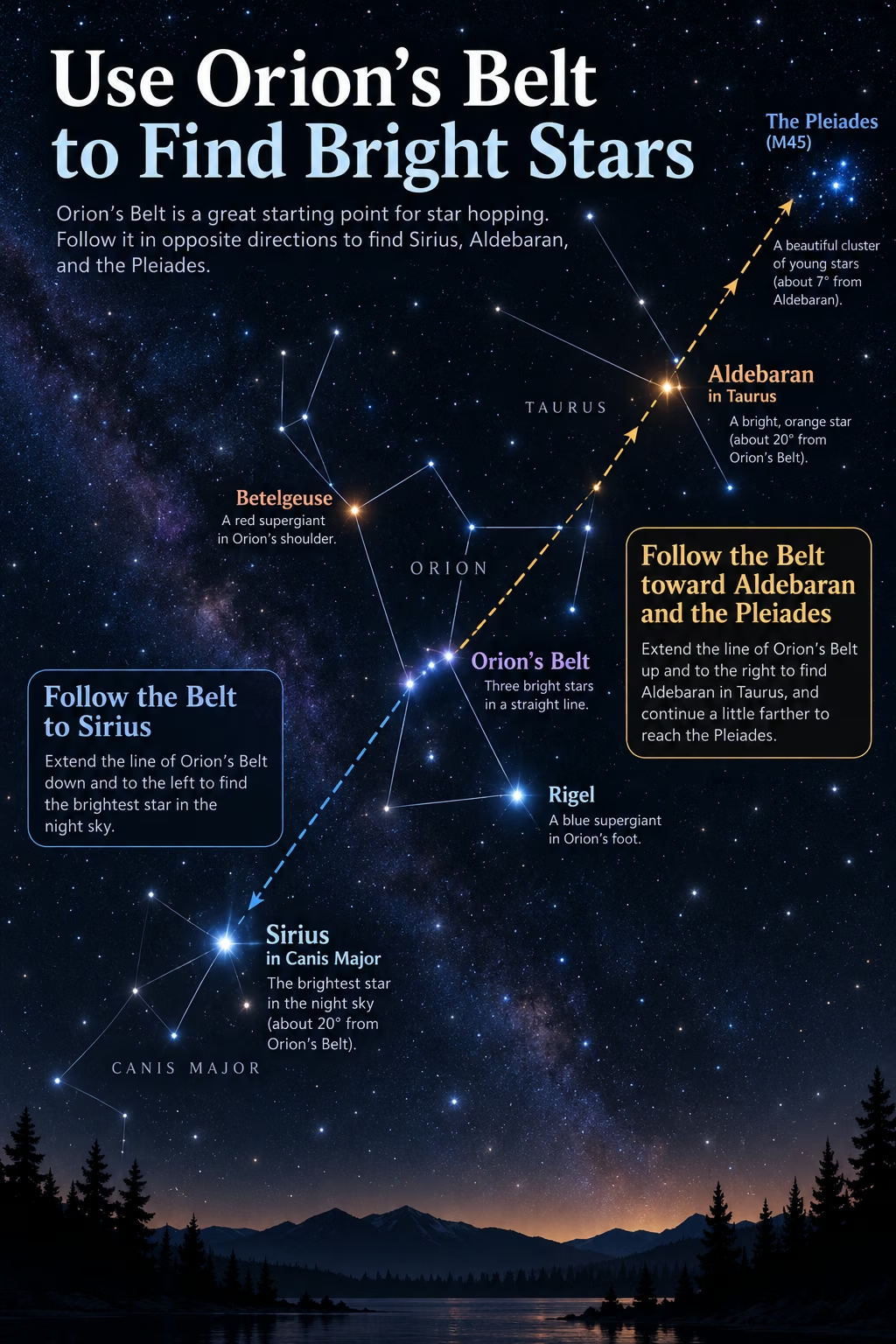
Follow the Belt Toward Sirius
Sirius is the brightest star in Earth’s nighttime sky, and Orion’s Belt provides a convenient way to find it.
First, identify Alnitak, Alnilam, and Mintaka. Imagine drawing a straight line through these stars. Extend the line beyond the Alnitak end, away from Mintaka, until you encounter an exceptionally bright star.
That star is Sirius, also called the Dog Star, located in the constellation Canis Major.
Sirius has an apparent magnitude of approximately -1.46, making it considerably brighter than any individual star in Orion’s Belt. It lies about 8.6 light-years from Earth, meaning it is much closer than the three massive Belt stars.
From mid-northern latitudes, Sirius generally appears below and to the left of Orion’s Belt when Orion is upright in the southern sky. In the Southern Hemisphere, the pattern can appear inverted, so following the star alignment is more dependable than memorizing left or right.
Sirius may also appear to flash different colors when low above the horizon because Earth’s atmosphere refracts and distorts its light.
Once you find Sirius, you have successfully used one constellation as a reference point to identify a star in another. [9]
Follow the Belt Toward Taurus
Orion’s Belt can also guide you toward Aldebaran, the prominent orange-red star associated with the constellation Taurus the Bull.
Begin with the three Belt stars and extend their alignment in the direction opposite Sirius. Continue beyond Mintaka, and you will reach the general area of Aldebaran.
Aldebaran is approximately magnitude 0.9, making it one of the brighter stars in the winter sky. Its noticeably warm, orange appearance helps distinguish it from many nearby blue-white stars.
Aldebaran appears close to the Hyades star cluster, which forms much of the familiar V-shaped face of Taurus. However, Aldebaran is a foreground star rather than a physical member of the Hyades cluster.
Continue farther through the same general region of the sky, and you can locate the Pleiades, also known as the Seven Sisters or Messier 45.
The Pleiades is a compact open star cluster that can appear as a tiny group of sparkling stars to the unaided eye. Binoculars reveal many additional cluster members.
By following Orion’s Belt in both directions, you can learn to identify several important celestial landmarks during a single observing session. [9]
| Starting point | Direction along the Belt | What you can find |
|---|---|---|
| Orion’s Belt | Beyond Alnitak | Sirius, Canis Major |
| Orion’s Belt | Beyond Mintaka | Aldebaran, Taurus |
| Aldebaran region | Farther toward Taurus’s upper region | Pleiades star cluster |
Directions refer to the stars along the Belt itself, not fixed left-right positions on the horizon. The apparent orientation changes with observing location and time.
What Else Can You See Around Orion?
Orion contains far more than its famous Belt. The constellation includes massive stars, luminous nebulae, star-forming regions, and dark molecular clouds that make it an important area for astronomical observation and research.
Some of these objects are easy to identify without equipment, while others require binoculars, telescopes, or specialized astrophotography techniques.
A particularly interesting feature of Orion is the contrast between its evolved massive stars and regions where new stars are being formed. Betelgeuse and Rigel illustrate different stages and properties of massive stellar evolution, while the Orion Nebula offers a direct view into an active stellar nursery.
The following objects are especially worth exploring once you become familiar with Orion’s Belt.
Betelgeuse: The Red Supergiant
Betelgeuse marks one of Orion’s shoulders and is recognizable by its orange-red appearance. It is a massive red supergiant that has evolved beyond the main-sequence stage of its life. Its brightness varies over time, and astronomers study it to understand the late evolutionary stages of massive stars. It is expected to end its life as a supernova, but there is no reliable prediction of exactly when this will happen. Betelgeuse’s warm color makes it particularly easy to distinguish from Rigel and the blue-white Belt stars.
Rigel: The Blue Supergiant
Rigel is one of the brightest stars in Orion and marks one of the hunter’s feet in traditional constellation drawings. It is a massive, very luminous blue supergiant with a much higher surface temperature than the Sun. Its blue-white color provides a striking contrast with the orange-red light of Betelgeuse. Rigel is also part of a multiple-star system, although its additional components are not obvious to the naked eye. Together, Rigel and Betelgeuse demonstrate how a star’s visible color relates to its surface temperature and physical properties.
Orion Nebula (M42): A Stellar Nursery
The Orion Nebula is among the most accessible bright nebulae for beginner observers. Located in Orion’s Sword, it is a large region of gas and dust where young stars are forming. At its center lies the Trapezium Cluster, whose massive stars illuminate and energize the surrounding gas. Binoculars reveal a fuzzy glow, while telescopes can resolve additional stellar detail and brighter nebular structures. The region is especially important scientifically because astronomers can study the processes of star formation relatively close to Earth. [5]

Horsehead Nebula: A Challenging Deep-Sky Object
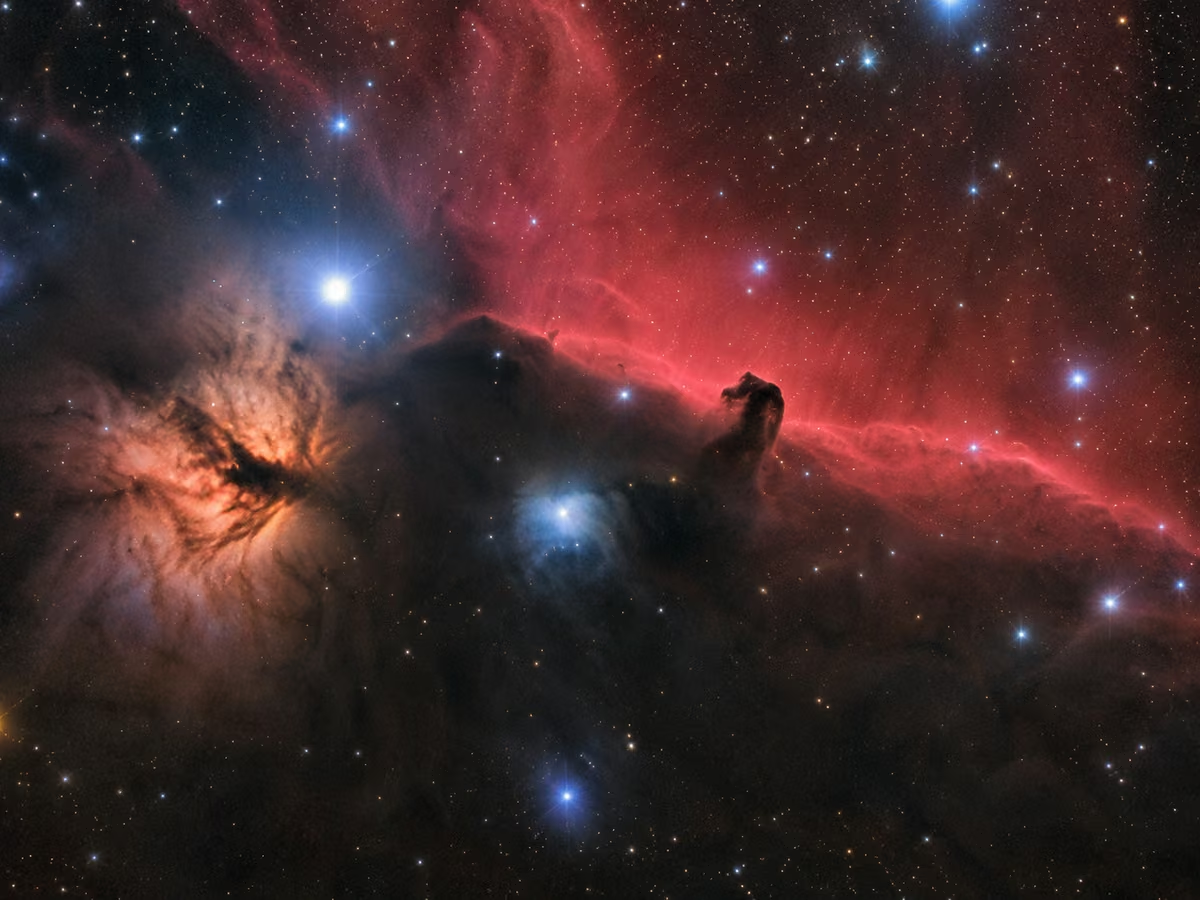
The Horsehead Nebula, also known as Barnard 33, is a dark nebula located near Alnitak, one of Orion’s Belt stars. Its distinctive horsehead-shaped silhouette appears against the brighter emission region IC 434. Unlike the Orion Nebula, the Horsehead is extremely difficult to observe visually because of its low contrast. It is primarily a target for experienced observers using suitable telescopes, filters, and dark skies, as well as astrophotographers. The nearby Flame Nebula is another interesting object in this region. NASA’s astronomical imagery has documented both nebulae near the Belt. [2]
Quick FAQ About Finding Orion’s Belt
Why Does Orion’s Belt Look Tilted?
Orion’s Belt appears tilted because the orientation of the star pattern changes relative to your local horizon as Earth rotates.
Although the three stars maintain nearly the same apparent positions relative to one another over a human lifetime, the entire constellation appears to rotate as it moves across the sky.
Your latitude also affects the angle at which you observe Orion. A skywatcher in northern Europe may see a different orientation from someone observing in Australia or near the equator.
This means that photographs and star charts showing Orion’s Belt as a horizontal line are not universally representative.
The most dependable identifying characteristic is the three-star alignment and spacing, rather than whether the Belt appears horizontal, diagonal, or almost vertical.
Can You See Orion’s Belt With the Naked Eye?
Yes. Orion’s Belt is easily visible with the naked eye under suitable observing conditions.
Its three stars have approximate apparent magnitudes between 1.7 and 2.3, making them bright enough to be seen in many suburban and urban environments when the sky is clear.
You do not need a dark-sky reserve to identify the Belt, although reducing light pollution can help you recognize more of the surrounding constellation.
Visibility may be affected by heavy cloud cover, strong atmospheric haze, bright local lighting, or Orion being below the horizon.
If you cannot see the Belt immediately, check whether Orion should be above the horizon at your location and observation time before assuming that poor sky conditions are responsible.
Do You Need a Telescope to Find Orion’s Belt?
No. A telescope is unnecessary for locating Orion’s Belt, and the naked eye is often more practical for identifying the complete pattern.
The stars are separated by angular distances large enough that many telescopes cannot display all three within a single field of view, particularly at higher magnifications.
Binoculars can be useful for examining fainter stars around the Belt, but even they are not required for basic recognition.
If you have access to a telescope, use the naked eye first to identify Orion and its surrounding features. Then point the instrument toward a specific target, such as a multiple-star system or the Orion Nebula.
This approach makes the observing process easier and avoids searching randomly through a narrow telescopic field.
Can Orion’s Belt Be Seen From Both Hemispheres?
Yes. Orion’s Belt is visible from most inhabited regions in both the Northern and Southern Hemispheres because its stars lie close to the celestial equator.
Unlike some northern or southern constellations that remain hidden from observers on the opposite side of Earth, Orion is accessible across an exceptionally wide range of latitudes.
However, its orientation differs between hemispheres. Observers in Australia, for example, frequently see the familiar hunter’s figure inverted relative to the way it is traditionally illustrated in Northern Hemisphere star charts.
Seasonal descriptions also require care. Orion is associated with winter evenings in the Northern Hemisphere but southern summer evenings in places such as Australia and South Africa.
The stars remain the same regardless of the hemisphere, so identifying the three-star alignment is the most reliable method.
Why Does Orion Move Across the Sky During the Night?
Orion appears to move across the sky primarily because Earth rotates on its axis.
As Earth turns eastward, stars and constellations appear to travel in the opposite direction, generally from east to west. This apparent movement is called diurnal motion.
During a typical observing session, you can notice Orion gradually changing its altitude and compass direction. Over several hours, its position may differ substantially from where it appeared earlier in the evening.
Earth’s annual revolution around the Sun causes a different, slower seasonal effect. The same constellation appears at progressively earlier clock times from one night to the next.
Together, Earth’s rotation and orbital motion explain why Orion changes position during a single night and why different seasons offer different viewing opportunities.
Final Thoughts: Finding Orion’s Belt Is the First Step to Exploring the Night Sky
Orion’s Belt provides one of the most accessible starting points for learning practical astronomy. With just three bright stars, you can recognize an entire constellation, identify nearby stellar landmarks, and begin exploring objects far beyond our Solar System.
The simplest approach is to observe during a season when Orion is prominent, locate the three aligned stars, and confirm their position using Betelgeuse, Bellatrix, Rigel, and Saiph.
Once you know the pattern, follow the Belt toward Sirius in one direction and Aldebaran in the other. Then explore Orion’s Sword to find the famous Orion Nebula.
Over time, recognizing Orion’s changing position also helps you understand how Earth’s rotation and orbit influence the night sky.
What begins as finding three stars can become a practical introduction to celestial navigation, stellar evolution, and the structure of our galaxy.
Sources
The following references support the astronomical explanations, observing instructions, and scientific information in this article.
[1] NASA Science. Discovering the Universe Through the Constellation Orion. Information about the Belt stars, their approximate distances, the three-dimensional nature of constellations, and the Orion Nebula. Read NASA source.
[2] NASA Astronomy Picture of the Day. Alnitak, Alnilam, Mintaka, November 20, 2025. Information on the blue supergiant stars and surrounding nebulae. Read NASA source.
[3] International Astronomical Union. The Constellations. Official definitions of constellations, asterisms, boundaries, and the celestial sphere. Read IAU source.
[4] NASA Science. What’s Up: February 2026 Skywatching Tips from NASA. Guidance for recognizing and locating Orion during Northern Hemisphere winter evenings. Read NASA skywatching guide.
[5] NASA Hubble Mission Team. Chaos at the Heart of Orion. Scientific information about the Orion Nebula, its massive young stars, and the Trapezium Cluster. Read NASA Hubble source.
[6] EarthSky. The Return of Sirius in the Morning Signals Seasonal Change, August 26, 2026. Explanation of seasonal sky visibility and why stars rise progressively earlier throughout the year. Read EarthSky guide.
[7] NASA Science. May’s Night Sky Notes: Stargazing for Beginners. Guidance on interactive sky charts, dark adaptation, red light, and moonlight. Read NASA beginner guide.
[8] NASA Science. How to Find Good Places to Stargaze. Recommendations about observing locations, light pollution, night vision, and safety. Read NASA stargazing guide.
[9] EarthSky. Use Orion’s Belt to Find 4 Bright Stars in the Sky. Guidance for using the Belt to identify Sirius, Aldebaran, and surrounding celestial objects. Read EarthSky star-hopping guide.