
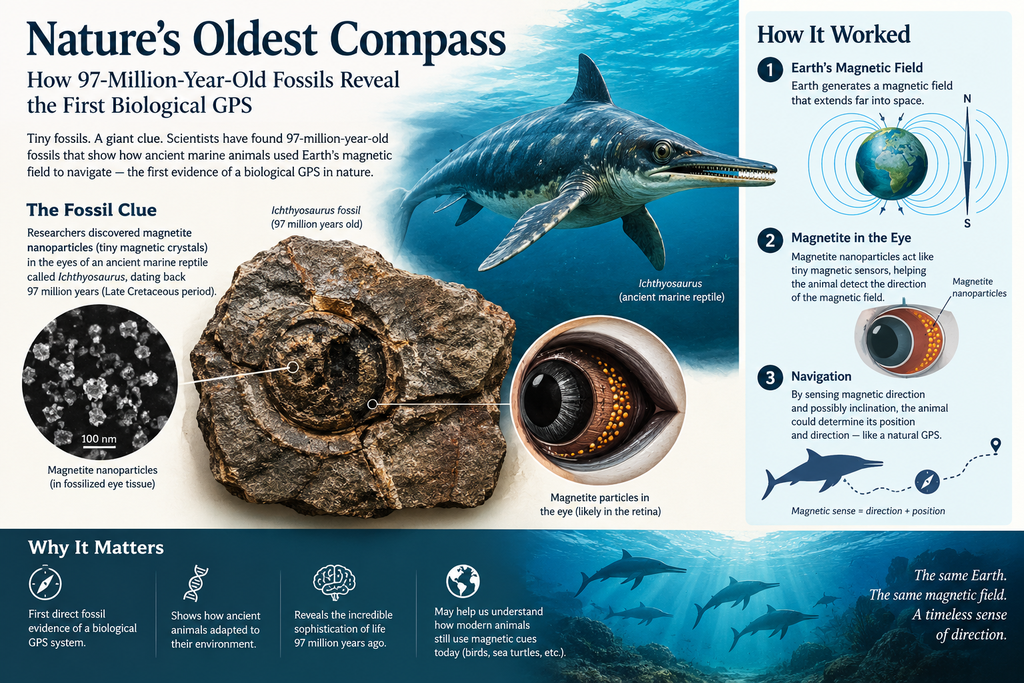
In the vast, dark oceans of the Cretaceous period, long before satellites or maps existed, an unknown marine creature may have possessed a remarkable internal guidance system. Scientists have now uncovered compelling evidence that animals were already using Earth’s magnetic field as a natural GPS nearly 100 million years ago. Tiny magnetic fossils, buried in ancient seafloor sediments, have provided the earliest direct proof that living organisms could sense both the direction and strength of the planet’s magnetic field to navigate across vast distances.
These microscopic remains, known as giant magnetofossils, are no larger than a bacterial cell—roughly 50 times thinner than a human hair. Shaped like spearheads, spindles, bullets, and needles, they are composed of magnetite, a strongly magnetic iron mineral. Discovered in North Atlantic sediments dating back as far as 97 million years, these particles had long puzzled researchers. While their biological origin was widely accepted, their exact purpose remained unclear. Some scientists suspected they once served as protective armour. A groundbreaking new study has rewritten that story.
Researchers from the University of Cambridge and the Helmholtz-Zentrum Berlin used advanced three-dimensional magnetic vector tomography to peer inside one of these fossils for the first time. The technique, applied at the Diamond Light Source facility in Oxford, mapped the internal arrangement of magnetic moments—tiny regions of magnetism created by spinning electrons. What they found was extraordinary: a single, swirling magnetic vortex optimised to detect subtle variations in both the direction and intensity of Earth’s magnetic field.
This dual sensitivity is crucial. A simple magnetic compass can tell an animal which way is north. But sensing changes in field strength allows an organism to determine its actual position on the planet—essentially creating a magnetic map. “Whatever creature made these magnetofossils, we now know it was most likely capable of accurate navigation,” said Professor Rich Harrison of Cambridge’s Department of Earth Sciences, co-leader of the research. The findings, published in the journal Communications Earth & Environment, provide the first fossil evidence that animals have been navigating with Earth’s magnetic field for at least 97 million years.
Magnetoreception—the ability to sense magnetic fields—is one of nature’s most mysterious senses. Today it is known to exist in birds, sea turtles, salmon, lobsters, and many other animals that undertake long migrations. Yet the precise biological mechanism has remained elusive. One leading hypothesis involves magnetite particles inside specialised cells that act like microscopic compass needles, aligning with Earth’s field and sending signals to the nervous system. The ancient giant magnetofossils appear to represent a highly refined version of this system.
The fossils’ size and structure suggest they were not produced by ordinary magnetotactic bacteria, which create much smaller particles simply to orient themselves in chemical gradients. Instead, these larger crystals seem engineered for greater sensitivity. Their magnetic properties would have allowed a mobile animal to detect the gradual changes in field intensity that occur with latitude and longitude, enabling true geolocation across thousands of kilometres of open ocean.
Who made these remarkable structures remains an open question. The organism that produced them left no other identifiable remains, only these scattered magnetic particles. Professor Harrison has suggested that early eels are a plausible candidate. Eels evolved around 100 million years ago and are famous for their extraordinary migrations—some species travel thousands of kilometres from freshwater rivers to the open ocean to spawn. Modern eels are known to possess magnetoreception, though the exact sensory organs have yet to be fully identified. A common, migratory marine animal capable of leaving abundant fossil traces fits the evidence well.
The discovery pushes the documented history of navigational magnetoreception deep into the Mesozoic Era, a time when dinosaurs still dominated the land and the oceans teemed with marine reptiles and early fish. It also raises the possibility that even older evidence may still lie hidden in the geological record. Because giant magnetofossils preserve more readily than smaller bacterial ones, future discoveries could extend this timeline further back.
Beyond rewriting the evolutionary history of a single sense, the research offers broader insights. It demonstrates how sophisticated biological adaptations can leave durable traces in the fossil record, even when the animals themselves have vanished without a trace. The techniques developed to image these particles may also prove useful in the search for early life on Earth and potentially on Mars, where iron oxide minerals are abundant and magnetic signatures could one day reveal ancient biological activity.
In the end, these tiny crystals tell a profound story. Long before humans invented compasses or global positioning systems, life itself had already evolved a way to read the invisible lines of force that surround our planet. In the silent depths of Cretaceous seas, an unknown creature carried within its body a magnetic map of the world—an ancient GPS that guided it through the darkness with a precision we are only now beginning to appreciate. The fossils it left behind continue to speak across nearly 100 million years, reminding us that nature’s most elegant technologies often predate our own by vast stretches of time.
References
University of Cambridge. (2025). Ancient ‘animal GPS’ identified in magnetic fossils. https://www.cam.ac.uk/research/news/ancient-animal-gps-identified-in-magnetic-fossils
ScienceDaily. (2026). 97-million-year-old fossils reveal the earliest known animal “GPS”. https://www.sciencedaily.com/releases/2026/09/260930020329.htm
Harrison, R. J., et al. (2025). Magnetic vector tomography reveals giant magnetofossils are optimised for magnetointensity reception. Communications Earth & Environment.
Reuters. (2025). Magnetic fossils may reveal ancient creature’s internal ‘GPS system’. https://www.reuters.com/science/magnetic-fossils-may-reveal-ancient-creatures-internal-gps-system-2025-11-17/
Space.com. (2025). Scientists discover ancient magnetic fossils of unknown creature with internal GPS. https://www.space.com/astronomy/earth/scientists-discover-ancient-magnetic-fossils-of-unknown-creature-with-internal-gps