
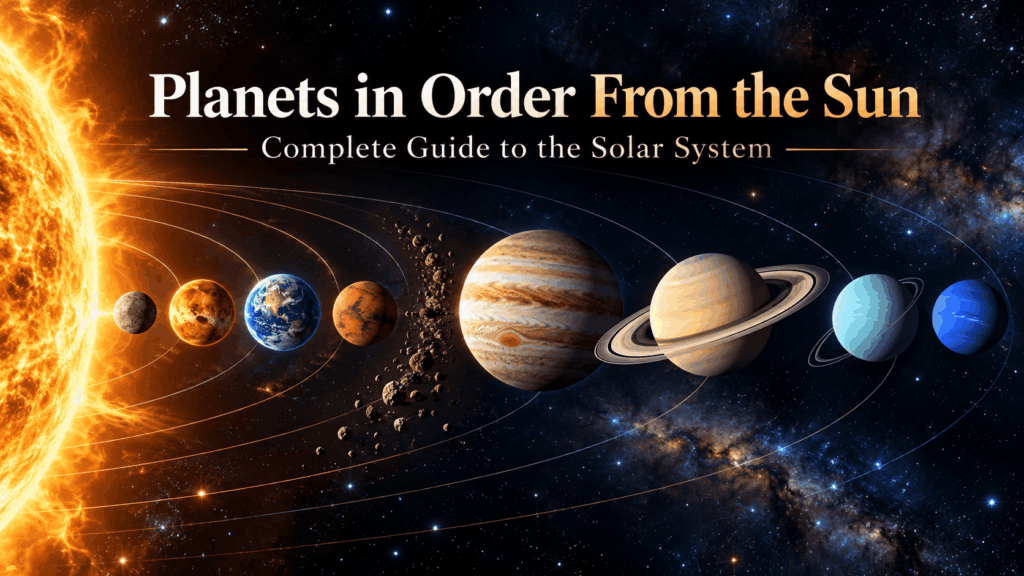
The planets in order from the Sun are Mercury, Venus, Earth, Mars, Jupiter, Saturn, Uranus, and Neptune. These are the eight planets officially recognized in our Solar System. Planetary order is determined primarily by each planet’s average orbital distance from the Sun, more precisely represented by the semi-major axis of its orbit. Mercury is the closest planet to the Sun, while Neptune is the farthest recognized major planet. [1][2]
The Sun is the central star of the Solar System and contains the overwhelming majority of its mass. Its gravity governs the motion of the planets and strongly influences dwarf planets, asteroids, comets, meteoroids, and countless smaller bodies. Planets are only one category of celestial body. Moons orbit planets or dwarf planets, asteroids are generally much smaller rocky or metallic bodies, comets contain substantial volatile material, and dwarf planets such as Pluto and Ceres occupy a separate classification under the International Astronomical Union’s current definition.
This guide travels outward from Mercury to Neptune, while also explaining why the planets occur in this order, how they formed, how their atmospheres and surfaces differ, why some have hundreds of moons, how Kepler’s laws describe their motion, why Pluto is no longer counted among the eight planets, and how spacecraft have transformed our understanding of the Solar System.
What Are the Planets in Order From the Sun?
There are eight officially recognized planets orbiting the Sun. Starting with the planet closest to the Sun and moving outward, the sequence is Mercury, Venus, Earth, Mars, Jupiter, Saturn, Uranus, and Neptune. The first four are small, dense terrestrial worlds. Beyond the main asteroid belt lie the four giant planets, including two gas giants and two ice giants. This outward sequence is useful because it simultaneously introduces planetary position, changing orbital distance, composition, temperature environment, orbital period, and the broad architecture of the Solar System. [1][19] (science.nasa.gov)
| Order | Planet | Positional Entity |
|---|---|---|
| 1 | Mercury | First Planet From the Sun |
| 2 | Venus | Second Planet From the Sun |
| 3 | Earth | Third Planet From the Sun |
| 4 | Mars | Fourth Planet From the Sun |
| 5 | Jupiter | Fifth Planet From the Sun |
| 6 | Saturn | Sixth Planet From the Sun |
| 7 | Uranus | Seventh Planet From the Sun |
| 8 | Neptune | Eighth Planet From the Sun |
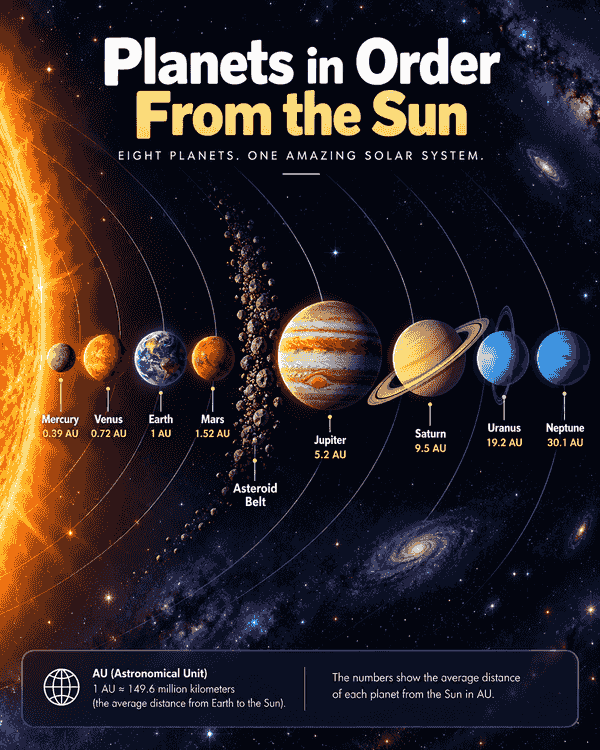
A useful structural version of the sequence is:
Sun → Mercury → Venus → Earth → Mars → Asteroid Belt → Jupiter → Saturn → Uranus → Neptune → Kuiper Belt
Why Are the Planets Listed in This Order?
Planetary order is based on increasing orbital distance, normally represented by each orbit’s semi-major axis rather than by the planet’s instantaneous distance from the Sun. That distinction matters because planets do not move around the Sun in perfect circles. Their orbits are ellipses, so their distance from the Sun changes continuously between a closest point called perihelion and a farthest point called aphelion. [14]
Mercury therefore remains the first planet even though its exact Sun-Mercury distance changes dramatically during its 88-day orbit. The same principle applies to every other planet. The semi-major axis provides a stable measurement of orbital size that allows scientists to say consistently that Venus is farther out than Mercury, Earth farther out than Venus, and so forth. NASA’s explanation of Kepler’s laws emphasizes that an elliptical orbit naturally causes the planet-Sun distance and orbital speed to vary throughout a revolution.
Planets in Order With Distance From the Sun
The distances below are average orbital distances, not fixed separations. Diameter values are equatorial diameters, and rotation periods refer primarily to sidereal rotation. Negative or retrograde rotation is described in words for clarity. Moon counts are time-sensitive because newly discovered satellites may be confirmed and officially recognized. The current table incorporates NASA figures available through August 2026 for the giant planets. [2][20]
| Planet | Position | Mean Dist. | Approx. Distance | Diameter | Orbital Period | Rotation Period | Moons* | Category |
|---|---|---|---|---|---|---|---|---|
| Mercury | 1st | 0.387 au | 57.9M km / 36.0M mi | 4,879 km | 88.0 days | 58.6 days | 0 | Terrestrial |
| Venus | 2nd | 0.723 au | 108.2M km / 67.2M mi | 12,104 km | 224.7 days | 243 days (R) | 0 | Terrestrial |
| Earth | 3rd | 1.000 au | 149.6M km / 93.0M mi | 12,756 km | 365.26 days | 23.9 hours | 1 | Terrestrial |
| Mars | 4th | 1.524 au | 228.0M km / 141.6M mi | 6,792 km | 687 days | 24.6 hours | 2 | Terrestrial |
| Jupiter | 5th | 5.20 au | 778M km / 484M mi | 142,984 km | 11.86 years | 9.9 hours | 115 | Gas Giant |
| Saturn | 6th | 9.54 au | 1.43B km / 890M mi | 120,536 km | 29.45 years | 10.7 hours | 293 | Gas Giant |
| Uranus | 7th | 19.2 au | 2.87B km / 1.78B mi | 51,118 km | 84 years | 17.2 hours (R) | 29 | Ice Giant |
| Neptune | 8th | 30.1 au | 4.5B km / 2.8B mi | 49,528 km | 164.8 years | 16.1 hours | 16 | Ice Giant |
*Known or confirmed moon totals change as observations improve. NASA listed Jupiter with 115 officially recognized moons, Saturn with 293 confirmed moons, Uranus with 29 known moons, and Neptune with 16 known moons in August 2026. [20]
A Simple Orbital Distance Graph
The following visualization uses approximately one full block for each astronomical unit. Planet sizes are not represented.
Mean Distance from the Sun
Distances shown in Astronomical Units (1 AU ≈ 149.6M km)
The graph makes an important feature of the Solar System immediately visible: the inner planets are packed into a comparatively compact region. Once we pass Jupiter, planetary spacing becomes enormous. Neptune’s average distance is roughly thirty times Earth’s distance from the Sun.
What Is an Astronomical Unit?
An astronomical unit, written formally as au, is a standard unit used for measuring distances within planetary systems. Since 2012, the International Astronomical Union has defined one astronomical unit as exactly 149,597,870,700 meters, or about 149.6 million kilometers and 93 million miles. It is approximately the mean Earth-Sun distance. [3]
Using au makes Solar System distances much easier to compare. Instead of continually writing that Jupiter is roughly 778 million kilometers away from the Sun, astronomers can describe its semi-major axis as about 5.2 au. Neptune lies at about 30.1 au. The unit therefore reveals the scale of the outer Solar System much more intuitively than a succession of very large kilometer measurements. [3]
Inner Planets vs. Outer Planets
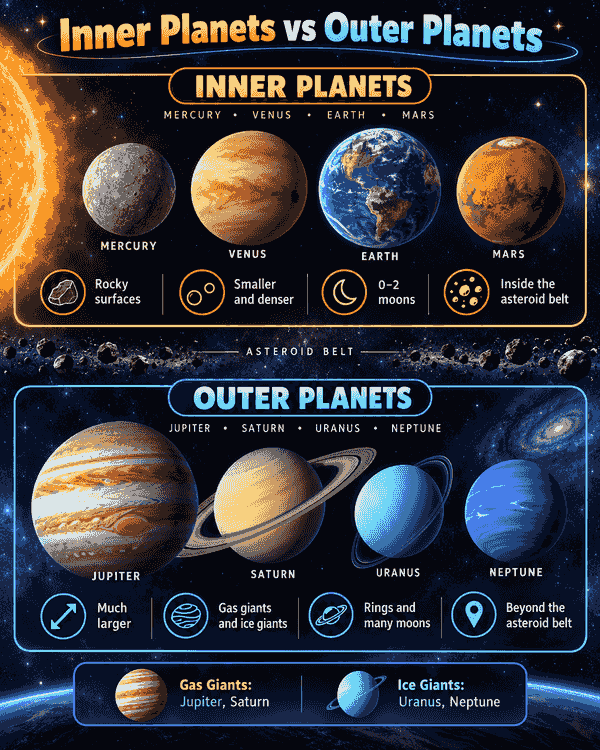
One of the most useful ways to understand the Solar System is to divide it into inner planets and outer planets. This distinction is geographic, but it also roughly tracks major physical differences. Mercury, Venus, Earth, and Mars are relatively small rocky worlds located on the Sunward side of the main asteroid belt. Jupiter, Saturn, Uranus, and Neptune lie beyond the belt and are much larger worlds with deep atmospheres, extensive moon systems, and planetary rings. The asteroid belt therefore provides a convenient transition between two distinctly different planetary environments. [1]
The Four Inner Planets
The four inner planets are Mercury, Venus, Earth, and Mars. They orbit between the Sun and the main asteroid belt and are collectively known as the terrestrial planets. Although these worlds differ dramatically in atmosphere and climate, they share important structural characteristics. Each has a relatively high density, a substantial rocky and metallic interior, and a physical surface on which a spacecraft could theoretically land.
Their compact arrangement is striking. Mars, the farthest of the four, orbits at only about 1.52 au, while the next planet, Jupiter, lies at about 5.2 au. Mercury and Venus have no moons, Earth has one, and Mars has two, making their satellite systems much simpler than those surrounding the giant planets. [2]
The Four Outer Planets
The outer planets are Jupiter, Saturn, Uranus, and Neptune. They lie beyond the main asteroid belt and are collectively called the giant planets. Jupiter and Saturn are conventionally classified as gas giants, while Uranus and Neptune belong to the distinct ice giant category.
These planets differ profoundly from terrestrial worlds. They have extensive atmospheres, enormous fluid interiors, no accessible solid surface comparable with Earth’s, powerful gravitational systems, numerous moons, and rings. Their distances also create long orbital periods. Jupiter takes nearly twelve Earth years to orbit the Sun, whereas Neptune requires nearly 165 Earth years. [2] All four possess ring systems, although Saturn’s rings are dramatically brighter and easier to observe.
Why the Asteroid Belt Is an Important Boundary
The main asteroid belt occupies a broad region between the orbits of Mars and Jupiter. Rather than being a densely packed field through which spacecraft must constantly dodge objects, it is an immense volume of space containing rocky and metallic bodies separated by substantial distances.
Its position makes it a convenient structural boundary between the terrestrial and giant planets. The belt also contains Ceres, the largest object in the main asteroid belt and the only dwarf planet in the inner Solar System. NASA notes that Ceres accounts for a significant fraction of the asteroid belt’s total mass and was the first dwarf planet visited by a spacecraft when Dawn arrived in 2015. [16]
The Main Categories of Planets
Planetary categories are based mainly on physical composition, size, interior structure, and atmospheric characteristics rather than simply distance. The eight planets can first be divided into terrestrial and giant worlds. The giant group can then be subdivided into gas giants and ice giants. These terms are scientific shorthand, not statements that Jupiter is simply a ball of ordinary gas or that Uranus is a frozen block of ice. All four giant planets contain complex, high-pressure interiors in which familiar materials behave in unfamiliar ways.
Terrestrial Planets
The terrestrial planets are Mercury, Venus, Earth, and Mars. The word terrestrial comes from terra, meaning Earth or land. These planets contain large proportions of silicate rock and metal and have solid surfaces. They are smaller than the giant planets but generally much denser.
Their surfaces display familiar geological structures such as volcanoes, impact craters, mountains, plains, canyons, and tectonic features. Earth and Venus are similar in diameter, while Mercury and Mars are significantly smaller. Terrestrial planets also possess relatively modest satellite systems. Mercury and Venus have no natural satellites, Earth has one, and Mars has two. These shared characteristics make them the Solar System’s principal examples of rocky planets.
Giant Planets
Jupiter, Saturn, Uranus, and Neptune are collectively called giant planets because their diameters and masses far exceed those of the terrestrial worlds. Jupiter alone has more than 300 times Earth’s mass, while even relatively small Neptune is nearly four times Earth’s diameter.
The giant planets also function as complex planetary systems. Each is surrounded by rings and numerous satellites. Some of their moons, including Europa, Ganymede, Titan, Enceladus, and Triton, are scientifically important worlds in their own right. The term “giant planet” is therefore the broadest useful category, with Jupiter and Saturn forming one compositional subgroup and Uranus and Neptune another. [2]
Gas Giants
Jupiter and Saturn are the Solar System’s two gas giants. Both are dominated by hydrogen and helium, the same two elements that dominate the Sun, although giant planets never acquired enough mass for sustained stellar fusion. Their visible cloud layers represent only the upper portion of deep atmospheres that transition gradually into increasingly compressed fluid material.
Neither planet has a conventional solid surface where a spacecraft could stand. Pressure and temperature increase dramatically with depth. Jupiter is much denser and more massive than Saturn, while Saturn’s remarkably low average density, roughly 687 kilograms per cubic meter, is lower than that of liquid water under standard terrestrial conditions. [2] That comparison is illustrative only because there is obviously no ocean large enough to float Saturn.
Ice Giants
Uranus and Neptune are called ice giants because a larger fraction of their bulk composition is associated with compounds such as water, methane, and ammonia compared with hydrogen-helium-dominated Jupiter and Saturn. In planetary science, the word “ice” refers partly to the chemical species from which these planets formed, not necessarily their present physical state.
Under enormous internal pressure and temperature, these substances can exist as hot, dense fluids rather than familiar solid ice. NASA describes Neptune, for example, as containing a deep region rich in water, methane, and ammonia above a rocky core. Methane in the upper atmospheres contributes to the blue-green appearance of both planets. [13]
What Is a Jovian Planet?
The term Jovian planet comes from Jove, another name associated with Jupiter, and historically describes large Jupiter-like planets. In broad educational usage, “Jovian” can refer to all four giant planets because they share enormous sizes, thick atmospheres, rings, and extensive satellite systems.
Modern planetary science often benefits from greater precision. Jupiter and Saturn are gas giants, while Uranus and Neptune are ice giants. Calling all four “Jovian planets” is therefore acceptable as a broad category but can hide important compositional differences. When discussing formation, internal chemistry, atmospheres, or exoplanets, the gas giant and ice giant distinction usually communicates more information.
What Is a Planet?
The word planet comes from an ancient Greek term meaning “wanderer,” referring to bright objects that appeared to move relative to the background stars. Modern astronomy required a much more specific definition once telescopes revealed asteroids, moons, dwarf planets, Kuiper Belt objects, and thousands of planets orbiting other stars.
For the Solar System, the most widely cited official definition comes from the International Astronomical Union, adopted in 2006. That definition established eight planets while creating a separate category called dwarf planets. The decision remains scientifically and philosophically debated. [4][5]
The Modern Planet Definition
Under the 2006 IAU definition, a Solar System planet must satisfy three requirements. It must orbit the Sun, possess sufficient mass for its own gravity to pull it into an approximately round shape, and have cleared the neighborhood around its orbit. [4]
The third condition does not mean that a planet’s orbit contains absolutely nothing else. Earth, for example, shares its broad orbital region with small asteroids and dust. Rather, the planet must be gravitationally dominant in its orbital zone. Mercury, Venus, Earth, Mars, Jupiter, Saturn, Uranus, and Neptune meet these conditions. Pluto satisfies the first two but not the third, which is why the IAU categorizes it differently.
Planetary Classification
Planetary classification attempts to organize an extremely diverse set of celestial bodies according to physical and dynamical characteristics. Planets dominate their orbital neighborhoods. Dwarf planets orbit the Sun and are approximately round but have not cleared their orbital regions. Natural satellites orbit another planetary body rather than the Sun directly in the relevant classification. Asteroids and other small Solar System bodies are generally much smaller objects whose gravity has not made them spherical.
Classification can also describe composition. A world may be terrestrial, a gas giant, or an ice giant. These labels answer different questions. “Planet” describes dynamical status under the IAU definition, whereas “terrestrial” describes important physical properties.
Why Planet Classification Is Still Debated
The planet definition remains controversial because there are several scientifically useful ways to classify worlds. The IAU definition is substantially dynamical, emphasizing an object’s relationship with its orbital environment. Some planetary scientists prefer geophysical definitions that focus on intrinsic properties such as sufficient self-gravity to become round, internal differentiation, geology, atmosphere, or other planetary processes.
A geophysical approach can classify some dwarf planets and large moons as planetary worlds even when they orbit another body. The debate also becomes more complicated when exoplanets are considered because the 2006 IAU Solar System wording specifically uses orbit around the Sun. This does not invalidate the IAU system, but it demonstrates that classification depends partly on the scientific problem being discussed. [5][21]
Why Isn’t Pluto the Ninth Planet?
Pluto occupied a special place in textbooks for more than seven decades after its discovery in 1930. The situation changed when astronomers discovered a growing population of Pluto-like objects beyond Neptune, including Eris, which forced scientists to confront a difficult question: should all sufficiently large bodies in that region become planets, or should the definition of a planet be changed?
The IAU chose the second approach in 2006. Pluto consequently became the most famous member of the newly formalized dwarf-planet category. [4][16]
Pluto’s Reclassification
Pluto was considered the Solar System’s ninth planet from 1930 until 2006. By the 1990s and early 2000s, astronomers had discovered many objects in the trans-Neptunian region. The 2005 announcement of Eris, an object comparable with Pluto in size, intensified the classification problem.
The IAU ultimately defined planets using the three-part test described above. Pluto orbits the Sun and is rounded by gravity, but it does not gravitationally dominate and clear its orbital region in the manner of the eight planets. It was therefore reclassified as a dwarf planet. Eris and Ceres were placed in the dwarf-planet category as well. [4][16]
What Is a Dwarf Planet?
A dwarf planet directly orbits the Sun, has sufficient self-gravity to assume an approximately round shape, has not cleared the neighborhood around its orbit, and is not a natural satellite. [4] The terminology can initially be confusing because the IAU treats planets and dwarf planets as separate classes rather than making dwarf planets a subset of planets.
NASA currently highlights five officially recognized dwarf planets: Ceres, Pluto, Haumea, Makemake, and Eris. Ceres lies in the main asteroid belt. The other four are distant icy worlds associated with the trans-Neptunian region. Many additional Solar System bodies may eventually satisfy geophysical criteria for dwarf-planet status. [5]
Pluto’s Unusual Orbit
Pluto’s orbit differs significantly from the nearly circular, relatively low-inclination orbits of the eight major planets. Its orbit is distinctly elliptical, with an average distance of roughly 39 au and a range that takes it from approximately 30 to 49 au from the Sun. It is also substantially inclined relative to the ecliptic plane. [16]
For part of its 248-year orbit, Pluto can actually lie closer to the Sun than Neptune. This does not mean the two bodies are likely to collide. Their orbital motions are stabilized by a resonance in which Pluto completes two orbits for every three Neptune orbits. Pluto is part of the Kuiper Belt population and shares its broad region with many other icy bodies.
Mercury: First Planet From the Sun
Mercury is the closest planet to the Sun and the smallest of the eight planets. At only about 4,879 kilometers in diameter, it is only modestly larger than Earth’s Moon. Yet Mercury is not simply a Moon-like object placed close to the Sun. It has an unusually large metallic core, a global magnetic field, a thin exosphere, evidence of water ice in permanently shadowed polar craters, and one of the Solar System’s most interesting rotation-orbit relationships. [6]
How Far Is Mercury From the Sun?
Mercury’s semi-major axis is about 57.9 million kilometers, or 0.387 au. Because its orbital eccentricity is relatively high, the actual Sun-Mercury distance changes from about 46 million kilometers at perihelion to almost 70 million kilometers at aphelion. Mercury completes an orbit in only about 88 Earth days, giving it the shortest planetary year. [2][6]
Its orbital velocity averages roughly 47 kilometers per second, faster than any other planet. This provides an excellent example of the relationship between orbital distance and orbital speed. Planets closer to the Sun must move rapidly through their orbits under the Sun’s strong gravitational influence.
Mercury’s Surface
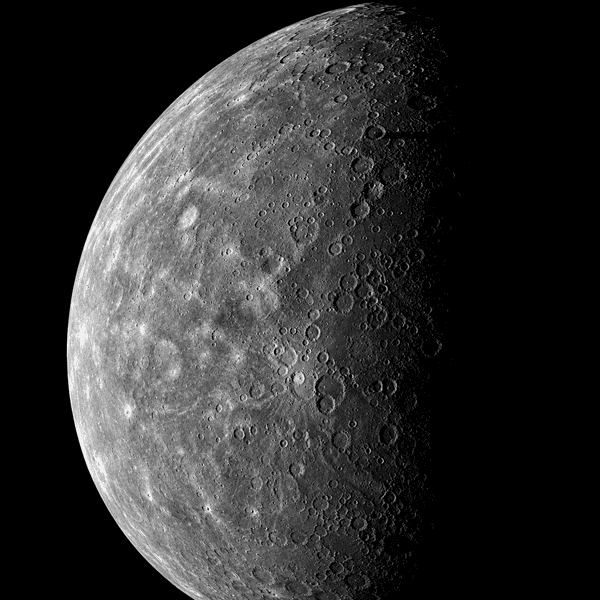
Mercury has a heavily cratered planetary surface that can superficially resemble Earth’s Moon. Ancient impacts produced enormous basins such as Caloris, while numerous smaller impact craters preserve a long geological record. Mercury also possesses long cliffs and scarps that formed as the planet’s interior cooled and the world contracted.
Unlike the Moon, however, Mercury contains a disproportionately large metallic core and maintains a global magnetic field. Its surface is continually exposed to micrometeoroids and solar-wind particles because Mercury lacks a substantial protective atmosphere. NASA describes its gaseous envelope more accurately as a thin exosphere containing elements such as oxygen, sodium, hydrogen, helium, and potassium. [6]
Mercury’s Extreme Temperature Changes
Being nearest to the Sun does not make Mercury the hottest planet overall, but its sunlit surface can reach roughly 430°C, while nighttime temperatures can plunge to around -180°C. [6] This extraordinary temperature range is possible because Mercury lacks the dense atmosphere required to efficiently transport and retain heat.
Its proximity to the Sun exposes it to far more solar radiation than Earth receives. However, atmospheric properties matter so much that Venus, despite orbiting farther from the Sun, maintains a much higher average surface temperature. Mercury therefore provides one of the clearest demonstrations that planetary temperature cannot be predicted from orbital distance alone.
Mercury’s Day and Year
Mercury presents an excellent example of why the word “day” needs careful definition. Its sidereal rotation period, the time required to rotate once relative to the distant stars, is about 58.6 Earth days. Its year lasts only about 88 Earth days.
However, Mercury is locked in a 3:2 spin-orbit resonance, completing three rotations for every two revolutions around the Sun. Because orbital motion and rotation combine in an unusual way, one complete solar day, sunrise to sunrise, lasts roughly 176 Earth days. A single Mercury solar day is therefore about twice as long as a Mercury year. [6]
Exploring Mercury
NASA’s Mariner 10 became the first spacecraft to explore Mercury, making three flybys in 1974 and 1975. It was also the first spacecraft to use a planetary gravity assist to reach another planetary target. Decades later, NASA’s MESSENGER became the first spacecraft to orbit Mercury and operated from 2011 until 2015, mapping the planet and helping confirm water-ice-rich polar deposits. [17]
Mercury exploration continues with the ESA-JAXA BepiColombo mission. NASA’s current mission summary states that the spacecraft is scheduled to enter Mercury orbit in November 2026 after multiple planetary flybys. Mercury remains challenging to reach because a spacecraft traveling inward must lose substantial orbital energy to enter orbit around the planet.
Venus: Second Planet From the Sun
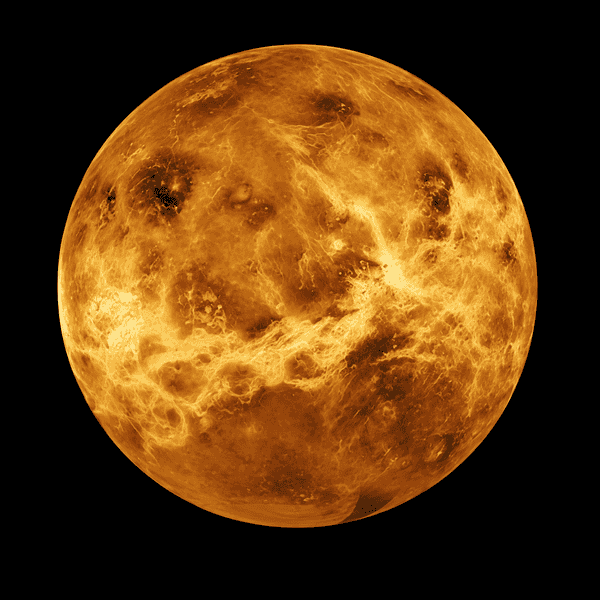
Venus is the second planet from the Sun and the closest planetary neighbor to Earth in terms of broad planetary properties. It is approximately 12,104 kilometers in diameter and has a mass about 81.5 percent of Earth’s. Those similarities inspired the nickname Earth’s twin, but modern spacecraft revealed a profoundly different environment. Venus possesses a crushing carbon-dioxide atmosphere, sulfuric-acid clouds, widespread volcanic terrain, retrograde rotation, and the highest surface temperature of any planet. [7]
Why Venus Is Called Earth’s Twin
Venus earns the Earth’s Twin nickname primarily because the two planets have similar diameter, mass, density, bulk rocky composition, and surface gravity. Venus is about 95 percent of Earth’s diameter, making it much closer in size to Earth than any other planet.
The similarities are scientifically important because they create a natural planetary experiment. Two rocky worlds of comparable size formed in neighboring regions of the same planetary system, yet evolved toward radically different climates. Studying Venus therefore helps researchers investigate atmospheric evolution, greenhouse processes, water loss, volcanic activity, and why superficially similar terrestrial planets can follow completely different environmental paths.
Venus as the Morning Star and Evening Star
Venus is one of the brightest natural objects visible from Earth and has traditionally been described as the Morning Star or Evening Star. These names do not mean Venus is a star. They describe when and where the planet appears in Earth’s sky.
Because Venus orbits closer to the Sun than Earth does, it never appears extremely far from the Sun in our sky. Depending on the relative positions of Earth, Venus, and the Sun, Venus becomes conspicuous shortly before sunrise or shortly after sunset. Ancient civilizations sometimes interpreted the two appearances as separate objects before recognizing that both were the same wandering planet. [7]
Why Venus Is the Hottest Planet
Venus has the hottest surface of any planet, with typical temperatures around 465°C to 470°C. Its atmosphere consists primarily of carbon dioxide, and the planet is covered by clouds containing sulfuric acid. Surface pressure is roughly 90 times Earth’s sea-level pressure. [7]
The reason Venus is hotter than Mercury is the runaway greenhouse effect. Solar energy reaches the surface and atmosphere, while the dense carbon-dioxide envelope strongly restricts the escape of thermal infrared energy. Heat accumulates until the planet reaches an extreme equilibrium temperature. Venus demonstrates why atmospheric composition can outweigh simple distance from the Sun when determining planetary temperature.
Venus’s Backward Rotation
Most planets rotate in the same general direction in which they orbit the Sun. Venus is one of the major exceptions. Its rotation is retrograde, meaning it spins in the opposite direction from most planets. A sidereal rotation takes approximately 243 Earth days, longer than Venus’s 225-day year.
Because of this reversed rotation, an observer able to survive on the surface would see the Sun generally rise in the west and set in the east. Interestingly, the Venusian solar day is about 117 Earth days because rotation and orbital motion interact. Scientists continue investigating how Venus acquired its unusual spin state, with tidal evolution and ancient collisions among the possibilities.
Earth: Third Planet From the Sun
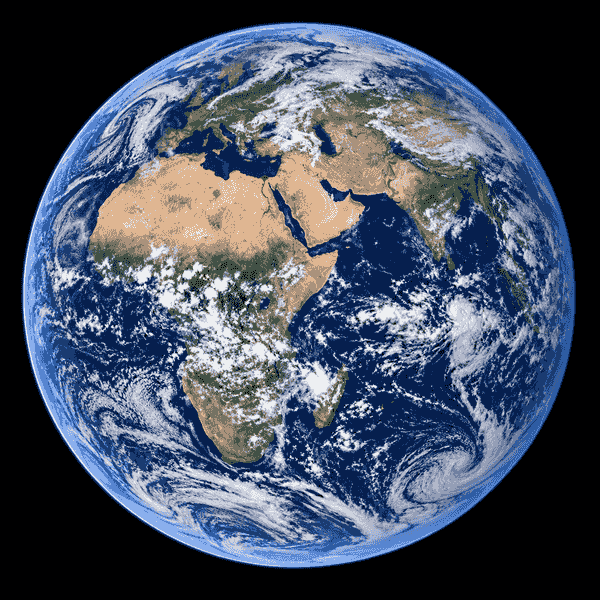
Earth is the third planet from the Sun, the largest terrestrial planet, and the only world currently known to support life. It combines stable surface liquid water, an oxygen-rich atmosphere, active geology, a protective magnetic field, and a favorable long-term climate environment. Earth should not be treated as an ordinary reference planet simply because we live here. In comparative planetary science, its oceans, biosphere, plate tectonics, large Moon, and atmospheric evolution make it a remarkably complex world. [8]
Earth at 1 Astronomical Unit
Earth orbits the Sun at approximately 1 astronomical unit, making it the practical reference point for comparing Solar System distances. The modern astronomical unit itself is defined exactly as 149,597,870,700 meters, while Earth’s actual Sun distance varies because its orbit is slightly elliptical. [3]
Earth completes a sidereal orbit in about 365.256 days and rotates relative to distant stars in roughly 23 hours 56 minutes. The familiar 24-hour solar day results from the additional rotation required as Earth advances along its orbit. These closely related but distinct measurements illustrate why orbital and rotational terminology requires precise definitions.
Earth and the Habitable Zone
Earth orbits within the Sun’s habitable zone, sometimes called the Goldilocks Zone, where incoming stellar energy can permit liquid water on the surface under appropriate atmospheric conditions. The concept does not mean every planet in a habitable zone must support life. Atmospheric composition, planetary mass, geological cycling, magnetic environment, water inventory, orbital stability, and stellar behavior also matter.
NASA describes the habitable zone primarily as the region around a star where surface liquid water could potentially exist. Earth provides the only confirmed example of a life-bearing planet, so liquid water remains a central criterion when scientists evaluate potentially habitable worlds around other stars. [18]
Earth’s Atmosphere and Surface
Roughly 71 percent of Earth’s surface is covered by water, while the remaining portion includes continents and islands. Earth’s atmosphere near the surface consists of approximately 78 percent nitrogen, 21 percent oxygen, and smaller amounts of argon, carbon dioxide, water vapor, and other gases. [8]
This atmosphere affects weather and climate, filters part of the Sun’s harmful radiation, and causes many incoming meteoroids to burn before reaching the surface. The oceans redistribute heat and interact continuously with the atmosphere and crust. Unlike the static appearance of many cratered worlds, Earth’s visible surface is repeatedly reshaped by plate tectonics, erosion, sedimentation, volcanism, ice, weather, oceans, and biological processes.
Earth’s Magnetic Protection
Earth possesses a strong planetary magnetic field generated largely by motion within its electrically conducting liquid outer core. The region dominated by this field is called the magnetosphere. Solar wind distorts the magnetosphere into an extended shape, compressing it on the Sun-facing side and stretching it into a long magnetotail on the night side.
The magnetosphere does not create an impenetrable shield, but it strongly influences how charged solar particles interact with Earth’s atmosphere. Some particles become guided toward polar regions, where collisions with atmospheric molecules generate auroras. Earth’s magnetic environment is therefore an important part of the coupled Sun-Earth system. [8]
Why Earth Has Seasons
Earth’s seasons are caused primarily by its axial tilt, not by large annual changes in distance from the Sun. Earth’s rotational axis is tilted approximately 23.4 degrees relative to its orbital plane. During part of the year, the Northern Hemisphere tilts toward the Sun, receiving more direct sunlight and longer daylight hours, while the Southern Hemisphere tilts away. Roughly six months later, the geometry reverses.
The axial tilt changes both solar intensity and day length with latitude. This is why summer and winter occur at opposite times in the two hemispheres and why seasonal differences become more pronounced toward the poles. [8]
Earth’s Moon
Earth has one large natural satellite, the Moon. Compared with Earth, the Moon is unusually substantial relative to its parent planet and plays important roles in tides and the long-term dynamical behavior of the Earth-Moon system.
Gravitational interactions between Earth and the Moon generate much of Earth’s ocean tidal cycle and gradually transfer angular momentum between the bodies. The Moon also helps moderate changes in Earth’s axial orientation over long timescales, contributing to climatic stability. Its cratered surface preserves a record of early Solar System impacts that Earth’s active geology has largely erased. The Moon therefore serves simultaneously as Earth’s companion and an archive of planetary history.
Mars: Fourth Planet From the Sun
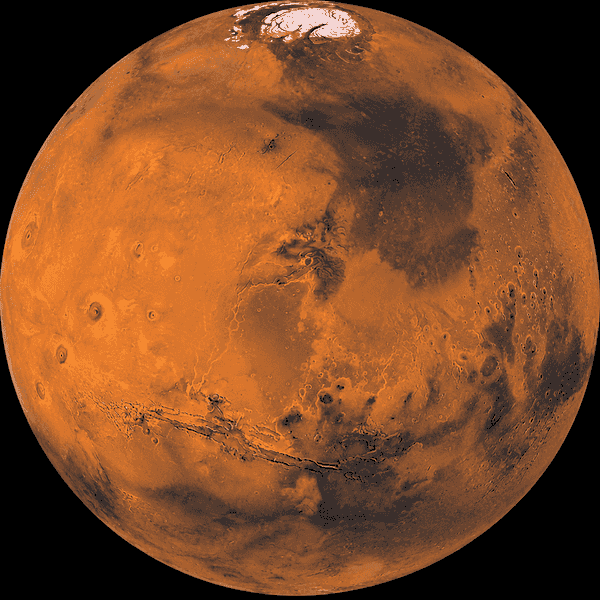
Mars is the fourth planet from the Sun and the outermost terrestrial planet. Its red surface, enormous volcanoes, immense canyon systems, polar ice, ancient river valleys, sedimentary deposits, and accessible geology have made it one of the most intensely explored worlds beyond Earth. Today Mars is cold, dry, and covered by a thin carbon-dioxide atmosphere, but multiple lines of evidence indicate that ancient Mars experienced environments in which liquid water was much more important. [9]
Why Mars Is Called the Red Planet
Mars is known as the Red Planet because iron-bearing minerals in its surface materials have oxidized, producing compounds similar to rust. These iron oxides give much of the Martian soil and dust its characteristic reddish or orange appearance.
Fine dust is readily transported by winds and can become suspended in the atmosphere during regional or planet-wide dust events, reinforcing Mars’s reddish visual character even when seen through a telescope. The coloration does not mean every Martian rock is bright red. Spacecraft images reveal gray, brown, tan, black, and other tones once dust and image processing are considered. The familiar red appearance is a planetary-scale consequence of oxidized surface material. [9]
Mars’s Surface
Mars has one of the Solar System’s most diverse planetary surfaces. Olympus Mons is the largest known volcano in the Solar System, rising far above the surrounding plains. Valles Marineris forms an enormous interconnected canyon system extending thousands of kilometers.
Mars also has polar caps, impact craters, lava plains, dunes, layered deposits, dried channels, deltas, and minerals associated with past interaction with water. Orbital imagery and rover observations show that rivers, lakes, groundwater, and possibly large bodies of water played important roles in ancient Martian geology. These features transformed Mars from a seemingly dead desert into a central target for reconstructing planetary climate history.
Mars’s Atmosphere and Temperature
Mars has a thin atmosphere dominated by carbon dioxide, with surface pressure far below Earth’s. The limited atmospheric mass makes it difficult for the planet to retain heat efficiently, producing large temperature variations between locations, seasons, and times of day.
Mars’s average distance of about 1.52 au also means it receives less solar energy than Earth. Its thin atmosphere can support winds and dramatic dust storms, but the low density means those winds exert much less force than an equivalent-speed wind on Earth. Present-day surface conditions generally prevent stable liquid water from persisting for long periods, although water ice is abundant in polar and subsurface reservoirs.
Could Mars Have Supported Life?
Mars is a major astrobiology target because ancient environments appear to have been significantly wetter and potentially more habitable than today’s surface. Evidence of old lake basins, river channels, hydrated minerals, sedimentary rocks, and long-lived groundwater systems demonstrates that liquid water once interacted extensively with the Martian surface.
Habitability, however, does not prove life existed. Scientists distinguish carefully between finding environments capable of supporting life and finding actual biological evidence. Current missions therefore investigate ancient sediments, organic chemistry, subsurface ice, atmospheric evolution, and possible biosignatures. Mars may ultimately reveal whether habitable conditions commonly produce life or whether Earth’s biological history was unusually difficult to reproduce.
Mars Exploration
Mars has been investigated through planetary exploration more extensively than any planet except Earth. Missions have included flybys, orbiters, stationary landers, and mobile rovers. Mariner 4 returned the first close-up images of Mars in 1965. Viking 1 and 2 conducted pioneering surface investigations in the 1970s.
Later missions dramatically expanded the scientific picture. NASA’s Spirit and Opportunity explored Martian geology, Curiosity investigates ancient habitable environments in Gale Crater, and Perseverance studies Jezero Crater while caching scientifically valuable samples. Orbiters continuously map minerals, ice, topography, atmospheric conditions, and potential landing sites. Mars exploration increasingly combines geology, climate science, geophysics, and astrobiology.
Jupiter: Fifth Planet From the Sun
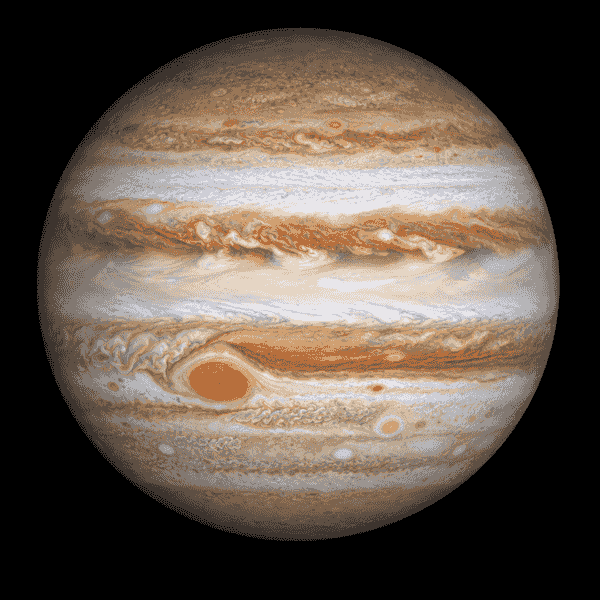
Jupiter is the fifth planet from the Sun and by far the largest planet in the Solar System. It contains more mass than all the other planets combined, excluding the Sun, and possesses an enormous magnetic environment, powerful atmospheric circulation, a faint ring system, and more than one hundred recognized moons. Jupiter’s scale makes it not simply a large version of Earth but a fundamentally different type of planetary object whose deep interior is dominated by hydrogen under extreme pressure. [10]
The Largest Planet
Jupiter has an equatorial diameter of approximately 142,984 kilometers, more than eleven times Earth’s diameter. Its mass is roughly 318 times Earth’s, yet its density is far lower because its composition is dominated by light elements. [2]
Jupiter’s powerful gravity shapes its enormous satellite system and influences smaller bodies throughout the Solar System. Surface gravity is more complicated to define for a gas giant because there is no solid surface. Values are conventionally specified at a reference atmospheric pressure level. Jupiter’s rapid rotation also produces noticeable equatorial bulging, so its equatorial diameter is significantly larger than its polar diameter.
What Is Jupiter Made Of?
Jupiter is composed predominantly of hydrogen and helium, with smaller quantities of heavier elements and compounds. Moving downward through the atmosphere, pressure rises until hydrogen behaves in increasingly unfamiliar ways. At extreme depths, hydrogen is thought to become electrically conductive metallic hydrogen, an important component in models of Jupiter’s magnetic field.
A dense central region enriched in heavier material probably exists, although modern models suggest Jupiter’s core may be diffuse rather than a simple sharply bounded rocky sphere. The planet therefore lacks a conventional solid surface. A descending spacecraft would instead encounter progressively greater pressure, temperature, and density until survival became impossible.
Jupiter’s Great Red Spot
The Great Red Spot is a gigantic long-lived atmospheric storm in Jupiter’s southern hemisphere. It is an anticyclonic vortex embedded in the planet’s powerful banded atmospheric circulation and has been observed for centuries in various forms.
The storm changes in size, shape, color, and internal behavior over time. Modern observations show it is smaller than it was during some historical measurements, reminding us that even extremely persistent planetary weather systems evolve. Jupiter also contains smaller storms, turbulent cloud boundaries, lightning, jet streams, and large-scale vortices. Its visible atmosphere is therefore a continuously changing fluid-dynamics laboratory rather than a fixed striped surface.
Jupiter’s Rapid Rotation
Jupiter has the shortest day of any planet, completing a rotation in roughly 9.9 hours. [10] Rotating such an enormous body so quickly has major physical consequences. Centrifugal effects contribute to a pronounced equatorial bulge, while the rotation strongly organizes atmospheric circulation into alternating east-west jet streams and cloud bands.
Because Jupiter does not have a rigid solid surface, different atmospheric latitudes can rotate at somewhat different rates. Scientists therefore use magnetic-field and radio measurements to help define a deeper rotation rate. Jupiter illustrates why “rotation period” for a fluid giant can be more technically complicated than measuring the spin of a rocky planetary crust.
Jupiter’s Moons
As of August 2026, Jupiter has 115 moons officially recognized by the International Astronomical Union. [20] The four largest are Io, Europa, Ganymede, and Callisto, discovered by Galileo Galilei in 1610 and collectively known as the Galilean moons.
Each is a major planetary-science target. Io is extraordinarily volcanically active. Europa appears to contain a global ocean beneath an icy shell and is an important astrobiology target. Ganymede is the Solar System’s largest moon and even possesses its own intrinsic magnetic field. Callisto preserves one of the most heavily cratered ancient surfaces known. Together, these moons make Jupiter resemble a miniature planetary system.
Jupiter’s Faint Rings
Jupiter possesses a ring system, although it is dramatically less conspicuous than Saturn’s. The rings consist largely of small dust particles, many of which are supplied by impacts on Jupiter’s small inner moons.
The existence of Jupiter’s rings helps correct a common misconception that Saturn is the only ringed planet. In fact, all four giant planets have rings. What makes Saturn unusual is the size, brightness, high ice content, and extraordinary structure of its ring system. Jupiter’s rings are much darker and fainter and generally require spacecraft observations or specialized astronomical techniques to study effectively.
Saturn: Sixth Planet From the Sun
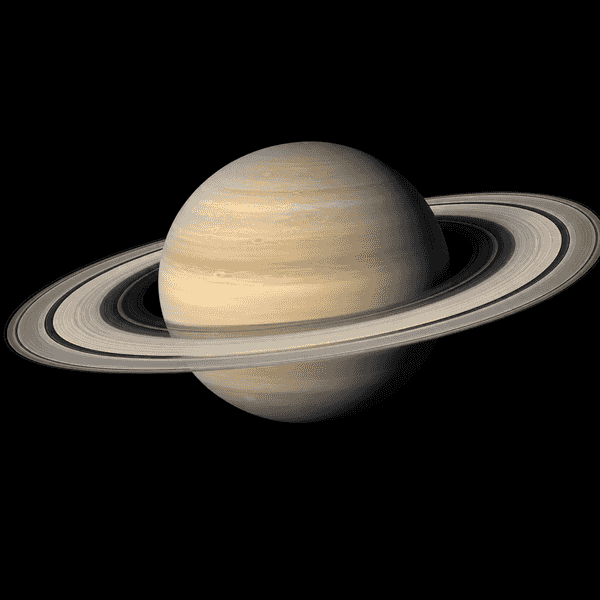
Saturn is the sixth planet from the Sun and the second-largest planet. Although best known for its spectacular rings, Saturn is an extraordinarily complex planetary system containing hundreds of confirmed moons, a deep hydrogen-helium interior, unusual atmospheric structures, a strong magnetosphere, and scientifically important satellites such as Titan and Enceladus. Its average orbital distance is about 9.5 au, nearly twice Jupiter’s distance from the Sun. [11]
Why Saturn Is the Ringed Planet
Saturn’s rings are composed of an immense number of particles ranging from tiny grains to much larger chunks, with water ice forming a major component alongside rocky and dusty material. They are organized into multiple major rings, narrow ringlets, divisions, gaps, waves, and gravitational structures.
The rings may look like solid disks from a distance, but they consist of countless individual objects traveling in orbit around Saturn. Gravitational interactions with Saturn’s moons sculpt many ring features. Some moons create gaps, waves, or sharp ring edges, while small embedded objects can disturb nearby particles. The ring system therefore provides an extraordinary natural laboratory for studying orbital dynamics.
Saturn’s Size and Composition
Saturn has an equatorial diameter of about 120,536 kilometers, making it roughly 9.5 times Earth’s diameter. Its mass is around 95 times Earth’s, considerably below Jupiter despite Saturn’s enormous size. [2]
Like Jupiter, Saturn is dominated by hydrogen and helium. Its average density is only about 687 kilograms per cubic meter, the lowest of any planet. Deep within Saturn, pressure compresses hydrogen into dense fluid states and eventually metallic hydrogen. Saturn also emits more energy than it receives from sunlight, indicating that internal heat remains an important part of its atmospheric and thermal behavior.
Saturn’s Moons
NASA listed 293 confirmed moons orbiting Saturn as of August 2026, giving it the largest currently confirmed planetary moon system. [20] The population includes tiny irregular bodies as well as enormous Titan, which is larger than Mercury.
Titan has a dense nitrogen-rich atmosphere and stable surface lakes and seas of liquid methane and ethane. Enceladus is much smaller but ejects plumes containing water vapor, ice, salts, and organic compounds from a global subsurface ocean. Other notable moons include Rhea, Dione, Tethys, Iapetus, Mimas, and Hyperion. The diversity of these satellites makes the Saturn system central to comparative planetary science and astrobiology.
Saturn’s Seasons
Saturn’s rotational axis is tilted by approximately 26.7 degrees, similar enough to Earth’s tilt that Saturn experiences a recognizable seasonal cycle. The difference is duration. Because Saturn requires approximately 29.5 Earth years to orbit the Sun, each astronomical season lasts more than seven Earth years on average.
Seasonal changes alter atmospheric circulation, cloud structures, temperatures, and illumination of the rings. From Earth, Saturn’s changing orbital geometry also causes the rings to appear at different opening angles. Near ring-plane crossings they can look extraordinarily thin because the main rings are broad but vertically narrow compared with their enormous radial extent.
Exploring Saturn
NASA’s Cassini-Huygens mission revolutionized knowledge of Saturn after entering orbit in 2004. Cassini spent more than thirteen years investigating the planet, rings, magnetosphere, and moons. The European Huygens probe descended through Titan’s atmosphere and landed on its surface in 2005.
Cassini discovered extraordinary evidence about Enceladus, including active plumes linked to a subsurface global ocean. It also observed Titan’s hydrocarbon weather cycle and studied Saturn’s rings at extremely high resolution. The mission ended in 2017 with a deliberate plunge into Saturn, protecting potentially habitable moons from accidental spacecraft contamination. Its scientific data continue to generate discoveries.
Uranus: Seventh Planet From the Sun
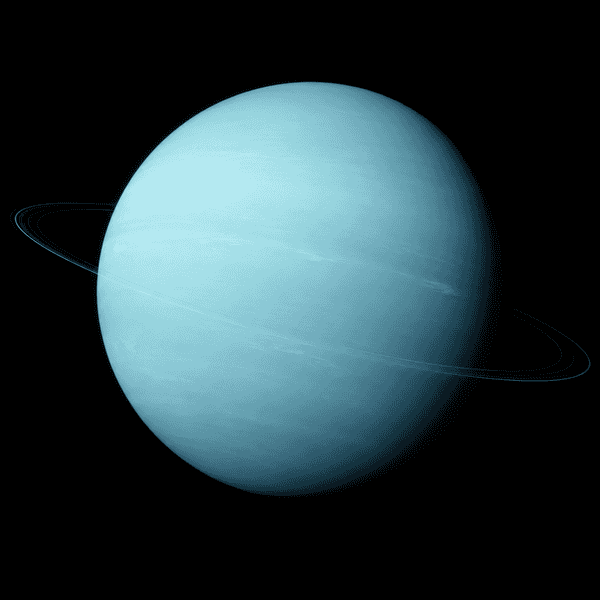
Uranus is the seventh planet from the Sun and the first planet discovered with a telescope rather than being known since antiquity. It is an ice giant approximately four times Earth’s diameter, surrounded by faint rings and a growing inventory of known moons. Uranus is especially famous for its extreme axial tilt, which causes the planet to rotate almost on its side and produces one of the most unusual seasonal cycles in the Solar System. [12]
Why Uranus Rotates on Its Side
Uranus has an axial tilt of approximately 97.8 degrees. Instead of spinning with its rotational axis roughly perpendicular to its orbital plane, Uranus effectively rolls around the Sun on its side. [12]
One widely discussed explanation is that a major collision or series of collisions during early planetary formation altered its orientation, although the planet’s exact evolutionary history remains an active research question. Because its tilt exceeds 90 degrees under the standard convention, Uranus is often described as having retrograde rotation. The sideways geometry affects atmospheric circulation, magnetic-field orientation, sunlight distribution, and seasonal illumination across the entire Uranian system.
Uranus as an Ice Giant
Uranus is classified as an ice giant, separating it compositionally from Jupiter and Saturn. Its outer atmosphere contains mostly hydrogen and helium with a smaller amount of methane. Deeper layers are thought to contain a much greater fraction of water, ammonia, methane, and heavier materials.
Methane absorbs red wavelengths of visible light and contributes to Uranus’s pale blue-green color. However, atmospheric aerosols and haze also influence how the planet looks. Uranus is less massive than Neptune despite being slightly larger in diameter, making Neptune the denser of the two ice giants. Understanding their interiors is important for exoplanet science because Neptune-sized worlds are common around other stars.
Uranus’s Rings and Moons
Uranus is encircled by 13 known rings and, as of August 2026, NASA lists 29 known moons. [12][20] Five relatively large moons dominate traditional descriptions of the system: Miranda, Ariel, Umbriel, Titania, and Oberon.
These moons are named primarily after characters from the works of William Shakespeare and Alexander Pope rather than figures from classical mythology. Their surfaces display craters, faults, canyons, and evidence of complex geological histories. Miranda is especially striking because Voyager 2 imagery revealed enormous fault scarps and dramatically different terrain units. Uranus’s small distant moons continue to be an active area of observational discovery.
Uranus’s Extraordinary Seasons
Uranus takes roughly 84 Earth years to complete one orbit. Combined with its extreme axial tilt, this creates an extraordinary seasonal geometry. Around the solstices, one pole points broadly toward the Sun while the opposite hemisphere experiences prolonged darkness.
A quarter of a Uranian year lasts about 21 Earth years, so seasonal changes occur on timescales far longer than human weather cycles. Near equinox, sunlight falls more directly around the equatorial region and the Sun illuminates both hemispheres more evenly. Astronomers have observed changing atmospheric activity as Uranus progresses through its seasons, showing that even this distant, apparently featureless world has dynamic weather.
Exploring Uranus
Voyager 2 remains the only spacecraft to have visited Uranus at close range. It passed the planet in January 1986, returning detailed observations of the atmosphere, magnetic environment, rings, and moons. Voyager discovered previously unknown satellites and rings while revealing the unusual orientation of Uranus’s magnetic field. [22]
Modern telescopes, particularly large ground-based observatories, Hubble, and the James Webb Space Telescope, continue to investigate the Uranian system from afar. However, the lack of a dedicated orbiter means fundamental questions about Uranus’s interior, atmospheric dynamics, satellite oceans, magnetic field, and formation history remain unresolved.
Neptune: Eighth and Farthest Planet From the Sun
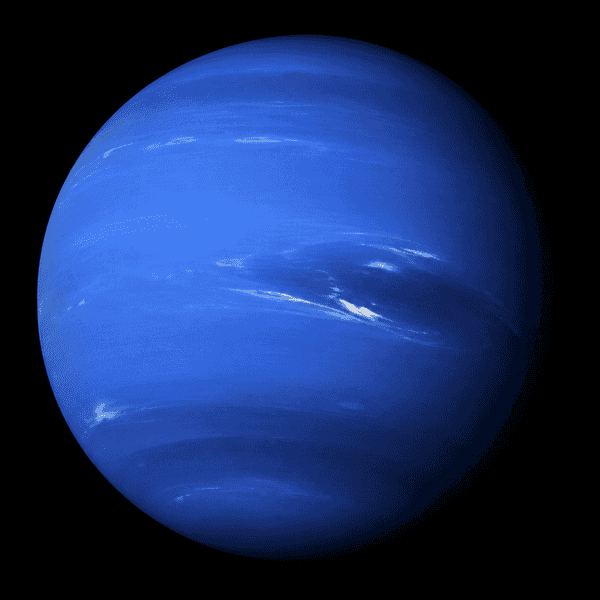
Neptune is the eighth and farthest recognized planet from the Sun, orbiting at an average distance of approximately 30 au. It is an ice giant slightly smaller in diameter than Uranus but more massive, making Neptune substantially denser. Despite receiving very little sunlight, Neptune possesses one of the Solar System’s most active atmospheres, including enormous storms and the fastest measured planetary winds. [13]
How Far Is Neptune From the Sun?
Neptune’s average orbital distance is roughly 4.5 billion kilometers, or about 30.1 au. Sunlight takes about four hours to travel from the Sun to Neptune, compared with a little over eight minutes to reach Earth. [13]
Neptune’s orbital period is almost 165 Earth years. Since the planet was discovered in 1846, it completed its first full orbit after discovery only in 2011. The enormous length of a Neptunian year means each season lasts more than forty Earth years. Neptune vividly demonstrates how orbital periods rise as planetary distance increases, in accordance with Kepler’s third law.
Why Neptune Is Blue
Methane in Neptune’s atmosphere absorbs red wavelengths and contributes to the planet’s blue-green appearance. Its atmosphere consists mostly of hydrogen and helium, with methane forming a smaller but optically significant component. [13]
However, the familiar intensely deep-blue Voyager images should not be interpreted as a completely literal view. NASA notes that Voyager-era images were processed to emphasize clouds and atmospheric features. Reprocessed observations indicate that Uranus and Neptune are more similar in visible color than many textbook illustrations suggest. Methane remains part of the explanation, but haze particles, clouds, atmospheric chemistry, and image processing must all be considered.
Neptune’s Extreme Weather
Neptune is the windiest planet known in the Solar System. NASA reports winds exceeding approximately 2,000 kilometers per hour in parts of its atmosphere. [13] This is remarkable because Neptune receives only a tiny fraction of the solar energy available at Earth.
Internal heat is therefore an important contributor to Neptune’s active atmosphere. Voyager 2 observed a massive storm called the Great Dark Spot, but later observations showed that the particular storm had disappeared. Other dark storms have subsequently formed, demonstrating that Neptune’s weather is dynamic. High-altitude methane-ice clouds, jet streams, vortices, and powerful winds make the distant planet meteorologically active rather than frozen and static.
Neptune’s Moons
Neptune has 16 known moons. [20] The dominant satellite is Triton, which follows a retrograde orbit around Neptune. Its backward orbital direction strongly suggests it did not form as an ordinary moon alongside Neptune but was captured from the outer Solar System.
Triton is one of the most remarkable icy worlds known. Voyager 2 observed nitrogen-rich surface frost and active geyser-like plumes. Other Neptunian moons include Nereid, Proteus, Larissa, Galatea, Despina, and several small irregular satellites. Triton’s capture may also have radically reorganized or destroyed an earlier Neptunian satellite system, although the detailed history remains the subject of dynamical research.
Neptune’s Discovery
Neptune occupies a unique place in scientific history because its existence was successfully predicted through mathematics before it was identified telescopically as a planet. Astronomers noticed that Uranus did not move exactly as expected under the gravitational influence of known bodies.
Calculations by Urbain Le Verrier, along with independent work by John Couch Adams, indicated where an additional distant planet could be located. Johann Gottfried Galle and Heinrich d’Arrest observed Neptune near the predicted position in September 1846. The discovery became a dramatic demonstration of Newtonian gravitational theory and showed that an unseen celestial body could be inferred from its gravitational influence. [13]
Planet Size, Mass, Gravity, and Composition Compared
Planetary size alone does not tell the whole story. Mass, density, composition, radius, rotation, and internal structure combine to determine how a world behaves. Jupiter has by far the largest diameter and mass. Mercury is the smallest major planet. Earth is the densest planet, while Saturn has the lowest mean density.
| Planet | Diameter | Mass vs. Earth | Gravity vs. Earth* | Mean Density | Main Composition |
|---|---|---|---|---|---|
| Mercury | 4,879 km | 0.055 | 0.38 g | 5,429 kg/m³ | Rock, metal |
| Venus | 12,104 km | 0.815 | 0.91 g | 5,243 kg/m³ | Rock, metal |
| Earth | 12,756 km | 1.000 | 1.00 g | 5,514 kg/m³ | Rock, metal |
| Mars | 6,792 km | 0.107 | 0.38 g | 3,934 kg/m³ | Rock, metal |
| Jupiter | 142,984 km | 317.8 | ~2.36 g | 1,326 kg/m³ | H, He dominated |
| Saturn | 120,536 km | 95.2 | ~0.92 g | 687 kg/m³ | H, He dominated |
| Uranus | 51,118 km | 14.5 | ~0.89 g | 1,270 kg/m³ | H, He, icy/volatile interior |
| Neptune | 49,528 km | 17.1 | ~1.12 g | 1,638 kg/m³ | H, He, icy/volatile interior |
*For giant planets, “surface gravity” is defined at a reference atmospheric pressure because they do not have a solid surface comparable with Earth. [2]
Which Planet Is the Biggest?
Jupiter is the biggest planet in the Solar System. Its equatorial diameter is approximately 142,984 kilometers, making it more than eleven times wider than Earth. In three-dimensional volume the difference becomes much more dramatic, since volume increases with the cube of radius.
Jupiter’s mass is roughly 318 Earth masses. Nevertheless, Jupiter is nowhere near massive enough to function as a star. Even very large gas giants occupy a completely different mass regime from hydrogen-fusing stars. Jupiter’s enormous scale instead creates a deep gravitational well, powerful magnetic environment, numerous moons, rapid rotation, intense atmospheric weather, and complex interactions with small Solar System bodies.
Which Planet Is the Smallest?
Mercury is the smallest of the eight planets, with a diameter of about 4,879 kilometers. It is smaller than two natural satellites, Jupiter’s Ganymede and Saturn’s Titan, although Mercury is substantially more massive because of its very high density and large metallic core.
This comparison demonstrates why the terms planet and moon do not describe size alone. A body’s classification depends in part on what it orbits. Ganymede can be larger than Mercury while remaining a natural satellite because it orbits Jupiter. Mercury directly orbits the Sun and satisfies the IAU criteria for a planet.
Planetary Diameter vs. Planetary Mass
Diameter measures how wide a planet is. Mass measures how much matter it contains. Although larger objects generally tend to contain more material, diameter and mass are not interchangeable because density varies dramatically.
Saturn provides a useful example. Its diameter is about 9.5 times Earth’s, but its mean density is only about one eighth of Earth’s. Neptune is smaller than Uranus by diameter but more massive, which makes Neptune substantially denser. Similarly, Mercury is small but unusually dense because a large portion of its interior is metallic. Comparisons of planetary structure therefore require diameter, mass, and density together.
How Planetary Gravity Differs
Surface gravity depends primarily on a planet’s mass and radius. Increasing mass generally strengthens gravity, while increasing the distance from the planet’s center weakens the gravitational acceleration experienced at a particular level.
This creates results that can initially seem surprising. Saturn has roughly 95 times Earth’s mass, yet its reference-level gravitational acceleration is close to Earth’s because Saturn is enormously larger in radius. Jupiter’s gravity at the conventional atmospheric reference level is a little more than twice Earth’s despite having hundreds of Earth masses. Density, rotational effects, and oblateness also affect precise gravitational measurements.
Comparing Planetary Composition
The planets fall naturally into three broad compositional groups. Mercury, Venus, Earth, and Mars are rocky terrestrial worlds with silicate mantles and substantial metallic components. Jupiter and Saturn are gas giants, dominated by hydrogen and helium.
Uranus and Neptune are ice giants. They also have hydrogen-helium atmospheres, but models indicate larger proportions of heavier volatile-forming compounds such as water, methane, and ammonia in their interiors. The arrangement is closely connected to Solar System formation. Temperature differences in the early protoplanetary disk influenced which materials could condense and accumulate at different distances from the young Sun.
Planet Atmospheres, Surfaces, and Temperatures
Planetary atmospheres illustrate how dramatically worlds can evolve despite forming around the same star. Mercury is almost airless. Venus possesses a dense carbon-dioxide atmosphere. Earth supports a nitrogen-oxygen atmosphere strongly influenced by life. Mars retains a thin carbon-dioxide envelope. Jupiter and Saturn have hydrogen-helium atmospheres, while methane contributes visibly to the atmospheres of Uranus and Neptune.
Atmospheres also determine whether talking about a “surface” is straightforward. The four terrestrial planets have solid crusts. Giant planets transition gradually from atmosphere into high-pressure fluid interiors.
Planetary Atmosphere Comparison
Mercury possesses only a tenuous exosphere. Venus has an extremely dense atmosphere dominated by carbon dioxide. Earth’s lower atmosphere contains about 78 percent nitrogen and 21 percent oxygen. Mars has a thin carbon-dioxide atmosphere.
Jupiter and Saturn are dominated by hydrogen and helium, with clouds containing compounds such as ammonia and water at different atmospheric depths. Uranus and Neptune are also hydrogen-helium worlds at the visible atmospheric level but contain methane and have internal compositions enriched in heavier volatile materials. These atmospheric differences control clouds, greenhouse warming, visible color, pressure, chemistry, wind patterns, and the environments encountered by spacecraft.
Planetary Surface Comparison
For terrestrial planets, planetary surface means a solid boundary. Mercury has cratered rock, Venus has volcanic and tectonic terrain beneath its clouds, Earth has oceans and continents, and Mars has dusty basaltic plains, volcanoes, craters, and sedimentary deposits.
For Jupiter, Saturn, Uranus, and Neptune, the word surface is mostly a convenient observational concept. There is no sharp solid exterior where atmosphere suddenly ends and ground begins. Atmospheric gases become progressively denser with depth and eventually merge into high-pressure fluid layers. Scientists therefore define reference pressure levels when quoting quantities such as planetary radius or gravity for giant planets.
What Determines Planetary Temperature?
Distance from the Sun is important, but planetary temperature depends on several interacting factors. Incoming solar energy, atmospheric composition, greenhouse warming, cloud coverage, surface and cloud reflectivity known as albedo, rotation, heat transport, and internal energy all contribute.
Venus demonstrates the importance of atmosphere because it is hotter than Mercury despite being farther from the Sun. Neptune demonstrates the role of internal heat because it remains meteorologically active at about 30 au. A planet with a bright reflective atmosphere can absorb less sunlight than a darker world at a similar distance. Planetary climate therefore emerges from an energy balance rather than distance alone.
How the Planets Orbit the Sun
The eight planets are continuously falling around the Sun under gravity. Without sufficient sideways velocity, they would fall inward. Without the Sun’s gravitational attraction, they would move away along approximately straight paths. An orbit emerges from the combination of inertia and gravitational acceleration.
Planetary motion is therefore not equivalent to simply circling the Sun at a fixed distance and constant speed. Orbital paths are elliptical, speeds vary, orbital planes differ slightly, and gravitational interactions among bodies create additional perturbations.
What Is an Orbit?
An orbit is the gravitationally governed trajectory of one object around another. In the Solar System, each major planet follows a stable elliptical orbit around the Sun. The Sun itself also moves slightly in response to planetary gravity, so more precisely both bodies move around their common center of mass.
For ordinary explanations, describing a planet as orbiting the Sun remains entirely appropriate. The planet continually accelerates toward the Sun because of gravity, but its tangential motion prevents a direct fall inward. The result is sustained orbital motion. Similar principles govern moons around planets, artificial satellites around Earth, and binary stars orbiting a shared barycenter.
Revolution vs. Rotation
Rotation and revolution describe different motions. Rotation is a body’s spin around its own axis. Earth rotates approximately once every 24 hours, producing the day-night cycle.
Revolution describes motion around another body. Earth completes one revolution around the Sun in roughly 365.25 days. The distinction becomes especially important for unusual planets. Venus requires about 243 Earth days for one sidereal rotation but only about 225 days for one revolution. Mercury rotates once every 58.6 Earth days and revolves around the Sun in only 88 days. Keeping the terms separate prevents confusion about planetary days and years.
Orbital Period
The orbital period is the time required for an object to complete one revolution around another body. Mercury’s orbital period is approximately 88 Earth days. Earth’s is about one year. Jupiter’s is almost twelve Earth years, and Neptune’s is nearly 165.
The systematic increase in orbital period with increasing distance is not accidental. Kepler’s third law connects orbital size to orbital period. In simplified form for planets orbiting the Sun, the square of the orbital period is proportional to the cube of the semi-major axis. As a result, moving a planet farther from the Sun increases its year much more rapidly than a simple linear relationship would suggest.
Planetary Year
A planetary year is one complete revolution around the Sun. Every planet therefore has a different year length. Mercury experiences many years during a single Earth year, while a human lifetime covers less than one complete Uranian year for many people and only a fraction of a Neptunian year.
Planetary years affect seasons because a seasonal cycle is tied to orbital position and axial tilt. Mars has Earth-like axial tilt but a 687-Earth-day year, so its seasons are generally longer. Saturn’s nearly 29.5-year orbit produces seasons lasting several Earth years. Neptune’s seasons persist for decades.
Planetary Day
A planetary day can mean different things depending on context. The sidereal rotation period measures one complete spin relative to distant stars. A solar day measures the interval between successive appearances of the Sun at approximately the same local position in the sky.
The two values differ because a planet moves along its orbit while rotating. On Earth the difference is only about four minutes. On Mercury it becomes dramatic because of Mercury’s slow rotation and rapid orbital motion. Mercury’s sidereal rotation is about 58.6 Earth days, but its solar day lasts approximately 176 Earth days.
Orbital Speed
Inner planets generally have greater orbital speed than outer planets. Mercury travels around the Sun at an average of roughly 47 kilometers per second, while Neptune moves at only a small fraction of that speed.
Kepler’s second law adds another layer: even the same planet changes speed during its orbit. A planet travels faster near perihelion, where it is closer to the Sun, and more slowly near aphelion. This variation follows from conservation of angular momentum and is represented geometrically by Kepler’s equal-area law. Planetary orbital speed is therefore linked both to overall orbital size and to position within an individual elliptical orbit. [14]
Kepler’s Laws and Planetary Motion
Johannes Kepler’s laws transformed astronomy by replacing idealized circular planetary paths with a mathematical description that matched observations. The laws were developed before Isaac Newton formulated universal gravitation, but Newton later showed why Kepler’s empirical relationships arise from gravitational physics.
Although modern celestial mechanics includes perturbations, relativity, and complex multi-body effects, Kepler’s laws remain an extraordinarily useful first description of planetary motion. [14]
Kepler’s Laws
Kepler’s three laws of planetary motion describe orbital shape, changing orbital speed, and the relationship between orbital size and period.
The first law states that planetary orbits are ellipses with the Sun at one focus. The second states that a line connecting a planet to the Sun sweeps out equal areas during equal intervals of time. The third relates orbital period to semi-major axis. Together they explain why the Sun-planet distance changes, why orbital speed varies throughout an orbit, and why distant planets take progressively longer to complete a year. [14]
First Law: Law of Ellipses
Kepler’s Law of Ellipses states that each planet travels along an elliptical orbit with the Sun located at one focus rather than at the geometric center. A circle is a special case of an ellipse with zero eccentricity, so nearly circular planetary paths still satisfy the law.
The practical consequence is that the distance between a planet and the Sun varies continuously. The closest point is perihelion and the most distant is aphelion. The size of the orbit is commonly characterized by the semi-major axis, which is why planetary order is based on that stable orbital measurement rather than instantaneous distance.
Elliptical Orbit
An elliptical orbit resembles a stretched circle, although many planetary orbits are only mildly stretched. Mercury has a noticeably larger orbital eccentricity than Venus or Earth, while Pluto’s orbit is considerably more eccentric than those of the major planets.
Orbital ellipses arise naturally from gravitational two-body motion. Depending on total orbital energy, gravity can produce bound elliptical trajectories or unbound parabolic and hyperbolic paths. Planets remain in bound orbits, although interactions with other planets create small deviations from a perfect mathematical ellipse. The ellipse is therefore an approximation, but an extremely useful and accurate one.
Orbital Eccentricity
Orbital eccentricity measures how much an orbit differs from a circle. An eccentricity of zero represents a perfect circle. Increasing values indicate progressively more elongated elliptical paths.
Venus has one of the least eccentric planetary orbits, while Mercury’s eccentricity is substantially greater. Pluto’s orbit is even more elongated, contributing to the large difference between its perihelion and aphelion distances. Eccentricity matters because it influences how much solar energy a body receives at different parts of its orbit, how strongly orbital speed changes, and, in some cases, aspects of long-term climate and seasonal behavior.
Orbital Inclination
Orbital inclination describes the angle between an object’s orbital plane and a chosen reference plane. For Solar System discussions, the ecliptic or a closely related reference plane is commonly used.
The eight planets orbit in relatively similar planes because they formed from the same flattened protoplanetary disk, but their inclinations are not identical. Mercury’s orbit is more noticeably tilted than Earth’s reference plane. Pluto’s inclination is much larger, another reason its orbit visually differs from those of the eight planets. Inclination is essential for calculating encounters, observing geometry, spacecraft trajectories, and the architecture of populations such as asteroids and trans-Neptunian objects.
The Ecliptic
The ecliptic is closely related to the plane of Earth’s orbit around the Sun and provides an important reference for positions and orbital inclinations. From Earth, the Sun appears to travel along the ecliptic against the background stars during the year.
Because the major planets formed in a broadly flattened disk, their orbital paths remain relatively close to this common plane. Consequently, Mercury, Venus, Mars, Jupiter, Saturn, Uranus, and Neptune are generally found near the ecliptic when viewed from Earth. The concentration of planetary orbits in a shared plane is one of the strongest visible clues to the Solar System’s disk-based formation history.
Why the Heliocentric Model Changed Astronomy
The heliocentric model places the planets, including Earth, in orbit around the Sun. It replaced earlier geocentric models in which Earth occupied the central position in the cosmic system. The transition was not merely a rearrangement of objects. It transformed the mathematical interpretation of planetary motion and fundamentally changed humanity’s understanding of Earth’s place in the universe.
Later work by Kepler, Galileo, Newton, and many others turned heliocentrism from a geometric model into a physically grounded description of planetary motion.
From Geocentric to Heliocentric Thinking
In a geocentric model, planets and the Sun were represented as moving around Earth, requiring increasingly complicated geometrical devices to reproduce observed planetary positions. Nicolaus Copernicus revived and developed a mathematically systematic heliocentric model in which Earth became one planet among several orbiting the Sun.
The early Copernican model still used circular assumptions and was not immediately perfect. Kepler’s later elliptical orbits greatly improved predictive accuracy. Telescopic observations by Galileo provided additional evidence incompatible with a simple Earth-centered universe, including the moons of Jupiter and phases of Venus. Heliocentrism became foundational to modern Solar System astronomy.
The Sun as the Center of Planetary Motion
In everyday Solar System language, the planets orbit the Sun because its enormous mass produces the dominant gravitational field. More precisely, a planet and the Sun both orbit their shared barycenter, or center of mass.
For Earth and the much more massive Sun, that barycenter lies close to the Sun’s center. Jupiter is massive enough to shift the Sun-Solar System barycentric relationship much more noticeably. This distinction matters for precision astronomy but does not change the practical conclusion: solar gravity dominates the planetary architecture, keeping Mercury through Neptune in their long-term orbital paths.
How Heliocentrism Makes Planetary Order Understandable
Once Earth is treated as another planet orbiting the Sun, planetary order becomes conceptually simple. Mercury and Venus have smaller orbits than Earth. Mars and the giant planets have progressively larger ones. Orbital periods also follow a systematic progression that Kepler’s laws explain.
The heliocentric model also clarifies retrograde motion. A planet such as Mars does not periodically reverse its physical orbital direction. Instead, its apparent backward motion against the stars results from changing viewing geometry as faster-moving Earth overtakes it. Planetary distances, orbital periods, brightness changes, phases, and apparent motions therefore fit into a unified physical framework.
Moons and Natural Satellites of the Planets
Moons are among the most scientifically diverse worlds in the Solar System. Some are tiny captured objects, while others are larger than planets such as Mercury. They include volcanic worlds, subsurface oceans, dense atmospheres, icy geysers, enormous impact basins, and complicated orbital resonances.
The giant planets host the overwhelming majority of known planetary moons, while the inner Solar System has only three natural satellites distributed among Earth and Mars.
What Is a Natural Satellite?
A natural satellite is a naturally occurring body gravitationally bound in orbit around another body rather than an artificial spacecraft. The Moon is Earth’s natural satellite, while Phobos and Deimos are the natural satellites of Mars.
Natural satellites can also orbit dwarf planets and small bodies. Pluto has five known moons, and even some asteroids possess small companions. The term therefore describes an orbital relationship rather than a specific size, shape, or composition. A natural satellite can be a nearly spherical world like Ganymede or a much smaller irregular object only a few kilometers across.
Is Every Natural Satellite a Moon?
In normal astronomical usage, moon and natural satellite are broadly interchangeable when discussing naturally occurring objects orbiting planets, dwarf planets, or small bodies. “The Moon” with a capital M traditionally refers specifically to Earth’s natural satellite.
The category is extremely diverse. Ganymede has a diameter greater than Mercury’s, Titan possesses a dense atmosphere, Io contains active volcanoes, Europa and Enceladus probably harbor subsurface oceans, and many irregular moons resemble captured asteroids. Calling all of them moons therefore describes their orbital status rather than implying that they resemble Earth’s Moon physically.
Planetary Moons
Mercury and Venus have no natural satellites. Earth has one Moon. Mars has Phobos and Deimos, two small irregular moons. The giant planets have much larger systems.
As of August 2026, NASA lists Jupiter with 115, Saturn with 293, Uranus with 29, and Neptune with 16 recognized or known moons. [20] These totals will continue changing as astronomers discover faint distant satellites and confirmation work proceeds. Moon counts should therefore always be associated with a date rather than treated as permanent constants. The scientific importance of a moon system also depends far more on its architecture and individual worlds than on the raw number.
Why Outer Planets Have Many Moons
Several factors contribute to the large satellite systems of the giant planets. Their enormous masses produce large regions of gravitational influence within which satellites can remain bound. During formation, circumplanetary disks of gas and solids surrounded young giant planets and produced regular satellites.
Giant planets could also capture smaller objects during the chaotic early history of the Solar System. Many distant irregular moons have inclined, elongated, or retrograde orbits consistent with capture followed by dynamical evolution. Collisions can further fragment captured populations. Today’s moon systems therefore preserve information about planetary formation, migration, capture, collision, and long-term gravitational interactions.
Planetary Rings
Planetary rings are not unique to Saturn. Jupiter, Saturn, Uranus, and Neptune all possess ring systems. The differences in brightness, particle composition, optical depth, width, and structure are enormous, however, making Saturn visually dominant.
Rings are dynamic systems. Particles orbit according to the same gravitational principles that control moons and planets, while embedded moons and nearby satellites create gaps, waves, resonances, arcs, and other structures.
Which Planets Have Rings?
All four giant planets have rings. Jupiter’s rings are faint and dusty. Saturn possesses the enormous bright system familiar from photographs. Uranus has a collection of narrow, relatively dark rings. Neptune has several faint rings along with unusual concentrations known as ring arcs.
None of the four terrestrial planets currently possesses a planetary ring system. Ring systems can evolve substantially over time as particles collide, spread, fall into planets, escape, or are replenished by impacts and moon-related processes. Rings therefore should not be assumed to be permanent, unchanging planetary features.
Why Saturn’s Rings Are So Prominent
Saturn’s rings are exceptionally visible because they contain large quantities of reflective water ice and have substantial surface area. Their orientation relative to both the Sun and an observer also changes dramatically as Saturn travels around its orbit.
Jupiter’s dusty rings absorb and scatter light much less conspicuously. Uranus’s rings are narrow and dark. Neptune’s are also faint and include incomplete-looking arcs. Saturn therefore appears unique in ordinary telescopes even though rings are actually a general feature of the giant planets. The contrast offers an excellent reminder that detecting a structure and seeing it easily are not the same thing.
What Are Planetary Rings Made Of?
Planetary ring systems contain combinations of ice particles, dust, rocky fragments, and orbital debris, with the exact mixture varying among planets and between individual rings. Saturn’s bright rings contain abundant water ice, while Jupiter’s faint system contains much more dust.
Ring material may originate from collisions, micrometeoroid impacts that eject material from small moons, tidal disruption, or debris left from the evolution of satellite systems. Ring particles range greatly in size and occupy enormous numbers of independent orbits. Shepherd moons and gravitational resonances can confine or restructure portions of a ring, producing the intricate patterns detected by spacecraft.
The Sun’s Influence on Every Planet
The Sun is far more than a source of daylight. Its mass controls the basic gravitational architecture of the Solar System, while its electromagnetic radiation and continuous outflow of charged particles influence planetary atmospheres, surfaces, magnetic fields, temperatures, weather systems, and space environments.
The intensity of solar energy decreases rapidly with distance, but planets respond differently depending on atmospheric composition, albedo, internal heat, magnetic fields, rotation, and geology.
Gravity
The Sun contains more than 99 percent of the Solar System’s total mass and consequently dominates planetary motion. Its gravity continually accelerates the planets inward while their sideways motion carries them along orbital trajectories.
Solar gravity also controls asteroids, comets, dwarf planets, and distant icy bodies, although planets can strongly perturb smaller objects. Jupiter’s gravity in particular has shaped populations of asteroids and comets. Planetary migration in the early Solar System probably rearranged large numbers of small bodies. The present Solar System is therefore not simply eight isolated planets but an interacting gravitational system dominated by the Sun.
Solar Radiation
Solar radiation is electromagnetic energy emitted by the Sun, spanning wavelengths from radio waves to visible light, ultraviolet radiation, X-rays, and beyond. Visible and infrared energy are central to planetary climate, while ultraviolet and higher-energy radiation can drive atmospheric chemistry and ionization.
The amount of solar energy received per unit area decreases approximately with the square of distance from the Sun. Mars therefore receives much less sunlight than Earth, while Neptune receives only a tiny fraction. Atmospheric and surface properties determine how much incoming energy is reflected, absorbed, redistributed, or eventually radiated back into space.
Solar Energy and Planetary Climate
Incoming solar energy is the primary external energy source for most planetary climates. It drives atmospheric circulation, surface heating, photochemistry, and, on suitable worlds, processes such as evaporation and weather.
The relationship is not simple. Venus traps heat so efficiently that it becomes hotter than Mercury. Earth maintains surface liquid water through a combination of solar input and atmospheric greenhouse warming. Jupiter, Saturn, and especially Neptune also release significant internal energy. Consequently, planetary climate depends on the balance between incoming sunlight, reflected energy, outgoing thermal radiation, atmospheric dynamics, internal heat, and feedback mechanisms.
Solar Wind
The solar wind is a continuous flow of charged particles escaping from the Sun’s outer atmosphere. It travels throughout the Solar System and interacts with planets, moons, comets, atmospheres, and magnetic fields.
A planet without a strong intrinsic magnetic field can still interact with the solar wind through its ionosphere or an induced magnetosphere, as Venus does. At Earth, the intrinsic magnetic field deflects and channels much of the incoming charged-particle flow. Solar storms can intensify these interactions, producing enhanced auroras and space-weather effects. The solar wind therefore connects planetary environments to changing conditions on the Sun.
Magnetospheres
A magnetosphere is the region of space dominated by a body’s magnetic field and its interaction with charged particles. Earth, Mercury, Jupiter, Saturn, Uranus, and Neptune possess intrinsic global magnetic fields of varying strength and geometry.
Jupiter’s magnetosphere is enormous and strongly affected by material supplied by volcanic Io. Uranus and Neptune have unusually tilted and offset magnetic fields. Venus lacks a global internally generated field but develops an induced magnetic environment through interaction between the solar wind and its ionosphere. Magnetospheres influence charged particles, radiation environments, atmospheric loss processes, auroras, and spacecraft operations.
How Did the Planets Form?
The broad structure of today’s Solar System is a fossil record of events that began approximately 4.6 billion years ago. The leading framework starts with the gravitational collapse of part of a molecular cloud containing gas and dust. Conservation of angular momentum caused much of the infalling material to flatten into a rotating disk surrounding the young Sun.
Within that disk, countless collisions and gravitational interactions transformed microscopic particles into planetesimals, planetary embryos, and eventually planets. [15]
Birth of the Solar System
About 4.6 billion years ago, a region within a cloud of interstellar gas and dust collapsed under gravity. Most material accumulated toward the center, where temperature and pressure eventually became high enough for hydrogen fusion to begin. The young Sun formed.
Remaining material occupied a rotating disk around it. Dust grains collided and interacted, progressively building larger solid bodies. The process was neither perfectly orderly nor gentle. Collisions, fragmentation, migration, gravitational scattering, and impacts all contributed to the final arrangement. The Solar System we see today is the outcome of billions of years of evolution after this violent formative period. [15]
The Solar Nebula
The solar nebula refers to the cloud and disk material from which the Sun, planets, moons, asteroids, comets, and many smaller Solar System bodies ultimately formed. As gravitational collapse proceeded, the nebula rotated more rapidly and flattened because angular momentum resisted direct collapse in the rotational direction.
Chemical and temperature gradients emerged through the disk. Material near the young Sun was much hotter than material farther away. This temperature structure helped determine which compounds could remain solid in different regions and contributed strongly to the compositional differences between terrestrial and giant planets.
The Protoplanetary Disk
The flattened material surrounding the young Sun became a protoplanetary disk. Similar disks are now observed around young stars elsewhere in the galaxy, providing direct evidence that disk formation is a common phase of stellar and planetary development.
Within the Solar System’s disk, dust and ice interacted through collisions, sticking processes, turbulence, and gravitational concentration. Gaps, pressure structures, and migrating embryos may have influenced where material accumulated. Planet formation is now understood as a dynamic process rather than a simple sequence in which every object quietly grew at its present orbital location.
Accretion
Accretion is the process by which smaller particles and bodies combine into larger objects. In the early disk, tiny grains accumulated into larger aggregates. These eventually contributed to kilometer-scale or larger planetesimals, which gravitationally interacted and collided.
Some collisions built larger bodies, while others shattered them. Once objects became sufficiently massive, their gravity allowed them to attract additional material more efficiently. This could produce rapid growth into planetary embryos. Giant planets also accumulated massive gaseous envelopes once sufficiently large cores developed while the protoplanetary gas disk still existed. Accretion therefore links microscopic dust directly to planetary-scale bodies.
Protoplanets
A protoplanet is a large planetary embryo formed during the intermediate stages of planet formation. Protoplanets were massive enough to gravitationally influence neighboring material but had not necessarily reached their final masses or orbits.
The early inner Solar System probably contained more large embryos than the four terrestrial planets seen today. Giant impacts merged or destroyed many of them. One leading model for the Moon’s origin involves a collision between the early Earth and a Mars-sized planetary embryo. The asteroid belt may likewise contain remnants of bodies that never assembled into a full planet because of dynamical disruption, particularly from Jupiter’s gravitational influence.
Why Rocky and Giant Planets Formed in Different Regions
The early protoplanetary disk had a strong temperature gradient. Close to the Sun, conditions were hot enough that many volatile compounds could not condense into solid material. Metals and silicate minerals remained available, favoring the formation of dense rocky planets.
Farther outward, beyond important condensation boundaries such as the frost line, water and other volatile compounds could exist more readily as solid ices. This dramatically increased the amount of solid material available for building planetary cores. Large cores could then attract enormous gaseous envelopes while disk gas remained. The result helped create Jupiter and Saturn, while Uranus and Neptune followed a related but compositionally distinct evolutionary pathway.
Dwarf Planets in Order From the Sun
Dwarf planets extend the architecture of the Solar System beyond the eight major planets. Five are currently highlighted as officially recognized dwarf planets: Ceres, Pluto, Haumea, Makemake, and Eris. [5]
Their order by average solar distance is broadly Ceres → Pluto → Haumea → Makemake → Eris, although their eccentric orbits mean instantaneous distance can vary substantially. Ceres is located in the asteroid belt. The remaining four belong to distant trans-Neptunian populations.
Ceres
Ceres is the largest body in the main asteroid belt and the only officially recognized dwarf planet located in the inner Solar System. It orbits at roughly 2.8 au and has a diameter just under 1,000 kilometers.
NASA’s Dawn spacecraft entered orbit around Ceres in 2015, becoming the first spacecraft to orbit a dwarf planet. Dawn revealed bright salt-rich deposits, evidence of past and possibly geologically recent briny activity, water-related minerals, and a complex geological history. Ceres is scientifically valuable because it bridges several categories: it is a dwarf planet, the dominant object in the asteroid belt, and a surviving record of early planetary formation. [16]
Pluto
Pluto orbits at an average distance of about 39 au within the Kuiper Belt. It has a diameter of roughly 2,376 kilometers and five known moons: Charon, Nix, Hydra, Kerberos, and Styx.
NASA’s New Horizons flyby in 2015 transformed Pluto from a distant point of light into a geologically diverse world containing mountains of water ice, vast plains of volatile ices, layered haze, glaciers, and complex surface chemistry. Pluto’s large moon Charon is roughly half Pluto’s diameter, creating an unusually prominent binary-like relationship. Its geological complexity also strengthened arguments that classification does not determine whether a world is scientifically interesting. [16][23]
Haumea
Haumea is a rapidly rotating dwarf planet located in the Kuiper Belt at an average distance of roughly 43 au. It completes a rotation in only about four hours, making it one of the fastest-spinning large bodies known.
The rapid rotation has stretched Haumea into an elongated shape rather than a simple sphere. It has two known moons, Hi’iaka and Namaka, and was the first Kuiper Belt object discovered to possess a ring. Haumea’s surface is rich in water ice, and several smaller objects with related orbital and compositional properties form what astronomers interpret as a collisional family associated with its past. [16]
Makemake
Makemake is a Kuiper Belt dwarf planet orbiting at an average distance of about 45.8 au. It requires roughly 305 Earth years to complete an orbit but rotates in approximately 22.5 hours. Its surface contains frozen methane and ethane and appears reddish-brown.
Makemake was discovered in 2005, and its discovery, together with Eris and other large trans-Neptunian objects, contributed to the debate that ultimately produced the IAU’s 2006 planet definition. Hubble observations also revealed a small provisional moon commonly nicknamed MK 2. Makemake demonstrates how the outer Solar System contains multiple substantial worlds rather than ending abruptly at Neptune. [16]
Eris
Eris is one of the most distant recognized dwarf planets and played a central historical role in Pluto’s reclassification. Its average distance from the Sun is about 68 au, although its highly eccentric orbit carries it through a much broader range of distances.
Eris is comparable in size to Pluto and has one known moon, Dysnomia. When its discovery was announced in 2005, descriptions of a possible “tenth planet” forced astronomers to address whether Pluto-like bodies should continuously expand the planetary list. The resulting debate helped lead directly to the IAU’s 2006 classification system. Eris takes about 557 Earth years to orbit the Sun. [16]
What Are Minor Planets and Trans-Neptunian Objects?
Solar System terminology reflects centuries of discoveries, so some categories overlap historically. The phrase minor planet has traditionally been used for bodies orbiting the Sun that are much smaller than the major planets, particularly asteroids. Modern IAU classification often uses more specific categories such as dwarf planets, small Solar System bodies, asteroids, Centaurs, Kuiper Belt objects, and trans-Neptunian objects.
Understanding these terms helps prevent the mistaken idea that everything beyond Neptune is simply “Pluto-like.”
Minor Planet
Historically, a minor planet was an object orbiting the Sun that was neither a major planet nor a comet. Asteroids were often called minor planets, and the Minor Planet Center continues to play a central role in cataloging orbital data for small Solar System bodies.
The 2006 IAU framework formally emphasized the categories planet, dwarf planet, and small Solar System body. Historical terminology has not completely disappeared, however, especially in catalog names and institutional usage. Classification vocabulary should therefore be interpreted in context. Ceres, for example, has historically been called a planet, asteroid, minor planet, and is now formally categorized as a dwarf planet.
Trans-Neptunian Object
A trans-Neptunian object, or TNO, is a Solar System body whose orbit lies primarily beyond Neptune. The category includes Kuiper Belt objects and other more distant populations.
Pluto, Haumea, Makemake, and Eris are all trans-Neptunian objects, but not every TNO is a dwarf planet. Most are far smaller and irregular. These bodies are valuable because many contain materials left relatively unaltered since the Solar System’s early history. Their orbital distributions also preserve evidence of Neptune’s migration and the gravitational rearrangement of the outer Solar System during planetary formation.
Kuiper Belt
The Kuiper Belt is a broad, doughnut-shaped region beyond Neptune populated by icy objects. NASA describes it as containing thousands of small worlds and remnants of Solar System formation. [24]
It begins around Neptune’s orbital region and extends broadly through tens of astronomical units, although the complete trans-Neptunian population extends even farther. Pluto is its most famous member, but the belt contains an enormous diversity of objects with different sizes, colors, compositions, inclinations, and resonant relationships with Neptune. The Kuiper Belt should therefore be understood as a major structural region of the Solar System rather than simply “where Pluto is.”
How These Bodies Differ From the Eight Planets
The eight major planets differ from most asteroids and trans-Neptunian objects primarily in orbital dominance, mass, size, and dynamical role. A major planet has become gravitationally dominant within its orbital region.
Dwarf planets may be rounded by self-gravity but remain embedded within broader populations of comparable or dynamically significant objects. Small bodies generally have much lower mass and frequently irregular shapes. Distribution also differs. The eight planets occupy distinct dominant orbital zones, whereas many asteroid-belt and trans-Neptunian objects belong to dense dynamical populations. This difference forms the basis of the IAU’s “cleared neighborhood” criterion.
Planetary Exploration: How We Learned About the Planets
Human understanding of planets progressed from naked-eye observation to telescopes, spectroscopy, photography, radar, robotic spacecraft, and modern space observatories. Every method reveals different properties.
A telescope can track clouds and storms. Spectroscopy identifies atmospheric and surface compounds. Radar can penetrate Venus’s clouds. Flybys obtain close-range snapshots. Orbiters observe seasonal and geological changes. Landers and rovers directly measure surface materials. Together, these techniques transformed planets from moving points of light into physical worlds.
What Is Planetary Exploration?
Planetary exploration includes every scientific technique used to investigate planets, moons, dwarf planets, asteroids, comets, and their environments. Remote methods include ground-based telescopes, space telescopes, radar, and spectroscopy.
Spacecraft add progressively closer observations through flybys, orbiters, atmospheric probes, landers, and rovers. Each mission architecture has advantages. A flyby can reach a distant target using less propellant but has limited encounter time. An orbiter allows repeated observations. A lander provides direct local measurements, while a rover can compare multiple geological sites. Modern planetary science combines all these approaches with laboratory experiments and numerical modeling.
Mariner 10
NASA’s Mariner 10, launched in 1973, was a landmark planetary mission. It became the first spacecraft to use a planetary gravity assist to change its trajectory toward another planet, using Venus to help reach Mercury.
Mariner 10 made three Mercury flybys and returned the first close-up images of the planet, revealing extensive cratered terrain. It also provided observations of Venus. Because the spacecraft encountered Mercury under similar illumination geometry on each pass, large portions of Mercury remained unmapped until MESSENGER arrived decades later. Mariner 10 nevertheless established the foundation for modern Mercury science and demonstrated sophisticated interplanetary trajectory design. [17]
Voyager Program
NASA’s Voyager program produced one of the greatest exploratory achievements in planetary science. Voyager 1 and Voyager 2 studied Jupiter and Saturn, while Voyager 2 continued onward to Uranus and Neptune.
Voyager 2 remains the only spacecraft to have visited Uranus and Neptune at close range. [22] Its observations discovered moons, rings, atmospheric features, magnetic-field structures, and previously unknown geological properties. The Voyager spacecraft later continued beyond the planetary region. Both became historic probes of the outer heliosphere and interstellar environment, extending a mission designed in the 1970s into a multigenerational scientific enterprise.
New Horizons
NASA’s New Horizons spacecraft was launched in 2006 and conducted the first close flyby of Pluto on July 14, 2015. Before that encounter, even the best images showed limited surface detail. New Horizons revealed towering water-ice mountains, nitrogen-ice plains, glaciers, atmospheric haze, complex geology, and detailed views of Pluto’s moons.
The spacecraft later flew past the Kuiper Belt object Arrokoth in January 2019, producing the first close exploration of such a distant small body. New Horizons remains the first and so far only spacecraft to investigate Pluto at close range. [23]
Why Exploration Changes What We Know
Planetary exploration repeatedly overturns assumptions based on distant observations. Before Voyager, active volcanism on Io was unknown. Before Cassini, Enceladus was not recognized as an ocean world ejecting material into space. Before New Horizons, few researchers expected Pluto to display such extensive geological diversity.
Spacecraft refine measurements of surfaces, atmospheres, rings, moons, gravitational fields, magnetic fields, temperatures, compositions, and internal structures. They also provide comparative evidence about planet formation and evolution. Exploration is therefore not simply a process of collecting photographs. It supplies measurements that allow physical models to be tested, rejected, or replaced.
How to Remember the Planets in Order
Memorizing the planetary order is easier when it is connected to the physical structure of the Solar System rather than treated as eight unrelated names. Start with the initials:
M – V – E – M – J – S – U – N
Then separate them into the four terrestrial planets and four giant planets. Finally, remember that the asteroid belt sits between Mars and Jupiter. The structure becomes easier to reconstruct even if a mnemonic sentence is temporarily forgotten.
Planet Mnemonic
A planet mnemonic assigns a memorable word to each planetary initial. The required first letters are:
Mercury
Venus
Earth
Mars
Jupiter
Saturn
Uranus
Neptune
Mnemonics are especially useful for children and beginning astronomy students, but they work best when paired with real conceptual understanding. Someone who also remembers that the four rocky planets come first and the four giant planets follow the asteroid belt has multiple ways to reconstruct the sequence rather than depending entirely on one sentence.
Example Mnemonic
A common mnemonic is:
My Very Educated Mother Just Served Us Nachos.
The first letter of each word corresponds to Mercury, Venus, Earth, Mars, Jupiter, Saturn, Uranus, and Neptune.
You can create your own sentence as long as the initials remain M, V, E, M, J, S, U, and N. Personalized or humorous sentences are often easier to remember because the unusual image created by the phrase gives the brain something distinctive to retrieve. The mnemonic should be treated as a memory aid, while understanding the actual planetary architecture provides the longer-lasting knowledge.
Visual Memory Method
A stronger visual method groups the planets into two sets:
Rocky worlds:
Mercury → Venus → Earth → Mars
Giant worlds:
Jupiter → Saturn → Uranus → Neptune
Then divide the giant worlds again:
Gas giants: Jupiter → Saturn
Ice giants: Uranus → Neptune
This creates a 4 + 4 pattern, followed by a 2 + 2 subdivision of the outer planets. The method simultaneously teaches order and planetary classification, making it more useful than memorizing eight names independently.
Remember the Asteroid Belt
Another useful sequence is:
Mercury → Venus → Earth → Mars → Asteroid Belt → Jupiter → Saturn → Uranus → Neptune
The asteroid belt becomes an anchor point. Everything before it is a terrestrial planet. Everything after it in the eight-planet sequence is a giant planet.
You can then place Ceres inside the asteroid belt and the Kuiper Belt beyond Neptune. This extends a basic mnemonic into a simplified structural map of the Solar System:
Sun → rocky planets → asteroid belt → giant planets → Kuiper Belt
That mental model makes later lessons about planet formation and dwarf planets easier to understand.
Quick Planet Comparison
The following table condenses the eight major planets into a single reference. Distances and periods are approximate, and current moon counts should be treated as dated values because satellite discoveries continue. [2][20]
| Planet | Order | Type | Distance | Diameter | Rotation | Year | Main Atmospheric Character | Moons* | Rings |
|---|---|---|---|---|---|---|---|---|---|
| Mercury | 1 | Terrestrial | 0.39 au | 4,879 km | 58.6 d | 88 d | Extremely thin exosphere | 0 | No |
| Venus | 2 | Terrestrial | 0.72 au | 12,104 km | 243 d retrograde | 225 d | Dense CO₂ | 0 | No |
| Earth | 3 | Terrestrial | 1.00 au | 12,756 km | 23.9 h | 365.26 d | N₂ and O₂ | 1 | No |
| Mars | 4 | Terrestrial | 1.52 au | 6,792 km | 24.6 h | 687 d | Thin CO₂ | 2 | No |
| Jupiter | 5 | Gas giant | 5.20 au | 142,984 km | 9.9 h | 11.86 y | H and He | 115 | Yes |
| Saturn | 6 | Gas giant | 9.54 au | 120,536 km | 10.7 h | 29.45 y | H and He | 293 | Yes |
| Uranus | 7 | Ice giant | 19.2 au | 51,118 km | 17.2 h retrograde | 84 y | H, He, methane | 29 | Yes |
| Neptune | 8 | Ice giant | 30.1 au | 49,528 km | 16.1 h | 164.8 y | H, He, methane | 16 | Yes |
Which Planet Is Closest to the Sun?
Mercury is the closest planet to the Sun, with an average orbital distance of approximately 0.387 au, or 57.9 million kilometers. Because Mercury follows an eccentric orbit, its actual distance varies substantially during each 88-day year.
Its close orbit produces the fastest mean orbital velocity of any planet and exposes the surface to intense solar radiation. However, Mercury is not the hottest planet. Its near absence of atmosphere allows heat to escape rapidly at night, producing extreme temperature differences. Venus’s dense atmosphere makes that second planet substantially hotter overall.
Which Planet Is Farthest From the Sun?
Neptune is the farthest officially recognized major planet, orbiting at an average distance of about 30.1 au, or approximately 4.5 billion kilometers.
Pluto and many other trans-Neptunian objects travel farther from the Sun, but they are not members of the eight-planet sequence. Neptune requires almost 165 Earth years to complete a revolution and receives only a tiny fraction of the sunlight Earth receives. Despite that distance, it has an extraordinarily dynamic atmosphere with powerful winds and large storms, demonstrating the importance of internal planetary heat.
Which Planet Is Largest?
Jupiter is the largest planet by both diameter and mass. Its equatorial diameter is about 142,984 kilometers and its mass is roughly 318 times Earth’s.
Jupiter’s enormous size influences almost every aspect of the planet, including deep internal pressure, rapid rotation, atmospheric circulation, magnetic activity, satellite retention, and its broader gravitational influence within the Solar System. Its mass has altered the trajectories of countless smaller objects during Solar System history. Yet even Jupiter contains only a small fraction of the Sun’s mass, emphasizing how overwhelmingly dominant the Sun remains.
Which Planet Is Smallest?
Mercury is the smallest major planet. Its diameter is approximately 4,879 kilometers, significantly smaller than Mars and only around 40 percent of Earth’s diameter.
Two moons, Ganymede and Titan, are wider than Mercury, but Mercury is denser and more massive than either. This illustrates a central classification principle: planets are not defined simply by being larger than moons. Orbital status and dynamical criteria matter. Mercury directly orbits the Sun and dominates its orbital neighborhood, satisfying the IAU planet definition despite being smaller in diameter than certain natural satellites.
Which Planets Are Rocky?
The rocky, or terrestrial, planets are Mercury, Venus, Earth, and Mars. All four contain silicate rock and substantial metallic components and possess solid surfaces.
Nevertheless, their environments vary enormously. Mercury is almost airless, Venus has an extremely dense atmosphere, Earth has oceans and a biologically modified atmosphere, and Mars has a thin atmosphere and cold desert surface. Their shared rocky composition therefore does not produce similar climates. Comparative study of these four planets is especially useful for understanding how atmosphere, water, volcanism, magnetic fields, size, and solar distance influence planetary evolution.
Which Are Gas Giants?
Jupiter and Saturn are the Solar System’s two gas giants. Both are dominated by hydrogen and helium and possess deep atmospheres that transition into high-pressure fluid interiors rather than ending at a solid terrestrial surface.
Jupiter is substantially more massive and denser than Saturn. Both rotate rapidly, possess powerful magnetic fields, have ring systems, and support extensive moon populations. “Gas giant” should not be interpreted as meaning that all of their material remains a normal gas. Under enormous pressure, hydrogen and other materials occupy dense fluid states unlike those encountered under ordinary conditions on Earth.
Which Are Ice Giants?
Uranus and Neptune are the ice giants. Their outer atmospheres contain hydrogen, helium, and methane, but their overall interiors contain a greater bulk contribution from compounds associated with water, methane, and ammonia than Jupiter and Saturn.
The word “ice” refers largely to planetary formation chemistry rather than implying that the interiors consist of ordinary frozen blocks. Extreme pressures and temperatures produce exotic fluid states. Uranus is slightly larger in diameter, while Neptune is more massive and denser. Both possess rings, unusual magnetic fields, numerous moons, and atmospheric systems that remain poorly understood compared with Jupiter and Saturn.
Which Planet Is Hottest?
Venus is the hottest planet, not Mercury. Surface temperatures are typically around 465°C or higher because Venus’s massive carbon-dioxide atmosphere creates an extreme greenhouse effect.
Mercury can become extremely hot during the day but has almost no atmosphere capable of retaining and redistributing that energy. Its nights consequently become extraordinarily cold. Venus remains intensely hot across both day and night and over much of the planet. This difference is one of the best examples of why atmosphere must be considered alongside solar distance when explaining planetary climate.
Which Planet Has the Most Visible Rings?
Saturn has by far the most prominent visible ring system. The rings contain abundant reflective ice particles and extend across an enormous region around the planet.
Jupiter, Uranus, and Neptune also have rings, but theirs are substantially fainter. Saturn’s rings can be observed from Earth with modest astronomical telescopes, while the other systems required much more challenging observations and spacecraft investigations to characterize. The visibility difference explains why Saturn became culturally synonymous with planetary rings even though rings are actually a shared characteristic of every giant planet.
Frequently Asked Questions About the Planets
The most common questions about planetary order usually involve position, Pluto’s classification, rocky versus giant planets, moons, rings, and differences in orbital period. The answers below summarize the essential facts while preserving the scientific distinctions discussed throughout this guide.
What Are the 8 Planets in Order From the Sun?
The eight planets in order are Mercury, Venus, Earth, Mars, Jupiter, Saturn, Uranus, and Neptune.
The sequence is based on increasing average orbital distance from the Sun, represented scientifically by each planet’s semi-major axis. Mercury is therefore number one, Earth number three, Jupiter number five, and Neptune number eight. The first four planets are rocky terrestrial worlds. The last four are giant planets. Jupiter and Saturn are gas giants, while Uranus and Neptune are ice giants. The main asteroid belt lies between Mars and Jupiter.
What Is the Closest Planet to the Sun?
Mercury is the closest planet to the Sun. Its average orbital distance is approximately 57.9 million kilometers, equivalent to about 0.387 astronomical unit.
Mercury’s exact distance varies considerably because its orbit is more eccentric than those of many other planets. At perihelion it travels much closer to the Sun than at aphelion. This close position gives Mercury the shortest year at about 88 Earth days and the highest average orbital speed among the planets. Despite the proximity, Venus is hotter overall because of its powerful greenhouse effect.
What Is the Farthest Planet From the Sun?
Neptune is the farthest officially recognized planet, with a mean orbital distance of roughly 30.1 au, or 4.5 billion kilometers.
Beyond Neptune lies the trans-Neptunian region containing the Kuiper Belt, Pluto, Haumea, Makemake, and many smaller icy bodies. Some of these objects travel much farther from the Sun than Neptune, but they are not classified as major planets. Neptune’s enormous orbital distance produces a year of nearly 165 Earth years, while sunlight requires about four hours to travel from the Sun to the planet.
Why Isn’t Pluto a Planet Anymore?
Pluto is classified as a dwarf planet because it does not satisfy all three conditions of the IAU’s 2006 Solar System planet definition. Pluto orbits the Sun and has sufficient gravity to become approximately round, but it has not cleared its orbital neighborhood.
Pluto belongs to a much larger population of trans-Neptunian bodies. The discovery of Eris and other Pluto-like objects forced astronomers to decide whether to keep expanding the planet list or establish a more restrictive classification. The IAU adopted the latter approach in 2006. Scientific debate over alternative definitions continues.
Are There Eight or Nine Planets?
Under the current International Astronomical Union classification, there are eight major planets in our Solar System. Pluto is categorized separately as a dwarf planet.
Historically, most textbooks from 1930 through 2006 taught a nine-planet system because Pluto was counted as the ninth planet. The change was not caused by Pluto physically changing. Instead, discoveries in the Kuiper Belt exposed a classification problem and prompted astronomers to define “planet” more formally. The current official sequence therefore ends with Neptune, while Pluto appears in the dwarf-planet and trans-Neptunian context.
What Comes After Mars?
Jupiter is the next planet after Mars when traveling outward from the Sun, but an important region lies between them: the main asteroid belt.
The sequence is therefore more accurately visualized as Mars → asteroid belt → Jupiter. Ceres, the only officially recognized dwarf planet in the inner Solar System, resides within this belt. The gap also marks a major compositional transition. Mars is a small rocky terrestrial planet, while Jupiter is an enormous hydrogen-helium gas giant. The asteroid belt provides a convenient boundary between the four inner planets and four outer planets.
What Comes After Neptune?
There is currently no ninth major planet officially recognized beyond Neptune. Instead, the Solar System transitions into populations of trans-Neptunian objects.
The Kuiper Belt begins around the region of Neptune’s orbit and extends outward through a broad zone containing icy bodies including Pluto, Haumea, and Makemake. Eris follows an even more distant and eccentric orbit. Scientists have investigated the possibility that an undiscovered large planet could exist much farther out, sometimes discussed under names such as Planet Nine, but no such object has yet been observationally confirmed as another major planet. The recognized planetary sequence therefore still ends at Neptune.
What Separates the Inner and Outer Planets?
The main asteroid belt between Mars and Jupiter is the conventional structural boundary separating the inner and outer planets.
Inside it are Mercury, Venus, Earth, and Mars, all terrestrial rocky worlds. Beyond it are Jupiter, Saturn, Uranus, and Neptune, all giant planets. The distinction is not merely geographic. The two groups differ substantially in size, composition, moon populations, ring systems, density, and formation history. The transition is related to changing physical conditions in the early protoplanetary disk, including temperature gradients and the availability of volatile-rich solid material farther from the young Sun.
What Are the Four Terrestrial Planets?
The four terrestrial planets are Mercury, Venus, Earth, and Mars. They have solid surfaces and interiors dominated by rock and metal.
These planets are substantially smaller than the giant planets and possess far fewer moons. Mercury and Venus have no moons, Earth has one, and Mars has two. Despite belonging to the same broad category, they have followed radically different environmental pathways. Mercury is almost airless, Venus experiences an extreme greenhouse climate, Earth contains abundant liquid water and life, and Mars became a cold world with a thin atmosphere after having much wetter ancient environments.
What Are the Four Giant Planets?
The four giant planets are Jupiter, Saturn, Uranus, and Neptune.
Jupiter and Saturn are gas giants dominated by hydrogen and helium. Uranus and Neptune are ice giants with a greater bulk contribution from compounds associated with water, methane, and ammonia. All four possess ring systems and extensive satellite populations. They also lack conventional solid surfaces accessible beneath their atmospheres. The giant planets occupy a vastly larger radial region than the terrestrial planets, stretching from Jupiter at about 5.2 au to Neptune at approximately 30.1 au.
Why Do Planets Farther From the Sun Have Longer Years?
Planets farther from the Sun have longer years because orbital size and orbital period are linked by Kepler’s third law. A more distant planet must travel around a much larger orbit and generally moves more slowly than a planet near the Sun.
The combination produces rapidly increasing orbital periods. Mercury completes a year in 88 Earth days, Jupiter requires almost twelve Earth years, Uranus takes about 84 years, and Neptune takes nearly 165. In simplified Solar System units, the square of a planet’s orbital period is proportional to the cube of its semi-major axis. The increase therefore follows a precise gravitational relationship rather than a simple arbitrary trend.
Do All Planets Rotate in the Same Direction?
No. Most planets rotate in a prograde direction, but Venus and Uranus are major exceptions under the conventional description.
Venus rotates very slowly in the direction opposite most planets, producing a retrograde rotation period of about 243 Earth days. Uranus has an axial tilt greater than 90 degrees, so its rotation is also represented as retrograde under standard orbital conventions. The origins of these unusual orientations are subjects of planetary-evolution research. Large ancient impacts, gravitational interactions, atmospheric tides, and long-term rotational evolution may all have contributed to unusual spin states in different cases.
Do All Planets Have Moons?
No. Mercury and Venus have no natural satellites. Earth has one, while Mars has two, Phobos and Deimos.
The four giant planets possess much more extensive satellite systems. Current NASA figures list Jupiter with 115 officially recognized moons, Saturn with 293 confirmed moons, Uranus with 29 known moons, and Neptune with 16. These numbers are not permanent because improved telescopes continue finding small distant moons. The contrast reflects differences in planetary mass, formation environment, circumplanetary disks, capture processes, collisions, and the enormous gravitational spheres of influence surrounding giant planets.
Do All Planets Have Rings?
No. The four terrestrial planets have no known planetary ring systems. All four giant planets do.
Saturn has the brightest and most extensive visible rings. Jupiter’s rings are faint and dusty. Uranus has narrow, dark rings, while Neptune possesses faint rings containing unusual arcs. Ring particles orbit independently rather than forming a continuous solid disk. Their material can include ice, dust, and rocky fragments. Moons frequently influence ring structure through resonances and gravitational confinement. Rings are therefore dynamic components of planetary systems rather than permanent decorative bands.
Key Takeaways
The fundamental order of the Solar System is:
Sun → Mercury → Venus → Earth → Mars → Asteroid Belt → Jupiter → Saturn → Uranus → Neptune → Kuiper Belt and broader trans-Neptunian region
Mercury through Mars are the terrestrial, rocky inner planets. Jupiter and Saturn are gas giants. Uranus and Neptune are ice giants. Planetary order is defined by average orbital size, particularly the semi-major axis, rather than by a planet’s instantaneous distance from the Sun.
The planets differ in almost every major physical attribute, including diameter, mass, density, gravity, composition, atmosphere, surface conditions, temperature, rotation, axial tilt, orbital period, magnetic field, rings, and moons. Those differences reflect both the conditions under which they formed and more than four billion years of subsequent evolution.
Pluto, Ceres, Haumea, Makemake, and Eris belong to the dwarf-planet context rather than the eight-planet sequence. The distinction comes from the current IAU classification, particularly whether a body gravitationally dominates its orbital neighborhood.
Kepler’s laws explain why planets travel on elliptical paths, change orbital speed, and experience progressively longer years with increasing orbital distance. The heliocentric model places those relationships into a coherent physical framework.
The modern Solar System ultimately developed from a solar nebula and protoplanetary disk roughly 4.6 billion years ago. Accretion transformed dust and planetesimals into protoplanets and eventually today’s planets, while temperature gradients helped produce rocky inner worlds and volatile-rich giant planets farther outward.
Finally, much of what we know comes from direct planetary exploration. Mariner 10 opened Mercury to close investigation. Voyager transformed knowledge of the giant planets and remains the only spacecraft to have visited Uranus and Neptune. Cassini revealed the extraordinary Saturn system. New Horizons transformed Pluto from a blurry distant object into a geologically complex world. Continuing observations and missions mean that our understanding of the Solar System is still evolving.
Sources
[1] NASA Science, About the Planets and Solar System Facts. Authoritative overview of the eight planets, planetary architecture, and Solar System formation. NASA: About the Planets NASA: Solar System Facts
[2] NASA Goddard NSSDCA, Planetary Fact Sheets. Source for planetary mass, diameter, gravity, density, rotation, orbital distance, orbital period, and related physical parameters. NASA Planetary Fact Sheets
[3] NASA JPL Solar System Dynamics, Astronomical Unit. Defines one au as exactly 149,597,870,700 meters. JPL Astronomical Unit Definition
[4] International Astronomical Union, 2006 Definition of a Planet. Primary source for the current IAU definition of planet, dwarf planet, and small Solar System bodies. IAU 2006 Planet Definition Resolution
[5] NASA Science, What Is a Planet? Overview of the planet-definition debate, Pluto’s classification, and recognized dwarf planets. NASA: What Is a Planet?
[6] NASA Science, Mercury Facts. Mercury distance, surface, temperature, rotation, exosphere, magnetic field, and physical characteristics. NASA Mercury Facts
[7] NASA Science, Venus Facts. Venus’s size, atmosphere, temperature, retrograde rotation, surface pressure, and observational history. NASA Venus Facts
[8] NASA Science, Earth Facts. Earth’s orbit, atmosphere, oceans, axial tilt, magnetosphere, and physical characteristics. NASA Earth Facts
[9] NASA Science, Mars Facts. Mars’s orbit, surface conditions, atmosphere, water history, seasons, and habitability context. NASA Mars Facts
[10] NASA Science, Jupiter Facts and Jupiter Moons. Jupiter’s size, rapid rotation, atmosphere, Great Red Spot, Galilean satellites, and current recognized moon total. NASA Jupiter Facts NASA Jupiter Moons
[11] NASA Science, Saturn Facts and Saturn Moons. Saturn’s rotation, seasons, composition, rings, moon system, and current satellite census. NASA Saturn Facts NASA Saturn Moons
[12] NASA Science, Uranus Facts and Uranus Moons. Uranus’s axial tilt, rings, ice-giant composition, orbital period, and current known moons. NASA Uranus Facts NASA Uranus Moons
[13] NASA Science, Neptune Facts and Neptune Moons. Neptune’s distance, atmospheric composition, winds, color, discovery, rings, and satellites. NASA Neptune Facts NASA Neptune Moons
[14] NASA Science, Orbits and Kepler’s Laws. Authoritative explanation of ellipses, semi-major axis, eccentricity, perihelion, aphelion, orbital speed, and Kepler’s three laws. NASA Orbits and Kepler’s Laws
[15] NASA Science, Solar System Formation. Formation of the Solar System from a collapsing cloud and rotating disk approximately 4.6 billion years ago. NASA Solar System Formation
[16] NASA Science, Dwarf Planet Resources. Primary references for Ceres, Pluto, Haumea, Makemake, and Eris. NASA Ceres Facts NASA Pluto Facts NASA Haumea Facts NASA Makemake Facts NASA Eris Facts
[17] NASA Science, Mariner 10 and BepiColombo. Mercury exploration history and current mission context. NASA Mariner 10 NASA BepiColombo
[18] NASA Science, Habitable Zone. Definition and context for the circumstellar region where surface liquid water may be possible under suitable planetary conditions. NASA Habitable Zone
[19] AstroBackyard, Planets in Order From the Sun. Supplementary comparison source and the reference article supplied for this content project, last updated July 21, 2026. AstroBackyard: Planets in Order From the Sun
[20] NASA Science, Current Planetary Moon Counts. August 2026 NASA data lists Jupiter with 115 recognized moons, Saturn with 293 confirmed moons, Uranus with 29 known moons, and Neptune with 16 known moons. NASA Jupiter Moons NASA Saturn Moons NASA Uranus Moons NASA Neptune Moons
[21] The Planetary Society, Planet Definition Discussion. Background on dynamical and geophysical approaches to defining planets and the continuing scientific debate. The Planetary Society: How Do You Define a Planet?
[22] NASA Science, Voyager 2. Mission record confirming Voyager 2 as the only spacecraft to have studied Uranus and Neptune at close range. NASA Voyager 2 Mission
[23] NASA Science, New Horizons. Mission history for the first close exploration of Pluto and later flyby of Kuiper Belt object Arrokoth. NASA New Horizons Mission
[24] NASA Science, Kuiper Belt Facts. Structure, populations, formation history, and dynamical evolution of the region beyond Neptune. NASA Kuiper Belt Facts