
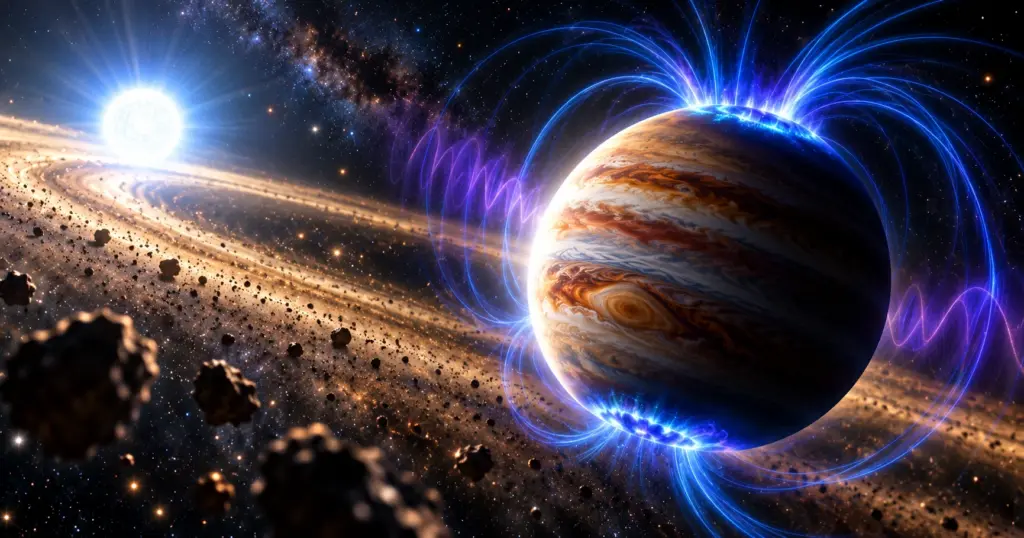
For the first time, astronomers have reported convincingly tracing radio emissions directly to a planet beyond our Solar System. The signals originate from Beta Pictoris b, a massive gas giant approximately 63 light-years from Earth, and appear to reveal an extraordinarily powerful planetary magnetic field.
Using the MeerKAT radio telescope array in South Africa, researchers detected rapid, recurring radio bursts and determined that their position matched the planet rather than its host star. The discovery could open an important new method for investigating the magnetic environments of distant worlds.
Although the detection has attracted headlines about mysterious signals from outer space, scientists have not discovered an alien message. The evidence instead points to a natural process associated with planetary auroras, somewhat similar to the magnetic activity responsible for Jupiter’s powerful radio emissions and Earth’s northern and southern lights.
The research, submitted to the arXiv preprint server on September 15, 2026, represents a potentially historic achievement in exoplanet science. However, the study has not yet undergone peer review, and further observations will be important for confirming its conclusions. [1]
What Exactly Did Scientists Discover?
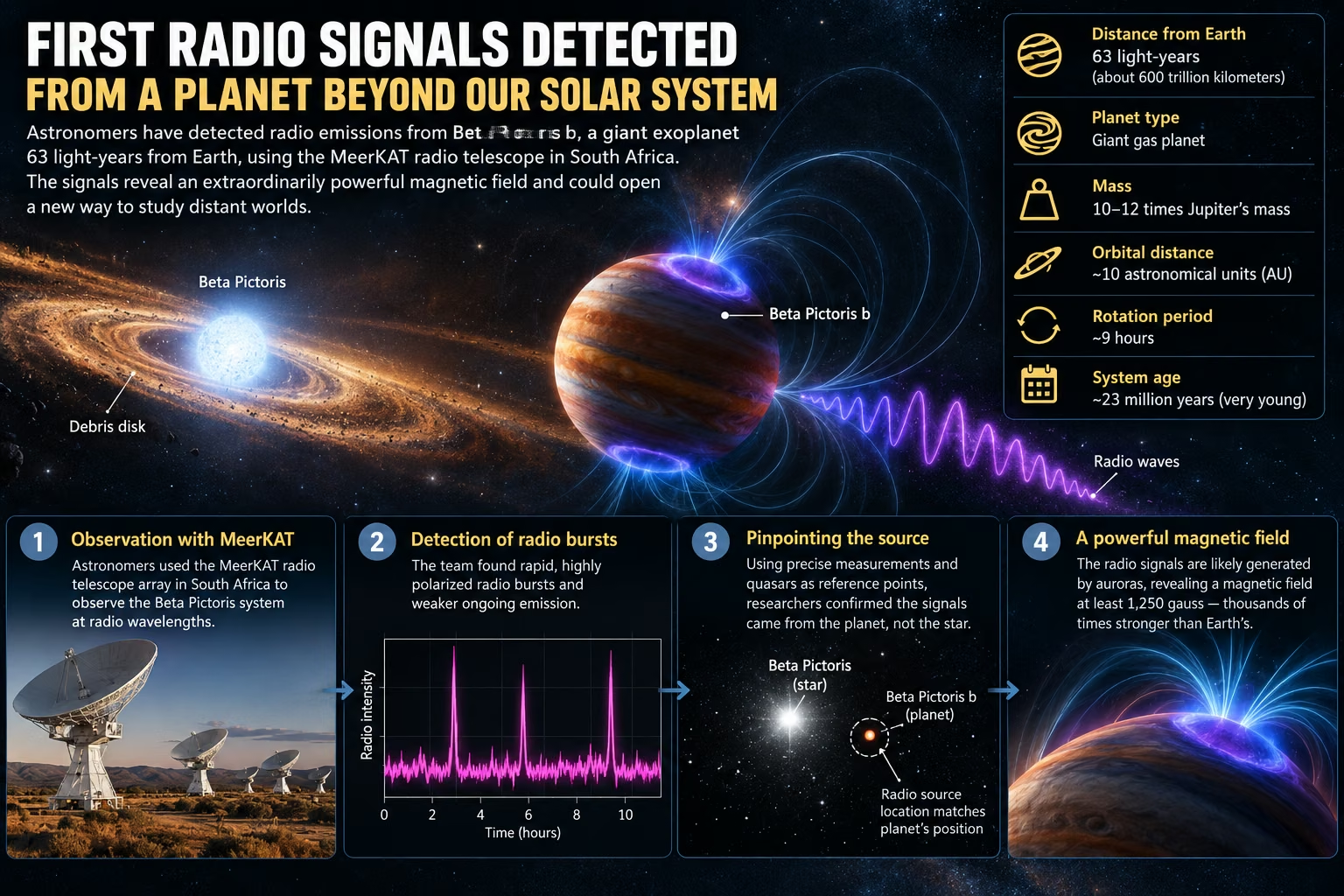
Astronomers detected radio waves associated with Beta Pictoris b, an enormous planet orbiting a star in the southern constellation Pictor. The extraordinary part is not simply that radio waves were found. Astronomers regularly observe natural radio emissions from stars, galaxies, and other astronomical objects. The breakthrough is that researchers were able to localize the signal to a particular exoplanet.
Earlier radio observations of systems containing planets often left an unresolved question: were the signals being generated by the planets or by their parent stars?
In this study, the researchers used precise radio measurements to distinguish the two possibilities. Their analysis placed the radio source at the known position of Beta Pictoris b, with a statistically significant separation from the position of its host star.
The radio emissions also displayed unusual properties. Some were brief, rapidly varying bursts, while weaker radio emission remained detectable between bursts. The strongest bursts showed substantial circular polarization, a characteristic associated with certain magnetic radio-emission mechanisms.
Researchers interpreted these measurements as evidence of auroral activity driven by the planet’s powerful magnetic environment.
If independently confirmed, this would establish Beta Pictoris b as the first known exoplanet whose radio emission has been directly localized to the planet itself rather than merely associated with its planetary system. [1]
Where Is Beta Pictoris b, and What Do We Know About This Planet?
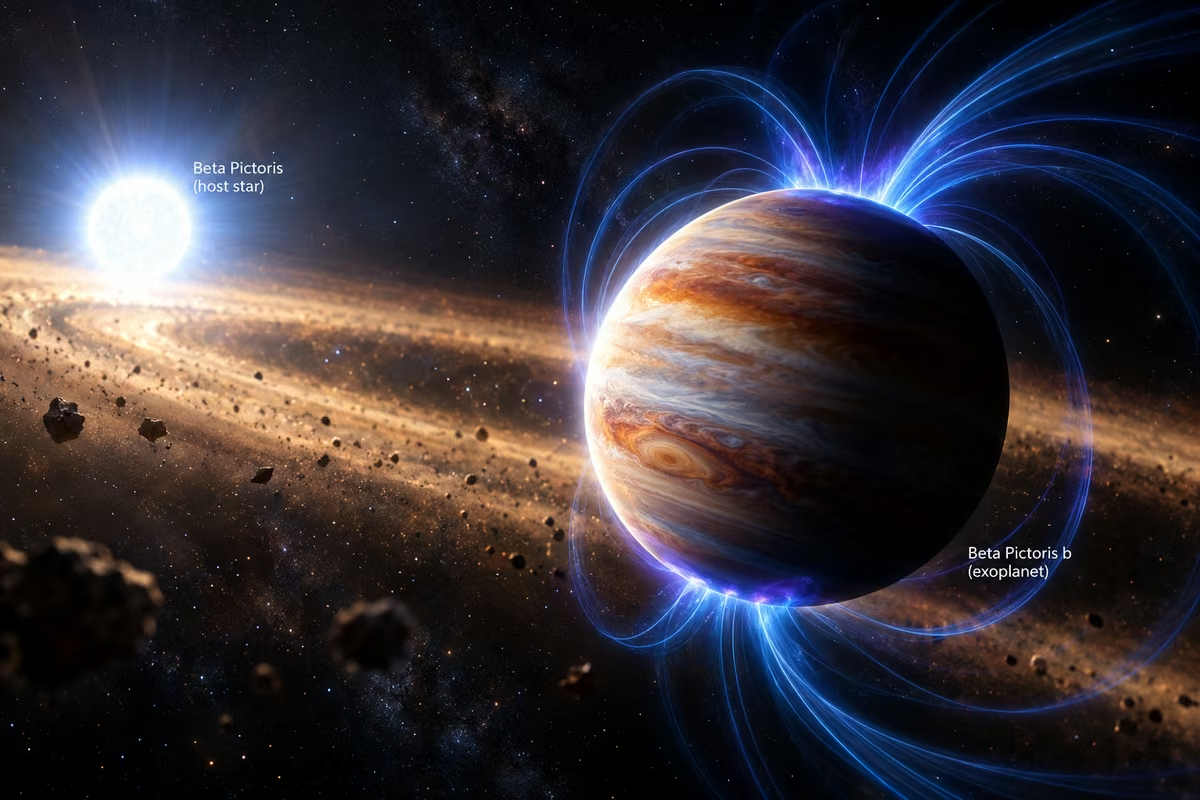
Beta Pictoris b is a giant exoplanet orbiting Beta Pictoris, a young, relatively massive star approximately 63 to 64 light-years from Earth. A light-year is the distance light travels in one year, approximately 9.46 trillion kilometers. The radio waves detected on Earth therefore began their journey from this system roughly six decades ago.
The planet was originally discovered through direct imaging, with its discovery announced in 2008. Unlike planets identified only through changes in starlight, Beta Pictoris b can be separated from its star in suitable astronomical images.
Its physical characteristics make it an unusual world:
| Property | Current scientific understanding |
|---|---|
| Planet name | Beta Pictoris b, also written β Pic b |
| Planet classification | Gas giant |
| Distance from Earth | Approximately 63 to 64 light-years |
| Mass | Roughly 10 to 12 Jupiter masses, depending on the estimate |
| Orbital distance | Approximately 10 astronomical units |
| Orbital period | Approximately 24 Earth years |
| Rotation period | Approximately 9 hours |
| Discovery announced | 2008 |
| Host star | Beta Pictoris, an A-type star |
| System age | Approximately 23 million years |
An astronomical unit, or AU, is the average distance between Earth and the Sun. Beta Pictoris b orbits at approximately 10 AU, comparable to Saturn’s distance from our Sun.
The entire planetary system is extraordinarily young. Our Solar System formed about 4.6 billion years ago, while Beta Pictoris is only around 23 million years old.
The star is also surrounded by a prominent debris disk containing material left over from planetary formation. Three giant planets, Beta Pictoris b, c, and d, have been reported in the system.
This combination of youth, large planetary mass, rapid rotation, and a relatively quiet host star makes Beta Pictoris b an especially valuable target for studying the magnetic fields of young giant planets. [1][2]
How Did Astronomers Detect the Radio Signals From Beta Pictoris b?
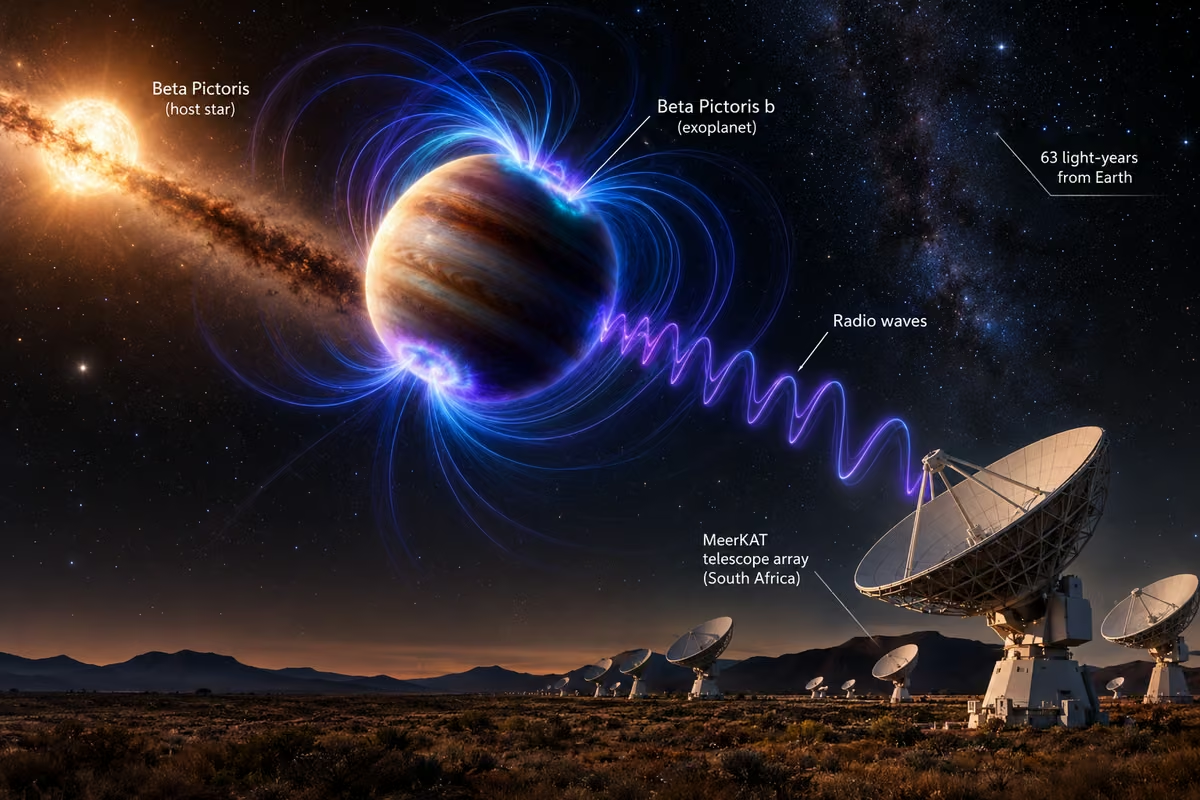
The research team, led by Kevin N. Ortiz Ceballos, with Edo Berger and Yvette Cendes, used the MeerKAT radio telescope array in South Africa to observe the Beta Pictoris system.
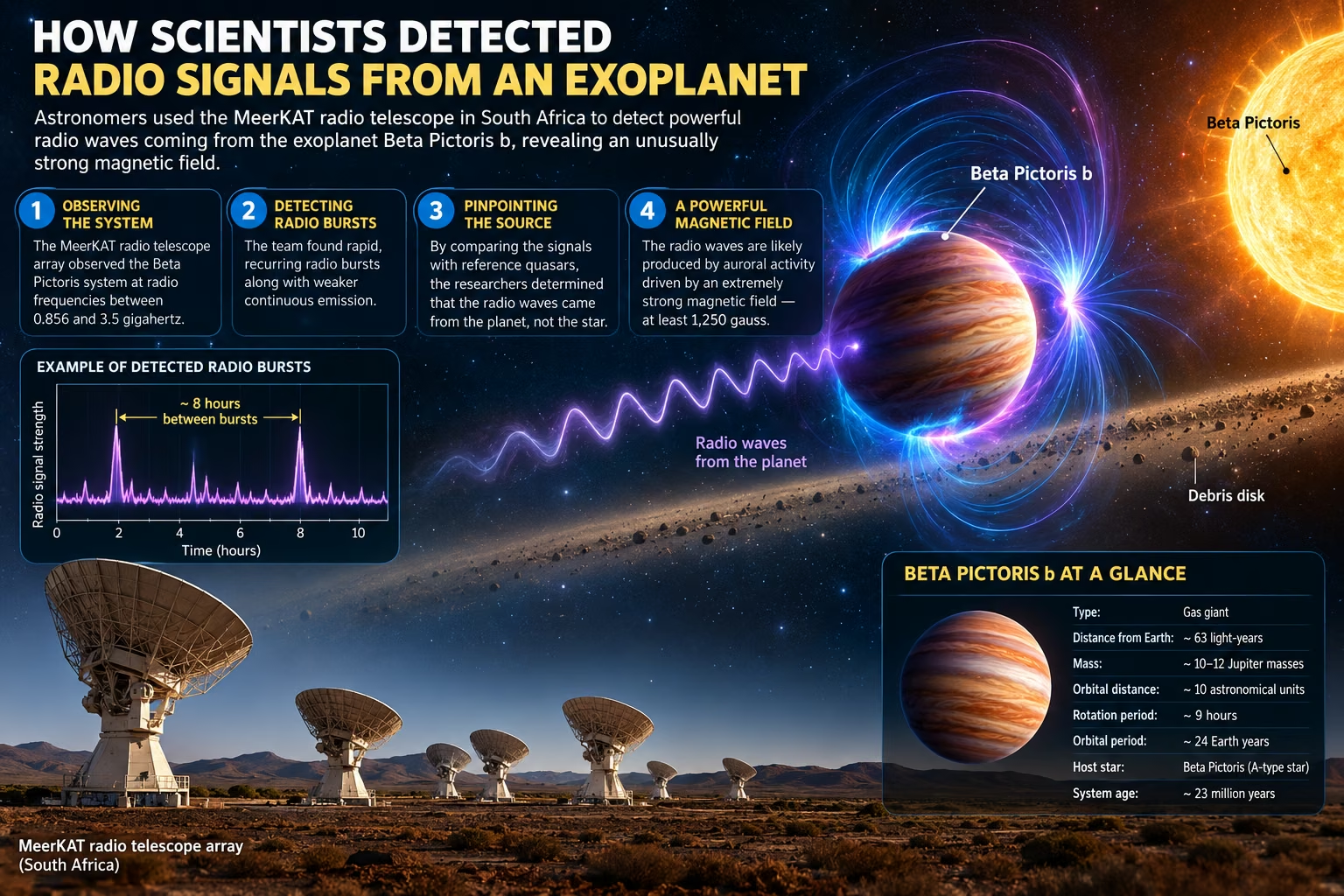
MeerKAT consists of 64 interconnected radio antennas located in the Northern Cape province, near Carnarvon. Each antenna has a main reflecting dish measuring 13.5 meters across.
Unlike an ordinary optical telescope, which collects visible light, MeerKAT detects radio-frequency electromagnetic radiation arriving from space. Signals received by its antennas are digitally processed and combined using a technique called radio interferometry. This allows astronomers to produce highly sensitive radio images and measure source positions with considerable precision.
The researchers observed the Beta Pictoris system during four observing sessions between February 2025 and May 2026.
Their observations covered two radio-frequency ranges:
- L-band observations from approximately 0.856 to 1.712 gigahertz.
- S-band observations from approximately 1.75 to 3.5 gigahertz.
A gigahertz represents one billion electromagnetic oscillations per second.
During these observations, the team detected radio emission associated with the system in all four observing sessions. Some signals appeared as brief, intense bursts, while other radio emissions persisted at lower levels.
The researchers also measured how the intensity and polarization of the radiation changed with time. Those measurements helped establish that the emissions were consistent with a magnetically driven natural radio source.
However, detecting radio activity was only the first part of the investigation. The more difficult task was determining precisely where the radio waves originated. [1][3]
How Did Scientists Confirm the Signals Came From the Planet Instead of Its Star?
One of the biggest challenges in exoplanet radio astronomy is distinguishing faint planetary radiation from emission produced by nearby stars.
Even a giant planet appears extremely close to its host star when observed across dozens of light-years. An apparent radio source in that direction might therefore represent stellar activity, planetary activity, or another source that requires careful identification.
To determine the source’s position, the research team used a sophisticated astrometric calibration method.
They compared the radio observations with the accurately measured celestial positions of distant quasars. Quasars are extremely luminous galactic nuclei powered by supermassive black holes. Because they are so distant, their apparent positions provide useful reference points for precise astronomical measurements.
The researchers used nine radio-detected quasars identified with Gaia reference data, together with an additional calibration source. They corrected the radio-image coordinate system and accounted for measurement uncertainties.
The resulting position matched the expected location of Beta Pictoris b.
Their statistical analysis found that the radio position was inconsistent with the host star’s position at a significance of approximately 4.4 sigma. It was also inconsistent with the position of another planet, Beta Pictoris c, at approximately 4.8 sigma.
These measurements provide substantial evidence that Beta Pictoris b was responsible for the detected radio emission.
This does not mean MeerKAT photographed the planet’s aurora in visible light. Rather, astronomers accurately determined the radio source’s celestial position and compared it with the planet’s known orbit.
That distinction is central to understanding why the discovery is scientifically important. [1][4]
What Do the Radio Signals Actually Look Like?
Radio waves are electromagnetic radiation, not audible sounds traveling through space. They cannot be heard directly by human ears, although scientists can convert radio measurements into sound for demonstrations or analysis.
The signals detected from Beta Pictoris b were characterized by changes in radio intensity, frequency, and polarization.
The study identified rapid bursts together with weaker emission between them. The most distinctive bursts displayed circular polarization of approximately 40 to 70 percent.
Circular polarization describes how the orientation of an electromagnetic wave’s electric field rotates as the radiation travels. In radio astronomy, strong circular polarization can be an important clue about the physical mechanism producing a signal.
The researchers detected both left-handed and right-handed circularly polarized bursts during different observing sessions. This behavior is compatible with radio emission associated with magnetic fields whose orientation relative to Earth changes.
Another potentially important observation involved the timing of the bursts.
Two bursts observed during one session were separated by approximately eight hours. Beta Pictoris b is independently estimated to complete a rotation in roughly nine hours.
That similarity raises the possibility that the planet’s rotation periodically changes the direction of its radio emission relative to Earth.
However, the observed timing is not yet sufficient to establish a definitive rotational cycle. Longer observations will be required to determine whether the bursts repeatedly follow the planet’s rotation. [1]
Why Would a Planet Naturally Produce Radio Signals?
The most likely explanation involves auroral radio emissions associated with the planet’s magnetosphere.
A magnetosphere is the region surrounding a planet where its magnetic field strongly influences the motion of electrically charged particles. These particles can include electrons and ions originating from the planet’s atmosphere, surrounding plasma, or the wider space environment.
On Earth, interactions involving charged particles and the upper atmosphere produce the aurora borealis and aurora australis.
Jupiter also experiences spectacular auroras. Its powerful magnetic field, rapid rotation, and surrounding plasma environment create intense electrical currents and radio emissions.
Researchers believe a related physical process operates around Beta Pictoris b, although the relative importance of the energy sources may differ significantly from Earth’s auroras.
The scientific mechanism proposed to explain the most strongly polarized radio bursts is called electron cyclotron maser instability, abbreviated ECMI.
This process occurs when energetic electrons move through a magnetized plasma under conditions that allow them to amplify electromagnetic waves coherently. The resulting radiation can be highly polarized, strongly directional, and concentrated into distinctive bursts.
The frequencies and polarization properties detected by MeerKAT are consistent with this mechanism.
Importantly, astronomers have not yet obtained visible photographs of auroras around Beta Pictoris b. The auroral interpretation is based on the radio observations and the known physics of magnetized plasma. [1][5]
Could the Planet’s Rapid Rotation Be Powering Its Auroras?
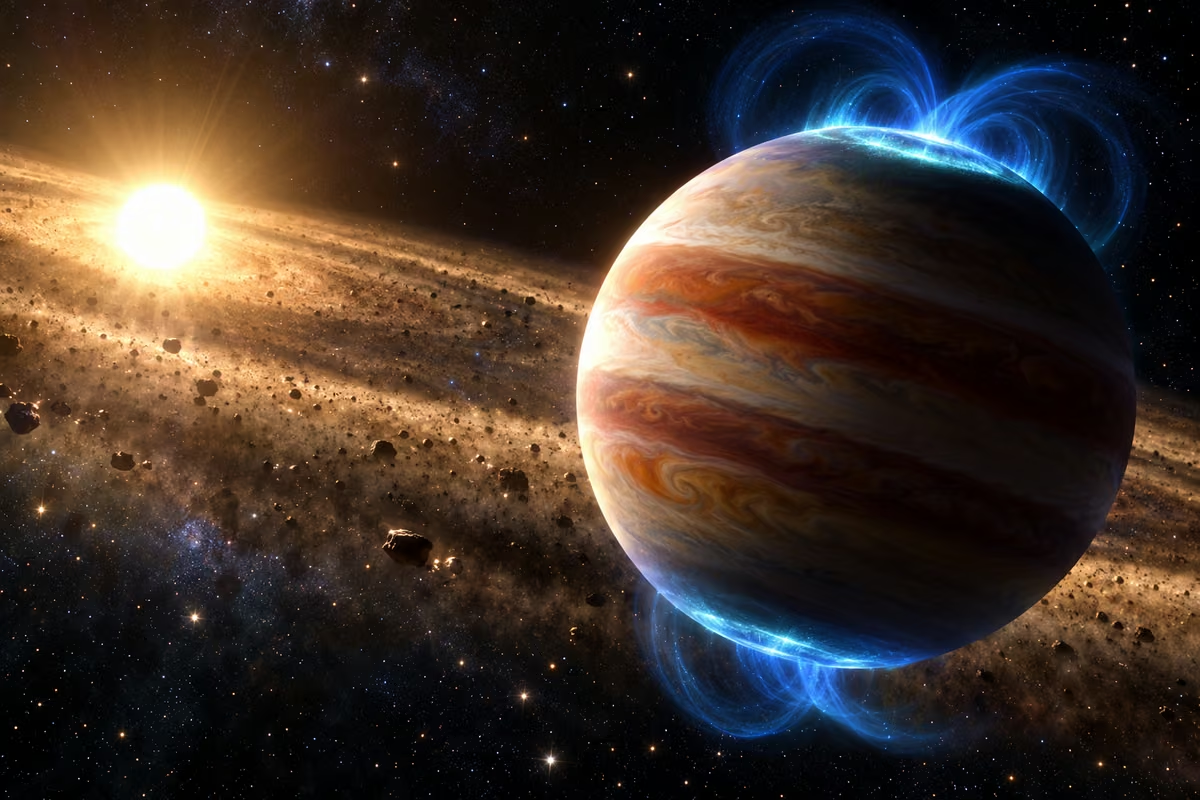
Beta Pictoris b rotates extremely quickly, completing one turn in approximately nine hours despite being much larger than Jupiter. Its rapid rotation may provide the energy needed to sustain powerful auroral currents.
The researchers favor a process known as magnetosphere-ionosphere coupling.
In this model, the planet’s magnetic field interacts with electrically charged plasma in its surrounding environment. As the planet rotates, parts of the magnetosphere attempt to rotate along with it.
Farther from the planet, however, the plasma may be unable to maintain the same rotational speed.
This difference in motion creates electric currents that flow along magnetic field lines. Under suitable conditions, these currents accelerate electrons and generate powerful auroral radio emissions.
The mechanism resembles processes responsible for some of Jupiter’s auroral activity.
The researchers also considered other possibilities, including interactions between the planetary magnetosphere and the stellar wind, or electrical interactions involving a hypothetical orbiting moon.
Their calculations suggested that these alternatives would not readily provide enough energy to explain the observed emission under the assumptions used.
The rotation-driven mechanism therefore provides a promising explanation, but it remains a physical interpretation that requires additional testing.
Future observations that establish a repeating radio pattern tied to the planet’s rotation would offer particularly valuable evidence for this model. [1]
Scientists May Have Measured an Exoplanet’s Magnetic Field Directly for the First Time
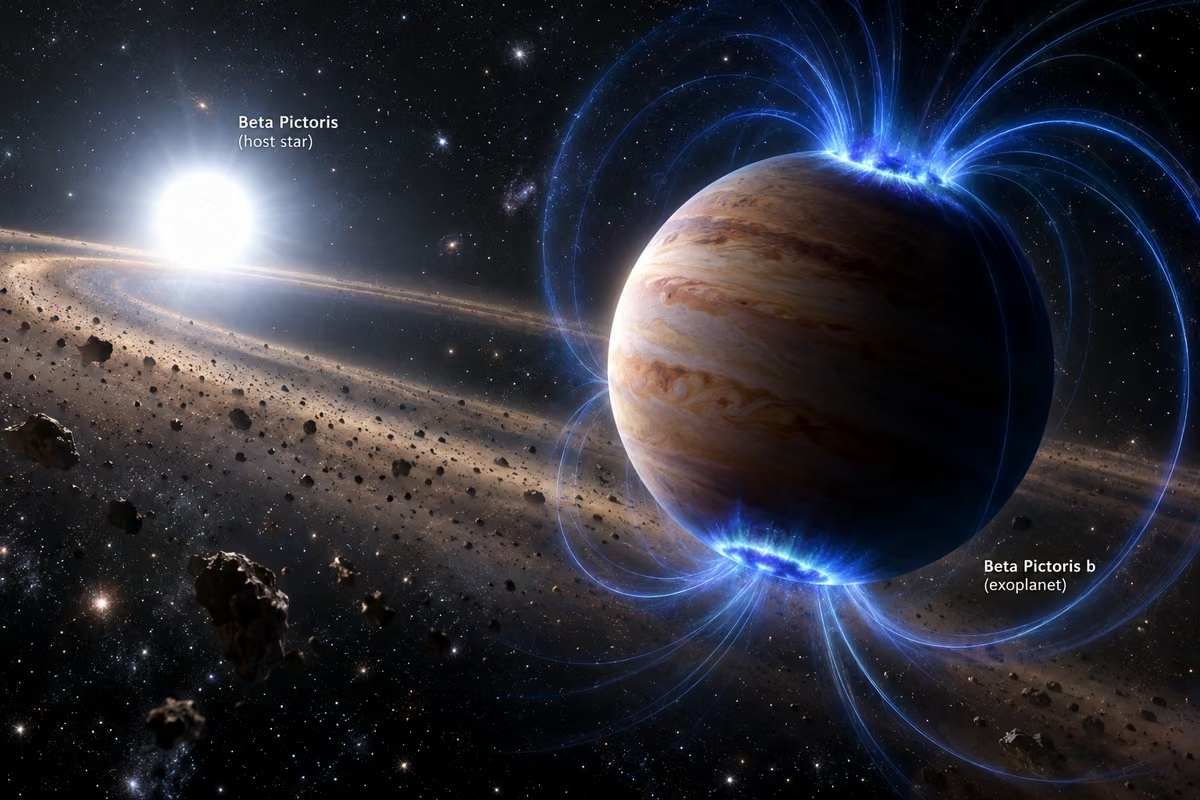
Perhaps the most important consequence of this discovery is that radio waves can reveal information about an exoplanet’s magnetic field.
Magnetic fields are difficult to measure on distant planets because the planets are faint and generally cannot be resolved in enough detail to observe their magnetospheres directly.
Auroral radio emissions offer another approach.
In the electron cyclotron maser model, the frequency at which the radiation is produced depends on the local magnetic field strength.
The relationship is approximately:
Electron cyclotron frequency (MHz) = 2.8 × Magnetic field strength (gauss)
Because the researchers detected polarized radio emission extending to at least 3.5 gigahertz, they inferred a magnetic field strength of at least 1,250 gauss, equivalent to 1.25 kilogauss, at the radio-emitting region.
For comparison, Earth’s surface magnetic field is approximately 0.25 to 0.65 gauss, varying by location. Jupiter’s magnetic field near its cloud tops is typically several gauss, although its strength also varies with location.
The inferred field at Beta Pictoris b’s radio-emission site is therefore thousands of times stronger than Earth’s surface field.
The result is a lower limit, not an exact measurement of the planet’s entire magnetic field. Radiation might extend to frequencies above the upper limit observed by MeerKAT, potentially indicating an even stronger field somewhere in the emission region.
The inference also depends on identifying the correct emission mechanism.
Such an unusually powerful field is nevertheless compatible with theoretical models predicting intense magnetic dynamos inside young, massive giant planets. If confirmed, the discovery would provide a valuable observational test of planetary interior physics. [1][4]
Why Is Beta Pictoris b’s Magnetic Field So Strong?
Planetary magnetic fields are generally generated by the movement of electrically conducting material inside a planet. This process is known as a planetary dynamo.
Earth’s magnetic field is primarily produced by the motion of molten, electrically conducting iron in its outer core.
Gas giants operate differently. Jupiter’s magnetic field is believed to be generated largely by the movement of electrically conducting metallic hydrogen deep inside the planet.
Beta Pictoris b is considerably more massive than Jupiter and remains hot from its relatively recent formation.
Its large internal energy supply, substantial pressure, and rapid rotation may create favorable conditions for a powerful dynamo.
The precise relationship between planetary mass, rotation, internal heat flow, electrical conductivity, and magnetic field strength remains an active area of research.
The new radio observations are particularly valuable because they provide a potential measurement against which competing dynamo models can be tested.
A stronger magnetic field does not automatically mean a planet is more suitable for life. Beta Pictoris b is a young, hot gas giant rather than an Earth-like rocky world.
Nevertheless, understanding the physical processes responsible for such extreme magnetism helps researchers investigate how magnetic fields develop and evolve throughout a planet’s lifetime. [1][2]
Have Astronomers Detected Radio Signals From Other Exoplanets Before?
The search for radio emissions from planets outside the Solar System has been underway for decades.
Astronomers already knew that planets within our Solar System emit radio waves. Jupiter’s natural radio emissions were discovered in the 1950s, establishing that planetary magnetospheres can produce detectable radiation.
Finding similar emissions from exoplanets has proved much harder because their signals are extremely faint at Earth’s distance and can be confused with emission from their host stars.
In 2023, researchers reported coherent radio bursts associated with the red dwarf YZ Ceti, which hosts several small planets. Some radio activity appeared potentially connected with the orbit of YZ Ceti b. However, the researchers could not exclude ordinary stellar magnetic activity as the cause.
Another prominent candidate was Tau Boötis b, a giant planet associated with tentative low-frequency radio detections.
A later study using 64 hours of Low-Frequency Array observations did not confirm the earlier candidate signal. The researchers established substantially lower limits on any persistent emission and questioned whether the original detection represented a genuine astrophysical signal.
These examples explain why identifying a radio source within a planetary system is not equivalent to demonstrating that the planet itself produces the emission.
The Beta Pictoris b result is potentially different because the researchers used positional measurements to distinguish the planet from its host star.
That improvement in source localization represents the central advance reported by the September 2026 study. [1][10][11]
What Have Other Space and Science Websites Reported About the Discovery?
The discovery received substantial coverage from established science publications after the research preprint became publicly available.
Although the reports generally agreed on the central findings, they differed in their treatment of scientific uncertainty and the broader implications of the radio detection.
| Publication | Publication date | Main focus |
|---|---|---|
| Science News | September 21, 2026 | Potential first direct detection and the need for independent confirmation |
| ScienceAlert | September 22, 2026 | Radio bursts, auroral physics, and an unusually strong magnetic field |
| Phys.org | September 22, 2026 | How astronomers localized the signals using quasars |
| BBC Sky at Night Magazine | September 22, 2026 | How planetary magnetic fields could improve understanding of distant worlds |
| Live Science | September 23, 2026 | Independent expert commentary and the distinction between natural radio waves and alien communications |
| WIRED | September 24, 2026 | The discovery’s historical context and earlier unsuccessful or inconclusive exoplanet radio searches |
| BBC Sky at Night Magazine | October 2, 2026 | A shorter summary of the discovery and its significance |
Science News emphasized the importance of the discovery while presenting an important caution from independent astronomer Joe Callingham. He described the result as exciting if it survives peer review and noted that observing repeatable modulation associated with the planet’s rotation would help strengthen the auroral interpretation. [4]
ScienceAlert and Phys.org focused more directly on how the discovery was made. ScienceAlert explained the electron cyclotron maser mechanism and its relationship to magnetic fields. Phys.org concentrated on the astrometric work that allowed researchers to distinguish the planet from its star. [6][8]
BBC Sky at Night Magazine placed the result in the broader context of exoplanet habitability, explaining why measuring planetary magnetism matters. Live Science included commentary from Oxford astrophysicist Suzanne Aigrain, who described the observation as a particularly convincing direct detection while emphasizing its natural origin. [5][7]
WIRED explored the history of the Beta Pictoris system and discussed earlier candidate radio detections, including YZ Ceti, that could not be securely attributed to a planet. [9]
The common scientific conclusion is that the radio detection provides strong evidence for a planetary source and an extraordinary magnetic field. The distinction is that the original study remains a preprint, meaning its conclusions have not yet completed formal peer review.
Are These Radio Signals Evidence of Alien Life?
No evidence connects the detected signals to extraterrestrial intelligence.
Radio astronomy plays an important role in the search for extraterrestrial intelligence, or SETI, because advanced civilizations might theoretically produce artificial radio transmissions.
However, most astronomical radio signals come from natural physical processes. Stars, pulsars, galaxies, magnetized planets, and energetic plasma environments can all produce radio radiation without any involvement from living organisms.
The signals attributed to Beta Pictoris b have characteristics expected from natural magnetic activity.
Their strong circular polarization, rapid variability, and broad frequency coverage are compatible with electron cyclotron maser radiation.
Researchers have not identified a coded message, a communication protocol, or any other evidence indicating technological activity.
There is also no evidence that Beta Pictoris b itself hosts life. The planet is a hot, massive gas giant, and its physical environment is dramatically different from Earth’s.
It would therefore be misleading to describe this discovery as scientists receiving a mysterious message from an alien civilization.
A more scientifically accurate description is that astronomers have identified radio emissions that appear to be generated by the magnetic environment of a distant giant planet.
That explanation is less sensational, but its implications for understanding planetary systems may be far more significant. [1][5]
Could This Discovery Help Scientists Find Habitable Planets?
Although Beta Pictoris b is not an Earth-like planet, the ability to investigate exoplanet magnetic fields could eventually become useful in the search for habitable worlds.
A planetary magnetic field can influence how charged particles from a host star interact with the upper atmosphere.
It can also shape magnetospheric currents, particle precipitation, auroral activity, and some mechanisms of atmospheric escape.
These processes matter because a planet’s long-term environment depends partly on whether its atmosphere can persist under the influence of stellar radiation and stellar winds.
However, magnetic fields do not provide a simple guarantee of atmospheric protection or habitability.
A planet’s atmospheric composition, gravity, distance from its star, surface conditions, geological activity, and stellar environment all affect its potential to support life.
Even planets without strong global magnetic fields can retain substantial atmospheres under certain conditions.
For that reason, the discovery should not be interpreted as a direct method for detecting life.
Its immediate value is more fundamental. It offers a new way to study the magnetic properties of planets that cannot be visited or examined directly.
Over time, combining radio observations with atmospheric spectroscopy, stellar activity measurements, and planetary climate models could help astronomers understand which planetary environments are stable over billions of years.
The ability to study magnetic fields on distant rocky planets would be particularly valuable, although the methods demonstrated for Beta Pictoris b cannot yet routinely accomplish that goal. [1][7]
What Are the Limitations of the Discovery?
Despite the strength of the reported evidence, several important questions remain unresolved.
First, the research was released as a preprint on September 15, 2026. As of October 10, 2026, the version reviewed for this article had not yet been published as a peer-reviewed journal paper.
That distinction matters because other scientists have not yet completed the formal evaluation of the analysis, assumptions, and interpretation through journal peer review.
Second, although the radio source’s position strongly supports Beta Pictoris b, further observations would provide an independent test of the localization.
Third, the interpretation of the polarized bursts as electron cyclotron maser radiation is physically persuasive, but detailed studies of the planet’s emission behavior remain necessary.
Fourth, the inferred magnetic field strength is a lower limit for the radio-emitting region. It is not a complete map of the planet’s magnetic field, its geometry, or its interior dynamo.
Finally, the proposed relationship between the observed bursts and the planet’s rotation is not yet firmly established.
Researchers observed bursts separated by approximately eight hours, close to the estimated planetary rotation period, but more extensive monitoring is needed to demonstrate a consistent repeating pattern.
These limitations do not invalidate the discovery. They define the questions that future studies must address to establish how the planet generates such powerful radio emissions. [1][4]
What Will Astronomers Investigate Next?
The immediate next step is to gather additional radio observations of Beta Pictoris b.
Longer observing campaigns could establish whether the radio bursts consistently repeat at intervals associated with the planet’s approximately nine-hour rotation period.
Such a pattern would help astronomers determine how the planet’s magnetic field is oriented and whether the radio emission originates primarily from particular regions of its magnetosphere.
Researchers could also observe the system over a wider range of frequencies. Detecting emission at frequencies higher than 3.5 gigahertz might place stronger constraints on the maximum magnetic field strength at the emission source.
Further measurements of polarization and radio intensity could help distinguish between possible plasma acceleration mechanisms.
The original study also identifies several other directly imaged giant planets that may be suitable for similar investigations.
The researchers estimate that seven additional giant exoplanets in five nearby systems could become accessible using comparable localization methods if future radio instruments achieve approximately five to seven times greater sensitivity.
Next-generation facilities, including developments associated with the Square Kilometre Array, could greatly improve astronomers’ ability to study faint radio sources.
Success would allow scientists to compare magnetic environments across planets of different masses, ages, orbital distances, and rotation rates.
Rather than relying entirely on theoretical predictions, researchers could begin building an observational understanding of magnetic field generation across diverse exoplanet populations. [1][3]
Frequently Asked Questions About the Exoplanet Radio Signals
Which planet produced the radio signals?
The detected emissions were attributed to Beta Pictoris b, a massive gas giant orbiting a young star approximately 63 to 64 light-years away. Its mass is estimated to be roughly 10 to 12 times Jupiter’s mass.
Who discovered the radio emissions?
The study was authored by Kevin N. Ortiz Ceballos, Edo Berger, and Yvette Cendes. Their work used observations collected with the MeerKAT radio telescope array in South Africa.
When were the signals detected?
The observations were conducted during four sessions between February 2025 and May 2026. The research paper was submitted to arXiv on September 15, 2026.
How strong is the planet’s magnetic field?
Under the authors’ interpretation of the radio emission, the magnetic field in the emitting region is at least 1,250 gauss, or 1.25 kilogauss. This is thousands of times stronger than Earth’s surface magnetic field.
Can these radio signals be heard on Earth?
Not directly. Radio waves are electromagnetic radiation rather than sound waves. Radio telescopes convert incoming radiation into electronic measurements that scientists can analyze or transform into audible representations.
Are the radio waves coming from aliens?
There is no evidence that the signals are artificial. Their measured properties are consistent with naturally occurring auroral radio emissions generated within a powerful planetary magnetic environment.
Why This Discovery Matters for the Future of Exoplanet Astronomy
The detection of radio signals associated with Beta Pictoris b could represent a major step forward in how astronomers investigate planets beyond our Solar System.
Scientists already use several powerful methods to discover and study exoplanets. Transit observations reveal changes in stellar brightness when a planet passes in front of its star. Radial velocity measurements identify stellar motion caused by orbiting planets. Direct imaging can reveal some large, young planets at sufficient separations from their stars, while spectroscopy provides information about atmospheric conditions.
Radio astronomy adds another potentially important dimension: the ability to probe planetary magnetism.
Magnetic fields influence the environments surrounding planets, their interactions with charged particles, and the processes that govern some forms of atmospheric evolution.
Until now, directly measuring the magnetic field strength of a confirmed exoplanet has remained exceptionally difficult.
The MeerKAT observations suggest that this limitation can begin to be overcome, at least for favorable giant planets with strong radio emissions.
The discovery does not establish the existence of life beyond Earth, nor does it reveal a communication from an unknown civilization.
Its importance lies in something more fundamental. It suggests that astronomers can use naturally generated radio waves to investigate physical conditions around planets many light-years away.
If subsequent research confirms these findings, Beta Pictoris b may be remembered as the exoplanet that helped open a new observational window into the magnetic environments of distant worlds.
Sources
This article was researched using the original scientific study, official astronomical reference material, and reporting from multiple established science publications. The primary research paper is the main source for measurements of radio frequency, polarization, positional significance, and inferred magnetic field strength. NASA’s exoplanet catalog and the South African Radio Astronomy Observatory provide supplementary planetary and telescope information. Independent science reporting was consulted to compare interpretations and identify unresolved questions, especially the study’s preprint status and the need for additional observations. Sources were checked against information available as of October 10, 2026.
[1] Original Scientific Research: Ortiz Ceballos, K. N., Berger, E., and Cendes, Y. (2026). Discovery of radio emission from the exoplanet β Pictoris b. arXiv:2609.16720.
https://arxiv.org/abs/2609.16720
[2] NASA Science: Beta Pictoris b, NASA Exoplanet Catalog.
https://science.nasa.gov/exoplanet-catalog/beta-pictoris-b/
[3] South African Radio Astronomy Observatory: About MeerKAT. Official telescope specifications and operational background.
https://www.sarao.ac.za/science/meerkat/about-meerkat/
[4] Science News: Emily Conover. First radio waves seen from an exoplanet hint at otherworldly auroras. September 21, 2026.
https://www.sciencenews.org/article/exoplanet-aurora-radio-waves
[5] Live Science: Pandora Dewan. Astronomers detected radio signals coming from an exoplanet for the first time. Spoiler alert: It’s not aliens. September 23, 2026.
https://www.livescience.com/space/exoplanets/astronomers-detected-radio-signals-coming-from-an-exoplanet-for-the-first-time-spoiler-alert-its-not-aliens
[6] Phys.org: Paul Arnold. Astronomers detect radio signals coming from an exoplanet for the first time. September 22, 2026.
https://phys.org/news/2026-09-astronomers-radio-exoplanet.html
[7] BBC Sky at Night Magazine: Iain Todd. Radio signals detected from a planet beyond our Solar System. Landmark discovery could help us search for habitable worlds. September 22, 2026.
https://www.skyatnightmagazine.com/news/radio-signals-detected-beta-pictoris-b
[8] ScienceAlert: David Nield. Astronomers Detect Radio Signals Coming Directly From an Exoplanet For The First Time. September 22, 2026.
https://www.sciencealert.com/astronomers-detect-radio-signals-coming-directly-from-an-exoplanet-for-the-first-time
[9] WIRED: Jorge Garay. Scientists Detect Radio Signals From an Exoplanet for the First Time in History. September 24, 2026.
https://www.wired.com/story/scientists-detect-radio-signals-from-exoplanet-for-first-time-in-history/
[10] Nature Astronomy: Coherent radio bursts from known M-dwarf planet-host YZ Ceti. 2023. Earlier research on potential star-planet magnetic interactions.
https://www.nature.com/articles/s41550-023-01914-0
[11] Astronomy & Astrophysics Research: Deep radio interferometric search for decametre radio emission from the exoplanet Tau Boötis b. 2025. Follow-up research on previously reported candidate exoplanet radio emissions.
https://arxiv.org/abs/2501.06301