From the quiet glow of distant red dwarfs to the blinding flash of a
supernova, stars shape the universe in ways both subtle and
spectacular. They are the cosmic forges that transform simple
hydrogen and helium into the heavier elements essential for planets,
chemistry, and life itself. Every atom of carbon in our bodies, oxygen
in the air we breathe, and iron in our blood was created inside a star
that lived and died long before the Sun was born. Stellar evolution—
the complete life cycle of stars from birth to death—reveals how
these celestial objects form, shine for millions or billions of years,
and ultimately return their enriched material to the cosmos. The
path each star follows depends almost entirely on its mass: low-mass
stars fade gently, while high-mass stars explode in dramatic finales.
Understanding this cycle not only explains the night sky but also
shows how the universe continually renews itself through an endless
process of creation and recycling.
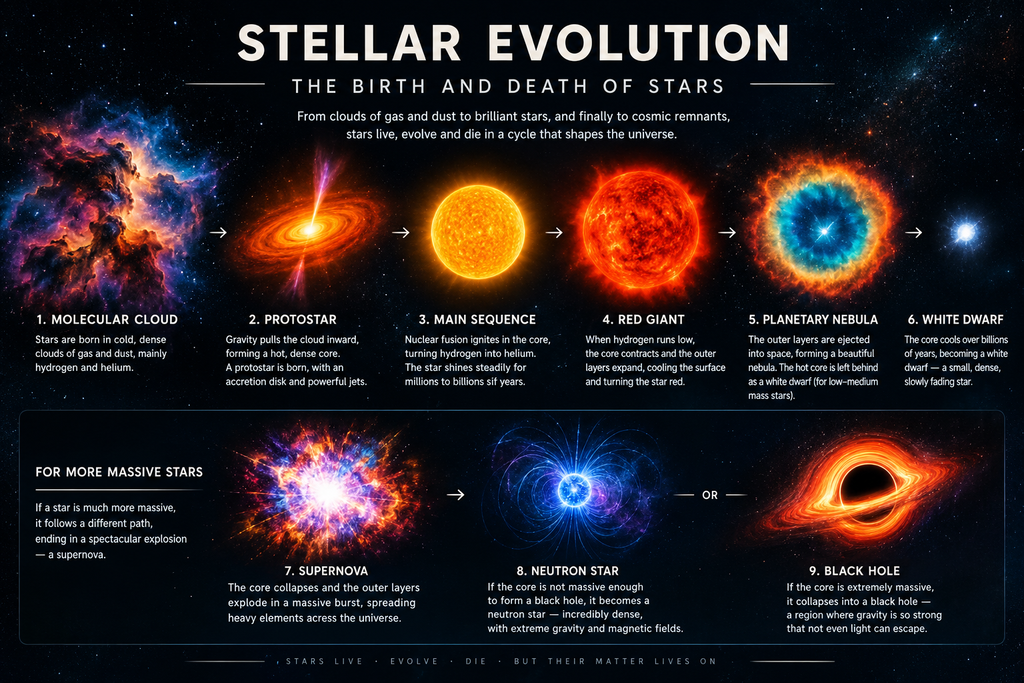
Stars begin their lives in vast, cold clouds of gas and dust
known as molecular clouds or nebulae. These stellar
nurseries, often found along the spiral arms of galaxies,
contain mostly hydrogen and helium left over from the Big
Bang, mixed with traces of heavier elements from earlier
generations of stars. Gravity and turbulence cause denser
regions within the cloud to collapse. As the material falls
inward, it heats up and begins to spin, forming a glowing
protostar. Over tens of thousands to several million years,
the protostar gathers more mass. When its core
temperature climbs to roughly 10–15 million degrees
Celsius, nuclear fusion ignites: hydrogen nuclei fuse into
helium, releasing enormous energy. Outward pressure from
this energy balances the inward pull of gravity, and the star
settles onto the main sequence—the longest and most
stable phase of its existence.
Our Sun, a middle-aged G-type star, is currently in this
main-sequence stage. It has been steadily fusing hydrogen
for about 4.6 billion years and will continue doing so for
roughly another 5 billion years. A star’s lifetime on the
main sequence depends strongly on its mass. Low-mass
red dwarfs burn their fuel slowly and can shine for tens or
even hundreds of billions of years. More massive stars are
far more luminous and consume their hydrogen much
faster; a star ten times the mass of the Sun may live only
about 20 million years.
When the hydrogen in a star’s core is finally exhausted,
fusion slows and the core begins to contract under
gravity. The rising temperature triggers hydrogen fusion
in a shell surrounding the core. This extra energy causes
the outer layers to expand and cool dramatically,
transforming the star into a red giant or, for more
massive stars, a red supergiant. A star like the Sun will
swell to many times its current size, eventually engulfing
the orbits of the inner planets.
What happens next is determined by mass. Stars up to
about eight times the mass of the Sun eventually fuse
helium into carbon and oxygen. After this fuel is spent,
they gently shed their outer layers, creating a colorful
shell of gas called a planetary nebula. The remaining
core, roughly Earth-sized yet containing about half a
solar mass, becomes a white dwarf. Supported by
electron degeneracy pressure, white dwarfs cool slowly
over billions of years and will eventually fade into black
dwarfs—though none yet exist because the universe is
not old enough.
Stars heavier than about eight solar masses follow a far
more violent path. They fuse successively heavier
elements—carbon, neon, oxygen, and silicon—until an
iron core forms. Iron fusion absorbs energy rather than
releasing it, so the core can no longer resist gravity. In
less than a second the core collapses, triggering a
catastrophic rebound that blasts the outer layers into
space as a core-collapse supernova. For a short time the
explosion can outshine an entire galaxy.
The remnant left behind depends on the mass of the
collapsed core. Between roughly 1.4 and 3 solar
masses, the result is a neutron star—an ultra-dense
object only about 20 kilometers across that often
spins rapidly and emits beams of radiation as a
pulsar. If the core exceeds about three solar masses,
nothing can stop the collapse, and a black hole forms.
Supernovae and the winds of dying stars scatter
newly forged elements into interstellar space. These
materials seed future molecular clouds, enabling the
birth of new stars, planets, and eventually life. In this
way, stellar evolution is both an ending and a
beginning—an endless cosmic cycle of birth,
transformation, and renewal that continues to shape
the universe we inhabit.
References
NASA Science. “The Lives, Times, and Deaths of Stars.”https://science.nasa.gov/universe/the-lives-times-and-deaths-of-stars/NASA Science. “Stars.”
https://science.nasa.gov/universe/stars/NASA WMAP. “Life and Death of Stars.”https://map.gsfc.nasa.gov/universe/rel_stars.html
NASA Science. “Star Lifecycle.”https://science.nasa.gov/mission/webb/star-lifecycle/
Astronomy.com. “How stars are born and die.”https://www.astronomy.com/science/how-stars-are-born-and-die/
Chandra X-ray Observatory. “Stellar Evolution.”https://chandra.harvard.edu/stellarev/
NASA Science Mission Directorate. “How Do Stars Form and Evolve?”https://science.nasa.gov/astrophysics/focus-areas/how-do-stars-form-and-evolv