
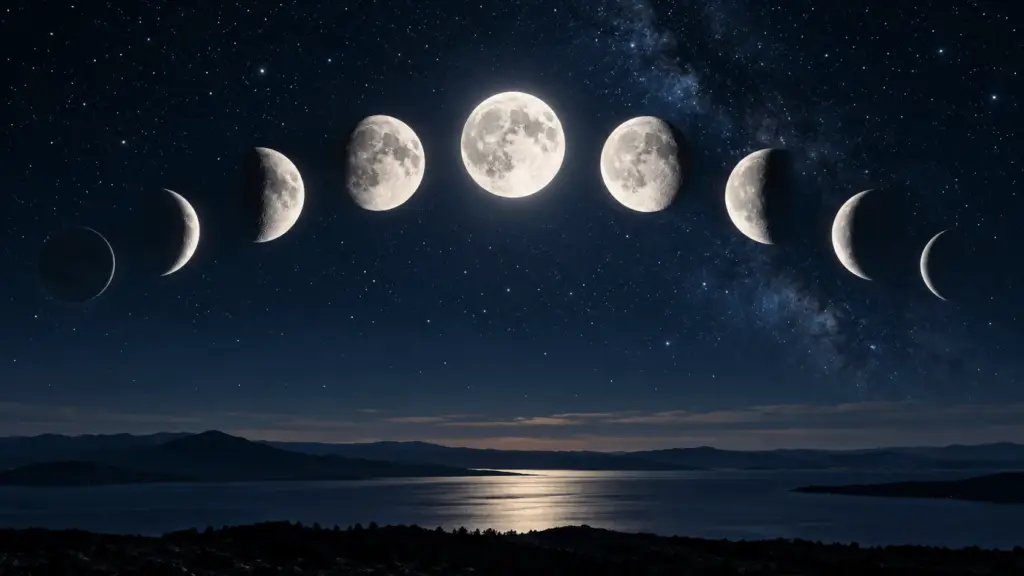
The eight phases of the Moon in order are New Moon, Waxing Crescent, First Quarter, Waxing Gibbous, Full Moon, Waning Gibbous, Third Quarter (also called Last Quarter), and Waning Crescent. These phases repeat as the Moon travels around Earth and our viewing angle toward its sunlit hemisphere changes. A complete phase cycle takes about 29.5 days, a period known as the synodic month. [1][2]
The Moon itself does not expand, shrink, disappear, or physically change shape during this cycle. It remains approximately spherical. At nearly every moment, the Sun illuminates roughly half of the Moon, just as it illuminates half of Earth. What changes is the amount of that illuminated hemisphere that can be seen by an observer on Earth. NASA describes the eight phases in the same sequence, while HowStuffWorks groups them into four primary phases and four intermediate, or secondary, phases. [1][3]
The changing appearance depends on three principal astronomical bodies: the Sun, Earth, and Moon. The Sun provides the light, the Moon reflects that sunlight, and observers on Earth see the illuminated portion from continuously changing angles as the Moon moves through its orbit.
When the illuminated portion visible from Earth is becoming larger, the Moon is waxing. When it is becoming smaller, the Moon is waning. A crescent Moon has less than half of its apparent disk illuminated, while a gibbous Moon has more than half, but less than the complete disk, illuminated.
Why Does the Moon Have Phases?
Moon phases are fundamentally a problem of light, orbital motion, and viewing geometry. The Sun continuously illuminates the Moon, while the Moon travels around Earth. Because Earth-based observers look toward the Moon from a changing direction relative to the Sun, they see different proportions of the Moon’s sunlit hemisphere. That changing visible proportion creates the familiar progression from New Moon to Full Moon and back again. Earth’s shadow normally has nothing to do with the process. [1][2]
The Moon Reflects Sunlight Rather Than Producing Its Own Light
The Moon does not produce visible light in the way the Sun does. What we call moonlight is reflected sunlight. Sunlight reaches the lunar surface and a portion of that light is scattered back toward space, including toward observers on Earth. Approximately half of the spherical Moon is illuminated by the Sun at any given time, although the exact half changes as the Moon rotates. [1]
The percentage of the Earth-facing lunar disk receiving direct sunlight is called the illuminated fraction. Lunar illumination can range from nearly 0 percent around New Moon to nearly 100 percent around Full Moon. The U.S. Naval Observatory uses the percentage of the Moon’s apparent disk illuminated as a quantitative description of its appearance. [2]
This distinction is important because the dark part of a partially illuminated Moon is not normally being covered by Earth’s shadow. It is simply lunar terrain experiencing nighttime while another region is experiencing lunar daylight.
How the Sun, Earth and Moon Create the Phases
The phase cycle develops from the changing geometric relationship among the Sun, Earth, and Moon. The Sun illuminates the Moon. The Moon orbits Earth. As the Moon changes orbital position, the observer’s viewing angle toward the illuminated lunar hemisphere changes. Consequently, the illuminated fraction visible from Earth increases and decreases in a predictable pattern.
The relationship can be summarized as:
Sun illuminates Moon → Moon orbits Earth → viewing geometry changes → visible illuminated fraction changes → apparent shape changes → Moon phases repeat.
Astronomers can describe this geometry using angular measurements. The elongation of the Moon describes its angular separation from the Sun as viewed from Earth. The term phase angle is related but technically refers to the angle involving the Sun, Moon, and observer. These geometrical quantities explain why the primary phases occur at well-defined positions rather than at arbitrary brightness levels. [2]
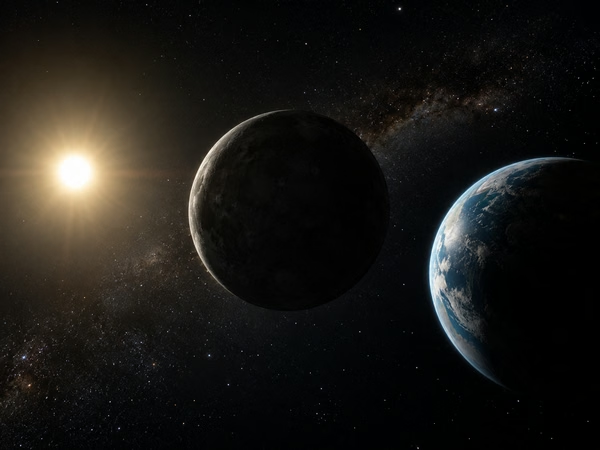
Does Earth’s Shadow Cause the Phases of the Moon?
No. Earth’s shadow does not cause the ordinary phases of the Moon. The phases occur because we see changing portions of the Moon’s illuminated hemisphere as it orbits Earth. Earth’s shadow becomes important during a lunar eclipse, when the Full Moon actually passes through Earth’s shadow.
A solar eclipse is different. It occurs around New Moon when the Moon passes between Earth and the Sun and casts its own shadow onto part of Earth. Neither type of eclipse occurs during every appropriate phase because the Moon’s orbital plane is tilted by roughly 5 degrees relative to Earth’s orbital plane. Consequently, the three bodies usually pass slightly above or below perfect alignment. [4]
What Are the 8 Phases of the Moon in Order?
The Moon’s phase cycle is continuous rather than a series of sudden changes. Nevertheless, astronomers and calendars traditionally divide the cycle into eight recognizable phases. Four are primary phases with precisely defined astronomical moments: New Moon, First Quarter, Full Moon, and Last or Third Quarter. The four intermediate phases describe the changing appearances between those events. Starting at New Moon, illumination increases until Full Moon and then decreases until the next New Moon. [1][2]
| Order | Moon Phase | General Appearance | Illumination Trend |
|---|---|---|---|
| 1 | New Moon | Nearly invisible | Minimum, cycle begins |
| 2 | Waxing Crescent | Thin crescent | Increasing |
| 3 | First Quarter | Half of disk illuminated | Increasing |
| 4 | Waxing Gibbous | More than half illuminated | Increasing |
| 5 | Full Moon | Nearly entire disk illuminated | Maximum |
| 6 | Waning Gibbous | More than half illuminated | Decreasing |
| 7 | Third Quarter | Half of disk illuminated | Decreasing |
| 8 | Waning Crescent | Thin crescent | Decreasing |
The sequence is therefore:
New Moon → Waxing Crescent → First Quarter → Waxing Gibbous → Full Moon → Waning Gibbous → Third Quarter → Waning Crescent → New Moon.
HowStuffWorks likewise identifies these four primary phases and four intermediate phases and places them in the same sequence. [3]
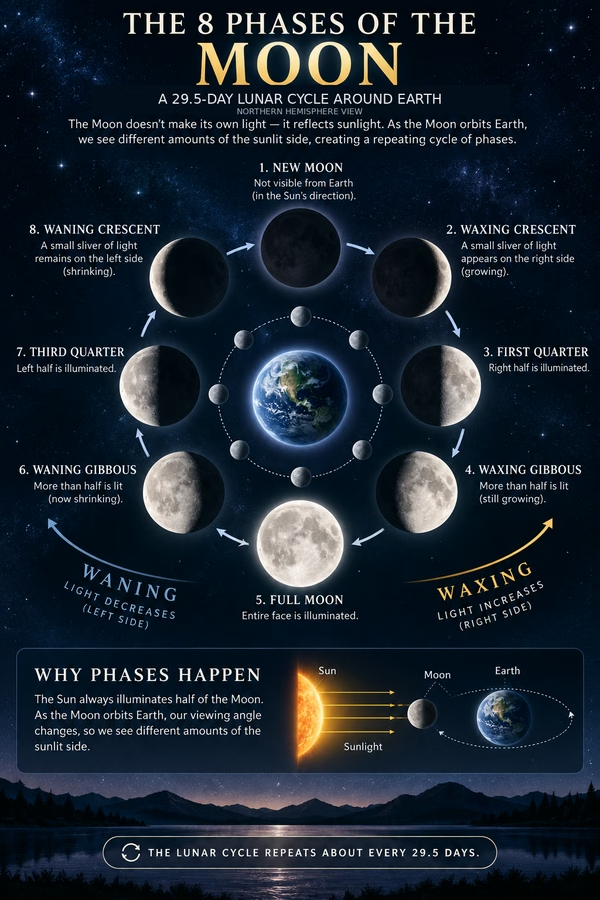
Approximate Illumination Trend During One Lunar Cycle
The illumination does not increase in a straight mathematical line between phases, but this simplified graph shows the overall pattern:
Visible Lunar Illumination over 29.5 Days
The important pattern is minimum → increasing → maximum → decreasing → minimum. The exact timing of intermediate illumination levels varies slightly because the Moon travels in an elliptical orbit rather than a perfectly circular one. [1][2]
1. New Moon
New Moon is the phase that conventionally begins a new lunar cycle. At this time the Moon and Sun occupy approximately the same direction in Earth’s sky. The Moon’s illuminated hemisphere therefore faces mostly away from Earth, leaving the hemisphere facing us largely unilluminated by direct sunlight. New Moon does not mean the Moon has disappeared or stopped reflecting light. Instead, the geometry prevents observers on Earth from seeing much of its directly illuminated surface. [1][2]
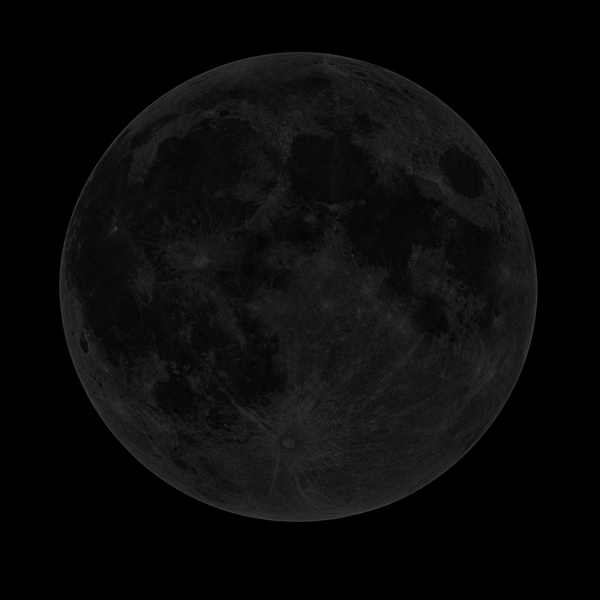
What Happens During a New Moon?
At New Moon, the Moon lies approximately between Earth and the Sun. Astronomically, this configuration is associated with conjunction, meaning the Moon and Sun have approximately the same apparent celestial longitude. The U.S. Naval Observatory precisely defines New Moon when the difference in their apparent ecliptic longitudes reaches 0 degrees. [2]
Most of the Moon’s sunlit hemisphere faces away from Earth, so its near side appears dark. The Moon is not normally positioned directly on the Earth-Sun line because its orbit is inclined. Instead, it usually passes somewhat above or below the Sun from our perspective.
This phase establishes the conventional starting point of the roughly 29.5-day synodic cycle.
Can You See a New Moon?
An ordinary New Moon is extremely difficult to observe because two factors work against visibility. First, almost none of its directly illuminated hemisphere faces Earth. Second, the Moon appears very close to the Sun in the sky, placing it within bright daytime glare. It rises approximately when the Sun rises and sets approximately when the Sun sets. [1]
A thin crescent becomes visible only after the Moon has moved far enough from conjunction. Shortly afterward, earthshine can sometimes reveal the otherwise dark portion of the lunar disk. Earthshine is not direct sunlight on that region. It is sunlight reflected by Earth toward the Moon and then reflected back toward the observer. [6]
Can a Solar Eclipse Happen at New Moon?
Yes. A solar eclipse can occur only around New Moon because the Moon must be positioned between Earth and the Sun for its shadow to reach Earth. However, most New Moons do not cause eclipses.
The reason is orbital inclination. The Moon’s orbit is tilted by approximately 5 degrees relative to Earth’s orbital plane around the Sun. During most New Moons, the Moon passes slightly above or below the apparent solar disk and its shadow misses Earth. A solar eclipse occurs only when New Moon happens sufficiently close to one of the orbital crossing points called nodes, producing a much more precise Sun-Moon-Earth alignment. [4]
2. Waxing Crescent Moon
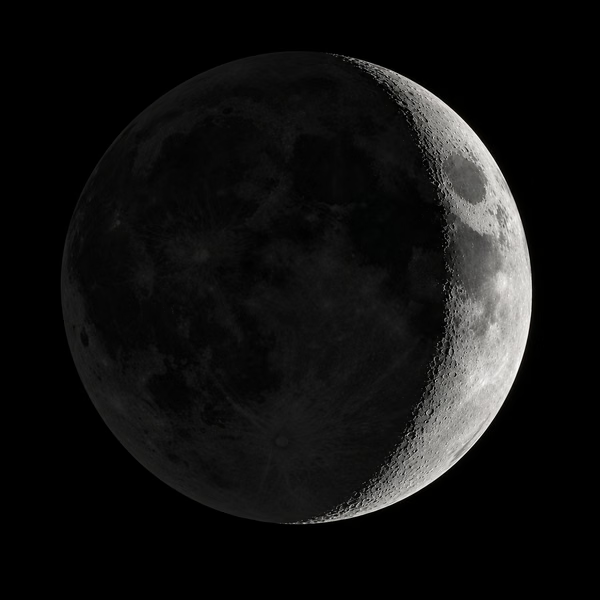
The Waxing Crescent begins after New Moon as the Moon moves farther eastward from the Sun in the sky. A small portion of the directly illuminated hemisphere becomes visible from Earth, creating the familiar curved sliver of light. Each successive evening usually reveals a larger illuminated fraction. This phase provides one of the best opportunities to understand that lunar phases are caused by geometry because the bright crescent, dark lunar disk, sunset direction, and sometimes visible earthshine can all be observed together.
What Does a Waxing Crescent Look Like?
A Waxing Crescent Moon has less than half of its apparent disk illuminated, while the amount of illumination increases from day to day. The word waxing means growing, referring specifically to the visible illuminated fraction rather than the Moon’s physical size. The word crescent indicates that less than half of the apparent lunar disk is directly illuminated.
Immediately after New Moon, the crescent can be extremely thin. Over the following nights, orbital motion exposes more of the Moon’s dayside to Earth. Eventually the illuminated fraction reaches roughly 50 percent, producing First Quarter. NASA describes this phase as a growing silver sliver whose visible dayside increases as the Moon travels through its orbit. [1]
When Is a Waxing Crescent Visible?
A Waxing Crescent is principally associated with the evening sky. It is found relatively close to the Sun, usually becoming noticeable after sunset as the sky darkens. As the crescent grows, its angular separation from the Sun increases, allowing it to remain above the horizon later into the evening.
NASA notes that a waxing crescent generally rises after sunrise and sets after sunset. Exact moonrise and moonset times depend on the observer’s date, latitude, longitude, season, and the Moon’s exact orbital position. [1]
The crescent’s orientation also varies. Observers in different hemispheres, latitudes, seasons, and viewing orientations can see the bright crescent tilted or apparently reversed. Therefore, identifying waxing solely by whether the bright portion is on the “right” or “left” is unreliable globally.
What Is Earthshine on a Crescent Moon?
Earthshine is the faint glow that can make the dark part of a crescent Moon visible. Its light follows a remarkable three-stage path. Sunlight first reaches Earth. Earth reflects some of that sunlight toward the Moon. The lunar surface then reflects a small portion of that Earth-reflected light back toward an observer on Earth.
Around a thin crescent phase, Earth would appear nearly full to an observer standing on the Moon. As a result, Earth can illuminate the lunar night side enough for its outline and surface features to become faintly detectable. NASA notes that earthshine is particularly easy to notice around thin crescent phases when the bright sunlit crescent does not overwhelm the much dimmer glow. [6]
3. First Quarter Moon
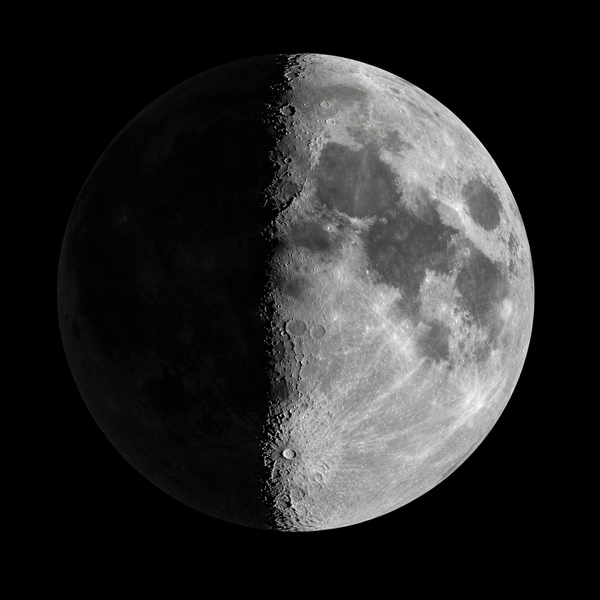
The First Quarter Moon occurs roughly one-quarter of the way through the synodic cycle. From Earth, approximately half of the apparent lunar disk is illuminated. The phase name can initially sound contradictory because “quarter” describes progress through the cycle, not the percentage of the visible disk that appears bright. Astronomically, First Quarter is also one of the four precisely defined primary phases, occurring when the Moon has moved approximately 90 degrees in apparent longitude away from the Sun. [2]
Why Is It Called First Quarter If Half the Moon Looks Illuminated?
The phrase First Quarter refers to orbital progress. Starting at New Moon, the Moon has completed roughly the first quarter of its phase cycle when First Quarter occurs. At this point, approximately half of its Earth-facing apparent disk receives direct sunlight from the observer’s perspective.
There is another useful geometric way to understand it. Half of the Moon as a sphere remains sunlit, but an Earth observer sees approximately half of that sunlit hemisphere. Therefore, about one-half of the apparent disk looks bright even though the Moon is one-quarter of the way through its monthly phase progression.
NASA explicitly warns against interpreting “quarter” as meaning one-quarter of the visible disk is illuminated. [1]
What Is Quadrature?
Quadrature describes a configuration in which the Moon and Sun are approximately 90 degrees apart in Earth’s sky. First Quarter is one of the Moon’s two quadrature phases. The other occurs at Third or Last Quarter.
The U.S. Naval Observatory defines First Quarter precisely when the Moon’s apparent ecliptic longitude exceeds the Sun’s by 90 degrees. [2] This geometrical definition is more rigorous than simply saying the Moon “looks half illuminated,” because the exact calculated instant of a primary phase can differ slightly from the instant when a particular observer measures an apparent illuminated fraction of exactly 50 percent.
Quadrature also helps explain why a First Quarter Moon can be high in the evening sky while the Sun has already moved below the horizon.
What Does the Lunar Terminator Look Like at First Quarter?
The lunar terminator is the boundary separating lunar daylight from lunar night. Around First Quarter, it crosses approximately through the middle of the visible lunar disk, making it especially easy to identify.
The terminator is valuable to observers because sunlight reaches terrain near it at a low angle. Mountains, crater rims, valleys, ridges, and other topographic features consequently cast long shadows. Those shadows can make surface relief appear dramatically three-dimensional.
NASA recommends observing phases other than Full Moon when studying mountains and craters because pronounced shadows can reveal features that become harder to recognize under the flatter, more direct illumination of Full Moon. [9] Astronomy observers often deliberately follow the terminator from night to night as it moves across the surface. [10]
4. Waxing Gibbous Moon
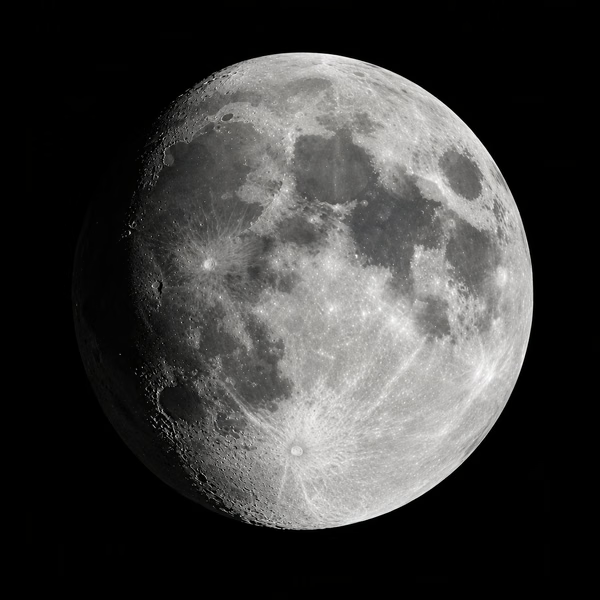
The Waxing Gibbous Moon fills the interval between First Quarter and Full Moon. More than half of the Earth-facing apparent disk is illuminated, and that fraction continues increasing. The phase can dominate the evening sky because the Moon is already bright but remains far enough from Full Moon for a visible terminator and significant surface shadowing to remain. Observing Waxing Gibbous on several consecutive evenings makes the continuous nature of the lunar phase cycle particularly obvious.
What Does Waxing Gibbous Mean?
A gibbous Moon is one in which more than half, but less than essentially all, of the visible lunar disk is illuminated. Waxing Gibbous therefore means that the Moon is more than half illuminated and the visible illuminated fraction is still increasing.
This phase begins after First Quarter and continues until Full Moon. As orbital motion changes the Sun-Earth-Moon geometry, a growing percentage of the Moon’s illuminated hemisphere becomes visible from Earth.
There is no single illumination percentage that defines the entire Waxing Gibbous phase because it is an interval rather than one instantaneous configuration. It begins above approximately 50 percent and approaches the maximum illumination of Full Moon. [1][2]
How Does Lunar Illumination Change During Waxing Gibbous?
During Waxing Gibbous, the Moon’s illuminated fraction increases progressively toward Full Moon. The lunar terminator moves across the visible disk, revealing terrain that was in lunar darkness only a few nights earlier.
This changing boundary represents local sunrise moving across the Moon’s near side. As the Moon approaches opposition with the Sun, observers see more of the hemisphere receiving direct sunlight. The apparent illuminated fraction can exceed 90 percent before the Moon technically reaches Full Moon, which demonstrates why phase names describe geometry and broad appearance rather than simple brightness thresholds.
The U.S. Naval Observatory notes, for example, that even two days away from Full Moon the lunar disk can already be roughly 93 to 97 percent illuminated. [2]
When Can You Observe a Waxing Gibbous Moon?
A Waxing Gibbous Moon is particularly convenient for afternoon and evening lunar observation. NASA’s general visibility pattern places its moonrise during the afternoon before sunset, while moonset occurs during the early morning hours. [1]
As Full Moon approaches, the Moon rises progressively later than it did around First Quarter but is still often above the horizon before sunset. It can therefore be visible as a pale object against a blue daytime sky before becoming much more conspicuous after dark.
A simple identification clue is to combine shape and timing. If more than half of the disk is illuminated, the illumination is increasing, and the Moon dominates much of the evening, it is likely Waxing Gibbous.
5. Full Moon
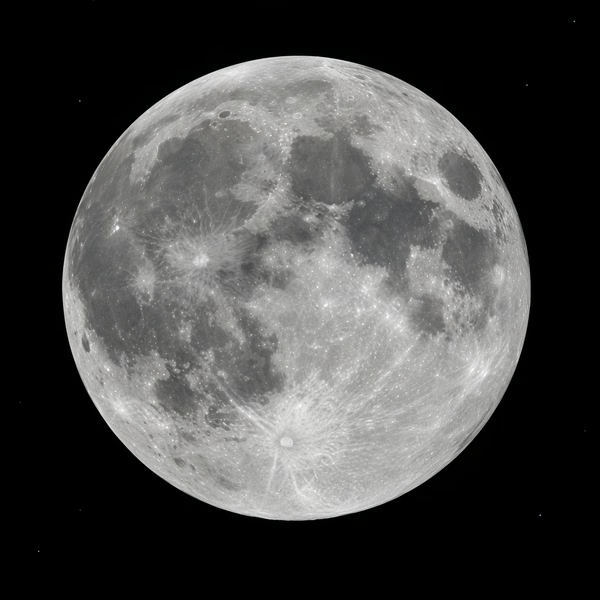
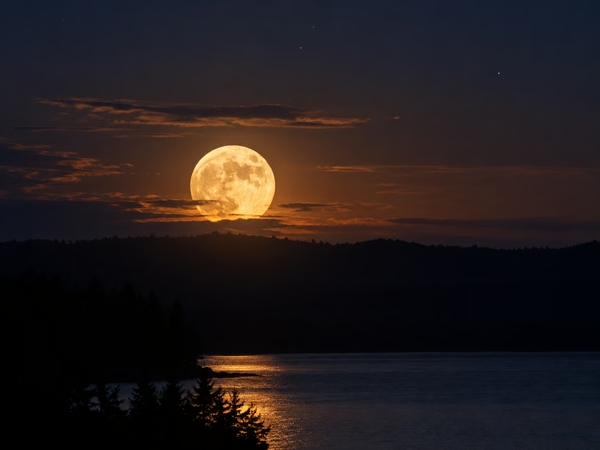
The Full Moon occurs when the Moon lies approximately opposite the Sun in Earth’s sky. Observers consequently look toward almost the entire hemisphere receiving direct sunlight. The Moon’s apparent disk becomes almost completely illuminated, producing the brightest and most recognizable phase of the cycle. Full Moon occurs about halfway through the synodic month and represents the transition from waxing to waning. However, despite its brightness, Full Moon is not always the best phase for observing craters because direct illumination produces relatively short surface shadows.
What Causes a Full Moon?
A Full Moon occurs when Earth lies approximately between the Sun and Moon, although the bodies are usually not aligned precisely enough to create an eclipse. In angular terms, the Moon and Sun appear approximately 180 degrees apart in Earth’s sky. This configuration is called opposition.
The Moon’s dayside then faces almost directly toward Earth, allowing us to see nearly all of the hemisphere receiving sunlight. The U.S. Naval Observatory defines Full Moon when the difference between the apparent ecliptic longitudes of the Moon and Sun reaches 180 degrees. [2]
The phase does not mean every part of the entire spherical Moon is illuminated. The far side is largely experiencing lunar night while the near side is experiencing lunar day. [1]
Why Does a Full Moon Rise Around Sunset?
A Full Moon rises around sunset because the Moon and Sun occupy nearly opposite directions in the sky. When Earth’s rotation carries the Sun below the western horizon, the opposite side of the sky is rising in the east, bringing the Full Moon into view.
Under typical conditions, the pattern is approximately:
Full Moon rises near sunset → reaches its highest region of the sky around the middle of the night → sets near sunrise.
NASA gives this same approximate sunset-to-sunrise visibility pattern. [1] Exact times differ according to location, season, horizon conditions, and the Moon’s orbital geometry, so “around sunset” should not be interpreted as exactly the same clock time as sunset everywhere.
Does Every Full Moon Cause a Lunar Eclipse?
No. A Full Moon is necessary for a lunar eclipse but not sufficient. A lunar eclipse occurs when the Moon actually enters Earth’s shadow, requiring a much more exact Sun-Earth-Moon alignment than an ordinary Full Moon.
The Moon’s orbital plane is inclined by about 5 degrees to Earth’s orbital plane. During most Full Moons, the Moon passes above or below Earth’s shadow. Only when Full Moon occurs sufficiently close to one of the Moon’s orbital nodes can Earth’s shadow fall across the lunar surface.
NASA explains that this orbital tilt is the reason eclipses occur only occasionally rather than every month. Depending on alignment, a lunar eclipse may be penumbral, partial, or total. [4]
6. Waning Gibbous Moon
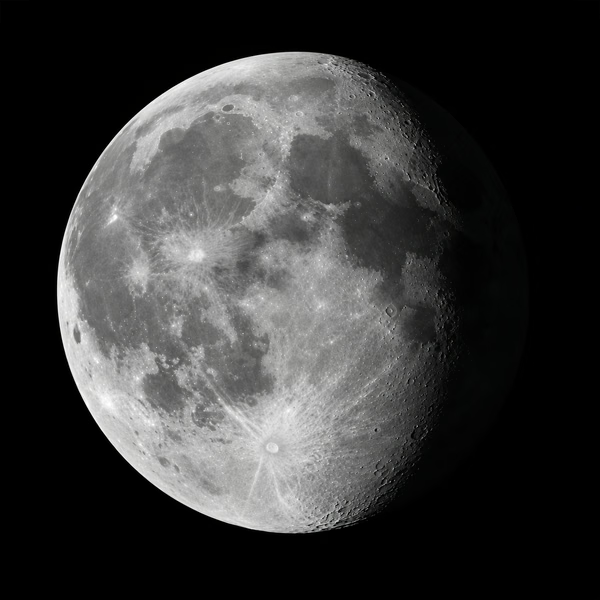
Immediately after Full Moon, the phase cycle enters its waning half. A Waning Gibbous Moon still looks large and bright because more than half of the apparent disk remains illuminated. However, the visible illuminated fraction now decreases each day. The phase also shifts toward later nighttime and morning visibility. Watching a Waning Gibbous for several consecutive mornings offers a useful demonstration that the Moon has not physically become smaller. Instead, orbital motion has begun turning more of its sunlit hemisphere away from Earth’s view.
What Does Waning Gibbous Mean?
Waning means the directly illuminated fraction visible from Earth is decreasing. Gibbous means more than half, but less than essentially all, of the visible disk is illuminated. A Waning Gibbous Moon therefore begins immediately after Full Moon and continues until Third Quarter.
The change happens because the Moon continues moving around Earth after opposition. Its dayside remains illuminated by the Sun, but Earth’s viewing angle exposes progressively less of it.
The terminology allows an observer to infer both shape and direction of change. “Gibbous” describes the present appearance, while “waning” indicates that the phase is progressing toward less illumination and ultimately toward New Moon.
Why Does the Moon Begin to Look Smaller After Full Moon?
The Moon does not physically shrink after Full Moon. Its diameter remains essentially unchanged apart from the modest apparent-size variation caused by its elliptical orbit and changing distance from Earth. What shrinks dramatically is the visible illuminated fraction.
The Sun continues illuminating approximately one-half of the Moon’s spherical surface. As the Moon travels onward from opposition, Earth-based observers see an increasing portion of the lunar night side and a decreasing portion of the lunar dayside.
NASA describes this apparent shrinking of the lighted portion as a consequence of orbital perspective. The bright surface is not disappearing; it is gradually rotating out of our line of sight because of changing Sun-Earth-Moon geometry. [1]
When Is a Waning Gibbous Moon Visible?
A Waning Gibbous is increasingly associated with the late-night and morning sky. NASA’s approximate phase schedule says it rises during the night after sunset and remains visible into the morning after sunrise. [1]
As the days after Full Moon accumulate, moonrise occurs progressively later. Someone who only looks for the Moon during the early evening may therefore believe it has disappeared, when it has simply not risen yet.
This changing schedule is a practical way to distinguish waning from waxing phases. Waxing phases generally favor the afternoon and evening, while waning phases increasingly favor late-night, predawn, and morning observation. Exact rise and set times should always be calculated for a specific location and date.
7. Third Quarter Moon
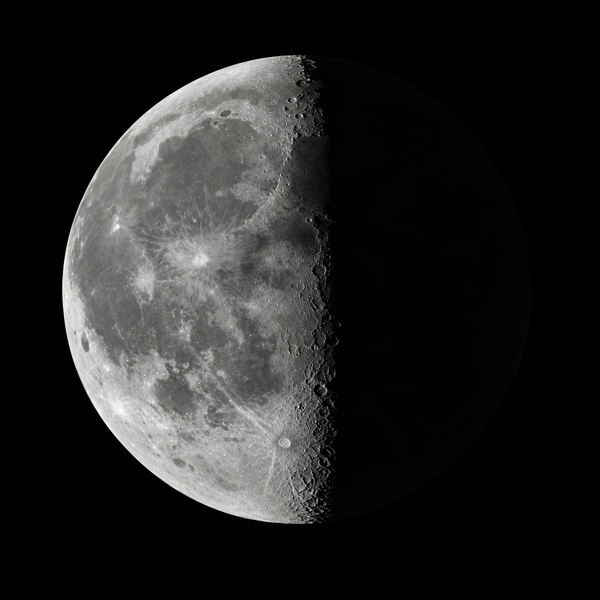
The Third Quarter Moon, often called Last Quarter, occurs roughly three-quarters of the way through the lunar phase cycle. Approximately half of the apparent disk is illuminated, just as at First Quarter, but the illuminated fraction is now decreasing. The Moon has again reached quadrature with the Sun, although on the opposite side of the phase cycle. Its typical visibility shifts toward the late-night and morning hours, making Third Quarter one of the phases frequently overlooked by people who observe the sky only during early evening.
What Is the Third Quarter Moon?
Third Quarter occurs when the Moon is approximately three-quarters of the way from one New Moon to the next. About half of its apparent disk is illuminated from Earth’s perspective. Unlike First Quarter, however, Third Quarter belongs to the waning portion of the cycle.
The terms Third Quarter and Last Quarter refer to the same primary phase. NASA commonly uses Last Quarter in some educational material and Third Quarter in others, while both terms are widespread in astronomy. [1]
The U.S. Naval Observatory defines the phase at an apparent ecliptic longitude difference of 270 degrees between the Moon and Sun. [2] This precise angular definition distinguishes the formal phase instant from a casual visual estimate of 50 percent illumination.
How Is Third Quarter Different From First Quarter?
First Quarter and Third Quarter can both appear approximately 50 percent illuminated, but they occur in opposite halves of the phase cycle.
| Feature | First Quarter | Third Quarter |
|---|---|---|
| Cycle position | About one-quarter through | About three-quarters through |
| Illumination trend | Waxing | Waning |
| Sun-Moon separation | About 90° | About 90° on opposite side |
| Typical visibility | Afternoon and evening | Late night and morning |
| Direction of cycle | Moving toward Full | Moving toward New |
The apparent bright side may also seem opposite between the two phases from the same terrestrial viewing location. However, orientation varies with observer location and sky orientation, so time, phase progression, and geometry provide more universally reliable identification than simply memorizing “left” versus “right.” [1][2]
Is Third Quarter Another Quadrature?
Yes. Third Quarter is the Moon’s second quadrature of the synodic cycle. The Moon and Sun again appear approximately 90 degrees apart in Earth’s sky, but the Moon has progressed roughly 270 degrees in apparent longitude from its New Moon position.
This geometry explains both the half-lit appearance and the unusual observing schedule. A Third Quarter Moon generally rises around the middle of the night, is prominent around dawn, and sets around midday. [1]
Quadrature also illustrates why an illuminated fraction alone does not completely describe a phase. First Quarter and Third Quarter can each be close to 50 percent illumination, yet one is waxing and the other waning because their positions and directions of orbital progression are different.
8. Waning Crescent Moon
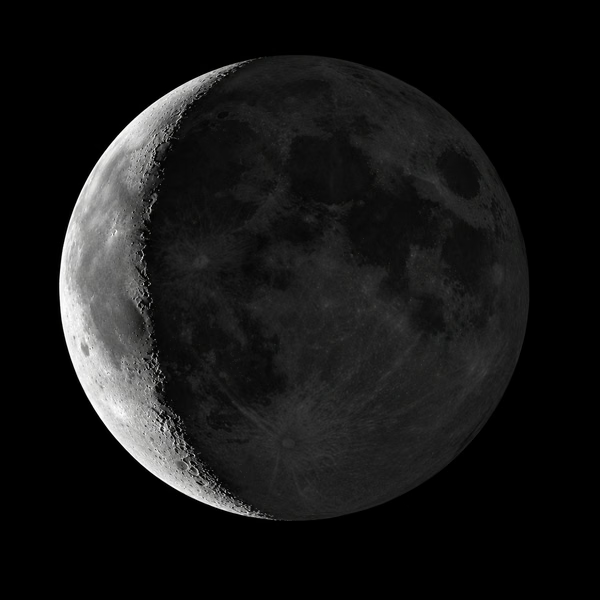
The Waning Crescent is the final commonly named phase before the cycle returns to New Moon. Less than half of the apparent lunar disk is illuminated, and the directly illuminated portion becomes progressively thinner. Because the Moon is moving closer to the Sun’s apparent position in the sky, the phase is most strongly associated with predawn and morning observation. A thin Waning Crescent can also display earthshine, making the dark remainder of the Moon faintly visible around the brightly illuminated arc.
What Does a Waning Crescent Look Like?
A Waning Crescent has less than half of its visible disk directly illuminated, and that illuminated fraction is becoming smaller each day. As the Moon approaches conjunction with the Sun, observers see progressively less of the lunar dayside.
The phase may begin as a broad crescent following Third Quarter and eventually narrow to a very thin arc shortly before New Moon. NASA describes this stage as the Moon approaching the position where its dayside faces almost completely toward the Sun and away from Earth. [1]
The thin illuminated curve can become visually striking in twilight, particularly when earthshine outlines the darker portion and makes the entire circular disk perceptible despite only a small fraction receiving direct sunlight from our perspective.
When Can You See a Waning Crescent?
The Waning Crescent is primarily a predawn and morning phase. It rises during the early morning before sunrise and can remain in the sky after sunrise before setting during the afternoon. [1]
The closer it approaches New Moon, the closer it appears to the Sun. This makes the window for seeing the crescent against a dark or twilight sky progressively shorter.
Observers looking before sunrise should seek a clear eastern horizon and ensure the Sun itself remains below the horizon when using optical equipment. Never sweep binoculars or telescopes near a rising Sun without appropriate solar safety procedures. For naked-eye observation, a thin morning crescent can provide a simple visual demonstration of the approaching end of one lunar cycle.
What Happens After the Waning Crescent?
After Waning Crescent, the illuminated fraction visible from Earth continues decreasing until the Moon returns to New Moon. The Moon then passes through conjunction with the Sun and begins another synodic cycle.
There is no physical discontinuity between Waning Crescent, New Moon, and Waxing Crescent. The Moon moves continuously in its orbit, while our classification divides that motion into convenient observational stages.
The repeating sequence is:
Waning Crescent → New Moon → Waxing Crescent.
Each return from one New Moon to the next takes about 29.5 days on average. That recurring interval explains why the Moon has served as a natural timekeeping marker for civilizations throughout human history. [7][8]
What Do Waxing and Waning Mean?
Waxing and waning describe the direction in which the Moon’s visible illuminated fraction is changing. Waxing phases progress toward Full Moon, while waning phases progress toward New Moon. These terms do not describe the Moon’s physical size, distance, or actual amount of solar illumination across the entire spherical Moon. Approximately half of the sphere remains illuminated. What changes is the proportion of that sunlit hemisphere visible from Earth. Understanding these two words makes the entire eight-phase sequence much easier to remember.
Waxing Moon Phases
The three named phases between New Moon and Full Moon are:
- Waxing Crescent
- First Quarter
- Waxing Gibbous
During this half of the cycle, the illuminated portion visible from Earth generally increases from almost 0 percent toward almost 100 percent.
The relationship can be summarized as:
Waxing → illuminated fraction increases → Moon progresses toward Full Moon.
New Moon itself acts as the transition into waxing, while Full Moon marks the transition into waning. The apparent bright region grows because orbital motion reveals an increasing proportion of the Moon’s dayside. It is not caused by an increasing amount of sunlight being generated or by the Moon getting closer to the Sun. [1][2]
Waning Moon Phases
The three named phases between Full Moon and New Moon are:
- Waning Gibbous
- Third Quarter
- Waning Crescent
During these phases, the proportion of the directly illuminated lunar disk visible from Earth decreases.
The relationship is:
Waning → illuminated fraction decreases → Moon progresses toward New Moon.
Full Moon is therefore a turning point rather than the end of the lunar cycle. After maximum visible illumination, orbital motion progressively carries the Moon’s dayside out of our view.
The waning phases also tend to shift toward later rising times. As a result, they become increasingly associated with the late-night, predawn, and morning sky rather than the early evening. [1]
Crescent vs. Gibbous
The distinction between crescent and gibbous depends on how much of the apparent disk is illuminated.
A crescent Moon has less than half of its visible disk directly illuminated. It can be waxing or waning.
A gibbous Moon has more than half but less than essentially all of its visible disk illuminated. It can also be waxing or waning.
This produces four descriptive combinations: Waxing Crescent, Waxing Gibbous, Waning Gibbous, and Waning Crescent.
The quarter phases separate the two shape categories. At First or Third Quarter, approximately half of the visible disk is illuminated, so the Moon is technically neither crescent nor gibbous at the exact primary phase. [2][3]
How Long Does the Lunar Cycle Take?
The repeating cycle of lunar phases takes approximately 29.5 Earth days. More precisely, the mean synodic month is close to 29.53 days. This is longer than the roughly 27.3 days the Moon needs to complete one orbit relative to the distant stars. The difference occurs because Earth itself moves around the Sun during the Moon’s orbit. The Moon must therefore travel slightly farther before it recreates the same Sun-Earth-Moon geometry and reaches the same phase again. [7][8]
What Is a Synodic Month?
A synodic month is the average interval between two successive occurrences of the same lunar phase, such as New Moon to New Moon or Full Moon to Full Moon. Its mean length is approximately 29.53 days. [7][8]
“Synodic” refers to the repeating alignment of the Moon relative to the Sun as viewed from Earth. Because Moon phases are controlled by this Sun-Earth-Moon geometry, the synodic month is the lunar period most directly relevant to the phase cycle.
It is important to describe it as an average interval. The Moon moves in an elliptical orbit with changing orbital speed, so individual lunations are not all precisely identical in duration.
Is a Lunar Month the Same as the Moon’s Orbital Period?
Not necessarily. The phrase lunar month can refer to several different lunar periods, so context matters.
The sidereal month measures the Moon’s orbit relative to distant stars and lasts about 27.3 days. The synodic month measures phase repetition relative to the Sun and lasts approximately 29.53 days. [8]
Why the difference? While the Moon completes its 27.3-day circuit around Earth, Earth has traveled farther along its own orbit around the Sun. The Moon therefore needs roughly two additional days of orbital motion to regain the same Sun-Earth-Moon alignment.
This distinction corrects a common simplification in popular descriptions that treat the 29.5-day phase cycle as though it were identical to the Moon’s orbital period relative to the stars.
How the Lunar Cycle Relates to a Lunar Calendar
The regular recurrence of Moon phases provides a natural basis for lunar calendars. Long before mechanical clocks and modern astronomical calculations, people could observe the changing Moon and use recurring phases to divide time into recognizable periods.
A synodic month of about 29.5 days does not fit exactly into a solar year, so calendar systems have developed different methods for handling the difference. Some calendars are primarily lunar, while lunisolar calendars periodically adjust lunar months to remain aligned with the seasons.
The astronomical phase cycle itself should be distinguished from culture-specific calendar rules. Astronomy describes when phases occur according to celestial geometry. Human calendar systems decide how those recurring events are translated into months, festivals, dates, or years. [8]
Does the Same Side of the Moon Always Face Earth?
Approximately the same lunar hemisphere faces Earth throughout the Moon’s orbit because the Moon is tidally locked to our planet. This does not mean the Moon does not rotate. In fact, it must rotate for the same side to continue facing Earth while it travels around us. The Moon completes one rotation on its axis in roughly the same amount of time that it completes one sidereal orbit around Earth. Small effects called libration allow observers to see slightly more than exactly half of the lunar surface over time. [5]
What Is Tidal Locking?
Tidal locking is a state in which an orbiting body’s rotation period becomes synchronized with its orbital period. Earth’s Moon rotates once on its axis during approximately the same 27.3-day interval in which it completes one orbit relative to the stars.
NASA describes this as synchronous tidal locking. Because the rotation and revolution stay synchronized, the same general lunar hemisphere remains directed toward Earth throughout the orbit. [5]
A useful demonstration is to walk in a circle around a chair while always facing the chair. By the time you complete one circuit, you have also turned your body through one complete rotation relative to the room. If you did not rotate, different sides of your body would face the chair as you moved around it.
What Is the Lunar Hemisphere We See From Earth?
The hemisphere that generally faces Earth is called the Moon’s near side. The opposite hemisphere is called the far side. Because of tidal locking, Earth-based observers repeatedly see the near side as the Moon goes through its phases.
Moon phases therefore do not result from completely different physical hemispheres rotating into view each night. Instead, nearly the same near-side terrain remains visible while the location of sunlight across that terrain changes.
The view is not perfectly fixed. Libration, produced by orbital and viewing geometry, allows observers to peek slightly around different lunar edges over time. NASA notes that the Moon appears to nod, roll, and twist slightly during its orbit, allowing more than exactly 50 percent of the total lunar surface to become observable from Earth over extended periods. [1]
Is There Really a Permanent “Dark Side” of the Moon?
No. The Moon has no hemisphere that remains permanently dark. Both the near side and far side experience alternating lunar day and night as the Moon rotates and orbits Earth.
The expression “dark side of the Moon” is therefore misleading when it is intended to describe the hemisphere permanently hidden from Earth. The scientifically clearer term is far side.
At Full Moon, the near side is largely illuminated by the Sun while much of the far side experiences night. Around New Moon, the situation is broadly reversed: the near side largely experiences night while the far side receives sunlight. NASA’s visualizations explicitly show sunlight and darkness sweeping across both hemispheres through the 29.5-day phase cycle. [5]
How Moonrise and Moonset Change With the Phases
Moonrise and moonset shift systematically because the Moon changes its angular position relative to the Sun as it travels around Earth. The values below are approximate patterns for many locations rather than fixed clock times. Latitude, longitude, season, atmospheric refraction, local horizon, and the Moon’s orbital position all affect the exact result. NASA recommends using location-specific predictions whenever accurate moonrise or moonset times are required. [1]
| Moon Phase | Approximate Visibility Pattern |
|---|---|
| New Moon | Near the Sun, rises and sets roughly with it |
| Waxing Crescent | Daytime into evening |
| First Quarter | Rises around midday, sets around midnight |
| Waxing Gibbous | Afternoon through much of the night |
| Full Moon | Rises around sunset, sets around sunrise |
| Waning Gibbous | Night into morning |
| Third Quarter | Rises around midnight, sets around midday |
| Waning Crescent | Predawn through part of the daytime |
These changes result directly from orbital motion and increasing or decreasing Sun-Moon angular separation. A Moon near the Sun in the sky naturally shares a similar rising and setting schedule, while a Full Moon 180 degrees away appears on approximately the opposite schedule.
What Is the Lunar Terminator and Why Does It Move?
The lunar terminator is one of the most useful features for understanding and observing Moon phases. It is the apparent boundary between illuminated lunar terrain and terrain experiencing night. Except near Full Moon, it forms the curved dividing line responsible for much of the Moon’s recognizable phase shape. As orbital geometry changes, the terminator sweeps across the lunar surface. For observers, this moving boundary is especially valuable because low-angle sunlight creates long shadows that reveal topographic detail. [9][10]
Definition of the Lunar Terminator
The lunar terminator is the boundary separating the Moon’s daylit region from its nighttime region. On a waxing Moon, the terminator generally represents sunrise advancing across visible terrain. On a waning Moon, it generally represents sunset progressing across that terrain.
It should not be confused with Earth’s shadow. Lunar terrain beyond the terminator is dark because it is turned away from the Sun, just as Earth’s nighttime hemisphere is dark every night.
The terminator’s curved appearance also helps illustrate the Moon’s spherical shape. The exact appearance of the curve changes according to phase because Earth is seeing the illuminated hemisphere from a continuously changing angle.
Why the Terminator Changes Position
The terminator moves across the visible lunar disk because the Moon changes its orbital position relative to Earth and the Sun.
During waxing phases, a progressively greater part of the Moon’s dayside comes into view. The terminator appears to retreat toward the edge of the disk until Full Moon, when very little internal day-night boundary is visible from Earth.
After Full Moon, the Moon begins waning. The terminator reappears from the opposite side and advances across the disk as the visible illuminated fraction decreases.
Thus:
orbital motion → changing phase geometry → changing illuminated fraction → changing terminator position → changing apparent lunar shape.
The progression is continuous, which is why a telescope observer can detect significant differences along the terminator from one night to the next.
Why the Terminator Is Useful for Lunar Observation
Near the terminator, sunlight strikes lunar mountains, crater walls, ridges, and valleys at a relatively low angle. This creates long, high-contrast shadows that make differences in elevation much easier to recognize.
For that reason, Full Moon is not automatically the best phase for detailed lunar observation. Near Full Moon, sunlight falls more directly onto much of the visible lunar surface, reducing the shadows that provide visual depth.
NASA recommends phases other than Full Moon when trying to distinguish craters and mountains. [9] Experienced lunar observers frequently examine terrain along the moving terminator, where crater walls and mountain peaks may remain sunlit while adjacent lower terrain is still in darkness. [10]
Moon Phases vs. Lunar and Solar Eclipses
Moon phases and eclipses both involve the Sun, Earth, and Moon, but they are different astronomical phenomena. Moon phases happen continuously every month because our viewing angle toward the Moon’s illuminated hemisphere changes. Eclipses require a much more exact alignment in which one body enters another body’s shadow or blocks its light. Understanding this distinction corrects one of the most widespread misconceptions about lunar phases and explains why Full and New Moons occur monthly while eclipses are comparatively uncommon. [4]
Moon Phases Are Not Eclipses
Ordinary Moon phases are produced by perspective and illumination, not by Earth’s shadow moving across the lunar disk.
At every phase, sunlight illuminates roughly one-half of the spherical Moon. The portion of that illuminated half visible to Earth changes as the Moon moves around us. That is why a crescent grows into a quarter phase, then a gibbous Moon, then Full Moon.
During an eclipse, an actual shadow is involved. A lunar eclipse occurs when Earth’s shadow reaches the Moon. A solar eclipse occurs when the Moon’s shadow reaches Earth.
The smooth monthly phase cycle would therefore occur even if no eclipses were visible during a particular year. [1][4]
Lunar Eclipse
A lunar eclipse is possible around Full Moon when the geometry becomes sufficiently precise for the Moon to pass into Earth’s shadow.
The causal sequence is:
Full Moon → sufficiently precise Sun-Earth-Moon alignment → Moon enters Earth’s shadow → lunar eclipse.
Earth’s shadow includes regions with different amounts of blocked sunlight, producing penumbral, partial, and total lunar eclipses depending on the Moon’s path.
A lunar eclipse can be visible across a broad region of Earth’s nighttime hemisphere because observers there can all look toward the Moon while it passes through Earth’s shadow. However, because the Moon’s orbit is tilted, an ordinary Full Moon usually passes above or below the central shadow region. [4]
Solar Eclipse
A solar eclipse occurs around New Moon when the Moon passes between Earth and the Sun closely enough for its shadow to reach Earth’s surface.
The sequence is:
New Moon → sufficiently precise Sun-Moon-Earth alignment → Moon blocks part or all of the Sun → solar eclipse visible from specific regions of Earth.
Depending on the observer’s position and the geometry, the eclipse may be partial, total, annular, or in unusual circumstances hybrid.
New Moon alone is not enough. NASA explains that the Moon normally passes above or below the Sun because its orbit is inclined relative to Earth’s orbital plane. Only New Moons near the appropriate orbital nodes can produce solar eclipses. [4]
Why Eclipses Don’t Happen Every Month
If the Moon orbited Earth in exactly the same plane that Earth orbits the Sun, solar and lunar eclipses would occur far more frequently. Instead, the lunar orbit is inclined by approximately 5 degrees to the ecliptic plane.
The Moon crosses this plane at two locations called nodes. An eclipse requires New Moon or Full Moon to occur near one of those nodes so the Sun, Earth, and Moon become sufficiently aligned.
During most New Moons and Full Moons, the Moon lies above or below the required line of alignment. NASA therefore distinguishes ordinary phase geometry from the much more restrictive eclipse geometry. Eclipse opportunities cluster into periods known as eclipse seasons rather than occurring at every lunation. [4]
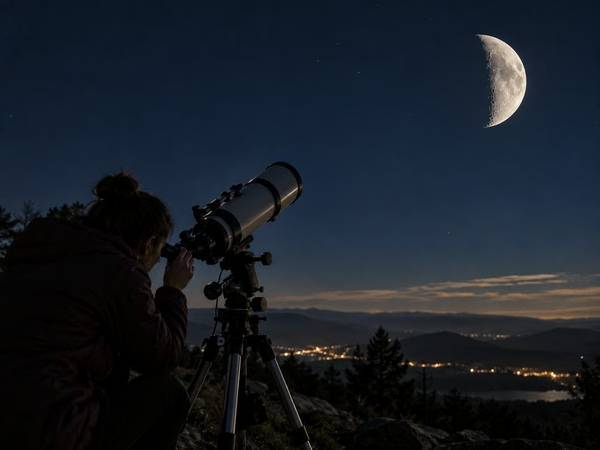
How to Observe the Eight Moon Phases Yourself
Observing the lunar cycle requires no sophisticated observatory. A clear view of the sky and a simple record of dates, shapes, positions, and observing times can reveal the entire geometry of the phase sequence. Binoculars can add surface detail, but the basic phases are readily observable with the naked eye. The most educational approach is not to observe the Moon only once, but to follow it repeatedly through an entire synodic month and note how illumination, position, rise time, and the terminator change together.
Start a Lunar Observation Journal
A lunar observation journal turns casual skywatching into a simple astronomy project. For each observation, record:
- Date and local time
- Moon phase
- Approximate apparent shape
- Estimated illuminated fraction
- Direction and height in the sky
- Approximate moonrise
- Approximate moonset
- Position and shape of the lunar terminator
- Visible earthshine
- Weather and sky clarity
- Surface features visible with binoculars or a telescope
Consistency matters more than precision. Try observing at roughly the same clock time for several evenings. You will notice that the Moon’s position changes and that it generally rises later from one day to the next.
A photograph or sketch beside each entry can make the progression particularly clear.
Follow the Phase Sequence for One Lunar Cycle
Following the Moon for an entire lunar cycle allows you to watch the geometry rather than merely memorize phase names. Track the sequence:
New Moon → Waxing Crescent → First Quarter → Waxing Gibbous → Full Moon → Waning Gibbous → Third Quarter → Waning Crescent → New Moon.
Pay attention to more than shape. Notice that evening visibility becomes increasingly favorable through the waxing half, while the Moon shifts toward late-night and morning visibility during the waning half.
Also watch how the terminator changes. Around quarter phases it cuts prominently across the disk. Near Full Moon it approaches the limb and becomes much less noticeable.
One full project requires about 29.5 days, although weather will inevitably cause some missing observations. [1]
Look for Earthshine During Crescent Phases
Earthshine is particularly rewarding during a thin Waxing Crescent after sunset or a thin Waning Crescent before sunrise.
Look first for the bright crescent created by direct sunlight. Under suitable conditions, you may also detect the faint circular outline of the rest of the Moon. That darker region is illuminated partly by sunlight that has reflected from Earth.
NASA explains that earthshine becomes especially noticeable near New Moon because Earth appears nearly full as seen from the Moon, while the directly illuminated lunar crescent seen from Earth is relatively small. [6]
Binoculars can make the phenomenon easier to see, but never point binoculars or a telescope anywhere near the Sun. Wait until the Sun has safely set for evening observations.
Common Misconceptions About the Phases of the Moon
Moon phases are familiar enough that several intuitive but incorrect explanations have become widespread. The most common errors involve Earth’s shadow, the so-called dark side of the Moon, the meaning of “First Quarter,” and the source of moonlight. Correcting these misconceptions requires returning to the same fundamental principle: approximately half of the Moon is illuminated by the Sun, while the fraction of that illuminated hemisphere visible from Earth changes because the Moon is moving through its orbit.
“Earth’s Shadow Causes Moon Phases”
This is incorrect. Earth’s shadow is not responsible for the normal progression of lunar phases.
A crescent Moon does not appear crescent-shaped because Earth is blocking sunlight from the missing portion. Instead, part of the Moon’s sunlit hemisphere is facing away from us.
The relevant chain is:
sunlight → illuminated lunar hemisphere → Moon’s orbital position → Earth’s viewing angle → visible illuminated fraction.
Earth’s shadow becomes important only during a lunar eclipse, when the alignment is precise enough for the Moon to enter the shadow.
A simple clue is frequency. Moon phases repeat continuously every synodic month, while lunar eclipses happen only occasionally because eclipse alignment is much more restrictive. [1][4]
“The Dark Side of the Moon Never Receives Sunlight”
This statement confuses the Moon’s far side with nighttime.
Because the Moon is tidally locked, approximately the same hemisphere faces Earth. The opposite hemisphere is therefore called the far side. But the far side receives sunlight just as the near side does.
Around New Moon, much of the near side is experiencing lunar night while the far side is receiving sunlight. Around Full Moon, the broad situation reverses.
Both hemispheres therefore experience day and night during each lunar cycle. “Far side” is the scientifically useful geographical description. “Dark side” should be reserved for informal contexts where “dark” means unknown or hidden, not permanently unilluminated. [5]
“First Quarter Means One-quarter of the Moon Is Lit”
First Quarter does not mean that one-quarter of the visible lunar disk is illuminated. At First Quarter, approximately half of the apparent disk looks bright.
The word “quarter” describes the Moon’s progress through its phase cycle. From New Moon, it has traveled roughly one-quarter of the way toward the next New Moon.
The geometry creates another interesting distinction. Because only half of the entire spherical Moon is sunlit at a time, seeing half of that illuminated hemisphere means we are seeing sunlight across roughly one-quarter of the Moon’s total spherical surface, even though half of the circular disk presented to us looks illuminated.
NASA specifically highlights the distinction between a quarter of the cycle and a half-illuminated apparent disk. [1]
“A Full Moon Means the Moon Produces More Light”
The Moon does not suddenly start generating additional light at Full Moon. It continues reflecting sunlight, just as it does during every other illuminated phase.
Full Moon looks much brighter because observers can see almost the entire Earth-facing lunar hemisphere receiving direct sunlight. During a crescent phase, only a small portion of that sunlit hemisphere is visible from Earth.
Brightness is also influenced by the way light scatters from the lunar surface and by the Moon’s distance from Earth, but the fundamental phase effect is geometric.
The Sun is the source of the visible illumination. Full Moon simply represents the part of the phase cycle in which the visible illuminated fraction reaches its maximum. [1]
The Eight Moon Phases at a Glance
The table below synthesizes the entire phase cycle using appearance, direction of illumination change, and Sun-Moon geometry. Remember that the four intermediate phases cover ranges rather than unique percentages. New Moon, First Quarter, Full Moon, and Third or Last Quarter are primary phases with precise astronomical definitions. [2]
| Phase | Apparent Shape | Waxing/Waning | Key Geometry | Illumination |
|---|---|---|---|---|
| New Moon | Dark or nearly invisible | Transition | Conjunction | Minimum |
| Waxing Crescent | Crescent | Waxing | Moving away from conjunction | Increasing, below 50% |
| First Quarter | Half disk | Waxing | Quadrature | About 50% |
| Waxing Gibbous | Gibbous | Waxing | Approaching opposition | Above 50%, increasing |
| Full Moon | Nearly full disk | Transition | Opposition | Maximum |
| Waning Gibbous | Gibbous | Waning | Moving away from opposition | Above 50%, decreasing |
| Third Quarter | Half disk | Waning | Quadrature | About 50% |
| Waning Crescent | Crescent | Waning | Approaching conjunction | Below 50%, decreasing |
The entire pattern is continuous:
minimum illumination → waxing → maximum illumination → waning → minimum illumination.
This repeating relationship links the Moon’s apparent shape directly to orbital geometry rather than to physical changes in the Moon itself.
Frequently Asked Questions About Moon Phases
The following questions cover the essential concepts needed to identify and understand Moon phases. The same principles repeatedly appear because they form one connected astronomical system: the Sun supplies light, the Moon reflects it, the Moon orbits Earth, and the changing viewing geometry determines the illuminated fraction we can see. Once that relationship is understood, terminology such as waxing, waning, crescent, gibbous, conjunction, opposition, quadrature, and synodic month becomes much easier to interpret.
What are the eight phases of the Moon in order?
The eight Moon phases in order are New Moon, Waxing Crescent, First Quarter, Waxing Gibbous, Full Moon, Waning Gibbous, Third Quarter or Last Quarter, and Waning Crescent.
After Waning Crescent, the sequence returns to New Moon and begins again. NASA and the U.S. Naval Observatory recognize this same traditional eight-stage progression. [1][2]
The sequence describes a continuous process rather than eight isolated physical states. The four primary phases are astronomically defined moments, while crescent and gibbous phases describe the changing intervals between them. Over one cycle, the visible illuminated fraction grows from minimum to maximum and then decreases again.
How long does the Moon take to go through all eight phases?
The complete phase cycle takes approximately 29.5 days, with the mean synodic month measuring about 29.53 days. This is the interval from one identical phase to the next, such as New Moon to New Moon.
It should not be confused with the Moon’s approximately 27.3-day sidereal orbital period. During those 27.3 days, Earth also moves along its orbit around the Sun. The Moon therefore must travel farther before reaching the same Sun-Earth-Moon geometry.
The additional motion extends the observed phase cycle to roughly 29.5 days. [7][8] That distinction explains why “one orbit” can have different measured durations depending on the reference frame being used.
Why does the Moon change shape?
The Moon does not actually change shape. It remains approximately spherical. Its apparent shape changes because observers on Earth see different fractions of its sunlit hemisphere as the Moon moves through its orbit.
The Sun illuminates roughly half of the Moon. As orbital motion changes the Sun-Earth-Moon geometry, Earth’s view includes more or less of that illuminated half.
Near New Moon, almost none faces us. At First Quarter, about half of the apparent disk is bright. At Full Moon, almost all of the Earth-facing disk is illuminated.
The repeating causal relationship is:
reflected sunlight + orbital motion + changing viewing angle = Moon phases. [1][2]
What is the difference between waxing and waning?
Waxing means the visible illuminated fraction of the Moon is increasing. Waning means it is decreasing.
The waxing sequence runs from New Moon toward Full Moon:
Waxing Crescent → First Quarter → Waxing Gibbous.
The waning sequence runs from Full Moon toward New Moon:
Waning Gibbous → Third Quarter → Waning Crescent.
The terms refer to illumination visible from Earth rather than physical size. The Moon itself does not grow during waxing or shrink during waning.
A practical observation clue is timing. Waxing phases tend to favor afternoon and evening visibility, while waning phases increasingly favor late-night and morning viewing. [1]
What is the difference between crescent and gibbous?
A crescent Moon has less than half of its apparent disk directly illuminated. A gibbous Moon has more than half, but less than essentially all, of its disk illuminated.
Either shape can occur while illumination is increasing or decreasing. That produces Waxing Crescent, Waxing Gibbous, Waning Gibbous, and Waning Crescent.
First and Third Quarter separate the categories because their visible disks are approximately half illuminated.
The terms therefore describe shape or illuminated fraction, while waxing and waning describe direction of change. Combining the two pieces of information tells you both what the Moon currently looks like and where it is heading within the lunar cycle. [2][3]
Why is a First Quarter Moon half illuminated?
First Quarter refers to the Moon being approximately one-quarter of the way through its cycle, not to one-quarter of the visible disk being illuminated.
At this stage, the Moon and Sun appear about 90 degrees apart from Earth, a configuration called quadrature. The geometry allows us to see approximately half of the Moon’s illuminated hemisphere, making half of its apparent circular disk look bright.
The U.S. Naval Observatory formally defines First Quarter using the 90-degree difference in apparent ecliptic longitude between the Moon and Sun. [2]
Thus “quarter” describes orbital phase progress, while “half illuminated” describes visual appearance. Both descriptions are correct because they measure different properties.
What causes a Full Moon?
A Full Moon occurs when the Moon appears roughly opposite the Sun in Earth’s sky, a configuration known as opposition. Earth is approximately between the Sun and Moon, although usually not precisely enough for a lunar eclipse.
From this geometry, observers see almost the entire Earth-facing hemisphere receiving direct sunlight. Consequently, the apparent lunar disk approaches maximum illumination.
A Full Moon generally rises near sunset, remains visible through much of the night, and sets near sunrise.
The Moon is still merely reflecting sunlight. It does not produce its own visible light or become physically larger. Full Moon is simply the phase in which Earth’s viewing direction aligns most closely with the Moon’s illuminated dayside. [1][2]
What causes a New Moon?
New Moon occurs when the Moon appears in approximately the same direction as the Sun from Earth. The Moon is roughly between Earth and the Sun, placing most of its illuminated hemisphere on the side facing away from us.
The Earth-facing portion is therefore mostly experiencing lunar night and appears extremely dark.
This configuration is associated with conjunction and represents an apparent Sun-Moon longitude difference of approximately 0 degrees. [2]
The New Moon also rises and sets roughly with the Sun, meaning it occupies the bright daytime sky and is difficult or impossible to observe normally.
A solar eclipse can occur at New Moon, but only when orbital alignment is considerably more precise than during an ordinary New Moon.
Are Moon phases caused by Earth’s shadow?
No. Normal Moon phases are not caused by Earth’s shadow.
They occur because the Moon’s illuminated hemisphere is viewed from changing angles while the Moon orbits Earth. The dark region of a crescent or quarter Moon is generally lunar nighttime, not a region covered by Earth’s shadow.
Earth’s shadow becomes relevant during a lunar eclipse, which can occur only around Full Moon and only when the Sun, Earth, and Moon align sufficiently closely.
This distinction explains why phases occur continuously every month while lunar eclipses happen much less frequently. If Earth’s shadow caused the ordinary phases, an eclipse-like alignment would have to occur throughout every lunar cycle, which observationally and geometrically does not happen. [1][4]
Can a solar eclipse happen during any Moon phase?
No. A solar eclipse is specifically associated with New Moon because the Moon must pass between Earth and the Sun for its shadow to fall on Earth’s surface.
Other lunar phases place the Moon in geometries that cannot produce an ordinary solar eclipse.
Even New Moon does not guarantee an eclipse. The Moon’s orbit is inclined by approximately 5 degrees relative to Earth’s orbital plane. Most New Moons therefore pass above or below the Sun from our viewpoint.
A solar eclipse occurs only when New Moon takes place sufficiently close to one of the Moon’s orbital nodes, where its orbital plane intersects the ecliptic and a precise alignment becomes possible. [4]
Does everyone on Earth see the same Moon phase?
At essentially the same moment, observers across Earth see the same astronomical lunar phase, provided the Moon is above their horizon. A Full Moon is not waxing crescent in one country while simultaneously being waning crescent somewhere else.
However, its orientation can look different. The Moon may appear rotated at different angles depending on hemisphere, latitude, time, and its position in the local sky.
This is why simple rules such as “waxing is illuminated on the right” can fail when applied globally. The actual phase is determined by Sun-Earth-Moon geometry and illumination, not by whether a bright crescent happens to appear on one side of a photograph.
Local moonrise and moonset times also differ dramatically across Earth.
Why do moonrise and moonset times change?
Moonrise and moonset change because the Moon is continuously moving eastward along its orbit around Earth while Earth itself rotates.
Each day, Earth generally needs to rotate a little farther before a particular location again faces the Moon. This causes the Moon’s rising time to shift from one day to the next, although the exact daily change is not constant.
The phase provides a useful approximation of the schedule. New Moon rises roughly with the Sun. First Quarter rises around midday. Full Moon rises around sunset. Third Quarter rises around midnight.
The pattern connects moonrise and moonset directly to the Moon’s changing angular separation from the Sun. [1]
Conclusion: Understanding the Moon’s Repeating Phase Cycle
The eight phases of the Moon are the visible result of a simple but elegant astronomical relationship involving sunlight, orbital motion, and perspective. The Moon remains approximately spherical and does not physically grow or shrink. The Sun continuously illuminates roughly half of it, while the Moon’s motion around Earth changes how much of that illuminated hemisphere we can see.
The complete process can be summarized as:
Sunlight → reflected light → Moon orbit → orbital motion → changing Sun-Earth-Moon geometry → changing angular relationship → changing illuminated fraction → changing apparent shape → waxing and waning → eight Moon phases → repeating 29.5-day synodic cycle.
The sequence runs continuously:
New Moon → Waxing Crescent → First Quarter → Waxing Gibbous → Full Moon → Waning Gibbous → Third Quarter → Waning Crescent → New Moon.
Understanding this geometry also explains related phenomena. Crescent and gibbous describe how much of the apparent disk is illuminated. Waxing and waning describe whether that fraction is increasing or decreasing. Moonrise and moonset shift because the Moon’s orbital position changes. The terminator moves because sunlight reaches different lunar terrain. Eclipses require special alignment and should not be confused with normal phases. Tidal locking explains why approximately the same lunar hemisphere faces Earth even while illumination changes.
Once these relationships are understood, the Moon stops looking like an object that mysteriously changes shape and becomes something even more interesting: a visible, continuously moving demonstration of orbital mechanics that can be followed from your own backyard every month.
Sources
[1] NASA Science, “Moon Phases.” Primary reference for the eight-phase sequence, illumination, visibility patterns, earthshine, phase descriptions, and the distinction between the 27.3-day orbital period and 29.5-day phase cycle.
NASA Science: Moon Phases
[2] U.S. Naval Observatory, “Phases of the Moon and Percent of the Moon Illuminated.” Reference for primary phase geometry, 0°, 90°, 180°, and 270° ecliptic longitude definitions, illuminated fraction, crescent and gibbous terminology, and quadrature.
U.S. Naval Observatory: Phases of the Moon and Percent Illuminated
[3] HowStuffWorks Science, “Moon Phases.” Reference for the traditional four primary and four intermediate phases, their sequence, waxing and waning terminology, earthshine discussion, and tidal locking overview.
HowStuffWorks: Moon Phases
[4] NASA Science, “Eclipses and the Moon” and eclipse geometry resources. Reference for lunar and solar eclipse geometry, orbital inclination, nodes, and why eclipses do not happen every month.
NASA Science: Eclipses and the Moon
[5] NASA Science, “Tidal Locking.” Reference for synchronous rotation, the Moon’s rotation and orbital synchronization, and why roughly the same hemisphere faces Earth.
NASA Science: Tidal Locking
[6] NASA Earth Observatory, “Earthshine.” Reference for sunlight reflecting from Earth to the Moon and back toward Earth, producing the faint glow visible on the dark part of a crescent Moon.
NASA Earth Observatory: Earthshine
[7] NASA, “When the Earth, Moon and Sun Align.” Reference for the approximately 29.5-day synodic month, New Moon geometry, and the Moon’s inclined orbit.
NASA: When the Earth, Moon and Sun Align
[8] NASA GSFC, “The Calendar: The Moon.” Reference for the approximately 27.3217-day sidereal month, approximately 29.5306-day synodic period, and the historical relationship between lunar cycles and calendars.
NASA GSFC: The Moon and Calendar
[9] NASA Science, “Moon Viewing Tips.” Reference for lunar observing, reflected sunlight, tidal locking, earthshine, and the advantages of observing surface detail away from Full Moon.
NASA Science: Moon Viewing Tips
[10] Astronomy Magazine, “Easy Moon Observing.” Practical observing reference for the lunar terminator, crater shadows, mountain relief, and changes visible along the terminator.
Astronomy Magazine: Easy Moon Observing